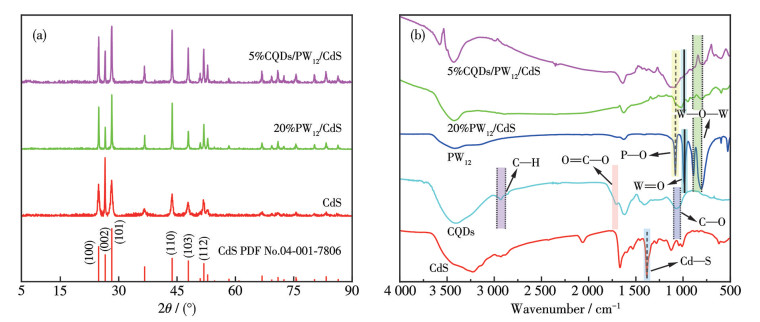
Figure 1.
XRD patterns (a) and FTIR spectra (b) of different samples

Photocatalytic degradation and hydrogen evolution performance of the broad-spectrum response composite material PW12/CdS modified by carbon quantum dots
Caihong ZHANG , Kexin WU , Zikang CAO , Hongji LIU , Luyao HAN , Yan YU , Li LI


Due to the massive discharge of industrial effluents and urban domestic wastewater, water pollution has become a serious threat to human health and the ecological environment[1]. Photocatalytic water splitting for hydrogen production is considered a highly viable strategy because it directly converts solar energy into chemical energy[2-4]. In this context, photocatalytic technology—offering unique advantages such as solar-driven catalytic activity and high cost-effectiveness—has attracted extensive attention for both organic pollutant degradation and solar hydrogen production[5-6].
As a key element of photocatalytic reactions, the performance of semiconductor photocatalysts directly determines the practical application value of the technology. Therefore, the search for efficient and stable semiconductor photocatalysts has become a major research focus[7]. Rational design and structural optimization aimed at enhancing light-harvesting capacity and charge-separation efficiency have become central to overcoming current technological bottlenecks[8-9]. Among various semiconductor photocatalysts, cadmium sulfide (CdS), as a typical Ⅱ-Ⅵ group semiconductor, has attracted extensive attention due to its unique properties. It has an appropriate band gap of approximately 2.4 eV, which enables it to effectively absorb visible light (λ < 520 nm)[10-11]. Nevertheless, the short lifetime of photogenerated charge carriers and severe photocorrosion arising from surface agglomeration markedly reduce its activity and long-term stability. Polyoxometalates (POMs) are metal oxide inorganic nanoclusters with unique structural characteristics and adjustable bandgap structures[12]. Keggin-type POMs show great potential in photocatalysis due to their strong electron storage capacity and rapid ionic conversion mechanism[13-14]. Carbon quantum dots (CQDs), an emerging class of zero-dimensional carbon nanomaterial, have demonstrated considerable potential in photocatalysis, bio-imaging, and drug-delivery applications owing to their low toxicity, excellent biocompatibility, readily tunable optical properties, and low cost[15]. However, their practical application still faces many challenges. Current research primarily focuses on surface engineering and heteroatom doping to boost their performance and advance practical implementation. Microwave-assisted synthesis delivers volumetric, uniform heating and precise temperature control through dielectric relaxation or dipole resonance, offering a highly efficient and environmentally benign route to materials fabrication[16].
In this work, a CQDs/PW12/CdS Z-scheme heterojunction was proposed to be constructed using CQDs, preformed CdS, and Keggin-type H3PW12O40·xH2O (PW12), with Keggin-type POMs regarded as the most stable structures in POM chemistry. The influence of different mass ratios of CQDs/PW12/CdS on the removal of rhodamine B (RhB) was systematically studied, and hydrogen evolution was evaluated using lactic acid as the sacrificial agent. The ternary composite exhibited markedly higher activity than either bare PW12 or CdS. The origin of the enhanced performance was elucidated, and the probable photocatalytic mechanism was proposed based on radical-trapping experiments.
Information on reagents and materials is provided in the Supporting information.
Details of the preparation of CQDs and CdS are provided in the Supporting information.
The PW12/CdS composite was prepared by a one-pot hydrothermal method. In a typical procedure, an amount of CdS and PW12 was added to deionized water at predetermined mass ratios. The suspension was magnetically stirred until homogeneous, transferred into a Teflon-lined stainless-steel autoclave, and heated at 180 ℃ for 12 h. After cooling, the yellow precipitate was collected by centrifugation, washed thoroughly with water and ethanol, and dried at 60 ℃ overnight. Binary composites with PW12 mass fractions of 10%, 20%, 30%, 40%, and 50% were fabricated and denoted as xPW12/CdS (x=10%, 20%, 30%, 40%, and 50%)。
The CQDs/PW12/CdS composite was prepared via a hydrothermal method. Typically, predetermined amounts of PW12, CdS, and CQDs powders were weighed and dispersed in deionized water under magnetic stirring. The resulting mixture was transferred into a Teflon-lined stainless-steel autoclave, which was then heated at 180 ℃ for 12 h. After naturally cooling to room temperature, the precipitate was collected by centrifugation, filtered, and thoroughly washed to afford the CQDs/PW12/CdS composite, which was stored for future use. CQDs with mass fractions of 1%, 5%, and 10% were separately introduced into the 20%PW12/CdS binary matrix to fabricate a set of samples denoted as yCQDs/PW12/CdS (y=1%, 5%, and 10%). For comparison, simply physically mix CQDs, PW12, and CdS to obtain 5%CQDs+PW12+CdS.
The physicochemical characterization of the prepared samples is supplied in the Supporting information.
The detailed experiments are displayed in the Supporting information.
To better study the chemical composition and crystal structure of the synthesized materials, X-ray diffraction (XRD) was used to analyze CdS, PW12, 20%PW12/CdS, and 5%CQDs/PW12/CdS. The results are shown in Fig. 1a and S1.
CdS exhibited multiple diffraction peaks at 24.9°, 26.5°, 28.2°, 43.8°, 47.9°, and 51.9°. The diffraction peaks matched the standard pattern (PDF No.04-001-7806) and could be indexed to the (100), (002), (101), (110), (103), and (112) planes of hexagonal wurtzite CdS. The composite exhibited broadened visible-light absorption compared with bare CdS. As can be seen from Fig.S1, PW12 exhibited multiple diffraction peaks at 10.3°, 20.7°, 25.4°, 29.4°, and 34.6°. The diffraction peaks correspond to cubic-phase H3PW12O40 and match the standard pattern (PDF No.04-009-5178).
To investigate the crystal structure of PW12/CdS composite materials with different multi-salt contents, XRD analysis was conducted. The results are shown in Fig.S2. As can be seen from Fig.S2, after loading different amounts of PW12 onto CdS, a series of new peaks appeared near the characteristic peaks of CdS in the XRD spectrum. The positions of these new peaks correspond to the characteristic peaks of PW12, indicating that PW12 was successfully fixed on the surface of CdS. Moreover, as the loading amount of PW12 increased, the intensity of the corresponding diffraction peaks gradually strengthened, further confirming the effective loading of PW12 on the surface of CdS. It was worth noting that the position of the PW12 diffraction peaks slightly shifted with the increase in loading amount, which might be due to the change in crystallinity during crystal growth or the lattice fine-tuning caused by interface interactions. This trend was more obvious at higher loading amounts.
Furthermore, from the XRD diffraction patterns of the 20%PW12/CdS and 5%CQDs/PW12/CdS composite materials, the diffraction peaks belonging to CdS and PW12, respectively, could be observed, confirming the coexistence of these two phases. In the XRD pattern of Fig. 1a, no characteristic peaks of CQDs were detected. Compared with 20%PW12/CdS, 5%CQDs/PW12/CdS showed no significant changes. This might be due to the extremely low addition amount of CQDs during the synthesis process, and no peaks were detected[17]. Based on the XRD patterns of the materials, a further analysis of 5%CQDs/PW12/CdS was conducted, and the results of the grain size calculation are shown in Table 1.

 下载:
导出CSV
下载:
导出CSV
| Sample | D / nm | SBET / (m2·g-1) | VP / (cm3·g-1) | DP / nm |
| CdS | 29.99 | 13 | 0.12 | 37.73 |
| 20%PW12/CdS | 41.12 | 11 | 0.08 | 27.88 |
| 5%CQDs/PW12/CdS | 33.36 | 17 | 0.08 | 18.86 |
To further confirm the composition of the sample and analyze the interactions between the substances, the sample was tested using Fourier transform infrared (FTIR) spectroscopy. Fig. 1b shows the FTIR spectra of the 5%CQDs/PW12/CdS, 20%PW12/CdS samples, as well as bare CdS, PW12, and CQDs. As shown in Fig. 1b, for pure PW12, these peaks are considered to be the backbone vibrations of the fixed POMs crystals, and the stretching bands at 1 078 and 985 cm-1 are attributed to the characteristic stretching modes of P—O and W=O stretching, respectively. The two peaks at 910 and 803 cm-1 are assigned to different types of W—O—W stretching bands. Compared with pure PW12 and CdS, the 20%PW12/CdS composite material retained the Cd—S peak (from CdS) and the three characteristic peaks of PW12 (P—O, W=O, W—O—W). This confirmed that PW12 was successfully loaded onto CdS, and the Keggin structure of PW12 was retained in the composite material.
Pure CdS exhibited several strong vibration peaks, which were also observed in the composite material, excluding the PW12-related peaks with identical or slightly shifted wavenumbers. The interfacial interaction between PW12 and the CdS substrate is mainly attributed to hydrogen bonding. The slightly broadened stretching band at 803 cm-1 indicates dipole-dipole interaction, and the stretching vibration was perturbed after the interaction between PW12 and the CdS carrier. CQDs displayed distinct characteristic absorption bands: the peak in the 2 960 and 2 865 cm-1 region is attributed to C—H vibration; a carbonyl band appeared around 1 710 cm-1; and strong C=O/C—O—C features were observed between 1 170 and 1 040 cm-1. These FTIR results were consistent with recent research reports on biomass-derived CQDs[18] and provide supportive evidence for the surface functional groups determined by X-ray photoelectron spectroscopy (XPS) analysis. The FTIR spectra of 5%CQDs/PW12/CdS inherit all the characteristic peaks of 20%PW12/CdS (including Cd—S, P—O, W=O, W—O—W), indicating that the introduction of CQDs did not damage the intrinsic crystal and molecular structures of PW12 or CdS. The PW12-related peaks (which may represent a slight displacement/extension, possibly due to the interfacial interactions between CQDs, PW12, and CdS (such as charge transfer or hydrogen bonding), are consistent with the successful formation of a ternary complex. The FTIR analysis results validated the structural integrity of each component and the effective integration of the three functional materials of CQDs, PW12, and CdS.
To systematically investigate the chemical states and valence distributions of each element in the 5%CQDs/PW12/CdS composite, XPS analysis was performed on this sample. The results are displayed in Fig. 2.
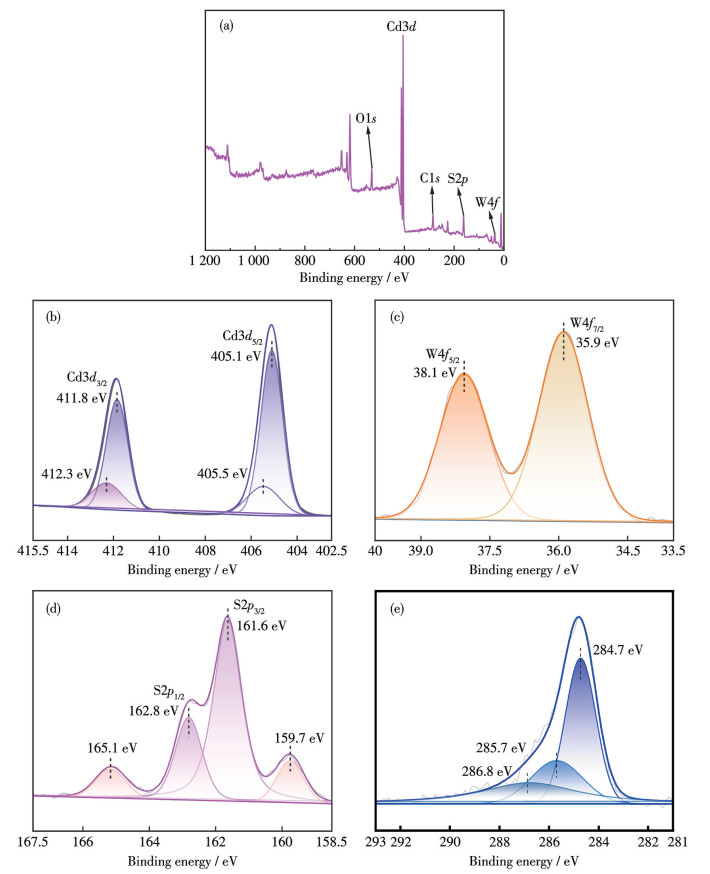
Fig. 2a shows the survey spectrum, in which distinct photoelectron peaks for C, O, W, Cd, and S were observed. Fig. 2b presents the high-resolution Cd3d region. The binding energies at 405.1 and 411.8 eV correspond to Cd3d5/2 and Cd3d3/2, respectively, with a spin-orbit splitting of 6.7 eV. These values agreed well with the reported data for Cd2+ in CdS[19], confirming both the successful incorporation of CdS and the chemical state of cadmium in the composite. Furthermore, the characteristic peaks at 405.5 and 412.3 eV are associated with Cd—O and Cd—O—S. However, no impurity phases (e.g., Cd(OH)2 and CdO) were detected in the XRD patterns. This phenomenon is attributed to NaOH, which, during the synthesis of CQDs, provides an alkaline environment, causing the chemical adsorption of Cd2+ in the composite material, thereby forming Cd—O[20] at the interface of the composite material. It is proposed that the peaks at 405.5 and 412.3 eV mainly originated from the interface Cd—O bonds formed through the chemical adsorption of Cd2+. However, considering the surface sensitivity of XPS and the inevitable surface oxidation of CdS nanocrystals under air exposure, these peaks might also result from the superposition of Cd—S bonds with oxygen adsorption at the surface sulfur sites forming Cd—S—O interface species[21].
As shown in Fig. 2c, the high-resolution XPS spectrum of W4f showed binding energy positions consistent with the reported values. These binding energy positions were consistent with the reported values of the W6+ oxidation state in the literature[22], indicating that tungsten in the composite mainly existed in the W6+ oxidation state. In Fig. 2d, the S2p peaks at 162.8 and 161.6 eV correspond to S2p1/2 and S2p2/3 orbitals, respectively, indicating that sulfur existed in the S2- oxidation state[23]. Additionally, two characteristic peaks at 165.1 and 159.7 eV were found, which accords with prior studies[24].
Fig. 2e presents the high-resolution C1s XPS spectrum in the composite. Three distinct characteristic peaks were observed in the spectrum, respectively, with binding energies centered at 284.7, 285.7, and 286.8 eV, respectively. Among them, the peak at 284.7 eV is assigned to C—C/C—H bonds; the peak at 285.7 eV is assigned to C—O bonds; and the peak at 286.8 eV is assigned to the O=C—O functional group in the carboxyl or ester group[25]. The existence of these oxygen-containing functional groups (C—O and O=C—O) was consistent with the literature reports, which are mainly attributed to the inherent hydrophilic functional groups of CQDs in the composite[26].
The morphological structures of CdS, PW12, 20%PW12/CdS, and 5%CQDs/PW12/CdS were observed using a scanning electron microscope (SEM), and the results are shown in Fig. 3.
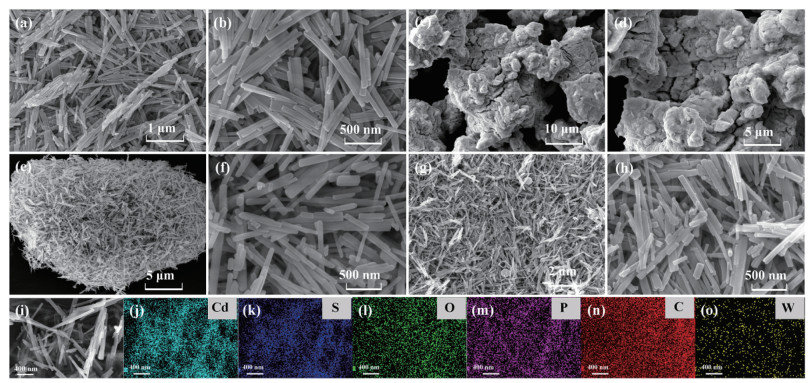
From Fig. 3a and 3b, it can be seen that CdS exhibited a nanorod-like structure with a smooth surface. From Fig. 3c and 3d, it can be observed that PW12 clusters were aggregated from numerous amorphous nanoparticles, from which it can be determined that pure PW12 presented an irregular aggregated morphology. From Fig. 3e and 3f, it can be observed that numerous rod-like CdS structures were uniformly loaded on the rough surface of PW12, confirming the effective composite. The morphology of the 5%CQDs/PW12/CdS composite material is shown in Fig. 3g and 3h. With the introduction of PW12 and CQDs, the intrinsic rod-like structure of CdS remained unchanged. This phenomenon is mainly attributed to the tiny particle size and sparse distribution of CQDs and their loose distribution. To further demonstrate the distribution of surface elements in 5%CQDs/PW12/CdS, energy dispersive X-ray spectroscopy (EDS) was carried out. As shown in Fig. 3i-3o, elements such as Cd, S, P, W, O, and C were present in 5%CQDs/PW12/CdS. Crucially, Fig. 3i-3o confirms the spatially uniform dispersion of CQDs within the composite. Such uniform element distribution favors efficient interfacial charge transfer and improved photocatalytic performance within the composite material, thereby enhancing the photocatalytic activity.
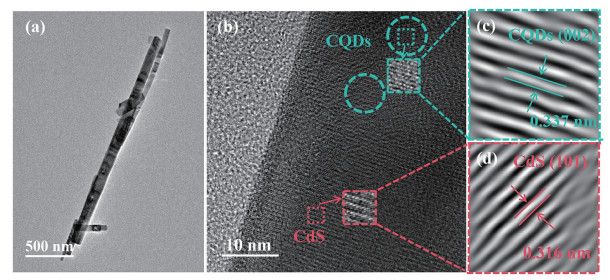
The crystal structure characteristics of the 5%CQDs/PW12/CdS composite material and the interactions between the materials were analyzed by transmission electron microscope (TEM) and high-resolution transmission electron microscope (HRTEM). The results are shown in Fig. 4 and S3. Fig. 4a shows the TEM image of 5%CQDs/PW12/CdS. The image presented a relatively smooth morphology. The difference in transparency between the two phases indicates that PW12 and rod-shaped CdS exhibit a strong interfacial interaction, further confirming the successful loading of PW12 on CdS. Fig. 4b and 4d are high-resolution TEM images of 5%CQDs/PW12/CdS, showing the 0.316 nm lattice fringes that correspond to the (101) crystal plane of CdS[27]. Fast Fourier transform (FFT) (Fig. 4c) showed the 0.337 nm lattice fringes that correspond to the (002) crystal plane of CQDs[28], further verifying the presence of CQDs. The above lattice spacing analysis results revealed that both CdS and CQDs existed in the composite, and the crystal planes of each component were consistent with the XRD analysis results. The close contact between CQDs, PW12, and CdS in the HRTEM images verified the successful construction of the heterostructure, which facilitates the efficient migration and separation of photogenerated carriers and serves as the structural basis for the excellent photocatalytic performance of this material. As shown in Fig.S3, the particle size distribution of CQDs fitted the Gaussian function well. The average particle size of CQDs was approximately 6.2 nm, and the proportion of nanoparticles ranging from 6 to 6.4 nm reached the highest value of approximately 30%.
To investigate the surface physical and chemical properties of the prepared materials, N2 adsorption-desorption tests were conducted on the 5%CQDs/PW12/CdS composite materials. The results are shown in Fig. 5. The isotherms of all samples belong to type Ⅳ and are accompanied by H3-type hysteresis loops, which conform to the classification of mesoporous materials by the International Union of Pure and Applied Chemistry (IUPAC). Compared with CdS and 20%PW12/CdS, the isotherms of 5%CQDs/PW12/CdS shifted significantly upwards, indicating a higher specific surface area. The pore size distribution diagram (inset in Fig. 5) further showed that the composite possessed a mesopore-dominated structure, which might result from the aggregation of nanorods and nanoparticles.
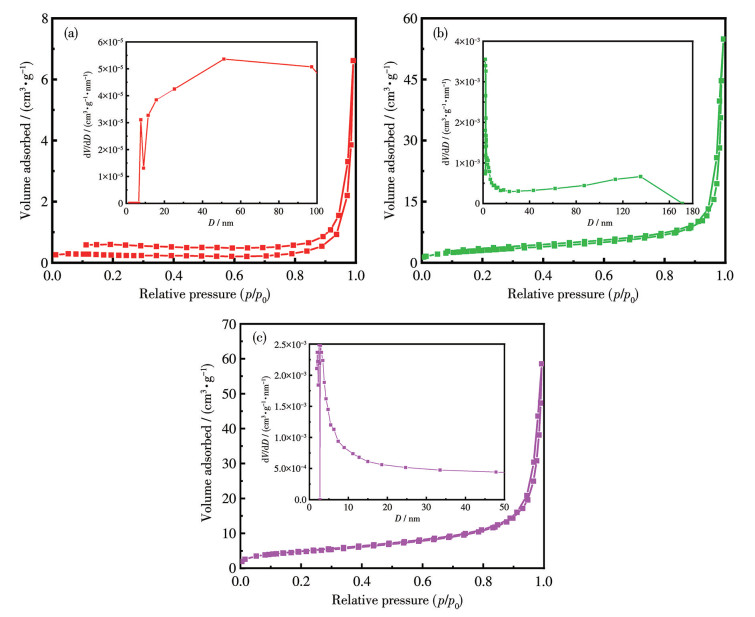
Table 1 lists the grain size (D), specific surface area (SBET), pore volume (VP), and average pore diameter (DP) of each catalyst. Compared with CdS and 20%PW12/CdS, the 5%CQDs/PW12/CdS ternary composite exhibited the largest specific surface area and the smallest average pore diameter. Meanwhile, the grain size and pore volume increased slightly. This variation indicated that the introduction of PW12 partially filled the pores of CdS. In contrast, the loading of CQDs significantly optimized the composite′s pore structure, increasing the specific surface area and forming uniform mesopores. The enhanced specific surface area is attributed to the surface effect of CQDs[29]. The abundant pore structure provides more active sites and enhances the adsorption capacity for dye molecules, thereby improving the photocatalytic performance of the composite.
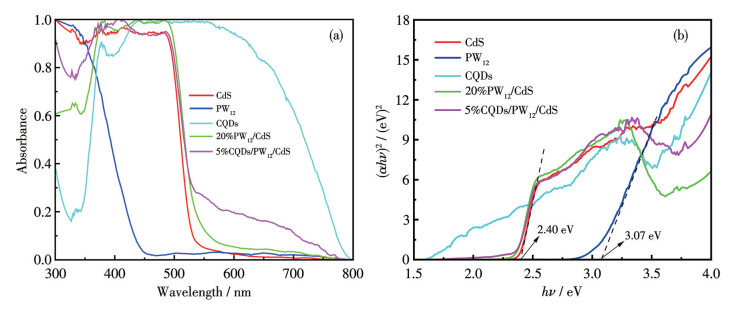
To study the light absorption characteristics of the catalysts, ultraviolet-visible diffuse reflection spectra (UV-Vis DRS) were conducted on different samples. The results are shown in Fig. 6.
Among them, Fig. 6a shows the UV-Vis DRS of different materials, and Fig. 6b displays the corresponding Kubelka-Munk energy curves. As observed from Fig. 6a, the absorption edges of PW12 and CdS were 440 and 532 nm, respectively. This indicates that PW12 exhibits strong UV absorption, while CdS possesses superior light absorption performance in the UV-Vis regions. The absorption edge of the 20%PW12/CdS composite red-shifted to the long-wavelength region, and compared with CdS and PW12, 20%PW12/CdS had a significant red shift. The enhanced light absorption ability of the PW12/CdS composite material is attributed to the fact that the light response of some polyoxynitride ions themselves broadened the light absorption edge of the composite material, enabling it to utilize more visible light. POM ions temporarily store electrons, which facilitates the improvement of the photocatalytic performance of the composite[30]. After introducing CQDs, the absorption edge of the composite was further red-shifted, indicating that CQD decoration improves the visible-light absorption capability of the composite for visible light.
As shown in Fig. 6b, the band gap energies of CdS and PW12 were 2.40 and 3.07 eV, respectively, which were consistent with previously reported values[31-32]. The introduction of PW12 and CQDs led to a reduced band gap for 5%CQDs/PW12/CdS, because CQDs and PW12 were loaded on the CdS surface, which broadened the visible-light absorption range. This demonstrates that the CdS-based composite with a broad spectral response is successfully fabricated. The optimized composite improves solar light utilization and further enhances photocatalytic activity.
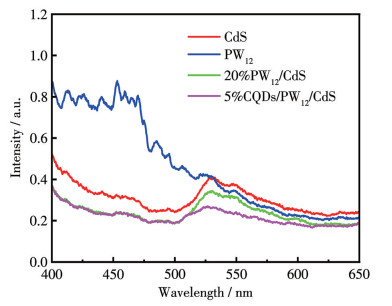
Generally, stronger PL indicates a higher electron (e-)-hole (h+) recombination rate[33]. To assess the recombination and migration behaviour of photogenerated charge carriers, PL spectra of CdS, PW12, 20%PW12/CdS, and 5%CQDs/PW12/CdS were recorded at an excitation wavelength of 325 nm. The results are shown in Fig. 7.
As shown in Fig. 7, the PL intensity of the samples follows the order: PW12 > CdS > 20%PW12/CdS > 5%CQDs/PW12/CdS. The results indicate that after the introduction of PW12, the PL intensity of the 20%PW12/CdS composite significantly decreased, suggesting that PW12, as an efficient electron acceptor, inhibited the carrier recombination of CdS. With the introduction of CQDs, the PL spectral intensity of 5%CQDs/PW12/CdS further decreased, suggesting that CQDs further promoted charge separation and transfer, demonstrating that the composite had higher photogenerated charge separation efficiency than bare CdS. The CQDs/PW12/CdS heterojunction structure effectively inhibited the recombination of photogenerated e--h+. This can be attributed to the unsaturated and dangling bonds on the CQDs′ surface, which generate surface defects, thereby improving photogenerated e--h+ pairs separation efficiency and prolonging carrier lifetime. The experimental results further indicate that the 5%CQDs/PW12/CdS composite may exhibit enhanced photocatalytic performance.
To further explore the e--h+ transfer and separation efficiency of the samples, transient photocurrent response tests were also conducted on the samples. The results are shown in Fig. 8. As observed from Fig. 8a, five on-off switching cycles were performed, and the photocurrent density of different catalysts followed the order: 5%CQDs/PW12/CdS > 20%PW12/CdS > CdS > PW12. The 5%CQDs/PW12/CdS composite exhibited the highest photocurrent density among all samples, verifying its superior photogenerated carrier separation efficiency.
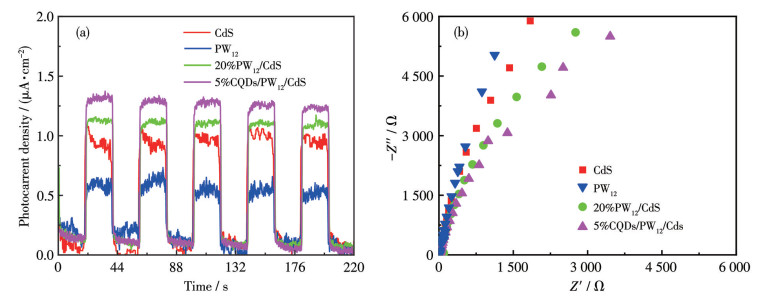
Compared with pure CdS, the introduction of CQDs promoted the generation and separation of photogenerated charges, thereby improving the photocurrent intensity of the CQDs/PW12/CdS composite. As shown in Fig. 8b, the Nyquist semicircle radii of different samples followed the sequence: 5%CQDs/PW12/CdS < 20%PW12/CdS < CdS < PW12. In general, a smaller Nyquist radius corresponds to lower charge transfer resistance. Among all samples, the 5%CQDs/PW12/CdS composite possessed the smallest Nyquist radius, indicating that the catalyst exhibited faster carrier transfer efficiency.
Compared with other samples, 5%CQDs/PW12/CdS exhibited the lowest PL intensity, the highest photocurrent density, and the lowest charge transfer resistance.
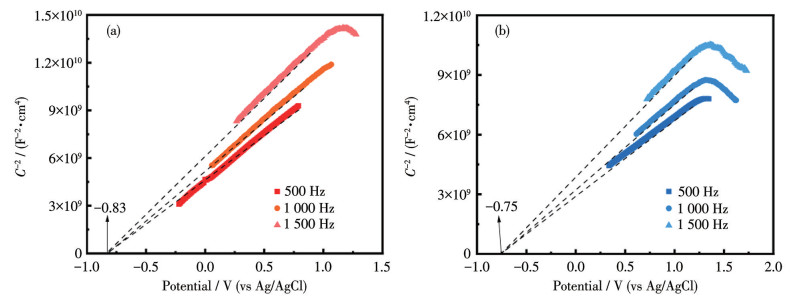
To further study the electronic band structure of the samples, Mott-Schottky tests were conducted on CdS and PW12, and the results are shown in Fig. 9. The Mott-Schottky curves of both samples in Fig. 9 all exhibited positive slopes, reflecting the n-type semiconductor characteristics of CdS and PW12. In this study, Ag/AgCl was used as the reference electrode. At 500, 1 000, and 1 500 Hz, from the x-axis intercepts, the flat band potentials of CdS and PW12 were -0.83 and -0.75 V (vs Ag/AgCl), respectively.
According to the Nernst equation[34], for n-type semiconductors, the conduction band (CB) energy (ECB) is generally close to the flat band energy[11]. Compared to the normal hydrogen electrode (ENHE), the ECB of CdS and PW12 were -0.63 and -0.55 eV.
|
|
(1) |
|
|
(2) |
where EVB is the valence band (VB) energy, and Eg is the band gap. From the Kubelka-Munk function and Eq.1 and 2, the EVB of CdS and PW12 were calculated. The calculated results are shown in Table 2.
下载:
导出CSV
| Sample | ECB / eV | Eg / eV | EVB / eV |
| CdS | -0.63 | 2.40 | 1.77 |
| PW12 | -0.55 | 3.07 | 2.52 |
To evaluate the photocatalytic performance of the composites for degrading wastewater pollutants, RhB was selected as the model pollutant, and degradation tests were performed under simulated sunlight. The results are shown in Fig. 10.
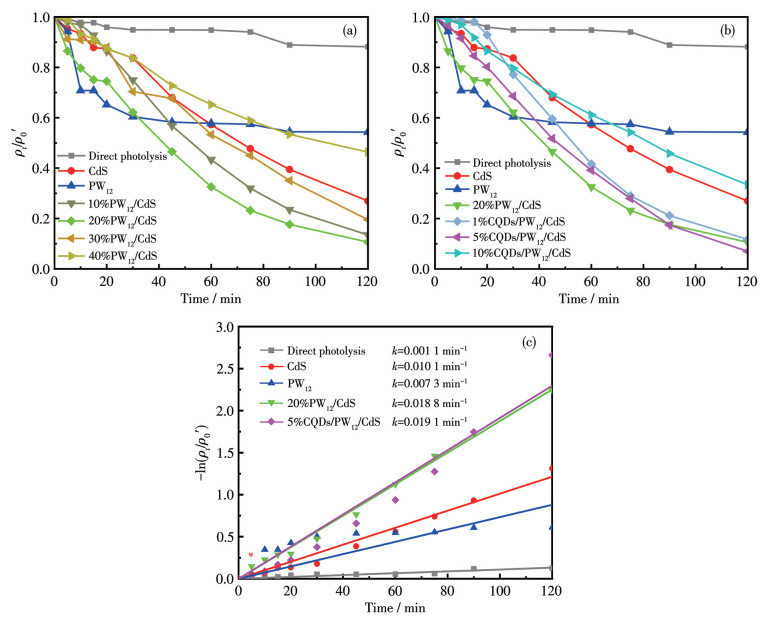
Fig. 10a shows the degradation effects using xPW12/CdS samples. The xPW12/CdS was generated by adjusting the mass ratio of PW12 and CdS by adding different amounts of PW12. Without the catalyst, after 120 min of simulated sunlight exposure, the degradation rate of RhB was 10.2%. With the addition of the xPW12/CdS catalyst, the degradation rate of RhB increased. It was found that the 20%PW12/CdS composite had the optimal RhB degradation effect. Fig. 10b shows the degradation effect of different yCQDs/PW12/CdS samples. It was found that the 5%CQDs/PW12/CdS composite exhibited a degradation rate of up to 93.01%, showing the optimal RhB degradation effect. The degradation rate of pure CQDs within 120 min was only 7.77%, indicating relatively low photocatalytic activity. This confirms that while CQDs contribute to the overall performance, the significantly enhanced performance of the CQDs/PW12/CdS composite mainly arises from a synergistic effect rather than from the properties of the quantum dots alone. Fig. 10c shows the corresponding first-order kinetic curves of the composite material, which indicates that -ln(ρt/ρ0′) has a linear relationship with time.
|
|
(3) |
Here, t represents the reaction time, ρ0′ and ρt are the initial concentration of RhB at the time when the adsorption-desorption equilibrium is reached, and the concentration of RhB at time t, respectively, and k is the pseudo-first-order rate constant. According to Eq.3, the degradation of RhB by the composite material followed pseudo-first-order reaction kinetics. Table S1 shows the rate constants and corresponding R2 values for each sample.
To ensure that the composite reached an adsorption-desorption equilibrium with the pollutants, a dark adsorption experiment was conducted for 120 min. The results are shown in Fig.S4. As shown in Fig.S4, after 30 min of adsorption, the catalysts and RhB nearly reached adsorption-desorption equilibrium. Additionally, a physical mixture of PW12, CdS, and CQDs was used as a control to verify the formation of the heterojunction. The results are shown in Fig.S5. The experimental results indicate that, compared with the hydrothermally synthesized 5%CQDs/PW12/CdS composite, the physical mixture exhibited a degradation efficiency of only 41.80%, which was significantly lower. This difference demonstrates that the enhanced photocatalytic activity originates from the heterojunction interface formed during hydrothermal synthesis, rather than from the simple physical coexistence of the three components. To evaluate the mineralization capacity of 5%CQDs/PW12/CdS for RhB degradation, a total organic carbon (TOC) analysis was performed. The TOC removal results are shown in Fig.S6. After 90 and 180 min of irradiation, the mineralization rates of RhB by 5%CQDs/PW12/CdS were 1.49% and 13.55%, respectively.
To explore the broad applicability of the as-prepared 5%CQDs/PW12/CdS photocatalyst, photocatalytic degradation tests were carried out on various common dyes and antibiotics. The corresponding results are presented in Fig. 11. Fig. 11a reveals that the 5%CQDs/PW12/CdS composite achieved prominent degradation activity against RhB, crystal violet (CV), methyl orange (MO), and methylene blue (MB), with CV showing the highest degradation efficiency. This suggests that the material can effectively degrade dyes with distinct molecular structures. As can be seen from Fig. 11b, the composite also displayed superior performance in degrading tetracycline hydrochloride (TC), chlortetracycline hydrochloride (CTC), and metronidazole (MTZ). These results confirm its versatility in removing various aqueous contaminants. Overall, the 5%CQDs/PW12/CdS composite exhibited excellent photocatalytic activity toward diverse water pollutants, showing promising potential for practical wastewater remediation.
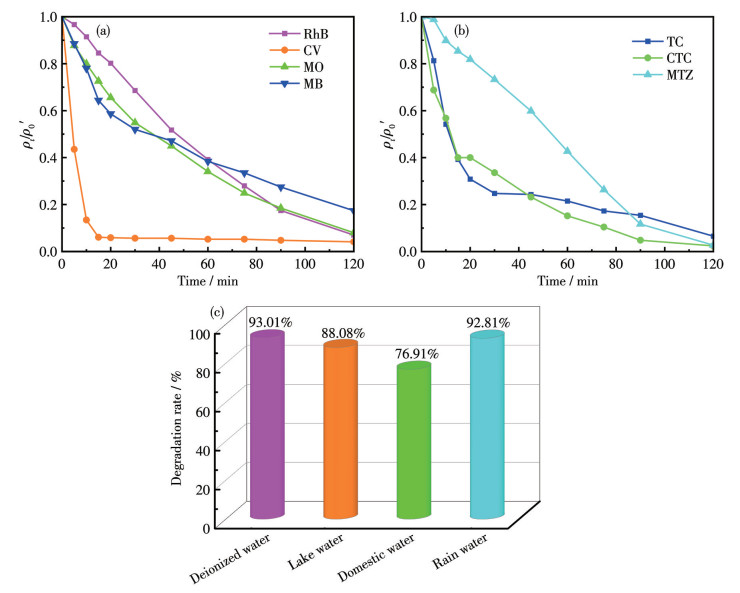
To study the degradation effect of the complex in real water environments, appropriate volumes of water were collected from household sources (domestic water) and natural sources (rainwater and lake water), and RhB solutions were prepared to simulate the presence of dyes in various aquatic environments. Photocatalytic degradation of dyes in different water qualities was carried out using 5%CQDs/PW12/CdS composite as catalysts, and the results are shown in Fig. 11c.
As can be seen from Fig. 11c, compared with deionized water, the degradation efficiency of RhB in rainwater, lake water, and domestic water decreased successively. This phenomenon can be attributed to the adsorption of other ions existing in lake water and domestic water onto the surface of the catalyst. These ions consume some free radicals and reduce the separation ability of e- and h+[35], resulting in a decrease in the degradation performance of 5%CQDs/PW12/CdS. Domestic water has the strongest interference due to its complex components, such as disinfection by-products and additives. The key point is that in rain and lake water, the catalyst still maintained an efficient degradation rate of over 80%, fully demonstrating its strong adaptability and practical potential in natural water environments, and providing a promising solution for the treatment of dye pollution in rivers and lakes. However, in other water sources, the composite maintained a catalytic efficiency of over 80%, indicating that the synthesized catalyst holds significant promise in real-world water environments. The good anti-interference property of composite materials may stem from the charge separation promoted by the heterojunction structure (Fig. 4d).
Fig.S7 presents the results of a series of four consecutive photocatalytic experiments conducted under the same reaction conditions and simulated sunlight exposure. These experiments were aimed at further evaluating the stability of the optimized composite material. As shown in Fig.S7, the 5%CQDs/PW12/CdS photocatalyst maintained 89.47% of its initial activity after four consecutive cycles, with a degradation efficiency that decreased by only approximately 3.5%. This indicated that the 5%CQD/PW12/CdS composite has excellent reusability and stability. To investigate whether the homogeneous photocatalytic reaction during the reaction process of 5%CQDs/PW12/CdS photocatalyst is caused by the Cd2+ generated by the photoinfiltration of the CdS component, this study used inductively coupled plasma atomic emission spectroscopy (ICP-OES) to test the solution after the photocatalytic cycle reaction. The detection and calculation results showed that the average concentration of Cd in the solution after the reaction was 3.96 mg·L-1, and the leaching rate of Cd in the catalyst was calculated to be approximately 0.066%. These results indicate that no obvious metal ion leaching phenomenon occurs in the photocatalytic reaction of this catalyst, demonstrating good stability. As shown in Table S2, the 5%CQDs/PW12/CdS composite material exhibited excellent degradation performance under simulated sunlight.
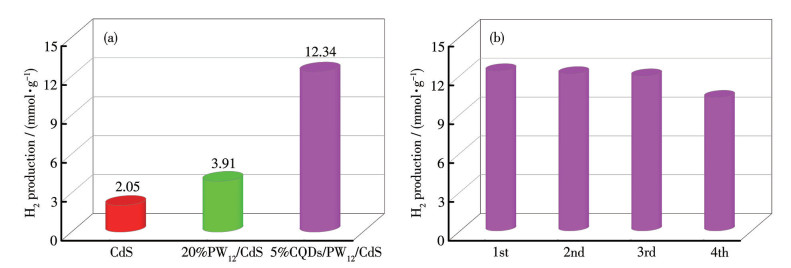
To investigate the hydrogen production capacity of the prepared materials through photolysis, an 8 h hydrogen production experiment was conducted on the 5%CQDs/PW12/CdS composite material using different sacrificial agents under the irradiation of a 300 W Xe lamp.
When using lactic acid as the sacrificial agent, the hydrogen production effect of the 5%CQDs/PW12/CdS composite was the best, and lactic acid was determined to be the most suitable sacrificial agent. The results of the photocatalytic hydrogen production of different samples using lactic acid as the sacrificial agent are shown in Fig. 12a. It was found that the hydrogen production rate of 5%CQDs/PW12/CdS was approximately three times that of 20%PW12/CdS and six times that of the monomer CdS, which further indicates that 5%CQDs/PW12/CdS has a high photocatalytic hydrogen production activity. In addition, to study the cycling stability of the 5%CQDs/PW12/CdS composite in the photocatalytic hydrogen production process using lactic acid as the sacrificial agent, the experimental results are shown in Fig. 12b. Although the hydrogen production rate of 5%CQDs/PW12/CdS slightly decreased, it still maintained a high hydrogen production volume. After four cycles, it was further confirmed that the composite had good hydrogen evolution performance and stability. In contrast to the photocatalytic degradation reactions, photocatalytic hydrogen evolution is more sensitive to the separation and migration efficiency of photogenerated electrons. Therefore, the 5%CQDs/PW12/CdS composite exhibited superior hydrogen production performance compared with the 20%PW12/CdS composite. As shown in Table S3, in the absence of precious metals, the 5%CQDs/PW12/CdS composite material also exhibited hydrogen production performance.
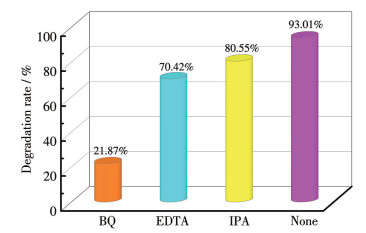
To explore the potential photocatalytic mechanism of the 5%CQDs/PW12/CdS composite material, a capture experiment was conducted to capture the active substances existing during the degradation process of the 5%CQDs/PW12/CdS composite material. Different scavengers, namely para-phenylenediamine (BQ), isopropanol (IPA), and disodium ethylenediaminetetraacetate (EDTA), were selected to perform the capture experiments for oxygen ion (·O2-), hydroxyl radical(·OH), and h+, respectively. The results are shown in Fig. 13. From Fig. 13, it could be seen that after adding BQ, the degradation effect of RhB by the 5%CQDs/PW12/CdS composite material was significantly reduced, with the degradation rate dropping to 21.87%. After adding EDTA, the degradation rate dropped to 70.42%. After adding IPA, the degradation rate was 80.55%, and no significant inhibition was observed. The research results indicate that in the photocatalytic degradation process of RhB by the 5%CQDs/PW12/CdS composite material, ·O2- and ·OH play the main role, while h+ plays the auxiliary role.
Based on the above experimental results, a possible traditional type Ⅱ photocatalytic reaction mechanism for the CQDs/PW12/CdS system was proposed, as shown in Fig. 14a. When the CQDs/PW12/CdS composite is illuminated, electrons are excited from the VB to the CB of the semiconductor. Photogenerated electrons accumulate on the CB, while an equal number of holes accumulate in the VB. Due to the close contact between the components, the CB of CdS is more negative than that of PW12. Therefore, the photogenerated electrons can be effectively transferred to the CB of PW12. The photogenerated electrons on the semiconductor CB react with dissolved oxygen on the catalyst surface to form strong oxidizing ·O2-, which converts RhB into CO2 and H2O. In this case, the VB potential of CdS (1.77 V) does not reach the standard oxidation potential of OH⁻/·OH (2.40 V). Obviously, in the assumed type Ⅱ heterojunction system, ·OH can not be generated. Considering the presence of ·OH radicals in the CQDs/PW12/CdS photocatalytic system, the type Ⅱ charge transfer mechanism is not applicable.
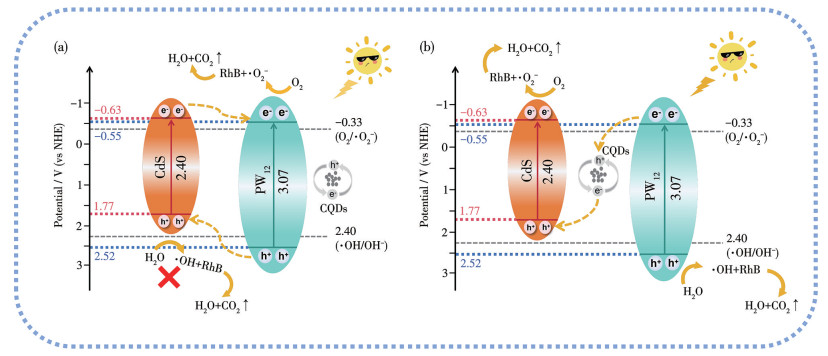
We are more inclined to believe that the photocatalytic degradation of the CQDs/PW12/CdS composite follows the Z-scheme electron transfer mechanism, as shown in Fig. 14b. This mechanism not only closely matches the results of the free radical capture experiment but also can reasonably explain its excellent photocatalytic performance. Firstly, under simulated sunlight irradiation, CdS and PW12 can be fully excited, generating abundant photogenerated e--h+ pairs. Subsequently, the photogenerated carriers undergo efficient Z-scheme transfer at the composite interface: the photogenerated electrons on the CB of PW12 and the photogenerated holes on the VB of CdS undergo efficient recombination through CQDs as the electron mediator. CQDs act as an electron transmission medium, accelerating the electron transfer rate. Through this selective interface recombination, the highly reducing electrons are retained on the CB of CdS, while the highly oxidizing holes are gathered on the VB of PW12, achieving the spatial separation of photogenerated carriers and significantly improving the charge separation efficiency. Moreover, PW12 not only serves as a key component of the Z-scheme junction but also acts as an "electron buffer" via its exceptional multi-electron redox capability, facilitating electron capture and storage while suppressing CdS photocorrosion.
The electrons enriched in the CB of CdS [-0.63 V (vs NHE)] have strong reducing properties and can convert O2 into ·O2-, for which the standard electrode potential was -0.33 V (vs NHE). Meanwhile, the holes enriched in the VB of PW12 possess strong oxidizing properties and can directly oxidize pollutants or react with H2O/OH- to generate ·OH. These active species ·O2-, ·OH, and h+ work together to drive the efficient degradation of RhB. In this study, a direct Z-scheme heterojunction bridged by CQDs is successfully constructed. By ingeniously integrating the electron buffering and storage capabilities of CQDs and PW12, efficient separation and utilization of photogenerated carriers are achieved.
In this work, a broad-spectrum responsive 5%CQDs/PW12/CdS composite modified with CQDs was fabricated via a microwave-assisted hydrothermal method. Under simulated solar irradiation, the composite degraded 93.01% of RhB, which was 1.27 times higher than that of pure CdS and twice that of PW12. Moreover, its photocatalytic H2 evolution rate reached 12.34 mmol·g-1 over 8 h, which was six times higher than that of pristine CdS. The improved photocatalytic activity is attributed to the introduction of CQDs, which increase the specific surface area and broaden the light absorption range of the composite. Radical trapping experiments identify ·O2- and h+ as the dominant active species during the photocatalytic reaction. Based on the band structure analysis and radical trapping results, a Z-scheme charge transfer pathway was proposed for the CQDs/PW12/CdS heterojunction, offering a simple and economical route to efficient CdS-based photocatalysts. This work not only constructs a high-efficiency Z-scheme heterojunction photocatalytic system but also provides a novel design strategy and experimental reference for the precise regulation of photogenerated carrier dynamics. Furthermore, this study offers a feasible route for the development of advanced solar energy conversion materials via the synergistic coupling of POMs and CQDs.
QUSTI A H, MALKHASIAN A Y S, SALAM M A. Enhancement of CdS nanoparticles photocatalytic activity by Pt and In2O3 doping for the degradation of malachite green dye in water[J]. J. Mol. Liq., 2018, 255: 364-369 doi: 10.1016/j.molliq.2018.01.127
ZHAO T W, XIONG J Y, LI W, CHENG G, DOU S X. Dual-cocatalysts-embedded hollow photocatalysis system drives solar fuel production[J]. Chem. Eng. J., 2025, 506: 160313 doi: 10.1016/j.cej.2025.160313
DUAN X Y, YU F C, JIANG R B, REN J L, ZHANG J L, FENG C C, LI C X, HU K C, HOU X G. Study on the photocatalytic properties of the ternary ZnO/MgAl-LDH/FeOOH composite photocatalyst with a type-Ⅱ and S-scheme linked carrier migration mechanism in degrading TC solution[J]. Compos. Commun., 2024, 52: 102156 doi: 10.1016/j.coco.2024.102156
XU Y, LIU J X, CAO H Q, ZHANG Q L. CdS nanocrystal/NiO nanosheet heterojunction for enhanced visible-light photocatalytic H2 production[J]. Compos. Commun., 2025, 55: 102323 doi: 10.1016/j.coco.2025.102323
ZHAI B Y, CHEN Y, LIANG Y N, GAO Y H, SHI J L, ZHANG H L, LI Y. Modifying Ag3VO4 with metal-organic frameworks for enhanced photocatalytic activity under visible light[J]. Mater. Chem. Phys., 2020, 239: 122078 doi: 10.1016/j.matchemphys.2019.122078
LIU L Z, HU T P, DAI K, ZHANG J F, LIANG C H. A novel step-scheme BiVO4/Ag3VO4 photocatalyst for enhanced photocatalytic degradation activity under visible light irradiation[J]. Chin. J. Catal., 2021, 42(1): 46-55 doi: 10.1016/S1872-2067(20)63560-4
TANG Y, TAI R, SONG X J, GAO S, WU R J, CHEN S W, WANG Q. Zinc-doped BiOBr hollow microspheres for enhanced visible light photocatalytic degradation of antibiotic residues[J]. Langmuir, 2024, 40(12): 6515-6523 doi: 10.1021/acs.langmuir.4c00155
NISHIOKA S, SHIBATA K, MISEKI Y, SAYAMA K, MAEDA K. Visible-light-driven nonsacrificial hydrogen evolution by modified carbon nitride photocatalysts[J]. Chin. J. Catal., 2022, 43(9): 2316-2320 doi: 10.1016/S1872-2067(21)64015-9
LIU Y M, ZENG Q R, WEI Y Z, GAO R C, ZENG D Q. Boosting photocatalytic H2 generation via interfacial charge transfer in CuInS2 nanoflower-decorated CdS nanosheets[J]. Int. J. Hydrogen Energy, 2025, 138: 286-295 doi: 10.1016/j.ijhydene.2025.05.180
WEN X R, FENG J P, ZHANG J, FU H Q, GAO H J, WANG J H, LIAO Y W. Enhanced visible‐light photocatalytic dye degradation ability of CdS/O‐CNTs nanocomposites[J]. ChemistrySelect, 2022, 7(35): e202202576 doi: 10.1002/slct.202202576
CHEN H Y, YE K, ZHANG W Y, FAN L L, KONG F J, ZHAO R F, CHEN M. Nickel-based bifunctional cocatalyst to enhance CdS photocatalytic hydrogen production[J]. Langmuir, 2023, 39(51): 18935-18945 doi: 10.1021/acs.langmuir.3c02855
MARTIN-SABI M, SORIANO-LÓPEZ J, WINTER R S, CHEN J J, VILÀ-NADAL L, LONG D L, GALÁN-MASCARÓS J R, CRONIN L. Redox tuning the Weakley-type polyoxometalate archetype for the oxygen evolution reaction[J]. Nat. Catal., 2018, 1(3): 208-213 doi: 10.1038/s41929-018-0037-1
SUN H L, HU L F, LI Z Y, LANG J Y, WANG C L, LIU X H, HU Y H, JIN F M. Ultra‐stable molecular interface SiW12Ox/TiO2 catalyst derived from keggin‐type polyoxometalates for photocatalytic conversion of methane to oxygenates[J]. ChemCatChem, 2022, 14(10): e202200001 doi: 10.1002/cctc.202200001
HOU Y S, CUI L P, WANG Q, WANG M L, LI G, YU K. The ternary composite formed by intercalation of porous Keggin-type POM and lamellar MoS2 into accordion-like MXene for enhanced electrochemical properties of the LIBs[J]. Chem. Eng. J., 2025, 507: 160503 doi: 10.1016/j.cej.2025.160503
LIU S D, WANG Q G, WANG K, YAO Y P, ZHANG H Y, REN T Q, YIN Z M, DU F L, ZHANG B T, HE J L. Two-photon saturable absorption properties and laser Q-switch application of carbon quantum dots[J]. Opt. Lett., 2017, 42(19): 3972-3975 doi: 10.1364/OL.42.003972
MISHRA S, PRIYADARSHINEE M, DEBNATH A K, MUTHE K P, MALLICK B C, DAS N, PARHI P. Rapid microwave assisted hydrothermal synthesis cerium vanadate nanoparticle and its photocatalytic and antibacterial studies[J]. J. Phys. Chem. Solids, 2020, 137: 109211 doi: 10.1016/j.jpcs.2019.109211
YAN M, HUA Y Q, ZHU F F, SUN L, GU W, SHI W D. Constructing nitrogen doped graphene quantum dots-ZnNb2O6/g-C3N4 catalysts for hydrogen production under visible light[J]. Appl. Catal. B‒Environ., 2017, 206: 531-537 doi: 10.1016/j.apcatb.2017.01.070
MOHAMMED H A, AZIZ D M, AZIZ S B, NOFAL M M, HAMASALIH G H, HUSSEIN I I, KAYANI K F, MOHAMMED P A, SANGARAJU S. Eco-friendly fabrication of flag blue flower-derived CQD-doped chitosan films with tunable optical and photoluminescent properties[J]. Sci. Rep., 2025, 16: 3030 doi: 10.1038/s41598-025-33019-1
SHI Z, LIU J N, LAN H X, LI X Y, ZHU B Y, YANG J H. Effect of CdS shell thickness on the photocatalytic properties of TiO2@CdS core-shell nanorod arrays[J]. J. Mater. Sci‒Mater. Electron., 2019, 30(19): 17682-17692 doi: 10.1007/s10854-019-02118-x
LIU Y T, LI L, HU T Y, ZHU X Y, WANG H X, ZHANG W J, CHEN S T, CHENG S T, LI Y X. Enhanced photocatalytic performance of multifunctional composite Ag-Ag2Se@CdSe/3DOM TiO2 with dual Z-scheme heterostructures coupling Ag NPs: Degradation, hydrogen production and antibacterial activity[J]. J. Alloy. Compd., 2025, 1021: 179571 doi: 10.1016/j.jallcom.2025.179571
LOEZA-POOT M, MIS-FERNÁNDEZ R, CAMACHO-ESPINOSA E, PEÑA J L. Physico-chemical analysis of the properties and stability of CdS and CdS: O to be applied in thin-film solar cells[J]. Appl. Surf. Sci., 2024, 662: 160125 doi: 10.1016/j.apsusc.2024.160125
LI R N, CHEN R, TANG L X, LI Q, CHEN Y X X, LIAO J S, WANG W. Constructing a P2W18O626--containing hybrid photocatalyst via noncovalent interactions for enhanced H2 production[J]. ACS Omega, 2024, 9(16): 18556-18565 doi: 10.1021/acsomega.4c01179
LIU H M, PENG J Y, ZHANG X, ZHENG K, ZHENG L R, LV K L, LI Q, ZHOU P. Engineering atomic Pt-N3 sites on CdS nanorods for overcoming the rate-determining organic dehydrogenation in photocatalytic coproduction of H2 and value-added chemicals[J]. Chem. Eng. J., 2025, 504: 158618 doi: 10.1016/j.cej.2024.158618
YOU J H, WANG L, BAO W T, YAN A G, GUO R. Synthesis and visible-light photocatalytic properties of BiOBr/CdS nanomaterials[J]. J. Mater. Sci., 2021, 56(11): 6732-6744 doi: 10.1007/s10853-020-05721-0
DING Y, GAO Y H, LI Z H. Carbon quantum dots (CQDs) and Co(dmgH)2PyCl synergistically promote photocatalytic hydrogen evolution over hexagonal ZnIn2S4[J]. Appl. Surf. Sci., 2018, 462: 255-262 doi: 10.1016/j.apsusc.2018.08.006
WANG B Q, DENG Z R, FU X Z, LI Z H. MoS2/CQDs obtained by photoreduction for assembly of a ternary MoS2/CQDs/ZnIn2S4 nanocomposite for efficient photocatalytic hydrogen evolution under visible light[J]. J. Mater. Chem. A, 2018, 6: 19735-19742 doi: 10.1039/C8TA07797E
JIANG H Q, LI X H, ZHENG W B, XU H S, HOU S, ZHENG L X, ZHENG H J, MAO L, SHI X W. Atomically dispersed Pt on CdS nanosheets for photocatalytic evolution of H2 and 1, 1-diethoxyethane from ethanol[J]. ACS Appl. Nano Mater., 2023, 6(18): 17161-17170 doi: 10.1021/acsanm.3c03418
CHENG M X, LI H L, WU Z Y, YU Z X, TAO X M, HUANG L. Synergistic effects of CQDs and oxygen vacancies on CeO2 photocatalyst for efficient photocatalytic nitrogen fixation[J]. Sep. Purif. Technol., 2025, 354: 129299 doi: 10.1016/j.seppur.2024.129299
DOU F Y, NISHIWAKI E, LARSON H, HOMER M K, ZION T, NGUYEN H A, COSSAIRT B M. Pathways of CdS quantum dot degradation during photocatalysis: Implications for enhancing stability and efficiency for organic synthesis[J]. ACS Appl. Nano Mater., 2024, 7(13): 15781-15785 doi: 10.1021/acsanm.4c02976
KHAN A, LI W J, MA X H, DONG M, LIU X T, REN C J. Novel binary photocatalysts containing polyoxometalate immobilized on CdS nanorods surface for enhance photocatalytic performance[J]. J. Photochem. Photobiol. A‒Chem., 2023, 443: 114854
HUANG J R, WANG M Y, ZHANG X Z, TAO J N, LU L, QIAO G J, LIU G W. Anchoring of 2D CdS on Nb2CTX MXene nanosheets for boosting photocatalytic H2 evolution[J]. J. Alloy. Compd., 2022, 923: 166256 doi: 10.1016/j.jallcom.2022.166256
TONG H J, SHI B F, ZHAO S L. Facile synthesis of a direct Z-scheme BiOCl-phosphotungstic acid heterojunction for the improved photodegradation of tetracycline[J]. RSC Adv., 2020, 10(29): 17369-17376 doi: 10.1039/D0RA02396E
ZHANG K F, LIU Y X, DENG J G, XIE S H, LIN H X, ZHAO X T, YANG J, HAN Z, DAI H X. Fe2O3/3DOM BiVO4: High-performance photocatalysts for the visible light-driven degradation of 4-nitrophenol[J]. Appl. Catal. B‒Environ., 2017, 202: 569-579 doi: 10.1016/j.apcatb.2016.09.069
WU Q, LU D Z, KONDAMAREDDY K K, HO W K, WANG Q P, ZHANG Y H, ZENG Y M, ZHANG B Y, XIE L H, ZHAO B, WANG Z N, HAO H J, FAN H Q, WANG H M. In-situ synthesis of ternary heterojunctions via g-C3N4 coupling with noble-metal-free NiS and CdS with efficient visible-light-induced photocatalytic H2 evolution and mechanism insight[J]. Int. J. Hydrog. Energy, 2022, 47(30): 14063-14076 doi: 10.1016/j.ijhydene.2022.02.153
CUI Y L, ZHENG J, ZHU Z J, HU C Y, LIU B J. Preparation and application of Bi4O7/Cu-BiOCl heterojunction photocatalyst for photocatalytic degradation of tetracycline under visible light[J]. J. Mol. Struct., 2023, 1274: 134486 doi: 10.1016/j.molstruc.2022.134486

Figure 2 XPS spectra of 5%CQDs/PW12/CdS: survey (a), Cd3d (b), W4f (c), S2p (d), and C1s (e)

Figure 3 SEM images of CdS (a, b), PW12 (c, d), and 20%PW12/CdS (e, f); SEM images (g, h) and corresponding EDS elemental mappings (i-o) of 5%CQDs/PW12/CdS

Figure 4 TEM (a) and HRTEM (b) images of 5%CQDs/PW12/CdS; FFT images of CQDs (c) and CdS (d)

Figure 5 N2 adsorption-desorption isotherms and pore-size distributions (inset) of CdS (a), 20%PW12/CdS (b), and 5%CQDs/PW12/CdS (c)

Figure 8 Transient photocurrent response curves (a) and Nyquist plots (b) of CdS, PW12, 20%PW12/CdS, and 5%CQDs/PW12/CdS

Figure 10 Photodegradation curves (a, b) and the corresponding kinetic curves (c) for different catalysts

Figure 11 Degradation curves of different pollutants (a), different antibiotics (b), and RhB in different water qualities (c) by 5%CQDs/PW12/CdS

Figure 12 Hydrogen production under simulated sunlight for CdS, 20%PW12/CdS, and 5%CQDs/PW12/CdS (a); Measurement results of the photocatalytic hydrogen production cycle of 5%CQDs/PW12/CdS (b)

Figure 13 Photocatalytic activities of 5%CQDs/PW12/CdS for RhB degradation with different scavengers

Figure 14 Possible mechanism of photocatalytic reaction of the CQDs/PW12/CdS composite: the traditional Ⅱ-type heterojunction electron transfer pathway (a) and the Z-scheme heterojunction electron transfer pathway (b)
Table 1. Grain size, specific surface area, pore volume, and average pore diameter of different samples
| Sample | D / nm | SBET / (m2·g-1) | VP / (cm3·g-1) | DP / nm |
| CdS | 29.99 | 13 | 0.12 | 37.73 |
| 20%PW12/CdS | 41.12 | 11 | 0.08 | 27.88 |
| 5%CQDs/PW12/CdS | 33.36 | 17 | 0.08 | 18.86 |
 下载: 导出CSV
Table 2. ECB, Eg, and EVB values of CdS and PW12
| Sample | ECB / eV | Eg / eV | EVB / eV |
| CdS | -0.63 | 2.40 | 1.77 |
| PW12 | -0.55 | 3.07 | 2.52 |
下载: 导出CSV

 扫一扫看文章


扫一扫关注我们


 下载:
下载: