Citation:
Wei ZHANG, Ye LIU, Zehong CHEN. Theoretical investigation of Pb2+ adsorption and migration behavior at the α-ZrP/polypyrrole composite interface[J]. Chinese Journal of Inorganic Chemistry,
2026, 42(10): 2232-2244.
doi:
10.11862/CJIC.20260054
Received Date:
12 February 2026 Revised Date:
08 July 2026 Available Online:
10 October 2026
Abstract:
In response to the relative scarcity of microscopic mechanism studies on electrically switched ion exchange materials in the field of ion removal, a theoretical investigation based on density functional theory was conducted to explore the adsorption and migration mechanisms of lead ions (Pb2+) at the α-Zirconium phosphate (α-ZrP)/polypyrrole (PPy) composite from an atomic scale perspective. It is found that the introduction of PPy not only enhances the structural stability of α-ZrP through a physical support effect, but more importantly, the formation of interfacial chemical bonds and the accompanying electron transfer induce the generation of an internal electric field, which confers exceptional electrochemical properties to the composite. The mechanistic analysis indicates that, within the coupled interfacial region, the synergistic interplay between multi-site “cooperative anchoring” and interfacial electronic structure regulation collectively enables the highly stable coordination of Pb2+, with an adsorption energy as high as -4.64 eV. Meanwhile, the kinetic results confirm that the pronounced electron-ion coupled transport effect in the interface effectively reduces the migration energy barrier, resulting in significantly enhanced interfacial diffusion kinetics of Pb2+ of the composite compared with those of the individual components.
High concentrations of lead ions (Pb2+), resulting from the discharge of industrial wastewater, have caused water pollution, posing a global environmental crisis due to their irreversible bioaccumulation and severe physiological and ecological toxicity[1-2]. In light of this pressing challenge, the development of efficient and selective deep removal technologies for Pb2+ has become urgent. Among various remediation techniques, electrically switched ion exchange (ESIX) technology has emerged as a standout option due to its electrochemically controllable characteristics. This technology enables precise regulation of the redox state of functional materials via applied external potentials, facilitating the rapid capture and selective recovery of target ions, while offering the dual advantages of low energy consumption and environmental friendliness[3-4]. However, the primary bottleneck in the practical application of ESIX technology lies in the construction of electrically switched ion exchange materials that possess high adsorption capacity, excellent cycling stability, and specific selectivity.
Currently, traditional adsorbents such as zeolites[5], agricultural waste[6], activated carbon[7], and clay[8], despite their widespread application in water treatment, exhibit inherent deficiencies including limited adsorption capacity, weak interfacial interactions, and difficulties in regeneration and separation. To overcome the performance limitations of single materials, significant attention has been directed towards organic-inorganic hybrid materials in recent years[9-11]. These materials significantly enhance the affinity and adsorption capacity for specific metal ions by synergistically combining the tunability of organic polymers with the high thermal stability and structural rigidity of inorganic substrates, achieving comprehensive optimization of physical, chemical, and mechanical properties.
Among various inorganic substrates, α-zirconium phosphate (α-ZrP) was regarded as a highly promising electrically switched ion exchange material due to its unique layered structure, excellent thermal stability, and superior ion exchange properties across a wide range of pH[12]. However, the adsorption performance of pure α-ZrP often fell short of the requirements for efficient removal due to interlayer diffusion resistance. Consequently, researchers focused on composite modification strategies to expand its interlayer spacing and enhance its electrochemical performance. For instance, the polypyrrole (PPy)/α-ZrP membrane electrode developed by Chen et al.[13] exhibited high selectivity for Pb2+; Gu et al.[14] significantly improved the adsorption capacity for Cs+ by intercalating crown ethers into α-ZrP; studies by Mu et al.[15], Samsudin et al.[16], and Gao et al.[17] also confirmed that composite materials with polymers such as polyaniline (PANI) or functional group modifications effectively enhanced the removal efficacy of α-ZrP for radioactive nuclides, ammonium ions, potassium ions, and cadmium ions. Despite significant advances in macroscopic adsorption performance, existing research has primarily focused on describing experimental phenomena. It has lacked theoretical discussions that deeply elucidate the selectivity mechanisms of heavy metal ions at the atomic scale, the transport mechanisms, and the interfacial electron-ion coupling characteristics in composite electrically switched ion exchange materials. Therefore, conducting theoretical calculations to investigate the structure-performance relationships of α-ZrP-based composite materials thoroughly is of significant importance for the design and development of efficient heavy-metal removal materials.
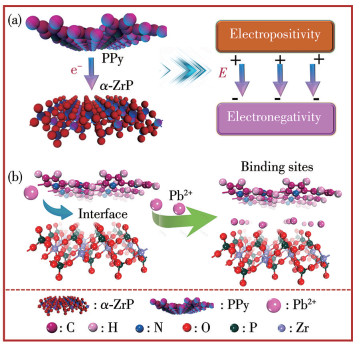
Based on this, the study employed density functional theory (DFT) calculations to elucidate the adsorption migration mechanisms and interfacial electron-ion transport characteristics during the removal of Pb2+ by the composite electrically switched ion exchange material α-ZrP/PPy. The theoretical analysis indicates that the composite structure of PPy and α-ZrP forms a close interfacial coupling architecture, which not only effectively expands the contact dimensions of α-ZrP but also induces directional electron transfer at the interface. This charge redistribution effect generates a spontaneous built-in electric field at the two-phase interface, which simultaneously enhances the structural stability of the composite material and promotes the formation of a negatively charged electron cloud layer on the surface of α-ZrP, providing a critical thermodynamic driving force for the selective accumulation of Pb2+ (Scheme 1a). As shown in Scheme 1b, the adsorption process is not confined to localized adsorption at a single site but is predominantly governed by the coupled effect of multi-site “cooperative anchoring” across the interface and interfacial electronic structure regulation. This mechanism establishes a more stable binding environment for Pb2+ within the interfacial region. Meanwhile, the strong interactions arising from chemical bonding effectively reduce the migration energy barrier, thereby significantly accelerating the interfacial migration kinetics of Pb2+. As a result, the α-ZrP/PPy composite exhibits outstanding electrochemical response activity and rapid ion diffusion kinetics. This study provides important theoretical insights into the role of interfacial effects in the adsorption of heavy metal ions in composite materials.
Scheme 1
Scheme 1.
Schematic diagram of the adsorption-migration mechanism of Pb2+ at the α-ZrP/PPy composite interface: (a) electron transfer and built-in electric field direction at the interface of α-ZrP/PPy; (b) adsorption sites and migration pathways of Pb2+
Based on the presence of an internal electric field characteristic along the (001) crystal direction (c-axis) of α-ZrP, this direction is regarded as the preferred orientation for structural growth. Accordingly, to construct a theoretical model of the electrically switched ion exchange material α-ZrP/PPy, a supercell structure with periodic boundaries was established in the two-dimensional xy plane. The specific chemical composition of this supercell included 16 oxygen (O) atoms, 4 phosphorus (P) atoms, 2 zirconium (Zr) atoms, 8 carbon (C) atoms, 4 hydrogen (H) atoms, and 2 nitrogen (N) atoms. Lattice mismatch analysis indicates that the mismatch between the α-ZrP and PPy layers along the xy direction is below 5%, within the theoretically acceptable error range, thereby ensuring the structural validity of the interfacial model.
All periodic DFT calculations in this study were performed using the Cambridge sequential total energy package (CASTEP) module of the Materials Studio software platform. The valence electron configurations chosen for the elements were as follows: Zr (4d25s2), P (3s23p3), O (2s22p4), Pb (6s26p2), C (2s22p2), N (2s22p3), and H (1s1). The exchange-correlation functional employed was the Perdew-Burke-Ernzerhof (PBE) functional under the generalized gradient approximation (GGA), which optimized both the electronic structure and geometric configuration. The plane-wave cutoff energy was set to 340 eV for self-consistent field (SCF) iterative calculations, and k-point sampling for the two-dimensional Brillouin zone was performed using a 2×2×1 Monkhorst-Pack grid. To eliminate interlayer mirror interactions caused by periodic boundary conditions, a vacuum layer of 2 nm was established in the direction perpendicular to the layers. Given the presence of weak physical interactions between the α-ZrP and PPy layers, the DFT-D2 dispersion correction method was introduced in the calculations to accurately describe the long-range van der Waals forces. A dipole correction was applied along the z-direction perpendicular to the interface to eliminate the artificial electric field arising from the asymmetric slab model. The convergence criteria for geometric structure relaxation were set as follows: maximum force less than 0.3 eV·nm-1, maximum stress less than 0.05 GPa, maximum displacement less than 0.000 2 nm, and total energy convergence accuracy of 10-6 eV.
Additionally, the nudged elastic band (NEB) method was employed to calculate the ion diffusion energy barriers, thereby determining the minimum energy path (MEP) of the diffusion reaction. When constructing a series of images between the initial and final states, the root mean square (RMS) convergence threshold for forces was set to 0.5 eV·nm-1. Within this framework, the diffusion energy barrier was strictly defined as the difference between the energy of the initial reaction state and the energy at the saddle point of the potential energy surface.
Notably, the isolated Pb2+ model employed in this study was primarily aimed at elucidating the intrinsic adsorption and migration mechanisms at the α-ZrP/PPy interface, without accounting for the complexity of realistic aqueous environments. Factors such as hydration shell removal and solvent polarization can alter the interfacial binding strength, while dynamic pH variations and competitive coexisting ions will directly affect the macroscopic adsorption capacity. Furthermore, the compensation scheme, assuming a uniform background charge in the model, deviated from the actual counterion environment. Therefore, although the present calculations effectively revealed the influence of interfacial coupling on the microscopic behavior of adsorbed ions, the absolute energy values can not be directly compared with experimental macroscopic measurements.
2.
Results and discussion
2.1
Geometric structure and stability analysis of the α-ZrP/PPy composite interface
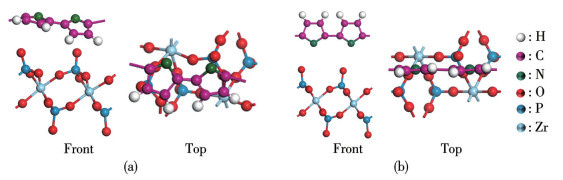
In investigating the adsorption and migration behavior of Pb2+ at the α-ZrP/PPy composite interface, the construction of reasonable and thermodynamically stable chemical configurations serves as a fundamental prerequisite for the computational simulations. This study establishes two representative composite structure models: the PPy chains are adsorbed parallel (Type Ⅰ, horizontal orientation) and perpendicular (Type Ⅱ, orthogonal orientation) to the α-ZrP substrate surface. The optimized structures, viewed from both frontal and top perspectives, are illustrated in Fig. 1. Analysis of the globally optimized structures reveals significant stability differences between the two models. The Type Ⅰ configuration maintains good structural integrity with no apparent deformation, whereas in the Type Ⅱ configuration, the P—O bond length is notably stretched to 0.164 8 nm, indicating that perpendicular adsorption results in severe lattice distortion and structural instability. To further quantitatively assess the stability of the system, thermodynamic calculations were performed based on the formula for adsorption energy (Eads)[18]:
Where Eα-ZrP/PPy, Eα-ZrP, and EPPy represent the total energies of the composite system, the α-ZrP substrate, and the PPy adsorbate, respectively. Generally, a negative value of Eads indicates that the adsorption process is thermodynamically spontaneous, with the absolute value reflecting the strength of the interfacial binding. The calculated results show that the adsorption energies for the Type Ⅰ and Ⅱ configurations are -1.59 and -9.96 eV, respectively. Although both values are negative, confirming the thermodynamic tendency for the formation of the α-ZrP/PPy composite structure, the excessively negative adsorption energy of the Type Ⅱ configuration (-9.96 eV) falls within the realm of chemisorption. This overly strong interaction induces severe reconstruction and degradation of the α-ZrP crystal structure, undermining its rationality as a computational model. In contrast, the Type Ⅰ configuration exhibits a moderate adsorption energy and reaches a minimum energy point at an adsorption distance of 0.297 1 nm, demonstrating excellent structural stability. Consequently, Type Ⅰ was selected as the ideal configuration for subsequent calculations. In this configuration, a strong interfacial coupling exists between α-ZrP and PPy, effectively reducing the interlayer distance; simultaneously, the insertion of the PPy molecules significantly expands the interlayer spacing of α-ZrP, providing ample active site space for the subsequent adsorption and migration of Pb2+.
Figure 1
Figure 1.
Front and top views of the α-ZrP/PPy composite structure: (a) Type Ⅰ; (b) Type Ⅱ
2.2
Electronic structure and interaction analysis of the α-ZrP/PPy interface
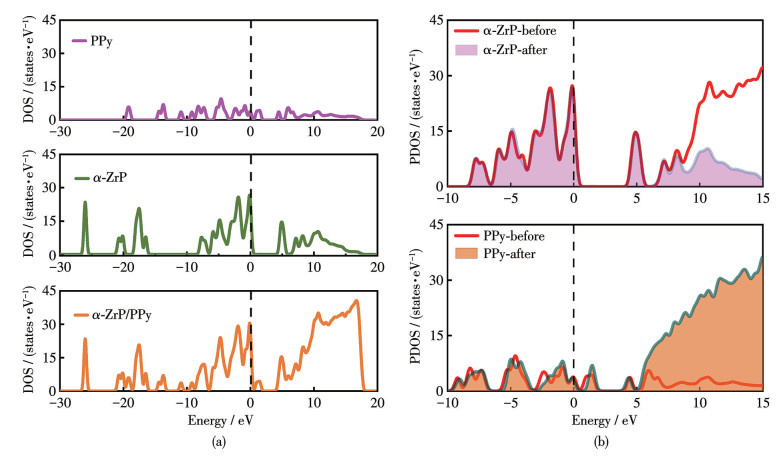
The distribution of electronic states near the Fermi level directly determines the electrochemical activity of the materials. Therefore, this section delves into the microscopic electronic structure of the α-ZrP and PPy interface through density of states (DOS) and projected DOS (PDOS) analyses[19]. As shown in Fig. 2a, significant energy level alignment and substantial orbital overlap are exhibited by α-ZrP and PPy near the Fermi level. This high degree of hybridization indicates the formation of abundant electron transfer pathways at the interface, significantly enhancing electron delocalization, thereby reducing contact resistance and improving the intrinsic electroactivity of the system. Furthermore, the atomic orbitals of PPy display a high electron occupancy in the conduction band, indicating that the PPy component significantly enhances the overall electrochemical reaction capability of the composite system.
Figure 2
Figure 2.
(a) DOS for PPy, α-ZrP, and α-ZrP/PPy; (b) PDOS before and after the composite of α-ZrP and PPy
The vertical dashed line in the figure represents the Fermi level, with all energy values referenced to this level as the zero point.
Mulliken population analysis further reveals the interfacial charge transfer mechanism. The calculated results show that approximately 0.58|e| is transferred from PPy to α-ZrP, indicating that significant charge transfer occurs in the interface. This interface-coupling-induced charge redistribution not only reflects the strong interaction between the two components, but also leads to the formation of an internal electric field directed from PPy to α-ZrP at the interface[20]. Driven by this internal electric field, the local electron density on the surface O atoms of α-ZrP is markedly increased, thereby effectively modulating the electronic structure and enhancing the Lewis basicity, which significantly improves the coordination capability toward Pb2+. Thus, it is demonstrated that the deep regulation of the interfacial electronic structure fundamentally activates the coordination activity of O sites, serving as the key driving force for the composite system to overcome the limitations of single components and achieve efficient Pb2+ capture.
A comparison of the PDOS before and after composite formation (Fig. 2b) reveals that, influenced by interfacial charge exchange, the DOS of α-ZrP shifts towards lower energy levels compared to PPy, with a noticeable decrease in the peak intensity of the antibonding orbitals. This evolution of energy levels indicates that the electronic interactions between α-ZrP and PPy effectively suppress the adverse effects of antibonding states, thus enhancing the structural stability of the interface[21-22].
To quantitatively evaluate the dynamics of charge carrier transport, the effective mass of electrons (m*) was calculated based on the following formula:
where $\hbar $ denotes the reduced Planck constant, k represents the wave vector, and Ek refers to the corresponding energy eigenvalue. The results indicate that the effective masses for the α-ZrP/PPy composite and pure α-ZrP are 0.31m0 and 0.64m0, respectively. The smaller effective mass suggests a higher electron mobility at the interface, further corroborating the excellent electroactivity of the composite system.
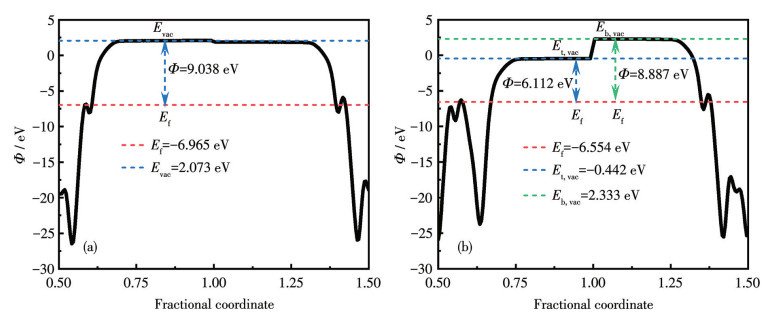
In addition, the electron emission capability of the system was quantitatively evaluated by calculating the work function (Φ=Evac-Ef, where Evac and Ef denote the vacuum level and the Fermi energy level, respectively)[23], as shown in Fig. 3. After the introduction of dipole correction, the electrostatic potential in the vacuum regions on both sides of the asymmetric α-ZrP/PPy composite tends to become flat; however, a pronounced spatially asymmetric dual-work-function characteristic is observed due to the compositional difference. Specifically, the work functions on the PPy side and the α-ZrP side are determined to be 6.112 and 8.887 eV, respectively. Driven by this potential difference, electrons are spontaneously transferred from the low-work-function PPy side to the high-work-function α-ZrP side, which induces interfacial charge redistribution and results in the formation of an internal electric field directed from PPy to α-ZrP. This result was in good agreement with the Mulliken charge analysis. Considering that the present study focused on the electroactive characteristics of the upper surface, subsequent comparisons were based on the work function of the upper surface. The calculations reveal that the work function of the α-ZrP/PPy upper surface (6.112 eV) is significantly reduced by 2.926 eV compared with that of pristine α-ZrP (9.038 eV), confirming that interfacial coupling effectively modulates the electron emission capability of the composite system. The reduction in work function indicates that electrons can more easily escape from the material surface or participate in surface reactions, thus demonstrating higher electronic activity for the composite material. Electrostatic potential distribution analysis further indicates that O atoms located at potential wells serve as electron acceptors, acting as active sites for the adsorption of cations[24], while the Zr and P atoms situated at potential peaks, due to their positive charge, exert repulsive forces on cations. This potential distribution facilitates the directional transport of ions.
Figure 3
Figure 3.
Work functions of (a) α-ZrP and (b) α-ZrP/PPy
Et, vac and Eb, vac represent the vacuum energy levels at the top and bottom surfaces of the system, respectively.
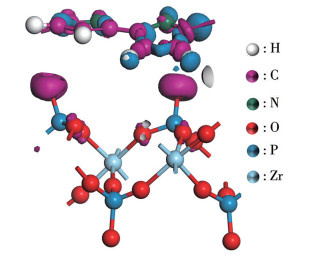
The differential charge density map (Fig. 4) visually demonstrates the charge rearrangement and accumulation of the electron cloud at the interface. A significant number of shared electrons are amassed in the α-ZrP and PPy interface region, indicating that the formation of strong chemical bonds is crucial for maintaining structural stability. In summary, the incorporation of PPy not only enhances the structural stability of α-ZrP through a supporting effect, more importantly, significantly strengthens the interfacial interactions via the formation of interfacial chemical bonds and the electron transfer-induced built-in electric field. This effectively improves the poor conductivity defects of pure α-ZrP, thereby substantially enhancing the electrochemical performance of the composite material. Based on these structural advantages and performance improvements, the α-ZrP/PPy system exhibits excellent characteristics as an electrochemical ion exchange material.
Figure 4
Figure 4.
Differential charge density map of the α-ZrP/PPy interface
Pink represents electron accumulation, and blue indicates electron depletion.
2.3
Adsorption configuration and mechanism of Pb2+ on the α-ZrP/PPy surface
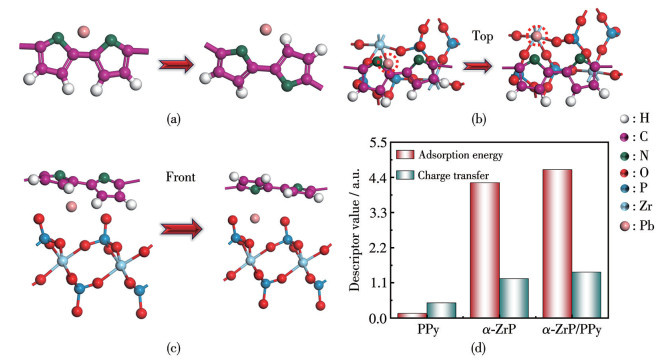
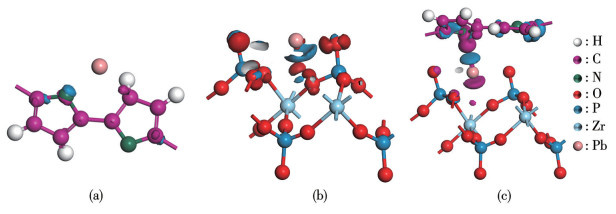
Given the decisive role of active sites in electrochemical ion-exchange materials, this study initially investigates the adsorption configurations of Pb2+ on the surfaces of PPy, α-ZrP, and the α-ZrP/PPy composite material. Based on the principle of surface symmetry, the adsorption behaviors of Pb2+ at the O bridge site (B) and O top site (T) on the α-ZrP surface, as well as at the nitrogen atom sites (N) between PPy chains, were examined (Fig. 5a-5c). For clarity, the Pb2+ adsorbed on PPy, α-ZrP, and α-ZrP/PPy systems are denoted as Pb2+@PPy, Pb2+@α-ZrP, and Pb2+@α-ZrP/PPy, respectively. The results of the structural optimization indicate that, whether in pure α-ZrP or the α-ZrP/PPy system, Pb2+ tends to stably adsorb at the Zr atom apex site while migrating towards the P—O surface layer. In contrast, the flipping phenomenon of the negatively charged N atoms in the pure PPy system reflects its weaker adsorption capability for Pb2+.
Figure 5
Figure 5.
Structural evolution of (a) PPy and (b, c) α-ZrP/PPy before and after Pb2+ adsorption; (d) Absolute values of Pb2+ adsorption energy and charge transfer for PPy, α-ZrP, and α-ZrP/PPy
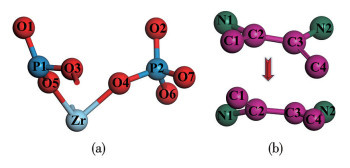
Adsorption energy calculations (Fig. 5d) indicate that the adsorption energies of Pb2+ on α-ZrP and α-ZrP/PPy are significantly higher than on pristine PPy, with the interfacial adsorption energy of the composite reaching -4.64 eV, confirming that the introduction of PPy enhances the adsorption performance. Further local structural analysis (Fig. 6, Table 1, Table 2) shows that the bond length variations of α-ZrP (P—O, Zr—O) and PPy (C—C, C—N) directly interacting with Pb2+ are all below 0.005 nm, demonstrating that the primary framework is maintained. At the inorganic/organic interface, the PPy chains are adjusted conformationally (∠C2—C3—N2 deviation of 5.842°) to optimize spatial matching with Pb2+, which facilitates the formation of a stable tridentate coordination, where Pb2+ is coordinated by two surface O atoms of α-ZrP and one N atom of PPy. These results suggest that the high adsorption energy is primarily attributed to the synergistic effect of interfacial multidentate cooperative coordination and local structural relaxation, rather than destructive chemical bond reconstruction, thus enabling efficient Pb2+ capture while avoiding lattice damage. Mulliken charge distribution analysis further indicates that the charge transfer amount in the α-ZrP/PPy system is markedly greater than that of other adsorbents. Based on this analysis, a universal criterion is established in this study: a significant positive correlation exists between the charge transfer amount and the adsorption energy[25].
Figure 6
Figure 6.
Schematic diagram of characteristic atomic labeling at the interface of Pb2+ adsorption in α-ZrP/PPy: (a) α-ZrP; (b) PPy
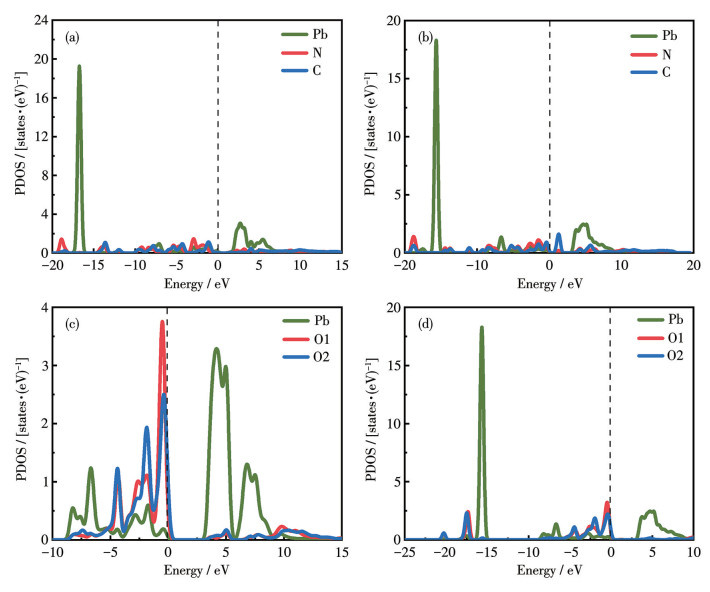
To investigate the microscopic mechanisms underlying the differences in adsorption energy of Pb2+ across various systems from an electronic structure perspective, PDOS analysis was conducted. As shown in Fig. 7a and 7b, no significant orbital overlap peaks were observed between the Pb atoms and PPy orbitals in the pure PPy system. However, upon the introduction of α-ZrP to form a composite system, slight hybridization between Pb and the C and N atoms was detected at the Fermi level, which strongly indicates that the incorporation of α-ZrP significantly enhances the interactions between PPy and Pb2+. Moreover, the PDOS analysis presented in Fig. 7c and 7d reveals excellent energy-level matching between the Pb6p and O2p orbitals within the energy range of -5 to 0 eV, elucidating the formation of Pb—O covalent bonds. Concurrently, the electronic difference density (EDD) results presented in Fig. 8 demonstrate substantial charge transfer between α-ZrP/PPy and Pb2+, further confirming the critical role of α-ZrP during the adsorption process.
Figure 7
Figure 7.
PDOS diagrams for (a) Pb2+@PPy, (b, d) Pb2+@α-ZrP/PPy, and (c) Pb2+@α-ZrP
The vertical dashed line in the figure represents the Fermi level, with all energy values referenced to this level as the zero point.
The comparison of electron density difference among the three systems in Fig. 8 reveals the intrinsic limitations of single-component adsorption. Specifically, the O sites in α-ZrP are constrained by insufficient local electron density, resulting in inadequate coordination driving force, while PPy, lacking strong coordination sites, can only provide relatively weak electrostatic interactions. In contrast, pronounced charge redistribution and exchange were observed between Pb2+ and the α-ZrP/PPy composite, indicating that the interfacial active sites enable efficient capture of target ions through effective electron transfer processes. Further analysis demonstrates that interfacial coupling not only regulates the electronic structure distribution of the system, but also reconstructs the local chemical environment of the active sites. As a result, the adsorption mode dominated by “isolated sites” in single components is overcome, and a stable binding microenvironment, driven synergistically by coordination bonding and charge interactions, is established, which is in good agreement with the aforementioned adsorption structure analysis.
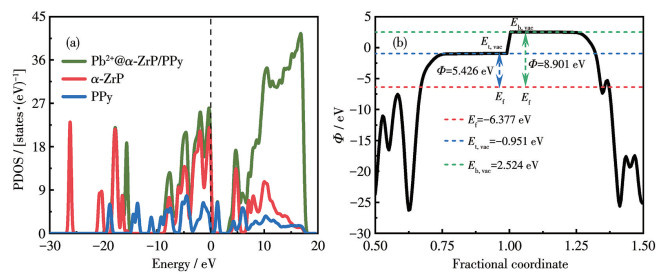
To further investigate the effects of Pb2+ adsorption on the electronic properties of the α-ZrP/PPy system, an in-depth analysis of the DOS and work function is conducted. As depicted in Fig. 9a, the PPy orbitals exhibit high activity and reactivity near the Fermi level, leading to a certain degree of geometric distortion of the PPy framework following adsorption, which is highly consistent with the results of structural optimization. The PDOS analysis indicates that the contributions of α-ZrP to the conduction band near the Fermi level are negligible, suggesting that its surface electronic states become saturated during the charge exchange process with Pb2+. Work function analysis (Fig. 9b) further demonstrates that the work function of the Pb2+@α-ZrP/PPy system is significantly reduced compared to that of the α-ZrP/PPy before adsorption. This indicates a decrease in the energy barrier required for charge transfer from the valence band to the conduction band edge, resulting in enhanced electronic activity.
Figure 9
Figure 9.
(a) PDOS diagrams for Pb2+@α-ZrP/PPy, α-ZrP, and PPy; (b) Work function of Pb2+@α-ZrP/PPy
(a) In panel a, the vertical dashed line in the figure represents the Fermi level, with all energy values referenced to this level as the zero point.
In summary, the efficient capture of Pb2+ by the α-ZrP/PPy composite is fundamentally attributed to the interfacial coupling-induced electronic structure reconstruction and the enhanced synergistic effect of multiple active sites. Specifically, the integration of the two components not only effectively expands the interfacial space and increases the number of surface active sites, but more importantly, the introduction of PPy significantly improves the degree of electron delocalization within the system. This optimization of the electronic structure enhances the electrical conductivity of the material and facilitates efficient electron transport between the α-ZrP and PPy channels, thereby markedly stabilizing the adsorption configuration of Pb2+ through the synergistic action of multiple active sites. Notably, the composite system retains excellent electroactivity after Pb2+ capture, which further confirms that the coupled interface is capable of achieving efficient adsorption while simultaneously maintaining superior electron transfer properties.
2.4
Kinetic behavior and energy barrier analysis of Pb2+ migration at the α-ZrP/PPy interface
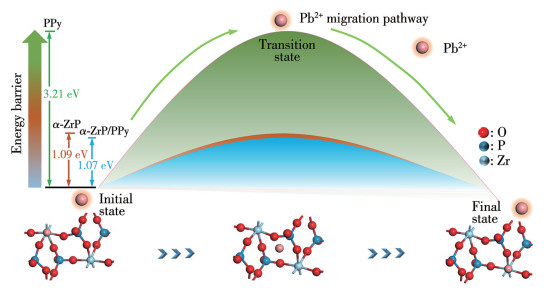
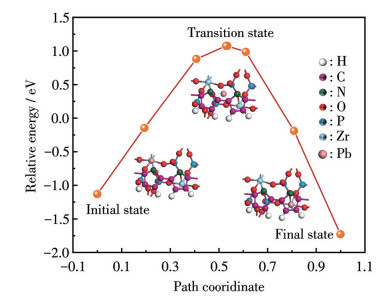
Given that ionic diffusion dynamics significantly constrain the adsorption/desorption rates of electroactive composites, this study, based on DFT calculations, deeply investigates the migration energy barrier and surface diffusion characteristics of Pb2+ [26]. By considering the geometric symmetry of the adsorption sites, a diffusion pathway was constructed, illustrating the migration of Pb2+ from a stable adsorption site on the α-ZrP surface to a neighboring active site. The simulation results (Fig. 10 and 11) indicate that Pb2+ completes the diffusion between sites along a unimodal potential energy surface, with only one intermediate state along the pathway. Notably, compared with pristine PPy, the migration energy barrier of Pb2+ on the α-ZrP surface is significantly reduced to only 1.09 eV. This behavior is primarily attributed to the pronounced difference in structural order between the two materials. In contrast to the random and constrained diffusion pathways in the disordered PPy network, the layered and ordered framework of α-ZrP offers well-defined adsorption sites and low-energy diffusion channels, enabling efficient two-dimensional migration of Pb2+ along specific directions. This reduces steric hindrance and enhances cooperative ion transport, thereby markedly improving diffusion kinetics while providing abundant ion storage sites. Further analysis reveals that the α-ZrP/PPy composite retains diffusion pathways and energy barriers comparable to those of the α-ZrP matrix. This indicates that high-energy migration pathways are effectively suppressed under ambient conditions and contribute negligibly to the overall diffusion process. Moreover, the introduction of PPy does not compromise the intrinsic ion diffusion characteristics of α-ZrP, highlighting its ability to retain excellent kinetic performance within the composite system.
Figure 10
Figure 10.
Schematic diagram of the energy barrier for the transport of Pb2+ at the surfaces of PPy, α-ZrP, and α-ZrP/PPy
Based on the aforementioned data, it is concluded that the electroactive material, constructed from the α-ZrP rich in adsorption sites and the highly electroactive PPy, achieves a synergistic enhancement in ion adsorption capacity and mobility. The ion migration channel formed at the α-ZrP/PPy interface exemplifies high efficiency, comparable to a “highway”. Meanwhile, the dynamic charge balance maintained between Pb2+, α-ZrP, and PPy provides the essential driving force and assurance for the rapid transport of ions.
3.
Conclusions
This study employed DFT computational methods to systematically investigate the adsorption behavior and diffusion dynamics of Pb2+ at the α-ZrP/PPy composite interface. The findings indicate that the introduction of PPy forms an internal electric field by modulating the electronic distribution at the interface, significantly enhancing the negative charge of the α-ZrP surface and the structural stability of the composite material. Benefiting from the coupled interfacial “multi-site cooperative coordination” mode in conjunction with interfacial electronic structure regulation, a strong adsorption energy as high as -4.64 eV is achieved in the composite system. Furthermore, the dynamic charge balance mechanism established between Pb2+ and the α-ZrP/PPy interface effectively ensures rapid ion transport, thereby improving its ion removal efficiency. This paper provides a theoretical framework for understanding the adsorption and migration mechanisms of Pb2+ from an electronic structural perspective, offering guidance for the development of high-performance heavy metal ion adsorption materials.
Acknowledgments:
This original work was financially supported by the Youth Scientific Research Project of Basic Research Program of Shanxi Province (Grant No.202403021222364), Science and Technology Innovation Project of the Higher Education institutions of Shanxi Province (Grant No.2024L378), and the Doctoral Starting Research Foundation of Taiyuan University (Grant No.24TYKY213).
Conflicts of interest: All authors claimed no competing interests.
[1]
SAHARI N S, SHAHIR S, IBRAHIM Z, HASMONI S H, ALTOWAYTI W A H. Bacterial nanocellulose and its application in heavy metals and dyes removal: A review[J]. Environ. Sci. Pollut. R, 2023, 30(51): 110069-110078 doi: 10.1007/s11356-023-30067-w
[2]
KOLLER M, SALEH H M. Introductory chapter: Introducing heavy metals[J]. Heavy Metals, 2018, 1: 3-11
[3]
ZHANG X F, PEI T, GAO F F, DU X, ZHANG Z L, XING L, LIU Z, LI J, HAO X G. Multiphysics and multizone modeling of electrically switched ion exchange with self-driven adsorption for Li+ extraction[J]. AIChE J., 2025, 71(5): e18778 doi: 10.1002/aic.18778
[4]
ZHANG Y T, LUO Q L, GAO F F, LUO X, MA Y Q, HUANG X L, WANG X Y. Confined-structured bismuth oxybromide-based polyaniline composite film electrodes for highly efficient and selective bromine ion extraction from oilfield brine[J]. Desalination, 2025, 613: 118966 doi: 10.1016/j.desal.2025.118966
[5]
CHENG T H, SANKARAN R, SHOW P L, OOI C W, CHANG Y K. Removal of protein wastes by cylinder-shaped NaY zeolite adsorbents decorated with heavy metal wastes[J]. Int. J. Biol. Macromol., 2021, 185: 761-772 doi: 10.1016/j.ijbiomac.2021.06.177
[6]
SAMIEY B, CHENG C H, WU J N. Organic-inorganic hybrid polymers as adsorbents for removal of heavy metal ions from solutions: A review[J]. Materials, 2014, 7(2): 673-726 doi: 10.3390/ma7020673
[7]
SONG H J, HUO M Z, ZHOU M M, CHANG H E, LI J R, ZHANG Q X, FANG Y X, WANG H X, ZHANG D. Carbon nanomaterials-based electrochemical sensors for heavy metal detection[J]. Crit. Rev. Anal. Chem., 2024, 54(7): 1987-2006 doi: 10.1080/10408347.2022.2151832
[8]
MAKHRAMOV I A, AFONINA A P, BURYKINA O V. Sorption of a mixture of heavy metal ions by clay rocks of the Bryansk oblast[J]. Russ. J. Phys. Chem. A, 2024, 98(7): 1615-1620 doi: 10.1134/S0036024424700638
[9]
BEIGI Z K, LARKI A, NASIRI E. Survey of a heteropoly acid-based organic-inorganic magnetic hybrid for effective removal of heavy metal ions from wastewater[J]. Inorg. Chem. Commun., 2025, 177: 114446 doi: 10.1016/j.inoche.2025.114446
[10]
GAN W X, ZHENG Z Y, YAN J W, HE X, ZHUANG Z Y, CHEN F F, YU Y. Vertical MOF film supported on an organic-inorganic mixed substrate for complex wastewater purification[J]. Appl. Surf. Sci., 2024, 652: 159253 doi: 10.1016/j.apsusc.2023.159253
[11]
YANG X Q, JI Y H, JIAN M P, MENG N N, ZHU Y J, TAN C H, LI H Y. Fabrication of metal-organic frameworks macro-structures for adsorption applications in water treatment: A review[J]. Sep. Purif. Technol., 2025, 354: 129376 doi: 10.1016/j.seppur.2024.129376
[12]
JIANG P J, PAN B J, PAN B C, ZHANG W M, ZHANG Q R. A comparative study on lead sorption by amorphous and crystalline zirconium phosphates[J]. Colloid Surf. Physicochem. Eng. Asp., 2008, 322(1): 108-112
[13]
陈如意, 张朋乐, 廖森梁, 李馨然, 王忠德, 郝晓刚. 电化学法控制聚吡咯/α-磷酸锆/碳毡电极去除水中低浓度铅离子[J]. 电化学, 2015, 21(4): 344-352CHEN R Y, ZHANG P L, LIAO S L, LI X R, WANG Z D, HAO X G. The electrochemical method for controlling the removal of low-concentration lead ions from water using polypyrrole/α-zirconium phosphate/carbon felt electrodes[J]. J. Electrochem., 2015, 21(4): 344-352
[14]
顾君阳, 杜申圳, 余钱红, 牟婉君. α-磷酸锆插层复合材料制备及其对Cs+吸附性能的研究[J]. 化学研究与应用, 2020, 32(6): 1067-1071GU J Y, DU S Z, YU Q H, MOU W J. Preparation of α-zirconium phosphate intercalated composite materials and their adsorption performance for Cs+[J]. Chem. Res. Appl., 2020, 32(6): 1067-1071
[15]
MU W J, CHEN B H, YU Q H, LI X L, WEI H Y, YANG Y C, PENG S M. A novel zirconium phosphonate adsorbent for highly efficient radioactive cesium removal[J]. J. Mol. Liq., 2021, 326: 115307 doi: 10.1016/j.molliq.2021.115307
[16]
SAMSUDIN I B, GOH L Z W, JAENICKE S, CHUAH G K. Polymer-encapsulated crystalline zirconium phosphates as NH4+ and K+ ion exchangers for application in sorbent dialysis cartridges[J]. J. Water Process Eng., 2022, 49: 102971 doi: 10.1016/j.jwpe.2022.102971
[17]
高凤凤, 陈如意, 杜晓, 郝晓刚. 聚苯胺/α-磷酸锆电控膜高效去除水中微量镉离子[J]. 水处理技术, 2022, 48(11): 31-34, 40GAO F F, CHEN R Y, DU X, HAO X G. Polyaniline/α-zirconium phosphate electrochemical membrane for the efficient removal of trace cadmium ions from water[J]. Technol. Water Treat., 2022, 48(11): 31-34, 40
[18]
LI T T, HE C, ZHANG W X. Electric field improved the sensitivity of CO on substitutionally doped antimonene[J]. Appl. Surf. Sci., 2018, 427: 388-395 doi: 10.1016/j.apsusc.2017.07.170
[19]
SEGALL M, SHAH R, PICKARD C, PAYNE M. Population analysis of plane-wave electronic structure calculations of bulk materials[J]. Phys. Rev. B, 1996, 54(23): 16317-16320 doi: 10.1103/PhysRevB.54.16317
[20]
LEE K P, ARNOT T C, MATTIA D. A review of reverse osmosis membrane materials for desalination-development to date and future potential[J]. J. Membr. Sci., 2011, 370(1/2): 1-22
[21]
WANG Y, LI X Y, QIN Y Y, ZHANG D Y, SONG Z X, DING S J. Local electric field effect of montmorillonite in solid polymer electrolytes for lithium metal batteries[J]. Nano Energy, 2021, 90: 106490 doi: 10.1016/j.nanoen.2021.106490
[22]
JEON Y M, KIM S, LEE M, LEE W B, PARK J H. Polymer-clay nanocomposite solid-state electrolyte with selective cation transport boosting and retarded lithium dendrite formation[J]. Adv. Energy Mater., 2020, 10(47): 2003114 doi: 10.1002/aenm.202003114
[23]
ZHANG X C, LI T, GUAN M H, LI R, LIU J X, WANG Y W, ZHANG C M, FAN C M. DFT insights into the migration of effective electrons towards O2 for ·OH formation over electron-rich sites on BiOBr (001) surface[J]. Appl. Surf. Sci., 2021, 567: 150828 doi: 10.1016/j.apsusc.2021.150828
[24]
PIRILLO S, LUNA C R, LOPEZ-CORRAL I, JUAN A, AVENA M J. Geometrical and electronic properties of hydrated sodium montmorillonite and tetracycline montmorillonite from DFT calculations[J]. Phys. Chem. C, 2015, 119(28): 16082-16088 doi: 10.1021/acs.jpcc.5b04061
[25]
CHEN X, PENG H J, ZHANG R, HOU T Z, HUANG J Q, LI B, ZHANG Q. An analogous periodic law for strong anchoring of polysulfides on polar hosts in lithium sulfur batteries: S-or Li-binding on first-row transition-metal sulfides[J]. ACS Energy Lett., 2017, 2(4): 795-801 doi: 10.1021/acsenergylett.7b00164
[26]
LI T T, HE C, ZHANG W X. A novel porous C4N4 monolayer as a potential anchoring material for lithium-sulfur battery design[J]. J. Mater. Chem. A, 2019, 7(8): 4134-4144 doi: 10.1039/C8TA10933H
Scheme 1
Schematic diagram of the adsorption-migration mechanism of Pb2+ at the α-ZrP/PPy composite interface: (a) electron transfer and built-in electric field direction at the interface of α-ZrP/PPy; (b) adsorption sites and migration pathways of Pb2+
Figure 5
Structural evolution of (a) PPy and (b, c) α-ZrP/PPy before and after Pb2+ adsorption; (d) Absolute values of Pb2+ adsorption energy and charge transfer for PPy, α-ZrP, and α-ZrP/PPy



 下载:


 下载:


 下载: