
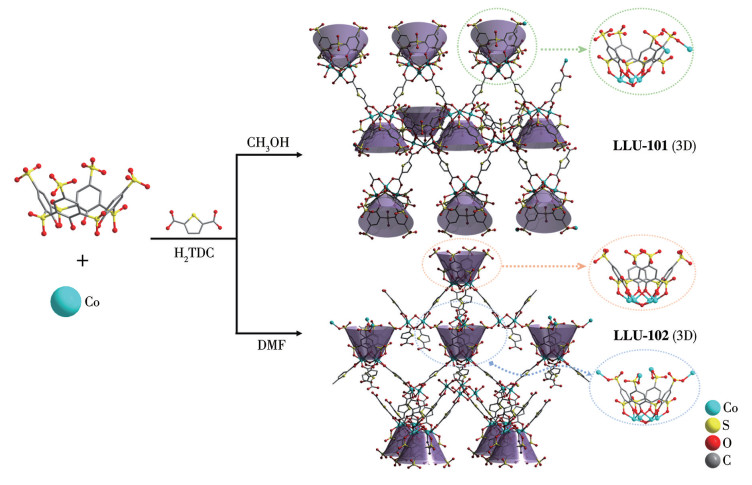
Scheme 1.
Synthetic route of LLU-101 and LLU-102


Supramolecular coordination complexes (SCCs) are discrete molecular entities formed through the self-assembly of metal ions or metal clusters and ligands[1-2]. These complexes represent a fusion of inorganic and supramolecular chemistry, focusing on self-assembled systems in which metal-based units are connected via coordination bonds and other intermolecular interactions. SCCs integrate the common characteristics of both coordination and supramolecular complexes, not only incorporating the diverse physical and chemical properties of metal ions/clusters, but also introducing well-established methodologies of organic synthesis and versatile strategies for structural design and modification. This synergy offers more choices for the rapid development of supramolecular synthesis technologies. As a result, SCCs demonstrate outstanding performance across multiple fields, including optics[3], proton conductivity[4-5], magnetism[6], catalysis[7-9], host-guest chemistry[10-11], gas storage and separation[12-13], nanoreactors[14-15], drug delivery[16-17], and molecular sensing[18-19].
Calixarenes are a classic class of macrocyclic complexes with cavity structures, composed of multiple phenol units connected through bridging groups at the ortho positions of the phenolic hydroxyl groups[20-21]. Due to their unique chemical structures and rich physical/chemical properties, calixarenes represent the third generation of supramolecular host compounds, following crown ethers and cyclodextrins. p-Sulfosulfonylcalix[4]arene (H8TC4AS-SO2)[22-24], a subclass of the calix[n]arene family, features sulfonate groups at the upper rim, four phenolic hydroxyl oxygen atoms at the lower rim, and sulfonyl bridging groups, providing multiple coordination sites for the construction of novel structures with metal ions[25-35]. Meanwhile, metal ions can also coordinate with auxiliary ligands possessing multiple coordination sites, thereby forming novel supramolecular complexes with diverse structures.
It is well known that in the construction of coordination complexes, besides the main and auxiliary ligands, the type of solvent also exerts a significant influence on the crystallization process, coordination geometry, and final structure of the coordination complexes, such as the polarity, volume ratio, proticity, coordination ability, and hydrogen-bonding interactions with ligands of solvent[36-40]. For example, when constructing supramolecular architectures employing TC4AS-SO2 as the main ligand, altering the solvent types can effectively change the way the main ligand coordinates, resulting in a variety of novel structures[25-35]. Under aqueous solvent conditions, the main ligand adopts diverse coordination behaviors: through the upper rim, the lower rim, or both edges simultaneously, giving rise to diverse zero-dimensional low-core cluster structures[25-27]. However, using methanol as a solvent enables TC4AS-SO2 to coordinate with transition metals, yielding an anionic {Co24} coordination cage[28-35].
Inspired by the significant influence of solvent regulation on the construction of calixarene-based complexes and the diverse coordination modes of functional auxiliary ligands, this work employs H8TC4AS-SO2 as the main ligand and thiophene-2,5-dicarboxylic acid (H2TDC) as a bridging ligand. These components react with Co2+ ions under solvothermal conditions. The present study aims to construct multifunctional coordination cage complexes through a synthetic approach analogous to that employed for p-tert-butylsulfonylcalix[4]arene (H4TC4A-SO2), auxiliary ligands, and metal ions[41]. Remarkably, solvent modulation led to the successful synthesis of both 2D layers and 3D network architectures, in which the upper and lower rims of (H4TC4AS-SO2)4-, as well as TDC2-, participate in coordination with cobalt metal ions (Scheme 1). Methanol with relatively high polarity promotes the formation of layered structures, resulting in {[(CH3)4N]4[Co3(μ3-O)(H4TC4AS-SO2)]2(TDC)2·2H2O·67CH3OH}n (denoted LLU-101, LLU=Lyuliang University), while DMF with lower polarity facilitates the assembly of more compact and interconnected 3D frameworks: {[(CH3)4N]2[Co3(μ4-O)(H4TC4AS-SO2)0.5(TDC)2]·32DMF}n (LLU-102). The syntheses, structures, and magnetic properties of these complexes are reported and discussed herein.
H8TC4AS-SO2 was prepared according to the reported synthetic methods in the literature[22-24]. The synthetic procedure is provided in the Supporting information, and the corresponding synthetic route is illustrated in Fig.S1 and S2. H2TDC was purchased from Aladdin Reagent Company. Other commercial reagents and raw materials used in this study were all of analytical grade and were directly used without further purification. Elemental analysis (C, H, S) was carried out on a Perkin-Elmer 2400 elemental analyzer. Scanning electron microscopy (SEM) images and energy-dispersive X-ray spectroscopy (EDS) mapping were obtained using a Zeiss Sigma 300, Oxford Instruments Xplore30 spectrometer. The thermogravimetric (TG) curve was determined on a Netzsch STA 449F3 thermogravimetric analyzer under an air atmosphere with a heating rate of 10 ℃·min-1, from room temperature to 800 ℃. Fourier transform infrared spectroscopy (FTIR) was measured using a Bruker IFS 66V/SFT/IR infrared spectrometer in the range of 400-4 000 cm-1 with KBr pellets. Variable-temperature magnetic susceptibility was measured using a Quantum Design MPMS XL-5/7 SQUID instrument at a fixed magnetic field strength of 1000 Oe, with the temperature range from 2.0 to 300 K. Single-crystal X-ray diffraction analysis was performed on a Bruker D8 QUEST (Cu Kα, λ=0.154 178 nm) single-crystal diffractometer from Bruker AXS GmbH, Germany.
H8TC4AS-SO2 (0.047 g, 0.05 mmol), CoCl2·6H2O (0.05 g, 0.2 mmol), CoSO4·7H2O (0.03 g, 0.11 mmol), H2TDC (0.026 g, 0.15 mmol), tetramethylammonium bromide (0.01 g, 0.06 mmol), and CH3OH (2.0 mL) were mixed evenly and then transferred successively into a 20 mL stainless steel autoclave with a polytetrafluoroethylene lining. The autoclave lid was immediately screwed on, and the mixture was heated at 130 ℃ for 72 h in a constant temperature oven. Then, it was slowly cooled to room temperature at a rate of 4 ℃·h-1, and red block crystals of LLU-101 were obtained. The crystals were separated and collected by filtration, washed with CH3OH solvent, and dried in air, with a yield of approximately 43% (based on H8TC4AS-SO2). The molecular formula of complex LLU-101 analyzed was {[(CH3)4N]4[Co3(μ3-O)(H4TC4AS-SO2)]2(TDC)2·2H2O·67CH3OH}n. Elemental analysis Calcd. for C143H348Co6O127N4S18(%): C 33.76, H 6.90, S 11.35, N 1.10; Found(%): C 32.85, H 6.14, S 11.36, N 1.45. FTIR (cm-1): 3 429 (w), 2 962 (s), 2 868 (w), 1 654 (m), 1 554 (w), 1 528 (w), 1 479 (w), 1 458 (m), 1 441 (w), 1 385 (s), 1 305 (m), 1 281 (w), 1 257 (s), 1 232 (w), 1 135 (m), 966 (w), 902 (w), 890 (s), 837 (s), 800 (m), 768 (m), 749 (s), 736 (w), 636 (w), 616 (m), 544 (m) (Fig.S3a).
LLU-102 was synthesized using the same method as LLU-101, except N,N-dimethylformamide (DMF) (2.0 mL) was used instead of methanol. Light red block crystals of LLU-102 were obtained. The crystals were separated by filtration, washed with DMF, and dried in air, with a yield of 44% (based on H8TC4AS-SO2). The molecular formula of complex LLU-102 was {[(CH3)4N]2[Co3(μ4-O)(H4TC4AS-SO2)0.5(TDC)2]·32DMF}n. Elemental analysis Calcd. for C128H258Co3O53N34S6(%): C 44.04, H 7.45, S 5.51, N 13.64; Found(%): C 42.85, H 7.40, S 4.88, N 13.62. FTIR (cm-1): 3 432 (w), 1 659 (m), 1 559 (s), 1 478 (m), 1 436 (w), 1 381 (w), 1 312 (m), 1 261 (w), 1 187 (m), 1 139 (m), 1 038 (s), 948 (s), 881 (s), 778 (w), 767 (w), 756 (m), 718 (m), 623 (s), 528 (w) (Fig.S3b).
The single-crystal diffraction data of complexes LLU-101 and LLU-102 were collected using a Bruker D8 QUEST (Cu Kα, λ=0.154 178 nm) instrument, and the diffraction data were subjected to reduction and absorption correction. The crystal structures of complexes were solved by the direct method and refined by the full-matrix least-squares method based on F 2 (SHELXL-2025)[42-44]. All non-hydrogen atoms in the crystal structures were refined anisotropically. For the carbon atoms in the structures, theoretical hydrogen atoms were added using a riding model, while for nitrogen and oxygen atoms, hydrogen atoms were added manually. Some disordered solvent molecules in the structures of complexes LLU-101 and LLU-102 could not be located and were processed using the “SQUEEZE” command in the PLATON software to remove the unidentified solvent molecules from the structures[45]. The crystal refinement parameters are shown in Table 1. The selected bond lengths and angles of complexes LLU-101 and LLU-102 are illustrated in Table S1 and Table S2.

 下载:
导出CSV
| Parameter | LLU-101 | LLU-102 |
| Formula | C143H348Co6O127N4S18 | C128H258Co3O53N34S6 |
| Formula weight | 5 087.01 | 3 490.80 |
| Crystal system | Triclinic | Tetragonal |
| Space group | P1 | P4/n |
| a / nm | 1.485 74(9) | 1.881 63(3) |
| b / nm | 2.164 55(13) | 1.881 63(3) |
| c / nm | 2.603 35(19) | 3.061 92(7) |
| α / (°) | 91.901(4) | |
| β / (°) | 99.687(4) | |
| γ / (°) | 101.781(4) | |
| V / nm3 | 8.059 2(9) | 10.840 8(4) |
| Z | 2 | 8 |
| T / K | 190 | 190 |
| Dc / (g·cm-3) | 1.212 | 1.409 |
| μ / mm-1 | 7.536 | 9.863 |
| F(000) | 2 988 | 4 664 |
| Total reflection | 23 880 | 50 472 |
| Unique reflection | 3 029 | 1 233 |
| Rint | 0.189 7 | 0.104 0 |
| GOF | 1.134 | 1.371 |
| Final R indices [I>2σ(I)] | R1=0.165 9, wR2=0.342 2 | R1=0.149 6, wR2=0.292 7 |
| R indices (all data) | R1=0.213 0, wR2=0.366 4 | R1=0.160 3, wR2=0.299 3 |
| aR1=∑||Fo|-|Fc||/∑|Fo|; bwR2=∑[w(Fo2-Fc2)2]/∑[w(Fo2)2]1/2. | ||
Complex LLU-101 crystallizes in the triclinic system, with the space group P1. As shown in Fig.S4 and S5, complex LLU-101 forms a 2D layered structure through the bridging of {Co3-H4TC4AS-SO2} secondary building units (SBUs) (Fig. 1a) and TDC2- units (Fig. 1b). Three adjacent Co2+ ions form a triangular planar Co3 cluster, and the Co2+ ions are connected by three phenolic hydroxyl oxygen atoms at the bottom end and one oxygen atom from the bridging sulfonyl group of the (H4TC4AS-SO2)4- ion. {Co3-H4TC4AS-SO2} SBU exhibits a cone conformation, resembling a shuttlecock with the bottom of the three adjacent Co2+ ions capped by a μ3-O atom (Fig. 1a). As illustrated in Fig. 1c, each Co2+ ion adopts a distorted octahedral coordination geometry. However, the Co2+ ions have two coordination environments: Co1 and Co3 share the same coordination environment, involving two phenolic hydroxyl oxygen atoms from (H4TC4AS-SO2)4-, one oxygen atom of the bridging sulfonyl group, one μ3-O oxygen atom, one oxygen atom from the bridging ligand TDC2-, and one oxygen atom from the sulfonate group at the upper rim in the adjacent (H4TC4AS-SO2)4- ion. In contrast, Co2 differs from Co1 and Co3 in that it is not coordinated with the sulfonate oxygen atom from the upper rim of (H4TC4AS-SO2)4-, but is coordinated with an oxygen atom from another bridging ligand TDC2-. As shown in Table S3, according to the valence bond sum theory calculation, all metal cobalt ions in this complex are divalent[46-48]. Each {Co3-H4TC4AS-SO2} SBU, as a vertex, is connected in a four-connected manner to two bridging ligands TDC2- and the sulfonate groups at the upper rim in two other (H4TC4AS-SO2)4- ions (Fig. 1c), while each bridging ligand TDC2-, as a two-connected linear edge, connects two {Co3-H4TC4AS-SO2} SBUs through the carboxyl oxygen atoms in the TDC2- ligand (Fig. 1d). Therefore, each asymmetric unit consists of two {Co3-H4TC4AS-SO2} SBUs and two bridging ligands TDC2-, forming a complete structural unit (Fig. 1e and 1f).
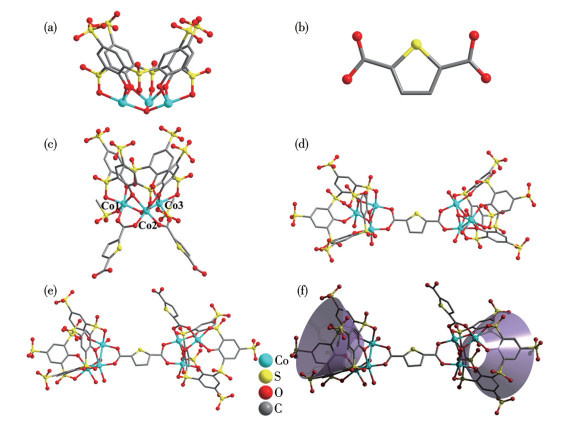
The hydrogen atoms are removed for clarity.
The asymmetric unit shown in Fig. 1e and 1f contains carboxylate groups from the TDC2- ligands on both the left and right sides of the supramolecular structure containing four {Co3-H4TC4AS-SO2} SBUs (red circles in Fig. 2a), as well as coordination sites formed by the coordination between the metal Co ions and the sulfonate groups at the upper rim of (H4TC4AS-SO2)4- (light blue circles in Fig. 2a). These coordination sites are equivalent to one (H4TC4AS-SO2)4- ion, facilitating their connection to form shuttlecock-like structures in an “upper-lower” arrangement (Fig. 2d). The “upper-lower” shuttlecock-like structures can further connect on both sides, resulting in the formation of multiple “upper-lower” shuttlecock-like units (the middle parts of Fig. 2b and 2c). The “upper-lower” shuttlecock-like structures are linked to TDC2- ligands above and below, and the carboxylate groups of the TDC2- ligands continue to connect with the {Co3-H4TC4AS-SO2} SBU, allowing the structure to extend repetitively in a 2D manner.
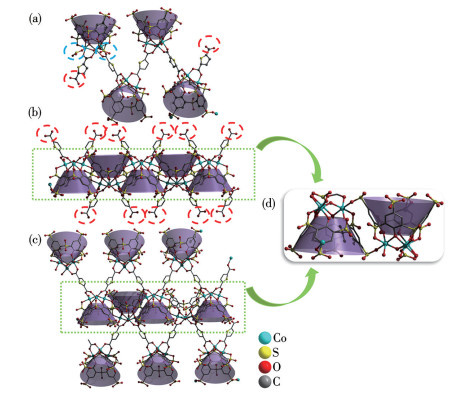
The hydrogen atoms are removed for clarity.
As shown in Fig.S4 and S5, viewed along the a-axis direction of the unit cell, the 2D layers stack on top of each other through non-covalent interactions and a shape match between the two shuttlecock units of opposite orientations in adjacent layers. This packing mode still leaves some gaps between the adjacent layers due to the irregular shape of the shuttlecock-like SBUs.
Complex LLU-102 crystallizes in the tetragonal system, with the space group P4/n. As illustrated in Fig. 3, in the structure of LLU-102, four adjacent cobalt ions form a square-planar Co4 nuclear cluster and are connected by four phenolic hydroxyl oxygen atoms at the lower end and two oxygen atoms from the bridging sulfonyl group of the (H4TC4AS-SO2)4- ion in a cone conformation. Finally, a {Co4-H4TC4AS-SO2} SBU resembling a shuttlecock is formed, with the bottom of the four adjacent cobalt ions capped by a μ4-O atom (Fig. 3a). As depicted in Fig. 3c and 3d, each central Co2+ ion in this structure adopts a distorted octahedral geometry. However, the Co ions exhibit two distinct coordination environments. Taking Co1 as an example, the coordination environment of the four Co2+ ions at the bottom of the shuttlecock-like {Co4-H4TC4AS-SO2} is coordinated by two phenolic hydroxyl oxygen atoms and two oxygen atoms of the bridging sulfonyl group from (H4TC4AS-SO2)4-, one μ4-O oxygen atom, and one oxygen atom from the bridging ligand TDC2-. In contrast, the coordination environment of Co2 in the structure is as follows: it is coordinated by two oxygen atoms from one bridging ligand TDC2-, two oxygen atoms from another two bridging ligands TDC2-, one μ2-O oxygen atom, and an oxygen atom from the sulfonate group at the upper rim of (H4TC4AS-SO2)4-. As seen from Table S4, according to the valence bond theory calculation, all metal cobalt ions in this complex are divalent[46-48]. Each {Co4-H4TC4AS-SO2} SBU, as a vertex, is connected to four bridging ligands TDC2- in a four-connected manner (Fig. 3c). Each bridging ligand TDC2- has two different coordination environments. From Fig. 3e, it is shown that the carboxylate oxygen atoms at one end of the bridging ligand TDC2- are all monodentately coordinated, connecting with two different Co2+ ions, while the carboxylate oxygen atoms at the other end are also monodentately coordinated, but coordinated with a single Co2+ ion. Fig. 3f demonstrates that the carboxylate oxygen atoms at both ends of the bridging ligand TDC2- have the same coordination mode, meaning they are respectively coordinated with different metal center Co2+ ions.
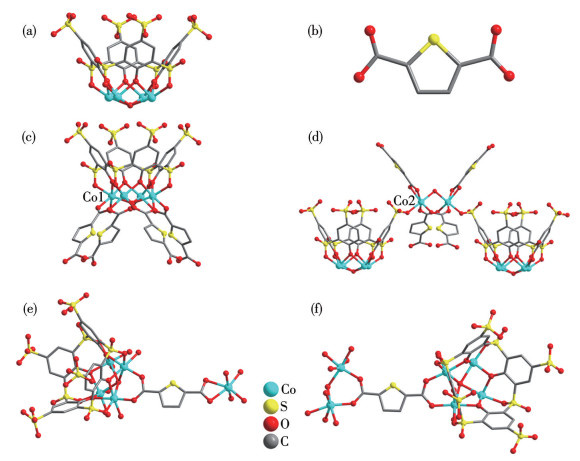
The hydrogen atoms are removed for clarity.
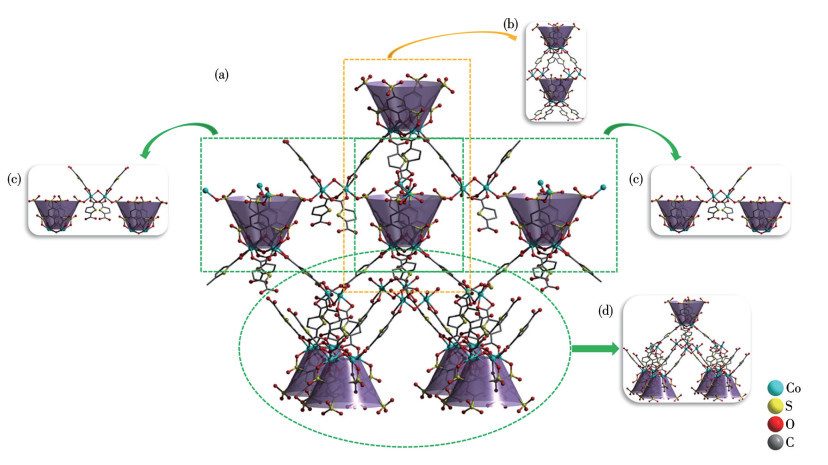
As shown in Fig. 4a, a “hierarchical” layer is formed through the four-connected mode of {Co4-H4TC4AS-SO2} SBUs, the diverse coordination modes of the bridging ligand TDC2-, the varying coordination environments of the metal center Co2+ ions, and the coordination characteristics of the oxygen atoms in the sulfonate groups at the upper rim of (H4TC4AS-SO2)4-. This “hierarchical” structure is further connected by the segments illustrated in Fig. 4b-4d. In this arrangement, each {Co4-H4TC4AS-SO2} SBU is connected to four bridging ligands, TDC2-. Then, the TDC2- ligands are connected to the Co2+ ions, which continue to coordinate with the oxygen atoms in the sulfonate groups at the upper rim of (H4TC4AS-SO2)4-, forming a “capsule-like” structure of double {Co4-H4TC4AS-SO2} SBUs (Fig. 4b). The metal centers in the coordination environment of two Co2 ions are connected to four TDC2- ligands and two {Co4-H4TC4AS-SO2} SBUs on both sides, resulting in a “balance pan” structure of double {Co4-H4TC4AS-SO2} SBUs (Fig. 4c). The tetracoordination formed by the sulfonate oxygen atoms at the upper rim of the {Co4-H4TC4AS-SO2} SBU and the four-connected mode formed by the TDC2- ligands at the bottom end endow the {Co4-H4TC4AS-SO2} SBU with an eight-connected mode. The four TDC2- ligands at the lower end continue to connect four inverted {Co4-H4TC4AS-SO2} SBUs through the Co2+ ions, finally forming a “four-wheel” structure (Fig. 4d).
The hydrogen atoms are removed for clarity.
As depicted in Fig.S6 and S7, the “capsule-like”, “balance pan”, and the “four-wheel” structures are interconnected to form a unified “hierarchical” network. Due to the supramolecular interactions between the molecules of the formed “hierarchical” structure, a non-covalent 3D network structure with a tightly combined “hierarchy” is finally formed. LLU-102 forms a tightly packed structure, leaving a small channel of 0.42 nm×0.33 nm running along the (110) direction (Fig.S8).
We further investigated the structural characteristics of complexes LLU-101 and LLU-102. As shown in Fig. 5, under varying solvent conditions, the (H4TC4AS-SO2)4- ions and H2TDC bridging ligands in these two complexes exhibit multiple coordination modes, resulting in distinct structural features for LLU-101 and LLU-102. In the structure of LLU-101, three phenolic hydroxyl oxygen atoms at the lower rim of the (H4TC4AS-SO2)4- ion and the oxygen atoms from three bridging sulfonyl groups coordinate with three Co2+ ions, forming a {Co3} trinuclear cluster (Fig. 5a). However, in the structure of LLU-102, four phenolic hydroxyl oxygen atoms at the lower rim of the (H4TC4AS-SO2)4- ion and the oxygen atoms from four bridging sulfonyl groups coordinate with four Co2+ ions, forming a square {Co4} tetranuclear cluster (Fig. 5b and 5c).
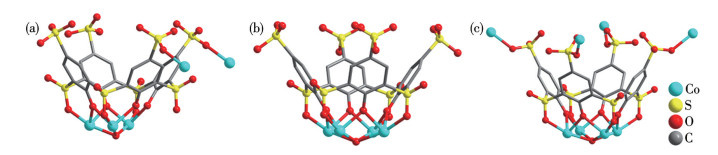
Moreover, at the bottom of the shuttlecock-like SBU, a bridging oxygen atom is present, but with different coordination modes. In LLU-101, the oxygen atom is μ3-O, while in LLU-102, it is μ4-O. In addition, in LLU-101, the oxygen atoms from two sulfonate groups at the upper rim of the (H4TC4AS-SO2)4- ion coordinate with two Co2+ ions, and the angle formed between these metal ions and the coordinated oxygen and sulfur atoms is 137° (Fig. 5a). In contrast, in LLU-102, the sulfonate groups at the upper rim of the (H4TC4AS-SO2)4- ion exhibit two coordination modes. The first mode, shown in Fig. 5b, is that the sulfonate groups at the upper rim do not coordinate with the metal. The second mode, depicted in Fig. 5c, is that one oxygen atom in each of the four sulfonate groups at the upper rim coordinates with the Co2+ ion, forming an angle of 132° with the coordinated oxygen and sulfur atoms.
Furthermore, the coordination modes of the bridging ligands differ between the two complexes. In LLU-101, the TDC2- ligand coordinates as shown in Fig. 1d. Methanol, with higher polarity compared to DMF, allows more open coordination geometries, which are further stabilized and favored for the formation of a layered architecture through extensive hydrogen bonding and π-π intermolecular interactions. In contrast, LLU-102, crystallized in DMF, exhibits two distinct coordination modes for TDC2-, which are depicted in Fig. 3e and 3f. DMF fosters a diverse array of coordination connections for the auxiliary ligands and, through a combination of hydrogen bonding and π-π interactions, ultimately promotes the formation of a compact 3D framework.
Based on the structures discussed above, it can be concluded that variations in solvent polarity directly govern the coordination modes of the (H4TC4AS-SO2)4- ligand and the bridging TDC2- ligand, thereby ultimately influencing the packing of the SBUs in LLU-101 and LLU-102. Furthermore, two complexes were compared and analyzed with the reported relevant Co-TC4AS-SO2-based supramolecular coordination complexes. The results indicate that TC4AS-SO2, as the main ligand, typically coordinates with cobalt ions to form {Co4} SBU, which then coordinates with various auxiliary ligands to form a series of zero-dimensional {Co24} organic coordination cages (Fig.S9)[28-35]. In these architectures, the sulfonate groups located on the upper rim of the main ligand remain uncoordinated. Additionally, complexes LLU-101 and LLU-102 were compared with the previously reported complex CIAC-122[41], which has the same auxiliary ligands (TDC2-), but a different main ligand is altered from TC4AS-SO2 to p-tert-butylsulfonylcalix[4]arene (TC4A-SO2). This modification ultimately results in the formation of a triangular {Co12} coordination cage in CIAC-122, in which the auxiliary ligands exhibit bidentate coordination and bind to four cobalt ions (Fig.S10).
It is noteworthy that earlier studies report that sulfonic acid groups incorporated at the upper rim of calixarenes, designed to provide additional coordination sites, usually remain non-coordinating toward cobalt. In contrast, the present study identifies a solvent-dependent deviation from this precedent, wherein the main ligand exhibits alternative coordination modes, accompanied by the emergence of novel coordination behaviors in the auxiliary ligands. This solvent-mediated modulation of ligand coordination capacity deepens the understanding of metal-calixarene and provides a theoretical foundation for the rational design of coordination architectures with tunable dimensionality.
As illustrated in Fig.S11 and S12, the SEM images and EDS mapping have been obtained to observe the surface morphology and elemental composition of LLU-101 and LLU-102. SEM analysis reveals that LLU-101 exhibited a layered, sheet-like morphology of the obtained crystals, whereas LLU-102 displayed a rod-like morphology with a honeycomb surface texture. EDS mapping confirmed the presence and uniform distribution of Co, S, O, and C within both LLU-101 and LLU-102, thereby substantiating their successful synthesis and the integrity of their structural frameworks.
Complexes LLU-101 and LLU-102 were subjected to TG measurement in an air atmosphere with the temperature ranging from 25 to 800 ℃. As shown in Fig.S13, the TG curves of LLU-101 and LLU-102 reveal that both complexes experienced an initial weight loss before 305 and 340 ℃, respectively. This initial weight loss can be attributed to the evaporation of solvent molecules from the crystals. As the temperature increased, a second weight loss stage occurred for both complexes, with LLU-101 losing weight between 305 and 505 ℃ and LLU-102 between 340 and 525 ℃. The weight loss is primarily due to the decomposition of the complexes′ frameworks. Complexes LLU-101 and LLU-102 reached the weight-loss equilibrium in the temperature range from 505 or 525 ℃ to 800 ℃, with no further weight changes. Ultimately, the remaining black powder was identified as cobalt oxides. The TG analysis further indicates that LLU-101 and LLU-102 exhibit good thermal stability, which may be attributed to the rigid coordination environment of the metal center, the high-dimensional structure, and the extensive hydrogen bonding and π-π interactions within the crystal[5,49].
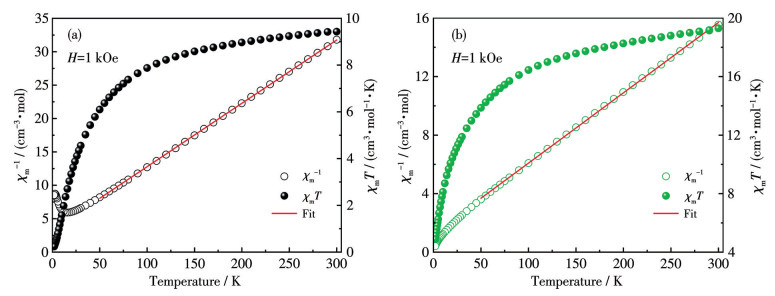
Variable-temperature direct-current magnetic susceptibility measurements for complexes LLU-101 and LLU-102 were conducted in the temperature range of 2-300 K under an applied magnetic field strength of 1 kOe. As shown in Fig. 6a and 6b, the χmT values of LLU-101 and LLU-102 at room temperature were 9.43 and 19.3 cm3·mol-1·K, respectively. These values exceeded the theoretical values for LLU-101 or LLU-102 containing high-spin Co2+ ions (S=3/2, g=2.0) without coupling interaction (15/8×3=5.63 cm3·mol-1·K for LLU-101, 15/8×6=11.25 cm3·mol-1·K, for LLU-102). This discrepancy may be attributed to spin-orbit coupling with the Co2+ ions and the distorted octahedral field[50]. For each Co2+ ion, the χmT values of LLU-101 and LLU-102 at room temperature were 3.14 and 3.22 cm3·mol-1·K, respectively. Variable-temperature magnetic susceptibility values of the reported typical compounds containing Co2+ ions were in a range of 2.7 to 3.4 cm3·mol-1·K[51]. As the temperature decreased, the χmT curves of LLU-101 and LLU-102 decreased gradually and exhibited a sharp decline in the low-temperature region. When the temperature was 2 K, the χmT values reached the minimum values of 0.23 and 4.88 cm3·mol-1·K, respectively. The progressive diminution of χmT over the temperature range from 300 to 2 K is indicative of pronounced antiferromagnetic coupling inherent within the molecular architecture[52-54]. In the 50-300 K range, the variable-temperature magnetic susceptibility curves of LLU-101 and LLU-102 conformed to the Curie-Weiss law: 1/χm=(T-θ)/C. The calculated Curie constants (C) were 10.54 and 20.81 cm3·K·mol-1, and the Weiss constants (θ) were -34.72 and -26.58 K, respectively. The negative Weiss constant indicates an overall antiferromagnetic interaction between the metal ions, consistent with the small ground-state spin value of the complexes[51,54].
Among these two complexes, LLU-101 exhibits a 2D structure, whereas LLU-102 adopts a 3D structure. These two structures also differ in their SBUs. LLU-101 contains a planar triangular Co2+ trimer (Fig.S14), while LLU-102 features both a planar quadrilateral Co²⁺ tetramer and a linear Co2+ dimer (Fig.S15). In each triangular, quadrilateral, or linear cluster, Co2+ centers are linked via oxygen atoms, forming the respective cluster units. This type of interaction pathway (Co-O-Co) fosters strong superexchange interactions between the magnetic Co2+ ions, owing to the effective overlap of the Co2+ 3d orbitals through the 2p orbitals of oxygen atoms[55-57]. Consequently, due to the structural similarity of their lattices, one would expect nearly identical magnetic behavior for LLU-101 and LLU-102. Indeed, the θ values for LLU-101 were relatively smaller, while LLU-102 exhibited larger θ values. These observations align closely with their respective structural features. Furthermore, in both LLU-101 and LLU-102, the Co2+ centers exhibit a distorted octahedral coordination geometry. This distortion induces significant orbital angular momentum and spin-orbit coupling, thereby resulting in the splitting of the d-orbitals[57]. As a result, the metal centers in both compounds exhibit antiferromagnetic interactions.
These observations indicate that the variation in solvent polarity not only alters the coordination modes of the TDC2- and (H4TC4AS-SO2)4- ligands but also governs the nuclearity of the metal clusters, which play a pivotal role in tuning the intracluster and intercluster magnetic exchange interactions[52-53], ultimately leading to the distinct magnetic properties observed for LLU-101 and LLU-102. The relationship between structure and magnetic properties is summarized and compared in Table S5. In the cobalt-based supramolecular complexes constructed with calixarene-type ligands, regardless of the nuclearity, the measured Weiss constants are consistently negative, indicating that the cobalt metal centers exhibit antiferromagnetic interactions.
In this study, p-sulfosulfonylcalix[4]arene (H8TC4AS-SO2) was used as the main ligand, and thiophene-2,5-dicarboxylic acid (H2TDC) was introduced as the bridging ligand to react with transition metal Co2+ ions. Two cluster-based extended structures, LLU-101 and LLU-102, were successfully constructed, with both the upper and lower rims of (H4TC4AS-SO2)4- being coordinated and connected through TDC2-. The solvent type during the solvothermal reactions significantly influences the final structure of the complexes. In the case of LLU-101, synthesized using methanol as the solvent, the shuttlecock-like unit formed is a trinuclear cobalt {Co3-H4TC4AS-SO2}, with both the upper and lower rims of (H4TC4AS-SO2)4- participating in coordination, and a single mode of the TDC2- ligand. On the other hand, when synthesized under DMF conditions, LLU-102 formed a shuttlecock-like unit, a tetranuclear cobalt {Co4-H4TC4AS-SO2}, where both the upper and lower rims of (H4TC4AS-SO2)4- are coordinated, some SBUs display coordination involving only the lower rim, and two different coordination modes of TDC2- ligands. The study on the magnetic properties of complexes LLU-101 and LLU-102 shows that the metal centers exhibit antiferromagnetic interactions and that solvent choice plays a pivotal role in tuning both structural features and magnetic interactions. This work is expected to provide valuable insights for the design and synthesis of other sulfonylcalixarene tetrasulfonate-derived complexes based on a solvent regulation strategy. This will facilitate the exploration of their potential applications based on defined structure-property relationships.
COOK T R, ZHENG Y R, STANG P J. Metal-organic frameworks and self-assembled supramolecular coordination complexes: Comparing and contrasting the design, synthesis, and functionality of metal-organic materials[J]. Chem. Rev., 2013, 113(1): 734-777 doi: 10.1021/cr3002824
COOK T R, STANG P J. Recent developments in the preparation and chemistry of metallacycles and metallacages via coordination[J]. Chem. Rev., 2015, 115(15): 7001-7045 doi: 10.1021/cr5005666
DEY N, HAYNES C J. Supramolecular coordination complexes as optical biosensors[J]. ChemPlusChem, 2021, 86(3): 418-433 doi: 10.1002/cplu.202100004
BOKOTIAL D, CHOWDHURY A. An overview on the proton conductivity of supramolecular coordination complexes[J]. Results Chem., 2022, 4: 100361 doi: 10.1016/j.rechem.2022.100361
ZHANG G S, WEI M J, ZANG H Y, ZHANG H, LIAO W P. Constructing p-sulfonatothiacalix[4]arene-based coordination squares as new type of efficient proton-conducting solid electrolytes[J]. Inorg. Chim. Acta, 2021, 514: 120027 doi: 10.1016/j.ica.2020.120027
WANG H, ZHU Z H, LA DROITTE L, LIAO W P, CADOR O, LE GUENNIC B, TANG J K. Toroidal moment and dynamical control in luminescent 1D and 3D terbium calixarene compounds[J]. Chem. Sci., 2023, 14(26): 7208-7214 doi: 10.1039/D3SC00541K
ZHANG X M, CHEN Q X, ZHANG W T, HU H Y, WU H M, XIE Z T, HE X, NIU Y L, DENG X M, LIU L, ZHANG Z H, PENG L L, CHEN Z. Supramolecularly confined catalysis in polyphthalocyanine-crown-ether frameworks boosts sulfur redox kinetics[J]. Angew. Chem. -Int. Edit., 2025, 64: e202507612 doi: 10.1002/anie.202507612
ZHAI Z H, ZHU J Y, CAO S C, ZHANG Y T, VAN DER BRUGGEN B. Supramolecular engineering of metal-organic membranes with metal-support interactions for nanoconfined synergistic catalysis[J]. Small Methods, 2025, 9(11): 2500409 doi: 10.1002/smtd.202500409
WANG Y Y, XIONG Y, LIAO W P. Solvent-polarity-controlled assembly of polynuclear titanium-calixarene complexes: Constructing isolated {Ti7}, {Ti13}, {Ti24} and {Tb2Ti13} clusters[J]. CrystEngComm, 2024, 26(17): 2287-2296 doi: 10.1039/D3CE01275A
MOAVEN S, VANDER GRIEND D A, JOHNSON D W, PLUTH M D. Expanding the toolbox for supramolecular chemistry: Probing host-guest interactions and binding with in situ FTIR spectroscopy[J]. Chem. Sci., 2025, 16(23): 10282-10288 doi: 10.1039/D5SC01329A
KHAN S B, LEE S L. Supramolecular chemistry: Host-guest molecular complexes[J]. Molecules, 2021, 26(13): 3995 doi: 10.3390/molecules26133995
WANG G D, SHI W J, LI Y Z, LU W, HOU L, LI D. Enabling high C2H2 storage and efficient C2H2/CO2 separation in a cage-like MOF with multiple supramolecular binding sites[J]. J. Mater. Chem. A, 2025, 13(2): 1213-1220 doi: 10.1039/D4TA06472K
HANG X X, LIU B, ZHU X F, WANG S T, HAN H T, LIAO W P, LIU Y L, HU C H. Discrete {Ni40} coordination cage: A calixarene-based Johnson-type (J17) hexadecahedron[J]. J. Am. Chem. Soc., 2016, 138(9): 2969-2972 doi: 10.1021/jacs.6b00695
LI J Z, KOU M C, ZHOU S B, DONG F, HUANG X Y, TANG X L, TANG Y, LIU W S. Regulation of lanthanide supramolecular nanoreactors via a bimetallic cluster cutting strategy to boost aza-Darzens reactions[J]. Nat. Commun., 2025, 16(1): 2169 doi: 10.1038/s41467-024-54950-3
TCHUITENG KOUATCHOU J A, HUBER G, MOINARD M, GRAVEL E, DORIS E. Aqueous photocatalytic oxidation of thioethers with polydiacetylene micelle nanoreactors[J]. ChemSusChem, 2025, 18(3): e202401395 doi: 10.1002/cssc.202401395
LIU Y X, WANG L L, ZHAO L, ZHANG Y G, LI Z T, HUANG F H. Multiple hydrogen bonding driven supramolecular architectures and their biomedical applications[J]. Chem. Soc. Rev., 2024, 53(3): 1592-1623 doi: 10.1039/D3CS00705G
KOTHAWADE S, SHENDE P. Coordination bonded stimuli-responsive drug delivery system of chemical actives with metal in pharmaceutical applications[J]. Coord. Chem. Rev., 2024, 510: 215851 doi: 10.1016/j.ccr.2024.215851
WANG S Y, ZHAO Z Z, MA D. Rapidly prepared and screened supramolecular fluorescent sensors for the detection of metal ions[J]. J. Mol. Liq., 2024, 407: 125163 doi: 10.1016/j.molliq.2024.125163
ZHANG W, LIU M Q, ZHU X X, LIU C, LUO Y. Metal coordination-induced structural regulation of twisted cucurbit[14]uril-based supramolecular assemblies for mercury ions detection on smart platform[J]. ACS Sens., 2025, 10(2): 1419-1428 doi: 10.1021/acssensors.4c03445
ASFARI M, BÖHMER V, HARROWFIELD J, VICENS J. Calixarenes 2001[M]. Dordrecht: Springer Science & Business Media, 2007.
GUTSCHE C D. Calixarenes: An introduction[M]. Cambridge: Royal Society of Chemistry, 2008.
IKI N, HORIUCHI T, OKA H, KOYAMA K, MOROHASHI N, KABUTO C, MIYANO S. Energy transfer luminescence of Tb3+ ion complexed with calix[4]arenetetrasulfonate and the thia and sulfonyl analogue. The effect of bridging groups[J]. J. Chem. Soc. Perkin Trans. 2, 2001(11): 2219-2225
MOROHASHI N, IKI N, SUGAWARA A, MIYANO S. Selective oxidation of thiacalix[4]arenes to the sulfinyl and sulfonyl counterparts and their complexation abilities toward metal ions as studied by solvent extraction[J]. Tetrahedron, 2001, 57(26): 5557-5563 doi: 10.1016/S0040-4020(01)00482-3
IKI N, KUMAGAI H, MOROHASHI N, EJIMA K, HASEGAWA M, MIYANATI S, MIYANO S. Selective oxidation of thiacalix[4]arenes to the sulfinyl-and sulfonylcalix[4]arenes and their coordination ability to metal ions[J]. Tetrahedron Lett., 1998, 39(41), 7559-7562 doi: 10.1016/S0040-4039(98)01645-1
BI Y F, LIAO W P, WANG X F, LI Y L, SU Z M, LIU Y B, ZHANG H J, LI D Q. Five supramolecular compounds of water-soluble sulfonylcalix[4]arenetetrasulfonate showing two calixarene conformations[J]. CrystEngComm, 2009, 11(4): 597-604 doi: 10.1039/B812582A
LIAO W P, LI Y L, WANG X F, BI Y F, SU Z M, ZHANG H J. Macroscopic single-crystal tubes assembled with porous supramolecular architecture of water-soluble calixarene and phenanthroline[J]. Chem. Commun., 2009(14): 1861-1863 doi: 10.1039/b821065a
ZHU X F, LIAO W P. 3d-4f coordination compounds of water-soluble sulfonylcalix[4]arenetetrasulfonate in cone conformation[J]. Polyhedron, 2016, 111: 185-189 doi: 10.1016/j.poly.2016.03.040
FANG Y, LI J L, TOGO T, JIN F Y, XIAO Z F, LIU L J, DRAKE H, LIAN X Z, ZHOU H C. Ultra-small face-centered-cubic Ru nanoparticles confined within a porous coordination cage for dehydrogenation[J]. Chem, 2018, 4(3): 555-563 doi: 10.1016/j.chempr.2018.01.004
FANG Y, XIAO Z F, LI J L, LOLLAR C, LIU L J, LIAN X Z, YUAN S, BANERJEE S Y, ZHANG P, ZHOU H C. Formation of a highly reactive cobalt nanocluster crystal within a highly negatively charged porous coordination cage[J]. Angew. Chem. -Int. Edit., 2018, 57(19): 5283-5287 doi: 10.1002/anie.201712372
FANG Y, ZHOU H C. Metal nanoparticles encapsulated within charge tunable porous coordination cages for hydrogen generation reaction[J]. Catal. Today, 2021, 374: 12-19 doi: 10.1016/j.cattod.2020.10.030
FANG Y, XIAO Z F, KIRCHON A, LI J L, JIN F Y, TOGO T, ZHANG L L, ZHU C F, ZHOU H C. Bimolecular proximity of a ruthenium complex and methylene blue within an anionic porous coordination cage for enhancing photocatalytic activity[J]. Chem. Sci., 2019, 10(12): 3529-3534 doi: 10.1039/C8SC05315D
ZHANG L L, LIANG Y, XIAO Z F, MENG Y X, HUANG J Y, LIN X, LI J, ZHOU H C, FANG Y. Lactonization of dyes promoted by a coordination cage facilitates cavity-induced chromism as ion mobile detector[J]. Sci. China Chem., 2024, 67(5): 1554-1560 doi: 10.1007/s11426-023-1921-6
FANG Y, LIAN X Z, HUANG Y Y, FU G, XIAO Z F, WANG Q, NAN B Y, PELLOIS J P, ZHOU H C. Investigating subcellular compartment targeting effect of porous coordination cages for enhancing cancer nanotherapy[J]. Small, 2018, 14(47): 1802709 doi: 10.1002/smll.201802709
LIANG C J, YUAN J P, ZHU C F, FANG Y. Surface charges of porous coordination cage tune the catalytic reactivity of Knoevenagel condensation[J]. Catal. Today, 2022, 400: 89-94
LIU K K, GUAN Z J, KE M T, FANG Y. Bridging the gap between charge storage site and transportation pathway in molecular-cage-based flexible electrodes[J]. ACS Cent. Sci., 2023, 9(4): 805-815 doi: 10.1021/acscentsci.3c00027
HUANG Y T, HE W, DONG J Z, FAN Y N, WEI Z W, PAN M. Solvent-induced crystal engineering for enhanced room-temperature phosphorescence in copper iodide clusters[J]. Mater. Chem. Front., 2025, 9(20): 3026-3033 doi: 10.1039/D5QM00636H
ZHANG C K, SI W D, WANG Z, DINESH A, GAO Z Y, TUNG C H, SUN D. Solvent-mediated hetero/homo-phase crystallization of copper nanoclusters and superatomic Kernel-related NIR phosphorescence[J]. J. Am. Chem. Soc., 2024, 146(15): 10767-10775 doi: 10.1021/jacs.4c00881
HUANG C, ZHANG Q, ZHANG Y, WANG F, ZHANG Y Y, QIU M, ZHANG Y F, ZHAI L P. Self-driven electrochemical system using solvent-regulated structural diversity of cadmium(Ⅱ) metal-organic frameworks[J]. J. Colloid Interface Sci., 2024, 662: 953-961 doi: 10.1016/j.jcis.2024.02.108
MOI R, MAITY K, BIRADHA K. Binary solvent system composed of polar protic and polar aprotic solvents for controlling the dimensionality of MOFs in the solvothermal synthesis[J]. Cryst. Growth Des., 2022, 22(2): 1276-1282 doi: 10.1021/acs.cgd.1c01245
KUNDU T, WAHIDUZZAMAN M, SHAH B B, MAURIN G, ZHAO D. Solvent-induced control over breathing behavior in flexible metal-organic frameworks for natural-gas delivery[J]. Angew. Chem. -Int. Edit., 2019, 131(24): 8157-8161 doi: 10.1002/ange.201902738
WANG S T, GAO X H, HANG X X, ZHU X F, HAN H T, LIAO W P, CHEN W. Ultrafine Pt nanoclusters confined in a calixarene-based {Ni24} coordination cage for high-efficient hydrogen evolution reaction[J]. J. Am. Chem. Soc., 2016, 138(50): 16236-16239 doi: 10.1021/jacs.6b11218
LUBBEN J, WANDTKE C M, HUBSCHLE C B, RUF M, SHELDRICK G M, DITTRICH B. Aspherical scattering factors for SHELXL-model, implementation and application[J]. Acta Crystallogr. Sect. A, 2019, A75(1): 50-62
SHELDRICK G M. Crystal structure refinement with SHELXL[J]. Acta Crystallogr. Sect. C, 2015, C71(1): 3-8
SHELDRICK G M. Programs for crystallographic solution and refinement[J]. Acta Crystallogr. Sect. A, 2008, 64: 112-22 doi: 10.1107/S0108767307043930
SPEK A L. Single-crystal structure validation with the program PLATON[J]. J. Appl. Crystallogr., 2003, 36(1): 7-13 doi: 10.1107/S0021889802022112
BROWN I D, ALTERMATT D. Bond-valence parameters obtained from a systematic analysis of the inorganic crystal structure database[J]. Acta Crystallogr. Sect. B, 1985, B41(4): 244-247
THORP H H. Bond valence sum analysis of metal-ligand bond lengths in metalloenzymes and model complexes[J]. Inorg. Chem., 1992, 31(9): 1585-1588 doi: 10.1021/ic00035a012
LIU W, THORP H H. Bond valence sum analysis of metal-ligand bond lengths in metalloenzymes and model complexes. 2. Refined distances and other enzymes[J]. Inorg. Chem., 1993, 32(19): 4102-4105 doi: 10.1021/ic00071a023
HUANG C Y, LIAO W P. A porous 2D cobalt-sulfonylcalix[4]arene coordination polymer for gas adsorption[J]. J. Mol. Struct., 2021, 1237: 130392 doi: 10.1016/j.molstruc.2021.130392
CHIBOTARU L F, UNGUR L, ARONICA C, ELMOLL H, PILET G, LUNEAU D. Structure, magnetism, and theoretical study of a mixed-valence Co3ⅡCo4Ⅲ heptanuclear wheel: Lack of SMM behavior despite negative magnetic anisotropy[J]. J. Am. Chem. Soc., 2008, 130(37): 12445-12455 doi: 10.1021/ja8029416
XIONG K C, JIANG F L, GAI Y L, HE Z Z, YUAN D Q, CHEN L, SU K Z, HONG M C. Self-assembly of thiacalix[4]arene-supported nickel(Ⅱ)/cobalt(Ⅱ) complexes sustained by in situ generated 5-methyltetrazolate ligand[J]. Cryst. Growth Des., 2012, 12(6): 3335-3341 doi: 10.1021/cg300483c
ZHU X F, WANG S T, HAN H T, LIAO W P. Organoamine-induced isomerism of calixarene-based complexes: From 1D to 2D[J]. RSC Adv., 2018, 8(68): 39208-39213 doi: 10.1039/C8RA07833E
LIAO W P, BI Y F, GAO S, LI D Q, ZHANG H J, DRONSKOWSKI R. Lanthanide-hinged calixarene bicapsules: Discrete hexanuclear LnⅢ/phenanthroline/p-sulfonatocalix[4]arene oligomers (Ln=Gd, Tb)[J]. Eur. J. Inorg. Chem., 2008(19): 2959-2962
YAO R X, QIN Y L, JI F, ZHAO Y F, ZHANG X M. Triangle, square and delta-chain based cobalt tetrazolate magnets[J]. Dalton Trans., 2013, 42(18): 6611-6618 doi: 10.1039/c3dt32539c
CLEMENTE-JUAN J M, CORONADO E, FORMENT-ALIAGA A, GALÁN-MASCARÓS J R, GIMÉNEZ-SAIZ C, GÓMEZ-GARCÍA C J. A new heptanuclear cobalt(Ⅱ) cluster encapsulated in a novel heteropolyoxometalate topology: Synthesis, structure, and magnetic properties of [Co7(H2O)2(OH)2P2W25O94]16[J]. Inorg. Chem., 2004, 43(8): 2689-2694 doi: 10.1021/ic0354872
ZHENG Y Z, TONG M L, ZHANG W X, CHEN X M. Coexistence of spin frustration and long-range magnetic ordering in a triangular Co3Ⅱ (μ3-OH)-based 2D compound[J]. Chem. Commun., 2006(2): 165-167 doi: 10.1039/B511612K
MANI P, MUKHARJEE P, HEGDE N G, NATH R C, MANDAL S. Triangular and linear Co3 cluster based metal-organic frameworks: Structures and magnetic properties[J]. J. Solid State Chem., 2018, 265: 123-128 doi: 10.1016/j.jssc.2018.05.029

Figure 1 Views of the structure of LLU-101: (a) structure of the shuttlecock-like {Co3-H4TC4AS-SO2} unit; (b) structure diagram of TDC2-; (c) one shuttlecock-like {Co3-H4TC4AS-SO2} and two TDC2- ligands; (d) two shuttlecock-like {Co3-H4TC4AS-SO2} units and one TDC2- ligand; (e) schematic diagram of the asymmetric unit; (f) schematic diagram of the bowl-shaped asymmetric unit
The hydrogen atoms are removed for clarity.

Figure 2 Views of the extended structures of LLU-101: (a) schematic diagram of the exposed coordination sites of the shuttlecock-like {Co3-H4TC4AS-SO2} and four TDC2- ligands; (b) schematic diagram of the exposed coordination sites of multiple “upper-lower” shuttlecock-like structures and their TDC2- ligands; (c) schematic diagram of the extended connection between multiple “upper-lower” shuttlecock-like structures and the TDC2- ligands to the shuttlecock-like {Co3-H4TC4AS-SO2} SBUs; (d) schematic diagram of the “upper-lower” shuttlecock-like SBU dimers with π-π interactions
The hydrogen atoms are removed for clarity.

Figure 3 Views of the extended structures of LLU-102: (a) diagram of the shuttlecock-like {Co4-H4TC4AS-SO2} unit; (b) structure diagram of TDC2-; (c) one shuttlecock-like {Co4-H4TC4AS-SO2} and four TDC2- ligands; (d) two shuttlecock-like {Co4-H4TC4AS-SO2} units and four TDC2- ligands; (e) schematic diagram of the first coordination mode of TDC2-; (f) schematic diagram of the second coordination mode of TDC2-
The hydrogen atoms are removed for clarity.

Figure 4 (a) Schematic diagram of the bowl-shaped “hierarchical” structure formed by LLU-102; (b) Schematic diagram of the bowl-shaped “capsule-like” structure of double {Co4-H4TC4AS-SO2} SBUs formed by LLU-102; (c) Schematic diagram of the bowl-shaped “balance pan” structure of double {Co4-H4TC4AS-SO2} SBUs formed by LLU-102; (d) Schematic diagram of the bowl-shaped “four-wheel” structure
The hydrogen atoms are removed for clarity.

Figure 5 (a) Schematic diagram of the coordination mode of (H4TC4AS-SO2)4- in the structure of complex LLU-101; (b, c) Schematic diagrams of the coordination mode of (H4TC4AS-SO2)4- in the structure of complex LLU-102

Figure 6 Variable-temperature magnetic susceptibility curves of complex LLU-101 (a) and complex LLU-102 (b) in the temperature range of 2-300 K
Table 1. Crystal data and structure refinement for LLU-101 and LLU-102
| Parameter | LLU-101 | LLU-102 |
| Formula | C143H348Co6O127N4S18 | C128H258Co3O53N34S6 |
| Formula weight | 5 087.01 | 3 490.80 |
| Crystal system | Triclinic | Tetragonal |
| Space group | P1 | P4/n |
| a / nm | 1.485 74(9) | 1.881 63(3) |
| b / nm | 2.164 55(13) | 1.881 63(3) |
| c / nm | 2.603 35(19) | 3.061 92(7) |
| α / (°) | 91.901(4) | |
| β / (°) | 99.687(4) | |
| γ / (°) | 101.781(4) | |
| V / nm3 | 8.059 2(9) | 10.840 8(4) |
| Z | 2 | 8 |
| T / K | 190 | 190 |
| Dc / (g·cm-3) | 1.212 | 1.409 |
| μ / mm-1 | 7.536 | 9.863 |
| F(000) | 2 988 | 4 664 |
| Total reflection | 23 880 | 50 472 |
| Unique reflection | 3 029 | 1 233 |
| Rint | 0.189 7 | 0.104 0 |
| GOF | 1.134 | 1.371 |
| Final R indices [I>2σ(I)] | R1=0.165 9, wR2=0.342 2 | R1=0.149 6, wR2=0.292 7 |
| R indices (all data) | R1=0.213 0, wR2=0.366 4 | R1=0.160 3, wR2=0.299 3 |
| aR1=∑||Fo|-|Fc||/∑|Fo|; bwR2=∑[w(Fo2-Fc2)2]/∑[w(Fo2)2]1/2. | ||
 下载: 导出CSV

 扫一扫看文章


扫一扫关注我们

 下载: