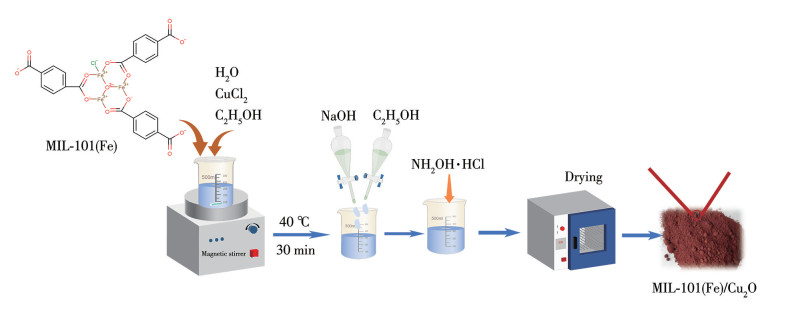
Figure 1.
Schematic illustration of the synthesis of MIL-101(Fe)/Cu2O photocatalyst

Constructing highly efficient Z-scheme MIL-101(Fe)/Cu2O heterojunction photocatalysts by interface coupling and their mechanism for tetracycline degradation
Junli WANG , Miaomiao JING , Danyang LIU , Yurun DAI , Qiang ZHAO , Zuopeng LI , Yong GUO


Rapid economic development and intensified human activities have placed growing pressure on the environment. Water pollution, which can readily cause diseases and harm human health, has become a critical environmental issue demanding urgent solutions[1-2]. Tetracycline (TC) hydrochloride, a widely used antibiotic, has drawn significant attention due to its environmental persistence, posing potential threats to ecosystems and human health[3]. Currently, common methods for removing TC from water include adsorption, electrochemical treatment, microbial degradation, and photocatalysis[4-6]. Among these, visible-light photocatalysis based on semiconductor materials has obvious advantages. So, the development of efficient, stable, and low-cost semiconductor photocatalysts for the degradation of TC antibiotics holds significant research value and practical importance.
However, traditional semiconductor materials such as TiO2, WO3, and ZnO have problems such as low light utilization efficiency and easy recombination of photogenerated carriers[7-9]. Among various materials, cuprous oxide (Cu2O) has become a potential visible light catalyst due to its low cost, easy preparation, and good environmental compatibility. As a typical p-type semiconductor photocatalyst, Cu2O has a narrow band gap, can effectively absorb visible light, and has low toxicity and economic properties. Its p-type property is attributed to the copper vacancies (VCu) formed during the preparation process. However, there are reports in the literature of n-type Cu2O, which is attributed to oxygen vacancies (VO), interstitial copper (Cui), or doping. Therefore, the semiconductor type of Cu2O can be controlled by the preparation conditions[10-12]. Regardless of which type it is, in practical applications, Cu2O often experiences a decrease in activity due to the easy aggregation of particles and a decrease in specific surface area, and its chemical properties are unstable, easily reacting with water vapor in the air to form more stable CuO. Studies have shown that by means of morphological control, element doping, or constructing heterojunctions, the recombination of photogenerated electron (e-)-hole (h+) pairs can be effectively inhibited, and the stability of Cu2O can be improved[13-15]. Therefore, combining it with other materials to form heterojunctions has become an effective strategy to improve the photocatalytic performance of Cu2O.
Fe-based metal-organic frameworks (Fe-MOFs) are a class of porous coordination polymers constructed from iron ions/clusters as inorganic building units and organic ligands via molecular self-assembly[16-17]. They exhibit high specific surface area, abundant active sites, and good visible-light absorption capability, showing broad prospects in the field of photocatalysis. Among various MOFs, MIL-101(Fe), featuring trivalent iron as the central metal, has demonstrated particularly outstanding properties. Its stable crystal structure, high porosity, and large pore size make it an ideal support for constructing efficient photocatalytic heterojunctions[18-20]. Notably, its high specific surface area increases the number of reactive sites, thereby enhancing catalytic performance. Thus, compositing Cu2O with MIL-101(Fe) may be a feasible approach to enhancing its photocatalytic activity.
In this study, a series of xMIL-101(Fe)/Cu2O [x=5%, 10%, 15%, 20%, and 25%; x was the mass fraction of MIL-101(Fe)] composite photocatalysts was synthesized via a co-precipitation method, incorporating dodecahedral Cu2O with MIL-101(Fe) at varying mass ratios. To systematically evaluate their photocatalytic performance, experiments were conducted under visible light irradiation using TC as the target pollutant. The photocatalytic behavior of the synthesized materials was assessed based on their degradation performance to develop an efficient and stable system for treating antibiotic-containing wastewater.
Anhydrous ethanol (C2H5OH), acetone ((CH3)2CO), copper(Ⅱ) chloride dihydrate (CuCl2·2H2O), hydrochloric acid (HCl), sodium hydroxide (NaOH), hydroxylamine hydrochloride (NH2OH·HCl), and TC (C22H24N2O8) were all purchased from Shanghai Aladdin Biochemical Technology Co., Ltd. All chemicals were of analytical grade and used as received.
The synthesis procedure of the xMIL-101(Fe)/Cu2O composite photocatalyst was illustrated in Fig.1. Typically, 83.4 mL of deionized water, 5 mL of copper chloride solution (0.5 mol·L-1), 20 mL of anhydrous ethanol, and MIL-101(Fe)[21] with different mass fractions (5%, 10%, 15%, 20%, and 25%) were mixed in a beaker. The mixture was transferred to a constant-temperature water bath at 40 ℃ under continuous stirring. Subsequently, 30 mL of anhydrous ethanol and 9 mL of NaOH solution (1.0 mol·L-1) were added dropwise simultaneously at controlled rates of 3-4 and 6-7 s per drop, respectively. After the addition was complete, 9 mL of hydroxylamine hydrochloride solution (0.5 mol·L-1) was added, and stirring was continued for another 10 min. The resulting mixture was then aged at 40 ℃ for 3 h without stirring. Finally, the precipitate was collected by filtration, washed thoroughly with deionized water and ethanol, and dried under vacuum at 40 ℃, yielding a series of composite photocatalysts with different MIL-101(Fe) loadings. Notably, Cu2O was obtained without the addition of MIL-101(Fe) in a similar co-precipitation method.
The crystal structure of the samples was analyzed using a powder X-ray diffractometer (Rigaku D/max 2500) with Cu Kα radiation (λ=0.151 8 nm), operated at 60 kV and 300 mA. The data were collected over a 2θ range of 10° to 90°. The micro-morphology of the samples was observed using a field-emission scanning electron microscope (SEM, TESCAN MAIA 3 LMH). To further investigate the microstructure and morphological features of the composite photocatalyst, high-resolution transmission electron microscopy (HRTEM) characterization was performed using a JEOL JEM-2999FMII apparatus, operating voltage: 200 kV. The optical absorption properties were examined by ultraviolet-visible diffuse reflectance spectroscopy (UV-Vis DRS). Photoelectrochemical measurements were conducted on an electrochemical workstation, and transient photocurrent responses were recorded in a 0.2 mol·L-1 Na2SO4 electrolyte. Electrochemical impedance spectroscopy (EIS) measurements were performed using a CHI760E electrochemical workstation with a standard three-electrode system. The working electrode was fabricated using the as-prepared samples, while a platinum plate and an Ag/AgCl electrode served as the counter and reference electrodes, respectively. The measurements were conducted in an electrolyte solution containing 0.1 mol·L-1 KCl and 2.5 mmol·L-1 [Fe(CN)6]3-/[Fe(CN)6]4-, with the frequency ranging from 0.01 Hz to 100 kHz. Furthermore, X-ray photoelectron spectroscopy (XPS, Thermo Scientific Escalab 250Xi) was employed to analyze the surface elemental composition and chemical states of the samples. Electron paramagnetic resonance (EPR) spectroscopy was carried out on a Bruker A300 spectrometer. 5, 5-Dimethyl-1-pyrroline N-oxide (DMPO) was introduced as a spin-trapping agent.
72 mL TC aqueous solution (10 mg·L-1) was placed in a jacketed quartz beaker. Then, 80 mg of the composite photocatalyst powder was accurately weighed and added to the solution. The beaker was sealed with a clean quartz plate. The suspension was first stirred in the dark for 30 min to establish adsorption-desorption equilibrium. Subsequently, the photocatalytic reaction was initiated under visible light irradiation. During illumination, 4 mL of the reaction mixture was sampled at 10 min intervals. After high-speed centrifugation, the absorbance of the clear supernatant was measured at a wavelength of 357 nm using a 722E Visible Spectrophotometer, and the data were recorded. Cycling experiments were conducted under the same reaction conditions. After each photocatalytic run, the catalyst was recovered by high-speed centrifugation, sequentially washed three times with deionized water and ethanol, and then dried at 60 ℃ for 12 h.
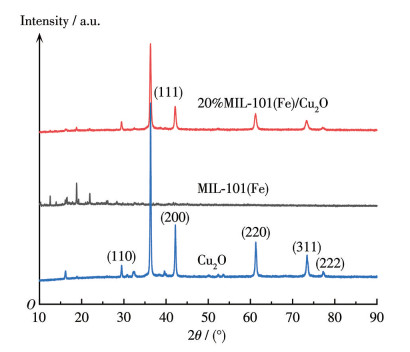
The phase structures of pure Cu2O, pure MIL-101(Fe), and the 20%MIL-101(Fe)/Cu2O composite catalyst were examined by X-ray diffraction (XRD), as shown in Fig.2. In the XRD pattern of pure Cu2O, distinct diffraction peaks were observed at 2θ=28.9°, 37.1°, 42.6°, 60.9°, 74.1°, and 76.8°, which can be indexed to the (110), (111), (200), (220), (311), and (222) crystal planes of Cu2O (PDF No.05-0667), respectively[15]. For the 20%MIL-101(Fe)/Cu2O composite, characteristic diffraction peaks corresponding to Cu2O were also present at the same positions, with the intensities of the (111), (200), and (220) peaks at 37.1°, 42.6°, and 60.9° being relatively weaker. It is noteworthy that no diffraction peaks from impurity phases were detected in the XRD patterns of all samples, indicating the high purity of the as-prepared materials. These results demonstrated that the incorporation of MIL-101(Fe) did not alter the crystal structure of Cu2O.
As shown in Fig.3, SEM and HRTEM were employed to investigate the microstructure and morphology of pure Cu2O, pure MIL-101(Fe), and the 20%MIL-101(Fe)/Cu2O composite catalyst. Fig.3a displays the SEM image of pure Cu2O, which exhibited a regular dodecahedral morphology. This type of structure is generally conducive to providing a high specific surface area, thereby exposing more active sites and enhancing catalytic performance. Fig.3b shows the SEM image of pure MIL-101(Fe), revealing its typical sheet-like structure. Fig.3c presents the SEM image of the 20%MIL-101(Fe)/Cu2O composite, where the MIL-101(Fe) nanosheets were uniformly decorated on the surface of the dodecahedral Cu2O, forming intimate interfacial contact between the two components, which is favorable for the construction of a heterojunction. Fig.3d shows the HRTEM image of the composite, in which distinct lattice fringes with a spacing of approximately 0.263 nm were observed, corresponding to a specific crystal plane of Cu2O. This result further confirmed the well-formed composite interface between MIL-101(Fe) and Cu2O.
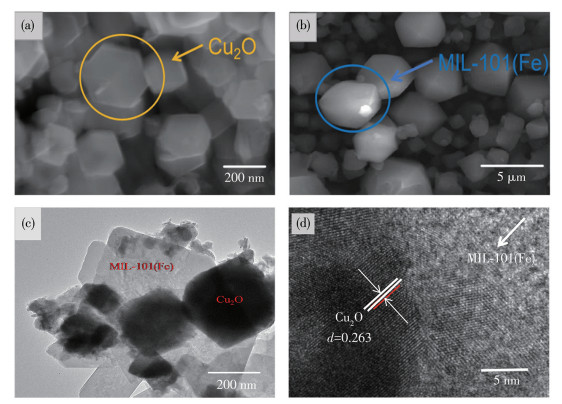
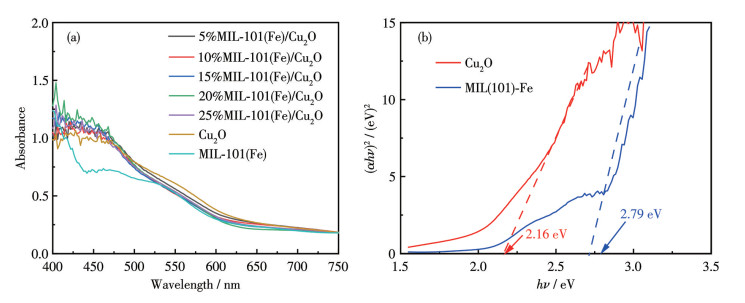
Fig. 4a displays the UV-Vis DRS of the xMIL-101(Fe)/Cu2O composites, pure MIL-101(Fe), and pure Cu2O, which were used to analyze their light absorption properties. As shown, both pure Cu2O and pure MIL-101(Fe) exhibited absorption edges around 630 nm. After compositing Cu2O with different amounts of MIL-101(Fe), the absorption edges of the resulting xMIL-101(Fe)/Cu2O composites showed a distinct red shift compared to pure Cu2O. These changes indicate that the composite materials can utilize visible light more effectively, which correlates well with their superior photocatalytic performance compared to pure Cu2O. The band gaps (Eg) of Cu2O and MIL-101(Fe) were obtained from UV-Vis DRS data by applying the Tauc equation[22-23].
|
|
(1) |
where α is the absorption coefficient, h is Planck′s constant, ν represents the light frequency, and A denotes the absorption constant. The corresponding Tauc plots for Cu2O and MIL-101(Fe) are shown in Fig.4b. Based on the band edge analysis and extrapolation of the linear segments, the optical band gaps were estimated to be 2.16 eV for Cu2O and 2.79 eV for MIL-101(Fe).
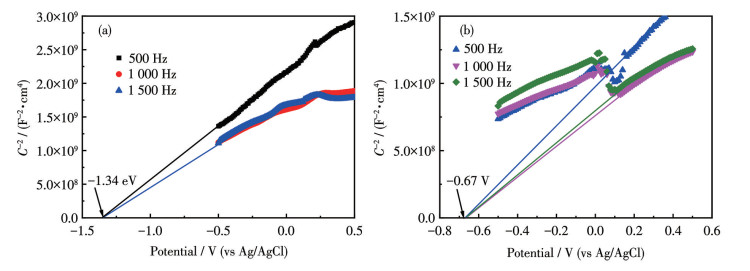
As illustrated in Fig.5, the Mott-Schottky plots for Cu2O and MIL-101(Fe) exhibited positive slopes, indicating their n-type semiconducting nature. From these curves, the flat-band potentials (Efb) were measured as -1.34 V (vs Ag/AgCl) for Cu2O and -0.67 V (vs Ag/ AgCl) for MIL-101(Fe). To convert these values to the standard hydrogen electrode (E), the following relationship was applied[24]:
|
|
(2) |
where E′ is the experimentally measured potential against the Ag/AgCl reference, and E⊖ represents its standard electrode potential (0.197 V). Given that the experiments were conducted in 0.5 mol·L-1 Na2SO4 with pH=6.8, the Efb were calculated to be -0.74 V (vs NHE) for Cu2O and -0.07 V (vs NHE) for MIL-101(Fe). For n-type semiconductors, the minimum conduction band (CB) potential (ECB) is generally positioned approximately 0.2 V more negative than the Efb[24-25]. Thus, the ECB values were estimated as -0.94 V (vs NHE) for Cu2O and -0.27 V (vs NHE) for MIL-101(Fe). Based on these results, the corresponding valence band (VB) potential (EVB) was derived as 1.22 V for Cu2O and 2.52 V for MIL-101(Fe).
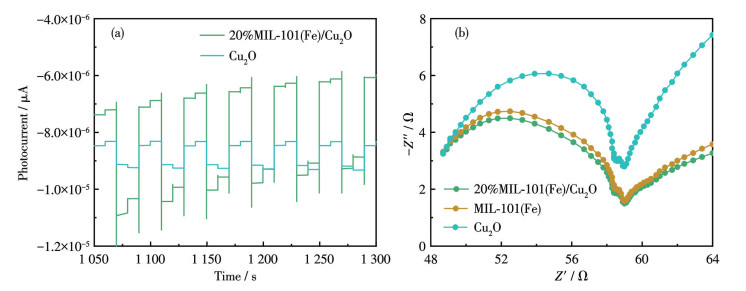
Fig. 6 presents the transient photocurrent response and EIS Nyquist plots of the samples. As shown in the transient photocurrent response curves (Fig. 6a), the 20%MIL-101(Fe)/Cu2O composite exhibited the highest photocurrent density, which was significantly greater than that of pure Cu2O. This indicates that the formation of the heterojunction effectively suppresses the recombination of photogenerated e--h+ pairs, thereby substantially increasing the concentration of charge carriers. This conclusion was strongly supported by the EIS results (Fig. 6b). The 20%MIL-101(Fe)/Cu2O composite showed the smallest arc radius in the Nyquist plot, suggesting the lowest interfacial charge transfer resistance, which greatly facilitates the migration and separation of photogenerated carriers at the interface. Together, these photoelectrochemical characterizations confirmed that constructing the MIL-101(Fe)/Cu2O heterojunction is an effective strategy for enhancing the photocatalytic activity of Cu2O.
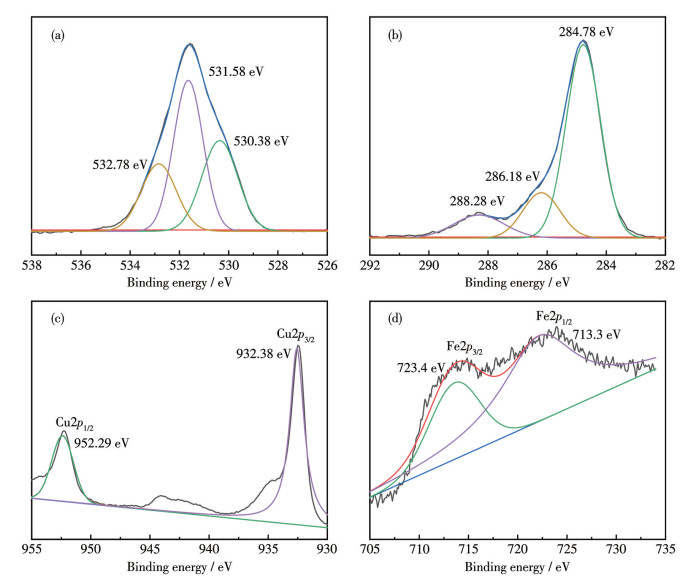
To elucidate the surface elemental composition and chemical states of the 20%MIL-101(Fe)/Cu2O composite, XPS analysis was performed, as shown in Fig.7. The high-resolution spectra of each element were deconvoluted as follows. The O1s spectrum (Fig.7a) exhibited peaks at binding energies of 530.38, 531.58, and 532.78 eV, which can be assigned to lattice oxygen (O2-), oxygen vacancies/defective oxygen species, and surface-adsorbed hydroxyl groups or water molecules, respectively[15, 25]. The C1s spectrum (Fig.7b) could be fitted into three components at 284.78, 286.18, and 288.28 eV, corresponding to C—C/C=C bonds, C—O bonds (or C—O species,bonded to Fe), and C=O bonds, respectively[18, 21]. In Fig.7c, the characteristic peaks at 932.38 and 952.29 eV are attributed to Cu2p3/2 and Cu2p1/2, respectively, indicating the predominant presence of Cu+ [15, 25]. The Fe2p spectrum (Fig.7d) showed peaks at 723.4 and 713.3 eV, which can be assigned to Fe2p1/2 and Fe2p3/2, respectively[18].
To systematically evaluate the photocatalytic activity of the as-prepared materials, the degradation performance of TC under visible light irradiation was compared among pure Cu2O, pure MIL-101(Fe), and a series of xMIL-101(Fe)/Cu2O composites (Fig.8a). The results indicated that after 100 min of irradiation, all composites exhibited significantly higher catalytic efficiency than the individual components, and their performance showed a strong dependence on the MIL-101(Fe) loading content. Among them, the 5%MIL-101(Fe)/Cu2O composite showed the lowest degradation efficiency of 63.65%, whereas the 20%MIL-101(Fe)/Cu2O sample demonstrated the optimal catalytic activity, achieving a high TC degradation rate of 87.37%. This suggests that an appropriate amount of MIL-101(Fe) doping can effectively facilitate the separation of photogenerated charge carriers, leading to the generation of more reactive oxygen species (ROS) such as ·O2- and ·OH, thereby significantly enhancing the degradation ability toward TC.
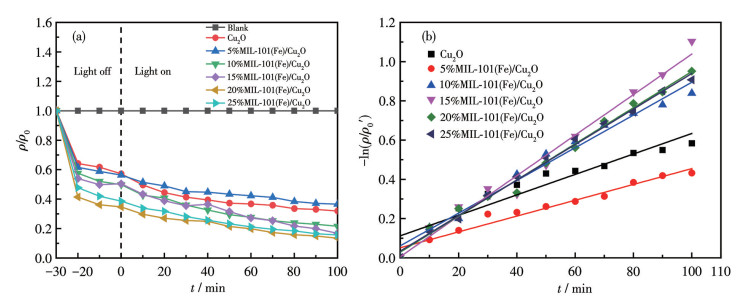
Fig. 8b presents the fitting curves of -ln(ρ/ρ0′) versus irradiation time (t) for the TC degradation process catalyzed by Cu2O and xMIL-101(Fe)/Cu2O. As shown, when fitted with a pseudo-first-order kinetic model, -ln(ρ/ρ0′) versus t exhibited a good linear relationship, with the correlation coefficients (R2) of all fitting curves exceeding 0.9. The apparent reaction rate constants (k) derived from the slopes revealed that all composites possessed higher k values than pure Cu2O (0.005 min-1). The 15%MIL-101(Fe)/Cu2O and 20%MIL-101(Fe)/Cu2O performed most notably, with k values of 0.010 and 0.009 min-1, respectively. These kinetic results further confirmed that constructing the MIL-101(Fe)/Cu2O heterojunction can remarkably enhance the photocatalytic degradation efficiency for TC.
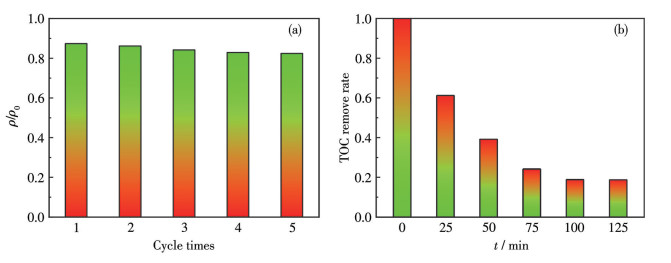
The stability of the 20%MIL-101(Fe)/Cu2O composite was tested through cyclic experiments. As illustrated in Fig.9a, even after five successive cycles of TC degradation, the photocatalyst retained a high performance, with its photocatalytic activity remaining as high as approximately 82.45%. This confirmed the excellent reusability and stability of the composite. In addition, the total organic carbon (TOC) analysis of the photocatalytic degradation process is shown in Fig.9b. It can be seen that after 100 min of reaction under light, 81.26% of TOC was removed. These results indicated that using MIL-101(Fe)/Cu2O as a photocatalyst to degrade TC, most of the TC was effectively mineralized by the MIL-101(Fe)/Cu2O composite.
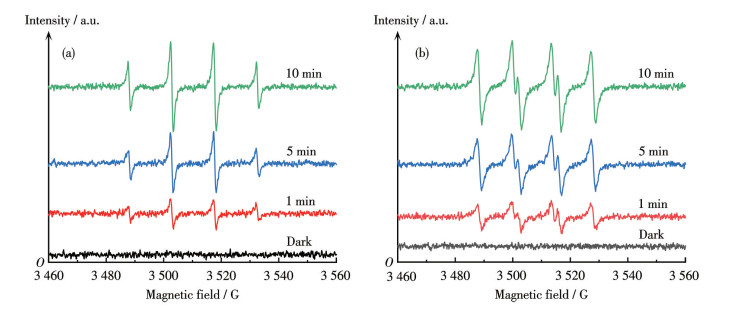
To identify the key active species involved in the photocatalytic degradation of TC, EPR spectroscopy was employed, with the results shown in Fig.10. The EPR spectra of the MIL-101(Fe)/Cu2O composite revealed distinct characteristic signals of hydroxyl radicals (·OH) and superoxide radicals (·O2-) under light irradiation, whose intensity increased with prolonged illumination. No such signals were detected under dark conditions. These findings provided direct evidence that ·OH and ·O2- serve as the predominant reactive species in the degradation process. Accordingly, a reaction pathway was proposed: photogenerated e- react with dissolved oxygen to form ·O2-, while photogenerated holes oxidize water molecules to generate ·OH. These highly oxidative radicals act synergistically to effectively cleave the chemical bonds of TC.
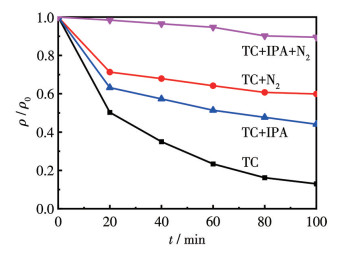
To further investigate the reactive species involved in the reaction, a radical trapping experiment was conducted, as shown in Fig.11. The results indicated that when the isopropyl alcohol (IPA, ·OH scavenger, 1.0 mmol·L-1) was added, the degradation rate of TC significantly decreased; while in the N2 atmosphere, the catalytic activity was also significantly inhibited. In addition, when IPA was added to the N2 atmosphere, the degradation rate of TC was very low, and only a small amount of TC was removed. Thus, it can be inferred that ·OH and ·O2- were the key reactive species in the photocatalytic reaction, which was consistent with the analysis results of EPR.
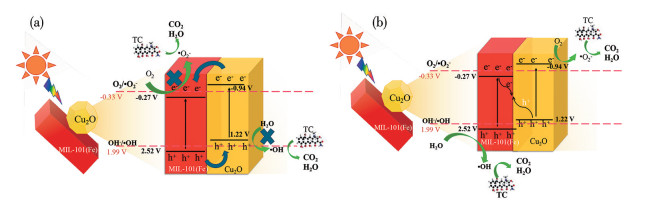
The photocatalytic mechanism of the MIL-101(Fe)/Cu2O heterojunction composite for TC degradation under visible light was analyzed as follows. As illustrated in Fig.12a, if a type-Ⅱ heterojunction were formed, under light irradiation, photogenerated e- would transfer from CB of Cu2O to that of MIL-101(Fe), while h+ would migrate from the VB of MIL-101(Fe) to that of Cu2O, resulting spatial separation of photogenerated e- and h+ and leading to e- accumulation in the CB of MIL-101(Fe) and h+ accumulation in the VB of Cu2O. However, the ECB of MIL-101(Fe) was -0.27 V (vs NHE), which was more positive than the standard redox potential of O2/·O2- [-0.33 V (vs NHE)], so e- in the CB of MIL-101(Fe) can not reduce adsorbed O2 to ·O2-. Meanwhile, the EVB of Cu2O was 1.22 V (vs NHE), which was more negative than the redox potential of H2O/·OH [1.99 V (vs NHE)]. The oxidation of surface hydroxyl groups or water molecules by h+ in the VB of Cu2O to generate ·OH was impossible. Nevertheless, both EPR characterization and radical trapping experiments confirmed the generation of ·OH and ·O2-. Therefore, the type-Ⅱ heterojunction mechanism does not match the experimental results. Based on the degradation experiments, photoelectric analysis, and active species detection, Fig.12b illustrates the proposed Z-scheme heterojunction mechanism for the photocatalytic degradation of TC by the MIL-101(Fe)/Cu2O heterojunction under visible light irradiation. Under visible light excitation, both semiconductors generated photogenerated e--h+ pairs. According to the Z-scheme heterojunction mechanism, the photogenerated e- in the CB of MIL-101(Fe) recombined with the h+ in the VB of Cu2O. This process led to the accumulation of strongly reductive e- in the CB of Cu2O and strongly oxidative h+ in the VB of MIL-101(Fe). The CB potential of Cu2O [-0.94 V (vs NHE)] was more negative than the standard redox potential of O2/·O2-, and the VB potential of MIL-101(Fe) (2.52 V) was more positive than the potential of H2O/·OH. So, the e- in the CB of Cu2O reacted with adsorbed O2 to form ·O2-, while the h+ in VB of MIL-101(Fe) reacted with surface hydroxyl groups or water molecules to produce ·OH. These highly oxidative reactive species are responsible for the efficient mineralization of TC into CO2, H2O, and other small molecular products.
The MIL-101(Fe)/Cu2O heterojunction photocatalyst was successfully prepared via a co-precipitation method. The photocatalytic performance of the composite with different doping ratios of MIL-101(Fe) was systematically investigated by the degradation of TC. The experimental results showed that the catalytic activity was closely related to the doping ratio, and the MIL-101(Fe)/Cu2O composite material with a doping amount of 20% had the best photocatalytic performance, achieving a TC degradation rate of 87.37% within 100 min. The results of photoelectrochemical characterization and mechanistic studies demonstrate that the integration of dodecahedral Cu2O with MIL-101(Fe) leads to a pronounced synergistic effect. The heterojunction interface facilitates the efficient spatial separation of photogenerated e--h+ pairs, effectively suppressing their recombination, and thereby leading to a remarkable enhancement in the photocatalytic degradation performance. The EPR test results proved that ·O2- and ·OH were the main active species in the photocatalytic reaction process.
ANJUM M, SIDDIQUE N, YOUNIS H, FAIZ Y, SHAFIQUE M A, MAHNOOR A, SAJID A, ALTAF M. Heavy metals and radionuclides in islamabad′s industrial area: A comprehensive analysis of soil and water pollution, source apportionment and health effects using statistical and geospatial tools[J]. Journal of Trace Elements and Minerals, 2024, 8: 100127 doi: 10.1016/j.jtemin.2024.100127
GUAN Y, ZHANG N N, CHU C J, XIAO Y, NIU R, SHAO C F. Health impact assessment of the surface water pollution in China[J]. Sci. Total Environ., 2024, 933: 173040 doi: 10.1016/j.scitotenv.2024.173040
DAI Y J, LIU M, LI J J, YANG S S, SUN Y, SUN Q Y, WANG W S, LU L, ZHANG K X, XU J Y, ZHENG W L, HU Z Y, YANG Y H, GAO Y W, LIU Z H. A review on pollution situation and treatment methods of tetracycline in groundwater[J]. Sep. Sci. Technol., 2020, 55(5): 1005 doi: 10.1080/01496395.2019.1577445
ZHANG D W, HE Q Q, HU X L, ZHANG K J, CHEN C H, XUE Y W. Enhanced adsorption for the removal of tetracycline hydrochloride (TC) using ball-milled biochar derived from crayfish shell[J]. Colloid Surf. A‒Physicochem. Eng. Asp., 2021, 615: 126254 doi: 10.1016/j.colsurfa.2021.126254
LI Q, ZHOU Q, DENG H, LI Z H, XUE B, LIU A X, SHEN B, HAO D, ZHU H Y, WANG Q. Schottky heterojunction-based photocatalysis-in-situ-self-Fenton system: Removal of tetracycline hydrochloride and biotoxicity evaluation of intermediates[J]. Appl. Catal. B‒Environ. Energy, 2025, 360: 124533 doi: 10.1016/j.apcatb.2024.124533
REN S X, WANG S Y, LIU Y F, WANG Y X, GAO F, DAI Y J. A review on current pollution and removal methods of tetracycline in soil[J]. Sep. Sci. Technol., 2023, 58(14): 2578 doi: 10.1080/01496395.2023.2259079
ANUCHA C B, ALTIN I, BACAKSIZ E, STATHOPOULOS V N. Titanium dioxide (TiO2-based photocatalyst materials activity enhancement for contaminants of emerging concern (CECs) degradation: In the light of modification strategies[J]. Chem. Eng. J. Adv., 2022, 10: 100262 doi: 10.1016/j.ceja.2022.100262
WU W G, GUAN X S, ZHANG X C, ZHANG C M, GUO X, LIU J X, LI R, FAN C M. In-situ construction of Bi2WO6/BiOCl p-n heterojunction film for photocatalytic CO2 reduction[J]. Inorg. Chem. Commun., 2023, 158(1): 111454
YU W L, ZHANG J F, PENG T Y. New insight into the enhanced photocatalytic activity of N-, C-and S-doped ZnO photocatalysts[J]. Appl. Catal. B‒Environ., 2016, 181: 220 doi: 10.1016/j.apcatb.2015.07.031
TRENCZEK-ZAJĄC A, BANAŚ-GAC J, ADAMCZYK A, RADECKA M. Can point defects work to your advantage? New insights into TiO2@n-type Cu2O heterostructures[J]. J. Alloy. Compd., 2025, 1033: 181228 doi: 10.1016/j.jallcom.2025.181228
CAO D W, WANG C Y, ZHENG F G, DONG W, FANG L, SHEN M R. High-efficiency ferroelectric-film solar cells with an n-type Cu2O cathode buffer layer[J]. Nano Lett., 2012, 12(6): 2803 doi: 10.1021/nl300009z
ADEL A, LOCIF R, YAACOUB B I, ABDELMADJID H, SELMA R, IMED-EDDINE B. pH-dependent deposition of Cu2O thin films: Tuning defect states and electronic properties for improved energy conversion applications[J]. Appl. Phys. A, 2025, 131(2): 105 doi: 10.1007/s00339-024-08229-5
SU Q, ZUO C, LIU M F, TAI X S. A review on Cu2O-based composites in photocatalysis: Synthesis, modification, and applications[J]. Molecules, 2023, 28(14): 5576 doi: 10.3390/molecules28145576
WANG J L, LI S Y, MA P Y, GUO Z A, MA Q, ZHAO Q, GUO Y, ZHAO J G, GUAN G Q. Carbon quantum dots/Cu2O S-scheme heterojunction for enhanced photocatalytic degradation of tetracycline[J]. Colloid Surf. A‒Physicochem. Eng. Asp., 2024, 690: 133779 doi: 10.1016/j.colsurfa.2024.133779
ZHAO Q, WANG J L, LI Z P, GUO Y, WANG J, TANG B, ABUDULA A, GUAN G Q. Heterostructured graphitic-carbon-nitride-nanosheets/copper(Ⅰ) oxide composite as an enhanced visible light photocatalyst for decomposition of tetracycline antibiotics[J]. Sep. Purif. Technol., 2020, 250: 117238 doi: 10.1016/j.seppur.2020.117238
DU C Y, ZHANG Y, ZHANG Z, ZHOU L, YU G L, WEN X F, CHI T Y, WANG G L, SU Y H, DENG F F, LV Y C, ZHU H. Fe-based metal organic frameworks (Fe-MOFs) for organic pollutants removal via photo-Fenton: A review[J]. Chem. Eng. J., 2022, 431: 133932 doi: 10.1016/j.cej.2021.133932
CAI J, PENG Y, JIANG Y X, LI L, WANG H, LI K Z. Application of Fe-MOFs in photodegradation and removal of air and water pollutants: A review[J]. Molecules, 2023, 28(20): 7121 doi: 10.3390/molecules28207121
WANG Q, ZHOU Q, WANG P, WANG E R, CHEN S W, SHI Y X, DENG H, LIU A X, DU H, LI Z H, ZHU H Y, LI Q. S-scheme POM/MIL-101 (Fe) heterojunction for photocatalytic decontamination of Cr(Ⅵ)[J]. Sep. Purif. Technol., 2025, 361: 131498 doi: 10.1016/j.seppur.2025.131498
XIAO Z Y, WU R, SHU T T, WANG Y X, LI L. Synthesis of Co-doped Fe metal-organic framework MIL-101 (Fe, Co) and efficient degradation of organic dyes in water[J]. Sep. Purif. Technol., 2023, 304: 122300 doi: 10.1016/j.seppur.2022.122300
LI S J, WANG C C, LIU Y P, LIU Y Z, CAI M J, ZHAO W, DUAN X G. S-scheme MIL-101 (Fe) octahedrons modified Bi2WO6 microspheres for photocatalytic decontamination of Cr(Ⅵ) and tetracycline hydrochloride: Synergistic insights, reaction pathways, and toxicity analysis[J]. Chem. Eng. J., 2023, 455: 140943 doi: 10.1016/j.cej.2022.140943
LI Z C, LIU X M, JIN W, HU Q S, ZHAO Y P. Adsorption behavior of arsenicals on MIL-101(Fe): The role of arsenic chemical structures[J]. J. Colloid Interface Sci., 2019, 554: 692 doi: 10.1016/j.jcis.2019.07.046
NAYAK S, MOHAPATRA L, PARIDA K. Visible light-driven novel g-C3N4/NiFe-LDH composite photocatalyst with enhanced photocatalytic activity towards water oxidation and reduction reaction[J]. J. Mater. Chem., 2015, 3(36): 18622 doi: 10.1039/C5TA05002B
BI J H, ZHANG Z T, TIAN J J, HUANG G C. Interface engineering in a nitrogen-rich COF/BiOBr S-scheme heterojunction triggering efficient photocatalytic degradation of tetracycline antibiotics[J]. J. Colloid Interface Sci., 2024, 661: 761 doi: 10.1016/j.jcis.2024.01.213
ZHAN T R, LIU X L, LU S S, HOU W G. Nitrogen doped NiFe layered double hydroxide/reduced graphene oxide mesoporous nanosphere as an effective bifunctional electrocatalyst for oxygen reduction and evolution reactions[J]. Appl. Catal. B‒Environ., 2017, 205: 551 doi: 10.1016/j.apcatb.2017.01.010
LI S Y, GUO Z A, LV J, ZHAO Y B, SHANG J P, ZHAO Q, GUO Y, WANG J L, ZHAO J G, ABUDULA A, GUAN G Q. Photocatalytic degradation of tetracycline by copper(Ⅰ) oxide loaded on Daylily Stalk derived carbon material[J]. Carbon Resources Convers., 2024, 7(2): 100191

Figure 3 SEM images of (a) Cu2O, (b) MIL-101(Fe), and (c) 20%MIL-101(Fe)/Cu2O; (d) HRTEM image of 20%MIL-101(Fe)/Cu2O

Figure 6 (a) Transient photocurrent response curves and (b) EIS spectra of the samples

Figure 8 (a) Photocatalytic performance curves and (b) the fitting curves of ln(ρ/ρ0′) versus t of Cu2O and xMIL-101(Fe)/Cu2O

Figure 9 (a) Stability test and (b) TOC analysis of 20%MIL-101(Fe)/Cu2O for TC degradation

Figure 11 Active species trapping experiments with 20%MIL-101(Fe)/Cu2O composite under visible light irradiation

 扫一扫看文章


扫一扫关注我们
 下载:
下载:

 下载:
下载:


 下载:
下载: