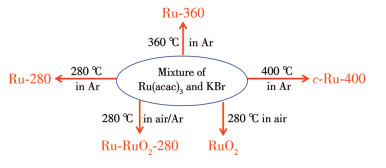
Figure 1.
Schematic illustration for the synthesis of Ru catalysts

Crystallinity and oxidation degree tuning of Ru for alkaline hydrogen oxidation
Yuanjun LIU , Jiayang JIANG , Rui WANG , Jiangnan HU , Chaoyi YUAN , Xingmei GUO , Junhao ZHANG , Guoxing ZHU


Hydrogen with high energy density and zero carbon emissions upon utilization shows great potential in alleviating the energy crisis and environmental pollution[1-4]. Among the various energy conversion technologies, fuel cells are considered one of the most efficient ways to convert chemical energy from hydrogen into electricity directly. Particularly, hydrogen fuel cells have attracted significant attention for applications ranging from portable electronics to transportation and stationary power generation[5-6]. Proton exchange membrane fuel cells (PEMFCs) dominate current commercial applications, while their reliance on expensive platinum-based catalysts and acidic operating conditions poses challenges in terms of cost and long-term durability[7]. In contrast, anion-exchange membrane fuel cells (AEMFCs) operate under alkaline conditions, which allow the use of non-platinum group metal-based catalysts[8-10]. Nevertheless, the kinetics of the hydrogen oxidation reaction (HOR) in alkaline media are significantly slower than in acidic environments, thereby seriously limiting the overall performance of AEMFCs[11-12]. Therefore, there is an urgent need to develop efficient and cost-effective HOR catalysts for alkaline conditions.
Among the various catalysts for alkaline HOR, ruthenium (Ru)-based materials with favorable hydrogen binding energy (HBE) and relatively low cost compared to platinum have garnered increasing attention[13-14]. Ru exhibits limited HOR activity in acidic environments; its performance significantly improves under alkaline conditions, making it a promising candidate for alkaline HOR[15-16]. Recent studies have shown that the catalytic performance of Ru-based materials is significantly influenced by its micro-stucture[17-21]. Amorphous metals possess a high density of unsaturated coordination sites and disordered atomic arrangements[22-23]. In contrast, crystalline metals typically offer superior electrical conductivity and structural stability[24-25]. Meanwhile, the oxidation state plays a critical role in modulating its interaction with hydrogen and OH intermediates, influencing the catalytic activity. Thus, the fine modulation of the crystallinity degree and the oxidation state will provide room for the enhancement of the catalytic activity. To date, few studies have investigated how the crystallinity and oxidation state of Ru affect alkaline HOR activity.
Crystalline phase engineering has emerged as an effective strategy to optimize the activity and stability of electrocatalysts by regulating their atomic arrangements, electronic structures, and surface coordination environments[26-29]. He et al. have demonstrated that phase engineering of Ru can significantly enhance the alkaline HOR activity, achieving over 20-fold higher performance than Pt/C[30]. In the context of the alkaline HOR, modulating the crystallinity of catalysts can influence key factors, such as hydrogen adsorption/ desorption kinetics, electronic conductivity, and the density of active sites[31]. Amorphous materials often exhibit enhanced catalytic activity due to their disordered atomic structures and abundant low-coordination surface atoms, which can reduce energy barriers for intermediate adsorption and improve reaction kinetics[32-33]. For instance, Wang et al. reported that local oxidation-induced amorphization of ultrathin Pt-Ru nanowires significantly enhanced alkaline HOR activity and CO tolerance, which was attributed to the formation of amorphous domains and abundant interfacial sites that optimized hydrogen and hydroxyl adsorption[34]. Lee et al. systematically investigated the effect of particle size and crystallinity of Ru nanoparticles on alkaline HOR activity, and demonstrated that Ru catalysts with reduced crystallinity exhibited enhanced hydrogen oxidation performance due to optimized hydrogen adsorption behavior[35]. However, amorphous materials may suffer from poor stability and lower conductivity. Conversely, highly crystalline materials usually offer better electrical transport and structural integrity, but may have fewer active sites or overly strong hydrogen binding, leading to sub-optimal HOR performance[33]. As such, a trade-off exists between amorphous and crystalline phase materials, while identifying the optimal phase state for maximum HOR activity remains a central challenge.
Herein, a series of Ru nanosheets with tunable crystallinity and oxidation degree were prepared. Electrochemical measurements showed that Ru with moderate crystallinity exhibited higher activity compared to amorphous and pristine crystalline materials. The mass activity of the optimized catalyst was 2.85, 5.7, and 2.27 times that of amorphous, crystalline counterparts, and commercial Pt/C, respectively. It was also found that partial oxidation is an effective strategy for enhancing the catalytic activity.
Ruthenium acetylacetonate (Ru(acac)3) was purchased from Energy Chemical Co., Ltd. Potassium bromide (KBr), potassium hydroxide (KOH), and sulfuric acid (H2SO4, 98%) were obtained from Macklin Biochemical Co., Ltd. Cupric sulfate (CuSO4) and ethanol (CH3CH2OH) were purchased from Sinopharm Chemical Reagent Co., Ltd. (Shanghai, China). The Pt/C catalyst (20% Pt) was purchased from Yilongsheng Energy Co., Ltd. Nafion solution (5%) was obtained from the Shanghai Branch of DuPont China Holding Co., Ltd. Deionized water (18.2 MΩ·cm) was used throughout all experiments. All chemicals were used as received without further purification.
Briefly, 30 mg of Ru(acac)3 and 60 mg of KBr were dissolved in a mixed solvent of 3 mL deionized water and 12 mL ethanol under ultrasonication. The resulting solution was dried in air. The obtained powder was ground and subsequently annealed in a tubular furnace at 280, 360, and 400 ℃ for 90 min under an Ar atmosphere. The product was repeatedly washed with a mixture of deionized water and ethanol, yielding Ru nanosheets, which were denoted as Ru-280, Ru-360, and c-Ru-400 according to the annealing temperature.
The Ru-RuO2-280 sample was synthesized using a similar procedure to that of Ru-280, except that the sample was annealed in air at 280 ℃ for 90 min and subsequently cooled under Ar protection. Pure RuO2 was obtained by annealing the precursor entirely in air.
Transmission electron microscopy (TEM) images were acquired using a JEOL JEM-2100F microscope (Japan) operated in imaging mode at an accelerating voltage of 200 kV. Scanning electron microscopy (SEM) images were obtained with a Zeiss Merlin Compact (Germany). Powder X-ray diffraction (PXRD) patterns were collected on a Rigaku SmartLab diffractometer (Japan) using Cu Kα radiation (λ=0.154 06 nm) at 40 kV and 150 mA to analyze the crystal structure and phase composition, with data acquired in continuous scanning mode over a 2θ range of 5°-85°, a step size of 0.020°, and a scan rate of 10 (°)·min-1. Electron paramagnetic resonance (EPR) spectra were recorded on a Bruker A300 spectrometer (Germany). X-ray photoelectron spectroscopy (XPS) analysis was performed using a Thermo Scientific Nexsa spectrometer (United States) equipped with a monochromatic Al Kα X-ray source (hν=1 486.6 eV). The spectrometer was operated at a voltage of 12 kV and a filament current of 6 mA. High-resolution spectra were recorded with a pass energy of 50 eV and a step size of 0.1 eV.
Electrochemical tests were conducted with a conventional three-electrode system using an Autolab PGSTAT204 workstation. A Hg/HgO electrode (1.0 mol·L-1 KOH) served as the reference electrode, a glassy carbon rotating disk electrode (GC-RDE, with disk diameter of 5.0 mm and disk area of 0.196 cm2) as the working electrode, and a carbon rod as the counter electrode. The catalyst slurry was fabricated by dispersing 1 mg of the catalyst and 4 mg of carbon black into a mixed solvent of 145 μL ethanol, 350 μL water, and 5 μL of 5% Nafion, which was sonicated for at least 3 h to form a suspension and was drop-cast onto the GC-RDE to get the working electrode.
Electrochemical hydrogen oxidation reaction (HOR) tests were conducted in 0.1 mol·L-1 KOH electrolyte saturated with H2 (bubbled for 30 min before measurements). Cyclic voltammetry (CV) was first performed for 20 cycles at a scan rate of 50 mV·s-1 to obtain stable voltammogram curves. HOR polarization curves were then recorded in H2-saturated 0.1 mol·L-1 KOH at a sweep rate of 10 mV·s-1 under different electrode rotation rates (400, 900, 1 600, and 2 500 r·min-1). All tests were carried out at room temperature.
The kinetic current density (jk) was calculated from the Koutecky-Levich (K-L) equation:
|
|
where j is the measured current density, jd is the diffusion-limited current density obtained from the Levich equation:
|
|
Here, n is the number of electrons involved in HOR, F is the Faraday constant, D is the diffusion coefficient of H2, v is the kinematic viscosity of the electrolyte, C0 is the solubility of H2 in the electrolyte, ω is the rotation rate, and B is the Levich constant.
The exchange current density (j0) was obtained by using the Butler-Volmer (B-V) equation:
|
|
where α is the charge transfer coefficient, R is the universal gas constant, T is the temperature, and η is the overpotential.
The electrochemically active surface area (ECSA) was estimated by Cu underpotential deposition (Cu-UPD) stripping. Firstly, CV curves were recorded at 50 mV·s-1 in Ar-purged 0.5 mol·L-1 H2SO4 to obtain a background curve. Cu-UPD stripping was then performed in 0.5 mol·L-1 H2SO4 containing 4 mmol·L-1 of CuSO4 for 100 s under a potential of about 0.25 V (vs RHE). The ECSA was calculated using the equation:
|
|
where QCu is the measured charge, and Qs is the surface charge density of 420 μC·cm-2, corresponding to a monolayer of copper.
Various Ru catalysts were obtained by mixing Ru(acac)3 with KBr followed by thermal treatment[36-37]. The annealing procedure at different temperatures and atmospheres enabled effective regulation of the crystallinity and oxidation degree of Ru (Fig. 1). In this synthesis procedure, the temperature is a critical parameter for the formation of amorphous metal, which must be situated between the melting point of metal acetylacetonate and that of KBr. Higher annealing temperature results in the formation of crystalline Ru materials. The involved KBr is also essential for controlling the formation of amorphous material. Molten KBr suppresses crystallization kinetics and stabilizes the amorphous phase by confining Ru species during thermal decomposition. In addition, molten KBr acts as a template and spatial separator, facilitating the formation of ultrathin Ru nanosheets. Annealing the mixture in air will induce the formation of RuO2.
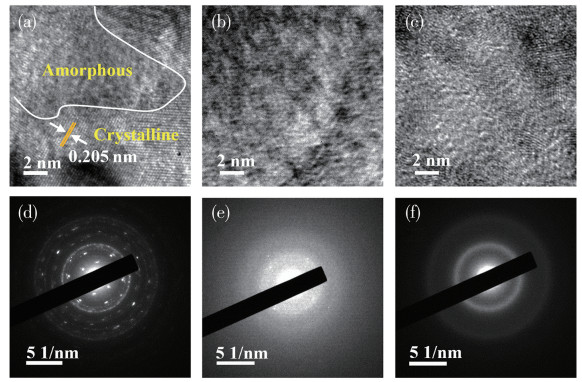
SEM images reveal that the synthesized Ru-280, Ru-360, and Ru-RuO2-280 samples exhibited nanosheet-like structures with lateral dimensions of hundreds of nanometers to the micrometer scale (Fig. 2a-2c). TEM images further confirm the 2D sheet-like microstructure (Fig. 2d-2f). High-resolution TEM (HR-TEM) observation was then employed to investigate the microstructures (Fig. 3). The HRTEM image showed that the Ru-360 nanosheets are composed of crystalline and amorphous domains interconnected with obvious interfaces (Fig. 3a). The amorphous and crystalline domains can be clearly identified in different regions of the nanosheets. In the crystalline domain, the measured lattice spacing of 0.205 nm corresponds to the (101) plane of hexagonal Ru. The existence of diffraction rings and bright spots in the selected-area electron diffraction (SAED) pattern further confirms the crystalline phase in Ru-360 (Fig. 3d). In contrast, no discernible lattice fringes were observed in the HRTEM image of Ru-RuO2-280 (Fig. 3b). The SAED pattern displayed very weak diffraction rings (Fig. 3e), verifying the typical amorphous nature of Ru-RuO2-280. The contrast samples of Ru-280 and c-Ru-400 were also investigated for comparison. Both samples exhibited nanosheet-like morphologies; however, distinct structural features were observed. The HRTEM image for Ru-280 does not show lattice fringes (Fig. 3c). The weak diffraction rings in the SAED pattern confirm its amorphous nature (Fig. 3f). In contrast, the c-Ru-400 product displayed well-defined and uniform lattice fringes with an interplanar spacing of 0.205 nm across the entire nanosheet (Fig.S1a, Supporting information). Its SAED pattern exhibited sharp diffraction rings with bright spots, indicating high crystallinity (Fig.S1b).

PXRD patterns showed that the Ru-280, Ru-360, and Ru-RuO2-280 lacked distinct diffraction peaks, while c-Ru-400 exhibited sharp diffraction peaks that match well with the standard PDF card of metallic Ru (PDF No.70-0274) (Fig. 4a)[38]. There is a discrepancy that no PXRD diffraction peaks were shown for Ru-360, while localized crystalline domains were observed in the HRTEM image. This is reasonable. The PXRD pattern reflects long-range structural ordering, whereas the TEM observation can probe short-range atomic arrangements. The low volume fraction of crystalline domains embedded in the amorphous matrix is insufficient to generate obvious PXRD signals, but can be clearly observed by local high-resolution imaging. The above results collectively demonstrate that the crystallinity can be effectively regulated by thermal treatment parameters. Electron paramagnetic resonance (EPR) spectroscopy analysis was carried out at room temperature for the samples (Fig. 4b). A strong EPR signal was observed at g=2.003, indicating the presence of abundant unpaired electrons on the Ru catalyst. With increased crystallinity, the EPR signals gradually weakened, suggesting that a large number of unpaired electrons are neutralized during the crystallization process[39-40].
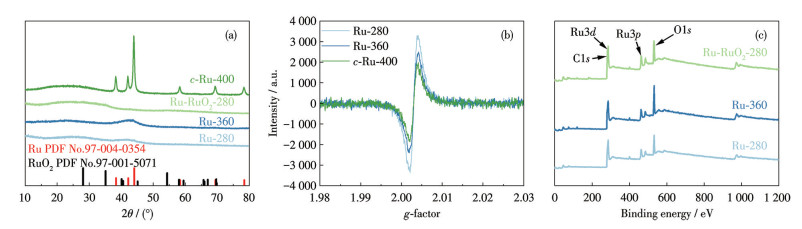
XPS was employed to probe the oxidation states of elements in the catalysts. Because the Ru3d and C1s signals significantly overlap, the Ru3p orbital was analyzed instead of Ru3d (Fig. 4c). Two characteristic peaks were observed at 462.4 and 484.8 eV, corresponding to the Ru3p1/2 and Ru3p3/2 orbitals, respectively[41-42]. High-resolution XPS spectra further revealed that all samples contained both Ru0 and Ru4+ species. The presence of Ru4+ is due to the surface oxidation of Ru upon exposure to air. The atomic ratio of Ru0 to Ru4+ in Ru-280 and Ru-360 was determined to be 2.06∶1 and 2.02∶1 (Fig. 5a and 5b). Considering the shallow probing depth of XPS (ca. 5 nm), this suggests that the majority of Ru exists in the metallic state. In contrast, the Ru-RuO2-280 sample exhibited a significantly higher proportion of Ru4+ with a Ru0/Ru4+ atomic ratio of 1.65:1, confirming its greater degree of oxidation compared with Ru-280 (Fig. 5c).
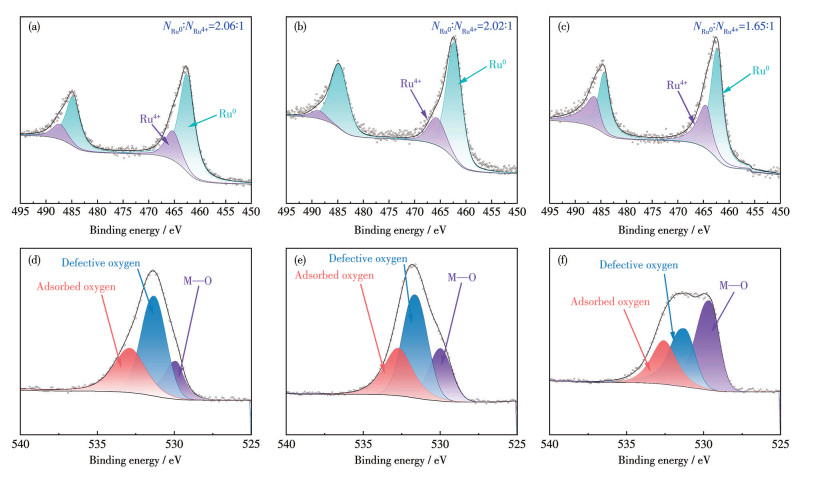
High-resolution XPS O1s spectra of the samples were then analyzed. All catalysts exhibited three typical components in the O1s region, which can be assigned to lattice oxygen (O2-, 529.7-530.2 eV), oxygen species associated with surface hydroxyl groups or defective oxygen sites (531.1-531.7 eV), and adsorbed water or chemisorbed oxygen (532.5-533.0 eV). For Ru-280, the O1s spectrum was dominated by the defective/hydroxyl oxygen component, suggesting the presence of abundant surface disorders and oxygen-containing functional groups, which originate from the low crystallinity of the nanosheets (Fig. 5d)[43]. Upon annealing to form partially crystalline Ru-360, the relative intensity of lattice oxygen slightly increased, while the proportion of defective oxygen evidently decreased, indicating that moderate crystallization partially reconstructs the local Ru-O coordination environment and suppresses surface disorder (Fig. 5e). In contrast, the Ru-RuO2-280 showed a markedly enhanced lattice-oxygen signal together with a higher fraction of metal-oxygen bonds, consistent with the formation of RuO2 domains and the higher oxidation state observed in the Ru3p spectra (Fig. 5f). Meanwhile, the increased amount of surface hydroxyl species suggests the coexistence of RuO2, which may contribute to optimized hydrogen and hydroxide adsorption during HOR. These trends collectively demonstrate that the thermal- and atmosphere-modulated synthesis successfully tunes both the oxygen coordination and the oxidation degree of Ru, which play essential roles in regulating the electronic structure and interfacial adsorption behavior pertinent for HOR catalysis.
The catalytic performance of the catalysts for HOR was then evaluated by using a rotating disk electrode (RDE) in a typical three-electrode system with H2-saturated alkaline electrolyte (0.1 mol·L-1 KOH). After activation within the potential range of -0.2 to 0.4 V (vs RHE), the electrocatalytic properties of the catalysts were measured. As shown in Fig. 6a, polarization curves recorded at 1 600 r·min-1 in H2-saturated KOH revealed that the Ru-360 product with moderate crystallinity and the Ru-RuO2-280 product exhibited superior HOR activity compared to commercial Pt/C and other contrast samples. The Ru-360 product displayed a current density of 2.47 mA·cm-2 at 0.3 V (vs RHE). HOR polarization curves were then collected at rotation rates ranging from 400 to 2 500 r·min-1. As the rotation rate increased, the limiting current density exhibited a systematic rise, which can be attributed to enhanced H2 mass transport (Fig.S2 and S3). In contrast, polarization curves obtained in N2-saturated 0.1 mol·L-1 KOH under identical conditions showed current density close to zero, confirming that the observed current densities in H2-saturated electrolyte originate from hydrogen oxidation (Fig.S4).
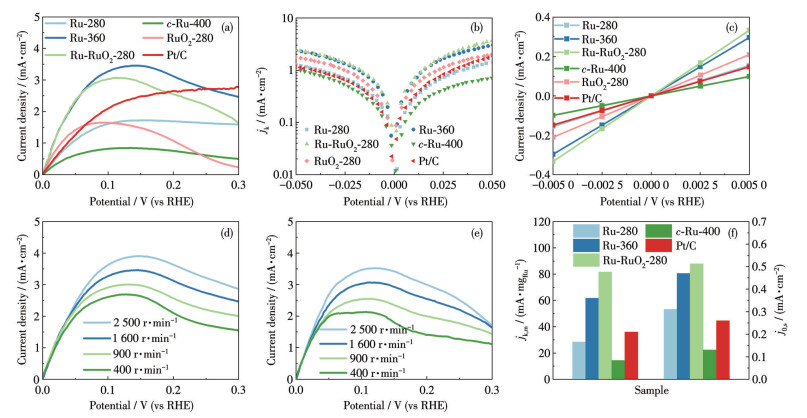
Fig. 6b further illustrates the kinetic current density (jk) calculated using the K-L equation. Among the three samples of Ru-280, Ru-360, and c-Ru-400, the Ru-360 product exhibited higher kinetic currents compared with the other samples. This indicates that a moderate crystallinity of Ru is favourable for the alkaline HOR. Between the two samples of Ru-280 and Ru-RuO2-280, the Ru-RuO2-280 product showed obviously higher catalytic current density, indicating that the presence of RuO2 is favourable for the catalytic process. The Ru content of the samples was determined by the ICP-OES method. The mass-specific kinetic current density (jk, m) of Ru-360 reached 61.78 mA·mgRu-1, which was 2.17, 4.35, and 1.74 times higher than those of Ru-280, c-Ru-400, and Pt/C, respectively (Table 1). Remarkably, the Ru-RuO2-280 product achieves a higher jk, m value of 81.66 mA·mgRu-1, corresponding to 2.85, 5.70, and 2.27 times relative to the Ru-280, c-Ru-400, and Pt/C products, respectively. Fig. 6d and 6e present the polarization curves collected on products of Ru-360 and Ru-RuO2-280 at different rotation rates. The increase in rotation rate enhances the mass transport, thereby leading to higher current densities.

 下载:
导出CSV
下载:
导出CSV
| Sample | Metal loading / (g·cm-2) | ECSA / (cm2·mg-1) | jk, 50 mV / (mA·cm-2) | jk, m / (mA·mg-1) | j0 / (mA·cm-2) | j0, s / (mA·cm-2) |
| Ru-280 | 4.97×10⁻⁵ | 51.08 | 1.42 | 28.52 | 0.79 | 0.31 |
| Ru-360 | 4.90×10⁻⁵ | 65.52 | 3.03 | 61.78 | 1.51 | 0.47 |
| Ru-RuO2-280 | 4.49×10⁻⁵ | 73.86 | 3.67 | 81.66 | 1.70 | 0.51 |
| c-Ru-400 | 4.95×10⁻⁵ | 77.01 | 0.71 | 14.34 | 0.50 | 0.13 |
| RuO2-280 | 4.16×10⁻⁵ | 91.66 | 1.99 | 47.74 | 1.07 | 0.28 |
| Pt/C | 5.10×10⁻⁵ | 56.50 | 1.84 | 35.99 | 0.75 | 0.26 |
The intrinsic catalytic activity of the catalysts is typically described by the exchange current density (j0), which was estimated from the linear fitting of the micropolarization region. The j0 values of Ru-360 and Ru-RuO2-280 reached 1.51 and 1.70 mA·cm-2, respectively, which were significantly higher than those of other reference samples and the Pt/C catalyst (j0=0.75 mA·cm-2). In addition, the ECSA of all samples was estimated using the Cu-UPD stripping voltammetry method (Table 1 and Fig.S5). The j0 values were then normalized by ECSA, providing a more accurate and direct evaluation of the intrinsic activity of the catalysts. The ECSA-normalized j0 value (j0, s) of Ru-360 was 0.47 mA·cm-2, which was 1.52, 3.62, and 1.81 times those of Ru-280, c-Ru-400, and Pt/C, respectively. The j0, s value of Ru-RuO2-280 reached 0.51 mA·cm-2 (Fig. 6f). Table 2 shows the catalytic activity comparison for the prepared catalysts with the reported catalysts, further indicating the excellent catalytic performance. These results indicate that the modulation of crystallinity and oxidation degree is important for the alkaline HOR.
下载:
导出CSV
Durability is a critical parameter for a HOR catalyst. To evaluate the catalytic stability of the Ru-360 and Ru-RuO2-280 products, accelerated durability tests were conducted using CV tests (Fig.S6a and S6c). The catalysts were subjected to 2 000 CV cycles between -0.1 and 0.4 V (vs RHE). The CV and linear sweep voltammetry (LSV) profiles were then recorded before and after the CV cycling for comparison. The Ru-360 and Ru-RuO2-280 products exhibited a decrease in current density of 17% and 18%, respectively, after the long-time CV cycles. Meanwhile, the exchange current density decreased by about 9% and 10% (Fig.S6b and S6d). This finding demonstrates that the Ru-360 and Ru-RuO2-280 products possess relatively higher durability.
It is generally accepted that the HOR processes involve three elementary steps:
Tafel step:
|
|
(1) |
Heyrovsky step:
|
|
(2) |
Volmer step:
|
|
(3) |
According to the hydrogen binding energy (HBE) theory, the adsorbed Had species on the catalyst surface reacts with OH- from the electrolyte to produce water[43, 52]. An optimal HBE ensures a balance between adsorption and desorption of Had intermediates, thus promoting efficient catalysis in alkaline media. The HBE of the samples was then investigated using the HUPD stripping method[53]. The results show that the Ru-360 and Ru-RuO2-280 products exhibited obvious negatively shifted hydrogen adsorption peaks. This indicates that the decreased HBE on the surface Ru sites would induce the enhancement of the catalytic activity (Fig.S7).
The characteristics of electron transfer can be explored through Bode plots[54-55]. EIS measurements were then conducted in H2-saturated 0.1 mol·L-1 KOH within the potential range of -0.06 to 0.08 V (vs RHE) (Fig. 7). Typically, the Volmer step manifests in the low-frequency region, whereas the Heyrovsky step appears in the mid-frequency region[30].When the applied potential shifted to HOR potential (E > 0 V), for the Ru-360 and Ru-RuO2-280 products, the majority of phase angle signals were distributed in the low-frequency region, with a much lower proportion in the mid-frequency region. This implies that fewer signals of the Heyrovsky step can be probed by HOR Bode plots. These results suggest the possibility of a Tafel-Volmer pathway on the two products, which is different from that on Ru-280. Notably, the Ru-280 product exhibited particularly intense signals in the mid-frequency range, suggesting the involvement of a Heyrovsky-Volmer pathway. This result indicates accelerated Volmer steps on the optimized Ru-360 and Ru-RuO2-280 products, leading to moderate binding of hydrogen and OH and inducing the enhancement of the catalytic activity.
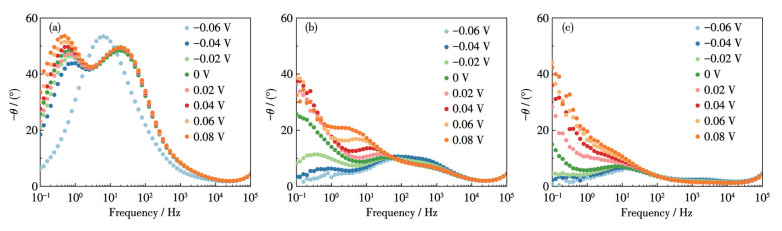
θ represents the phase angle.
In combination, the enhanced HOR activity of Ru-360 and Ru-RuO2-280 can be attributed to the synergistic effects of moderate crystallinity and partial oxidation. Moderate crystallinity balances the electronic conductivity and the structural stability, while maintaining abundant defect sites for hydrogen adsorption. Partial oxidation introduces Ru-O interfaces that optimize OH- adsorption and lower the energy barrier for the Volmer step. These factors jointly promote a favorable Tafel-Volmer pathway, leading to accelerated reaction kinetics.
This work demonstrates that controlling the crystallinity and partial oxidation of Ru is a powerful strategy to enhance their hydrogen oxidation reaction performance in alkaline media. Ru-based catalysts with moderate crystallinity (Ru-360) and partial oxidation (Ru-RuO2-280) exhibit superior activity compared to the amorphous or highly crystalline Ru and commercial Pt-based references. The improved performance originates from optimized hydrogen binding energy and accelerated reaction pathways enabled by crystallinity and surface oxidation modulation. These findings highlight the importance of crystallinity tuning and surface oxidation in the rational design of efficient, durable, and cost-effective Ru-based catalysts for alkaline fuel cell applications.
LU Y Z, AKBAR M, XIA C, MI Y Q, MA L G, WANG B Y, ZHU B. Catalytic membrane with high ion-electron conduction made of strongly correlated perovskite LaNiO3 and Ce0.8Sm0.2O2-delta for fuel cells[J]. J. Catal., 2020, 386: 117-125 doi: 10.1016/j.jcat.2020.04.004
LIU S L, ZHANG H, MU X Q, CHEN C Y. Surface reconstruction engineering of twinned Pd2CoAg nanocrystals by atomic vacancy inducement for hydrogen evolution and oxygen reduction reactions[J]. Appl. Catal. B‒Environ., 2019, 241: 424-429 doi: 10.1016/j.apcatb.2018.09.067
ZHOU G, SHAN Y, HU Y Y, XU X Y, LONG L Y, ZHANG J L, DAI J, GUO J H, SHEN J C, LI S, LIU L Z, WU X L. Half-metallic carbon nitride nanosheets with micro grid mode resonance structure for efficient photocatalytic hydrogen evolution[J]. Nat. Commun., 2018, 9(1): 3366 doi: 10.1038/s41467-018-05590-x
JIN G X, HAN C C, ZHAO H R, WU X W, LI Y L, WANG H Y, MA J P. Small-molecules-induced metal-organic-framework-based photosensitizer for greatly enhancing H2 production efficiency[J]. ACS Mater. Lett., 2023, 6(2): 375-383
STEELE B C H, HEINZEL A. Materials for fuel-cell technologies[J]. Nature, 2001, 414(6861): 345-352 doi: 10.1038/35104620
CHENG X, SHI Z, GLASS N, ZHANG L, ZHANG J J, SONG D T, LIU Z S, WANG H J, SHEN J. A review of PEM hydrogen fuel cell contamination: Impacts, mechanisms, and mitigation[J]. J. Power Sources, 2007, 165(2): 739-756 doi: 10.1016/j.jpowsour.2006.12.012
RAMASWAMY N, MUKERJEE S. Alkaline anion-exchange membrane fuel cells: Challenges in electrocatalysis and interfacial charge transfer[J]. Chem. Rev., 2019, 119(23): 11945-11979 doi: 10.1021/acs.chemrev.9b00157
SU L X, GONG D, JIN Y M, WU D A, LUO W. Recent advances in alkaline hydrogen oxidation reaction[J]. J. Energy Chem., 2022, 66: 107-122 doi: 10.1016/j.jechem.2021.07.015
MUSHTAQ N, LU Y Z, XIA C, DONG W J, WANG B Y, WANG X Y, YOUSAF SHAH M A K, RAUF S, JINGJING N, HU E Y, XIAO H B, RAZA R, KIM J S, ZHU B. Design principle and assessing the correlations in Sb-doped Ba0.5Sr0.5FeO3-delta perovskite oxide for enhanced oxygen reduction catalytic performance[J]. J. Catal., 2021, 395: 168-177 doi: 10.1016/j.jcat.2020.12.005
孙龙, 王晓霞, 苏峰. 金属硫族非超四面体In—Sn—S团簇的合成、结构及电催化氧还原反应性能[J]. 无机化学学报, 2023, 39(7): 1369-1378SUN L, WANG X X, SU F. Synthesis, structure, and electrocatalytic oxygen reduction reaction properties of metal chalcogenide non-supertetrahedral In—Sn—S cluster materials[J]. Chinese J. Inorg. Chem., 2023, 39(7): 1369-1378
MCCRUM I T, KOPER M T M. The role of adsorbed hydroxide in hydrogen evolution reaction kinetics on modified platinum[J]. Nat. Energy, 2020, 5(11): 891-899 doi: 10.1038/s41560-020-00710-8
ZHAO C X, ZHANG Q. Breaking the scaling relationship for electrocatalysis[J]. Chem Catal., 2022, 2(10): 2417-2419
SAIRA Y, LI Z J, ZHU Y, LIU Q C, LUO W K, WANG Y, GONG M X, FU G T, TANG Y W. Low-loaded Ru on hollow SnO2 for enhanced electrocatalytic hydrogen evolution[J]. Chem. Commun., 2024, 60(20): 2768-2771 doi: 10.1039/D3CC06209K
LIU S L, MU X Q, JI P X, LV Y, WANG L, ZHOU Q, CHEN C Y, MU S C. Constructing a rod-like CoFeP@Ru heterostructure with additive active sites for water splitting[J]. ChemCatChem, 2020, 12(20): 5149-5155 doi: 10.1002/cctc.202000911
TANG T, DING L, YAO Z C, PAN H R, HU J S, WAN L J. Synergistic electrocatalysts for alkaline hydrogen oxidation and evolution reactions[J]. Adv. Funct. Mater., 2022, 32(2): 2107479 doi: 10.1002/adfm.202107479
HU C, XU J J, TAN Y Z, HUANG X Q. Recent advances of ruthenium-based electrocatalysts for hydrogen energy[J]. Trends Chem., 2023, 5(3): 225-239 doi: 10.1016/j.trechm.2023.01.002
CONG Y Y, DOU D, ZHANG L M, WANG H B, LIU M L, CHEN L Y, ZHAO Q P, LI C L. Synergistic interactions of electronic modulation and low crystallization in Ru-RuO2/C heterostructure for highly efficient multifunctional electrocatalysis[J]. Fuel, 2024, 367: 131472 doi: 10.1016/j.fuel.2024.131472
周琦, 黎新宝, 李志洋. RuO2修饰纳米多孔Ni-Mo复合电极及其电催化析氢性能[J]. 无机化学学报, 2020, 36(9): 1649-1658ZHOU Q, LI X B, LI Z Y. Composite electrodes of nano-porous Ni-Mo modified by RuO2 and electrocatalytic property for hydrogen evolution[J]. Chinese J. Inorg. Chem., 2020, 36(9): 1649-1658
ZHANG X J, LI Z Q, SUN X P, WEI L Z, NIU H L, CHEN S, CHEN Q W, WANG C J, ZHENG F C. Regulating the surface electronic structure of RuNi alloys for boosting alkaline hydrogen oxidation electrocatalysis[J]. ACS Mater. Lett., 2022, 4(11): 2097-2105 doi: 10.1021/acsmaterialslett.2c00699
施华锋. MnCoNi层状双氢氧化物@Co-Ni-S非晶空心多面体复合物的构筑及其优异的电催化析氧性能[J]. 无机化学学报, 2025, 41(7): 1380-1386SHI H F. Construction of MnCoNi layered double hydroxide@Co-Ni-S amorphous hollow polyhedron composite with excellent electrocatalytic oxygen evolution performance[J]. Chinese J. Inorg. Chem., 2025, 41(7): 1380-1386
GUPTA S, PATEL M K, MIOTELLO A, PATEL N. Metal boride-based catalysts for electrochemical water-splitting: A review[J]. Adv. Funct. Mater., 2020, 30(1): 1906481 doi: 10.1002/adfm.201906481
GUO T Q, HU P F, LI L D, WANG Z C, GUO L. Amorphous materials emerging as prospective electrodes for electrochemical energy storage and conversion[J]. Chem, 2023, 9(5): 1080-1093 doi: 10.1016/j.chempr.2023.03.032
JU M, WANG X T, LONG X, YANG S H. Recent advances in transition metal based compound catalysts for water splitting from the perspective of crystal engineering[J]. CrystEngComm, 2020, 22(9): 1531-1540 doi: 10.1039/C9CE01533G
WEI B Q, LI L, SHAO L, WANG J. Crystalline-amorphous nanostructures: Microstructure, property and modelling[J]. Materials, 2023, 16(7): 2874 doi: 10.3390/ma16072874
ZHOU Y, LIANG Y H, WU Z, WANG X L, GUAN R N, LI C Q, QIAO F, WANG J F, FU Y S, BAEK J B. Amorphous/crystalline heterostructured nanomaterials: An emerging platform for electrochemical energy storage[J]. Small, 2025, 21(12): 2411941 doi: 10.1002/smll.202411941
CHEN Y, LAI Z C, ZHANG X, FAN Z X, HE Q Y, TAN C L, ZHANG H. Phase engineering of nanomaterials[J]. Nat. Rev. Chem., 2020, 4(5): 243-256 doi: 10.1038/s41570-020-0173-4
QIU Y L, JIA Q, YAN S H, LIU B P, LIU J Q, JI X Q. Favorable amorphous-crystalline iron oxyhydroxide phase boundaries for boosted alkaline water oxidation[J]. ChemSusChem, 2020, 13(18): 4911-4915 doi: 10.1002/cssc.202001229
LIANG L H, JIN H H, ZHOU H, LIU B S, HU C X, CHEN D, ZHU J W, WANG Z, LI H W, LIU S L, HE D P, MU S C. Ultra-small platinum nanoparticles segregated by nickel sites for efficient ORR and HER processes[J]. J. Energy Chem., 2022, 65: 48-54 doi: 10.1016/j.jechem.2021.05.033
WANG H Y, SU J, ZUO J L. Porous crystalline materials based on tetrathiafulvalene and its analogues: Assembly, charge transfer, and applications[J]. Accounts Chem. Res., 2024, 57(13): 1851-1869 doi: 10.1021/acs.accounts.4c00228
HE S Y, TU Y H, ZHANG J X, ZHANG L H, KE J, WANG L M, DU L, CUI Z L, SONG H Y. Ammonia-induced fcc Ru nanocrystals for efficient alkaline hydrogen electrocatalysis[J]. Small, 2024, 20(15): 2308053 doi: 10.1002/smll.202308053
CHEN J S, HUANG J F, WANG H, FENG W H, LUO T M, HU Y Z, YUAN C K, CAO L Y, JIE Y N, KAJIYOSHI K, FENG Y Q. Phase-mediated cobalt phosphide with unique core-shell architecture serving as efficient and bifunctional electrocatalyst for hydrogen evolution and oxygen reduction reaction[J]. Chin. Chem. Lett., 2022, 33(8): 3752-3756 doi: 10.1016/j.cclet.2021.11.063
GUO T Q, LI L D, WANG Z C. Recent development and future perspectives of amorphous transition metal-based electrocatalysts for oxygen evolution reaction[J]. Adv. Energy Mater., 2022, 12(24): 2200827 doi: 10.1002/aenm.202200827
WEI L C, FANG N, XUE F, LIU S H, HUANG W H, PAO C W, HU Z W, XU Y, GENG H B, HUANG X Q. Amorphous-crystalline RuTi nanosheets enhancing OH species adsorption for efficient hydrogen oxidation catalysis[J]. Chem. Sci., 2024, 15(11): 3928-3935 doi: 10.1039/D3SC06705J
WANG S P, FU L H, HUANG H P, FU M, CAI J L, LYU Z X, WANG Q X, KUANG Q, XIE Z X, XIE S F. Local oxidation induced amorphization of 1.5-nm-thick Pt-Ru nanowires enables superactive and CO-tolerant hydrogen oxidation in alkaline media[J]. Adv. Funct. Mater., 2023, 33(43): 2304125 doi: 10.1002/adfm.202304125
LEE W J, BERA S, WOO H J, AN J W, BAE J S, OH I K, KWON S H. Controllable size and crystallinity of Ru nanoparticles on a carbon support synthesized by fluidized bed reactor-atomic layer deposition for enhanced hydrogen oxidation activity[J]. J. Mater. Chem. A, 2021, 9(32): 17223-17230 doi: 10.1039/D1TA03678E
XU J, KONG X K. Amorphous/crystalline heterophase ruthenium nanosheets for pH-universal hydrogen evolution[J]. Small Methods, 2022, 6(3): 2101432 doi: 10.1002/smtd.202101432
WU G, ZHENG X S, CUI P X, JIANG H Y, WANG X Q, QU Y T, CHEN W X, LIN Y, LI H, HAN X, HU Y M, LIU P G, ZHANG Q H, GE J J, YAO Y C, SUN R B, WU Y, GU L, HONG X, LI Y D. A general synthesis approach for amorphous noble metal nanosheets[J]. Nat. Commun., 2019, 10(1): 4855 doi: 10.1038/s41467-019-12859-2
CHEN C H, WU D Y, LI Z, ZHANG R, KUAI C G, ZHAO X R, DONG C, QIAO S Z, LIU H, DU X W. Ruthenium-based single-atom alloy with high electrocatalytic activity for hydrogen evolution[J]. Adv. Energy Mater., 2019, 9(20): 1803913 doi: 10.1002/aenm.201803913
LEVIN N, CASADEVALL C, CUTSAIL Ⅲ G E, LLORET-FILLOL J, DEBEER S, RUDIGER O. XAS and EPR in situ observation of Ru(Ⅴ) oxo intermediate in a Ru water oxidation complex[J]. ChemElectroChem, 2022, 9(3): e202101271 doi: 10.1002/celc.202101271
WANG B Y, YAN X M, ZHOU M, LI H. Tailoring crystal planes and oxygen vacancies of ceria for enhanced catalytic performance of single-atom Ru in hydrogenative dearomatization of lignin-derived phenols[J]. Energy Mater., 2025, 5(8): 500084
ZHAO R B, LIU C W, ZHANG X X, ZHU X J, WEI P P, JI L, GUO Y B, GAO S Y, LUO Y L, WANG Z M, SUN X P. An ultrasmall Ru2P nanoparticles-reduced graphene oxide hybrid: An efficient electrocatalyst for NH3 synthesis under ambient conditions[J]. J. Mater. Chem. A, 2020, 8(1): 77-81 doi: 10.1039/C9TA10346E
ZHOU Y N, WANG F L, NAN J, DONG B, ZHAO H Y, WANG F G, YU N, LUAN R N, LIU D P, CHAI Y M. High-density ultrafine RuP2 with strong catalyst-support interaction driven by dual-ligand and tungsten-oxygen sites for hydrogen evolution at 1 A·cm-2[J]. Appl. Catal. B‒Environ., 2022, 304: 120917 doi: 10.1016/j.apcatb.2021.120917
WANG J W, CAI L J, YU Z P, TAN H, XIANG X Y, XU K Y, CHAO Y, THALLURI S M, LIN F, HUANG H L, ZHANG C Y, ZHAO Y, WANG W L, LIU L F. Oxygen-defective ruthenium oxide as an efficient and durable electrocatalyst for acidic oxygen evolution reaction[J]. J. Mater. Chem. A, 2025, 13(1): 312-324 doi: 10.1039/D4TA06592A
WU L Q, SU L X, LIANG Q, ZHANG W, MEN Y N, LUO W. Boosting hydrogen oxidation kinetics by promoting interfacial water adsorption on dp hybridized Ru catalysts[J]. ACS Catal., 2023, 13(7): 4127-4133 doi: 10.1021/acscatal.2c05547
YANG C Y, LI Y B, GE C X, JIANG W Y, CHENG G Z, ZHUANG L, LUO W. The role of hydroxide binding energy in alkaline hydrogen oxidation reaction kinetics on RuCr nanosheet[J]. Chin. J. Chem., 2022, 40(21): 2495-2501 doi: 10.1002/cjoc.202200385
YANG G, YANG Y B, QU H S, WANG Y B, RU C Y, WU H X, HAN Y R, ZHU J B, XIAO M L, LIU C P, XING W. Engineering Ru-RuO2 interface with regulated hydroxyl adsorption towards efficient and CO-tolerant hydrogen oxidation reaction[J]. Mater. Today Phys., 2024, 40: 101312 doi: 10.1016/j.mtphys.2023.101312
LI Y B, YUE J C, YANG C Y, JIA H N, CONG H J, LUO W. Metastable face-centered cubic ruthenium-based binary alloy for efficient alkaline hydrogen oxidation electrocatalysis[J]. J. Energy Chem., 2024, 92: 207-215 doi: 10.1016/j.jechem.2024.01.032
WANG P C, YANG Y, ZHENG W, CHENG Z Y, WANG C L, CHEN S, WANG D D, YANG J H, SHI H D, MENG P, WANG P C, TONG H G, CHEN J T, CHEN Q W. V-O species-doped carbon frameworks loaded with Ru nanoparticles as highly efficient and CO-tolerant catalysts for alkaline hydrogen oxidation[J]. J. Am. Chem. Soc., 2023, 145(50): 27867-27876 doi: 10.1021/jacs.3c11734
ZHAO T H, XIAO D D, CHEN Y, TANG X, GONG M X, DENG S F, LIU X P, MA J M, ZHAO X, WANG D L. Boosting alkaline hydrogen electrooxidation on an unconventional fcc-Ru polycrystal[J]. J. Energy Chem., 2021, 61: 15-22 doi: 10.1016/j.jechem.2020.12.008
LIU Y, CHEN L R, HUANG Y, YANG Y T, RAO X F, ZHOU S Q, ISIMJAN T T, YANG X L. Electronic modulation and mechanistic study of Ru-decorated porous Cu-rich cuprous oxide for robust alkaline hydrogen oxidation and evolution reactions[J]. ChemSusChem, 2023, 16(9): e202202113 doi: 10.1002/cssc.202202113
SU L X, FAN X R, JIN Y M, CONG H J, LUO W. Hydroxyl-binding energy-induced kinetic gap narrowing between acidic and alkaline hydrogen oxidation reaction on intermetallic Ru3Sn7 catalyst[J]. Small, 2023, 19(11): 2207603 doi: 10.1002/smll.202207603
WANG X D, LIU X R, FANG J J, WANG H P, LIU X W, WANG H Y, CHEN C J, WANG Y S, ZHANG X J, ZHU W, ZHUANG Z B. Tuning the apparent hydrogen binding energy to achieve high-performance Ni-based hydrogen oxidation reaction catalyst[J]. Nat. Commun., 2024, 15(1): 1137 doi: 10.1038/s41467-024-45370-4
SHENG W C, MYINT M N Z, CHEN J G, YAN Y S. Correlating the hydrogen evolution reaction activity in alkaline electrolytes with the hydrogen binding energy on monometallic surfaces[J]. Energy Environ. Sci., 2013, 6(5): 1509-1512 doi: 10.1039/c3ee00045a
CHEN W, WU B B, WANG Y Y, ZHOU W, LI Y Y, LIU T Y, XIE C, XU L T, DU S Q, SONG M L, WANG D D, LIU Y B, LI Y F, LIU J L, ZUO Y Q, CHEN R, CHEN C, ZHENG J Y, LI Y F, CHEN J, WANG S Y. Deciphering the alternating synergy between interlayer Pt single-atom and NiFe layered double hydroxide for overall water splitting[J]. Energy Environ. Sci., 2021, 14(12): 6428-6440 doi: 10.1039/D1EE01395E
ZHANG Y D, ARPINO K E, YANG Q, KIKUGAWA N, SOKOLOV D A, HICKS C W, LIU J, FELSER C, LI G W. Observation of a robust and active catalyst for hydrogen evolution under high current densities[J]. Nat. Commun., 2022, 13(1): 7784 doi: 10.1038/s41467-022-35464-2

Figure 2 SEM images of (a) Ru-360, (b) Ru-RuO2-280, and (c) Ru-280; TEM images of (d) Ru-360, (e) Ru-RuO2-280, and (f) Ru-280

Figure 3 HRTEM images of (a) Ru-360, (b) Ru-RuO2-280, and (c) Ru-280; SAED patterns of (d) Ru-360, (e) Ru-RuO2-280, and (f) Ru-280

Figure 4 (a) PXRD patterns of Ru-280, Ru-360, Ru-RuO2-280, and c-Ru-400; (b) EPR spectra of Ru-280, Ru-360, and c-Ru-400; (c) XPS survey spectra of Ru-280, Ru-360, and Ru-RuO2-280

Figure 5 High-resolution XPS spectra: Ru3p spectra of (a) Ru-280, (b) Ru-360, and (c) Ru-RuO2-280; O1s spectra of (d) Ru-280, (e) Ru-360, and (f) Ru-RuO2-280

Figure 6 Catalytic performance of the Ru-280, Ru-360, Ru-RuO2-280, c-Ru-400, RuO2-280, and commercial Pt/C catalysts: (a) HOR polarization curves, (b) Tafel slopes; (c) Micro-polarization region fitting; HOR polarization curves of (d) Ru-360 and (e) Ru-RuO2-280 at different rotating rates; (f) Kinetic current density and exchange current density comparison for various catalysts

Figure 7 Bode plots of (a) Ru-280, (b) Ru-360, (c) Ru-RuO2-280 at different applied potentials
θ represents the phase angle.
Table 1. Electrochemical performance of the catalysts
| Sample | Metal loading / (g·cm-2) | ECSA / (cm2·mg-1) | jk, 50 mV / (mA·cm-2) | jk, m / (mA·mg-1) | j0 / (mA·cm-2) | j0, s / (mA·cm-2) |
| Ru-280 | 4.97×10⁻⁵ | 51.08 | 1.42 | 28.52 | 0.79 | 0.31 |
| Ru-360 | 4.90×10⁻⁵ | 65.52 | 3.03 | 61.78 | 1.51 | 0.47 |
| Ru-RuO2-280 | 4.49×10⁻⁵ | 73.86 | 3.67 | 81.66 | 1.70 | 0.51 |
| c-Ru-400 | 4.95×10⁻⁵ | 77.01 | 0.71 | 14.34 | 0.50 | 0.13 |
| RuO2-280 | 4.16×10⁻⁵ | 91.66 | 1.99 | 47.74 | 1.07 | 0.28 |
| Pt/C | 5.10×10⁻⁵ | 56.50 | 1.84 | 35.99 | 0.75 | 0.26 |
 下载: 导出CSV

 扫一扫看文章


扫一扫关注我们
