Table 1.
Selected crystallographic data for complexes 1 and 2


Tin oxide (SnO2) is a typical n-type semiconductor material that can be used as a photocatalyst for the degradation of organic pollutants, water splitting, and hydrogen production[1-5]. However, the optical band gap of SnO2 is 3.4 eV, which means it can only absorb ultraviolet light from sunlight, greatly limiting the efficiency of solar light utilization. As is known, by introducing transition metal ions into SnO2, the band structure of SnO2 can be regulated, thereby reducing its bandgap and increasing its spectral absorption range, and as well improving its photocatalytic performance[6-9]. To be noted, these transition metal ions doped SnO2 materials also have some drawbacks which cannot be ignored, including structural inaccuracy, uneven particle size, unclear inorganic-organic interface information, and uncertain surface composition. These factors may greatly hinder the study of such important photocatalytic materials, such as the exploration of catalytic mechanisms, determination of charge transfer pathways, rational modification of surface interfaces, and exploration of structure-activity relationships[10].
Crystalline tin oxo clusters (TOCs) with clear structural information have gradually become the focus of researchers′ attention in the very recent years[10-17]. TOCs can be used as a structure and reactivity model for further study on SnO2 materials due to their precise atomic position information, clear ligand cluster nucleus connection mode, and controllable cluster nucleus size, which provides the possibility to understand their structure-activity relationship and broaden their functional applications[10, 18-19]. Moreover, TOCs have important potential applications in the field of electrocatalytic CO2 reduction[18, 20], extreme ultraviolet lithography[17, 21], and so on. The solvothermally synthetic approach by using butyltin hydroxide oxide as a tin source has greatly promoted the development of TOCs because the Sn4+ ion in the obtained TOCs only has one butyl group, leaving five positions for ligand coordination and providing more possibilities for novel structures[10, 18]. To date, a great number of TOCs based on butyltin hydroxide oxide have been synthesized and investigated. As is well known, by incorporating transition metal ions, the obtained heterometallic TOCs may be more reactive than the homonuclear TOCs because of the polarity, different electronic and steric structure of the two metal centers. To our knowledge, only a few heterometallic TOCs have been synthesized, and their photocatalytic properties are rarely reported[20, 22]. Then, it is of great importance to explore the synthesis and photocatalytic properties of heterometallic TOCs.
Based on the above-described background, in this work, diphenylphosphonic acid was selected as a ligand to construct TOCs because diphenylphosphonic acid is a medium-strong acid with certain steric hindrance, which is a promising ligand for tin-oxo clusters construction. Butyltin hydroxide oxide is selected as the tin source, and (CH3COO)2Ni·4H2O and (CH3COO)2Co·4H2O are the introduced metal ions, respectively. Here we have successfully synthesized two heterometallic TOCs formulated as [(n-BuSn)4Ni2(μ3-O)2(μ3-OH)2(CH3COO)4(Ph2PO2)6] (1) and [(n-BuSn)4Co2(μ3-O)2(μ3-OH)2(CH3COO)4(Ph2PO2)6] (2). Their structures were determined by single-crystal X-ray diffraction (SXRD), and the phase purities were characterized by powder X-ray diffraction (PXRD). Moreover, their photocatalytic CO2 reduction reaction (CO2RR) properties were also investigated.
In this work, all the reagents were AR grade and used directly. IR spectra measurements were performed on a Perkin-Elmer Spectrum 100 FT-IR Spectrometer. The PXRD patterns were characterized at room temperature on a Rigaku D/Max-2500 diffractometer (Cu Kα, λ=0.154 2 nm) with the range from 5° to 50°, and the voltage and current settings of the light tube were 40 kV and 100 mA, respectively. The UV-Vis diffuse-reflectance spectra were measured at solid-state with the scanning range of 250-800 nm using a TU-1901 spectrophotometer. All the electrochemical measurements were performed on a CHI 660E electrochemical work station, and the method was a standard three-electrode system at ambient conditions. The sample was thoroughly ground, and then a 5 mg sample was coated on the ITO glass, which was used as the working electrode[23-26]. The auxiliary electrode was a Pt plate, and the reference electrode was an Ag/AgCl electrode. The aqueous solution of Na2SO4 (0.2 mol·L-1) was used as electrolyte. A 300 W xenon lamp was used in a full-wavelength as the light source for photocurrent measurement, which was placed at a distance of 20 cm from the surface of the ITO electrode. During the photocurrent measurement, the applied potential was located at 0.25 V, and the irradiation on-off cycling intervals were 10 s.
A photocatalytic CO2 reduction experiment was performed in a closed gas circulation system (Aulight Co.). The photocatalyst (20 mg) was added to the mixed solution, which contained H2O (10 mL) and N, N-dimethylformamide (40 mL), and triethanolamine (TEOA, 5 mL) as an electron donor. The reaction temperature was controlled at 280 K by using the cooling water circulation. After thorough digestion, the above suspension was then irradiated by a 300W Xe lamp. The photocatalytic gas-phase products (CO, CH4) were monitored by online GC-7920A (Aulight Co., TDX-01 column, flame ionization detector, N2 Carrier).
First, a mixture of Ni(CH3COO)2·4H2O (0.5 mmol, 0.124 g), NaOH (0.25 mmol, 0.010 g), butyltin hydroxide oxide (0.5 mmol, 0.105 g), diphenylphosphinic acid (0.5 mmol, 0.109 g), acetonitrile (6 mL), and H2O (0.2 mL) was placed in a 15 mL Teflon liner. The above solution was stirred for 10 min, then the Teflon liner was heated to 100 ℃ and held for 72 h. After cooling to room temperature, green crystals were obtained and then washed thoroughly with acetonitrile. The yield was 0.159 g (78%, based on diphenylphosphinic acid). Elemental analysis Calcd. (Found) for C96H110Ni2O24 P6Sn4(%): C, 47.53 (47.62); H, 4.57 (4.48). IR (KBr pellet, cm-1): 3 083 (w), 3 052 (w), 2 955 (m), 2 929 (w), 2 867 (w), 1 567 (s), 1 438 (s), 1 407 (s), 1 135 (s), 1 037 (s), 1 017 (s), 719 (m), and 693 (m).
This complex was obtained according to the procedure described for 1, using Co(CH3COO)2·4H2O (0.4 mmol, 0.097 g) in place of Ni(CH3COO)2·4H2O (0.5 mmol, 0.124 g). Pink crystals were obtained and then washed thoroughly with acetonitrile. The yield was 0.161 g (62%, based on diphenylphosphinic acid). Elemental analysis Calcd. (Found) for C96H110Co2O24P6Sn4(%): C, 47.52(47.59); H, 4.57 (4.62). IR (KBr pellet, cm-1): 3 073 (w), 3 052 (w), 2 955 (m), 2 929 (w), 2 867 (w), 1 592 (s), 1 551 (s), 1 433 (m), 1 402 (s), 1 341 (w), 1 130 (s), 1 032 (w), 1 011 (m), 723 (m), and 554 (s).
A Bruker APEX Ⅱ CCD diffractometer equipped with graphite-monochromatized Mo Kα radiation (λ=0.071 073 nm) was used for SXRD data collection for complexes 1 and 2, and the method was a multi-scan technique. The direct methods and full-matrix least-squares technique were used for solving and refining structures, respectively, by using the SHELXTL-2014 program. All the non-hydrogen atoms were refined anisotropically. The hydrogen atoms were added theoretically, which were attached to the concerned atoms and refined with fixed thermal factors. Due to the disordered carbon atoms from butyl groups, several relatively large residual peaks in the structures were found near the carbon atoms. The main crystallographic data and selected bond lengths and bond angles are shown in Table 1 and 2, respectively.
 下载:
导出CSV
下载:
导出CSV
| Parameter | 1 | 2 |
| Formula | C96H110Ni2O24P6Sn4 | C96H110Co2O24P6Sn4 |
| Formula weight | 2 423.82 | 2 424.26 |
| Temperature/K | 296 | 296 |
| Crystal system | Monoclinic | Monoclinic |
| Space group | P21/c | P21/c |
| a/nm | 1.573 83(12) | 1.576 9(3) |
| b/nm | 1.445 65(11) | 1.446 4(3) |
| c/nm | 2.381 57(18) | 2.386 1(5) |
| β/(°) | 104.743 0(10) | 104.815(3) |
| V/nm3 | 5.240 2(7) | 5.261 6(19) |
| Z | 2 | 2 |
| Dc/(g·cm-3) | 1.536 | 1.530 |
| μ/mm-1 | 1.450 | 1.402 |
| F(000) | 2 448 | 2 444 |
| Collected reflection | 38 016 | 38 846 |
| Unique reflection (Rint) | 12 978 (0.025 2) | 13 241 (0.032 4) |
| Completeness/% | 99.7 | 99.9 |
| GOF on F 2 | 1.019 | 1.055 |
| R1, wR2 [I>2σ(I)] | 0.034 7, 0.084 3 | 0.052 3, 0.148 9 |
| R1, wR2 (all data) | 0.054 4, 0.094 5 | 0.090 4, 0.197 4 |
下载:
导出CSV
| 1 | |||||
| Sn1—O5 | 0.212 9(3) | Sn1—C45 | 0.212 3(4) | Ni1—O7 | 0.204 1(2) |
| Sn1—O7 | 0.200 9(2) | Sn2—O1 | 0.215 1(3) | Ni1—O9 | 0.205 8(3) |
| Sn1—O8 | 0.212 4(3) | Sn2—O3 | 0.214 6(3) | Ni1—O10i | 0.211 0(2) |
| Sn1—O10i | 0.212 5(2) | Sn2—O4 | 0.215 8(3) | Ni1—O10 | 0.208 9(2) |
| Sn1—O12 | 0.215 8(3) | Ni1—O2 | 0.202 0(3) | Ni1—O11 | 0.203 3(3) |
| O5—Sn1—O12 | 90.37(12) | O7—Sn1—O12 | 88.22(11) | O2—Ni1—O7 | 101.37(10) |
| O7—Sn1—O5 | 87.99(10) | O7—Sn1—C45 | 176.84(17) | O2—Ni1—O9 | 88.72(11) |
| O7—Sn1—O8 | 87.74(11) | O8—Sn1—O5 | 91.38(12) | O2—Ni1—O10 | 94.56(10) |
| O7—Sn1—O10i | 80.43(9) | O8—Sn1—O10i | 92.91(11) | O2—Ni1—O11 | 88.99(12) |
| O1—Sn2—O4 | 90.91(12) | O1—Sn2—O6 | 176.14(11) | O3—Sn2—O1 | 92.25(13) |
| O3—Sn2—O4 | 176.67(13) | O3—Sn2—O6 | 88.31(13) | O4—Sn2—O6 | 88.47(13) |
| 2 | |||||
| Sn1—O1 | 0.212 5(4) | Sn2—O7 | 0.214 4(4) | Co1—O4 | 0.203 5(4) |
| Sn1—O5i | 0.211 1(3) | Sn2—O9 | 0.216 6(4) | Co1—O2 | 0.210 5(4) |
| Sn1—O8 | 0.216 5(4) | Sn2—O10 | 0.216 1(4) | Co1—O5 | 0.210 9(3) |
| Sn1—O11 | 0.213 7(3) | Sn2—O12 | 0.196 8(3) | Co1—O5 | 0.210 9(3) |
| Sn1—O12 | 0.201 0(3) | Sn2—C41 | 0.211 2(6) | Co1—O6 | 0.206 9(4) |
| Sn1—C45 | 0.212 0(7) | Sn2—O3 | 0.214 7(4) | Co1—O12 | 0.207 1(3) |
| O1—Sn1—O8 | 175.87(14) | O12—Sn1—O1 | 88.00(14) | O2—Co1—O5 | 80.89(14) |
| O1—Sn1—O11 | 91.43(16) | O12—Sn1—O8 | 88.17(14) | O2—Co1—O5i | 90.76(13) |
| O5i—Sn1—O1 | 93.82(14) | O3—Sn2—O9 | 176.40(14) | O4—Co1—O2 | 89.38(14) |
| O5i—Sn1—O8 | 84.06(13) | O3—Sn2—O10 | 90.67(16) | O4—Co1—O5 | 96.54(13) |
| O5i—Sn1—O11 | 167.47(14) | O7—Sn2—O3 | 92.00(16) | O4—Co1—O6 | 89.87(15) |
| O11—Sn1—O8 | 89.96(15) | O7—Sn2—O9 | 88.69(17) | O4—Co1—O12 | 101.56(13) |
| Symmetry codes: i -x, -y+1, -z+1 for 1; i -x+2, -y+1, -z+1 for 2. | |||||
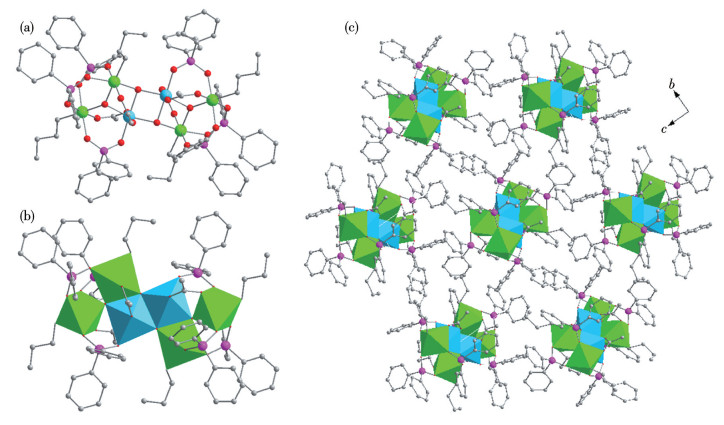
Complexes 1 and 2 have the same skeleton structures except for the introduced transitional metal ions; therefore, complex 1 is selected to describe the structure in detail. SXRD analysis reveals that complex 1 crystallizes in the monoclinic system, space group P21/c. There are four Sn4+ ions, two Ni2+ ions, two μ3-O atoms, two μ3-OH- ions, four n-butyl groups, four acetate, and six diphenylphosphonate groups in the molecular structure (Fig.1a). Both the acetate and diphenylphosphonate groups present μ2-η1∷η1 coordination mode. All the Sn4+ ions show the same octahedral [SnO5C] coordination environments, and the two Ni2+ ions show octahedral [NiO6] coordination environments. The average bond lengths of Sn1—O and Sn2—O are 0.210 9 and 0.211 9 nm, respectively, while the average bond length of Ni—O is 0.205 9 nm. Both the bond lengths of Sn—O and Ni—O are consistent with those in the literature[20, 22]. The skeleton Sn4Ni2O2 can be seen as two Sn2Ni(μ3-O) units linked by two μ3-O atoms via edge-sharing mode. Each Sn2Ni(μ3-O) unit features a nearly flat mode (Fig.1b). The packing structure is demonstrated in Fig.1c. To the best of our knowledge, complex 1 is the first heterometallic cobalt TOCs among the reported TOCs.
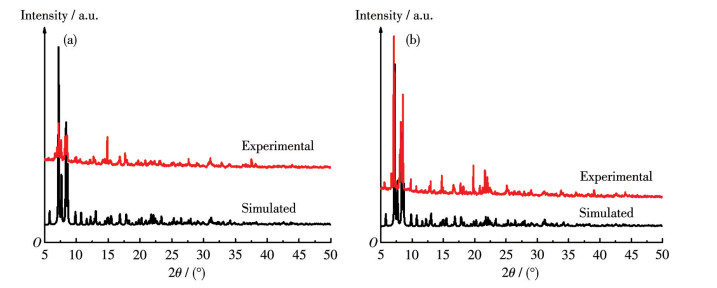
It is important to determine the phase purity of complexes 1 and 2, and then the PXRD analysis was conducted at room temperature. As shown in Fig.2, the experiment PXRD patterns were in good agreement with the simulated ones from single-crystal X-ray data, which confirmed the pure phase of 1 and 2. To be noted, the intensity difference of the simulated and experimental patterns is mainly because of the powder size and variation in different orientations during the PXRD experiment[23].
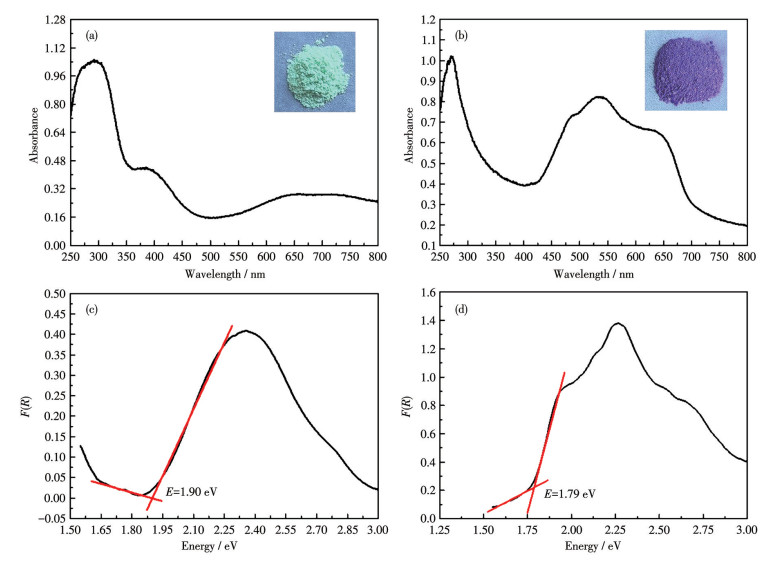
The light absorption and band gaps are important parameters for a photocatalyst. Herein, the UV-Vis diffuse-reflectance measurement of complexes 1 and 2 was performed in a solid state at room temperature. As shown in Fig.3a and 3b, both 1 and 2 had ultraviolet absorption ranging from 250 to 400 nm, which could be ascribed to the aromatic ligands and the Sn oxo cores. Moreover, due to the introduced transition metal ions, 1 and 2 showed obvious absorption in the visible region (400-800 nm), consistent with the 3dn electronic configurations of the metal ions present. For complex 1, the two absorption bands in the visible region at 375-450 and 500-800 nm correspond well to two of the three spin-allowed transitions [3A2g→3T1g(P) and 3A2g→ 3T1g(F)][27]. For 2, the absorption peaks at 533 and 636 nm could be ascribed to 4T1g(F)→4A2g and 4T1g(F)→ 4T1g(P) transitions of octahedral Co2+ ions[28]. From Fig.3c and 3d, it can be seen that the optical band gaps of 1 and 2 were estimated to be 1.90 and 1.79 eV, respectively, based on the Kubelka-Munk function[29], indicating that they possess semiconductor-like characteristics. The obviously narrower band gaps of complexes 1 and 2 than 3.6 eV of SnO2 can be ascribed to the introduced metal ions.
Inset: the morphology and colors of 1 and 2.
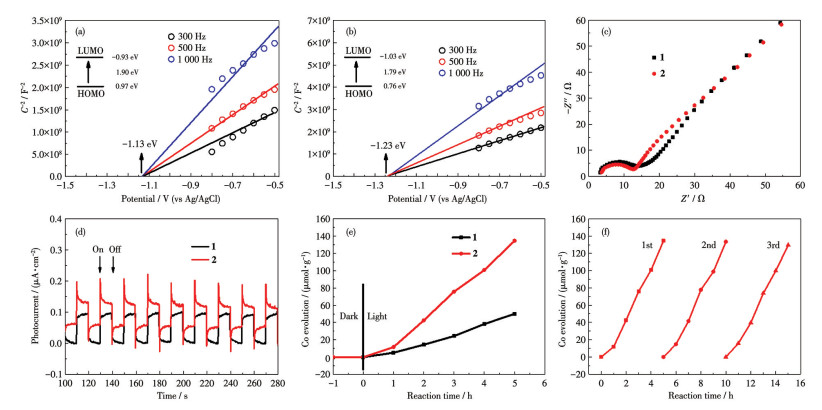
The prepared complexes 1 and 2 are semiconductor materials that are expected to be studied for their photoelectric properties. The Mott-Schottky measurements were performed at frequencies of 300, 500, and 1 000 Hz. As shown in Fig.4a and 4b, the LUMO energy levels for complexes 1 and 2 were estimated to be -0.93 and -1.03 eV, respectively. The LUMO energy levels of 1 and 2 are lower than the potential requirements of reducing CO2 to many carbon-based products, indicating that they can be used as potential photocatalysts for CO2RR. The electrochemical impedance spectroscopy (EIS) of complexes 1 and 2 was measured by using a typical three-electrode photoelectrochemical cell under 0.2 V bias potential (Fig.4c), and the results indicated that their charge transfer resistance was nearly the same because of their same skeleton structures. The photocurrent densities of 1 and 2 were also measured. As shown in Fig.4d, the on-off illumination circles of photocurrent responses of 1 and 2 showed that their photocurrents could be quickly generated and decayed, and the photocurrent density for 1 and 2 were 0.097 and 0.128 μA·cm-2, respectively.
Inset: the energy diagram of the HOMO and LUMO levels
Both complexes 1 and 2 were used as photocatalysts for the photocatalytic CO2RR experiment under UV-Vis light illumination. As shown in Fig.4e, both complex 1 and 2 showed photocatalytic CO2RR activity, and only CO was generated with the rates of 10.01 and 26.89 μmol·g-1·h-1 for 1 and 2, respectively. There was no other gas that could be detected in the gas phases, indicating the high selectivity toward the CO product for 1 and 2 photocatalysts. The fact that 1 and 2 have the same structures but different photocatalytic CO2RR efficiency may greatly prove that the introduced transitional ions paly reactive site role in the photocatalytic CO2RR process. Based on the analysis of the photoelectric property data of 1 and 2 and the analysis of the photocatalytic CO2RR mechanism of similar clusters reported in literature[30], the possible CO2RR mechanism of 1 and 2 was proposed as follows. Under visible light irradiation, the part of the SnO core of molecular may produce photo-generated electrons and further transfer to the transitional metal active site. With the departure of the coordinated group of acetate, CO2 adsorbs on the exposed transitional metal active site and accepts an electron to form the *CO2- intermediate, and then a *COOH intermediate is generated by receiving a proton, followed by *COOH transforming into CO with the aid of an external proton and electron. Finally, the oxidized SnO core is reductively quenched by TEOA, completing the photocatalytic CO2RR process. To our knowledge, it is the first study on the use of heterometallic TOC for photocatalytic CO2RR. Complexes 1 and 2 should have the same photocatalytic stability due to their same skeleton structures, and then complex 2 was selected to study the photocatalytic stability. As shown in Fig.4f, complex 2 showed good photocatalytic stability, and it could be reused at least three times, with no significant loss of activity observed, mainly because of the good structural stability, resulting from the protection ligands of diphenylphosphonate in the structure.
In summary, two transition metal ions heterometallic TOCs have been successfully synthesized in a simple and general synthetic approach, which will enrich the types and number of TOCs. Both complexes showed the characteristic absorption of the transition metal ions in the visible light range. Moreover, complexes 1 and 2 had photocatalytic CO2RR activities featuring the high selectivity toward the CO product. This work will not only promote the synthetic study of TOCs but also develop an investigation of photocatalytic CO2RR using TOCs.
PRAKASH K, SENTHIL KUMAR P, PANDIARAJ S, SARAVANAKUMAR K, KARUTHAPANDIAN S. Controllable synthesis of SnO2 photocatalyst with superior photocatalytic activity for the degradation of methylene blue dye solution[J]. J. Exp. Nanosci., 2016, 11(14): 1138-1155 doi: 10.1080/17458080.2016.1188222
ZHENG L R, ZHENG Y H, CHEN C Q, ZHAN Y Y, LIN X Y, ZHENG Q, WEI K M, ZHU J F. Network structured SnO2/ZnO heterojunction nanocatalyst with high photocatalytic activity[J]. Inorg. Chem., 2009, 48(5): 1819-1825 doi: 10.1021/ic802293p
SUN C Y, YANG J K, XU M, CUI Y, REN W W, ZHANG J X, ZHAO H L, LIANG B. Recent intensification strategies of SnO2-based photocatalysts: A review[J]. Chem. Eng. J., 2022, 427: 131564 doi: 10.1016/j.cej.2021.131564
JUNAID M, SHARAF M, EI-MELIGY M, RIAZ M A, DAR M A, KHAN I U. Innovative approach to solar hydrogen generation using SnO2 photocatalyst in water splitting[J]. J. Chin. Chem. Soc., 2025, 72(5): 488-497 doi: 10.1002/jccs.70009
LIU C, HE J Q, SHEN L, HOU J H, ZHANG Y C. One-pot solvothermal synthesis of flower-like Zn2+-doped SnO2 with superior photocatalytic activity[J]. J. Mol. Struct., 2025, 1330: 141500
VINDHYA P, SURESH S, KAVITHA V. Biofabrication and characterisation of Ni-doped SnO2 nanoparticles with enhanced cytotoxicity, antioxidant, antimicrobial and photocatalytic activities[J]. Appl. Organomet. Chem., 2025, 39(3): e7875 doi: 10.1002/aoc.7875
SHABNA S, DHAS S S J, SHENBAGAVALLI V, NIXON R G S, BIJU C, SEBASTIAMMAL S, ASWATHAPPA S, ALMANSOUR A I. Preparation of S, Zn co-doped SnO2 nanostructures and their insights into the structural, morphological, optical and photocatalytic activity[J]. Res. Chem. Intermed., 2025, 51(7): 3443-3466 doi: 10.1007/s11164-025-05608-2
KARONNAN KOROTH S, ISLAM H, PAL U. VASUNDHARA M. Tailoring Co-loaded SnO2 nanostructures as next-generation photocatalysts for efficient hydrogen evolution[J]. ACS Appl. Energy Mater., 2025, 8(21): 16082-16100 doi: 10.1021/acsaem.5c02588
BISHT R, JOSHI G C, JOSHI C S. Investigation of the effect of Cu doping on dielectric and photocatalytic behaviour of SnO2 nanoparticles[J]. J. Mater. Sci.‒Mater. Electron., 2025, 36(4): 235-241 doi: 10.1007/s10854-025-14288-y
ZHU Y, ZHANG L, ZHANG J. Assembly of high-nuclearity Sn26, Sn34-oxo clusters: Solvent strategies and inorganic Sn incorporation[J]. Chem. Sci., 2019, 10(39): 9125-9129 doi: 10.1039/C9SC02503K
ZHU Y, OLSEN M R, NYMAN M, ZHANG L, ZHANG J. Stabilizing gamma-alkyltin-oxo keggin ions by borate functionalization[J]. Inorg. Chem., 2019, 58(7): 4534-4539 doi: 10.1021/acs.inorgchem.9b00093
LIU S B, XIAO J, LU X F, WANG J, WANG X, LOU X W. Efficient electrochemical reduction of CO2 to HCOOH over sub-2 nm SnO2 quantum wires with exposed grain boundaries[J]. Angew. Chem.‒Int. Edit., 2019, 58(25): 8499-8503 doi: 10.1002/anie.201903613
ZHU Y, ZHANG J, ZHANG L. Sn13-oxo clusters with an open hollow structural motif and decorated by different functional ligands[J]. Inorg. Chem., 2019, 58(23): 15692-15695 doi: 10.1021/acs.inorgchem.9b02474
ZHU Y, LI Q H, LI D S, ZHANG, J, ZHANG L. Functional ligand directed assembly and electronic structure of Sn18-oxo wheel nanoclusters[J]. Chem. Commun., 2021, 57(42): 5159-5162 doi: 10.1039/D1CC00651G
GLOWACKI B, LUTTER M, SCHOLLMEYER D, HILLER W, JURKSCHAT K. Novel stannatrane N(CH2CMe2O)2(CMe2CH2O)SnO-t-Bu and related oligonuclear tin(Ⅳ) oxoclusters. Two isomers in one crystal[J]. Inorg. Chem., 2016, 55(20): 10218-10228 doi: 10.1021/acs.inorgchem.6b01429
WANG Q F, MA C L, HE G F, LI Z. Synthesis and characterization of new tin derivatives derived from 3, 5, 6-trichlorosalicylic acid: Cage, chain and ladder X-ray crystal structures[J]. Polyhedron, 2013, 49(1): 177-182 doi: 10.1016/j.poly.2012.09.057
LIU F F, WANG, D, CHEN G H, QIAO Y, LUO F, ZHANG J, ZHANG L. Alkenyl-type ligands functionalized tin-lanthanide oxo nanoclusters as molecular lithography resists[J]. Sci. China Chem., 2023, 66(6): 1731-1736 doi: 10.1007/s11426-023-1598-3
TIAN X J, YU Y Z, LU Q, ZHANG X M. Organic-inorganic high-valence Sn18-oxo clusters: Direct utilization of an inorganic Sn(Ⅳ) source to improve the nuclearity and electrocatalytic CO2 reduction properties[J]. Inorg. Chem., 2022, 61(16): 6037-6044 doi: 10.1021/acs.inorgchem.2c00038
ZHU Y, WANG Z R, LI D J, ZHU Y D, LI Q H, LI D S, ZHANG L. Silver-templated γ-Keggin alkyltin-oxo cluster: Electronic structure and optical limiting effect[J]. Angew. Chem.‒Int. Edit., 2022, 61(27): e202202853 doi: 10.1002/anie.202202853
WANG D, CHEN G H, WANG S T, ZHANG J, ZHANG L. Triethanolamine stabilized non-alkyl Sn4Cd4 and alkyl Sn2Cd12 oxo clusters with distinct electrocatalytic activities[J]. Chem. Commun., 2022, 58(30): 4759-4762 doi: 10.1039/D2CC00574C
WANG D, YI X F, ZHANG L. Non-alkyl tin-oxo clusters as new-type patterning materials for nanolithography[J]. Sci. China Chem., 2022, 65(1): 114-119 doi: 10.1007/s11426-021-1092-2
SUN X X, GUO Y H, YU Y Z. Crystal structure of bis(μ3-diphenyl-phosphinato)-tetrakis(μ2-diphenylphosphinato)-bis(diphenylphosphinato)-bis(μ2-hydroxo)dicopper(Ⅱ)-ditin(Ⅳ), C104H100O18P8Cu2Sn2[J]. Z. Krist.‒New Cryst. Struct., 2023, 238(1): 123-125
郁有祝, 张艳茹, 郭玉华, 周忠源, 巫婧, 张姝晗, 陈阳, 董要栋. 水杨醛肟和乙酰氧肟酸钛氧簇合物的合成及光电性质[J]. 无机化学学报, 2023, 39(11): 2231-2239YU Y Z, ZHANG Y Y, GUO Y H, ZHOU Z Y, WU J, ZHANG S H, CHEN Y, DONG Y D. Syntheses and photoelectric properties of titanium oxo clusters assembled by salicylaldoxime and acetohydroxamic acid[J]. Chinese J. Inorg. Chem., 2023, 39(11): 2231-2239
GUO Y H, YU Y Z, SHEN Y H, YANG L G, LIU N N, ZHOU Z Y, NIU Y S. “Three-in-one” structural-building-mode-based Ti16-type titanium oxo cluster entirely protected by the ligands benzoate and salicylhydroxamate[J]. Inorg. Chem., 2022, 61: 8685-8693 doi: 10.1021/acs.inorgchem.2c00327
YU Y Z, ZHANG Y R, GENG C H, SUN L, GUO Y, FENG Y R, WANG Y X, ZHANG X M. Precise and wide-ranged band-gap tuning of Ti6-core-based titanium oxo clusters by the type and number of chromophore ligands[J]. Inorg. Chem., 2019, 58(24): 16785-16791 doi: 10.1021/acs.inorgchem.9b02951
郁有祝, 张艳茹, 郭玉华, 周忠源, 杨立国, 李嘉琳, 方黎月, 乔宽宽. 吡啶-2-甲醛肟钛氧簇合物的合成、结构调控及光电性质[J]. 无机化学学报, 2022, 38(11): 2299-2307YU Y Z, ZHANG Y Y, GUO Y H, ZHOU Z Y, YANG L G, LI J L, FANG L Y, QIAO K K. Preparation, syntheses, structure-regulation and photoelectric properties of 2-pyridinecarbaldehyde oxime assembled titanium oxo clusters[J]. Chinese J. Inorg. Chem., 2022, 38(11): 2299-2307
ESLAVA S, MCPARTLIN M, THOMSON R I, RAWSON J M, WRIGHT D S. Single-source materials for metal-doped titanium oxide: Syntheses, structures, and properties of a series of heterometallic transition-metal titanium oxo cages[J]. Inorg. Chem., 2010, 49(24): 11532-11540 doi: 10.1021/ic101687m
ESLAVA S, GOODWILL B P, MCPARTLIN M, WRIGHT D S. Extending the family of titanium heterometallic-oxo-alkoxy cages[J]. Inorg. Chem., 2011, 50(12): 5655-5662 doi: 10.1021/ic200350j
TAUC J. Absorption edge and internal electric fields in amorphous semiconductors[J]. Mater. Res. Bull., 1970, 5(8): 721-729 doi: 10.1016/0025-5408(70)90112-1
CHEN W P, BAI K P, LV M T, NI S, HUANG C, YANG Q Y, ZHENG Y Z. Porous 3d-4f coordination clusters for selective visible-light photocatalytic CO2 reduction to CO[J]. Angew. Chem.‒Int. Edit., 2025, 64(15): e202424805 doi: 10.1002/anie.202424805

Figure 1 Crystal structure of complex 1 (a), polyhedral view of 1 (b), and packing diagram (c) for 1

Figure 3 Solid-state UV-Vis diffuse-reflectance absorption spectra of complexes 1 (a) and 2 (b), respectively; Band gaps of 1 (c) and 2 (d), respectively
Inset: the morphology and colors of 1 and 2.

Figure 4 Mott-Schottky plots for (a) 1 and (b) 2 in 0.2 mol·L-1 Na2SO4 aqueous solution; (c) Nyquist plots for 1 and 2; (d) Photocurrent responses of 1 and 2 under on/off cycle irradiation; (e) Photocatalytic CO2 activity of 1 and 2 under UV-Vis light illumination; (f) Recyclability test of 2
Inset: the energy diagram of the HOMO and LUMO levels
Table 1. Selected crystallographic data for complexes 1 and 2
| Parameter | 1 | 2 |
| Formula | C96H110Ni2O24P6Sn4 | C96H110Co2O24P6Sn4 |
| Formula weight | 2 423.82 | 2 424.26 |
| Temperature/K | 296 | 296 |
| Crystal system | Monoclinic | Monoclinic |
| Space group | P21/c | P21/c |
| a/nm | 1.573 83(12) | 1.576 9(3) |
| b/nm | 1.445 65(11) | 1.446 4(3) |
| c/nm | 2.381 57(18) | 2.386 1(5) |
| β/(°) | 104.743 0(10) | 104.815(3) |
| V/nm3 | 5.240 2(7) | 5.261 6(19) |
| Z | 2 | 2 |
| Dc/(g·cm-3) | 1.536 | 1.530 |
| μ/mm-1 | 1.450 | 1.402 |
| F(000) | 2 448 | 2 444 |
| Collected reflection | 38 016 | 38 846 |
| Unique reflection (Rint) | 12 978 (0.025 2) | 13 241 (0.032 4) |
| Completeness/% | 99.7 | 99.9 |
| GOF on F 2 | 1.019 | 1.055 |
| R1, wR2 [I>2σ(I)] | 0.034 7, 0.084 3 | 0.052 3, 0.148 9 |
| R1, wR2 (all data) | 0.054 4, 0.094 5 | 0.090 4, 0.197 4 |
 下载: 导出CSV
Table 2. Selected bond lengths (nm) and angles (°) in complexes 1 and 2
| 1 | |||||
| Sn1—O5 | 0.212 9(3) | Sn1—C45 | 0.212 3(4) | Ni1—O7 | 0.204 1(2) |
| Sn1—O7 | 0.200 9(2) | Sn2—O1 | 0.215 1(3) | Ni1—O9 | 0.205 8(3) |
| Sn1—O8 | 0.212 4(3) | Sn2—O3 | 0.214 6(3) | Ni1—O10i | 0.211 0(2) |
| Sn1—O10i | 0.212 5(2) | Sn2—O4 | 0.215 8(3) | Ni1—O10 | 0.208 9(2) |
| Sn1—O12 | 0.215 8(3) | Ni1—O2 | 0.202 0(3) | Ni1—O11 | 0.203 3(3) |
| O5—Sn1—O12 | 90.37(12) | O7—Sn1—O12 | 88.22(11) | O2—Ni1—O7 | 101.37(10) |
| O7—Sn1—O5 | 87.99(10) | O7—Sn1—C45 | 176.84(17) | O2—Ni1—O9 | 88.72(11) |
| O7—Sn1—O8 | 87.74(11) | O8—Sn1—O5 | 91.38(12) | O2—Ni1—O10 | 94.56(10) |
| O7—Sn1—O10i | 80.43(9) | O8—Sn1—O10i | 92.91(11) | O2—Ni1—O11 | 88.99(12) |
| O1—Sn2—O4 | 90.91(12) | O1—Sn2—O6 | 176.14(11) | O3—Sn2—O1 | 92.25(13) |
| O3—Sn2—O4 | 176.67(13) | O3—Sn2—O6 | 88.31(13) | O4—Sn2—O6 | 88.47(13) |
| 2 | |||||
| Sn1—O1 | 0.212 5(4) | Sn2—O7 | 0.214 4(4) | Co1—O4 | 0.203 5(4) |
| Sn1—O5i | 0.211 1(3) | Sn2—O9 | 0.216 6(4) | Co1—O2 | 0.210 5(4) |
| Sn1—O8 | 0.216 5(4) | Sn2—O10 | 0.216 1(4) | Co1—O5 | 0.210 9(3) |
| Sn1—O11 | 0.213 7(3) | Sn2—O12 | 0.196 8(3) | Co1—O5 | 0.210 9(3) |
| Sn1—O12 | 0.201 0(3) | Sn2—C41 | 0.211 2(6) | Co1—O6 | 0.206 9(4) |
| Sn1—C45 | 0.212 0(7) | Sn2—O3 | 0.214 7(4) | Co1—O12 | 0.207 1(3) |
| O1—Sn1—O8 | 175.87(14) | O12—Sn1—O1 | 88.00(14) | O2—Co1—O5 | 80.89(14) |
| O1—Sn1—O11 | 91.43(16) | O12—Sn1—O8 | 88.17(14) | O2—Co1—O5i | 90.76(13) |
| O5i—Sn1—O1 | 93.82(14) | O3—Sn2—O9 | 176.40(14) | O4—Co1—O2 | 89.38(14) |
| O5i—Sn1—O8 | 84.06(13) | O3—Sn2—O10 | 90.67(16) | O4—Co1—O5 | 96.54(13) |
| O5i—Sn1—O11 | 167.47(14) | O7—Sn2—O3 | 92.00(16) | O4—Co1—O6 | 89.87(15) |
| O11—Sn1—O8 | 89.96(15) | O7—Sn2—O9 | 88.69(17) | O4—Co1—O12 | 101.56(13) |
| Symmetry codes: i -x, -y+1, -z+1 for 1; i -x+2, -y+1, -z+1 for 2. | |||||
下载: 导出CSV

 扫一扫看文章


扫一扫关注我们