Figure 1.
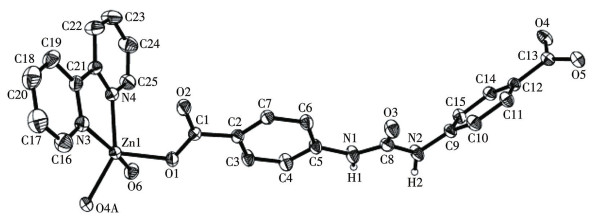
Drawing of the asymmetric unit of complex 1 with 30% probability thermal ellipsoids
H atoms are omitted for clarity; Symmetry code: A: x+1/2, -y+3/2, z+3/2.


In recent decades, coordination polymers (CPs) have attracted considerable research interest as an important class of materials, primarily due to their diverse structural architectures[1-5] and outstanding functional properties. These materials show promising applications in areas such as chemical sensing[6-7], gas storage and separation[8-9], and catalytic processes[10-13]. This growing attention is further driven by the favorable attributes of metal ions and their complexes, including low cost, widespread availability, biological activity, photochemical responsiveness, and rich coordination behavior that allows compatibility with numerous ligand varieties[14-16]. Of the many organic linkers available, aromatic carboxylic acids stand out as the most commonly employed building blocks in assembling coordination polymers and related frameworks[5, 12-13]. Present research efforts are increasingly focused on designing novel carboxylate-based ligands featuring multiple binding sites, which are then systematically studied for their potential in constructing advanced metal-organic frameworks.
As a continuation of our previous studies on functional CPs derived from commercially available carboxylic acid linkers[12-13, 17-18], we have now investigated the flexible dicarboxylate ligand bis(4-carboxyphenyl)urea (H2cada) as an underexplored linker to construct coordination polymers[19-22]. H2cada was chosen owing to its four potential coordination sites, which enable diverse coordination modes. In this study, we report the hydrothermal synthesis and characterization of three new CPs assembled from metal(Ⅱ) salts, H2cada, and two auxiliary ligands acting as mediators of crystallization. These products exhibit diverse 1D chain structures, formulated as [Zn(μ-cada)(bipy)(H2O)]n (1), [Zn(μ3-cada)(phen)·H2O]n (2) and [Cd(μ3-cada)(phen)]n (3), where bipy=2, 2′-bipyridine and phen=1, 10-phenanthroline. Structural and topological features, as well as catalytic performance of the obtained products in the condensation reaction between benzaldehyde and malononitrile, are described below. This work expands the family of CPs constructed from flexible carboxylate linkers and underscores the promising catalytic potential of these materials in heterogeneous catalysis.
All reagents and solvents utilized were of analytical grade and were used as received, without any additional purification. Carbon, hydrogen, and nitrogen were determined using an Elementar Vario EL elemental analyzer. The IR spectrum was recorded using KBr pellets and a Bruker EQUINOX 55 spectrometer. Thermogravimetric analysis (TGA) data were collected on a LINSEIS STA PT1600 thermal analyzer with a heating rate of 10 ℃·min-1. Powder X-ray diffraction (PXRD) patterns were measured on a Rigaku-Dmax 2400 diffractometer using Cu Kα radiation (λ=0.154 06 nm). The X-ray apparatus functioned at a voltage of 40 kV and a current of 40 mA, with data acquired over a 2θ range from 5° to 45°. Additionally, 1H NMR spectra were captured using a JNM ECS 400M spectrometer.
In a reaction setup, 0.027 g (0.20 mmol) of ZnCl2 was combined with 0.060 g (0.20 mmol) of H2cada, bipy (0.031 g, 0.20 mmol), along with 0.016 g (0.40 mmol) of NaOH and 10 mL of water. The mixture was stirred for 15 min at room temperature and then transferred to a 25 mL Teflon-lined stainless steel container. This vessel was heated to 160 ℃ for 3 d, after which it was slowly cooled to room temperature at a rate of 10 ℃·h-1. The resulting colourless block-shaped crystals of 1 were extracted by hand and rinsed with distilled water, yielding 52% based on H2cada. Anal. Calcd. for C25H20ZnN4O6(%): C 55.83, H 3.75, N 10.42; Found(%): C 56.07, H 3.73, N 10.72. IR (KBr, cm-1): 3 333m, 3 072w, 1 648m, 1 594w, 1 567m, 1 525s, 1 433m, 1 305w, 1 236w, 1 175w, 1 113w, 1 013w, 975w, 871m, 851w, 778m, 725w, 640w, 621w.
ZnCl2 (0.027 g, 0.20 mmol), H2cada (0.060 g, 0.20 mmol), phen (0.040 g, 0.20 mmol), NaOH (0.016 g, 0.40 mmol), and 10 mL of H2O were gently mixed at ambient temperature for 15 min. The mixture was then enclosed in a stainless steel container lined with Teflon, totaling 25 mL in capacity, and heated at 160 ℃ for 3 d. Subsequently, the container was allowed to reach ambient temperature at a controlled pace of 10 ℃·h-1. Manually, the distinct colourless block-like crystals of complex 2 were obtained, rinsed thoroughly with purified water, and then allowed to dry. Yield: 46% (based on H2cada). Anal. Calcd. for C27H20ZnN4O6(%): C 57.72, H 3.59, N 9.97; Found(%): C 57.46, H 3.56, N 10.14. IR (KBr, cm-1): 3 519w, 3 280w, 3 058w, 1 630m, 1 605s, 1 542w, 1 482w, 1 412w, 1 382w, 1 332s, 1 235s, 1 176m, 1 142w, 1 105w, 1 016w, 869w, 845w, 798m, 765w, 727m, 643w, 613w.
CdCl2·H2O (0.040 g, 0.20 mmol), H2cada (0.060 g, 0.20 mmol), phen (0.040 g, 0.20 mmol), NaOH (0.016 g, 0.40 mmol), and H2O (10 mL) were agitated at ambient temperature for 15 min, and subsequently the mixture was placed into a Teflon-lined stainless steel container with a volume of 25 mL, and heated at 160 ℃ for 3 d. Then the temperature was decreased to ambient conditions at a controlled rate of 10 ℃·h-1. Manually isolated, colourless block-shaped crystals of 3 were obtained, and subsequently rinsed with distilled water. The yield was recorded at 45% (based on H2cada). Anal. Calcd. for C27H18CdN4O5(%): C 54.88, H 3.07, N 9.48; Found(%): C 55.14, H 3.09, N 9.44. IR (KBr, cm-1): 1 663w, 1 609m, 1 537s, 1 406s, 1 297w, 1 229w, 1 171w, 1 144w, 1 101w, 1 009w, 951w, 894w, 856m, 779m, 728m, 698w, 636w, 617w. These complexes are insoluble in water and common organic solvents, such as methanol, ethanol, acetone, and DMF.
A total of three individual crystals with sizes of 0.05 mm×0.03 mm×0.03 mm (1), 0.06 mm×0.05 mm×0.04 mm (2), and 0.06 mm×0.04 mm×0.03 mm (3) were selected, and the data were collected at 303(2) K on a Bruker SMART APEX Ⅱ CCD diffractometer with Mo Kα (λ=0.071 073 nm). The structures were solved by direct methods and refined by full matrix least-squares on F2 using the SHELXTL-2014 program. All non-hydrogen atoms were refined anisotropically. All the hydrogen atoms (except for the ones bound to water molecules) were placed in calculated positions with fixed isotropic thermal parameters and included in structure factor calculations in the final stage of full-matrix least-squares refinement. The hydrogen atoms of water molecules in 1 and 2 were located by different maps and constrained to ride on their parent O atoms. A summary of the crystallography data and structure refinements for 1-3 is given in Table S1 (Supporting information). The selected bond lengths and angles for complexes 1-3 are listed in Table S2. Hydrogen bond parameters of complexes 1-3 are given in Table S3.
In a typical protocol, benzaldehyde (0.50 mmol), malononitrile (1.0 mmol), and catalyst (typically 2.0% of molar fraction) were combined in CH3OH (1.0 mL), and the obtained suspension was stirred for 10-60 min at 25 ℃. The catalyst was then isolated by centrifugation, and the filtrate was evaporated under reduced pressure, resulting in a crude solid. This was dissolved in CDCl3 and analyzed by 1H NMR spectroscopy (JNM ECS 400M spectrometer) for product quantification (Fig.S1). In catalyst recycling experiments, the catalyst was removed by centrifugation, washed with CH3OH, dried at 25 ℃, and reused in subsequent catalytic tests. Effects of catalyst and solvent, as well as substrate scope with other aldehydes, were investigated following the above-described procedure.
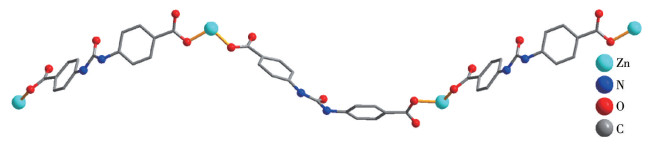
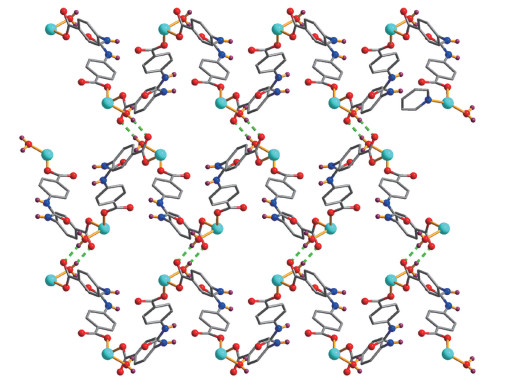
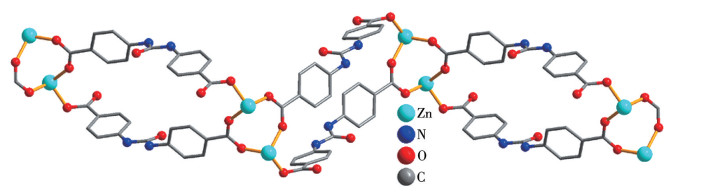
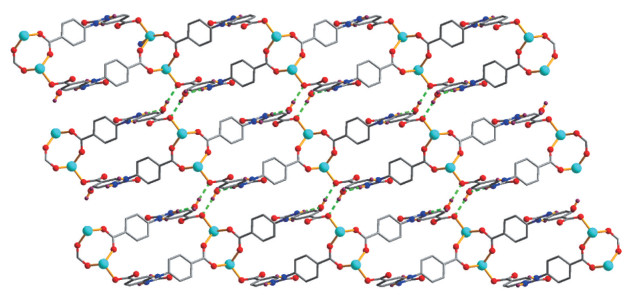
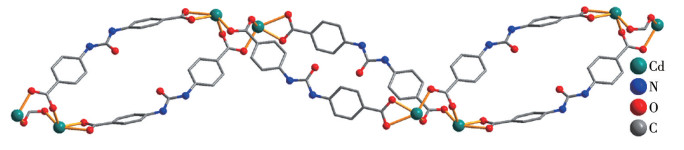
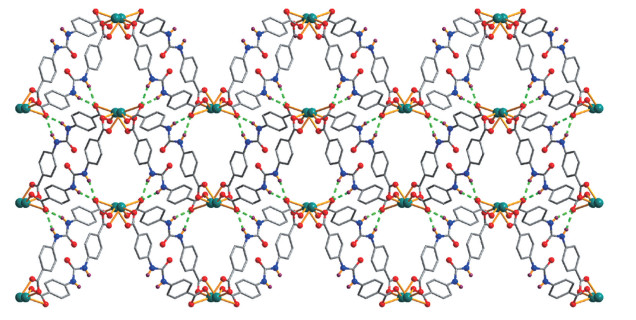
In the asymmetric unit of 1, there are one Zn(Ⅱ) center, a μ-cada2- block, a terminal bipy, and a H2O ligand. The Zn1 ion reveals a distorted trigonal bipyramidal {ZnN2O3} geometry, filled by two carboxylate oxygen atoms from two μ-cada2- units one O atom from the H2O ligand as well as a pair of nitrogen atoms contributed by one bipy ligand (Fig.1). The cada2- linkers display a μ-coordination (mode Ⅰ, Scheme 1) and assemble the Zn1 ions into a 1D chain (Fig.2) with a 2C1 topology (Fig.3). Furthermore, the adjacent chains assemble into a 2D layer through hydrogen bonding (Fig.4 and Table S3).
H atoms are omitted for clarity; Symmetry code: A: x+1/2, -y+3/2, z+3/2.

In the asymmetric unit of this 1D coordination polymer, there is one Zn(Ⅱ) center, a μ3-cada2- block, a terminal phen ligand, and one lattice water molecule (Fig.5). The Zn1 center is five-coordinated and adopt distorted trigonal bipyramidal {ZnN2O3} geometry, which is populated by two Nphen atoms and three carboxylate O donors from two μ3-cada2- linkers (Fig.5). The cada2- blocks function as μ3-linkers (mode Ⅱ, Scheme 1) and assemble the Zn1 centers into a 1D chain (Fig.6) with a (4, 4)(0, 2) topology (Fig.7). Furthermore, the adjacent chains assemble into a 2D layer through hydrogen bonding (Fig.8 and Table S3).
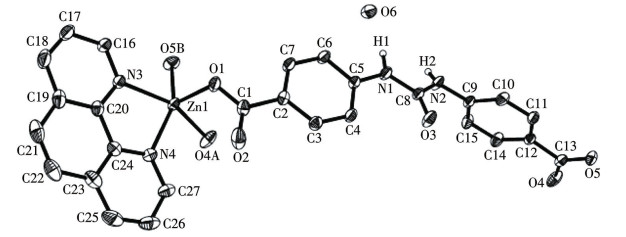
H atoms and lattice water molecules are omitted for clarity; Symmetry codes: A: -x+3/2, -y+3/2, -z+3/2; B: x, -y+3/2, z-1/2.

The asymmetric unit of this 1D coordination polymer is composed of one Cd(Ⅱ) ion, a μ3-cada2- linker, and a terminal phen ligand (Fig.9). The Zn1 ion adopts a distorted octahedral {CdN2O4} geometry filled by four carboxylate O atoms from three μ3-cada2- ligands and two N donors from the terminal phen ligand. The cada2- linkers display a μ3-coordination (mode Ⅲ, Scheme 1) and assemble the Cd1 ions into a 1D chain (Fig.10) with a fes topology and a point symbol of (4.82) (Fig.11). Furthermore, the adjacent chains assemble into a 2D layer through hydrogen bonding (Fig.12 and Table S3).
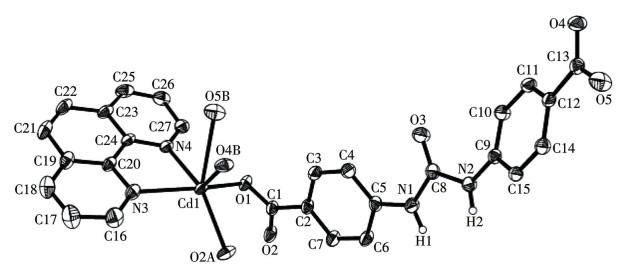
H atoms are omitted for clarity; Symmetry codes: A:-x+2, y, -z+3/2; B:-x+1, -y+1, -z+1.

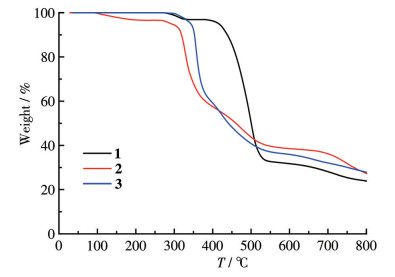
TGA of complexes 1-3 was conducted under an inert nitrogen atmosphere over the temperature range of 25-800 ℃ (Fig.13). Complex 1 had a weight loss between 272 and 331 ℃ due to the release of one coordinated water molecule (Obsd. 3.1%, Calcd. 3.3%). The decomposition of the dehydrated sample started at 383 ℃. Similarly, a release of one lattice water molecule (Obsd. 3.4%; Calcd. 3.2%) was observed in the TGA curve of complex 2 between 90 and 206 ℃, followed by the decomposition at 267 ℃. Complex 3 has no coordinated or crystallization water, and its metal-organic network remained stable on heating up to 270 ℃.
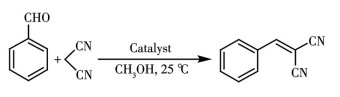
Coordination polymers are known as catalysts for various condensation reactions[10, 12-13, 17-18]. In this study, we explored the obtained complexes 1-3 as heterogeneous catalysts in the condensation reaction between an aldehyde and a dinitrile. As model substrates, benzaldehyde and malononitrile were used. The reaction was carried out at 25 ℃ in methanol as a typical solvent, leading to the selective generation of 2-benzylidenemalononitrile (Scheme 2, Table 1). Additionally, the effects of different parameters, including catalyst loading (xcat) and recyclability, reaction time, solvent choice, and substrate scope, were investigated.
Among the obtained complexes, complexes 1 and 2 revealed the highest catalytic activity, converting benzaldehyde to 2-benzylidenemalononitrile with the yields as high as 100% (Table 1 and Fig.S1). Complex 1 was selected to evaluate the influence of various reaction parameters. For example, when the reaction time was extended from 10 to 60 min (Table 1, entries 1-6), the product yield increased from 51% to 100%. The increase in the catalyst loading from 1% to 2% also boosted the product yield from 94% to 100% (Table 1, entries 6 and 11). We also screened alternative solvents, such as water, ethanol, acetonitrile, and chloroform, but these proved less effective than methanol, with the yields ranging from 67% to 98%. It should be mentioned that very high product yields (98% and 96%; Table 1, entries 7 and 8) could be obtained in water or ethanol that are considered green solvents. In contrast to complexes 1 and 2, complex 3 revealed lower activity, with maximum yields of 85% (Table 1, entry 13). This difference in activity can be attributed to the presence of Zn2+ centers with unsaturated coordination sites in complexes 1 and 2[13, 17-18]. Blank tests showed that the condensation reaction was much less pronounced when using H2cada (26% yield) or ZnCl2 (31% yield) as catalysts (Table 1, entries 14-16). In the absence of a catalyst, the yield dropped to 20%.
 下载:
导出CSV
下载:
导出CSV
| Entry | Catalyst | Time/min | xcat/% | Solvent | Yield*/% |
| 1 | 1 | 10 | 2.0 | CH3OH | 51 |
| 2 | 1 | 20 | 2.0 | CH3OH | 71 |
| 3 | 1 | 30 | 2.0 | CH3OH | 82 |
| 4 | 1 | 40 | 2.0 | CH3OH | 91 |
| 5 | 1 | 50 | 2.0 | CH3OH | 96 |
| 6 | 1 | 60 | 2.0 | CH3OH | 100 |
| 7 | 1 | 60 | 2.0 | H2O | 98 |
| 8 | 1 | 60 | 2.0 | C2H5OH | 96 |
| 9 | 1 | 60 | 2.0 | CH3CN | 85 |
| 10 | 1 | 60 | 2.0 | CHCl3 | 67 |
| 11 | 1 | 60 | 1.0 | CH3OH | 94 |
| 12 | 2 | 60 | 2.0 | CH3OH | 100 |
| 13 | 3 | 60 | 2.0 | CH3OH | 85 |
| 14 | Blank | 60 | CH3OH | 20 | |
| 15 | ZnCl2 | 60 | 2.0 | CH3OH | 31 |
| 16 | H2cada | 60 | 2.0 | CH3OH | 26 |
| * The yield (Y) was calculated by 1H NMR spectroscopy: Y=nproduct/naldehyde×100%. | |||||
Several substituted benzaldehyde substrates were tested to explore the substrate scope in the condensation reaction with malononitrile. These studies were performed under optimized conditions (1 h of reaction time, 25 ℃, 2.0% of catalyst 1, methanol as solvent). The corresponding products were obtained in yields ranging from 45% to 100% (Table 2). Benzaldehyde substrates comprising strong electron-withdrawing groups, such as nitro, fluoro, chloro, and bromo, revealed the highest efficiency, likely due to the increased electrophilicity of the substrates (Table 2, entries 5-7). In contrast, benzaldehyde substrates with electron-donating groups, such as methyl or methoxy, resulted in lower yields (Table 2, entries 9 and 10).
下载:
导出CSV
| Entry | Substituted benzaldehyde substrate (R-C6H4CHO) | Yieldb/% |
| 1 | R=H | 100 |
| 2 | R=2-NO2 | 100 |
| 3 | R=3-NO2 | 100 |
| 4 | R=4-NO2 | 100 |
| 5 | R=4-F | 100 |
| 6 | R=4-Cl | 100 |
| 7 | R=4-Br | 100 |
| 8 | R=4-OH | 45 |
| 9 | R=4-CH3 | 95 |
| 10 | R=4-OCH3 | 71 |
| a Reaction conditions: aldehyde (0.5 mmol), malononitrile (1.0 mmol), complex 1 (2.0%), and CH3OH (1.0 mL) at 25 ℃ for 1 h; b Calculated by 1H NMR spectroscopy. | ||
In addition, the recyclability of complex 1 was investigated by performing several reaction cycles with the same sample of the catalyst. After each cycle of the condensation reaction between benzaldehyde and malononitrile, the catalyst was recovered by centrifugation, washed with methanol, air-dried at 25 ℃, and then used again. The obtained results showed that complex 1 maintained its original activity for at least five cycles, leading to product yields of 100%, 99%, 97%, and 95% in the second through fifth runs, respectively. Furthermore, PXRD patterns of parent complex 1 and reused catalyst confirmed that its structure is preserved (Fig.S2), although some new signals were observed along with peak broadening. These changes, which are expected in the catalyst recycling experiments, likely result from impurities or a decrease in crystallinity. The catalytic performance of complexes 1 and 2 in this type of model condensation reactions is comparable to or even superior to those of other heterogeneous catalysts based on metal-carboxylate CPs (Table S4)[23-27].
In the present research study, we applied a hydrothermal method to assemble three new coordination polymers, using a still little explored bis(4-carboxyphenyl)urea (H2cada) as the primary linker. The obtained complexes were fully characterized, and their crystal structures were determined by single-crystal X-ray diffraction. The products reveal different types of 1D chain networks with distinct topologies. The diversity in coordination modes of the cada2- linkers is likely influenced by the nature of the metal(Ⅱ) centers and the N-donor auxiliary ligands. In addition, all the obtained products were screened as heterogeneous catalysts in the model condensation reaction between benzaldehyde and malononitrile. Remarkably, the Zn-based complexes 1 and 2 showed high catalytic activity and reusability, leading to almost quantitative product yield under optimized conditions.
Supporting information is available at
GONG W, CHEN Z J, DONG J Q, LIU Y, CUI Y. Chiral metal-organic frameworks[J]. Chem. Rev., 2022, 122: 9078-9144 doi: 10.1021/acs.chemrev.1c00740
GLASBY L T, CORDINER J L, COLE J C, MOGHADAM P Z. Topological characterization of metal-organic frameworks: A perspective[J]. Chem. Mater., 2024, 36: 9013-9030 doi: 10.1021/acs.chemmater.4c00762
CHAKRABORTY G, PARK I H, MEDISHETTY R, VITTAL J J. Two-dimensional metal-organic framework materials: Synthesis, structures, properties and applications[J]. Chem. Rev., 2021, 121: 3751-3891 doi: 10.1021/acs.chemrev.0c01049
ZHENG J, LU Z, WU K, NING G H, LI D. Coinage-metal-based cyclic trinuclear complexes with metal-metal interactions: Theories to experiments and structures to functions[J]. Chem. Rev., 2020, 120: 9675-9742 doi: 10.1021/acs.chemrev.0c00011
GU J Z, LU W G, JIANG L, ZHOU H C, LU T B. 3D porous metal-organic framework exhibiting selective adsorption of water over organic solvents[J]. Inorg. Chem., 2007, 46: 5835-5837 doi: 10.1021/ic7004908
DEBSHARMA K, DUTTA S B, DEY S, SINHA C. Metal-organic coordination polymers: A review of electrochemical sensing of environmental pollutants[J]. Cryst. Growth Des., 2024, 24: 6503-6530 doi: 10.1021/acs.cgd.4c00421
ALSHARABASY A M, PANDIT A, FARRAS P. Recent advances in the design and sensing applications of hemin/coordination polymer-based nanocomposites[J]. Adv. Mater., 2021, 33: 2003883 doi: 10.1002/adma.202003883
GU Y F, ZHENG J J, OTAKE K I, SHIVANNA M, SAKAKI S, YOSHINO H, OHBA M, KAWAGUCHI S, WANG Y, LI F T, KITAGAWA S. Host-guest interaction modulation in porous coordination polymers for inverse selective CO2/C2H2 separation[J]. Angew. Chem.‒Int. Edit., 2021, 60: 11688-11694 doi: 10.1002/anie.202016673
ZHAO X, WANG Y X, LI D S, BU X H, FENG P Y. Metal-organic frameworks for separation[J]. Adv. Mater., 2018, 30: 1705189 doi: 10.1002/adma.201705189
CHAUHAN N P S, PERUMAL P, CHUNDAWAT N S, JADOUN S. Achiral and chiral metal-organic frameworks (MOFs) as an efficient catalyst for organic synthesis[J]. Coord. Chem. Rev., 2025, 533: 216536 doi: 10.1016/j.ccr.2025.216536
WEI Y S, ZHANG M, ZOU R Q, XU Q. Metal-organic framework-based catalysts with single metal sites[J]. Chem. Rev., 2020, 120: 12089-12174 doi: 10.1021/acs.chemrev.9b00757
GU J Z, WEN M, CAI Y, SHI Z F, NESTEROV D S, KIRILLOVA M V, KIRILLOV A M. Cobalt(Ⅱ) coordination polymers assembled from unexplored pyridine-carboxylic acids: Structural diversity and catalytic oxidation of alcohols[J]. Inorg. Chem., 2019, 58: 5875-5885 doi: 10.1021/acs.inorgchem.9b00242
梅震中, 王鸿宇, 亢秀琪, 邵永亮, 顾金忠. 包含四羧酸配体的配位聚合物的合成及其催化性质[J]. 无机化学学报, 2024, 40(9): 1795-1802MEI Z Z, WANG H Y, KANG X Q, SHAO Y L, GU J Z. Syntheses and catalytic performances of three coordination polymers with tetracarboxylate ligands[J]. Chinese J. Inorg. Chem., 2024, 40(9): 1795-1802
WANG Y J, WANG S Y, ZHANG Y, XIA B, LI Q W, WANG Q L, MA Y. Two zinc coordination polymers with photochromic behaviors and photo-controlled luminescence properties[J]. CrystEngComm, 2020, 22: 5162-5169 doi: 10.1039/D0CE00725K
JEONG A R, SHIN J W, JEONG J H, JEOUNG S, MOON H R, KANG S, MIN K S. Porous and nonporous coordination polymers induced by pseudohalide ions for luminescence and gas sorption[J]. Inorg. Chem., 2020, 59: 15987-15999 doi: 10.1021/acs.inorgchem.0c02503
ZHANG Q L, XIONG Y, LIU J Q, ZHANG T T, LIU L L, HUANG Y W. Porous coordination/covalent hybridized polymers synthesized from pyridine-zinc coordination compound and their CO2 capture ability, fluorescence and selective response properties[J]. Chem. Commun., 2018, 54: 12025-12028 doi: 10.1039/C8CC05930F
CHEN Y, KANG X Q, WANG H Y, GU J Z, AZAM M. Co(Ⅱ), Ni(Ⅱ), Mn(Ⅱ) and Cd(Ⅱ) coordination polymers constructed with tetracarboxylic linker: Syntheses, structural investigation and catalytic application[J]. Cryst. Growth Des., 2025, 25: 347-358 doi: 10.1021/acs.cgd.4c01394
CHENG X Y, GUO L R, WANG H Y, GU J Z, YANG Y, KIRILLOVA M V, KIRILLOV A M. Coordination polymers from biphenyl-dicarboxylate linkers: Synthesis, structural diversity, interpenetration, and catalytic properties[J]. Inorg. Chem., 2022, 61: 12577-12590 doi: 10.1021/acs.inorgchem.2c01488
ESRAFILI L, TEHRANI A A, MORSALI A, CARLUCCI L, PROSERPIO D M. Ultrasound and solvothermal synthesis of a new urea-based metal-organic framework as a precursor for fabrication of cadmium(Ⅱ) oxide nanostructures[J]. Inorg. Chim. Acta, 2019, 484: 386-393 doi: 10.1016/j.ica.2018.09.025
GHOSH D, DAMODARAN K K. Analysing the role of anions in the synthesis of catalytically active unra-based MOFs[J]. Dalton Trans., 2022, 51: 16316-16324 doi: 10.1039/D2DT02421G
GLOMB S, MAKHLOUFI G, GRUBER I, JANIAK C. Urea-based flexible dicarboxylate linkers for three-dimensional metal-organic frameworks[J]. Inorg. Chim. Acta, 2018, 475: 35-46 doi: 10.1016/j.ica.2017.09.029
TEHRANI A A, ABEDI S, MORSALI A, WANG J, JUNK P C. Urea-containing metal-organic frameworks as heterogeneous organocatalysts[J]. J. Mater. Chem. A, 2015, 3: 20408-20415 doi: 10.1039/C5TA03835A
FAN W D, WANG Y T, XIAO Z Y, ZHANG L L, GONG Y Q, DAI F N, WANG R M, SUN D F. A stable amino-functionalized interpenetrated metal-organic framework exhibiting gas selectivity and poresize-dependent catalytic performance[J]. Inorg. Chem., 2017, 56: 13634-13637 doi: 10.1021/acs.inorgchem.7b02148
WANG X F, ZHOU S B, DU C C, WANG D Z, JIA D. Seven new Zn(Ⅱ)/Cd(Ⅱ) coordination polymers with 2-(hydroxymethyl)-1H-benzo[d]imidazole-5-carboxylic acid: Synthesis, structures and properties[J]. J. Solid State Chem., 2017, 252: 72-85 doi: 10.1016/j.jssc.2017.04.039
YAO C, ZHOU S L, KANG X J, ZHAO Y, YAN R, ZHANG Y, WEN L L. A cationic zinc-organic framework with Lewis acidic and basic bifunctional sites as an efficient solvent-free catalyst: CO2 fixation and Knovenagel condensation reaction[J]. Inorg. Chem., 2018, 57: 11157-11164 doi: 10.1021/acs.inorgchem.8b01713
FAN W D, WANG X, XU B, WANG Y T, LIU D D, ZHANG M, SHANG Y Z, DAI F N, ZHANG L L, SUN D F. Amino-functionalized MOFs with high physicochemical stability for efficient gas storage/separation, dye adsorption and catalytic performance[J]. J. Mater. Chem. A, 2018, 6: 24486-24495 doi: 10.1039/C8TA07839D
ZHAI Z W, YANG S H, LV Y R, DU C X, LI L K, ZANG S Q. Amino functionalized Zn/Cd-metal-organic frameworks for selective CO2 adsorption and Knoevenagel condensation reactions[J]. Dalton Trans., 2019, 48: 4007-4014 doi: 10.1039/C9DT00391F

Figure 1 Drawing of the asymmetric unit of complex 1 with 30% probability thermal ellipsoids
H atoms are omitted for clarity; Symmetry code: A: x+1/2, -y+3/2, z+3/2.

Figure 3 Topological representation of a chain of 1 with 2C1 topology viewed along the a-axis

Figure 5 Drawing of the asymmetric unit of complex 2 with 30% probability thermal ellipsoids
H atoms and lattice water molecules are omitted for clarity; Symmetry codes: A: -x+3/2, -y+3/2, -z+3/2; B: x, -y+3/2, z-1/2.

Figure 7 Topological representation of a chain of 2 with (4, 4)(0, 2) topology viewed along the b-axis

Figure 9 Drawing of the asymmetric unit of complex 3 with 30% probability thermal ellipsoids
H atoms are omitted for clarity; Symmetry codes: A:-x+2, y, -z+3/2; B:-x+1, -y+1, -z+1.

Figure 11 Topological representation of a chain of 3 with a fes topology viewed along the c-axis

Scheme 2 Catalytic Knoevenagel condensation reaction of benzaldehyde with malononitrile (model substrate)
Table 1. Catalytic Knoevenagel condensation reaction of benzaldehyde with malononitrile
| Entry | Catalyst | Time/min | xcat/% | Solvent | Yield*/% |
| 1 | 1 | 10 | 2.0 | CH3OH | 51 |
| 2 | 1 | 20 | 2.0 | CH3OH | 71 |
| 3 | 1 | 30 | 2.0 | CH3OH | 82 |
| 4 | 1 | 40 | 2.0 | CH3OH | 91 |
| 5 | 1 | 50 | 2.0 | CH3OH | 96 |
| 6 | 1 | 60 | 2.0 | CH3OH | 100 |
| 7 | 1 | 60 | 2.0 | H2O | 98 |
| 8 | 1 | 60 | 2.0 | C2H5OH | 96 |
| 9 | 1 | 60 | 2.0 | CH3CN | 85 |
| 10 | 1 | 60 | 2.0 | CHCl3 | 67 |
| 11 | 1 | 60 | 1.0 | CH3OH | 94 |
| 12 | 2 | 60 | 2.0 | CH3OH | 100 |
| 13 | 3 | 60 | 2.0 | CH3OH | 85 |
| 14 | Blank | 60 | CH3OH | 20 | |
| 15 | ZnCl2 | 60 | 2.0 | CH3OH | 31 |
| 16 | H2cada | 60 | 2.0 | CH3OH | 26 |
| * The yield (Y) was calculated by 1H NMR spectroscopy: Y=nproduct/naldehyde×100%. | |||||
 下载: 导出CSV
Table 2. Knoevenagel condensation reaction of various aldehydes with malononitrile catalyzed by complex 1a
| Entry | Substituted benzaldehyde substrate (R-C6H4CHO) | Yieldb/% |
| 1 | R=H | 100 |
| 2 | R=2-NO2 | 100 |
| 3 | R=3-NO2 | 100 |
| 4 | R=4-NO2 | 100 |
| 5 | R=4-F | 100 |
| 6 | R=4-Cl | 100 |
| 7 | R=4-Br | 100 |
| 8 | R=4-OH | 45 |
| 9 | R=4-CH3 | 95 |
| 10 | R=4-OCH3 | 71 |
| a Reaction conditions: aldehyde (0.5 mmol), malononitrile (1.0 mmol), complex 1 (2.0%), and CH3OH (1.0 mL) at 25 ℃ for 1 h; b Calculated by 1H NMR spectroscopy. | ||
下载: 导出CSV

 扫一扫看文章


扫一扫关注我们