

表 1
数据库中关键参数数值分布
Table 1.
Distribution of key parameter values in the database


近年来,Eu2+掺杂的白磷钙矿型结构荧光粉因其结构可调性强、阳离子格位丰富及发光颜色覆盖范围宽等优点而受到广泛关注[1-2]。该结构类型的典型代表为属于R3c空间群的β-Ca3(PO4)2相,其晶体结构中存在5个Ca晶格位点,这些Ca格位可被不同价态的阳离子(R+、R2+、R3+、R4+)所取代,且阳离子空位占有率亦可相应变化[3-4]。此类取代还可能引发对称性的改变,从而产生结晶于R3m、C2/c等不同空间群的新相[5-6]。因此,由于白磷钙矿型结构化合物独特的晶体化学性质与可调的晶体场环境,其在发光二极管(LED)用荧光粉探索中备受关注[7]。这类荧光粉可呈现丰富的发光颜色,例如,Ca9Mg1.5(PO4)7∶Eu2+可发射蓝光[8];Ca8ZnY(PO4)7∶Eu2+ [9]与Ca9Lu(PO4)7∶Eu2+ [10]均发射青光;Sr9MgLi(PO4)7∶Eu2+ [11]与Sr₈MgAl(PO4)7∶Eu2+ [12]则可实现黄光发射;Sr9Mg1.5(PO4)7∶Eu2+则发射橙光[13]。此外,夏志国课题组利用结构限域效应,显著增强了Sr9Mn1.26Li0.24(PO4-δ)7∶Eu2+荧光粉中Mn2+的红光发射[14]。
白磷钙矿型结构的材料具有高度化学灵活性,其掺杂后的发光特性随组分变化呈现出丰富的可调性,使得其发光特性的准确预测仍极具难度[15]。近10年来,数据驱动的机器学习引发了荧光粉研究范式的转变,并逐渐成为该领域智能化发展的关键推动力[16]。与传统研究依赖专家经验不同,机器学习通过从数据中不断学习以揭示底层规律。该方法的核心在于,研究者通过精心定义材料描述符(特征)和目标性能指标,建立可量化的构效关系,从而为构建可靠且可转移的预测模型奠定基础[17]。例如,Wang等基于结构特征构建了发射波长预测模型,并据此成功发现了发射位于628 nm的靶向材料Cs2NaAlF6∶Mn4+ [18];Molokeev等则通过随机森林方法的指导,设计并合成了量子产率高达96.5%的零维ns2金属卤化物(C10H16N)2SbCl5[19]。Ming等基于有限数据集开发了用于估算Mn4+激活氟化物荧光粉激发态寿命的模型[20];Liu等报道了针对UCr4C4型硅酸盐荧光粉的发射光谱半高宽(FWHM)的预测模型[21]。
针对现有模型因依赖结构数据而导致的收集困难、普适性差等问题,我们直接利用白磷钙矿体系的成分特征,开发了一种可同步预测发射光谱FWHM与热稳定性(TS,在423和303 K下的发射强度比)的机器学习模型。在该模型中,FWHM被进一步用作输入特征,以辅助TS的推断,从而实现了较高的级联预测精度。为验证模型可靠性,我们合成了Ca8.92Y(PO4)7∶0.08Eu2+(CYP∶0.08Eu2+)荧光粉样品,其FWHM和TS的实验测量值与模型预测结果高度吻合。这一结果表明白磷钙矿体系中成分与局部配位环境之间存在强关联性,使得化学成分本身即可作为反映材料发光性能的高效代理特征。
本工作的数据库源于60篇文献[1-13, 15, 22-67],共收录了90个Eu2+掺杂白磷钙矿型荧光粉样本(Supporting information 1)。由于现有文献通常仅报道最佳Eu2+掺杂浓度下的TS数据,因此本研究的样本集也据此构建,仅收录该条件下的对应数据。由于Eu2+掺杂白磷钙矿型荧光粉的TS与其发射峰位有较强联系[22],而不同的发射峰位具有差异性较大的FWHM[23]。因此,将FWHM作为输入特征来预测TS可以有效提高预测精度。尽管所构建的数据集规模有限,但已涵盖了当前该领域公开的主要研究成果。为确保特征的一致性并最大化数据效用,我们选取了所有文献均明确报告的成分参数作为输入特征。在特征预处理阶段,所有化学式被统一规范为通式AxByRz(PO4)14,其中A、B、R分别代表一价、二价与三价阳离子,且满足x+2y+3z=42的电荷平衡条件。鉴于所有样本中(PO4)14基团的组成固定,其不提供任何区分度信息,故未将其纳入特征数据集。此外,为增强模型对组分差异的辨识能力,我们在输入特征中引入了除P以外的其他阳离子(Other)。数据库中各关键参数的统计分布详见表 1(其中,NMin代表对应特征的最小值,NMax代表对应特征的最大值,NMean代表对应特征的平均值,NStd代表对应特征的标准差,NVar代表对应特征的方差)。
 下载:
导出CSV
下载:
导出CSV
| Feature | NMin | NMax | NMean | NStd | NVar |
| Other | 1.000 | 5.000 | 2.778 | 0.742 | 0.551 |
| Eu | 0.002 | 0.150 | 0.037 | 0.030 | 0.001 |
| Ca | 0.000 | 21.000 | 10.116 | 8.486 | 72.018 |
| Sr | 0.000 | 21.000 | 5.898 | 7.787 | 60.631 |
| Ba | 0.000 | 21.000 | 0.484 | 2.723 | 7.416 |
| Mg | 0.000 | 7.000 | 0.978 | 1.563 | 2.444 |
| Zn | 0.000 | 14.000 | 0.422 | 1.591 | 2.533 |
| La | 0.000 | 7.000 | 0.360 | 1.153 | 1.330 |
| Y | 0.000 | 7.000 | 0.275 | 0.892 | 0.795 |
| Lu | 0.000 | 2.000 | 0.179 | 0.553 | 0.306 |
| Gd | 0.000 | 7.000 | 0.159 | 0.820 | 0.672 |
| Sc | 0.000 | 2.000 | 0.070 | 0.339 | 0.115 |
| Ga | 0.000 | 2.000 | 0.084 | 0.370 | 0.137 |
| Al | 0.000 | 2.000 | 0.170 | 0.516 | 0.266 |
| In | 0.000 | 2.000 | 0.058 | 0.319 | 0.102 |
| Bi | 0.000 | 2.000 | 0.044 | 0.295 | 0.087 |
| Li | 0.000 | 2.000 | 0.146 | 0.507 | 0.257 |
| Na | 0.000 | 3.000 | 0.280 | 0.702 | 0.493 |
| K | 0.000 | 7.000 | 0.420 | 1.357 | 1.842 |
| Rb | 0.000 | 7.000 | 0.078 | 0.734 | 0.538 |
调整机器学习模型的超参数对于充分发挥其预测能力至关重要。合适的超参数组合能够有效提升模型精度,同时降低预测误差。常见的超参数优化方法包括网格搜索、随机搜索和贝叶斯优化。其中,随机搜索通过在参数空间中随机采样进行寻优,但其结果可能因采样随机性而表现不稳定;贝叶斯优化则基于概率代理模型,利用先验知识迭代地引导参数选择;而网格搜索通过对预设参数范围进行穷举遍历,以寻找最优配置。在数据集规模较小时,网格搜索与贝叶斯优化的计算消耗相当。然而,网格搜索能够系统性地考察关键超参数之间的交互效应,这对于揭示成分与发射特性之间复杂的非线性关系尤为重要。因此,本研究中选择网格搜索作为全局超参数优化的主要方法,具体的超参数组合见Supporting information 2。
模型评估指标包括决定系数(R2)和均方根误差(RMSE),其定义如下:
|
|
(1) |
|
|
(2) |
式中,yi、
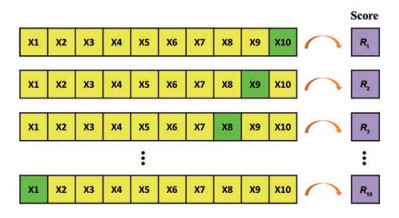
The yellow box represents the training set, and the green box represents the validation set.
实验中所用的主要试剂包括CaCO3(AR,国药集团化学试剂有限公司)、NH4H2PO4(AR,国药集团化学试剂有限公司)、Y2O3(99.99%,上海阿拉丁股份有限公司)、Eu2O3(99.99%,上海阿拉丁股份有限公司)、Yb2O3(99.99%,上海阿拉丁股份有限公司)。首先按照Ca9-xY(PO4)7∶xEu2+(CYP∶xEu2+,x=0、0.02、0.04、0.06、0.08、0.10、0.12,x为Eu2+掺杂的物质的量分数)和Ca8.98Y(PO4)7∶0.02Yb3+(CYP∶0.02Yb3+,Yb3+掺杂的物质的量分数为0.02)的化学计量比分别称取原料。然后采用高温固相法将原料全部置于玛瑙研钵中,并加入5 mL的无水乙醇,研磨15~20 min后转移到氧化铝坩埚中,之后置于箱式炉中于700 ℃预烧结3 h,将所得混合物再次研磨后置于箱式炉中,于CO气氛下1 300 ℃烧结4 h。烧结物随炉冷却至室温后研磨即可得到所需样品。
采用Rigaku公司Ultima Ⅳ型X射线粉末衍射仪分析样品的物相。采用Cu Kα1辐射,λ=0.154 06 nm,工作电压为40 kV,工作电流为40 mA,用于物相对比的扫描范围为10°~60°,用于Rietveld结构精修的扫描范围为5°~120°。稳态荧光光谱采用Edinburgh-FSL920荧光分析仪分析,信噪比为6 000∶1。变温发射光谱采用Hitachi型F-4600荧光光谱仪测试,光电倍增管电压为400 V,激发光源为150 W氙灯。样品的紫外可见漫反射光谱在SolidSpec-3700型紫外可见分光光度计上测量,采用BaSO4(反射率100%)为基准物。
图 2a和2b分别展示了目标FWHM和TS的数值分布,两者均近似服从正态分布。这符合中心极限定理,表明性能目标受到多种因素的共同影响。鉴于数据量有限,我们将数据集按9∶1的比例划分为训练集与测试集,测试集不参与模型训练过程。为确定最优的机器学习模型,我们采用了6种不同算法进行建模,其中包括1种非集成算法——决策树回归(DTR),以及5种集成算法,分别为梯度提升回归树(GBR)、装袋法(Bagging)、随机森林回归(RFR)、极限梯度提升法(XGBoosting)和自适应提升法(AdaBoosting)。
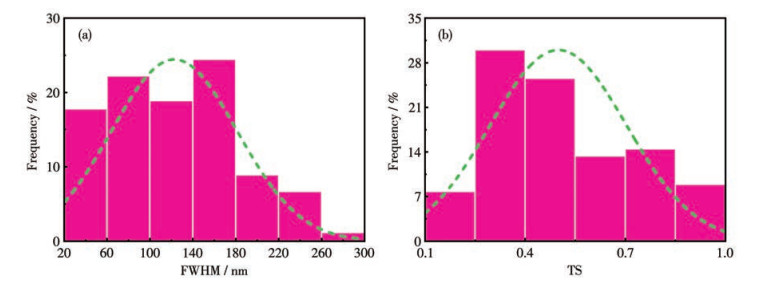
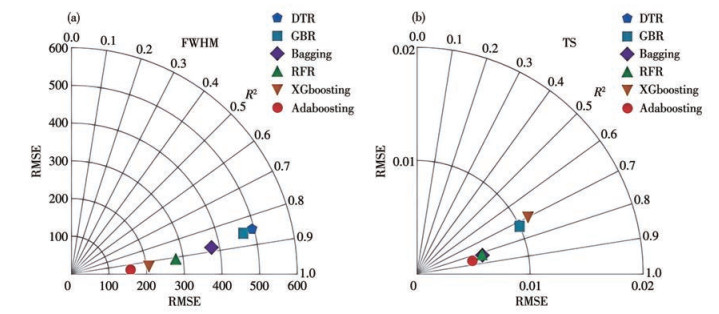
图 3展示了不同机器学习算法的预测结果,证实所有模型均成功从输入特征中学习了规律。图中点的位置越靠近左下角圆心处,表示模型的R2和RMSE越小,性能越优。可以观察到,集成算法的表现显著优于非集成算法,这揭示了Eu2+掺杂白磷钙矿型荧光粉的性能(FWHM与TS)与其成分之间不存在简单的线性关联,而是受成分因素的复杂耦合作用影响。
图 4展示了FWHM作为预测目标的拟合效果。图中绿色虚线为Y=X参考线,代表预测值与实际值完全一致;数据点越靠近该虚线,说明模型的预测精度越高。在所用算法中,AdaBoosting模型取得了最佳性能,训练集和测试集的数据点分布更为集中,其在测试集上的R2为0.951,RMSE为157.2。在TS的机器学习预测中,我们采用了将FWHM纳入输入特征的级联策略。如图 5显示,其拟合效果与FWHM模型的结果相近。AdaBoosting模型再次表现出最佳效果,其测试集的R2为0.852,RMSE为0.005。这一结果表明了该模型对于未参与训练数据的泛化能力。
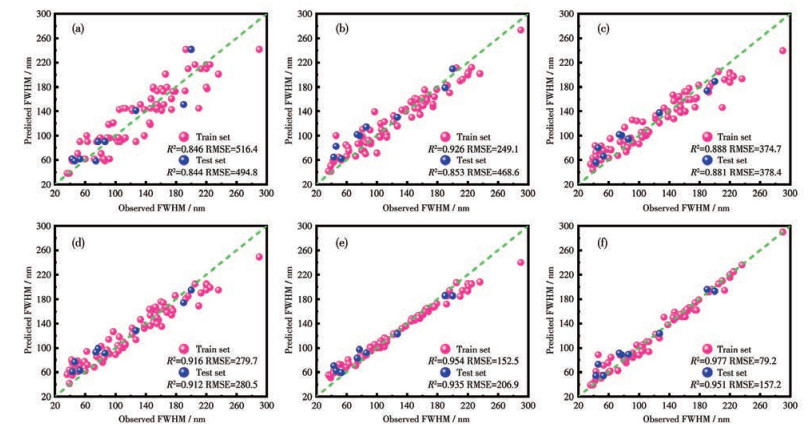
(a) DTR; (b) GBR; (c) Bagging; (d) RFR; (e) XGBoosting; (f) AdaBoosting.
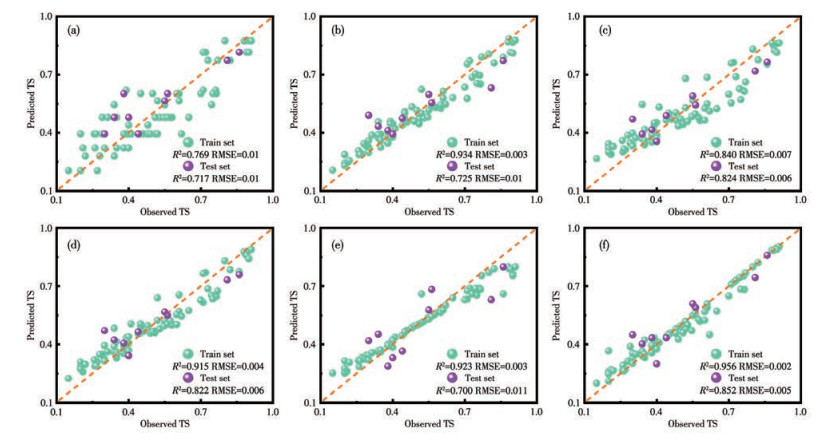
(a) DTR; (b) GBR; (c) Bagging; (d) RFR; (e) XGBoosting; (f) AdaBoosting.
AdaBoosting模型通过迭代过程动态调整样本与弱学习器的权重,能够优先关注并修正前一轮中被错误拟合的“困难样本”,同时赋予表现较好的弱学习器更高权重,从而有效整合多个弱学习器的优势,提升整体预测能力。这一机制使得AdaBoosting在小规模、低维数据集中表现出明显优势。为进一步评估模型的性能,我们对CYP∶0.08Eu2+样品进行了实验表征,并将其FWHM与TS的实测结果与AdaBoosting预测值一同列于表 2。两者之间微小的偏差表明,尽管晶体结构复杂,但仅凭化学组分就足以捕获决定FWHM和TS的关键因素。这表明在白磷钙矿体系中,成分与局部配位环境之间存在强关联,使得成分本身成为有效的代理特征。
下载:
导出CSV
| Sample | Observed FWHM / nm | Predicted FWHM / nm | Error of FWHM / % | Experimental TS | Predicted TS | Error of TS / % |
| CYP∶0.08Eu2+ | 79 | 76.97 | 2.57 | 0.42 | 0.415 | 1.19 |
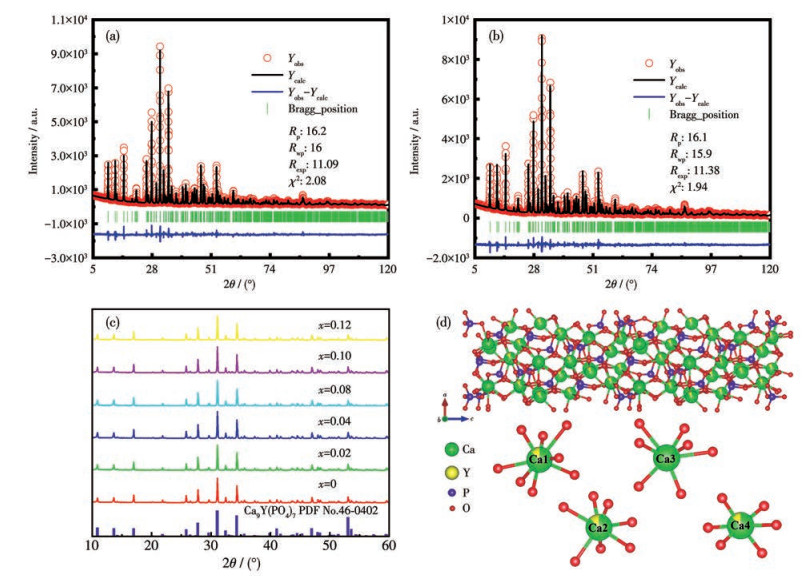
采用Fullprof软件对CYP基质及CYP∶0.08Eu2+荧光粉的X射线衍射数据进行Rietveld结构精修。图 6a和6b分别展示了CYP与CYP∶0.08Eu2+的精修结果,精修所得的拟合优度χ2较低(CYP的为2.08,CYP∶0.08Eu2+的为1.94),表明拟合质量良好,结果可靠。相应的精修数据列于表 3,结果表明,CYP基质晶体属于三方晶系,空间群为R3c,其晶胞参数a=b=1.043 1 nm,c=3.731 4 nm,V=3.515 9 nm3。对于CYP∶0.08Eu2+荧光粉,Eu2+的掺杂未改变其晶体结构,但引起了晶胞参数的微小变化:a=b=1.043 2 nm,c=3.731 8 nm,V=3.516 7 nm3。晶格参数的增加可归因于Eu2+取代了离子半径更小的Ca2+位点,导致晶格产生膨胀。不同CYP∶xEu2+样品的XRD图均与Ca9Y(PO4)7的PDF No.46-0402标准卡片匹配良好(图 6c),表明所有样品均形成了纯相。图 6d展示了CYP基质的晶体结构,以及4种不同Ca/Y阳离子格位的局部配位构型(分别命名为Ca1、Ca2、Ca3、Ca4)。Ca1、Ca2和Ca3位于18b Wyckoff位点,配位数分别为8、7和7;而Ca4位于6a位点,配位数为6。在占位情况方面,Ca1、Ca2和Ca4位点为由Ca2+离子(占6/7)和Y3+离子(占1/7)构成的混合占位,而Ca3位点则完全由Ca2+占据。因此,在CYP∶xEu2+晶体中,上述4个Ca位点均可能被Eu2+所取代。
 下载:
导出CSV
下载:
导出CSV
| Parameter | CYP | CYP∶0.08Eu2+ |
| Space group | R3c | R3c |
| Z | 6 | 6 |
| a=b / nm | 1.043 1 | 1.043 2 |
| c / nm | 3.731 4 | 3.731 8 |
| V / nm3 | 3.515 9 | 3.516 7 |
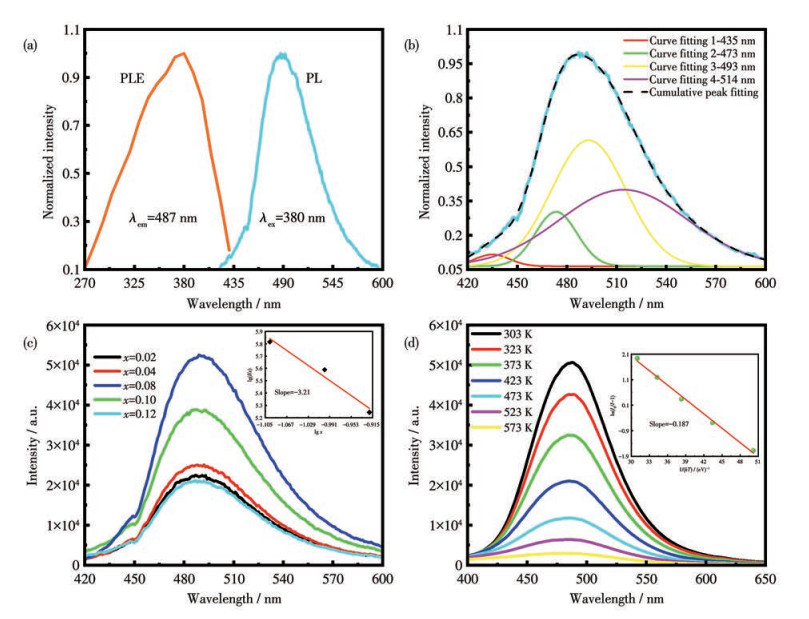
图 7a展示了CYP∶0.08Eu2+荧光粉的归一化光致发光激发(PLE)与发射(PL)光谱。其激发光谱在250~450 nm范围内呈现一个宽峰,峰值位于380 nm,表明该荧光粉适用于近紫外(NUV)芯片激发的白光LED(w-LED)。在380 nm光激发下,荧光粉在487 nm处出现一个主发射带,归属于Eu2+的4f65d1→4f7特征跃迁。该青色发射源于基质晶格中较弱的晶体场分裂,使得5d激发态能级较高。此外,发射光谱的不对称性与激发光谱的宽化特征,表明存在多个发射中心。为进一步解析其来源,我们将发射光谱通过4个高斯峰进行拟合(图 7b),得到分别位于435、473、493和514 nm的峰。为探究这4个发射峰的格位,我们采用Van Uitert提出的经验公式进行分析。该公式描述了Eu2+的发射能量与其局域晶体场环境之间的经验关系[68]:
|
|
(3) |
其中,E为Eu2+的发射带峰位(cm-1),Q为自由Eu2+离子下d带边缘能量(34 000 cm-¹),v为Eu2+的价态(值为2),n为Eu2+第一配位层中的阴离子数目(即其配位数),EA为配位阴离子的电子亲和能(eV),r为被Eu2+取代的基质阳离子半径。由于局部晶体结构的复杂性,利用此公式精确计算Eu2+在各晶位上的能级具有一定挑战,但仍可合理推断E与n和r大致成正比关系。考虑到Ca1、Ca2和Ca4位点均由Ca2+离子(
Inset in panel c: lg(I/x)-lg x curve; Inset in panel d: ln[(I0/I)-1]-1/(kT) curve.
图 7c展示了在380 nm激发下,不同Eu2+掺杂浓度的CYP∶xEu2+荧光粉的PL光谱图。除发光强度变化外,各谱图的轮廓基本一致。随着Eu2+浓度增加,发光强度先增强,在x=0.08时达到最大值,随后因浓度猝灭效应而逐渐下降。该现象主要源于Eu2+离子间的能量转移所引起的非辐射弛豫。为深入探究浓度猝灭机制,根据Blasse理论,可通过如下公式估算Eu2+离子间的临界距离(Rc)[23]:
|
|
(4) |
其中,V为单位晶胞体积,xc为Eu2+的临界掺杂浓度,N为一个晶胞中可供掺杂的阳离子位点数。对于CYP∶xEu2+荧光粉,xc=0.08,V=3.516 7 nm3,N=4。计算得到其临界距离为2.758 nm,远大于0.5 nm,表明Eu2+离子间能量转移的主导机制为电多极相互作用。进一步依据Dexter理论,可通过以下公式判断相互作用的具体类型[22]:
|
|
(5) |
其中,I为Eu2+的发射强度,x为掺杂浓度,K和β为常数。当参数θ取值为6、8和10时,分别对应偶极-偶极(d-d)、偶极-四极(d-q)和四极-四极(q-q)相互作用。通过拟合lg(I/x)与lg x的关系(图 7c插图),得到斜率为-3.21(-θ/3),进而计算得出θ≈9.63,表明在CYP∶Eu2+中,浓度猝灭的主要机制为四极-四极相互作用。
图 7d展示了CYP∶0.08Eu2+荧光粉在380 nm激发下,于303~573 K温度区间的变温发射光谱。随着温度升高,由于热猝灭效应,发射强度显著降低。当温度升至423 K时,其发射强度仍可维持在室温初始值的约42%。为进一步量化材料的TS,可根据阿伦尼乌斯方程计算其热活化能(Ea)[69]:
|
|
(6) |
其中,I0和I分别为室温和高温下的发光强度,k为玻尔兹曼常数(8.617×10⁻⁵ eV·K-1)。根据阿伦尼乌斯方程,以ln(I0/I-1)对1/(kT)作图并进行线性拟合(图 7d中插图)。由该曲线斜率求得CYP∶0.08Eu2+荧光粉的热活化能为0.187 eV。
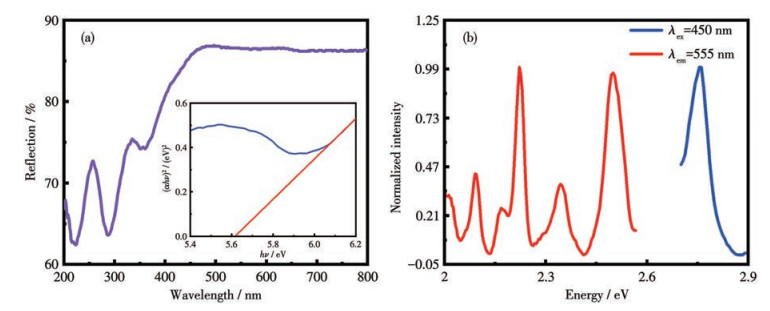
由于5d能级到导带的热激活电离过程对荧光粉的TS具有显著影响,我们构建了CYP的HRBE图与VRBE图。HRBE图可用于呈现各二价/三价稀土离子相对于基质价带顶的4fn与4fn-15d能级位置;VRBE则表征电子在自由空间中的静止能量。两者在能量标度上相互关联,可通过统一框架进行换算与分析。HRBE图的构建首先需要确定价带顶(EVB)至导带底(ECB)的能隙(Eg)。该能隙(即光学带隙)可通过基质的紫外可见漫反射光谱获得,其室温测量结果为5.64 eV,如图 8a所示。
Inset in a: band gap of CYP.
为构建HRBE图中的4f能级基准曲线,采用电荷迁移模型确定了Yb3+的电荷迁移能(ECT)。图 8b展示了CYP∶0.02Yb3+的激发与发射光谱,由此确定了Yb3+的电荷迁移能为3.54 eV。在此基础上,结合其他二价稀土离子相对于Eu2+的4f能级能量差[ΔEvf(n+1,7,2+)]的已知参数[70],即可标定出二价稀土离子的4f能级基准曲线。进一步,为标定三价稀土离子的4f能级基准曲线,需引入库仑排斥能U(6,A),其定义为Eu2+与Eu3+的4f基态能级之差,其中A代表基质化合物Ca9Y(PO4)7。采取的U(6,A)为文献报道的数值(7.08 eV)[71]。基于已标定的二价稀土离子4f能级曲线,并结合三价稀土离子相对于Eu3+的4f能级能量差[ΔEvf(n,6,3+)],最终完成了三价稀土离子4f能级基准曲线的标定。
为标定5d能级,Eu2+的4f-5d能量差[Efd(7,2+,A)]可从CYP∶0.08Eu2+光谱中直接获取,为3.23 eV;Ce3+的对应值[Efd(1,3+,A)]则通过红移模型予以推导[72]。
|
|
(7) |
|
|
(8) |
|
|
(9) |
其中,Eu2+与Ce3+的自由离子能量[Efd(7,2+,free)]分别为4.2和6.2 eV,D(2+,A)和D(3+,A)分别代表Eu2+和Ce3+在基质A中的红移量。基于红移模型计算出Ce3+在基质中的Efd(1,3+,A)后,再结合已知的二价与三价稀土离子相对于Eu2+和Ce3+的5d能级能量差参数ΔEvd(n+1,7,2+)与ΔEvd(n,1,3+),即可确定所有相关二价及三价稀土离子的最低5d能级位置。至此,构建完整的HRBE图所需的全部数据均已完备。
对于VRBE图,其关键在于确定Eu2+在真空中的4f基态能量[E4f(7,2+,A)],该能量与库仑排斥能U(6,A)遵循以下关系[73]:
|
|
(10) |
在获得Eu2+的4f能级在VRBE图中的能量[E4f(7,2+,A)]后,可进一步推导出Eu3+的对应值E4f(6,3+,A)。结合前述全部数据,最终构建出完整的VRBE图。
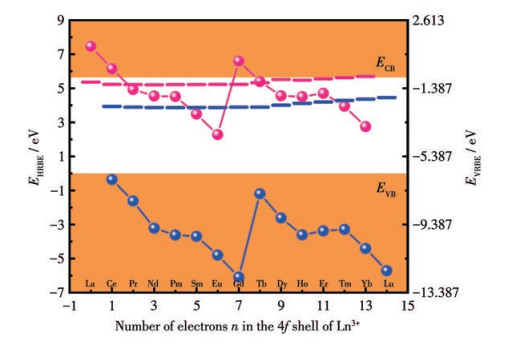
图 9展示了CYP的HRBE/VRBE图。由图可见,Eu2+的最低5d能级在能量上非常接近基质的导带底边缘,表明两者之间的能量差很小。在此情况下,电子仅需克服较低的热扰动势垒,即可从5d能级热跃迁至导带。电子一旦进入导带,材料内部将主要发生2个过程,一是电离后的Eu2+转化为Eu3+,不再产生有效的5d→4f辐射跃迁;二是高能导带电子在热振动的辅助下,通过非辐射弛豫返回Eu2+的基态或与缺陷复合,亦不产生发光。这2种途径均导致原本用于发光的5d电子数目减少,从而造成发光强度随温度升高而显著下降,即发生热猝灭现象。因此,Eu2+的最低5d能级靠近导带是导致CYP∶xEu2+荧光粉TS较差的关键结构因素[74]。
Blue represents divalent rare earth ions and red represents trivalent rare earth ions; The dotted line represent the excited state energy level, and the dashed line represent the ground state energy level.
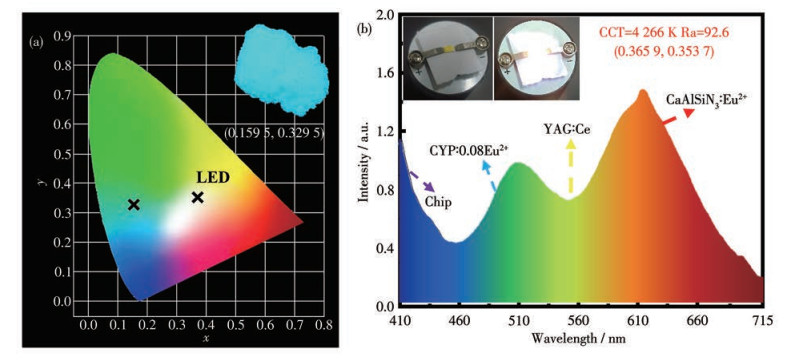
为评估CYP∶0.08Eu2+在w-LED中的应用潜力,我们计算了在380 nm激发下CYP∶0.08Eu2+样品在CIE 1931色度图中的坐标,结果示于图 10a。插图中同时展示了该荧光粉在365 nm紫外灯照射下的发光照片,其呈现明亮的青光,对应CIE色坐标为(0.159 5,0.329 5)。基于此,我们将质量比为4∶1∶10∶150的黄光发射商用Y3Al5O12∶Ce3+(YAG∶Ce)荧光粉、红光发射商用CaAlSiN3∶Eu2+荧光粉、所合成的青光CYP∶0.08Eu2+荧光粉以及环氧树脂混合均匀,然后将混合物涂覆在365 nm紫外LED芯片上,封装成一种w-LED器件。图 10b展示了该器件在300 mA驱动电流下的电致发光光谱,插图为实物发光照片。测得器件的CIE色坐标为(0.365 9,0.353 7),相关色温(CCT)为4 266 K,表明白光发射属于暖色调。此外,该器件的显色指数(Ra)达到92.6。上述结果表明,CYP∶Eu2+荧光粉在实现高显色性暖白光w-LED方面具有潜在的应用前景。
Inset in panel a: the digital photograph of CYP∶0.08Eu2+ phosphor under 365 nm UV lamp; Inset in panel b: the photographs of the as-fabricated (left) and the light (right) w-LED device.
我们成功构建了一种基于成分特征的级联机器学习模型,通过对90个白磷钙矿样本的数据训练,采用AdaBoosting算法实现了对荧光粉发射半高宽(FWHM)与热稳定性(TS)的高精度预测,其中FWHM预测的测试集决定系数R2达0.951,TS预测的R2为0.852。以Ca9Y(PO4)7∶Eu2+作为验证体系,其FWHM与TS的预测误差分别仅为2.57%和1.19%,充分验证了模型的可靠性。结构精修与光谱分析表明,该荧光粉发射光谱中的4个高斯分量可分别归属为Eu2+占据4个不同的Ca格位。通过构建宿主参考能级(HRBE)与真空参考能级(VRBE)图,揭示了其较差的TS源于Eu2+的5d能级与导带底过近导致的电离和非辐射弛豫现象。基于该荧光粉参与封装的暖白光LED器件表现出高显色指数(92.6)与低相关色温(4 266 K)的优良性能。本工作表明,即使仅利用成分参数,机器学习方法仍可有效预测复杂基质荧光粉的发光性能,为其定向设计提供了新策略。
ZHANG H L, YUAN D W, MI X Y, LIU X L, LIN J. Color tuning in Ca3-xMx(PO4)2∶Eu2+ (M=Sr, Ba) phosphors via cation substitution[J]. Dalton Trans., 2020, 49(26): 8949-8958 doi: 10.1039/D0DT01130D
LIU S Q, LIANG Y J, ZHU Y L, LI H R, CAI Y X, TU D. Full visible spectra emission introduced by crystal-site engineering in β-Ca3(PO4)2-type solid solution phosphors for high quality white light emitting diodes application[J]. Chem. Eng. J., 2019, 375: 121976 doi: 10.1016/j.cej.2019.121976
ZHOU J C, CHEN M T, ZHANG J X, SHI C, DING J Y, ZHUANG Y H, WU Q S. Regulating photoluminescence behavior by neighboring-cation-size in Sr8CaX(PO4)7∶Eu2+ (X=Al and Ga) phosphors for high color rendering solid-state lighting source[J]. Chem. Eng. J., 2021, 426: 131869 doi: 10.1016/j.cej.2021.131869
ZHANG D, ZHANG X T, ZHENG B F, SUN Q, ZHENG Z B, SHI Z, SONG Y H, ZOU H F. Li+ ion induced full visible emission in single Eu2+-doped white emitting phosphor: Eu2+ site preference analysis, luminescence properties, and WLED applications[J]. Adv. Opt. Mater., 2021, 9(19): 2100337 doi: 10.1002/adom.202100337
ZHANG D, ZHENG B F, ZHENG Z B, LI L, YANG Q, SONG Y H, ZOU B, ZOU H F. Multifunctional Ca9NaZn1-yMgy(PO4)7∶Eu2+ phosphor for full-spectrum lighting, optical thermometry and pressure sensor applications[J]. Chem. Eng. J., 2022, 431: 133805 doi: 10.1016/j.cej.2021.133805
DONG L P, YANG S X, YANG C Y, SHAO B Q, HOU J S, FANG Y Z. Multiple lattice sites driven broadband yellow emitting Ca8-y-zSryBaz MgLa(PO4)7∶Eu2+ solid solution phosphor with improved luminescence for high-quality white LED[J]. Ceram. Int., 2025, 51(19): 28819-28828 doi: 10.1016/j.ceramint.2025.04.091
LONG Q, WANG C, LI Y Y, DING J Y, WANG Y H. Synthesis and investigation of photo/cathodoluminescence properties of a novel green emission phosphor Sr8ZnLu(PO4)7∶Eu2+[J]. J. Alloy. Compd., 2016, 671: 372-380 doi: 10.1016/j.jallcom.2016.01.249
MI R Y, LIU Y G, MEI L F, HUANG Z H, FANG M H, WU X W, MIN X. Multi-site occupancies and dependent photoluminescence of Ca9Mg1.5(PO4)7∶Eu2+ phosphors: A bifunctional platform for optical thermometer and plant growth lighting[J]. J. Rare. Earths, 2023, 41(10): 1503-1511 doi: 10.1016/j.jre.2022.06.009
MI R Y, LIU Y G, MEI L F, MIN X, FANG M H, WU X W, HUANG Z H, CHEN C J. Highly-efficient cyan-emitting phosphor enabling high‑color‑quality lighting and transparent anticounterfeiting[J]. Chem. Eng. J., 2023, 457: 141377 doi: 10.1016/j.cej.2023.141377
RUAN W K, XIE M B, YANG Q L, HU L M, SU K S. Preparation and properties of Eu2+/Eu3+ co-activated Ca9Lu(PO4)7 phosphors for multichannel photoluminescence[J]. Inorg. Chem. Front., 2022, 9(20): 5267-5278 doi: 10.1039/D2QI01359B
QIAO J W, XIA Z G, ZHANG Z C, HU B T, LIU Q L. Near UV-pumped yellow-emitting Sr9MgLi(PO4)7∶Eu2+ phosphor for white-light LEDs[J]. Sci. China. Mater., 2018, 61(7): 985-992 doi: 10.1007/s40843-017-9207-2
周江聪, 陈梦婷, 赖亦晴, 时晨, 吴德武, 吴泉生. 用于宽谱带发射白色发光二极管的黄色荧光粉Sr8MgAl(PO4)7∶xEu2+的制备及发光性能[J]. 无机化学学报, 2021, 37: 1237-1244.ZHOU J C, CHEN M T, LAI Y Q, SHI C, WU D W, WU Q S. Synthesis and luminescence properties of broadband emitting yellow phosphor Sr8MgAl(PO4)7∶xEu2+ for white light-emitting diode[J]. Chinses J. Inorg. Chem., 2021, 37(7): 1237-1244
SUN W Z, JIA Y L, PANG R, LI H F, MA T F, LI D, FU J P, ZHANG S, JIANG L H, LI C Y. Sr9Mg1.5(PO4)7∶Eu2+: A novel broadband orange-yellow-emitting phosphor for blue light-excited warm white LEDs[J]. ACS. Appl. Mater. Interfaces, 2015, 7(45): 25219-25226 doi: 10.1021/acsami.5b06961
ZHANG Z C, MA C G, GAUTIER R, MOLOKEEV M S, LIU Q L, XIA Z G. Structural confinement toward giant enhancement of red emission in Mn2+-based phosphors[J]. Adv. Funct. Mater., 2018, 28(41): 1804150 doi: 10.1002/adfm.201804150
ZHENG B F, YAN J H, LI J Y, WANG Y X, YANG X Y, LI W Z. Sr8MgSc(PO4)7∶Eu2+ phosphor: d-f transition driven applications for solid‑state lighting and extreme environment multimode sensing investigations[J]. Inorg. Chem. Front., 2025, 12(2): 730-743 doi: 10.1039/D4QI02664K
YUAN H L, QI L Y, PARIS M, CHEN F, SHEN Q, FAULQUES E, MASSUYEAU F, GAUTIER R. Machine learning guided design of single-phase hybrid lead halide white phosphors[J]. Adv. Sci., 2021, 8(19): 2101407 doi: 10.1002/advs.202101407
WANG J X, DOU Y Y, ZHANG J H, CHEN M Y, SONG Z, LIU Q L. Deciphering the key factors governing Mn4+ zero-phonon line characteristics via machine learning decoding of host-Mn4+ interactions[J]. J. Phys. Chem. C, 2025, 129(41): 18571-18577 doi: 10.1021/acs.jpcc.5c05715
WANG Y J, TANG W Y, ZHANG C, MOLOKEEV M S, MING H, ZHOU Y Y, PENG S, SONG E H, ZHANG Q Y. Structure-based machine learning enables discovery of Mn4+-activated red-light fluorides for ultrawide-gamut mini-light-emitting diodes[J]. Adv. Funct. Mater., 2023, 34(14): 2313490
MOLOKEEV M S, SU B B, ALEKSANDROVSKY A S, GOLOVNEV N N, PLYASKIN M E, XIA Z G. Machine learning analysis and discovery of zero-dimensional ns2 metal halides toward enhanced photoluminescence quantum yield[J]. Chem. Mater., 2022, 34(2): 537-546 doi: 10.1021/acs.chemmater.1c02725
MING H, ZHOU Y Y, MOLOKEEV M S, ZHANG C, HUANG L, WANG Y J, SUN H T, SONG E H, ZHANG Q Y. Machine-learning-driven discovery of Mn4+-doped red-emitting fluorides with short excited-state lifetime and high efficiency for mini light-emitting diode displays[J]. ACS. Mater. Lett., 2024, 6(5): 1790-1800 doi: 10.1021/acsmaterialslett.4c00263
LIU S F, SONG K J, LI S X, XIE R J. Machine learning-driven discovery of efficient narrow-band green phosphor for wide-color-gamut backlight displays[J]. Chem. Eng. J., 2025, 520: 165719 doi: 10.1016/j.cej.2025.165719
QIAO J W, ZHANG Z C, ZHAO J, XIA Z G. Tuning of the compositions and multiple activator sites toward single-phased white emission in (Ca9-xSrx)MgK(PO4)7∶Eu2+ phosphors for solid-state lighting[J]. Inorg. Chem., 2019, 58(8): 5006-5012 doi: 10.1021/acs.inorgchem.9b00028
CHEN M Y, XIA Z G, MOLOKEEV M S, WANG T, LIU Q L. Tuning of photoluminescence and local structures of substituted cations in xSr2Ca(PO4)2-(1-x)Ca10Li(PO4)7∶Eu2+ phosphors[J]. Chem. Mater., 2017, 29(3): 1430-1438 doi: 10.1021/acs.chemmater.7b00006
ZHANG J, JI B W, HUA Z H. Investigations on the luminescence of Ba2Mg(PO4)2∶Eu2+, Mn2+ phosphors for LEDs[J]. Opt. Mater. Express., 2016, 6(11): 3470-3475 doi: 10.1364/OME.6.003470
KIM D, LEE B R, PARK S H, CHOI B C, KIM J H, JEONG J H. Cation substitution induced excellent quantum efficiency and thermal stability in (Ca1-xSrx)9La(PO4)7∶Eu2+ phosphors[J]. New J. Chem., 2019, 43(31): 12325-12330 doi: 10.1039/C9NJ01825E
GUO N, YOU H P, SONG Y H, YANG M, LIU K, ZHENG Y H, HUANG Y J, ZHANG H J. White-light emission from a single‑ emitting-component Ca9Gd(PO4)7∶Eu2+, Mn2+ phosphor with tunable luminescent properties for near-UV light-emitting diodes[J]. J. Mater. Chem., 2010, 20(41): 9061-9067 doi: 10.1039/c0jm01860k
HOU J S, PAN C X, CHEN X Y, ZHAO G Y, LIU Y F, LI Y, FANG Y Z. White-light-emitting from single-phased (Ca, Eu, Mn)9Al(PO4)7 phosphor with blue-white-yellow tunable luminescence properties for UV-based LEDs[J]. Mater. Technol., 2019, 34(3): 135-142 doi: 10.1080/10667857.2018.1540331
KIM D, SEO Y W, PARK S H, CHOI B C, KIM J H, JEONG J H. Theoretical design and characterization of high efficient Sr9Ln(PO4)7∶Eu2+ phosphors[J]. Mater. Res. Bull., 2020, 127: 110856 doi: 10.1016/j.materresbull.2020.110856
DING X, LI Z H, XIA D Y. New whitlockite-type structure material Sr9Y(PO4)7 and its Eu2+ doped green emission properties under NUV light[J]. J. Lumin., 2020, 221: 117114 doi: 10.1016/j.jlumin.2020.117114
CHEN H, ZHANG Z Q, MI R Y, MOLOKEEV M S, LIU Y K, WANG B C, MEI L F, FANG M H, WU X W, MIN X, LIU Y G. Synergetic manipulation of components and multiple activator sites towards full-spectrum lighting in Eu2+-doped whitlockite phosphors for high color-rendering WLED[J]. J. Lumin., 2024, 275: 120795 doi: 10.1016/j.jlumin.2024.120795
HUANG C H, CHIU Y C, YEH Y T, CHEN T M. Novel Eu2+-activated yellow-emitting Sr8MgLu(PO4)7 phosphors for white-light near-ultraviolet LEDs[J]. Mater. Express., 2012, 2(4): 303-310 doi: 10.1166/mex.2012.1081
YAN J, ZHANG Z W, WEN D W, ZHOU J B, XU Y Q, LI J H, MA C G, SHI J X, WU M M. Crystal structure and photoluminescence tuning of novel single-phase Ca8ZnLu(PO4)7∶Eu2+, Mn2+ phosphors for near-UV converted white light-emitting diodes[J]. J. Mater. Chem. C, 2019, 7(27): 8374-8382 doi: 10.1039/C9TC02494H
HUANG C H, CHEN T M. Novel yellow-emitting Sr8MgLn(PO4)7∶Eu2+ (Ln=Y, La) phosphors for applications in white LEDs with excellent color rendering index[J]. Inorg. Chem., 2011, 50(12): 5725-5730 doi: 10.1021/ic200515w
FENG N N, HUANG R, ZHANG G Q, YUAN L, JIAO H, HAN J S, CAO D Z, WANG B Y, ZHAO K. Energy transfer and tunable photoluminescence of novel white-emitting Sr8MgY(PO4)7∶Ce3+/Eu2+/Sm3+ phosphors[J]. J. Lumin., 2025, 277: 120967 doi: 10.1016/j.jlumin.2024.120967
LONG J Q, WANG Y Z, MA C Y, YUAN X Y, DONG W F, MA R, WEN Z C, DU M M, CAO Y G. Photoluminescence tuning of Ca8-xSrxMgGd(PO4)7∶Eu2+, yMn2+ phosphors for applications in white LEDs with excellent color rendering index[J]. RSC Adv., 2017, 7(31): 19223-19230 doi: 10.1039/C6RA28594E
ZHOU J C, CHEN M T, LI B J, LIN L, WANG B, WU D W, DING J Y, WU Q S. A broadband emitting Sr8MgGa(PO4)7∶Eu2+ phosphor for application in white light-emitting diodes with excellent color rendering index[J]. Appl. Phys. A‒Mater. Sci. Process., 2021, 127(5): 322 doi: 10.1007/s00339-021-04480-2
ZHONG Y, GAI S J, YANG Y M, XIA M, ZHANG Y, QIU F S, XIANG F, ZHOU Z. A novel green phosphor Sr8ZnY(PO4)7∶Eu2+, Ln3+ (Ln=Pr, Tm, Yb) with broad emission band for high color rendering white-lighting-emitting diodes[J]. J. Lumin., 2019, 214: 116600 doi: 10.1016/j.jlumin.2019.116600
ZHU Y, ZHANG N M, WANG J L, KANG Y H, FANG M H. Luminescence properties and high energy transfer of Ca9MgNa(PO4)7∶Eu2+, Mn2+ blue-red dual emission phosphor for plant growth LEDs[J]. Opt. Mater., 2023, 144: 114316 doi: 10.1016/j.optmat.2023.114316
FULATI R, DAI P P. The phase transition and photoluminescence properties of (Ca9-xSrx)Mg1.5(PO4)7∶Eu2+ solid-solution phosphors[J]. ECS J. Solid State Sci. Technol., 2021, 10(3): 036005 doi: 10.1149/2162-8777/abefae
YU H, RUAN F P, CHEN L F, DENG D G. Dual-emitting Eu2+/Eu3+ co-doped Ca9Zn1.5(PO4)7 phosphor for self-calibrated optical thermometry[J]. Opt. Mater., 2020, 100: 109678 doi: 10.1016/j.optmat.2020.109678
YU H, DENG D G, LI Y Q, XU S Q, LI Y Y, YU C P, DING Y Y, LU H W, YIN H Y, NIE Q L. Electronic structure and photoluminescence properties of yellow-emitting Ca10Na(PO4)7∶Eu2+ phosphor for white light-emitting diodes[J]. J. Lumin., 2013, 143: 132-136 doi: 10.1016/j.jlumin.2013.04.036
XIE C A, MEI L F, LIU Y G, MI R Y, YU H J, BU X Y, CHEN J, YANG J Y, LIU D Y. Simultaneous spectral tuning and thermal stability adjustment in Ca8ZnGa(1-x)Lax(PO4)7∶Eu2+ phosphors[J]. Inorg. Chem., 2022, 61(7): 3263-3273 doi: 10.1021/acs.inorgchem.1c03833
LIU W R, CHIU Y C, YEH Y T, JANG S Y, CHEN T M. Luminescence and energy transfer mechanism in Ca10K(PO4)7∶Eu2+, Mn2+ phosphor[J]. J. Electrochem. Soc., 2009, 156(7): J165-J169 doi: 10.1149/1.3121531
XIE W Y, MIAO X, ZHANG L, QI G C, YIN X J, ZHANG P. Tunable photoluminescence in Eu2+-activated KCaLa(PO4)2 phosphor through structural disorder[J]. J. Lumin., 2025, 284: 121292 doi: 10.1016/j.jlumin.2025.121292
GUO H, LI R M, PENG X Y, CUI R R, DENG C Y. Multiple applications of Sr8ZnIn(1-m)Lum(PO4)7∶Eu2+/Mn2+ through thermal stability adjustment, spectral tuning, and resonance energy transfer[J]. J. Alloy. Compd., 2025, 1034: 181312 doi: 10.1016/j.jallcom.2025.181312
CHEN M T, LAI Y Q, ZHOU J C, SHI C, LI B J, WU D W, WANG B, DING J Y, JIANG X Y, WU H M, WU Q S. Near-ultraviolet excited broadband orange-yellow emitting Sr8MgIn(PO4)7∶Eu2+ phosphors for WLEDs with high color rendering index[J]. Opt. Mater., 2021, 115: 111055 doi: 10.1016/j.optmat.2021.111055
WEI Y P, WU Y L, LI Q X, LIU L X, SUN B, YU J Y. Tunable emission in Sr9LiY0.667(PO4)7∶Eu2+, Mn2+ phosphor via energy transfer for pc-LEDs application[J]. Opt. Mater., 2025, 162: 116850 doi: 10.1016/j.optmat.2025.116850
QIAN K X, SHI Z X, WANG J, GUAN X, XU K N, SUN X. Structural regulation and properties of Ca8.96LixNa1-xAl0.667(PO4)7∶0.04Eu2+ full spectrum phosphor[J]. J. Alloy. Compd., 2025, 1010: 178045 doi: 10.1016/j.jallcom.2024.178045
YANG N, LI Z, LIANG J H, HUANG W J, YE Z B, HE W, TONG Y X, SHI J X. Designing of Eu2+-activated single-phase white-emitting phosphor through modifying cationic sites for high color rendering full-spectrum illumination[J]. J. Alloy. Compd., 2025, 1010: 17767
SU Q H, ZHENG Z B, YANG X L, ZHAO Y X, LUO Z, WANG C, SONG Y H, ZOU H F, SHENG S H. Two substitution strategies realize single-phase full-spectrum emission in Ca10Na(PO4)7∶Eu2+ phosphors for WLED[J]. Ceram. Int., 2024, 50(19): 36330-36339 doi: 10.1016/j.ceramint.2024.07.016
LUO Z, ZOU H F, ZHENG Z B, ZHAO Y X, WANG C, SUN Q H, SONG Y H. Ca9-yMgyNaGd0.667(PO4)7∶Eu2+: A single Eu2+-doped full-spectrum white light emission phosphor with high color rendering index[J]. Inorg. Chem., 2024, 63(38): 17449-17459 doi: 10.1021/acs.inorgchem.4c01750
LIU W R, HUANG C H, YEH C W, TSAI J C, CHIU Y C, YEH Y T, LIU R S. A study on the luminescence and energy transfer of single-phase and color-tunable KCaY(PO4)2∶Eu2+, Mn2+ phosphor for application in white-light LEDs[J]. Inorg. Chem., 2012, 51(18): 9636-9641 doi: 10.1021/ic3007102
YAN L Q, LUO N, ZHU G, LI H Y, WANG D P, ZHANG Z Y, CHEN Z P, MA S, XIN S Y. Multi-sites induced ultra-broadband luminescence based on Eu2+ doped whitlockite-type phosphor for full-spectrum WLEDs[J]. J. Lumin., 2024, 272: 120659 doi: 10.1016/j.jlumin.2024.120659
DENG M L, SHANG M M, SUN Y X, WANG Y N, XING X L. Thermally stable red‑emitting Ca18K3Sc(PO4)14∶Mn2+ phosphor and enhanced luminescence by energy transfer between Ce3+-Eu2+-Mn2+[J]. Inorg. Chem., 2024, 63(8): 3901-3912 doi: 10.1021/acs.inorgchem.3c04284
YANG L, YOU F L, PANG T, PAN X F, WANG S X, JIN S L, FANG Y Z, CHEN D Q. Tuning Eu2+ luminescence in Sr8CaLu(PO4)7 via Na+-induced local structure engineering for violet-chip-excitable full-spectrum lighting[J]. Inorg. Chem. Front., 2024, 11(3): 779-788 doi: 10.1039/D3QI02377J
ZHAO Y X, ZHANG D, SONG Y H, LI Z L, ZHENG B F, ZHENG Z B, ZHANG X T, ZOU H F. Single-phase white light emission Ca9NaLu0.667(PO4)7∶Eu2+, Mn2+ phosphor for the application of WLED[J]. Ceram. Int., 2023, 49(15): 25831-25839 doi: 10.1016/j.ceramint.2023.05.130
SUN W Z, FAN L Y, ZHANG X X, WEI D H, JIAO M M, XU W L, ZHANG H W. Design of Eu2+-activated broadband orange-emitting phosphors with excellent luminescent performance for warm WLEDs[J]. J. Am. Ceram. Soc., 2022, 106(4): 2443-2454
LI Z W, LI S S, XIN S Y, BIAN Q F, ZHU G, DONG B. Site‑ selective occupation and luminescence property investigation of Ca18Na3Y(PO4)14∶Eu2+ phosphor for full-spectrum LED[J]. J. Am. Ceram. Soc., 2022, 105(10): 6449-6461 doi: 10.1111/jace.18594
CAO Y X, WANG X C, DING J Y, ZHOU X P, SETO T, WANG Y H. Constructing a single-white-light emission by finely modulating the occupancy of luminescence centers in europium-doped (Ca1-xSrx)9 Bi(PO4)7 for WLEDs[J]. J. Mater. Chem. C, 2020, 8(28): 9576-9584 doi: 10.1039/D0TC02467H
QIU Z X, ZHOU W L, MA Z Y, ZHANG J L, LIAN S X, LIU R S. An insight into the preferential substitution and structure repair in Eu2+-doped whitlockite-type phosphors based on the combined experimental and theoretical calculations[J]. J. Mater. Chem. C, 2019, 7(29): 8954-8961 doi: 10.1039/C9TC01832H
LIU S Q, LIANG Y J, ZHU Y L, LI H R, CHEN J H, WANG S. The exploration of structure evolution and photoluminescence property in Ca9Al1-xYx(PO4)7∶Eu2+ solid solution phosphors via the construction of bi-directional relationships[J]. J. Alloy. Compd., 2019, 785: 573-583 doi: 10.1016/j.jallcom.2019.01.228
YU L P, YAN H F, FAN Y T, ZHANG J H, MA Z Y, ZHOU W L, CHEN Y, PAN F J, LIAN S X. Cation vacancy repair for the enhancement of orange-yellow luminescence in Sr9Mg1.5-xKx(PO4)7∶Eu2+ phosphors[J]. J. Mater. Chem. C, 2018, 6(40): 10723-10729 doi: 10.1039/C8TC01756E
ZHANG Q, WANG X C, DING X, WANG Y H. A broad band yellow-emitting Sr8CaBi(PO4)7∶Eu2+ phosphor for n-UV pumped white light emitting devices[J]. Dyes. Pigment., 2018, 149: 268-275 doi: 10.1016/j.dyepig.2017.10.004
CHEN X, WANG Q D, LV F Z, CHU P K, ZHANG Y H. Synthesis, crystal structure and photoluminescence properties of Eu2+-activated RbCaGd(PO4)2 phosphors[J]. RSC Adv., 2016, 6(14): 11211-11217 doi: 10.1039/C5RA25124A
PAN Z F, HU Q S, XU Y, WANG L L. Phase identification and dopant site occupancy of yellow-emitting phosphor BaSrMg(PO4)2∶Eu2+[J]. J. Am. Ceram. Soc., 2015, 98(8): 2518-2522 doi: 10.1111/jace.13653
XU C Y, LI Y D, HUANG Y L, YU Y M, SEO H J. Luminescence characteristics and site-occupancy of Eu2+- and Eu3+-doped MgZn2(PO4)2 phosphors[J]. J. Mater. Chem, 2012, 22(12): 5419-5426 doi: 10.1039/c2jm16352g
SUN Z S, ZHU Z P, LUO J B, GUO Z Y, ZHANG X G, WU Z C. High-efficient and thermal-stable Ca19Zn2(PO4)14∶Eu2+, Mn2+ blue-red dual-emitting phosphor for plant cultivation LEDs[J]. J. Alloy. Compd., 2019, 811: 151956 doi: 10.1016/j.jallcom.2019.151956
KUANG Y H, JIN J C, LIU G C, CHEN W B, XIA Z G. KBaScSi3O9∶Eu2+ glass-ceramics as single-phase high-power white emitters[J]. Adv. Funct. Mater., 2025, 35(15): 2418751 doi: 10.1002/adfm.202418751
XIONG Z, LIU G C, CHEN W B, XIA Z G. Laser-driven (Ga/Sc)2O3∶Cr3+ luminescent ceramics enabling near-infrared light source for noninvasive imaging and detection[J]. Laser. Photonics. Rev., 2025, 19(2): 2401248 doi: 10.1002/lpor.202401248
DORENBOS P. Electronic structure and optical properties of the lanthanide activated RE3(Al1-xGax)5O12 (RE=Gd, Y, Lu) garnet compounds[J]. J. Lumin., 2013, 134: 310-318 doi: 10.1016/j.jlumin.2012.08.028
DORENBOS P. An estimator for the Coulomb repulsion parameter U to generate vacuum referred binding energy schemes for lanthanides in compounds[J]. J. Lumin., 2024, 67: 120358
ZHANG R J, SONG Z, HE L Z, XIA Z G, LIU Q L. Improvement of red-emitting afterglow properties via tuning electronic structure in perovskite-type (Ca1-xNax)[Ti1-xNbx]O3∶Pr3+ compounds[J]. J. Alloy. Compd., 2017, 729: 663-670 doi: 10.1016/j.jallcom.2017.09.147
DORENBOS P. Modeling the chemical shift of lanthanide 4f electron binding energies[J]. Phys. Rev. B, 2012, 85(16): 165107 doi: 10.1103/PhysRevB.85.165107
CUI D P, SONG Z, XIA Z G, LIU Q L. Luminescence tuning, thermal quenching and electronic structure of narrow-band red-emitting nitride phosphors[J]. Inorg. Chem., 2017, 56(19): 11837-11844 doi: 10.1021/acs.inorgchem.7b01816

图 1 十折交叉验证示意图
Figure 1 Ten-fold cross-validation schematic
The yellow box represents the training set, and the green box represents the validation set.

图 2 (a) FWHM和(b) TS的密度分布直方图
Figure 2 Histograms of the density distribution of (a) FWHM and (b) TS

图 4 六种机器学习模型对FWHM目标的预测结果
Figure 4 Prediction results of six machine learning models for the FWHM target
(a) DTR; (b) GBR; (c) Bagging; (d) RFR; (e) XGBoosting; (f) AdaBoosting.

图 5 六种机器学习模型对TS目标的预测结果
Figure 5 Prediction results of six machine learning models for the TS target
(a) DTR; (b) GBR; (c) Bagging; (d) RFR; (e) XGBoosting; (f) AdaBoosting.

图 6 (a) CYP和(b) CYP∶0.08Eu2+的XRD结构精修图; (c) CYP∶xEu2+的XRD图; (d) CYP的晶体结构示意图和Ca/Y配位构型
Figure 6 XRD structure Rietveld refinement patterns of (a) CYP and (b) CYP∶0.08Eu2+; (c) XRD patterns of CYP∶xEu2+; (d) Schematic illustration of the crystal structure of CYP and the coordination environments of Ca/Y sites

图 7 (a) CYP∶0.08Eu2+的归一化PLE和PL光谱图; (b) CYP∶0.08Eu2+的高斯分峰发射光谱图; (c) CYP∶xEu2+的PL光谱图; (d) CYP∶0.08Eu2+的变温发射光谱图
Figure 7 (a) Normalized PLE and PL spectra of CYP∶0.08Eu2+; (b) Gaussian peak-fitting emission spectra of CYP∶0.08Eu2+; (c) PL spectra of CYP∶0.08Eu2+; (d) Temperature-dependent emission spectra of CYP∶0.08Eu2+
Inset in panel c: lg(I/x)-lg x curve; Inset in panel d: ln[(I0/I)-1]-1/(kT) curve.

图 8 (a) CYP的紫外可见漫反射光谱图; (b) CYP∶0.02Yb3+的激发和发射光谱图
Figure 8 (a) UV-visible diffuse reflectance spectrum of CYP; (b) Excitation and emission spectra of CYP∶0.02Yb3+
Inset in a: band gap of CYP.

图 9 CYP的HRBE和VRBE图
Figure 9 HRBE and VRBE diagrams of CYP
Blue represents divalent rare earth ions and red represents trivalent rare earth ions; The dotted line represent the excited state energy level, and the dashed line represent the ground state energy level.

图 10 (a) CYP∶0.08Eu2+荧光粉和封装的w-LED器件的CIE色度坐标图; (b) 封装的w-LED器件的电致发射光谱图
Figure 10 (a) CIE chromaticity coordinates of the CYP∶0.08Eu2+ phosphor and the constructed w-LED device; (b) Electroluminescence spectra of the constructed w-LED
Inset in panel a: the digital photograph of CYP∶0.08Eu2+ phosphor under 365 nm UV lamp; Inset in panel b: the photographs of the as-fabricated (left) and the light (right) w-LED device.
表 1 数据库中关键参数数值分布
Table 1. Distribution of key parameter values in the database
| Feature | NMin | NMax | NMean | NStd | NVar |
| Other | 1.000 | 5.000 | 2.778 | 0.742 | 0.551 |
| Eu | 0.002 | 0.150 | 0.037 | 0.030 | 0.001 |
| Ca | 0.000 | 21.000 | 10.116 | 8.486 | 72.018 |
| Sr | 0.000 | 21.000 | 5.898 | 7.787 | 60.631 |
| Ba | 0.000 | 21.000 | 0.484 | 2.723 | 7.416 |
| Mg | 0.000 | 7.000 | 0.978 | 1.563 | 2.444 |
| Zn | 0.000 | 14.000 | 0.422 | 1.591 | 2.533 |
| La | 0.000 | 7.000 | 0.360 | 1.153 | 1.330 |
| Y | 0.000 | 7.000 | 0.275 | 0.892 | 0.795 |
| Lu | 0.000 | 2.000 | 0.179 | 0.553 | 0.306 |
| Gd | 0.000 | 7.000 | 0.159 | 0.820 | 0.672 |
| Sc | 0.000 | 2.000 | 0.070 | 0.339 | 0.115 |
| Ga | 0.000 | 2.000 | 0.084 | 0.370 | 0.137 |
| Al | 0.000 | 2.000 | 0.170 | 0.516 | 0.266 |
| In | 0.000 | 2.000 | 0.058 | 0.319 | 0.102 |
| Bi | 0.000 | 2.000 | 0.044 | 0.295 | 0.087 |
| Li | 0.000 | 2.000 | 0.146 | 0.507 | 0.257 |
| Na | 0.000 | 3.000 | 0.280 | 0.702 | 0.493 |
| K | 0.000 | 7.000 | 0.420 | 1.357 | 1.842 |
| Rb | 0.000 | 7.000 | 0.078 | 0.734 | 0.538 |
 下载: 导出CSV
表 2 CYP∶0.08Eu2+荧光粉的预测结果
Table 2. Prediction results of CYP∶0.08Eu2+ phosphor
| Sample | Observed FWHM / nm | Predicted FWHM / nm | Error of FWHM / % | Experimental TS | Predicted TS | Error of TS / % |
| CYP∶0.08Eu2+ | 79 | 76.97 | 2.57 | 0.42 | 0.415 | 1.19 |
下载: 导出CSV
表 3 CYP和CYP∶0.08Eu2+的精修结果
Table 3. Rietveld refinement results of CYP and CYP∶0.08Eu2+
| Parameter | CYP | CYP∶0.08Eu2+ |
| Space group | R3c | R3c |
| Z | 6 | 6 |
| a=b / nm | 1.043 1 | 1.043 2 |
| c / nm | 3.731 4 | 3.731 8 |
| V / nm3 | 3.515 9 | 3.516 7 |
下载: 导出CSV

 扫一扫看文章


扫一扫关注我们

 下载:
下载: