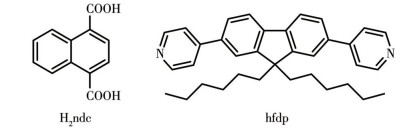
Scheme 1.
Structure of H2ndc and hfdp


The rational design of coordination polymers (CPs) remains a significant challenge in chemistry, which continues to attract considerable research interest. It stems not only from their fascinating topological varieties but also from their broad functional applications, including gas storage, chemical sensing, catalysis, and luminescent materials[1-7]. A common synthetic strategy for CPs involves combining polycarboxylic acids and multidentate N-donor auxiliary ligands. In such mixed-ligand systems, metal centers coordinate with both carboxylate oxygen atoms and nitrogen donors, leading to the formation of extended frameworks with unique topological features[1-7]. However, the final structural assembly is highly sensitive to various experimental factors, including reactant ratios, templating agents, temperature, solvent selection, and pH conditions.
In line with our ongoing efforts to develop functional CPs[8-10], we report two new CPs using the mixed-ligand strategy in which 1, 4-naphthalenedicarboxylic acid (H2ndc) and 9, 9′-dihexyl-2, 7-di(pyridin-4-yl) fluorene (hfdp) (Scheme 1) were employed to construct {[M(hfdp)(ndc)(H2O)]·DMA}n systems, where M=Co (1), Cd (2), and DMA=N, N-dimethylacetamide. Single- crystal X-ray diffraction reveals the metal centers (Co2+/Cd2+) in 1 and 2 are bridged by ndc2- and hfdp ligands, forming 2D networks. Moreover, the fluorescent sensing properties of 1 and 2 have been studied in detail.
Reagents and solvents were purchased from Aladdin Industrial Corporation (Shanghai, China) and used as received. Elemental analyses (EA) were performed on an Elementar Vario EL Ⅲ elemental analyzer. The infrared (IR) spectra were recorded on a Bruker Vector 22 spectrophotometer with KBr pellets in the 4 000-400 cm-1 region. The luminescence spectra were measured on a Hitachi F-4600 fluorescence spectrometer. UV-Vis spectra were recorded with an Agilent Cary5000 spectrophotometer. Thermogravimetric analyses (TGA) were carried out on a NETZSCH STA 449F3 unit at a heating rate of 10 ℃·min-1 under a nitrogen atmosphere. Powder X-ray diffraction data were measured on a Rigaku SmartLab 3 diffractometer with Cu Kα radiation (λ=0.154 184 nm, 40 kV, 30 mA), and scans were run for each sample over a 2θ range of 3°-60°.
A mixture of 9, 9′-dihexyl-2, 7-dibromofluorene (14.76 g, 30 mmol), 4-pyridineboronic acid (18 g, 146 mmol), anhydrous potassium carbonate (24 g, 174 mmol), Pd(PPh3)4 (240 mg), and 1, 4-dioxane/H2O (120 and 20 mL, respectively) was heated to 90 ℃ with stirring under an nitrogen atmosphere for 48 h. After evaporating the solvent, the slurry mud was collected and washed with H2O (400 mL). Slow evaporation from acetone/H2O (150 mL and 50 mL, respectively) yielded 9.80 g (66.8%) of pure hfdp as light yellow crystals. Anal. Calcd. for C35H40N2(%): C, 86.02; H, 8.25; N, 5.73. Found(%): C, 85.89; H, 8.19; N, 5.58. IR (cm-1): 3 456, 3 076, 3 024, 2 951, 2 924, 2 854, 1 589, 1 545, 1 462, 1 408, 1 373, 1 296, 1 254, 1 223, 1 142, 1 117, 1 066, 1 041, 999, 887, 800, 754, 708, 669, 611, 590, 561, 488, 442. 1H NMR (600 MHz, CDCl3): 8.71 (d, J=6.0 Hz, 4H), 7.86 (d, J=7.8 Hz, 2H), 7.69 (d, J=9.6 Hz, 2H), 7.65 (s, 2H), 7.62 (d, J=6.6 Hz, 4H), 1.27 (t, J=6.6 Hz, 4H), 1.04-1.15 (m, 12H), 0.77 (t, J=6.6 Hz, 6H), 0.68-0.73 (m, 4H).
A mixture of Co(NO3)2·6H2O (0.04 mmol), hfdp (0.04 mmol), and H2ndc (0.04 mmol) in DMA/H2O (4 and 3 mL, respectively) was added in a 15 mL Teflon-lined stainless steel reactor and heated at 95 ℃ for a week, after which it was cooled to ambient temperature. Purple block crystals were obtained by filtration. Yield: 64% (based on hfdp). Anal. Calcd. for C51H57Co N3O6(%): C, 70.66; H, 6.63; N, 4.85. Found(%): C, 70.52; H, 6.50; N, 4.97. IR (cm-1): 3 445, 3 080, 3 041, 3 004, 2 954, 2 924, 2 870, 2 854, 1 637, 1 610, 1 551, 1 508, 1 465, 1 411, 1 350, 1 257, 1 220, 1 190, 1 159, 1 111, 1 068, 1 018, 908, 883, 825, 814, 791, 750, 719, 667, 627, 590, 565, 538, 498, 446.
Preparation of complex 2 was similar to that of complex 1 except that Cd(NO3)2·4H2O (0.04 mmol) was used instead of Co(NO3)2·6H2O. Colorless block crystals were obtained by filtration. Yield: 55% (based on hfdp). Anal. Calcd. for C51H57CdN3O6(%): C, 66.55; H, 6.24; N, 4.57. Found(%): C, 66.36; H, 6.13; N, 4.72. IR (cm-1): 3 423, 3 225, 3 039, 2 955, 2 923, 2 850, 1 634, 1 609, 1 555, 1 510, 1 462, 1 402, 1 350, 1 257, 1 221, 1 153, 1 068, 1 014, 816, 791, 748, 717, 663, 625, 594, 563, 444.
The diffraction data of complexes 1 and 2 were collected at 293(2) K on a Bruker Smart-1000 CCD diffractometer (Mo Kα, λ=0.071 073 nm). Absorption corrections of 1 and 2 were applied using the program SADABS[11]. The structures were solved by Direct Methods[11] with the SHELXTL program (version 6.10)[11-12] and refined by full matrix least-squares techniques on F 2 with SHELXTL. All non-hydrogen atoms were refined anisotropically. The hydrogen atoms bonded to carbon atoms were fixed geometrically at calculated distances and allowed to ride on the parent atoms. The water hydrogen atoms were located in difference Fourier maps and refined with d(O—H)=0.085(2) nm and d(H…H)=0.135(2) nm distances as restraints. Crystallographic data and structure refinements for complexes 1 and 2 are presented in Table 1. Selected bond distances and angles for 1 and 2 are listed in Table 2.
 下载:
导出CSV
下载:
导出CSV
| Parameter | 1 | 2 |
| Formula | C51H57CoN3O6 | C51H57CdN3O6 |
| Formula weight | 873.39 | 920.41 |
| Crystal system | Monoclinic | Monoclinic |
| Space group | P21/c | P21/c |
| Crystal size / mm | 0.26×0.22×0.20 | 0.28×0.25×0.22 |
| a / nm | 1.322 12(8) | 1.337 08(6) |
| b / nm | 2.744 10(11) | 2.757 78(10) |
| c / nm | 1.550 98(13) | 1.537 87(9) |
| β / (°) | 125.427(4) | 124.099(3) |
| V / nm3 | 4.585 2(5) | 4.695 7(4) |
| Dc / (g·cm-3) | 1.265 | 1.302 |
| Z | 4 | 4 |
| μ / mm-1 | 0.426 | 0.516 |
| F(000) | 1 848 | 1 920 |
| Unique reflection | 8 240 | 8 434 |
| Observed reflection [I > 2σ(I)] | 6 848 | 7 036 |
| Number of parameters | 552 | 552 |
| GOF | 1.020 | 1.088 |
| Final R indices [I > 2σ(I)] | R1=0.068 3, wR2=0.184 9 | R1=0.048 9, wR2=0.126 3 |
| R indices (all data) | R1=0.081 1, wR2=0.195 1 | R1=0.060 7, wR2=0.136 3 |
下载:
导出CSV
| 1 | |||||
| Co1—O1 | 0.208 4(2) | Co1—O4#1 | 0.212 0(3) | Co1—N2#2 | 0.215 9(3) |
| Co1—O5 | 0.209 6(3) | Co1—N1 | 0.214 4(3) | Co1—O3#1 | 0.220 7(3) |
| O1—Co1—O5 | 88.71(10) | O1—Co1—O3#1 | 111.38(10) | N1—Co1—N2#2 | 94.47(12) |
| O1—Co1—O4#1 | 171.84(10) | O5—Co1—N2#2 | 175.26(12) | O5—Co1—O3#1 | 88.23(11) |
| O1—Co1—N1 | 91.86(11) | O4#1—Co1—N1 | 96.26(11) | O4#1—Co1—O3#1 | 60.47(10) |
| O1—Co1—N2#2 | 87.63(11) | O4#1—Co1—N2#2 | 92.52(11) | N1—Co1—O3#1 | 156.47(11) |
| 2 | |||||
| Cd1—O1 | 0.22 54(3) | Cd1—O3#2 | 0.229 9(3) | Cd1—N2#1 | 0.234 4(3) |
| Cd1—O5 | 0.228 9(3) | Cd1—N1 | 0.232 8(3) | Cd1—O4#2 | 0.237 5(3) |
| O1—Cd1—O5 | 86.57(11) | O1—Cd1—O4#2 | 114.81(11) | N1—Cd—N2#1 | 92.58(12) |
| O1—Cd1—O3#2 | 169.52(11) | O3#2—Cd1—N1 | 98.42(11) | N1—Cd1—O4#2 | 153.86(11) |
| O1—Cd1—N1 | 91.33(12) | O3#2—Cd1—N2#1 | 96.14(12) | O5—Cd1—N2#1 | 173.59(12) |
| O1—Cd1—N2#1 | 87.22(11) | O3#2—Cd1—O4#2 | 55.56(10) | O5—Cd1—O4#2 | 92.84(13) |
| Symmetry codes: #1: -x, y+1/2, -z+3/2; #2: -x+2, y+1/2, -z+3/2 for 1; #1: -x, y+1/2, -z+3/2; #2: x-1, y-1, z for 2. | |||||
Complexes 1 and 2 were successfully synthesized by reacting hfdp and H2ndc with Co(NO3)2 (or Cd(NO3)2) at 95 ℃ in moderate yields. However, other complexes could not be prepared when using metal nitrates such as manganese nitrate, nickel nitrate, zinc nitrate, and copper nitrate. For the IR spectra of 1 and 2, prominent and sharp peaks corresponding to the C—H stretching mode of the aryl groups appeared in a range of 3 000-3 100 cm-1. Bands observed in the region of 2 950-2 850 cm-1 can be attributed to the aliphatic C—H stretching vibration modes of the —CH2— group. Peaks at 1 634-1 637 cm-1 (asymmetric stretching) and 1 462-1 465 cm-1 (symmetric stretching) indicate the characteristic bands of the carboxylate groups in both complexes. The IR spectra and elemental analyses of 1 and 2 were consistent with the structural models obtained from single-crystal X-ray diffraction analyses.
Single-crystal X-ray diffraction confirms that both 1 and 2 are isostructural frameworks with the monoclinic P21/c space group (Fig.1 and 2). Thus, only the structure of 1 is described herein in detail. As illustrated in Fig.1, complex 1 contains one Co2+ cation, one ndc2- anion, one hfdp ligand, one coordinated water molecule, and one lattice DMA molecule in its asymmetric unit. The Co1 center adopts a distorted octahedral coordination geometry, binding to two nitrogen atoms from distinct hfdp ligands and to four oxygen atoms supplied by two ndc2- ligands and one coordinated water molecule. The Co—N bond lengths are 0.214 4(3) and 0.215 9(3) nm, respectively, while Co—O distances range from 0.208 4(2) to 0.220 7(3) nm.
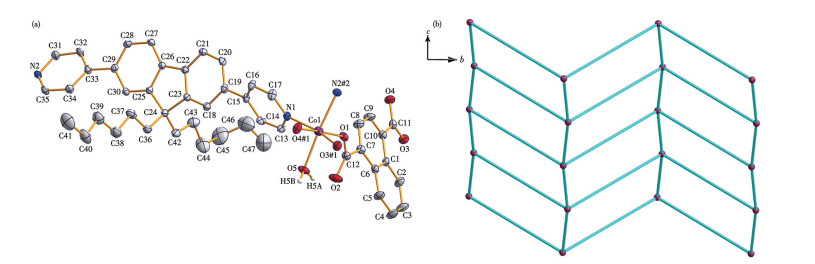
The hydrogen atoms bonded to carbon atoms and lattice DMA molecules are omitted for clarity; 30% ellipsoid probability; Symmetry codes: #1:-x, y+1/2, -z+3/2; #2:-x+2, y+1/2, -z+3/2.
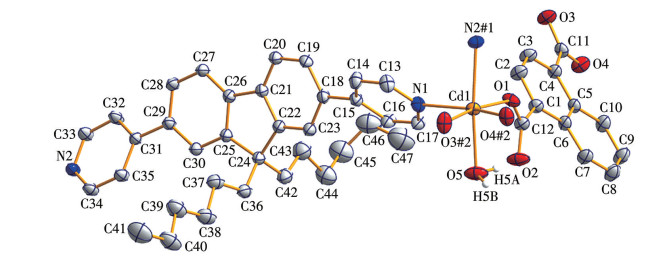
The hydrogen atoms bonded to carbon atoms and lattice DMA molecules are omitted for clarity; 30% ellipsoid probability; Symmetry codes: #1:-x, y+1/2, -z+3/2; #2: x-1, y-1, z.
In complex 1, each ndc2- anion adopts both μ1-η1∶η1 and μ1-η1∶η0 coordination modes, bridging two adjacent Co(Ⅱ) centers. This linkage extends the Co(Ⅱ) centers into a zigzag chain with a repeat distance of 1.079 4(4) nm and a Co…Co…Co angle of 172.90(4)°. Adjacent zigzag chains are interconnected by hfdp ligands, forming a 2D layered structure extending along the [102] direction (Fig.1). To understand the topology of the 2D layer, the Co(Ⅱ) centers can be defined as 4-connected nodes, while the ndc2- and hfdp ligands act as linkers. The structure of 1 can be described as a 2D topological network with Schläfli symbol {44·62} (Fig.1)[13].
PXRD patterns of complexes 1 and 2 were measured at room temperature to confirm phase purity. For both complexes, the experimental patterns closely match those simulated from single-crystal diffraction data (Fig.S1 and S2, Supporting information), exhibiting only minor intensity discrepancies. The observed minor intensity variations are likely due to slight lattice solvent loss, confirming the high phase purity of the bulk materials[14].
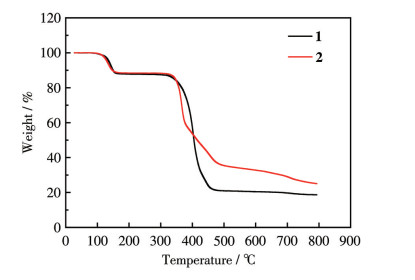
To verify the thermal stabilities of the complexes, TGA of complexes 1 and 2 has been performed in a range of 30 to 800 ℃ with a heating rate of 10 ℃·min-1 under a N2 atmosphere (Fig.3). For 1, the framework remained stable up to 127 ℃, with no significant weight loss observed below this temperature. A weight loss of 12.06% (Calcd. 12.04%) occurred between 127 and 154 ℃, attributed to the release of free DMA molecules and coordinated water molecules. Further decomposition proceeded with a major weight loss of 54.11% between 376 and 416 ℃, corresponding to the degradation of hfdp ligands (Calcd. 55.96%). For 2, an initial weight loss of 11.98% (Calcd. 11.42%) was observed between 116 and 149 ℃, assigned to the loss of one DMA molecule and a coordinated water molecule per formula unit. Subsequent decomposition showed a weight loss of 52.11% between 348 and 477 ℃, corresponding to the collapse of the hfdp ligands (Calcd. 53.10%).
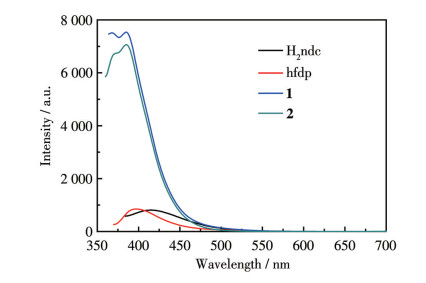
Since CPs with fluorene ligands generally exhibit significant luminescence properties, the photoluminescence behaviors of compounds 1, 2, H2ndc, and hfdp were investigated in DMF solution at room temperature[8-10]. As shown in Fig.4, the H2ndc ligand exhibited an emission maximum at 414 nm (λex=364 nm). The hfdp ligand displayed a fluorescence peak at 390 nm (λex=347 nm). The emission spectra of 1 and 2 showed intense peaks at 385 nm (λex=344 nm for 1, λex=339 nm for 2). Compared to the hfdp ligand, both complexes demonstrated blue-shifted emissions, with a hypsochromic shift of 5 nm. These luminescence behaviors of 1 and 2 may originate from n→π* or π→π* electronic transitions within the hfdp ligand upon coordination[10]. Notably, 1 and 2 exhibited significantly enhanced fluorescence intensity relative to the free ligands, attributed to metal-ligand coordination increasing ligand rigidity and reducing non-radiative energy loss.
In view of their structural characteristics and favorable luminescence properties, complexes 1 and 2 were employed as fluorescent probes to detect various nitro-explosives, including 2, 4, 6-trinitrophenol (TNP), 4-nitrophenol (4-NP), 4-nitrotoluene (4-NT), 1, 2-dinitrobenzene (1, 2-DNB), 1, 3-dinitrobenzene (1, 3-DNB), and 1, 4-dinitrobenzene (1, 4-DNB) (Structural formulas of the six nitro-explosives tested are provided in Table S1.). Given that complexes 1 and 2 exhibit similar quenching effects towards nitro-explosives, complex 1 was selected for detailed elucidation.
As depicted in Fig.5a, the fluorescence intensity of 1 was quenched to varying degrees upon the addition of different nitro-explosives. Upon addition of 50 μL of TNP solution, the emission intensity of 1 (2 mL) was quenched by nearly 96.38%. This quench efficiency was significantly higher than that observed for other nitro-explosives under identical conditions (59.76% for 1, 4-DNB, 57.91% for 4-NP, 14.06% for 1, 2-DNB, 12.20% for 1, 3-DNB, and 10.81% for 4-NT, Fig.S3). Anti-interference experiments further demonstrated the selectivity of 1 for TNP. As depicted in Fig.5b, the fluorescence of 1 was still quenched to a large extent after the concomitant addition of TNP and other nitro explosives at the same time, indicating its pronounced selectivity toward TNP under competitive conditions. Subsequent concentration titration experiments revealed a progressive decline in the fluorescence emission intensity of 1 with increasing TNP concentration (Fig.5c). The Stern-Volmer (S-V) equation (I0/I=1+KSVcTNP)[8-10] was applied to quantify the quenching efficiency, where I0 and I represent the fluorescence intensities of 1 before and after TNP addition, respectively, KSV is the quenching constant, and cTNP is the TNP concentration. A linear relationship between cTNP and I0/I was observed within the concentration range of 0-25 μmol·L-1 (Fig.5d). From the linear regression, a KSV of 7.05×10⁴ L·mol-1 was determined. The limit of detection (LOD) for TNP was calculated to be 0.107 μmol·L-1 (at 3σ/k level, σ=standard deviation, k=slope, Fig.S5), comparing favorably with most reported values in the literature[5, 8-10, 15-25] (Table S2). The results indicate that complex 1 can function as an effective fluorescent probe for TNP detection.
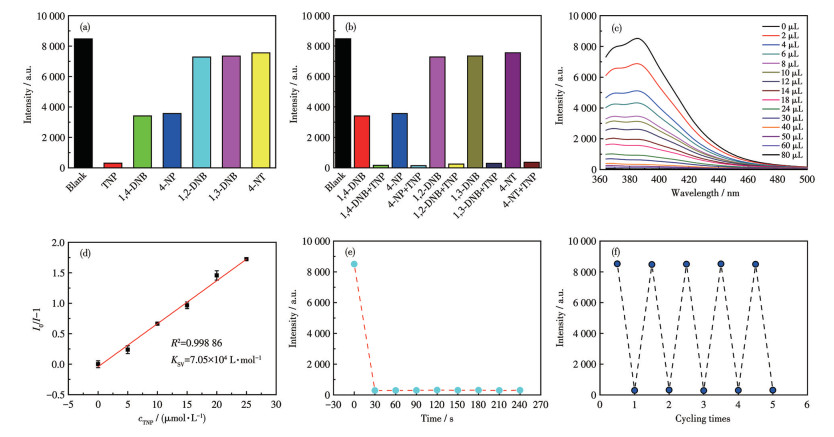
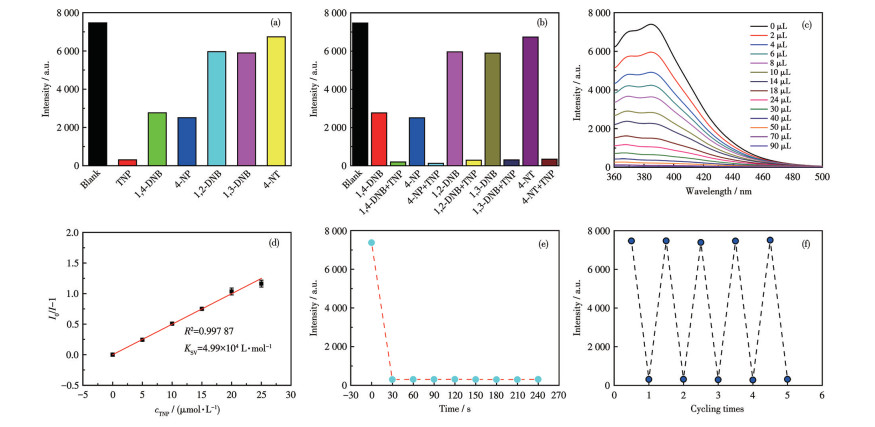
For practical application, response time and reusability are critical parameters. The fluorescence quenching of 1 occurred rapidly, within 30 s of TNP addition, and remained stable over the subsequent 240 s (Fig.5e). Reusability was assessed through cyclic experiments: after soaking in a TNP solution for several minutes, 1 was recovered by washing with deionized water followed by centrifugal filtration. The probe retained its sensing capability effectively for at least five cycles (Fig.5f). Therefore, complex 1 functioned as a rapid, selective, sensitive, and recyclable fluorescent sensor for TNP detection. Complex 2 exhibited similar properties, with a KSV of 4.99×10⁴ L·mol-1 and LOD of 0.327 μmol·L-1 (at 3σ/k level) (Fig.6, S4, and S6).
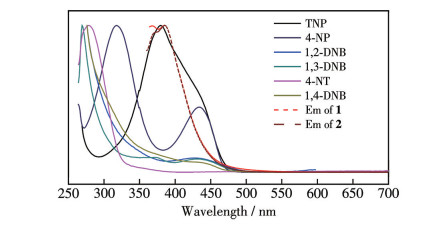
To elucidate the fluorescence quenching mechanisms of 1 and 2 induced by TNP, UV-Vis absorption spectra of TNP, and other nitroaromatic analytes (i.e., 4-NP, 1, 2-DNB, 1, 3-DNB, 1, 4-DNB, and 4-NT) were measured in DMF solution. As shown in Fig.7, a significant spectral overlap existed between the emission bands of the complex and the absorption bands of TNP. This overlap between the analyte (TNP) and the sensors (1 or 2) leads to competitive energy absorption, resulting in fluorescence quenching via an energy competition mechanism[10].
In this study, two coordination polymers, [Co(hfdp)(ndc)(H2O)]·DMA}n (1) and {[Cd(hfdp)(ndc)(H2O)]·DMA}n (2), were synthesized under solvothermal conditions. Their structures were confirmed by EA, IR, TGA, and single-crystal X-ray diffraction analyses. The results show that 1 and 2 exhibit identical coordination geometries, remarkable thermal stability, and good fluorescence properties. Both function as effective fluorescent sensors for TNP through luminescence quenching with high sensitivity and selectivity.
Supporting information is available at
DUTTA A, SINGH A, WANG X X, KUMAR A, LIU J Q. Luminescent sensing of nitroaromatics by crystalline porous materials[J]. CrystEngComm, 2020, 22(45): 7736-7781 doi: 10.1039/D0CE01087A
YANG J, HUANG Z X, XIA G H, RHIM J W, ZHANG W L. Recent trends in the application of MOFs for quality management and safety monitoring of postharvest fruits and vegetables[J]. Coord. Chem. Rev., 2025, 544: 216973 doi: 10.1016/j.ccr.2025.216973
LI J, LIN G, LIANG H, WANG S X, HU T, LI S W, ZHANG L B. Recent advances in the synthesis of MOF-based composites for heavy-metal ion adsorption[J]. Coord. Chem. Rev., 2025, 545: 217010 doi: 10.1016/j.ccr.2025.217010
ZHAO Z H, HUANG J R, LIAO P Q, CHEN X M. Highly efficient electroreduction of CO2 to ethanol via asymmetric C—C coupling by a metal-organic framework with heterodimetal dual sites[J]. J. Am. Chem. Soc., 2023, 145(30): 26783-26790
NAGARKAR S S, DESAI A V, SAMANTA P, GHOSH S K. Aqueous phase selective detection of 2, 4, 6-trinitrophenol using a fluorescent metal-organic framework with a pendant recognition site[J]. Dalton Trans., 2015, 44(34): 15175-15180 doi: 10.1039/C5DT00397K
MU Y J, RAN Y G, ZHANG B B, DU J L, JIANG C Y, DU J. Dicarboxylate ligands modulated structural diversity in the construction of Cd(Ⅱ) coordination polymers built from N-heterocyclic ligand: Synthesis, structures, and luminescent sensing[J]. Cryst. Growth Des. 2020, 20(9): 6030-6043 doi: 10.1021/acs.cgd.0c00739
SUN N N, SHAH S S A, LIN Z Y, ZHENG Y Z. JIAO L, JIANG H L. MOF-based electrocatalysts: An overview from the perspective of structural design[J]. Chem. Rev. 2025, 125(5): 2703-2792 doi: 10.1021/acs.chemrev.4c00664
王高峰, 孙述文, 宋少飞, 吕玫. 一种镉基配位聚合物的合成及其对2, 4, 6-三硝基苯酚的荧光识别[J]. 无机化学学报, 2023, 39(12): 2407-2414WANG G F, SUN S W, SONG S F, LÜ M. Synthesis of a Cd(Ⅱ)-based coordination polymer for luminescence detecting 2, 4, 6-trinitrophenol[J]. Chinese J. Inorg. Chem., 2023, 39(12): 2407-2414
孙述文, 王高峰. 一种痕量监测2, 4, 6-三硝基苯酚的锌基配位聚合物荧光探针的构筑[J]. 无机化学学报, 2025, 41(4): 753-760SUN S W, WANG G F. Design and synthesis of a Zn-based coordination polymer as a fluorescent probe for trace monitoring 2, 4, 6-trinitrophenol[J]. Chinese J. Inorg. Chem., 2025, 41(4): 753-760
王高峰, 孙述文, 杨海英, 王叶. 2, 7-双(4-吡啶基)-9, 9-二甲基芴的锌配位聚合物合成及其对2, 4, 6-三硝基苯酚的荧光传感研究[J]. 分析科学学报, 2024, 40(6): 648-654WANG G F, SUN S W, YANG H Y, WANG Y. A fluorescent zinc-based coordination polymer constructed by 4, 4′-(9, 9-dimethyl-9H-fluorene-2, 7-diyl)dipyridine with sensitive sensing property for 2, 4, 6-trinitrophenol[J]. Journal of Analytical Science, 2024, 40(6): 648-654
SHELDRICK G M. SHELXL 2014/7, Program for crystal structure refinement[CP]. University of Göttingen, Germany, 2014.
SHELDRICK G M. A short history of SHELX[J]. Acta Crystallogr. Sect. A, 2008, A64: 112-122
BLATOV V A. Multipurpose crystallochemical analysis with the program package TOPOS[J]. IUCr CompComm Newsletter, 2006, 7: 4-38
LIANG Q F, ZHENG H W, YANG D D, ZHENG X J. Zn(Ⅱ) complexes based on a Schiff base: Mechanochromism- and solvent molecule-dependent acidochromism[J]. Cryst. Growth Des. 2022, 22(6): 3924-3931 doi: 10.1021/acs.cgd.2c00320
徐涵, 潘兆瑞, 亓昭鹏, 孙洁. 基于V型配体的三个荧光Zn-MOF对水溶液中2, 4, 6-三硝基苯酚和Fe3+的荧光传感[J]. 无机化学学报, 2022, 38(12): 2479-2490XU H, PAN Z R, QI Z P, SUN J. Three luminescent Zn-MOFs based on V-shaped ligands for fluorescence sensing of 2, 4, 6-trinitrophenol and Fe3+ in aqueous solution[J]. Chinese J. Inorg. Chem., 2022, 38(12): 2479-2490
ZHANG J F, WU J J, GONG L P, FENG J Y, ZHANG C. Water- stable luminescent Zn(Ⅱ) metal-organic framework as rare multifunctional sensor for Cr and TNP[J]. ChemistrySelect, 2017, 2(24): 7465-7473 doi: 10.1002/slct.201701253
ZHANG J F, WU J J, TANG G D, FENG J Y, LUO F M, XU B, ZHANG C. Multiresponsive water-stable luminescent Cd coordination polymer for detection of TNP and Cu2+[J]. Sens. Actuator B‒Chem., 2018, 272: 166-174 doi: 10.1016/j.snb.2018.05.121
WANG J, WU X R, LIU J Q, LI B H, SINGH A, KUMAR A, BATTEN S R. An uncommon (5, 5)-connected 3D metal organic material for selective and sensitive sensing of nitroaromatics and ferric ion: Experimental studies and theoretical analysis[J]. CrystEngComm, 2017, 19(25): 3519-3525 doi: 10.1039/C7CE00912G
HE H M, CHEN S H, ZHANG D Y, YAN E C, ZHAO X J. A luminescent metal-organic framework as an ideal chemosensor for nitroaromatic compounds[J]. RSC Adv., 2017, 7(62): 38871-38876 doi: 10.1039/C7RA06320B
HE H M, SONG Y, SUN F X, BIAN Z, GAO L X, ZHU G S. A porous metal-organic framework formed by a V-shaped ligand and Zn(Ⅱ) ion with highly selective sensing for nitroaromatic explosives[J]. J. Mater. Chem. A, 2015, 3(32): 16598-16603 doi: 10.1039/C5TA03537F
DENG Y J, CHEN N J, LI Q Y, WU X J, HUANG X L, LIN Z H, ZHAO Y G. Highly fluorescent metal-organic frameworks based on a benzene-cored tetraphenylethene derivative with the ability to detect 2, 4, 6-trinitrophenol in water[J]. Cryst. Growth Des., 2017, 17(6): 3170-3177 doi: 10.1021/acs.cgd.7b00131
PARMAR B, RACHURI Y, BISHT K K, SURESH E. Syntheses and structural analyses of new 3D isostructural Zn(Ⅱ) and Cd(Ⅱ) luminescent MOFs and their application towards detection of nitroaromatics in aqueous media[J]. ChemistrySelect, 2016, 1(19): 6308-6315 doi: 10.1002/slct.201601134
YANG Y, SHEN K, LIN J Z, ZHOU Y, LIU Q Y, HANG C, ABDELHAMID H N, ZHANG Z Q, CHEN H. A Zn-MOF constructed from electron-rich π-conjugated ligands with an interpenetrated graphene-like net as an efficient nitroaromatic sensor[J]. RSC Adv., 2016, 6(51): 45475-45481 doi: 10.1039/C6RA00524A
RACHURI Y, PARMAR B, BISHTA K K, SURESH E. Mixed ligand two dimensional Cd(Ⅱ)/Ni(Ⅱ) metal organic frameworks containing dicarboxylate and tripodal N-donor ligands: Cd(Ⅱ) MOF is an efficient luminescent sensor for detection of picric acid in aqueous media[J]. Dalton Trans., 2016, 45(18): 7881-7892 doi: 10.1039/C6DT00753H
SONG X Z, SONG S Y, ZHAO S N, HAO Z M, ZHU M, MENG X, WU L L, ZHANG H J. Single-crystal-to-single-crystal transformation of a europium(Ⅲ) metal-organic framework producing a multi- responsive luminescent sensor[J]. Adv. Funct. Mater., 2014, 24(26): 4034-4041 doi: 10.1002/adfm.201303986

Figure 1 (a) Coordination environments in complex 1; (b) Schematic representation of the nets with Schläfli symbol of {44·62}
The hydrogen atoms bonded to carbon atoms and lattice DMA molecules are omitted for clarity; 30% ellipsoid probability; Symmetry codes: #1:-x, y+1/2, -z+3/2; #2:-x+2, y+1/2, -z+3/2.

Figure 2 Coordination environments in complex 2
The hydrogen atoms bonded to carbon atoms and lattice DMA molecules are omitted for clarity; 30% ellipsoid probability; Symmetry codes: #1:-x, y+1/2, -z+3/2; #2: x-1, y-1, z.

Figure 5 (a) Fluorescence intensity of 1 in the presence of different nitro-explosives; (b) Fluorescence intensity of 1 in the presence of other nitro-explosives and TNP; (c) Fluorescence spectra of 1 upon gradual addition of TNP solution (5 mmol·L-1); (d) S-V plot for 1 detecting TNP in DMF suspension at the low concentration (0-25 μmol·L-1); (e) Time-dependent fluorescence intensity for 1 detecting TNP; (f) Cyclic stability for 1 detecting TNP

Figure 6 (a) Fluorescence intensity of 2 in the presence of different nitro-explosives; (b) Fluorescence intensity of 2 in the presence of other nitro-explosives and TNP; (c) Fluorescence spectra of 2 upon gradual addition of TNP solution (5 mmol·L-1); (d) S-V plot for 2 detecting TNP in DMF suspension at the low concentration (0-25 μmol·L-1); (e) Time-dependent fluorescence intensity for 2 detecting TNP; (f) Cyclic stability for 2 detecting TNP

Figure 7 Spectra overlap between the UV-Vis spectra of nitro-explosives and the emission spectra of 1 and 2 in DMF
Table 1. Crystallographic data and refinement parameters for complexes 1 and 2
| Parameter | 1 | 2 |
| Formula | C51H57CoN3O6 | C51H57CdN3O6 |
| Formula weight | 873.39 | 920.41 |
| Crystal system | Monoclinic | Monoclinic |
| Space group | P21/c | P21/c |
| Crystal size / mm | 0.26×0.22×0.20 | 0.28×0.25×0.22 |
| a / nm | 1.322 12(8) | 1.337 08(6) |
| b / nm | 2.744 10(11) | 2.757 78(10) |
| c / nm | 1.550 98(13) | 1.537 87(9) |
| β / (°) | 125.427(4) | 124.099(3) |
| V / nm3 | 4.585 2(5) | 4.695 7(4) |
| Dc / (g·cm-3) | 1.265 | 1.302 |
| Z | 4 | 4 |
| μ / mm-1 | 0.426 | 0.516 |
| F(000) | 1 848 | 1 920 |
| Unique reflection | 8 240 | 8 434 |
| Observed reflection [I > 2σ(I)] | 6 848 | 7 036 |
| Number of parameters | 552 | 552 |
| GOF | 1.020 | 1.088 |
| Final R indices [I > 2σ(I)] | R1=0.068 3, wR2=0.184 9 | R1=0.048 9, wR2=0.126 3 |
| R indices (all data) | R1=0.081 1, wR2=0.195 1 | R1=0.060 7, wR2=0.136 3 |
 下载: 导出CSV
Table 2. Selected bond lengths (nm) and bond angles (°) for complexes 1 and 2
| 1 | |||||
| Co1—O1 | 0.208 4(2) | Co1—O4#1 | 0.212 0(3) | Co1—N2#2 | 0.215 9(3) |
| Co1—O5 | 0.209 6(3) | Co1—N1 | 0.214 4(3) | Co1—O3#1 | 0.220 7(3) |
| O1—Co1—O5 | 88.71(10) | O1—Co1—O3#1 | 111.38(10) | N1—Co1—N2#2 | 94.47(12) |
| O1—Co1—O4#1 | 171.84(10) | O5—Co1—N2#2 | 175.26(12) | O5—Co1—O3#1 | 88.23(11) |
| O1—Co1—N1 | 91.86(11) | O4#1—Co1—N1 | 96.26(11) | O4#1—Co1—O3#1 | 60.47(10) |
| O1—Co1—N2#2 | 87.63(11) | O4#1—Co1—N2#2 | 92.52(11) | N1—Co1—O3#1 | 156.47(11) |
| 2 | |||||
| Cd1—O1 | 0.22 54(3) | Cd1—O3#2 | 0.229 9(3) | Cd1—N2#1 | 0.234 4(3) |
| Cd1—O5 | 0.228 9(3) | Cd1—N1 | 0.232 8(3) | Cd1—O4#2 | 0.237 5(3) |
| O1—Cd1—O5 | 86.57(11) | O1—Cd1—O4#2 | 114.81(11) | N1—Cd—N2#1 | 92.58(12) |
| O1—Cd1—O3#2 | 169.52(11) | O3#2—Cd1—N1 | 98.42(11) | N1—Cd1—O4#2 | 153.86(11) |
| O1—Cd1—N1 | 91.33(12) | O3#2—Cd1—N2#1 | 96.14(12) | O5—Cd1—N2#1 | 173.59(12) |
| O1—Cd1—N2#1 | 87.22(11) | O3#2—Cd1—O4#2 | 55.56(10) | O5—Cd1—O4#2 | 92.84(13) |
| Symmetry codes: #1: -x, y+1/2, -z+3/2; #2: -x+2, y+1/2, -z+3/2 for 1; #1: -x, y+1/2, -z+3/2; #2: x-1, y-1, z for 2. | |||||
下载: 导出CSV

 扫一扫看文章


扫一扫关注我们