Table 1.
Crystal data and structure refinement for Mo8-CP

Synthesis, characterization, and ion exchange properties of octamolybdate-based Cu(Ⅱ) coordination polymer
Xiuli HAO , Chenhao ZHANG , Chenkun FENG , Haolin HAN , Xudong ZHAO , Guoliang SHI


Polyoxometalates (POMs), as one type of unique nano-sized metal-oxo clusters, have been used as anionic precursors, not only because of their controllable shape, size, and high negative charges, but also because of their potential advantages in the design of new materials with abundant chemical combinations and multiple functionalities[1-5]. Especially, the design and synthesis of new coordination polymers (CPs) based on POMs have attracted considerable attention in recent years[6-12]. In this research field, the POMs can act as “templates” for a variety of structures, and can be regarded as “building blocks”, with their terminal or bridging oxides coordinating to metal cations. In the POM-based CPs, different POMs clusters, including Keggin[13-14], Dawson[15-16], Anderson[17-18], Strandberg[19-20], and Lindqvist-type[21-22] clusters, etc., have been employed to build CPs. Among these POM clusters, octamolybdates have received much attention in constructing POM-based CPs due to their structural diversity, that is, octamolybdates exist in eight isomeric forms (α, β, γ, δ, ε, ζ, η, and θ isomers), and these isomers are easily interconvertible under mild environmental modification[23-26]. Therefore, various topological architectures can be afforded through introducing octamolybdates into metals and organic ligand systems.
In the synthesis of the POM-based CPs, hydrothermal[13-26] and solvothermal[27-28] syntheses have been widely used. Recently, ionothermal synthesis acted as a kind of synthetic method starts to be used, in which ionic liquids (ILs) act as the solvents[29-31]. Compared to the solvents used in traditional hydro/solvothermal synthesis, ILs possess better solubility to most of the inorganic precursors, lower vapor pressure, higher chemical and thermal stabilities, and lower toxicity. Hence, ionothermal synthesis is considered an environmentally friendly synthetic method[32]. Additionally, in CPs synthesized by hydrothermal and solvothermal methods, most of the pore channels are occupied by water or traditional organic solvents such as methanol, acetonitrile, and acetone. When using ILs for synthesis, the pore channels can be occupied by organic counter cations, which can be removed by ion exchange, thus restoring the pore structure for relevant property tests.
The synthetic system of POM-based CPs includes three key factors: transition metal (TM) ions, neutral N-donor bridging ligands (L), and POMs. In this reaction system, the design and selection of organic N-donor bridging ligands play a key role in exploring the POM-based CPs. Among them, bridging ligands formed by the combination of bridging groups and triazole have diverse and flexible coordination modes with TM ions, thus enabling the preparation of POM-based CPs with different structures[33-35]. Our research group has carried out exploration and research in this regard[36-38].
Based on the above considerations and our previous work, we carried out systematic research on the ionothermal reaction system Cu/BBTZ/heptamolybdate (BBTZ=1,4-bis(1,2,4-triazol-1-ylmethyl)benzene) to construct POM-based CPs with the ion exchange properties. Herein, the octamolybdate-based CP, (Emim)2[Cu(BBTZ)2(β-Mo8O26)] (Mo8-CP), was prepared from this reaction system. Mo8-CP contains a 3D anionic framework with channels, in which 1-ethyl-3-methylimidazolium ((Emim)+) acts as a structure-directing agent and occupies the channels. Furthermore, luminescent materials with different colors can be obtained through the exchange of Eu3+ or Tb3+.
All chemicals and organic solvents used for synthesis were of reagent grade without further purification. The ligand BBTZ was synthesized according to the literature procedure[39]. The 1-ethyl-3-methylimidazolium bromide ((Emim)Br) was prepared according to the literature methods[40]. Elemental analysis was performed on a Perkin-Elmer 2400 CHN elemental analyzer (C, H, and N) and a Leeman inductively coupled plasma (ICP) spectrometer (Cu and Mo). The FTIR spectra were analyzed on a Mattson Alpha-Centauri spectrometer with KBr pellets in a range of 4 000-400 cm-1. Thermogravimetry (TG) analysis was carried out on a Pyris Diamond TG instrument in flowing N2 with a heating rate of 10 ℃·min-1. The powder X-ray diffraction (PXRD) studies were performed with a Rigaku D/max-IIB X-ray diffractometer operating at 40 kV and 30 mA, using Cu Kα radiation (λ=0.154 18 nm), at a scanning rate of 1 (°)·min-1 with 2θ ranging from 5° to 50°. Photoluminescence spectra were obtained by using an FLSP 980 Edinburgh instrument (Eng) with a 450 W xenon lamp monochromatized by a double grating. The luminescence photograph was taken under UV excitation by an upright microscope (model Ni-L) equipped with a digital camera.
The mixture of (NH4)6Mo7O24·4H2O (0.16 g, 0.13 mmol), CuCl2·2H2O(0.15 g, 0.87 mmol), BBTZ (0.1 g, 0.41 mmol), and (Emim)Br (2 g, 4.6 mmol) was stirred at room temperature for 0.5 h. During this period, the pH value of the reaction mixture was adjusted to 4.5 with 1.0 mol·L-1 NaOH and 1.0 mol·L-1 HCl. Then, the suspension was sealed into a Teflon-lined autoclave, kept under autogenous pressure at 160 ℃ for 5 d, and then slowly cooled to room temperature at a rate of 10 ℃·h-1. Blue block crystals of Mo8-CP thus obtained were isolated via filtration, washed with distilled water, and kept in a vacuum desiccator (55% yield based on Mo). Anal. Calcd. for C36H46N16O26Mo8Cu(%): C 22.15, H 2.36, N 11.49, Cu 3.28, Mo 39.38. Found(%): C 21.96, H 2.47, N 11.35, Cu 3.12, Mo 39.19. Selected IR data (KBr pellet, cm-1): 3 450(s), 3 128(s), 3 025(w), 2 962(w), 1 620(w), 1 523(s), 1 423(w), 1 380(w), 1 284(s), 1 209(m), 1 124(s), 1 008(s), 943(w), 904(m), 866(w), 793(w), 761(w), 725(m), 657(m).
Eu3+ exchange: 120 mg of Eu(NO3)3·6H2O was dispersed in 10 mL of ethanol, and then, 100 mg of Mo8-CP was added and stirred for 24 h. After repeated washing with ethanol and drying, the final product can be collected.
Tb3+ exchange: the preparation method of Tb3+ exchange was analogous to that of Eu3+ exchange mentioned above; only Eu(NO3)3·6H2O should be replaced by the same amount of Tb((NO3)3·6H2O.
The crystallographic data of Mo8-CP were collected at 298 K on the Rigaku R-axis Rapid IP diffractometer using graphite monochromatic Mo Kα radiation (λ=0.071 073 nm) and IP techniques. The crystal was maintained at a temperature of 298.15 K throughout the data collection process. The structure was solved by direct methods using the SHELXT program and refined with SHELXL-97 by full matrix least-squares techniques on F2. Non-hydrogen atoms were refined anisotropically, while the hydrogen atoms were located geometrically and refined isotropically. During the refinement of Mo8-CP, non-hydrogen atoms were refined anisotropically. The H atoms on organic C centers were fixed in calculated positions. The detailed crystal data and structure refinement for Mo8-CP are given in Table 1. Selected bond lengths and angles of Mo8-CP are listed in Table 2.
 下载:
导出CSV
下载:
导出CSV
| Parameter | Mo8-CP | Parameter | Mo8-CP | ||
| Formula | C36H46N16O26Mo8Cu | Z | 4 | ||
| Formula weight | 1 949.95 | μ/mm-1 | 1.982 | ||
| Crystal system | Monoclinic | F(000) | 3 788 | ||
| Space group | C2/c | Total reflection | 23 785 | ||
| a/nm | 2.168 0(4) | Rint | 0.039 1 | ||
| b/nm | 1.254 1(3) | GOF | 1.025 | ||
| c/nm | 2.336 0(5) | R1 [I>2σ(I)]a | 0.037 2 | ||
| β/(°) | 102.04(3) | wR2 (all data)b | 0.089 1 | ||
| V/nm3 | 6.212(2) | ||||
| a R1=∑||Fo|-|Fc||/∑|Fo|; b wR2=∑[w(Fo2-Fc2)2]/∑[w(Fo2)2]1/2. | |||||
下载:
导出CSV
| Cu1—N1i | 0.201 0(5) | Cu1—N1 | 0.201 0(5) | Cu1—N4i | 0.201 1(5) |
| Cu1—N4 | 0.201 1(5) | Cu1—O8i | 0.249 9(0) | Cu1—O8 | 0.249 9(0) |
| N1i—Cu1—N1 | 180.0(2) | N1i—Cu1—N4 | 89.93(19) | N1i—Cu1—N4i | 90.07(19) |
| N1—Cu1—N4i | 89.9(2) | N1—Cu1—N4 | 90.07(19) | N4i—Cu1—N4 | 180.0 |
| N1—Cu1—O8 | 88.33(31) | N4—Cu1—O8 | 94.08(81) | N1i—Cu1—O8 | 91.66(71) |
| N4i—Cu1—O8 | 85.91(81) | O8—Cu1—O8i | 179.98(9) | ||
| Symmetry code: i -x, -y, 1-z. | |||||
In the construction of porous materials, the synthetic outcomes often fall short of expectations, primarily due to ligand entanglement during the self-assembly process, which leads to pore size reduction or even structural collapse. To address this issue, this study proposes employing bulky organic counterions as pore-filling templates. This strategy effectively suppresses ligand interpenetration during self-assembly by pre-occupying the pore space with organic cations. Although these cations initially block the pores, subsequent ion exchange removes them, restoring porosity and enabling further characterization. The ionothermal synthesis method offers several advantages: (ⅰ) ILs exhibit excellent solubility for inorganic precursors; (ⅱ) they combine low vapor pressure with high thermal/chemical stability and low toxicity; (ⅲ) the intrinsic organic cations of ILs can directly act as pore-filling counterions; (ⅳ) introducing specific organic ligands may provide supplementary cationic species for pore occupation. Based on this rationale, we extended the classical Cu/BBTZ/(Mo8O26)4- hydrothermal system to an ionothermal approach, obtaining porous materials with distinct architectures.
In the hydrothermal synthesis system for preparing CPs using Cu2+, organic ligands, and (NH4)6Mo7O24 as raw materials, the pH value is the core factor regulating product formation[41]. Similarly, in the ionothermal synthesis experiment of Mo8-CP, 1.0 mol·L-1 NaOH solution and 1.0 mol·L-1 HCl solution were used as acid-base regulators to precisely control the pH value of the reaction system. The synthesis effects were systematically investigated when the pH values were 2.5, 3.0, 3.5, 4.0, 4.5, and 5.0. The results showed that: (ⅰ) when the pH value was 2.5, 3.0, or 3.5, no crystals appeared in the system after the reaction was completed, and only amorphous precipitates were formed; (ⅱ) when the pH value increased to 4.0 and 4.5, blue crystals were successfully precipitated from the system, and a comparison revealed that when pH=4.5, the obtained blue crystals had a higher yield and better crystal quality; (ⅲ) when the pH value was further increased to 5.0, the target blue crystals were not generated in the system, and only yellow microcrystals were obtained. Due to the excessively small grain size of these yellow microcrystals, their single-crystal structure could not be successfully resolved.
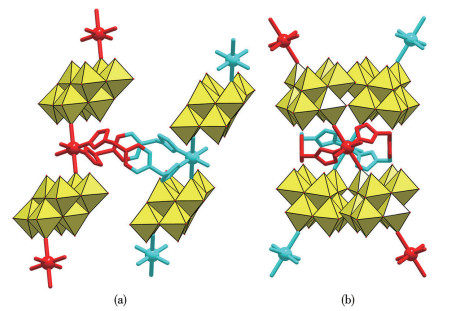
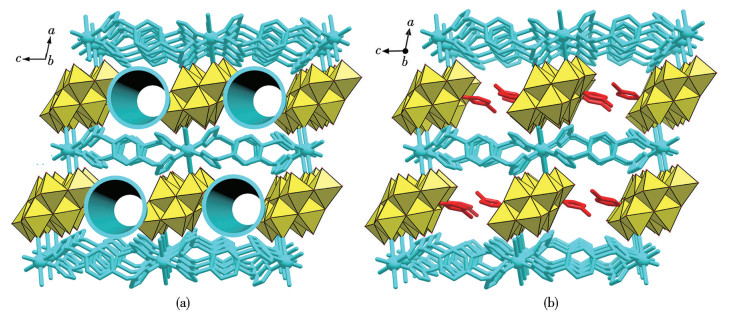
Mo8-CP crystallizes in the monoclinic space group C2/c, with the basic structural unit comprising one polyoxometalate anion (β-Mo8O26)4-, one Cu2+ cation, two BBTZ ligands, and two (Emim)+ counter cations (Fig.1). In Mo8-CP, the (β-Mo8O26)4- anion consists of eight distorted {MoO6} octahedra, containing four types of oxygen atoms: six μ2-O, four μ3-O, two μ5-O, and twelve terminal O (Ot) atoms, exhibiting characteristic β-type octamolybdate structural features. The metal-organic fragment contains only one crystallographically independent Cu2+ center. Each Cu2+ center adopts a six-coordinated geometry, ligated by four nitrogen atoms from triazole groups of BBTZ ligands and two terminal oxygen atoms from the (β-Mo8O26)4- polyanion (Fig.2). The Cu—N bond lengths are 0.201 0(5) and 0.201 1(5) nm, with N—Cu—N bond angles of 90° and 180°. The Cu—O8 bond distance of 0.249 9(0) nm suggests a weak coordination interaction between the Cu2+ center and the surface oxygen atom of (β-Mo8O26)4-. Structurally, each BBTZ ligand in Mo8-CP adopts a cis-configuration, bridging two Cu2+ centers to form binuclear [Cu-BBTZ]2 metallacycles (Fig.2). These [Cu-BBTZ]2 units are further interconnected via Cu2+ centers to generate loop-containing 1D chain (Cu-BBTZ chain) (Fig.2). Concurrently, octamolybdate (Mo8) clusters coordinate to Cu2+ centers, forming 1D Cu-Mo8 chains (Fig.3a). Notably, the two Cu2+ centers in each [Cu-BBTZ]2 unit coordinate to Mo8 clusters, resulting in two sets of 1D Cu-Mo8 chains extending orthogonally (Fig.3b). Through this connection, the 1D Cu-BBTZ chains and Cu-Mo8 chains collectively assemble into a 3D anionic framework via shared Cu2+ centers, featuring 1D channels along the b-axis (Fig.4a). (Emim)+ occupy these channels, serving dual roles: preventing framework entanglement through steric effects and acting as structure-directing agents for channel formation (Fig.4b).
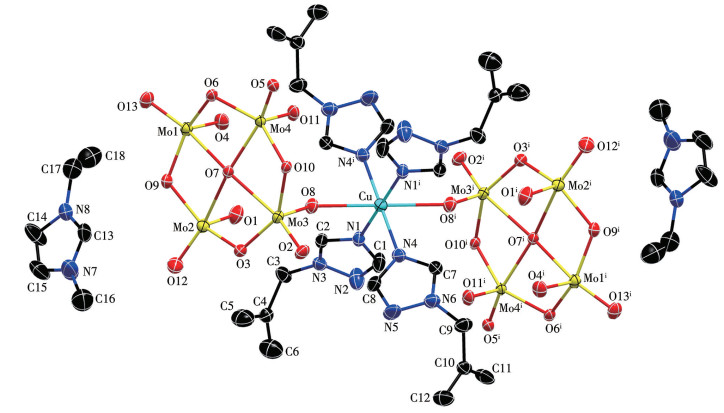
All H atoms are omitted for clarity; Symmetry code: i -x, -y, 1-z.
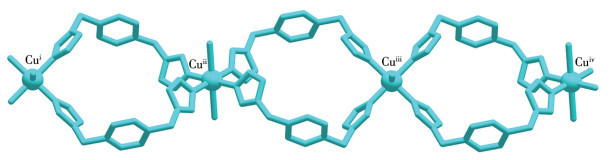
Symmetry codes: i 1/2-x, 1/2+y, 3/2-z; ii 1/2+x, 1/2+y, z; iii 1/2-x, 1/2+y, 1/2-z; iv 1/2+x, 1/2+y, -1+z.
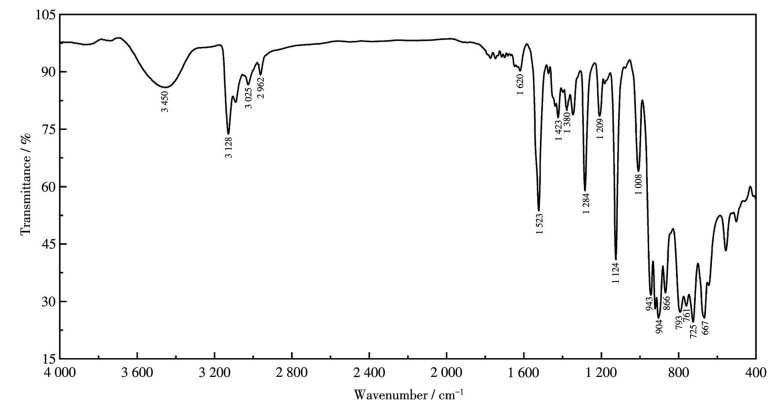
The IR spectrum (Fig.5) of Mo8-CP showed characteristic peaks of the polyoxoanion (Mo8O26)4- in a range of 667-943 cm-1, which are ascribed to the vibrations of ν(Mo—Ot) and ν(Mo—O—Mo). In addition, the peaks at 3 025-3 128 cm-1 are attributed to the vibrations of the C—H in phenyl/triazole/imidazole rings of the BBTZ ligand or (Emim)+. The peaks at 2 960 and 1 380 cm-1 are assigned to the ν(C—H) and δ(C—H) in the CH3 group of (Emim)+. Peaks in the regions of 1 423-1 620 cm-1 may belong to the vibrations of the C=C, C=N, and N=N in phenyl/triazole/imidazole rings of the BBTZ ligand or (Emim)+. The peaks at 3 450 cm-1 is attributed to the vibrations of H2O.
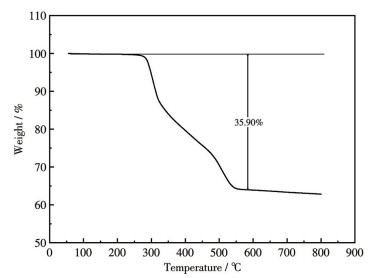
The TG curve of Mo8-CP showed one weight loss step (Fig.6). The whole weight loss of 36% occurring from 255 to 560 ℃ is mainly ascribed to the decomposition and loss of BBTZ ligands and counter cation (Emim)+ in Mo8-CP (Calcd. 35.67%). Additionally, a weight loss of approximately 11.74% occurring between 255 and around 320 ℃ can be attributed to the loss of counter cation (Emim)+. Thereafter, the decomposition and loss of BBTZ ligands commence, leading to the collapse of the framework.
Microporous CPs with negatively charged groups can achieve precise replacement of cations in the channels through ion exchange strategies, thereby constructing functional composite materials[42-44]. The advantage of this strategy lies in its ability to directionally introduce a variety of functional cationic species into the channel structure, providing an efficient approach for regulating material functions. Notably, Mo8-CP not only has a stable negatively charged framework, but its crystal structure can remain stable and insoluble in water and various organic solvents. This excellent chemical stability provides a reliable guarantee for the structural integrity during the ion exchange process. Therefore, the counterion (Emim)+ filled in its channels can be exchanged through a mild ion exchange process, creating conditions for expanding the material′s functions. Considering that the BBTZ organic ligand contained in Mo8-CP may have luminescent properties, we systematically investigated its luminescent performance. The experimental results showed that under an excitation wavelength of 375 nm, the maximum emission peak of Mo8-CP was located at 423 nm (Fig.7). A comparison with the luminescent spectrum of the free BBTZ ligand (whose maximum emission peak was at 427 nm, Fig.8) reveals that the emission characteristics of the two are homologous, both originating from electronic transitions within the aromatic system of the BBTZ ligand—specifically, π-π* or π-n ligand-centered transitions[45]. This further confirms that the emission peak is a characteristic emission of the organic ligand. Furthermore, through observation with an upright fluorescence microscope, blue fluorescence emitted by Mo8-CP could be directly observed (inset of Fig.7). The above results indicate that this polyoxometalate-based coordination polymer has potential application value in the field of fluorescent materials.
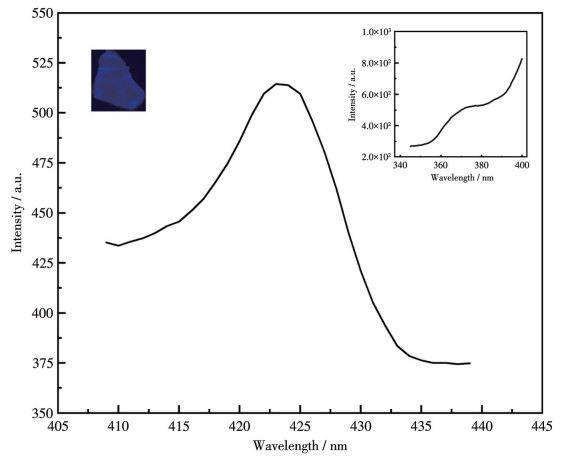
The upper left inset shows the corresponding fluorescence microscopy image of the sample; The upper right inset indicates the excitation wavelength (λex=375 nm)
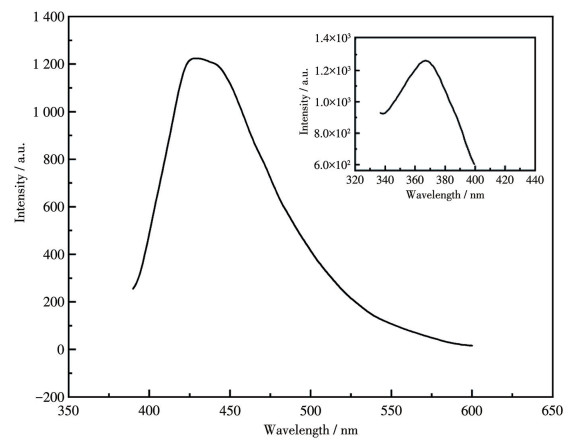
The upper right inset indicates the excitation wavelength (λex=368 nm).
Based on the structural characteristics (capable of ion exchange) and luminescent properties (intrinsically emitting blue light) of Mo8-CP, we further designed rare-earth ion exchange experiments with the aim of regulating its luminescent performance. The specific operation was as follows: the crystals of Mo8-CP were immersed in an ethanol solution containing Eu3+. After a mild exchange for 24 h, the Eu3+-exchanged composite material was obtained through multiple centrifugation, washing, and drying steps. The characterization of its fluorescent properties showed that under excitation at 332 nm, the composite material had characteristic emission peaks at 592, 616, 653, and 697 nm, which correspond to the 5D0→7F1, 5D0→7F2, 5D0→7F3, and 5D0→7F4 transitions of Eu3+, respectively (Fig.9)[46-47]. Meanwhile, obvious red fluorescence could be observed under an upright fluorescence microscope (inset of Fig.9), confirming that a red fluorescent material was successfully constructed through ion exchange. Using the same experimental approach, the Tb3+-exchanged composite material was obtained by replacing the exchange ion with Tb3+. Under excitation at 248 nm, the emission peaks at 490, 544, 584, and 622 nm in its fluorescence spectrum (Fig.10) correspond to the 5D4→7F6, 5D4→7F5, 5D4→7F4, and 5D4→7F3 transitions of Tb3+, respectively[49]. In addition, green fluorescence could be observed under an upright fluorescence microscope (inset of Fig.10), indicating the successful preparation of a green fluorescent material.
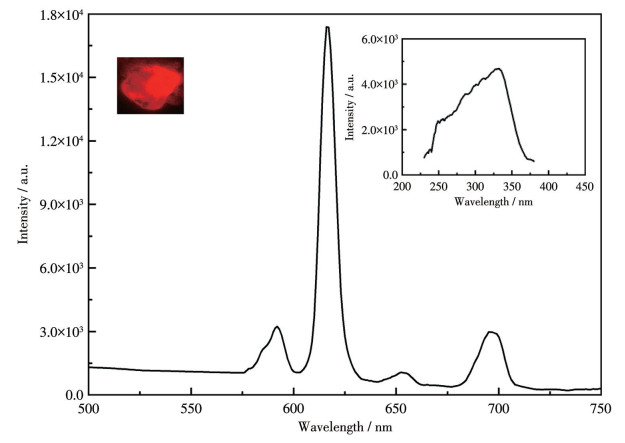
The upper right inset indicates the excitation wavelength (λex=332 nm); The upper left inset shows the fluorescence microscopy image of Mo8-CP after Eu3+ exchange.
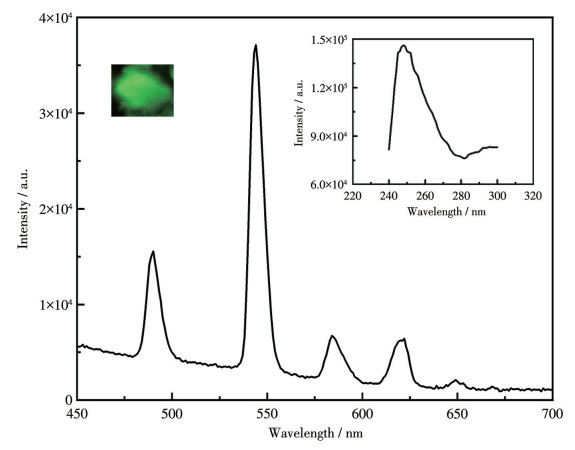
The upper right inset indicates the excitation wavelength (λex=248 nm); The upper left inset shows the fluorescence microscopy image of Mo8-CP after Tb3+ exchange.
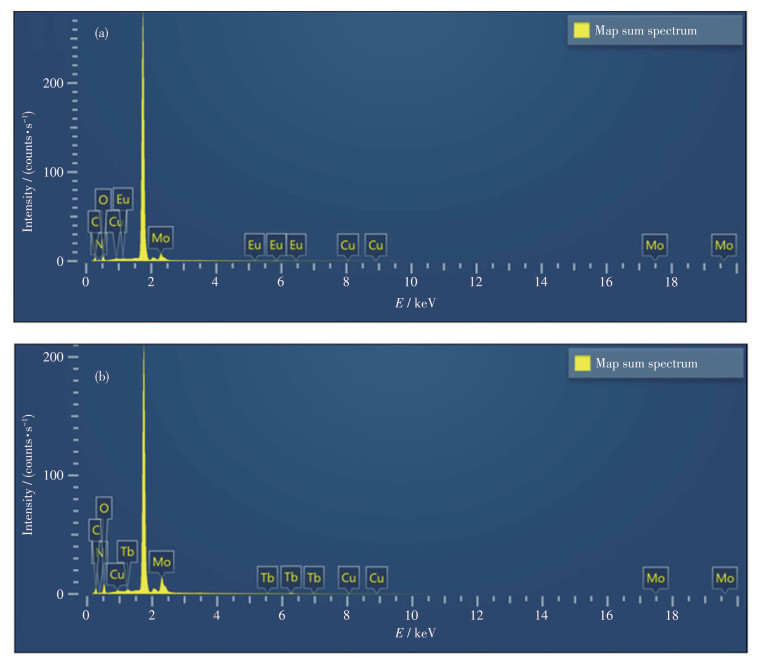
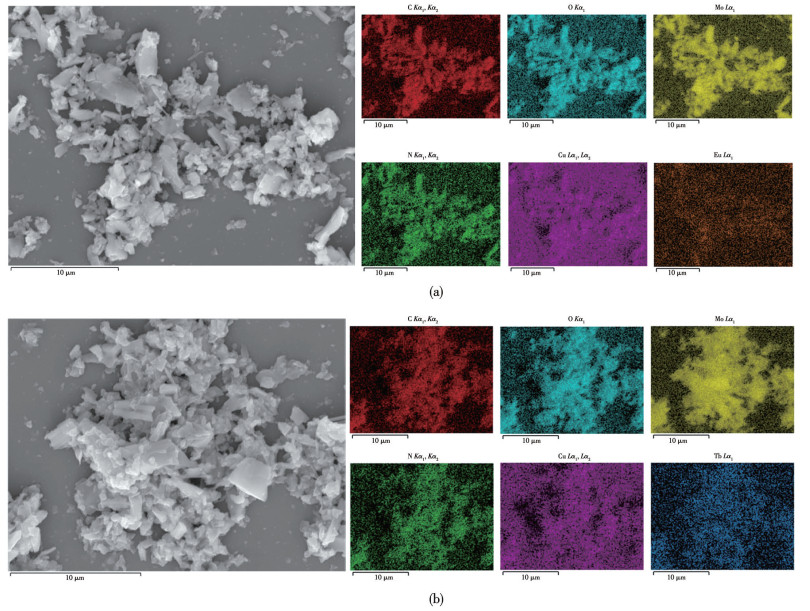
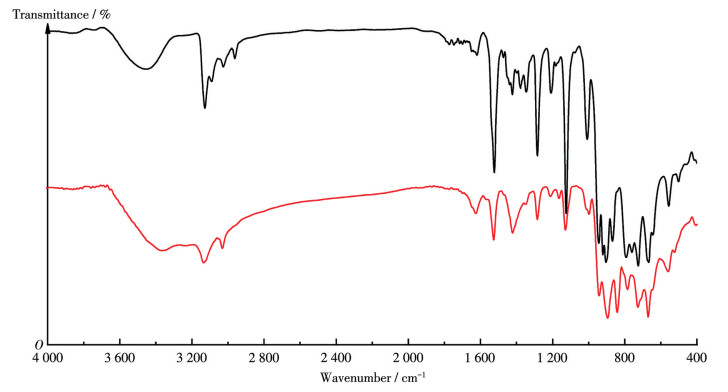
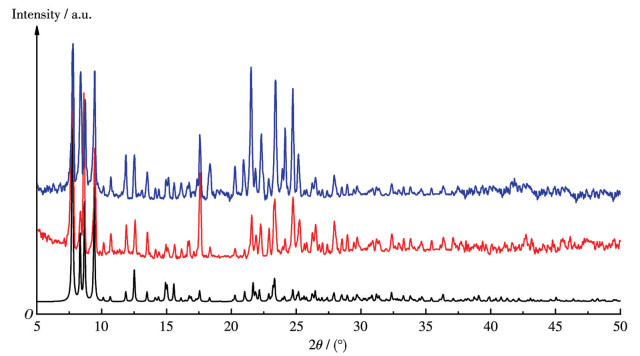
To confirm the replacement of (Emim)+ cations in the framework by Eu3+ and Tb3+ through ion exchange, C, H, and N elemental analyses were performed on Mo8-CP after the ion exchange process. The results indicated a significant decrease in the C, H, and N contents of the exchanged samples compared to the original material, as shown in Table 3. Based on the assumption that each Eu3+/Tb3+ replaces three (Emim)+ to maintain charge balance, the elemental analysis data were used to calculate the extent of exchange. It was found that approximately 1.447 (Emim)+ per Mo8-CP molecule were displaced in the case of Eu3+ exchange, corresponding to an exchange ratio of 72.35% (based on (Emim)+). For Tb3+ exchange, about 1.323 (Emim)+ per Mo8-CP molecule were replaced, giving an exchange ratio of 66.15%. These results strongly support the occurrence of ion exchange. Furthermore, energy-dispersive X-ray spectroscopy (EDS) elemental mapping confirmed the uniform distribution of Eu and Tb elements in Mo8-CP after ion exchange (Fig.11 and 12). To further evaluate the structural stability of the material during ion exchange, the IR spectra (Fig.13) and PXRD patterns (Fig.14) of Mo8-CP before and after exchange were compared. The results showed that the position and intensity of the absorption peaks and the diffraction peaks remained largely unchanged, indicating that the framework structure was preserved without collapse and exhibited good stability. This study not only clearly demonstrates the excellent ion exchange capability of Mo8-CP but also reveals its potential for modulating luminescence properties through ion exchange, providing an effective strategy for the design and preparation of multifunctional fluorescent materials.
下载:
导出CSV
| Material* | Mass fraction/% | ||
| C | H | N | |
| Mo8-CP | 21.96 | 2.47 | 11.35 |
| Mo8-CP-Eu3+ | 17.73 | 1.69 | 9.85 |
| Mo8-CP-Tb3+ | 18.12 | 1.74 | 9.98 |
| *Mo8-CP-Eu3+: Mo8-CP after Eu3+ exchange; Mo8-CP-Tb3+: Mo8-CP after Tb3+ exchange. | |||
In summary, we successfully prepared a POM-based microporous CP based on Cu2+, bridging ligands (BBTZ), and octamolybdate polyoxoanions (Mo8O26)4- by ionicothermal synthesis. In Mo8-CP, the interlocking 1D chains connect with (Mo8O26)4- polyoxoanions extending in two directions to form a 3D CP. Given that the formation of entangled networks during the construction of CP is unpredictable and unavoidable, introducing a large-sized organic cationic template agent into the reaction system can partially prevent entanglement in POM-based microporous CPs. Therefore, the ionic liquid (Emim)Br serves dual roles in the reaction system: as a reaction solvent and as a large organic cationic template agent, providing an effective strategy for the design and synthesis of POM-based microporous CPs. Based on this research, it is expected that novel POM-based CPs with intriguing structural topologies, cavities, and functional properties can be obtained. This work is ongoing in our group.
WANG Y H, TONG K W, CHEN C Q, DU J, YANG P. Weak interaction-steered evolution of polyoxovanadate-based metal-organic polyhedra from transformation via interlock to packing[J]. Chin. Chem. Lett., 2024, 35: 109066 doi: 10.1016/j.cclet.2023.109066
ZHU C C, XU L, LIU Y Z, LIU J, WANG J, SUN H J, LAN Y Q, WANG C. Polyoxometalate-based plasmonic electron sponge membrane for nanofluidic osmotic energy conversion[J]. Nat. Commun., 2024, 15(1): 4213 doi: 10.1038/s41467-024-48613-6
WANG Y J, CHENG X, MA N N, CHENG W Y, ZANG P, LUO F, SHI W X, YAO S, LU T B, ZHANG Z M. In situ growth of metal-organic layer on polyoxometalate-etching Cu2O to boost CO2 reduction with high stability[J]. Angew. Chem. ‒Int. Edit., 2025, 64(13): e202423204 doi: 10.1002/anie.202423204
CHEN H H, SUN Y H, ZHANG M Y, MA P T, WANG J P, NIU J Y. Self-assembly of cis-trans Ta/W mixed-addendum POMs based on hexalacunary [H2P2W12O48]12- building blocks[J]. Chin. Chem. Lett., 2025, 36(9): 110329 doi: 10.1016/j.cclet.2024.110329
LIU Y C, WANG X C, LANG Z L, LI Y Q, YU F Y, DONG H L, YAO R Q, GENG S, LIU Z X, TAN H Q, LI Y G. Pd0-polyoxometalates cluster-cluster catalyst for efficient selective hydrogenation of olefins[J]. Nano Res., 2025, 18(6): 94907437
HOU Y J, SUN Y H, WANG X J, HAN P L, ZHANG S X, CHEN H Y, CHENG Y F. A 3D Keggin-type phosphomolybdate-based coordination polymer for improving electrochemical behavior for supercapacitors[J]. Eur. J. Inorg. Chem., 2025, 28: e202500043 doi: 10.1002/ejic.202500043
LUN H J, ZHANG Z M, SUN Y H, WANG M M, CAI J J, LIANG X Y, LI Y M, BAI Y. N—N-bridged polynuclear POM-based coordination polymers based on a Ⅴ-type ligand: Proton conduction and magnetism[J]. Inorg. Chem., 2023, 62: 17093-17101 doi: 10.1021/acs.inorgchem.3c01606
KHOSHKHAN Z, MIRZAEI M, AMIRI A, LOTFIAN N, MAGUE J T. Anticancer drug extraction from plasma samples using three-dimensional polyoxometalate-based supramolecular frameworks as sorbents[J]. Inorg. Chem., 2024, 63: 2877-2887 doi: 10.1021/acs.inorgchem.3c02130
SUN J Y, ZHENG Y, ZHANG Z, LI X H, LIU G C, WANG X LI. In situ carboxylate-functionalized {Mo12O38}4--based three-dimensional supramolecular framework as a copper-triggered heterogeneous catalyst for alkene oxidation[J]. Inorg. Chem., 2025, 64: 9631-9638 doi: 10.1021/acs.inorgchem.5c00646
MUKHTIAR S, RAUF S, IBRAHIM M M, ULLAH H, SHEHZAD F K, NADEEM M, ASIFA H M, HUSSAIN S, SALEEMA U. Harnessing encapsulated polyoxometalate in MOFs for sonophotocatalytic Cr(Ⅵ) reduction: Unveiling the pathway to eco-friendly chromium remediation[J]. J. Photochem. Photobiol. A‒Chem., 2025, 468: 116506 doi: 10.1016/j.jphotochem.2025.116506
LI X Y, WU Y F, CHEN T T, WANG Q, LU C W, HAO H R, WEI B, WANG H L, YAO C B, ZHANG F, PANG H J, WANG G N. Construction of proton channels in POMCPs@MXene electrodes for flexible all-solid-state symmetrical supercapacitors[J]. Chem. Eng. J., 2025, 519: 164816 doi: 10.1016/j.cej.2025.164816
CAI J J, HAN J, NIE Y, GAO K, LI W, ZHANG J Q, LUN H J, LI Y M. Preyssler-type POM-based CPs incorporating Ⅴ-type N-heterocyclic ligands as proton conductors[J]. Inorg. Chem., 2025, 64: 12981-12989 doi: 10.1021/acs.inorgchem.5c00950
LI S, HAN Q, MA Y Y, ZHANG S M, DU J, HAN Z G. Polyoxometalate-encapsulated copper-organic complexes for efficient C—H bond oxidation of alkylbenzenes[J]. J. Mol. Struct., 2025, 1342: 142686
HAN Z G, DAI L L, TIAN H R, REN X Y, LIAN J, CHEN B K, BI Y F. Additive-free oxidation of isochromans with molecular oxygen synergistically catalyzed by mixed-addendum polyoxometalate-based coordination polymers[J]. Rare Met., 2025, 44: 4003-4013 doi: 10.1007/s12598-024-03120-x
ZHANG B Y, WU X S, WANG N H, WANG X L, HAN X Q, SU Z M. Polyoxometalates-based metal-organic frameworks with conjugated acid-base pairs for proton supercapacitors[J]. Chem. Eng. J., 2024, 500: 157502 doi: 10.1016/j.cej.2024.157502
LIU F H, LI X, CHI J Q, SU Z M. Two functional hybrids based on polyoxometalate coordination polymers: Synthesis, electrochemical and photocatalytic properties[J]. Inorg. Chem. Commun., 2021, 130: 108673 doi: 10.1016/j.inoche.2021.108673
LUN H J, DAI S Q, LI Y X, GUO H L, ANDRA S, DANG D B, BAI Y. Assembly of lanthanide-containing 3D [MnMo9O32]6--based metal-organic frameworks and oxidative desulfurization performance[J]. Inorg. Chem., 2023, 62: 19749-19757 doi: 10.1021/acs.inorgchem.3c03194
SUN F Z, YANG Y H, LIU T, YANG M L, YING J. Three Anderson-type polyoxometalate-based compounds with dual functions of supercapacitors and trace Cr(Ⅵ)-sensitive detection[J]. J. Mol. Struct., 2025, 1345: 14312
XU H, CHEN Q, WANG J L, WANG Q, JIAO C Y, YAN P F, MEI H, XU Y. Constructing two Cu-modified organophosphomolybdates from a nanocluster to a one-dimensional chain for boosted visible-light-driven hydrogen production[J]. Inorg. Chem., 2023, 62: 18878-18886 doi: 10.1021/acs.inorgchem.3c02274
GAO Q, DONG X R, LIN Z, LIU WEI, HU D H, XU L. 3D organic-inorganic hybrid based on Strandberg-type cluster of [(PⅢO3)2Mo5O15]6-: Synthesis, crystal structure and electrochemical properties[J]. J. Mol. Struct., 2025, 1321: 140171
LU B B, GUAN J Q, WU Y T, AN S Y, FU Y, YE F. Electron-withdrawing effect of polyoxometalates in Cu-based metal-organic frameworks for enhanced azide-alkyne “click” reaction[J]. J. Catal., 2024, 440: 115818 doi: 10.1016/j.jcat.2024.115818
LIU J J, ZHANG Y, WANG S Y, ZHAO B, LIU Z L, DONG X T, FENG S H. Polyoxometalate-based iron-organic complex nanozymes with peroxidase-like activities for colorimetric detection of hydrogen peroxide and ascorbic acid[J]. Anal. Bioanal. Chem., 2024, 416: 6137-6148 doi: 10.1007/s00216-024-05440-4
NING C H, ZHANG Y P, LIU S L, YING J, TIAN A X. Two octamolybdate compounds based on an asymmetric viologen: Syntheses, structures and electrochemical performance[J]. Polyhedron, 2024, 262: 117173 doi: 10.1016/j.poly.2024.117173
ZHANG C J, LIU X, CUI G N, DONG L M, SUI F Y, PANG H J. A new octamolybdate-based coordination polymer for light-driven hydrogen evolution[J]. J. Mol. Struct., 2022, 1262: 132995
REN W B, LI B, LI S Q, LI Y, GAO Z. X, CHEN X Y, ZANG H Y. Synthesis and proton conductivity of two molybdate polymers based on [Mo8O26]4-[J]. ChemistrySelect, 2022, 7: e202201337 doi: 10.1002/slct.202201337
YANG L, ZHANG Z, XU N, LIU Q Q, WANG X L. A new [δ-Mo8O26]4--based NiⅡ-coordination polymer constructed from a pyridinum ligand as a full spectrum responsive photocatalyst and its electrocatalytic properties[J]. Inorg. Chem. Commun., 2021, 132: 108819 doi: 10.1016/j.inoche.2021.108819
YANG Y H, LIU T, SUN F, YING J, TIAN A X, YANG M L. Four Anderson-type POM-based viologen compounds for information encryption and food freshness detection[J]. Dyes Pigment., 2025, 241: 112917 doi: 10.1016/j.dyepig.2025.112917
WANG M Y, JIA C B, HUI H H, XU Q X, LI X, REN Y H, BIN Y, HE H Y. Engineering the heterogeneous photocatalytic activity of crystalline decatungstate-based coordination polymers[J]. CrystEngComm, 2024, 26: 3303-3310 doi: 10.1039/D4CE00391H
KUCHEKAR S, GAIKWAD S, HAN S. Novel ionothermal synthesis of PZ-MIL-101(Cr) at low temperature for CO2 and VOCs adsorption[J]. Environ. Chem. Eng., 2025, 13: 116884 doi: 10.1016/j.jece.2025.116884
ZOTTNICK S H, SPRENGER J A P, FINZE M, MÜLLER-BUSCHBAUM K. Statistic replacement of lanthanide ions in bis-salicylatoborate coordination polymers for the deliberate control of the luminescence chromaticity[J]. ChemistryOpen, 2021, 10: 164-170 doi: 10.1002/open.202000251
HU B Y, ZHANG J, YANG Y L, DONG Y Y, WANG J Q, WANG W, LIN K F, XIA D B. Dual-functional POM@IL complex modulate hole transport layer properties and interfacial charge dynamics for highly efficient and stable perovskite solar cells[J]. Chin. Chem. Lett., 2024, 35: 108933 doi: 10.1016/j.cclet.2023.108933
HAJIPOUR A R, REFIEE F. Recent progress in ionic liquids and their applications in organic synthesis[J]. Org. Prep. Proced. Int., 2015, 47: 249-308 doi: 10.1080/00304948.2015.1052317
ZHANG T W, GUO J, ZHANG Y J, ZHANG D, LU L, QIU S Y, ZHONG J Q. Synthesis, characterization, and catalytic performance of modified Keggin-type calix[6]arene-like polyoxometalates[J]. ChemistrySelect, 2023, 8: e202204971 doi: 10.1002/slct.202204971
LIU J, WANG G N, ZHANG S Y, ZHANG C J, WANG C X, YANG S Q, CHEN T T, PANG H J. Directed synthesis of synergistic trimetallic sulfides hydrogen evolution electrocatalysts by pre-designed polynuclear silver modified POMCPs[J]. J. Electroanal. Chem., 2025, 977: 118868 doi: 10.1016/j.jelechem.2024.118868
HOU Y, XIN J J, GÓMEZ-GARCÍA C J, XIAO B X, PANG H J, MA H Y, WANG X M, TAN L C. A facile strategy to create electrocatalysts of highly dispersive Ni-Mo sulfide nanosheets on graphene by derivation of polyoxometalate coordination polymer for advanced H2 evolution[J]. ACS Appl. Energy Mater., 2021, 4: 13191-13198 doi: 10.1021/acsaem.1c02800
HAO X L, JIA S F, WEN Y Z. Two new polyoxomolybdate-based organic-inorganic hybrid compounds with copper ions and bridging ligands[J]. J. Coord. Chem., 2024, 77: 219-229 doi: 10.1080/00958972.2024.2315570
HAO X L, JIA S F, MA Y Y, WANG H Y, LI Y G. Two new Keggin-type polyoxometalate-based entangled coordination networks constructed from metal-organic chains with dangling arms[J]. Inorg. Chem. Commun., 2016, 72: 132-137 doi: 10.1016/j.inoche.2016.08.013
HAO X L, MA Y Y, ZANG H Y, WANG Y H, LI Y G, WANG E B. A polyoxometalate-encapsulating cationic metal-organic framework as a heterogeneous catalyst for desulfurization[J]. Chem. ‒Eur. J. 2015, 21: 3778-3784 doi: 10.1002/chem.201405825
MENG X R, SONG Y L, HOU H W, HAN H Y, XIAO B, FAN Y T, ZHU Y. Hydrothermal syntheses, crystal structures, and characteristics of a series of Cd-btx coordination polymers (btx=1,4-bis(triazol-1-ylmethyl)benzene)[J]. Inorg. Chem. 2004, 43: 3528-3536 doi: 10.1021/ic0354670
DZYUBA S V, BARTSCH R A. Efficient synthesis of 1-alkyl(aralkyl)-3-methyl(ethyl)imidazolium halides: Precursors for room-temperature ionic liquids[J]. J. Heterocycl. Chem., 2001, 38: 265-268 doi: 10.1002/jhet.5570380139
HAO X L, MA Y Y, WANG Y H, ZANG H Y, LI Y G. Isopolymolybdate-induced organic-inorganic hybrid assemblies with copper ions and bichelate-bridging ligands[J]. CrystEngComm, 2014, 16: 10017-10027 doi: 10.1039/C4CE01591F
WEI W, LI X, ZHANG Y Y, ZHANG J W. Rational construction of luminescent Eu-doped Y-MOF for ratiometric temperature sensing[J]. RSC Adv., 2024, 14: 28340-28344 doi: 10.1039/D4RA05796A
DENG M Q, CHEN X, MA X S, ZHANG H, LI P, GAO W, LI J Y, ZHANG X M. Water-stabilized Cd4 cluster-based metal-organic framework with pyrrolo-pyrrole-based linker for fast efficient organic dye adsorption and highly selective detection of Fe3+ and Cr(Ⅵ) in water[J]. Colloid Surf. A‒Physicochem. Eng. Asp., 2025, 724: 137491 doi: 10.1016/j.colsurfa.2025.137491
FU H, QIN C, LU Y, ZHANG Z M, LI Y G, SU Z M, LI W L, WANG E B. An ionothermal synthetic approach to porous polyoxometalate-based metal-organic frameworks[J]. Angew. Chem. ‒Int. Ed., 2012, 51: 7985-7989 doi: 10.1002/anie.201202994
HAO X L, LUO M F, YAO W, LI Y G, WANG Y H, WANG E B. Polyoxometalate-templated lanthanide-organic hybrid layers based on 63-honeycomb-like 2D nets[J]. Dalton Trans., 2011, 40: 5971-5976 doi: 10.1039/c1dt10139k
HE R, WANG Y L, MA H F, YIN S G, LIU Q Y. Eu3+-functionalized metal-organic framework composite as ratiometric fluorescent sensor for highly selective detecting urinary 1-hydroxypyrene[J]. Dyes Pigment., 2018, 151: 342-347 doi: 10.1016/j.dyepig.2018.01.018
CHEN Y J, DOU C X, YIN P P, CHEN J T, YANG X G, LI B, MA L F, WANG L Y. U-type π-conjugated phosphorescent ligand sensitized lanthanide metal-organic frameworks for efficient white-light-emitting diodes[J]. Dalton Trans., 2023, 52: 13872-13877 doi: 10.1039/D3DT01869E

Figure 1 ORTEP diagram of the basic structural units in Mo8-CP with thermal ellipsoids at 30% probability displacement
All H atoms are omitted for clarity; Symmetry code: i -x, -y, 1-z.

Figure 2 Structure of loop-containing 1D chains in Mo8-CP
Symmetry codes: i 1/2-x, 1/2+y, 3/2-z; ii 1/2+x, 1/2+y, z; iii 1/2-x, 1/2+y, 1/2-z; iv 1/2+x, 1/2+y, -1+z.

Figure 4 (a) Structural illustration of 3D POMs-based anionic framework with the pore along the b-axis in Mo8-CP; (b) Structural illustration of the 3D POMs-based CP with (Emim)+ cations occupying the 1D channels in Mo8-CP

Figure 7 Emission spectrum of Mo8-CP
The upper left inset shows the corresponding fluorescence microscopy image of the sample; The upper right inset indicates the excitation wavelength (λex=375 nm)

Figure 8 Emission spectrum of free BBTZ excited at 368 nm
The upper right inset indicates the excitation wavelength (λex=368 nm).

Figure 9 Characteristic luminescence spectrum of Eu(Ⅲ) in Mo8-CP after cation exchange, excited at 332 nm
The upper right inset indicates the excitation wavelength (λex=332 nm); The upper left inset shows the fluorescence microscopy image of Mo8-CP after Eu3+ exchange.

Figure 10 Characteristic luminescence spectrum of Tb(Ⅲ) in Mo8-CP after cation exchange, excited at 248 nm
The upper right inset indicates the excitation wavelength (λex=248 nm); The upper left inset shows the fluorescence microscopy image of Mo8-CP after Tb3+ exchange.

Figure 11 SEM images and the EDS elemental mappings of C, N, O, Cu, Mo, and Eu/Tb for Mo8-CP after Eu3+ exchange (a) or Tb3+ exchange (b)

Figure 13 IR spectra of Mo8-CP: as-synthesized (black) and recovered after cation exchange (red)

Figure 14 PXRD patterns of Mo8-CP: simulated (black), measured (red), and recovered after cation exchange (blue)
Table 1. Crystal data and structure refinement for Mo8-CP
| Parameter | Mo8-CP | Parameter | Mo8-CP | ||
| Formula | C36H46N16O26Mo8Cu | Z | 4 | ||
| Formula weight | 1 949.95 | μ/mm-1 | 1.982 | ||
| Crystal system | Monoclinic | F(000) | 3 788 | ||
| Space group | C2/c | Total reflection | 23 785 | ||
| a/nm | 2.168 0(4) | Rint | 0.039 1 | ||
| b/nm | 1.254 1(3) | GOF | 1.025 | ||
| c/nm | 2.336 0(5) | R1 [I>2σ(I)]a | 0.037 2 | ||
| β/(°) | 102.04(3) | wR2 (all data)b | 0.089 1 | ||
| V/nm3 | 6.212(2) | ||||
| a R1=∑||Fo|-|Fc||/∑|Fo|; b wR2=∑[w(Fo2-Fc2)2]/∑[w(Fo2)2]1/2. | |||||
 下载: 导出CSV
Table 2. Selected bond lengths (nm) and angles (°) of Mo8-CP
| Cu1—N1i | 0.201 0(5) | Cu1—N1 | 0.201 0(5) | Cu1—N4i | 0.201 1(5) |
| Cu1—N4 | 0.201 1(5) | Cu1—O8i | 0.249 9(0) | Cu1—O8 | 0.249 9(0) |
| N1i—Cu1—N1 | 180.0(2) | N1i—Cu1—N4 | 89.93(19) | N1i—Cu1—N4i | 90.07(19) |
| N1—Cu1—N4i | 89.9(2) | N1—Cu1—N4 | 90.07(19) | N4i—Cu1—N4 | 180.0 |
| N1—Cu1—O8 | 88.33(31) | N4—Cu1—O8 | 94.08(81) | N1i—Cu1—O8 | 91.66(71) |
| N4i—Cu1—O8 | 85.91(81) | O8—Cu1—O8i | 179.98(9) | ||
| Symmetry code: i -x, -y, 1-z. | |||||
下载: 导出CSV
Table 3. C, H, and N elemental analysis of Mo8-CP before and after ion exchange with Eu3+/Tb3+
| Material* | Mass fraction/% | ||
| C | H | N | |
| Mo8-CP | 21.96 | 2.47 | 11.35 |
| Mo8-CP-Eu3+ | 17.73 | 1.69 | 9.85 |
| Mo8-CP-Tb3+ | 18.12 | 1.74 | 9.98 |
| *Mo8-CP-Eu3+: Mo8-CP after Eu3+ exchange; Mo8-CP-Tb3+: Mo8-CP after Tb3+ exchange. | |||
下载: 导出CSV

 扫一扫看文章


扫一扫关注我们