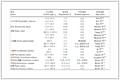
Table 1.
Crystallographic data and structural refinement of 1-4

Synthesis and crystal structures of Co(Ⅱ)/Cu(Ⅱ) coordination polymers based on solvent and ligand concentration regulation strategy
Yinxia SUN , Liping LIU , Xue BAI , Yu SUN , Wanhong SUN , Zhepeng DENG , Jianghai CHEN , Jianjun WANG , Li XU , Shuzhen ZHANG


Over the past few decades, transition metal-based coordination polymers (TM-CPs), as important inorganic-organic hybrid materials[1-5], have received extensive attention and in-depth study due to their promising applications in various fields such as adsorption[6-8], separation[9-12], catalysis[13-17], and sensing[18-23]. This research interest mainly stems from their unique chemical structure and tunable compositional properties[24-31], which determine their significant application potential across multiple fields. In the design of novel CPs, many factors are crucial to the material′s dimensionality and topology[32-34]. Yet, the framework structure of CPs mainly depends on the metal coordination preference and the type of ligand as the connector[35-40]. Against this research background, carboxylate-based ligands[41-45] have achieved remarkable success in constructing various CPs. This is mainly due to the ability of carboxylate groups to coordinate with diverse metal ions and their excellent compatibility with various coordination geometries[46-49].
When designing appealing CPs, Co(Ⅱ) ions with considerable magnetic anisotropy are a good choice to combine with organic ligands to form porous crystalline materials[50-53]. Cu(Ⅱ) exhibits a strong affinity for oxygen donors, and polycarboxylate ligands, including aromatic acids and heterocyclic acids, have been widely used in constructing CPs[54-56]. Among numerous organic ligands, those containing dicarboxylate and dimidazole groups have proven to be ideal candidates for building novel CPs due to their flexible and diverse coordination modes[57-59]. Among them, 1, 3, 5-triimidazole benzene (L) and 2, 5-furandicarboxylic acid (H2FDCA), as flexible multidentate ligands, exhibit many fascinating properties. Multidentate ligands can coordinate through oxygen donors in various modes, such as monodentate coordination, chelation, bidentate bridging, monodentate bridging, and chelating bridging.
We synthesized four CPs by changing the solvent system and ligand concentration through solvothermal method: [Co(L)(FDCA)(H2O)2]·0.5H2O (1), [Co(HL)2(H2O)2](FDCA)2·6H2O (2), [Cu(L)(FDCA)(H2O)]·2H2O (3) and [Cu(HL)2(H2O)2](FDCA)2·6H2O (4). Single- crystal X-ray analysis shows that ligand concentration and solvent systems together control the structure of these CPs. Scanning electron microscopy (SEM) was used to observe the morphological changes of the CPs, and their room-temperature solid-state photoluminescent properties were studied. Besides, Density functional theory (DFT) calculations were performed on the CP materials. The electrostatic potential analysis revealed that oxygen and nitrogen atoms carry most of the negative charge, which facilitates more effective coordination between L, H2FDCA, and metal ions.
All the reagents were purchased commercially and used directly without purification. Single-crystal X-ray diffraction analysis was performed on a four-circle diffractometer using a Super Nova-type X-ray single crystal diffractometer (microfocus sealed X-ray tube, Cu Kα, λ=0.154 184 nm) to obtain single-crystal data. Powder X-ray diffraction (PXRD) was performed using a BRUKER D8 ADVANCE diffractometer operated at 40 kV and 40 mA, using Cu Kα radiation (λ=0.154 06 nm), with a 2θ range of 5°-50° and a scan rate of 5 (°)·min-1. Thermogravimetric (TG) analysis was performed using a Netzsch synchronous thermal analyzer. The surface morphology of the samples was imaged at high resolution by a SEM 3200 scanning electron microscope, while the elemental composition of the samples was analyzed using energy dispersive spectroscopy (EDS). The chemical bonds and functional groups of the samples were characterized using a VERSEX 70 Fourier transform infrared spectrometer (FTIR). To investigate the optical properties of the samples, fluorescence spectra were measured using an F-7000 fluorescence spectrophotometer.
L (0.006 9 g, 0.025 mmol), H2FDCA (0.004 3 g, 0.027 mmol), and Co(CH3COO)2·4H2O (0.006 2 g, 0.025 mmol) were dissolved in 10 mL of methanol and water (4∶6, V/V), sonicated for 5 min, and then subsequently transferred to a 25 mL capacity polytetrafluoroethylene (PTFE)-lined automatic pressure vessel. The temperature was increased to 140 ℃ over 3 h and then cooled to room temperature for 3 d. It was washed three times with deionized water to obtain dark red transparent crystals, and then dried under vacuum at 60 ℃ for 24 h. The yield of CP 1 was 60.1%, calculated based on the metal salt Co(CH3COO)2·4H2O. Elemental analysis Calcd. for C21H19N6O7.5Co(%): C, 47.20; H, 3.58; N, 15.73. Found(%): C, 46.53; H, 3.46; N, 15.46.
L (0.002 8 g, 0.01 mmol), H2FDCA (0.004 3 g, 0.027 mmol), and Co(CH3COO)2·4H2O (0.006 2 g, 0.025 mmol) were dissolved in 10 mL of water, sonicated for 5 min, and then subsequently transferred to a 25 mL capacity polytetrafluoroethylene (PTFE)-lined automatic pressure vessel. The temperature was increased to 140 ℃ over 3 h and then cooled to room temperature for 3 d. It was washed three times with deionized water to obtain pink transparent crystals and dried under vacuum at 60 ℃ for 24 h. The yield of CP 2 was 29.9%, calculated based on the metal salt Co(CH3COO)2·4H2O. In summary, both CPs 1 and 2 were synthesized using Co(Ⅱ) as the metal center, demonstrating how changes in solvent composition and ligand concentration can lead to different coordination frameworks within the same metal system. Elemental analysis Calcd. for C21H23N6O9Co0.5(%): C, 47.33; H, 4.35; N, 15.77. Found(%): C, 46.49; H, 3.97; N, 16.25.
L (0.005 5 g, 0.02 mmol), H2FDCA (0.003 1 g, 0.02 mmol), and Cu(CH3COO)2·H2O (0.004 g, 0.02 mmol) were dissolved in 10 mL of methanol and water (1∶9, V/V), sonicated for 5 min, and then subsequently transferred to a 25 mL capacity polytetrafluoroethylene (PTFE)-lined automatic pressure vessel. The temperature was increased to 140 ℃ over 3 h and then cooled to room temperature for 3 d. It was washed three times with deionized water to obtain dark blue transparent crystals, and dried under vacuum at 60 ℃ for 24 h. The yield of CP 3 was 55.8%, calculated based on the metal salt Cu(CH3COO)2·H2O. Elemental analysis Calcd. for C21H20N6O8Cu(%): C, 46.03; H, 3.68; N, 15.34. Found(%): C, 45.15; H, 4.02; N, 14.98.
L (0.006 9 g, 0.025 mmol), H2FDCA (0.004 3 g, 0.027 mmol), and Cu(NO3)2·3H2O (0.006 g, 0.025 mmol) were dissolved in 10 mL of water, sonicated for 5 min, and subsequently transferred to a 25 mL capacity polytetrafluoroethylene (PTFE)-lined automatic pressure vessel. The temperature was increased to 140 ℃ over 3 h and then cooled to room temperature for 3 d. It was washed three times with deionized water to obtain light-blue transparent crystals and dried under vacuum at 60 ℃ for 24 h. The yield of CP 4 was 20.0%, calculated based on the metal salt Cu(NO3)2·3H2O. Elemental analysis Calcd. for C42H46N12O18Cu(%): C, 47.13; H, 4.33; N, 15.70. Found(%): C, 46.55; H, 4.85; N, 16.06. In summary, both CPs 3 and 4 were synthesized using Cu(Ⅱ) as the metal center, demonstrating the influence of solvent composition and ligand concentration on the formation of distinct coordination frameworks within the same metal system.
CPs 1-4, which had an appropriate crystallographic size and were transparent and free of cracks, were selected and placed on a single-crystal diffractometer equipped with a single-wavelength X-ray source (Cu Kα radiation, λ=0.154 184 nm) for data collection, and the crystal structures were analyzed and refined using SHELX-97. The crystal structures were solved using SHELXL-2018/3 installed in Olex2 and anisotropically refined using F2-based full-matrix least squares. Table 1 lists the key crystallographic data and the results of the structure refinement. Table S1 (Supporting information) shows the main bond length and bond angle information for the single-crystal structure in detail.
 下载:
导出CSV
下载:
导出CSV
| Parameter | 1 | 2 | 3 | 4 |
| Formula | C21H19N6O7.5Co | C21H23N6O9Co0.5 | C21H20N6O8Cu | C42H46N12O18Cu |
| Formula weight | 534.35 | 532.92 | 547.97 | 1 070.45 |
| Temperature / K | 293 | 293 | 292 | 292 |
| Crystal system | Orthorhombic | Triclinic | Triclinic | Triclinic |
| Space group | Pbca | P1 | P1 | P1 |
| a / nm | 1.559 03(3) | 0.795 26(7) | 0.848 56(4) | 0.794 04(4) |
| b / nm | 1.579 61(3) | 1.054 24(6) | 1.051 85(4) | 1.044 59(4) |
| c / nm | 1.778 85(3) | 1.425 13(13) | 1.952 0(7) | 1.437 54(8) |
| α / (°) | 90.327(6) | 88.978(4) | 87.454(4) | |
| β / (°) | 104.825(8) | 71.497(4) | 75.049(5) | |
| γ / (°) | 93.341(6) | 78.681(3) | 88.869(4) | |
| V / nm3 | 4.380 70(14) | 1.152 82(17) | 1.073 73(9) | 1.150 82(10) |
| Z | 8 | 2 | 2 | 1 |
| Dc / (g·cm-3) | 1.620 | 1.535 | 1.695 | 1.542 |
| μ / mm-1 | 6.687 | 3.709 | 2.019 | 1.462 |
| F(000) | 2192 | 553 | 562 | 553 |
| Crystal size / mm | 0.02×0.04×0.04 | 0.03×0.04×0.04 | 0.03×0.04×0.04 | 0.02×0.04×0.04 |
| θ range for data collection / (°) | 5.6-69.8 | 4.2-69.7 | 3.6-69.7 | 4.2-69.8 |
| Limiting indices |
-18 ≤ h ≤ 13, -19 ≤ k ≤ 13, -21 ≤ l ≤ 21 |
-6 ≤ h ≤ 9, -12 ≤ k ≤ 12, -17 ≤ l ≤ 16 |
-7 ≤ h ≤ 10, -8 ≤ k ≤ 12, -15 ≤ l ≤ 15 |
-9 ≤ h ≤ 9, -12 ≤ k ≤ 10, -14 ≤ l ≤ 17 |
| Reflection collected, unique | 9 558, 4 072 (Rint=0.043) |
7 455, 4 269 (Rint=0.023) |
6 785, 3 945 (Rint=0.015) |
7 504, 4 265 (Rint=0.015) |
| Completeness to θ / % | 98.6 | 97.9 | 97.4 | 98.1 |
| Data, Nr, Np* | 4 072, 3, 338 | 4 269, 0, 357 | 3 945, 0, 336 | 4 265, 0, 341 |
| GOF on F2 | 1.040 | 1.04 | 1.04 | 1.05 |
| R1 [I > 2σ(I)] | 0.067 9 | 0.036 4 | 0.031 1 | 0.034 7 |
| wR2 [I > 2σ(I)] | 0.189 4 | 0.094 6 | 0.083 6 | 0.096 0 |
| Largest diff. peak and hole / (e·nm-3) | -1 290 and 910 | -550 and 200 | -490 and 290 | -410 and 660 |
| *Nr: number of restraints, Np: number of parameters. | ||||
Single-crystal X-ray diffraction analysis showed that 1 presents a 2D layered neutral skeleton. Its crystal structure belongs to the orthorhombic crystal system and is characterized by the Pbca space group (Table 1). The asymmetric unit of 1 contains one Co(Ⅱ) center, a deprotonated FDCA2- ligand, a L ligand, two coordinated water molecules, and half of a lattice water molecule (Fig.1a). Table S1 shows that the bond distances of Co1—O6 [0.216 0(4) nm] and Co1—N1 [0.211 6(3) nm] are not equal, so the coordination geometry of the Co(Ⅱ) center in 1 is a slightly distorted octahedral geometry configuration (Fig.1b). The central metal Co(Ⅱ) ions were bridged by FDCA2- and L to form a 2D AB interspersed layer structure (Fig.1c).
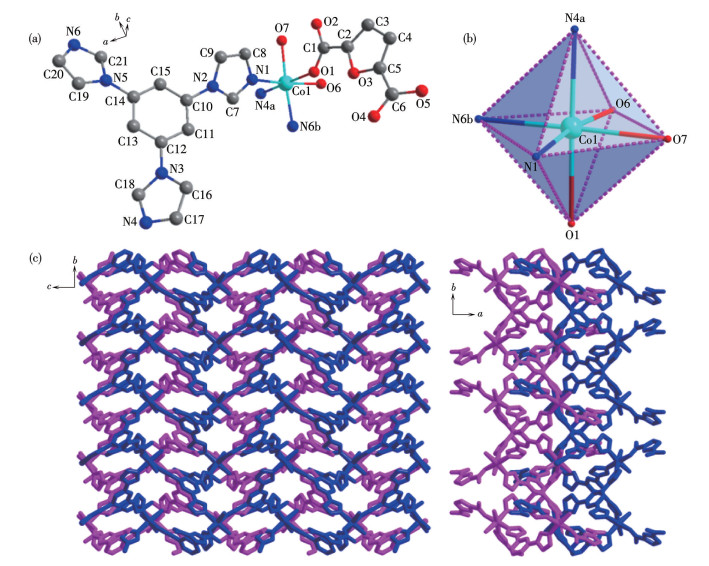
The hydrogen atoms are omitted for clarity; Symmetry codes: a: 1-x, 1-y, 1-z; b: x, -1+y, z; c: 1-x, 2-y, 1-z.
CP 2 presents a 1D chain cationic skeleton. Its crystal structure belongs to the triclinic crystal system and is characterized by the P1 space group (Table 1). The asymmetric unit of 2 contains one Co(Ⅱ) center, two protonated HL+ ligands, two coordinated water molecules, two deprotonated FDCA2- ions for balanced charge, and six lattice water molecules (Fig.2a). Table S1 shows that the bond distances of Co1—O6 [0.212 9(2) nm] and Co1—N1 [0.213 9(2) nm] are not equal, so the coordination geometry of the Co(Ⅱ) center in 2 is also a slightly distorted octahedral geometry configuration (Fig.2b). As shown in Fig.2c, N1 and N4 of the two L ligands connect each Co(Ⅱ) ion via the μ2-bridging mode, forming an infinitely extended 1D looped chain structure.
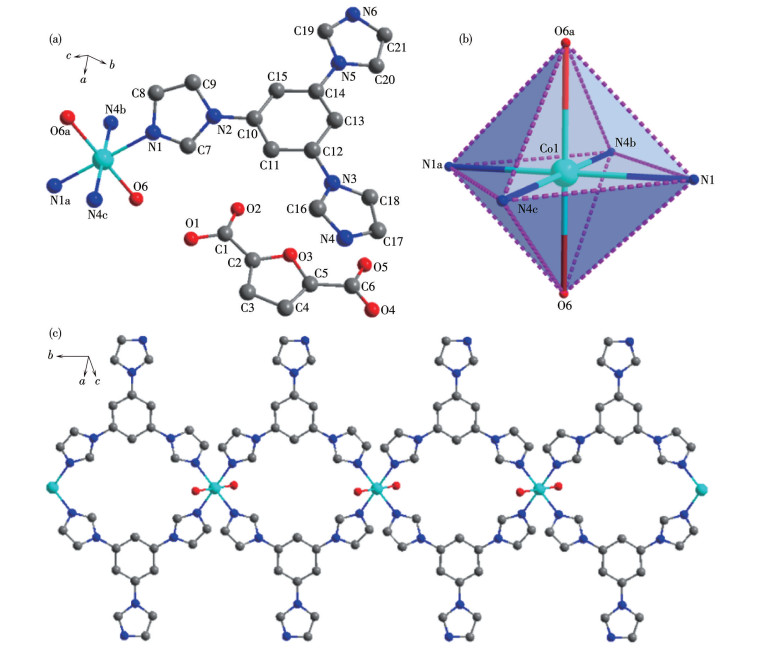
The Co1 ion in 2 is six-coordinated with four nitrogen atoms from the HL+ ligands and two oxygen atoms from the coordinated water molecules. And the Co1 ion in 1 is six-coordinated with two oxygen atoms in the FDCA2- anion, one oxygen atom in the coordinated water molecule, and three nitrogen atoms in the L ligands. In the presence of varying ligand concentrations and solvents, the difference in the CPs structures from 2D (1) to 1D (2) is attributed to the fact that the deprotonated FDCA2- is uninvolved in the coordination in 2. This also leads to a change in the CPs from a neutral backbone (1) to a cationic backbone (2).
3 shows a 1D neutral skeleton. It is a triclinic crystal system in the P1 space group (Table 1). The asymmetric unit of 3 contains one Cu(Ⅱ) center, one deprotonated FDCA2- ligand, one L ligand, one coordinated water molecule, and two lattice water molecules. Both carboxylates in the FDCA2- are bridge and chelate two Cu(Ⅱ) ions through three oxygen atoms, and it is worth noting that the furan oxygen atom is also involved in the coordination (Fig.3a). The Cu(Ⅱ) center was six-coordinated with three oxygen atoms from the FDCA2- anion, which includes two oxygen atoms from the carboxylate groups and one furan oxygen atom, as well as an oxygen atom from the coordinated water molecule (Fig.3b). Table S1 shows that the bond distances of Cu1a—O1a [0.197 96(2) nm] and Cu1a—O4 [0.198 67(2) nm], which are not equal, so the coordination geometry of the Cu(Ⅱ) center in 3 is a slightly distorted octahedral configuration (Fig.3b). As shown in Fig.3c, N1 and N6 of the two L ligands connected each Cu(Ⅱ) ion via the μ2-bridging mode, thus forming an infinitely extended 1D looped chain structure.
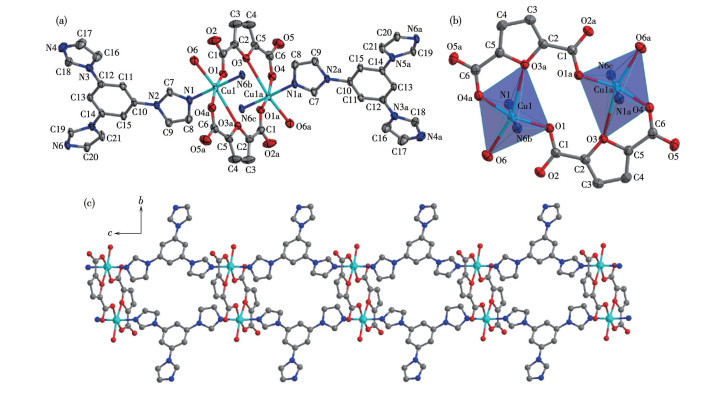
The hydrogen atoms are omitted for clarity; Symmetry codes: a: 2-x, -y, -z; b: 1-x, -y, 1-z; c: 1+x, y, -1+z.
CP 4 shows a 1D cationic skeleton. Its crystal structure belongs to the triclinic crystal system and is characterized by the P1 space group (Table 1). The asymmetric unit of 4 contains one Cu(Ⅱ) center, two protonated HL+ ligands, two coordinated water molecules, and two deprotonated FDCA2- ions for balanced charge, and six lattice water molecules (Fig.4a). The Cu(Ⅱ) center was six-coordinated with two nitrogen atoms each from two HL+ ligands, and two oxygen atoms from the coordinated water molecules. From Fig.4b, it can be seen that the coordination geometry of the Cu(Ⅱ) center in 4 is octahedral. As shown in Fig.4c, N1 and N4 of the two HL+ ligands connected each Cu(Ⅱ) ion via the μ2-bridging mode, thus forming an infinitely extended 1D looped chain structure.
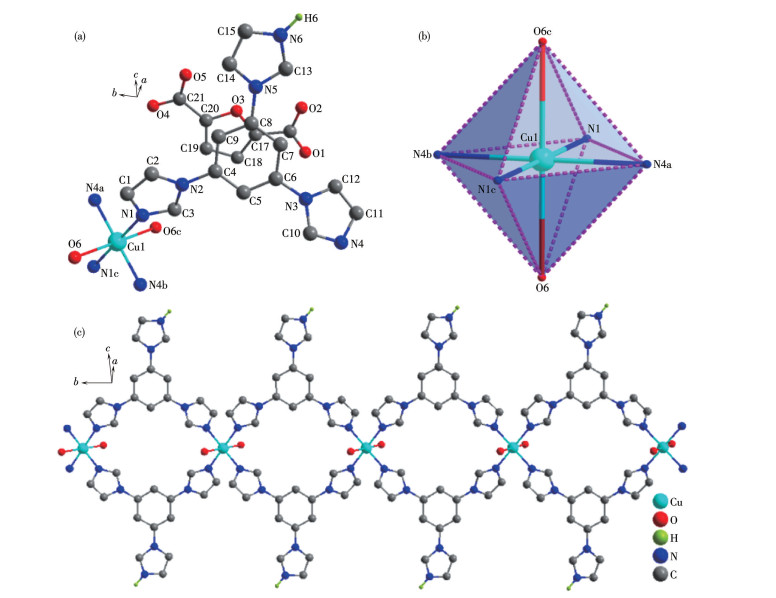
The hydrogen atoms are omitted for clarity; Symmetry codes: a: x, 1+y, z; b: 1-x, 1-y, -z; c: 1-x, 2-y, -z.
Although 3 and 4 are both 1D looped chains, 3 is a bimetallic [(L)2-Cu2]n neutral skeleton consisting of a deprotonated FDCA2- bridged and chelated by three oxygen atoms, whereas 4 is a monometallic [(HL)-Cu]n cationic backbone formed by the attachment of N atoms (HL+ ligand). In addition, the water molecules are involved in the coordination of 1-4, which shows that water molecules also have a strong coordination ability. Adjusting the solvent to water and increasing the concentration of H2FDCA, based on 1 and 3, the deprotonated FDCA2- ligands are uninvolved in the coordination in 2 and 4. This is a result of the presence of more water molecules occupying some of the sites when the pure solvent is water. Therefore, solvent molecules may have been involved in crystal growth as templating or structure-directing agents during the experiment, leading to the formation of specific crystal morphologies and structures. The presence of coordination sites for the water molecule allows for a change in the coordination mode, resulting in a different structure, which is consistent with our experimental results.
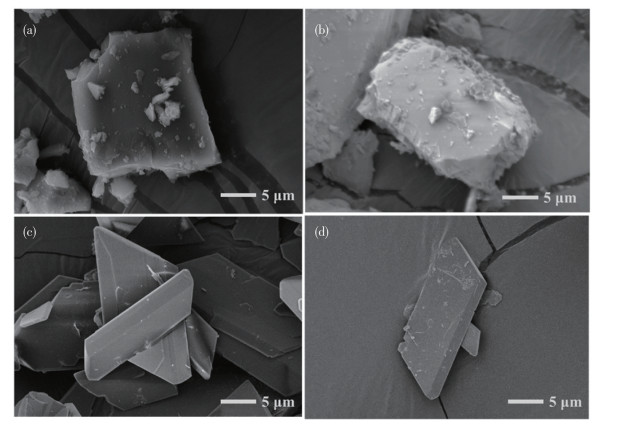
The morphology of 1-4 was observed by SEM. As shown in Fig.5a-5b, SEM shows that 1 and 2 had irregular rectangular morphology. As shown in Fig.5c-5d, SEM shows that 3 and 4 had regular parallel tetrahedral morphology. The EDS indicates that the elements contained in 1-4 were well distributed (Fig.S1-S4). The SEM comparisons revealed that by adjusting the solvent system and ligand concentration, the change in crystal structure does not produce a large change in the morphology.
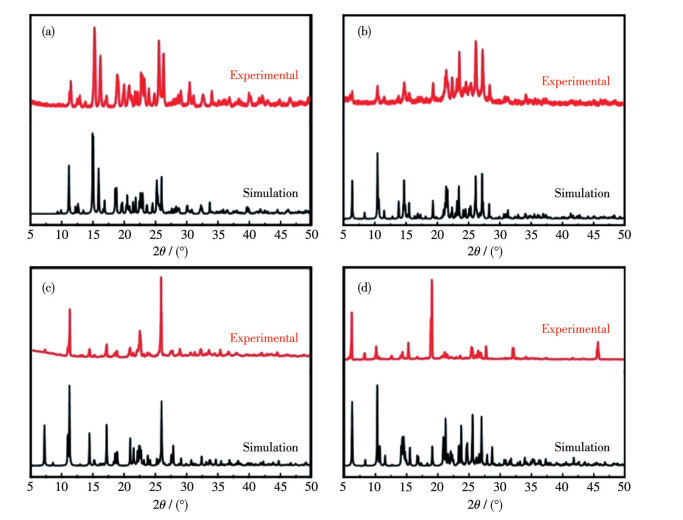
The experimental PXRD data for samples 1, 2, 3, and 4 were compared with the corresponding simulated data from single-crystal X-ray diffraction (Fig.6). The comparison revealed that the diffraction peaks of the experimental and simulated data were in good agreement, indicating that the respective crystal phases of the complexes are pure.
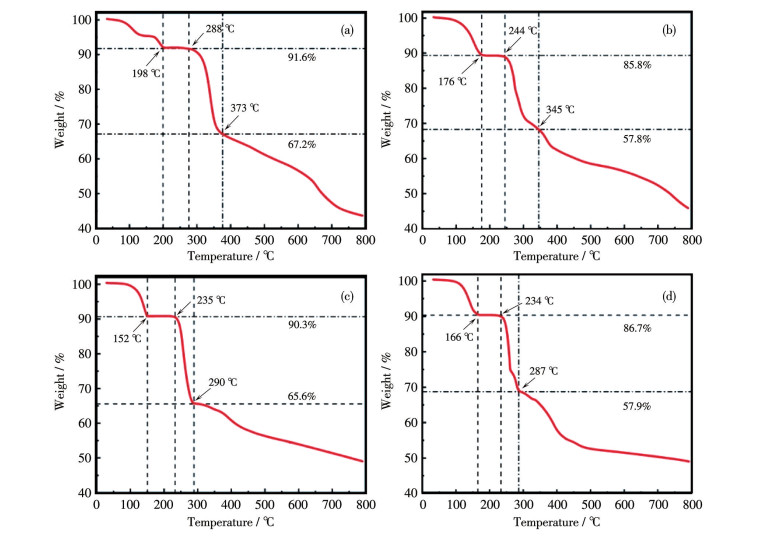
TG analysis was conducted on samples 1, 2, 3, and 4 in an N2 environment to assess their thermal stability (Fig.7). The first weightless stage of 1 was from room temperature to198.08 ℃, which is the loss of two coordination water and 0.5 lattice water molecules, and the loss in weight was 8.3% (Calcd. 8.4%). The second stage of weightlessness was from 288 to 373 ℃, attributed to the loss of FDCA2-, with a weight loss of about 24.4% (Calcd. 28.8%). Above 373 ℃, the decomposition attributed to the remaining ligand L led to the complete collapse of the skeleton. At 800 ℃, the residual weight was 48.1% (Fig.7a).
The first weightless stage of 2 was from room temperature to 176 ℃, which is the loss of two coordinated water molecules and six lattice water molecules, and a weight of 14.2% (Calcd. 13.5%). The second stage of weightlessness was from 244 to 345 ℃, attributed to the loss of FDCA2-, with a weight loss of about 28.0% (Calcd. 28.9%). Above 345 ℃, the decomposition attributed to the remaining ligand HL+ led to the complete collapse of the skeleton. At 800 ℃, the residual weight was 28% (Fig.7b).
The first weightless stage of 3 was from room temperature to 152 ℃, which is the loss of one coordination water and two lattice water molecules, and a weight of 9.7% (Calcd. 9.9%). The second stage of weightlessness was from 235 to 290 ℃, attributed to the loss of FDCA2-, with a weight loss of about 24.7% (Calcd. 28.1%). Above 290.38 ℃, the decomposition attributed to the remaining ligand L led to the complete collapse of the skeleton. At 800 ℃, the residual weight was 49.1% (Fig.7c).
The first weightless stage of 4 was from room temperature to 166 ℃, which is the loss of two coordination water molecules and six lattice water molecules, and the loss in weight was 13.3% (Calcd. 13.5%). The second stage of weightlessness was from 234 to 287 ℃, attributed to the loss of FDCA2-, with a weight loss of about 28.7% (Calcd. 28.8%). Above 287 ℃, the decomposition attributed to the remaining ligand HL+ led to the complete collapse of the skeleton. At 800 ℃, the residual weight was 31.7% (Fig.7d).
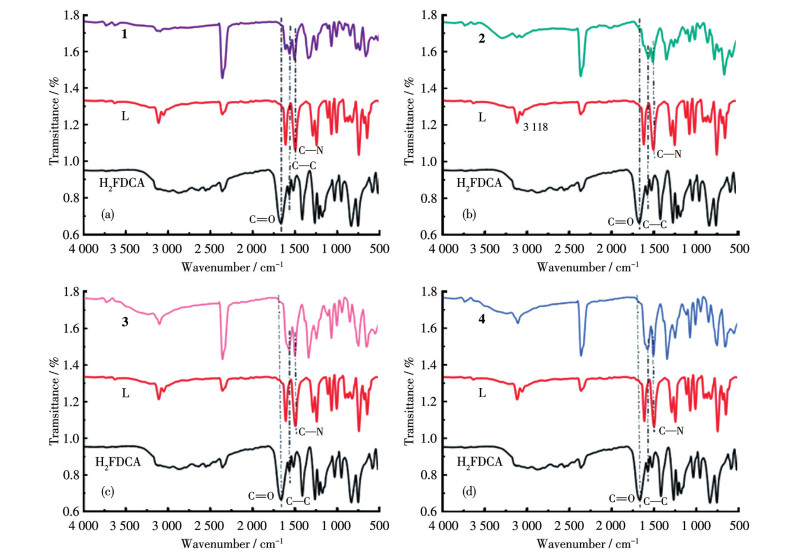
Comparison of the FTIR spectra of the ligands (H2FDCA and L) with CPs 1-4 provides insight into the coordination interactions between the ligand and metal ions. Infrared spectroscopic measurements showed that the major characteristic peaks of the ligand and 1-4 were successfully identified in the wave number range of 500-4 000 cm-1 (Fig.8).
For the H2FDCA ligand, the absorption peak located near 1 670 cm-1 is thought to be due to stretching vibrations occurring at the carbonyl (C=O) group in the carboxylic acid moiety[43-45]. The absorption peak observed at 1 565 cm-1 can be attributed to the C=C bond stretching vibration in the furan ring. In CPs 1 and 3, the metal ions form a coordination bond with the ligand H2FDCA in C=O (1 670 cm-1), resulting in a displacement in the infrared absorption peak of C=O. This displacement is due to the fact that coordination changes the electron density distribution of the C=O double bond, thus affecting its vibrational frequency. Chemical change of deprotonation of H2FDCA to form carboxylate ions (FDCA2-) was found in the single crystal structures of CPs 2 and 4. This change may alter the vibrational properties of the C=O bond, resulting in a displacement of the infrared absorption peak of C=O. The generation of absorption peaks near 1 614 and 1 070 cm-1 for ligand L is attributed to the C=C and C—H bonding vibrations in the benzene ring, respectively. For ligand L, the absorption peak located near 1 494 cm-1 is usually attributed to the stretching vibration of the C—N bond in the imidazole ring[57]. It is important to note that in 2 and 4, although the carboxylate groups do not participate in coordination, they form multiple hydrogen bonds. These hydrogen bonds have a significant impact on the vibrational characteristics of the C=O bonds. As a result, it is challenging to distinguish the C=O absorption peaks of coordinated and uncoordinated carboxylate groups in the infrared spectra. This is because the hydrogen bonding alters the vibrational frequency of the C=O bonds, thus masking the subtle differences that might be caused by coordination. This phenomenon demonstrates that hydrogen bonds play a crucial role in modulating the vibrational properties of carboxylate ions, which in turn affects the characteristic absorption peaks in the infrared spectra. However, in 1-4, the intensity of the absorption peak at 1 494 cm-1 was weakened compared to L, suggesting that the coordination of the metal ion to the ligand may have led to a change in this absorption peak. This change may be due to the coordination of the metal ions with the nitrogen atoms in the imidazole ring, which affects the electron density distribution of the C—N bond, thus altering its vibrational frequency and intensity. This spectral variation is an important basis for the study of metal-ligand interactions in CPs.
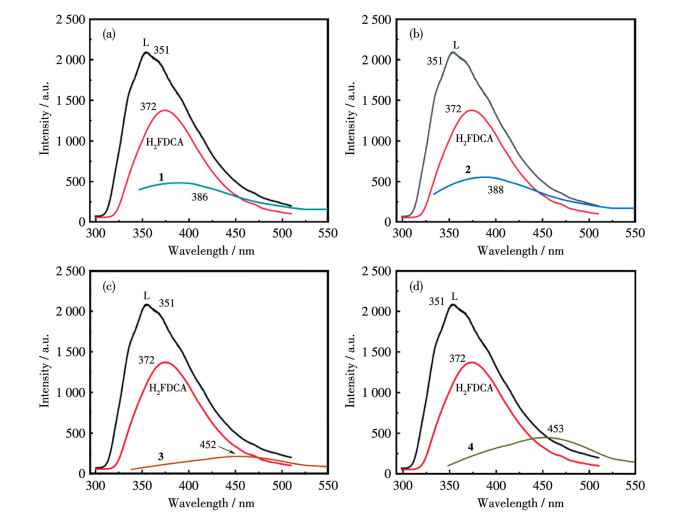
Solid-state fluorescence spectra at room temperature were determined for 1-4 and the ligands (Fig.9). The solid-state fluorescence spectra of H2FDCA and L were measured at an excitation wavelength of 278 nm. It can be found that the ligand H2FDCA showed an obvious emission peak at 372 nm, which may be due to the transition between the π-electrons on the furan ring and the lone pair of electrons on the carboxyl group of the ligand. The ligand L showed a distinct emission peak at 351 nm, which may be due to the π-π* jump within the ligand. The solid-state fluorescence spectra of CPs 1-4 were measured at an excitation wavelength of 255 nm. In the synthesis of CPs, metal ions are coordinated to organic ligands. During this process, excited electrons may be transferred from the organic ligand to the metal center, and this charge transfer leads to a decrease in the energy of the luminescent emission peak, resulting in a redshift phenomenon. Compared to the ligand, 1-4 showed a lower fluorescence intensity, a phenomenon likely due to ligand-to-metal charge transfer (LMCT). The photoluminescence spectra of 1-4 showed different absorption patterns compared to L and H2FDCA, reflecting the effect of interaction or complexation between CPs single crystals and ligands on optical properties[51, 57].
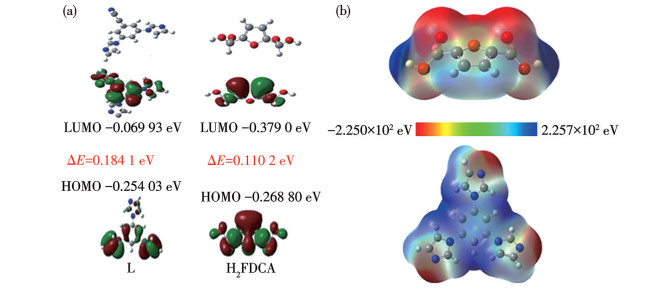
To investigate the mechanism of the CPs′ single-crystal formation from ligands and transition metals, DFT calculations were carried out. The B3LYP/6-31G(D) method basis set in the Gaussian 09 program was employed for the calculations. As depicted in Fig.10a, the electron clouds of the highest occupied molecular orbital (HOMO) and the lowest unoccupied molecular orbital (LUMO) are predominantly concentrated in the central region of the ligand. This area typically manifests as a denser region of the electron cloud, which facilitates more efficient coordination with metal ions. To explore the electronic properties of the ligands in CPs under different conditions, an electrostatic potential analysis of the ligands was performed. The results indicate that the ligand possesses a notable low/high potential region at (-0.025 50, 0.022 57), which may influence its coordination behavior with the metal center (Fig.10b). Further investigations revealed that the negative charge distribution is primarily focused on the O and N atoms of the ligand. This distribution favors the coordination of the ligand with the metal ion[60-62].
Four CPs were synthesized via solvothermal synthesis, and the effects of ligand concentration, solvent system, and metal ions on coordination modes were investigated. Results show that ligand concentration and solvent can cause changes in crystal structure. However, in the four studied CPs, metal ions maintained a consistent coordination mode with ligands, exhibiting an octahedral configuration. Thermogravimetric analysis indicated that all CPs demonstrated good thermal stability. Studies on the solid-state fluorescence photoluminescence properties of 1-4 revealed that the interaction between CPs and ligands affects optical properties. Theoretical calculations and electrostatic potential analyses showed that the L ligand has superior coordination ability. Ligands with higher energy possess optimal spatial and geometric structures, enabling metal ions to form more stable coordination environments with ligands.
Supporting information is available at
XIE J Z, WANG L, ANDERSON J S. Heavy chalcogenide-transition metal clusters as coordination polymer nodes[J]. Chem. Sci., 2020, 11(32): 8350-8372 doi: 10.1039/D0SC03429K
LIU G H, CHAI Z L, GAN L L, LI X X, MA C Y, DU M X, DONG W K. An efficient copper(Ⅱ) salamo-based complex fluorescence chemosensor for detecting sulfide ions: Structure exploration and practical application[J]. J. Mol. Struct., 2024, 1306: 137878
DU M X, LI X X, MA C Y, DONG W K, DING Y J. A unique N- heterocyclic oligo(N, O-donor) salamo-Ni(Ⅱ)-based probe for highly selective fluorescence detection of Cr2O72-[J]. Spectroc. Acta Pt. A‒Molec. Biomolec. Spectr., 2024, 310: 123909 doi: 10.1016/j.saa.2024.123909
LA Y T, YAN Y J, LI X, ZHANG Y, SUN Y X, DONG W K. Coordination-driven Salamo-Salen-Salamo-type multinuclear transition metal(Ⅱ) complexes: Synthesis, structure, luminescence, transformation of configuration, and nuclearity induced by the acetylacetone anion[J]. Inorg. Chem., 2023, 62: 9945-9963 doi: 10.1021/acs.inorgchem.3c01149
WU H L, MA Y Y, TENG J J, CAI Q L, GAO R R, XIE Y Y. Electrocatalytic applications in hydrogen evolution of two nitrogen heterocyclic Cu(Ⅰ) coordination polymer modified electrodes[J]. Appl. Organomet. Chem., 2025, 39(3): e7848 doi: 10.1002/aoc.7848
BARUAH J B. Coordination polymers in adsorptive remediation of environmental contaminants[J]. Coord. Chem. Rev., 2022, 470: 214694 doi: 10.1016/j.ccr.2022.214694
张星星, 牛云垠. 含苯并咪唑三足配体的金属配位化合物的合成及对碘的吸附性能[J]. 无机化学学报, 2024, 40(1): 111-123ZHANG X X, NIU Y Y. Synthesis of metal coordination compounds containing benzimidazole tripod ligand and their adsorption properties for iodine[J]. Chinese J. Inorg. Chem., 2024, 40(1): 111-123
SUN Y X, JI B T, CHEN J H, LIU L P, GAO L L, DENG Z P, SUN Y, WANG J J, ZHAO B, LI J G. A smartphone-integrated bimetallic ratiometric fluorescent probe for specific visual detection of tetracycline antibiotics in food samples and latent fingerprinting[J]. Food Chem., 2025, 464: 141782 doi: 10.1016/j.foodchem.2024.141782
LIPPI M, CAMETTI M. Highly dynamic 1D coordination polymers for adsorption and separation applications[J]. Coord. Chem. Rev., 2021, 430: 213661 doi: 10.1016/j.ccr.2020.213661
TONG L, YAN Y B, LI X, SUN Y X, ZHANG Y, DONG W K, KONG H Z. Synthesis, crystal structure, and magnetic properties of polynuclear salamo Ni(Ⅱ) complexes[J]. Cryst. Growth Des., 2024, 24(24): 10143-10151 doi: 10.1021/acs.cgd.4c00943
DUAN J, JIN W Q, KITAGAWA S. Water-resistant porous coordination polymers for gas separation[J]. Coord. Chem. Rev., 2017, 332: 48-74 doi: 10.1016/j.ccr.2016.11.004
SUN Y X, LIU L P, LUO A P, LI Q S, SUN Y, DENG Z P, SUN W H, GUO G. Anionically engineered Ce-MOF for ultra-selective capture and separation of cationic dyes: Mechanistic insights and environmental remediation potential using methylene blue as a paradigm[J]. Mater. Today Commun., 2025, 48: 113516 doi: 10.1016/j.mtcomm.2025.113516
乔科, 李彦霖, 黄胜利, 杨国昱. 手性铱(钌)配合物在不对称催化反应中的应用进展[J]. 无机化学学报, 2024, 40(11): 2091-2104QIAO K, LI Y L, HUANG S L, YANG G Y. Advancements in asymmetric catalysis employing chiral iridium (ruthenium) complexes[J]. Chinese J. Inorg. Chem., 2024, 40(11): 2091-2104
XIANG R F, ZHOU CH X, LIU Y CH, QIN T R, LI D Q C, DONG X Y, MUDDASSIR M, ZHONG A G. A new type Co(Ⅱ)-based photocatalyst for the nitrofurantoin antibiotic degradation[J]. J. Mol. Struct., 2024, 1312: 138501
LIU Y C, ZHOU C X, XIANG R F, XIONG D Q, LI D Q C, QIN T R, DONG X Y, MUDDASSIR M, PAN Y. A new Ag-based photocatalyst for efficient degradation of antibiotic nitrofurantoin[J]. Appl. Organomet. Chem., 2024, 38(7): e7517 doi: 10.1002/aoc.7517
XIANG R F, ZHOU C X, LIU Y C, QIN T R, LI D Q C, DONG X Y, MUDDASSIR M, ZHONG A G. A new type Co(Ⅱ)-based photocatalyst for the nitrofurantoin antibiotic degradation[J]. J. Mol. Struct., 2024, 1312: 138501
DONG X Y, LI Y Y, LI D Q C, LIAO D H, QIN T R, PRAKASH O, KUMAR A, LIU J Q. A new 3D 8-connected Cd(Ⅱ) MOF as a potent photocatalyst for oxytetracycline antibiotic degradation[J]. CrystEngComm, 2022, 24(39): 6933-6943 doi: 10.1039/D2CE01121B
CHENG H, SONG F Q, ZHAO N N, SONG X Q. A hydrostable Zn2+ coordination polymer for multifunctional detection of inorganic and organic contaminants in water[J]. Dalton Trans., 2021, 50(44): 16110-16121 doi: 10.1039/D1DT03022A
SUN Y X, JI B T, CHEN J H, GAO L L, SUN Y, DENG Z P, ZHAO B, LI J G. Ratiometric emission of Tb(Ⅲ)-functionalized Cd-based layered MOFs for portable visual detection of trace amounts of diquat in apples, potatoes and corn[J]. Food Chem., 2024, 449: 139259 doi: 10.1016/j.foodchem.2024.139259
DENG Z P, JI B T, CHEN J H, ZHAO B, LI J G, SUN Y X, SUN Y. A multifunctional fluorescence probe based on a new Cd-MOF for HSO4-, acidic amino acids, and continuous basic amino acids detection[J]. J. Mol. Struct., 2024, 1299: 137132
LA Y T, YAN Y J, LI X, ZHANG Y, SUN Y X, DONG W K. A novel Salamo-Salen-Salamo hybrid Mg(Ⅱ) complex fluorescent chemosensor for highly effective monitoring H2PO4- in zebrafish and plants[J]. J. Mol. Struct., 2024, 1295: 136641
SUN Y X, HAN W Y, DENG Z P, SUN Y G, JIA Y H, SUN Y, ZHANG S Z. Zn-based metal-organic-framework as a multifunctional fluorescent sensor for HSO4-, acidic and basic amino acids[J]. Inorg. Chim. Acta, 2023, 556: 121643 doi: 10.1016/j.ica.2023.121643
SONG X Q, MENG H H, LIN Z G, WANG L. 2D lanthanide coordination polymers: Synthesis, structure, luminescent properties, and ratiometric sensing application in the hydrostable PMMA-doped hybrid films[J]. ACS Appl. Polym. Mater., 2020, 2(4): 1644-1655 doi: 10.1021/acsapm.0c00052
LI D Q C, QIN T R, SHI ZH, LI Y Y, DONG X Y, MUDDASSIR M, KUSHWAHA A, SRIVASTAVA D, KUMAR A. Synthesis, structure, and small molecule in situ modification effects on proton conduction properties of triazine-based triscarboxylic acid complexes[J]. Appl. Organomet. Chem., 2024, 8(7): e7498
LI D Q C, LIU Y CH, XIANG R F, LI Y Y, QIN T R, DONG X Y, SAKIYAMA H, MUDDASSIR M, LIU J Q. Synthesis, structure, and investigation of unique magnetic properties in two novel Mn-based coordination polymers[J]. CrystEngComm, 2023, 25(48): 6777-6785 doi: 10.1039/D3CE01060K
ZHANG X Y, ZHANG W J, XIANG R F, LAN L, DONG X Y, SAKIYAMA H, MUDDASSIR M. Auxiliary linkers-induced assembly of two 2D Co(Ⅱ)-based coordination polymers with different interpenetrating fashion: Structure and magnetism[J]. Polyhedron, 2023, 244: 116625 doi: 10.1016/j.poly.2023.116625
QIN T R, SHI ZH, ZHANG W J, DONG X Y, AN N, SAKIYAMA H, MUDDASSIR M, SRIVASTAVA D, KUMAR A. 2D isostructural Ln(Ⅲ)-based coordination polymer derived from imidazole carboxylic acid: Synthesis, structure and magnetic behavior[J]. J. Mol. Struct., 2023, 1282: 135220
LI Y Y, LI D Q C, QIN T R, SHI Z, FU P K, XIONG D Q, DONG X Y. A comparative study of proton conduction between two new Cd(Ⅱ) and Co(Ⅱ) complexes and in vitro antibacterial study of the Cd(Ⅱ) complex[J]. Appl. Organomet. Chem., 2023, 37(1): e6920 doi: 10.1002/aoc.6920
XI W, WANG C Y, MENG H H, SONG X Q. Syntheses, structure, DNA-binding and DFT studies of a Cu(Ⅱ) complex based on a pyrazolone derivative[J]. J. Coord. Chem., 2019, 72(18): 3128-3143 doi: 10.1080/00958972.2019.1680835
ZHANG Y, CHEN R, SHI H N, YAN Y B, DONG W K. Exploration of the differences in coordination behaviors and spectrographic properties of two novel seven-nucleated Ni(Ⅱ) complexes of a salamo-type flexible-bisoxime ligand[J]. Appl. Organomet. Chem., 2025, 39(3): e7890 doi: 10.1002/aoc.7890
ZHANG Y, SU Y X, CAI Z, TONG L, DONG W K. Structural, fluorescent and theoretical studies of a more flexible salamo-type ligand and its uncommon tetranuclear chloride-bridged nickel(Ⅱ) complex[J]. J. Mol. Struct., 2024, 1309: 138164
SONG F Q, CHENG H, ZHAO N N, SONG X Q, WANG N. Anion-dependent structure and luminescence diversity in ZnⅡ-LnⅢ heterometallic architectures supported by a salicylamide-imine ligand[J]. Inorg. Chem., 2021, 60(22): 17051-17062 doi: 10.1021/acs.inorgchem.1c02228
WANG X R, SONG X Q. White light emitting EuⅢ and TbⅢ doped lanthanide coordination polymers based on in situ formed nitrilotriacetic anion[J]. J. Inorg. Organomet. Polym. Mater., 2017, 27: 850-860 doi: 10.1007/s10904-017-0526-8
LI S Z, LI W D, YAN Y B, ZHANG Y, DONG W K. Investigations of stable penta-and hexa-coordinate polynuclear Zn(Ⅱ) and Cd(Ⅱ) complexes derived from a single-armed salamo-based ligand[J]. J. Coord. Chem., 2023, 76(1): 28-44 doi: 10.1080/00958972.2022.2159396
GUO S Z, FENG T, FENG S S, ZHANG Y, DONG W K, DING Y J. An insight into molecular structures, fluorescent, and catalytic oxidase properties of novel heteromultinuclear [Cu4ⅡSm2Ⅲ] and [Cu2ⅡTbⅢ] bis(salamo)-based complexes[J]. Appl. Organomet. Chem., 2021, 35(7): e6241 doi: 10.1002/aoc.6241
YAN Y B, YANG R W, ZHANG H W, ZHANG Y, DONG W K. Crystal structure and luminescent mechanochromism of a quinoline-appended acylhydrazone ligand and its Zn(Ⅱ) complex[J]. J. Mol. Struct., 2024, 1299: 137148
LI X, LI W D, DING Y F, TONG L, ZHANG Y, DONG W K. The first double-armed salamo-like trinuclear Ni(Ⅱ) complex: Synthesis, structure, spectroscopic and theoretical studies, and fluorescence properties[J]. J. Mol. Struct., 2024, 1295: 136649
ZHANG Y, HUANG Y, DING Y F, ZHENG Y R, DONG W K. Synthesis, crystal structure, properties, and theoretical studies of novel tetra-nuclear copper(Ⅱ) salamo-like complex containing four-and five-coordinated geometries[J]. J. Mol. Struct., 2023, 1291: 136051
HAN X J, LI R Y, YUE Y N, ZHANG Y, DONG W K. Studying anion-dependent paradoxically fluorescent Cu(Ⅱ) complexes bearing a pyridine-decorated tetradentate half-salamo-like ligand[J]. Inorg. Chim. Acta, 2022, 529: 120634 doi: 10.1016/j.ica.2021.120634
CUI Y F, LIU C, ZHANG Y, ZHANG Y. Newly designed and synthesized heterobimetallic [CuⅡ-DyⅢ] salamo-like complex: Structural characterization, DFT calculation, and fluorescent property[J]. Inorg. Nano‒Met. Chem., 2020, 51(2): 288-295
LIU Q F, LIU W. A new luminescent Pb(Ⅱ) coordination polymer based on designed pyridinecarboxylate ligand[J]. Inorg. Nano‒Met. Chem., 2017, 47(5): 768-771
JIANG D N, HUANG C, ZHU J, WANG P, LIU Z M, FANG D. Classification and role of modulators on crystal engineering of metal organic frameworks (MOFs)[J]. Coord. Chem. Rev., 2021, 444: 214064 doi: 10.1016/j.ccr.2021.214064
SUN Y X, LIU L P, BAI X, GAO L L, HU W Q, HAN W Y, SUN Y, DENG Z P, SUN W H, WANG J J, XU L. Layered Mn-MOF modified with carbon quantum dots for efficient detection of trace hydrogen peroxide in beverages[J]. Electrochim. Acta, 2025, 532: 146469 doi: 10.1016/j.electacta.2025.146469
SUN Y X, BAI X, LUO A P, SUN Y, DENG Z P, SUN W H, HAN W Y. Ratiometric fluorescent sensor CQDx@Co/Mn-MOF for rapid and sensitive detection of quinolone antibiotics[J]. Talanta, 2025, 293: 128034 doi: 10.1016/j.talanta.2025.128034
QIN T R, ZHANG X Y, LI D Q C, DONG X Y, QIN N, SHANG Y J, SAKIYAMAD H, AFZAL M, ALARIFI A. Temperature modulation on functional coordination polymers with tetracarboxylate linker: Syntheses, structural traits, and magnetism[J]. J. Mol. Struct, 2023, 1291: 136074
QIN T R, LI D Q C, SHI Z, XIONG D Q, DONG X Y, AN N, CHU Y H. Proton conductance and mechanism of the synthesized two Co(Ⅱ)-CPs/Nafion composite membranes based on N-heterocyclic carboxylic acid-based ligand[J]. J. Solid State Chem., 2022, 648(9): e202000418
FU P K, LI Y Y, QIN T R, LI D Q C, SHI Z, XIONG D Q, YANG Q L, ZHU Y Y, DONG X Y. Three new one-, two-, and three-dimensional complexes based on semi-rigid tricarboxylate ligand: Syntheses, structures and properties[J]. Inorg. Chim. Acta, 2022, 533: 120774 doi: 10.1016/j.ica.2021.120774
ZHANG X Y, QIN T R, XIANG R F, DONG X Y, SAKIYAMA H, MUDDASSIR M, PAN Y. Impact of N-donor auxiliary ligands on three new CoⅡ-based coordination polymers with symmetrical tetracarboxylate ligands: A magnetism study[J]. New J. Chem., 2023, 47(44): 20426-20434 doi: 10.1039/D3NJ03772J
ZHANG X Y, QIN T R, LIU Y C, AN N, AFZAL M, ALARIFI A, MUDDASSIR M, SAKIYAMA H, MOHANTY A, DONG X Y. Structures and magnetic studies of four new Ni(Ⅱ) coordination polymers built using symmetrical tetracarboxylate and N-donor linkers[J]. New J. Chem., 2023, 47(46): 21214-21224 doi: 10.1039/D3NJ03643J
DONG X Y, ZHANG X Y, LI Y Y, XIONG D Q, FU P K, AFZAL M, ALARIFI A, SAKIYAMA H. Impact of N-donor auxiliary ligands on two new Co(Ⅱ)-based MOFs with N-heterocyclic ligands and a magnetism study[J]. New J. Chem., 2022, 46(24): 11623-11631 doi: 10.1039/D2NJ01675C
MAN L L, DING Y F, LI X, TONG L, DONG W K. Exploring the structural diversities of three Co(Ⅱ) complexes constructed from a new quinoline-containing N3O-cavity half-salamo type ligand and various counteranions[J]. Polyhedron, 2023, 245: 116654 doi: 10.1016/j.poly.2023.116654
DONG X Y, SHI Z, LI D Q C, LI Y Y, AN N, SHANG Y J, SAKIYAMA H, MUDDASSIR M, SI C D. The regulation research of topology and magnetic exchange models of CPs through Co(Ⅱ) concentration adjustment[J]. J. Solid State Chem., 2023, 318: 123713 doi: 10.1016/j.jssc.2022.123713
SUN Y X, CHEN J H, LUO A P, SUN Y, DENG Z P, SUN W H, XU L. A novel Co-MOF@ZIF-8 nano-heterojunction for efficient photocatalytic nitrogen fixation[J]. Environ. Chem. Eng., 2025, 13: 118191 doi: 10.1016/j.jece.2025.118191
WU H L, MA Y Y, TENG J J, CAI Q L, GAO R R, XIE Y Y. Electrocatalytic applications in hydrogen evolution of two nitrogen heterocyclic Cu(Ⅰ) coordination polymer modified electrodes[J]. Appl. Organomet. Chem., 2025, 39(3): e7848 doi: 10.1002/aoc.7848
SUN Y X, PAN Y Q, XU X, ZHANG Y. Unprecedented dinuclear CuⅡ N, O-donor complex: Synthesis, structural characterization, fluorescence property, and Hirshfeld analysis[J]. Crystals, 2019, 9: 607 doi: 10.3390/cryst9120607
张淑珍, 常健, 张宏佳, 武娅, 孙银霞, 王彦斌. 基于香豆素Schiff碱双核Ni(Ⅱ)和立方烷型Cu4(μ3-O)4的四核Cu(Ⅱ)配合物的合成、晶体结构及光谱性质[J]. 无机化学学报, 2020, 36(3): 503-514ZHANG S Z, CHANG J, ZHANG H J, WU Y, SUN Y X, WANG Y B. Synthesis, crystal structure and spectral properties of binuclear Ni(Ⅱ) and cubane-like Cu4(μ3-O)4 cored tetranuclear Cu(Ⅱ) complexes based on coumarin Schiff base[J]. Chinese J. Inorg. Chem., 2020, 36(3): 503-514
YAN Y, HENFLING S, ZHANG N N, KRAUTSCHEID H. Semiconductive coordination polymers with continuous π-π interactions and defined crystal structures[J]. Chem. Commun., 2021, 57(80): 10407-10410 doi: 10.1039/D1CC03333F
ZHANG X Y, FU P K, XIONG D Q, LI Y Y, DONG X Y. Synthesis, crystal structures, and magnetic properties of three nickel(Ⅱ) coordination polymers based on a rigid pyrazine carboxylic acid containing different N ligands[J]. J. Mol. Struct., 2022, 1261: 132889
DENG Z P, GAO L L, CHEN J H, HU W Q, JIA Y H, SUN Y G, SUN Y X, SUN Y. Synthesis, crystal structure, theoretical calculation and luminescence properties of Cu(Ⅱ), Co(Ⅱ), Ni(Ⅱ) and Zn(Ⅱ) quinolinyl benzimidazole complexes with multiple coordination number induced by proton[J]. Inorg. Chim. Acta, 2024, 572: 122315 doi: 10.1016/j.ica.2024.122315
MEHMOOD A, JONES S I, TAO P, JANESKO B G. An orbital-overlap complement to ligand and binding site electrostatic potential maps[J]. J. Chem. Inf. Model., 2018, 58(9): 1836-1846 doi: 10.1021/acs.jcim.8b00370
JI B T, LIU L P, CHEN J H, GAO L L, SUN Y, WANG J J, DENG Z P, SUN Y X. Ratiometric fluorescence sensor based on dye-encapsulated Zn-MOF for highly sensitive detection of diquat in tap water and apple samples[J]. Microchem. J., 2024, 207: 111663 doi: 10.1016/j.microc.2024.111663
张花红, 赵洋, 宁锐, 吴水星, 张小朋. 环金属铂配合物[Pt(κ3-N^C^N′)(CNXyl)]Cl与[Pt(κ2-N^C^N′)(CNXyl)Cl]的配位平衡[J]. 无机化学学报, 2025, 41(9): 1840-1850ZHANG H H, ZHAO Y, NING R, WU S X, ZHANG X P. Coordination equilibrium between cyclometalated Pt(Ⅱ) complexes [Pt(κ3-N^C^N′)(CNXyl)]Cl and [Pt(κ2-N^C^N′)(CNXyl)Cl][J]. Chinese J. Inorg. Chem., 2025, 41(9): 1840-1850

Figure 1 (a) Coordination environment of Co(Ⅱ) in 1; (b) Geometric configuration of Co(Ⅱ); (c) 2D interspersed structure
The hydrogen atoms are omitted for clarity; Symmetry codes: a: 1-x, 1-y, 1-z; b: x, -1+y, z; c: 1-x, 2-y, 1-z.

Figure 2 (a) Coordination environment of Co(Ⅱ) in 2; (b) Geometric configuration of Co(Ⅱ); (c) 1D chain structure

Figure 3 (a) Coordination environment of Cu(Ⅱ) in 3 (30% probability level of ellipsoids); (b) Geometric configuration of Cu(Ⅱ) (30% probability level of ellipsoids); (c) 1D chain structure
The hydrogen atoms are omitted for clarity; Symmetry codes: a: 2-x, -y, -z; b: 1-x, -y, 1-z; c: 1+x, y, -1+z.

Figure 4 (a) Coordination environment of Cu(Ⅱ) in 4; (b) Geometric configuration of Cu(Ⅱ); (c) 1D chain structure
The hydrogen atoms are omitted for clarity; Symmetry codes: a: x, 1+y, z; b: 1-x, 1-y, -z; c: 1-x, 2-y, -z.

Figure 10 (a) HOMO and LUMO energy levels of L and H2FDCA; (b) Electrostatic potentials of L and H2FDCA
Table 1. Crystallographic data and structural refinement of 1-4
| Parameter | 1 | 2 | 3 | 4 |
| Formula | C21H19N6O7.5Co | C21H23N6O9Co0.5 | C21H20N6O8Cu | C42H46N12O18Cu |
| Formula weight | 534.35 | 532.92 | 547.97 | 1 070.45 |
| Temperature / K | 293 | 293 | 292 | 292 |
| Crystal system | Orthorhombic | Triclinic | Triclinic | Triclinic |
| Space group | Pbca | P1 | P1 | P1 |
| a / nm | 1.559 03(3) | 0.795 26(7) | 0.848 56(4) | 0.794 04(4) |
| b / nm | 1.579 61(3) | 1.054 24(6) | 1.051 85(4) | 1.044 59(4) |
| c / nm | 1.778 85(3) | 1.425 13(13) | 1.952 0(7) | 1.437 54(8) |
| α / (°) | 90.327(6) | 88.978(4) | 87.454(4) | |
| β / (°) | 104.825(8) | 71.497(4) | 75.049(5) | |
| γ / (°) | 93.341(6) | 78.681(3) | 88.869(4) | |
| V / nm3 | 4.380 70(14) | 1.152 82(17) | 1.073 73(9) | 1.150 82(10) |
| Z | 8 | 2 | 2 | 1 |
| Dc / (g·cm-3) | 1.620 | 1.535 | 1.695 | 1.542 |
| μ / mm-1 | 6.687 | 3.709 | 2.019 | 1.462 |
| F(000) | 2192 | 553 | 562 | 553 |
| Crystal size / mm | 0.02×0.04×0.04 | 0.03×0.04×0.04 | 0.03×0.04×0.04 | 0.02×0.04×0.04 |
| θ range for data collection / (°) | 5.6-69.8 | 4.2-69.7 | 3.6-69.7 | 4.2-69.8 |
| Limiting indices |
-18 ≤ h ≤ 13, -19 ≤ k ≤ 13, -21 ≤ l ≤ 21 |
-6 ≤ h ≤ 9, -12 ≤ k ≤ 12, -17 ≤ l ≤ 16 |
-7 ≤ h ≤ 10, -8 ≤ k ≤ 12, -15 ≤ l ≤ 15 |
-9 ≤ h ≤ 9, -12 ≤ k ≤ 10, -14 ≤ l ≤ 17 |
| Reflection collected, unique | 9 558, 4 072 (Rint=0.043) |
7 455, 4 269 (Rint=0.023) |
6 785, 3 945 (Rint=0.015) |
7 504, 4 265 (Rint=0.015) |
| Completeness to θ / % | 98.6 | 97.9 | 97.4 | 98.1 |
| Data, Nr, Np* | 4 072, 3, 338 | 4 269, 0, 357 | 3 945, 0, 336 | 4 265, 0, 341 |
| GOF on F2 | 1.040 | 1.04 | 1.04 | 1.05 |
| R1 [I > 2σ(I)] | 0.067 9 | 0.036 4 | 0.031 1 | 0.034 7 |
| wR2 [I > 2σ(I)] | 0.189 4 | 0.094 6 | 0.083 6 | 0.096 0 |
| Largest diff. peak and hole / (e·nm-3) | -1 290 and 910 | -550 and 200 | -490 and 290 | -410 and 660 |
| *Nr: number of restraints, Np: number of parameters. | ||||
 下载: 导出CSV

 扫一扫看文章


扫一扫关注我们