
Figure 1.
(a) Sketch maps and (b) the optimized ground state (S0) geometrical structures of the complexes

Theoretical study on the thermally activated delayed fluorescence, and efficiency roll-off characteristics of a series of blue and blue-green Ir(Ⅲ) complexes
Zhengkun QIN , Lixin BAO , Yunkai ZHANG , Lin CUI , Jinyu WANG , Yuhao WANG , Mingxing SONG


For more than a decade, Ir(Ⅲ) complexes have gained significant attention in organic light-emitting diodes (OLEDs) due to their excellent features, such as high quantum efficiency, excellent thermal and chemical stability, and a wide scope of emissive colors, demonstrating potential applications in flat-panel displays and solid-state lighting sources[1-2]. Up to now, the comprehensive performance of Ir(Ⅲ)-complex-based green/red-light phosphors has approached commercial standards, exemplified by compounds such as Ir(ppy)3 and Ir(dfppy)2(acac) (green: ppy=2-phenylpyridine, dfppy=4, 6-difluorophenylpyridine, acac=acetylacetonate) and Ir(piq)3 (red: piq=1-phenylisoquinolato)[3-17]. However, the use of Ir(Ⅲ)-complex-based blue-light phosphors in commercial applications has rarely been reported[18-21]. This is primarily because, on the one hand, the wide energy gap leads to insufficient emission efficiency for blue-light phosphors. On the other hand, the efficiency roll-off effect prevents their effective use in solid-state lighting sources and even flat-panel displays[22-23].
Generally, improving the luminescence efficiency of blue-light phosphors through ligand adjustment is challenging, as it is an inherent property of the wide energy gap. Conversely, introducing electron-withdrawing or electron-donating groups into the ligand can adjust the charge transfer mode, thereby reducing the phosphorescence lifetime. This lifetime is a key factor in determining whether the material exhibits the efficiency roll-off effect[24]. In 2011, Zhu et al. proposed a strategy to reduce the phosphorescence lifetime of a blue Ir(Ⅲ) complex (Ir(dfppy)2(tpip): dfppy=4, 6-difluorophenylpyridine, tpip=tetraphenylimidodiphosphinate), thereby mitigating its efficiency roll-off effect[24]. The literature reports excellent performance for this complex, characterized by an emission maximum at 485 nm, CIE color coordinates of (0.15, 0.36), and a triplet state (T1) lifetime of 0.77 μs. However, the analysis of the complex′s photophysical properties is limited.
For Ir(dfppy)2(tpip), what attracts us is not only its aforementioned excellent performance but also its broad emission spectrum band (430-600 nm), which necessarily corresponds to richer charge transfer modes. Interestingly, research on the thermal activation delayed fluorescence (TADF) properties of transition metal complexes has been extremely limited since Kawai et al. first proposed this phenomenon for such complexes in 2006[25-36].
In this article, using the classic blue Ir(Ⅲ) complexes FIrpic (pic=picolinic acid) and Ir(dfppy)2(tpip) as parent compounds, we extracted their auxiliary ligands and introduced a benzene ring into the main ligand phenylpyridine to provide rich frontier molecular orbitals (FMOs). We designed six blue Ir complexes: (Phppy)2Ir(pic) (1), (F3Phppy)2Ir(pic) (2), (Phppy)2Ir(tmd) (3), (F3Phppy)2Ir(tmd) (4), (Phppy)2Ir(tpip) (5), and (F3Phppy)2 Ir(tpip) (6), where Phppy=2-(biphenyl-4-yl)pyridine, tmd=2,2,6,6-tetramethyl-3,5-heptanedione). We investigated the electronic structures, fragment-composed FMOs, absorption spectra, and emission spectra (fluorescence and phosphorescence) properties of Ir(Ⅲ) complexes 1-6 using density functional theory (DFT) and time-dependent density functional theory (TDDFT) methods. To investigate the TADF property of the designed complexes, the spin-orbit coupling (SOC) matrix elements were also calculated. We anticipate that the materials we designed can be synthesized in the future.
As is well known, FIrpic is a classic blue electroluminescent material, holding a leading position among blue emitters in key performance metrics. These include an emission maximum at approximately 472 nm, a high maximum current efficiency of 53.6 cd·A-1, and a high maximum external quantum efficiency (EQE) of 30.0% at 100 cd·m-2 [22]. These data demonstrate the rationality of the structural design of FIrpic. However, its severe efficiency roll-off effect prevents it from reaching commercial standards. Zhu et al. replaced the pic ligand in FIrpic with tpip and experimentally synthesized Ir(dfppy)2(tpip)[24]. This modification concentrated the FMOs towards the main ligand and the metal center, shortened the charge transfer distance, and mitigated the efficiency roll-off effect of the emitter, which increases the triplet intra-ligand charge transfer (3ILCT) component while decreasing the triplet ligand-to-ligand charge transfer (3LLCT) component. However, it also caused a redshift of the emission spectrum (to 485 nm)[24]. This systematic design explores the distinct roles of main ligands (Phppy vs F3Phppy) and ancillary ligands (pic, tmd, and tpip). Qualitatively: (1) extending conjugation in the main ligand (Phppy) increases FMO contributions and induces a blue shift in absorption; (2) introducing strong electron-withdrawing fluorine groups (F3Phppy) effectively compresses the energy gap between the singlet excited state (S1) and T1 (
In previous work, we carefully studied the effect of tpip ligands on the FMOs in Ir(Ⅲ) complexes. We found that although tpip ligands increased the 3ILCT contribution, the 3LLCT component persisted. This persistence is the main reason for the observed emission spectrum redshift[37-40]. We speculate two primary reasons for this phenomenon: firstly, the structure of the main ligands might be too small to provide sufficient FMOs; secondly, the electron-withdrawing group tpip might be insufficient to fully concentrate the FMOs on the main ligands and the metal center. To verify the correctness of this hypothesis, we introduced the main ligand Phppy (providing more active orbitals for the FMOs) to address the first point, and the main ligand F3Phppy (containing the electron-withdrawing fluorine group) to address the second point in this study (Fig.1).
To ensure the reliability of the calculation results, we employed the established computational methodology previously used for FIrpic[41-43]. The S0 and T1 geometries were optimized using the DFT and TDDFT methods, respectively, with the Becke three-parameter Lee-Yang-Parr (B3LYP) exchange-correlation functional[44-46]. No symmetry constraints were applied to these complexes.
Sketch maps depicting the optimized S0 geometrical structures of the complexes are shown in Fig.1. Key geometric parameters for the S0 and T1 are summarized in Table 1. As shown in Table 1, the molecular structures of complexes 1-6 exhibit slight distortions in their S0. The bond lengths of Ir—C and Ir—N maintain good symmetry, while minor changes (<9.38°) are observed in bond angles ∠N1—Ir—C1, ∠N1—Ir—C2, ∠N1—Ir—N3/∠N1—Ir—O1, and ∠N1—Ir—O/∠N1—Ir—O2. Furthermore, the S0 structures of all complexes maintain a regular octahedral configuration, effectively preventing π-π stacking——a key factor contributing to the efficiency roll-off effect. Compared to the S0 of complexes 1-6, the T1 structures of complexes 1-3 undergo significant deformation, while complexes 4-6 show nearly no structural changes. This suggests that complexes 1-3 require a larger energy barrier to undergo radiative transitions.
 下载:
导出CSV
下载:
导出CSV
| Complex | State | Selected bond length / nm | Selected bond angle / (°) | ||||||||||
| R1 | R2 | R3 | R4 | R5 | R6 | A1 | A2 | A3 | A4 | A5 | |||
| 1 | S0 | 0.20 | 0.20 | 0.20 | 0.20 | 0.21 | 0.21 | 174.87 | 80.70 | 94.73 | 89.88 | 91.20 | |
| T1 | 0.20 | 0.19 | 0.20 | 0.20 | 0.22 | 0.21 | 175.86 | 82.12 | 95.46 | 88.00 | 92.35 | ||
| 2 | S0 | 0.20 | 0.20 | 0.20 | 0.20 | 0.21 | 0.21 | 175.02 | 80.62 | 94.89 | 89.78 | 91.33 | |
| T1 | 0.20 | 0.19 | 0.20 | 0.20 | 0.22 | 0.21 | 176.46 | 82.13 | 95.97 | 87.10 | 92.71 | ||
| 3 | S0 | 0.20 | 0.20 | 0.20 | 0.20 | 0.21 | 0.21 | 176.59 | 80.74 | 96.86 | 93.33 | 89.17 | |
| T1 | 0.20 | 0.20 | 0.20 | 0.19 | 0.22 | 0.22 | 177.54 | 96.82 | 80.59 | 94.64 | 87.56 | ||
| 4 | S0 | 0.20 | 0.20 | 0.20 | 0.20 | 0.21 | 0.21 | 176.49 | 80.68 | 96.79 | 93.37 | 89.42 | |
| T1 | 0.20 | 0.20 | 0.20 | 0.20 | 0.21 | 0.21 | 176.49 | 80.72 | 96.89 | 93.19 | 89.19 | ||
| 5 | S0 | 0.20 | 0.20 | 0.20 | 0.20 | 0.22 | 0.22 | 174.98 | 80.88 | 95.61 | 94.59 | 88.93 | |
| T1 | 0.20 | 0.20 | 0.20 | 0.20 | 0..2 | 0.22 | 174.98 | 80.89 | 95.62 | 94.58 | 88.92 | ||
| 6 | S0 | 0.20 | 0.20 | 0.20 | 0.20 | 0.22 | 0.22 | 175.02 | 80.83 | 95.68 | 94.33 | 89.23 | |
| T1 | 0.25 | 0.20 | 0.20 | 0.20 | 0.22 | 0.22 | 175.02 | 80.83 | 95.68 | 94.33 | 89.23 | ||
| *R1: Ir—N1, R2: Ir—C1, R3: Ir—N2, R4: Ir—C2, R5: Ir—N3/Ir—O1, R6: Ir—O/Ir—O2; A1: ∠N1—Ir—N2, A2: ∠N1—Ir—C1, A3: ∠N1—Ir—C2, A4: ∠N1—Ir—N3/∠N1—Ir—O1, A5: ∠N1—Ir—O/∠N1—Ir—O2. | |||||||||||||
It is known that charge transitions within the FMOs of the S0 of complexes——which represent the system′s most active orbitals——will be accompanied by optical radiation or non-radiation processes. Therefore, we discuss the S0 electronic structure, focusing on the highest occupied molecular orbit (HOMO)/lowest unoccupied molecular orbit (LUMO) distribution, energy levels, and energy gaps. These for complexes 1-6 are shown in Fig.2; their fragment-composed FMOs are in Table S1-S6 (Supporting information).
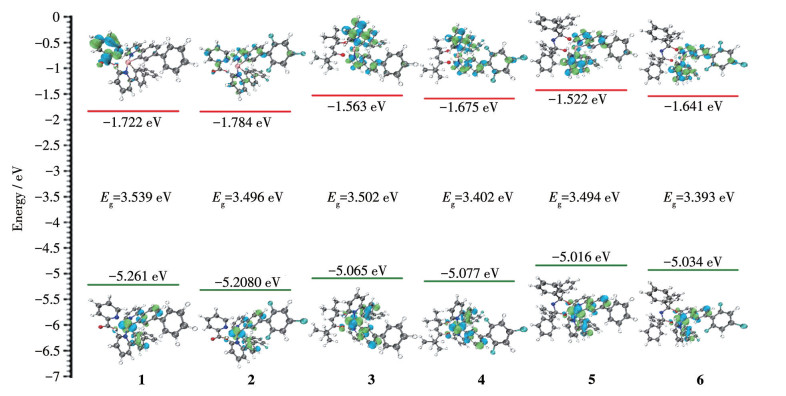
The lines of green and the lines of red are HOMO and LUMO energy levels, respectively.
In FIrpic′s S0, HOMO localizes on Ir and the main ligand phenyl, LUMO localizes on auxiliary ligands[41-43]. Compared to it, complex 1′s extra main ligand phenyl increases main ligands′ HOMO/LUMO contributions via more FMOs, with this amplified in complex 2 by electron-withdrawing fluorine (Fig.2, Table S1-S6). For complexes 3 and 4, replacing the auxiliary ligand pic with tmd increases the proportion of FMO components localized on the main ligands, while significantly reducing the proportion on the auxiliary ligands. Similarly, the FMOs of complexes 5-6 are almost entirely localized on the main ligands. This indicates that complexes 5-6 exhibit low efficiency roll-off characteristics, attributable to the strongly electron-withdrawing group tpip. This phenomenon demonstrates that introducing a phenyl group into the main ligand shifts the FMOs toward the main ligand, and fluorination of this phenyl group amplifies the effect. Additionally, adjusting the electron-donating ability of the auxiliary ligand achieves the same outcome.
The energies of different states and the energy gaps between states for complexes 1-6 are listed in Table 2. Our calculation results show that the energy levels of each electronic state in the complexes are reasonably distributed. The
下载:
导出CSV
| Complex | Δ |
|||||
| 1 | -5.261 | -1.722 | -2.896 | 3.539 | 2.365 | 1.174 |
| 2 | -5.280 | -1.784 | -2.853 | 3.496 | 2.427 | 1.069 |
| 3 | -5.065 | -1.563 | -2.719 | 3.502 | 2.346 | 1.156 |
| 4 | -5.077 | -1.675 | -2.680 | 3.402 | 2.397 | 1.005 |
| 5 | -5.016 | -1.522 | -2.383 | 3.494 | 2.633 | 0.861 |
| 6 | -5.034 | -1.641 | -2.393 | 3.393 | 2.641 | 0.752 |
| $E_{S_0}, E_{S_1}$, and $E_{T_1}$ are the energies of S0, the lowest S1, and the lowest T1 under the M06-2X functional, respectively; and are the energy gaps between different states (S0 and S1, S0 and T1, respectively). | ||||||
Fluorination of the phenyl group on the main ligand causes a slight decrease in
Based on the FMO composition and energy gap analysis (Fig.2, Table 2 and S1-S6), the performance tendencies of the six complexes are summarized as follows: complexes 1-2 with the weakly electron-withdrawing ancillary ligand pic are prone to 3LLCT and exhibit a higher risk of efficiency roll-off; complexes 3-4 with the moderately electron-withdrawing tmd show improvement; complexes 5-6 with the strongly electron-withdrawing tpip display the lowest tendency for efficiency roll-off due to highly localized FMOs and significantly reduced 3LLCT. Notably, complex 6 combines the low
The calculated absorption spectra, along with their oscillator strengths, assignments, and excitation energies, are listed in Table S7. The FMO properties are listed in Table S1-S6. For clarity, only the leading excited states (with large configuration interaction coefficients) are listed. The calculated phosphorescent emissions of the complexes in CH2Cl2 solution are listed in Table 3.
下载:
导出CSV
| Complex | Energy / eV | Wavelength / nm | Major | Contribution rate / % | Character |
| 1 | 2.37 | 524.25 | HOMO→LUMO | 55.7 | 3MLCT*+3LLCT+3ILCT |
| HOMO→LUMO+1 | 36.8 | ||||
| 2 | 2.43 | 510.78 | HOMO→LUMO | 55.8 | 3MLCT+3LLCT+3ILCT |
| HOMO→LUMO+1 | 35.6 | ||||
| 3 | 2.35 | 528.50 | HOMO→LUMO | 60.2 | 3MLCT+3LLCT+3ILCT |
| HOMO→LUMO+1 | 28.7 | ||||
| 4 | 2.40 | 517.23 | HOMO→LUMO | 59.6 | 3MLCT+3LLCT+3ILCT |
| HOMO→LUMO+2 | 30.0 | ||||
| 5 | 2.63 | 470.85 | HOMO→LUMO | 57.0 | 3MLCT+3LLCT+3ILCT |
| HOMO→LUMO+2 | 33.5 | ||||
| 6 | 2.64 | 469.39 | HOMO→LUMO | 58.2 | 3MLCT+3LLCT+3ILCT |
| HOMO→LUMO+2 | 31.7 | ||||
| *3MLCT: the triplet metal-to-ligand charge transfer. | |||||
In addition, Ir(Ⅲ) complexes typically exhibit main peaks and shoulder peaks in their emission spectra. The main peak primarily corresponds to fluorescence emission, while the shoulder peak primarily corresponds to phosphorescence emission. Thus, the fluorescence emission spectra of the complexes were also calculated and are shown in Fig.3, together with the absorption spectra of complexes 1-6.
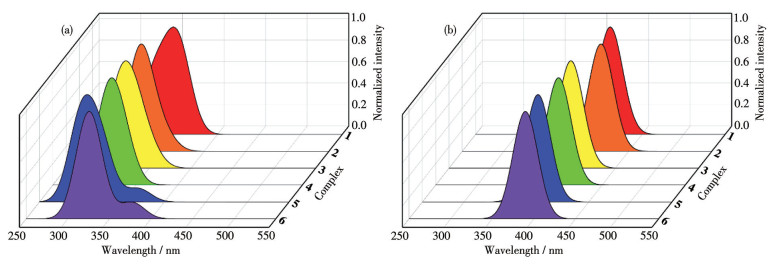
As shown in Table S7 and Fig.3, the positions of the strongest absorption peaks for complexes 1-6, generated by the excitation of multiple electronic states, are 347, 325, 322, 321, 307, and 326 nm, respectively. Compared to FIrpic, the absorption spectra of complexes 1-2 show a blue shift (ca. 78 nm), attributed to the introduction of phenyl groups into the main ligand[43]. For complexes 3-6, as electron-withdrawing groups are introduced via the auxiliary ligands, the frontier orbital components gradually shift towards the main ligand and the metal center, and the original 1LLCT charge transfer transition transforms into 1ILCT. Consequently, compared to complexes 1-2, the blue shift in the absorption spectra of complexes 3-6 is less pronounced.
Interestingly, as reported in the literature, Ir complexes typically undergo a blue shift in their absorption and emission spectra upon fluorination of the main ligand[48]. In this work, complexes 1-2 (with pic as the auxiliary ligand) follow this pattern. For complexes 3-4 (with tmd as the auxiliary ligand), fluorination of the main ligand has almost no effect on the absorption spectrum. Uniquely, complexes 5-6 (with tpip as the auxiliary ligand) exhibit a red shift in their absorption spectra. The reason for this anomalous phenomenon is that the tmd and tpip groups possess strong electron-withdrawing abilities, causing the FMOs of complexes 3-6 to localize on both the main ligand and the metal center. Therefore, fluorination of the main ligand affects both the HOMO and LUMO.
Complexes 1-6 show fluorescence emission peaks (412-390 nm, Fig.3) and phosphorescence peaks (524.25-469.39 nm, Table 3; blue/blue-green). Their emission spectra have a main fluorescence peak (determining color) and a phosphorescent shoulder. Enhanced auxiliary ligand electron-donating ability causes significant blue shifts in emission; main ligand fluorination has little effect, due to weakened 3LLCT and strengthened 3ILCT. Notably, complexes 5-6 have absorption shoulder peaks (363, 367 nm) near their fluorescence peaks (389, 390 nm), suggesting possible TADF.
The efficiency roll-off in OLEDs, particularly problematic for blue emitters, is primarily caused by exciton-exciton annihilation at high current densities. Its severity is critically linked to the material′s phosphorescence lifetime (τ). According to the well-established model by Adachi et al.: efficiency roll-off is proportional to τ2/d2, where d is the exciton diffusion distance[27]. This highlights that shortening τ is a highly effective strategy to suppress roll-off. Strikingly, Zhu et al. experimentally measured an exceptionally short τ (0.77 μs) for Ir(dfppy)2(tpip)[24], a complex structurally analogous to our designed 5-6 (both featuring the key tpip ancillary ligand). This value is significantly lower than the typical τ (1.4 μs) observed for the benchmark blue emitter FIrpic[49]. Applying the relationship above, a reduction in τ from 1.40 to 0.77 μs (a decrease of ca. 45%) would theoretically suppress efficiency roll-off by approximately 70% under comparable exciton diffusion conditions. This compelling experimental evidence strongly corroborates our theoretical prediction that the tpip ligand effectively mitigates efficiency roll-off. The physical origin lies in the strong electron-withdrawing nature of tpip, which localizes FMOs on the main ligand and metal center (Fig.2, Table S5-S6), thereby reducing long-range 3LLCT processes and shortening the excited-state lifetime, τ.
To further validate the TADF properties of the complexes, SOC matrix elements (<T|HSOC|S>, shown in Table 4) were calculated. The results show that the <T|HSOC|S> between the S1 and T1 states for complexes 3 and 6 are below 10 cm-1. This small SOC matrix element <T|HSOC|S> facilitates the reverse intersystem crossing (RISC) process between the S1 and T1 states for these complexes. However, for complex 3, the
下载:
导出CSV
| Complex | <S1|Hsoc|T1> / cm-1 |
<S1|Hsoc|T2> / cm-1 |
<S1|Hsoc|T3> / cm-1 |
| 1 | 55.78 | 67.67 | 117.86 |
| 2 | 49.78 | 89.19 | 124.28 |
| 3 | 6.61 | 79.96 | 822.29 |
| 4 | 10.42 | 46.56 | 843.64 |
| 5 | 23.33 | 181.74 | 813.78 |
| 6 | 8.09 | 136.56 | 817.62 |
To investigate the efficiency roll-off effect and thermally activated delayed fluorescence (TADF) characteristics of Ir(Ⅲ) complexes, we theoretically designed and calculated complexes 1-6, focusing on their geometrical structures, FMO properties, absorption spectra, emission spectra (fluorescence and phosphorescence), and SOC effects. The results show that the S0 molecular structures of all complexes exhibit a regular octahedral configuration, which structurally reduces the efficiency roll-off effect. Significant differences between the ground and excited state molecular structures of complexes 1-3 indicate that they require overcoming higher energy barriers during light emission.
Furthermore, introducing phenyl groups into the main ligands broadens their steric volume, facilitating the shift of FMOs towards the main ligands and the Ir center. Introducing tpip auxiliary ligands shifts almost all FMOs onto the main ligands, shortening the charge transfer distance and thereby achieving the goal of reducing the efficiency roll-off effect for complexes 5-6.
Critically, the strong electron-withdrawing ancillary ligand tpip localizes FMOs on the main ligand and metal (reducing 3LLCT), leading to a significant shortening of the phosphorescence lifetime τ (experimentally demonstrated to be >45% reduction in analogous tpip complexes[24]). According to the Adachi model, this translates to a substantial suppression of efficiency roll-off by ca. 70%. Simultaneously, the fluorinated main ligand F3Phppy compresses the
Analysis of photophysical properties reveals that introducing phenyl groups into the main ligands causes a blue shift in the absorption spectra. Conversely, fluorination of these phenyl groups has little effect on the spectral shift because the FMOs are primarily localized on the main ligands and the Ir atom. Finally, the calculated <T|HSOC|S> values, S1-T1 energy gaps, and emission spectra collectively indicate that complex 6 displays TADF properties.
LI X N, XIE Y J, LI Z. Diversity of luminescent metal complexes in OLEDs: Beyond traditional precious metals[J]. Chem. Asian J., 2021, 16: 2817-2829 doi: 10.1002/asia.202100784
JAYARAMAN J, VENUGOPAL T, SHANMUGAM T. Phosphorescent organic light-emitting devices: iridium based emitting materials-An overview[J]. Coord. Chem. Rev., 2023, 483: 215100 doi: 10.1016/j.ccr.2023.215100
BALDO M A, LAMANSKY S, BURROWS P E, THOMPSON M E, FORREST S R. Very high-efficiency green organic light-emitting devices based on electrophosphorescence[J]. Appl. Phys. Lett., 1999, 75(1): 4-6 doi: 10.1063/1.124258
HOLMES R J, FORREST S R, TUNG Y J, KWONG R C, BROWN J J, GARON S, THOMPSON M E. Efficient blue organic light-emitting devices with reduced efficiency roll-off[J]. Appl. Phys. Lett., 2003, 82(15): 2422-2424 doi: 10.1063/1.1568146
TOKITO S, IIJIMA T, SUZURI Y, KITA H, TSUZUKI T, SATO F. Highly efficient phosphorescence from organic light-emitting devices with an exciton-block layer[J]. Appl. Phys. Lett., 2003, 83: 569-571 doi: 10.1063/1.1594834
LI J, DJUROVICH P I, ALLEYNE B D, YOUSUFUDDIN M, HO N N, THOMAS J C, PETERS J C, BAU R, THOMPSON M E. Synthetic control of excited-state properties in cyclometalated Ir(Ⅲ) complexes using ancillary ligands[J]. Inorg. Chem., 2005, 44(6): 1713-1727 doi: 10.1021/ic048599h
LYU Y Y, BYUN Y, KWON O, HAN E, JEON W S, DAS R R, CHAR K. Substituent effect on the luminescent properties of a series of deep blue emitting mixed ligand Ir(Ⅲ) complexes[J]. J. Phys. Chem. B, 2006, 110(21): 10303-10314 doi: 10.1021/jp057446s
CHENG M N, WANG H, GONG L Z. A Facile and general approach to the synthesis of chiral biphenyl-based phosphoric acids and their application in asymmetric catalysis[J]. Angew. Chem. ‒Int. Edit., 2007, 46(14): 2418-2421 doi: 10.1002/anie.200604733
ZHOU G J, WONG W Y, YAO B, XIE Z Y, WANG L X. A facile synthesis of chiral biphenyl-based phosphoric acids via palladium-catalyzed asymmetric cross-coupling[J]. Angew. Chem. ‒Int. Edit., 2007, 46(8): 1189-1192 doi: 10.1002/anie.200790022
HO C L, WONG W Y, WANG Q, MA D G, WANG L X, LIN Z Y. Highly efficient green-emitting iridium(Ⅲ) phosphors with tunable triplet energy for phosphorescent organic light-emitting diodes[J]. Adv. Funct. Mater., 2008, 18(13): 2305-2310
CHANG C F, CHENG Y M, CHI Y, CHIU Y C, LIN C C, LEE G H, CHOU P T, CHEN C C, CHANG C H, WU C C. Ruthenium-catalyzed asymmetric transfer hydrogenation of quinolines: A practical approach to chiral tetrahydroquinolines[J]. Angew. Chem. ‒Int. Edit., 2008, 47(24): 4449-4452 doi: 10.1002/anie.200890111
LEE J H, SHIN H, KIM J M, KIM K H, KIM J J. Exciplex-forming co-host-based red phosphorescent organic light-emitting diodes with long operational stability and high efficiency[J]. ACS Appl. Mater. Interfaces, 2017, 9(4): 3277-3281 doi: 10.1021/acsami.6b14438
KIM K H, AHN E S, HUH J S, KIM Y H, KIM J J. Design of heteroleptic Ir complexes with horizontal emitting dipoles for highly efficient organic light-emitting diodes with an external quantum efficiency of 38%[J]. Chem. Mater., 2016, 28(20): 7505-7510 doi: 10.1021/acs.chemmater.6b03428
KIM S Y, JEONG W I, MAYR C, PARK Y S, KIM K H, LEE J H, MOON C K, BRÜTTING W, KIM J J. Organic light-emitting diodes with 30% external quantum efficiency based on a horizontally oriented emitter[J]. Adv. Funct. Mater., 2013, 23(31): 3896-3900 doi: 10.1002/adfm.201300104
SEO S, SHITAGAKI S, OHSAWA N, INOUE H, SUZUKI K, NOWATARI H, YAMAZAKI S. Exciplex-triplet energy transfer: A new method to achieve extremely efficient organic light-emitting diode with external quantum efficiency over 30% and drive voltage below 3 V[J]. Jpn. J. Appl. Phys., 2014, 53: 042102 doi: 10.7567/JJAP.53.042102
KIM K H, LEE S, MOON C K, KIM S Y, PARK Y S, LEE J H, KIM J J. Phosphorescent dye-based supra-molecules for high-efficiency organic light-emitting diodes[J]. Nat. Commun., 2014, 5: 4769 doi: 10.1038/ncomms5769
LI X, ZHANG J, ZHAO Z, WANG L, YANG H, CHANG Q, LU Z. Deep blue phosphorescent organic light-emitting diodes with CIEy value of 0.11 and external quantum efficiency up to 22.5%[J]. Adv. Mater., 2018, 30: 1705005 doi: 10.1002/adma.201705005
LEE J H, CHENG S H, YOO S J, SHIN H, CHANG J H, WU C I, WONG K T, KIM J J. An exciplex forming host for highly efficient blue organic light emitting diodes with low driving voltage[J]. Adv. Funct. Mater., 2015, 25(3): 361-366 doi: 10.1002/adfm.201402707
SHIN H, LEE J H, MOON C K, HUH J S, SIM B, KIM J J. Sky-blue phosphorescent OLEDs with 34.1% external quantum efficiency using a low refractive index electron transporting layer[J]. Adv. Mater., 2016, 28(25): 4920-4925
ZAEN R, PARK K M, LEE K H, LEE J Y, KANG Y. Blue phosphorescent Ir(Ⅲ) complexes achieved with over 30% external quantum efficiency[J]. Adv. Opt. Mater., 2019, 7: 1901387 doi: 10.1002/adom.201901387
BARANOFF E, CURCHOD B F E. FIrpic: Archetype blue phosphorescent emitter for electroluminescence[J]. Dalton Trans., 2014, 43(21): 2991-2995
KANG J W, LEE S H, PARK H D, JEONG W I, YOO K M, PARK Y S, KIM J J. Highly efficient blue phosphorescent organic light-emitting diodes with a hole-blocking layer[J]. Appl. Phys. Lett., 2007, 90(22): 223508 doi: 10.1063/1.2745224
ZHU Y C, ZHOU L, LI H Y, XU Q L, TENG M Y, ZHENG Y X, ZUO J L, ZHANG H J, YOU X Z. Highly efficient green and blue-green phosphorescent OLEDs based on iridium complexes with the tetraphenylimidodiphosphinate ligand[J]. Adv. Mater., 2011, 23: 4041-4046 doi: 10.1002/adma.201101792
WONG M Y, ZYSMAN-COLMAN E. Purely organic thermally activated delayed fluorescence materials for organic light-emitting diodes[J]. Adv. Mater., 2017, 29(22): 1605444 doi: 10.1002/adma.201605444
ADACHI C, BALDO M A, THOMPSON M E. Nearly 100% internal phosphorescence efficiency in an organic light-emitting device[J]. J. Appl. Phys., 2001, 90(10): 5048-5051 doi: 10.1063/1.1409582
ENDO A, OGASAWARA M, TAKAHASHI A, YOKOYAMA D, KATO Y, ADACHI C. Thermally activated delayed fluorescence from Sn4+-porphyrin complexes and their application to organic light emitting diodes——A novel mechanism for electroluminescence[J]. Adv. Mater., 2009, 21(47): 4802-4806 doi: 10.1002/adma.200900983
LEITL M J, KRYLOVA V A, DJUROVICH P I, THOMPSON M E, YERSIN H. Phosphorescence versus thermally activated delayed fluorescence: Controlling singlet-triplet splitting in brightly emitting and sublimable Cu compounds[J]. J. Am. Chem. Soc., 2014, 136(45): 16032 doi: 10.1021/ja508155x
KRYLOVA V A, DJUROVICH P I, CONLEY B L, HAIGES R, WHITED M T, WILLIAMS T J, THOMPSON M E. Highly efficient blue thermally activated delayed fluorescence emitters based on ortho-metalated iridium complexes[J]. Chem. Commun., 2014, 50(60): 7176-7178
HOFBECK T, MONKOWIUS U, YERSIN H. Highly efficient luminescence of Cu compounds: Thermally activated delayed fluorescence combined with short-lived phosphorescence[J]. J. Am. Chem. Soc., 2015, 137(1): 399-404 doi: 10.1021/ja5109672
ZINK D M, VOLZ D, BAUMANN T, MYDLAK M, FLÜGGE H, FRIEDRICHS J, NIEGER M, BRÄSE S. Highly soluble copper complexes for inkjet-printed OLEDs[J]. Chem. Mater., 2013, 25(22): 4471-4479 doi: 10.1021/cm4018375
WALLESCH M, VOLZ D, ZINK D M, SCHEPERS U, NIEGER M, BAUMANN T, BRÄSE S. Bright coppertunities: Multinuclear Cu complexes with N-P ligands and their applications[J]. Chem. ‒Eur. J., 2014, 20(22): 6578-6590 doi: 10.1002/chem.201402060
BIZZARRI C, STRABLER C, PROCK J, TRETTENBREIN B, RUGGENTHALER M, YANG C H, POLO F, IORDACHE A, BRUGGELLER P, DE COLA L. Influence of substituents on the energy and nature of the lowest excited states of heteroleptic phosphorescent Ir(Ⅲ) complexes: A joint theoretical and experimental study[J]. Inorg. Chem., 2014, 53(21): 10944-10952
LIANG D, CHEN X L, LIAO J Z, HU J Y, JIA J H, LU C Z. Influence of substituents on the magnetic properties of a series of dysprosium-based single-molecule magnets[J]. Inorg. Chem., 2016, 55(14): 7467-7474
WANG Z, ZHENG C, WANG W, XU C, JI B, ZHANG X. Synthesis, structure, and magnetic properties of a series of dysprosium-based single-molecule magnets with different substituents[J]. Inorg. Chem., 2016, 55(5): 2157-2164 doi: 10.1021/acs.inorgchem.5b02546
KAWAMURA Y, BROOKS J, BROWN J J. Intermolecular interaction and a concentration-quenching mechanism of phosphorescent iridium(Ⅲ) complexes in a solid film[J]. Phys. Rev. Lett., 2006, 96(1): 017404 doi: 10.1103/PhysRevLett.96.017404
CHI H Y, JI Y, ZHANG Y K, ZHAO X M, QU S J, JIANG F D, LU C H, XIAO B, SONG M X, LI D F. Theoretical study of blue-green iridium(Ⅲ) complexes with low-efficiency roll-off properties for application in phosphorescent organic light-emitting diodes[J]. Appl. Organomet. Chem., 2024, 38: e7322 doi: 10.1002/aoc.7322
CHI H Y, ZHANG Y K, JI Y, SUN Y, LI G, ZHU Y, JIANG L, XIAO B, SONG M X, LI D F. Theoretical study on a series of iridium(Ⅲ) complexes with low-efficiency roll-off properties for application in OLEDs[J]. Chem. Phys. Lett., 2024, 838(1): 141080
QIN Z, ZHANG Y, TIAN H, PAN Z, WANG M, CUI L, WANG J, BAO L, WANG Y, ZHANG W, SONG M. A series of blue phosphorescent iridium(Ⅲ) complexes with thermally activated delayed fluorescence and efficiency roll-off properties[J]. RSC Adv., 2024, 14(34): 36895-36901
SONG M X, ZHANG H, LIU X H, JI Y, GUO X L, YANG J Y, QIN Z K, BAI F Q, ZHANG H J. Theoretical study of the high intersystem spin crossing (ISC) ability of a series of iridium complexes with low efficiency roll-off properties[J]. Appl. Organomet. Chem., 2022, 36: e6875 doi: 10.1002/aoc.6875
PARK N G, CHOI G C, LEE Y H, KIM Y S. Theoretical studies on the ground and excited states of blue phosphorescent cyclometalated Ir(Ⅲ) complexes having ancillary ligand[J]. Curr. Appl. Phys., 2006, 6(6): 620-626
GU X, FEI T, ZHANG H Y, XU H, YANG B, MA Y G, LIU X D. Theoretical studies of blue-emitting iridium complexes with different ancillary ligands[J]. J. Phys. Chem. A, 2008, 112(36): 8387-8393 doi: 10.1021/jp8026429
YANG B, ZHANG M, ZHANG H, SUN J. Theoretical study on the influence of ancillary ligand on the energy and optical properties of heteroleptic phosphorescent Ir(Ⅲ) complexes[J]. J. Lumin., 2011, 131(6): 1158-1163 doi: 10.1016/j.jlumin.2011.02.026
RUNGE E, GROSS E K U. Density-functional theory for time-dependent systems[J]. Phys. Rev. Lett., 1984, 52(12): 997-1000 doi: 10.1103/PhysRevLett.52.997
PETERSILKA M, GOSSMANN U J, GROSS E K U. Time-dependent density-functional theory for many-body systems[J]. Phys. Rev. Lett., 1996, 76(6): 1212-1215
MAYO S L, OLAFSON B D, GODDARD W A Ⅲ. DREIDING: A generic force field for molecular simulations[J]. J. Phys. Chem., 1990, 94(26): 8897-8909 doi: 10.1021/j100389a010
ZHANG T, XIAO Y, WANG H, KONG S, HUANG R, AU V K, YU T, HUANG W. Highly twisted thermally activated delayed fluorescence (TADF) molecules and their applications in organic light-emitting diodes(OLEDs)[J]. Angew. Chem. ‒Int. Edit., 2023, 62: e202301896 doi: 10.1002/anie.202301896
FLAMIGNI L, BARBIERI A, SABATINI C, VENTURA B, BARIGELLETTI F. Luminescent platinum complexes: Influence of ligands on excited states and applications[J]. Top. Curr. Chem., 2007, 281: 143-178
NEESE F. Software update: The ORCA program system——Version 5.0[J]. Wiley Interdiscip. Rev. ‒Comput. Mol. Sci., 2022, 12: e1606 doi: 10.1002/wcms.1606
HUMPHREY W, DALKE A, SCHULTEN K. VMD: Visual Molecular Dynamics[J]. J. Mol. Graph., 1996, 14: 33-38 doi: 10.1016/0263-7855(96)00018-5

Figure 1 (a) Sketch maps and (b) the optimized ground state (S0) geometrical structures of the complexes

Figure 2 Electronic structures on the HOMOs and LUMOs of S0, energy levels, and energy gaps (Eg) between HOMO and LUMO of the complexes 1-6
The lines of green and the lines of red are HOMO and LUMO energy levels, respectively.

Figure 3 (a) Absorption spectra and (b) fluorescence emission spectra of the complexes 1-6
Table 1. Main geometry structural parameters of S0 and T1 of the complexes under DFT and TDDFT level*
| Complex | State | Selected bond length / nm | Selected bond angle / (°) | ||||||||||
| R1 | R2 | R3 | R4 | R5 | R6 | A1 | A2 | A3 | A4 | A5 | |||
| 1 | S0 | 0.20 | 0.20 | 0.20 | 0.20 | 0.21 | 0.21 | 174.87 | 80.70 | 94.73 | 89.88 | 91.20 | |
| T1 | 0.20 | 0.19 | 0.20 | 0.20 | 0.22 | 0.21 | 175.86 | 82.12 | 95.46 | 88.00 | 92.35 | ||
| 2 | S0 | 0.20 | 0.20 | 0.20 | 0.20 | 0.21 | 0.21 | 175.02 | 80.62 | 94.89 | 89.78 | 91.33 | |
| T1 | 0.20 | 0.19 | 0.20 | 0.20 | 0.22 | 0.21 | 176.46 | 82.13 | 95.97 | 87.10 | 92.71 | ||
| 3 | S0 | 0.20 | 0.20 | 0.20 | 0.20 | 0.21 | 0.21 | 176.59 | 80.74 | 96.86 | 93.33 | 89.17 | |
| T1 | 0.20 | 0.20 | 0.20 | 0.19 | 0.22 | 0.22 | 177.54 | 96.82 | 80.59 | 94.64 | 87.56 | ||
| 4 | S0 | 0.20 | 0.20 | 0.20 | 0.20 | 0.21 | 0.21 | 176.49 | 80.68 | 96.79 | 93.37 | 89.42 | |
| T1 | 0.20 | 0.20 | 0.20 | 0.20 | 0.21 | 0.21 | 176.49 | 80.72 | 96.89 | 93.19 | 89.19 | ||
| 5 | S0 | 0.20 | 0.20 | 0.20 | 0.20 | 0.22 | 0.22 | 174.98 | 80.88 | 95.61 | 94.59 | 88.93 | |
| T1 | 0.20 | 0.20 | 0.20 | 0.20 | 0..2 | 0.22 | 174.98 | 80.89 | 95.62 | 94.58 | 88.92 | ||
| 6 | S0 | 0.20 | 0.20 | 0.20 | 0.20 | 0.22 | 0.22 | 175.02 | 80.83 | 95.68 | 94.33 | 89.23 | |
| T1 | 0.25 | 0.20 | 0.20 | 0.20 | 0.22 | 0.22 | 175.02 | 80.83 | 95.68 | 94.33 | 89.23 | ||
| *R1: Ir—N1, R2: Ir—C1, R3: Ir—N2, R4: Ir—C2, R5: Ir—N3/Ir—O1, R6: Ir—O/Ir—O2; A1: ∠N1—Ir—N2, A2: ∠N1—Ir—C1, A3: ∠N1—Ir—C2, A4: ∠N1—Ir—N3/∠N1—Ir—O1, A5: ∠N1—Ir—O/∠N1—Ir—O2. | |||||||||||||
 下载: 导出CSV
Table 2. Energy levels of the S0, the lowest singlet S1, and the lowest T1 under the M06-2X functional
| Complex | Δ |
|||||
| 1 | -5.261 | -1.722 | -2.896 | 3.539 | 2.365 | 1.174 |
| 2 | -5.280 | -1.784 | -2.853 | 3.496 | 2.427 | 1.069 |
| 3 | -5.065 | -1.563 | -2.719 | 3.502 | 2.346 | 1.156 |
| 4 | -5.077 | -1.675 | -2.680 | 3.402 | 2.397 | 1.005 |
| 5 | -5.016 | -1.522 | -2.383 | 3.494 | 2.633 | 0.861 |
| 6 | -5.034 | -1.641 | -2.393 | 3.393 | 2.641 | 0.752 |
| $E_{S_0}, E_{S_1}$, and $E_{T_1}$ are the energies of S0, the lowest S1, and the lowest T1 under the M06-2X functional, respectively; and are the energy gaps between different states (S0 and S1, S0 and T1, respectively). | ||||||
下载: 导出CSV
Table 3. Phosphorescent emission parameters of the complexes in CH2Cl2 solution under the TDDFT/M06-2X calculations
| Complex | Energy / eV | Wavelength / nm | Major | Contribution rate / % | Character |
| 1 | 2.37 | 524.25 | HOMO→LUMO | 55.7 | 3MLCT*+3LLCT+3ILCT |
| HOMO→LUMO+1 | 36.8 | ||||
| 2 | 2.43 | 510.78 | HOMO→LUMO | 55.8 | 3MLCT+3LLCT+3ILCT |
| HOMO→LUMO+1 | 35.6 | ||||
| 3 | 2.35 | 528.50 | HOMO→LUMO | 60.2 | 3MLCT+3LLCT+3ILCT |
| HOMO→LUMO+1 | 28.7 | ||||
| 4 | 2.40 | 517.23 | HOMO→LUMO | 59.6 | 3MLCT+3LLCT+3ILCT |
| HOMO→LUMO+2 | 30.0 | ||||
| 5 | 2.63 | 470.85 | HOMO→LUMO | 57.0 | 3MLCT+3LLCT+3ILCT |
| HOMO→LUMO+2 | 33.5 | ||||
| 6 | 2.64 | 469.39 | HOMO→LUMO | 58.2 | 3MLCT+3LLCT+3ILCT |
| HOMO→LUMO+2 | 31.7 | ||||
| *3MLCT: the triplet metal-to-ligand charge transfer. | |||||
下载: 导出CSV
Table 4. SOC matrix elements of the complexes $\Delta E_{S_0 T_1}$
| Complex | <S1|Hsoc|T1> / cm-1 |
<S1|Hsoc|T2> / cm-1 |
<S1|Hsoc|T3> / cm-1 |
| 1 | 55.78 | 67.67 | 117.86 |
| 2 | 49.78 | 89.19 | 124.28 |
| 3 | 6.61 | 79.96 | 822.29 |
| 4 | 10.42 | 46.56 | 843.64 |
| 5 | 23.33 | 181.74 | 813.78 |
| 6 | 8.09 | 136.56 | 817.62 |
下载: 导出CSV

 扫一扫看文章


扫一扫关注我们