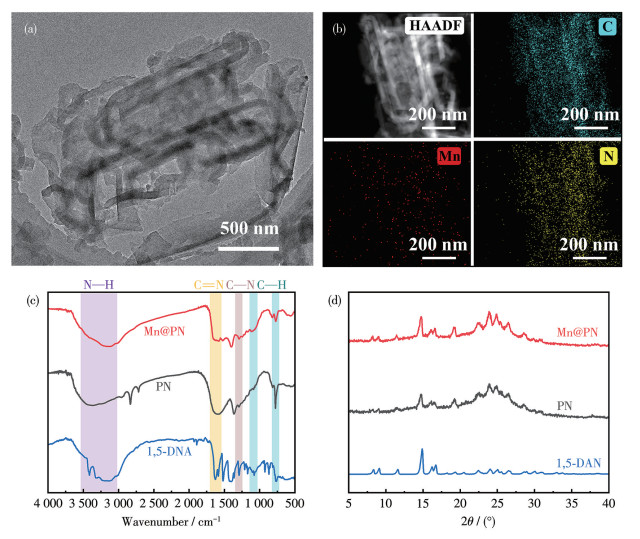
Figure 1.
(a) TEM image and (b) HAADF-STEM image and corresponding elemental mappings of Mn@PN; (c) FTIR spectra and (d) XRD patterns of 1, 5-DAN, PN, and Mn@PN

Manganese-doped poly(1,5-diaminonaphthalene) based high-performance supercapacitors
Mengying XU , Wen LI , Junzhong MEI , Cheng ZHANG , Kannan Palanisamy , Lei LU , Lianpeng ZHANG , Peng WANG


Driven by carbon neutrality strategies, the development of electrochemical energy storage devices that simultaneously exhibit high energy density and exceptional cyclic stability has emerged as a crucial pathway for addressing the global energy crisis[1]. Supercapacitors have demonstrated unique application potential in smart grid peak regulation and rail transit braking energy recovery, exhibiting ultra-high power densities of 104-105 W·kg-1 and cyclic lives exceeding 105 cycles[2-4]. Current research indicates that incorporating materials with redox centers into supercapacitors to create pseudocapacitors can effectively enhance energy density[5]. This strategy has paved new avenues for the development of high-performance energy storage systems.
Conductive polymers exhibit unique mechanical properties and abundant redox sites, rendering them ideal materials for pseudocapacitors due to their reversible p-/n-type doping mechanisms and flexible structural characteristics[6-7]. Although traditional conductive polymers such as polyaniline (PANI) have a theoretical capacitance of 1 325 F·g-1, the breakage of polymer chain structures and volume deformation during cycling severely impair electron transmission, resulting in an actual capacitance of less than 50% after 1 000 cycles[8-9]. In contrast, 1, 5-diaminonaphthalene (1, 5-DAN) forms conjugated ladder polymers through oxidative polymerization. This conjugated ladder structure imparts exceptional mechanical strength to the electrode material and effectively inhibits structural relaxation during the charge/discharge process[10-13]. The theoretical specific capacitance of these materials reaches 1 545 F·g-1 with improved mechanical stability[14]. Acerce et al.[15] demonstrated that a poly(1, 5-diaminonaphthalene) (PN) electrode grafted onto a three-dimensional carbon nanotube (CNT-a-CC) electrode retained 94% of its specific capacitance after 25 000 cycles at 100 mV·s-1, significantly outperforming PANI in terms of cyclic stability.
Transition metals are frequently utilized as dopants owing to their distinctive electronic structures and ability to donate or accept electrons, thereby providing an effective strategy for optimizing the performance of conductive polymers[16-23]. Dhibar et al.[24] synthesized Mn-PANI/SW-CNT nanocomposites via in-situ polymerization. The coordination between Mn2+ ions and the lone pair electrons on nitrogen atoms in PANI enhanced the specific capacitance, elevating the conductivity of PANI from 0.41 to 9.65 S·cm-1 and achieving a remarkable capacitance retention rate of 88.13% after 1 000 cycles. Consequently, the novel conductive polymer doped with the transition metal Mn may overcome the limitations of poor stability and low conductivity associated with traditional conductive polymers, thus providing a pathway for exceptional cyclic stability and theoretical capacitance[25-26].
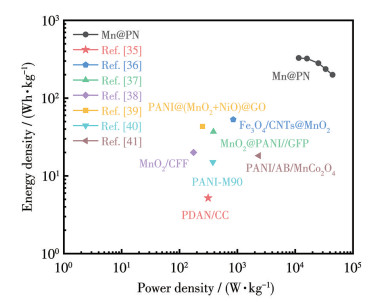
Herein, the Mn-doped PN (Mn@PN) electrode materials were prepared. The PN substrate exhibited exceptional mechanical strength, and its unique vesicle structure facilitates rapid ion transport. Furthermore, Mn doping enhances the conductivity of Mn@PN. Experimental results indicated that the synthesized material achieved an excellent specific capacitance of 10 318 F·g-1 at 3 A·g-1 and retained a specific capacitance of 9 415 F·g-1 at a high current density of 50 A·g-1. After 9 000 charge/discharge cycles at 30 A·g-1, the specific capacitance retention rate reached 97.4%, with a 15% reduction in the decay rate compared to the undoped system. Notably, the assembled asymmetric supercapacitor (Mn@PN||AC, AC=activated carbon) demonstrated a maximum energy density of 328 Wh·kg-1 and a maximum power density of 44 kW·kg-1. These comprehensive findings confirm the potential of this metal-polymer synergistic strategy for high-energy-density supercapacitors.
This study utilized analytical-grade compounds that required no further purification. 1, 5-DAN (99.99%), hydrogen peroxide (H2O2) (≥30%), manganese(Ⅱ) chloride tetrahydrate (MnCl2·4H2O) (≥99.0%), ethanol (≥99.7%), and potassium hydroxide (KOH) (≥90.0%) were purchased from Adamas-beta. All experiments were conducted using deionized water (DI water).
1.58 g (0.01 mol) 1, 5-DAN was dissolved in 50 mL 1 mol·L-1 HCl within a beaker. Then, 0.099 g (0.5 mmol) MnCl2·4H2O was added to the solution, followed by stirring at 25 ℃ for 4 h. After the addition of 2.5 mL H2O2, the reaction proceeded under vigorous stirring for an additional 24 h. 1 mol·L-1 NaOH solution was added dropwise to the above solution to adjust the pH of the system to about 7. The solution was filtered, and the obtained polymer was washed three times with deionized water and then with ethanol. It was subsequently vacuum-dried at 50 ℃ for 12 h. The final product was labeled as Mn@PN. For comparison, the pure PN sample was prepared under the same conditions without the addition of MnCl2·4H2O.
The morphology and microstructure of the samples were characterized using field-emission scanning electron microscopy (SEM, Hitachi S-4200) and transmission electron microscopy (TEM, Tecnai G2 20) with carbon-coated grids. Single atoms were detected by high-angle annular dark-field scanning transmission electron microscopy (HAADF-STEM, JEOL ARM200F). The vibrational states of functional groups were measured using Fourier-transform infrared spectroscopy (FTIR, NICOLET 6700 FITR). X-ray diffraction (XRD) measurements were carried out using a Rigaku CCD X-ray diffractometer with Ni-filtered Cu Kα radiation (λ=0.154 06 nm) at 40 kV and 40 mA in the 2θ range of 5° to 60°. Thermogravimetric analysis (TGA) was conducted on a PerkinElmer TGA7 with a heating rate of 10 ℃·min-1 in air. The copper content was determined by inductively coupled plasma-optical emission spectrometry (ICP-OES, iCAP PRO X). The surface elements and electronic states were analyzed using X-ray photoelectron spectroscopy (XPS, PHI 5000C & PHI 5300). Nitrogen adsorption-desorption isotherms were measured using a specific surface area and pore size analyzer (Micromeritics ASAP 2020).
The Mn@PN electrode materials were evaluated for electrochemical performance in a 3 mol·L-1 KOH electrolyte using both three-electrode and two-electrode systems. In the three-electrode system, the Mn@PN electrode served as the working electrode, AC as the counter electrode, and Hg/HgO as the reference electrode. The two-electrode system employed the Mn@PN electrode as the anode and AC as the cathode. To fabricate the working electrode, a homogeneous mixture containing Mn@PN, acetylene black, and polytetrafluoroethylene with the mass ratio of 60∶30∶10 was prepared in isopropanol, followed by drying. The resulting viscous composite was pressed into thin sheets, sectioned into smaller units, and subsequently adhered to nickel foam current collectors under pressure. The active material mass loading was maintained at approximately 2.0 mg·cm-2. Electrochemical characterizations were conducted using a CHI 660D electrochemical workstation (Shanghai, China). Cyclic voltammetry (CV) measurements were performed with potential windows of 0-0.7 V (three-electrode) and 0-2.2 V (two-electrode), while electrochemical impedance spectroscopy (EIS) covered a frequency range of 10 mHz to 100 kHz. Additionally, galvanostatic charge/discharge (GCD) tests with potential windows of 0-0.45 V (three-electrode) and 0-1.0 V (two-electrode) were executed on a LAND CT2001A battery testing system under constant current conditions.
The specific capacitance (Cs) of the electrode was measured using the galvanostatic discharge method, and the calculation formula is as follows:
|
|
(1) |
where I (A) is the constant discharge current, Δt (s) is the discharge time, ΔV (V) is the potential window, and m (g) is the weight of the active material in the electrode.
The calculation formulas for energy density (E) and power density (P) are as follows:
|
|
(2) |
|
|
(3) |
Mn@PN were successfully synthesized through the copolymerization of MnCl2 and 1, 5-DAN under H2O2-induced chemical oxidative polymerization. SEM revealed an irregular structure for Mn@PN (Fig.S1, Supporting information), while the TEM image showed a unique vesicular structure (Fig.1a). This vesicular morphology may result from Mn doping enhancing the π-plane stacking interaction during polymerization[27]. Such internal vesicle structures can facilitate the interface between the electrode material and the electrolyte, thereby accelerating ion transport and stabilizing the physical properties of the electrode material. Energy dispersive X-ray spectroscopy (EDS) mappings demonstrated uniform distributions of C, N, and Mn elements within the material (Fig.1b). Notably, no Mn metal nanoparticles or metallic phases were observed in TEM images (Fig.S2a), suggesting that Mn may exist in an atomically dispersed state[28-29]. Further HAADF-STEM images revealed bright, isolated spots distributed throughout the PN matrix, which can be attributed to a single Mn atom dispersed within the PN matrix (Fig.S2b, indicated by red circles). ICP-OES determined the Mn content (mass fraction) to be approximately 0.21%, consistent with the EDS-mapping results (Fig.S3). Despite the low absolute content of Mn, Mn@PN still exhibited excellent electrochemical stability and significantly enhanced electronic conductivity (as detailed subsequently).
The chemical structures of 1, 5-DAN, PN, and Mn@PN were systematically characterized using FTIR (Fig.1c). Compared to the monomer 1, 5-DAN, the vibration bands of the polymers exhibited significant shifts. PN displayed a broad peak in the range of 3 100-3 600 cm-1, corresponding to N—H bond stretching vibration. The peak at 1 598 cm-1 is attributed to the C=N bond stretching vibration, while the peak at 1 298 cm-1 correspond to the C—N bond stretching vibration. The peaks at 1 074 and 776 cm-1 represent the out-of-plane and in-plane bending vibrations of the C—H bond, respectively. Notably, Mn@PN exhibited red-shifted characteristic peaks at 1 585, 1 290, 1 064, and 768 cm-1, likely due to Mn—N coordination[30-31].
XRD analysis was conducted to examine the crystal structure of the material (Fig.1d). The 1, 5-DAN monomer exhibited distinct characteristic peaks in the range of 8° to 36°, indicative of its crystalline nature. In contrast, both PN and Mn@PN displayed amorphous structures with a main broad peak between 22° and 26°, indicating a high degree of polymerization and successful synthesis of Mn-doped polynaphthalene. To further investigate the elemental chemical states, XPS was employed (Fig.S5). In the C1s spectrum (Fig.S5b), peaks at 284.80 and 286.68 eV correspond to the C—C and C—N bonds in the polymer structure, respectively. The N1s spectrum (Fig.S5c) revealed peaks at 399.28 and 401.08 eV, attributed to the C—N and —NH— bond, respectively. The Mn2p spectrum (Fig.S5d) exhibited spin-orbit splitting peaks for Mn2p3/2 and Mn2p1/2 located at 641.58 and 653.18 eV, respectively, indicating that Mn mainly exists in the +2 valence state[32]. TGA (Fig.S6) demonstrated that 1, 5-DAN decomposed rapidly at 200 ℃, losing 96% of its weight at 400 ℃. However, Mn@PN retained 74% of its weight at 800 ℃, indicating significantly enhanced thermal stability.
The electrochemical performance of the material was evaluated using a three-electrode system in 3 mol·L-1 KOH electrolyte, with the Mn@PN electrode as the working electrode, AC as the counter electrode, and Hg/HgO as the reference electrode. As illustrated in Fig.2a, Mn@PN displayed a typical reversible redox peak within the scan rate range of 1-30 mV·s-1, consistent with the electrochemical energy storage mechanism involving the coordination reaction between C=N and K+. The CV curve indicates that Mn doping did not significantly alter the redox peaks (Fig.S7a). The observed one oxidation peak and two reduction peaks are attributed to the reversible insertion/migration process of K+ in Mn@PN. The closed loop area and the number of redox peaks of the CV curve are directly correlated with the specific capacitance of the material. Notably, the CV curve for Mn@PN exhibited a significantly larger closed-loop area compared to that of the PN electrode (Fig.2b), confirming that the Mn-doped system exhibited higher ion migration rates and reaction reversibility, thereby substantially enhancing the K+ storage capacitance of Mn@PN in the three-electrode system. Charge transfer kinetics were analyzed using EIS, where Rs represents the solution resistance, Rct represents the charge transfer resistance, CPE represents the constant phase element, and ZW represents the Warburg impedance (Fig.2c). The Nyquist plot for Mn@PN showed a considerably smaller semicircle in the high-frequency region, with the corresponding Rct reduced to 2.4 Ω·cm2. Additionally, the slope of the ZW in the low-frequency region increased by 45%, indicating a significant enhancement in K+ diffusion kinetics.
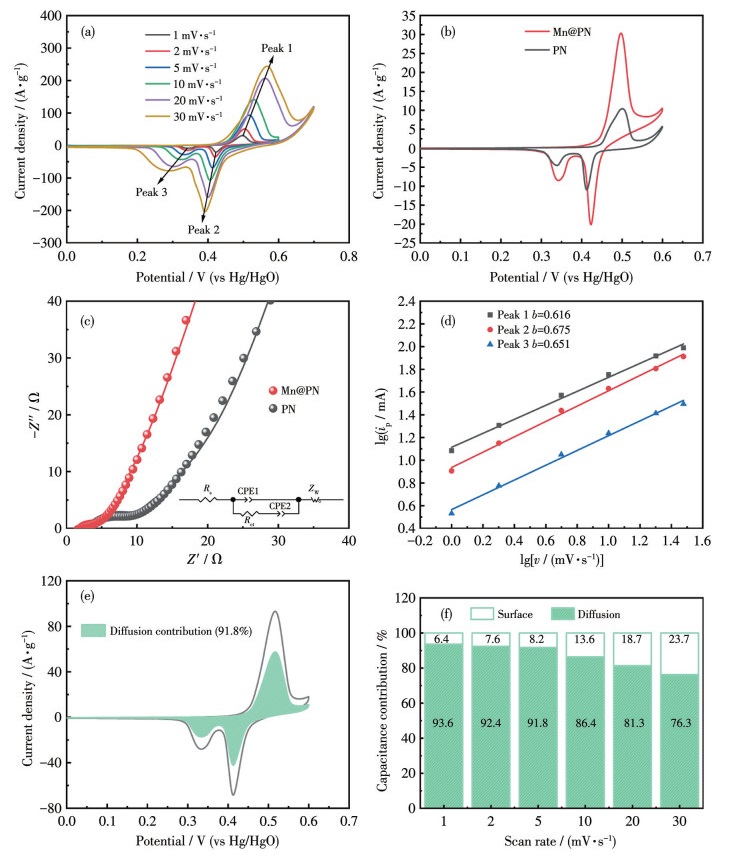
Inset: corresponding equivalent circuit diagram.
To investigate the charge storage dynamics of K+ in the Mn@PN electrode, a capacitance contribution analysis was conducted using the Trasatti method to determine the relative contributions of surface-controlled and diffusion-controlled processes[33]. The relationship between the redox peak current (ip) and the scan rate (v) was calculated using Eq.4:
|
|
(4) |
where a and b are adjustable parameters. When b=0.5, the reaction process is dependent on ion diffusion, indicating battery-like behavior. For 0.5<b<1, both surface-controlled and diffusion-controlled processes influence the reaction, resulting in combined battery and pseudocapacitance behavior. When b=1, the process is purely capacitance-dependent, characteristic of supercapacitor behavior. The b values for peaks 1, 2, and 3, determined by linear fitting, were 0.616, 0.675, and 0.651, respectively, suggesting that the entire charge/discharge process is governed by both battery and pseudocapacitance behavior (Fig.2d). Similarly, the b values of peaks 1, 2, and 3 for PN were 0.673, 0.632, and 0.677 (Fig.S7d). The minimal difference between the b values of Mn@PN and PN indicates that a small amount of Mn doping does not significantly affect the redox behavior. These values are close to 0.5, indicating that the diffusion-controlled process predominantly affects the redox process of K+ in Mn@PN. As shown in Fig.2e, the diffusion-controlled process accounted for 91.8% of the stored charge at a scan rate of 5 mV·s-1. As the scan rate increased from 1 to 30 mV·s-1, the contribution of diffusion-controlled decreased from 93.6% to 76.3% (Fig.2f), whereas for PN, it decreased from 87.2% to 62.2% (Fig.S7b and S7c).
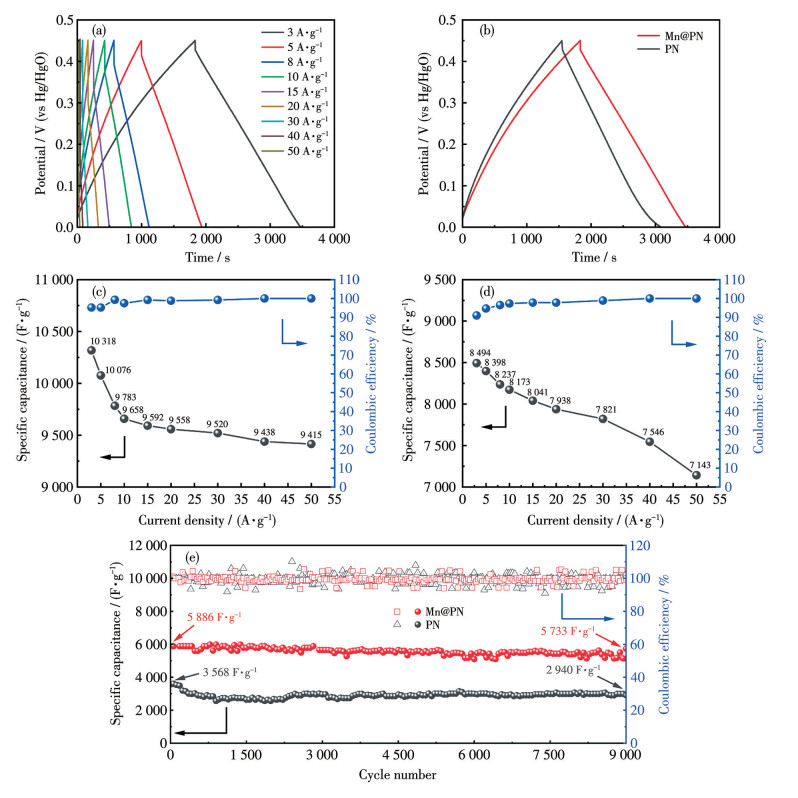
The GCD test accurately reveals the energy storage characteristics of the electrode material. When the voltage was set above 0.45 V, the Coulombic efficiency of Mn@PN was found to be below 98% (Fig.S8a). Therefore, the voltage of 0-0.45 V was selected for testing in the three-electrode system. As shown in Fig.3a, the GCD curves of the Mn@PN electrode at a current density of 3-50 A·g-1 all exhibited a highly symmetrical triangle, indicating excellent electrochemical reversibility and pseudocapacitive properties. Compared to the PN electrode (Fig.3b), the Mn@PN electrode showed a longer discharge time and a broader voltage platform at 3 A·g-1. This nonlinear charge/discharge characteristic originated from the good reversibility of the redox reaction, which is consistent with the CV curve results. The Mn@PN electrode demonstrated excellent specific capacitance and rate performance (Fig.3c), with a specific capacitance reaching an astonishing 10 318 F·g-1 at 3 A·g-1. Even at an ultra-high current density of 50 A·g-1, the Mn@PN electrode maintained a stable specific capacitance of 9 415 F·g-1, with a capacitance retention rate of 91.3%, which was 1.32 times that of the PN electrode (7 143 F·g-1) (Fig.3d). The Coulombic efficiency of the Mn@PN electrode was 93% at 3 A·g-1 and stabilized above 95% in the range of 5-50 A·g-1, confirming its excellent charge transfer efficiency under high-speed charge/discharge cycles. These outstanding electrochemical properties are attributed to the extended conjugated system and multi-electron sites in Mn@PN, which reduce the energy barrier for charge transfer in the material and facilitate the insertion/migration of large-radius K+ ions[34]. The surface storage and release of K+ on the Mn@PN electrode enable rapid transmission at various current densities. Notably, increasing the current density has minimal impact on the specific capacitance of the Mn@PN electrode. Cyclic stability is a crucial indicator for evaluating the performance of electrode materials (Fig.3e). After 9 000 cycles at 30 A·g-1, the Mn@PN electrode retained 97.4% of its initial capacitance, corresponding to an ultra-low capacitance decay rate of 0.003‰ per cycle, significantly outperforming the PN electrode (0.002% per cycle). These results underscore the exceptional cyclic stability of the Mn@PN electrode.
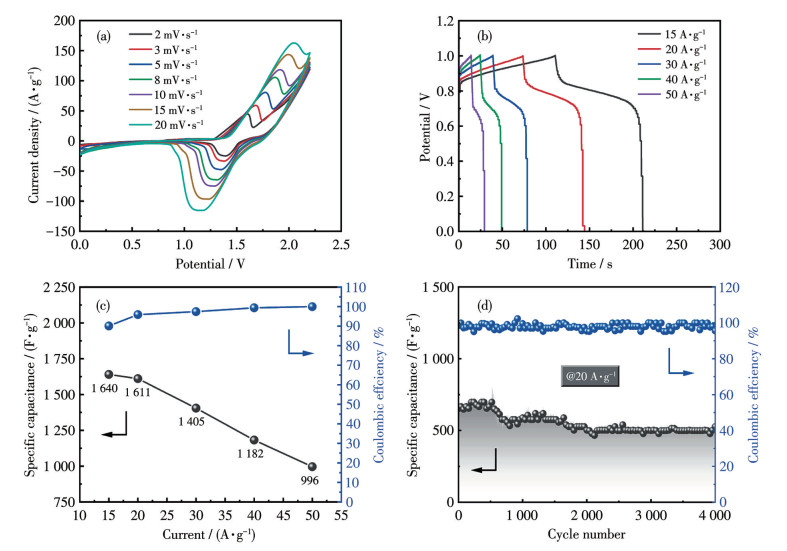
Based on the high theoretical specific capacitance of the Mn@PN electrode, an asymmetric supercapacitor (Mn@PN||AC) was assembled with 3 mol·L-1 KOH as the electrolyte, Mn@PN as the working electrode, and AC as the counter electrode, to systematically evaluate its practical application potential. As shown in Fig.4a, within a broad voltage window of 0-2.2 V and in the range of 2-20 mV·s-1, the CV curves retained their morphology without noticeable polarization effects, indicating the superior electrochemical reversibility of Mn@PN||AC. The GCD curve (Fig.4b) further substantiates the rate capability of the material. The Coulombic efficiency of Mn@PN||AC decreased significantly when the voltage exceeded 1.0 V (Fig.S8b). Therefore, a voltage window of 0-1.0 V was selected for testing. Mn@PN||AC demonstrated stable operation even under high current densities spanning 15 to 50 A·g-1, while maintaining an exceptional Coulombic efficiency (≥95%). Specifically, the specific capacitances recorded were 1 640 F·g-1 at 15 A·g-1, 1 405 F·g-1 at 30 A·g-1, and still 996 F·g-1 at the elevated rate of 50 A·g-1 (Fig.4c). The cyclic stability assessment (Fig.4d) revealed that after 4 000 deep charge/discharge cycles at 20 A·g-1, the capacitance retention stood at 84.4%, accompanied by a minimal single-cycle decay rate of merely 0.024%. Furthermore, the Ragone plot (Fig.5) illustrated that Mn@PN achieved a remarkable maximum power density of 44 kW·kg-1 alongside an energy density of 328 Wh·kg-1, outperforming recently reported Mn-based and conductive polymer electrode systems[35-41]. Consequently, Mn@PN emerges as a frontrunner in high-performance supercapacitor materials.
In summary, compared to other traditional polymer materials (e.g., PANI and polypyrrole) and carbon-based materials (e.g., biomass-derived carbons), Mn@PN demonstrated significantly enhanced reversible capacitance, rate capability, and cycling stability, especially at high current densities. The possible reasons are as follows: (ⅰ) PN may exhibit a bipolar energy storage mechanism, which combines the advantages of both n- and p-type organic materials, allowing for efficient energy storage and release[42]. (ⅱ) PN is a conjugated polymer formed via the oxidative polymerization of 1, 5-DAN. Its unique structure provides the electrode material with higher mechanical strength and effectively suppresses structural relaxation during charging and discharging, enabling the material to operate stably at high current densities. (ⅲ) The uniform doping of Mn single atoms within the polymer matrix is achieved through a simple oxidative polymerization method. This Mn doping further improves the material's electronic conductivity and forms Mn-N coordination structures within the PN framework. This effectively increases the energy density by providing more active sites for energy storage.
In this study, a highly stable Mn@PN electrode for supercapacitor was successfully synthesized via chemical oxidative polymerization. The Mn@PN electrode demonstrated an exceptional specific capacitance of 10 318 F·g-1 at a current density of 3 A·g-1. Additionally, the Mn@PN electrode exhibited remarkable ultra-high rate performance, retaining 91.2% of its specific capacitance when the current density increased to 50 A·g-1. The assembled asymmetric supercapacitor (Mn@PN||AC) achieved an energy density of 328 Wh·kg-1 and a power density of 44 kW·kg-1, maintaining a capacitance retention rate of 84.4% after 4 000 charge/discharge cycles. Overall, the Mn@PN electrode offers a novel approach to developing next-generation energy storage devices with both high energy and high power.
LIU B, LIU G, TANG Y B, CHENG H M. Advanced materials and energy technologies towards carbon neutrality[J]. Sci. China Mater., 2022, 65(12): 3187-3189 doi: 10.1007/s40843-022-2324-0
NAVARRO G, TORRES J, BLANCO M, NÁJERA J, SANTOS-HERRAN M, LAFOZ M. Present and future of supercapacitor technology applied to powertrains, renewable generation and grid connection applications[J]. Energies, 2021, 14(11): 3060 doi: 10.3390/en14113060
HUANG S F, ZHU X L, SARKAR S, ZHAO Y F. Challenges and opportunities for supercapacitors[J]. APL Mater., 2019, 7(10): 100901 doi: 10.1063/1.5116146
YI T F, QIU L Y, MEI J, QI S Y, CUI P, LUO S H, ZHU Y R, XIE Y, HE Y B. Porous spherical NiO@NiMoO4@PPy nanoarchitectures as advanced electrochemical pseudocapacitor materials[J]. Sci. Bull., 2020, 65(7): 546-556 doi: 10.1016/j.scib.2020.01.011
KUMAR M S, K Y Y, DAS P, MALIK S, KOTHURKAR N K, BATABYAL S K. Urea-mediated synthesized carbon quantum dots to tune the electrochemical performance of polyaniline nanorods for supercapacitor device[J]. J. Sci. Adv. Mater. Dev., 2022, 7(2): 100403
NASKAR P, MAITI A, CHAKRABORTY P, KUNDU D, BISWAS B, BANERJEE A. Chemical supercapacitors: A review focusing on metallic compounds and conducting polymers[J]. J. Mater. Chem. A, 2021, 9(4): 1970-2017 doi: 10.1039/D0TA09655E
MENG Q F, CAI K F, CHEN Y X, CHEN L D. Research progress on conducting polymer based supercapacitor electrode materials[J]. Nano Energy, 2017, 36: 268-285 doi: 10.1016/j.nanoen.2017.04.040
LIU T Y, FINN L, YU M H, WANG H Y, ZHAI T, LU X H, TONG Y X, LI Y. Polyaniline and polypyrrole pseudocapacitor electrodes with excellent cycling stability[J]. Nano Lett., 2014, 14(5): 2522-2527 doi: 10.1021/nl500255v
BAKER C O, HUANG X W, NELSON W, KANER R B. Polyaniline nanofibers: Broadening applications for conducting polymers[J]. Chem. Soc. Rev., 2017, 46(5): 1510-1525 doi: 10.1039/C6CS00555A
WU Y G, ZHANG J Y, FEI Z P, BO Z S. Spiro-bridged ladder-type poly(p-phenylene)s: Towards structurally perfect light-emitting materials[J]. J. Am. Chem. Soc., 2008, 130(23): 7192-7193 doi: 10.1021/ja801422n
LEE J B, KALIN A J, YUAN T Y, AL-HASHIMI M, FANG L. Fully conjugated ladder polymers[J]. Chem. Sci., 2017, 8(4): 2503-2521 doi: 10.1039/C7SC00154A
ABDEL A M, YOUSEF U S, LIMOSIN D, PIERRE G. Electro-oxidative oligomerization of 1, 5-diaminonaphthalene in acetonitrile medium[J]. J. Electroanal. Chem., 1996, 417(1/2): 163-173
JACKOWSKA K, BUKOWSKA J, JAMKOWSKI M. Synthesis, electroactivity and molecular structure of poly(1, 5-diaminonaphthalene)[J]. J. Electroanal. Chem., 1995, 388(1/2): 101-108
LI H L, WANG J X, CHU Q X, WANG Z, ZHANG F B, WANG S C. Theoretical and experimental specific capacitance of polyaniline in sulfuric acid[J]. J. Power Sources, 2009, 190(2): 578-586 doi: 10.1016/j.jpowsour.2009.01.052
ACERCE M, CHIOVOLONI S, HERNANDEZ Y, ORTUNO C, QIAN J, LU J. Poly(1, 5-diaminonaphthalene)-grafted monolithic 3D hierarchical carbon as highly capacitive and stable supercapacitor electrodes[J]. ACS Appl. Mater. Interfaces, 2021, 13(45): 53736-53745 doi: 10.1021/acsami.1c13746
STAVALE F, SHAO X, NILIUS N, FREUND H J, PRADA S, GIORDANO L, PACCHIONI G. Donor characteristics of transition-metal-doped oxides: Cr-doped MgO versus Mo-doped CaO[J]. J. Am. Chem. Soc., 2012, 134(28): 11380-11383 doi: 10.1021/ja304497n
GÜNGÖR A, BAKAN-MISIRLIOGLU F, GENÇ ALTURK R, ERDEM E. Elevating supercapacitor performance: Enhancing electrochemical efficiency with transition metal-doped polyaniline electrode[J]. J. Energy Storage, 2024, 76: 110143 doi: 10.1016/j.est.2023.110143
YAN L J, NIU L Y, SHEN C, ZHANG Z K, LIN J H, SHEN F Y, GONG Y Y, LI C, LIU X J, XU S Q. Modulating the electronic structure and pseudocapacitance of δ-MnO2 through transitional metal M (M=Fe, Co and Ni) doping[J]. Electrochim. Acta, 2019, 306: 529-540 doi: 10.1016/j.electacta.2019.03.174
XU X D, LIU W, KIM Y, CHO J. Nanostructured transition metal sulfides for lithium ion batteries: Progress and challenges[J]. Nano Today, 2014, 9(5): 604-630 doi: 10.1016/j.nantod.2014.09.005
MOHD ABDAH M A A, AZMAN N H N, KULANDAIVALU S, SULAIMAN Y. Review of the use of transition-metal-oxide and conducting polymer-based fibres for high-performance supercapacitors[J]. Mater. Des., 2020, 186: 108199 doi: 10.1016/j.matdes.2019.108199
ZHU C R, YANG L, SEO J K, ZHANG X, WANG S, SHIN J, CHAO D L, ZHANG H, MENG Y S, FAN H J. Self-branched α-MnO2/δ-MnO2 heterojunction nanowires with enhanced pseudocapacitance[J]. Mater. Horiz., 2017, 4(3): 415-422 doi: 10.1039/C6MH00556J
HUANG Z H, SONG Y, FENG D Y, SUN Z, SUN X Q, LIU X X. High mass loading MnO2 with hierarchical nanostructures for supercapacitors[J]. ACS Nano, 2018, 12(4): 3557-3567 doi: 10.1021/acsnano.8b00621
YUAN L Y, LU X H, XIAO X, ZHAI T, DAI J J, ZHANG F C, HU B, WANG X, GONG L, CHEN J, HU C G, TONG Y X, ZHOU J, WANG Z L. Flexible solid-state supercapacitors based on carbon nanoparticles/MnO2 nanorods hybrid structure[J]. ACS Nano, 2012, 6(1): 656-661 doi: 10.1021/nn2041279
DHIBAR S, BHATTACHARYA P, HATUI G, SAHOO S, DAS C K. Transition metal-doped polyaniline/single-walled carbon nanotubes nanocomposites: Efficient electrode material for high performance supercapacitors[J]. ACS Sustain. Chem. Eng., 2014, 2(5): 1114-1127 doi: 10.1021/sc5000072
BRYAN A M, SANTINO L M, LU Y, ACHARYA S, D′ARCY J M. Conducting polymers for pseudocapacitive energy storage[J]. Chem. Mater., 2016, 28(17): 5989-5998 doi: 10.1021/acs.chemmater.6b01762
MIKE J F, LUTKENHAUS J L. Recent advances in conjugated polymer energy storage[J]. J. Polym. Sci. Pt. B‒Polym. Phys., 2013, 51(7): 468-480 doi: 10.1002/polb.23256
ISLAM S, ALFARUQI M H, SONG J, KIM S, PHAM D T, JO J, KIM S, MATHEW V, BABOO J P, XIU Z L, KIM J. Carbon-coated manganese dioxide nanoparticles and their enhanced electrochemical properties for zinc-ion battery applications[J]. J. Energy Chem., 2017, 26(4): 815-819 doi: 10.1016/j.jechem.2017.04.002
FENG J, GAO H, ZHENG L, CHEN Z, ZENG S, JIANG C, DONG H, LIU L, ZHANG S, ZHANG X. A Mn-N3 single-atom catalyst embedded in graphitic carbon nitride for efficient CO2 electroreduction[J]. Nat. Commun., 2020, 11(1): 4341 doi: 10.1038/s41467-020-18143-y
GUO Z, XIE Y, XIAO J, ZHAO Z J, WANG Y, XU Z, ZHANG Y, YIN L, CAO H, GONG J. Single-atom Mn-N4 site-catalyzed peroxone reaction for the efficient production of hydroxyl radicals in an acidic solution[J]. J. Am. Chem. Soc., 2019, 141(30): 12005-12010 doi: 10.1021/jacs.9b04569
GHOSH D, GIRI S, MANDAL A, DAS C K. Supercapacitor based on H+ and Ni2+ co-doped polyaniline-MWCNTs nanocomposite: Synthesis and electrochemical characterization[J]. RSC Adv., 2013, 3(29): 11676 doi: 10.1039/c3ra40955d
CHEN Y C, XIE Y B. Electrochemical performance of manganese coordinated polyaniline[J]. Adv. Electron. Mater., 2019, 5(12): 1900816 doi: 10.1002/aelm.201900816
BIESINGER M C, PAYNE B P, GROSVENOR A P, LAU L W M, GERSON A R, SMART R S C. Resolving surface chemical states in XPS analysis of first row transition metals, oxides and hydroxides: Cr, Mn, Fe, Co and Ni[J]. Appl. Surf. Sci., 2011, 257(7): 2717-2730 doi: 10.1016/j.apsusc.2010.10.051
VOGT H. Note on a method to interrelate inner and outer electrode areas[J]. Electrochim. Acta, 1994, 39(13): 1981-1983 doi: 10.1016/0013-4686(94)85077-1
ZHU C Z, KALIN A J, FANG L. Covalent and noncovalent approaches to rigid coplanar π-conjugated molecules and macromolecules[J]. Acc. Chem. Res., 2019, 52(4): 1089-1100 doi: 10.1021/acs.accounts.9b00022
LAI X J, DANG Z Q, WANG L, LI P, YANG Y F, WANG C. Electropolymerization of 1, 5-diaminonaphthalene in water-in-reline electrolyte as supercapacitor electrode material[J]. J. Energy Storage, 2024, 91: 112032 doi: 10.1016/j.est.2024.112032
WANG N N, DING G P, YANG X H, ZHAO L J, HE D Y. Membrane MnO2 coated Fe3O4/CNTs negative material for efficient full-pseudocapacitance supercapacitor[J]. Mater. Lett., 2019, 255: 126589 doi: 10.1016/j.matlet.2019.126589
GHOSH K, YUE C Y, SK M M, JENA R K. Development of 3D urchin-shaped coaxial manganese dioxide@polyaniline (MnO2@ PANI) composite and self-assembled 3D pillared graphene foam for asymmetric all-solid-state flexible supercapacitor application[J]. ACS Appl. Mater. Interfaces, 2017, 9(18): 15350-15363 doi: 10.1021/acsami.6b16406
CAKICI M, KAKARLA R R, ALONSO-MARROQUIN F. Advanced electrochemical energy storage supercapacitors based on the flexible carbon fiber fabric-coated with uniform coral-like MnO2 structured electrodes[J]. Chem. Eng. J., 2017, 309: 151-158 doi: 10.1016/j.cej.2016.10.012
MA Y H, FU Y, WEI N, ZHU J B, NIU H J, QIN C L, JIANG X K. Polyaniline/manganese nickel oxide/graphene composites as electrode materials for supercapacitors[J]. J. Appl. Polym. Sci., 2023, 140(46): e54672 doi: 10.1002/app.54672
LEE C C, OMAR F S, NUMAN A, DURAISAMY N, RAMESH K, RAMESH S. An enhanced performance of hybrid supercapacitor based on polyaniline-manganese phosphate binary composite[J]. J. Solid State Electrochem., 2017, 21(11): 3205-3213 doi: 10.1007/s10008-017-3624-1
DAS T, VERMA B. Polyaniline based ternary composite with enhanced electrochemical properties and its use as supercapacitor electrodes[J]. J. Energy Storage, 2019, 26: 100975 doi: 10.1016/j.est.2019.100975
YAN L, ZHU Q, QI Y, XU J, PENG Y, SHU J, MA J, WANG Y G. Towards high-performance aqueous zinc batteries via a semi-conductive bipolar-type polymer cathode[J]. Angew. Chem. ‒Int. Edit., 2022, 61(42): e202211107 doi: 10.1002/anie.202211107

Figure 1 (a) TEM image and (b) HAADF-STEM image and corresponding elemental mappings of Mn@PN; (c) FTIR spectra and (d) XRD patterns of 1, 5-DAN, PN, and Mn@PN

Figure 2 (a) CV curves of Mn@PN at different scan rates; (b) CV curves of Mn@PN and PN at 1 mV·s-1; (c) Nyquist plots of Mn@PN and PN; (d) b-values of Mn@PN for different peaks; (e) Diffusion control contribution rate of Mn@PN at 5 mV·s-1; (f) Relative contributions of surface-controled and diffusion-controled to the charge storage process of Mn@PN at various scan rates
Inset: corresponding equivalent circuit diagram.

Figure 3 (a) GCD curves of Mn@PN at various current densities; (b) GCD curves of Mn@PN and PN at 3 A·g-1; Corresponding specific capacitances after iR-drop correction of (c) Mn@PN and (d) PN at various current densities; (e) Cycling performance of Mn@PN and PN at 30 A·g-1

Figure 4 (a) CV curves, (b) GCD curves, (c) corresponding specific capacitance after iR-drop correction, and (d) cycling performance of Mn@PN||AC

 扫一扫看文章


扫一扫关注我们
 下载:
下载:
 下载:
下载:
