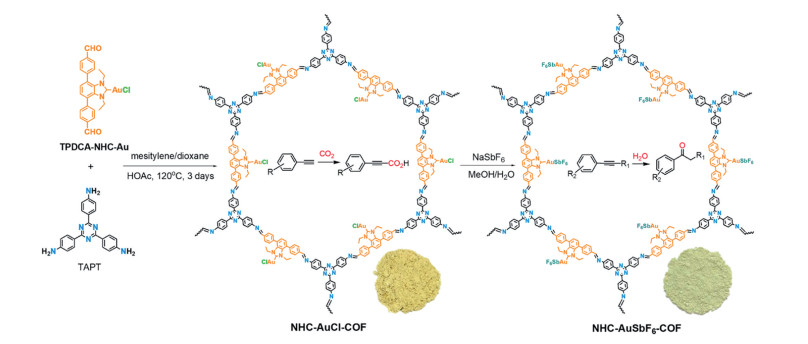
Figure 1.
Synthesis process and catalytic application of NHC-AuCl-COF and NHC-AuSbF6-COF[101]

Advances in electrocatalytic and photocatalytic CO2 conversion to value-added chemicals using copper-based covalent organic frameworks
Yue LI , Ziqi LIU , Ke FENG , Yingdan LI , Yue NING , Li SHEN , Jitao LU , Qingguo MENG , Min WANG , Haiying WANG


In the past century, the extensive extraction and use of fossil fuels such as oil, coal, and natural gas have led to a significant amount of CO2 being emitted into the atmosphere, disrupting the original "carbon cycle" primarily driven by biological metabolism, and causing a surge in CO2 concentration in the atmosphere[1-2]. This has resulted in irreversible impacts on the Earth′s environment. Against the backdrop of global energy shortages and severe environmental degradation, directly converting CO2 into various carbon-based hydrocarbons can achieve "negative emissions" of carbon[3], and is also a strategy that serves two purposes: it not only alleviates excessive CO2 emissions but also provides energy and industrial raw materials for human development.
Therefore, the strategy of reducing CO2 to valuable chemicals is most beneficial for achieving lower carbon emissions and mitigating the greenhouse effect[4-9]. Due to the high thermodynamic stability of CO2 molecules, a significant amount of energy is required for CO2 conversion. This can typically be achieved through techniques such as photocatalytic reduction[10-23] and electrochemical reduction[24-28]. Among these, photocatalytic CO2 reduction utilizes solar energy as the sole energy source to convert CO2 and water into hydrocarbons directly. Electrocatalytic CO2 reduction utilizes external voltage as the primary energy source to achieve the catalytic conversion of CO2 at an appropriate negative potential.
Covalent organic framework (COF) is a two-dimensional (2D) or three-dimensional (3D) crystalline porous organic polymer composed of organic building blocks connected by covalent bonds[29-37]. Currently, chemists have synthesized numerous COF materials with diverse topological structures and functions using various synthesis strategies[38-44]. Their unique structure and chemical stability make them have broad application prospects in separation[45-53], catalysis[54-59], energy and environmental science[60-69], biomedical[70-79], solar cell light energy conversion[80-84], proton conduction[85-88], semiconductors[89-90], photoluminescence[91-93], enantiomer separation[94-97], adsorption of radioactive elements[98], detection and removal of pollutants[99-100], and other fields. On the other hand, as a class of organic porous materials, COFs do not contain metals and therefore cannot meet the requirements of catalytic applications involving metal catalysts. Therefore, the design and synthesis of metalized COFs can not only make up for the shortcomings of COFs in this regard but also greatly broaden the application range of COFs in the field of catalysis. The so-called metallization process, which involves combining metal ions with COFs, includes direct synthesis and post-synthetic modification approaches. In the direct synthesis of metallized COFs, monomers containing metal complexes can be constructed to precisely control the position and quantity of metals within the COFs. However, due to the slight differences in the physical and chemical properties of metallized and non-metallized monomers, it is necessary to optimize the synthesis conditions multiple times during the construction of COFs. In addition, metal complexes may not be stable under certain harsh reaction conditions. Currently, the post-synthetic modification method provides new ideas for the synthesis of metallized COFs. In this approach, metals are introduced into the COFs through direct coordination or monomer exchange, and their content is controlled by adjusting the concentration and the time of the reaction system, while the COFs retain their original framework structure. According to the location of the metal, the introduction of metal active centers can be divided into three categories: (1) the metal coordinates with the COF building blocks in the form of ions; (2) the metal coordinates with the COF linking units in the form of ions; (3) the metal is embedded in the COFs in the form of nanoparticles.
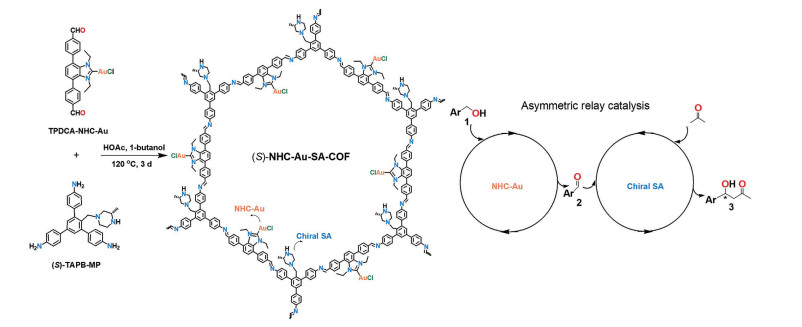
Our research group has been engaged in the synthesis, design, and performance research of COFs for a long time. We have also achieved certain research results in metal catalysis[101-102]. A novel NHC-AuCl-COF was prepared under solvothermal conditions[101]. Subsequently, NHC-AuSbF6-COF was prepared by ion exchange from NHC-AuCl-COF (Fig.1). As a heterogeneous catalyst, NHC-AuCl-COF can efficiently catalyze the carboxylation reaction of terminal alkynes and CO2 under mild conditions. Compared with NHC-AuCl-COF, NHC-AuSbF6-COF exhibited higher catalytic activity in the hydration reaction of terminal alkynes. A chiral COF (CCOF) with an imine linkage was constructed by direct polymerization[102]. The obtained (S)-NHC-Au-SA-COF had dual catalytic active sites, which can efficiently catalyze the asymmetric series reaction of aryl methanol oxidation, aldol condensation with heterogeneous catalysis (Fig.2).
Therefore, the research and design of metallized COFs is gradually becoming one of the research hotspots in recent years. It is imperative to design novel, efficient, and highly selective metallized COFs. Currently, copper (Cu), as one of the most common catalysts capable of converting CO2, has long attracted widespread attention from researchers[103-104]. Cu has a moderate adsorption energy for *CO intermediates, which is beneficial for maintaining the balance between adsorption and desorption on the catalyst surface. Therefore, Cu sites embedded in the COF can promote the adsorption and activation of CO2, thereby lowering the energy barriers for the formation of different intermediates and improving the CO2 reduction performance of the catalyst. In this review, we present the research progress on Cu-based COF[105-107], including the synthesis methods of Cu-based COFs and applications in the fields of electrocatalysis and photocatalysis.
Researchers generally agree that the electrocatalytic CO2 reduction reaction (CO2RR) consists of four main steps: (1) CO2 molecules are chemisorbed on the cathode catalyst surface; (2) CO2 molecules are activated into intermediate free radicals *CO2-; (3) multiple electron/proton transfers occur to form hydrocarbons; (4) products desorb from the electrocatalyst surface. Mechanistic studies of electrocatalytic CO2RR have found that the rate and product distribution of the catalytic reaction are mainly affected by the active sites, surface properties, and electron transfer effects of the catalyst. Among them, the characteristics and number of active sites, as well as their adsorption capacity for reaction substrates, directly determine the activity of the catalyst; while the physical and chemical properties of the catalyst surface affect the adsorption and desorption behavior of reactants and products on the catalyst surface, thereby affecting the rate and direction of the catalytic reaction; the electron transfer effect is related to the migration and distribution of charges during the catalytic process and is also a key factor determining catalytic efficiency. Therefore, the design of novel, efficient, and highly selective electrocatalysts is particularly important. Cu-based COFs with regular structures can be used for electrocatalytic CO2RR due to the following characteristics: (1) the porous structure increases the contact speed between the substrate and the active sites; (2) abundant active sites promote the adsorption and conversion of CO2; (3) the rational arrangement between building units and active sites makes the electron transfer and mass transfer properties adjustable. In this section, we will elucidate the importance of Cu-based COFs in electrocatalytic CO2RR.
Currently, Cu is considered an effective electrocatalyst for producing C2+ products via CO2RR. Its moderate adsorption energy for intermediates allows these intermediates to remain on the catalyst surface with sufficient opportunities for C—C coupling with neighboring intermediates, which is the rate-determining step for generating C2H4. To achieve efficient conversion of CO2 to multi-carbon products, researchers have made significant efforts to enhance both the activity and selectivity of CO2 conversion to C2H4.
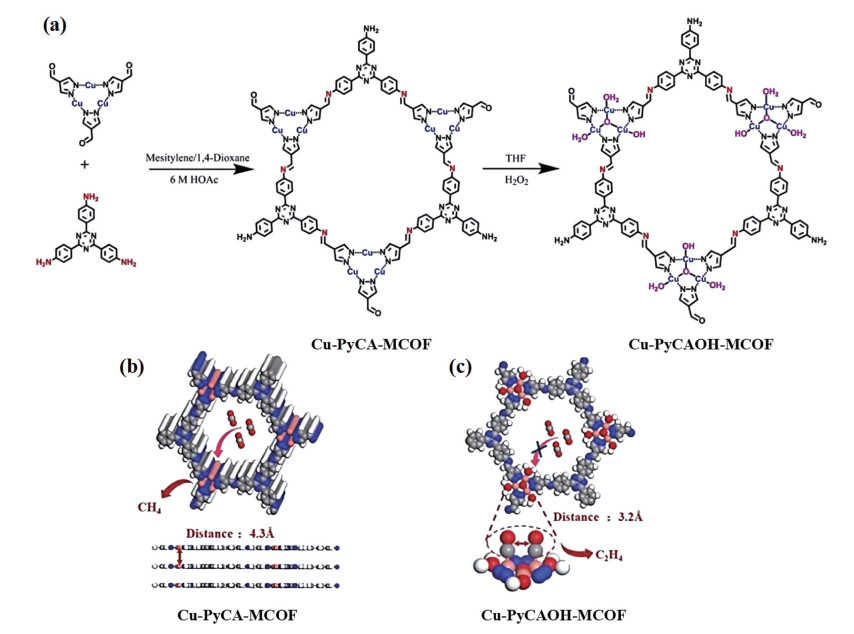
Huang et al. stated that the coordination structure of materials can affect the selectivity of reactions[108]. They prepared Cu-PyCA-MCOF from copper-pyrazolate complex and 2,4,6-tris(4-aminophenyl)-1,3,5-triazine under solvothermal conditions. Afterwards, nanosheet Cu-PyCAOH-MCOF was obtained by treating Cu-PyCA-MCOF with H2O2 at room temperature (Fig.3a). Although Cu-PyCA-MCOF and Cu-PyCAOH-MCOF had similar topological structures, they exhibited significantly different selectivity in CO2RR (Fig.3b). When Cu-PyCA-MCOF was used as a catalyst, the main product of electrocatalytic CO2RR was CH4, while Cu-PyCAOH-MCOF promoted the formation of more valuable chemical C2H4. On the one hand, this is attributed to the advantage of the nanosheet structure in exposing the Cu sites of Cu-PyCAOH-MCOF, which effectively contact the electrolyte and CO2 from a direction perpendicular to the plane of the trinuclear Cu cluster. On the other hand, the coordination of oxygen species (μ3-O, OH-/H2O) not only changes the charge density distribution of Cu centers of Cu-PyCAOH-MCOF, reducing the formation energy of *COOH, but also affects the attack direction of CO2. Thus, it effectively promotes the C—C coupling reaction and efficiently converts CO2 into C2H4. This work opens a new avenue for improving the conversion performance of C2+ products in CO2RR by adjusting the coordination structure of Cu-based electrocatalysts.
In electrocatalytic CO2RR, the selectivity for acetate is typically lower than that for ethylene. This is attributed to the different pathways for CO2 conversion to ethylene and acetate, respectively. CO2 conversion to ethylene involves C—C coupling of *CO with *CO or *CHO, a process that requires the synergistic effect of adjacent catalytic sites. However, CO2 conversion to acetate requires C—C coupling of *CH3 and CO2, for which single or isolated active sites are beneficial. Benefiting from uniform and isolated active sites, Cu-based COFs exhibit great potential in efficient electrocatalytic CO2 reduction for acetate production.
Liao et al. prepared a stable and conductive 2D COF, named PcCu-TFPN, with a singular copper phthalocyanine center (Fig.4)[109]. PcCu-TFPN was synthesized by reacting Cu(Ⅱ) 2,3,9,10,16,17,23,24-octahydroxyphthalocyanine (PcCu-(OH)8) with 2,3,5,6-tetrafluorobenzonitrile (TFPN) in a vacuum at 150 ℃ for 3 d. PcCu-TFPN exhibited an excellent selectivity in electrocatalytic CO2RR for acetate [Faraday efficiency (FE): 90.3%], with a current density of 12.5 mA·cm-2 at -0.8 V (vs RHE). Due to PcCu-TFPN being a single active site catalyst, *CO species can be converted into *CH3 through hydrogenation reaction, which then couples with CO2 to form acetate. To certify this hypothesis, the authors synthesized a metal organic framework, PcCu-CuO, which consists of PcCu-(OH)8 ligands and square planar CuO4 nodes, where CuO4 is the second active site. The results showed that the main product of PcCu-CuO was C2H4, while PcCu-TFPN promoted the reaction to mainly produce C2H4 and C2H5OH. These results indicate that with a second active site that generates CO or in the presence of CO gas molecules, the isolated copper-phthalocyanine active site will catalyze the reduction of CO2 to produce C2H4 and C2H5OH in the CO2 atmosphere. To further investigate the catalytic mechanism of acetate production of PcCu-TFPN, the authors analyzed and compared two recently reported catalysts with similar isolated Cu-N4 catalytic sites, namely the single-atom Cu catalyst (CuSAC) and Cu-porphyrin-based COF (Cu-porphyrin). Among them, the CO2RR product of CuSAC was CO, and the product of Cu-porphyrin was CH4. This may be due to the unstable adsorption of *CO intermediates in CuSAC, leading to desorption of *CO instead of further hydrogenation. The energy barrier in Cu-porphyrin (0.29 eV) for the formation of *OOCCH3 by the combination of *CH3 and CO2 was much higher than that in PcCu-TFPN (0.55 eV), indicating that Cu-porphyrin is more conducive to the production of CH4.
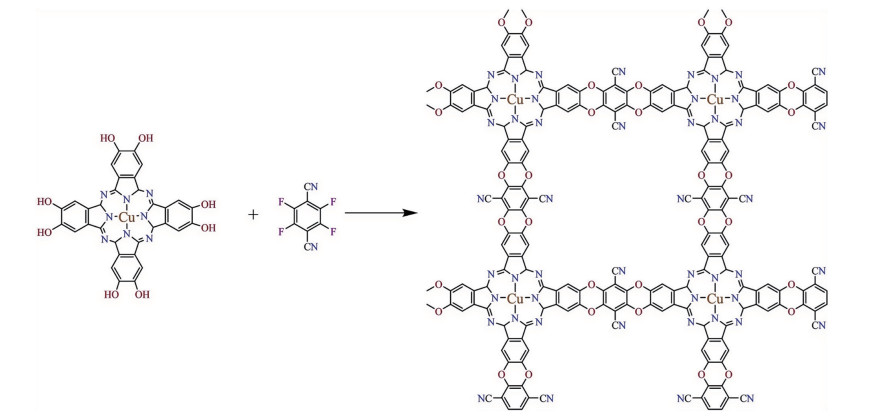
Reaction conditions: dimethylacetamide, 1,3,5-trimethylbenzene, 150 ℃, 3 d, 85% yield.
CH4 is a crucial strategic energy source. It is cleaner than coal and oil and plays an indispensable role in the current energy system. However, the electroreduction of CO2 to methane is a complex process. This process faces two major challenges: the need to activate water molecules to provide protons and competition with the strong hydrogen evolution side reaction. Researchers have successfully created a unique microenvironment by integrating Cu into a COF. This environment efficiently activates both CO2 and water, and stabilizes reaction intermediates, thereby effectively guiding the reaction towards methane production while suppressing hydrogen generation.
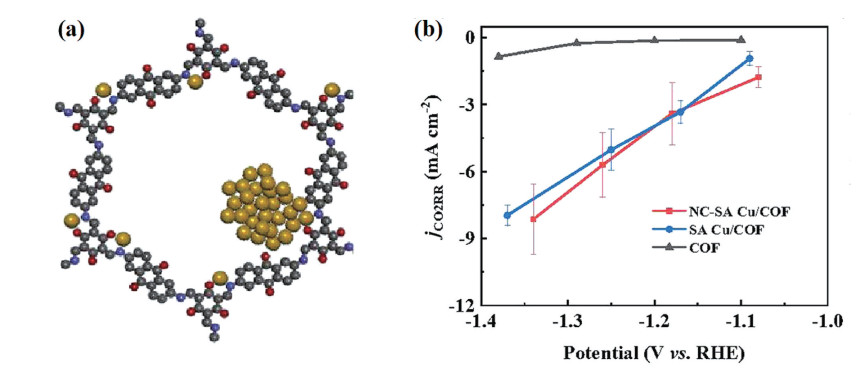
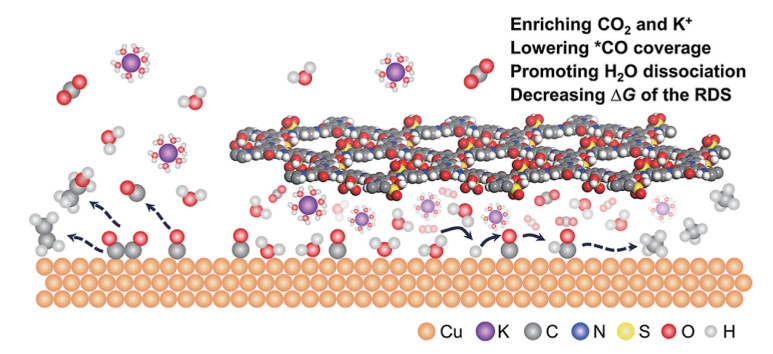
Shao et al. developed a tandem electrocatalyst composed of Cu single atoms (SAs) and nanoclusters (NCs) to achieve the conversion of CO2 to CH4 (Fig. 5a)[110]. Firstly, COF grew on a glassy carbon electrode by in-situ polymerization using 2,6-diaminoanthraquinone and 2,4,6-triformylphloroglucinol. Afterwards, different types of Cu aggregates were deposited onto the electrode by an electrodeposition method. When an electrochemical reduction potential of 0.12 V (vs Ag/AgCl) was applied to the electrode for 100 s, Cu SA was formed in the COF network (referred to as SA Cu/COF). As the electrodeposition time increased, many Cu atoms aggregated to form Cu NCs (referred to as NC-SA Cu/COF). The FEs of products at different potentials indicate that the catalytically active sites in the CO2RR are Cu atoms, rather than the COF. After 1 h of catalysis, the morphology of COF retained its original appearance, and no other products were detected in the electrolyte after reaction. Interestingly, although NC-SA Cu/COF and SA Cu/COF had similar CO2 reduction current densities (Fig.5b), there were significant differences in catalytic products. This indicated that Cu NCs of NC-SA Cu/COF play a crucial role in the CO2RR, altering the pathway of CO2 conversion to CH4. This may be related to the synergistic effect between SA Cu/COF and Cu NCs, where CO generated on SA Cu/COF is rapidly transferred to the nearby Cu NCs and is subsequently reduced to CH4. In addition, coordinated K+ ions can promote CO2 adsorption activation and H2O dissociation by stabilizing the more electronegative O atoms in the adsorbed material.
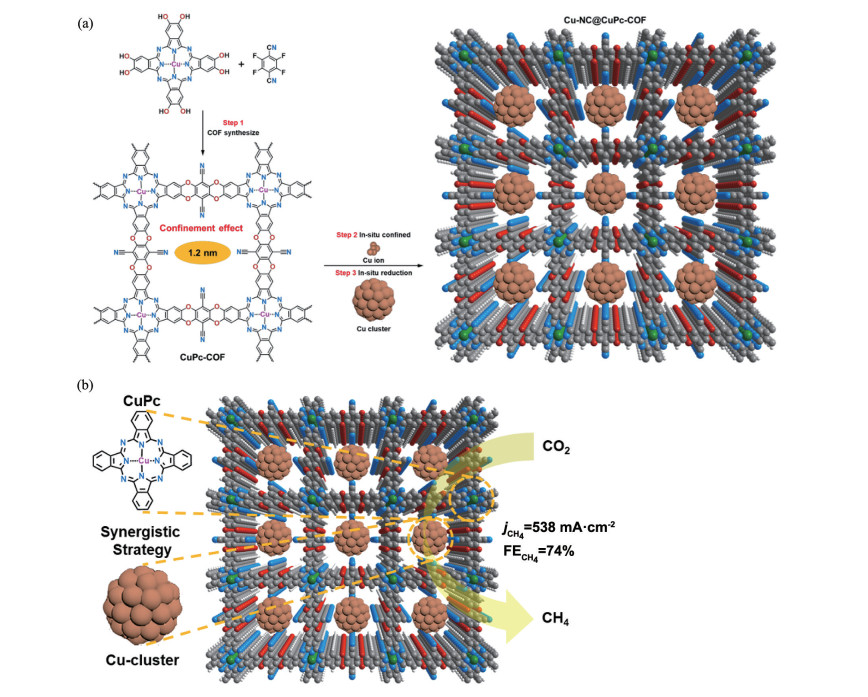
Lan et al. designed and synthesized cyanide-containing COFs to uniformly support and encapsulate metal NCs[111]. Firstly, 2,3,9,10,16,17,23,24-octahydroxyphthalocyaninato copper (CuPc) underwent a condensation reaction with tetrafluorophthalonitrile (TFPN) to obtain a Cu-phthalocyanine COF (CuPc-COF). Afterwards, CuPc-COF and hexahydrate copper perchlorate were mixed by the hydrothermal method. Then Cu(Ⅱ) ions were reduced using hydrazine hydrate to obtain the final product Cu-NC@CuPc-COF (Fig.6a). During this process, the coordination interaction between —CN and Cu in the COF pores guided the formation of Cu-NCs, and the confinement effect resulted in their uniform dispersion. The diffraction peaks in the powder X-ray diffraction (PXRD) pattern indicate that COFs had high crystallinity, but no obvious diffraction peaks of Cu-NCs were observed in the Cu-NC@CuPc-COF PXRD pattern. The porosity and surface areas of COFs were studied through nitrogen adsorption-desorption experiments at 77 K. Compared with CuPc-COF, the surface area and pore size of Cu-NC@CuPc-COF had significantly decreased. These results indicated that Cu-NCs of approximately the same size occupied the pores of COF, and these Cu-NCs were extremely small and uniformly dispersed. Cu-NC@CuPc-COF as a gas diffusion electrode, achieved the FE (CH4) of ca. 74.3% at a potential of 1.0 V (vs RHE), along with a current density of 538.31 mA·cm-2 at a potential of 1.2 V (vs RHE), which is significantly higher than the corresponding values of most existing advanced electrocatalysts and exceeds the relevant industrial current density (200 mA·cm-2) (Fig.6b). The in-situ Fourier transform infrared (FTIR) spectroscopy results showed that the Cu atoms and Cu-NCs in the composite material have a synergistic effect on the catalytic active sites during CO2 reduction. This work provides a new paradigm for designing highly active CO2 electrocatalytic reduction catalysts using pore confinement effects and synergistic strategies.
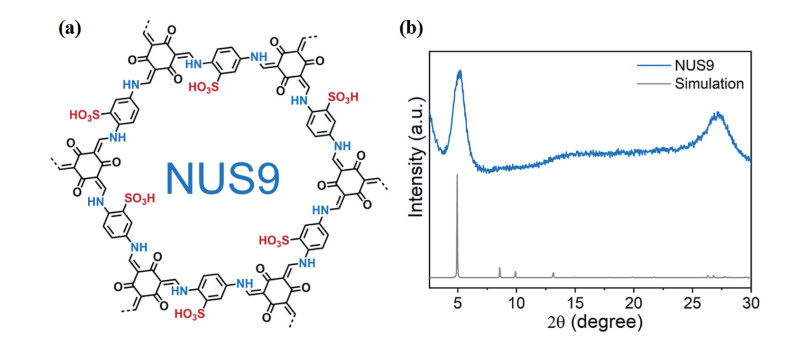
Wang′s group modulated the microenvironment of Cu nanoparticles (Cu NPs) using an ionomer of COF nanosheets containing heteroatoms and sulfonic acid groups, meeting the requirements for CO2 reduction at industrial-grade current densities[112]. First, NUS9 nanosheets were prepared using 2,5-diaminobenzenesulfonic acid and 1, 3, 5-triformylphloroglucinol (Fig.7a). PXRD patterns of NUS9 showed two significant peaks at 4.9° and 27° (Fig.7b). Subsequently, a mixture obtained by mixing Cu NPs with the NUS9 ionomer (named Cu-NUS9) was coated on a gas diffusion layer to construct a catalyst layer. The catalyst layer was tested in a three-electrode flow cell using 0.5 mol·L-1 potassium sulfate as an acidic electrolyte. Experiments showed that in the CO2 reduction to CH4 process catalyzed by Cu-NUS9, FE was 66%, and the current density was 296 mA·cm-2. In addition, Cu-NUS9 could operate continuously for 9 h at a current density of 200 mA·cm-2 and maintain good stability. The authors also elucidated the mechanism of the main product transition in the CO2RR through experiments and theoretical calculations (Fig.8). They stated that the porous structure of the Cu-NUS9 nanosheets improved the adsorption and conversion rate of CO2, while the high charge structure and carbonyl groups in the framework were beneficial for cation enrichment. These synergistic effects enabled the CO2RR to proceed over a wide pH range.
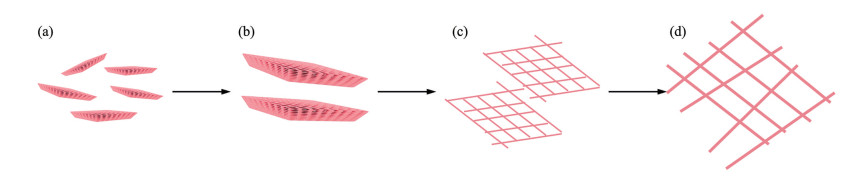
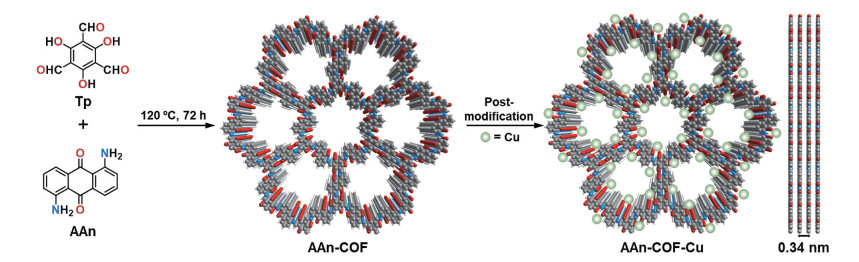
Lan et al. synthesized anthraquinone-based COFs with a one-dimensional superstructure via a condensation reaction, investigated the formation mechanism of the anthraquinone-based COF morphology, and explored their CO2RR performance[113]. First, AAn-COF nanofibers with a one-dimensional superstructure were prepared using a Schiff-base condensation reaction between 1,3,5-triformylphloroglucinol and 1,5-diaminoanthraquinone (Fig.9). To investigate the formation mechanism of the nanofibers, the authors recorded the morphological changes of AAn-COF at different reaction times (Fig.10). Small nanoparticles appeared after 1 h of reaction, and then the small nanoparticles gradually grew larger and stacked to produce nanosheets. Then, the size of the nanosheets increased, and nanofibers began to grow on their surface as the reaction time was extended. When the reaction proceeded for 24 h, all the nanosheets were transformed into uniform nanofibers. As the reaction time continued to increase, the surface of the nanofibers began to become rough, gradually forming a mace-like nanofiber. This process adopted a bottom-up self-templating mechanism. For comparison, the authors synthesized OH-AAn-COF hollow tubes, performed similar structural characterization, and studied the formation mechanism. Unlike the formation mechanism of AAn-COF, the synthesis process of OH-AAn-COF involved a nanosheet curling mechanism. In addition, AAn-COF and OH-AAn-COF were separately added to an aqueous solution of Cu(OAc)2 and refluxed for 72 h, yielding AAn-COF-Cu and OH-AAn-COF-Cu, respectively. AAn-COF-Cu and OH-AAn-COF-Cu exhibited excellent catalytic activity in CO2RR. Specifically, FECH4 of OH-AAn-COF-Cu was 61% (99.5 mA·cm-2, 1.0 V). FECH4 of AAn-COF-Cu was 77% (128.1 mA·cm-2, 0.9 V). This FECH4 was relatively high among reported crystalline COFs. This work provides a general method for designing COF electrocatalysts with different morphologies in the CO2RR process.
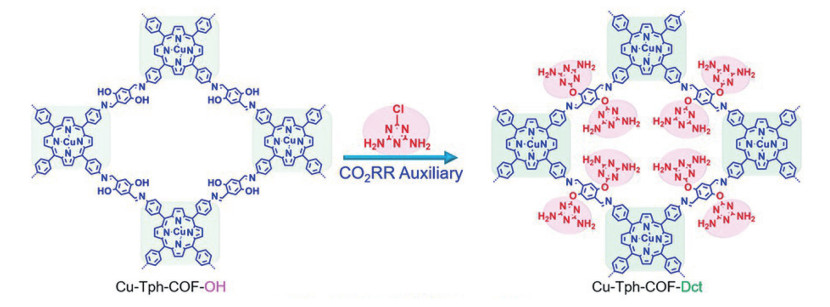
Lan′s group proposed a strategy based on functionalized exfoliants that can simultaneously modify bulk COFs and exfoliate them into functionalized nanosheets, while also exploring their electrocatalytic performance for CO2RR[114]. This strategy exposes more active sites in the exfoliated COFs, resulting in a larger surface area, which significantly enhances the contact area between reactants and intermediates, as well as the selectivity of the reaction towards CH4. First, Cu-Tph-COF-OH was prepared under solvothermal conditions, and then Cu-Tph-COF-Dct was synthesized in the presence of the functionalized exfoliant (2,4-diamino-6-chloro-1,3,5-triazine, Dct) (Fig.11). It was shown that the PXRD patterns of Cu-Tph-COF-Dct and Cu-Tph-COF-OH were essentially consistent. In CO2 adsorption experiments at 273 and 298 K, Cu-Tph-COF-Dct exhibited a higher CO2 absorption capacity compared to Cu-Tph-COF-OH. TEM tests revealed that the morphology of Cu-Tph-COF-Dct was nanosheets with a thickness of approximately 3.8 nm. The authors conducted electrochemical tests in a flow cell, where at -0.90 V, FECH4 was 80%, with a current density of -220.0 mA·cm-2. Notably, the FECH4 of Cu-Tph-COF-Dct remained above 68% over a wide potential range from -0.8 to -1.0 V. Additionally, the catalytic mechanism of CO2RR and the influence of Dct on the reaction were systematically studied through theoretical calculations. The amino and triazine structures in the Dct group enhanced the availability of CO2 and regulated the coverage of *CO on the catalyst surface, thereby effectively promoting the conversion of CO2 to CH4. This work provides a very important method for generating valuable chemicals through CO2RR.
Reaction conditions: 1,4-dioxane, triethylamine, 90 ℃, 6 h.
Generally, the photocatalytic CO2RR process is similar to the electrocatalytic CO2RR, including four aspects: (1) the photocatalyst is photoexcited to generate carrier electron-hole pairs; (2) efficient separation and transfer of electron-hole pairs; (3) adsorption and activation of CO2; (4) separated electrons and holes are transferred to the catalyst surface and participate in redox reactions. According to the above basic principles, an ideal photocatalyst for CO2 reduction needs to meet the following conditions: (1) strong light absorption capacity; (2) large specific surface area; (3) suitable band structure; (4) abundant active sites; (5) high electron-hole pair separation efficiency and charge transfer efficiency; (6) strong CO2 adsorption capacity. Fortunately, Cu-based COFs have effective photocatalytic active sites. When they act as photocatalysts for CO2RR, they can meet the above requirements because they have the following advantages: (1) the ordered arrangement and combination of various building units and active sites make the band structure and active sites adjustable; (2) high surface area and porous structure increase the possibility of contact between the substrate and active sites; (3) the conjugated and heterojunction structures existing in the framework are conducive to the separation and migration of electron/hole pairs; (4) multiple active sites can improve the absorption and activation of CO2. This section will discuss the photocatalytic structure-activity relationship of Cu-based COFs with photocatalytically active sites.
Cu-based COF photocatalytic reduction of CO2 to CH4 is a cutting-edge research direction in the field of artificial photosynthesis. This technology cleverly combines the Cu active center with the designable structure of COFs, achieving highly selective conversion of CO2. Although challenges remain in catalytic efficiency, material stability, and preparation costs, this innovative strategy provides an important theoretical basis and technical pathway for developing efficient solar fuel conversion systems.
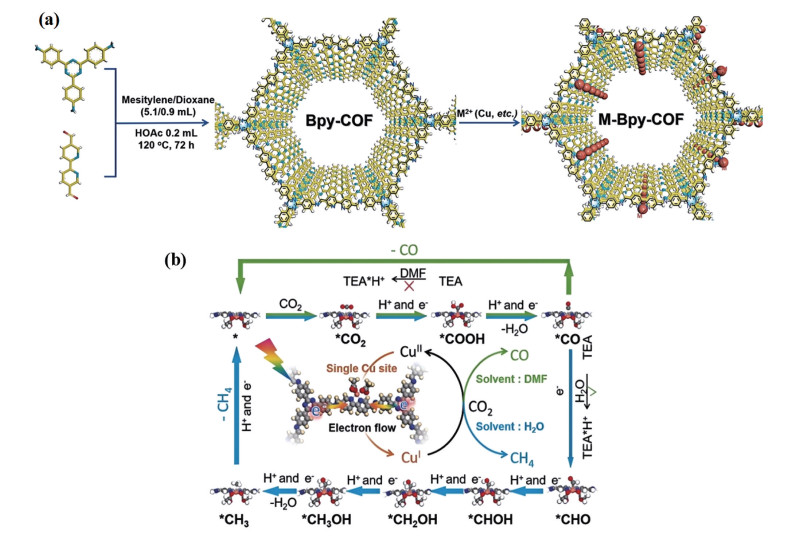
Lan et al. synthesized Bpy-COF using the typical solvothermal method through the imine condensation reaction of 1,3,5-tris(4-aminophenyl) triazine and 2,2″-bipyridine-5,5″-dicarboxaldehyde[115]. Then, they used the bipyridine unit in Bpy-COF to connect a single non-precious metal Cu site, obtaining Cu-Bpy-COF (Fig.12a). The prepared Cu-Bpy-COF exhibited high selectivity and efficiency in aqueous photocatalytic CO2 reduction without photosensitizers. Experiments and DFT calculations have shown that single Cu sites can act as active centers, promoting the activation and adsorption of CO2 molecules, thereby achieving almost 100% selective directional conversion of CO2 to CO or CH4 (Fig.12b). It is also found that the triethylamine has a dual function, serving as both a sacrificial agent and a proton transfer catalyst for CO2 reduction. It can capture protons from H2O to further reduce *CO to CH4 due to its lower dissociation energy.
Photocatalytic conversion of CO2 into high-value carbon monoxide was one of the key technologies for achieving the "dual carbon" goals. Cu-based COFs offer an innovative solution for this: their ordered channels can efficiently concentrate CO2, while precisely integrated Cu sites not only promote photogenerated charge separation but also significantly reduce the CO2 activation energy barrier, preferentially generating CO rather than deeply reduced CH4. Through molecular-level structural design, the adsorption energy of intermediates can be optimized, thereby achieving efficient and highly selective production of CO, providing a very promising research path for solar-driven carbon resource conversion.
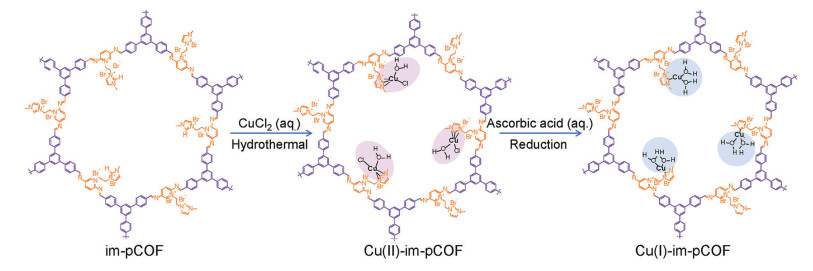
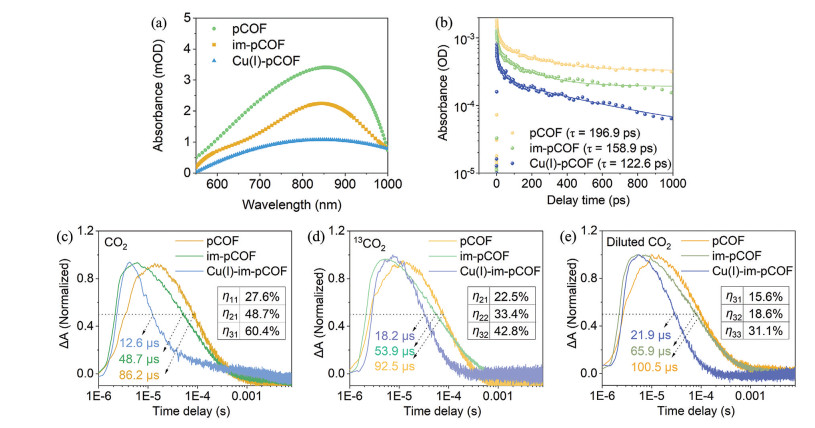
Jing et al. successfully synthesized a mesoporous donor-acceptor pyridine-based COF (pCOF) with broad-spectrum light absorption properties using the solvothermal method, and subsequently prepared ultrathin pCOF nanosheets in the solvent of 1-methyl-2-pyrrolidinone using the ultrasonic exfoliation method[116]. Then, ionic liquid portions were covalently attached to the pyridine N of pCOF through an aromatic N-quaternization reaction to obtain im-pCOF. Subsequently, using CuCl2 as the metal source and EmimBr-derived NHC ligand as the anchor site, a single Cu(Ⅱ) atom was successfully fixed in the pores of pCOF (denoted as Cu(Ⅱ)-im-pCOF). Further reduction treatment of Cu(Ⅱ)-im-pCOF with ascorbic acid resulted in the formation of a single Cu(Ⅰ) atom (Fig.13). The catalytic effect of the obtained Cu(Ⅰ)-im-pCOF is superior to that of a single Cu(Ⅱ) atomic photocatalyst. The CO2 conversion rate of Cu(Ⅰ)-im-pCOF in pure water was 184.8 μmol·g-1·h-1, and the selectivity toward CO2 reduction to produce CO was approximately 100%. It is worth noting that during the reduction process of low-concentration CO2 (CO2/N2 with a volume ratio of 10%), the photocatalyst also maintained 87.5% of its inherent photoactivity. Compared with single Cu(Ⅱ) atoms, single Cu(Ⅰ) atoms had higher electron capture and CO2 adsorption/activation capabilities. Further study the overall electron dynamics by combining fs- and μs-transient absorption spectroscopy (TAS). It has been confirmed that a single Cu(Ⅰ) atom can rapidly extract electrons from the electron-rich region of pCOF along the NHC ligand at an electron transfer rate of 3×10⁹ s-1 and promote the adsorption and activation of CO2 (Fig.14a, 14b). Through in-situ isotope μs-TAS measurement, the electron transfer efficiency could reach 60.4% and 31.1% in the reduction process of pure CO2 and diluted CO2, respectively (Fig.14c-14e). This work provides a research solution for the application of photocatalysts based on COF in energy conversion.
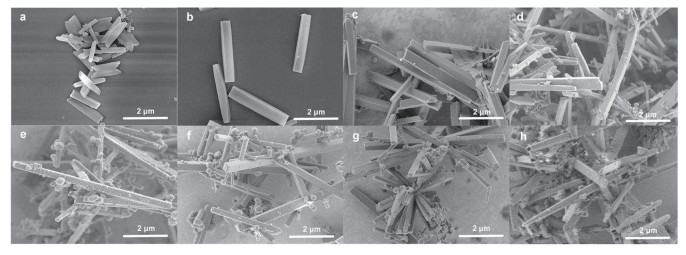
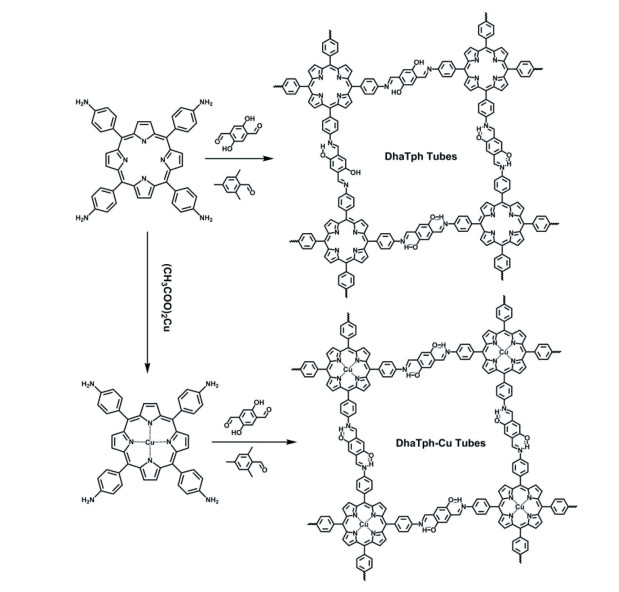
Yang′s group synthesized DhaTph using 5,10,15,20-tetra(4-aminophenyl)-porphyrin (Tph) and 2,5-dihydroxyterephthal-aldehyde (Dha) as monomers[117]. When synthesizing DhaTph-Cu, Tph was first complexed with Cu(CH3COO)2 to form a complex and then subjected to a condensation reaction under similar conditions. The hollow DhaTph Tubes and DhaTph-Cu Tubes were prepared under solvothermal conditions by a bottom-up template-free method using 2,4,6-trimethylbenzaldehyde (TBA) as a competitive reagent (Fig.15). To investigate the formation mechanism of COF tubular structures, the authors recorded the changes in morphology of DhaTph Tubes over time. Fig.16 shows SEM images at different time intervals during the formation process of DhaTph Tubes. When the system reacted for 0.5 h, a solid rectangular prism with a smooth surface was displayed. As time went on, the surface of the rectangular prism became rough, and some microcrystals appeared on the surface. The overflowing microcrystals gradually form large aggregates, forming hollow tubular structures within the rectangular prism. As the reaction time increased further, the outer tube wall became thinner and thinner. The formation mechanism of hollow DhaTph Tubes was speculated based on Ostwald maturation. In addition, under full light irradiation (200≤λ≤1 000 nm), without any cocatalysts or hole scavengers, the yield of the main product CO in the photocatalytic CO2RR over DhaTph-Cu Tubes was 15.9 μmol·g-1·h-1, which was about two and three times higher than that of DhaTph Tubes and DhaTph COF under the same experimental conditions. DhaTph-Cu Tubes exhibited excellent photostability, and even after three consecutive uses, the CO precipitation rate remained high at approximately 13.1 μmol·g-1·h-1. The CH4 production of DhaTph-Cu Tubes was 13.7 μmol·g-1·h-1, which was superior to the other two materials. They stated that due to the tubular structure and Cu(Ⅱ) anchoring on the porphyrin ring, DhaTph-Cu Tubes had rapid separation and transfer ability, thus exhibiting efficient photocatalytic activity.
Xu et al. obtained DHTA-TTA 2D COF by the solvothermal method using 2,5-dimethoxybenzene-1,4-dicarboxaldehyde (DHTA) and 4,4′,4″-(1,3,5-triazine-2,4,6-triyl)trianiline (TTA)[118]. Then, Cu-COF was prepared by mixing DHTA-TTA 2D COF and CuCl2 in acetonitrile (Fig.17a, 17b). The mass fraction of Cu in Cu-COF was 0.2%. The PXRD patterns of Cu-COF were similar to that of DHTA-TTA 2D COF, although the peak intensity became weaker (Fig.17c). The CO2 adsorption experiment at an ambient pressure of 25 ℃ showed that the Brunauer-Emmett-Teller (BET) specific surface area of Cu-COF was slightly lower than that of COF, but its CO2 adsorption capacity was higher, which was related to the Cu—O/N bonds in Cu-COF. In addition, Cu—O/N as the active center can selectively reduce CO2 to CO under visible light (> 420 nm) irradiation and in the absence of any photosensitizer. The activity and selectivity of Cu-COF did not show significant deactivation during the fifth use, and no Cu-derived nanoclusters or nanoparticles were observed on Cu-COF. To further investigate the process of photocatalytic reduction of CO2, the author studied the reaction mechanism through UV-visible absorption spectroscopy, the photoluminescence transient time-resolved decay measurement, and in situ electron paramagnetic resonance experiments. The above experimental results indicated that Cu-COF had good photothermal stability.
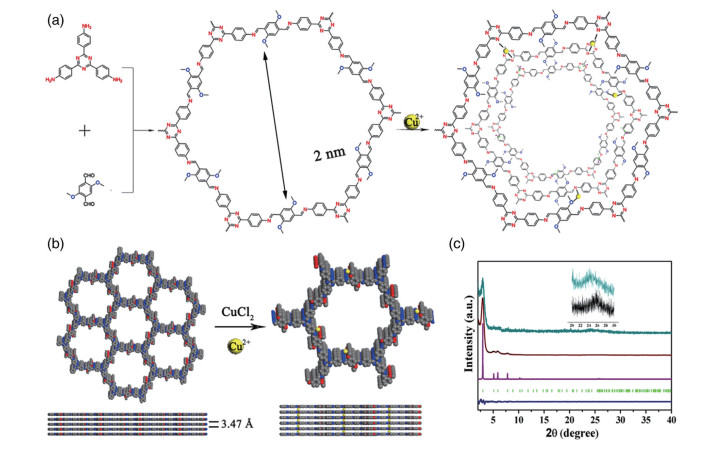
Reaction conditions: 1,2-dichlorobenzene, 1-butanol, 120 ℃, 36 h, CuCl2; In c: comparison between the experimental (black) and Pawley refined (red) profiles, the simulated pattern for AA stacking mode (purple), the refinement differences (blue), and experimental PXRD patterns for Cu-COF (dark cyan).
Photocatalytic CO2 reduction to produce easily storable liquid HCOOH is one of the ideal routes to achieve carbon resource recycling. Cu-based COFs have demonstrated unique potential in this field: their highly designable pore environment can precisely anchor Cu active sites and effectively stabilize the key *OCHO intermediate in the HCOOH production pathway through specific interactions between the skeleton functional groups and reaction intermediates, thereby significantly improving reaction activity and HCOOH selectivity. This strategy provides a blueprint for developing efficient and specific photocatalysts for CO2-to-HCOOH conversion.
Kim′s group prepared ethynyl-linked photogate catalyst ZnCu-COF through polymerization reaction between Zn(Ⅱ) 5,10,15,20-tetrakis (4-bromophenyl)porphyrin (ZnBPP) and Cu(Ⅱ) 5,15-bis(pentafluorophenyl)-10,20-bis(4-ethynylphenyl)porphyrin (CuFPP), and characterized the properties of the catalyst using commonly used characterization techniques[119]. The mass fractions of Zn (3.06%) and Cu (5.93%) in the material were analyzed using inductively coupled plasma-optical emission spectrometry (ICP-OES). For comparison, the author also synthesized single-metal COFs (Zn-COF and Cu-COF) to investigate the role of Zn and Cu sites in electronics during the photocatalytic process. Photoelectrochemical characterizations indicate that the excellent photocatalytic performance is attributed to the synergistic effect between Zn/Cu structures, which facilitates efficient charge transfer within the framework. The AB-stacked structure results in a periodic arrangement of multiple Zn and Cu active centers in the skeleton. Each Zn-porphyrin photoresponsive center is connected to four Cu-porphyrin catalytic units to form a square structure, which promotes energy and electron transfer (Fig.18). The energy transfer and electron diffusion within ZnCu-COF occur from the ZnBPP compartment to the CuFPP compartment. Cu atom centers enrich the electrons of zinc photocenters through electron diffusion, which affects the energy of Cu3d orbitals and determines the electronic state dispersion of Cu3d orbitals under the excited states. When ZnCu-COF was used as a catalyst, the yields of HCOOH, CO, and H2 were 138.6, 12.7, and 4.3 μmol·g-1·h-1, respectively, with HCOOH selectivity of 89.1%, which was superior to that of the Zn-COF and Cu-COF. By manipulating the orbital energy/interacting orientation between Cu3d and C2pz orbital of HCOOH, Cu sites promote CO2 absorption and nucleophilic reaction of *COOH intermediates, resulting in higher HCOOH selectivity of ZnCu-COF than that of Zn-COF and Cu-COF.
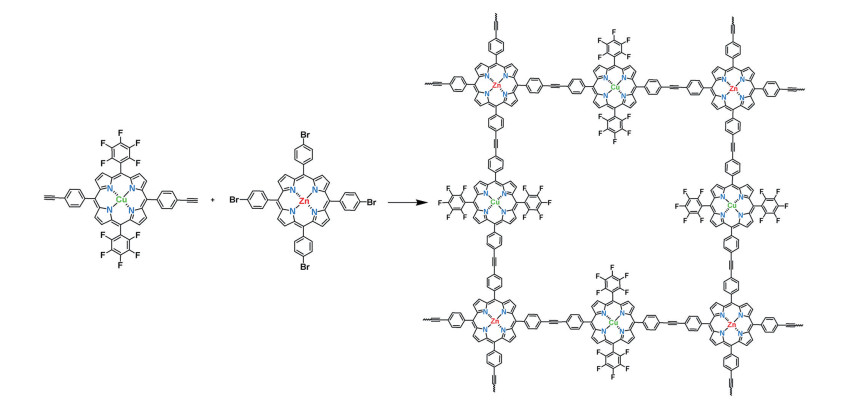
Reaction conditions: triethylamine, tetrahydrofuran, triphenylphosphine, Pd(Ⅱ) acetate, cuprous iodide, 130 ℃, 120 h.
Developing photochemical and electrochemical reduction conversion technologies for CO2 is not only an effective way to reduce carbon emissions and realize the resource utilization of pollutants, but also of great significance in promoting green economic growth and sustainable development. As an emerging organic crystalline functional material, Cu-based COFs have been widely applied in the field of CO2 reduction, exhibiting many excellent properties in photocatalytic and electrocatalytic applications. Here, we summarize the research progress of Cu-based COFs in this area, covering Cu-based COFs synthesis strategies and examples of electrocatalytic and photocatalytic CO2 reduction conversion.
Cu-based COFs possess large specific surface areas, providing abundant active sites for photocatalytic and electrocatalytic reactions, effectively enhancing the apparent activity of the catalytic process. Furthermore, their unique electronic structure offers special electron transport and distribution capabilities during CO2 reduction, thereby modulating the energy barriers and kinetics of the reaction process and enabling precise control over the catalytic process. More importantly, because the framework structure of Cu-based COFs is composed of strong covalent bonds, they can usually maintain their structural stability under water, organic solvents, bases, acids, reducing, and oxidizing conditions, thus extending the lifespan of the catalyst. Therefore, Cu-based COF catalysts, with their excellent performance, demonstrate great application potential and have become an important frontier area in current catalytic science.
With the advancement of research, chemists have constructed numerous COF materials with diverse topologies and functionalities through various synthetic strategies. Continuous progress in characterization techniques and theoretical calculations has opened innovative pathways for elucidating the structure-property relationship, significantly deepening researchers′ understanding and design capabilities for high-performance materials. The breakthrough advancements in artificial intelligence technology are reshaping the paradigm of new material development, and its powerful data analysis and model prediction capabilities are opening unprecedented innovative space for designing high-performance, multifunctional materials. Considering the enormous development potential of COFs, we sincerely hope that this review can inspire future researchers and motivate them to accelerate the leapfrog development of COFs from laboratory-based fundamental research to industrial-scale CO2 utilization applications.
FAN L, XIA C, YANG F Q, WANG J, WANG H T, LU Y Y. Strategies in catalysts and electrolyzer design for electrochemical CO2 reduction toward C2+ products[J]. Sci. Adv., 2020, 6: eaay3111 doi: 10.1126/sciadv.aay3111
HAN N, DING P, HE L, LI Y Y, LI Y G. Promises of main group metal-based nanostructured materials for electrochemical CO2 reduction to formate[J]. Adv. Energy Mater., 2019, 10: 1902338
YAN Y L, BORHANI T N, SUBRAVETI S G, PAI K N, PRASAD V, RAJENDRAN A, NKULIKIYINKA P, ASIBOR J O, ZHANG Z N, SHAO D, WANG L J, ZHANG W B, YAN Y, AMPOMAH W, YOU J Y, WANG M H, ANTHONY E J, MANOVIC V, CLOUGH P T. Harnessing the power of machine learning for carbon capture, utilisation, and storage (CCUS)—A state-of-the-art review[J]. Energy Environ. Sci., 2021, 14: 6122-6157 doi: 10.1039/D1EE02395K
HE C H, DUAN D L, LOW J X, BAI Y, JIANG Y W, WANG X Y, CHEN S M, LONG R, SONG L, XIONG Y J. Cu2-xS derived copper nanoparticles: A platform for unraveling the role of surface reconstruction in efficient electrocatalytic CO2-to-C2H4 conversion[J]. Nano Res., 2023, 16: 4494-4498 doi: 10.1007/s12274-021-3532-7
KIBRIA M G, EDWARDS J P, GABARDO C M, DINH C T, SEIFITOKALDANI A, SINTON D, SARGENT E H. Electrochemical CO2 reduction into chemical feedstocks: From mechanistic electrocatalysis models to system design[J]. Adv. Mater., 2019, 31: 1807166 doi: 10.1002/adma.201807166
LIM J W, DONG W J, PARK J Y, HONG D M, LEE J L. Spontaneously formed CuSx catalysts for selective and stable electrochemical reduction of industrial CO2 gas to formate[J]. ACS Appl. Mater. Interfaces, 2020, 12: 22891-22900 doi: 10.1021/acsami.0c03606
KURISINGAL J F, KIM H, CHOE H J, CHANG S H. Covalent organic framework-based catalysts for efficient CO2 utilization reactions[J]. Coord. Chem. Rev., 2022, 473: 214835 doi: 10.1016/j.ccr.2022.214835
WANG H Y, SU J, ZUO J L. Porous crystalline materials based on tetrathiafulvalene and its analogues: Assembly, charge transfer, and applications[J]. Acc. Chem. Res., 2024, 57: 1851-1869 doi: 10.1021/acs.accounts.4c00228
ZHU X L, ZHOU E L, TAI X S, ZONG H B, YI J J, YUAN Z M, ZHAO X L, HUANG P, XU H, JIANG Z Y. g-C3N4 S-scheme homojunction through van der Waals interface regulation by intrinsic polymerization tailoring for enhanced photocatalytic H2 evolution and CO2 reduction[J]. Angew. Chem.‒Int. Edit., 2025, 64: e202425439 doi: 10.1002/anie.202425439
ZHU X L, ZONG H B, CAMILO J V P, MIAO H H, SUN W, YUAN Z M, WANG S H, ZENG G X, XU H, JIANG Z Y, OZIN G A. Supercharged CO2 photothermal catalytic methanation: High conversion, rate, and selectivity[J]. Angew. Chem.‒Int. Edit., 2023, 135: e202218694 doi: 10.1002/ange.202218694
ZUO C, SU Q, JIANG Z Y. Advances in the application of Bi-based compounds in photocatalytic reduction of CO2[J]. Molecules, 2023, 28: 3982 doi: 10.3390/molecules28103982
ZUO C, SU Q, YAN X Y. Research progress of Co-catalysts in photocatalytic CO2 reduction: A review of developments, opportunities, and directions[J]. Processes, 2023, 11: 867 doi: 10.3390/pr11030867
WANG L H, TAI X S. Synthesis, structural characterization, Hirschfeld surface analysis and photocatalytic CO2 reduction activity of a new dinuclear Gd(Ⅲ) complex with 6-phenylpyridine-2-carboxylic acid and 1, 10-phenanthroline ligands[J]. Molecules, 2023, 28: 7595 doi: 10.3390/molecules28227595
TAI X S, YAN X H, WANG L H. Synthesis, structural characterization, Hirschfeld surface analysis, density functional theory, and photocatalytic CO2 reduction activity of a new Ca(Ⅱ) complex with a bis-Schiff base ligand[J]. Molecules, 2024, 29: 047
DONG H, CHE H T, BAI L W, ZHANG N N, TIAN Y Q, LI B Z, WANG Y, ZHANG X, ZHANG F M. Benzotrithiophene-based covalent organic frameworks with rhenium modified for artificial photosynthetic CO2 reduction[J]. Inorg. Chem., 2024, 63: 24421-24428 doi: 10.1021/acs.inorgchem.4c04599
MANDAL A, KARGUPTA K. Cu-doped 2D-Bi2MoO6 nanoribbon/rGO photocatalysts for selective ethanol production by photocatalytic CO2 reduction[J]. ACS Appl. Nano Mater., 2025, 8: 3471-3486 doi: 10.1021/acsanm.4c06608
WANG J X, GUO S E, XU C, JIANG Y Q, WU X M, YU P, XIAO Y T, SONG R J. Zinc-porphyrin conjugated polymer nanosheets with accelerated charge transfer dynamics for selective photocatalytic CO2 reduction to CH4[J]. ACS Appl. Nano Mater., 2025, 8: 2022-2032 doi: 10.1021/acsanm.4c06800
XIE K L, WU L P, LIAO Y Q, HU J J, LU K Q, WEN H R, HUO J R. Highly stable lanthanide-organic frameworks based on {Ln6O8} clusters with photocatalytic reduction of CO2 to CO[J]. Inorg. Chem., 2025, 64: 638-645 doi: 10.1021/acs.inorgchem.4c03799
YAN Y K, WANG Y, PENG C X, WANG J, WANG X S, SHI L. Single-atom Ni sites with asymmetric coordination structures for efficient photocatalytic CO2 reduction[J]. ACS Sustain. Chem. Eng., 2025, 13: 1628-1636 doi: 10.1021/acssuschemeng.4c08332
YANG J L, CHEN Z H, ZHANG L, ZHANG Q C. Covalent organic frameworks for photocatalytic reduction of carbon dioxide: A review[J]. ACS Nano, 2024, 18: 21804-21835 doi: 10.1021/acsnano.4c06783
ZHANG J J, ZHENG M, WU Y, XIONG J, LI S Z, JIANG W, LIU Z, DI J. Strongly coupled interface in electrostatic self-assembly covalent triazine framework/Bi19S27Br3 for high-efficiency CO2 photoreduction[J]. ACS Nano, 2025, 19: 2759-2768 doi: 10.1021/acsnano.4c15225
ZHANG H Y, SU Q. Recent advances of indium-based sulfides in photocatalytic CO2 reduction[J]. ACS Omega, 2025, 10: 8793-8815 doi: 10.1021/acsomega.4c09487
ZHU Y R, XUE Y L, WANG Z, CHAO D B. Robust noble metal-free photoconversion of CO2 to CO with a molecule/MOF hybrid catalyst for straightforward two-chamber organic carbonylation[J]. ACS Catal., 2025, 15: 3546-3557 doi: 10.1021/acscatal.4c07343
LIU H, GUO R T, YAN J S, GUO S H, YU L Q, PAN W G. Progress and prospect of application of two-dimensional materials in electrochemical CO2 reduction: A review[J]. Energy Fuels, 2024, 38: 16010-16025 doi: 10.1021/acs.energyfuels.4c03022
LIU J W, PENG D, LIU S J, WEN H R, ZHU Z H, ZHAO J, CHEN J L. New insight into the conjugation effect of tetranuclear copper(Ⅰ) cluster catalysts for efficient electrocatalytic reduction of CO2 into CH4[J]. ACS Sustain. Chem. Eng., 2025, 13: 2564-2573 doi: 10.1021/acssuschemeng.4c09723
MEI B B, MAO J N, LIANG Z F, SUN F F, YANG S, LI J; MA J Y, SONG F, ZHENG J. Reversible angle distortion-dependent electrochemical CO2 reduction on cobalt phthalocyanine[J]. J. Am. Chem. Soc., 2025, 147: 5819-5827 doi: 10.1021/jacs.4c14409
MENG F F, DONG M, HE J T, GU J X, YAO X H, SUN C Y, WANG X L, SU Z M. Metal cluster-based crystalline materials for the electrocatalytic reduction of carbon dioxide[J]. ACS Materials Lett., 2025, 7: 229-249 doi: 10.1021/acsmaterialslett.4c02064
SHAO W W, FAN W Y, GUAN H M, ZU X L, JIAO X C. Fundamentals and perspectives of positively charged single-metal site catalysts for CO2 electroreduction[J]. ACS Appl. Mater. Interfaces, 2025, 17: 10276-10291 doi: 10.1021/acsami.4c21988
XU H S, DING S Y, AN W K, WU H, WANG W. Constructing crystalline covalent organic frameworks from chiral building blocks[J]. J. Am. Chem. Soc., 2016, 138: 11489-11492 doi: 10.1021/jacs.6b07516
ZHANG J, HAN X, WU X W, LIU Y, CUI Y. Chiral DHIP- and pyrrolidine-based covalent organic frameworks for asymmetric catalysis[J]. ACS Sustain. Chem. Eng., 2019, 7: 5065-5071 doi: 10.1021/acssuschemeng.8b05887
ZHANG J, HAN X, WU X W, LIU Y, CUI Y. Multivariate chiral covalent organic frameworks with controlled crystallinity and stability for asymmetric catalysis[J]. J. Am. Chem. Soc., 2017, 139: 8277-8285 doi: 10.1021/jacs.7b03352
DONG B, WANG L Y, ZHAO S, GE R L, SONG X D, WANG Y, GAO Y A. Immobilization of ionic liquids to covalent organic frameworks for catalyzing the formylation of amines with CO2 and phenylsilane[J]. Chem. Commun., 2016, 52: 7082-7085 doi: 10.1039/C6CC03058K
TAN K T, GHOSH S, WANG Z Y, WEN F X, RODRÍGUEZ-SAN-MIGUEL D, FENG J, HUANG N, WANG W, ZAMORA F, FENG X L, THOMAS A, JIANG D L. Covalent organic frameworks[J]. Nat. Rev. Methods Primers, 2023, 3: 1 doi: 10.1038/s43586-022-00181-z
HUANG N, WANG P, JIANG D. Covalent organic frameworks: A materials platform for structural and functional designs[J]. Nat. Rev. Mater., 2016, 1: 16068 doi: 10.1038/natrevmats.2016.68
GUAN X, CHEN F, FANG Q, QIU S. Design and applications of three dimensional covalent organic frameworks[J]. Chem. Soc. Rev., 2020, 49: 1357-1384 doi: 10.1039/C9CS00911F
CÔTÉ A P, BENIN A I, OCKWIG N W, O′KEEFFE M, MATZGER A J, YAGHI O M. Porous, crystalline, covalent organic frameworks[J]. Science, 2005, 310: 1166-1170 doi: 10.1126/science.1120411
FENG X, DING X S, JIANG D L. Covalent organic frameworks[J]. Chem. Soc. Rev., 2012, 41: 6010-6022 doi: 10.1039/c2cs35157a
JIN F Y, NGUYEN H, ZHONG Z Y, HAN X, ZHU C H, PEI X K, MA Y H, YAGHI O M. Entanglement of square nets in covalent organic frameworks[J]. J. Am. Chem. Soc., 2022, 144: 1539-1544 doi: 10.1021/jacs.1c13468
FENG J, ZHANG Y J, MA S H, YANG C, WANG Z P, DING S Y, LI Y, WANG W. Fused-ring-linked covalent organic frameworks[J]. J. Am. Chem. Soc., 2022, 144: 6594-6603 doi: 10.1021/jacs.2c02173
MASCHITA J, BANERJEE T, SAVASCI G, HAASE F, OCHSENFELD C, LOTSCH B V. Ionothermal synthesis of imide-linked covalent organic frameworks[J]. Angew. Chem.‒Int. Edit., 2020, 59: 15750-15758 doi: 10.1002/anie.202007372
ZHAO Y B, GUO L, GÁNDARA F, MA Y H, LIU Z, ZHU C H, LYU H, TRICKETT C A, KAPUSTIN E A, TERASAKI O, YAGHI O M. A synthetic route for crystals of woven structures, uniform nanocrystals, and thin films of imine covalent organic frameworks[J]. J. Am. Chem. Soc., 2017, 139: 13166-13172 doi: 10.1021/jacs.7b07457
XIONG Z S, SUN B B, ZOU H B, WANG R W, FANG Q R, ZHANG Z T, QIU S L. Amorphous-to-crystalline transformation: General synthesis of hollow structured covalent organic frameworks with high crystallinity[J]. J. Am. Chem. Soc., 2022, 144: 6583-6593 doi: 10.1021/jacs.2c02089
ZHAO W, YAN P Y, YANG H F, BAHRI M, JAMES A M, CHEN H M, LIU L J, LI B Y, PANG Z F, CLOWES R, BROWNING N D, WARD J W, WU Y, COOPER A I. Using sound to synthesize covalent organic frameworks in water[J]. Nat. Synth., 2022, 1: 87-95 doi: 10.1038/s44160-021-00005-0
WANG L L, XU C W, ZHANG W Q, ZHANG Q L, ZHAO M L, ZENG C, JIANG Q L, GU C, MA Y G. Electrocleavage synthesis of solution-processed, imine-linked, and crystalline covalent organic framework thin films[J]. J. Am. Chem. Soc., 2022, 144: 8961-8968 doi: 10.1021/jacs.1c13072
ZHAO Y F, YAO K X, TENG B Y, ZHANG T, HAN Y. A perfluorinated covalent triazine-based framework for highly selective and water-tolerant CO2 capture[J]. Energy Environ. Sci., 2013, 6: 3684-3692 doi: 10.1039/c3ee42548g
WANG Z F, ZHANG Y S, LIU J J, CHEN Y, CHENG P, ZHANG Z J. Flux synthesis of two-dimensional covalent organic frameworks[J]. Nat. Protoc., 2024, 19: 3489-3519 doi: 10.1038/s41596-024-01028-5
WU C, XIA L, XIA S J, VAN DER BRUGGEN B, ZHAO Y. Advanced covalent organic framework-based membranes for recovery of ionic resources[J]. Small, 2023, 19: 2206041 doi: 10.1002/smll.202206041
LI B Y, ZHANG Y M, KRISHNA R, YAO K X, HAN Y, WU Z L, MA D X, SHI Z, PHAM T, SPACE B, LIU J, THALLAPALLY P K, LIU J, CHRZANOWSKI M, MA S Q. Introduction of π-complexation into porous aromatic framework for highly selective adsorption of ethylene over ethane[J]. J. Am. Chem. Soc., 2014, 136: 8654-8660 doi: 10.1021/ja502119z
HASELL T, MIKLITZ M, STEPHENSON A, LITTLE M A, CHONG S Y, CLOWES R, CHEN L J, HOLDEN D, TRIBELLO G A, JELFS K E, COOPER A I. Porous organic cages for sulfur hexafluoride separation[J]. J. Am. Chem. Soc., 2016, 138: 1653-1659 doi: 10.1021/jacs.5b11797
WANG Z F, ZHANG S N, CHEN Y, ZHANG Z J, MA S Q. Covalent organic frameworks for separation applications[J]. Chem. Soc. Rev., 2020, 49: 708-735 doi: 10.1039/C9CS00827F
YUAN S S, LI X, ZHU J Y, ZHANG G, VAN PUYVELDE P, VAN DER BRUGGEN B. Covalent organic frameworks for membrane separation[J]. Chem. Soc. Rev., 2019, 48: 2665-2681 doi: 10.1039/C8CS00919H
LI J, ZHOU X, WANG J, LI X F. Two-dimensional covalent organic frameworks (COFs) for membrane separation: A mini review[J]. Ind. Eng. Chem. Res., 2019, 58: 15394-15406 doi: 10.1021/acs.iecr.9b02708
SONG Q L, JIANG S, HASELL T, LIU M, SUN S J, CHEETHAM A K, SIVANIAH E, COOPER A I. Porous organic cage thin films and molecular-sieving membranes[J]. Adv. Mater., 2016, 28: 2629-2637 doi: 10.1002/adma.201505688
DING S Y, GAO J, WANG Q, ZHANG Y, SONG W G, SU C Y, WANG W. Construction of covalent organic framework for catalysis: Pd/COF-LZU1 in Suzuki-Miyaura coupling reaction[J]. J. Am. Chem. Soc., 2011, 133: 19816-19822 doi: 10.1021/ja206846p
FANG Q R, GU S, ZHENG J, ZHUANG Z B, QIU S L, YAN Y S. 3D microporous base-functionalized covalent organic frameworks for size-selective catalysis[J]. Angew. Chem.‒Int. Edit., 2014, 53, 2878-2882 doi: 10.1002/anie.201310500
XU H, GAO J, JIANG D L. Stable, crystalline, porous, covalent organic frameworks as a platform for chiral organocatalysts[J]. Nat. Chem., 2015, 7: 905-912 doi: 10.1038/nchem.2352
KAMIYA K, KAMAI R, HASHIMOTO K, NAKANISHI S. Platinum-modified covalent triazine frameworks hybridized with carbon nanoparticles as methanol-tolerant oxygen reduction electrocatalysts[J]. Nat. Commun., 2014, 5: 5040 doi: 10.1038/ncomms6040
SHARMA R K, YADAV P, YADAV M, GUPTA R, RANA P, SRIVASTAVA A, ZBORIL R, VARMA R S, ANTONIETTI M, GAWANDE M B. Recent development of covalent organic frameworks (COFs): Synthesis and catalytic (organic-electro-photo) applications[J]. Mater. Horizons, 2020, 7: 411-454 doi: 10.1039/C9MH00856J
ZHI Y F, WANG Z R, ZHANG H L, ZHANG Q C. Recent progress in metal-free covalent organic frameworks as heterogeneous catalysts[J]. Small, 2020, 16: 2001070 doi: 10.1002/smll.202001070
CAO S, LI B, ZHU R M, PANG H. Design and synthesis of covalent organic frameworks towards energy and environment fields[J]. Chem. Eng. J., 2019, 355: 602-623 doi: 10.1016/j.cej.2018.08.184
WANG J L, ZHUANG S T. Covalent organic frameworks (COFs) for environmental applications[J]. Coord. Chem. Rev., 2019, 400: 213046 doi: 10.1016/j.ccr.2019.213046
ZHENG W R, TSANG C S, LEE L Y S, WONG K Y. Two-dimensional metal-organic framework and covalent-organic framework: Synthesis and their energy-related applications[J]. Mater. Today Chem., 2019, 12: 34-60 doi: 10.1016/j.mtchem.2018.12.002
FERNANDES S P S, ROMERO V, ESPIÑA B, SALONEN L M. Tailoring covalent organic frameworks to capture water contaminants[J]. Chem.‒Eur. J., 2019, 25: 6461-6473 doi: 10.1002/chem.201806025
HE T, GENG K Y, JIANG D L. Engineering covalent organic frameworks for light-driven hydrogen production from water[J]. ACS Mater. Lett., 2019, 1: 203-208 doi: 10.1021/acsmaterialslett.9b00153
LIN J M, ZHONG Y R, TANG L Y, WANG L Q, YANG M, XIA H. Covalent organic frameworks: From materials design to electrochemical energy storage applications[J]. Nano Select, 2022, 3: 320-347 doi: 10.1002/nano.202100153
XU J Y, XU Y F, LAI C L, XIA T T, ZHANG B N, ZHOU X S. Challenges and perspectives of covalent organic frameworks for advanced alkali-metal ion batteries[J]. Sci. China Chem., 2021, 64: 1267-1282
LI J, JING X C, LI Q Q, LI S W, GAO X, FENG X, WANG B. Bulk COFs and COF nanosheets for electrochemical energy storage and conversion[J]. Chem. Soc. Rev., 2020, 49: 3565-3604 doi: 10.1039/D0CS00017E
WANG Z Y, WANG C J, CHEN Y, WEI L. Covalent organic frameworks for capacitive energy storage: Recent progress and technological challenges[J]. Adv. Mater. Technol., 2023, 8: 2201828 doi: 10.1002/admt.202201828
TAO R, YANG T F, WANG Y, ZHANG J M, WU Z Y, QIU L. Design strategies of covalent organic framework-based electrodes for supercapacitor application[J]. Chem. Commun., 2023, 59: 3175-3192 doi: 10.1039/D2CC06573H
SCICLUNA M C, VELLA-ZARB L. Evolution of nanocarrier drug-delivery systems and recent advancements in covalent organic framework-drug systems[J]. ACS Appl. Nano Mater., 2020, 3: 3097-3115 doi: 10.1021/acsanm.9b02603
BHUNIA S, DEO K A, GAHARWAR A K. 2D covalent organic frameworks for biomedical applications[J]. Adv. Funct. Mater., 2020, 30: 2002046 doi: 10.1002/adfm.202002046
SINGH N, KIM J, KIM J, LEE K Y W, ZUNBUL Z, LEE I J, KIM E, CHI S G, KIM J S. Covalent organic framework nanomedicines: Biocompatibility for advanced nanocarriers and cancer theranostics applications[J]. Bioact. Mater., 2023, 21: 358-380
SHI Y Q, GAO F, ZHANG Q C, YANG J L. Covalent organic frameworks: Recent progress in biomedical applications[J]. ACS Nano, 2023, 17: 1879-1905 doi: 10.1021/acsnano.2c11346
ESRAFILI A, WAGNER A, INAMDAR S, ACHARYA A P. Covalent organic frameworks for biomedical applications[J]. Adv. Healthc. Mater., 2021, 10: 2002090 doi: 10.1002/adhm.202002090
LIAO C Y, LIU S J. Tuning the physicochemical properties of reticular covalent organic frameworks (COFs) for biomedical applications[J]. J. Mater. Chem. B, 2021, 9: 6116-6128 doi: 10.1039/D1TB01124C
YAO S C, LIU Z R, LI L L. Recent progress in nanoscale covalent organic frameworks for cancer diagnosis and therapy[J]. Nano-Micro Lett., 2021, 13: 176 doi: 10.1007/s40820-021-00696-2
GUAN Q, ZHOU L L, LI W Y, LI Y A, DONG Y B. Covalent organic frameworks (COFs) for cancer therapeutics[J]. Chem. Eur. J., 2020, 26: 5583-5591 doi: 10.1002/chem.201905150
FENG L L, QIAN C, ZHAO Y L. Recent advances in covalent organic framework-based nanosystems for bioimaging and therapeutic applications[J]. ACS Mater. Lett., 2020, 2: 1074-1092 doi: 10.1021/acsmaterialslett.0c00260
ZHAO Y, DAS S, SEKINE T, MABUCHI H, IRIE T, SAKAI J, WEN D, ZHU W D, BEN T, NEGISHI Y. Record ultralarge-pores, low density three-dimensional covalent organic framework for controlled drug delivery[J]. Angew. Chem.‒Int. Edit., 2023, 62: e202300172 doi: 10.1002/anie.202300172
LV J Q, TAN Y X, XIE J F, YANG R, YU M X, SUN S S, LI M D, YUAN D Q, WANG Y B. Direct solar-to-electrochemical energy storage in a functionalized covalent organic framework[J]. Angew. Chem.‒Int. Edit., 2018, 57: 12716-12720 doi: 10.1002/anie.201806596
LI Z P, ZHANG Z W, NIE R M, LI C Z, SUN Q K, SHI W, CHU W C, LONG Y Y, LI H, LIU X M. Construction of stable donor-acceptor type covalent organic frameworks as functional platform for effective perovskite solar cell enhancement[J]. Adv. Funct. Mater., 2022, 32: 2112553 doi: 10.1002/adfm.202112553
STEGBAUER L, SCHWINGHAMMER K, LOTSCH B V. A hydrazone-based covalent organic framework for photocatalytic hydrogen production[J]. Chem. Sci., 2014, 5: 2789-2793 doi: 10.1039/C4SC00016A
KRISHNARAJ C, JENA H S, BOURDA L, LAEMONT A, PACHFULE P, ROESER J, CHANDRAN C V, BORGMANS S, ROGGE S M J, LEUS K, STEVENS C V, MARTENS J A, VAN SPEYBROECK V, BREYNAERT E, THOMAS A, VAN DER VOORT P. Strongly reducing (diarylamino) benzene-based covalent organic framework for metal-free visible light photocatalytic H2O2 generation[J]. J. Am. Chem. Soc., 2020, 142: 20107-20116 doi: 10.1021/jacs.0c09684
CHEN W B, WANG L, MO D Z, HE F, WEN Z L, WU X J, XU H X, CHEN L. Modulating benzothiadiazole-based covalent organic frameworks via halogenation for enhanced photocatalytic water splitting[J]. Angew. Chem.‒Int. Edit., 2020, 59: 16902-16909 doi: 10.1002/anie.202006925
HAO L Q, JIA S P, QIAO X L, LIN E, YANG Y, CHEN Y, CHENG P, ZHANG Z J. Pore geometry and surface engineering of covalent organic frameworks for anhydrous proton conduction[J]. Angew. Chem.‒Int. Edit., 2022, 62: e202217240
LIU S J, LIN Z, WANG C C, GUO J. Dual-sided symmetric crystalline orientation of covalent organic framework membranes for unidirectional anhydrous proton conduction[J]. Sci. China Chem., 2022, 65: 2548-2557 doi: 10.1007/s11426-022-1379-y
JIANG G X, ZOU W W, OU Z Y, ZHANG L H, ZHANG W F, WANG X J, SONG H Y, CUI Z M, LIANG Z X, DU L. Tuning the interlayer interactions of 2D covalent organic frameworks enables an ultrastable platform for anhydrous proton transport[J]. Angew. Chem.‒Int. Edit., 2022, 61: e202208086 doi: 10.1002/anie.202208086
ZHANG J, KONG Y R, LIU Y Y, LUO H B, ZOU Y, ZANG S Q, REN X M. Superprotonic conduction of acidified benzimidazole-linked covalent organic framework[J]. ACS Mater. Lett., 2022, 4: 2597-2603 doi: 10.1021/acsmaterialslett.2c00432
HE C Y, TAO S S, LIU R Y, ZHI Y F, JIANG D L. Covalent organic frameworks: Linkage chemistry and its critical role in the evolution of π electronic structures and functions[J]. Angew. Chem.‒Int. Edit., 2024, 63: e202403472 doi: 10.1002/anie.202403472
MA H P, LIU B L, LI B, ZHANG L M, LI Y G, TAN H Q, ZANG H Y, ZHU G S. Cationic covalent organic frameworks: A simple platform of anionic exchange for porosity tuning and proton conduction[J]. J. Am. Chem. Soc., 2016, 138: 5897-5903 doi: 10.1021/jacs.5b13490
XU S, ZHANG Q. Recent progress in covalent organic frameworks as light-emitting materials[J]. Mater. Today Energy, 2021, 20: 100635 doi: 10.1016/j.mtener.2020.100635
VYAS V S, HAASE F, STEGBAUER L, SAVASCI G, PODJASKI F, OCHSENFELD C, LOTSCH B V. A tunable azine covalent organic framework platform for visible light-induced hydrogen generation[J]. Nat. Commun., 2015, 6: 8508 doi: 10.1038/ncomms9508
DALAPATI S, JIN E Q, ADDICOAT M, HEINE T, JIANG D L. Highly emissive covalent organic frameworks[J]. J. Am. Chem. Soc., 2016, 138: 5797-5800 doi: 10.1021/jacs.6b02700
YUAN C, WANG Z, XIONG W Q, HUANG Z F, LAI Y L, FU S G, DONG J Q, DUAN A H, HOU X D, YUAN L M, CUI Y. Cyclodextrin incorporation into covalent organic frameworks enables extensive liquid and gas chromatographic enantioseparations[J]. J. Am. Chem. Soc., 2023, 145: 18956-18967 doi: 10.1021/jacs.3c05973
HOU B, LI Z P, KANG X, JIANG H, CUI Y. Recent advances of chiral covalent organic frameworks for enantiomer separation[J]. Chem. Res. Chin. Univ., 2022, 38: 350-355 doi: 10.1007/s40242-022-1490-6
ZHANG S Y, ZHOU J, LI H B. Chiral covalent organic framework packed nanochannel membrane for enantioseparation[J]. Angew. Chem.‒Int. Edit., 2022, 61: e202204012 doi: 10.1002/anie.202204012
MANORANJAN N, FANG W X, ZHU Y Z, JIN J. A chiral COFs membrane for enantioselective amino acid separation[J]. Angew. Chem.‒Int. Edit., 2025, 64: e202417088 doi: 10.1002/anie.202417088
ZHANG Z C, WANG P L, SUN Y F, YANG T, DING S Y, WANG W. Rational synthesis of functionalized covalent organic frameworks via four-component reaction[J]. J. Am. Chem. Soc., 2024, 146: 4822-4829 doi: 10.1021/jacs.3c13172
YANG J, HUANG L J, YOU J M, YAMAUCHI Y. Magnetic covalent organic framework composites for wastewater remediation[J]. Small, 2023, 19: 2301044 doi: 10.1002/smll.202301044
LIU X L, PANG H W, LIU X W, LI Q, ZHANG N, MAO L, QIU M Q, HU B W, YANG H, WANG X K. Orderly porous covalent organic frameworks-based materials: Superior adsorbents for pollutants removal from aqueous solutions[J]. Innovation, 2021, 2: 100076
LI Y, DONG Y, KAN J L, WU X W, DONG Y B. Synthesis and catalytic properties of metal-N-heterocyclic-carbene-decorated covalent organic framework[J]. Org. Lett., 2020, 22: 7363-7368 doi: 10.1021/acs.orglett.0c02721
LI Y, WANG J M, KAN J L, LI F, DONG Y, DONG Y B. Combination of a metal-N-heterocyclic-carbene catalyst and a chiral aminocatalyst within a covalent organic framework: A powerful cooperative approach for relay asymmetric catalysis[J]. Inorg. Chem., 2022, 61: 2455-2462 doi: 10.1021/acs.inorgchem.1c03268
LI J, WANG Z Y, MCCALLUM C, XU Y, LI F W, WANG Y H, GABARDO C M, DINH C T, ZHUANG T T, WANG L, HOWE J Y, REN Y, SARGENT E H, SINTON D. Constraining CO coverage on copper promotes high-efficiency ethylene electroproduction[J]. Nat. Catal., 2019, 2: 1124-1131 doi: 10.1038/s41929-019-0380-x
WEI P F, GAO D F, LIU T F, LI H F, SANG J Q, WANG C, CAI R, WANG G X, BAO X H. Coverage-driven selectivity switch from ethylene to acetate in high-rate CO2/CO electrolysis[J]. Nat. Nanotechnol., 2023, 18: 299-306 doi: 10.1038/s41565-022-01286-y
WANG L C, FU R Y, LI C, YANG X T, ZHANG C, OUYANG M J, WANG K B, ZHANG Q C. Metal-covalent organic frameworks: Design strategy, structure feature, and applications in energy storage[J]. Angew. Chem.‒Int. Edit., 2025, 64: e202513165 doi: 10.1002/anie.202513165
GUAN Q, ZHOU L L, DONG Y B. Metalated covalent organic frameworks: From synthetic strategies to diverse applications[J]. Chem. Soc. Rev., 2022, 51: 6307-6416 doi: 10.1039/D1CS00983D
WANG C L, LU Z H, YANG W X, FENG X, WANG B. A rational design of functional porous frameworks for electrocatalytic CO2 reduction reaction[J]. Chem. Soc. Rev., 2023, 52: 1382-1427 doi: 10.1039/D2CS00843B
CHEN Q, SI D H, WU Q J, CAO R, HUANG Y B. Engineering copper-based covalent organic framework microenvironments to enable efficient CO2 electroreduction with tunable ethylene/methane switch[J]. Adv. Funct. Mater., 2024, 34: 2315368 doi: 10.1002/adfm.202315368
QIU X F, HUANG J R, YU C, ZHAO Z H, ZHU H L, KE Z F, LIAO P Q, CHEN X M. A stable and conductive covalent organic framework with isolated active sites for highly selective electroreduction of carbon dioxide to acetate[J]. Angew. Chem.‒Int. Edit., 2022, 61: e202206470 doi: 10.1002/anie.202206470
ZHAO Q L, WANG Y A, LI M, ZHU S Q, LI T H, YANG J X, LIN T, DELMO E P, WANG Y N, JANG J H, GU M, SHAO M H. Organic frameworks confined Cu single atoms and nanoclusters for tandem electrocatalytic CO2 reduction to methane[J]. SmartMat, 2022, 3: 183-193 doi: 10.1002/smm2.1098
ZHANG M, LU M, YANG M Y, LIAO J P, LIU Y F, YAN H J, CHANG J N, YU T Y, LI S L, LAN Y Q. Ultrafine Cu nanoclusters confined within covalent organic frameworks for efficient electroreduction of CO2 to CH4 by synergistic strategy[J]. eScience, 2023, 3: 100116 doi: 10.1016/j.esci.2023.100116
ZHU Z J J, ZHU Y H, REN Z X, LIU D, YUE F Y, SHENG D F, SHAO P P, HUANG X Y, FENG X, YIN A X, XIE J, WANG B. Covalent organic framework ionomer steering the CO2 electroreduction pathway on Cu at industrial-grade current density[J]. J. Am. Chem. Soc., 2024, 146: 1572-1579 doi: 10.1021/jacs.3c11709
LIU M, WANG Y R, DING H M, LU M, GAO G K, DONG L Z, LI Q, CHEN Y F, LI S L, LAN Y Q. Self-assembly of anthraquinone covalent organic frameworks as 1D superstructures for highly efficient CO2 electroreduction to CH4[J]. Sci. Bull., 2021, 66: 1659-1668 doi: 10.1016/j.scib.2021.05.001
WANG Y R, DING H M, MA X Y, LIU M, YANG Y L, CHEN Y F, LI S L, LAN Y Q. Imparting CO2 electroreduction auxiliary for integrated morphology tuning and performance boosting in a porphyrin-based covalent organic framework[J]. Angew. Chem.‒Int. Edit., 2022, 61: e202114648 doi: 10.1002/anie.202114648
ZHANG Y Z, CAO L L, BAI G Y, LAN X W. Engineering single Cu sites into covalent organic framework for selective photocatalytic CO2 reduction[J]. Small, 2023, 19: 2300035 doi: 10.1002/smll.202300035
LIU Z Y, YIN H C, SUN J H, BAI L L, LI Z, ZHAO X M, YAN X D, ZHAO M, JING L Q. Engineering single Cu atoms anchored via N-heterocyclic carbene in COF mesopores for modulating electron kinetics of CO2 photoconversion[J]. Adv. Energy Mater., 2024, 14: 2401713 doi: 10.1002/aenm.202401713
ZHANG Z H, LU J, YANG K, CAO J Y, ZHAO Y, GE K, WANG S, YANG Y, ZHANG Y, YANG Y F. DhaTph tubes and DhaTph-Cu tubes with hollow tubular structure and their photocatalytic reduction of CO2[J]. ChemistrySelect, 2022, 7: e202201203 doi: 10.1002/slct.202201203
TU W G, YANG Y Q, CHEN C P, ZHOU T H, LI T H, WANG H J, WU S Y, ZHOU Y, O′HARE D, ZOU Z G, XU R. Cu-O/N single sites incorporated 2D covalent organic framework ultrathin nanobelts for highly selective visible-light-driven CO2 reduction to CO[J]. Small Struct., 2023, 4: 2200233 doi: 10.1002/sstr.202200233
WANG J M, LEE J H, WOO T G, ZHANG Y X, JANG W D, KIM T K. Regulating Cu atom orbital state on self-built photogate catalyst for improving HCOOH selectivity of CO2 reduction[J]. Appl. Catal. B‒Environ., 2023, 324: 122287 doi: 10.1016/j.apcatb.2022.122287

Figure 1 Synthesis process and catalytic application of NHC-AuCl-COF and NHC-AuSbF6-COF[101]

Figure 2 Synthesis process and asymmetric catalytic application of (S)-NHC-Au-SA-COF[102]

Figure 3 (a) Schematic representation of the synthesis of Cu-PyCA-MCOF and Cu-PyCAOH-MACOF; Views of (b) Cu-PyCA-MCOF and (c) Cu-PyCAOH-MCOF structural models (C: gray, N: blue, O: red, Cu: pink, and H: white)[108]

Figure 4 Schematic representation of the synthesis of PcCu-TFPN[109]
Reaction conditions: dimethylacetamide, 1,3,5-trimethylbenzene, 150 ℃, 3 d, 85% yield.

Figure 5 (a) A Structural model of NC‐SA Cu/COF (Grey, blue, red, and brown spheres represent C, N, O, and Cu atoms, respectively, and H atoms are omitted for clarity); (b) CO2 reduction current densities on NC-SA Cu/COF, SA Cu/COF, and pure COF[110]

Figure 6 (a) Synthesis and structure illustrations of Cu-NC@CuPc-COF; (b) Catalytic application in CO2 reduction of Cu-NC@CuPc-COF

Figure 7 (a) Chemical structure of NUS9; (b) Typical PXRD patterns of NUS9 nanosheets with an eclipsed stacking model[112]

Figure 10 Schematic representation of AAn-COF obtained from different reaction times of (a) 6 h, (b) 12 h, (c) 18 h, and (d) 72 h, respectively[113]

Figure 11 Schematic preparation of Cu-Tph-COF-Dct[114]
Reaction conditions: 1,4-dioxane, triethylamine, 90 ℃, 6 h.

Figure 12 (a) Schematic representation of Bpy-COF and M-Bpy-COF; (b) Proposed reaction mechanism for photocatalytic CO2 conversion over Cu-Bpy-COF[115]

Figure 13 Schematic illustration for the preparation process of Cu(Ⅱ)-im-pCOF and Cu(Ⅰ)-im-pCOF[116]

Figure 14 (a) fs-TAS spectra and (b) fs-TAS kinetic plots at 900 nm of pCOF, im-pCOF, and Cu(Ⅰ)-im-pCOF; μs-TAS spectra of pCOF, im-pCOF, and Cu(Ⅰ)-im-pCOF under different CO2 environments of (c) H2O bubbled with 12CO2, (d) H2O bubbled with 13CO2, and (e) H2O bubbled with 10%CO2/90%N2[116]

Figure 16 SEM images of the intimal Tph+TBA (a), DhaTph Tubes prepared with different reaction times of 0 h (b), 0.5 h (c), 2 h (d), 5 h (e), 15 h (f), 35 h (g), and 72 h (h)[117]

Figure 17 (a) Synthetic scheme of DHTA-TTA 2D COF and Cu-COF; (b) Structural models of DHTA-TTA 2D COF and Cu-COF (Grey, blue, red, and yellow spheres represent C, N, O, and Cu atoms, respectively; H atoms are omitted for clarity); (c) PXRD patterns of DHTA-TTA 2D COF[118]
Reaction conditions: 1,2-dichlorobenzene, 1-butanol, 120 ℃, 36 h, CuCl2; In c: comparison between the experimental (black) and Pawley refined (red) profiles, the simulated pattern for AA stacking mode (purple), the refinement differences (blue), and experimental PXRD patterns for Cu-COF (dark cyan).

 扫一扫看文章


扫一扫关注我们
 下载:
下载:
 下载:
下载:


