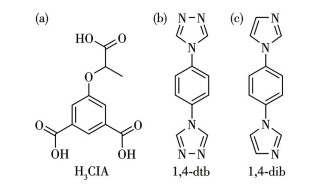
Scheme 1.
Structures of ligands H3CIA (a), 1, 4-dtb (b) and 1, 4-dib (c)


Multinuclear metal clusters have precise atomic structure and large nanoscale size, and their charge density can be regulated by organic ligands when they are inorganic parts of coordination polymers (CPs)[1-2]. Many CPs based on multinuclear clusters have shown excellent performance in catalysis, separation, magnetism, chirality, and so on[3-7]. In view of this, the study of cluster-based CPs has become an important multidisciplinary field over the past few decades, encompassing various subdisciplines such as chemistry, physics, and materials science[8-10]. Up to now, two main ways have been used to prepare cluster-based CPs. The first way is to assemble existing polynuclear metal clusters with ligands, and then obtain cluster-based CPs by ligand exchange or modification of metal clusters[11]. The second method is to use ligands to directly assemble with metal ions to obtain cluster-based CPs[12]. Compared with the former, the latter is more direct, and choosing ligands to react with metal ions is a concise way to prepare cluster-based CPs[13-14].
Fortunately, some organic ligands have strong coordination trends to form metal clusters. For example, tripodal alcohol compounds can use their three flexible alcohol hydroxyl arms to chelately coordinate with metal centers to construct magnetic cluster-based frameworks[15]. Furthermore, many polycarboxylic aromatic acids can also assemble with metal ions to obtain various functional metal clusters[16-17]. In view of this, a feasible way to obtain cluster-based CPs is to select ligands with a clustering coordination tendency to assemble with metal ions. Among them, 5-(1-carboxyethoxy)isophthalic acid (H3CIA) with three carboxyl groups and one ether group can provide strong coordination ability and chelate coordination modes in CPs (Scheme 1a). Furthermore, the semi-rigid skeleton of H3CIA can also enhance its ability to construct metal cluster units by regulating the coordination configuration. Benefiting from these unique structural characteristics, H3CIA has a strong tendency to form homo-metal clusters or heterometal clusters in the synthesis of CPs[18-20]. Therefore, we continue to use H3CIA to obtain cluster-based CPs. To adjust the framework structure, nitrogen heterocyclic compounds 1, 4-di(4H-1, 2, 4-triazol-4-yl)benzene (1, 4-dtb) and 1, 4-di(1H-imidazol-1-yl)benzene (1, 4-dib) as a second ligand were added into the reaction system, respectively (Scheme 1b and 1c). As a result, 3D frameworks {[Co2(CIA)(OH)(1, 4-dtb)]·2H2O}n (HU23) and {[Co2(CIA)(OH)(1, 4-dib)]·3.5H2O·DMF}n (HU24) were obtained under hydrothermal and solvothermal reaction conditions, respectively. As expected, the special coordination tendency from H3CIA resulted in tetranuclear [Co4(μ3-OH)2]6+ clusters in HU23 and HU24, respectively. Their synthesis process, structural details, light absorption characteristics, and magnetic behaviors are reported below.
Ligand H3CIA was prepared from 5-hydroxyisophthalate and methyl lactate according to the previous method[18]. The other chemicals used were analytically pure, purchased through commercial means, and can be used directly without further purification. Powder X-ray diffraction (PXRD) patterns and thermogravimetric analysis (TGA) curves were collected by a Rigaku Miniflex-600 diffractometer (voltage: 40 kV, current: 15 mA, Cu Kα radiation, λ=0.154 06 nm, scanning range: 5°-50°) and a Netzsch STA 449F5 thermogravimetric analyzer, respectively. Elemental analysis experiment for C, H, and N, and infrared test were carried out on a Perkin-Elmer 240C elemental analyzer and an Agilent Cary660 FTIR infrared spectrometer, respectively. The UV-Vis absorption curves and magnetic data were collected through a Shimadzu UV-3600 Plus spectrophotometer and an MPMS-XL magnetic analyzer, respectively.
H3CIA (0.026 g, 0.10 mmol), 1, 4-dtb (0.032 g, 0.15 mmol), K2CO3 (0.012 g, 0.15 mmol), and distilled water (6 mL) were successively added into a 20 mL Teflon high-pressure reactor. After being stirred for 10 min, Co(NO3)2 (0.025 mL, 0.025 mmol) was added to the reaction mixture and stirred for another 10 min. Then, the reactor was sealed and heated at 130 ℃ for 4 d. Until the reaction was cooled to room temperature, red block crystals were collected after washing with absolute ethyl alcohol and drying (Yield: 24 mg, 40% based on H3CIA). Anal. Calcd. for C21H20Co2N6O10(%): C 39.77, H 3.18, N 13.25; Found(%): C 40.62, H 3.04, N 13.57. IR (KBr, cm-1): 3 261(w), 3 106(w), 1 633(w), 1 608(m), 1 578(s), 1 522(s), 1 441(w), 1 398(s), 1 374(s), 1 305(w), 1 244(m), 1 200(w), 1 077(m), 1 033(m), 1 009(m), 983(w), 915(w), 889(w), 828(m), 773(m), 712(m), 637(m), 544(m), 445(w) (Fig.S1, Supporting information).
H3CIA (0.025 g, 0.10 mmol), 1, 4-dib (0.032 g, 0.15 mmol), DMF (3 mL), H2O (1 mL), and Co(NO3)2 (0.025 mL, 0.025 mmol) were successively added into a 20 mL Teflon high-pressure reactor. After being stirred at room temperature for 5 min, the reactor was sealed and then heated at 100 ℃ for 5 d. Until the reactor was cooled to room temperature, red block crystals were obtained after washing with absolute ethyl alcohol and drying (Yield: 30 mg, 50% based on H3CIA). Anal. Calcd. for C26H32N5O12.5Co2(%): C 42.64, H 4.40, N 9.56; Found(%): C 44.12, H 4.28, N 9.12. IR (KBr, cm-1): 3 419(w), 3 140(w), 1 615(s), 1 572(s), 1 535(s), 1 440(m), 1 379(s), 1 308(w), 1 251(w), 1 109(w), 1 063(m), 982(w), 958(m), 931(w), 845(w), 796(w), 780(m), 723(m) (Fig.S2).
Single crystal diffraction tests were carried out on a Rigaku 003 single crystal diffractometer with Mo Kα radiation (λ=0.071 073 nm). The resulting data were reduced and corrected through Rigaku OD (2015) software, and were further analyzed and refined by SHELXT-2017 and SHELXL-2017 programs. Disordered atoms from ligands were handled with the Part command. All non-hydrogen atoms and their thermal parameters were refined by the full matrix least squares method. The crystallographic data of HU23 and HU24 are listed in Table 1, and selected bond lengths and bond angles are shown in Table S1.
 下载:
导出CSV
下载:
导出CSV
| Parameter | HU23 | HU24 |
| Empirical formula | C21H20Co2N6O10 | C26H32N5O12.5Co2 |
| Formula weight | 634.29 | 732.07 |
| Temperature / K | 295.2 | 295.2 |
| Crystal system | Monoclinic | Monoclinic |
| Space group | P21/c | P21/c |
| a / nm | 1.096 60(7) | 1.471 33(6) |
| b / nm | 2.019 88(8) | 1.934 61(5) |
| c / nm | 1.201 44(8) | 1.250 23(5) |
| β / (°) | 115.374(8) | 111.428(4) |
| Volume / nm3 | 2.404 5(3) | 3.312 7(2) |
| Z | 4 | 4 |
| Dc / (g·cm-3) | 1.653 | 1.196 |
| μ / mm-1 | 1.439 | 1.043 |
| F(000) | 1 208.0 | 1 208.0 |
| Crystal size / mm | 0.2×0.2×0.2 | 0.2×0.2×0.2 |
| 2θ range / (°) | 7.774-60.896 | 7.644-63.266 |
| Reflection collected | 28 306 | 75 571 |
| Independent reflection | 6 488 | 10 091 |
| Rint | 0.034 7 | 0.039 3 |
| Final R1 valuesa [I > 2σ(I)] | 0.081 0 | 0.045 7 |
| Final wR2b values [I > 2σ(I)] | 0.192 0 | 0.127 9 |
| Final R1a values (all data) | 0.085 0 | 0.049 1 |
| Final wR2b values (all data) | 0.193 4 | 0.129 6 |
| Goodness-of-fit on F2 | 1.067 | 0.981 |
| a R1=∑||Fo|-|Fc||∑|Fo|; b wR2=[∑w(Fo2-Fc2)2/∑w(Fo2)2]1/2. | ||
The single crystal structure analysis shows that HU23 crystallizes in the monoclinic P21/c space group, and each asymmetric unit contains two independent Co(Ⅱ) ions, one CIA3- anion, one μ3-OH- anion and one 1, 4-dtb ligand (Fig.1a). In addition, disordered guest molecules are not be confirmed, so their diffraction contributions have been removed from the crystal data through Mask strategy. Nevertheless, two guest water molecules can be identified in an asymmetric unit according to the synthesis conditions, TGA curve, elemental analysis data, and Mask information.
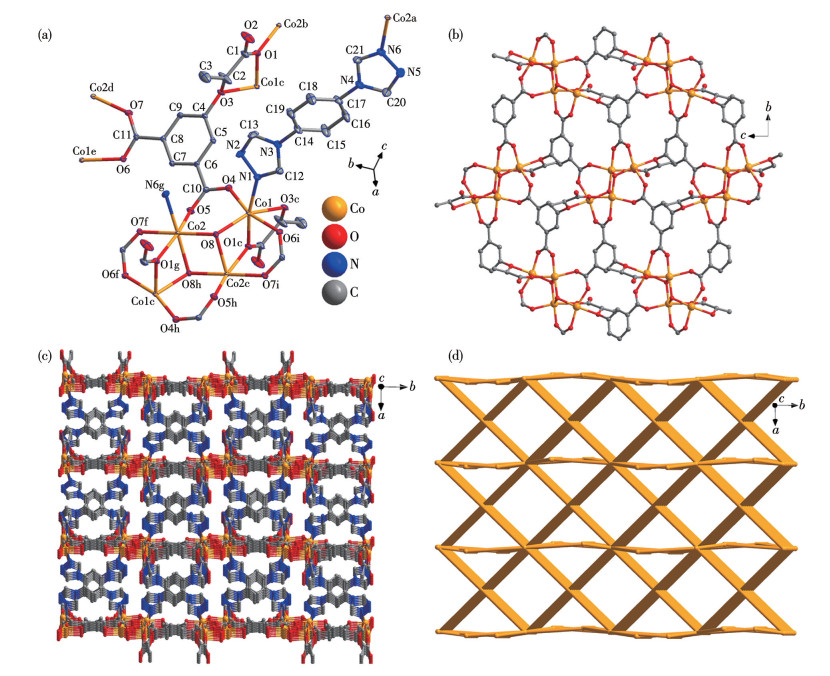
Ellipsoid probability level: 50%; Symmetry codes: a: -x, -0.5+y, 0.5-z; b: x, y, 1+z; c: 1-x, 1-y, 1-z; d: x, 1.5-y, 0.5+z; e: 1-x, 0.5+y, 0.5-z; f: x, 1.5-y, -0.5+z; g: x, y, z-1; h: 1-x, 1-y, -z; i: 1-x, -0.5+y, 0.5-z.
CIA3- anion adopts a κ7-mode to link six Co(Ⅱ) ions through five carboxyl oxygen atoms and one ether oxygen atom. Based on such coordination pattern, two independent Co(Ⅱ) centers build tetranuclear [Co4(μ3-OH)2]6+ unit in the presence of μ3-OH- anions (Fig.1a). The [Co4(μ3-OH)2]6+ unit is butterfly-shaped and centrally symmetrical. Therefore, after symmetrical operation, two Co2 ions form butterfly twist atoms, while two Co1 ions form wing tip atoms. Co1 and Co2 ions have an octahedral coordination configuration in the [Co4(μ3-OH)2]6+ unit, but their coordination environments are different from each other. The details are that Co1 is coordinated by three carboxyl oxygen atoms, one μ3-OH- anion, one ether oxygen atom, and one nitrogen atom from 1, 4-dtb, while Co2 is connected by three carboxyl oxygen atoms, two μ3-OH- anions, and one nitrogen atom.
Each [Co4(μ3-OH)2]6+ unit is connected by six CIA3- anions and each CIA3- anion links three [Co4(μ3-OH)2]6+ unit. In this connection, a 2D layer that can be reduced to a kgd net is constructed by CIA3- anions and [Co4(μ3-OH)2]6+ units (Fig.1b and S3). 1, 4-dtb further joins the adjacent 2D layers together to form the final column-layer framework of complex HU23 (Fig.1c). In this framework, CIA3- anions and [Co4(μ3-OH)2]6+ units act as 3-connected and 10-connected nodes (Fig.S4), respectively, while 1, 4-dtb are simple linkers. In such an analytical method, the whole framework of HU23 can be simplified as an unusual 3, 10-connected network with point symbol of (410.633.82)(43)2 from a topological viewpoint (Fig.1d).
HU24 also crystallizes in the monoclinic P21/c space group, where each asymmetric unit is comprised of two independent Co(Ⅱ) ions, one CIA3- anion, one μ3-OH- anion, and one 1, 4-dib ligand (Fig.2a). The guest molecules can not be further identified owing to their disorder behaviors, and their diffraction contributions have also been deleted. Although the types and numbers of solvent molecules cannot be determined by single crystal diffraction, it can be preliminarily estimated that each asymmetric unit contains 3.5 water molecules and one DMF molecule based on reaction conditions, TGA curves, and elemental analysis results. Herein, CIA3- anion also adopts the κ7-mode to connect six Co(Ⅱ) ions to form a butterfly-shaped [Co4(μ3-OH)2]6+ unit in the presence of μ3-OH- anions. In the [Co4(μ3-OH)2]6+ unit, both Co1 and Co2 are octahedral coordination configurations, where Co1 connects three carboxyl oxygen atoms, one ether oxygen atom, μ3-OH- anion, and one nitrogen atom from 1, 4-dib. On the other hand, the atoms connecting the Co2 center are three carboxyl oxygen atoms, two μ3-OH- coordination anions, and one nitrogen atom from 1, 4-dib. With the help of 1, 4-dib, the above 2D layers are joined together to form a 3D framework in HU24 (Fig.2c). In HU23, four 1, 4-dtb ligands from one [Co4(μ3-OH)2]6+ unit are connected by four [Co4(μ3-OH)2]6+, but for HU24 four 1, 4-dib from one [Co4(μ3-OH)2]6+ unit are only connected by other two [Co4(μ3-OH)2]6+ units. Based on such a coordination environment, the [Co4(μ3-OH)2]6+ unit acts as the 8-connected node in HU24, unlike the 10-connected node from HU23 (Fig.S5). Therefore, the whole framework of HU24 can be reduced to a 3, 8-connected tfz-d network (Fig.2d).

Ellipsoid probability level: 50%; Symmetry codes: a: 1+x, y, 1+z; b: -x, 0.5-y, 0.5+z; c: -x, 0.5+y, 1.5-z; d: x, 0.5-y, 0.5+z; e: -x, 1-y, 1-z; f: -x, 0.5+y, 0.5-z; g: x, 0.5-y, -0.5+z; h: -1+x, y, -1+z.
In complexes HU23 and HU24, five carboxyl oxygen atoms and one ether oxygen atom from CIA3- anion are coordinated with Co(Ⅱ) centers, showing a κ7-coordination pattern. Such a unique coordination configuration contributes to the formation of Co-oxo clusters. Although the synthesis conditions of HU23 and HU24 are completely different from each other, the tetranuclear [Co4(μ3-OH)2]6+ units appear in both structures, which is determined by the coordination pattern of CIA3- anion. So, it is an important way to obtain cluster-based CPs by selecting organic ligands with strong coordination tendency to form metal clusters as ligands. In addition, the 1, 4-dtb and 1, 4-dib have two coordinating nitrogen atoms that act as pillars to connect the adjacent layers together to produce a 3D framework. Although 1, 4-dtb and 1, 4-dib have very similar skeletons, their different nucleophile properties make them have different coordination angles at [Co4(μ3-OH)2]6+ units. As a result, the [Co4(μ3-OH)2]6+ unit is a 10-connected node in HU23 and an 8-connected node in HU24, respectively. Therefore, the introduction of nitrogen heterocyclic ligands plays a role in regulating the final structure of the complexes.
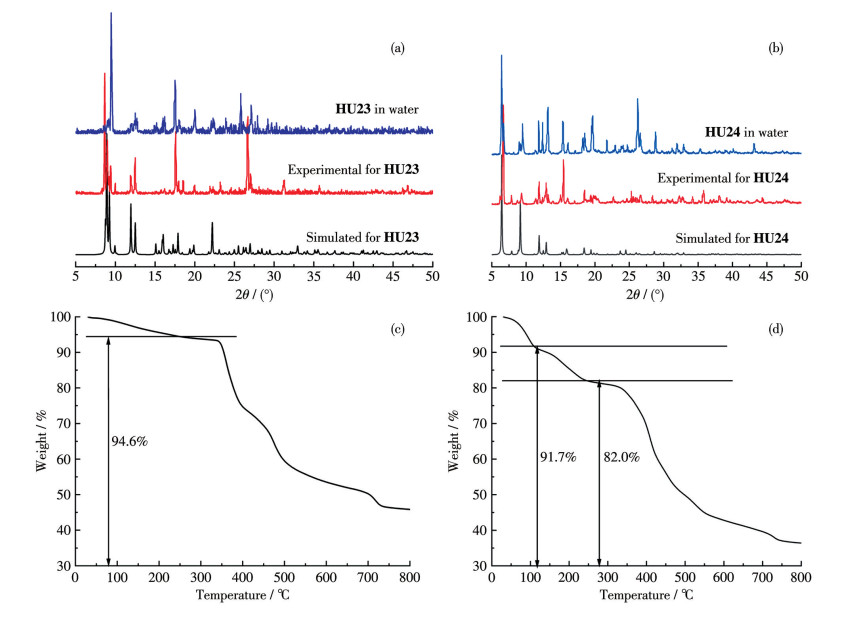
To investigate the phase purity of the bulk products, PXRD measurements were performed on the synthesized HU23 and HU24 samples. The test results indicated that the experimental patterns agreed with the simulated ones derived from their single-crystal structures, confirming the phase-pure nature of the prepared materials. Additionally, the stability of HU23 and HU24 samples was examined through water immersion tests. After 3 d of soaking in water, no observable changes occurred in either sample (Fig.3a and 3b). Subsequent PXRD analyses revealed maintained consistency between experimental and simulated patterns, demonstrating that both HU23 (synthesized via hydrothermal method) and HU24 (prepared through solvothermal approach) have aqueous stability.
To further explore the thermal behavior of HU23 and HU24, TGA was conducted under a nitrogen atmosphere. The TGA curve of HU23 exhibited gradual weight loss from ambient temperature to 345 ℃. This weight loss comes from the loss of guest water molecules in the framework (Obsd. 5.4%, Calcd. 5.7%). A sharp weight reduction occurred above 345 ℃, indicative of framework collapse, which continued until the termination of the test (Fig.3c). In contrast, HU24 displayed two distinct weight loss stages before framework decomposition. The first stage (ambient to 110 ℃) showed an 8.3% weight loss corresponding to the removal of guest water molecules (Calcd. 8.6%). The second stage (110-210 ℃) presented a 9.7% weight loss, ascribed to the elimination of residual DMF molecules (Calcd. 10.1%). When the test temperature was above 320 ℃, a sudden weight loss occurred, indicating that the ligand decomposed at an accelerated rate, leading to the collapse of the framework (Fig.3d). These thermal analyses systematically revealed the differential stability profiles and guest-host interactions in the two frameworks under thermal stress.
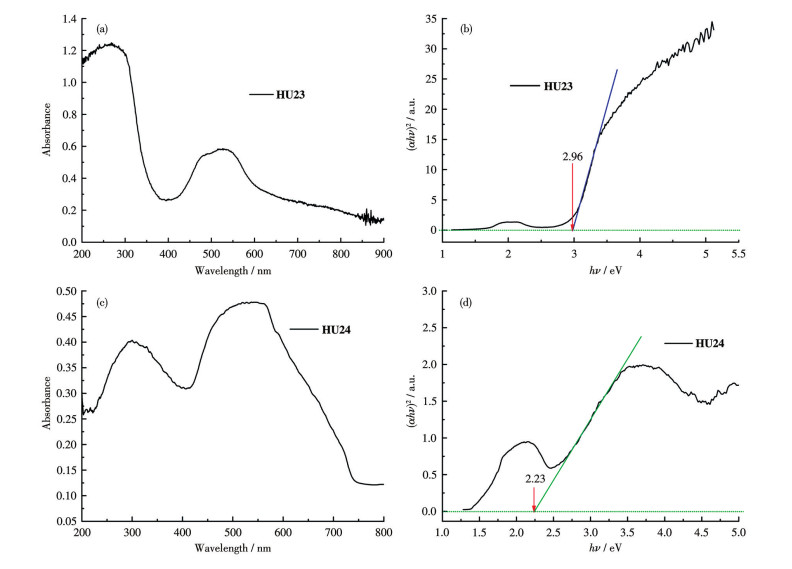
To investigate the optical absorption properties of complexes HU23 and HU24, solid-state UV-Vis absorption spectroscopy was performed. As shown in Fig.4a, the HU23 sample exhibited two intense absorption bands in the ranges of 200-350 nm and 450-600 nm, with the former demonstrating higher absorption intensity than the latter. In contrast, HU24 displayed two strong absorption bands spanning 200-380 nm and 450-700 nm, where the intensity of the former was weaker than that of the latter (Fig.4c). These results indicate that both HU23 and HU24 possess strong light absorption capabilities across the ultraviolet and visible spectral regions. Furthermore, the bandgap values of HU23 and HU24, calculated using the Kubelka-Munk (K-M) method, were determined to be 2.96 and 2.33 eV, respectively, falling within the range characteristic of semiconductor materials (Fig. 4b and 4d).
Cobalt-based complexes have outstanding magnetic characteristics, while HU23 and HU24 contain tetranuclear [Co4(μ3-OH)2]6+ units. In view of this, the temperature-dependent magnetic susceptibility of HU23 and HU24 was measured under a 1 000 Oe magnetic field in the 2-300 K range. At 300 K, the χMT values for HU23 and HU24 were 12.58 and 13.34 cm3·mol-1·K (including solvent contributions), significantly exceeding the theoretical value (7.52 cm3·mol-1·K) for an isolated [Co4(μ3-OH)2]6+ unit. Despite this, its test values were still within the range observed in most Co(Ⅱ) systems. This enhancement is related to the orbital contribution resulting from the spin-orbit coupling (S=3/2, effective orbital quantum number L=1)[21-22]. As a Kramer′s ion, Co(Ⅱ) ion has a considerable spin-orbit coupling (-180 cm-1), and the effective spin is 3/2 at high temperatures and is reduced to 1/2 at low temperatures[23]. Here, the χMT values of HU23 and HU24 also follow this rule. For HU23, χMT decreased slightly from 12.58 to 9.42 cm3·mol-1·K between 300 and 120 K, followed by a rapid decline to 0.86 cm3·mol-1·K at 2 K. Unlike HU23, the χMT curve of HU24 showed a slightly ascending process within the range of 300-250 K, and the value of χMT increased from 12.58 to 12.76 cm3·mol-1·K (Fig.5a and 5b). When the temperature further decreased, the value of χMT gradually decreased and reached the minimum value of 0.23 cm3·mol-1·K at 2 K. At 2 K, the χMT values of HU23 and HU24 were close to 0 cm3·mol-1·K, indicating that all adjacent spins had already reached parallel alignment in opposite directions at very low temperatures. Moreover, they exhibited nearly diamagnetic properties, suggesting that the strong antiferromagnetic coupling in the compound dominates their magnetism[24]. The magnetic susceptibility of HU23 and HU24 also followed the Curie-Weiss law in the range of 300-55 K and 300-35 K, with Curie constants (C) of 16.56 and 20.43 cm3·mol-1·K and Weiss temperatures (θ) of -106.39 and -107.39 K, respectively (Fig 5a and 5b, inset). Despite the strong spin-orbit coupling, the Curie-Weiss law fitting can only provide a reference, but the results once again indicate the existence of antiferromagnetism in the [Co4(μ3-OH)2]6+ unit.
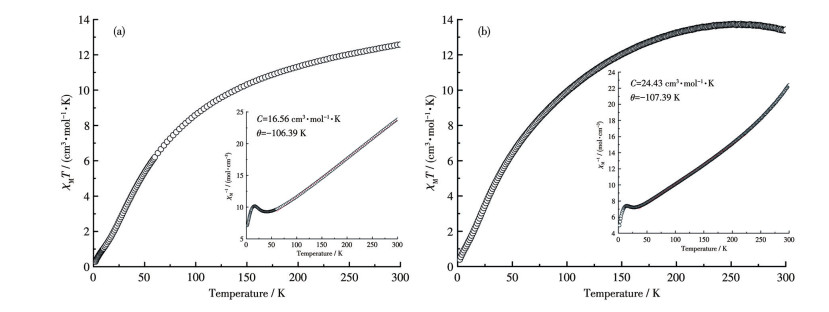
Inset: the Curie-Weiss fitting curves.
The semi-rigid ligand H3CIA with different nitrogen heterocyclic ligands (1, 4-dtb and 1, 4-dib, respectively) reacted with Co2+ to form two CPs featuring pillared-layer framework architectures. Although 1, 4-dtb and 1, 4-dib are different nitrogen heterocyclic ligands, both of these CPs have a secondary building unit (SBUs) with a tetranuclear [Co4(μ3-OH)2]6+ structure. The structural similarity was determined by the inherent cluster-forming coordination propensity of the CIA3- anion. In summary, this study demonstrates controllable framework construction through a ligand engineering strategy, providing a new research approach for developing novel magnetic semiconductor materials.
CHU J Q, LI L, LIU L, HAN Z B. A twelve-connected 3D mixed valence Ni(Ⅱ)/Ni(Ⅲ) metal-organic framework based on hexnuclear nickel clusters building unit: Synthesis, structure and magnetic properties[J]. Inorg. Chem. Commun., 2022, 140: 109431 doi: 10.1016/j.inoche.2022.109431
BERA M K, SARMAH S, SANTRA D C, HIGUCHI M H. Heterometallic supramolecular polymers: From synthesis to properties and applications[J]. Coord. Chem. Rev., 2024, 501: 215573 doi: 10.1016/j.ccr.2023.215573
DONG J Q, LIU Y, CUI Y. Supramolecular chirality in metal-organic complexes[J]. Accounts Chem. Res., 2021, 54: 194-206 doi: 10.1021/acs.accounts.0c00604
CHEN D M, ZHENG Y P, SHI D Y, FANG S M. An acid-base resistant polyoxometalate-based metal-organic framework constructed from {Cu4Cl}7+ and {Cu2(CO2)4} clusters for photocatalytic degradation of organic dye[J]. J. Solid State Chem., 2020, 287: 121384 doi: 10.1016/j.jssc.2020.121384
GU Z G, ZHANG C H, ZHANG J, BU X H. Chiral chemistry of metal-camphorate frameworks[J]. Chem. Soc. Rev., 2016, 45: 3122-3144 doi: 10.1039/C6CS00051G
GHEORGHE A, TEPASKE M A, TANASE S. Homochiral metal-organic frameworks as heterogeneous catalysts[J]. Inorg. Chem. Front., 2018, 5: 1512-1523 doi: 10.1039/C8QI00063H
LAN G X, LI Z, VERONEAU S S, ZHU Y Y, XU Z W, WANG C, LIN W B. Photosensitizing metal-organic layers for efficient sunlight-driven carbon dioxide reduction[J]. J. Am. Chem. Soc., 2018, 140: 12369-12373 doi: 10.1021/jacs.8b08357
PAN Z H, WENG Z Z, KONG X J, LONG L S, ZHENG L S. Lanthanide-containing clusters for catalytic water splitting and CO2 conversion[J]. Coord. Chem. Rev., 2022, 457: 214419 doi: 10.1016/j.ccr.2022.214419
LI T, ZHANG R R, FANG N J, SHI Y B, LI J H, HE C S, CHU Y H. Metal cluster-mediated photocatalysis: Synthesis, characterization and application[J]. Nanoscale, 2025, 17: 9834-9869 doi: 10.1039/D5NR00506J
ZHANG R W, LI X F, ZHOU H, ZHAO Y J, ZHAO J Q, WU P, HUANG Q, TIAN D. A Cu-modified Th6-based framework for regulating products in photocatalytic oxidation of tetrahydroisoquinoline[J]. New J. Chem., 2025, 49: 6694-6701 doi: 10.1039/D5NJ00330J
YU X J, KHAN S U, JIN Z X, WU Q, PANG H J, MA H Y, WANG X M, TAN L C, YANG G X. Water cluster encapsulated polyoxometalate-based hydrogen-bonded supramolecular frameworks (PHSFs) as a new family of high-capacity electrode materials[J]. J. Energy Storage, 2022, 53: 105192 doi: 10.1016/j.est.2022.105192
MAHAJAN S, LAHTINEN M. 3D zinc-organic frameworks based on mixed thiophene dicarboxylate and 4-amino-3, 5-bis(4-pyridyl)-1, 2, 4-triazole linkers: Syntheses, structural diversity, and single-crystal-to-single-crystal transformations[J]. Cryst. Growth Des., 2024, 24: 747-762 doi: 10.1021/acs.cgd.3c01172
LUO X L, LAN D, LIN Y, PAN Z Z, YANG T, LU R M. A two-dimensional framework with U-shaped Cu4I4 cluster linked by semi-rigid ligand: Synthesis, crystal structure and luminescent properties[J]. J. Mol. Struct., 2022, 1251: 131958 doi: 10.1016/j.molstruc.2021.131958
JIANG G M, LIU X Y, JIAN H L, LU P, BAI J W, ZHANG G Z, YUN W, LI S Q, HE Y Z. Cu-clusters nodes of 2D metal-organic frameworks as a cost-effective noble-metal-free cocatalyst with high atom-utilization efficiency for efficient photocatalytic hydrogen evolution[J]. Chin. Chem. Lett., 2022, 33: 3049-3052 doi: 10.1016/j.cclet.2021.09.047
LV W, HAN S D, LI X Y, WANG G M. Coordination chemistry and magnetic properties of polynuclear metal clusters/cluster-based frameworks with tripodal alcohol ligands[J]. Coord. Chem. Rev., 2023, 495: 215376 doi: 10.1016/j.ccr.2023.215376
ZHANG M M, ZHAO J S, LI S Q, LUO X L, ZHANG S T, SHAO Y Z, ZHU X F. Cu-based metal-organic frameworks characterized by Ⅴ-shaped ligands and application to efficient separation of C2H2/CO2 and C2H2/CH4[J]. Cryst. Growth Des., 2025, 25: 2002-2012 doi: 10.1021/acs.cgd.4c01524
WANG S J, ALAVI M A, KARIZI F Z, TEHRAIN A A, YAN X W, MORSALI A, HU M L. A pillar-layered metal-organic framework based on pinwheel trinuclear zinc-carboxylate clusters: Synthesis and characterization[J]. Mater. Lett., 2021, 287: 129261 doi: 10.1016/j.matlet.2020.129261
XU Z X, XIAO Y, KANG Y, ZHANG L, ZHANG J. Homochiral cluster-organic frameworks constructed from enantiopure lactate derivatives[J]. Cryst. Growth Des., 2015, 15: 4676-4686 doi: 10.1021/acs.cgd.5b00958
XU Z X, AO K H, ZHANG J. A pair of novel Cd(Ⅱ) enantiomers based on lactate derivatives: Synthesis, crystal structures and properties[J]. J. Solid State Chem., 2016, 241: 105-109 doi: 10.1016/j.jssc.2016.06.001
XU Z X, YANG J, XU Y Y, ZHENG Y J, LIU X R, FEI F. Chiral Ca-Mn-frameworks with double helical chains and one-dimensional channels constructed from enantiomorphous lactate synthons[J]. J. Solid State Chem., 2024, 339: 124917 doi: 10.1016/j.jssc.2024.124917
ZHAO F H, ZHAO Z H, LI Y S, FENG R, HAN T, HE Y C, LI Z L. Two diverse 3D 6-connected Cd(Ⅱ)/Co(Ⅱ) MOFs based on binuclear clusters as fluorescence sensors for detection of Fe3+, Cr2O72- and nitrobenzene[J]. J. Mol. Struct., 2024, 1298: 137051 doi: 10.1016/j.molstruc.2023.137051
XIE C Z, LUO R, GAO Q, ZHANG X, ZHANG D M, FAN Y H, BI S Y, SHAO F. Photocatalytic degradation of dyes and magnetic properties in two one-dimensional coordination polymers[J]. Polyhedron, 2024, 250: 116825 doi: 10.1016/j.poly.2024.116825
SALAH M B, VILMINOT S, ANDRÉ G, RICHARD-PLOUET M, MHIRI T, TAKAGI S, KURMOOK M. Nuclear and magnetic structures and magnetic properties of the layered cobalt hydroxysulfate Co5(OH)6(SO4)2(H2O)4 and its deuterated analogue, Co5(OD)6(SO4)2(D2O)4[J]. J. Am. Chem. Soc., 2006, 128: 7972-7981 doi: 10.1021/ja061302p
LINES M E. Orbital angular momentum in the theory of paramagnetic cluster[J]. J. Chem. Phys., 1971, 55: 2977-2984 doi: 10.1063/1.1676524

Figure 1 Schematic illustrations of HU23: (a) coordination modes of ligands and Co(Ⅱ) centers; (b) 2D layer based on [Co4(OH)2]6+ and CIA3- anions; (c) 3D framework; (d) 3, 10-connected net
Ellipsoid probability level: 50%; Symmetry codes: a: -x, -0.5+y, 0.5-z; b: x, y, 1+z; c: 1-x, 1-y, 1-z; d: x, 1.5-y, 0.5+z; e: 1-x, 0.5+y, 0.5-z; f: x, 1.5-y, -0.5+z; g: x, y, z-1; h: 1-x, 1-y, -z; i: 1-x, -0.5+y, 0.5-z.

Figure 2 Schematic illustrations of HU24: (a) coordination environments of Co(Ⅱ) centers; (b) 2D layer based on [Co4(OH)2]6+ and CIA3-; (c) 3D framework; (d) 3, 8-connected net
Ellipsoid probability level: 50%; Symmetry codes: a: 1+x, y, 1+z; b: -x, 0.5-y, 0.5+z; c: -x, 0.5+y, 1.5-z; d: x, 0.5-y, 0.5+z; e: -x, 1-y, 1-z; f: -x, 0.5+y, 0.5-z; g: x, 0.5-y, -0.5+z; h: -1+x, y, -1+z.

Figure 4 UV-Vis absorption spectra (a, c) and band gaps based on the K-M method (b, d) of HU23 and HU24

Figure 5 Temperature dependence of χMT for HU23 (a) and HU24 (b)
Inset: the Curie-Weiss fitting curves.
Table 1. Crystal data and structure refinement for HU23 and HU24
| Parameter | HU23 | HU24 |
| Empirical formula | C21H20Co2N6O10 | C26H32N5O12.5Co2 |
| Formula weight | 634.29 | 732.07 |
| Temperature / K | 295.2 | 295.2 |
| Crystal system | Monoclinic | Monoclinic |
| Space group | P21/c | P21/c |
| a / nm | 1.096 60(7) | 1.471 33(6) |
| b / nm | 2.019 88(8) | 1.934 61(5) |
| c / nm | 1.201 44(8) | 1.250 23(5) |
| β / (°) | 115.374(8) | 111.428(4) |
| Volume / nm3 | 2.404 5(3) | 3.312 7(2) |
| Z | 4 | 4 |
| Dc / (g·cm-3) | 1.653 | 1.196 |
| μ / mm-1 | 1.439 | 1.043 |
| F(000) | 1 208.0 | 1 208.0 |
| Crystal size / mm | 0.2×0.2×0.2 | 0.2×0.2×0.2 |
| 2θ range / (°) | 7.774-60.896 | 7.644-63.266 |
| Reflection collected | 28 306 | 75 571 |
| Independent reflection | 6 488 | 10 091 |
| Rint | 0.034 7 | 0.039 3 |
| Final R1 valuesa [I > 2σ(I)] | 0.081 0 | 0.045 7 |
| Final wR2b values [I > 2σ(I)] | 0.192 0 | 0.127 9 |
| Final R1a values (all data) | 0.085 0 | 0.049 1 |
| Final wR2b values (all data) | 0.193 4 | 0.129 6 |
| Goodness-of-fit on F2 | 1.067 | 0.981 |
| a R1=∑||Fo|-|Fc||∑|Fo|; b wR2=[∑w(Fo2-Fc2)2/∑w(Fo2)2]1/2. | ||
 下载: 导出CSV

 扫一扫看文章


扫一扫关注我们