Scheme 1.
Schematic diagram for preparation of sample AgCl@SiO2/CTS-Cl and evaluation of its antibacterial performance

Silver chloride/chitosan-based chloramine nanohybrid with excellent antibacterial activity: Design and structure characterization as well as Ag+-Cl- synergistic antibacterial effect
Xinzhe ZHANG , Jiarong XU , Mochou GAO , Yage LIU , Yanbao ZHAO , Jingzeng CUI , Xueyan ZOU


Infection diseases caused by pathogenic bacteria have aroused global concern, and antibacterial materials have played an important role in fighting microbial threats[1-5]. During the past few years, some materials, varying from free halogen, chlorine oxide, metal oxides, metal ions, molecular engineered peptides, to N-halamines and chitosan, have been developed for application to antimicrobial agents[6-10]. However, traditional antibacterial materials have problems such as instability, easy decomposition, poor biocompatibility, and high production cost. Nowadays, nanomaterials are considered excellent antibacterial agents due to their large surface area, easy surface modification, easy processing, and good biocompatibility[11-18]. Among them, silver-based nanomaterials are the most widely explored ones, due to their broad antibacterial activities and low toxicity toward mammalian cells[19-23]. Ag+ ion is well known as the active component, and its antibacterial efficiency highly relies on its release from silver-containing materials[24-26]. Especially, silver halides are proven to be potential antimicrobial agents, thanks to their low solubility in water and good ability to slowly release Ag+ [27-29]. In the meantime, silver halides as antimicrobial agents could be of particular significance, because they can be embedded into some matrices to achieve tuned release of Ag+ [30-32].
In the study of substances bound to silver halide, we are highly interested in N-chloramine compounds and chitosan (CTS, a cationic polymer derived from chitin) with promising antimicrobial potentials. This is because N-chloramine compounds bearing N—Cl bonds can liberate Cl- in water and instantly sterilize a broad spectrum of bacteria[33] while CTS containing a large number of hydroxyl and amino groups displays a broad biocide and can inhibit the growth of various bacteria and fungi[34-35]. Unfortunately, CTS exhibits only a moderate antimicrobial activity, which limits its application in a broad scope.
To address the limitations of CTS, we attempted to chlorinate the amino groups of CTS to form N—Cl bonds, thereby significantly enhancing its antibacterial activity. Simultaneously, we leveraged the abundant hydroxyl groups on the surface of CTS, which provide numerous active sites for hybridization with other materials[14]. We combined the advantageous properties of CTS and silver halides by integrating silver chloride (AgCl) with N-chloramine. This approach led to the development of a novel antibacterial composite that exhibits rapid and long-lasting synergistic antibacterial effects[36].
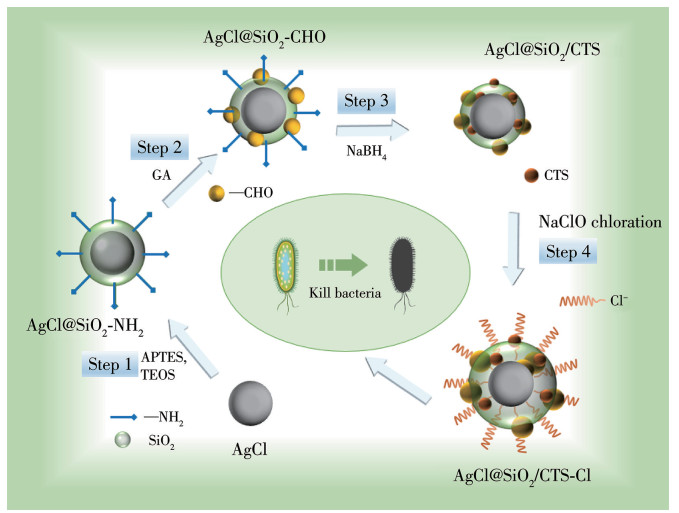
Herein, we establish a facile one-pot route (Scheme 1) to prepare amino-silica functionalized silver chloride (AgCl@SiO2-NH2) nanoparticles (NPs). Then we graft glutaraldehyde, the linker molecule, onto the surface of AgCl@SiO2-NH2 to afford AgCl@SiO2-CHO. Further, we conjugate CTS, the chloramine precursor possessing an amide bond, onto the surface of AgCl@SiO2-CHO to yield AgCl@SiO2/CTS. Finally, we chlorinate AgCl@SiO2/CTS with sodium hypochlorite to obtain AgCl/CTS-based N-chloramine (AgCl@SiO2/CTS-Cl). This article deals with the preparation and characterization of AgCl@SiO2/CTS-Cl as well as the evaluation of its antibacterial performance towards Escherichia coli (E. coli) and Staphylococcus aureus (S. aureus) bacteria as the model pathogens.
Cetyltrimethylamine chloride (CTAC, AR, 99.0%), tetraethyl orthosilicate (TEOS, AR, 99.5%), and 3-aminopropyl triethoxysilane (APTES, AR, 98.0%) were purchased from Shanghai Aladdin Biochemical Technology Company Limited (Shanghai, China). Glutaraldehyde (GA, AR, 25.0%), potassium persulfate (KPS, AR, 99.0%), CTS (AR, 98.0%), sodium hypochlorite (NaClO, AR, 99.5%), potassium iodide (KI, AR, 99.0%), sodium thiosulfate (Na2S2O3, AR, 99.5%), hydrochloric acid (HCl, AR, 36.0%-38.0%), sodium borohydride (NaBH4, AR, 99.5%), silver nitrate (AgNO3, AR, 99.8%), and sodium chloride (NaCl, AR, 99.8%) were purchased from Sinopharm Group Chemical Reagent Company Limited (Shanghai, China). Nutrient agar (NA) and nutritious broth (NB) were purchased from Beijing Aobo Biotechnology Company Limited (Beijing, China). Gram-positive bacteria S. aureus (ATCC 35696) and Gram-negative bacteria E. coli (ATCC 23282) were purchased from China General Microbial Culture Preservation and Management Center (Beijing, China).
0.5 mol·L-1 NaCl solution and 0.5 mol·L-1 AgNO3 solution were prepared first. 0.18 mmol CTAC (0.057 g) was added to a three-mouth flask containing 97 mL of deionized water. The mixture was ultrasonicated for 10 min, heated, and stirred for 30 min. 1 mL NaCl solution was added to the above solution. After stirring at a high speed for 30 min, 1 mL AgNO3 solution was added to the above solution drop by drop. After reacting at 40 ℃ for 1 h, HCl solution (1 mL, 0.1 mol·L-1) was added to adjust the pH value of the solution to about 5, and then 3 mL TEOS and 3 mL APTES were slowly added to continue the reaction for 8 h. After centrifugation and washing, AgCl@SiO2-NH2 was obtained, the CTAC template was removed with anhydrous ethanol, and vacuum dried at 30 ℃ for 24 h.
0.5 g AgCl@SiO2-NH2 was added to a 25% GA solution and stirred magnetically for 3 h. The aldehyde-functionalized NPs were obtained by centrifugation and washing. Then, 0.5 g aldehyde-functionalized NPs and 0.2 g sodium borohydride were added to the acetic acid solution containing CTS. After stirring vigorously at room temperature for 3 h, AgCl@SiO2/CTS was obtained by centrifugation, washed, and dried overnight in a vacuum drying oven at 40 ℃.
0.3 g AgCl@SiO2/CTS was weighed and dispersed in 60 mL neutral sodium hypochlorite solution. The mixture was stirred at room temperature for 1 h. The reaction product was centrifuged, washed with deionized water, and dried under vacuum at 30 ℃ for 24 h to obtain AgCl@SiO2/CTS-Cl sample. Similarly, 0.3 g CTS was weighed and dispersed in 60 mL neutral sodium hypochlorite solution. The mixture was stirred at room temperature for 1 h, centrifuged, washed with deionized water, and dried under vacuum at 30 ℃ for 24 h to obtain the CTS-Cl sample.
A growth-counting assay was employed to evaluate the antimicrobial activity of the sample AgCl@SiO2/CTS-Cl against Gram-positive S. aureus and Gram-negative E. coli bacteria. E. coli and S. aureus were selected as representative model pathogens to evaluate the broad-spectrum potential of the antibacterial agents, as they differ significantly in their cell wall structures and are common causes of infections. This is an initial study, focusing on these two common and representative bacteria. Subsequent studies will expand to include tests on other stains. Before tests, all media and glassware were sterilized in an autoclave. The to-be-tested stains were precultured at 37 ℃ in Langmuir-Blodgett growth medium overnight under agitation. Log-phase bacterial cells were diluted to a concentration of about 108 CFU·mL-1.
In terms of the determination of concentration-disinfecting rate, a proper amount of the sterile sample AgCl@SiO2/CTS-Cl was dispersed in phosphate buffer solution and diluted by a twofold serial dilution method to pre-set mass concentrations (10.00, 20.00, 40.00, 80.00, 160.00, 320.00, 640.00, and 1 280.00 μg·mL-1). At the same time, 50 μL of the bacterial suspension was separately mixed with 450 μL of the serial dilutions of AgCl@SiO2/CTS-Cl in tubes and incubated at 37 ℃ for 12 h. Upon completion of incubation, excessive Na2S2O3 solution (0.03%) was added to terminate the bactericidal effect, while 20 μL of the as-treated bacterial suspensions was taken and spread onto nutrient agar plates for further incubation. The viable bacteria in the as-treated bacterial suspensions were determined by counting the number of colony-forming units.
In terms of the determination of time-disinfecting rate, 50 μL of the bacterial suspension was added into 450 μL of AgCl@SiO2/CTS-Cl suspension (640.00 μg·mL-1) in sterile tubes. The mixture was sonicated for 3 min and incubated at 37 ℃ for 0.25, 0.50, 0.75, 1.00, 1.25, 1.50, 2.00, 4.00, 6.00, 8.00, 10.00, and 12.00 h, respectively. At predetermined intervals, 20 μL of the bacterial suspension treated with Na2S2O3 was withdrawn and cultured. The same procedures were applied to monitor the viable bacteria. The bacterial reduction rate (R) was calculated as R=(A-B)/A×100%, where A is the number of bacterial colonies in the blank as the control and B is that after the exposure of the blank to the sample AgCl@SiO2/CTS-Cl for different durations.
For the antibacterial cycling experiment and regeneration experiment, the materials that completed the single antibacterial test were collected by centrifugation at 4 000 r·min-1 for 5 min, washed three times with sterile deionized water, and then transferred to a sterile centrifuge tube containing 0.5 mol·L-1 NaClO solution and incubated for 2 h at room temperature with shaking (150 r·min-1). After the regeneration treatment, the material was collected by centrifugation at 4 000 r·min-1 for 5 min, and then washed with sterile deionized water three times to obtain the regenerated AgCl@SiO2/CTS-Cl material, which was used in the next round of antibacterial cycle test for 10 times. The content of active chlorine after each cycle was determined by iodometry using starch as an indicator.
The morphology and composition of the as-prepared antibacterial samples were characterized by transmission electron microscopy (TEM, JEM-2100, Japan, 200 kV), scanning electron microscopy (SEM, Carl Zeiss, UK), Fourier transform infrared spectroscopy (FTIR, AVATAR360, USA), and X-ray diffraction (XRD, D8-ADVANCE, USA, 40 kV, 40 mA, 2θ=20°-80°, Cu Kα, 0.154 18 nm); and the ζ potential was determined with a nano ZS facility (USA) to elucidate the surface modification of AgCl by —NH2 yielding AgCl@SiO2-NH2 NPs. Moreover, an ultrasonic cleaner (KQ118, China), a biosafety cabinet (ZSB-1200IIAI, China), a constant temperature and humidity box (ZXMP-A1230, China), an oscillator (ZWYR-2102/2102C, China), and an automatic vertical autoclave (GR60DA, USA) were used for the preparation of various samples and the evaluation of their antibacterial activity against S. aureus and E. coli.
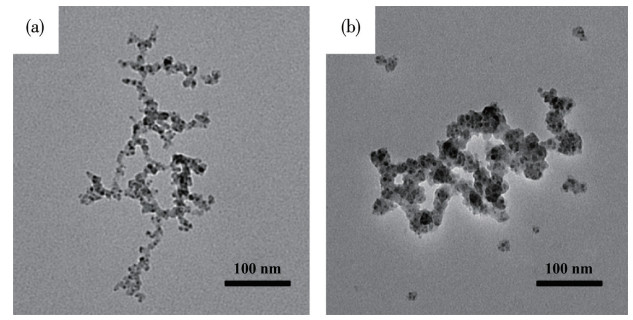
Fig. 1 displays the TEM images of AgCl@SiO2-NH2 and AgCl@SiO2/CTS. It can be seen that sample AgCl@SiO2-NH2 exhibited a chain-like structure of non-spherical particles with a size of about 12 nm (Fig. 1a). Besides, there existed a thin SiO2 modified layer on the surface of AgCl NPs, which form chain-like aggregates likely owing to interactions (e.g., van der Waals forces, potential hydrogen bonding involving —NH2 or surrounding solvent molecules) between the functionalized NPs. After grafting CTS onto AgCl@SiO2-NH2, the as-obtained sample AgCl@SiO2/CTS still retained the core-shell structure, but its size (about 30 nm) rose significantly as compared with that of AgCl@SiO2-NH2. Moreover, AgCl@SiO2/CTS displayed a slight sign of aggregation, and each AgCl@SiO2/CTS NPs contained several AgCl cores (Fig. 1b).
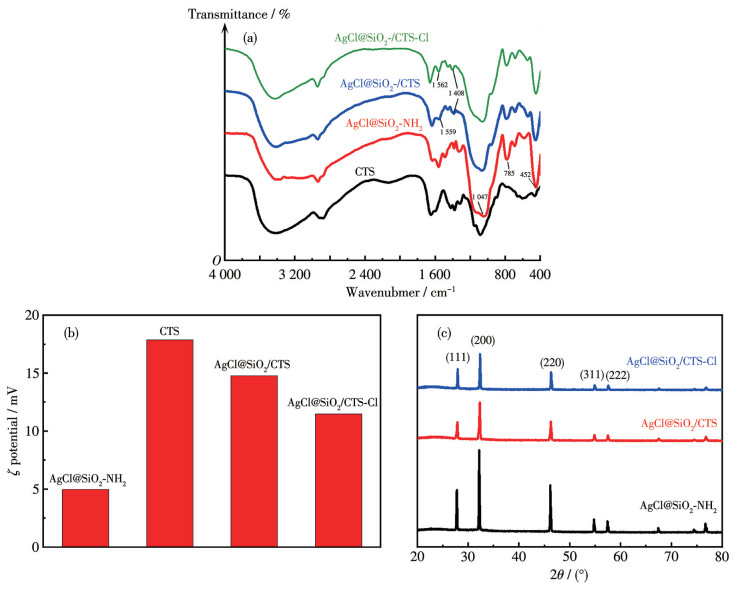
FTIR spectra were recorded to confirm the presence of the surface-modified layer on various as-prepared samples. As shown in Fig. 2a, AgCl@SiO2-NH2, AgCl@SiO2/CTS, and AgCl@SiO2/CTS-Cl show the characteristic Si—O bending vibration peak at 452 cm-1 and the Si—O—Si stretching vibration peaks at 785 and 1 047 cm-1, which proves that there is indeed a modified layer on their surfaces[37]. AgCl@SiO2/CTS showed the Schiff base adduct peak at 1 408 cm-1, which is analogous to the deformation of the aldehyde′s C—H bond[38-39]. Crucially, there are new characteristic bands in the AgCl@SiO2/CTS spectrum: the amide Ⅰ band (C=O stretching) at approximately 1 650 cm-1 and the amide Ⅱ band (N—H bending) at 1 559 cm-1, which are distinctive fingerprints of the amide groups in the CTS molecular chain. These FTIR data confirm that CTS molecules are successfully grafted onto the surface of AgCl@SiO2-NH2. After the chlorination of AgCl@SiO2/CTS, the intensity of the amide Ⅱ bond (1 559 cm-1, N—H bending vibration) decreased and slightly shifted to 1 562 cm-1, which is obviously due to the partial substitution of the N—H bond by the N—Cl bond[40], which confirmed the successful synthesis of AgCl@SiO2/CTS-Cl. ζ potential measurements were used to elucidate the surface modification process of AgCl@SiO2, including amino functionalization, CTS grafting, and subsequent chlorination. As shown in Fig. 2b, AgCl@SiO2-NH2 was obtained by modification of an amino group at AgCl@SiO2, which exhibited a ζ potential of 4.98 mV, indicating the introduction of surface amino groups. The ζ potential of AgCl@SiO2/CTS was 14.80 mV, which was between the ζ potential of pure CTS (17.5 mV) and that of AgCl@ SiO2-NH2 (4.98 mV), indicating the successful grafting of CTS. The chlorinated sample AgCl@SiO2/CTS-Cl showed a ζ potential of 11.5 mV, which reflects successful chlorination. Notably, the changes in ζ potential of these samples (AgCl@SiO2-NH2, CTS, AgCl@SiO2/CTS, and AgCl@SiO2/CTS-Cl) correspond to the introduction of different functional groups at each modification step, thus confirming the continuous surface modification. Fig. 2c shows the XRD patterns of AgCl@SiO2-NH2, AgCl@SiO2/CTS, and AgCl@SiO2/CTS-Cl. All three samples displayed multiple characteristic peaks of face-centered cubic phase AgCl (PDF No.31-1238) at 2θ values of 27.9° (111), 32.5° (200), 46.53° (220), 55° (311), and 57.6° (222), which refers to the formation of well-crystallized AgCl[41-42]. Besides, a very broad and weak hump in the 2θ range of 20°-28° corresponds to an amino-functionalized amorphous silica layer.
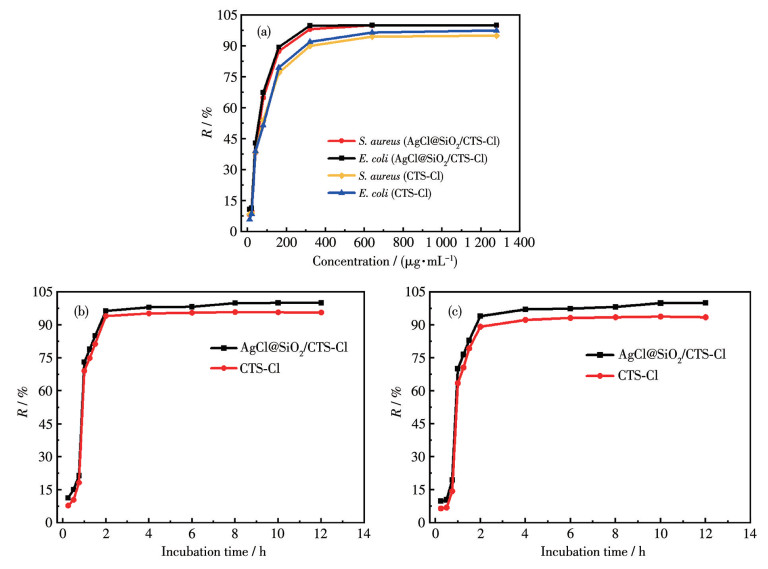
The active chlorine content (corresponding to the N—Cl bonds) of sample AgCl@SiO2/CTS-Cl was determined by iodometric titration[35], from which its active chlorine content was calculated to be 3.74% (mass fraction). It should be noted that this method specifically measures the oxidizable chlorine associated with the N—Cl bonds, and does not detect the Cl- bound within the AgCl lattice. Both E. coli and S. aureus were employed to assess the antimicrobial activity of AgCl@SiO2/CTS-Cl. Fig. 3a displays the antibacterial activity of CTS-Cl and AgCl@SiO2/CTS-Cl at different mass concentrations towards E. coli and S. aureus after 12 h of exposure. The data show that both CTS-Cl and AgCl@SiO2/CTS-Cl exhibited strong antibacterial performance against both bacterial stains, with efficacy increasing significantly with mass concentration. Specifically, at 320 μg·mL-1, the bacterial reduction rates for E. coli and S. aureus were approximately 100% and 99%, respectively, for AgCl@SiO2/CTS-Cl, and for CTS-Cl, the bacterial reduction rates were about 95% and 93%, respectively. Fig. 3b and 3c give the antibacterial kinetic curves of 640.00 μg·mL-1 of AgCl@SiO2/CTS-Cl for E. coli and S. aureus. The bacterial reduction for both stains tends to increase with extended incubation time. For example, AgCl@SiO2/CTS-Cl could inactivate 73% of E. coli and 69% of S. aureus after 1 h of incubation, which indicates that it has a rapid sterilization effect for the two kinds of stains. In the meantime, it could kill all the tested bacteria after incubating for 12 h, displaying a long-lasting inhibiting effect. Particularly, AgCl@SiO2/CTS-Cl displayed better bacterial reduction than CTS-Cl, which implies that there might exist a synergistic antibacterial effect between Ag+ and Cl-.
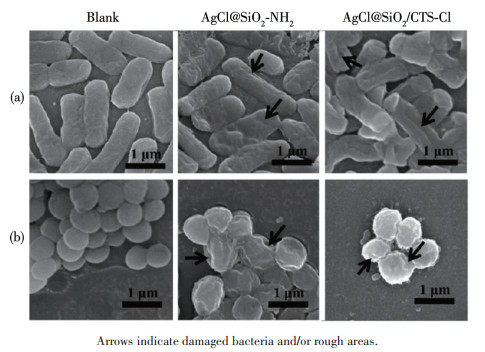
The antibacterial mechanism of AgCl@SiO2/CTS-Cl was further investigated by observing the change in germ morphology with SEM. Fig. 4 shows the SEM images of the normal bacteria and those treated with 50 mg·mL-1 of AgCl@SiO2-NH2 or 50 mg·mL-1 of AgCl@ SiO2/CTS-Cl for 12 h. Original E. coli and S. aureus had a short rod morphology and a uniform spherical shape, respectively, and after being treated with AgCl@SiO2-NH2 and AgCl@SiO2/CTS-Cl, the morphology of their cells significantly changed along with the appearance of cell debris. Besides, the shrunk and deformed membrane and the rough areas indicated by arrows demonstrate that the antibacterial effect ascribed to active Ag+ and Cl- is closely related to the damage of the bacterial membranes. Moreover, AgCl@SiO2/CTS-Cl exhibited much better antibacterial performance than AgCl@SiO2-NH2, proving that synergistic antibacterial effects exist between Ag+ and active Cl-.
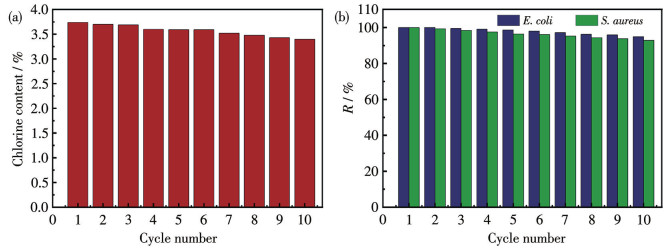
The potential recycling of antibacterial activity is an important feature of chloramine, whose antibacterial activity can be recovered by simple chlorination. Fig. 5a gives the chlorine content of the as-recovered AgCl@SiO2/CTS-Cl during 10 cycles of chlorination. The active chlorine content of the AgCl@SiO2/CTS-Cl remained high at approximately 3.48% (retaining 93% of the initial chlorine content) even after 10 cycles of antibacterial testing and regeneration (Fig. 5a), which indicates that it has an excellent regenerability. Fig. 5b shows the bacterial reduction rate of the regenerated AgCl@SiO2/CTS-Cl. The antibacterial capability of the regenerated AgCl@SiO2/CTS-Cl was proportional to its Cl content and remained stable even after 10 cycles of antimicrobial tests. In particular, the bacterial reduction rate after 10 cycles of antibacterial treatment for both stains remained as high as 98%.
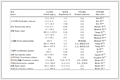
To further investigate the antimicrobial performance of various as-prepared samples, we comparatively tested the antibacterial activity of AgCl@SiO2-NH2, AgCl@SiO2/CTS, and AgCl@SiO2/CTS-Cl against E. coli and S. aureus. The results are shown in Table 1 (all evaluations are objective and supported by data). After 1 h of incubation with bacteria, the bacterial reduction rates of AgCl@SiO2-NH2 and AgCl@SiO2/CTS were relatively low. The E. coli and S. aureus reduction rates of AgCl@SiO2-NH2 and AgCl@SiO2/CTS were 0.2% and 0.1%, 2.8% and 1.8% respectively, and the bacterial reduction of AgCl@SiO2/CTS-Cl reached 73.0% and 75.0%. This indicates that halogenamines can rapidly disinfect the tested stains. After 12 h of exposure, the sample AgCl@SiO2/CTS-Cl could kill all the tested bacteria. In contrast, the bacterial reduction rate of sample AgCl@SiO2-NH2 was only 17.9% and 14.4%, and the bacterial reduction rates of AgCl@SiO2/CTS were 20.9% and 19.7%. This demonstrates that AgCl@SiO2/CTS-Cl exhibits a synergistic antimicrobial effect ascribed to the combination of the long-lasting antimicrobial effect of AgCl with the rapid bactericidal effect of halamine. Compared with the reported N-halamine materials[35] and silver-based nanocomposites[33], the antibacterial effect of the sample AgCl@SiO2/CTS-Cl was comparable or even superior. Particularly, it stands out in achieving complete sterilization during the initial rapid killing stage and the long-term synergistic antibacterial mechanism. Moreover, it also exhibits excellent recyclability.
 下载:
导出CSV
下载:
导出CSV
| Incubation time / h | Bacterial reduction rate / % | ||||||
| E. coli | S. aureus | ||||||
| AgCl@SiO2-NH2 | AgCl@SiO2/CTS | AgCl@SiO2/CTS-Cl | AgCl@SiO2-NH2 | AgCl@SiO2/CTS | AgCl@SiO2/CTS-Cl | ||
| 0.5 | 0.2 | 1.9 | 15.2 | 0 | 1.1 | 10.4 | |
| 1 | 0.2 | 2.8 | 73.0 | 0.1 | 1.8 | 75.0 | |
| 1.5 | 1.7 | 3.7 | 85.0 | 0.7 | 2.4 | 83.0 | |
| 2 | 2.3 | 4.8 | 96.3 | 1.5 | 4.0 | 94.0 | |
| 4 | 6.3 | 7.4 | 98.0 | 3.0 | 6.5 | 97.1 | |
| 6 | 9.8 | 11.8 | 98.2 | 4.4 | 11.1 | 97.4 | |
| 8 | 11.8 | 14.5 | 99.8 | 9.9 | 13.9 | 99.5 | |
| 10 | 14.2 | 15.2 | 100.0 | 11.7 | 15.8 | 99.9 | |
| 12 | 17.9 | 20.9 | 100.0 | 14.4 | 19.7 | 100.0 | |
| Conditions: the concentration of both E. coli and S. aureus was 107 CFU·mL-1; the chlorinated AgCl@SiO2/CTS-Cl contained 3.74% of active chlorine; the concentration of the three materials was 640.00 μg·mL-1. | |||||||
AgCl@SiO2/CTS hybrid NPs were prepared by grafting chitosan onto the surface of amino-functionalized AgCl cores. The as-prepared AgCl@SiO2/CTS NPs were chlorinated by NaClO solution to obtain AgCl@SiO2/CTS-Cl, an AgCl@SiO2/CTS-based chloramine. TEM, XRD, and FTIR characterizations demonstrated that sample AgCl@SiO2-NH2 exhibited a chain-like structure of non-spherical particles with a size of about 12 nm, which was due to the aggregation of AgCl NPs under hydrogen bond interaction. Grafting CTS onto AgCl@SiO2-NH2 yielded a sample AgCl@SiO2/CTS, which retained core-shell structure but exhibited significantly increased size of about 30 nm, due to the slight aggregation of the AgCl@SiO2/CTS NPs containing several AgCl cores. Besides, the chlorinated sample AgCl@SiO2/CTS-Cl exhibited excellent antibacterial activity against E. coli and S. aureus. Its initial rapid antibacterial activity (e.g., a significant reduction in colony count within 1 h) mainly attributes to the released active chlorine (N—Cl) from the chloramine component (CTS-Cl); while the continuously enhanced antibacterial efficacy—particularly demonstrated in achieving complete sterilization within 12 h and being significantly superior to AgCl@SiO2-NH2 and AgCl@ SiO2/CTS in terms of antibacterial performance—indicates the existence of a synergistic antibacterial mechanism between the slow-release of Ag+ and the active chlorine species, and it retains a high antibacterial efficiency even after 10 cycles of antibacterial tests.
YAO M. SARS-CoV-2 aerosol transmission and detection[J]. Eco-Environment & Health, 2022, 1(1): 3-10
WANG H F, TANG B, LI X Y, M Y. Antibacterial properties and corrosion resistance of nitrogen-doped TiO2 coatings on stainless steel[J]. J. Mater. Sci. Technol., 2011, 27(4): 309-316 doi: 10.1016/S1005-0302(11)60067-4
WEI Y, DONG Z M, FAN W H, XU K Q, TANG S, WANG Y, WU F C. A narrative review on the role of temperature and humidity in COVID-19: Transmission, persistence, and epidemiological evidence[J]. Eco-Environment & Health, 2022, 1(2): 73-85
LUO Y, GAO Y T. Potential role of hydrogels in stem cell culture and hepatocyte differentiation[J]. Nano Biomed. Eng., 2024, 16(2): 188-202 doi: 10.26599/NBE.2024.9290055
FU X, OU Z Y, SUN Y. Indoor microbiome and allergic diseases: From theoretical advances to prevention strategies[J]. Eco-Environment & Health, 2022, 1(3): 133-146
CHENG X L, MA K K, LI R, REN X H, HUANG T S. Antimicrobial coating of modified chitosan onto cotton fabrics[J]. Appl. Surf. Sci., 2014, 309: 138-143 doi: 10.1016/j.apsusc.2014.04.206
ABHIMANYU P, ARVIND M, KISHOR N. Biosynthesis of CuO nanoparticles using plant extract as a precursor: Characterization, antibacterial, and antioxidant activity. [J]. Nano Biomed. Eng., 2023, 15(4): 369-377 doi: 10.26599/NBE.2023.9290027
KHAN M M, MATUSSIN S N, RAHMAN A. Recent development of metal oxides and chalcogenides as antimicrobial agents[J]. Bioproc. Biosyst. Eng., 2023, 46(9): 1231-1249 doi: 10.1007/s00449-023-02878-1
SHIN H K, PARK M, CHUNG Y S, KIM H, JIN F, PARK S. Antimicrobial characteristics of n-halaminated chitosan salt/cotton knit composites[J]. J. Ind. Eng. Chem., 2014, 20(4): 1476-1480 doi: 10.1016/j.jiec.2013.07.034
XUAN J Q, FENG W G, WANG J Y, WANG R C, ZHANG B W, BO L T, CHEN S, YANG H, SUN L M. Antimicrobial peptides for combating drug-resistant bacterial infections[J]. Drug Resist Update, 2023, 68: 100954-100965 doi: 10.1016/j.drup.2023.100954
GAO M C, LI L X, LIU Q, XUE Y Y, WANG W H, ZHAO Y B, ZOU X Y. Synthesis of multifunctional silica composite nanospheres and their application in separation of MBP-tagged protein[J]. Mater. Lett., 2022, 318: 132222-132225 doi: 10.1016/j.matlet.2022.132222
梁静, 韩露, 李宝, 时珍珠, 刘星驰, 彭李超, 邹雪艳. 双功能化磁性纳米修复剂对多重金属的快速、高效钝化行为. 无机化学学报, 2021, 37(11): 1981-1990LIANG J, HAN L, LI B, SHI Z Z, LIU X C, PENG L C, ZOU X Y. Fast and efficient immobilization behavior of bifunctional magnetic nano-amendment against multi-heavy metal[J]. Chinese J. Inorg. Chem., 2021, 37(11): 1981-1990
ZOU X Y, YIN Y B, ZHAO Y B, CHEN D Y, DONG S. Synthesis of ferriferrous oxide/L-cysteine magnetic microspheres and their adsorption capacity for Pb(Ⅱ) ions[J]. Mater. Lett., 2015, 150: 59-61 doi: 10.1016/j.matlet.2015.02.133
JIN Y L, HAN G H, ZHANG W J, BU B, ZHAO Y B, WANG J J, LIU R S, YANG H, XU H X, MA P T. Evaluation and genetic dissection of the powdery mildew resistance in 558 wheat accessions[J]. New Crops, 2024, 1: 100018 doi: 10.1016/j.ncrops.2024.100018
ZOU X Y, YANG F B, SUN X, QIN M M, ZHAO Y B, ZHANG Z J. Functionalized nano-adsorbent for affinity separation of proteins[J]. Nanoscale Res. Lett., 2018, 13(1): 165-172 doi: 10.1186/s11671-018-2531-4
YIN Y B, WEI G M, ZOU X Y, ZHAO Y B. Functionalized hollow silica nanospheres for His-tagged protein purification[J]. Sens. Actuator B‒Chem., 2015, 209: 701-705 doi: 10.1016/j.snb.2014.12.049
ZOU X Y, ZHANG Y, YUAN J Q, WANG Z B, ZENG R, LI K, ZHAO Y B, ZHANG Z J. A porous nano-adsorbent with dual functional groups for selective binding proteins with a low detection limit[J]. RSC Adv., 2020, 10(39): 23270-23275 doi: 10.1039/D0RA01193B
TIAN S F, ZOU X Y, LU H T, HE J Y, ZHAO Y B, GUO J Y. Synthesis of nanometer hollow silica composite microspheres for affinity separation of protein[J]. Inorg. Chem., 2015, 31(7): 1329-1334
IVLIEVA A, PETRITSKAYA E, ROGATKIN D, YUSHIN N, GROZDOV D, VERGEL K, ZINICOVSCAIA I. Does nanosilver have a pronounced toxic effect on humans[J]. Appl. Sci., 2022, 12(7): 3476-3489 doi: 10.3390/app12073476
MA C Y, ZHANG X Y, BAO X Y, ZHU X H. In the symbiosome: Cross-kingdom dating under the moonlight[J]. New Crops, 2024, 1: 100015 doi: 10.1016/j.ncrops.2024.100015
ABHIMANYU P, ARVIND M, KISHOR N. Biosynthesis of CuO nanoparticles using plant extract as a precursor: Characterization, antibacterial, and antioxidant activity[J]. Nano Biomed. Eng., 2023, 15(4): 369-377 doi: 10.26599/NBE.2023.9290027
YANG Y, ZHANG Z J, WAN M H, WANG Z H, ZOU X Y, ZHAO Y B, SUN L. A facile method for the fabrication of silver nanoparticles surface decorated polyvinyl alcohol electrospun nanofibers and controllable antibacterial activities[J]. Polymers, 2020, 12(11): 2486-2498 doi: 10.3390/polym12112486
NI Z H, GU X X, HE Y L, WANG Z H, ZOU X Y, ZHAO Y B, SUN L. Synthesis of silver nanoparticle-decorated hydroxyapatite (HA@Ag) poriferous nanocomposites and the study of their antibacterial activities[J]. RSC Adv., 2018, 8(73): 41722-41730 doi: 10.1039/C8RA08148D
TAN P, LI Y H, LIU X Q, JIANG Y, SUN L B. Core-shell AgCl@SiO2 nanoparticles: Ag(Ⅰ)-based antibacterial materials with enhanced stability[J]. ACS Sustainable Chem. Eng., 2016, 4(6): 3268-3275 doi: 10.1021/acssuschemeng.6b00309
GAO M J, DU J Y, HAN Z H, WANG Z H, ZHAO Y B, ZOU X Y, SUN L. Precise preparation of various morphological silver sulfide nanostructures, investigation of formation mechanism and comparative study of photothermal performance for cancer treatment[J]. Part. Part. Syst. Char., 2021, 23: 1-13
GAO M C, ZHAO H D, WANG Z H, ZHAO Y B, ZOU X Y, SUN L. Controllable preparation of Ag2S quantum dots with size-dependent fluorescence and cancer photothermal therapy[J]. Adv. Powder Technol., 2021, 32(6): 1972-1982 doi: 10.1016/j.apt.2021.04.011
SAMBHY V, MACBRIDE M M, PETERSON B R, SEN A. Silver bromide nanoparticle/polymer composites: Dual action tunable antimicrobial materials[J]. J. Am. Chem. Soc., 2006, 128(30): 9798-9808 doi: 10.1021/ja061442z
HOSSAIN S I, SPORTELLI M C, PICCA R A, GENTILE L, PALAZZO G, DITARANTO N, CIOFFI N. Green synthesis and characterization of antimicrobial synergistic AgCl/BAC nanocolloids[J]. ACS Appl. Bio Mater., 2022, 5(7): 3230-3240 doi: 10.1021/acsabm.2c00207
DU P H, HALMA M. Graphene-based nanomaterials: Uses, environmental fate, and human health hazards[J]. Nano Biomed. Eng., 2024, 16(2): 219-231 doi: 10.26599/NBE.2024.9290059
WANG L M, WANG Y Y, YIN P, JIANG C F, ZHANG M. ZmHAK17 encodes a Na+-selective transporter that promotes maize seed germination under salt conditions[J]. New Crops, 2024, 1: 100024 doi: 10.1016/j.ncrops.2024.100024
WAN M H, ZHAO H D, WANG Z H, ZOU X Y, ZHAO Y B, SUN L. Fabrication of Ag modified SiO2 electrospun nanofibrous membranes as ultrasensitive and high stable SERS substrates for multiple analytes detection[J]. Colloid Interface Sci. Commun., 2021, 42: 100428-100437 doi: 10.1016/j.colcom.2021.100428
ZHANG Z J, WU Y P, WANG Z H, ZOU X Y, ZHAO Y B, SUN L. Fabrication of silver nanoparticles embedded into polyvinyl alcohol (Ag/PVA) composite nanofibrous films through electrospinning for antibacterial and surface-enhanced Raman scattering (SERS) activities[J]. Mater. Sci. Eng. C, 2016, 69: 462-469 doi: 10.1016/j.msec.2016.07.015
LI Y Y, YANG L S, ZHAO Y B, LI B J, SUN L, LUO H J. Preparation of AgBr@SiO2 core@shell hybrid nanoparticles and their bactericidal activity[J]. Mater. Sci. Eng. C, 2013, 33(3): 1808-1812 doi: 10.1016/j.msec.2012.12.016
GAO M C, ZHAO X H, WANG W, ZOU X Y, SONG C P. Preparation of fluorescently and biologically active chain-like chitosan nanocomposite and its use in separating MBP-tagged proteins and as fluorescent tracer of tobacco[J]. Sens. Actuator B‒Chem., 2023, 381: 133371-133381 doi: 10.1016/j.snb.2023.133371
HARUGADE A, SHERJE A P, PETHE A. Chitosan: A review on properties, biological activities and recent progress in biomedical applications[J]. React. Funct. Polym. , 2023, 191: 105634-105652 doi: 10.1016/j.reactfunctpolym.2023.105634
LI A Q, YANG Y, GUO Y X, LI Q Z, Z A, W J H, L R, SHE D M, WU C Y, WU J D. ZmASR6 positively regulates salt stress tolerance in maize[J]. New Crops, 2025, 2: 100067 doi: 10.1016/j.ncrops.2025.100067
CAO N, XIE X, ZHANG Y, ZHAO Y B, CAO L Q, SUN L. Dendritic porous SnO2/SiO2@polymer nanospheres for pH-controlled styptic drug release[J]. J. Ind. Eng. Chem., 2016, 34: 9-13 doi: 10.1016/j.jiec.2015.10.040
LI A, LIN R J, LIN C, HE B Y, ZHENG T T, LU L B, CAO Y. An environment-friendly and multi-functional absorbent from chitosan for organic pollutants and heavy metal ion[J]. Carbohyd Polym, 2016, 148: 272-280 doi: 10.1016/j.carbpol.2016.04.070
LI X, ZHENG H L, WANG Y L, SUN Y J, XU B C, ZHAO C L. Fabricating an enhanced sterilization chitosan-based flocculant: Synthesis, characterization, evaluation of sterilization and flocculation[J]. Chem. Eng. J., 2017, 319: 119-130 doi: 10.1016/j.cej.2017.02.147
ZHANG X, WANG Y M, ZHAO Y B, SUN L. pH-responsive drug release and real-time fluorescence detection of porous silica nanoparticles[J]. Mater. Sci. Eng. C, 2017, 77: 19-26 doi: 10.1016/j.msec.2017.03.224
MIN Y L, HE G Q, XU Q J, CHEN Y C. Self-assembled encapsulation of graphene oxide/Ag@AgCl as a Z-scheme photocatalytic system for pollutant removal[J]. J. Mater. Chem. A, 2014, 2(5): 1294-1301 doi: 10.1039/C3TA13687F
SHEN Y F, CHEN P L, XIAO D, CHEN C C, ZHU M S, LI T S, MA W G, LIU M H. Spherical and sheetlike Ag/AgCl nanostructures: Interesting photocatalysts with unusual facet-dependent yet substrate-sensitive reactivity[J]. Langmuir, 2015, 31(1): 602-610 doi: 10.1021/la504328j

Scheme 1 Schematic diagram for preparation of sample AgCl@SiO2/CTS-Cl and evaluation of its antibacterial performance

Figure 3 (a) Bacterial reduction of different concentrations of CTS-Cl and AgCl@SiO2/CTS-Cl for E. coli and S. aureus in 12 h of incubation; Bacterial reduction of CTS-Cl and AgCl@SiO2/CTS-Cl for (b) E. coli and (c) S. aureus at different incubation times

Figure 4 SEM images of (a) E. coli and (b) S. aureus before and after being treated with AgCl@SiO2-NH2 and AgCl@SiO2/CTS-Cl

Figure 5 (a) Active chlorine content and (b) antibacterial activity of AgCl@SiO2/CTS-Cl against E. coli and S. aureus in 10 antibacterial cycles
Table 1. Antibacterial activity of various as-prepared nanohybrids for E. coli and S. aureus
| Incubation time / h | Bacterial reduction rate / % | ||||||
| E. coli | S. aureus | ||||||
| AgCl@SiO2-NH2 | AgCl@SiO2/CTS | AgCl@SiO2/CTS-Cl | AgCl@SiO2-NH2 | AgCl@SiO2/CTS | AgCl@SiO2/CTS-Cl | ||
| 0.5 | 0.2 | 1.9 | 15.2 | 0 | 1.1 | 10.4 | |
| 1 | 0.2 | 2.8 | 73.0 | 0.1 | 1.8 | 75.0 | |
| 1.5 | 1.7 | 3.7 | 85.0 | 0.7 | 2.4 | 83.0 | |
| 2 | 2.3 | 4.8 | 96.3 | 1.5 | 4.0 | 94.0 | |
| 4 | 6.3 | 7.4 | 98.0 | 3.0 | 6.5 | 97.1 | |
| 6 | 9.8 | 11.8 | 98.2 | 4.4 | 11.1 | 97.4 | |
| 8 | 11.8 | 14.5 | 99.8 | 9.9 | 13.9 | 99.5 | |
| 10 | 14.2 | 15.2 | 100.0 | 11.7 | 15.8 | 99.9 | |
| 12 | 17.9 | 20.9 | 100.0 | 14.4 | 19.7 | 100.0 | |
| Conditions: the concentration of both E. coli and S. aureus was 107 CFU·mL-1; the chlorinated AgCl@SiO2/CTS-Cl contained 3.74% of active chlorine; the concentration of the three materials was 640.00 μg·mL-1. | |||||||
 下载: 导出CSV

 扫一扫看文章


扫一扫关注我们