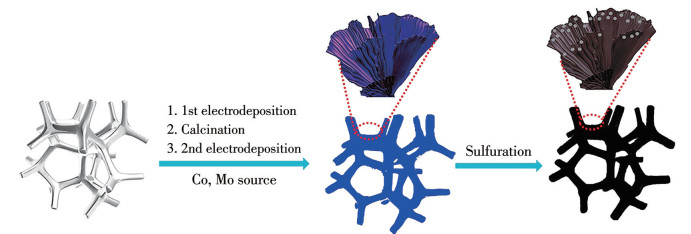
Figure 1.
Schematic of the fabrication procedure of CoMoNiO-S/NF-T

CoMoNiO-S/nickel foam heterostructure composite for efficient oxygen evolution catalysis performance
Hong YANG , Shengjuan SHAO , Baoyi LI , Yifan LU , Na LI


In water electrolysis, the oxygen evolution reaction (OER) proceeds through a four-step reaction, with each step involving a single-electron transfer. The energy accumulation required for each step results in a large overpotential. Therefore, the significant energy barrier caused by the four-electron transfer leads to slow OER kinetics, limiting the efficiency of the water decomposition process. In addition, the OER process is accompanied by the adsorption-desorption of multiple intermediates, whose binding energies are interrelated and cannot be simultaneously optimized, posing inherent limitations to catalyst design. In addition, the non-zero overpotential arising from these varying binding energies necessitates that OER electrocatalysts operate at high-potential regions, presenting another obstacle to their development. Therefore, developing a high-performance and stable OER electrocatalyst is essential for enabling water electrolysis with low overpotential and accelerated reaction kinetics.
In recent years, various strategies have been proposed to prepare cost-effective OER catalysts exhibiting high electrocatalytic activity and stability, with some achieving or exceeding the activity of precious metal catalysts. Designing heterogeneous electrocatalysts with rich interfaces between different components has emerged as a particularly promising approach. Heterogeneous electrocatalysts offer a significant advantage due to their ability to change the chemical composition and crystal structure at the interface, leading to different atomic coordination and lattice strain. The interface formed by combining two different components with differing electronegativities facilitates electron interaction and redistribution, thus triggering a synergistic effect between components. Numerous heterogeneous OER electrocatalysts use metal alloys[1], oxides[2-8], sulfides[9-15], selenides[16-21], nitrides[22-23], carbides[24-28], and phosphides[29-34] as building blocks. However, reports on the simultaneous preparation of cobalt oxides, nickel sulfides, and molybdenum sulfides into heterogeneous OER electrocatalysts remain scarce[35-36].
In this study, a composite electrocatalyst comprising Co3O4, Ni3S2, Mo2S3, and CoSO4 was successfully constructed using nickel foam (NF) as a sacrificial template and a nickel source through a vulcanization process. The catalyst, designated as CoMoNiO-S/NF, was found to be significantly influenced by the vulcanization temperature. Among the tested samples, the CoMoNiO-S/NF-110 electrocatalyst demonstrated excellent OER performance, achieving overpotentials of 199.4 and 224.4 mV at current densities of 100 and 200 mA·cm-2, respectively. These values reflect remarkably low overpotentials, highlighting excellent electrocatalytic activity, which surpasses both its precursor and commercial RuO2. This outstanding catalytic activity is primarily attributed to the self-growth of the catalyst on the substrate, which is conducive to accelerating electron transfer and increasing stability. Additionally, the rich interfaces within the heterogeneous structure, the synergistic interactions of electrons at these interfaces, and the active site exposed by the defect structure collectively contribute to enhanced OER activity of the catalyst.
Potassium hydroxide (KOH), cobalt nitrate hexahydrate (Co(NO3)2·6H2O), sodium molybdate dihydrate (Na2MoO4·2H2O), and thiourea (CH4N2S) were purchased from Meryer Co., Ltd. (China). All chemicals were used as received without any further purification.
The synthesis of the precursor Mo-Co(OH)2/Co3O4/NF followed a previously reported method[37]. For catalyst preparation, 76.1 mg of thiourea was dissolved in 10 mL of water and stirred to form a uniform solution. The solution was transferred to a hydrothermal reactor along with a piece of the precursor (1 cm×1.5 cm) and subjected to a reaction at 90, 110, 120, and 130 ℃ for 2 h. After the reaction, the mixture was naturally cooled to room temperature, rinsed with water, and vacuum-dried at 50 ℃ for 10 h. The resulting samples were denoted as CoMoNiO-S/NF-T (T=90, 110, 120, and 130, corresponding to the temperature of 90, 110, 120, and 130 ℃, respectively). The synthetic strategy of CoMoNiO-S/NF-T is presented in Fig.1. The synthesis details of the control samples are provided in the Supporting information.
The crystal structures of the samples were examined using a Rigaku Ultima Ⅳ X-ray diffractometer (XRD, Cu Kα radiation, λ=0.154 178 nm, 40 kV, 40 mA) within a 2θ range of 10°-80°. Scanning electron microscope (SEM) images were captured using a JEOL JSM-6700 M microscope at an accelerating voltage of 15 kV. Transmission electron microscope (TEM) and high-resolution TEM (HRTEM) images were acquired on a JEM-2100PLUS TEM operating at 200 kV. The binding energies of Co, Mo, O, and S were assessed using X-ray photoelectron spectroscopy (XPS, ESCALAB Perkin Elmer) to investigate the surface elemental chemical states. The resulting spectra were processed with a Shirley background and fitted via XPSPEAK software.
All electrochemical tests were performed with a standard three-electrode system on a CHI-760E electrochemical workstation at room temperature, with a 1.0 mol·L-1 KOH aqueous solution (pH=14) as the electrolyte. The synthesized catalyst served as the working electrode, a graphite rod as the counter electrode, and a Hg/HgO electrode as the reference electrode. The polarization curve was scanned at a rate of 2 mV·s-1, and the final test potential related to the Hg/HgO electrode (E′) was converted to a potential related to the standard hydrogen electrode (E) using the Nernst equation: E=E′+0.098+0.059 1pH. All polarization curves were iR-compensated with a 90% compensation value to account for the resistance between the catalyst and electrolyte. The electrochemical impedance spectroscopy (EIS) test was performed with a frequency range of 100 000-0.01 Hz and an amplitude of 5 mV.
The synthesized materials were characterized by XRD to analyze their composition. As shown in the XRD results (Fig.S1), temperature had a significant effect on the formation of material components during the reaction process. At reaction temperatures of 110 and 120 ℃, Ni3S2, Mo2S3, CoSO4, and other components were formed during the sulfurization process, with a distinct Co3O4 phase also observed. This indicates that part of the Co3O4 in the precursor was reduced to CoSO4 (PDF No.78-1799) at 110 and 120 ℃. The diffraction peaks at 20.4°, 22.1°, and 24.8° correspond to the (114), (114), and (021) planes of CoSO4, respectively. This may be due to the following reactions:
|
|
(1) |
|
|
(2) |
However, at a temperature of 130 ℃, the Co3O4 peak in CoMoNiO-S/NF-130 disappeared, while at 90 ℃, the diffraction peak of CoSO4 was absent in the CoMoNiO-S/NF-90 pattern. This indicates that Co3O4 was converted to CoSO4 at high temperatures during thiourea hydrolysis, whereas it was not reduced at lower temperatures. Moreover, the XRD patterns of CoMoNiO-S/NF-130 showed diffraction peaks for Ni3S2 and Mo2S3, with 2θ values of 21.6°, 31.0° and 44.3° corresponding to the (100), (110), and (200) planes of Ni3S2 (PDF No.85-1802), and 16.3°, 38.2°, and 55.1° corresponding to the (101), (103), and (302) planes of Mo2S3 (PDF No.78-1332). In contrast, only weak diffraction peaks of Ni3S2 and Mo2S3 were observed in CoMoNiO-S/NF-90, suggesting that HS- produced by thiourea hydrolysis at high temperatures, contributes to sulfide formation. The formation of Ni3S2 results from the vulcanization of NF as a nickel source, while Mo2S3 is formed due to the reduction of [MoO4]2- in the precursor.
|
|
(3) |
|
|
(4) |
|
|
(5) |
The morphology and microstructure of CoMoNiO-S/NF composites were analyzed using SEM and TEM. As shown in Fig.2a, the nanosheets were stacked into nano-flower clusters, a typical morphology of Co3O4 at a vulcanization temperature of 90 ℃. At 110 ℃, the Co3O4 nanosheets in CoMoNiO-S/NF-110 (Fig.2b) became thinner and smaller, with fine Ni3S2 and Mo2S3 nanoparticles growing at the edges. This structure can provide a rich, heterogeneous interface, enhancing the synergistic effects between the components[38-39]. Meanwhile, when the temperature reached 120 ℃, the nanoparticles increased in size, and the cluster structure began to collapse (Fig.2c), indicating that the structure of Co3O4 was destroyed under the action of thiourea at elevated temperatures. At 130 ℃, the nanosheets in CoMoNiO-S/NF-130 (Fig.2d) almost disappeared, and numerous nanoparticles accumulated irregularly, indicating that Ni3S2 and Mo2S3 were the primary products under high-temperature conditions.
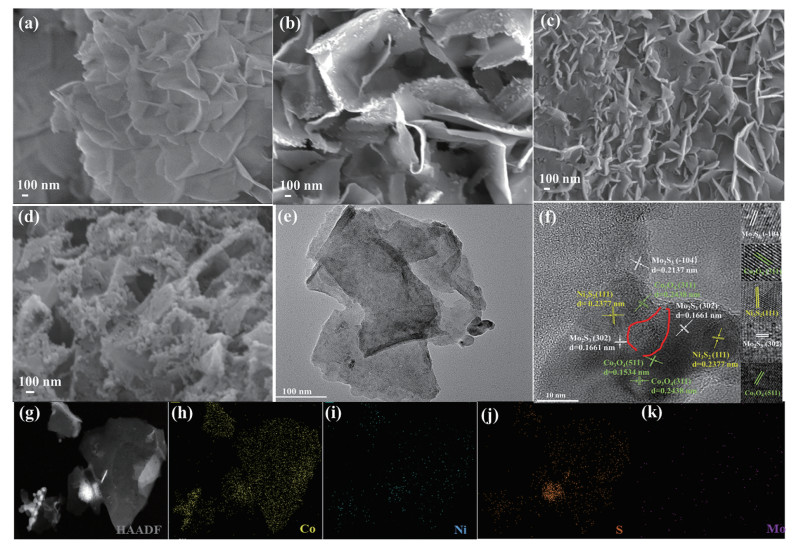
The surface and interface structures of the CoMoNiO-S/NF-110 components were further analyzed using HRTEM. The TEM image (Fig.2e) confirms the ultra-thin nanosheet structure. HRTEM (Fig.2f) showed distinct lattice diffraction fringes of 0.213 7 and 0.166 1 nm, corresponding to the (104) and (302) planes of Mo2S3, respectively. Additionally, the lattice fringes of 0.243 8 and 0.153 4 nm correspond to the (311) and (511) planes of Co3O4. These results were consistent with XRD results. In addition, a lattice fringe of 0.237 7 nm corresponds to the (200) plane of Ni3S2, with interfaces forming between the components. Moreover, dislocations and lattice deformation (indicated by red lines) at the boundaries of Co3O4-Ni3S2 and Co3O4-Mo2S3 indicate a defect structure, enhancing active site exposure. High-angle annular dark-field scanning transmission electron microscopy (HAADF-STEM) and the corresponding elemental distributions (Fig.2g-2k) reveal that the S element was predominantly distributed at the edges, aligning with the sulfide nanoparticles observed at the edge of the nanoparticle in SEM, further confirming the successful introduction of S.
The XPS survey spectra (Fig.3a) display the presence of Co, Mo, Ni, S, and O elements in the synthetic material, with all elemental peaks normalized to the C1s standard at 284.8 eV. Fig.3b shows the high-resolution XPS spectrum of Co2p of the samples prepared at different temperatures, where CoMoNiO-S/NF-130 differs significantly from the other samples. In addition to the typical Co2+, Co3+, and satellite peaks noted in all samples, the Co2p3/2 and Co2p1/2 peaks at 778.50 and 793.40 eV, respectively, correspond to Co0. This indicates that Co3O4 is further reduced to Co0 at high temperatures, which promotes reduction reactions. This phenomenon was further confirmed by high-resolution XPS spectra of O1s in various samples. In the O1s spectra (Fig.3c) of CoMoNiO-S/NF-90, CoMoNiO-S/NF-110, and CoMoNiO-S/NF-120, peaks at ca. 530.20, 531.10, 531.70, and 532.40 eV belong to M—O, M—OH (M=Co, Mo, and Ni), SO42-, and adsorbed H2O, respectively[40-41]. However, the O1s spectrum of CoMoNiO-S/NF-130 showed the complete disappearance of the M—O peak, implying the reduction of Co3O4, which was consistent with the XRD results.
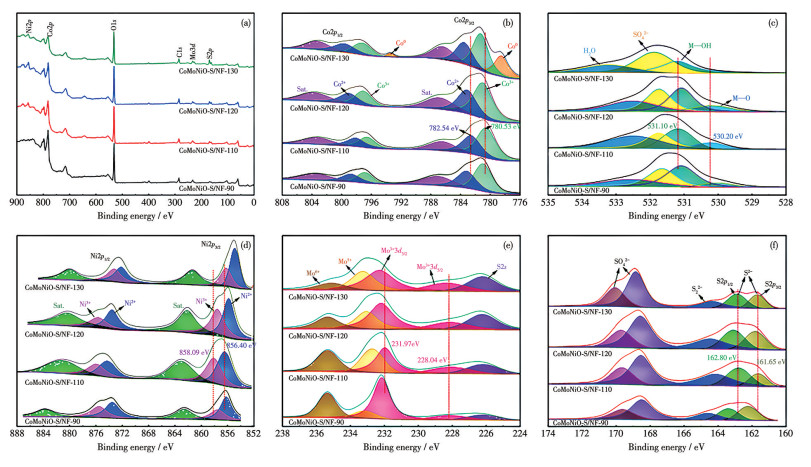
The fine spectrum of Ni2p in CoMoNiO-S/NF displayed four distinct spin-orbit splitting peaks and two broad satellite peaks, as shown in Fig.3d. The peaks at ca. 856.40 and 858.09 eV correspond to Ni2p3/2, while those at ca. 874.26 and 875.93 eV belong to Ni2p1/2. The energy difference between Ni2p1/2 and Ni2p3/2 was approximately 17.8 eV, and the presence of satellite peaks at 863.01 and 881.13 eV illustrates the coexistence of Ni2+ and Ni3+[42]. In addition, the binding energies of Ni2p3/2 and Ni2p1/2 in CoMoNiO-S/NF-110 shifted to higher binding energies compared to other samples, indicating electron transfer from Ni3S2 to Mo2S3 due to strong electron coupling. In the Mo3d fine spectrum of all samples (Fig.3e), the peak at 226.19 eV is attributed to the S2s signal, while peaks at 228.04 and 231.97 eV represent Mo3d5/2 and Mo3d3/2 of Mo3+[43-44], respectively. The peaks at binding energies of 232.72 and 235.34 eV are attributed to Mo5+ and Mo6+, possibly due to the partial oxidation of low-priced Mo in the air or the presence of MoO42- in the sample. Among all Mo3d spectra, the Mo3+ signal peak of CoMoNiO-S/NF-110 showed the lowest binding energy, consistent with the Ni2p signal observed in Fig.1e, further illustrating the electronic interaction between Mo and Ni. The S2p spectrum (Fig.3f) shows that the S2p signal peak of CoMoO-S/NF-90 was the weakest, aligning with the XRD results, indicating the lowest sulfide content. Peaks at 162.80 and 161.65 eV correspond to S2p1/2 and S2p3/2 in S2-, respectively, while the binding energy at 164.10 eV is ascribed to S22-, which is usually related to the S vacancies at bridging or terminal sites. This suggests the existence of unsaturated S atoms at Mo-S or Ni-S sites, which serve as active sites, increasing the catalyst activity[45]. Peaks at 168.56 and 169.69 eV in CoMoO-S/NF-110, CoMoO-S/NF-120, and CoMoO-S/NF-130 belong to SO42-[46-47], indicating the presence of CoSO4. In contrast, the peak at this binding energy in CoMoO-S/NF-90 may stem from S oxidation in the air.
The analytical results demonstrate that CoMoNiO-S/NF-T is a composite phase formed by CoSO4/Ni3S2/Mo2S3/NF in CoMoNiO-S/NF-130, CoSO4/Ni3S2/Mo2S3/Co3O4/NF in CoMoNiO-S/NF-110 and CoMoNiO-S/NF-120, and Ni3S2/Mo2S3/Co3O4/NF in CoMoNiO-S/NF-90. These findings also reveal electronic interactions among the components, altering the frontier orbital energy of the metal sulfide and thus affecting the binding energy and catalytic rate of the intermediate[48].
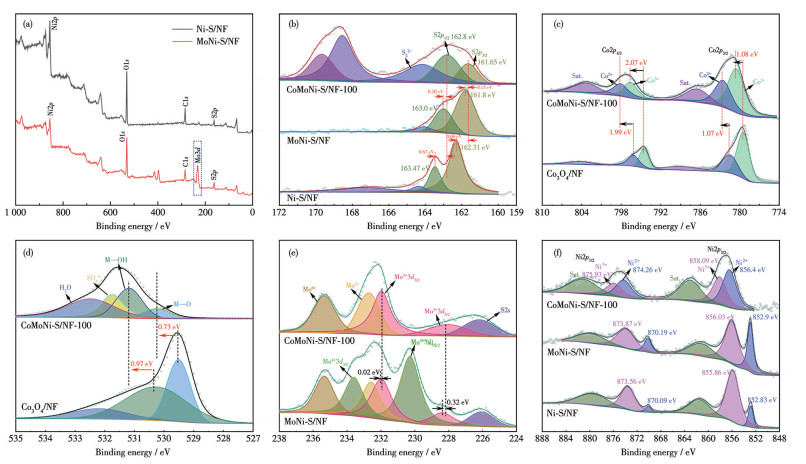
Next, to study the heterogeneous interfacial interactions of components in CoMoNiO-S/NF-110, Ni3S2/NF (Ni-S/NF), Mo2S3/Ni3S2/NF (MoNi-S/NF), and pure Co3O4/NF (the preparation methods were shown in the supporting information) were synthesized for comparison. The composition and the valence states of the surface elements were analyzed using XRD (Fig.S2) and XPS. As shown in Fig.4a, Ni-S/NF contained Ni and S, whereas MoNi-S/NF included Mo, Ni, and S. Compared to Ni-S/NF and MoNi-S/NF (Fig.4b), the binding energies of S2p3/2 and S2p1/2 in CoMoNiO-S/NF-110 exhibited a negative shift of 0.66 and 0.67 eV, and 0.15 and 0.20 eV, respectively. These shifts indicate the formation of S vacancies[49] in CoMoNiO-S/NF-110, which is conducive to exposing more active sites compared to Ni-S/NF and MoNi-S/NF. Fig.4c and 4d showed a positive shift in the Co2p and O1s peaks of the CoMoNiO-S/NF-110 compared with pure Co3O4, indicating a reduction in the electron cloud density around Co3O4 after the complex formation. CoMoNiO-S/NF-110 composite exhibited only five cleavage peaks (Fig.4e), possibly due to the reduced Mo content, where the Mo3d5/2 and Mo3d3/2 peaks of Mo3+ were shifted negatively relative to MoNi-S/NF. Moreover, the Ni2p spectrum (Fig.4f) of the composite displayed a positive shift, similar to Co2p, when compared with MoNi-S/NF and Ni-S/NF, implying a decrease in electron cloud density around Ni3S2 and Co3O4, while it increases around Mo2S3. These observations confirm the presence of a distinct heterostructure in CoMoNiO-S/NF-110, characterized by interfaces between Co3O4 and Mo2S3, as well as between Ni3S2 and Mo2S3. The electronic structure at these interfaces is adjusted, leading to the formation of partial positive and negative charges.
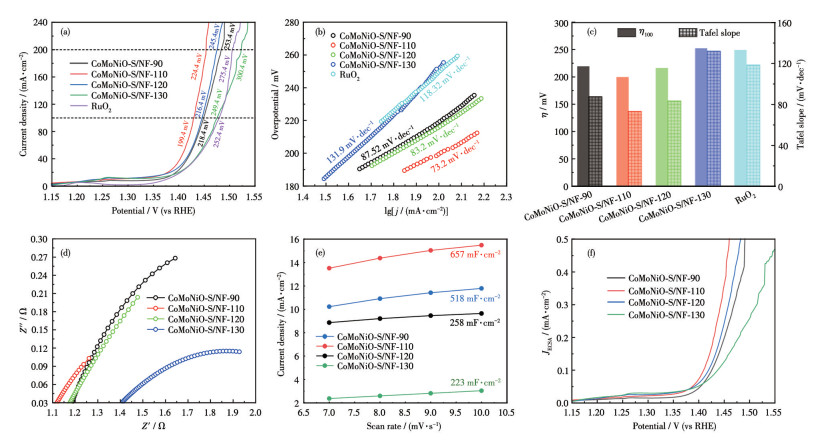
The OER performance was evaluated in 1.0 mol·L-1 KOH, comparing the properties of materials synthesized at different temperatures with commercial RuO2. As shown in Fig.5a, CoMoNiO-S/NF-110 exhibited superior electrocatalytic performance, ascribed to its unique heterogeneous structure. At current densities of 100 and 200 mA·cm-2, it required overpotentials (η) of 199.4 and 224.4 mV, respectively. CoMoNiO-S/NF-130 demonstrates a lower current density growth than RuO2 at high potential, with η100 and η200 of 252.4 and 300.4 mV, respectively. Additionally, the catalytic performance of other nanomaterials surpassed that of RuO2, with CoMoNiO-S/NF-90 exhibiting η100 and η200 of 218.4 and 253.4 mV, respectively, and CoMoNiO-S/NF-110 and CoMoNiO-S/NF-120 achieving η100 and η200 values of 216.4 and 245.4 mV, respectively. Compared to cobalt-based oxides and molybdenum sulfide/nickel sulfide electrocatalysts reported in the literature, CoMoNiO-S/NF-110 showed superior OER performance (Table 1). Tafel slopes analysis provides insights into the reaction kinetics of the catalysts. As displayed in Fig.5b and 5c, the Tafel slopes of CoMoNiO-S/NF-90, CoMoNiO-S/NF-110, CoMoNiO-S/NF-120, CoMoNiO-S/NF-130, and RuO2 catalysts were calculated to be 87.52, 73.20, 83.20, 131.90, and 118.32 mV·dec-1, respectively. The CoMoNiO-S/NF-110 catalyst exhibited the smallest Tafel slope, indicating the fastest reaction kinetics and enhanced acceleration of the electrochemical OER.

 下载:
导出CSV
下载:
导出CSV
| Catalyst | Current density / (mA·cm-2) | η / mV | Ref. |
| core-shell MoS2@CoO | 10 | 320 | [50] |
| CoS2@Co3O4 | 10 | 320 | [51] |
| Co3O4/MoS2 | 20 | 230 | [52] |
| Co3O4-MoS2(75%)/NF | 10 | 298 | [53] |
| Ni-Mo-S@Co3O4/CF | 10 | 275 | [36] |
| Co3O4@Mo-Co3S4-Ni3S2/NF | 50 | 295 | [35] |
| Ni3S2/MoS2 hollow sphere | 10 | 303 | [54] |
| MoS2-Ni3S2 nanosphere | 100 | 269 | [55] |
| Ni3S2/MoS2/20g-C3N4 | 10 | 183 | [56] |
| CoS2/MoS2/Ni3S2/NF | 100 | 300 | [57] |
| NiS2/MoS2/CNTs | 10 | 315 | [58] |
| NiCoP-Ni3S2-MoS2 | 10 | 160 | [59] |
| Ni3S2NSs/NF | 10 | 223 | [60] |
| Zr-MoS2@Ni3S2 | 20 | 275 | [61] |
| Co-NiS@MoS2 | 50 | 170.6 | [62] |
| CoMoNiO-S/NF-110 | 100 | 199.4 | This work |
In electrocatalysis, the resistance of a catalyst significantly determines the kinetics of the process. To investigate this, the electrochemical impedance spectra of various catalysts were analyzed to determine their resistance and assess their kinetic behavior. The findings, presented in Fig.5d and Table S1, indicate that the CoMoNiO-S/NF-110 catalyst exhibited an electron transfer resistance (Rct) of only 0.987 Ω, which was lower than that of other CoMoNiO-S/NF-T (T=90, 120, and 130) catalysts. These results suggest that the CoMoNiO-S/NF-110 catalyst possesses superior charge transfer efficiency during electrocatalytic OER. To gain further insights into the inherent OER activity of the prepared material, the electrochemically active surface area (ECSA) of the catalysts was evaluated by comparing their double-layer capacitance (Cdl), as ECSA is linearly proportional to Cdl. A larger Cdl indicates a larger ECSA, which enhances the number of active sites at the solid-liquid interface, facilitates bubble elimination, and improves electrochemical performance. The cyclic voltammetry (CV) curves of the synthesized catalysts under different sweep rates in the non-Faraday region were recorded (Fig.S3a-S3d) to fit the Cdl values. The fitted Cdl values (Fig.5e) of CoMoNiO-S/NF-90, CoMoNiO-S/NF-110, CoMoNiO-S/NF-120, and CoMoNiO-S/NF-130 were noted to be 518, 657, 258, and 223 mF·cm-2, respectively. In addition, the electrocatalytic OER polarization curves of CoMoNiO-S/NF-T catalysts were normalized by their ECSA values[63]. As depicted in Fig.5f, CoMoNiO-S/NF-110 exhibited the highest OER catalytic activity, aligning with the results shown in Fig.5a. This observation indicates that temperature affects not only the ECSA of the catalyst, but also its intrinsic electrocatalytic activity.
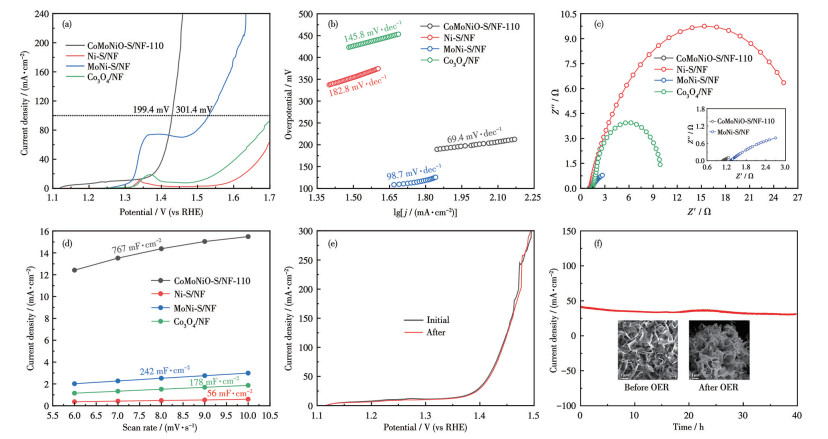
Fig.6a shows the electrocatalytic OER performance of CoMoNiO-S/NF-110 and the control samples Ni-S/NF, MoNi-S/NF, and Co3O4/NF. As expected, CoMoNiO-S/NF-110 demonstrated superior performance. The current density of CoMoNiO-S/NF-110 increased rapidly with applied potential, requiring a substantially lower overpotential to achieve a current density of 100 mA·cm-2 compared to the other catalysts. This improved performance is mainly due to the formation of S vacancy and the strong electron coupling interaction at the interfaces of Co3O4 with Mo2S3 and Ni3S2 with Mo2S3. These interactions optimize the electronic structure of the composite, promoting electron transfer across the interfaces. The generation of S vacancies creates more active sites, which are conducive to the adsorption and reaction of reactants. The Tafel slope of CoMoNiO-S/NF-110, as illustrated in Fig.6b, was only 69.4 mV·dec-1, significantly lower than that of Ni-S/NF (182.2 mV·dec-1), MoNi-S/NF (98.7 mV·dec-1), and Co3O4/NF (145.8 mV·dec-1). The results show that the formation of heterogeneous interfaces not only improves the OER activity of the catalyst but also promotes catalytic kinetics. The EIS tests (Fig.6c) show that CoMoNiO-S/NF-110 exhibited the smallest semicircle region among all samples, suggesting that the synergistic interaction at heterogeneous interfaces leads to faster charge transfer during the OER, thereby improving electronic conductivity. In addition, the Cdl estimated from CV curves at different scanning rates was used to assess the active sites. Fig.6d shows that CoMoNiO-S/NF-110 displayed the highest Cdl value of 767 mF·cm-2, indicating that the heterogeneous interface significantly increases the ECSA, leading to superior electrocatalytic activity.
Inset in panel c: enlarged EIS views of CoMoNiO-S/NF-110 and MoNi-S/NF; Inset in panel f: SEM images of CoMoNiO-S/NF-110 before and after OER stability test.
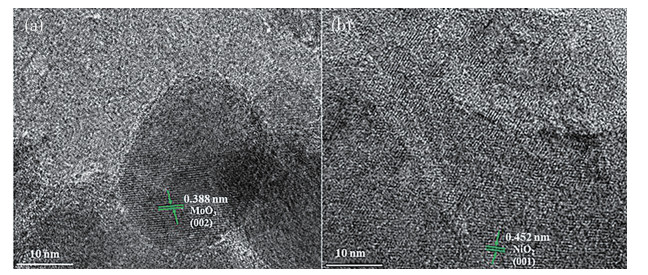
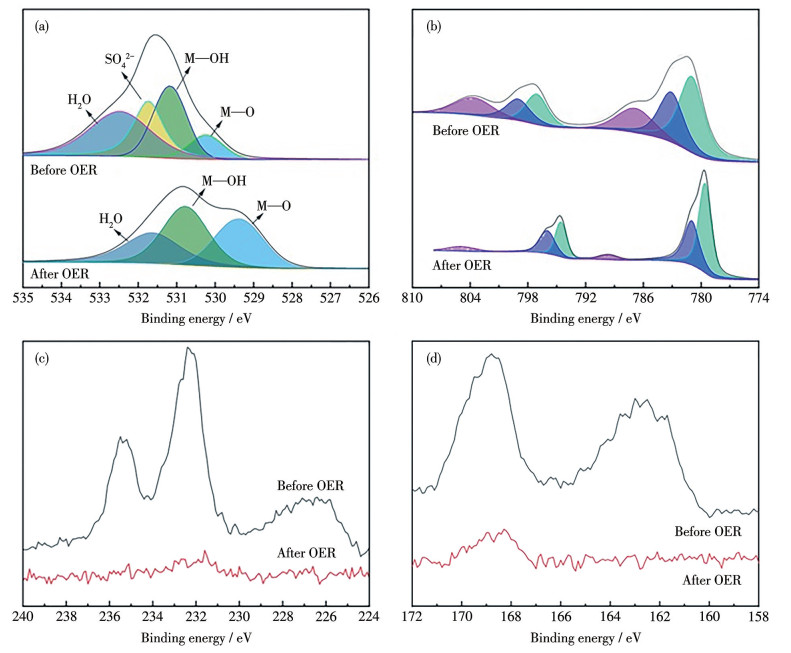
The stability of a catalyst is crucial for practical applications. CoMoNiO-S/NF-110 demonstrates excellent electrocatalytic oxygen evolution stability in alkaline environments (Fig.6e). Following a 40 h constant voltage test, the polarization curve remained nearly identical to its initial state, indicating a minimal decline in reaction activity. The time-current (i-t) curve revealed negligible variation in current density (Fig.6f), and the catalyst morphology showed no significant changes. After the stability test, the XRD pattern of CoMoNiO-S/NF-110 (Fig.S4) indicates that the peaks remained largely unchanged, except for the disappearance of CoSO4 peaks, likely due to its dissolution during the test. After the OER stability test, the peak corresponding to SO42- in the O1s high-resolution XPS spectrum disappeared, while the M—O peak area increased (Fig.7a), attributed to M—O bond formation during the OER process. For the high-resolution Co2p XPS spectrum of (Fig.7b), the Co peak area decreased significantly after testing, possibly due to CoSO4 dissolution during the OER test. In contrast, the high-resolution Ni2p XPS spectrum showed minimal changes compared to the pre-test spectrum (Fig.S5). During OER testing, nickel sulfide usually oxidizes to hydroxyl nickel or nickel oxide. A significant reduction in the high-resolution XPS signal intensities of Mo3d and S2p (Fig.7c and 7d) suggests partial dissolution of Mo and S in the electrolyte after stability testing, which is consistent with previous reports[64-65]. HRTEM images (Fig.8a and 8b) reveal clear lattice fringes after the stability test, with a spacing of 0.388 and 0.452 nm corresponding to the (002) plane of MoO3 and the (001) plane of NiO2. This observation aligned with the increased M—O peak area shown in Fig.7a.
In this study, the composite electrocatalyst CoMoNiO-S/NF was successfully prepared through the vulcanization process. Among the prepared catalysts, the CoMoNiO-S/NF-110 nanosheets, featuring Mo and Ni sulfides at the edges, provided rich active sites and interfaces. This structure shows excellent OER activity under the synergistic action of Ni3S2, Mo2S3, Co3O4, and other components. At current densities of 100 and 200 mA·cm-2, the catalyst achieved overpotentials of 199.4 and 224.4 mV, respectively, outperforming commercial RuO2 in electrocatalytic efficiency. The exceptional catalytic performance of the CoMoNiO-S/NF-110 catalyst in OER highlights the crucial impact of temperature in determining the composition of the composite catalyst. Optimizing temperature emerges as a key strategy for the construction of high-performance electrocatalysts. This study provides a cost-effective and efficient alkaline oxygen evolution catalyst, while also serving as a valuable guide for the design and synthesis of other advanced electrocatalysts.
LIU Q Q, SHI C Y, REN Y R, FAN X A, MENG Z W, HUANG B Y, XU M L. Superhydrophilic and heterostructured NiCu/polyaniline nanocomposites as highly efficient electrocatalyst and photothermal conversion layer integrated thermoelectric device for overall water splitting[J]. Appl. Surf. Sci., 2024, 664: 160266 doi: 10.1016/j.apsusc.2024.160266
ZHANG L H, FAN Q, LI K, ZHANG S, MA X B. First-row transition metal oxide oxygen evolution electrocatalysts: Regulation strategies and mechanistic understandings[J]. Sustain. Energ. Fuels, 2020, 4: 5417-5432 doi: 10.1039/D0SE01087A
ZhANG Y Y, FU Q, SONG B, XU P. Regulation strategy of transition metal oxide-based electrocatalysts for enhanced oxygen evolution reaction[J]. Acc. Mater. Res., 2022, 3: 1088-1100 doi: 10.1021/accountsmr.2c00161
WEI C, SUN S N, MANDLER D, WANG X, QIAO S Z, XU Z J. Approaches for measuring the surface areas of metal oxide electrocatalysts for determining their intrinsic electrocatalytic activity[J]. Chem. Soc. Rev., 2019, 48: 2518-2534 doi: 10.1039/C8CS00848E
GAO J J, TAO H B, LIU B. Progress of nonprecious‐metal‐based electrocatalysts for oxygen evolution in acidic media[J]. Adv. Mater., 2021, 33: 2003786 doi: 10.1002/adma.202003786
CHEN M, KITIPHAPIBOON N, FENG C R, ABUDULA A, MA Y F, GUAN G Q. Recent progress in transition-metal-oxide-based electrocatalysts for the oxygen evolution reaction in natural seawater splitting: A critical review[J]. eScience, 2023, 3: 100111 doi: 10.1016/j.esci.2023.100111
ADAMSON W, BO X, LI Y B, SURYANTO B H R, CHEN X J, ZHAO C. Co-Fe binary metal oxide electrocatalyst with synergistic interface structures for efficient overall water splitting[J]. Catal. Today, 2020, 351: 44-49 doi: 10.1016/j.cattod.2019.01.060
LI Z W, ZHANG K, WEI S C, ZHANG Z S, HAN H S, LIU G H. Titanium oxide supported molybdenum-nickel-iron oxide electrocatalyst for efficient and durable oxygen evolution reaction[J]. Fuel, 2024, 375: 132509 doi: 10.1016/j.fuel.2024.132509
HE R Z, HUANG X Y, FENG L G. Recent progress in transition-metal sulfide catalyst regulation for improved oxygen evolution reaction[J]. Energy & Fuels, 2022, 36: 6675-6694
LI F Q, WU H, LV S C, MA Y J, WANG B, REN Y L, WANG C, SHI Y X, JI H R, GU J, TANG S C, MENG X K. Two birds with one stone: contemporaneously enhancing OER catalytic activity and stability for dual‐phase medium‐entropy metal sulfides[J]. Small, 2023, 20: 2309025
QIN J F, YANG M, CHEN T S, DONG B, HOU S, MA X, ZHOU Y N, YANG X L, NAN J, CHAI Y M. Ternary metal sulfides MoCoNiS derived from metal organic frameworks for efficient oxygen evolution[J]. Int. J. Hydrog. Energy, 2020, 45: 2745-2753 doi: 10.1016/j.ijhydene.2019.11.156
ZHANG S Q, CHENG Y, WANG P, LEI X F, YOU J H, GUO R, ZHANG H Z. Research progress on surface reconstruction of transition metal sulfides (TMS, M=Fe, Co, Ni) as precatalysts for oxygen evolution reaction[J]. Int. J. Hydrog. Energy, 2024, 51: 545-560 doi: 10.1016/j.ijhydene.2023.10.122
WU L, SHEN X P, JI Z Y, YUAN J R, YANG S K, ZHU G X, CHEN L Z, KONG L R, ZHOU H B. Facile synthesis of medium‐entropy metal sulfides as high‐efficiency electrocatalysts toward oxygen evolution reaction[J]. Adv. Funct. Mater., 2022, 33: 2208170
VERMA M, SINHA L, SHIRAGE P M. Electrodeposited nanostructured flakes of cobalt, manganese and nickel-based sulfide (CoMnNiS) for electrocatalytic alkaline oxygen evolution reaction (OER)[J]. J. Mater. Sci.‒Mater. Electron., 2021, 32: 12292-12307 doi: 10.1007/s10854-021-05860-3
REN Y Y, SHI C Y, ZHU E Z, WEI D Y, MENG Z W, HUANG B Y, XU M L. Optimization of light response and electron redistribution of active sites by structuring CoS2/MoS2/Ni3S2 heterojunction for highly efficient photo-assisted oxygen evolution[J]. J. Alloy. Compd., 2024, 1000: 175109
JUNAID A, ABDULLAH M, BANO N, NOREEN F, SHAH S I A, ALSHGARI R A, MAHAMMAD S, MANZOOR S, EHSAN M F, ASHIQ M N. Facile synthesis of strontium selenide supported copper sulfide hybrid nanosheets as an efficient electrode for high-performance OER[J]. J. Korean Ceram. Soc., 2024, 61: 469-481 doi: 10.1007/s43207-024-00372-2
SINGH H, MARLEY-HINES M, CHAKRAVARTY S, NATH M. Multi-walled carbon nanotube supported manganese selenide as a highly active bifunctional OER and ORR electrocatalyst[J]. J. Mater. Chem. A, 2022;10: 6772-6784 doi: 10.1039/D1TA09864K
WU Z. Transition metal selenides for oxygen evolution reaction[J]. Energy Technol., 2024, 12: 2301574 doi: 10.1002/ente.202301574
MASUD J, LIYANAGE W P R, CAO X, SAXENA A, NATH M. Copper selenides as high-efficiency electrocatalysts for oxygen evolution reaction[J]. ACS Appl. Mater. Interfaces, 2018, 1: 4075-4083
SRINIVAS K, MA F, LIU Y, ZHANG Z, WU Y, CHEN Y. Metal-organic framework-derived Fe-doped Ni3Se4/NiSe2 heterostructure-embedded mesoporous tubes for boosting oxygen evolution reaction[J]. ACS Appl. Mater. Interfaces, 2022, 14: 52927-52939 doi: 10.1021/acsami.2c16133
SWESI A T, MASUD J, NATH M. Nickel selenide as a high-efficiency catalyst for oxygen evolution reaction[J]. Energ. Environ. Sci., 2016, 9: 1771-1782 doi: 10.1039/C5EE02463C
BATOOL M, WASEEM A, NADEEM M A, NADEEM M A. Phase pure synthesis of iron-nickel nitride nanoparticles: A low cost electrocatalyst for oxygen evolution reaction[J]. Int. J. Hydrog. Energy, 2023;48: 18280-18290 doi: 10.1016/j.ijhydene.2023.01.308
LU Y K, LI Z X, XU Y L, TANG L Q, XU S J, LI D, ZHU J J, JIANG D L. Bimetallic Co-Mo nitride nanosheet arrays as high-performance bifunctional electrocatalysts for overall water splitting[J]. Chem. Eng. J., 2021, 411: 128433 doi: 10.1016/j.cej.2021.128433
CHEN C H, RASAL A S, CHANG J Y, YU W Y. Unlocking the catalytic potential of tungsten carbide coordinated with 3d transition metals in oxygen electrochemistry[J]. Chem. Eng. J., 2024, 497: 154145 doi: 10.1016/j.cej.2024.154145
KIRAN G K, SREEKANTH T V M, YOO K, KIM J. Bifunctional electrocatalytic activity of two-dimensional multilayered vanadium carbide (MXene) for ORR and OER[J]. Mater. Chem. Phys., 2023, 296: 127272 doi: 10.1016/j.matchemphys.2022.127272
GUO Y Y, HUANG Q, DING J Y, ZHONG L, LI T T, PAN J Q, HU Y, QIAN J J, HUANG S M. CoMo carbide/nitride from bimetallic MOF precursors for enhanced OER performance[J]. Int. J. Hydrog. Energy, 2021, 46: 22268-22276 doi: 10.1016/j.ijhydene.2021.04.084
ROY S, BAGCHI D, DHEER L, SARMA S C, RAJAJI V, NARAYANA C, WAGHMARE U V, PETER S C. Mechanistic insights into the promotional effect of Ni substitution in non-noble metal carbides for highly enhanced water splitting[J]. Appl. Catal. B‒Environ., 2021, 298: 120560 doi: 10.1016/j.apcatb.2021.120560
SEENIVASAN S, SEO J. Inverting destructive electrochemical reconstruction of niobium nitride catalyst to construct highly efficient HER/OER catalyst[J]. Chem. Eng. J., 2023, 454: 140558 doi: 10.1016/j.cej.2022.140558
LEI X, QING J C, WENG L T, LI S M, PENG R Z, WANG W, WANG J L. Porous FeP/CoP heterogeneous materials as efficient alkaline oxygen evolution reaction (OER) catalysts[J]. New J. Chem., 2022, 46: 15351-15357 doi: 10.1039/D2NJ01557A
CAO Q B, SU W X, LIU H R, FENG C C, ZHOU Q. Nickel-cobalt phosphide nanowires as precatalysts for surface reconstruction to prepare durable and efficient OER catalysts[J]. Electroanal. Chem., 2024, 952: 117928 doi: 10.1016/j.jelechem.2023.117928
WANG Y, XIE M S, DAI F F, LIU J, ZHANG L B, ZHANG R Z, ZHANG Z, HU W P. Iron regulates the interfacial charge distribution of transition metal phosphides for enhanced oxygen evolution reaction[J]. J. Colloid Interface Sci., 2022, 615: 725-731 doi: 10.1016/j.jcis.2022.02.009
ZEENAT, AHMAD Z, MAQBOOL A, ASIF HUSSAIN M, ADEL PASHAMEAH R, SHAHZADI A, NAZRA N, IQBAL S, ALANAZI A K, ASHIQ M N, ABO-DIEF H M. One-pot solvothermal synthesis of highly catalytic Janus transition metal phosphides (TMPs) for high performance OER[J]. Fuel, 2023, 331: 125913 doi: 10.1016/j.fuel.2022.125913
LIU Y L, GE P J, LI Y F, ZHAI X W, LU K, CHEN X X, YANG J M, WANG Z Y, ZHANG H Y, GE G X. Prussian blue analogues derived Fe-NiCoP reveals the cooperation of Fe doping and phosphating for enhancing OER activity[J]. Appl. Surf. Sci., 2023, 615: 156378 doi: 10.1016/j.apsusc.2023.156378
BHUTANI D, MAITY S, CHATURVEDI S, CHALAPATHI D, WAGHMARE U V, NARAYANA C, PRABHAKARAN V C, MUTHUSAMY E. Heterostructure from heteromixture: Unusual OER activity of FeP and CoP nanostructures on physical mixing[J]. J. Mater. Chem. A, 2022, 10: 22354-22362 doi: 10.1039/D2TA04296G
WU Q X, DONG A Q, YANG C C, YE L, ZHAO L J, JIANG Q. Metal-organic framework derived Co3O4@Mo-Co3S4-Ni3S2 heterostructure supported on Ni foam for overall water splitting[J]. Chem. Eng. J., 2021, 413: 127482 doi: 10.1016/j.cej.2020.127482
XIONG T, LI G F, YOUNG D J, TAN Z Y, YIN X H, MI Y, HU F L. In-situ surface-derivation of Ni-Mo bimetal sulfides nanosheets on Co3O4 nanoarrays as an advanced overall water splitting electrocatalyst in alkaline solution[J]. J. Alloy. Compd., 2019, 791: 328-335 doi: 10.1016/j.jallcom.2019.03.313
YANG H, HU T P, MENG R Q, GUO L J. Efficient Mo-Co(OH)2/Co3O4/Ni foam electrocatalyst for overall water splitting[J]. J. Solid State Chem., 2023, 320: 123837 doi: 10.1016/j.jssc.2023.123837
DU X Q, YANG Z, LI Y, GONG Y Q, ZHAO M. Controlled synthesis of Ni(OH)2/Ni3S2 hybrid nanosheet arrays as highly active and stable electrocatalysts for water splitting[J]. J. Mater. Chem. A, 2018, 6: 6938-6946 doi: 10.1039/C8TA01387J
LI S M, YU Y M, SUN X Y, DING X F, YANG H F, PAN S B, WANG L X, ZHANG Q T. Enhanced electronic interaction in hemin@Ni(OH)2 composite for efficient electrocatalytic oxygen evolution[J]. J. Alloy. Compd., 2022, 892: 161780 doi: 10.1016/j.jallcom.2021.161780
SUN F Z, LI C Q, LI B, LIN Y Q. Amorphous MoSx developed on Co(OH)2 nanosheets generating efficient oxygen evolution catalysts[J]. J. Mater. Chem. A, 2017, 5: 23103-23114 doi: 10.1039/C7TA07729G
JAIN P, JHA S, INGOLE P P. Concurrently engineered Lewis acid sites and coordination sphere vacancies in CoFe Prussian blue analogues for boosted bifunctional oxygen electrocatalysis[J]. ACS Appl. Energy Mater., 2023, 6: 3278-3290
LUO X, JI P X, WANG P Y, CHENG R L, CHEN D C, LIN C, ZHANG J N, HE J W, SHI Z H, LI N, XIAO S Q, MU S C. Interface engineering of hierarchical branched Mo‐doped Ni3S2/NixPy hollow heterostructure nanorods for efficient overall water splitting[J]. Adv. Energy Mater., 2020, 10: 1903891 doi: 10.1002/aenm.201903891
CUI Z, GE Y C, CHU H, BAINES R, DONG P, TANG J H, YANG Y, AJAYAN P M, YE M X, SHEN J F. Controlled synthesis of Mo-doped Ni3S2 nano-rods: An efficient and stable electro-catalyst for water splitting[J]. J. Mater. Chem. A, 2017, 5: 1595-1602 doi: 10.1039/C6TA09853C
WU C R, LIU B T, WANG J, SU Y Y, YAN H Q, NG C T, LI C, WEI J M. 3D structured Mo-doped Ni3S2 nanosheets as efficient dual-electrocatalyst for overall water splitting[J]. Appl. Surf. Sci., 2018, 441: 1024-1033 doi: 10.1016/j.apsusc.2018.02.076
SUN R, ZHAO Z F, SU Z H, LI T S, ZHAO J X, SHANG Y C. Multi-interface MoS2/Ni3S4/Mo2S3 composite as an efficient electrocatalyst for hydrogen evolution reaction over a wide pH range[J]. Dalton Trans, 2022, 51: 6825-6831 doi: 10.1039/D2DT00231K
LIU R R, ZHANG H M, ZHANG X, WU T X, ZHAO H J, WANG G Z. Co9S8@N, P-doped porous carbon electrocatalyst using biomass-derived carbon nanodots as a precursor for overall water splitting in alkaline media[J]. RSC Adv., 2017, 7: 19181-19188 doi: 10.1039/C7RA01798G
ZHANG G S, WANG Y, CHEN M, XU J X, WANG L. ZIF-67-derived carbon@Co3S4/CoSO4/MnO polyhedron to activate peroxymonosulfate for degrading levofloxacin: Synergistic effect and mechanism[J]. Chem. Eng. J., 2023, 451: 138976 doi: 10.1016/j.cej.2022.138976
YANG Y, YAO H Q, YU Z H, ISLAM S M, HE H Y, YUAN M W, YUE Y H, XU K, HAO W C, SUN G B, LI H F, MA S L, ZAPOL P, KANATZIDIS M G. Hierarchical nanoassembly of MoS2/Co9S8/Ni3S2/Ni as a highly efficient electrocatalyst for overall water splitting in a wide pH range[J]. J. Am. Chem. Soc., 2019, 141: 10417-10430 doi: 10.1021/jacs.9b04492
ZHOU S Y, ZHU F, CHENG H, KOMARNENI S, MA J F. In-situ growth of Ni3S2@Mo2S3 catalyst on Mo-Ni foam for degradation of p-nitrophenol with a good synergetic effect by using ozone[J]. J. Environ. Chem. Eng., 2023, 11: 111477 doi: 10.1016/j.jece.2023.111477
CHENG P F, YUAN C, ZHOU Q W, HU X B, LI J, LIN X Z, WANG X, JIN M L, SHUI L L, GAO X S, NÖTZEL R, ZHOU G F, ZHANG Z, LIU J M. Core-Shell MoS2@CoO electrocatalyst for water splitting in neural and alkaline solutions[J]. J. Phys. Chem. C, 2019;123: 5833-5839 doi: 10.1021/acs.jpcc.8b10954
AFTAB U, TAHIRA A, SAMO A H, ABRO M I, BALOCH M M, KUMAR M, SIRAJUDDIN, IBUPOTO Z H. Mixed CoS2@Co3O4 composite material: An efficient nonprecious electrocatalyst for hydrogen evolution reaction[J]. Int. J. Hydrog. Energy, 2020, 45: 13805-13813 doi: 10.1016/j.ijhydene.2020.03.131
MUTHURASU A, MARUTHAPANDIAN V, KIM H Y. Metal-organic framework derived Co3O4/MoS2 heterostructure for efficient bifunctional electrocatalysts for oxygen evolution reaction and hydrogen evolution reaction[J]. Appl. Catal. B‒Environ., 2019, 248: 202-210 doi: 10.1016/j.apcatb.2019.02.014
ABD-ELRAHIM, CHUN D M. Nanosized Co3O4-MoS2 heterostructure electrodes for improving the oxygen evolution reaction in an alkaline medium[J]. J. Alloy. Compd., 2021, 853: 156946 doi: 10.1016/j.jallcom.2020.156946
KIM S, MIN K, KIM H, YOO R, SHIM S E, LIM D, BAECK S H. Bimetallic-metal organic framework-derived Ni3S2/MoS2 hollow spheres as bifunctional electrocatalyst for highly efficient and stable overall water splitting[J]. Int. J. Hydrog. Energy, 2022, 47: 8165-8176 doi: 10.1016/j.ijhydene.2021.12.208
LIU H R, OUYANG D, ZhOU Q, FENG C C. Successional heterostructure MoS2-Ni3S2 nanospheres based on 3D nano-porous Ni: An efficient electrocatalyst for overall water splitting[J]. J. Alloy. Compd., 2022, 920: 165243 doi: 10.1016/j.jallcom.2022.165243
WANG H X, REN J S, WANG A J, WANG Q, ZHAO W, ZHAO L. Synergistic catalysis of graphitic carbon nitride supported bimetallic sulfide nanostructures for efficient oxygen generation[J]. Chem. Commun., 2022, 58: 9202-9205 doi: 10.1039/D2CC03619C
ZHANG Y, GUO H R, SONG M, QIU Z Z, WANG S H, SUN L M. Hierarchical interfaces engineering-driven of the CoS2/MoS2/Ni3S2/NF electrode for high-efficient and stable oxygen evolution and urea oxidation reactions[J]. Appl. Surf. Sci., 2023, 617: 156621 doi: 10.1016/j.apsusc.2023.156621
LING T, ZHANG T, GE B H, HAN L L, ZHENG L R, LIN F, XU Z R, HU W B, DU X W, DAVEY K, QIAO S Z. Well‐dispersed nickel‐ and zinc‐tailored electronic structure of a transition metal oxide for highly active alkaline hydrogen evolution reaction[J]. Adv. Mater., 2019, 31: 1807771 doi: 10.1002/adma.201807771
WANG Q R, DU X Q, ZHANG X S. Controlled synthesis of NiCoM (M=P, S, Se, O)-Ni3S2-MoS2 hybrid material as environmentally friendly water splitting catalyst[J]. Int. J. Hydrog. Energy, 2023, 48: 9260-9272 doi: 10.1016/j.ijhydene.2022.12.021
YAO M Q, SUN B L, HE L X, WANG N, HU W C, KOMARNENI S. Self-assembled Ni3S2 nanosheets with mesoporous structure tightly held on Ni foam as a highly efficient and long-term electrocatalyst for water oxidation[J]. ACS Sustain. Chem. Eng., 2019, 7: 5430-5439 doi: 10.1021/acssuschemeng.8b06525
PANG N, LI Y, TONG X, WANG M Q, SHI H Y, WU D J, XIONG D Y, XU S H, WANG L W, JIANG L, CHU P K. Activation of basal-plane sulfur sites on MoS2@Ni3S2 nanorods by Zr plasma ion implantation for bifunctional electrocatalysts[J]. J. Alloy. Compd., 2023, 947: 169448 doi: 10.1016/j.jallcom.2023.169448
GAO H W, ZANG J B, WANG Y H, ZHOU S Y, TIAN P F, SONG S W, TIAN X Q, LI W. One-step preparation of cobalt-doped NiS@MoS2 core-shell nanorods as bifunctional electrocatalyst for overall water splitting[J]. Electrochim. Acta, 2021, 377: 1138051
WEI C, XU Z J. The Comprehensive understanding of as an evaluation parameter for electrochemical water splitting[J]. Small Methods, 2018, 2: 1800168 doi: 10.1002/smtd.201800168
YIN J, LI Y X, LV F, LU M, SUN K, WANG W, WANG L, CHENG F Y, LI Y F, XI P X, GUO S J. Oxygen vacancies dominated NiS2/CoS2 interface porous nanowires for portable Zn-air batteries driven water splitting devices[J]. Adv. Mater., 2017, 29: 1704681 doi: 10.1002/adma.201704681
WANG Q, ZHAO H Y, LI F M, SHE W Y, WANG X M, XU L, JIAO H. Mo-doped Ni2P hollow nanostructures: Highly efficient and durable bifunctional electrocatalysts for alkaline water splitting[J]. J. Mater Chem. A, 2019, 7: 7636-7643 doi: 10.1039/C9TA01015G

Figure 2 SEM images of (a) CoMoNiO-S/NF-90, (b) CoMoNiO-S/NF-110, (c) CoMoNiO-S/NF-120, and (d) CoMoNiO-S/NF-130; (e) TEM and (f) HRTEM images, (g) HAADF-STEM image, and (h-k) elemental mappings of CoMoO-S/NF-110

Figure 3 (a) XPS survey spectra and high-resolution XPS spectra of (b) Co2p, (c) O1s, (d) Ni2p, (e) Mo3d, and (f) S2p for CoMoNiO-S/NF-T

Figure 4 (a) XPS survey spectra of the control samples Ni-S/NF and MoNi-S/NF; High-resolution XPS spectra of (b) S2p, (c) Co2p, (d) O1s, (e) Mo3d, and (f) Ni2p in CoMoNiO-S/NF-110 and other control samples

Figure 5 Electrocatalytic OER performance of composites CoMoNiO-S/NF-T: (a) polarization curves; (b) Tafel slopes; (c) column chart of current density and Tafel slope; (d) EIS; (e) estimated Cdl, and (f) polarization curves of catalytic OER normalized by ECSA

Figure 6 (a) LSV curves, (b) Tafel plots, (c) EIS, (d) estimation of Cdl of CoMoNiO-S/NF-110 and Ni-S/NF, MoNi-S/NF, Co3O4/NF in 1.0 mol·L-1 KOH; (e) Polarization curves before and after OER test, and (f) i-t curve of CoMoNiO-S/NF-110 for OER in 1.0 mol·L-1 KOH
Inset in panel c: enlarged EIS views of CoMoNiO-S/NF-110 and MoNi-S/NF; Inset in panel f: SEM images of CoMoNiO-S/NF-110 before and after OER stability test.

Figure 7 XPS spectra of (a) O1s, (b) Co2p, (c) Mo3d, and (d) S2p before and after OER stability test
Table 1. Comparison of the OER electrocatalytic performance of CoMoNiO-S/NF-110 with reported composite electrocatalysts in 1 mol·L-1 KOH
| Catalyst | Current density / (mA·cm-2) | η / mV | Ref. |
| core-shell MoS2@CoO | 10 | 320 | [50] |
| CoS2@Co3O4 | 10 | 320 | [51] |
| Co3O4/MoS2 | 20 | 230 | [52] |
| Co3O4-MoS2(75%)/NF | 10 | 298 | [53] |
| Ni-Mo-S@Co3O4/CF | 10 | 275 | [36] |
| Co3O4@Mo-Co3S4-Ni3S2/NF | 50 | 295 | [35] |
| Ni3S2/MoS2 hollow sphere | 10 | 303 | [54] |
| MoS2-Ni3S2 nanosphere | 100 | 269 | [55] |
| Ni3S2/MoS2/20g-C3N4 | 10 | 183 | [56] |
| CoS2/MoS2/Ni3S2/NF | 100 | 300 | [57] |
| NiS2/MoS2/CNTs | 10 | 315 | [58] |
| NiCoP-Ni3S2-MoS2 | 10 | 160 | [59] |
| Ni3S2NSs/NF | 10 | 223 | [60] |
| Zr-MoS2@Ni3S2 | 20 | 275 | [61] |
| Co-NiS@MoS2 | 50 | 170.6 | [62] |
| CoMoNiO-S/NF-110 | 100 | 199.4 | This work |
 下载: 导出CSV

 扫一扫看文章


扫一扫关注我们