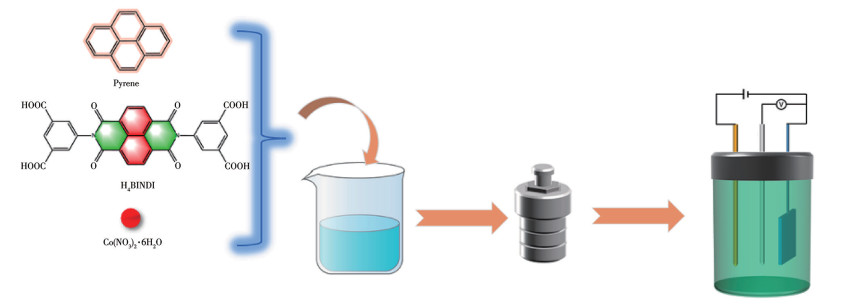
Scheme 1.
Illustration of the synthesis process of Py@Co-MOF and the three-electrode system for OER

Post-synthetic modification strategy to construct Co-MOF composites for boosting oxygen evolution reaction activity
Haifeng ZHENG , Xingzhe GUO , Yunwei WEI , Xinfang WANG , Huimin QI , Yuting YAN , Jie ZHANG , Bingwen LI


In recent years, the global economy has experienced rapid growth alongside a population increase, which has intensified the energy demand. However, the extraction of traditional energy resources has become increasingly challenging, resulting in significant environmental pollution. The development of new clean energy sources is considered a crucial strategy for addressing environmental issues[1-5]. Among alternative energy sources, hydrogen stands out due to its unique properties. Currently, water electrolysis for hydrogen production is regarded as a promising method. The oxygen evolution reaction (OER) is the rate-determining step (RDS) in the water electrolysis process, and its sluggish kinetics lead to low energy efficiency[6-8]. While noble metals such as ruthenium (Ru) and iridium (Ir) exhibit excellent catalytic performance for OER, their high costs make them unsuitable for large-scale applications. Consequently, researchers are actively pursuing more cost-effective alternative materials[9-12].
Transition metal oxides, hydroxides, sulfides, and phosphides are regarded as promising alternatives on account of their relatively low cost and abundant resources[13]. These materials can be optimized for catalytic performance through modifying their chemical composition and structure. Among these materials, metal-organic frameworks (MOFs), which are self-assembled polymeric ligands formed by metal ions and organic ligands, have witnessed rapid development in recent decades[14-15]. Owing to their large surface area, porosity, abundant metal sites, and topological diversity, MOFs have been extensively utilized in sensing, medicine, and catalysis[16-20]. Additionally, electrical conductivity is a crucial factor in evaluating catalyst performance. Electrocatalysts with high electrical conductivity possess higher electron transfer efficiency and display outstanding catalytic performance[21-28]. Compared with other metal catalysts, MOFs generally have lower electrical conductivity, mainly attributed to their distinctive metal-inorganic structure. The primary strategy for enhancing the electrical conductivity of MOFs at present is high-temperature calcination. However, high temperatures can cause damage to the active metal sites of MOFs. Additionally, it is regrettable that the oxides based on Ni or Co, which are the most active, it is estimated that the TOFs of each metal site are at least one order of magnitude lower than those of the TOFs in the OER complexes in biological systems[29-33]. Therefore, designing MOF materials with high activity and stability was the current focus of work.
In this work, we present the synthesis of a novel Co-MOF {[Co2(BINDI)(DMA)2]·DMA}n (H4BINDI=N,N′-bis(5-isophthalic acid)naphthalenediimide, DMA=N,N-dimethylacetamide), using naphthalene diimide (NDI) as the ligand and Co2+ ions as metal nodes. Furthermore, pyrene (Py), an electron donor, was effectively encapsulated within the porous structure of the Co-MOF through host-guest interactions, resulting in the self-assembled Py@Co-MOF composite. A comprehensive investigation of the catalytic performance of both Co-MOF and Py@Co-MOF electrodes revealed that the latter exhibited enhanced catalytic current and durability in the OER, significantly outperforming the Co-MOF without pyrene. These findings indicate that the presence of coordinated DMA within the Co-MOF promotes the formation of open metal sites (OMS), thereby enhancing catalytic activity. Additionally, the strong non-covalent π-π interactions between pyrene and the Co-MOF are believed to facilitate rapid electron transfer from the electrode to the Co-MOF, contributing to the improved stability of the Co-MOF-based electrode, as illustrated in Scheme 1.
Materials and methods are listed in the Supporting information.
A mixture of ligand H4BINDI (3 mg) and Co(NO3)2·6H2O (3.0 mg) was dissolved in 2.0 mL DMA. The resulting mixture was stirred for 0.5 h before being transferred to a 25 mL Teflon-lined autoclave to undergo heating at 120 ℃ for 24 h. Purplish-red bulk crystals of Co-MOF were obtained after the mixture was cooled slowly to room temperature. Anal. Calcd. for C23H23CoN3O8 (%): C, 52.28; H, 4.38; N, 7.95. Found (%): C, 52.72; H, 4.20; N, 7.59. IR (KBr, cm-1): 3 385 (s), 2 891 (m), 1 718 (s), 1 680 (w), 1 448 (m), 1 397 (m), 1 251 (w), 1 113 (m), 1 113 (w), 770 (w), 718 (w), 651 (m).
The synthesis step of Py@Co-MOF was similar to that of Co-MOF, with a slight modification. A mixture of H4BINDI (1.5 mg), Co(NO3)2·6H2O (1.5 mg), and pyrene (6.0 mg) was dissolved in 2.0 mL DMA. The resulting mixture was stirred for 0.5 h before being transferred to a 25 mL Teflon-lined autoclave to undergo heating at 115 ℃ for 3 d. Red crystals were obtained after the mixture had cooled slowly to room temperature.
All electrochemical measurements were conducted at room temperature using a CHI760E workstation. The performance of the OER was assessed by employing a standard three-electrode electrochemical system in an alkaline electrolyte (1.0 mol·L-1 KOH). Co-MOF and Py@Co-MOF/NF samples, each with an area of 1 cm×1 cm, were adopted as working electrodes. The counter electrode and reference electrode were a platinum sheet and an Ag/AgCl electrode, respectively. The electrode was fabricated by dispersing the sample, PVDF, and carbon black in an ethanol solution at a mass ratio of 8∶1∶1, followed by ultrasonic oscillation for 30 min to obtain a homogeneous suspension. Subsequently, this suspension was deposited onto nickel foam and then dried and weighed for subsequent OER testing.
Single-crystal X-ray diffraction data were collected on a XtaLAB (Rigaku synergy S) at approximately 300 K with graphite-monochromated Mo Kα radiation (λ=0.071 073 nm). The crystal structures were ascertained by direct methods and then underwent full-matrix least-squares refinement using the Olex2 software suite. In the final refinement cycles, non-hydrogen atoms were dealt with anisotropic displacement parameters. Organic hydrogen atoms were positioned in calculated locations, and their isotropic displacement parameters were set to 1.2Ueq of the attached atom. Comprehensive crystallographic details, including refinement parameters and experimental conditions, have been systematically compiled in Table 1.
 下载:
导出CSV
下载:
导出CSV
| Parameter | Co-MOF | Parameter | Co-MOF | |
| Empirical formula | C19H14CoN2O7·C4H9NO | μ / mm-1 | 0.617 | |
| Formula weight | 528.37 | F(000) | 1 180 | |
| Temperature / K | 297 | θ range for data collection / (°) | 4.032-49.97 | |
| Crystal system | Orthorhombic | Index ranges | -43 ≤ h ≤ 18, -17 ≤ k ≤ 10, -12 ≤ l ≤ 7 | |
| Space group | Imma | Reflection collected | 8 006 | |
| a / nm | 3.695 85(17) | Independent reflection | 2 694 (Rint=0.072 6, Rσ=0.056 4) | |
| b / nm | 1.504 41(8) | Data, number of restraints, number of parameters | 2 694, 36, 162 | |
| c / nm | 1.050 32(5) | Goodness-of-fit on F2 | 1.062 | |
| Volume / nm3 | 5.839 9(5) | Final R indexes [I≥2σ(I)] | R1=0.064 5, wR2=0.182 0 | |
| Z | 8 | Final R indexes (all data) | R1=0.082 5, wR2=0.202 2 | |
| Dc / (g·cm-3) | 1.004 | Largest diff. peak and hole / (e·nm-3) | 620, -800 |
Single-crystal X-ray diffraction studies show that Co-MOF crystallizes in an orthorhombic crystal system with an Imma space group (Table 1). As shown in Fig.1, the asymmetric unit in Co-MOF contains one crystallographically independent Co2+ ion and half a BINDI4- ligand, one coordinated DMA molecule, and half a lattice DMA molecule (Fig.1a). Co1 is coordinated with one O atom from a DMA molecule and four O atoms from the four different BINDI4- ligands. The two adjacent Co2+ ions are linked by four carboxylate groups to form the paddle-wheel secondary building unit (SBU) [Co2(COO)4], which further allows for the formation of extended 2D networks through the expansion of BINDI4- ligands (Fig.1b). This 2D networks along the a-axis by linking with neighboring carboxylate oxygen atoms on BINDI4- ligands, creating a 3D framework with the potential porosity of 24.4% after removing the free solvents, according to the free software of PLATON. Furthermore, the structural features of Co-MOF, such as relevant bond lengths (nm), bond angles (°), and π-π stacking interactions, have been compiled in Table S1 and S2.
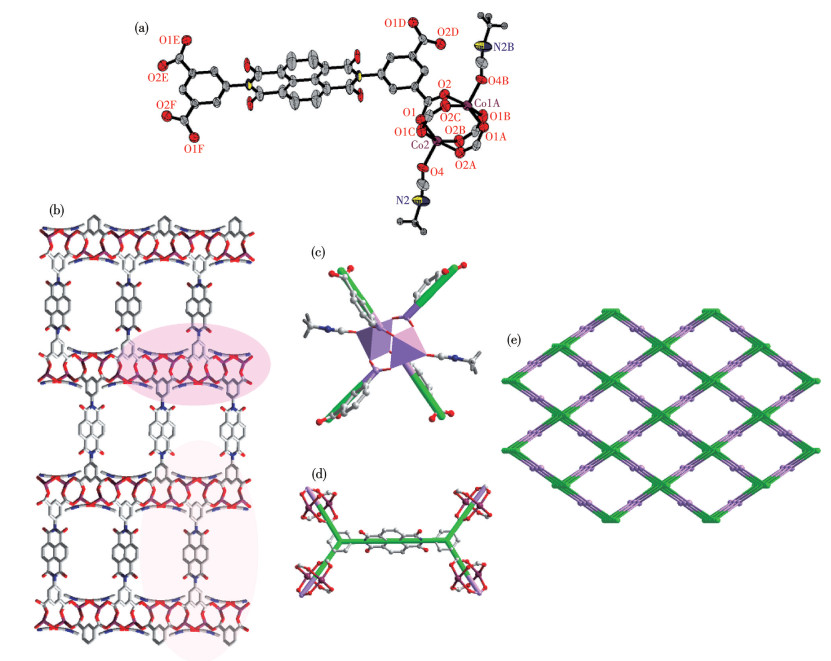
Red stands for the O atom, blue for the N atom, purple for the Co atom, and gray for the C atom; Thermal ellipsoids are drawn at the 50% probability level; Symmetry codes: A: 1-x, 1-y, 1-z; B: x, 1-y, 1-z; C: 1-x, y, z; D: 0.5-x, y, 0.5-z; E: 0.5-x, 1.5-y, 0.5-z; F: x, 1.5-y, z.
From a topological perspective, when the paddle-wheel [Co2(COO)4] cluster, BINDI4- ligands could be simplified as a 4-c, the whole framework of Co-MOF can be viewed as a 4-node 3D fsc framework with the point symbols of {(44·610·8)(44·62)} (Fig.1c-1e).
The powder X-ray diffraction (PXRD) patterns manifested the resemblance of the main framework of Co-MOF and Py@Co-MOF (Fig.S1). It should be emphasized that the key peak positions of Co-MOF were completely consistent with the simulation one, which indicates that Co-MOF has been prepared with good phase purity. In addition, a nearly identical trend of thermogravimetric analysis (TGA) curves for Co-MOF and Py@Co-MOF further verified the similar skeleton of the materials. As shown in Fig.S2, the observed 9.00% weight loss below 173 ℃ can be attributed to the desorption of approximately half of the adsorbate DMA molecules initially confined within the porous structure and surface of the material. It is worth noting that, compared with Co-MOF, the weightlessness of Py@Co-MOF decreased when the temperature was higher than 400 ℃. It was confirmed that some DMA solvent molecules were replaced by pyrene guest molecules.
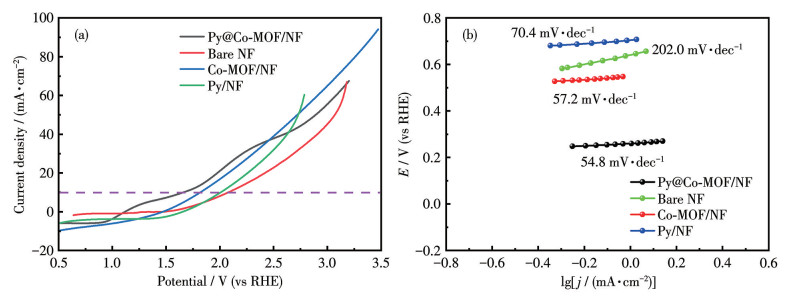
The as-prepared samples were evaluated for their OER activity by the linear scan voltammogram (LSV) in a 1.0 mol·L-1 KOH solution. As shown in Fig.2, the Py@Co-MOF/NF samples exhibited lower overpotentials and smaller Tafel slopes compared to both the Co-MOF/NF and Py/NF electrodes. Notably, Py@Co-MOF/NF demonstrated superior electrocatalytic performance. At a current density of 10 mA·cm-2, the overpotentials were measured at 246 mV for Py@Co-MOF/NF, 261 mV for Co-MOF/NF, and 279 mV for Py/NF (Fig.2a). The overpotentials of Py@Co-MOF prior most of the MOF-based materials. Similarly, the Tafel slope for Py@Co-MOF/NF was determined to be 54.8 mV·dec-1, which was lower than those observed for Co-MOF/NF (57.2 mV·dec-1) and Py/NF (70.4 mV·dec-1) (Fig.2b). These remarkable outcomes imply that Py@ Co-MOF/NF manifests a notably diminished degree of polarization loss and exhibits more highly efficient kinetics during the process of water oxidation. The as-prepared Py@Co-MOF/NF is also a comparable active catalyst for OER with the overpotential and potential difference at 10 mA·cm-2 between the as-prepared catalyst (Table 2)[34-40]. The observed phenomenon suggests that Py@Co-MOF possesses superior attributes and capabilities in the domain associated with OER reaction, which might potentially give rise to significant advancements and enhancements in related applications and research fields.
 下载:
导出CSV
下载:
导出CSV
| Catalyst | Electrolyte | Current density / (mA·cm-2) |
Overpotential / mV |
Tafel slope / (mV·dec-1) |
Ref. |
| CoOx | 1.0 mol·L-1 KOH | 10 | 420 | 42 | [34] |
| FeNi/NiFe2O4@NC-800 | 1.0 mol·L-1 KOH | 10 | 316 | 60 | [35] |
| Co3O4/CoMoO4 hollow nanosphere | 1.0 mol·L-1 KOH | 10 | 370 | 59 | [36] |
| MOF(Fe1-Co3)550N | 1.0 mol·L-1 KOH | 10 | 390 | 72.9 | [37] |
| NiFe LDH/carbon nanotubes | 1.0 mol·L-1 KOH | 10 | 247 | — | [38] |
| FeCo alloy/CNF | 1.0 mol·L-1 KOH | 10 | 557 | — | [39] |
| Ni60Co30M10 | 1.0 mol·L-1 KOH | 10 | 287 | 41 | [40] |
| Py@Co-MOF | 1.0 mol·L-1 KOH | 10 | 246 | 54.8 | This work |
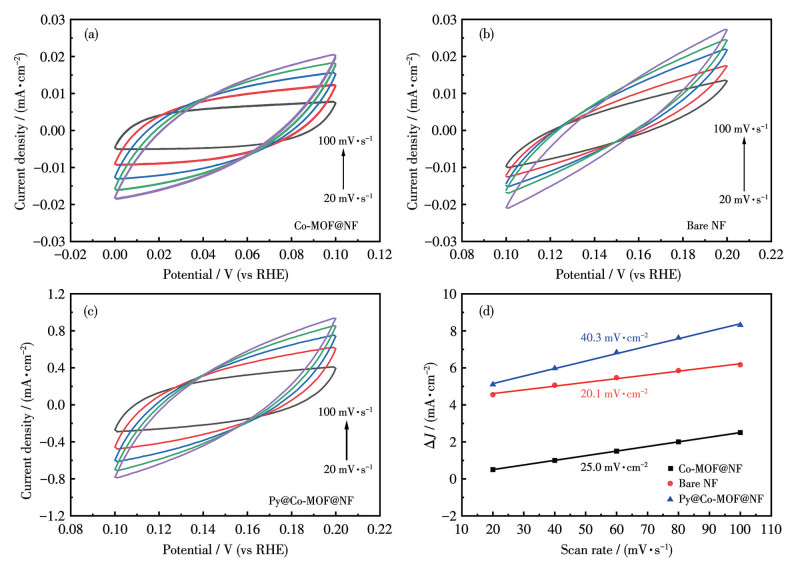
To acquire a more distinct comprehension of the outstanding OER performance of Py@Co-MOF/NF, the electrochemical double-layer capacitance (Cdl) of the electrode material was ascertained by means of CV curves obtained at diverse scanning rates within the non-Faradaic region (Fig.3a-3c). The experimental outcomes reveal that the electrochemically active surface area (ECSA) of the three electrodes is directly proportional to the sweep rate of the double-layer capacitor. The ECSA values for Py@Co-MOF/NF, Co-MOF/NF, and bare NF were 40.3, 25.0, and 20.1 cm2, respectively (Fig.3d). Notably, Py@Co-MOF/NF manifests the highest ECSA value, suggesting that the Py@Co-MOF/NF sample possesses a larger electrochemically active surface area and abundant active sites, which facilitate the enhancement of OER activity[12, 41-44]. The LSV curves normalized by ECSA indicate that Py@Co-MOF/NF exhibits the highest intrinsic catalytic activity. These results further imply that the moderate transformation of Py@Co-MOF/NF can conspicuously improve the intrinsic catalytic activity of the electrocatalysts.
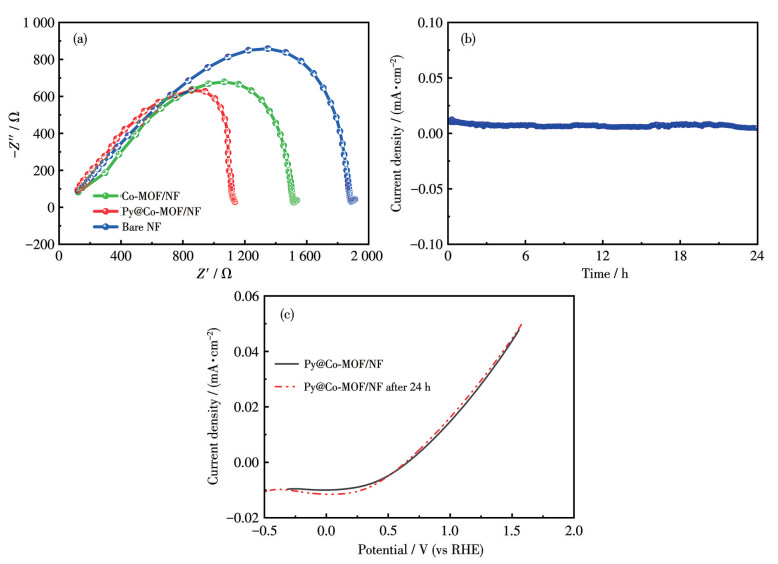
Electrochemical impedance spectroscopy (EIS) was also employed to elucidate the electrocatalytic kinetics of the fabricated electrodes. The Nyquist plots reveal that the Py@Co-MOF/NF exhibited the smallest semicircle diameter, indicating the lowest charge transfer resistance (Fig.4a). Whereas it showed a larger semicircle diameter, the charge transfer ability of Py@Co-MOF/NF was significantly enhanced after the introduction of the pyrene molecules. The outcome was highly consistent with the electrocatalytic activity of these catalysts, which further proved that the introduction of pyrene molecules indeed improved the OER properties of the fabricated electrode. The outstanding catalytic activity of Py@Co-MOF/NF can be ascribed to the synergy effect of the π-π interaction between MOF and pyrene molecules in the composite and the active sites which formed by the OMS. Furthermore, the chronoamperometric technique demonstrated that Py@Co-MOF/NF maintained its performance after 24 h at a current density of 10 mA·cm-2 (Fig.4b). The LSV curve obtained post-stability test exhibited minor deviations at higher current densities and resembled the curves obtained before the test (Fig.4c).
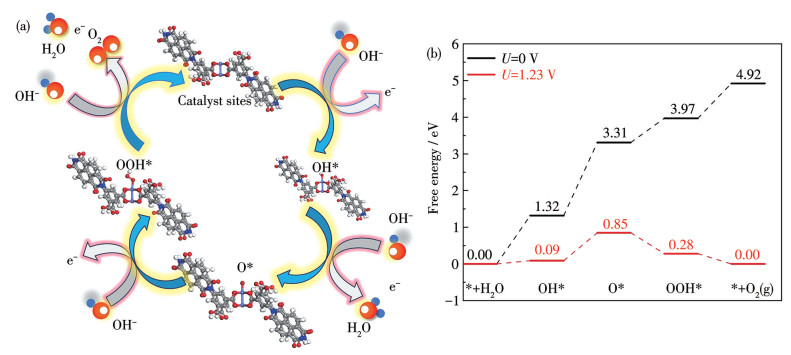
To further elucidate the specific impact of active sites in the electrode materials, DFT was employed to calculate the electron structure of the Co-MOF model regarding the adsorption free energy of OH*, O*, OOH*, and the variation of Gibbs free energy in the fundamental steps of OER. Fig.5a depicts the basic steps of the OER process on the Co-MOF. Experimental outcomes reveal that the calculated energy barriers of the three electrochemical steps are 0.09, 0.85, and 0.28 eV, respectively, in the discrete unit. Fig.5b indicates that the formation of O* demands the highest Gibbs free energy and constitutes the RDS of OER, which is due to the OH* intermediate has a weak adsorption affinity for the Co site, resulting in a high energy barrier of 0.85 eV for OH* conversion to O*. These discoveries suggest that Co is a preferred site for OER electrochemical processes and offer insights into its potential applications for enhancing water cracking efficiency in various catalytic processes. Additionally, the integration of electron-rich pyrene into electron-deficient Co-MOF induces significant charge transfer interactions in the host-guest system, which might be another crucial reason why Py@Co-MOF/NF exhibits outstanding OER properties.
In summary, the Py@Co-MOF composite catalyst has been developed to enhance electrical conductivity through the establishment of non-covalent π-π interactions between pyrene and Co-MOF. The OER performance of the Py@Co-MOF composite catalyst was significantly improved, achieving an overpotential of 246 mV at a current density of 10 mA·cm-2, which was superior to both Co-MOF-based and pyrene-based electrodes, noted for their low cost and good stability. Additionally, DFT calculations indicate that the formation of O* within the OER process of the Co-MOF catalyst constitutes the RDS, primarily due to the weak adsorption affinity of OH* intermediates at the Co site. This results in a high energy barrier of 0.85 eV for the conversion of OH* to O*. Overall, the insights gained from this study provide a potential pathway for the preparation of composite MOF-based electrochemical catalysts utilizing post-synthetic modification and compositional strategies.
魏学东, 刘楠, 乔双燕. NiMoO4纳米线@ZnCo MOF(350)核壳结构复合材料的制备及其析氧电催化性能[J]. 无机化学学报, 2022, 38(11): 2308-2320WEI X DONG, LIU N, QIAO S Y. Preparation and oxygen evolution reaction electrocatalytic performance of NiMoO4 nanowires@ZnCo MOF(350) core-shell structure composites[J]. Chinese J. Inorg. Chem., 2022, 38(11): 2308-2320
WANG X Z, LIU S, ZHANG H, ZHANG S S, MENG G, LIU Q, SUN Z Y, LUO J, LIU X J. Polycrystalline SnSx nanofilm enables CO2 electroreduction to formate with high current density[J]. Chem. Commun., 2022, 58: 7654-7657 doi: 10.1039/D2CC01888H
PAUL A, UPADHYAY K K, BACKOVIC G, KARMAKAR A, FERREIRA L F V, SLJUKIC B, MONTEMOR M F, DA SILVA M F C G, POMBEIRO A J L. Versatility of amide-functionalized Co and Ni coordination polymers: From thermochromic-triggered structural transformations to supercapacitors and electrocatalysts for water splitting[J]. Inorg. Chem., 2020, 59: 16301-16318 doi: 10.1021/acs.inorgchem.0c02084
MENG G, WEI T R, LIU W J, LI W B, ZHANG S S, LIU W X, LIU Q, BAO H H, LUO J, LIU X J. NiFe layered double hydroxide nanosheet array for high-efficiency electrocatalytic reduction of nitric oxide to ammonia[J]. Chem. Commun., 2022, 58: 8097-8100 doi: 10.1039/D2CC02463B
LI X F, MA D D, CAO C S, ZOU R Q, XU Q, WU X T, ZHU Q L. Inlaying ultrathin bimetallic MOF nanosheets into 3D ordered macroporous hydroxide for superior electrocatalytic oxygen evolution[J]. Small, 2019, 15: 1902218 doi: 10.1002/smll.201902218
HOU J R, PENG X Y, SUN J Q, ZHANG S S, LIU Q, WANG X Z, LUO J, LIU X J. Accelerating hydrazine-assisted hydrogen production kinetics with Mn dopant modulated CoS2 manowire arrays[J]. Inorg. Chem. Front., 2022, 9: 3047-3058 doi: 10.1039/D2QI00083K
LI L F, WANG P T, HUANG X Q, YOUNG D J, WANG H F, BRAUNSTEIN P, LANG J P. Large-scale, bottom-up synthesis of binary metal-organic framework nanosheets for efficient water oxidation[J]. Angew. Chem.‒Int. Edit., 2019, 58: 7051-7056 doi: 10.1002/anie.201902588
YANG M S, LIU Y F, SUN J Q, ZHANG S S, LIU X J, LUO J. Integration of partially phosphatized bimetal centers into trifunctional catalyst for high-performance hydrogen production and flexible Zn-air battery[J]. Sci. China Mater., 2022, 65: 1176-1186 doi: 10.1007/s40843-021-1902-2
LI L F, SHAO P, HUANG X Q, LANG J P. Nanoscale trimetallic metal organic frameworks enable efficient oxygen evolution electrocatalysis[J]. Angew. Chem.‒Int. Edit., 2018, 57: 1888-1892 doi: 10.1002/anie.201711376
WU L L, WANG Q S, LI J, LONG Y, LIU Y, SONG S Y, ZHANG H J. Co9S8 nanoparticles-embedded N/S-codoped carbon nanofibers derived from meal-organic framework-wrapped CdS nanowires for efficient oxygen evolution reaction[J]. Small, 2018, 14: 1704035 doi: 10.1002/smll.201704035
XU Y Y, DENG P L, CHEN G D, CHEN Y X, YAN Y, QI K, LIU H F, XIA B Y. 2D nitrogen-doped carbon nanotubes/graphene hybrid as bifunctional oxygen electrocatalyst for long-life rechargeable Zn-air batteries[J]. Adv. Funct. Mater., 2020, 30: 1906081 doi: 10.1002/adfm.201906081
BAI Z Y, HENG J M, ZHANG Q, YANG L, CHANG F F. Rational design of dodecahedral MnCo2O4.5 hollowed-out nanocages as efficient bifunctional electrocatalysts for oxygen reduction and evolution[J]. Adv. Energy Mater., 2018, 8: 1802390 doi: 10.1002/aenm.201802390
GUO X Z, ZHANG J, LIN B, XIONG G Z, ZHANG X X, LI Z C, GUI L, SI Y, CHEN S S, QIU Z. A bifunctional 3D porous MOF with potential for fluorescence sensing of picric acid and natural gas purification[J]. J. Mol. Struct., 2024, 130: 137569
GUO X Z, LI B, XIONG G Z, LIN B, GUI L C, ZHANG X X, QIU Z, KRISHNA R, WANG X, YAN X, CHEN S S. A stable ultramicroporous Cd(Ⅱ)-MOF with accessible oxygen sites for efficient separation of light hydrocarbons with high methane production[J]. Sep. Purif. Technol., 2023, 334: 125987
GUO X Z, LIN B, XIONG G Z, KRISHNA R, ZHANG Z R, LIU Q Z, ZHANG Z X, FAN L, ZHANG J, LI B W. Construction of negative electrostatic sugared gourd pore within nickel-based metal-organic framework for one-step purification acetylene from ethylene and carbon dioxide mixture[J]. Chem. Eng. J., 2024, 498: 154734 doi: 10.1016/j.cej.2024.154734
XIONG G Z, ZHANG J, LIN B, DU Y T, LI B, GUI L C, ZHANG X X, QIU Z, GUO X Z, CHEN S S. A stable paddle-wheel Co-MOF (FNU-2) for the efficient separation of light hydrocarbons[J]. Microporous Mesoporous Mat., 2023, 366: 112970
ZHANG J, GUO X Z, LIN B, XIONG G Z, WANG H S, ZHANG M, FAN L W, LI B W, CHEN S S. Efficient adsorption separation of methane from C2-C3 hydrocarbons in a Co(Ⅱ)-nodes metal-organic framework[J]. Chin. J. Chem. Eng., 2024, 69: 192-198 doi: 10.1016/j.cjche.2024.02.001
ZHANG X X, GUO X Z, CHEN S S, KANG H W, ZHAO Y, GAO J X, XIONG G Z, HOU L. A stable microporous framework with multiple accessible adsorption sites for high capacity adsorption and efficient separation of light hydrocarbons[J]. Chem. Eng. J., 2023, 466: 143170 doi: 10.1016/j.cej.2023.143170
籍文娟, 王丹, 王国娇, 孙秀玲, 付云龙. 同构MOFs复合氧化石墨烯电极材料构筑高性能超级电容器[J]. 无机化学学报, 2021, 37(11): 1931-1942JI W J, WANG D, WANG G J, SUN X L, FU Y L. High performance supercapacitors constructed with isomorphic MOFs doped graphene oxide electrode materials[J]. Chinese J. Inorg. Chem., 2021, 37(11): 1931-1942
牛百通, 夏汪男, 赖招琴, 郭鸿旭, 陈彰旭. 金属有机骨架Ni-BTC和Ni-BDC的溶剂效应形貌调控及超级电容器性能[J]. 无机化学学报, 2022, 38(8): 1643-1654NIU B T, XIA W N, LAI S Q, GUO H X, CHEN Z X. Solvent-controlled morphology of Ni-BTC and Ni-BDC metal-organic frameworks for supercapacitors[J]. Chinese J. Inorg. Chem., 2022, 38(8): 1643-1654
苏莉鑫, 王先梅, 姜清艳, 张慧敏, 陆逸雯, 刘琦. 一种基于二维钴基配位聚合物[KCo(pa)(OH)]n的高容量超级电容器电极材料[J]. 无机化学学报, 2023, 39(8): 1481-1488SU L X, WANG X M, JIANG Q Y, ZHANG H M, LU Y W, LIU Q. A two-dimensional Co-based coordination polymer [KCo(pa)(OH)]n as the electrode material of supercapacitors with higher-capacity[J]. Chinese J. Inorg. Chem., 2023, 39(8): 1481-1488
DU Y Q, XIAO P, YUAN J, CHEN J W. Research progress of graphene-based materials on flexible supercapacitors[J]. Coatings, 2020, 10(9): 892 doi: 10.3390/coatings10090892
WANG C, HU K, LI W J, WANG H Y, LI H, ZUO Y, ZHAO C C, LI Z, YU M, TAN P C, LI Z. Wearable wire-shaped symmetric supercapacitors based on activated carbon-coated graphite fibers[J]. ACS Appl. Mater. Interfaces, 2018, 10(40): 34302-34310 doi: 10.1021/acsami.8b12279
KANG C S, KO Y I, FUJISAWA K, YOKOKAWA T, KIM J H, HAN J H, WEE J H, KIM Y A, MURAMATSU H, HAYASHI T. Hybridized double-walled carbon nanotubes and activated carbon as free-standing electrode for flexible supercapacitor applications[J]. Carbon Lett., 2020, 30(5): 527-534 doi: 10.1007/s42823-020-00122-4
GHANADHYAM G, JEONG H K. Plasma treated carbon nanofiber for flexible supercapacitors[J]. J. Energy Storage, 2021, 40: 102806 doi: 10.1016/j.est.2021.102806
王晨, 刘启航, 戚晨阳, 王琮钰, 赵晓莉, 杨晓伟. 零维/二维MXene复合膜的制备及其超级电容器性能[J]. 无机化学学报, 2022, 38(9): 1707-1715WANG C, LIU Q H, QI C Y, WANG Z Y, ZHAO X L, YANG X W. Synthesis and supercapacitor performances of 0D/2D MXene composite membrane[J]. Chinese J. Inorg. Chem., 2022, 38(9): 1707-1715
ASBANI ASBANI B, ROBERT K, ROUSSEL P, BROUSSE T, LETHIEN C. Asymmetric micro-supercapacitors based on electrodeposited RuO2 and sputtered VN films[J]. Energy Storage Mater., 2021, 37: 207-214 doi: 10.1016/j.ensm.2021.02.006
YU F, PANG L, WANG H X. Preparation of mulberry-like RuO2 electrode material for supercapacitors[J]. Rare Met., 2021, 40(2): 440-447 doi: 10.1007/s12598-020-01561-8
ZHOU Y, CHENG X Y, TYNAN B, SHA Z, HUANG F, ISLAM M S, ZHANG J, RIDER A N, DAI L M, CHU D W, WANG D W, HAN Z J, WANG C H. High-performance hierarchical MnO2/CNT electrode for multifunctional supercapacitors[J]. Carbon, 2021, 184: 504-513 doi: 10.1016/j.carbon.2021.08.051
SWAIN N, MITR A, SARAVANAKUMAR B, BALASINGAM S K, MOHANTY S, NAYAK S K, RAMADOSS A. Construction of three-dimensional MnO2/Ni network as an efficient electrode material for high performance supercapacitors[J]. Electrochim. Acta, 2020, 342: 136041 doi: 10.1016/j.electacta.2020.136041
ZHANG H, HAN X R, GAN R, GUO Z H, NI Y H, ZHANG L. A facile biotemplate-assisted synthesis of mesoporous V2O5 microtubules for high performance asymmetric supercapacitors[J]. Appl. Surf. Sci., 2020, 511: 145527 doi: 10.1016/j.apsusc.2020.145527
TANG M, WU Y T, YANG J H, WANG H X, LIN T, XUE Y H. Graphene/tungsten disulfide core-sheath fibers: High-performance electrodes for flexible all-solid-state fiber-shaped supercapacitors[J]. J. Alloy. Compd., 2021, 858: 157747 doi: 10.1016/j.jallcom.2020.157747
MAO Y L, SHAN B Y, YU J, LIU X X, CHU J Y, MA X Y, LI M, ZHENG Y M, ZHU B L, ZUO M H, CUI S X. A novel naphthalene diimide-based compound: Synthesis, photochromism, ammonia vapor and triethylamine detection[J]. J. Solid State Chem., 2024, 338: 124902 doi: 10.1016/j.jssc.2024.124902
FOMINYKH K, FECKL J M, SICKINGER J, DÖBLLINGER M, BÖCKLEIN S, ZIEGLER J, PETER L, RATHOUSKY J, SCHEIDT E W, BEIN T, ROHLFING D F. Ultrasmall dispersible crystalline nickel oxide nanoparticles as high-performance catalysts for electrochemical water splitting[J]. Adv. Funct. Mater., 2014, 24: 3123-3129 doi: 10.1002/adfm.201303600
MA Y D, DAI X P, LIU M Z, YONG J X, QIAO H Y, JIN A X, LI Z Z, HUANG X L, WANG H, ZHANG X. Strongly coupled FeNi alloys/NiFe2O4@carbonitride layers assembled microboxes for enhanced oxygen evolution reaction[J]. ACS Appl. Mater. Interfaces, 2016, 8: 34396-34404 doi: 10.1021/acsami.6b11821
HAN Y J, ZHAI J F, ZHANG L L, DONG S J. Direct carbonization of cobalt-doped NH2-MIL-53(Fe) for electrocatalysis of oxygen evolution reaction[J]. Nanoscale, 2016, 8: 1033-1039 doi: 10.1039/C5NR06626C
LI M, XIONG Y P, LIU X T, BO X J, ZHANG Y F, HAN C, GUO L P. Facile synthesis of electrospun MFe2O4 (M=Co, Ni, Cu, Mn) spinel nanofibers with excellent electrocatalytic properties for oxygen evolution and hydrogen peroxide reduction[J]. Nanoscale, 2015, 7: 8920-8930 doi: 10.1039/C4NR07243J
GONG M, LI Y G, WANG H L, LIANG Y Y, WU J Z, ZHOU J G, WANG J, REGIER T, WEI F, DAI H J. An advanced Ni-Fe layered double hydroxide electrocatalyst for water oxidation[J]. J. Am. Chem. Soc., 2013, 135: 8452-8455 doi: 10.1021/ja4027715
JEONG B, SHIN D, LEE J K, KIM D H, KIM Y D, LEE J. The influence of a fibrous carbon envelope on the formation of CoFe nanoparticles for durable electrocatalytic oxygen evolution[J]. Phys. Chem. Chem. Phys., 2014, 16: 13807-13813 doi: 10.1039/C4CP00385C
ROSALBINO F, DELSANTE S, BORZONE G, SCAVINO G. Electrocatalytic activity of crystalline Ni-Co-M (M=Cr, Mn, Cu) alloys on the oxygen evolution reaction in an alkaline environment[J]. Int. J. Hydrog. Energy, 2013, 38: 10170-10177 doi: 10.1016/j.ijhydene.2013.06.035
ZENG L, HUANG L, WANG Z H, WEI J W, HUANG K, LIN W H, DUAN C Y, HAN G. Self-assembled metal-organic framework stabilized organic cocrystals for biological phototherapy[J]. Angew. Chem.‒Int. Edit., 2021, 60: 23569-23573 doi: 10.1002/anie.202108076
DONG X, XIN Z, HE D, ZHANG J L, LAN Y Q, ZHANG Q F, CHEN Y. Boosting CO2 electroreduction performance over fullerene-modified MOF-545-Co promoted by π-π interaction[J]. Chin. Chem. Lett. 2023, 34: 107459 doi: 10.1016/j.cclet.2022.04.057
ZHENG D J, GÖRLIN M, MCORMACK K, KIM J, PENG J, XU H, MA X, LEBEAU J M, FISCHER R A, ROMÁN-LESHKOV Y, SHAO-HORN Y. Linker-dependent stability of metal-hydroxide organic frameworks for oxygen evolution[J]. Chem. Mat., 2023, 35: 5017-5031 doi: 10.1021/acs.chemmater.3c00316
PRAKASH S, KAMLESH, TAVAR D, BANDYOPADHYAY S, SINGHAI S, SRIVASTAVA A K, SINGH A. Graphene supported pillared Ni-Co metal-organic framework as an efficient electrocatalyst for the water oxidation reaction[J]. ACS Appl. Energy Mater., 2023, 6: 8422-8433 doi: 10.1021/acsaem.3c01117

Scheme 1 Illustration of the synthesis process of Py@Co-MOF and the three-electrode system for OER

Figure 1 (a) Coordination environment of Co-MOF; (b) 2D network of Co-MOF; (c, d) 3D framework of Co-MOF; (e) 3D fsc topology of Co-MOF
Red stands for the O atom, blue for the N atom, purple for the Co atom, and gray for the C atom; Thermal ellipsoids are drawn at the 50% probability level; Symmetry codes: A: 1-x, 1-y, 1-z; B: x, 1-y, 1-z; C: 1-x, y, z; D: 0.5-x, y, 0.5-z; E: 0.5-x, 1.5-y, 0.5-z; F: x, 1.5-y, z.

Figure 2 OER LSV curves (a) and Tafel plots (b) of Py@Co-MOF/NF-, Co-MOF/NF-, Py/NF-, and bare NF-based electrode as characterized in 1.0 mol·L-1 KOH aqueous electrolyte

Figure 3 CV curves of Co-MOF/NF (a), bare NF (b), and Py@Co-MOF/NF (c) for estimating the ECSA; Corresponding plots of capacitive currents vs scan rates for various OER catalysts (d)

Figure 4 (a) EIS of Co-MOF/NF-, Py@Co-MOF/NF-, and bare NF-based electrode; (b) J-t curve of Py@Co-MOF/NF-based electrode; (c) Comparison of OER LSV curve of Py@Co-MOF/NF-based electrode before and after the stability experiment after 24 h

Figure 5 Detailed electron transfer process (a) and the plot of the Gibbs free energy of Co-MOF (b) in the OER reaction
Table 1. Crystal data and structure refinements for Co-MOF
| Parameter | Co-MOF | Parameter | Co-MOF | |
| Empirical formula | C19H14CoN2O7·C4H9NO | μ / mm-1 | 0.617 | |
| Formula weight | 528.37 | F(000) | 1 180 | |
| Temperature / K | 297 | θ range for data collection / (°) | 4.032-49.97 | |
| Crystal system | Orthorhombic | Index ranges | -43 ≤ h ≤ 18, -17 ≤ k ≤ 10, -12 ≤ l ≤ 7 | |
| Space group | Imma | Reflection collected | 8 006 | |
| a / nm | 3.695 85(17) | Independent reflection | 2 694 (Rint=0.072 6, Rσ=0.056 4) | |
| b / nm | 1.504 41(8) | Data, number of restraints, number of parameters | 2 694, 36, 162 | |
| c / nm | 1.050 32(5) | Goodness-of-fit on F2 | 1.062 | |
| Volume / nm3 | 5.839 9(5) | Final R indexes [I≥2σ(I)] | R1=0.064 5, wR2=0.182 0 | |
| Z | 8 | Final R indexes (all data) | R1=0.082 5, wR2=0.202 2 | |
| Dc / (g·cm-3) | 1.004 | Largest diff. peak and hole / (e·nm-3) | 620, -800 |
 下载: 导出CSV
Table 2. Comparison of OER performance for Py@Co-MOF with other OER electrocatalysts
| Catalyst | Electrolyte | Current density / (mA·cm-2) |
Overpotential / mV |
Tafel slope / (mV·dec-1) |
Ref. |
| CoOx | 1.0 mol·L-1 KOH | 10 | 420 | 42 | [34] |
| FeNi/NiFe2O4@NC-800 | 1.0 mol·L-1 KOH | 10 | 316 | 60 | [35] |
| Co3O4/CoMoO4 hollow nanosphere | 1.0 mol·L-1 KOH | 10 | 370 | 59 | [36] |
| MOF(Fe1-Co3)550N | 1.0 mol·L-1 KOH | 10 | 390 | 72.9 | [37] |
| NiFe LDH/carbon nanotubes | 1.0 mol·L-1 KOH | 10 | 247 | — | [38] |
| FeCo alloy/CNF | 1.0 mol·L-1 KOH | 10 | 557 | — | [39] |
| Ni60Co30M10 | 1.0 mol·L-1 KOH | 10 | 287 | 41 | [40] |
| Py@Co-MOF | 1.0 mol·L-1 KOH | 10 | 246 | 54.8 | This work |
下载: 导出CSV

 扫一扫看文章


扫一扫关注我们