Citation: Wanting SHEN, Shaoxuan SUN, Yuting FENG, Fengqi ZHANG, Tingting LU, Yongsheng YANG. Research progress of coordination-driven assembly of single-component white light emission metal-organic complex materials[J]. Chinese Journal of Inorganic Chemistry, 2024, 40(1): 33-53. doi: 10.11862/CJIC.20230380
配位驱动组装单组分白光发光金属-有机配合物材料的研究进展
English
Research progress of coordination-driven assembly of single-component white light emission metal-organic complex materials
-
白光照明有助于将环境中真实的颜色信息准确地传达给人们,已成为人类生产、生活中不可或缺的一部分[1]。目前商用的白光光源主要是白炽灯和汞基发光材料,复合白光基于汞蒸气发光并激发半导体荧光粉获得[2]。然而,汞的过度使用对健康及环境都会产生不利的影响,因此,亟需开发出更绿色、更安全、更节能的白光荧光粉作为替代材料。白光荧光粉可以直接被紫外发光二极管(LED)或电场激发,直接发射出颜色稳定、重现性好的白光,引起了科研工作者极大的研究兴趣,相关综述文章很好地总结了各类白光材料的研究工作[3-13]。白光发光二极管(WLED)基于其节能环保、尺寸小、易加工等优势,在显示装置及照明等领域被广泛应用[14-17]。由于采用无机、有机半导体制备的WLED易于合成、可大规模加工,在开发节能和廉价照明方面具有优势[18]。然而,这些无机、有机半导体材料存在发射峰窄、可见光区域颜色覆盖范围少等问题,很难达到取代传统光源的目的[19]。因此,需要探索新型易加工、易修饰、易调色的照明材料来解决发光颜色及效率的问题。
近些年,由金属离子和有机配体通过配位驱动力组装的各种金属-有机配合物材料为开发单相WLED材料提供了新策略。配合物中心金属及有机配体的多样性可以提供更多发光中心组合的可能,此外,对于金属有机骨架(MOFs)结构来说,其具备大小尺寸固定且多样化的孔隙,能够捕获各种金属离子及染料分子,增加发光多样性,实现白光发光的精准调控。与传统无机或有机发光材料相比,金属-有机配合物材料极大地扩展了发光范围和调控方式,拓宽了在显示装置、光电器件、光学传感器、光学探测器等领域的应用范围。特别的是,通过配位驱动力组装产生不同类别的发光中心,并将其组合、调制,很容易获得单组分白光发光材料。
本综述首先介绍了配合物发光机理、白光发光组成及白光性能指标以及白光发光材料构筑策略。然后,按照不同配位中心金属以及发光中心组合将配合物发光材料分为以下几类:Au(Ⅰ)/Ag(Ⅰ)/Cu(Ⅰ)配合物、Zn(Ⅱ)/Cd(Ⅱ)配合物、Eu(Ⅲ)和Tb(Ⅲ)共掺杂Ln(Ⅲ)配合物、染料掺杂配合物、其他主族元素/过渡元素/镧系元素掺杂/多元素掺杂配合物。对上述每个类别的构筑思路进行介绍,总结不同类型配合物与白光发光性能之间的构效关系。最后,本文总结了此类白光材料的优势,并对应用前景进行了展望。
1. 发光机理
光致发光指物质吸收电磁波后重新辐射出电磁波的过程。光致发光类型主要分为2大类:(1) 由单重激发态(S1)到单重基态(S0)的辐射跃迁产生荧光,其发光寿命通常在纳秒级别;(2) 由三重激发态(T1)到单重基态(S0)的辐射跃迁产生磷光,其发光寿命在微秒甚至毫秒级别。由于金属-有机配合物材料结构组成的多样性,其光致发光性能的产生也分为多种类型,包括有机配体发光、激基缔合物/复合物发光、金属中心发光以及金属与配体之间电荷转移发光等[20]。
有机配体为中心的发光形式通常指含有较大π共轭体系的有机分子,当吸收适当能量的电磁辐射后,产生一系列光物理过程,包括内转换、振动弛豫、系间穿越,最后发出荧光或磷光。通常有机配体与金属配位后,有机配体的稳定性以及刚性会显著增强,可以减少非辐射跃迁能量损失,增强发光强度,延长发光寿命。此外,紧密堆积的配体能够产生配体到配体的电荷转移(LLCT),导致发光波长的红移或蓝移以及发射谱带的变宽。
激基缔合物为处于激发态的同种物质二聚体,而激基复合物为处于激发态的非同种物质二聚体。激基缔合物/复合物的形成与配位组装体系中发色团在光辐射作用诱导下堆积取向密切相关,通常受π-π堆积作用影响,由此产生的发光相比于单分子发光较为红移。
配合物金属中心发光可以大致分为镧系金属离子的f→f轨道跃迁、过渡金属离子的d→d轨道跃迁以及一些主族离子的s→p轨道跃迁。其中,镧系金属离子的f→f轨道跃迁例子最为常见,具有固定的发射波长、尖锐的发射峰以及较长的发光寿命(可达微秒或毫秒级别)。通常,由于宇称禁阻跃迁,镧系金属离子的f→f轨道跃迁吸收光子效率极低,为了实现有效的光吸收,需要选择固定的有机配体作为“天线”,敏化镧系金属离子发光。该过程可表达为配体吸收光子能量,从单重态基态跃迁至激发态,随后经过系间穿越跃迁至三重激发态,进一步将能量转移到镧系金属离子特征能级,实现特征性f→f轨道跃迁发光。该过程中,配体的三重激发态能级与镧系金属离子f轨道能级之间的能量差将决定能量转移效率,从而直接影响镧系金属离子发光性能,因此选择合适的“天线分子”尤为重要。除此之外,一些多金属异核配合物的d→f轨道跃迁或p→f轨道跃迁体系中,金属到配体电荷转移(MLCT)以及配体到金属的电荷转移(LMCT)也能够将能量传递给镧系金属离子,敏化其发光。通常情况下,过渡金属离子d→d轨道跃迁是无辐射失活的,而主族离子的s→p轨道跃迁较强,s轨道上孤对电子的存在能够实现长波长、强发射性能,有助于单组分白光发光配合物体系的构筑。
电荷转移发光是电子给体-受体体系中,激发态到基态的跃迁过程产生的光辐射现象。其中MLCT和LMCT是配位组装体系中最典型的2种电荷转移跃迁类型。MLCT为部分电子从金属轨道转移到配体轨道,通常发生在如第二或第三系列过渡金属配合物中。这些配合物体系中,中心金属通常具有d6、d8或d10电子构型,配体具有空π*轨道,能级较低。处于低价态的变价金属离子配合物较容易发生MLCT过程。相反,LMCT是指电子从配体轨道转移到金属轨道,通常发生在高氧化态的主族金属以及部分过渡金属阳离子的配合物体系中。
2. 白光发光组成及白光性能指标
理想情况下,白光是由2种(蓝色和黄色)或3种(蓝色、绿色和红色)颜色组成,同时存在互补的高能谱带发射和低能谱带发射,覆盖整个可见光电磁辐射范围(400~800 nm)。通常,蓝光、黄光组合表现为冷白光,引入红光组分会表现出暖白光。白光发光一般可以通过色坐标、色温、显色指数3个参数来描述[21]:色坐标(CIE)为(0.33,0.33)表示标准白光;色温(CCT)大于5 000 K为冷白光,3 000~5 000 K为白光,小于3 000 K为暖白光;显色指数(CRI)越接近100,表示在光源照射下越能“渲染”物体的真实颜色。白光光源可以通过将不同发光颜色光源按比例精确混合获得,也可以利用紫外光激发蓝、黄或红、绿、蓝特定组成的荧光粉实现。传统的发光二极管是通过将多组分不同颜色荧光粉涂覆在LED器件实现白光发光,利用这种方法制备WLED器件存在加工工艺复杂、成本高、混合荧光粉不稳定、发光颜色易改变等问题[22],为了解决上述问题,具备更精确颜色调控及更高发光效率的单组分白光发光材料应运而生。
3. 白光发光材料构筑策略
迄今为止,白光荧光粉的制备主要可以通过以下3种方法:第一种方法是将2种或2种以上的常见稳定发光物种(包括有机染料分子、金属离子、金属-有机配合物等)通过直接合成或主客体掺杂的方法组装在同一体系,分别表现出各自的发光特点,该方法已广泛应用于白光荧光粉的制备。第二种方法是增加激发态发射路径,实现高能谱带发射和低能谱带发射共存。例如,通过引入重金属元素,增加系间穿越概率[23],同时实现高能谱带的荧光和低能谱带的磷光发射。另外,含有烯醇式和酮式的结构容易发生分子内质子转移过程,同时产生高能和低能谱带发射。第三种是利用有机分子的共轭体系,构建紧密堆积构型,获得激基复合物或激基缔合物,同时获得来自有机分子单体的高能谱带发射以及复合物或缔合物的低能谱带发射。
4. 白光金属-有机配合物材料类别
4.1 Au(Ⅰ)/Ag(Ⅰ)/Cu(Ⅰ)配合物
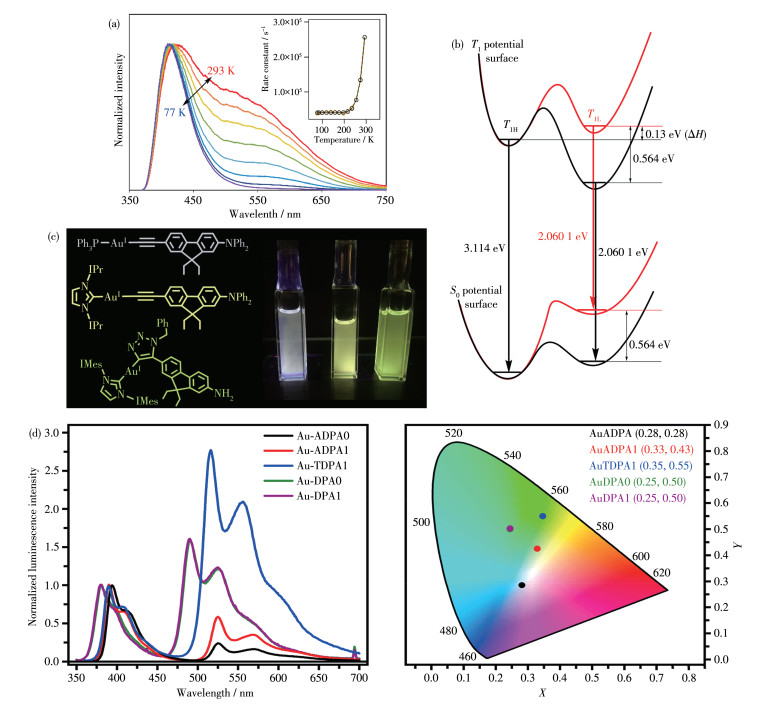
2023年,Osawa等[24]合成了3种以乙腈(AN)为辅助配体的双核Au(Ⅰ)配合物[(μ-LMe)(Au(AN))2](BF4)2、[(μ-LEt)(Au(AN))2](BF4)2和[(μ-LiPr)(Au(AN))2](BF4)2,其中LMe=1,2-双(双(2-甲基苯基)膦基)苯,LEt=1,2-双(双((2-乙基苯基)膦酰基)苯,LiPr=1,2-二(双(2-异丙基苯基)膦酰)苯。通过单晶X射线衍射表征,证实了Au(Ⅰ)配合物中的Au(Ⅰ)…Au(Ⅰ)距离较短,为0.298~0.305 nm,表明Au(Ⅰ)之间存在亲金相互作用。[(μ-LMe)(Au(AN))2](BF4)2在293 K下发射光谱峰值为415 nm,表现出紫罗兰色的磷光发光,而[(μ-LEt) (Au(AN))2](BF4)2最大发射峰位于430 nm,发射光谱中伴随着415 nm处的弱发射峰。[(μ-LiPr)(Au(AN))2](BF4)2的发射光谱中存在425和580 nm两个明显的发射峰,表现出白色磷光(0.29,0.32)。变温光谱表明,[(μ-LiPr)(Au(AN))2](BF4)2的2个发光谱带来源于2个处于热平衡状态的激发三重态(图 1a)。理论计算进一步表明,观察到的[(μ-LiPr)(Au(AN))2](BF4)2的双重磷光可解释为来自2个激发的三重态T1H和T1L,前者表现出高能磷光带(紫罗兰色),后者表现出低能磷光带(橙色)(图 1b)。2022年,Gray等[25]设计合成了5种新型具有受体-π-给体(A-π-D)结构的含二苯胺基芴Au(Ⅰ)配合物,其中的二苯胺基芴通过芳基、炔基以及三唑基进行修饰。同时,体系中还引入辅助配体有机膦或氮杂环卡宾与中心金属Au(Ⅰ)配位。所有配合物在298 K的甲苯溶液中都表现出双重发光,其荧光和磷光发光可归属于二苯胺基芴π体系中的π-π*跃迁(图 1c)。其中,有机膦作为辅助配体的炔基二苯胺基芴衍生物Au(Ⅰ)配合物表现出白光发光,其余的表现为绿色、黄绿色、黄色发光(图 1d)。发光颜色的不同是封端配体及辅助配体的多样性影响荧光、磷光量子产率及能级差所导致的。该工作表明,通过选择封端配体及辅助配体,能够直接影响二苯胺基芴Au(Ⅰ)配合物的光物理性能,为建立该体系的结构与发光性能的构效关系提供了理论和实验支撑。
图 1
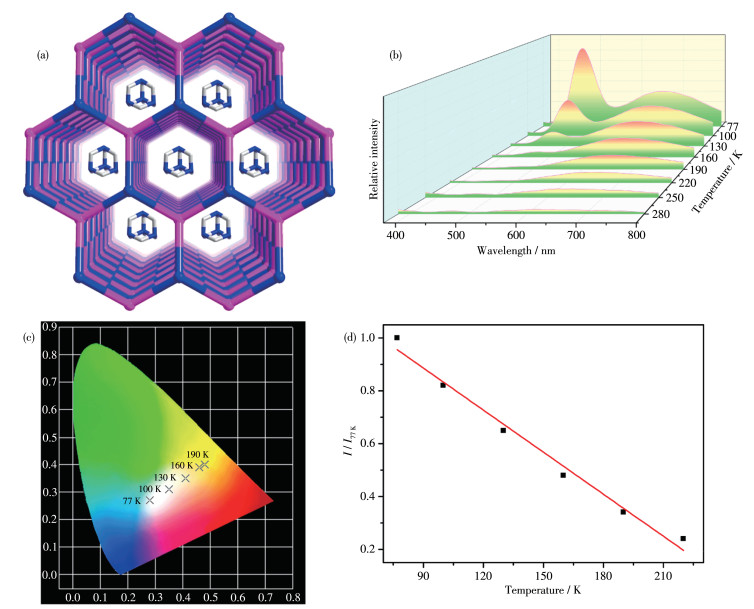
图 1. (a) 激发波长为355 nm时, 不同温度下[(μ-LiPr)(Au(AN))2](BF4)2的发射光谱[24]; (b)假设S0态和T1态势能面, 在T1态对结构进行几何优化后描绘的晶体场效应对势能变化的影响[24]; (c) 二苯胺基芴Au(Ⅰ)配合物结构及甲苯溶液中发光照片[25]; (d) Au(Ⅰ)配合物的归一化发射光谱(左)及其对应的CIE 1931色坐标(右)[25]Figure 1. (a) Emission spectra of [(μ-LiPr)(Au(AN))2](BF4)2 at different temperatures with an excitation wavelength of 355 nm[24]; (b) Assuming the S0 state and T1 state energy surfaces, the impact of crystal field effects on potential energy changes depicted after geometric optimization of the structure in T1 state[24]; (c) Structure of Au(Ⅰ) complexes with diphenylamine substituted fluorene and luminescence photos in toluene solution[25]; (d) Normalized emission spectra of Au(Ⅰ) complexes (left) and the corresponding CIE 1931 chromaticity diagram (right)[25]2021年,潘杰教授课题组[26]通过溶剂热合成方法制备了一种三维[Ag4Br6]簇合物基配位聚合物(NH4)(MeHmta)[Ag4Br6(Hmta)](Hmta=六亚甲基四胺),其中游离NH4+和甲基化胺MeHmta作为结构模板剂,金属簇合物与有机配体以四面体方式连接,具备类似金刚烷的构型(图 2a)。该Ag(Ⅰ)配合物在低温下呈现出典型的双发射特征(低能谱带发射和高能谱带发射),并且2种特征发射在不同温度下相对强度发生转变,表现出有趣的热致发光变色性能(图 2b)。当温度降为100 K时,表现出标准的白光发光(0.35,0.31)(图 2c),这为制备新型单组分白光磷光体提供了新思路。此外,该Ag(Ⅰ)配合物的低能谱带发射与温度之间表现出良好的线性关系,被认为是一种有前途的发光温度计(图 2d)。
图 2
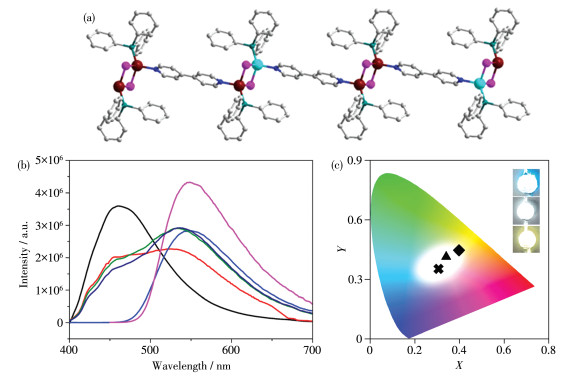
图 2. (a) 三维[Ag4Br6]簇合物基配位聚合物的类似金刚烷构型; (b) Ag(Ⅰ)配合物在77~280 K下的发射光谱; (c) 不同温度下Ag(Ⅰ)配合物对应的色坐标; (d) 77~220 K范围内, 低能发射谱带相对强度(I/I77 K)与温度之间的线性关系[26]Figure 2. (a) Adamantane-like configuration of 3D [Ag4Br6]2- cluster-based coordination polymer; (b) Emission spectra of Ag(Ⅰ) complex at 280-77 K; (c) Color coordinates of Ag(Ⅰ) complex at different temperatures; (d) Linear relationship between the relative intensity of low-energy emission bands (I/I77 K) and temperature in the range of 77~220 K [26]2020年,李静教授课题组[27]制备了一系列基于M2I2(M=Ag(Ⅰ),Cu(Ⅰ))二聚体的一维无机-有机杂化材料1D-Ag2-xCuxI2(tpp)2(4,4′-bpy)(x < 2,tpp=三苯基膦,4,4′-bpy=4,4′-联吡啶)(图 3a)。紫外光照下,1D-Ag2I2(tpp)2(4,4′-bpy)表现出蓝色发光(λem=460 nm),而1D-Cu2I2(tpp)2(4,4′-bpy)表现出黄色发光(λem=550 nm)。利用Cu(Ⅰ)定量取代一维链中的Ag(Ⅰ),实现杂化材料发光颜色的调节。当x=0.001、0.005、0.01时分别获得色坐标为(0.33,0.42)、(0.35,0.43)、(0.43,0.45)的白光发光材料(图 3c),同时具备较高的内量子产率,最高可达与商业发光材料相当的95%。高量子产率、易于合成和发光可调性的优点使这类杂化材料成为通用照明荧光粉的候选材料。
图 3
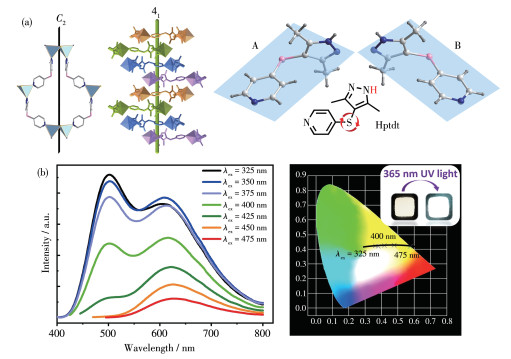
图 3. (a) 一维无机-有机杂化材料1D-Ag2-xCuxI2(tpp)2(4, 4′-bpy)的晶体结构; Ag(Ⅰ)杂化材料取代不同量的Cu(Ⅰ)的(b) 发射光谱(λex=360 nm; x=0, 黑色线; x=0.001, 红色线; x=0.005, 绿色线; x=0.01, 深蓝色线; x=0.02, 蓝色线; x=2, 紫色线)及(c) 白光发光色坐标(从左到右, x=0.001、0.005、0.01)[27]Figure 3. (a) Crystal structure of 1D-Ag2-xCuxI2(tpp)2(4, 4′-bpy) 1D inorganic-organic hybrid material; (b) Emission spectra and (c) white light color coordinates (from left to right, x=0.001, 0.005, 0.01) of Ag(Ⅰ) hybrid materials with different Cu(Ⅰ) substitution amounts (λex=360 nm; x=0, black line; x=0.001, red line; x=0.005, green line; x=0.01, dark blue line; x=0.02, blue line; x=2, purple line)[27]2023年,汪芳明课题组[28]利用烷基化三乙烯二胺配体,通过溶剂挥发法成功合成了4种碘化亚铜簇无机-有机杂化材料。三乙烯二胺上烷基链的修饰可以实现不同碘化亚铜团簇的形成,改变堆积模式,并提高其热稳定性。研究结果表明,直链烷基链的长度可以改变配合物的内量子效率,烷基链的异构化可以有效地改变配合物发光的相关色温和颜色,实现暖白光和近白光发射,内量子效率从5%提升至83%。该工作为开发碘化亚铜杂化白光材料提供了新思路,并为其在固态照明领域的潜在应用给予合理的理论支撑。2022年,洪茂椿教授课题组[29]通过非手性配体Hptdp((4-(吡啶-4′-硫代))3,5-二甲基-1H-吡唑)与Cu2I2簇进行不对称组装,以结晶驱动破坏对称性,得到一对手性CuI配位聚合物{[(CuI)(Hptdp)]4·H2O}n,分离出的2个对映异构体具有独特的螺旋层状结构和可调谐的双发射光致发光性能(图 4)。该Cu(Ⅰ)配合物发射光谱表现出双发射谱带,分别为510 nm(高能谱带发射)和605 nm(低能谱带发射),2个发射谱带的相对强度可以通过调节激发波长来控制。当激发波长为400 nm左右时,高能发射带和低能发射带强度相当,表现出白光发光(0.42,0.42),量子效率为2.4%。在380 nm紫外发射的商用LED芯片上涂覆Cu(Ⅰ)配合物粉末组装成LED灯,表现出暖白光发光(0.41,0.41),色温为3 632 K,显色指数高达93.4,表明该Cu(Ⅰ)配合物是一种具备潜在应用价值的单相白色磷光体。
图 4
图 4. (a) Hptdp配体与Cu2I2簇构成的十元环Cu(Ⅰ)配合物、手性堆积构型及两种异构体中Hptdp配体镜像构型; (b) Cu(Ⅰ)配合物随激发波长改变的发射光谱及其色坐标[29]Figure 4. (a) Ten‐membered ring Cu(Ⅰ) complex formed by Hptdp ligand and Cu2I2 cluster, chiral stacking configuration and mirror configuration of Hptdp ligand in two isomers; (b) Emission spectra and color coordinates of Cu(Ⅰ) complex with changing of excitation wavelength[29]4.2 Zn(Ⅱ)/Cd(Ⅱ)配合物
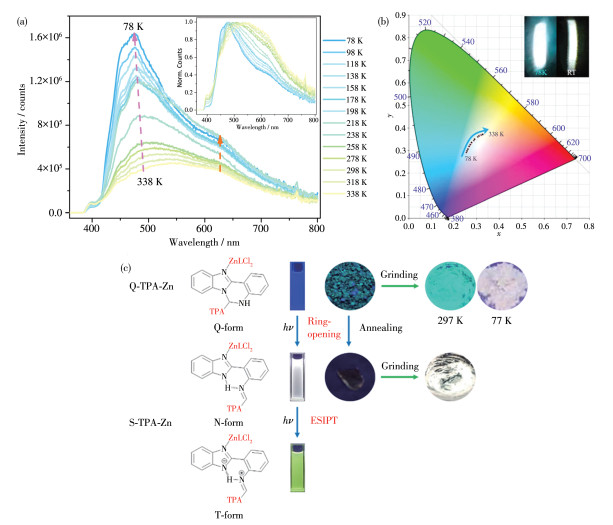
2020年,吴大雨教授课题组[30]通过溶剂热法合成了2种具有本征白光发光的Zn(Ⅱ)配位聚合物[ZnCl(μ-stdb)0.5(μ-bima)]n和[Zn(fc)2(μ-bima)]n,其中Hfc=甲酸,H2stdb=4,4′-二苯乙烯二羧酸,bima=9,10-二(咪唑基)蒽。通过含氮杂环蒽配体及二羧酸配体的桥联作用,构成二维金属有机层状构型。室温下,[ZnCl(μ-stdb)0.5(μ-bima)]n光谱为宽谱带,而[Zn(fc)2(μ-bima)]n光谱为双发射,均表现出近白光发光,其色坐标分别为(0.324,0.355)和(0.342,0.345)。2种Zn(Ⅱ)配位聚合物的发光性能均来源于双配体激基复合物的形成,伴随着温度依赖的发光特性。[ZnCl(μ-stdb)0.5(μ-bima)]n的低温荧光光谱表明其宽谱带白光发光来自于多种互补色谱带的叠加,当温度从78 K升高到338 K时,光谱逐渐变宽,发光颜色从冷白光(0.255,0.356)变为暖白光(0.355,0.383)(图 5a和5b)。2021年,郑向军教授课题组[31]通过一锅法水热合成了一种基于三苯胺的2H-喹唑啉Zn(Ⅱ)配合物Q-TPA-Zn,该配合物具备荧光、磷光双重发光性能,同时具备力致发光变色和热致发光变色性能(图 5c)。该配合物固体在77 K表现出白色发光(0.27,0.33),297 K表现出青色发光(0.32,0.39)。在300 ℃下Q-TPA-Zn可以转变为席夫碱配合物S-TPA-Zn,室温下表现出白光发光(0.32,0.38)。这是由于苯并咪唑N—H基团中H原子到席夫碱N原子的激发态分子内质子转移(ESIPT)引起的互变异构。在溶液中,Q-TPA-Zn在365 nm光照下也可以通过光化学开环反应转化为同分异构体S-TPA-Zn,表现出高对比度的光致发光变色。这是第一个通过加热或紫外光照将2H-喹唑啉转变为席夫碱的实例,该工作将对多刺激光响应配合物以及单组分白光发光材料的发展产生重要影响。
图 5
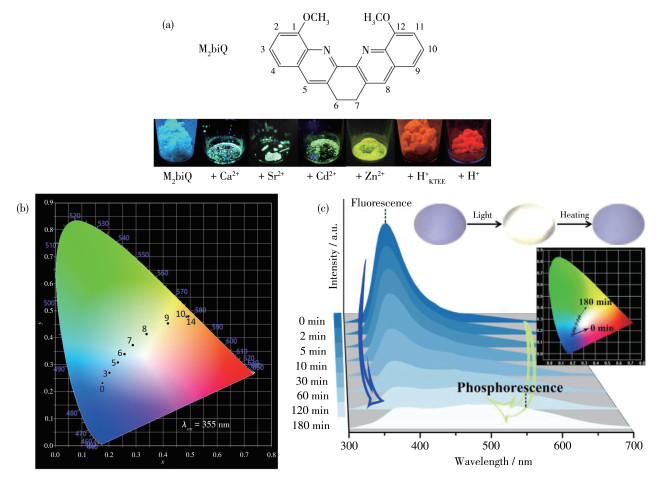
2020年,Zavaleta等[32]对M2biQ(6,7-二氢-1,12-二甲氧基二苯并-菲咯啉[b,j][1, 10])的发光性能展开深入研究。结果表明,该荧光基团与不同阳离子结合时,能够表现出红-绿-蓝多色发光(图 6a)。同时,通过改变与该荧光基团相互作用的阳离子类别及比例,能够实现整个光谱范围的发光调节。当引入适当比例的锌离子和氢离子,能够获得白光发光,该过程中甲氧基基团提供电子,联吡啶基团与Zn2+和H+结合后充当电子受体(图 6b)。基于M2biQ对不同阳离子产生的近乎全光谱颜色可调的性能,这类材料可以作为光学化学传感器。2022年,胡继祥教授课题组[33]以含多吡啶基的1,3,5-三(4-吡啶基)苯和草酸作为配体构建一种新型光活性Zn(Ⅱ)配合物,通过调节光生自由基实现白光发射。该配合物在室温下,经紫外光、太阳光或氙灯照射后,具有光致变色及光致白光发光性能。通过一系列表征证实该配合物在光照下,发生草酸基团到多吡啶基团的电子转移,引起1,3,5-三(4-吡啶基)苯配体构型的扭转,分子间堆积作用发生变化。样品在270 nm光照后,380 nm处荧光发光逐渐减弱,而550 nm处磷光发光逐渐增强(图 6c)。光照3h后,光致变色发光从蓝色转变为白色,变色前后色坐标分别为(0.20,0.16)和(0.27,0.33),上述光致发光变色在热处理作用后可以恢复。这种通过光致电子转移产生自由基形成的光致发光变色材料为构筑新型多功能发光材料提供了新思路。
图 6
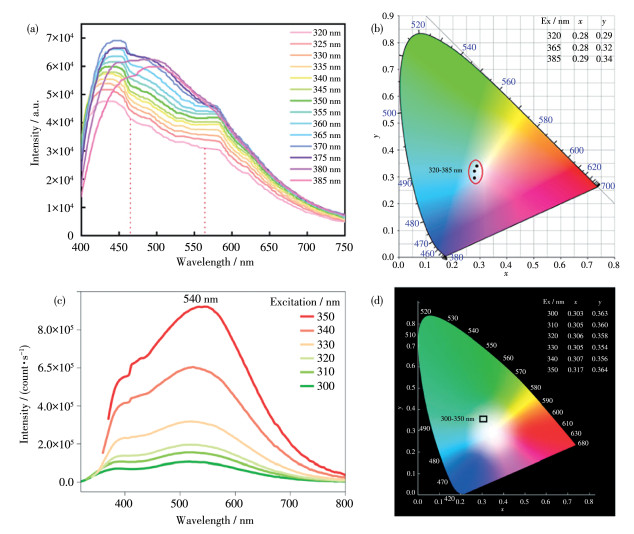
图 6. (a) M2biQ结构及与不同阳离子配位组装后固态发光照片[32]; (b) 355 nm激发波长下, M2biQ与不同比例Zn2+配位后发射光谱对应的色坐标[32]; (c) Zn(Ⅱ)配合物随光照时间变化的发射光谱及对应色坐标[33]Figure 6. (a) M2biQ structure and solid-state luminescence photos after coordination assembly with different cations[32]; (b) Under the excitation wavelength of 355 nm, the color coordinates corresponding to the emission spectra of M2biQ after coordination with different proportions of Zn2+ [32]; (c) Emission spectra and the corresponding color coordinates of Zn(Ⅱ) complex with the change of illumination time[33]2022年,马建方教授课题组[34]通过环三藜芦烃基配体与Cd(NO)2·4H2O的溶剂热反应,制备得到新型Cd(Ⅱ)配位聚合物,结构中六核Cd—O簇与配体阴离子连接形成二维层状结构。该配合物表现出激发波长依赖的光致发光性能,在320~385 nm的宽激发波长范围内均可以观察到白光发光,表现出可调节的光致发光现象(图 7a和7b)。在385 nm激发波长下,色坐标为(0.29,0.34),接近于纯白光区域(0.33,0.33),同时色温为7 994 K,表现为冷白光。2020年,殷政教授课题组[35]以均苯三酸(H3btc)为配体,利用溶剂热法制备得到新型Cd(Ⅱ)配合物(Me2NH2)[Cd(btc)]·0.5DMA·2H2O,该配合物为基于[Cd2(COO)4]-的多孔骨架,属于(3,6)连接的α-PbO2拓扑网络类型。该配合物具备单相白光发光性能,其宽谱带光谱的半峰宽高达268 nm(图 7c和7d),这是由于该配合物结构中存在配体-配体和配体-金属的2种跃迁方式,且能量相近、强度相当。上述2种Cd(Ⅱ)配合物白光材料在不使用贵金属和复杂有机配体的情况下,能够表现出与自然光相似的明亮白光发光性能,在照明领域具备潜在的应用价值。2022年,傅红如教授课题组[36]利用溶剂热法合成了2种Cd基超分子配位聚合物[Cd3(CzIP)3(DMF)2]和[Cd2(CzIP)2(DMF)4],其中CzIP=5-(咔唑-9-基)间苯二甲酸。配合物[Cd3(CzIP)3(DMF)2]中CzIP配体分子与Cd2+离子配位形成一维链状结构,[Cd2(CzIP)2(DMF)4]中CzIP分子与Cd2+离子配位形成二维层状结构,一维链和二维层通过氢键及π-π相互作用堆积成三维空间结构。2种配合物均具备室温下长寿命磷光,表现为荧光、磷光共存的双重发光。其中[Cd2(CzIP)2(DMF)4]显示出近乎纯白光发光(0.33,0.33)。值得注意的是,该工作是第一个具有单相白光发光以及室温磷光变色转变的配位聚合物的实例。此外,这类材料在含时的防伪和WLED领域存在一定潜力,并为通过分子间相互作用及电荷转移体系设计多重发光材料开辟了新方向。
图 7
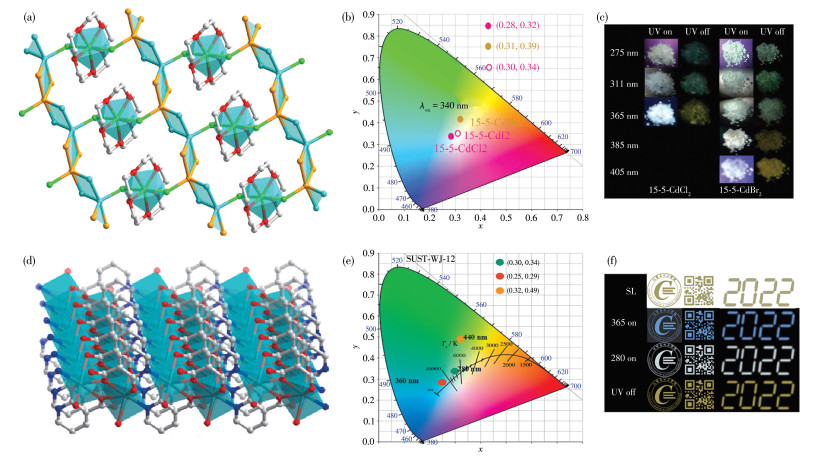
图 7. 环三藜芦烃基Cd(Ⅱ)配合物在不同激发波长下的(a) 发射光谱及(b) 对应白光发光色坐标[34]; [Me2NH2][Cd(btc)]·0.5DMA·2H2O阴离子MOFs在不同激发波长下的(c) 发射光谱及(d)对应白光发光色坐标[35]Figure 7. (a) Emission spectra and (b) the corresponding white light emission color coordinates of the cyclotriterpene‐based Cd(Ⅱ) complexes at different excitation wavelengths[34]; (c) Emission spectra and (d) the corresponding white light emission color coordinates of the [Me2NH2][Cd(btc)]·0.5DMA·2H2O anionic MOFs at different excitation wavelengths[35]2023年,王政教授课题组利用冠醚配体(15-Crown-5)与适当比例的金属卤化物(CdX2),通过一锅溶剂热反应合成了3种金属卤化物基配合物(15-5-CdCl2、15-5-CdBr2和15-5-CdI2),其中卤素原子桥联金属离子形成主体骨架(图 8a)。在室温下,3种配合物在340 nm的紫外光照射下均表现白光发光,CIE坐标分别为(0.28,0.32)、(0.31,0.39)、(0.30,0.34)(图 8b)。15-5-CdCl2在室温下,磷光寿命长达0.12 s,15-5-CdCl2和15-5-CdBr2表现出蓝色/青色到绿色/黄色转变的余辉发光性能(图 8c)。余辉性能主要归功于结构中重原子效应和丰富的分子间、分子内相互作用。同年,该课题组还利用多齿配体2-羟基烟酸与Zn(Ⅱ)/Cd(Ⅱ)金属离子,在溶剂热反应条件下制备得到Zn簇和Cd簇长余辉MOFs(图 8d)。与以单金属为节点构建的传统MOFs材料相比,具有多核簇亚结构单元的MOFs材料可以有效地通过多个配位键增强分子构象的稳定,从而形成致密的堆叠和刚性骨架,抑制三线态激子的非辐射跃迁。金属团簇可以作为重原子在一定程度上增加自旋轨道耦合,促进Sn-Tn能量转移,有效提高系间穿越效率,提升长余辉发光性能。2种金属簇配合物室温下发光寿命可以达到69.92和63.22 ms。同时,配合物表现出从蓝光到绿光的激发波长依赖的光致发光性能,Cd簇MOFs在280 nm激发波长下,能够得到冷白光发光(0.30,0.34)(图 8e和8f)。理论计算表明,2种金属簇配合物的发光性能均来自金属簇增强的配体发光中心。上述材料在化学传感、光学记录设备、生物成像和安全系统领域中有巨大的应用潜力。
图 8
图 8. (a) 冠醚-金属卤化物配合物结构[37]; (b) 340 nm激发波长下发射光谱对应的色坐标[37]; (c) 不同激发波长下, 颜色可变余辉发光照片[37]; (d) 金属簇配合物结构[38]; (e) 不同激发波长下发光光谱对应的色坐标[38]; (f) 自然光、360 nm/280 nm紫外光及关闭紫外光条件下荧光、磷光发光照片[38]Figure 8. (a) Structure of crown ether-metal halide complexes[37]; (b) The color coordinates corresponding to the emission spectra under the excitation wavelength of 340 nm[37]; (c) Color variable afterglow luminescence photos under different excitation wavelengths[37]; (d) Structure of metal cluster complexes[38]; (e) The color coordinates corresponding to the luminescence spectra under different excitation wavelengths[38]; (f) Photos of fluorescence and phosphorescence under natural light, 360 nm/280 nm ultraviolet light and off ultraviolet light conditions[38]4.3 Eu(Ⅲ)和Tb(Ⅲ)共掺杂Ln(Ⅲ)配合物
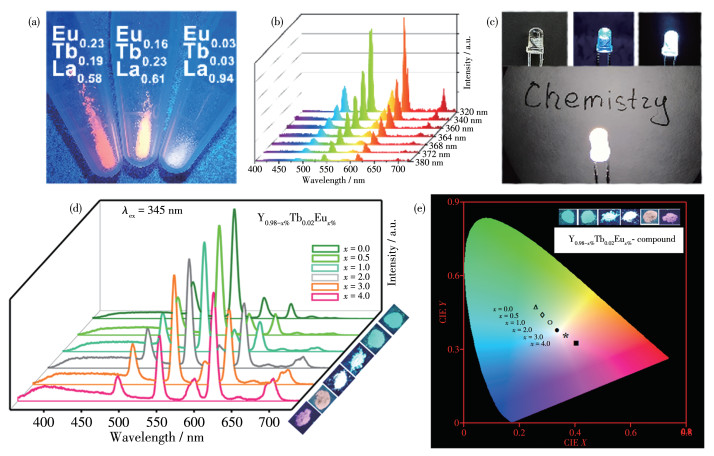
镧系配位聚合物具有高发光效率和窄发光光谱带,而镧系金属离子半径相似,可以将不同的镧系金属离子掺杂到同一配位聚合物中以精准控制发光颜色,是制备单组分白光材料的首选策略。2023年,Fedin等[39]以4-(3,5-二羧基苯氧基)间苯二甲酸(L)为配体制备获得具有高量子产率、耐水、耐高温的三维Eu-MOF:[Eu(H2O)(HL)]·0.5CH3CN·0.25H2O。通过将结构中Eu3+取代为Tb3+和La3+,实现发光颜色的调节。在365 nm紫外灯照射下,Eu0.23Tb0.19La0.58-MOF呈现橙色发光,Eu0.16Tb0.23La0.61-MOF呈现黄色发光,Eu0.03Tb0.03La0.94-MOF呈现近白色发光,不同稀土金属离子掺杂量通过电感耦合等离子体原子发射光谱仪测定(图 9a)。同时,Eu0.03Tb0.03La0.94-MOF还表现出激发波长依赖的发光特点(图 9b),随着激发波长从320 nm增加至380 nm,其发光颜色由黄色变为近白色(0.31,0.32),将其与LED器件组装,显色指数高达90(图 9c)。除白光发光外,该配合物还具备对Fe3+或氧氟沙星抗生素光响应性能、对乙炔及二氧化碳选择性吸附性能以及质子传导性能。2022年,Natarajan等[40]利用2,5-双(丙-2-炔-1-氧基)对苯二甲酸(2,5-BPTA)作为配体,通过水热法制备了一系列新型镧系金属有机骨架(Ln-MOFs):[Ln(2,5-BPTA)3(H2O)2]·4H2O(Ln=Y、Pr、Nd、Sm、Eu、Gd、Tb、Dy)和[Ln(2,5-BPTA)3(DMF)(H2O)]·2H2O·DMF(Ln=La、Ce、Pr),分别具有二维和三维结构。为实现白光发光,首先向[Y(2,5-BPTA)3(H2O)2]·4H2O结构中引入2%的Tb3+,然后引入0、0.5%、1%、2%、3%、4%的Eu3+,随着Eu3+浓度的增加,Tb3+的特征发射峰强度持续降低,表明体系中存在Tb3+到Eu3+的能量传递(图 9d)。当Eu3+引入量为2%时,获得[Y0.96Tb0.02Eu0.02(2,5-BPTA)3(H2O)2]·4H2O共掺杂体系,实现白光发光,发光量子效率为28%(图 9e)。同时,Tb-MOF具备对水溶液中Cr3+和Fe3+的选择性检测(检测限分别为0.41和8.6 mg·L-1),并对芳基化反应具备良好的非均相催化性能(产率为95%)。上述工作均表现出Ln-MOFs在白光发光、金属离子检测、多相催化等多领域的研究价值,为其更广泛、更多样化的应用提供了有力支撑。
图 9
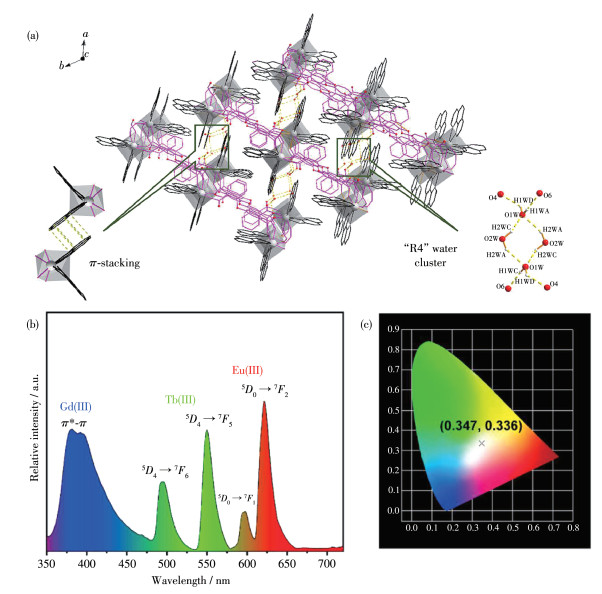
图 9. (a) 不同稀土离子掺杂比例的Ln-MOFs在365 nm紫外光照射下发光照片[39]; (b) Eu0.03Tb0.03La0.94-MOF在不同激发波长下发射光谱[39]; (c) Eu0.03Tb0.03La0.94-MOF LED器件的白光发光照片[39]; 不同Eu3+引入量的[Y0.98-xTb0.02Eux(2, 5-BPTA)3(H2O)2]·4H2O在345 nm激发波长下的(d) 发射光谱及(e) 对应色坐标和发光照片[40]Figure 9. (a) Luminescence photos of Ln-MOFs with different rare earth ion doping ratios under 365 nm ultraviolet light irradiation[39]; (b) Emission spectra of Eu0.03Tb0.03La0.94-MOF under different excitation wavelengths[39]; (c) Eu0.03Tb0.03La0.94-MOF LED device white light emission photo[39]; (d) Emission spectra and (e) the corresponding color coordinates and luminescence photos of [Y0.98-xTb0.02Eux(2, 5-BPTA)3(H2O)2]·4H2O with different amounts of Eu3+ under the excitation wavelength of 345 nm[40]2022年,李夏教授课题组[41]利用水热法制备得到新型镧系配位聚合物(Ln-CPs):{[Ln(DPBA)(phen)2]·2H2O}n,其中Ln=Eu、Tb、Gd,DPBA=2-(3′,4′-二羧基苯氧基)-苯甲酸,phen=菲咯啉。3种配合物分别表现出红色、绿色、蓝色发光(图 10a)。Ln-CPs由[LnO4N4]多面体和DPBA配体构成一维链状结构,并通过水分子团簇和π-π堆积作用构成三维超分子结构。该镧系配位聚合物具备较好的热稳定性(分解温度340 ℃)、溶剂稳定性(pH=3~12的含水溶剂)以及抗紫外光稳定性。将Eu3+和Tb3+掺杂到Gd-CP中获得Gd0.993Eu0.0017Tb0.0053-CP,在330~355 nm的宽激发波长范围内,均表现出白光发光(图 10b)。当激发波长为332 nm时,发射光谱对应的色坐标为(0.347,0.336)(图 10c),与标准白光(0.333,0.333)非常接近,其色温为4 827 K,显色指数为90,白光发光量子产量高达35.09%,在已报道的白光发光材料中处于较高水平。
图 10
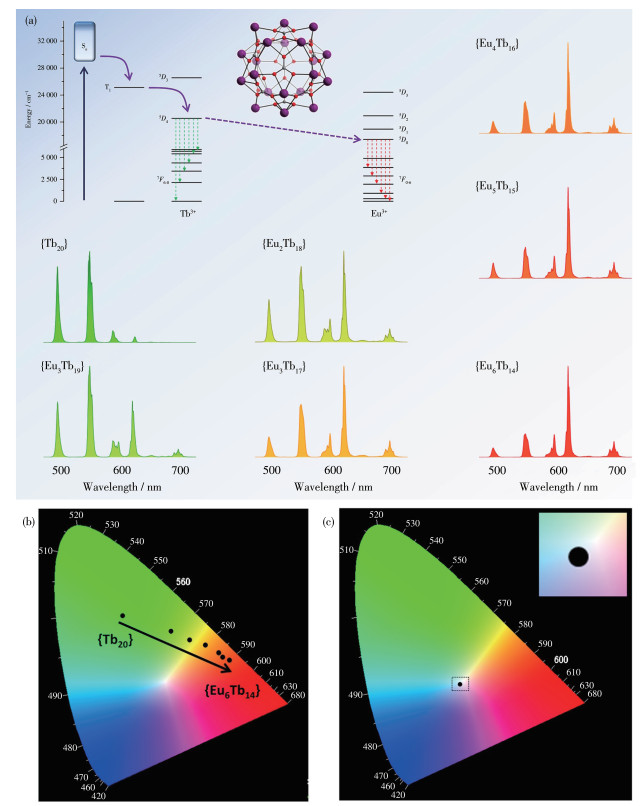
图 10. (a) {[Ln(DPBA)(phen)2]·2H2O}n的结构; 在332 nm激发波长下, Gd0.993Eu0.0017Tb0.0053-CP的(b)发光光谱及(c)对应的色坐标[41]Figure 10. (a) Structure of {[Ln(DPBA)(phen)2]·2H2O}n; (b) Luminescence spectrum and (c) the corresponding color coordinates of Gd0.993Eu0.0017Tb0.0053-CP under the excitation wavelength of 332 nm[41]分子簇合物(MCAs)结构及性能可以通过与不同的Ln3+离子共掺杂来微调,以控制金属离子与配体之间的能量转移过程,从而控制发光颜色。2021年,Murugesu等[42]利用溶剂挥发法合成配合物{Tb20}MCA:[Ln20(chp)30(CO3)12(NO3)6(H2O)6](chp-为去质子化的6-氯-2-羟基吡啶)。通过向{Tb20}MCA掺入不同量的Eu3+,得到系列{EuxTb20-x}MCA,发光颜色从{Eu1Tb19}的黄绿色到{Eu6Tb14}的红橙色,实现不同发光颜色的转变(图 11a和11b)。对于镧系元素配合物体系,通常采用将配体蓝色发光与Eu3+红色发光和Tb3+绿色发光相结合的获得白光发光。通常Gd3+离子不具备发光性能,其配合物表现为配体发光特征。该工作中通过调配Gd3+、Eu3+、Tb3+在MCA中的比例,制备得到白光发光的{Eu3Gd5Tb12}MCA(图 11c)。该工作为探索组成控制纳米分子材料发光性能提供了新思路。
图 11
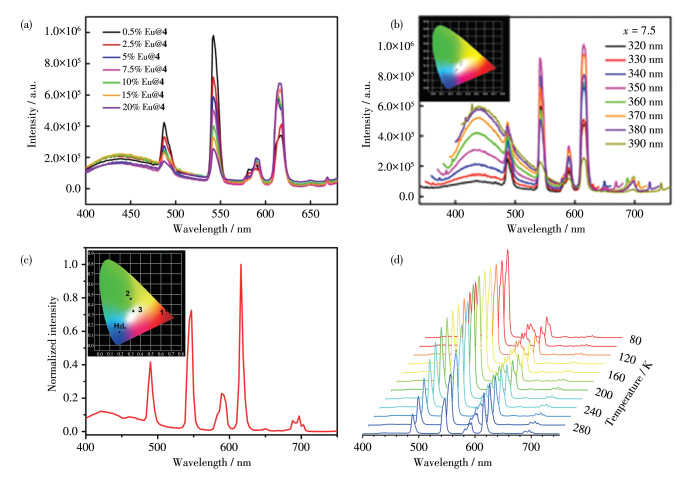
图 11. 320 nm激发波长下, {EuxTb20-x}MCAs的(a) 发射光谱及(b) 对应的色坐标; (c) {Eu3Gd5Tb12}MCA的白光发射光谱(λex=355 nm)对应的色坐标[42]Figure 11. (a) Under the excitation wavelength of 320 nm, (a) emission spectra and (b) the corresponding color coordinates of {EuxTb20-x}MCAs; (c) Color coordinate of {Eu3Gd5Tb12}MCA white light emission spectrum (λex=355 nm)[42]2021年,白凤英教授课题组[43]采用溶剂热法设计合成了4种具有新颖三维结构的Ln-MOFs:((CH3)2NH2)[Ln3(HCPCP)1.5(CH3COO)]·6DMA,其中Ln=Ce (1)、Sm (2)、Eu (3)、Tb (4),HCPCP=六(4-羧基苯氧基)环三磷腈。将具有红色发光的Eu3+离子掺杂到化合物(CH3)2NH2[Tb3(HCPCP)1.5(CH3COO)]·6DMA中,得到了一系列掺杂的Ln-MOFs材料。随着Eu3+离子掺杂比例的增加,Tb3+和Eu3+的特征峰发生规律性变化,产生了Tb3+到Eu3+离子的能量传递,Tb3+离子的发光强度降低,Eu3+离子的发光强度增强(图 12a)。通过改变不同Eu3+离子掺杂浓度样品的激发波长,最终得到质量较高的白色发光材料7.5% Eu3+@4(λex=340 nm),CIE坐标为(0.326 8,0.321 2),结果表明7.5% Eu3+@4是一种具有实际应用潜在价值的白色发光材料(图 12b)。2021年,龙腊生教授课题组[44]利用水热合成方法制备得到2个镧系金属配位聚合物[Ln(L)(D/L-Hlac)(H2O)2]·0.5H2O,其中Ln=Eu、Tb,H2L=4,4′-(吡啶-3,5-二基)二苯甲酸,D/L-H2lac=右旋/左旋乳酸。[Eu(L)(D/L-Hlac)(H2O)2]·0.5H2O显示出红光发光,在80~300 K的温度范围发光颜色几乎不变,而[Tb(L)(D/L-Hlac)(H2O)2]·0.5H2O发光颜色从黄色变为绿色,色坐标从80 K的(0.36,0.56)变为300 K的(0.30,0.46)(图 12c和12d),表现出温度传感性能(1.07%·K-1)。Eu3+和Tb3+共掺杂体系[Tb0.9373Eu0.0627(L)(D/L-Hlac)(H2O)2]·0.5H2O不仅显示出白光发光(0.33,0.33),在230~300 K温度范围还具备较好的温敏传感性能(2.27%·K-1)。该工作将有助于设计同时作为热敏发光温度计和高效白光发光器件的多功能镧系金属配位聚合物材料。
图 12
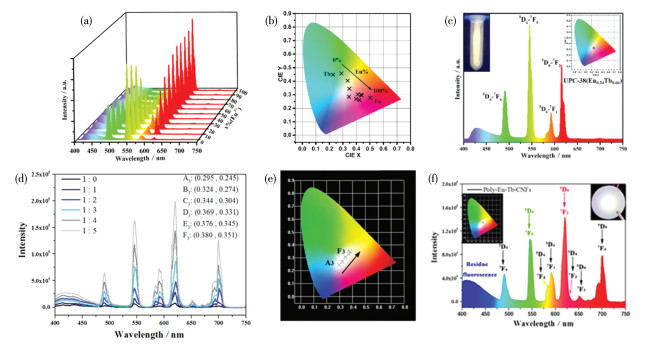
图 12. (a) 不同稀土掺杂量的x%Eu3+@4(x=0.5、2.5、5、7.5、10、15、20)的发射光谱(λex=350 nm)[43]; (b) 不同激发波长下7.5%Eu3+@4的发射光谱以及激发波长为340 nm时对应的色坐标[43]; (c) 300 K下[Tb0.9373Eu0.0627(L)(D/L-Hlac)(H2O)2]·0.5H2O的发射光谱及色坐标[44]; (d) 不同温度下[Tb0.9373Eu0.0627(L)(D/L-Hlac)(H2O)2]·0.5H2O的发射光谱[44]Figure 12. (a) Emission spectra (λex=350 nm) of x%Eu3+@4 (x=0.5, 2.5, 5, 7.5, 10, 15, 20) with different rare earth doping amounts[43]; (b) Emission spectra of 7.5%Eu3+@4 under different excitation wavelengths and the corresponding color coordinates when the excitation wavelength was 340 nm[43]; (c) Emission spectrum and color coordinate of [Tb0.9373Eu0.0627(L)(D/L-Hlac)(H2O)2]·0.5H2O at 300 K[44]; (d) Emission spectra of [Tb0.9373Eu0.0627(L)(D/L-Hlac)(H2O)2]·0.5H2O at different temperatures[44]2020年,赵琦华教授课题组[45]利用水热合成方法,制备了一系列镧系配位聚合物[Ln(Hmpda)3(H2mpda)],其中Ln=Eu、Tb、Gd,H2mpda=2,6-二甲基吡啶-3,5-二羧酸。单晶X射线衍射结构表征显示,[Ln(Hmpda)3(H2mpda)]为一维链状结构,并通过氢键相互作用扩展为三维超分子构型。在280 nm激发波长下,掺杂镧系金属化合物[(Gd0.9083Eu0.0688Tb0.0229)(Hmpda)3(H2mpda)]同时显示H2mpda配体的发射(473 nm)、Tb3+的特征发射(543和589 nm)和Eu3+的特征发射(618和698 nm),显示出暖白光发光(0.36,0.33),并将其封装在LED器件中,具备优异的显色指数和色温。2020年,孙道峰教授课题组[46]采用溶剂热方法成功制备了一系列同构的稀土金属有机骨架(RE-MOFs)结构,即{[RE(L-X)(H2O)]2·DMF}n(UPC-38), 其中RE=Eu、Tb,X=H、F、Cl、NH2、CH3、OCH3,L=(1,1′∶3′,1″-三联苯)-4,4″,5′-三羧酸。研究表明,将不同官能团连接至配体会对UPC-38的荧光强度、发射波长和量子产率产生影响,引入氨基会导致发射波长的红移。将Eu3+和Tb3+以不同比例与蓝光发光最强的(L-OCH3)3+配体结合,获得双掺杂RE-MOF:UPC-38(EuxTb1-x)-OCH3。随着Eu3+的增加,UPC-38(EuxTb1-x)-OCH3在365 nm紫外灯下的颜色从绿色到黄色、白色、粉红色,最后到红色(图 13a和13b)。当激发波长为335 nm时,UPC-38(Eu0.34Tb0.66)-OCH3呈现近白光发光(0.335,0.325)(图 13c)。该材料为设计可调谐的彩色和固态白光MOFs材料提供了一种思路。2019年,张召教授课题组[47]制备获得一系列Eu3+和Tb3+共掺杂的镧系金属配位聚合物(Poly-Eu-Tb,Eu3+对Tb3+的物质的量之比为1∶1、1∶2、1∶4和1∶8)。依据三原色策略,通过调节Eu3+红光、Tb3+绿光和聚合物蓝光的比例,获得白光发光的Poly-Eu-Tb。随着Tb3+浓度的增加,发光颜色由粉红色逐渐变为白光。当nEu3+∶nTb3+=1∶8且在DMF溶液中该配位聚合物浓度为1 mg·mL-1时,具备较强的白光发光效果,随着浓度的降低,稀土离子发光减弱,表现出聚合物骨架微弱的蓝光发光。上述实验结果符合典型的聚集诱导发光效应,随着在DMF稀溶液中加入1,4-二噁烷(Diox),白光发光可以得到恢复。当VDMF/VDiox=1∶2时,Poly-Eu-Tb(1∶8)获得理想白光(0.344,0.304)(图 13d和13e)。此外,通过简单的旋涂工艺将Poly-Eu-Tb均匀地分散到纤维素纳米纸表面,紫外激发白光的纤维素纳米纸显示出优异的透雾特性(高达98%,图 13f)。
图 13
图 13. 不同Eu3+掺杂量的UPC-38(EuxTb1-x)-OCH3的(a) 发射光谱及(b) 对应色坐标[46]; (c) UPC-38(Eu0.34Tb0.66)-OCH3的发射光谱(λex=335 nm)、对应色坐标以及白光照片[46]; Poly-Eu-Tb(1∶8)在不同体积比的DMF和1, 4-二噁烷溶液中的(d) 发射光谱及(e) 对应色坐标[47]; (f) 通过旋涂工艺制备得到的Poly-Eu-Tb纤维素纳米纸发射光谱、对应色坐标及白光照片[47]Figure 13. (a) Emission spectra and (b) the corresponding color coordinates of UPC-38(EuxTb1-x)-OCH3 with different Eu3+ doping amounts[46]; (c) Emission spectrum (λex=335 nm), the corresponding color coordinate and white light photo of UPC-38 (Eu0.34Tb0.66)-OCH3[46]; (d) Emission spectra and (e) the corresponding color coordinates of Poly-Eu-Tb (1∶8) in DMF and 1, 4-dioxane solutions with different volume ratios[47]; (f) Emission spectrum, corresponding color coordinate and white light photos of Poly-Eu-Tb cellulose nanopaper prepared by spin coating process[47]4.4 染料掺杂配合物
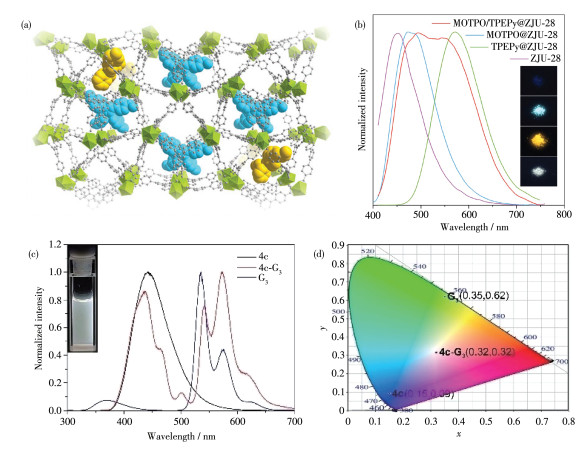
2022年,单国刚教授课题组[48]提出了一种将聚集诱导发光材料(AIEgens)封装到MOFs孔隙中,实现高性能LED白光发光的策略。他们制备了2种染料阳离子,分别为蓝色发光的2,3,4,5-四(4-甲氧基苯基)恶唑-3-鎓(MOTPO)和黄绿色发光的1-甲基-4-(4-(1,2,2-三苯基乙烯基))苯基)吡啶-1-鎓(TPEPy),并将其成功封装到阴离子MOF ZJU-28孔隙中(图 14a)。通过调节2种客体分子的比例,在紫外光激发下单相固态复合材料MOTPO/TPEPy@ZJU-28实现白光发光(0.35,0.34),量子效率高达64.9%(图 14b)。将复合材料涂覆在市售的395 nm紫外发射的InGaAsN芯片上,制备获得WLED器件,证明其具备潜在应用价值。2022年,张明明教授课题组[49]以六苯基三亚苯基吡啶(HPT)为配体,通过配位驱动自组装制备获得3种六棱柱状金属笼。金属笼与平面型客体分子表现出良好的主客体相互作用。由于金属笼的蓝光发光与荧光染料苝二酰亚胺衍生物的橙光发光互补,将金属笼与苝二酰亚胺衍生物按适当比例混合,获得明亮的白光发光材料(0.32,0.32)(图 14c和14d)。该研究不仅构建了一种新型的蓝色发光金属笼聚合物骨架,而且探索了其作为超分子主体与荧光染料客体的“主客体络合作用” (host-guest complexation),这将有利于进一步设计智能发光及白光照明材料。
图 14
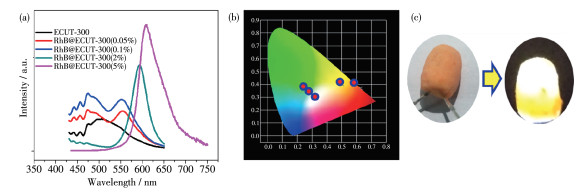
图 14. (a) MOTPO/TPEPy@ZJU-28单相固态复合材料结构[48]; (b) 390 nm激发波长下MOTPO/TPEPy@ZJU-28、MOTPO@ZJU-28、TPEPy@ZJU-28、ZJU-28的发射光谱及365 nm紫外光照射下发光照片[48]; 金属笼(4c)、苝二酰亚胺衍生物染料(G3)及二者复合物(4c~G3)在265 nm激发波长下的(c) 发光光谱及(d) 对应色坐标[49]Figure 14. (a) MOTPO/TPEPy@ZJU-28 single-phase solid composite structure[48]; (b) Emission spectra of MOTPO/TPEPy@ZJU-28, MOTPO@ZJU-28, TPEPy@ZJU-28, ZJU-28 under 390 nm excitation wavelength and the luminescence photos under 365 nm ultraviolet light irradiation[48]; (c) Luminescence spectra and (d) the corresponding color coordinates of metal cage (4c), the perylene diimide derivative dye (G3) and their composite (4c-G3) under an excitation wavelength of 265 nm[49]2021年,罗峰教授课题组[50]以4,4′,4″,4‴-(乙烯-1,1,2,2-四酰基)四苯甲酸(TPE)为配体,采用溶剂热合成方法制备得到一种新的铀基MOF(ECUT-300)。该MOF具有3个尺寸的孔道,分别为2.8、2.0和0.9 nm,可以吸附不同尺寸的染料或金属有机阳离子客体分子,从而具有不同的性能。该工作将不同质量分数的罗丹明B(RhB)封装到结构中,制备得到RhB@ECUT-300复合材料,可以精准定位染料分子存在于2.0 nm的孔道中。RhB@ECUT-300(0.1%)在408 nm激发波长下表现出白光发光(0.31,0.31)(图 15a和15b)。为了证实该复合材料可以作为白光照明材料,将RhB@ECUT-300涂覆在紫外LED芯片(400 nm)表面,该LED器件在3.0 V电压和20 mA电流下发出明亮白光(图 15c)。该工作是首次报道利用锕系MOF封装染料实现白光发光的成功实例。
图 15
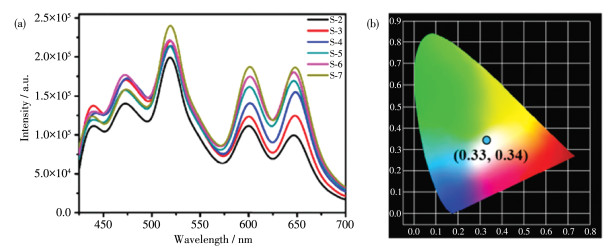
图 15. 封装不同质量分数的RhB的RhB@ECUT-300复合材料在408 nm激发波长下的(a) 发射光谱及(b) 对应色坐标; (c)RhB@ECUT-300涂覆紫外LED芯片(400 nm)的白光发光照片[50]Figure 15. (a) Emission spectra and the corresponding color coordinates (b) of RhB@ECUT-300 composites with different mass fractions of RhB at 408 nm excitation wavelength; (c) White light emitting photos of UV LED chip (400 nm) coated by RhB@ECUT-300[50]具有良好光稳定性和出色的光致发光特性的荧光蛋白是用于制造WLED非常有前途的候选材料,但是其对水性环境要求以及较差的热稳定性限制了其在照明领域的应用。2020年,彭新生教授课题组[51]通过固态限域作用将R-藻红蛋白封装到蓝色发光的席夫碱MOF薄膜中。嵌入到MOF中的藻红蛋白发生了变性,在可见光区其原有的橙色(578 nm)发射峰转变为绿色(518 nm)和红色(600、647 nm)发射峰,这可能是由于其与MOF中心金属离子Zn2+产生作用,阻碍了原有的能量转移路径(图 16a)。通过将其封装,光、热稳定性及抗衰老性均有明显提升。在405 nm激发波长下,藻红蛋白@MOF薄膜发出暖白色光(0.33,0.34)(图 16b),色温5 740 K,显色指数约为85。该工作证明了将高量子产率荧光分子封装到不同发光MOFs中,是获得白光发光复合材料的有效途径。
图 16
4.5 其他类型配合物
白光发光配合物材料的构建体系除上述4种类型外,还存在许多其他单金属或多金属类型,例如:过渡金属元素为主的Mn(Ⅱ)[52]、Zr[53]配合物;以主族元素为主的Pb(Ⅱ)[54-55]、Sn[56]配合物;以单镧系金属元素为主的Sm(Ⅲ)[57-58]、Eu(Ⅲ)[58-61]、Dy(Ⅲ)[62-64]配合物;以多镧系金属元素为主的La(Ⅲ)/Eu(Ⅲ)[65]、Ga(Ⅲ)/Dy(Ⅲ)[66]、Ga(Ⅲ)/Sm(Ⅲ)[67]配合物;多元素共掺杂的Mn(Ⅱ)/ Cd(Ⅱ)[68]、Eu(Ⅲ)/Tb(Ⅲ)/Cd(Ⅱ)[69]、Eu(Ⅲ)/Tb(Ⅲ)/Ti[70]、Eu(Ⅲ)/Zn(Ⅱ)/Pt(Ⅱ)[71]、Ce(Ⅲ)/Tb(Ⅲ)/Sm(Ⅲ)/Ru(Ⅱ)[72]配合物等。丰富的结构类型、灵活的发光调节能力以及优异的白光发光性能充分说明了金属-有机配合物材料是构建白光发光体系的优秀候选材料(表 1)。
表 1
Complex Ligand CIE CCT / K CRI Ref. [μ-LiPr(AuAN)2](BF4)2 LiPr=1, 2-bis(bis(2-isopropylphenyl)phosphino)benzene (0.29, 0.32) [24] Au-ADP-PPh3 ADP=σ-alkynyldiphenylaminofluorene (0.28, 0.28) [25] PPh3=triphenylphosphine [NH4][MeHmta][Ag4Br6(Hmta)] Hmta=hexamethylenetetramine (0.35, 0.31) [26] 1D-Ag2-xCuxI2(tpp)2(4, 4′-bpy) tpp=triphenylphosphine (0.33, 0.42) 5 628 63 [27] 4, 4′-bpy=4, 4′-bipyridine (0.35, 0.43) 5 034 65 (0.43, 0.45) 4 578 67 Cu6I8(i-bu-ted)2 i-bu-ted=isobutyltriethylenediamine (0.31, 0.44) 6 201 [28] {[(CuI)(Hptdp)]4·H2O}n Hptdp=(4-(pyridin-4′-ylthio)-3, 5-dimethyl-1H-pyrazole (0.41, 0.41) 3 632 93.4 [29] [ZnCl(μ-stdb)0.5(μ-bima)]n Hfc=formic acid; carboxylic acid (0.324, 0.355) [30] [Zn(fc)2(μ-bima)]n bima=9, 10-bis(bromomethyl)anthracene (0.342, 0.345) Q-TPA-Zn Q-TPA=2-(2-aminophenyl)benzimidazole (0.27, 0.33)77 K [31] S-TPA-Zn S-TPA=4-(N, N-diphenylamino)benzaldehyde (0.32, 0.38) M2biQ-Z M2biQ=dimethoxydimethylenebiquinoline (0.289, 0.372) 7 271 [32] [Zn(C2O4)2]·(H2-TPB)·H2O TPB=1, 3, 5-tris(4-pyridyl)benzene; H2C2O4=oxalic acid (0.27, 0.33) [33] [Cd3L(H2O)3]·DMA·4H2O H6L=5, 6, 12, 13, 19, 20-hexacarboxy-methoxy- cyclotriveratrylene (0.29, 0.34) 7 994 [34] [Me2NH2][Cd(btc)]·0.5DMA·2H2O H3btc=benzene-1, 3, 5-tricarboxylic acid (0.31, 0.35) 5 800 90 [35] [Cd2(CzIP)2(DMF)4] CzIP=5-(carbazo-9-yl) isophthalate (0.33, 0.34) 5 708 83 [36] 15-5-CdCl2 15-5=15-crown-5 (0.28, 0.32) [37] 15-5-CdBr2 (0.31, 0.39) 15-5-CdI2 (0.30, 0.34) [CdL]n H2L=2-hydroxyniotinic acid (0.36, 0.35) [38] [Zn3(L)2(HCOO)(OH)]n (0.31, 0.46) [Eu0.03Tb0.03La0.94(H2O)(HL)]· 0.5MeCN·0.25H2O H4L=4-(3, 5-dicarboxyphenoxy)isophthalic acid (0.31, 0.32) 6 500 90 [39] [Y0.96Tb0.02Eu0.02(2, 5-BPTA)3(H2O)2]·4H2O 2, 5-BPTA=2, 5-bis(prop-2-yn-1-yloxy)terephthalic acid (0.334, 0.346) 5 432 [40] {[Gd0.993Eu0.0017Tb0.0053(DPBA)(phen)2]·2H2O}n H3DPBA=2-(3′, 4′-dicarboxyphenoxy)-benzoic acid (0.347, 0.336) 4 827 90 [41] phen=1, 10-phenanthroline [Eu3Gd5Tb12(chp)30(CO3)12(NO3)6(H2O)6] H2chp=6-chloro-2-pyridinol (0.32, 0.33) [42] 7.5%Eu3+@(CH3)2NH2[Tb3(HCPCP)1.5(CH3COO)]·6DMA HCPCP=hexa(4-carboxyphenoxy)cyclotriphosphazene (0.3268, 0.3212) 7 585 [43] [Tb0.9373Eu0.0627(L)(D/L-Hlac)(H2O)2]·0.5H2O H2L=4, 4′-(pyridine-3, 5-diyl)dibenzoic acid (0.330, 0.334) [44] D/L-H2lac=D/L-lactic acid (Gd0.9083Eu0.0688Tb0.0229)(Hmpda)3(H2mpda) H2mpda=2, 6-dimethylpyridine-3, 5-dicarboxylic acid (0.36, 0.33) 3 198 90.4 [45] UPC-38(Eu0.34Tb0.66)-OCH3 L=1, 1′∶3′, 1″-terphenyl-4, 4″, 5′-tricarboxylic acid (0.335, 0.325) [46] Poly-Eu-Tb (nEu3+∶nTb3+=1∶8) Poly=poly((N-(2-hydroxyethyl)-acrylamide)-co-(2-(4-(4-(4-vinylbenzyloxy)phenyl)-6-(pyridin-2-yl)- pyridin-2-yl)pyridine)) (0.344, 0.304) [47] Poly-Eu-Tb-CNFs (CNFs=cellulose nanopaper) (0.385, 0.324) 3 347 84 MOTPO/TPEPy@ZJU-28(In(Ⅲ)) MOTPO=2, 3, 4, 5-tetrakis(4-methoxyphenyl)oxazol-3-ium (0.35, 0.34) 4 076 86 [48] TPEPy=4-(4-(1, 2, 2-triphenylvinyl)phenyl)pyridin-1-ium H3BTB=1, 3, 5-tri(4-carboxyphenyl)benzene G3@Pt-HPT G3=perylenediimide derivative; HPT=hexaphenyltriphenylene (0.32, 0.32) [49] RhB@ECUT-300(U) RhB=rhodamine B (0.31, 0.31) [50] TPE=4, 4′, 4″, 4‴-(ethene-1, 1, 2, 2-tetrayl)-tetrabenzoic acid R-PE@HSB-W1(Zn(Ⅱ)) R-PE=R-phycoerythrin; HSB=hydrogenated Schiff base (0.33, 0.34) 5 740 85 [51] 5. 结论与展望
在本综述中,我们简述了白光发光材料构筑策略,并详细总结了各种类型金属-有机配合物在白光发光材料领域的研究进展,包括(Au(Ⅰ)/Ag(Ⅰ)/Cu(Ⅰ)配合物、Zn(Ⅱ)/Cd(Ⅱ)配合物、Eu(Ⅲ)和Tb(Ⅲ)共掺杂Ln(Ⅲ)配合物、染料掺杂配合物、其他主族元素/过渡元素/镧系元素掺杂/多元素掺杂配合物(表 1)。金属-有机配合物白光材料之所以能被科研人员们广泛研究,是因为其具备以下优势:(1) 多样化的配位中心金属离子以及可修饰的有机配体提供丰富的结构类别,并有助于实现发光性能的调控。(2) 配位中心发光、金属/团簇发光、缔合物/复合物发光、电荷转移发光等多种发光类别,能够满足白光发光材料对于不同波段电磁辐射的需求。(3) 金属-有机配合物特有的孔道结构,为捕获染料分子,优化发光性能提供了可能。(4) 金属-有机配合物体系内可同时存在多种发光中心,很容易获得单组分白光发光材料,降低了WLED器件化难度,增强了白光发光的稳定性。(5) 配合物白光材料结构可解析,能够建立结构与性能之间的关系,有利于实现在分子水平上的精准设计。(6) 发光中心在配合物空间结构中分散排布均匀,有助于各组分间能量传递过程,提高白光发光效率,同时避免了浓度猝灭以及其他非辐射能量消耗过程。近些年,基于上述优势,金属-有机配合物在白光发光领域已取得了实质性的发展,但在理论研究和实际应用方面仍存在一些问题。在理论研究方面,光致发光或电致发光机理、多发光中心体系能量的竞争与传递过程以及形貌、尺寸、缺陷对发光性能的影响等问题都有待进一步探索。在实际应用方面,发光效率、发光稳定性、集成工艺以及薄膜化、器件化技术等难题也需要逐一攻破。相信在化学、物理、材料等不同学科科研及技术人员的共同努力下,一定能够突破层层壁垒,获得低成本、高效率、长寿命、绿色安全、易加工的单组分配位驱动组装的白光发光材料,最终实现工业化批量生产并应用的理想前景。
-
-
[1]
Wang M S, Guo G C. Inorganic-organic hybrid white light phosphors[J]. Chem. Commun., 2016, 52(90): 13194-13204. doi: 10.1039/C6CC03184F
-
[2]
Bergh A, Craford G, Duggal A, Haitz R. The promise and challenge of solid-state lighting[J]. Phys. Today, 2001, 54(12): 42-47. doi: 10.1063/1.1445547
-
[3]
Cui Y J, Yue Y F, Qian G D, Chen B L. Luminescent functional metal-organic Frameworks[J]. Chem. Rev., 2012, 112(2): 1126-1162. doi: 10.1021/cr200101d
-
[4]
Cui Y J, Chen B L, Qian G D. Lanthanide metal-organic frameworks for luminescent sensing and light-emitting applications[J]. Coord. Chem. Rev., 2014, 273: 76-86.
-
[5]
Xu L J, Xu G T, Chen Z N. Recent advances in lanthanide luminescence with metal-organic chromophores as sensitizers[J]. Coord. Chem. Rev., 2014, 273: 47-62.
-
[6]
Allendorf M D, Bauer C A, Bhakta R K, Houk R J T. Luminescent metal-organic frameworks[J]. Chem. Soc. Rev., 2009, 38(5): 1330-1352. doi: 10.1039/b802352m
-
[7]
Hu Z C, Deibert B J, Li J. Luminescent metal-organic frameworks for chemical sensing and explosive detection[J]. Chem. Soc. Rev., 2014, 43(16): 5815-5840. doi: 10.1039/C4CS00010B
-
[8]
Meyer L V, Schönfeld F, Müller-Buschbaum K. Lanthanide based tuning of luminescence in MOFs and dense frameworks—From mono- and multimetal systems to sensors and films[J]. Chem. Commun., 2014, 50(60): 8093-8108. doi: 10.1039/c4cc00848k
-
[9]
Roy S, Chakraborty A, Maji T K. Lanthanide-organic frameworks for gas storage and as magneto-luminescent materials[J]. Coord. Chem. Rev., 2014, 273: 139-164.
-
[10]
Müller-Buschbaum K, Beuerle F, Feldmann C. MOF based luminescence tuning and chemical/physical sensing[J]. Microporous Mesoporous Mat., 2015, 216: 171-199. doi: 10.1016/j.micromeso.2015.03.036
-
[11]
Gather M C, Köhnen A, Meerholz K. White organic light-emitting diodes[J]. Adv. Mater., 2011, 23(2): 233-248. doi: 10.1002/adma.201002636
-
[12]
Mukherjee S, Thilagar P. Organic white-light emitting materials[J]. Dyes Pigment., 2014, 110: 2-27. doi: 10.1016/j.dyepig.2014.05.031
-
[13]
Shang M M, Li C X, Lin J. How to produce white light in a single-phase host?[J]. Chem. Soc. Rev., 2014, 43(5): 1372-1386. doi: 10.1039/C3CS60314H
-
[14]
Kamtekar K T, Monkman A P, Bryce M R. Recent advances in white organic light-emitting materials and devices (WOLEDs)[J]. Adv. Mater., 2010, 22(5): 572-582. doi: 10.1002/adma.200902148
-
[15]
Wang Q, Ma D G. Management of charges and excitons for high- performance white organic light-emitting diodes[J]. Chem. Soc. Rev., 2010, 39(7): 2387-2398. doi: 10.1039/b909057f
-
[16]
Wu H B, Ying L, Yang W, Cao Y. Progress and perspective of polymer white light-emitting devices and materials[J]. Chem. Soc. Rev., 2009, 38(12): 3391-3400. doi: 10.1039/b816352a
-
[17]
Abbel R, Grenier C, Pouderoijen M J, Stouwdam J W, Leclère P E L G, Sijbesma R P, Meijer E W, Schenning A P H J. White-light emitting hydrogen-bonded supramolecular copolymers based on π-conjugated oligomers[J]. J. Am. Chem. Soc., 2009, 131(2): 833-843. doi: 10.1021/ja807996y
-
[18]
Almeida D A, Santos B, Paolo B, Quicheron M. Solid state lighting review—Potential and challenges in europe[J]. Renew. Sust. Energ. Rev., 2014, 34: 30-48. doi: 10.1016/j.rser.2014.02.029
-
[19]
Narukawa Y, Ichikawa M, Sanga D, Sano M, Mukai T. White light emitting diodes with super-high luminous efficacy[J]. J. Phys. D: Appl. Phys., 2010, 43(35): 354002. doi: 10.1088/0022-3727/43/35/354002
-
[20]
Pan M, Liao W M, Yin S Y, Sun S S, Su C Y. Single-phase white-light-emitting and photoluminescent color-tuning coordination assemblies[J]. Chem. Rev., 2018, 118(18): 8889-8935. doi: 10.1021/acs.chemrev.8b00222
-
[21]
Schubert E F, Kim J K. Solid-state light sources getting smart[J]. Science, 2005, 308(5726): 1274-1278. doi: 10.1126/science.1108712
-
[22]
He G J, Guo D, He C, Zhang X L, Zhao X W, Duan C Y. A color- tunable europium complex emitting three primary colors and white light[J]. Angew. Chem. Int. Ed., 2009, 121(33): 6248-6251. doi: 10.1002/ange.200901266
-
[23]
Xue P C, Wang P P, Chen P, Yao B Q, Gong P, Sun J B, Zhang Z Q, Lu R. Bright persistent luminescence from pure organic molecules through a moderate intermolecular heavy atom effect[J]. Chem. Sci., 2017, 8(9): 6060-6065. doi: 10.1039/C5SC03739E
-
[24]
Osawa M, Soma S, Kobayashi H, Tanaka Y, Hoshino M. Near-white light emission from single crystals of cationic dinuclear gold(Ⅰ) complexes with bridged diphosphine ligands[J]. Dalton Trans., 2023, 52(10): 2956-2965. doi: 10.1039/D2DT03785H
-
[25]
Mihaly J J, Wolf S M, Phillips A T, Mam S, Yung Z, Haley J E, Zeller M, de La Harpe K, Holt E, Grusenmeyer T A, Collins S, Gray T G. Synthetically tunable white-, green-, and yellow-green-light emission in dual-luminescent gold(Ⅰ) complexes bearing a diphenylamino-2, 7-fluorenyl moiety[J]. Inorg. Chem., 2022, 61(3): 1228-1235. doi: 10.1021/acs.inorgchem.1c02405
-
[26]
Xue Z Z, Meng X D, Li X Y, Han S D, Pan J, Wang G M. Luminescent thermochromism and white-light emission of a 3D[Ag4Br6] cluster-based coordination framework with both adamantane-like node and linker[J]. Inorg. Chem., 2021, 60(7): 4375-4379. doi: 10.1021/acs.inorgchem.1c00280
-
[27]
Lin F, Liu W, Wang H, Li J. Strongly emissive white-light-emitting silver iodide based inorganic-organic hybrid structures with comparable quantum efficiency to commercial phosphors[J]. Chem. Commun., 2020, 56(10): 1481-1484. doi: 10.1039/C9CC09260A
-
[28]
Shao J J, Chen W M, Mensah A, Liu P L, Ni J L, Chen L Z, Wang F M. Realizing near white and warm light emission of cuprous iodide complexes by alkyl-isomerization of ligands[J]. Dalton Trans., 2023, 52(11): 3254-3259. doi: 10.1039/D2DT02526D
-
[29]
Yu M X, Liu C P, Zhao Y F, Li S C, Yu Y L, Lv J Q, Chen L, Jiang F L, Hong M C. White-light emission and circularly polarized luminescence from a chiral copper(Ⅰ) coordination polymer through symmetry-breaking crystallization[J]. Angew. Chem. Int. Ed., 2022, 134(22): e202201590. doi: 10.1002/ange.202201590
-
[30]
Yu C F, Wang X L, Wu T, Gu X W, Huang W, Kirillov A M, Wu D Y. Color tuning of intrinsic white-light emission in anthracene-linker coordination networks[J]. Dalton Trans., 2020, 49(34): 12082-12087. doi: 10.1039/D0DT02033H
-
[31]
Li J B, Zheng H W, Wu M, Liang Q F, Yang D D, Zheng X J, Tan H W. Multistimulus response of two tautomeric Zn(Ⅱ) complexes and their white-light emission based on different mechanisms[J]. Inorg. Chem., 2021, 60(23): 17677-17686. doi: 10.1021/acs.inorgchem.1c02286
-
[32]
Zavaleta A, Lykhin A O, Monteiro J H S K, Uchida S, Bell T W, de Bettencourt-Dias A, Varganov S A, Gallucci J. Full visible spectrum and white light emission with a single, input-tunable organic fluorophore[J]. J. Am. Chem. Soc., 2020, 142(48): 20306-20312. doi: 10.1021/jacs.0c08182
-
[33]
Li Q, Wei W J, Xue Z Z, Mu Y, Pan J, Hu J X, Wang G M. Achieving an electron transfer photochromic complex for switchable white-light emission[J]. Chin. Chem. Lett., 2022, 33(6): 3203-3206. doi: 10.1016/j.cclet.2021.10.015
-
[34]
Wang X D, Song Y T, Pei W Y, Ma J F. Single-component white light emission from a metal-coordinated cyclotriveratrylene-based coordination polymer[J]. Inorg. Chem., 2022, 61(28): 10768-10773. doi: 10.1021/acs.inorgchem.2c00974
-
[35]
Wang C, Yin Z, Cheng Z, Ma W M, Li X Y, Hu X T, Shi R, Chen A W, Ma Y M. A series of anionic MOFs with cluster-based, pillared-layer and rod-spacer motifs: Near-sunlight white-light emission and selective dye capture[J]. CrystEngComm, 2020, 22(5): 878-887. doi: 10.1039/C9CE01691K
-
[36]
Liu H, Zhang K, Gao P F, Luo J H, Jiang Y Y, Zhou M S, Li T, Zhu X L, Fu H R. Realization of single-phase white-light-emitting materials with time-evolution ultralong room-temperature phosphorescence by coordination assemblies[J]. Inorg. Chem., 2022, 61(3): 1636-1643. doi: 10.1021/acs.inorgchem.1c03461
-
[37]
Wang Z, Mo J T, Pan J J, Pan M. White light and color-tuning long persistent luminescence from metal halide based metal-organic frameworks[J]. Adv. Funct. Mater., 2023, 33(21): 2300021. doi: 10.1002/adfm.202300021
-
[38]
Wang Z, Liu J J, Li M Y, Chen G. White light and long persistent luminescence from metal cluster-based metal-organic frameworks[J]. Chem. Eng. J., 2023, 462: 142154. doi: 10.1016/j.cej.2023.142154
-
[39]
Yu X L, Ryadun A A, Kovalenko K A, Guselnikova T Y, Ponomareva V G, Potapov A S, Fedin V P. 4 in 1: Multifunctional europium- organic frameworks with luminescence sensing properties, white light emission, proton conductivity and reverse acetylene-carbon dioxide adsorption selectivity[J]. Dalton Trans., 2023, 52(25): 8695-8703. doi: 10.1039/D3DT01323E
-
[40]
Manna K, Sutter J P, Natarajan S. Blue-emitting ligand-mediated assembly of rare-earth MOFs toward white-light emission, sensing, magnetic, and catalytic studies[J]. Inorg. Chem., 2022, 61(42): 16770-16785. doi: 10.1021/acs.inorgchem.2c02611
-
[41]
Wei M M, Luo L L, Cui R F, Wang X, Chen J Y, Gai Z L, Li X, Wei H B, Wei C, Bian Z Q. Highly luminescent and stable lanthanide coordination polymers based 2-(3', 4'-dicarboxyphenoxy)-benzoic acid: Crystal structure, photoluminescence, white light emission and fluorescence sensing[J]. Dyes Pigment., 2022, 206: 110650. doi: 10.1016/j.dyepig.2022.110650
-
[42]
Gálico D A, Kitos A A, Ovens J S, Sigoli F A, Murugesu M. Lanthanide-based molecular cluster-aggregates: Optical barcoding and white-light emission with nanosized {Ln20} compounds[J]. Angew. Chem. Int. Ed., 2021, 133(11): 6195-6201. doi: 10.1002/ange.202013867
-
[43]
Wang M, Gao H W, Li J X, Bai F Y, Xing Y H, Shi Z. Multifunctional luminescence sensing and white light adjustment of lanthanide metal-organic frameworks constructed from the flexible cyclotriphosphazene-derived hexacarboxylic acid ligand[J]. Dalton Trans., 2021, 50(41): 14618-14628. doi: 10.1039/D1DT02560K
-
[44]
Chen H J, Chen L Q, Lin L R, Long L S, Zheng L S. Doped luminescent lanthanide coordination polymers exhibiting both white-light emission and thermal sensitivity[J]. Inorg. Chem., 2021, 60(10): 6986-6990. doi: 10.1021/acs.inorgchem.1c00740
-
[45]
Li Q P, Qian J J, Zhou J, Du L, Zhao Q H. Highly chemically and thermally stable lanthanide coordination polymers for luminescent probes and white light emitting diodes[J]. CrystEngComm, 2020, 22(15): 2667-2674. doi: 10.1039/D0CE00228C
-
[46]
Wang Y T, Zhang K, Wang X K, Xin X L, Zhang X R, Fan W D, Xu B, Dai F N, Sun D F. Accurate tuning of rare earth metal-organic frameworks with unprecedented topology for white-light emission[J]. J. Mater. Chem. C, 2020, 8(4): 1374-1379. doi: 10.1039/C9TC05471E
-
[47]
Zhang Z, Chen Y X, Chang H, Wang Y Y, Li X P, Zhu X J. Aggregation-induced white emission of lanthanide metallopolymer and its coating on cellulose nanopaper for white-light softening[J]. J. Mater. Chem. C, 2020, 8(6): 2205-2210. doi: 10.1039/C9TC05894J
-
[48]
Yang Y, Li W L, Sun C Y, Shan G G, Qin C, Shao K Z, Wang J G, Su Z M. Encapsulation of AIEgens within metal-organic framework toward high-performance white light-emitting diodes[J]. Adv. Opt. Mater., 2022, 10(16): 2200174. doi: 10.1002/adom.202200174
-
[49]
Liu H F, Guo C X, Zhang Z Y, Mu C Q, Feng Q, Zhang M M. Hexaphenyltriphenylene-based multicomponent metallacages: Host-guest complexation for white-light emission[J]. Chem.-Eur. J., 2023, 29(21): e202203926. doi: 10.1002/chem.202203926
-
[50]
Gu S F, Xiong X H, Gong L L, Zhang H P, Xu Y, Feng X F, Luo F. Classified encapsulation of an organic dye and metal-organic complex in different molecular compartments for white-light emission and selective adsorption of C2H2 over CO2[J]. Inorg. Chem., 2021, 60(11): 8211-8217. doi: 10.1021/acs.inorgchem.1c00863
-
[51]
Wang X B, Li Z Y, Ying W, Chen D K, Li P P, Deng Z, Peng X S. Blue metal-organic framework encapsulated denatured R-phycoerythrin proteins for a white-light-emitting thin film[J]. J. Mater. Chem. C, 2020, 8(1): 240-246. doi: 10.1039/C9TC05342E
-
[52]
Fu H M, Jiang C L, Luo C H, Lin H C, Peng H. Manganese halide hybrids with a reversible luminous color and their application for a white light-emitting diode[J]. CrystEngComm, 2022, 24(39): 6910-6916. doi: 10.1039/D2CE00883A
-
[53]
Wang Q, Liu Q, Du X M, Zhao B, Li Y, Ruan W J. A white-light-emitting single MOF sensor-based array for berberine homologue discrimination[J]. J. Mater. Chem. C, 2020, 8(4): 1433-1439. doi: 10.1039/C9TC05180E
-
[54]
Peedikakkal A M P, Jalilov A S, Shaikh A R, Kalanthoden A N, Al-Saadi A A. Blue- and white-light-emitting 2D-coordination polymers and their solid-state photodimerization reaction[J]. CrystEngComm, 2021, 23(43): 7663-7670. doi: 10.1039/D1CE00991E
-
[55]
Song X L, Peng C D, Xu X X, Yin J L, Fei H H. Efficient, broadband self-trapped white-light emission from haloplumbate-based metal- organic frameworks[J]. Chem. Commun., 2020, 56(69): 10078-10081. doi: 10.1039/D0CC04473C
-
[56]
Song G M, Li Z Y, Gong P F, Xie R J, Lin Z S. Tunable white light emission in a zero-dimensional organic-inorganic metal halide hybrid with ultra-high color rendering index[J]. Adv. Opt. Mater., 2021, 9(11): 2002246. doi: 10.1002/adom.202002246
-
[57]
Feng X, Shang Y P, Zhang K, Hong M Z, Li J F, Xu H D, Wang L Y, Li Z J. In situ ligand-induced Ln-MOFs based on a chromophore moiety: White light emission and turn-on detection of trace antibiotics[J]. CrystEngComm, 2022, 24(23): 4187-4200. doi: 10.1039/D2CE00613H
-
[58]
Chen J, Xie Z Y, Meng L Y, Hu Z Y, Kuang X F, Xie Y M, Lu C Z. Luminescence tunable europium and samarium complexes: Reversible on/off switching and white-light emission[J]. Inorg. Chem., 2020, 59(10): 6963-6977. doi: 10.1021/acs.inorgchem.0c00392
-
[59]
Mund S, Vaidyanathan S. New isomeric ancillary ligands and their EuⅢ complexes: A single component white light emissive phosphor and their applications in red/white smart LEDs, electronic noses, and temperature sensing[J]. J. Mater. Chem. C, 2022, 10(18): 7201-7215. doi: 10.1039/D2TC00664B
-
[60]
Devi R, Singh K, Vaidyanathan S. Synergy in the energy transfer between ligands and EuⅢ ions in molecular europium complexes: Single-component white light-emitting luminogens[J]. J. Mater. Chem. C, 2020, 8(25): 8643-8653. doi: 10.1039/D0TC01360A
-
[61]
O'Neil A T, Chalard A, Malmström J, Kitchen J A. White light and colour-tunable emission from a single component europium-1, 8-naphthalimide thin film[J]. Dalton Trans., 2023, 52(8): 2255-2261. doi: 10.1039/D2DT03644D
-
[62]
Mara D, Pilia L, Van de Steen M, Miletto I, Zeng M, Hecke K V, Serpe A, Deplano P, Deun R V, Artizzu F. Single-component panchromatic white light generation, and tuneable excimer-like visible orange and NIR emission in a Dy quinolinolate complex[J]. J. Mater. Chem. C, 2021, 9(43): 15641-15648. doi: 10.1039/D1TC04191F
-
[63]
Zhong L, Chen W B, Ouyang Z J, Yang M, Zhang Y Q, Gao S, Schulze M, Wensdorfer W, Dong W. Unprecedented one-dimensional chain and two-dimensional network dysprosium(Ⅲ) single-molecule toroics with white-light emission[J]. Chem. Commun., 2020, 56(17): 2590-2593. doi: 10.1039/C9CC08852K
-
[64]
Cai Z L, Yan W C, Guo R Y, Liu H Y, Huo P H, Yu G, Bian Z Q, Liu Z W. Warm-white-light perdeuterated Dy(Ⅲ) complex with a photoluminescence quantum yield of up to 72% in deuterated chloroform[J]. Inorg. Chem., 2023, 62(17): 6560-6564. doi: 10.1021/acs.inorgchem.3c00721
-
[65]
Psalti A E, Andriotou D, Diamantis S A, Chatz-Giachia A, Pournara A, Manos M J, Hatzidimitriou A, Lazarides T. Mixed-metal and mixed-ligand lanthanide metal-organic frameworks based on 2, 6-naphthalenedicarboxylate: Thermally activated sensitization and white-light emission[J]. Inorg. Chem., 2022, 61(30): 11959-11972. doi: 10.1021/acs.inorgchem.2c01703
-
[66]
Eliseeva S V, Salerno E V, Lopez Bermudez B A, Petpud S, Pecoraro V L. Dy3+ white light emission can be finely controlled by tuning the first coordination sphere of Ga3+/Dy3+ metallacrown complexes[J]. J. Am. Chem. Soc., 2020, 142(38): 16173-16176. doi: 10.1021/jacs.0c07198
-
[67]
Qian J F, Lu H J, Zheng Z F, Xu M M, Qian Y, Zhang Z H, Wang J Q, He M Y, Lin J. Achieving colour tuneable and white-light luminescence in a large family of dual-emission lanthanide coordination polymers[J]. Dalton Trans., 2021, 50(40): 14325-14331. doi: 10.1039/D1DT01618K
-
[68]
Zhang G Y, Yin J L, Song X L, Fei H H. A moisture-stable organosulfonate-based metal-organic framework with intrinsic self-trapped white-light emission[J]. Chem. Commun., 2020, 56(9): 1325-1328. doi: 10.1039/C9CC09486E
-
[69]
Huang M Y, Liang Z X, Huang J L, Zhang S Y, Wen Y H, Wu X T. Dimensional expansion of 1D zigzag chains to a 2D two-fold interpenetrated metal-organic framework for adsorption of lanthanide cations and white light emission[J]. CrystEngComm, 2023, 25(11): 1637-1642. doi: 10.1039/D3CE00001J
-
[70]
Zhang Z, Li Y J, Geng L J, Feng G L, Ren J J, Yu X D. Healable, phase-selective, and white-light-emitting titania based hybrid lanthanide-doped metallogels[J]. Inorg. Chem., 2020, 59(6): 3974-3982. doi: 10.1021/acs.inorgchem.9b03662
-
[71]
Qiu Y Q, Feng Y Q, Zhao Q, Wang H W, Guo Y C, Qiu D F. White light emission from a green cyclometalated platinum(Ⅱ) terpyridylphenylacetylide upon titration with Zn(Ⅱ) and Eu(Ⅲ)[J]. Dalton Trans., 2020, 49(32): 11163-11169. doi: 10.1039/D0DT02336A
-
[72]
Charytanowicz T, Sieklucka B, Chorazy S. Lanthanide hexacyanidoruthenate frameworks for multicolor to white-light emission realized by the combination of d-d, d-f, and f-f electronic transitions[J]. Inorg. Chem., 2023, 62(4): 1611-1627. doi: 10.1021/acs.inorgchem.2c03885

-
[1]
-
图 1 (a) 激发波长为355 nm时, 不同温度下[(μ-LiPr)(Au(AN))2](BF4)2的发射光谱[24]; (b)假设S0态和T1态势能面, 在T1态对结构进行几何优化后描绘的晶体场效应对势能变化的影响[24]; (c) 二苯胺基芴Au(Ⅰ)配合物结构及甲苯溶液中发光照片[25]; (d) Au(Ⅰ)配合物的归一化发射光谱(左)及其对应的CIE 1931色坐标(右)[25]
Figure 1 (a) Emission spectra of [(μ-LiPr)(Au(AN))2](BF4)2 at different temperatures with an excitation wavelength of 355 nm[24]; (b) Assuming the S0 state and T1 state energy surfaces, the impact of crystal field effects on potential energy changes depicted after geometric optimization of the structure in T1 state[24]; (c) Structure of Au(Ⅰ) complexes with diphenylamine substituted fluorene and luminescence photos in toluene solution[25]; (d) Normalized emission spectra of Au(Ⅰ) complexes (left) and the corresponding CIE 1931 chromaticity diagram (right)[25]
图 2 (a) 三维[Ag4Br6]簇合物基配位聚合物的类似金刚烷构型; (b) Ag(Ⅰ)配合物在77~280 K下的发射光谱; (c) 不同温度下Ag(Ⅰ)配合物对应的色坐标; (d) 77~220 K范围内, 低能发射谱带相对强度(I/I77 K)与温度之间的线性关系[26]
Figure 2 (a) Adamantane-like configuration of 3D [Ag4Br6]2- cluster-based coordination polymer; (b) Emission spectra of Ag(Ⅰ) complex at 280-77 K; (c) Color coordinates of Ag(Ⅰ) complex at different temperatures; (d) Linear relationship between the relative intensity of low-energy emission bands (I/I77 K) and temperature in the range of 77~220 K [26]
图 3 (a) 一维无机-有机杂化材料1D-Ag2-xCuxI2(tpp)2(4, 4′-bpy)的晶体结构; Ag(Ⅰ)杂化材料取代不同量的Cu(Ⅰ)的(b) 发射光谱(λex=360 nm; x=0, 黑色线; x=0.001, 红色线; x=0.005, 绿色线; x=0.01, 深蓝色线; x=0.02, 蓝色线; x=2, 紫色线)及(c) 白光发光色坐标(从左到右, x=0.001、0.005、0.01)[27]
Figure 3 (a) Crystal structure of 1D-Ag2-xCuxI2(tpp)2(4, 4′-bpy) 1D inorganic-organic hybrid material; (b) Emission spectra and (c) white light color coordinates (from left to right, x=0.001, 0.005, 0.01) of Ag(Ⅰ) hybrid materials with different Cu(Ⅰ) substitution amounts (λex=360 nm; x=0, black line; x=0.001, red line; x=0.005, green line; x=0.01, dark blue line; x=0.02, blue line; x=2, purple line)[27]
图 4 (a) Hptdp配体与Cu2I2簇构成的十元环Cu(Ⅰ)配合物、手性堆积构型及两种异构体中Hptdp配体镜像构型; (b) Cu(Ⅰ)配合物随激发波长改变的发射光谱及其色坐标[29]
Figure 4 (a) Ten‐membered ring Cu(Ⅰ) complex formed by Hptdp ligand and Cu2I2 cluster, chiral stacking configuration and mirror configuration of Hptdp ligand in two isomers; (b) Emission spectra and color coordinates of Cu(Ⅰ) complex with changing of excitation wavelength[29]
图 5 (a) 在77~338 K下Zn(Ⅱ)配合物的发射光谱[30]; (b)不同温度下, 发射光谱对应的色坐标[30]; (c) Q‐TPA‐Zn与S‐TPA‐Zn在光、热刺激下互变异构以及发光颜色的转变[31]
Figure 5 (a) Emission spectra of Zn(Ⅱ) complex at 77‐338 K[30]; (b) The color coordinates corresponding to the emission spectra at different temperatures[30]; (c) Tautomerism and luminescence color transition of Q‐TPA‐Zn and S‐TPA‐Zn under light and heat stimulation[31]
图 6 (a) M2biQ结构及与不同阳离子配位组装后固态发光照片[32]; (b) 355 nm激发波长下, M2biQ与不同比例Zn2+配位后发射光谱对应的色坐标[32]; (c) Zn(Ⅱ)配合物随光照时间变化的发射光谱及对应色坐标[33]
Figure 6 (a) M2biQ structure and solid-state luminescence photos after coordination assembly with different cations[32]; (b) Under the excitation wavelength of 355 nm, the color coordinates corresponding to the emission spectra of M2biQ after coordination with different proportions of Zn2+ [32]; (c) Emission spectra and the corresponding color coordinates of Zn(Ⅱ) complex with the change of illumination time[33]
图 7 环三藜芦烃基Cd(Ⅱ)配合物在不同激发波长下的(a) 发射光谱及(b) 对应白光发光色坐标[34]; [Me2NH2][Cd(btc)]·0.5DMA·2H2O阴离子MOFs在不同激发波长下的(c) 发射光谱及(d)对应白光发光色坐标[35]
Figure 7 (a) Emission spectra and (b) the corresponding white light emission color coordinates of the cyclotriterpene‐based Cd(Ⅱ) complexes at different excitation wavelengths[34]; (c) Emission spectra and (d) the corresponding white light emission color coordinates of the [Me2NH2][Cd(btc)]·0.5DMA·2H2O anionic MOFs at different excitation wavelengths[35]
图 8 (a) 冠醚-金属卤化物配合物结构[37]; (b) 340 nm激发波长下发射光谱对应的色坐标[37]; (c) 不同激发波长下, 颜色可变余辉发光照片[37]; (d) 金属簇配合物结构[38]; (e) 不同激发波长下发光光谱对应的色坐标[38]; (f) 自然光、360 nm/280 nm紫外光及关闭紫外光条件下荧光、磷光发光照片[38]
Figure 8 (a) Structure of crown ether-metal halide complexes[37]; (b) The color coordinates corresponding to the emission spectra under the excitation wavelength of 340 nm[37]; (c) Color variable afterglow luminescence photos under different excitation wavelengths[37]; (d) Structure of metal cluster complexes[38]; (e) The color coordinates corresponding to the luminescence spectra under different excitation wavelengths[38]; (f) Photos of fluorescence and phosphorescence under natural light, 360 nm/280 nm ultraviolet light and off ultraviolet light conditions[38]
图 9 (a) 不同稀土离子掺杂比例的Ln-MOFs在365 nm紫外光照射下发光照片[39]; (b) Eu0.03Tb0.03La0.94-MOF在不同激发波长下发射光谱[39]; (c) Eu0.03Tb0.03La0.94-MOF LED器件的白光发光照片[39]; 不同Eu3+引入量的[Y0.98-xTb0.02Eux(2, 5-BPTA)3(H2O)2]·4H2O在345 nm激发波长下的(d) 发射光谱及(e) 对应色坐标和发光照片[40]
Figure 9 (a) Luminescence photos of Ln-MOFs with different rare earth ion doping ratios under 365 nm ultraviolet light irradiation[39]; (b) Emission spectra of Eu0.03Tb0.03La0.94-MOF under different excitation wavelengths[39]; (c) Eu0.03Tb0.03La0.94-MOF LED device white light emission photo[39]; (d) Emission spectra and (e) the corresponding color coordinates and luminescence photos of [Y0.98-xTb0.02Eux(2, 5-BPTA)3(H2O)2]·4H2O with different amounts of Eu3+ under the excitation wavelength of 345 nm[40]
图 10 (a) {[Ln(DPBA)(phen)2]·2H2O}n的结构; 在332 nm激发波长下, Gd0.993Eu0.0017Tb0.0053-CP的(b)发光光谱及(c)对应的色坐标[41]
Figure 10 (a) Structure of {[Ln(DPBA)(phen)2]·2H2O}n; (b) Luminescence spectrum and (c) the corresponding color coordinates of Gd0.993Eu0.0017Tb0.0053-CP under the excitation wavelength of 332 nm[41]
图 11 320 nm激发波长下, {EuxTb20-x}MCAs的(a) 发射光谱及(b) 对应的色坐标; (c) {Eu3Gd5Tb12}MCA的白光发射光谱(λex=355 nm)对应的色坐标[42]
Figure 11 (a) Under the excitation wavelength of 320 nm, (a) emission spectra and (b) the corresponding color coordinates of {EuxTb20-x}MCAs; (c) Color coordinate of {Eu3Gd5Tb12}MCA white light emission spectrum (λex=355 nm)[42]
图 12 (a) 不同稀土掺杂量的x%Eu3+@4(x=0.5、2.5、5、7.5、10、15、20)的发射光谱(λex=350 nm)[43]; (b) 不同激发波长下7.5%Eu3+@4的发射光谱以及激发波长为340 nm时对应的色坐标[43]; (c) 300 K下[Tb0.9373Eu0.0627(L)(D/L-Hlac)(H2O)2]·0.5H2O的发射光谱及色坐标[44]; (d) 不同温度下[Tb0.9373Eu0.0627(L)(D/L-Hlac)(H2O)2]·0.5H2O的发射光谱[44]
Figure 12 (a) Emission spectra (λex=350 nm) of x%Eu3+@4 (x=0.5, 2.5, 5, 7.5, 10, 15, 20) with different rare earth doping amounts[43]; (b) Emission spectra of 7.5%Eu3+@4 under different excitation wavelengths and the corresponding color coordinates when the excitation wavelength was 340 nm[43]; (c) Emission spectrum and color coordinate of [Tb0.9373Eu0.0627(L)(D/L-Hlac)(H2O)2]·0.5H2O at 300 K[44]; (d) Emission spectra of [Tb0.9373Eu0.0627(L)(D/L-Hlac)(H2O)2]·0.5H2O at different temperatures[44]
图 13 不同Eu3+掺杂量的UPC-38(EuxTb1-x)-OCH3的(a) 发射光谱及(b) 对应色坐标[46]; (c) UPC-38(Eu0.34Tb0.66)-OCH3的发射光谱(λex=335 nm)、对应色坐标以及白光照片[46]; Poly-Eu-Tb(1∶8)在不同体积比的DMF和1, 4-二噁烷溶液中的(d) 发射光谱及(e) 对应色坐标[47]; (f) 通过旋涂工艺制备得到的Poly-Eu-Tb纤维素纳米纸发射光谱、对应色坐标及白光照片[47]
Figure 13 (a) Emission spectra and (b) the corresponding color coordinates of UPC-38(EuxTb1-x)-OCH3 with different Eu3+ doping amounts[46]; (c) Emission spectrum (λex=335 nm), the corresponding color coordinate and white light photo of UPC-38 (Eu0.34Tb0.66)-OCH3[46]; (d) Emission spectra and (e) the corresponding color coordinates of Poly-Eu-Tb (1∶8) in DMF and 1, 4-dioxane solutions with different volume ratios[47]; (f) Emission spectrum, corresponding color coordinate and white light photos of Poly-Eu-Tb cellulose nanopaper prepared by spin coating process[47]
图 14 (a) MOTPO/TPEPy@ZJU-28单相固态复合材料结构[48]; (b) 390 nm激发波长下MOTPO/TPEPy@ZJU-28、MOTPO@ZJU-28、TPEPy@ZJU-28、ZJU-28的发射光谱及365 nm紫外光照射下发光照片[48]; 金属笼(4c)、苝二酰亚胺衍生物染料(G3)及二者复合物(4c~G3)在265 nm激发波长下的(c) 发光光谱及(d) 对应色坐标[49]
Figure 14 (a) MOTPO/TPEPy@ZJU-28 single-phase solid composite structure[48]; (b) Emission spectra of MOTPO/TPEPy@ZJU-28, MOTPO@ZJU-28, TPEPy@ZJU-28, ZJU-28 under 390 nm excitation wavelength and the luminescence photos under 365 nm ultraviolet light irradiation[48]; (c) Luminescence spectra and (d) the corresponding color coordinates of metal cage (4c), the perylene diimide derivative dye (G3) and their composite (4c-G3) under an excitation wavelength of 265 nm[49]
图 15 封装不同质量分数的RhB的RhB@ECUT-300复合材料在408 nm激发波长下的(a) 发射光谱及(b) 对应色坐标; (c)RhB@ECUT-300涂覆紫外LED芯片(400 nm)的白光发光照片[50]
Figure 15 (a) Emission spectra and the corresponding color coordinates (b) of RhB@ECUT-300 composites with different mass fractions of RhB at 408 nm excitation wavelength; (c) White light emitting photos of UV LED chip (400 nm) coated by RhB@ECUT-300[50]
表 1 金属-有机配合物材料白光发光工作进展
Table 1. Progress in white light emission of metal⁃organic complex materials
Complex Ligand CIE CCT / K CRI Ref. [μ-LiPr(AuAN)2](BF4)2 LiPr=1, 2-bis(bis(2-isopropylphenyl)phosphino)benzene (0.29, 0.32) [24] Au-ADP-PPh3 ADP=σ-alkynyldiphenylaminofluorene (0.28, 0.28) [25] PPh3=triphenylphosphine [NH4][MeHmta][Ag4Br6(Hmta)] Hmta=hexamethylenetetramine (0.35, 0.31) [26] 1D-Ag2-xCuxI2(tpp)2(4, 4′-bpy) tpp=triphenylphosphine (0.33, 0.42) 5 628 63 [27] 4, 4′-bpy=4, 4′-bipyridine (0.35, 0.43) 5 034 65 (0.43, 0.45) 4 578 67 Cu6I8(i-bu-ted)2 i-bu-ted=isobutyltriethylenediamine (0.31, 0.44) 6 201 [28] {[(CuI)(Hptdp)]4·H2O}n Hptdp=(4-(pyridin-4′-ylthio)-3, 5-dimethyl-1H-pyrazole (0.41, 0.41) 3 632 93.4 [29] [ZnCl(μ-stdb)0.5(μ-bima)]n Hfc=formic acid; carboxylic acid (0.324, 0.355) [30] [Zn(fc)2(μ-bima)]n bima=9, 10-bis(bromomethyl)anthracene (0.342, 0.345) Q-TPA-Zn Q-TPA=2-(2-aminophenyl)benzimidazole (0.27, 0.33)77 K [31] S-TPA-Zn S-TPA=4-(N, N-diphenylamino)benzaldehyde (0.32, 0.38) M2biQ-Z M2biQ=dimethoxydimethylenebiquinoline (0.289, 0.372) 7 271 [32] [Zn(C2O4)2]·(H2-TPB)·H2O TPB=1, 3, 5-tris(4-pyridyl)benzene; H2C2O4=oxalic acid (0.27, 0.33) [33] [Cd3L(H2O)3]·DMA·4H2O H6L=5, 6, 12, 13, 19, 20-hexacarboxy-methoxy- cyclotriveratrylene (0.29, 0.34) 7 994 [34] [Me2NH2][Cd(btc)]·0.5DMA·2H2O H3btc=benzene-1, 3, 5-tricarboxylic acid (0.31, 0.35) 5 800 90 [35] [Cd2(CzIP)2(DMF)4] CzIP=5-(carbazo-9-yl) isophthalate (0.33, 0.34) 5 708 83 [36] 15-5-CdCl2 15-5=15-crown-5 (0.28, 0.32) [37] 15-5-CdBr2 (0.31, 0.39) 15-5-CdI2 (0.30, 0.34) [CdL]n H2L=2-hydroxyniotinic acid (0.36, 0.35) [38] [Zn3(L)2(HCOO)(OH)]n (0.31, 0.46) [Eu0.03Tb0.03La0.94(H2O)(HL)]· 0.5MeCN·0.25H2O H4L=4-(3, 5-dicarboxyphenoxy)isophthalic acid (0.31, 0.32) 6 500 90 [39] [Y0.96Tb0.02Eu0.02(2, 5-BPTA)3(H2O)2]·4H2O 2, 5-BPTA=2, 5-bis(prop-2-yn-1-yloxy)terephthalic acid (0.334, 0.346) 5 432 [40] {[Gd0.993Eu0.0017Tb0.0053(DPBA)(phen)2]·2H2O}n H3DPBA=2-(3′, 4′-dicarboxyphenoxy)-benzoic acid (0.347, 0.336) 4 827 90 [41] phen=1, 10-phenanthroline [Eu3Gd5Tb12(chp)30(CO3)12(NO3)6(H2O)6] H2chp=6-chloro-2-pyridinol (0.32, 0.33) [42] 7.5%Eu3+@(CH3)2NH2[Tb3(HCPCP)1.5(CH3COO)]·6DMA HCPCP=hexa(4-carboxyphenoxy)cyclotriphosphazene (0.3268, 0.3212) 7 585 [43] [Tb0.9373Eu0.0627(L)(D/L-Hlac)(H2O)2]·0.5H2O H2L=4, 4′-(pyridine-3, 5-diyl)dibenzoic acid (0.330, 0.334) [44] D/L-H2lac=D/L-lactic acid (Gd0.9083Eu0.0688Tb0.0229)(Hmpda)3(H2mpda) H2mpda=2, 6-dimethylpyridine-3, 5-dicarboxylic acid (0.36, 0.33) 3 198 90.4 [45] UPC-38(Eu0.34Tb0.66)-OCH3 L=1, 1′∶3′, 1″-terphenyl-4, 4″, 5′-tricarboxylic acid (0.335, 0.325) [46] Poly-Eu-Tb (nEu3+∶nTb3+=1∶8) Poly=poly((N-(2-hydroxyethyl)-acrylamide)-co-(2-(4-(4-(4-vinylbenzyloxy)phenyl)-6-(pyridin-2-yl)- pyridin-2-yl)pyridine)) (0.344, 0.304) [47] Poly-Eu-Tb-CNFs (CNFs=cellulose nanopaper) (0.385, 0.324) 3 347 84 MOTPO/TPEPy@ZJU-28(In(Ⅲ)) MOTPO=2, 3, 4, 5-tetrakis(4-methoxyphenyl)oxazol-3-ium (0.35, 0.34) 4 076 86 [48] TPEPy=4-(4-(1, 2, 2-triphenylvinyl)phenyl)pyridin-1-ium H3BTB=1, 3, 5-tri(4-carboxyphenyl)benzene G3@Pt-HPT G3=perylenediimide derivative; HPT=hexaphenyltriphenylene (0.32, 0.32) [49] RhB@ECUT-300(U?) RhB=rhodamine B (0.31, 0.31) [50] TPE=4, 4′, 4″, 4‴-(ethene-1, 1, 2, 2-tetrayl)-tetrabenzoic acid R-PE@HSB-W1(Zn(Ⅱ)) R-PE=R-phycoerythrin; HSB=hydrogenated Schiff base (0.33, 0.34) 5 740 85 [51] -
扫一扫看文章
计量
- PDF下载量: 30
- 文章访问数: 4724
- HTML全文浏览量: 1171

下载:
下载: