
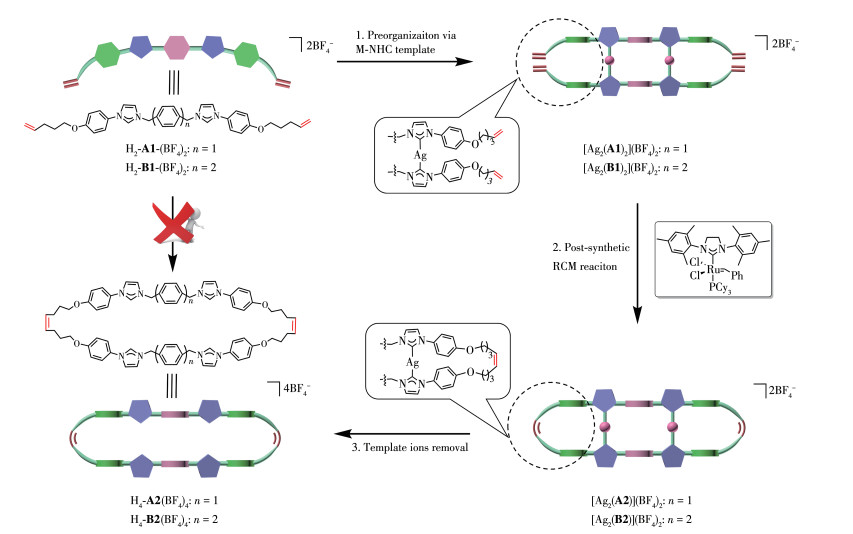
Scheme 1.
Synthesis of the designed covalent organic macrocycles through metal-carbene-templated ring-closing metathesis approach


Metal-directed self-assembly stands as a pivotal synthetic strategy in the construction of supramolecular structures, consistently yielding valuable metallosupramolecular entities of diverse shapes and sizes[1-5]. Traditionally, structures of this kind have been predominantly fashioned from Werner-type complexes, wherein polydentate ligands featuring N or O donor atoms are coordinated to metal centers[6-11]. Moreover, the integration of extended organometallic fragments such as M—CNHC (NHC=N-heterocyclic carbene) building blocks has facilitated the development of innovative assemblies[12-15]. Capitalizing on the exceptional stability intrinsic to selected M—CNHC bonds, a spectrum of organometallic molecular assemblies has been meticulously designed and explored, employing a variety of polydentate NHC ligands[16-21]. Owing to their captivating structures and remarkable properties in the realms of sensing, catalysis, and optics, these assemblies find widespread applications in host-guest chemistry, template-controlled photoreactions, and selective catalytic transformations[22-30].
Macrocycles, especially those incorporating extensive heterocyclic structures with diverse ring sizes and functionalities, have discovered intriguing applications in materials, pharmaceuticals, and supramolecular science[31-35]. Their synthesis has frequently been approached through ring-closing metathesis (RCM) reactions, standing as a pivotal step in the synthetic process. In historical context, the narrative of non-stereoselective macrocyclic RCM reactions commenced in 1980[36-37]. In the late 1990s, the RCM-based syntheses of epothilone and the 18-membered α, β-unsaturated macrolide aspicilin were deemed as pioneering total syntheses of natural macrocyclic compounds utilizing the RCM strategy[38-40]. Subsequent to these milestones, the development of efficient catalysts, exemplified by ruthenium-based Grubbs′ complexes and molybdenum Schrock′s catalysts, has firmly established RCM as one of the most extensively employed methodologies in the design and synthesis of macrocycles[41-43].
Despite notable achievements in the field, there exists substantial potential for the expansion of the functional macrocycle class. Macrocyclization reactions often contend with undesired intermolecular reactions[44-45]. Conventional synthetic methodologies for macrocycles prove impractical and inefficient, frequently resulting in diminished yields and the occurrence of unwanted side reactions. This study introduces the construction of ordered structures derived from poly-NHC precursors via template-directed RCM. Our approach capitalizes on metal-directed self-assembly in conjunction with a suitable template to facilitate the RCM of linear dienes. This strategic amalgamation enables the promotion of the desired dinuclear silver(Ⅰ) tetracarbene complex, ultimately leading to the formation of the corresponding covalent organic macrocycle upon removing silver ions.
1H and 13C{1H} spectra were acquired on a Bruker AVANCE Ⅲ 400 spectrometer. Chemical shifts (δ) are reported in parts per million relative to tetramethylsilane, with the residual protonated solvent serving as an internal standard. Mass spectra were generated using a Bruker microTOF-Q Ⅱ mass spectrometer (Bruker Daltonics Corp., USA) employing the electrospray ionization (ESI) mode. Unless explicitly mentioned, all reagents were commercially sourced and employed without additional purification.
A Schlenk flask was charged with 4-(imidazole-1-yl)phenol (0.705 g, 4.4 mmol) and 1,4-bis(bromomethyl)benzene (0.528 g, 2.0 mmol). To this mixture, DMF was added (2 mL), and the reaction mixture was heated to 110 ℃ for 12 h. After cooling the reaction mixture to ambient temperature, 30 mL ethyl acetate was added, and a white compound precipitated. The solid was isolated by filtration, washed with ethyl acetate, and dried in vacuo to give a white solid. Yield: 1.138 g (1.95 mmol, 97%). The obtained solid (0.292 g, 0.5 mmol) was transferred to a bottle containing 5-bromo-1-pentene (0.6 mL, 5 mmol), NaOH (0.060 g, 1.5 mmol) and 40 mL ethanol. The mixture was stirred for 48 h under reflux. Then, remove the solvent and the solid was washed with water. The solid was isolated by filtration and transferred to a bottle containing 10 mL methanol; a solution of NH4BF4 (0.210 g, 2.0 mmol) in methanol (20 mL) was added. The resulting mixture was stirred at ambient temperature for 6 h. Then, the solvent was removed, and the solid was washed with water and dried in vacuo. Yield: 0.312 g (0.43 mmol, 85%, two steps). 1H NMR (400 MHz, DMSO-d6): δ=9.96 (s, 2H, H1), 8.25 (s, 2H, imidazolium-H), 8.01 (s, 2H, imidazolium-H), 7.70 (d, J=8.8 Hz, 4H, Ar-H), 7.61 (s, 4H, Ar-H), 7.18 (d, J=8.8 Hz, 4H, Ar-H), 5.92-5.82 (m, 2H, H14), 5.52(s, 4H, H4), 5.08-4.98 (m, 4H, H15), 4.06 (t, J=6.4 Hz, 4H, H11), 2.20 (q, J=6.8 Hz, 4H, H13), 1.83 (p, J=6.6 Hz, 4H, H12). 13C{1H} NMR (100 MHz, DMSO-d6): δ=159.4, 137.8, 135.3, 135.1, 129.1, 127.7, 123.5, 123.0, 121.9, 115.6, 115.3, 67.4, 51.8, 29.5, 27.7. ESI-MS (positive ions): m/z=280.157 0 (Calcd. for [H2-A1]2+ 280.141 3).
A Schlenk flask was charged with 4-(imidazole-1-yl)phenol (1.600 g, 10.0 mmol) and 4,4′-bis(bromomethyl)biphenyl (1.700 g, 5.0 mmol). To this mixture, DMF was added (4 mL), and the reaction mixture was heated to 110 ℃ for 12 h. After cooling the reaction mixture to ambient temperature, 40 mL ethyl acetate was added, and a white compound precipitated. The solid was isolated by filtration, washed with ethyl acetate, and dried in vacuo to give a white solid. Yield: 3.136 g (4.747 mmol, 95%). The solid (2.642 g, 4.0 mmol) was transferred to a bottle containing 5-bromo-1-pentene (1.4 mL, 12.0 mmol), NaOH (0.480 g, 12.0 mmol) and 40 mL ethanol. The mixture was stirred for 48 h under reflux. After cooling to room temperature, the reaction mixture was concentrated to 5 mL, and diethyl ether (40 mL) was added. This led to the precipitation of a white solid H2-B1Br2. Yield: 3.311 g (3.90 mmol, 98%). The solid H2-B1Br2 (2.400 g, 3.0 mmol) was isolated by filtration and transferred to a bottle containing 10 mL methanol, a solution of NH4BF4 (0.944 g, 9.0 mmol) in methanol (10 mL) was added. The resulting mixture was stirred at ambient temperature overnight and concentrated to 5 mL. Upon addition of diethyl ether (40 mL) to this solution, the white tetrafluoroborate salt H2-B1(BF4)2 precipitated immediately. The precipitated solid was collected by filtration, washed with small portions of diethyl ether and cold water, and dried in vacuo. Yield: 2.018 g (2.490 mmol, 83%). 1H NMR (400 MHz, DMSO-d6): δ=10.01 (s, 2H, H1), 8.28 (s, 2H, imidazolium-H), 8.08 (s, 2H, imidazolium-H), 7.77 (d, J=8.0 Hz, 4H, H7), 7.74 (d, J=8.8 Hz, 4H, H10), 7.66 (d, J=8.0 Hz, 4H, H6), 7.19 (d, J=8.8 Hz, 4H, H11), 5.95-5.81 (m, 2H, H16), 5.57 (s, 4H, H4), 5.20-4.86 (m, 4H, H17), 4.07 (t, J=6.4 Hz, 4H, H13), 2.20 (q, J=7.2 Hz, 4H, H15), 1.83 (p, J=6.8 Hz, 4H, H14). 13C{1H} NMR (100 MHz, DMSO-d6): δ=159.4, 139.8, 137.8, 135.3, 134.0, 129.3, 127.7, 127.3, 123.5, 123.0, 121.9, 115.6, 115.3, 67.4, 51.9, 29.5, 27.7. ESI-MS (positive ions): m/z=723.350 8 (Calcd. for [H2-B1(BF4)]+ 723.349 5), m/z=318.176 7 (Calcd. for [H2-B1]2+ 318.172 7).
A sample of H2-A1(BF4)2 (73 mg, 0.1 mmol) was dissolved in 25 mL of CH3CN, and to this solution Ag2O (46 mg, 0.2 mmol) was added. The resulting suspension was heated to 70 ℃ for 24 h without light. After cooling to ambient temperature, the obtained suspension was filtered through a pad of Celite to give a clear solution. The filtrate was concentrated to 3 mL, and diethyl ether (30 mL) was added, leading to the precipitation of [Ag2(A1)2](BF4)2 as a yellow solid. The solid was filtrated, washed with diethyl ether, and dried in vacuo. Yield: 62 mg (0.041 mmol, 82%). 1H NMR (400 MHz, DMSO-d6): δ=7.81 (s, 4H, Ar-H), 7.73 (s, 4H, Ar-H), 7.48 (d, J=8.4 Hz, 8H, Ar-H), 7.13 (s, 8H, Ar-H), 6.92 (d, J=8.4 Hz, 8H, Ar-H), 5.97-5.74 (m, 4H, H14), 5.29 (s, 8H, H4), 5.14-4.88 (m, 8H, H15), 3.99 (s, 8H, H11), 2.19 (s, 8H, H13), 1.83 (s, 8H, H12). 13C{1H} NMR (100 MHz, DMSO-d6): δ=158.5, 138.8, 136.7, 132.6, 127.7, 125.1, 123.1, 122.9, 115.2, 115, 67.2, 53.9, 29.5, 27.7. ESI-MS (positive ions): m/z=666.196 6 (Calcd. for [Ag2(A1)2]2+ 666.204 3).
A sample of H2-B1(BF4)2 (0.810 g, 1.0 mmol) was dissolved in 40 mL of CH3CN, and to this solution Ag2O (0.695 g, 3.0 mmol) was added. The resulting suspension was heated to 70 ℃ for 24 h without light. After cooling to ambient temperature, the obtained suspension was filtered through a pad of Celite to give a clear solution. The filtrate was concentrated to 3 mL, and diethyl ether (30 mL) was added, leading to the precipitation of [Ag2(B1)2](BF4)2 as a yellow solid. The solid was filtrated, washed with diethyl ether, and dried in vacuo. Yield: 0.819 g (0.49 mmol, 98%). 1H NMR (400 MHz, DMSO-d6): δ=7.83 (s, 4H, H2), 7.80 (s, 4H, H3), 7.55 (d, J=8.6 Hz, 8H, H10), 7.35 (d, J=7.4 Hz, 8H, H7), 7.18 (d, J=7.4 Hz, 8H, H6), 6.95 (d, J=8.6 Hz, 8H, H11), 6.01-5.71 (m, 4H, H16), 5.45 (s, 8H, H4), 5.15-4.90 (m, 8H, H17), 4.01 (t, J=6.1 Hz, 8H, H13), 2.22 (q, J=6.5 Hz, 8H, H15), 1.85 (p, J=6.2 Hz, 8H, H14). 13C{1H} NMR (100 MHz, DMSO-d6): δ=178.1 (C1), 158.5 (C12), 138.8 (C8), 137.8 (C16), 136.2 (C5), 132.5 (C9), 127.7 (C6), 126.8 (C7), 125.1 (C10), 123.2 (C2), 123.2 (C3), 115.3 (C17), 115.1 (C11), 67.2 (C13), 54.1 (C4), 29.6 (C15), 27.8 (C14). ESI-MS (positive ions): m/z=1 571.445 1 (Calcd. for [Ag2(B1)2(BF4)]+ 1 571.476 1), m/z=742.255 2 (Calcd. for [Ag2(B1)2]2+ 742.235 8).
A sample of [Ag2(A1)2](BF4)2 (151 mg, 0.1 mmol) and Grubbs′ 2nd catalyst (42 mg, 0.05 mmol) were dissolved in dry CH2Cl2 (80 mL) under a nitrogen atmosphere. The reaction mixture was stirred at 40 ℃ for 12 h. After the reaction was cooled to room temperature, 10 mL acetonitrile was added to the mixture, and the obtained mixture was filtered to give a clear solution. The filtrate was concentrated to 3 mL, and ethyl acetate (30 mL) was added, leading to the precipitation of [Ag2(A2)](BF4)2 as a gray solid. The solid was collected by filtration, washed with ethyl acetate, and dried in vacuo. Yield: 0.119 g (0.085 mmol, 85%). [Ag2(A2)](BF4)2 was used for subsequent reactions without further purification.
A sample of [Ag2(B1)2](BF4)2 (100 mg, 0.06 mmol) and Grubbs′ 2nd catalyst (10 mg, 0.01 mmol) were dissolved in dry CH2Cl2 (80 mL) under a nitrogen atmosphere. The reaction mixture was stirred at 40 ℃ for 12 h. After the reaction was cooled to room temperature, 10 mL acetonitrile was added to the mixture, and the obtained mixture was filtered to give a clear solution. The filtrate was concentrated to 3 mL, and diethyl ether (30 mL) was added, leading to the precipitation of [Ag2(B2)](BF4)2 as a gray solid. The solid was filtrated, washed with diethyl ether, and dried in vacuo. Yield: 79 mg (0.049 mmol, 82%). 1H NMR (400 MHz, DMSO-d6): δ=7.83 (s, 4H, H3), 7.77 (s, 4H, H2), 7.57 (d, J=8.8 Hz, 8H, H10), 7.27 (d, J=8.0 Hz, 8H, H7), 7.10 (d, J=8.0 Hz, 8H, H6), 6.92 (d, J=8.8 Hz, 8H, H11), 5.62-5.35 (m, 8H, H16, H4), 4.06-3.90 (m, 8H, H13), 2.27-2.13 (m, 8H, H15), 1.96-1.70 (m, 8H, H14). 13C{1H} NMR (100 MHz, DMSO-d6): δ=176.9 (C1), 158.6 (C12), 138.6 (C8), 136.0 (C5), 132.5 (C9), 130.2 (C16), 127.3 (C6), 126.6 (C7), 125.0 (C10), 123.3 (C2, C3), 115.1 (C11), 67.0 (C13), 54.1 (C4), 28.5 (C15), 27.6 (C14). ESI-MS (positive ions): m/z=1 515.391 9 (Calcd. for [Ag2(B2)(BF4)]+ 1 515.413 4), m/z=714.205 6 (Calcd. for [Ag2(B2)]2+ 714.204 5).
[Ag2(A2)](BF4)2 (0.060 g, 0.041 mmol) was dissolved in CH3CN (5 mL). To this was added NH4Cl (0.007 g, 0.124 mmol) in methanol (5 mL). White solid AgCl precipitated immediately. The resulting suspension was filtered through Celite to obtain a clear solution. The solvent was removed to give a gray solid. The solid was washed with water and then suspended in CH3CN (2 mL), and a solution of NH4BF4 (0.013 g, 0.124 mmol) in methanol (2 mL) was added. The mixture was stirred at ambient temperature for 12 h. The solvent was removed, and the solid was washed with water and dried in vacuo. Yield: 44 mg (0.031 mmol, 76%). 1H NMR (400 MHz, DMSO-d6): δ=9.81 (s, 4H, H1), 8.21 (s, 4H, imidazolium-H), 8.00 (s, 4H, imidazolium-H), 7.70-7.61 (m, 8H, Ar-H), 7.57 (s, 8H, Ar-H), 7.22-7.13 (m, 8H, Ar-H), 5.48 (s, 12H, H4, H14), 4.03 (s, 8H, H11), 2.14 (s, 8H, 13), 1.78 (s, 8H, H12). 13C{1H} NMR (100 MHz, DMSO-d6): δ=159.4, 135.2, 129.8, 129.1, 127.6, 123.5, 123.0, 121.9, 115.6, 67.4, 51.9, 28.2, 23.0. ESI-MS (positive ions): m/z=266.147 8 (Calcd. for [H4-A2]4+ 266.141 4).
A sample of [Ag2(B2)](BF4)2 (0.069 g, 0.043 mmol) was dissolved in CH3CN (10 mL). To this was added NH4Cl (0.007 g, 0.13 mmol) in methanol (5 mL). A white solid (AgCl) precipitated immediately. The reaction mixture was stirred for 6 h. The resulting suspension was filtered through a pad of Celite to obtain a clear solution. The solvent was removed to give a gray solid. The gray solid was dissolved in methanol (10 mL), and a solution of NH4BF4 (0.014 g, 0.13 mmol) in methanol (10 mL) was added. The mixture was stirred at ambient temperature for 12 h. The solvent was removed, and the solid was washed with water and dried in vacuo. Yield: 0.052 g (0.033 mmol, 77%). 1H NMR (400 MHz, DMSO-d6): δ=9.86 (s, 4H, H1), 8.23 (s, 4H, H2), 8.03 (s, 4H, H3), 7.84-7.71 (m, 8H, H7), 7.71-7.64 (m, 8H, H10), 7.64-7.55 (m, 8H, H6), 7.25-7.11 (m, 8H, H11), 5.64-5.43 (m, 12H, H16, H4), 4.20-3.78 (m, 8H, H13), 2.27-2.08 (m, 8H, H15), 1.88-1.66 (m, 8H, H14). 13C{1H} NMR (100 MHz, DMSO-d6): δ=159.4 (C12), 139.8 (C8), 135.2 (C1), 134.0 (C5), 129.8 (C16), 129.2 (C6), 127.7 (C9), 127.3 (C7), 123.6 (C10), 123.1 (C3), 121.9 (C2), 115.6 (C11), 67.3 (C13), 52.0 (C4), 28.3 (C15), 26.6 (C14). ESI-MS (positive ions): m/z=1 477.616 5 (calcd. for [H4-B2(BF4)3]+ 1 477.641 7), 695.317 2 (Calcd. for [H4-B2(BF4)2]2+ 695.318 6), 434.548 7 (Calcd. for [H4-B2(BF4)]3+ 434.544 3), 304.161 1 (Calcd. for [H4-B2]4+ 304.157 0).
In contrast to the numerous molecular macrocycles constructed through metal coordination and hydrogen bonding, the synthesis of covalent organic macrocycles poses greater challenges due to their heightened thermal and chemical stability[46-47]. Consequently, template-directed synthesis has been acknowledged as a rational strategy for the intricate construction of such macrocycles. Here, we introduce a rectangular metallacycle assembled by two bidentate ligands and two metal(Ⅰ) ions. Two terminal olefins were incorporated into the ligands, positioning them in proximity. With an appropriate linker, these positions were designed for cross-linking neighboring ligands through olefin metathesis reactions. Given its high thermal stability and resistance to Grubbs′ 2nd catalyst, we selected an Ag(Ⅰ) metallacycle. Our approach showcases the highly efficient synthesis of a covalent organic macrocycle, commencing with H2-L1(BF4)2, through a four-step process (Scheme 1): (1) the design and preparation of the ligand; (2) NHC-directed self-assembly; (3) ring-closing metathesis (RCM) reaction between the adjacent olefins on the Ag(Ⅰ) metallacycle; (4) removal of the Ag(Ⅰ) ions.
To facilitate this, we designed bidentate ligands H2-L1(BF4)2 (L1=A1, B1), where two terminal olefins are connected to benzene rings via alkoxy linkers. For instance, H2-B1(BF4)2 was synthesized using 4-(imidazol-1-yl)phenol, 4,4′-bis(bromomethyl)biphenyl, and 5-bromo-1-pentene, followed by exchanging the counteranion from bromide to tetrafluoroborate with NH4BF4. This anion exchange significantly improved the solubility of the ligand precursor in acetonitrile. The 1H NMR spectrum of H2-B1(BF4)2 in DMSO-d6 (Fig.S1) reveals the characteristic resonance of the imidazolium NCHN proton at δ=10.01, consistent with previously reported examples[16-21].
The reaction of H2-L1(BF4)2 (L1=A1, B1) with Ag2O yielded complexes [Ag2(L1)2](BF4)2 (L1=A1, B1) in satisfactory yields. A thorough characterization was carried out utilizing various techniques, including NMR spectroscopy (1H, 13C, H-H COSY, HSQC, and HMBC) and mass spectrometry (Fig.S4-S9). In the 1H NMR spectra of [Ag2(B1)2](BF4)2, the expected resonance for the carbene ligand was observed, accompanied by the disappearance of the original imidazolium NCHN proton signal. Notably, characteristic doublet resonances for protons Hb and Hc were observed at δ=6.01-5.71 and 5.15-4.90, respectively (Fig. 1a and 1b). In the 13C and HMBC spectra, resonances corresponding to the CNHC atom and C=C carbon nuclei (Cb, Cc) were observed at δ=178.1, 137.8, and 115.3 (Fig.S5), respectively. Further validation through ESI-MS revealed two intense peaks consistent with the Ag(Ⅰ) metallacycle, with m/z values of 1 571.445 1 and 742.255 2, corresponding to the [Ag2(B1)2(BF4)]+ (Calcd. m/z=1 571.476 1) and [Ag2(B1)2]2+ ions (Calcd. m/z=742.235 8), respectively (Fig.S9).
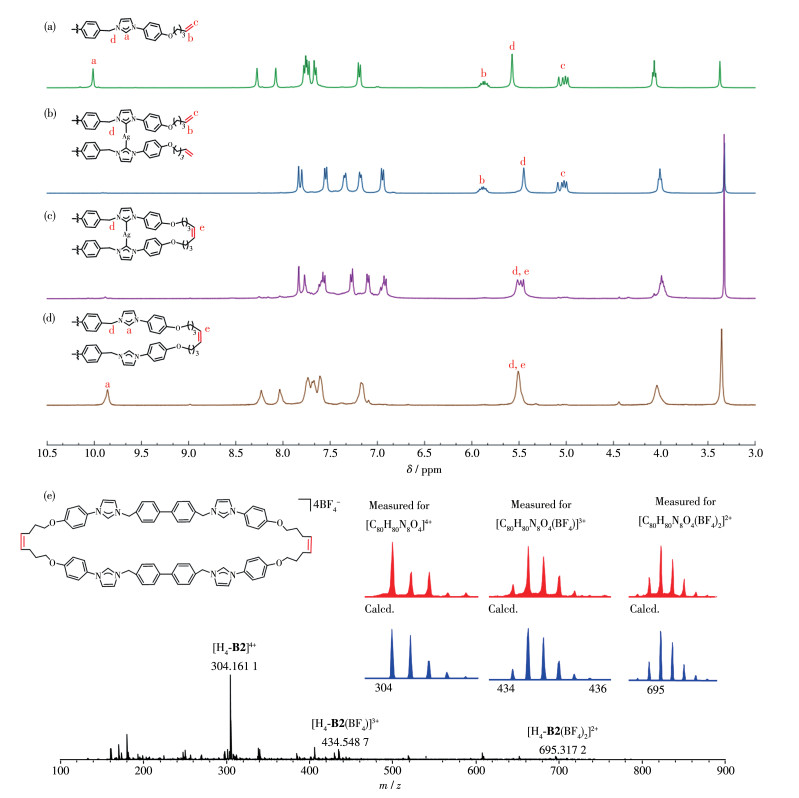
Inset: experimental (red) and calculated (blue) isotope distributions of selected cations [H4-B2]4+, [H4-B2(BF4)]3+, and [H4-B2(BF4)2]2+, respectively.
The pivotal step in our procedure was the template-directed RCM, which proved highly suitable for creating the required rectangular structure. This reaction was conducted at a relatively low concentration of 0.6 mmol·L-1 to prevent undesired side-oligomerization reactions. The metallacycle [Ag2(B1)2](BF4)2 in anhydrous CH2Cl2 was stirred at room temperature. Subsequently, a solution of Grubbs′ 2nd catalyst in dry CH2Cl2 was slowly added into the solution. The resulting mixture was stirred at 40 ℃ overnight, exclusively leading to the formation of the dinuclear cyclized product [Ag2(B2)](BF4)2. Evidence confirming the successful formation of the cyclized structure was provided by 1H, 13C, 2D NMR spectroscopy, and HR-ESI spectrometry (Fig.S10-S15). Upon the RCM reaction, signals at 5.62-5.35 and 130.2, corresponding to the newly generated doublet resonances for He (Fig. 1c) and Ce, respectively, were observed in 1H, 13C NMR spectroscopy (Fig.S10, S11). The ESI-MS spectrum of the final solution revealed signals originating from the most intense peaks at m/z=1 515.391 9 and 714.205 6, consistent with a silver(Ⅰ) metallacycle of the formula [Ag2(B2)](BF4)2. It suggested the presence of a cyclized intramolecular species and confirmed that the isotopic distribution of the dinuclear cyclized metallacycle closely matched the theoretical spectra (Fig.S15).
The two silver ions can be successfully removed from the complex [Ag2(B2)](BF4)2 through the addition of NH4Cl. Subsequent anion exchange reactions with NH4BF4 yielded the desired tetraimidazolium macrocycle in approximately 80% yield. Compound H4-B2(BF4)4 was comprehensively characterized using NMR spectroscopy, and all protons and carbons were fully assigned through 2D NMR measurements (1H-1H COSY, HSQC, and HMBC, Fig.S16-S21). ESI-MS spectrometry (Fig. 1e) confirmed the presence of peaks consistent with the target covalent organic macrocycle at 695.317 2 (Calcd. for [H4-B2(BF4)2]2+ 695.318 6), 434.548 7 (Calcd. for [H4-B2(BF4)]3+ 434.544 3), 304.161 1 (Calcd. for [H4-B2]4+ 304.157 0).
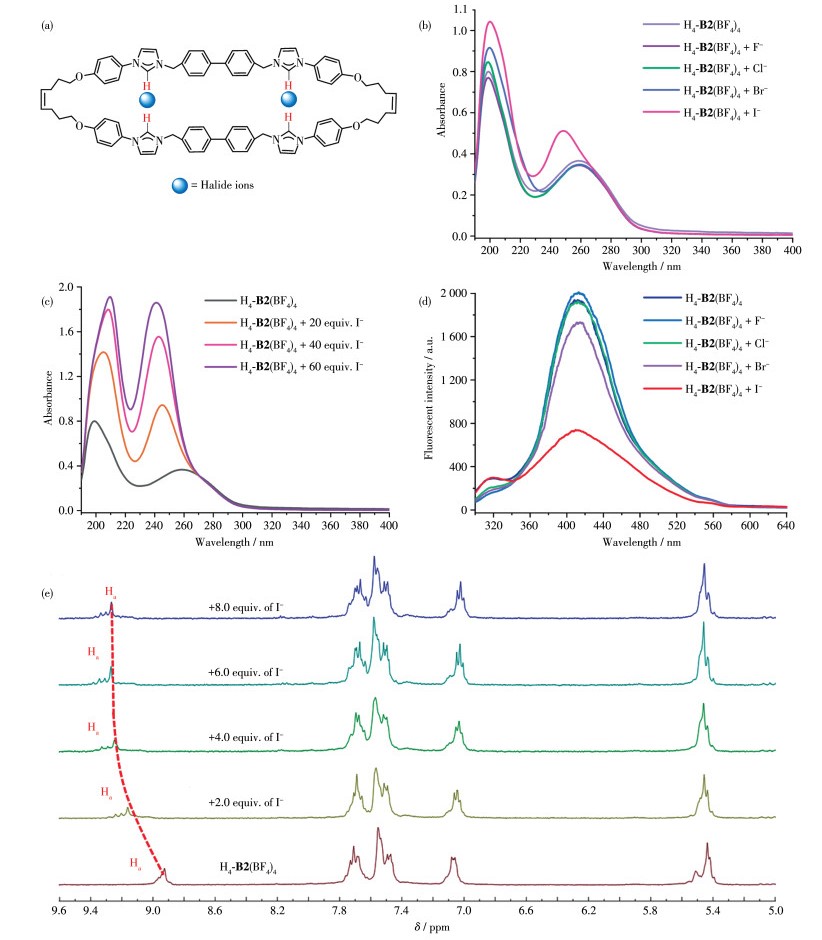
To explore the ion detection capability of H4-B2(BF4)4, halide ions (F-, Cl-, Br-, and I-) were introduced (using their sodium salts) for ultraviolet, fluorescence, and 1H NMR titrations (Fig. 2). As illustrated in Fig. 2b, the addition of 10.0 equivalents of F-, Cl- and Br- to the solutions of H4-B2(BF4)4, respectively, did not induce significant changes in the ultraviolet spectra. However, adding an equivalent amount of I- resulted in a blue shift from the original Soret band (258 nm) to a new band with maximum absorption at 241 nm. The absorption intensity increased significantly with increasing I- concentration (Fig. 2c). Additionally, fluorescence titration experiments were conducted. No noticeable changes in the fluorescence spectra were observed upon adding 10.0 equivalents of F-, Cl- and Br- to the H4-B2(BF4)4 solutions. However, upon the addition of I-, the fluorescence intensity of H4-B2(BF4)4 at approximately 413 nm noticeably decreased (Fig. 2d). As confirmed by 1H NMR titration, the continuous addition of I- to the solution of H4-B2(BF4)4 caused a downfield shift in the signal corresponding to the imidazolium Ha proton (Fig. 2e). No such significant changes were observed for the other protons, indicating that iodides bind to the cavity of the polyimidazolium macrocycle through hydrogen bonding involving C—H⋯I interactions (Fig. 2a).
In summary, we have demonstrated an efficient macrocyclization strategy for synthesizing covalent organic macrocycles through ring-closing metathesis employing a metal-carbene template. Our approach offers an alternative method for generating a silver bis-carbene compound through the self-assembly of Ag(Ⅰ) ions and dicationic bis-carbene precursors. This method effectively creates the required macrocyclic structure and facilitates the development of functionalized metallacycles. Utilizing the excellent properties of N-heterocyclic carbenes, the product can be easily isolated following the RCM reaction and Ag(Ⅰ) removal, achieved through anion exchange reactions. Furthermore, this approach holds promise for preparing a wide range of functional organic macrocycles and three-dimensional cages. Future endeavors will explore more intricate structures and properties in this context.
Chen L, Chen Q H, Wu M Y, Jiang F L, Hong M C. Controllable coordination-driven self-assembly: from discrete metallocages to infinite cage-based frameworks[J]. Acc. Chem. Res., 2015, 48(2): 201-210. doi: 10.1021/ar5003076
Pullen S, Clever G H. Mixed-ligand metal-organic frameworks and heteroleptic coordination cages as multifunctional scaffolds—A comparison[J]. Acc. Chem. Res., 2018, 51(12): 3052-3064. doi: 10.1021/acs.accounts.8b00415
Zheng J, Lu Z, Wu K, Ning G H, Li D. Coinage-metal-based cyclic trinuclear complexes with metal-metal interactions: theories to experiments and structures to functions[J]. Chem. Rev., 2020, 120(17): 9675-9742. doi: 10.1021/acs.chemrev.0c00011
陶艳丽, 陈维超, 王新龙, 苏忠民. 锆簇基纳米分子胶囊的合成、晶体结构和荧光性质[J]. 无机化学学报, 2019,35,(11): 2108-2116. doi: 10.11862/CJIC.2019.224TAO Y L, CHEN W C, WANG X L, SU Z M. Synthesis, crystal structures and fluorescence properties of two nanosized Zr-based molecular capsules[J]. Chinese J. Inorg. Chem., 2019, 35(11): 2108-2116. doi: 10.11862/CJIC.2019.224
于艺彩, 王海玲, 李丽丽, 何成. 蒽醌基金属-有机笼光氧化性能[J]. 无机化学学报, 2023,39,(9): 1649-1660. YU Y C, WANG H L, LI L L, HE C. Anthraquinone-based metal-organic cages as efficient photocatalysts for oxidation reactions[J]. Chinese J. Inorg. Chem., 2023, 39(9): 1649-1660.
郭婷婷, 安燕燕, 赵丹, 闫娟枝. 多酸导向的间苯二酚杯[4]芳烃[Co8]配位笼的组装及电化学性质[J]. 无机化学学报, 2023,39,(9): 1791-1799. GUO T T, AN Y Y, ZHAO D, YAN J Z. Polyoxometalate-directing calix[4]resorcinarene-based giant[Co8] coordination cage: Self-assembly and electrochemical performance[J]. Chinese J. Inorg. Chem., 2023, 39(9): 1791-1799.
Ward M D, Hunter C A, Williams N H. Coordination cages based on bis(pyrazolylpyridine) ligands: structures, dynamic behavior, guest binding, and catalysis[J]. Acc. Chem. Res., 2018, 51(9): 2073-2082. doi: 10.1021/acs.accounts.8b00261
Jongkind L J, Caumes X, Hartendorp A P T, Reek J N H. Ligand template strategies for catalyst encapsulation[J]. Acc. Chem. Res., 2018, 51(9): 2115-2128. doi: 10.1021/acs.accounts.8b00345
Fang Y, Powell J A, Li E, Wang Q, Perry Z, Kirchon A, Yang X Y, Xiao Z F, Zhu C F, Zhang L L, Huang F H, Zhou H C. Catalytic reactions within the cavity of coordination cages[J]. Chem. Soc. Rev., 2019, 48(17): 4707-4730. doi: 10.1039/C9CS00091G
Sinha I, Mukherjee P S. Chemical transformations in confined space of coordination architectures[J]. Inorg. Chem., 2018, 57(8): 4205-4221. doi: 10.1021/acs.inorgchem.7b03067
Roberts D A, Pilgrim B S, Nitschke J R. Covalent post-assembly modification in metallosupramolecular chemistry[J]. Chem. Soc. Rev., 2018, 47(2): 626-644. doi: 10.1039/C6CS00907G
Levin E, Ivry E, Diesendruck C E, Lemcoff N G. Water in N-heterocyclic carbene-assisted catalysis[J]. Chem. Rev., 2015, 115(11): 4607-4692. doi: 10.1021/cr400640e
Narayan S, Hahn F E. Metallosupramolecular architectures obtained from poly-N-heterocyclic carbene ligands[J]. Acc. Chem. Res., 2017, 50(9): 2167-2184. doi: 10.1021/acs.accounts.7b00158
Zhong R, Lindhorst A C, Groche F J, Kühn F E. Immobilization of N-heterocyclic carbene compounds: A synthetic perspective[J]. Chem. Rev., 2017, 117(3): 1970-2058. doi: 10.1021/acs.chemrev.6b00631
Lindhorst A C, Kaspar M, Altmann P J, Pöthig A, Kühn F E. Synthesis, characterization and derivatization of hydroxyl-functionalized iron(Ⅱ) bis(NHC) complexes[J]. Dalton Trans., 2018, 47(6): 1857-1867. doi: 10.1039/C7DT04774F
Bai S, Han Y F. Metal-N-heterocyclic carbene chemistry directed toward metallosupramolecular synthesis and beyond[J]. Acc. Chem. Res., 2023, 56(10): 1213-1227. doi: 10.1021/acs.accounts.3c00102
Zhang L, Das R, Li C T, Wang Y Y, Hahn F E, Hua K, Sun L Y, Han Y F. C3-symmetric assemblies from trigonal polycarbene ligands and MI ions for the synthesis of three-dimensional polyimidazolium cations[J]. Angew. Chem. Int. Ed., 2019, 58(38): 13360-13364. doi: 10.1002/anie.201907003
Wang Y S, Li H, Bai S, Wang Y Y, Han Y F. N-Heterocyclic carbene-stabilized platinum nanoparticles within a porphyrinic nanocage for selective photooxidation[J]. Sci. China Chem., 2023, 66(3): 778-782.
Wang Y S, Feng T, Wang Y Y, Hahn F E, Han Y F. Homo- and heteroligand poly-NHC metal assemblies: Synthesis by narcissistic and social self-sorting[J]. Angew. Chem. Int. Ed., 2018, 57(48): 15767-15771. doi: 10.1002/anie.201810010
Wang Y S, Bai S, Wang Y Y, Han Y F. Process-tracing study on the post-assembly modification of poly-NHC-based metallosupramolecular cylinders with tunable aggregation-induced emission[J]. Chem. Commun., 2019, 55(91): 13689-13692. doi: 10.1039/C9CC07113J
Wang Y S, Sun L Y, Wang Y Y, Han Y F. Phase-mediated controllable intramolecular and intermolecular photocycloadditions assisted by supramolecular templates[J]. Sci. China Chem., 2022, 65(6): 1129-1133. doi: 10.1007/s11426-022-1237-x
王志国, 边清泉, 黄宝美, 邓毅, 刘思曼. 氮杂环卡宾银碘化物[Ag(MEIm)2]+[AgI2]的合成、结构与催化性能(MEIm=1-methyl-3-ethyl-imidazolyl)[J]. 无机化学学报, 2012,28,(1): 191-194. WANG Z G, BIAN Q Q, HUANG B M, DENG Y, LIU S M. Synthesis, crystal structure and catalytic behavior of linear N-heterocyclic carbene silver[Ag(MEIm)2]+[AgI2]- (MEIm=1-methyl-3-ethyl-imidazolyl)[J]. Chinese J. Inorg. Chem., 2012, 28(1): 191-194.
李晓微, 王晓斌, 徐会君, 于先进, 禚淑萍. 氮杂环卡宾羰基氯钌配合物的合成、晶体结构及催化性质[J]. 无机化学学报, 2014,30,(6): 1381-1387. LI X W, WANG X B, XU H J, YU X J, ZHUO S P. Synthesis, crystal structure and catalytic properties of ruthenium complexes bearing N-heterocyclic carbene ligand[J]. Chinese J. Inorg. Chem., 2014, 30(6): 1381-1387.
杨冰冰, 赵丰, 许胜先, 何海峰. 绿色磷光四配位氮杂环卡宾铜(Ⅰ)配合物的合成及发光性质[J]. 无机化学学报, 2019,35,(6): 1020-1026. YANG B B, ZHAO F, XU S X, HE H F. Syntheses and luminescent properties of green phosphorescent four-coordinated N-heterocyclic carbene copper(Ⅰ) complexes[J]. Chinese J. Inorg. Chem., 2019, 35(6): 1020-1026.
Zhang Y F, Zhang Y W, Li Xin, Sun L Y, Han Y F. Synthesis of triarylborane-centered N-heterocyclic carbene cages with tunable photophysical properties[J]. Chem. Commun., 2023, 59(16): 2291-2294. doi: 10.1039/D2CC06584C
Zhang Y F, Li X, Zhang H, Wang X Q, Sun L Y, Duan X L, Han Y F. Gold(Ⅰ) N-heterocyclic carbene complexes with tunable electronic properties for sensitive colorimetric detection of glutathione[J]. Mater. Chem. Front., 2023, 7(14): 2880-2888. doi: 10.1039/D3QM00167A
Jin G F, Zhang Y Z, Yu L, Jiang W L, Li Y, Sun L Y, Li P, Han Y F. Radical organometallic nanocages with redox switchable poly-NHC ligands[J]. Nano Res., 2023, 16(7): 10678-10683. doi: 10.1007/s12274-023-5690-2
Li M, Li Y, Li X, Wang F, Han Y F. An ultralong low-temperature phosphorescent pentagonal prismatic organometallic cylinder featuring pentaphenylpyrrole-N-heterocyclic carbenes[J]. Chin. J. Chem., 2023, 41(12): 1431-1436. doi: 10.1002/cjoc.202300026
Wang C, Zhu Q W, Yu J G, Li X, Li H, Sun L Y, Han Y F. Hierarchical self-assembly of a radical naphthalenediimide-based N-heterocyclic carbene-Au(Ⅰ) macrocycle[J]. Inorg. Chem. Front., 2023, 10(5): 1457-1464. doi: 10.1039/D2QI02685F
Zhang H, Li Y, Zhang Y F, Qiao X J, Sun L Y, Li J L, Wang Y Y, Han Y F. Solvato-controlled assembly and structural transformation of emissive poly-NHC-based organometallic cages and their applications in amino acid sensing and fluorescence imaging[J]. Chem.-Eur. J., 2023, 29(23): e202300209. doi: 10.1002/chem.202300209
Patil S A, Patil S A, Patil R. Medicinal applications of (benz)imidazole- and indole-based macrocycles[J]. Chem. Biol. Drug Des., 2017, 89(4): 639-649. doi: 10.1111/cbdd.12802
Ermert P. Design, properties and recent application of macrocycles in medicinal chemistry[J]. Chimia, 2017, 71(10): 678-702. doi: 10.2533/chimia.2017.678
Barlow T M A, Tourwé D, Ballet S. Cyclisation to form small, medium and large rings using catalyzed and uncatalysed azide-alkyne cycloadditions (AACs)[J]. Eur. J. Org. Chem., 2017, 2017(32): 4678-4694. doi: 10.1002/ejoc.201700521
Ball M, Zhang B, Zhong Y, Fowler B, Xiao S, Ng F, Steigerwald M, Nuckolls C. Conjugated macrocycles in organic electronics[J]. Acc. Chem. Res., 2019, 52(4): 1068-1078. doi: 10.1021/acs.accounts.9b00017
Mortensen K T, Osberger T J, King T A, Sore H F, Spring D R. Strategies for the diversity-oriented synthesis of macrocycles[J]. Chem. Rev., 2019, 119(17): 10288-10317. doi: 10.1021/acs.chemrev.9b00084
Villemi D. Synthese de macrolides par methathese[J]. Tetrahedron Lett., 1980, 21(18): 1715-1718. doi: 10.1016/S0040-4039(00)77818-X
Tsuji J, Hashiguchi S. Application of olefin metathesis to organic synthesis. Syntheses of civetone and macrolides[J]. Tetrahedron Lett., 1980, 2(31): 2955-2958.
Altmann K H. The merger of natural product synthesis and medicinal chemistry: on the chemistry and chemical biology of epothilones[J]. Org. Biomol. Chem., 2004, 2(15): 2137-2152. doi: 10.1039/b405839a
Zhang R Z, Liu Z Y. Recent progress in the synthesis of epothilones[J]. Curr. Org. Chem., 2004, 8(4): 267-290. doi: 10.2174/1385272043485927
Nishioka T, Iwabuchi Y, Irie H, Hatakeyama S. Concise enantioselective synthesis of (+)-aspicilin based on a ruthenium catalyzed olefin metathesis reaction[J]. Tetrahedron Lett., 1980, 39(31): 5597-5600.
Schrock R R, Czekelius C. Recent advances in the syntheses and applications of molybdenum and tungsten alkylidene and alkylidyne catalysts for the metathesis of alkenes and alkynes[J]. Adv. Synth. Catal., 2007, 349(1/2): 55-77.
Vougloukalakis G J, Grubbs R H. Ruthenium-based heterocyclic carbene-coordinated olefin metathesis catalysts[J]. Chem. Rev., 2010, 110(3): 1746-1787. doi: 10.1021/cr9002424
Bieniek M, Michrowska A, Usanov D L, Grela K. In an attempt to provide a user's guide to the galaxy of benzylidene, alkoxybenzylidene, and indenylidene ruthenium olefin metathesis catalysts[J]. Chem. Eur. J., 2008, 14(3): 806-818. doi: 10.1002/chem.200701340
Conrad J C, Eelman M D, Silva J A D, Monfere S, Parnas H, Snelgrove J L, Fogg D E. Oligomers as intermediates in ring-closing metathesis[J]. J. Am. Chem. Soc., 2007, 129(5): 1024-1025. doi: 10.1021/ja067531t
Hiraoka S, Yamauchi Y, Arakane R, Shionoya M. Template-directed synthesis of a covalent organic capsule based on a 3 nm-sized metallocapsule[J]. J. Am. Chem. Soc., 2009, 131(33): 11646-11647. doi: 10.1021/ja903324r
Kim I, Ko K C, Lee W R, Cho J, Moon J H, Moon D, Sharma A, Lee J Y, Kim J S, Kim S. Calix[n]triazoles and related conformational studies[J]. Org. Lett., 2017, 19(20): 5509-5512. doi: 10.1021/acs.orglett.7b02557
Beuerle F, Gole B. Covalent organic frameworks and cage compounds: Design and applications of polymeric and discrete organic scaffolds[J]. Angew. Chem. Int. Ed., 2018, 57(18): 4850-4878. doi: 10.1002/anie.201710190

Scheme 1 Synthesis of the designed covalent organic macrocycles through metal-carbene-templated ring-closing metathesis approach

Figure 1 1H NMR spectra (400 MHz, DMSO-d6) of (a) H2-B1(BF4)2, (b) [Ag2(B1)2](BF4)2, (c) [Ag2(B2)](BF4)2, and (d) H4-B2(BF4)4, (e) HR-ESI mass spectra (positive ions) of H4-B2(BF4)4
Inset: experimental (red) and calculated (blue) isotope distributions of selected cations [H4-B2]4+, [H4-B2(BF4)]3+, and [H4-B2(BF4)2]2+, respectively.

Figure 2 (a) Observed binding interactions between host H4-B2(BF4)4 and iodides, (b) Ultraviolet spectra of H4-B2(BF4)4 (c=4×10⁻⁶ mol·L-1) and adding 10.0 equivalent of different ions (F-, Cl-, Br- and I-) in acetonitrile, (c) Ultraviolet titration spectra of H4-B2(BF4)4 (c=4×10⁻⁶ mol·L-1) with I- in acetonitrile, (d) Fluorescent spectra of H4-B2(BF4)4 (c=4×10⁻⁶ mol·L-1, λ=275 nm) and adding 100.0 equivalent of different ions (F-, Cl-, Br- and I-) in acetonitrile, (e) Partial 1HNMR spectra obtained upon continuous addition of NaI to a CD3CN solution containing H4-B2(BF4)4

 扫一扫看文章


扫一扫关注我们
 下载:
下载:
 下载:
下载: