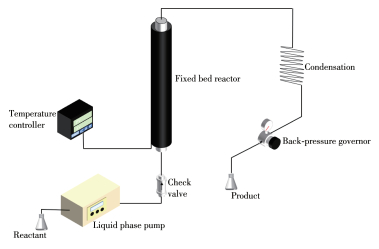
Figure 1.
Scheme of the reaction equipment

Continuous catalytic transfer hydrogenation of methanol as hydrogen source to synthesize aromatic amines
Xueli HONG , Yunyang HONG , Suhong SONG , Qianxi WANG , Xinhuan YAN


NH2 moieties are present in a wide variety of pharmaceutical molecules, dyes, agrochemicals, and bulk chemicals[1]. Especially aromatic amines play a privileged role in medicinal chemistry[2-3]. There are many methods to synthesize aromatic amines[4-8]. The typical process for synthesizing aromatic amines is to use hydrogen as the hydrogen source and obtain it by catalytic hydrogenation of noble metal catalysts such as Pd[9-11]. However, those methods involve the direct use of gaseous H2, which adds additional difficulty in handling due to safety reasons, particularly in large-scale commercial applications[12]. As people′s environmental protection and security requirements continue to increase, it is still necessary to develop simple, efficient, and green synthesis methods.
Catalytic transfer hydrogenation with an in-situ hydrogen donor has received a great deal of attention from both academia and industry as an alternative to the traditional high-pressure hydrogen process, owing to its better efficiency, atom economy, and sustainability features[13-15]. Based on this, some new synthetic methods have been developed. In this regard, methanol[16-19] is a very attractive hydrogen donor. Methanol can be produced from fossil resources and renewable resources[20]. Methanol has been referred to as "the safest source of hydrogen[19]". But compared to the commonly used hydrogen transfer reagent, isopropanol[21-24], the dehydrogenation of methanol requires higher energy[25]. There have been some reports on the synthesis of amines by hydrogen transfer reaction of methanol. Li′s group[25] has explored the hydrogen transfer reaction of nitrobenzene with Pd-Ba/Al2O3 and Pd-Fe/Al2O3, and the yield could reach 51.45%. However, the substrate is limited to the nitrobenzene. Zhu and co-workers[26] reported that X zeolites exhibited higher catalytic performance for the transfer hydrogenation of 2-nitrotoluene with methanol. Transfer hydrogenation achieved the highest conversion of 2-nitrotoluene (76.70%) over NaX and the highest yield of main product 2-methylaniline (42.53%) over KX. Ray and co-workers[27] reported a series of aromatic amines were obtained within 24 h at 100-120 ℃ in the presence of KOtBu using Pd/C as a catalyst. However, catalytic transfer hydrogenation of nitroarenes using methanol is still underdeveloped. Developing a catalytic system that efficiently utilizes methanol for hydrogen transfer is still necessary.
Earlier, we reported the synthesis of quinoline compounds from nitroarenes and ethanol/water. Interestingly, the formation of amines intermediate compounds was found in the course[28], which inspires us to envisage the selective hydrogenation of nitroarenes to amines via hydrogen transfer reactions. Unlike the previous work, we chose methanol as the hydrogen source and solvent, focusing on preparing amines from nitroaromatics. Thus, an effective and mild synthesis method of amines from the nitroarenes was developed by us using Ru-Fe/γ-Al2O3 as catalysts and methanol/water as a hydrogen source and solvent under mild conditions in a fixed-bed flow reactor. This present protocol exhibited excellent yield and selectivity for unsaturated group-substituted nitroarenes such as aldehyde, carbonyl, or alkynyl-substituted starting nitro compounds.
Ethanol (AR), acetone (AR), methanol (AR), isopropanol (AR), and Fe(NO3)3·9H2O (AR) were purchased from Sinopharm Chemical Reagent Co., Ltd. m-dinitrobenzene (m-DNB, AR), o-chloronitrobenzene (AR), m-chloronitrobenzene (AR), p-chloronitrobenzene (AR), 3,4-dichloronitrobenzene (AR), o-bromonitrobenzene (AR), p-bromonitrobenzene (AR), p-nitrobenzaldehyde (AR), o-nitrobenzaldehyde (AR), m-nitrobenzaldehyde (AR), o-nitrophenol (AR), p-nitrophenol (AR), o-nitrobenzonitrile (AR), p-nitroacetophenone (AR), p-nitrostyrene (AR) were purchased from Shanghai Macklin Biochemical Co., Ltd. RuCl3·3H2O (CP) was purchased from Sino-Platinum Metals Co., Ltd. γ-Al2O3 (1-2 mm) was purchased from Henan Zhongbang Environmental Protection Technology Co., Ltd. The water used for all the experiments was deionized water.
Ru-Fe/γ-Al2O3 was prepared by a sequential impregnation method. Typically, the metered Fe(NO3)3·9H2O aqueous solution was added to a beaker containing a certain amount of γ-Al2O3, and the mixture was kept at 70 ℃ and stirred to dryness. The obtained sample was calcined in N2 at 260 ℃ for 2 h and reduced in H2 at 260 ℃ for 2 h. Then, the reduced catalyst particles were transferred to the stoichiometric RuCl3·3H2O aqueous solution in the same operation and stirred at 70 ℃ to dry. The obtained sample was calcined again in N2 at 260 ℃ for 2 h and reduced in H2 at 260 ℃ for 2 h to get a Ru-Fe/γ-Al2O3 catalyst. Catalysts with different Ru/Fe mass ratios (including Ru and Fe) were prepared under the same operating conditions. The theoretical loading of the catalysts used for characterization was expressed by mass fraction. For example, the theoretical loading (mass fraction) of Ru and Fe was all 5%, which was referred to as 5%Ru-5%Fe/γ-Al2O3. The theoretical loading (mass fraction) of single Ru was 5%, which was referred to as 5%Ru/γ-Al2O3. The theoretical loading (mass fraction) of single Fe was 5%, which was referred to as 5%Fe/γ-Al2O3.
Metal element content in the catalyst was determined by inductively coupled plasma-mass spectrometry (ICP-MS) using Agilent 7500 CE.
The TEM was performed using JEOL JEM-1200EX with an operating voltage of 200 kV. The elements contained in the catalyst were analyzed using an energy spectrometer (EDS). Before analysis, the catalyst particles to be tested were ground to powder form using a mortar and pestle and dispersed with ethanol; a small amount of sample was taken and dropped onto a microgrid Cu grid, dried with an infrared lamp, and sent to the instrument for observation and analysis.
X-ray diffraction (XRD) patterns were performed using a Dutch PANalytical X-ray diffractometer with Cu Kα radiation (λ=0.154 1 nm). The working voltage was 40 kV, the working current was 40 mA, and the pattern was collected in a step of 0.026 2° in the range of 2θ from 10° to 80°.
The hydrogen temperature-programmed reduction (H2-TPR) experiment was conducted using a fully automated chemisorption instrument, Autochem2910, from Mac, USA. At first, the pellet samples were pretreated at 260 ℃ for 1 h under argon, cooled to 50 ℃ and then the gas was switched to a 5% H2-Ar mixture and ramped up to 800 ℃ at a rate of 10 ℃·min-1. A thermal conductivity detector was used to record the sample′s signal in the heating range.
All catalytic tests were carried out in a laboratory-made fixed-bed flow reactor. The fixed bed reactor was a stainless-steel tube with an inner diameter of 6 mm and a length of 60 cm. The quartz beads were filled at both ends to fix the catalyst in the middle of the reaction tube. An outer heating sleeve heated the reaction tube, and the reaction temperature was measured by a thermocouple placed between the outer heating sleeve and the reaction tube. The temperature controller connected to the outer heating sleeve to accurately control the temperature rise. A back pressure regulator controlled the pressure of the reaction system and a liquid phase pump was used to transport the solution to maintain the pressure continuously. In the typical catalytic transfer hydrogenation process, 5 g Ru-Fe/γ-Al2O3 was fixed in the middle of the reaction tube, and a certain concentration of m-DNB solution was transported to the reaction tube through a liquid phase pump at a flow rate of 1 mL·min-1, When the solution flew out of the reaction tube, the pressure of the back pressure regulator was adjusted to 3 MPa. After the pressure was stabilized, the temperature controller was adjusted to the temperature required for the reaction. After the system was stable, samples were collected after regular intervals (30 min) and used Shimadzu gas chromatography (GC-2014, FID, AT. OV-1701) for real-time analysis. The identification of the compounds was performed by comparison of the retention times with pure standards. The scheme of the reaction equipment was shown in Fig. 1.
The contents of Ru and Fe in the catalyst were determined by ICP-MS. The results are shown in Table 1. The actual loadings (mass fraction) of Ru and Fe were 4.85% and 4.81%, respectively, which were close to the theoretical values (5%Ru-5%Fe/γ-Al2O3). The loading decreased slightly after the reaction and the loss was less, which may be caused by trace leaching during the reaction.
 下载:
导出CSV
下载:
导出CSV
| Catalyst | Type | Ru loading / % | Fe loading / % | |||
| Theoretical | Actual | Theoretical | Actual | |||
| 5%Ru-5%Fe/γ-Al2O3 | Before reaction | 5.00 | 4.85 | 5.00 | 4.81 | |
| After reaction | 4.57 | 4.62 | ||||
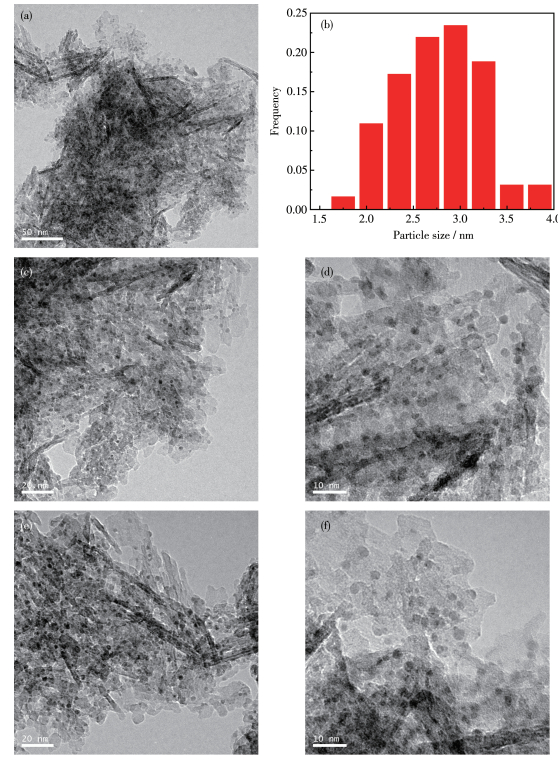
TEM results were shown in Fig. 2. In Fig. 2a, 2c, and 2d, the nanoparticles loaded on γ-Al2O3 had no obvious agglomeration and were well dispersed. Fig. 2b shows the particle size distribution of the catalyst. The particle size of nanoparticles was relatively small, the particle size distribution was 1.31-4.01 nm, and the average particle size was about 2.95 nm. Fig. 2e, 2f were TEM images of the catalyst after the reaction. The size of the reacted catalyst nanoparticles remained small and uniformly dispersed with no obvious agglomeration, indicating good stability of the catalyst.
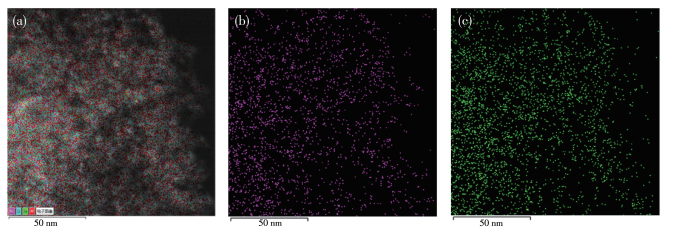
The results of the EDS analysis are shown in Fig. 3. Ru and Fe elements are evenly distributed on the surface of the carrier without obvious agglomeration, which further proves that the catalyst had good dispersion and uniform particle size. It was also observed that the distributions of Ru and Fe do not completely overlap, which, in combination with other characterization tools, suggested that Ru and Fe are not present in an alloy structure, but rather in separate nanoparticle structures.
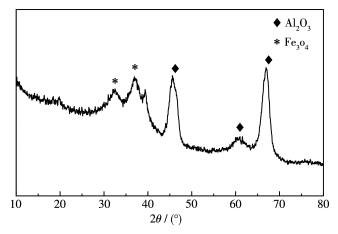
The results of the XRD analysis are shown in Fig. 4. Compared with the standard PDF No.00-001-1303, there were three diffraction peaks at 45.8°, 60.9°, and 66.8°, which corresponded to the (111), (210), and (211) crystal planes of γ-Al2O3 carrier, respectively. Compared with the standard PDF No.00-026-1136, the diffraction peaks were observed at 31.2° and 36.8°, which belonged to the (220) and (311) crystal planes of Fe3O4, indicating that Fe element existed in the form of Fe3O4 in the catalyst. Martínez et al. suggested that the Fen+ site can inhibit the formation of intermediate hydroxylamine in nitroaromatic hydrogenation reactions and improve the selectivity of the reaction[29], and Li et al. concluded that Fe3O4 promoted the formation of Ru0 species[30]. In addition, no obvious Ru diffraction peak was found in the spectrum, which was attributed to the good dispersion and small particle size of Ru nanoparticles, by the granularity statistics of the TEM (2.95 nm).
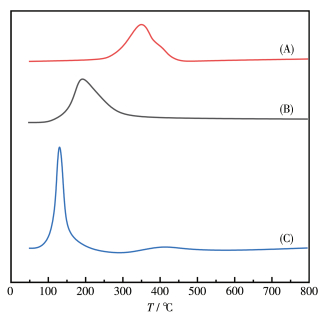
The results of H2-TPR analysis of three typical catalysts are shown in Fig. 5. Curve A was the H2-TPR information of the 5%Fe/γ-Al2O3 catalyst. The reduction peak at about 350 ℃ was attributed to the reduction peak from Fe2O3 to Fe3O4. The 5%Ru/γ-Al2O3 catalyst in curve B showed a reduction peak near 190 ℃, which may be attributed to the reduction of the RuO2 substance with weak interaction with the support. A weak reduction peak near 450 ℃ may correspond to the reduction formed by the strong interaction between the RuO2 substance and the support. Curve C was the H2-TPR information of the 5%Ru-5%Fe/γ-Al2O3 catalyst. The reduction peaks appeared at 130 and 420 ℃, respectively. There may be electron transfer between Ru and Fe species, which changed the interaction between each other and the γ-Al2O3 support. This interaction made the reduction peak of Ru species move to low temperatures and promotes the reduction of Ru, which also confirmed the study of Li et al. that Fe3O4 promoted the formation of Ru0 species[30].
To evaluate the performance of the catalysts for the hydrogen transfer reaction, we first explored the transfer hydrogenation of m-DNB. Table 2 shows the effect of different solvents on the reaction. The results showed that methanol was the best solvent and hydrogen donor for this hydrogen transfer system. From the entries 5 and 9 in Table 2, methanol/water displayed better catalytic efficiency than isopropanol/water, a commonly used hydrogen donor in hydrogen transfer reactions. Fig. 6A shows the effect of different methanol-to-water ratios on the reaction. The reaction was more favorable when the methanol/water volume ratio was 8∶2. We found that the conversion rate increased significantly when a small amount of water was added to the system. With the increase in water ratio, the conversion remained almost unchanged, and the selectivity decreased slightly but remained at a high level. This was different from the research by Cecilia and co-workers[22]. According to the density functional theory calculation by Wang et al.[31], nitrobenzene surpassed aniline in competing for surface active sites with the addition of water. This may also apply to our system. The difference between the two was conducive to the adsorption of m-DNB and desorption of m-nitroaniline (m-NAN), which increased the adsorption concentration of m-DNB, reduced the adsorption concentration of m-NAN, and improved the activity and selectivity. Akula et al. believed that the spillover of H on the catalyst surface from H2O further enhances the Ru hydrogenation capacity and improves the selectivity[32]. Therefore, the solvent for the reaction system was chosen as methanol/water, and the ratio of methanol/water was 8∶2.
下载:
导出CSV
| Entry | Ru/Fe mass ratio | Solvent | Conversion / % | Selectivity / % | |
| m-NAN | Otherb | ||||
| 1c | — | Methanol/water | 2.5 | 100 | — |
| 2d | — | Methanol/water | 95.9 | 94.6 | 5.4 |
| 3 | 3∶5 | Methanol/water | 91.9 | 95.6 | 4.4 |
| 4 | 5∶3 | Methanol/water | 98.2 | 96.6 | 3.4 |
| 5 | 5∶5 | Methanol/water | 99.2 | 99.4 | 0.6 |
| 6 | 5∶7 | Methanol/water | 95.8 | 87.9 | 12.1 |
| 7e | 5∶5 | Methanol/water | 90.8 | 60.1 | 39.9 |
| 8 | 5∶5 | Ethanol/water | 76.8 | 87.1 | 12.9 |
| 9 | 5∶5 | Isopropanol/water | 48.3 | 96.6 | 3.4 |
| a Reaction conditions: mass fraction of 2% of m-DNB, 3 MPa, 1 mL·min-1, 5 g catalysts, 130 ℃, alcohol-water volume ratio of 8∶2; b Other products mainly were m-phenylenediamine and N-alkylation products; c The catalyst was 5%Fe/γ-Al2O3; d The catalyst was 5%Ru/γ-Al2O3; e Reaction conditions: 1 g m-DNB, H2 pressure of 2 MPa, 0.1 g 5%Ru-5%Fe/γ-Al2O3, 80 ℃, methanol-water volume ratio of 8∶2. | |||||
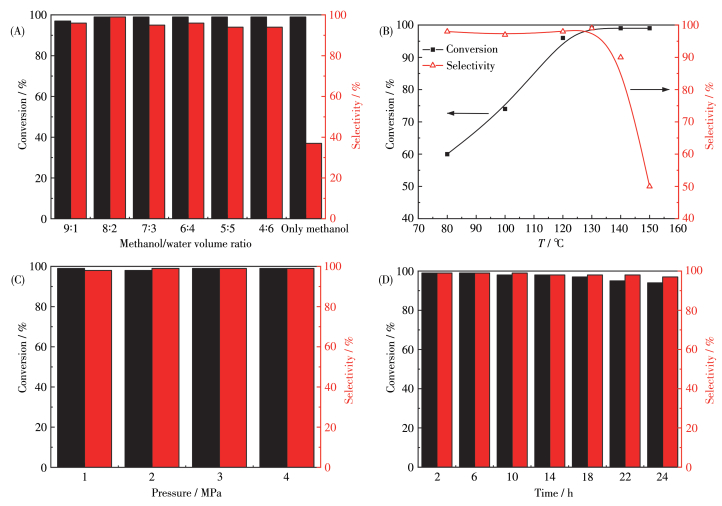
Common reaction conditions: mass fraction of 2% m-DNB, 5 g 5%Ru-5%Fe/γ-Al2O3; Reaction conditions in A: 1 mL·min-1, 130 ℃, 3 MPa; Reaction conditions in B: 1 mL·min-1, 3 MPa, methanol/water volume ratio of 8∶2; Reaction conditions in C: 1 mL·min-1, 130 ℃, methanol/water volume ratio of 8∶2; Reaction conditions in D: 1 mL·min-1, 130 ℃, 3 MPa, methanol/water volume of ratio 8∶2.
Table 2 also shows the catalytic performance of the catalysts with different Ru-Fe mass ratios under the same conditions. The transfer hydrogenation activity of monometallic Fe catalyst was low. The transfer hydrogenation activity of a single metal Fe catalyst was much lower than that of a single metal Ru catalyst, indicating that Ru had good catalytic activity for the reaction system, while Fe alone showed relative inertia. The catalytic selectivity of 5%Ru-5%Fe/γ-Al2O3 bimetallic catalysts for m-NAN was higher than that of single 5%Ru/γ-Al2O3 or 5%Fe/γ-Al2O3 single metal catalysts. More interestingly, the 5%Ru-5%Fe/γ-Al2O3 bimetallic catalyst further improved the transfer hydrogenation activity of m-MAN compared with the single 5%Ru/ γ-Al2O3 catalyst. When the content of Fe was too high, the yield of m-NAN decreased. This may be because the active center Ru determines the adsorption and desorption ability of the catalyst to the reactants. After adding a small amount of Fe species, the synergistic effect of Ru and Fe metals improved the transfer hydrogenation activity[31]. Combined with TEM, XRD, and other characterizations, the nanoparticles on the catalyst′s surface had small particle size and good dispersion.
As shown in entry 7 of Table 2, we chosen a suitable reaction condition, using hydrogen as the hydrogen source, and using 5%Ru-5%Fe/γ-Al2O3 to hydrogenate m-DNB through a traditional autoclave. It was found that the selectivity of m-NAN (60.1%) was not high when the conversion rate (90.8%) was not high, which was much lower than the selectivity of m-NAN (99.4%) in our continuous flow hydrogenation system using methanol as the hydrogen source. At the same time, compared with the traditional high-pressure reactor, the continuous flow production mode was more efficient. Continuous flow hydrogen transfer hydrogenation with methanol as the hydrogen source was advantageous.
We have also explored the reaction′s temperature, pressure, flow rate, and stability. As shown in Fig. 6B, as expected, the conversion continued to increase until 100% with the temperature increased. However, the selectivity began to decrease when the temperature rose to 140 ℃. As shown in Fig. 6C, under different pressures, the conversion and selectivity of the reaction hardly changed, indicating that the pressures had nothing to do with the reaction. However, to maintain the entire system′s stability and keep it in a liquid phase, the final pressure was 3 MPa. As for the flow rate, when the flow rate was too fast, the contact time between the substrate and the catalysts became shorter, and the reaction was not sufficient. When the flow rate was too slow, the contact time between the substrate and the catalysts became longer, and the selectivity of the reaction decreased. So, the appropriate flow rate was 1 mL·min-1. The results were not listed in the paper. The stability of the catalyst was evaluated for its recyclability, as shown in Fig. 6D. To investigate the stability of 5%Ru-5%Fe/γ-Al2O3 for this hydrogen transfer reaction, the experiment was carried out for 24 h. The conversion of m-DNB and the selectivity of m-NAN did not change significantly, indicating that the catalyst had high stability during the whole hydrogen transfer process.
As shown in Fig. 7, to compare with the stability of 5%Ru-5%Fe/γ-Al2O3 for the hydrogen transfer reaction, the stability of 5%Ru/γ-Al2O3 for the reaction was also studied, and the experiment was also carried out for 24 h. The conversion of m-DNB was significantly reduced, indicating that the addition of Fe could improve the stability of the catalyst. Good stability was essential in continuous flow reactions.
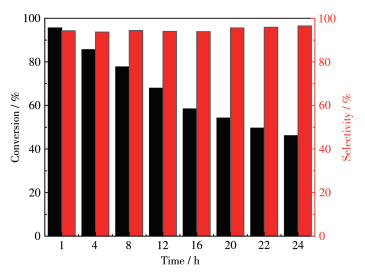
Reaction conditions: mass fraction of 2% m-DNB, 5 g 5%Ru/γ-Al2O3, 1 mL·min-1, 130 ℃, 3 MPa, methanol/water volume ratio of 8∶2.
Under the optimized conditions, a variety of nitroarenes can be reduced with methanol to the corresponding amines in high conversion and selectivity (Table 3). There were also reducible aldehyde groups and cyano groups in nitro benzaldehyde and nitro benzonitrile, which were not reduced to the corresponding alcohols and amines, which were usually difficult to achieve in H2 hydrogenation reactions. Similarly, the selectivity of corresponding halogenated aromatic amines was also good for halogenated nitroaromatics. The substituents on the aromatic ring had an insignificant effect on the reaction and can tolerate various substituents, including aldehyde, cyano, nitro, halides, carbonyls, and hydroxyl, and the conversion did not vary considerably with the position of substitution, e.g., ortho and para.
下载:
导出CSV
 |
||||
| Entry | Product | T / ℃ | Conversion / % | Yield / % |
| 1 |  |
180 | 99 | 98 |
| 2 |  |
180 | 100 | 95 |
| 3 |  |
160 | 100 | 92 |
| 4 |  |
160 | 100 | 98 |
| 5 |  |
140 | 100 | 98 |
| 6 |  |
140 | 100 | 97 |
| 7 |  |
180 | 100 | 97 |
| 8 |  |
180 | 100 | 97 |
| 9 |  |
180 | 100 | 99 |
| 10 |  |
180 | 100 | 94 |
| 11 |  |
140 | 100 | 91 |
| 12 |  |
180 | 100 | 95 |
| 13 |  |
160 | 100 | 100 |
| 14b |  |
120 | 83 | 83 |
| a Reaction conditions: mass fraction of 2% of substrate, 5 g catalysts, 3 MPa, 1 mL·min-1, methanol/water volume ratio of 8∶2; b The mass fraction of p-nitrostyrene was 1%. | ||||
In conclusion, as far as we know, we have pioneered the development of heterogeneous Ru-Fe catalysts for the continuous conversion of nitroaromatics to corresponding amines using methanol as a solvent and hydrogen source. The system also produces the corresponding aromatic amines with better selectivity than the conventional hydrogen hydrogenation reaction. The catalyst synthesis path is convenient, the stability is good, and it may have wide applicability.
Yao W B, Wang J L, Lou Y P, Wu H J, Qi X X, Yang J G, Zhong A G. Chemoselective hydroborative reduction of nitro motifs using a transition-metal-free catalyst[J]. Org. Chem. Front., 2021, 8(16): 4554-4559. doi: 10.1039/D1QO00705J
Kita Y, Kai S, Rustad L B S, Kamata K, Hara M. One-pot reductive amination of carbonyl compounds with nitro compounds over a Ni/NiO composite[J]. RSC Adv., 2020, 10(54): 32296-32300. doi: 10.1039/D0RA06937J
Magano J, Dunetz J R. Large-scale applications of transition metal-catalyzed couplings for the synthesis of pharmaceuticals[J]. Chem. Rev., 2011, 111(3): 2177-2250. doi: 10.1021/cr100346g
Bai Y W, Wang Q Z, Du C B, Bu T, Liu Y N, Sun X Y, Luo W F, Li R, Zhao Y J, Zheng X H, Wang L. Three-dimensional Cu/C porous composite: Facile fabrication and efficient catalytic reduction of 4-nitrophenol[J]. J. Colloid Interface Sci., 2019, 553(1): 768-777.
Silva T R, de Oliveira D C, Pal T, Domingos J B. The catalytic evaluation of bimetallic Pd-based nanocatalysts supported on ion exchange resin in nitro and alkyne reduction reactions[J]. New J. Chem., 2019, 43(18): 7083-7092. doi: 10.1039/C9NJ00285E
Su J, Zou X X, Li G D, Li L, Zhao J, Chen J S. Porous vanadium-doped titania with active hydrogen: A renewable reductant for chemoselective hydrogenation of nitroarenes under ambient conditions[J]. Chem. Commun., 2012, 48(72): 9032-9034. doi: 10.1039/c2cc33969b
Rezaei S J T, Malekzadeh A M, Poulaei S, Ramazani A, Khorramabadi H. Chemo-selective reduction of nitro and nitrile compounds using Ni nanoparticles immobilized on hyperbranched polymer-functionalized magnetic nanoparticles[J]. Appl. Organomet. Chem., 2018, 32(1): 1-13.
Zhang K Q, Hong K, Suh J M, Lee T H, Kwon O, Shokouhimehr M, Jang H W. Facile synthesis of monodispersed Pd nanocatalysts decorated on graphene oxide for reduction of nitroaromatics in aqueous solution[J]. Res. Chem. Intermed., 2018, 45(2): 599-611.
Alexander S, Udayakumar V, Nagaraju N, Gayathri V. Hydrogenation of substituted nitroarenes by a polymer-bound palladium(Ⅱ) Schiff base catalyst[J]. Transit. Met. Chem., 2009, 35(2): 247-251.
Song J J, Huang Z F, Pan L, Li K, Zhang X W, Wang L, Zou J J. Review on selective hydrogenation of nitroarene by catalytic, photocatalytic and electrocatalytic reactions[J]. Appl. Catal. B-Environ., 2018, 227(1): 386-408.
Supriya P, Srinivas B T V, Chowdeswari K, Naidu N V S, Sreedhar B. Biomimetic synthesis of gum acacia mediated Pd‑ZnO and Pd‑TiO2‑Promising nanocatalysts for selective hydrogenation of nitroarenes[J]. Mater. Chem. Phys., 2018, 204: 27-36. doi: 10.1016/j.matchemphys.2017.10.026
Rao S, Prabhu K R. Stereodivergent alkyne reduction by using water as the hydrogen source[J]. Chem.-Eur. J., 2018, 24(52): 13954-13962. doi: 10.1002/chem.201803147
Nie R, Tao Y, Nie Y, Lu T, Wang J, Zhang Y, Lu X, Xu C C. Recent advances in catalytic transfer hydrogenation with formic acid over heterogeneous transition metal catalysts[J]. ACS Catal., 2021, 11(3): 1071-1095. doi: 10.1021/acscatal.0c04939
许响生, 陈傲昂, 周莉, 李小青, 顾辉子, 严新焕. Ru-Fe/C催化剂上邻氯硝基苯原位液相加氢性能[J]. 催化学报, 2014,34,(2): 391-396. XU X S, CHEN A A, ZHOU L, LI X Q, GU H Z, YAN X H. Catalytic stability of othro-chloronitrobenzene hydrogenation on Ru‑Fe/C catalyst[J]. Chin. J. Catal., 2014, 34(2): 391-396.
陈傲昂, 许响生, 华焱祥, 顾辉子, 严新焕. Fe3O4改性的Ru/γ-Al2O3催化剂的原位液相加氢性能[J]. 物理化学学报, 2013,29,(4): 799-805. CHEN A A, XU X S, HUA Y X, GU H Z, YAN X H. Fe3O4 modified alumina supported ruthenium catalyst for novel in-situ liquid phase catalytic hydrogenation[J]. Acta Phys.-Chim. Sin., 2013, 29(4): 799-805.
Aboo A H, Bennett E L, Deeprose M, Robertson C M, Iggo J A, Xiao J. Methanol as hydrogen source: Transfer hydrogenation of aromatic aldehydes with a rhodacycle[J]. Chem. Commun., 2018, 54(83): 11805-11808. doi: 10.1039/C8CC06612D
Sklyaruk J, Zubar V, Borghs J C, Rueping M. Methanol as the hydrogen source in the selective transfer hydrogenation of alkynes enabled by a manganese pincer complex[J]. Org. Lett., 2020, 22(15): 6067-6071. doi: 10.1021/acs.orglett.0c02151
Wang R Z, Han X Y, Xu J, Liu P, Li F. Transfer hydrogenation of ketones and imines with methanol under base-free conditions catalyzed by an anionic metal-ligand bifunctional iridium catalyst[J]. J. Org. Chem., 2020, 85(4): 2242-2249. doi: 10.1021/acs.joc.9b02957
Zhang J, Chen J Z. Selective transfer hydrogenation of biomass-based furfural and 5-hydroxymethylfurfural over hydrotalcite‑ derived copper catalysts using methanol as a hydrogen donor[J]. ACS Sustain. Chem. Eng., 2017, 5(7): 5982-5993. doi: 10.1021/acssuschemeng.7b00778
Pelckmans M, Renders T, Van de Vyver S, Sels B F. Bio-based amines through sustainable heterogeneous catalysis[J]. Green Chem., 2017, 19(22): 5303-5331. doi: 10.1039/C7GC02299A
López-Asensio R, Cecilia J A, Jiménez-Gómez C P, García-Sancho C, Moreno-Tost R, Maireles-Torres P.. Selective production of furfuryl alcohol from furfural by catalytic transfer hydrogenation over commercial aluminas[J]. Appl. Catal. A-Gen., 2018, 556(1): 1-9.
Wang D, Astruc D. The golden age of transfer hydrogenation[J]. Chem. Rev., 2015, 115(13): 6621-6686. doi: 10.1021/acs.chemrev.5b00203
黄韬, 曹自强, 蒋圣鹏, 李年, 夏鑫鑫, 丁伟, 李锋. 负载Ru的Fe3O4改性碳纳米管催化剂糠醛催化转移加氢研究[J]. 能源化工, 2020,41,(2): 1-6. HUANG T, CAO Z Q, JIANG S P, LI N, XIA X X, DING W, LI F. Study on catalytic transfer hydrogenation of furfural over Fe3O4 modified carbon nanotubes supported Ru catalyst[J]. Energy Chemical Industry, 2020, 41(2): 1-6.
李佩, 秦品典, 汪艳艳, 王越, 李翠勤, 李锋. 缺陷改性UiO-66糠醛催化转移加氢研究[J]. 能源化工, 2022,43,(4): 1-5. LI P, QIN P D, WANG Y Y, WANG Y, LI C Q, LI F. Study on catalytic transfer hydrogenation of furfural by defects modified UiO-66[J]. Energy Chemical Industry, 2022, 43(4): 1-5.
Xiang Y Z, Li X N, Lu C S, Ma L, Zhang Q F. Water-improved heterogeneous transfer hydrogenation using methanol as hydrogen donor over Pd-based catalyst[J]. Appl. Catal. A-Gen., 2010, 375(2): 289-294. doi: 10.1016/j.apcata.2010.01.004
Zhao G Q, Chen H H, Yuan Y, Li X C, Zhu Z R. New process of 2-nitrotoluene into 2-methylaniline by transfer hydrogenation with methanol over X zeolite catalyst[J]. Catal. Lett., 2015, 146(1): 174-179.
Goyal V, Sarki N, Natte K, Ray A. Pd/C-catalyzed transfer hydrogenation of aromatic nitro compounds using methanol as a hydrogen source[J]. J. Indian Chem. Soc., 2021, 98(1): 1-4.
Song S H, Dai Y Y, Hong Y Y, Li X Q, Yan X H. A simple continuous reaction for the synthesis of quinoline compounds[J]. Green Chem., 2022, 24(4): 1714-1720. doi: 10.1039/D1GC03064G
Martínez J J, Rojas H, Vargas L, Parra C, Brijaldo M H, Passos F B. Hydrogenation of m-dinitrobenzene over Au catalysts on magnetic supports[J]. J. Mol. Catal. A-Chem., 2014, 383(1): 31-37.
Li F, Zhu W X, Jiang S S, Wang Y, Song H, Li C Q. Catalytic transfer hydrogenation of furfural to furfuryl alcohol over Fe3O4 modified Ru/carbon nanotubes catalysts[J]. Int. J. Hydrog. Energy, 2020, 45(3): 1981-1990. doi: 10.1016/j.ijhydene.2019.11.139
Wang H J, Wang Y, Li Y F, Lan X C, Ali B, Wang T F. Highly efficient hydrogenation of nitroarenes by N-doped carbon-supported cobalt single-atom catalyst in ethanol/water mixed solvent[J]. ACS Appl. Mater. Interfaces, 2020, 12(30): 34021-34031. doi: 10.1021/acsami.0c06632
Velisoju V K, Peddakasu G B, Gutta N, Boosa V, Kandula M, Chary K V R, Akula V. Influence of support for ru and water role on product selectivity in the vapor-phase hydrogenation of levulinic acid to γ-valerolactone: Investigation by probe-adsorbed Fourier transform infrared spectroscopy[J]. J. Phys. Chem. C, 2018, 122(34): 19670-19677. doi: 10.1021/acs.jpcc.8b06003

Figure 2 TEM images of the fresh (a, c, d) and the recovered (e, f) 5%Ru-5%Fe/γ-Al2O3 catalyst; Ru-Fe nanoparticles distribution of the 5%Ru-5%Fe/γ-Al2O3 catalyst (b)

Figure 5 H2-TPR spectra of the catalysts (A) 5%Fe/γ-Al2O3, (B) 5%Ru/γ-Al2O3, and (C) 5%Ru-5%Fe/γ-Al2O3

Figure 6 Catalytic properties of hydrogenation of m-DNB
Common reaction conditions: mass fraction of 2% m-DNB, 5 g 5%Ru-5%Fe/γ-Al2O3; Reaction conditions in A: 1 mL·min-1, 130 ℃, 3 MPa; Reaction conditions in B: 1 mL·min-1, 3 MPa, methanol/water volume ratio of 8∶2; Reaction conditions in C: 1 mL·min-1, 130 ℃, methanol/water volume ratio of 8∶2; Reaction conditions in D: 1 mL·min-1, 130 ℃, 3 MPa, methanol/water volume of ratio 8∶2.

Figure 7 Catalytic properties of hydrogenation of m-DNB
Reaction conditions: mass fraction of 2% m-DNB, 5 g 5%Ru/γ-Al2O3, 1 mL·min-1, 130 ℃, 3 MPa, methanol/water volume ratio of 8∶2.
Table 1. Loading of Ru-Fe catalysts
| Catalyst | Type | Ru loading / % | Fe loading / % | |||
| Theoretical | Actual | Theoretical | Actual | |||
| 5%Ru-5%Fe/γ-Al2O3 | Before reaction | 5.00 | 4.85 | 5.00 | 4.81 | |
| After reaction | 4.57 | 4.62 | ||||
 下载: 导出CSV
Table 2. Catalytic properties of the catalysts with different mass ratios of Ru/Fe and in different solventsa
| Entry | Ru/Fe mass ratio | Solvent | Conversion / % | Selectivity / % | |
| m-NAN | Otherb | ||||
| 1c | — | Methanol/water | 2.5 | 100 | — |
| 2d | — | Methanol/water | 95.9 | 94.6 | 5.4 |
| 3 | 3∶5 | Methanol/water | 91.9 | 95.6 | 4.4 |
| 4 | 5∶3 | Methanol/water | 98.2 | 96.6 | 3.4 |
| 5 | 5∶5 | Methanol/water | 99.2 | 99.4 | 0.6 |
| 6 | 5∶7 | Methanol/water | 95.8 | 87.9 | 12.1 |
| 7e | 5∶5 | Methanol/water | 90.8 | 60.1 | 39.9 |
| 8 | 5∶5 | Ethanol/water | 76.8 | 87.1 | 12.9 |
| 9 | 5∶5 | Isopropanol/water | 48.3 | 96.6 | 3.4 |
| a Reaction conditions: mass fraction of 2% of m-DNB, 3 MPa, 1 mL·min-1, 5 g catalysts, 130 ℃, alcohol-water volume ratio of 8∶2; b Other products mainly were m-phenylenediamine and N-alkylation products; c The catalyst was 5%Fe/γ-Al2O3; d The catalyst was 5%Ru/γ-Al2O3; e Reaction conditions: 1 g m-DNB, H2 pressure of 2 MPa, 0.1 g 5%Ru-5%Fe/γ-Al2O3, 80 ℃, methanol-water volume ratio of 8∶2. | |||||
下载: 导出CSV
Table 3. Transfer hydrogenation of nitroarenes under optimized conditionsa
|
||||
| Entry | Product | T / ℃ | Conversion / % | Yield / % |
| 1 | |
180 | 99 | 98 |
| 2 | |
180 | 100 | 95 |
| 3 | |
160 | 100 | 92 |
| 4 | |
160 | 100 | 98 |
| 5 | |
140 | 100 | 98 |
| 6 | |
140 | 100 | 97 |
| 7 | |
180 | 100 | 97 |
| 8 | |
180 | 100 | 97 |
| 9 | |
180 | 100 | 99 |
| 10 | |
180 | 100 | 94 |
| 11 | |
140 | 100 | 91 |
| 12 | |
180 | 100 | 95 |
| 13 | |
160 | 100 | 100 |
| 14b | |
120 | 83 | 83 |
| a Reaction conditions: mass fraction of 2% of substrate, 5 g catalysts, 3 MPa, 1 mL·min-1, methanol/water volume ratio of 8∶2; b The mass fraction of p-nitrostyrene was 1%. | ||||
下载: 导出CSV

 扫一扫看文章


扫一扫关注我们