Table 1.
Crystallographic data and structure refinement details for Co-1, Co-2, and Zn-3

Competitive coordination in 2-nitro benzoate protected one-dimensional Co(Ⅱ)/Zn(Ⅱ) complexes
Xiao-Qin CUI , Dian-Hui WANG , Xin LI , Yu-Xin WANG , Ting LI , Jing DOND , Huan LI


Searching and characterizing transition metal complexes are one of the most interesting and challenging research areas[1-3]. These compounds are usually composed of one or several metallic atomic centers which bonded with organic ligands[4-8]. They can be viewed as platforms for evaluating the bonding mode of specific organic liquid with the metal. Among different kinds of ligands, carboxylate ligand can be arguably recognized as one of the most studied ones[9-12]. They have been widely used for fabricating a large number of metal complexes as well as frameworks, especially for early transition metals[13-17]. Among them, 1D complexes have drawn special attention not merely because of their potential applications, but also for their value as a model for understanding the interaction of ligands with metal[18-19]. However, it is still a challenge to synthesize 1D complex in a controllable manner. Taking cobalt as an example, only a few 1D complexes are available[20-21], either by multidentate carboxylic[22], thiolate[23], or other kinds of ligands[24-25]. We disclose here two new members of 1D Co(Ⅱ) complexes protected by 2-nitro benzoate (2-nba-).
On the other hand, to further enrich the architectures of metal complexes, introducing a second ligand can often be effective[26]. Researchers use two or more kinds of ligands, such as carboxylic acid and pyridine, and many other combinations to explore new complexes[27-30]. The second one which usually bears different coordination modes with metal can function as auxiliary ligands to stabilize the complex. Optionally, they also competitively bond with metal so that the original bonding pattern will be significantly altered[31]. As a result, new complexes and bonding modes may arise. Herein, we report a typical example of this mechanism. By simply adjusting the amount of 2-nitrobenzoic acid (2-nbaH), two 1D Co complexes [Co(H2O)(2-nba)2]n (Co-1) and [Co3(2-nba)4(acac)2]n (Co-2) featuring different local coordination modes were isolated. And to prove the utility of our synthetic method, we took a step further to synthesize a Zn complex [Zn2(2-nba)4]n (Zn-3), which is also in one dimension.
2-nbaH (98%), tris(acetylacetonato)cobalt(Ⅲ) (Co(acac)3, 98%), and zinc(Ⅱ) acetylacetonate (Zn(acac)2, 99%) were purchased from Shanghai Meryer Chemical Technology Co., Ltd (China). Toluene solvent was purchased from Sinopharm Shanxi Co., Ltd. All chemicals and solvents were used as received.
The content of the Co or Zn in complexes Co-1, Co-2, or Zn-3 was determined using an inductively coupled plasma mass spectrometry (ICP-MS) spectrometer PE NexION 350. Elemental analyses were performed on a Perkin Elmer 2400 Ⅱ Elemental Analyzer. Fourier transforms infrared (FTIR) spectra were collected on Nicolet iS5 with samples prepared as KBr pellets. The UV-Vis diffuse reflectance spectroscopy (UV-Vis DRS) of the powder samples was obtained on a Purkinje IS19-2 spectrometer.
2-nbaH (0.050 g, 0.3 mmol) and Co(acac)3 (0.021 g, 0.06 mmol) were mixed and dissolved in 3 mL of toluene. The mixture was sealed in a glass tube. It was then subjected to heat treatment in an oven at 100 ℃ for 4 d. After the reaction, the mixture was cooled to room temperature. The flaky single crystals were obtained, which were analyzed by single-crystal X-ray crystallography. ICP-MS for Co in C14H10CoN2O9 (409.17): Calcd. 14.40%; Obsd. 13.67%. Elemental Anal. Calcd. for C14H10CoN2O9(%): C, 41.10; N, 6.85; H, 2.46. Found(%): C, 41.22; N, 6.78; H, 2.51. Selected IR (KBr, cm-1): 3 031 (m), 2 932 (w), 2 878 (w), 1 943 (w), 1 863 (w), 1 800 (w), 1 604 (w), 1 492 (w), 1 455 (w), 1 381 (w), 1 080 (w), 1 026 (w), 732 (s), 694 (m), 461 (m).
The synthesis of Co-2 is similar to that of Co-1, except that the amount of 2-nbaH was reduced to 0.1 mmol. ICP-MS for Co in C38H30Co3N4O20 (1 039.45): Calcd. 17.01%; Obsd. 16.46%. Elemental Anal. Calcd. for C38H30Co3N4O20(%): C, 43.91; N, 5, 40; H, 2.91. Found(%): C, 43.97; N, 5.35; H, 3.16. Selected IR (KBr, cm-1): 3 078 (m), 3 031 (m), 2 931 (w), 2 878 (w), 1 942 (w), 1 863 (w), 1 800 (w), 1 604 (w), 1 492 (w), 1 461 (w), 1 377 (w), 1 080 (w), 1 032 (w), 725 (s), 694 (m), 462 (m).
Preparation as for Co-1, while Zn(acac)2 was used instead of Co(acac)3. ICP-MS for Zn in C28H16Zn2N4O16 (795.19): Calcd. Zn 16.44%; Obsd. 16.70%. Elemental Anal. Calcd. for C28H16Zn2N4O16(%): C, 42.29; N, 7.05; H, 2.03. Found(%): C, 42.35; N, 6.97; H, 2.11. Selected IR (KBr, cm-1): 3 031 (m), 2 932 (w), 2 878 (w), 1 942 (w), 1 863 (w), 1 800 (w), 1 736 (w), 1 604 (w), 1 495 (w), 1 536 (w), 1 292 (w), 1 249 (w), 1 074 (w), 1 026 (w), 725 (s), 689 (m), 684 (m), 472 (m), 462 (m).
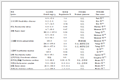
Data collection for the complexes was carried out on a Rigaku Oxford Single Crystal Diffractometer using Mo Kα radiation (λ=0.071 073 nm) at 293 K. Absorption corrections were applied by using the program CrysAlisPro (multi-scan). The structure was solved and refined using Full-matrix least-squares based on F2 with programs SHELXS-97 and SHELXL-97 within OLEX2[32]. All non-hydrogen atoms were refined anisotropically and the positions of C—H hydrogen atoms were calculated theoretically. The H atoms of water molecules were located by electron density and constrained by geometrical parameters during the refinement procedure. O atom of the —NO2 group in Co-2 was refined as disordered. The two moieties were restrained to have similar distances with the N atom. The parameters of the crystal data collection and refinement of complexes Co-1, Co-2, and Zn-3 are summarized in Table 1.
 下载:
导出CSV
下载:
导出CSV
| Parameter | Co-1 | Co-2 | Zn-3 |
| Empirical formula | C14H10CoN2O9 | C38H30Co3N4O20 | C28H16Zn2N4O16 |
| Formula weight | 409.17 | 1 039.45 | 795.19 |
| Temperature / K | 293(2) | 293(2) | 293(2) |
| Crystal system | Monoclinic | Triclinic | Monoclinic |
| Space group | P21/c | P1 | P21/c |
| a / nm | 0.731 84(3) | 0.997 59(10) | 1.112 37(5) |
| b / nm | 1.899 43(7) | 1.025 65(7) | 1.318 66(5) |
| c / nm | 1.172 84(5) | 1.086 74(9) | 2.072 28(8) |
| α / (°) | 79.587(7) | ||
| β / (°) | 103.675(4) | 68.323(9) | 98.151(4) |
| γ / (°) | 89.439(7) | ||
| Volume / nm3 | 1.584 12(11) | 1.014 29(16) | 3.009 0(2) |
| Z | 4 | 1 | 4 |
| Dc / (g·cm-3) | 1.716 | 1.702 | 1.755 |
| μ / mm-1 | 1.139 | 1.303 | 1.682 |
| F(000) | 828.0 | 527.0 | 1 600.0 |
| Crystal size / mm | 0.3×0.1×0.05 | 0.35×0.1×0.02 | 0.5×0.4×0.1 |
| 2θ range for data collection / (°) | 7.152-59.216 | 6.576-57.378 | 7.204-59.326 |
| Reflection collected | 18 295 | 8 761 | 33 898 |
| Independent reflection | 3 919 (Rint=0.030 8) | 4 534 (Rint=0.055 1) | 7 523 (Rint=0.037 9) |
| Data, restraint, parameter | 3 919, 0, 246 | 4 534, 13, 307 | 7 523, 0, 451 |
| Goodness-of-fit on F2 | 1.084 | 1.036 | 1.041 |
| R1, wR2 [I > 2σ(I)] | 0.042 8, 0.089 0 | 0.062 0, 0.106 2 | 0.036 5, 0.072 8 |
| R1, wR2 (all data) | 0.060 2, 0.095 9 | 0.091 0, 0.119 4 | 0.057 9, 0.080 9 |
| Largest diff. peak and hole / (e·nm-3) | 360, -360 | 550, -430 | 370, -330 |
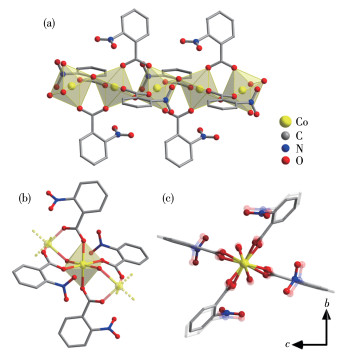
To synthesize Co-1, 2-nbaH and Co(acac)3 were mixed and dissolved in toluene, then the mixture was sealed in a glass tube and placed in a 100 ℃ oven for 4 d, after which the single crystal of Co-1 was obtained. It was then analyzed by single-crystal X-ray crystallography. The structure of Co-1 is shown in Fig. 1a. It has an infinite linear chain structure. Every neighboring two Co2+ ions are bonded with two 2-nba- ligands which are roughly perpendicular to each other. For three adjacent Co2+ ions, there are four 2-nba- ligands, with each pair of them pointing in opposite directions. They are aligned in such a manner most likely to avoid the steric hindrance. Besides four 2-nba- ligands, each Co2+ ion was also connected by two bridging aqua ligands. In all, every Co2+ ion is hexa-coordinated with six oxygen atoms to form an octahedron. And it is slightly distorted due to the deviation of the Co—O bond lengths (Fig. 1b). It is also interesting that the nitro groups of 2-nba- ligands bonding with the same two Co2+ ions point in opposite directions. This makes all the nitro groups in the upper area in Fig. 1a align themselves in the same direction, while the other half are arranged oppositely. Such an arrangement can avoid the unfavorable interaction of two neighboring nitro groups (Fig. 1c). The distance between two Co2+ ions of Co-1 is 0.3659 nm, significantly longer than common Co—Co bonds[33-36]. Therefore, there is no metal-metal bonding in Co-1.
All Co2+ ions are hexa-coordinated (yellow octahedrons); H atoms are omitted for clarity.
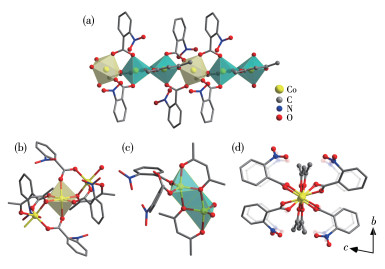
It is unanticipated that the original ligand of the precursor Co(acac)3 was completely replaced by the 2-nba- ligands in Co-1, given that acac- is a fairly strong ligand[37]. With this in view, we made attempts to address the possibility to retain part of the acac- ligands in the product. And by reducing the amount of 2-nba- to one-third, another 1D Co complex (Co-2) was successfully isolated (Fig. 2a). From Fig. 2 we can see that despite the structural similarity of Co-1 and Co-2, their differences are still outstanding. The most notable one is the participation of acac- as a second ligand and its significant influence on the coordination of Co. Unlike Co-1 where all Co2+ ions have the same coordination environment, Co2+ ions of Co-2 can be divided into two types. One-third of them are found in a similar octahedron geometry as in Co-1 (Fig. 2b), while the other two-thirds are penta-coordinated with O atoms, shaping into trigonal bipyramids (Fig. 2c). The bonding of acac- with Co2+ is responsible for the unusual penta-coordinated Co2+ ions. On one hand, acac- functions solely as chelating ligands in the precursor (i.e., Co(acac)3), where one Co2+ ion is coordinated with three acac- ligands. In Co-2, however, acac- also functions as a bridging ligand. Each binding site of acac-, namely the O atom, bonds with two neighboring Co2+ ions. Also, there are no other kinds of bridging oxygen. As mentioned, two-thirds of the Co2+ ions are penta-coordinated. In this type of coordination mode, as shown in Fig. 2c, three vertices out of five of the trigonal bipyramids are from two closely arranged acac- ligands. The rigidity of acac- ligands which require the local O—Co—O motif to be roughly in a plane is supposed to be responsible for this unusual bonding pattern. Viewing along the a-axis (Fig. 2d), the Co2+ ions are not precisely in a line, quite different from Co-1 (Fig. 1c). This can be ascribed to the non-uniform coordination environment of Co. We also noted that the acute angle between 2-nba- ligands of Co-2 is smaller than that of Co-1. By comparing Fig. 1c and 2d, one possible explanation is that acac- takes up more room and pushes 2-nba- ligands closer[38-39].
One-third of the Co2+ ions are hexa-coordinated (yellow octahedrons) and two-thirds of the Co2+ ions are penta-coordinated (cyan trigonal bipyramids); H atoms are omitted for clarity.
Although Co-1 and Co-2 have different local structures, the stacking of their 1D chains both rely on the non-covalent π-π interactions of the benzene rings[40-42]. As shown in Fig. 3a, there are two orientations of π-π interaction in Co-1 (as indicated by black dashed lines). The two interaction distances are the same (0.365 1 nm, Table 2). That is to say, there are also two orientations of the Co-1 chains. They are arranged in such a manner that the two kinds of chains can interlace with each other and maximize their interactions (Fig. 3a)[43]. On the other hand, there is only one kind of π-π interaction in Co-2 as shown in Fig. 3b. And such interaction is less in number than that of Co-1, due to the coordination of acac-.
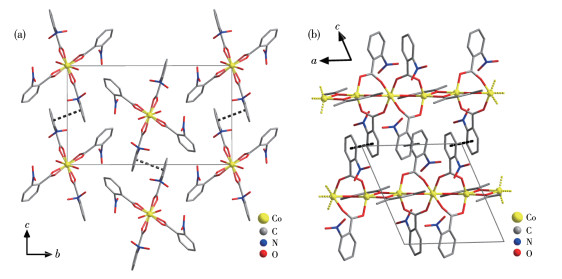
The non-covalent π-π interactions of the benzene rings are indicated by black dashed lines; H atoms are omitted for clarity.
下载:
导出CSV
| Complex | DCg-Cga / nm | DCg-ringb / nm |
| Co-1 | 0.365 1 | 0.355 9 |
| Co-2 | 0.379 2 | 0.331 8 |
| a Centroid distance between the centroids of the rings; b Vertical distance from the centroid to the ring. | ||
To further validate the applicability of our method for other transition metals, Zn(acac)2 was employed as a precursor. And as expected, another 1D Zn complex Zn-3 was successfully obtained (Fig. 4). Along the zigzag-shaped chain, every four Zn2+ ions can be viewed as a repeating unit. This unit can be further divided into two subgroups (Fig. 4a). Each subgroup is composed of two Zn2+ ions and three 2-nba- ligands, which form a commonly seen paddle wheel structure. Between every two subgroups, there is another 2-nba- ligand bridging them (Fig. 4b). It means 2-nba- is the only kind of ligand present in Zn-3. Every Zn2+ ion is tetrahedrally coordinated with four O atoms. At this stage, however, we failed to obtain a Zn chain structure where acac- is involved (Fig. 4b and 4c). Notwithstanding, the results mentioned above indicate that our synthetic method has the potential to apply to other metals as well[30].
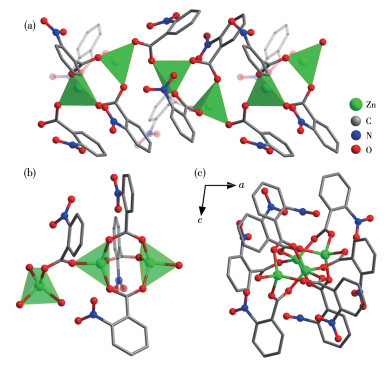
Each Zn2+ ion is tetrahedrally coordinated with four O atoms (green tetrahedrons); H atoms are omitted for clarity.
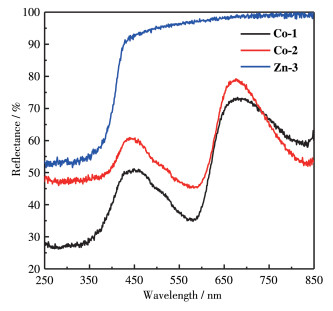
The UV-Vis DRS spectra of Co-1, Co-2, and Zn-3 are shown in Fig. 5. Co-1 and Co-2 had strong absorption in the UV and visible light region, corresponding to the color of both are purple, and there were obvious absorption peaks at 579 nm. Zn-3 is a colorless crystal. The absorption was weak in the visible region, and Zn-3 had obvious absorption in the UV region.
Three 1D Co(Ⅱ) and Zn(Ⅱ) complexes are reported in this paper. It is proved that the competitive coordination of acac- with 2-nba- can significantly change the coordination mode of Co2+ and thus lead to the generation of new 1D Co(Ⅱ) complexes. Two-thirds of the Co2+ ions of the complex [Co3(2-nba)4(acac)2]n are penta-coordinated. Our synthetic strategy was also successfully applied to synthesize a new 1D Zn(Ⅱ) complex.
Nadurata V L, Boskovic C. Switching metal complexes via intramolecular electron transfer: Connections with solvatochromism[J]. Inorg. Chem. Front., 2021, 8(7): 1840-1864. doi: 10.1039/D0QI01490G
Seo J S, Whang D, Lee H, Jun S I, Oh J, Jeon Y J, Kim K. A homochiral metal-organic porous material for enantioselective separation and catalysis[J]. Nature, 2000, 404(6781): 982-986. doi: 10.1038/35010088
Salassa G, Coenen M J J, Wezenberg S J, Hendriksen B L M, Speller S, Elemans J A A W, Kleij A W. Extremely strong self-assembly of a bimetallic salen complex visualized at the single-molecule level[J]. J. Am. Chem. Soc., 2012, 134(16): 7186-7192. doi: 10.1021/ja3030802
Han Y F, Jin G X. Cyclometalated [Cp*M(C^X)] (M = Ir, Rh; X = N, C, O, P) complexes[J]. Chem. Soc. Rev., 2014, 43(8): 2799-2823. doi: 10.1039/C3CS60343A
Mazzoni R, Roncaglia F, Rigamonti L. When the metal makes the difference: template syntheses of tridentate and tetradentate salen-type Schiff base ligands and related complexes[J]. Crystals, 2021, 11(5): 483. doi: 10.3390/cryst11050483
Alfonso-Herrera L A, Rosete-Luna S, Hernández-Romero D, Rivera-Villanueva J M, Olivares-Romero J L, Cruz-Navarro J A, Soto-Contreras A, Arenaza-Corona A, Morales-Morales D, Colorado-Peralta R. Transition metal complexes with tridentate Schiff bases (O N O and O N N) derived from salicylaldehyde: An analysis of their potential anticancer activity[J]. ChemMedChem, 2022, 17(20): e202200367.
Lin C Y, Power P P. Complexes of Ni(Ⅰ): A "rare" oxidation state of growing importance[J]. Chem. Soc. Rev., 2017, 46(17): 5347-5399. doi: 10.1039/C7CS00216E
Bellemin-Laponnaz S, Dagorne S. Group 1 and 2 and early transition metal complexes bearing N-heterocyclic carbene ligands: Coordination chemistry, reactivity, and applications[J]. Chem. Rev., 2014, 114(18): 8747-8774. doi: 10.1021/cr500227y
陈铭臻, 陈金香, 王若伦, 卢钧雄, 许雪飞. 基于两性羧酸配体的Cu(Ⅱ)、Zn(Ⅱ)、Co(Ⅱ)、Mn(Ⅱ)配合物的合成、晶体结构及其与DNA相互作用[J]. 无机化学学报, 2022,38,(12): 2499-2510. doi: 10.11862/CJIC.2022.241CHEN M Z, CHEN J X, WANG R L, LU J X, XU X F. Synthesis, crystal structures, and DNA interaction of Cu(Ⅱ), Zn(Ⅱ), Co(Ⅱ), and Mn(Ⅱ) complexes derived from zwitterionic carboxylate ligand[J]. Chinese J. Inorg. Chem., 2022, 38(12): 2499-2510. doi: 10.11862/CJIC.2022.241
Das B, Rahaman A, Shatskiy A, Verho O, Kärkäs M D, Åkermark B. The impact of ligand carboxylates on electrocatalyzed water oxidation[J]. Acc. Chem. Res., 2021, 54(17): 3326-3337. doi: 10.1021/acs.accounts.1c00298
James S L. Metal-organic frameworks[J]. Chem. Rev., 2003, 32(5): 276-288.
Murugavel R, Walawalkar M G, Dan M, Roesky H W, Rao C N R. Transformations of molecules and secondary building units to materials: A bottom-up approach[J]. Acc. Chem. Res., 2004, 37(10): 763-774. doi: 10.1021/ar040083e
Cohen S M. Postsynthetic methods for the functionalization of metal-organic frameworks[J]. Chem. Rev., 2012, 112(2): 970-1000. doi: 10.1021/cr200179u
Yoshinari N, Konno T. Multitopic metal-organic carboxylates available as supramolecular building units[J]. Coord. Chem. Rev., 2023, 474: 214850. doi: 10.1016/j.ccr.2022.214850
Jiang J C, Yaghi O M. Brønsted acidity in metal-organic frameworks[J]. Chem. Rev., 2015, 115(14): 6966-6997. doi: 10.1021/acs.chemrev.5b00221
Schubert U. Clusters with a Zr6O8 core[J]. Coord. Chem. Rev., 2022, 469: 214686. doi: 10.1016/j.ccr.2022.214686
Kuznetsova A, Matveevskaya V, Pavlov D, Yakunenkov A, Potapov A. Coordination polymers based on highly emissive ligands: Synthesis and functional properties[J]. Materials, 2020, 13(12): 2699. doi: 10.3390/ma13122699
Schlachter A, Tanner K, Harvey P D. Copper halide-chalcogenoether and -chalcogenone networks: Chain and cluster motifs, polymer dimensionality and photophysical properties[J]. Coord. Chem. Rev., 2021, 448: 214176. doi: 10.1016/j.ccr.2021.214176
Hosseinzadeh B, Ahmadi M. Coordination geometry in metallo-supramolecular polymer networks[J]. Coord. Chem. Rev., 2022, 471: 214733. doi: 10.1016/j.ccr.2022.214733
Tian Z F, Moorthy S, Xiang H, Peng P, You M L, Zhang Q, Yang S Y, Zhang Y L, Wu D Q, Singh S K, Shao D. Tuning chain topologies and magnetic anisotropy in one-dimensional cobalt(Ⅱ) coordination polymers via distinct dicarboxylates[J]. CrystEngComm, 2022, 24(21): 3928-3937. doi: 10.1039/D2CE00437B
Zhu Z, Xu C G, Wang M, Zhang X, Wang H, Luo Q D, Bi S Y, Fan Y H. Six Co(Ⅱ) coordination polymers based on two isomeric semirigid ether-linked aromatic tetracarboxylate acid: Syntheses, structural comparison, and magnetic properties[J]. Cryst. Growth Des., 2017, 17(10): 5533-5543. doi: 10.1021/acs.cgd.7b01070
Gutschke S O H, Price D J, Powell A K, Wood P T. Hydrothermal synthesis, structure, and magnetism of [Co2(OH){1, 2, 3-(O2C)3C6H3}(H2O)]·H2O and [Co2(OH){1, 2, 3-(O2C)3C6H3}]: Magnetic Δ-chains with mixed cobalt geometries[J]. Angew. Chem. Int. Ed., 2001, 40(10): 1920-1923. doi: 10.1002/1521-3773(20010518)40:10<1920::AID-ANIE1920>3.0.CO;2-2
Guo C L, Zhuo X, Li Y Z, Zheng H G. Synthesis, crystal structures, and fluorescence properties of six complexes with thiophene derivative carboxylic acid ligand[J]. Inorg. Chim. Acta, 2009, 362(2): 491-501. doi: 10.1016/j.ica.2008.04.044
Yambulatov D S, Voronina J K, Goloveshkin A S, Svetogorov R D, Veber S L, Efimov N N, Matyukhina A K, Nikolaevskii S A, Eremenko I L, Kiskin M A. Change in the electronic structure of the cobalt(Ⅱ) ion in a one-dimensional polymer with flexible linkers induced by a structural phase transition[J]. Int. J. Mol. Sci., 2023, 24(1): 215.
黄瑞琴, 刘峥, 王胜, 余彩莉, 魏润芝, 唐群. 基于2, 5-二溴对苯二甲酸配体的锰/钴配合物的合成、晶体结构及性质[J]. 无机化学学报, 2013,39,(1): 159-167. HUANG R Q, LIU Z, WANG S, YU C L, WEI R Z, TANG Q. Synthesis, crystal structure, and properties of manganese/cobalt complexes based on 2, 5-dibromoterephthalic acid ligands[J]. Chinese J. Inorg. Chem., 2013, 39(1): 159-167.
Sharma R P, Saini A, Kumar S, Venugopalan P, Ferretti V. Isolation of two rare aqua-bridged zigzag copper(Ⅱ) coordination polymers: syntheses, characterization and X-ray structures of [Cu(2-bromobenzoate)2(β/γ-picoline)2(μ-H2O)]n[J]. J. Mol. Struct., 2014, 1060(1): 256-263.
de Almeida F B, da Silva Cunha M, Barros W P, De Abreu H A, Diniz R. Structure, electronic, magnetic, and gas adsorption properties of zinc(Ⅱ) and cobalt(Ⅱ) coordination polymers assembled from isonicotinylhydrazine and trimesic acid[J]. J. Phys. Chem. C, 2020, 124(38): 21103-21112. doi: 10.1021/acs.jpcc.0c06479
Novitchi G, Shova S, Train C. Investigation by chemical substitution within 2p-3d-4f clusters of the cobalt(Ⅱ) role in the magnetic behavior of [vdCoLn]2 (vd = verdazyl radical)[J]. Inorg. Chem. Commun., 2022, 61(43): 17037-17048. doi: 10.1021/acs.inorgchem.2c01742
Lin J G, Qiu L, Cheng W, Luo S N, Wang K, Meng Q J. A novel cobalt(Ⅱ) complex based on nicotinamide and 2-nitrobenzoate mixed ligands: Synthesis, characterization, and biological activity[J]. Inorg. Chem. Commun., 2010, 13(7): 855-858. doi: 10.1016/j.inoche.2010.04.013
Gu J Z, Cai Y, Qian Z Y, Wen M, Shi Z F, Lv D Y, Kirillov A M. A new series of Co, Ni, Zn, and Cd metal-organic architectures driven by an unsymmetrical biphenyl-tricarboxylic acid: Hydrothermal assembly, structural features and properties[J]. Dalton Trans., 2018, 47(22): 7431-7444. doi: 10.1039/C8DT01299G
Aakeröy C B, Schultheiss N, Desper J. Directed supramolecular assembly of Cu(Ⅱ)-based "paddlewheels" into infinite 1-D chains using structurally bifunctional ligands[J]. Dalton Trans., 2006, (13): 1627-1635. doi: 10.1039/B513765A
Dolomanov O V, Bourhis L J, Gildea R J, Howard J A K, Puschmann H. OLEX2: A complete structure solution, refinement and analysis program[J]. J. Appl. Cryst., 2009, 42(2): 339-341. doi: 10.1107/S0021889808042726
Danopoulos A A, Braunstein P, Monakhov K Y, van Leusen J, Kögerler P, Clémancey M, Latour J M, Benayad A, Tromp M, Rezabal E, Frison G. Heteroleptic, two-coordinate [M(NHC){N(SiMe3)2}] (M = Co, Fe) complexes: Synthesis, reactivity and magnetism rationalized by an unexpected metal oxidation state[J]. Dalton Trans., 2017, 46(4): 1163-1171. doi: 10.1039/C6DT03565E
Meng W, Qin Y, Hou Q Q, He W J, Li J, Xu F. Dinuclear cage-core [Co2]/[Ni2] oxo-clusters supported by Sb(Ⅲ) tartrate scaffolds: Synthesis, structure and magnetic properties[J]. Polyhedron, 2018, 153: 76-81. doi: 10.1016/j.poly.2018.06.045
Pyykkö P, Atsumi M. Molecular double-bond covalent radii for elements Li-E112[J]. Chem.-Eur. J., 2009, 15(46): 12770-12779. doi: 10.1002/chem.200901472
Pyykkö P, Riedel S, Patzschke M. Triple-bond covalent radii[J]. Chem.-Eur. J., 2005, 11(12): 3511-3520. doi: 10.1002/chem.200401299
Khranenko S P, Bykova E А, Gromilov S А, Gallyamov M R, Kozlova S G, Moroz N K, Kоrenev S V. Novel mixed-ligand palladium complexes [Pd2(acac)3NO3] and [Pd(acac)NO3]n involving O, O- and γ-C-bonded acetylacetonate linkers[J]. Polyhedron, 2012, 31(1): 272-277. doi: 10.1016/j.poly.2011.09.026
Hey D A, Sauer M J, Fischer P J, Esslinger E M H J, Kühn F E, Baratta W. Acetate acetylacetonate ampy ruthenium(Ⅱ) complexes as efficient catalysts for ketone transfer hydrogenation[J]. ChemCatChem, 2020, 12(13): 3537-3544. doi: 10.1002/cctc.202000542
Langley S K, Chilton N F, Moubaraki B, Murray K S. Single-molecule magnetism in {Co2ⅢDy2Ⅲ}-amine-polyalcohol-acetylacetonate complexes: Effects of ligand replacement at the DyⅢ Sites on the dynamics of magnetic relaxation[J]. Inorg. Chem. Front., 2015, 2(9): 867-875. doi: 10.1039/C5QI00076A
Kumar S, Sharma R P, Saini A, Venugopalan P, Ferretti V. Design and construction of two rare aqua bridged copper(Ⅱ) coordination polymers through mixed ligand strategy: Synthesis, characterization and single crystal X-ray structure determination of [Cu(2-iodobenzoate)2(β/γ-picoline)2(μ-H2O)]n[J]. J. Mol. Struct., 2015, 1083: 398-404. doi: 10.1016/j.molstruc.2014.11.017
Krinchampa P, Chainok K, Phengthaisong S, Youngme S, Kielar F, Wannarit N. A novel one-dimensional double-chain-like ZnⅡ coordination polymer: Poly[bis(1-benzyl-1H-imidazole-κN3)tris(μ-cyanido-κ2C: N)(cyanido-κC)disilver(Ⅰ)zinc(Ⅱ)][J]. Acta Crystallogr. Sect. C, 2016, C72(12): 960-965.
Xu L C, Zhu B Y. Syntheses and characterization of two Cd(Ⅱ) coordination polymers based on mixed flexible ligands[J]. J. Inorg. Organomet. Polym. Mater., 2016, 26(1): 264-269. doi: 10.1007/s10904-015-0306-2
Banerjee S, Rajakannu P, Butcher R, Murugavel R. Auxiliary ligand-aided tuning of aggregation of transition metal benzoates: Isolation of four different types of coordination polymers[J]. CrystEngComm, 2014, 16(36): 8429-8441. doi: 10.1039/C4CE01043D

Figure 1 (a) Crystal structure of Co-1; (b) Coordination environment of the Co2+ ion in Co-1; (c) A view along the a-axis
All Co2+ ions are hexa-coordinated (yellow octahedrons); H atoms are omitted for clarity.

Figure 2 (a) Crystal structure of Co-2; Coordination environment of (b) hexa-coordinated Co(Ⅱ) and (c) penta-coordinated Co(Ⅱ); (d) A view along the a-axis
One-third of the Co2+ ions are hexa-coordinated (yellow octahedrons) and two-thirds of the Co2+ ions are penta-coordinated (cyan trigonal bipyramids); H atoms are omitted for clarity.

Figure 3 (a) Cell stacking diagram along the a-axis of Co-1; (b) Cell stacking diagram along the b-axis of Co-2
The non-covalent π-π interactions of the benzene rings are indicated by black dashed lines; H atoms are omitted for clarity.

Figure 4 (a) Crystal structure of Zn-3; (b) Coordination environment of the Zn2+ ion in Zn-3; (c) A view along the b-axis
Each Zn2+ ion is tetrahedrally coordinated with four O atoms (green tetrahedrons); H atoms are omitted for clarity.
Table 1. Crystallographic data and structure refinement details for Co-1, Co-2, and Zn-3
| Parameter | Co-1 | Co-2 | Zn-3 |
| Empirical formula | C14H10CoN2O9 | C38H30Co3N4O20 | C28H16Zn2N4O16 |
| Formula weight | 409.17 | 1 039.45 | 795.19 |
| Temperature / K | 293(2) | 293(2) | 293(2) |
| Crystal system | Monoclinic | Triclinic | Monoclinic |
| Space group | P21/c | P1 | P21/c |
| a / nm | 0.731 84(3) | 0.997 59(10) | 1.112 37(5) |
| b / nm | 1.899 43(7) | 1.025 65(7) | 1.318 66(5) |
| c / nm | 1.172 84(5) | 1.086 74(9) | 2.072 28(8) |
| α / (°) | 79.587(7) | ||
| β / (°) | 103.675(4) | 68.323(9) | 98.151(4) |
| γ / (°) | 89.439(7) | ||
| Volume / nm3 | 1.584 12(11) | 1.014 29(16) | 3.009 0(2) |
| Z | 4 | 1 | 4 |
| Dc / (g·cm-3) | 1.716 | 1.702 | 1.755 |
| μ / mm-1 | 1.139 | 1.303 | 1.682 |
| F(000) | 828.0 | 527.0 | 1 600.0 |
| Crystal size / mm | 0.3×0.1×0.05 | 0.35×0.1×0.02 | 0.5×0.4×0.1 |
| 2θ range for data collection / (°) | 7.152-59.216 | 6.576-57.378 | 7.204-59.326 |
| Reflection collected | 18 295 | 8 761 | 33 898 |
| Independent reflection | 3 919 (Rint=0.030 8) | 4 534 (Rint=0.055 1) | 7 523 (Rint=0.037 9) |
| Data, restraint, parameter | 3 919, 0, 246 | 4 534, 13, 307 | 7 523, 0, 451 |
| Goodness-of-fit on F2 | 1.084 | 1.036 | 1.041 |
| R1, wR2 [I > 2σ(I)] | 0.042 8, 0.089 0 | 0.062 0, 0.106 2 | 0.036 5, 0.072 8 |
| R1, wR2 (all data) | 0.060 2, 0.095 9 | 0.091 0, 0.119 4 | 0.057 9, 0.080 9 |
| Largest diff. peak and hole / (e·nm-3) | 360, -360 | 550, -430 | 370, -330 |
 下载: 导出CSV
Table 2. Geometrical parameters of the π-π interactions for complexes Co-1 and Co-2
| Complex | DCg-Cga / nm | DCg-ringb / nm |
| Co-1 | 0.365 1 | 0.355 9 |
| Co-2 | 0.379 2 | 0.331 8 |
| a Centroid distance between the centroids of the rings; b Vertical distance from the centroid to the ring. | ||
下载: 导出CSV

 扫一扫看文章


扫一扫关注我们