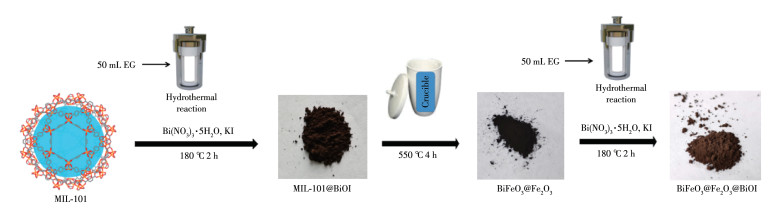
Figure 1.
Preparation of 1-BFB

Decorated BiOI on MIL-101(Fe)@BiOI derived BiFeO3@Fe2O3 for improved photocatalytic performance
Yu ZHU , Wei-Qi LUO , Dong-Mei HOU , Chu-Wen LI , Zheng-Zhou DUAN , Qin-Yun XU , Gui-Cheng GAO , Ji-Jun TANG


Materials of Institute Lavoisier (MIL), one of the categories of metal - organic frameworks (MOF), is a porous nanomaterial formed from terephthalic acid and transition metals, with large specific surface area, high porosity, multi - functionality, tunable structural function, and high stability. Typically, MIL-templatederived materials can inherit the advantages of MIL and have been used in a wide range of excellent applications, such as supercapacitors, lithium-ion batteries, and catalysis[1].
Tetracycline (TC), one of the most common antibiotics, is becoming a significant pollutant in the water environment due to its widespread and inappropriate use in human life and pharmaceutical production[2]. Semiconductor - based photocatalytic degradation technology has attracted a lot of attention in the removal of pollutants from the aqueous environment because of its green - friendly and energy - saving properties[3]. Most recently, visible-light active BiFeO3 has drawn growing interest due to its ease of preparation and easy band gap adjustment[4]. However, the photocatalytic activity of pure BiFeO3 is still very low because of the low charge transfer efficiency. The development of new and more efficient BiFeO3-based photocatalysts is essential to meet the requirements of future environmental applications and make better use of solar energy[5].
It is widely accepted that strengthening the separation of photogenerated electron - hole pairs and prolonging the visible light reaction are two effective methods[6]. The recombination of light - generated electronhole pairs can be effectively suppressed once BiFeO3 is coupled to another semiconductor with a suitable conduction band (CB) or valence band (VB) position[7]. For example, BiOX@BiFeO3 and Fe2O3@BiFeO3 binary heterostructures were developed, which showed stronger photocatalytic activity in the oxidative degradation of organic pollutants. Meanwhile, BiOX and Fe2O3 were both very sensitive to visible light, which may also be beneficial for the extension of visible light response[8-9].
Several new photocatalysts, focusing on metal oxide and oxygen-acid composite semiconductors with narrow band gaps, have now been investigated for photocatalytic applications[10]. Inorganic BiOI has been reported to be a promising oxy-acid photocatalyst. Among bismuth oxyhalides (BiOX, X=F, Cl, Br, Ⅰ), BiOI with a narrow band gap (1.77 eV) exhibits great photocatalytic performance in practical experiments under visible light irradiation. Fe2O3 with a narrow band gap (2.2 eV) is a potential visible light - driven n-type semiconductor due to its low cost, high thermodynamic stability, and environment friendliness[11-12]. However, the short lifetime of the photogenerated charge carriers and the small hole diffusion length greatly hinder the widespread use of Fe2O3 in photocatalysis[13]. What′s more, when Fe2O3 were dispersed onto the surface of a semiconductor with suitable CB edges, such as BiFeO3, BiOI, WO3, BiPO4, or TiO2, high stability as well as superior visible-light photocatalytic activity of Fe2O3 can be attained[14]. Since both BiOI and Fe 2 O3 are suitable for modifying BiFeO3, it is desirable to devise a ternary composite containing BiOI, Fe2O3, and BiFeO3.
In this study, new visible-light active BiFeO3@Fe2O3@BiOI ternary composites have been prepared by calcination of MOF precursors and hydrothermal method. The photocatalytic performance of TC degradation with BiFeO3@Fe2O3@BiOI in the absence and presence of organic pollutants was investigated[15]. In-depth studies were carried out to investigate the effects of changes in complex composition and reaction conditions[16]. Finally, a capture experiment was carried out to study the factors affecting the photocatalyst.
The consumable chemicals were absolute ethanol (EtOH), ethylene glycol (EG), iron(Ⅲ) chloride hexahydrate (FeCl3·6H2O), N, N-dimethylformamide (DMF), 1, 4-benzene-dicarboxylic acid (C8H6O4), sodium hydroxide (NaOH), hydrogen chloride (HCl), isopropyl alcohol (C3H8O), benzoquinone(C6H 4 O2) and sodium oxalate(C2Na2O4), all purchased from Merck Company. The bismuth nitrate pentahydrate (Bi(NO3)3·5H2O), potassium iodide(KI), and tetracycline hydrochloride (C22H25ClN 2O8) were purchased from Sigma-Aldrich.
Following a reported procedure[17], 0.675 g (2.45 mmol) FeCl3 ·6H2O, 0.206 g (1.24 mmol) 1,4-benzenedicarboxylic acid, and 15 mL DMF was heated in a polytetrafluoroethylene lined hydrothermal reactor at 110 ℃ for 20 h. The orange powder was centrifuged after cooling to room temperature and washed three times with H2O and ethanol. The orange powder was finally dried at 80 ℃ under a vacuum for 12 h to obtain MIL-101(Fe).
Fe2O3 was obtained through calcined in a muffle furnace at 600 ℃ for 5 h and cooled in the furnace to room temperature.
MIL-101(Fe) (0.711 g, 0.001 mol), Bi(NO3)3·5H2O (0.485 g, 0.001 mol), and 1 g KI were dissolved and suspended in 50 mL of EG and stirred for 20 min. Then, it was added to a polytetrafluoroethylene - lined hydrothermal reactor and reacted at 180 ℃ for 2 h. The suspension obtained was washed three times with water and ethanol and dried in an oven at 80 ℃ for 12 h.
MIL-101(Fe) (0.711 g, 0.001 mol), Bi(NO3)3·5H2O (0.161 g, 0.00033 mol), and 0.33 g KI were dissolved in 50 mL of EG and stirred for 20 min. Then, it was added to a polytetrafluoroethylene-lined hydrothermal reactor and reacted at 180 ℃ for 2 h. The obtained suspension was aged for 1 h, centrifuged, washed several times with water and ethanol, and dried at 80 ℃ overnight. The brown powder was calcined in a muffle furnace at 600 ℃ for 5 h and cooled in the furnace to obtain BiFeO3.
MIL - 101(Fe)@BiOI in three calculated mass ratios (6∶1, 5∶1, 4∶1) was put into a crucible, wrapped in tin foil, calcined at 600 ℃ for 5 h in a muffle furnace, and cooled in the furnace. Three mass ratios of BiFeO3 and Fe2O3 (1∶1, 1∶2, 2∶1) were synthesized to explore the best ratio for enhancing activity. When the mass ratio of BiFeO3 and Fe2O3 was 1∶1, we denoted it as 1-BF for clear presentation. Similarly, 2-BF and 0.5-BF mean that the mass ratios of BiFeO3 and Fe 2O3 were 2∶1 and 1∶2, respectively.
BiFeO3@Fe2O3 (0.891 g, 0.001 mol), Bi(NO3)3·5H2O (0.485 g, 0.001 mol), and 1g KI were dissolved in 50 mL EG and stirred for 20 min. Then, it was added to a polytetrafluoroethylene-lined hydrothermal reactor and reacted at 180 ℃ for 2 h. The obtained suspension was aged for 1 h, centrifuged, washed with water and ethanol several times, and dried at 80 ℃ overnight. BiFeO3@Fe2O3@BiOI (1-BFB) indicates that the mass ratio of BiFeO3, Fe2O3, and BiOI was 1∶1∶1. The preparation flow chart of 1-BFB is shown in Fig. 1.
X-ray diffraction (XRD) data were collected with Cu Kα radiation (λ =0.154 nm) on a Shimadzu XRD-6000 instrument (voltage: 40 kV, current: 30 mA, scan range: 5°-80°, scan speed: 5 (°)·min-1). Scanning electron microscopy (SEM) was performed on a Japan Electronics JSM-6480 microscope to observe the morphology of the photocatalysts. High-resolution transmission electron microscopy (HRTEM) and scanning TEM elemental mapping were achieved by an FEI Tecnai G2 F30 microscope (accelerating voltage: 300 kV). X-ray spectroscopy (XPS) was used to study the binding energies of all the elements of composite materials. FTIR spectra were obtained using an Agilent spectrometer in a wavenumber range of 4 000-400 cm-1. The UV - Vis absorption spectra were recorded on a Hitachi U4100 UV spectrometer. Fluorescent spectra were obtained on an FS5 spectrofluorometer. The transient photo-current measurements were performed using a DH-7000 Electrochemical Workstation (Jiangsu Donghua Analysis Instruments Co., Ltd., China), equipped with three electrodes including an ITO electrode covered with the samples, Pt and Ag@AgCl electrodes. For the single working electrode, 5 mg of the sample was dispersed in 10 μL Nafion and then added 0.1 mL anhydrous ethanol to make a homogeneous solution. Then, 40 μL of the above solution was dropped onto the ITO conducting glass. The 0.5 mol·L-1 Na2SO4 aqueous solution was used as the electrolyte and exposed with a Xe lamp (250 W, λ > 420 nm). The impedance test was performed in a frequency range of 0.1 Hz-10 kHz with an amplitude of 0.005 V, a silence time of 2 s, and an initial potential of 0.071 V.
The photocatalytic degradation of TC under visible light irradiation was studied with the photocatalysts. A 250 W xenon lamp (λ≥420 nm) and an ultraviolet cut-off filter were used as the visible light source. The photocatalyst (50 mg) was dispersed in 100 mL TC aqueous solution (10 mg·L-1) and stirred for 30 min away from light to ensure the adsorption - desorption equilibrium. After centrifugation of the suspension to remove the catalyst from the aqueous solution, the absorbance of TC was analyzed at 357 nm using a UV-Vis spectrophotometer (Persee TU-1901, China) to detect the concentration of TC in the solution.
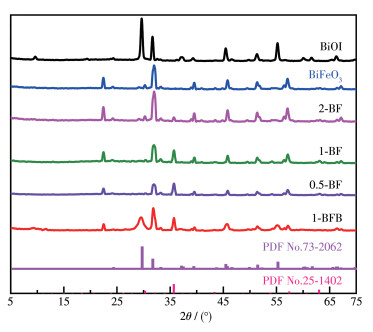
Fig. 2 shows the XRD patterns of composites BiFeO3, Fe2O3, BiOI, BiFeO3@Fe2O3, and BiFeO3@ Fe2O3@BiOI. As shown in Fig. 2, the XRD patterns reflect the tetragonal phase of BiOI (PDF No.73-2062), with the main diffraction peaks at 2θ being 29.73°, 31.72°, 45.46°, and 55.23°[18]. Moreover, the peaks at 2θ of 22.51°, 32.11°, and 45.97° are indexed to the (101), (110), and (202) planes of BiFeO3 (PDF No.72-2321). Other diffraction peaks were observed at 2θ = 28.08°, 31.1° and 53.4°[19-20], which are similar to those of the Fe2O3 hematite phases with rhombohedra (PDF No.25-1402), suggesting the successful construction of Fe2O3 on BiFeO3. For 1-BFB, different peaks corresponding to BiFeO3 and Fe2O3, and BiOI can be observed, indicating the ternary composite was successfully synthesized[21].
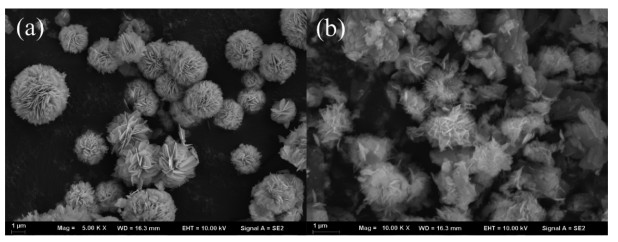
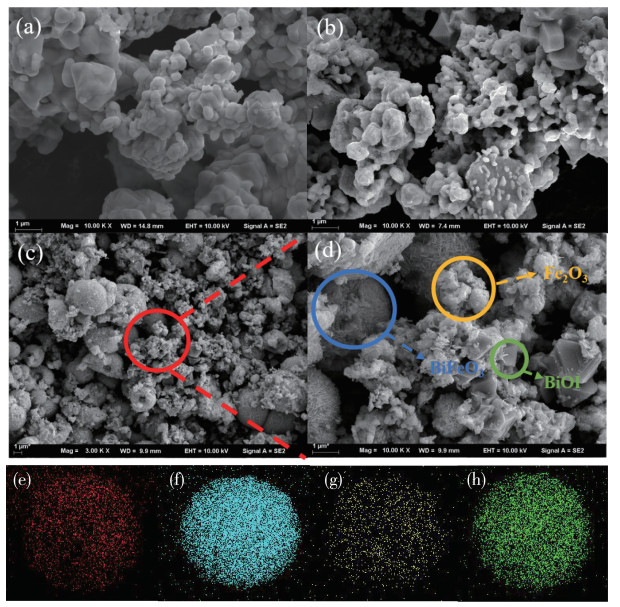
To study the surface morphology of the synthesized samples, they were characterized using SEM images. As shown in Fig. 3b, BiOI presented a uniform 3D microsphere structure, uniformly distributed on the surface of MIL-101(Fe). In Fig. 4a, BiFeO3 particles synthesized by calcination were agglomerated. Fe2O3 was attached to the surface of BiFeO3 through a calcination reaction (Fig. 4b). After being decorated with BiOI, Fe2O3 and BiOI nanoparticles could be observed to anchor on the surface of ball-like BiFeO3, where the hollow structure was collapsed (Fig. 4c and 4d) [22-23]. This indicates that ternary composites with a heterojunction structure have been successfully synthesized. Fig. 4e-4h presents the element mapping and energy dispersive spectrum of 1-BFB for elements O, I, Fe, and Bi. No other impurities were discovered.
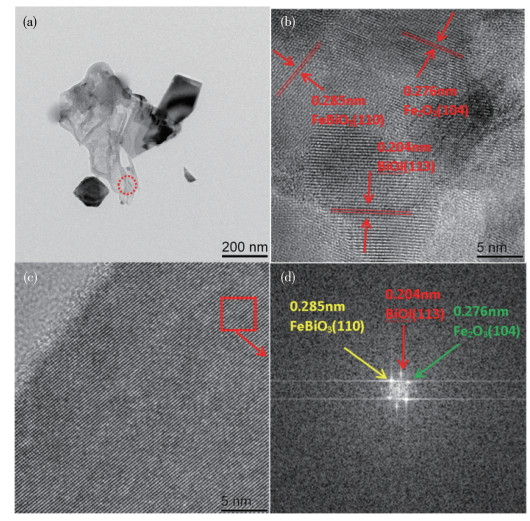
The HRTEM image (Fig. 5b) showed a lattice spacing of 0.285 nm which corresponds to the (110) plane of BiFeO3, a lattice fringe at 0.276 nm which is ascribed to the (104) plane of Fe2 O3, and a lattice fringe at 0.204 nm which is ascribed to the (113) plane of BiOI. The FFT (fast Fourier transform) image has been derived by selecting the square area in Fig. 5c. The FFT image gave three groups of adjacent symmetrical points, which can be indexed to the planes of (110) of BiFeO3, (104) of Fe2O3 and (113) of BiOI (Fig. 5d). This also verifies the successful preparation of 1-BFB. All the above results confirm the successful formation of as-prepared heterojunctions.
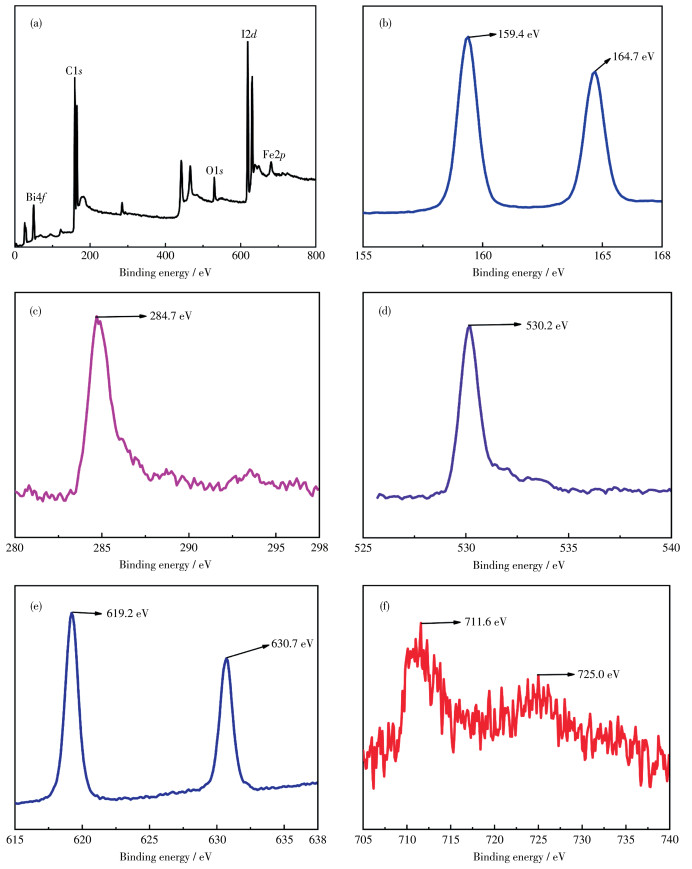
XPS spectra of 1-BFB are displayed in Fig. 6a, for analyzing the surface element compositions and the chemical states of all elements in as-prepared photocatalysts. The binding energy of the obtained samples was calibrated by the C1s peak at 284.7 eV (Fig. 6c). The high-resolution XPS spectrum of Bi4f revealed that two peaks presented at 159.04 and 164.7 eV are assigned to Bi4 f7/2 and Bi4f5/2 spin states, which are corresponding to the oxidation state of Bi3+ in BiFeO3 and BiOI (Fig. 6b). The binding energy of O peak at 530.2 eV corresponding to O1s can represent for O2- in BiFeO3, BiOI, and Fe2O3 (Fig. 6d). The binding energies of I peaks at 619.2 and 630.7 eV corresponding to I3d5/2 and I3d3/2 can represent for I- in BiOI (Fig. 6e). The binding energies of Fe peaks at 711.6 and 725.0 eV corresponding to Fe2p3/2 and Fe2p1/2 can represent for Fe3+ in BiFeO3 and Fe2O3 (Fig. 6f).
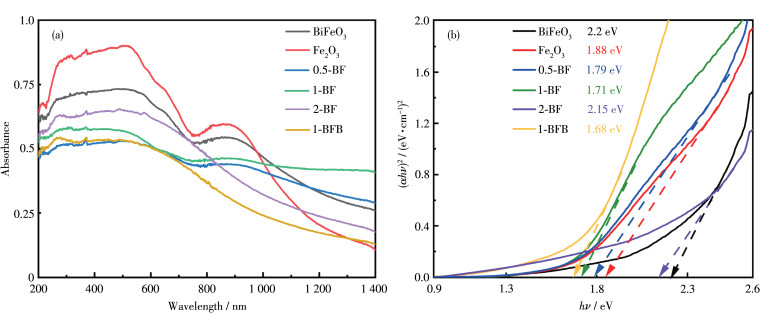
The UV-Vis absorption spectra of BiFeO3, Fe2O3, 0.5-BF, 1-BF, 2-BF, and 1-BFB are shown in Fig. 7. The band edges of the light absorption coefficients follow the Tauc plot as a function of (αhν)2=A(hν-Eg), where Eg, ν, h, and A are the band gap, optical frequency, Planck′s constant, and constant, respectively[24]. The Eg of the photocatalyst was evaluated by plotting (αhν)1/2 vs the optical energy (hν) [25]. The estimated band gaps for BiFeO3, Fe2O3, 1-BF, and 1-BFB were about 2.20, 1.88, 1.71, and 1.68 eV, respectively. The reduction in band gap results in better visible light response and enhanced photocatalytic activity.
The photocatalytic performance of the prepared photo-catalyst was assessed by the degradation of TC under visible light irradiation (Fig. 8). When BiFeO3, 1-BF, 0.5-BF, 2-BF, and 1-BFB were induced as photocatalysts, 40%, 53%, 52%, 51% and 96% of TC can be removed respectively. The enhanced removal of this material can be attributed to the powerful adsorption capacity of the hollow flower-like structure derived from BiOI[26].
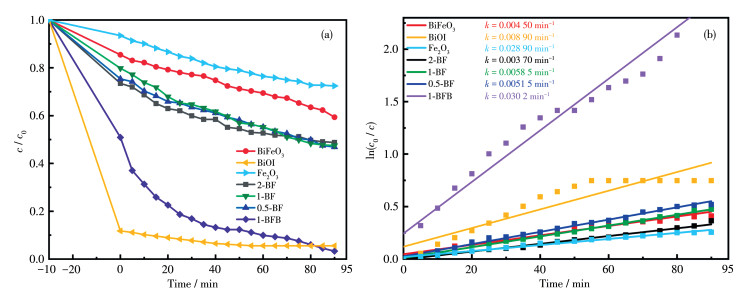
1-BFB shows higher photocatalytic activity compared with BiFeO3 and BiFeO3@Fe2O3 composites, indicating improved charge transfer in 1-BFB[27]. The photodegradation of organic pollutants usually follows a pseudo-first-order equation:
|
|
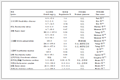
where c (mol·L-1) is the transient concentration of the TC concentration in solution at time t, c0 is reactant concentration at t=0 and k is the epiphenomenal pseudo-first-order rate constant[28]. The linear fitting results are shown in Fig. 8b. The results show that the charge transfer efficiency of BiFeO3@Fe2O3 composites can be improved by combining BiOI to create effective heterogeneous functional structures. Due to the charge potential difference and interfacial interactions between BiFeO3, Fe2O3, and BiOI, BiOI can serve as a good platform to facilitate the separation and transfer of electron-hole pairs[29]. Table 1 shows that 1-BFB can be an excellent photocatalyst compared to the materials reported[30-35].
 下载:
导出CSV
下载:
导出CSV
| Sample | mcat/mg | ρTC/(mg·L-1) | Removal efficiency/% | Time/min | Ref. |
| BiFeO3/Bi2O3 | 20 | 30 | 80.0 | 120 | [30] |
| BiFeO3/TiO2 | 50 | 10 | 67.9 | 180 | [31] |
| BiFeO3/Bi2WO6/g-C3N4 | 10 | 10 | 83.7 | 45 | [32] |
| BiFeO3/BNQDs | 20 | 10 | 80.0 | 180 | [33] |
| BiFeO3/MnFeO3 | 20 | 10 | 91.9 | 180 | [34] |
| BiFeO3/Er | 200 | 30 | 57.8 | 180 | [35] |
| BiFeO3@Fe2O3@BiOI | 50 | 10 | 96 | 90 | This work |
In addition, the TOC (total organic carbon) removal efficiency during the photocatalytic TC removal process was investigated to determine the degree of mineralization of the pollutant over 1-BFB. The TOC removal efficiencies at 0 and 60 min were 41% and 75%, respectively. The TOC measurement can detect the intermediates of TC in the photocatalytic process, resulting in a lower removal efficiency than the UV-Vis measurement.
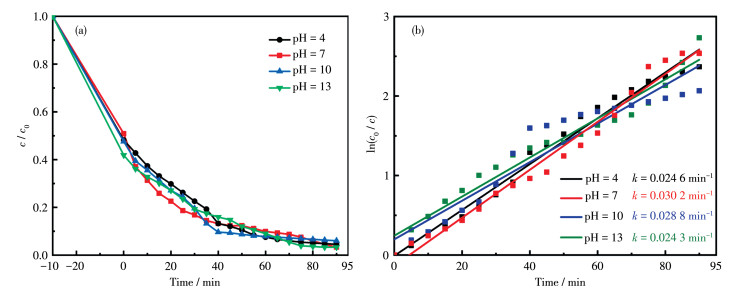
The pH is considered to have a significant influence on the TC degradation activity. Fig. 9 shows that the degradation rate constant was highest at pH=7 and slightly decreased under acidic (pH=4) or alkaline (pH =13) conditions. However, it is easy to see from Fig. 9 that the effect on the degradation activity of 1-BFB is limited at different pH environments, indicating that the material has good stability. In acidic or alkaline environments, TC molecules generate an electrical charge creating an electrostatic effect on the composite surface, thus enhancing the adsorption capacity of the composite[36-37].
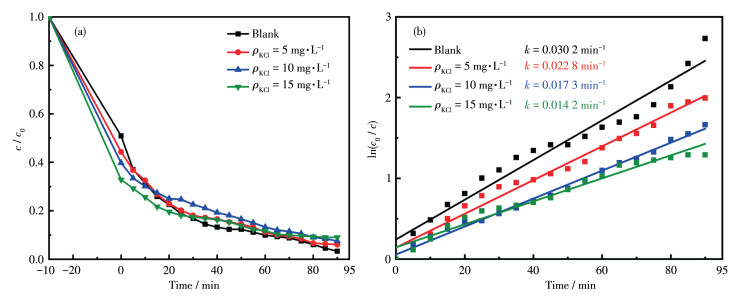
The ionic strength is another major factor affecting the TC degradation activity. The ionic strength has an effect on the sorption of TC in the dark. When the KCl concentration was increased from 0 to 15 mg·L-1 (Fig. 10), the adsorption capacity of 1-BFB increased slightly, which may be due to the electrostatic interaction after the addition of KCl[38].
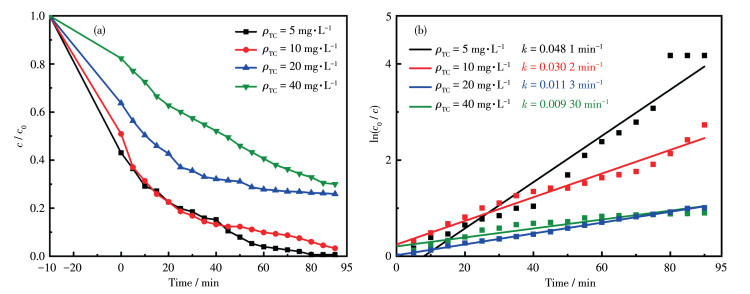
Under the environment of TC concentration of 10-40 mg·L-1, the effect of different initial TC concentrations on the degradation was studied. The TC concentration has an important influence on the adsorption and photocatalytic processes (Fig. 11). As the TC concentration increased, the degradation efficiency of the catalyst gradually decreased. The sharp drop in the degradation rate constant should be due to because the TC concentration is too high, the excess TC molecules collect and adsorb on the surface of 1-BFB, which impedes the transfer of visible light[39].
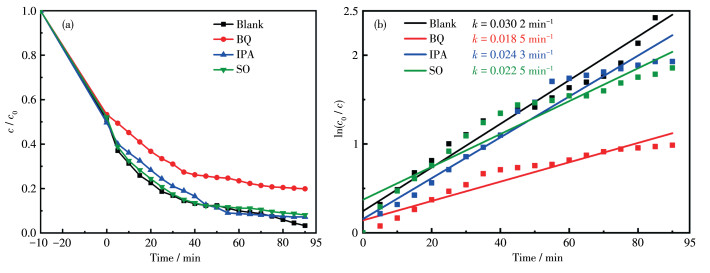
Taking 1-BFB as an example, reactive radical capture tests were carried out on the degradation reactions of TC. Isopropyl alcohol (IPA), p-benzoquinone (BQ), and sodium oxalate (SO) were selected as scavengers for ·OH, ·O2-, and h+ [40]. As shown in Fig. 12, when BQ was added, the degradation efficiency of TC decreased, indicating ·O2- is the major active substance in the degradation process.
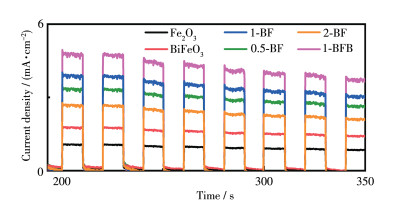
The transfer and generation of light-excited charge carriers have been studied by transient photocurrent reactions in the presence or absence of visible illumination. Stronger photocurrent intensities tend to reveal higher efficiency in the separation of holes and electrons[41]. Fig. 13 illustrates the instantaneous photocurrent curve of BiFeO3, Fe2O3, 1-BF, 0.5-BF, 2-BF, and 1-BFB. 1-BFB showed the highest photocurrent response with intensities 3.02 and 2.10 times those of pristine BiFeO3 and Fe2O3, respectively. This indicates that a more efficient electron and hole separation efficiency occurs in the 1 -BFB heterojunction, leading to a significant increase in photocatalytic activity[42].
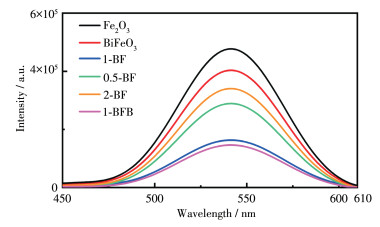
To further confirm the separation of the effective charge in the material, the samples were analyzed by fluorescence spectroscopy. An emission peak could be seen near 546 nm due to the recombination of photogenerated electrons and valence band holes (Fig. 14). The peak intensity of BiFeO3 was 3.02 times that of 1-BFB, which is consistent with the photocurrent test results. The composites had lower emission intensity, suggesting that they are more conducive to charge separation, which inhibits the recombination of electronhole pairs.
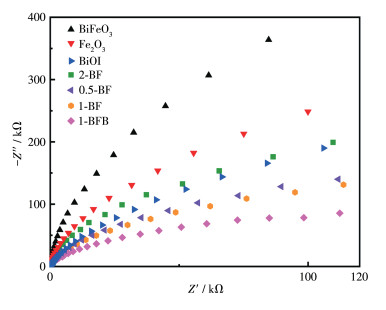
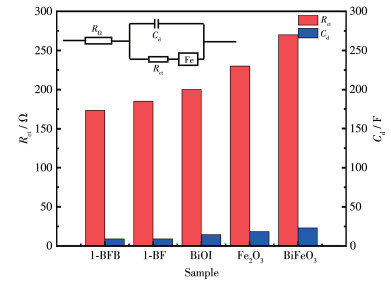
The charge transfer efficiency at semiconductor phototube interfaces was verified by electrochemical impedance spectroscopy (EIS). Fig. 15 displays the EIS Nyquist plots of BiFeO3, Fe2O3, BiFeO3@Fe2O3, and 1-BFB composites. The curve arc of 1-BFB was significantly lower than the other samples, indicating that the transfer resistance of the charge carriers at the surface of 1-BFB is smaller[43]. Fig. 16 shows the resistance Rct values for each sample, with the phase angle changes concentrated in the low - frequency region, indicating that the response of the material to the circuit is mainly in the low-frequency region.
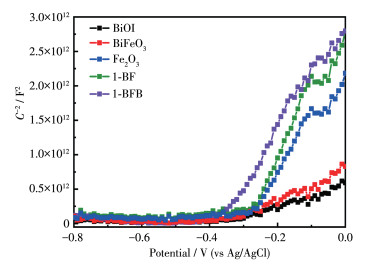
The charge density in a semiconductor is verified by testing the Mott-Schottky curves. Fig. 17 shows the Mott-Schottky curves for the monomers and composites, and the positive slope of the Mott-Schottky plot indicates that both 1-BFB and BiFeO3 are n-type semiconductors[44]. The slopes of the Mott-Schottky curves of all composite samples were higher than those of BiFeO3, Fe2O3, and BiOI, implying that the carrier densities of the composite samples are higher than those of the monomer samples. In particular, 1-BFB had the best carrier density. The carrier improvement can be attributed to two factors. Firstly, the compounding of the three semiconductors decreases the band gap width, which improves the absorption efficiency of light and facilitates the production of photoelectrons and holes. Secondly, the forming of heterojunctions facilitates the separation of photoelectrons and holes and inhibits the recombination of photogenerated carriers, thus extending their lifetimes[45].
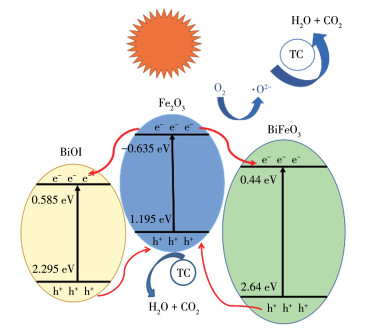
The energy level diagram of the material ground charge separation and transfer between BiFeO3, Fe2O3, and BiOI catalyst surfaces under optical excitation is shown in Fig. 18. The valence band (VB) and conduction band (CB) potentials of BiFeO3, Fe2O3, and BiOI were determined from the literature[46]. The VB and CB energetic potentials were about 2.44 and 0.64 eV for BiFeO3, 1.195 and -0.635 eV for Fe2O3, and 1.59 and -0.25 eV for BiOI. The electrons on the CB of Fe2O3 can interact with the absorbed O2 to create reactive species superoxide radicals (·O2-), which contributes to the degradation of TC[47-48]. Meanwhile, the holes on the VB of BiOI and BiFeO3 migrated to the VB of Fe2O3 with weaker oxidative activity because of the lower energetic potential of 1.195 eV, which is in accordance with the reactive radical capture test.
A ternary composite of BiFeO3@Fe2O3@BiOI was prepared by calcination and hydrothermal methods. As compared to BiFeO3, Fe2O3, and BiOI monomers, the formation of BiFeO3@Fe2O3@BiOI heterojunction enhances the photocatalytic activity of photocatalyst. The trapping experiment showed that ·O2- is the prime active molecule. BiFeO3@Fe2O3@BiOI displays n-type heterojunction, which can improve the separation efficiency of electrons and holes, reduce carrier recombination and produce an increased number of active ·O2- molecules. Therefore, BiFeO3@Fe2O3@BiOI is very promising as a photocatalyst for the degradation of TC.
Mehraj O, Pirzada B M, Mir N A, Khan M Z, Sabir S. A highly efficient visible-light-driven novel p-n junction Fe2O3/BiOI photocatalyst: Surface decoration of BiOI nanosheets with Fe2O3 nanoparticles[J]. Appl. Surf. Sci., 2016, 387(30): 642-651.
Wang Q, Shi X, Liu E, C J, Crittenden , Ma X J, Zhang Y, Cong Y Q. Facile synthesis of AgI/BiOI-Bi2O3 multi - heterojunctions with high visible light activity for Cr(Ⅵ) reduction[J]. J. Hazard. Mater., 2016, 317: 8-16. doi: 10.1016/j.jhazmat.2016.05.044
Chang M J, Wang H, Li H L, Liu J, Du H L. Facile preparation of novel Fe2O3/BiOI hybrid nanostructures for efficient visible light photocatalysis[J]. J. Mater. Sci. Technol., 2017, 53(5): 3682-3691.
Zhang Y, Li Y, Sun W N, Yuan C X, Wang B X, Zhang W, Song X M. Fe2O3/BiOI - based photoanode with n-p heterogeneous structure for photoelectric conversion[J]. Langmuir, 2017, 33(43): 12065-12071. doi: 10.1021/acs.langmuir.7b02969
Bera S, Ghosh S, Shyamal S, Bhattacharya C, Basu R N. Photocatalytic hydrogen generation using gold decorated BiFeO3 heterostructures as an efficient catalyst under visible light irradiation[J]. Sol. Energy Mater. Sol. Cells, 2019, 194: 195-206. doi: 10.1016/j.solmat.2019.01.042
Wang C C, Cai M J, Liu Y P, Yang F, Zhang H Q, Liu J S, Li S J. Facile construction of novel organic-inorganic tetra(4-carboxyphenyl) porphyrin/Bi2MoO6 heterojunction for tetracycline degradation: Performance, degradation pathways, intermediate toxicity analysis, and mechanism insight[J]. J. Colloid Interface Sci., 2022, 605: 727-740. doi: 10.1016/j.jcis.2021.07.137
Di L J, Yang H, Xian T, Liu X Q, Chen X J. Photocatalytic and photo-Fenton catalytic degradation activities of Z-scheme Ag2S/BiFeO3 heterojunction composites under visible-light irradiation[J]. Nanomaterials, 2019, 9(3): 399. doi: 10.3390/nano9030399
Hu X J, Wang W X, Xie G Y, Wang H, Tan X F, Jin Q, Zhou D X, Zhao Y L. Ternary assembly of g-C3N4/graphene oxide sheets/BiFeO3 heterojunction with enhanced photoreduction of Cr(Ⅵ) under visible-light irradiation[J]. Chemosphere, 2019, 216: 733-741. doi: 10.1016/j.chemosphere.2018.10.181
Huo H W, Hu X J, Wang H, Li J, Xie G Y, Tan X F, Jin Q, Zhou D X, Li C, Qiu G Q, Liu Y G. Synergy of photocatalysis and adsorption for simultaneous removal of hexavalent chromium and methylene blue by g-C3N4/BiFeO3/carbon nanotubes ternary composites[J]. Int. J. Environ. Res. Public Health, 2019, 16(17): 3219. doi: 10.3390/ijerph16173219
Shang J, Chen H G, Chen T Z, Wang X W, Feng G, Zhu M W, Yang Y X, Jia X S. Photocatalytic degradation of rhodamine B and phenol over BiFeO3/BiOCl nanocomposite[J]. Appl. Phys. A-Mater. Sci. Process., 2019, 125(2): 1-7.
Xie Y Y, Zhang C S, Wang D T, Lu J F, Wang Y H, Wang J, Zhang L Z, Zhang R Q. Catalytic performance of a Bi2O3-Fe2O3 system in soot combustion[J]. New J. Chem., 2019, 43(38): 15368-15374. doi: 10.1039/C9NJ03419F
Yang Q Q, Deng J X, Wang G S, Deng Q S, Zhao J L, Dai Y X, Duan P, Cui M, Kong L, Gao H L, Nie R J, Wang F. The physical properties and microstructure of BiFeO3/YBCO heterostructures[J]. Vacuum, 2019, 167: 313-318. doi: 10.1016/j.vacuum.2019.06.025
Li S J, Shen X F, Liu J S, Zhang L S. Synthesis of Ta3N5/Bi2MoO6 core-shell fiber-shaped heterojunctions as efficient and easily recyclable photocatalysts[J]. Environ. Sci.-Nano, 2017, 4(5): 1155-1167. doi: 10.1039/C6EN00706F
Bai P J, Li Y T, Wang G, Han J, Wei Y X, Li M W, Mao D, Zeng Y M. Fabrication of Al2O3-coated BiFeO3 particles and fine - grained ceramics with improved electric properties[J]. J. Mater. Sci. - Mater. Electron., 2020, 31(23): 21723-21731. doi: 10.1007/s10854-020-04685-w
Li S J, Wang C C, Cai M J, Yang F, Liu Y P, Chen J L, Zhang P, Li X, Chen X B. Facile fabrication of TaON/Bi2MoO6 core - shell S-scheme heterojunction nanofibers for boosting visible-light catalytic levofloxacin degradation and Cr(Ⅵ) reduction[J]. Chem. Eng. J., 2022, 428: 131158. doi: 10.1016/j.cej.2021.131158
Guo Y H, Zhou S H, Sun X K, Yuan H L. Synthesis and photocatalytic activity of BiFeO3 and Bi/BiFeO3 cubic microcrystals[J]. J. Am. Ceram. Soc., 2020, 103(8): 4122-4128. doi: 10.1111/jace.17083
Huang Y X, Lin H, Zhang Y H. Synthesis of MIL-101(Fe)/SiO2 composites with improved catalytic activity for reduction of nitroaromatic compounds[J]. J. Solid State Chem., 2019, 283: 121150.
Lei Y X, Zhang Y P, Ding W M, Yu L Q, Zhou X P, Wu C M. Preparation and photoelectrochemical properties of BiFeO3/BiOI composites[J]. RSC Adv., 2020, 10(45): 26658-26663. doi: 10.1039/D0RA02457K
Mansingh S, Sultana S, Acharya R, Ghosh M K, Parida K M. Correction to efficient photon conversion via double charge dynamics CeO2-BiFeO3 p-n heterojunction photocatalyst promising toward N2 fixation and phenol-Cr(Ⅵ) detoxification[J]. Inorg. Chem., 2020, 59(9): 6646. doi: 10.1021/acs.inorgchem.0c00981
Margha F H, Radwan E K, Badawy M I, Gad-Allah T A. Bi2O3-BiFeO3 glass - ceramic: Controllable β-/γ-Bi2O3 transformation and application as magnetic solar - driven photocatalyst for water decontamination[J]. ACS Omega, 2020, 5(24): 14625-14634. doi: 10.1021/acsomega.0c01307
Rusly S N A, Ismail I, Matori K A, Abbas Z, Shaari , A H, Ibrahim I R. A study of multiferroic BiFeO3/epoxy resin composite as potential coating materials for microwave absorption[J]. Solid State Phenomena, 2020, 307: 20-25. doi: 10.4028/www.scientific.net/SSP.307.20
Zhang X Y, Wang X, Chai J N, Xue S, Wang R X, Jiang L, Wang J, Zhang Z H, Dionysiou D D. Construction of novel symmetric double Z-scheme BiFeO3/CuBi2O4/BaTiO3 photocatalyst with enhanced solar-light-driven photocatalytic performance for degradation of norfloxacin[J]. Appl. Catal. B-Environ., 2020, 272: 119017. doi: 10.1016/j.apcatb.2020.119017
Li H J, Zhuang J, Bokov A A, Zhang N, Zhang J, Zhao J Y, Ren W, Ye Z G. Evolution of relaxor behavior in multiferroic Pb (Fe2/3W1/3)O3-BiFeO3 solid solution of complex perovskite structure[J]. J. Eur. Ceram. Soc., 2021, 41(1): 310-318. doi: 10.1016/j.jeurceramsoc.2020.07.068
Su G, Liu L H, Liu X, Zhan L X, Xue J R, Tang A P. Magnetic Fe3O4@SiO2@BiFeO3/rGO composite for the enhanced visible - light catalytic degradation activity of organic pollutants[J]. Ceram. Int., 2021, 47(4): 5374-5387. doi: 10.1016/j.ceramint.2020.10.118
Zhu Y, Zhu M, Lv H, Zhao S, Shen X R, Zhang Q Y, Zhu W F, Li B D. Coating BiOCl@g-C3N4 nanocomposite with a metal organic framework: Enhanced visible light photocatalytic activities[J]. J Solid State Chem., 2020, 292: 121641. doi: 10.1016/j.jssc.2020.121641
Kadi M W, Mohamed R M, Ismail A A. Facile synthesis of mesoporous BiFeO3/graphene nanocomposites as highly photoactive under visible light[J]. Opt. Mater., 2020, 104: 109842. doi: 10.1016/j.optmat.2020.109842
Shi Y H, Li J S, Wan D J, Huang J H, Liu Y D. Peroxymonosulfate-enhanced photocatalysis by carbonyl - modified g-C3N4 for effective degradation of the tetracycline hydrochloride[J]. Sci. Total Environ., 2020, 749: 142313. doi: 10.1016/j.scitotenv.2020.142313
Liu N, Tang M Q, Jing C W, Huang W Y, Tao P, Zhang X D, Lei J Q, Tang L. Synthesis of highly efficient Co3O4 catalysts by heat treatment ZIF-67 for CO oxidation[J]. J. Sol-Gel Sci. Technol., 2018, 88: 163-171. doi: 10.1007/s10971-018-4784-x
Li S J, Wang C C, Liu Y P, Xue B, Jiang W, Liu Y, Mo L Y, Chen X B. Photocatalytic degradation of antibiotics using a novel Ag/Ag2S/Bi2MoO6 plasmonic p-n heterojunction photocatalyst: Mineralization activity, degradation pathways and boosted charge separation mechanism[J]. Chem. Eng. J., 2021, 415: 128991. doi: 10.1016/j.cej.2021.128991
Duan F, Ma Y, Lv P, Sheng J L, Zhu H, Du M L, Chen X, Chen M Q. Oxygen vacancy - enriched Bi2O3/BiFeO3 p-n heterojunction nanofibers with highly efficient photocatalytic activity under visible light irradiation[J]. Appl. Surf. Sci., 2021, 562: 150171. doi: 10.1016/j.apsusc.2021.150171
Liao X L, Li T T, Ren H T, Mao Z Y, Zhang X F, Lin J H. Enhanced photocatalytic performance through the ferroelectric synergistic effect of p-n heterojunction BiFeO3/TiO2 under visible-light irradiation[J]. Ceram. Int., 2021, 47(8): 10786-10795. doi: 10.1016/j.ceramint.2020.12.195
Wang T Y, Bai Y C, Si W, Mao W, Gao Y H, Liu S X. Heterogeneous photo-Fenton system of novel ternary Bi2WO6/BiFeO3/g-C3N4 heterojunctions for highly efficient degrading persistent organic pollutants in wastewater[J]. J. Photochem. Photobiol. A-Chem., 2021, 404: 112856. doi: 10.1016/j.jphotochem.2020.112856
Balta Z, Simsek E B. Uncovering the systematical charge separation effect of boron nitride quantum dots on photocatalytic performance of BiFeO3 perovskite towards degradation of tetracycline antibiotic[J]. J. Environ. Chem. Eng., 2021, 9(6): 106567. doi: 10.1016/j.jece.2021.106567
Balta Z, Simsek E B. Understanding the structural and photocatalytic effects of incorporation of hexagonal boron nitride whiskers into ferrite type perovskites (BiFeO3, MnFeO3) for effective removal of pharmaceuticals from real wastewater[J]. J. Alloy. Compd., 2022, 898: 162897. doi: 10.1016/j.jallcom.2021.162897
Zhou J B, Jiang L D, Chen D, Liang J H, Qin L S, Bai L Q, Sun X G, Huang Y X. Facile synthesis of Er-doped BiFeO3 nanoparticles for enhanced visible light photocatalytic degradation of tetracycline hydrochloride[J]. J. Sol-Gel Sci. Technol., 2019, 90(3): 535-546. doi: 10.1007/s10971-019-04932-5
Zhu Y, Han Z G, Zhao S Y, Zhang Q Y, Shen X R, Lv H, Liu J, Li B D. In-situ growth of Ag/AgBr nanoparticles on a metal organic framework with enhanced visible light photocatalytic performance[J]. Mater. Sci. Semicond. Process, 2021, 133: 105973. doi: 10.1016/j.mssp.2021.105973
Zhu M, Chen H M, Dai Y, Wu X Y, Han Z G, Zhu Y. Novel n-p-n heterojunction of AgI/BiOI/UiO-66 composites with boosting visible light photocatalytic activities[J]. Appl. Organomet. Chem., 2021, 35(5): e6186.
Wang H Y, Fu W Y, Chen Y W, Xue F Y, Shan G Y. ZIF-67-derived Co3O4 hollow nanocage with efficient peroxidase mimicking characteristic for sensitive colorimetric biosensing of dopamine[J]. Spectroc. Acta Pt. A-Molec. Biomolec. Spectr., 2021, 246: 119006. doi: 10.1016/j.saa.2020.119006
Hu L X, Hu H M, Lu W C, Lu Y S, Wang S Q. Novel composite Bi-FeO3/ZrO2 and its high photocatalytic performance under white LED visible-light irradiation[J]. Mater. Res. Bull., 2019, 120: 110605. doi: 10.1016/j.materresbull.2019.110605
Li Z D, Cheng L, Zhang K, Wang Z H. Enhanced photocatalytic performance by Y-doped BiFeO3 particles derived from MOFs precursor based on band gap reduction and oxygen vacancies[J]. Appl. Organomet. Chem., 2021, 35(3): 6113.
Li S J, Wang C C, Liu Y P, Cai M J, Wang Y N, Guo Y, Zhao W, Wang Z H, Chen X B. Photocatalytic degradation of tetracycline antibiotic by a novel Bi2Sn2O7/Bi2MoO6 S-scheme heterojunction: Performance, mechanism insight, and toxicity assessment[J]. Chem. Eng. J., 2022, 429: 132519. doi: 10.1016/j.cej.2021.132519
Bai Y, Ye L Q, Chen T, Wang L, Shi X, Zhang X, Chen D. Facet-dependent photocatalytic N2 fixation of bismuth-rich Bi5O7I nanosheets[J]. ACS Appl. Mater. Interfaces, 2016, 8(41): 27661-27668. doi: 10.1021/acsami.6b08129
Chao X J, Yang Z P, Kang C, Gu R. Effect of BiFeO3 addition on Bi2O3-ZnO-Nb2O5 based ceramics[J]. Curr. Appl. Phys., 2010, 10(1): 26-30. doi: 10.1016/j.cap.2009.04.007
Zhu Y, Wang Y M, Liu P, Xia C K, Wu Y L, Lu X Q, Xie J M. Two chelating-amino-functionalized lanthanide metal-organic frameworks for adsorption and catalysis[J]. Dalton Trans., 2015, 44(4): 1955-1961. doi: 10.1039/C4DT02048K
Li Z D, Zhang S L, Xu R C, Zhang Q W, Wang Z H, Fu C L. Photocatalytic performance of BiFeO3 based on MOFs precursor[J]. Appl. Organomet. Chem., 2019, 33(10): e5105.
Li S J, Chen J L, Hu S W, Wang H L, Jiang W, Chen X B. Facile construction of novel Bi2WO6/Ta3 N5 Z-scheme heterojunction nanofibers for efficient degradation of harmful pharmaceutical pollutants[J]. Chem. Eng. J., 2020, 402: 12616.
Lam S M, Sin J C, Mohamed A R. A newly emerging visible light-responsive BiFeO3 perovskite for photocatalytic applications: A mini review[J]. Mater. Res. Bull., 2017, 90: 15-30. doi: 10.1016/j.materresbull.2016.12.052
Li S J, Wang C C, Liu Y P, Xue B, Chen J L, Wang H W, Liu H. Facile preparation of a novel Bi2WO6/calcined mussel shell composite photocatalyst with enhanced photocatalytic performance[J]. Catalysts, 2020, 10(10): 1166. doi: 10.3390/catal10101166

Figure 4 SEM images of (a) BiFeO3, (b) 1-BF, (c, d) 1-BFB and corresponding elemental mappings of O (e), I(f), Fe(g) and Bi(h)

Figure 5 (a) TEM and (b, c) HRTEM images of 1-BFB; (d) FFT image in the red square box in c

Figure 6 XPS spectra of 1-BFB: (a) survey, (b) Bi4f, (c) C1s, (d) O1s, (e) I3d, and (f) Fe2p

Figure 8 (a) Degradation efficiencies and (b) fitted rate constants for photocatalytic degradation of TC (10 mg·L-1) by as-prepared samples

Figure 9 Photocatalytic degradation of TC (10 mg·L-1) by 1-BFB in the solutions with different pH values: (a) degradation efficiencies and (b) fitted rate constants

Figure 10 Photocatalytic degradation of TC (10 mg·L-1) by 1-BFB in the solutions containing KCl with different concentrations: (a) degradation efficiencies and (b) fitted rate constants

Figure 11 Photocatalytic degradation of TC (10 mg·L-1) by 1-BFB in the solutions with different initial TC concentrations: (a) degradation efficiencies and (b) fitted rate constants

Figure 12 Photocatalytic degradation of TC (10 mg·L-1) by 1-BFB in the presence of different inhibitors: (a) degradation efficiencies and (b) fitted rate constants

Figure 16 Equivalent circuit diagram (Inset) and Rct and Cd values for the monomers and composites

Figure 18 Energy band structure and charge separation map of 1-BFB and possible ways of photodegradation of pollutants
Table 1. Comparison with reported BiFeO3-based photocatalysts for degradation of TC
| Sample | mcat/mg | ρTC/(mg·L-1) | Removal efficiency/% | Time/min | Ref. |
| BiFeO3/Bi2O3 | 20 | 30 | 80.0 | 120 | [30] |
| BiFeO3/TiO2 | 50 | 10 | 67.9 | 180 | [31] |
| BiFeO3/Bi2WO6/g-C3N4 | 10 | 10 | 83.7 | 45 | [32] |
| BiFeO3/BNQDs | 20 | 10 | 80.0 | 180 | [33] |
| BiFeO3/MnFeO3 | 20 | 10 | 91.9 | 180 | [34] |
| BiFeO3/Er | 200 | 30 | 57.8 | 180 | [35] |
| BiFeO3@Fe2O3@BiOI | 50 | 10 | 96 | 90 | This work |
 下载: 导出CSV

 扫一扫看文章


扫一扫关注我们