Received Date:
29 November 2022 Revised Date:
23 April 2023 Available Online:
10 June 2023
Abstract:
By tuning the solvothermal reaction conditions, we prepared three Ni(Ⅱ)-based coordination polymers (CPs), namely[Ni(CH3-BDC)(3-TBT)(H2O)2]·EtOH·2H2O (CP1), [Ni3(CH3-BDC)3(3-TBT)2(H2O)5]·2DMF·2H2O (CP2), and[Ni3(CH3-BDC)3(3-TBT)2(H2O)6]·2DMF·4H2O (CP3), where CH3-H2BDC=5-methyl isophthalic acid, 3-TBT=2, 4, 6-tris(3-pyridyl)-1, 3, 5-benzene. X-ray single crystal diffraction analyses reveal that three CPs are constructed from similar Ni2(CH3-BDC)2 binuclear units and exhibited different zero-dimensional (0D), 2D, and 3D networks, respectively. Meanwhile, the catalytic experiments show that CP3 exhibits the best catalytic activities and cycle stability for the oxidative coupling reaction of benzyl alcohol and its derivatives with aniline under solvent-free conditions.
During the past few decades, coordination polymers (CPs), as one kind of relatively novel crystalline materials[1-2], have attracted considerable interest from chemists and materials scientists, not only for their promising applications in gas separation and storage, catalysis, magnetism, optoelectronics, luminescent sensing[3-9] but also for their interesting structural variety. Generally speaking, CPs is obtained by the self-assembling reaction of metal ions and organic bridging ligand under hydro/solvothermal conditions. Nowadays, the enormous growth of synthesis methods has led to an increasing number of CPs. However, the accurate control of final compounds with controllable networks and properties is still a challenging task because uncontrollable factors, including the molar ratio of reactants, metal salts, solvent, pH, and the reaction temperature, will influence the structure of the final compounds[10-11]. We aim to explore the assembly and structural properties of CPs with C3-symmetric ligands, such as benzene-1, 3, 5-tribenzoic acid (H3BTB) and 1, 3, 5-benzene-tricarboxylic acid (multi-carboxylate ligands), and 2, 4, 6-tris(n-pyridyl)-1, 3, 5-triazine (n-TPT, n=3 or 4) and 2, 4, 6-tris(n-pyridyl)-1, 3, 5-benzene) (n-TBT, n=3 or 4) (multi-pyridyl ligands) [12-14]. In our previous work, we have shown the systematic research of some CPs containing C3-symmetric ligands by modifying connection nodes and multi-carboxylate ligands. In the present work, we demonstrated the synthesis, characterization, and catalytic properties of three Ni(Ⅱ)-based CPs with different structures. These Ni(Ⅱ)-based CPs (CP1-CP3) were obtained through the reaction of Ni(Ⅱ) ions with CH3-H2BDC (5-methyl isophthalic acid) and 3-TBT under controllable solvothermal conditions. CP1 exhibits Ni2(3-TBT)2(CH3-BDC)2 binuclear unit with zerodimensional (0D) structure, and the 2D supramolecular network is formed by the hydrogen bonding interactions between the uncoordinated carboxylate O atoms and hydrogen atoms from pyridyl and benzene rings. CP2 obtained by using the metalloligand of CP1 as a reactant exhibits a 2D structure based on the binuclear unit. CP3 was separated when the reaction was conducted under a higher temperature (130 ℃) exhibiting a 3D network based on a similar binuclear unit. Interestingly, the catalytic experiments reveal that CP3 exhibits the best catalytic activities for the oxidative coupling reaction of benzyl alcohols with aniline under solvent-free conditions.
1.
Experimental
1.1
Materials and synthesis
CH3-H2BDC, N, N-dimethylformamide (DMF), ethanol (EtOH), methanol (MeOH), Ni(NO3) 2 and other chemical reagents were purchased from commercial sources and used without further purification. The 3-TBT ligand was prepared according to a modified procedure in the literature[15].
1.1.1
Synthesis of [Ni(CH3-BDC) (3-TBT) (H2O)2] · EtOH·2H2O (CP1)
CH3-H2BDC (0.05 mmol, 0.009 g), 3-TBT (0.05 mmol, 0.015 g), and Ni(NO3)2·6H2O (0.05 mmol, 0.014 5 g) were dissolved in EtOH/H2O (5∶5, V/V) in a 20 mL sealed Teflon-lined autoclave, which was placed in an 80 ℃ oven for 3 d to yield big green block crystals of CP1 with only one phase (Yield: 73% based on CH3-H2BDC). Elemental analysis Calcd. for C32H35N3NiO9 (%): C, 57.85; H, 5.31; N, 6.33. Found(%): C, 58.37; H, 4.44; N, 7.15. IR (KBr, cm-1): 3 469(br), 1 634(vs), 1 550(s), 1 394(s), 1 247(m), 1 187(m), 1 094(s), 979 (w), 945 (w), 885(m), 792(m), 712(m), 626(m).
1.1.2
Synthesis of [Ni3(CH3-BDC)3(3-TBT)2(H2O)5] · 2DMF·2H2O (CP2)
CH3-H2BDC (0.15 mmol, 0.027 g), 3-TBT (0.05 mmol, 0.015 g), and Ni(NO3)2·6H2O (0.2 mmol, 0.058 g) were dissolved in DMF/MeOH/H2O (5, 1, 2 mL, respectively) in a 20 mL sealed Teflon-lined autoclave, which was placed in an 80 ℃ oven for 4 d to yield pale-blue rod-shaped crystals of CP2 with only one phase (Yield: 61% based on CH3-H2BDC). Element analysis Calcd. for C75H74N8Ni3O20(%): C, 58.89; H, 4.71; N, 7.08. Found(%): C, 58.43; H, 3.99; N, 7.92. IR (KBr, cm-1): 3 469(br), 1 652(vs), 1 549(s), 1 402(vs), 1 247 (w), 1 091(s), 991(w), 888(w), 784(m), 704(m), 643(m). In addition, CP2 could also be synthesized using as-prepared CP1, CH3-H2BDC (0.1 mmol, 0.018 g), and Ni(NO3) 2·6H2O (0.1 mmol, 0.0291 g) as reactant under similar conditions, and the phase purity of the bulk sample was confirmed by powder X-ray diffraction (PXRD) experiments.
1.1.3
Synthesis of [Ni3(CH3-BDC)3(3-TBT)2(H2O)6]·2DMF·4H2O (CP3)
The synthetic process of CP3 was similar to that of CP2, except the solvothermal temperature was 130 ℃ for 4 d. After cooling to room temperature slowly, blue rod-shaped crystals of CP3 were collected with only one phase (Yield: 44% based on CH3-H2BDC). Element analysis Calcd. for C75H82N 8Ni3O24(%): C, 54.41; H, 4.99; N, 6.77. Found(%): C, 55.18; H, 4.09; N, 7.53. IR (KBr, cm-1): 3 409(br), 1 628(vs), 1 557(s), 1 480(m), 1 395(vs), 1 344(w), 1 298(w), 1 238(w), 1 204 (m), 1 118(m), 1 049(m), 988(w), 945(w), 885(m), 809 (m), 780(s), 712(s).
1.2
Evaluation of heterocatalytic performance
The catalytic reaction was carried out according to the following procedure: benzyl alcohols (1.0 mmol), aniline (2.0 mmol, 2.0 equiv.), catalyst (x=0.2%), base (0.10 mmol), and pyrene (100 µL, as an internal standard to calculate the conversion) were charged into a 10 mL oven-dried Schlenk tube with an air balloon, and then the mixture was homogeneously mixed and heated in a preheated oil bath to the desired temperature. After the reaction, small aliquots of the supernatant were withdrawn to monitor the progress by gas chromatography-mass spectrometer (GC-MS, SHIMADZUQP2010). For comparison, the control experiments were also carried out under similar conditions.
1.3
Physical measurements
FT-IR spectra were performed in a range of 500-4 000 cm-1 on a Nicolet NEXUS 670 spectrophotometer using KBr pellets. PXRD patterns were collected on a Rigaku Miniflex Ⅱ powder diffractometer at 40 kV, 35 mA with Cu Kα radiation (λ=0.154 18 nm) in a 2θ range of 3°-40°. Elemental analyses were obtained on a Perkin-Elmer 2400 CHN elemental analyzer. Thermo-gravimetric (TG) and derivative thermogravimetry (DTG) analyses were carried out on a NETZSCH TG 209F1 instrument under flowing air at a heating rate of 10 ℃·min-1. N2 adsorption-desorption was carried out on an ASAP 2020 M gas adsorption analyzer at 77 K. The simulation of the PXRD pattern was carried out by the single-crystal data and diffraction-crystal module of the Mercury program available free of charge via the Internet at http://www.iucr.org. X-ray photoelectron spectroscopy (XPS) spectra were obtained from a PHI Versaprobe Ⅱ.
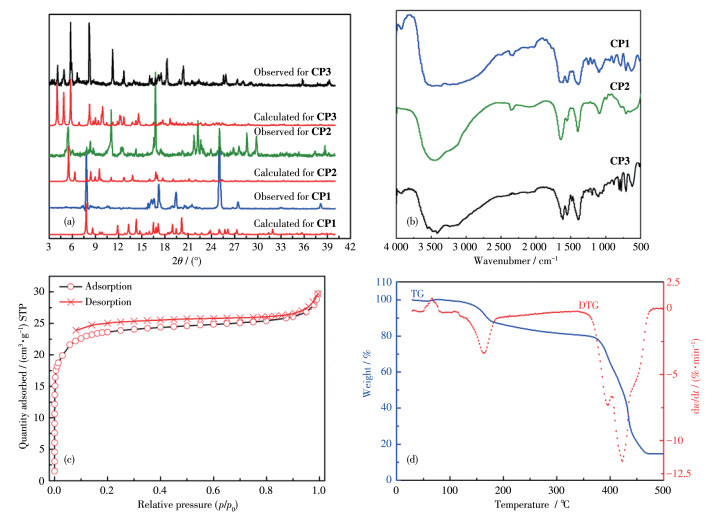
The phase purity and stabilities of bulk samples were confirmed by PXRD (Fig. 1a) experiments, and the samples were all characterized by FT-IR (Fig. 1b).
Figure 1
Figure 1.
(a) Comparison of the observed and calculated PXRD patterns from three Ni(Ⅱ)-based CPs; (b) FT-IR spectra of the three Ni(Ⅱ)-based CPs; (c) N2 adsorption-desorption isotherms at 77 K for CP3; (d) TG and DTG curves of CP3
Diffraction intensity data were collected at 273 K on a Bruker SMART APEX CCD area-detector diffractometer equipped with a CCD area detector and graphite-monochromated Mo Kα radiation (λ=0.071 073 nm) for CP1 and CP2 and Cu Kα radiation (λ=0.154 18 nm) for CP3. Empirical absorption corrections were applied using the SADABS program[16]. The structures were solved by the direct method and refined on F2 by full-matrix least-squares procedure using the SHELX2014 program with all non-hydrogen atoms refined with anisotropic displacement parameters[17]. The hydrogen atoms attached to C atoms were placed in calculated positions and refined isotropically using the riding model. The hydrogen atoms of coordinated H2O were not ridden from satisfying. For the three compounds, there was a number of residual electron density peaks in the voids of the final structures (0.128 1 nm3 of 9.0% for CP1, 1.595 4 nm3 of 37.0% for CP2, 3.577 5 nm3 of 39.8% for CP3), which may be attributed to heavy disorder solvent molecules but could not be satisfactorily modeled. Hence, the SQUEEZE routine within the PLATON software package was applied to subtract the scattering contributions of the highly disordered solvent molecules (EtOH, DMF, or H2O) from the intensity data[18-19]. The reported refinements were of the guest-free structures obtained by the SQUEEZE routine and the results were attached to the CIF files. The summary of the crystallographic data and refinement details for the three compounds are displayed in Table 1. Selected bond lengths and angles are summarized in Table 2.
Table 1
Table 1.
Crystallographic data and refinement parameters for CP1-CP3
Symmetry codes: #1: -x+1, -y+2, -z for CP1; #1: x, -y+3, z+1/2; #2: x+1, y, z+1 for CP2; #1: 1-x, 1/2+y, 3/2-z; #2: 1-x, -y, 1-z; #3: -x, 2-y, 1-z for CP3.
2.
Results and discussions
2.1
Structural description
2.1.1
Crystal structure of CP1
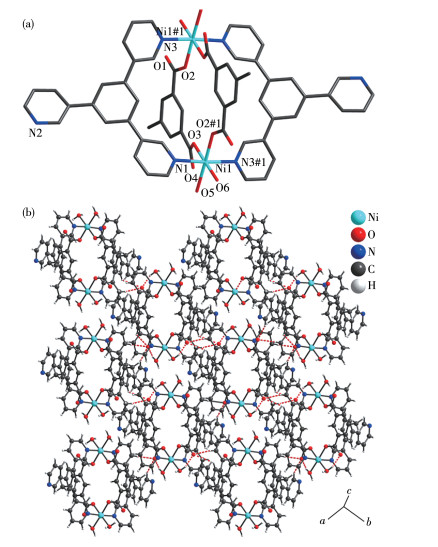
When the EtOH/H2O (5 and 5 mL, respectively) mixture containing CH 3-H2BDC, 3-TBT, and Ni(NO3) 2· 6H2O was heated in a sealed Teflon-lined autoclave at 80 ℃ for 3 d, we separated green block-shaped crystals of CP1 with high yield (73% based on CH3-H2BDC ligand). Single-crystal X-ray diffraction analysis reveals that CP1 crystallizes in the triclinic P1 space group and exhibits 0D [Ni2(3-TBT)2(CH3-BDC)2] binuclear unit. The molecular structure is shown in Fig. 2 and the selected bond distances and angles are given in Table 2. The asymmetric unit contains one CH3-BDC2- ion, one 3-TBT molecule, and two coordinated H2O molecules. The Ni(Ⅱ) center adopts [NiN2O4] six-coordinated octahedral symmetry, in which the equatorial plane is occupied by two carboxylate oxygen atoms (O2 and O3A) and two terminal H2O molecules (O5 and O6), and two pyridyl nitrogen atoms (N1 and N3A) occupy axial positions. The Ni—O/N bond distances fall in a narrow range of 0.202 85(14)-0.213 15(15) nm, com-pared to the Ni(Ⅱ)-based CPs in the literature[20]. Two carboxylate groups of CH3-BDC2- ligand adopt monodentate mode to bridge two Ni(Ⅱ) ions into [Ni2(3-TBT)2 (CH3-BDC)2] binuclear second building unit (SBU) with Ni…Ni distance of 0.782 1(2) nm. The 3-TBT ligand links two Ni(Ⅱ) centers through its two pyridyl groups, serving as a V-shaped linker to bridge two Ni(Ⅱ) centers into a binuclear unit, which prevents the formation of a higher dimensional network. Similar to other compounds containing 3-TBT ligand, the coordination interaction induces large dihedral angles between the central benzene ring and three pyridyl rings, which are 30.09(12)°, 29.1(09)°, and 20.11(16)°, respectively. Limited by the poor coordination abilities of CH3-BDC2- and 3-TBT ligands in CP1, only a binuclear unit was obtained.
Figure 2
Figure 2.
(a) Local coordination environments of Ni(Ⅱ), CH3-BDC2- and 3-TBT ligands in CP1; (b) Supramolecular network of CP1 constructed by hydrogen bonding interactions
The hydrogen atoms attached to carbon atoms are omitted for clarity; Symmetry codes: #1:-x+1, -y+2, -z
In CP1, the uncoordinated carboxylate O atoms act as donors of hydrogen bonding, by which the 2D supramolecular network is formed. The open O1 and O4 atoms interact with the hydrogen atoms (H13#1 and H30#1) from the pyridyl ring and benzene ring of the 3-TBT ligand from adjacent SBUs forming C—H…O hydrogen bonds (C…O distances are 0.320 4(1) and 0.350 5(1) nm, respectively). There are small cavities between the 0D molecules (the free volume is about 9.0% according to the PLATON calculations[18], corresponding to 0.128 1 nm3 out of 1.420 79(9) nm3 unit cell volume), which are filled with undefined EtOH and H2O guest molecules. From the structure of CP1, we can find that only 0D binuclear SBU was obtained due to the V-shaped 3-TBT ligand and bis-monodentate CH3-BDC2-, but it provides the possibility that it could be used as metalloligand to construct more dimensional structures through the increasing of coordination sites from open pyridyl group and carboxylate oxygen atoms under controllable conditions.
2.1.2
Crystal structures of CP2
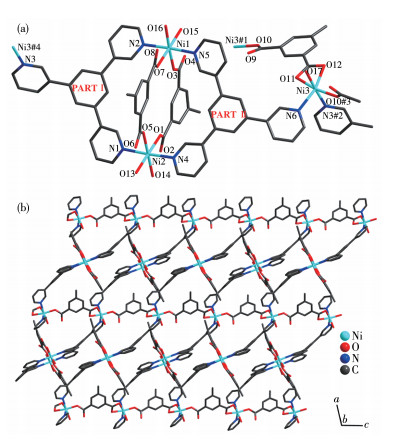
Based on the structure of CP1, we optimized the solvothermal conditions to control the structure. When the reaction was carried out in DMF/MeOH/H 2O (5, 1, 2 mL, respectively) mixed solution and heated at 80 ℃ for 4 d, we separated pale-blue rod-shaped crystals of CP2 with only one phase and the phase purity and stabilities of the bulk sample has been confirmed by PXRD measurements. More interestingly, the asprepared CP1 metalloligand can also be used as a reactant to react with further added CH3-H2BDC and Ni(NO3)2 salt to yield CP2. The X-ray crystallographical analysis reveals that CP2 crystallizes in the monoclinic Pc space group and exhibits a 2D structure. As shown in Fig. 3a, the asymmetric unit had three Ni(Ⅱ) ions, three CH3-BDC2- ions, two 3-TBT molecules, and five terminal coordinated H2O molecules. The coordination environment of the Ni1 and Ni2 centers is similar to that of CP1. The octahedral Ni3 is completed by three carboxylate oxygen atoms (O10#1, O11, O12), one oxygen atom of H2 O (O17), and two pyridyl nitrogen atoms (N3#2 and N6). The Ni—O bond lengths range from 0.199 8(4) to 0.218 3(5) nm, and Ni—N bond distances are in a narrow range of 0.209 8(6)-0.212 2(6) nm (Table 2), which are all in the normal range of the reported Ni(Ⅱ)-based compounds[20]. Unlike that in CP1, the CH3-BDC2- exhibits two different coordination modes. Except for the bis-monodentate coordination mode, another coordination mode of CH3-BDC2- is observed: one carboxylate adopted μ1, 3-chelating mode and the other is a monodentate mode in CH3-BDC2-. Meanwhile, three pyridyl groups all coordinate to three Ni(Ⅱ) centers, serving as Y-shaped bridging linkers, and 2D sheets are constructed together with the linkage of CH3-BDC2- ligand. The dihedral angles between the central benzene ring and three pyridyl rings are 27.63(21)°, 27.22(23)°, 41.14(29)° for PART Ⅰ (Fig. 2a) and 27.92(23)°, 27.97(23)°, 14.40(40)° for PART Ⅱ, respectively.
Figure 3
Figure 3.
(a) Coordination environments of Ni(Ⅱ), CH3-BDC2-, and 3-TBT ligands in CP2; (b) View of the 2D sheet of CP2
Hydrogen atoms are omitted for clarity; Symmetry codes: #1: x, -y+3, z-1/2; #2: x+1, y, z+1; #3: x, -y+3, z+1/2; #4: x-1, y, z-1
As shown in Fig. 2a, Ni1 and Ni2 are linked by two CH3-BDC2- ions and two 3-TBT molecules into binuclear SBU with Ni…Ni distance of 0.780 4(3) nm, which is similar to that in CP1. Ni3 centers are also bridged by another CH3-BDC2- ligands in monodentate and μ1, 3-chelating mode into 1D [Ni(CH3-BDC)]n chain along the c-axis. The neighboring [Ni(CH3-BDC)]n chains are further connected by the [Ni2(3-TBT)2(CH3-BDC)2] SBU through the third pyridyl group into the final 2D sheet, paralleling to the ac plane. PLATON program calculations reveal that there is large void space in CP2 and the free volume is 1.595 4 nm3, which is 37.0% of the unit cell volume (4.308 6(3) nm3), occu-pied by disordered DMF and water molecules[19].
2.1.3
Crystal structures of CP3
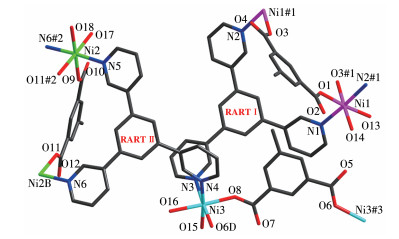
Furthermore, similar to the synthesis of CP2, when the reaction was carried out at 130 ℃ for 4 d, blue rod-shaped crystals of CP3 could be obtained with good yield. X-ray structural analysis reveals that CP3 crystallizes in monoclinic space group P21/c, and possesses a 3D network. As shown in Fig. 4, the asymmetric unit consists of three Ni(Ⅱ) ions, three CH3-BDC2-ions, two 3-TBT molecules, and six coordinated H2O molecules. The coordination environment of Ni1, Ni2, and Ni3 is similar to that of CP2. The selected bond distances and angles are listed in Table 2. Both Ni1 and Ni2 and their symmetry equivalent ones are bridged by two CH3-BDC2- and two 3-TBT ligands into two centrosymmetric binuclear [Ni2(3-TBT)2(CH 3-BDC)2] SBUs with similar structure and the Ni…Ni distances are 0.775 7(2) and 0.780 8(2) nm, respectively. In CP3, only one kind of coordination mode of CH3-BDC2- is observed, that is the bis-monodentate mode. The 3-TBT ligand also bridges three Ni(Ⅱ) ions via its three pyridyl groups and serves as a Y-shaped linker. The dihedral angles between the central benzene ring and three pyridyl rings are 35.92(13)°, 30.69(14)°, 31.09(15)° for PART Ⅰ and 46.24(13)°, 31.98(14)°, 30.46(16)° for PART Ⅱ, respectively, which are larger than those of CP2.
Figure 4
Figure 4.
Coordination environments of Ni(Ⅱ), CH3-BDC2-, and 3-TBT ligands in CP3
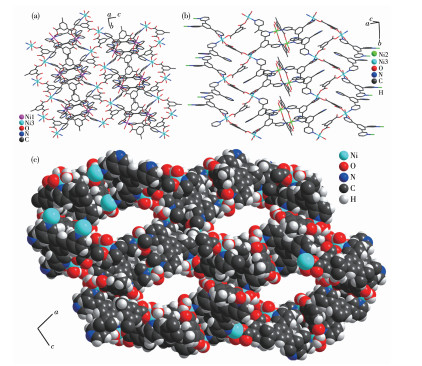
Similar to those in CP2, the Ni3 centers in CP3 are also bridged by the other CH3-BDC2- ligands into 1D [Ni(CH3-BDC)]n chain along the b-axis, which are further linked by binuclear [Ni2(3-TBT)2(CH3-BDC)2] SBUs of Ni1 into a 2D sheet (Fig. 5a). Meanwhile, the 1D [Ni(CH3-BDC)]n chains are also connected by the binuclear [Ni2(3-TBT)2(CH3-BDC) 2] SBUs of Ni2 into a 2D sheet (Fig. 5b). As shown in Fig. 5c, two kinds of sheets with similar structure but extending along different directions crossing-connect into the final 3D network, which is different from CP2. The 3D CP3 network possesses a 1D channel along the b-axis, which is occupied by DMF and water molecules, and the effective free volume is about 39.8% of the crystal volume according to the PLATON calculations[19]. Meanwhile, we have also done the N2 adsorption-desorption experiments to confirm the presence of porous structure in CP3. The N2 sorption isotherm at 77 K showed the characteristic type-Ⅰ isotherm, indicating its microporous property (Fig. 1c). The surface area of Brunauer-Emmett-Teller (BET) was calculated to be about 85 m2·g-1.
Figure 5
Figure 5.
View of two kinds of 2D sheets of CP3 constructed by (a) Ni1-Ni3 SBUs and (b) Ni2-Ni3 SBUs, respectively; (c) Final 3D network of CP3 showing the 1D channels along the b-axis
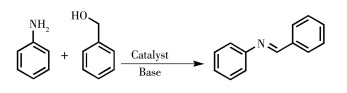
In our previous works, we have reported that the Co(Ⅱ)/Ni(Ⅱ)-based CPs with uncoordinated coordination sites (UCSs) could effectively catalyze the oxidative reactions[21]. Herein, we evaluated the catalytic activities of the three CPs in the oxidative coupling reaction of alcohols and aniline. The typical procedure was described in experimental sections and the conversation was determined by GC-MS results. As shown in Scheme 1, the initial reaction temperature was set at 100 ℃ according to the literature[22]. A series of control experiments were also performed for comparison, and the conversion was monitored by GC-MS during the reaction process. A little product (Conv. < ca. 4%) was detected when the reaction was carried out for 16 h without any catalyst. Interestingly, the obtained CPs as heterogeneous catalysts could significantly promote the oxidative reaction and gave good conversions from 52% to 91%. When CP3 was added to the reaction mixture, the conversion could achieve 95% after 24 h. Similarly, when the Ni(NO3) 2 salt was used as a catalyst, a moderate conversion of about 47% could be obtained, justifying the active center of Ni(Ⅱ). We have previously reported a series of porous Ni(Ⅱ)-MOF with good catalytic activity for this oxidative reaction[10]. Additionally, Trace product was detected when the reaction was carried out without KOH base, showing the importance of the addition of base. Meanwhile, the effect of the added base, reaction temperature, and reaction time was also evaluated by parallel experiments. As shown in Table 3, compared to Na2CO 3, K3PO4, and NaOAc, KOH was the best base for this oxidative coupling reaction. The conversion increased with the increase of reaction temperature and further decreased when the temperature was higher than 100 ℃. Considering the economic view, the optimized reaction was conducted at 100 ℃ for 8 h under the solvent-free condition with KOH as the base, and CP3 exhibited the best catalytic activities. In addition, CP3 exhibited higher heterogeneous catalytic activity by comparison with CP1 and CP2, which may be due to their structural difference. As described, ordered 1D channels are observed in CP3 along the b-axis, and the effective free volume being about 39.8% of the crystal volume is obtained. As known, large surface area and order channels would facilitate the catalytic performance.
Scheme 1
Scheme 1.
Oxidative coupling reaction over Ni(Ⅱ)-based catalysts
a Reaction conditions: benzyl alcohol (1.0 mmol), aniline (2.0 mmol, 2.0 equiv.), catalyst (x=0.2%), base (0.1 mmol), pyrene (100 µL, as internal standard), solvent-free; b determined by GC-MS; cxcat.=0.5%.
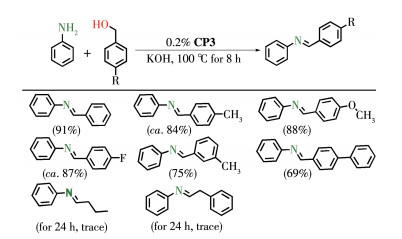
A series of benzyl alcohols with different substitutes were used as reactants to couple with aniline under the optimized reaction conditions. As shown in Scheme 2, good conversion was obtained for the benzyl alcohols with either electron-donating (such as —CH3, —OCH3) or electron-withdrawing (such as —F) substitutes. With bulky substitutes (such as — Ph) on the paraposition of benzyl alcohol, accepted conversion was still observed. In addition, the hot filtration reaction confirmed the heterogeneous catalysis in nature (Fig. 6a). After four cyclic runs of catalytic reaction, the conversion could still retain up to 89%, demonstrating its good stability (Fig. 6b). The PXRD pattern of the used CP3 was essentially identical to as-synthesized CP3 sample, showing that the crystal integrity and framework of CP3 remained intact after recycling catalysis reaction (Fig. 6c). Meanwhile, the XPS spectra of CP3 before and after the catalytic reaction were recorded. As presented in the high-resolution XPS spectrum of Ni2p on as-prepared CP3 (Fig. 6d), two peaks at about 873.4 and 856.0 eV are accompanied by two satellite peaks centered at 879.2 and 861.6 eV, which are typical Ni2p1/2 and Ni2p3/2 transitions of Ni2+ ion, respectively[23]. After the catalytic reaction, two characteristic peaks of used CP3 were similar to those of freshly synthesized CP3 and no Ni(0) or Ni(Ⅱ) species was observed after the catalytic reaction, thus confirming its good stability of CP3 together with the unchanged PXRD patterns.
Scheme 2
Scheme 2.
Oxidative coupling reactions of aniline and benzyl alcohols with various substituted groups
Reaction conditions: benzyl alcohol (1.0 mmol), aniline (2.0 mmol, 2.0 equiv.), CP3 (0.2%), KOH (0.1 mmol), pyrene (100 µL, as internal standard), T=100 ℃, t=8 h, solvent-free; the conversion was determined by GC-MS
Figure 6.
(a) Hot filtration experiment, (b) recycle tests, (c) corresponding PXRD patterns, (d) high-resolution XPS of Ni2p for the reaction of aniline and benzyl alcohol catalyzed by CP3
Herein, we demonstrate the synthesis and characterization of three Ni(Ⅱ)-based CPs via tuning the reaction conditions. CP1 exhibits 0D Ni2(CH3-BDC)2 binuclear unit with uncoordinated carboxylate O and pyridyl N atoms, the 2D supramolecular network is formed by the hydrogen bonding interactions. CP2 is obtained by using CP1 metalloligand as a reactant and exhibits a 2D structure based on the binuclear unit. CP3 is separated when the reaction is conducted under a higher temperature (130 ℃) and exhibits a 3D network based on a similar binuclear unit. Meanwhile, the catalytic experiments show that CP3 exhibits the best catalytic activities for the oxidative coupling reaction of aniline and benzyl alcohols under solvent-free conditions.
[1]
Zhou H C, Long J R, Yaghi O M. Introduction to metal-organic frameworks[J]. Chem. Rev.,
2012, 112:
673-674.
doi: 10.1021/cr300014x
[2]
陈小明, 张杰鹏. 金属-有机框架材料. 北京: 化学工业出版社, 2016: 56-59CHEN X M, ZHANG J P. Metal-organic frameworks. Beijing: Chemical Industry Press, 2016: 56-59
[3]
Wang H, Liu X Y, Yang W J, Mao G Y, Meng Z, Wu Z K, Jiang H L. Surface-clean Au25 nanoclusters in modulated microenvironment enabled by metal-organic frameworks for enhanced catalysis[J]. J. Am. Chem. Soc.,
2022, 144:
22008-22017.
doi: 10.1021/jacs.2c09136
[4]
白亚峰, 杨子恒, 冯勇, 刘富亮, 陈晓涛, 常继莹. MOF衍生的Zn/N共掺杂碳催化剂的制备及其电催化性能[J]. 无机化学学报,
2021,37,(6): 1055-1061.
BAI Y F, YANG Z H, FENG Y, LIU F L, CHEN X T, CHANG J Y. Preparation and electrocatalytic performance of Zn/N co-doped carbon catalyst derived from MOF[J]. Chinese J. Inorg. Chem.,
2021, 37(6):
1055-1061.
[5]
Kang Y S, Lu Y, Chen K, Zhao Y, Wang P, Sun W Y. Metal-organic frameworks with catalytic centers: From synthesis to catalytic application[J]. Coord. Chem. Rev.,
2019, 378:
262-280.
doi: 10.1016/j.ccr.2018.02.009
[6]
杨华, 吴雨泽, 崔华莉, 刘琳, 王记江, 陈小莉. 基于苯四甲酸和双(咪唑基甲基)苯配体的三维Cd-MOF的合成、结构及荧光性质[J]. 无机化学学报,
2021,37,(3): 465-472.
YANG H, WU Y Z, CUI H L, LIU L, WANG J J, CHEN X L. Three-dimensional Cd-MOF based on benzenetetracarboxilic acid and bis (imidazolylmethyl)benzene ligands: Synthesis, structure and fluorescence property[J]. Chinese J. Inorg. Chem.,
2021, 37(3):
465-472.
[7]
Yue Q, Gao E Q. Azide and carboxylate as simultaneous coupler for magnetic coordination polymers[J]. Coord. Chem. Rev.,
2019, 382:
1-31.
doi: 10.1016/j.ccr.2018.12.002
[8]
李建惠, 兰天昊, 陈杨, 杨江峰, 李立博, 李晋平. MOF复合材料在气体吸附分离中的研究进展[J]. 化工学报,
2021,72,(1): 167-179.
LI J H, LAN T H, CHEN Y, YANG J F, LI L B, LI J P. Research progress of MOF-based composites for gas adsorption and separation[J]. CIESC Journal,
2021, 72(1):
167-179.
[9]
赵丹, 廖再添, 张旺, 陈治洲, 孙为银. 功能化金属有机框架材料催化二氧化碳转化研究进展[J]. 无机化学学报,
2021,37,(7): 1153-1176.
ZHAO D, LIAO Z T, ZHANG W, CHEN Z Z, SUN W Y. Progress in functional metal-organic frameworks for catalytic conversion of carbon dioxide[J]. Chinese J. Inorg. Chem.,
2021, 37(7):
1153-1176.
[10]
Zhang J P, Zhou H L, Zhou D D, Liao P Q, Chen X M. Controlling flexibility of metal-organic frameworks[J]. Natl. Sci. Rev.,
2018, 5:
907-919.
doi: 10.1093/nsr/nwx127
[11]
Sun Y X, Sun W Y. Influence of temperature on metal-organic frameworks[J]. Chin. Chem. Lett.,
2014, 25:
823-828.
doi: 10.1016/j.cclet.2014.04.032
[12]
Liu Q, Zhang L Y, Bao Y M, Zhang N, Zhang J Y, Xing Y Y, Deng W, Liu Z J. Structures and catalytic oxidative coupling reaction of four Co-MOFs modified with R-isophthalic acid (R=H, OH and COOH) H, OH and COOH) and trigonal ligands[J]. CrystEngComm,
2021, 23(43):
7590-7601.
doi: 10.1039/D1CE01221E
[13]
Zhang Y Y, Liu Q, Zhang L Y, Bao Y M, Tan J Y, Zhang N, Zhang J Y, Liu Z J. MOFs assembled from C3 symmetric ligands: Structure, iodine capture and role as bifunctional catalysts towards the oxidation-Knoevenagel cascade reaction[J]. Dalton Trans.,
2021, 50(2):
647-659.
[14]
Liu Q, Tan J Y, Zhang J Y, Zhang N, Deng W. R-Substituent induced structural diversity, synergistic effect and highly selective luminescence sensing for Fe3+ detection by post-synthetically modified Cd-MOFs[J]. CrystEngComm,
2020, 22(22):
3871-3883.
[15]
Schmittel M, He B, Mal P. Supramolecular multicomponent self-assembly of shape-adaptive nanoprisms: Wrapping up C60 with three porphyrin units[J]. Org. Lett.,
2008, 10(12):
2513-2516.
[16]
Spek A L. PLATON, A multipurpose crystallographic tool. Utrecht University, The Netherlands, 2006.
[17]
Sheldrick G M. SADABS, Program for empirical absorption correction of area detector data. University of Göttingen, Germany, 1996.
[18]
Sheldrick G M. SHELXTL Version 5.1. Bruker Analytical X-ray Instruments Inc., Madison, Wisconsin, USA, 1998.
[19]
Pal A, Debreczeni J É, Sevvana M, Gruene T, Kahle B, Zeeck A, Sheldrick G M. Structures of viscotoxins A1 and B2 from European mistletoe solved using native data alone[J]. Acta Crystallogr. Sect. A,
2008, A64(9):
985-992.
[20]
Zhang N, Sun Y J, Yang H, Zhang Y J, Gao E Q. Solvothermal synthesis, structures, and magnetic properties of NiⅡ compounds directed by N, N'-bridging auxiliary ligands[J]. Inorg. Chem. Acta,
2015, 428:
37-43.
[21]
Tan J Y, Shi J X, Cui P H, Zhang Y Y, Zhang N, Zhang J Y, Deng W. A Ni3(OH)(COO)6-based MOF from C3 symmetric ligands: Structure and heterogeneous catalytic activities in one-pot synthesis of imine[J]. Microporous Mesoporous Mat.,
2019, 287:
152-158.
[22]
Chen B, Wang L Y, Gao S. Recent advances in aerobic oxidation of alcohols and amines to imines[J]. ACS Catal.,
2015, 5:
5851-5876.
[23]
Yan H J, Bai J W, Wang J, Zhang X Y, Wang B, Liu Q, Liu L H. Graphene homogeneously anchored with Ni(OH)2 nanoparticles as advanced supercapacitor electrodes[J]. CrystEngComm,
2013, 15(46):
10007-10015.
Figure 1
(a) Comparison of the observed and calculated PXRD patterns from three Ni(Ⅱ)-based CPs; (b) FT-IR spectra of the three Ni(Ⅱ)-based CPs; (c) N2 adsorption-desorption isotherms at 77 K for CP3; (d) TG and DTG curves of CP3
Figure 2
(a) Local coordination environments of Ni(Ⅱ), CH3-BDC2- and 3-TBT ligands in CP1; (b) Supramolecular network of CP1 constructed by hydrogen bonding interactions
The hydrogen atoms attached to carbon atoms are omitted for clarity; Symmetry codes: #1:-x+1, -y+2, -z
Figure 5
View of two kinds of 2D sheets of CP3 constructed by (a) Ni1-Ni3 SBUs and (b) Ni2-Ni3 SBUs, respectively; (c) Final 3D network of CP3 showing the 1D channels along the b-axis
Figure 6
(a) Hot filtration experiment, (b) recycle tests, (c) corresponding PXRD patterns, (d) high-resolution XPS of Ni2p for the reaction of aniline and benzyl alcohol catalyzed by CP3



 下载:
下载:



 下载:
下载:



