

引用本文:
李渝航, 王鹏, 王崇臣, 刘艳彪. 缺陷金属有机骨架的制备及其去除水中污染物的研究进展[J]. 无机化学学报,
2022, 38(12): 2342-2362.
doi:
10.11862/CJIC.2022.252

Citation: Yu-Hang LI, Peng WANG, Chong-Chen WANG, Yan-Biao LIU. State-Of-The-Art Review of Defective Metal-Organic Frameworks for Pollutant Removal from Water[J]. Chinese Journal of Inorganic Chemistry, 2022, 38(12): 2342-2362. doi: 10.11862/CJIC.2022.252
Citation: Yu-Hang LI, Peng WANG, Chong-Chen WANG, Yan-Biao LIU. State-Of-The-Art Review of Defective Metal-Organic Frameworks for Pollutant Removal from Water[J]. Chinese Journal of Inorganic Chemistry, 2022, 38(12): 2342-2362. doi: 10.11862/CJIC.2022.252
缺陷金属有机骨架的制备及其去除水中污染物的研究进展
摘要:
在避免母体结构坍塌的前提下,通过缺陷工程对金属有机骨架(MOFs)进行处理可有效提升其去除水体污染物的性能。目前,通过调整合成条件(温度、金属/配体比例等)、添加调制剂、热处理和金属节点取代等方式可制备缺陷MOFs。粉末X射线衍射(PXRD)、比表面积分析、热重-差热分析(TGA-DSC)、电子顺磁共振(EPR)、X射线光电子能谱(XPS)、高分辨率透射电子显微镜(HR-TEM)、球差校正透射电镜(AC-TEM)和X射线吸收光谱(XAS)表征技术可证实MOFs中缺陷的特征。相比原始MOFs,从光催化等高级氧化的角度来看,构造缺陷型MOFs可促进电子转移、减小带隙以提升其高级氧化降解去除污染物的性能。此外,缺陷型MOFs还可为污染物提供更多吸附位点,进一步提升吸附剂的吸附容量和吸附速率。本文系统总结缺陷MOFs的制备方法、现有常见表征技术及其在水处理领域中的应用。同时,本文还根据缺陷MOFs用于去除水中污染物的研究现状对其今后发展予以展望。
English
State-Of-The-Art Review of Defective Metal-Organic Frameworks for Pollutant Removal from Water
Abstract:
Defect engineering is an effective strategy for modulating the structure of metal-organic frameworks (MOFs) to boost their performance in water treatment. The defect can be formed when the regular periodic arrangement of atoms or ions in the crystalline parent framework is broken due to the missing or dislocation of atoms or ions. In the field of defective MOFs, the types of defects are divided into (ⅰ) missing linker defects, (ⅱ) modified linker defects, (ⅲ) missing node defects, and (ⅳ) modified node defects. Although the construction of defective MOFs has received continuous attention, which remains challenging today. Up to now, there are two synthetic pathways to fabricate defective MOFs: the modulation during the synthesis process and the post-synthetic treatment methods. Specifically, defective MOFs can be fabricated by adjusting the synthesis conditions (temperature, the ratio of metal/ligand, etc.), introducing modulators, thermal activation, metal node substitution, and so on. Many advanced techniques like X-ray diffraction (XRD), specific surface area analysis, thermogravimetric analyses-differential scanning calorimetry (TGA-DSC), electron paramagnetic resonance (EPR), X-ray photoelectron spectra (XPS), high-resolution transmission electron microscopy (HR-TEM), spherical aberration-corrected transmission electron microscope (AC-TEM), and X-ray absorption spectroscopy (XAS) can effectively affirm the defective structure of MOFs. In the field of water remediation, the construction of defective MOFs can boost their performance of advanced oxidation processes like photocatalysis, persulfate (PS) activation, and photo-Fenton by enhancing separation rates of photoinduced electron-hole, promoting the photoelectron transfer and narrowing the band gap compared with pristine MOFs. Moreover, because the defective sites are introduced in the framework, they act as dominant active sites in the PS system, promoting the generation of radicals and creating a nonradical degradation pathway. Meanwhile, defective MOFs with rich unsaturated coordination centers can provide more adsorption sites toward pollutants, further enhancing the adsorption capacities and rates of sorbents. This review summarized the fabrications, characterizations, and applications in the water treatment of defective MOFs. Meanwhile, the prospects of defective MOFs for pollutant removal from water are proposed in this review.
-
0. 引言
金属有机骨架(metal-organic frameworks,MOFs)是由无机金属离子或金属簇和有机配体桥联构造的一类多孔新型材料[1-3]。相比于传统的纳米材料,MOFs拥有超高的孔隙度、超大的比表面积、可调节的孔道结构、丰富的活性位点等众多优点,在催化[4-8]、储存与分离[9-11]、传感[12-13]、质子传导[14-17]和吸附[18-20]等方面具有良好的应用前景。
近年来,通过对MOFs构造缺陷来提升其在水处理领域中的应用受到研究者的广泛关注[21-23]。在MOFs母体骨架中由于金属节点/簇或配体发生缺失或错位而破坏骨架内部原有的排布形式,即形成缺陷MOFs[24]。事实上,在MOFs成核生长过程中不可避免会产生缺陷。2008年,Shoaee等利用原位原子力显微镜观察到HKUST-1在生长过程中产生一定的缺陷位点[25]。但这种缺陷并不足以显著提升MOFs的性能。2010年,Ravon等首次在合成MOF-5的前驱体溶液中加入单羧酸配体(2-甲基-苯甲酸),部分取代对苯二甲酸配体得到更大孔径的MOF-5。孔径的提升使得其可容纳大量芳香族分子,并有效提升其多相催化的性能[26]。构造缺陷虽然会对MOFs原有骨架造成一定程度破坏,但合适程度的破坏有助于提升MOFs去除水中污染物的性能。例如,目前报道绝大多数MOFs的孔道结构均为微孔结构(孔直径小于2 nm),骨架内部的平均孔径以及MOFs表面最小开口直径(limited window)是限制污染物向骨架内部扩散的2个原因[27-28]。因此,在利用吸附法去除水中污染物时,水合半径较大的污染物进入骨架内部的速率将会变慢,进而不利于吸附过程的进行。通过缺陷工程对MOFs骨架结构进行调整不仅可有效扩大孔道的平均孔径,且更易于暴露更多的吸附位点。Kirchon等利用不同链长和浓度的不饱和脂肪酸充当调制剂去取代一部分配体(3,3',5,5'-偶氮苯四甲酸),通过酸洗处理去除配位的不饱和脂肪酸,得到具有多级孔结构的PCN-250 (HP-PCN-250)[27]。孔道尺寸的扩大使得有机污染物亚甲基蓝(MB)更容易进入到骨架内部,极大地提升吸附剂的吸附速率。Li等利用相同的策略对UiO-66(Zr)结构进行调制得到HP-UiO-66(Zr)-XA(X=F、B、O),结果表明HP-UiO-66(Zr)-FA、HP-UiO-66(Zr)-BA和HP-UiO-66(Zr)-OA的中孔体积占有率分别为38.8%、41.7% 和64.3%,对磷酸盐的吸附量(以磷计)从37.7 mg·g-1增加到186.6 mg·g-1[29]。单组分MOF光生电子和空穴易发生聚合,较宽的带隙则使得光生电子跃迁所克服的阻力更大,这也限制MOFs在高级氧化中的应用[30]。通过缺陷工程对MOFs配体进行移位或替换,对金属节点或金属簇进行调整则可有效提升MOFs高级氧化的性能。例如,Guo等利用4种小分子酸(苯甲酸、乙酸、草酸和柠檬酸)分别取代部分对苯二甲酸配体,得到4种具有不饱和配位点的MIL-101(Fe)。由于Fe-O簇的暴露和孔道尺寸的增加使得光催化剂通过活化过硫酸盐降解罗丹明B(RhB)的性能从58.7% 提升至94.05%[31]。Cao等在合成UiO-66前驱体溶液中引入钴源,制备出一系列Zr/Co双金属光催化剂(CoUiO-X),双金属催化剂的构造不仅为四环素(TC)提供更多吸附位点,由于过渡金属的存在,电子转移速率更快,易于产生高效氧化分解有机污染物的自由基[32]。
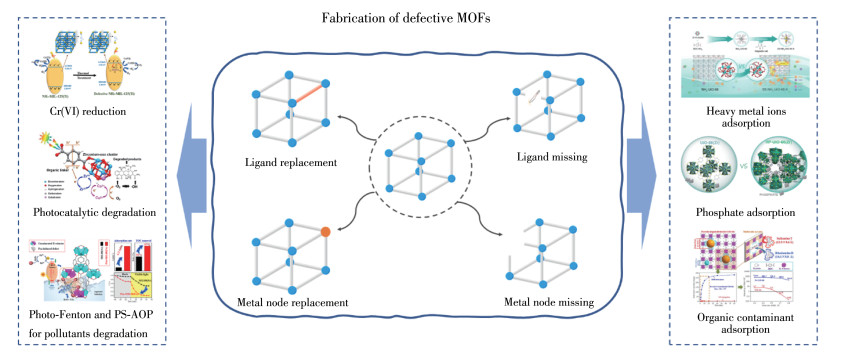
发展至今,MOFs缺陷的类型可分为配体缺失、金属节点缺失、配体替换和金属节点替换。如果配体和/或金属节点的替换并未破坏MOFs的结构,则这一替换过程将不会产生缺陷位点。例如,Li等利用混合配体(对苯二甲酸和2,5-二羟基对苯二甲酸),通过溶剂热法制备出羟基修饰UiO-66((OH)2-UiO-66-X),其中并未产生不饱和配位点,即所得(OH)2-UiO-66-X是非缺陷型MOF[5]。在本综述中,不同类型缺陷MOFs的制备思路可归类为在合成过程中引入缺陷及合成后处理引入缺陷。文中进一步总结了一些被认为可有效证明缺陷结构的表征技术,包括粉末X射线衍射(PXRD)、比表面积分析、热重-差热分析(TGA-DSC)、电子顺磁共振(EPR)、X射线光电子能谱(XPS)、高分辨率透射电子显微镜(HR-TEM)、球差校正透射电镜(AC-TEM)和X射线吸收光谱(XAS)。此外,系统介绍若干种缺陷MOFs在水处理领域的应用,例如高级氧化(AOP)和吸附(图 1)。最后,本文对未来缺陷MOFs在水处理、水净化领域发展进行了展望。
图 1
1. 缺陷MOF的制备策略
1.1 合成过程中引入缺陷
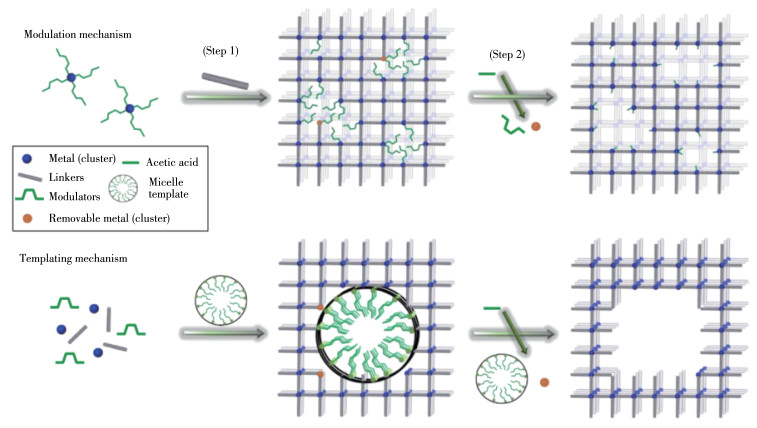
(1) 加入调制剂。在目前的研究中,构造缺陷MOFs最常用的一种方式是在合成前引入一元羧酸作为调制剂。调制剂的存在会与配体发生竞争配位,骨架内部由于单羧酸的存在会产生大量不饱和配位点,这种方法也被称为调制法(modulating)。常用的一元羧酸调制剂有甲酸、乙酸、苯甲酸、三氟乙酸及其衍生物。在合成MOFs前驱体溶液中引入少量一元羧酸可以有效增加MOFs的结晶度。Wißmann等在合成Zr-fumarate MOF(MOF-801)前驱体溶液中加入不同数量的甲酸作为调制剂,可有效地提高MOF-801的结晶度[36]。在随后的研究中发现,调制剂不仅可以提高MOFs的结晶度,还可以导致缺陷的形成。2010年,Ravon等首次在合成MOF-5前驱体溶液中引入2-甲基-苯甲酸充当调制剂,合成出具有更大孔径的缺陷MOF-5[26]。之后,大量的研究开始利用调制法制备缺陷MOFs。以调制剂与配体进行竞争配位,合成后再将调制剂洗脱去除,原本需要配体桥联的位点由于配体的缺失,孔道的尺寸便会增加。Vermoortele等在2013年使用三氟乙酸充当调制剂合成出具有高度缺陷的UiO-66,随后用320 ℃高温热处理去除配位的三氟乙酸,创造出大量具有高活性的不饱和配位点[37]。Kirchon等利用不同链长和浓度的脂肪酸充当调制剂,随后用冰醋酸和DMF的混合溶液浸泡去除脂肪酸,制备出分级多孔Fe-MOF(HP-PCN-250)(图 2)[27]。通过总结先前研究可以发现,调制法主要应用于以羧酸类配体作为连接剂的MOFs。
图 2

(2) 改变合成条件。提高合成温度或者改变金属和配体的比例也可以构造缺陷。Shearer等研究发现,在UiO-66合成过程中改变合成温度和BDC/Zr比例会影响配体与Zr-O簇的配位[38]。结果表明,当使用220 ℃高温和较高的BDC/Zr比(nBDC∶nZr=2∶1)时,可得到近乎无配体缺失的UiO-66。作者提出,提高BDC/Zr比和合成温度更有利于形成配位键,进而可消除连接剂的缺失。当反应温度降低至160或100 ℃,BDC/Zr比为1∶1时,UiO-66骨架内部便会出现配体的缺失。Fu等利用相同的策略制备出缺少金属簇的MOF-808[39]。Zhang等在合成中通过改变合成的温度而未改变配体和金属的比例制备出缺陷MIL-88B(Fe)[40]。
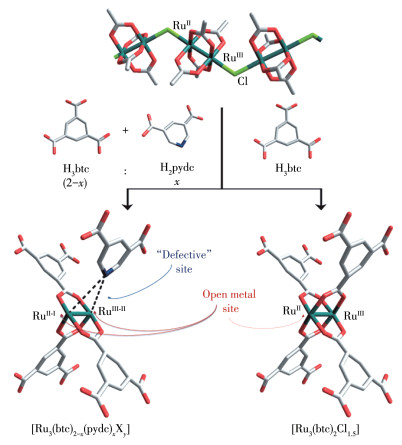
(3) 修饰或置换配体。在合成前对配体进行修饰或置换可将部分配体替换成可产生不饱和配位点的配体。与原配体结构相比,置换配体需缺少与金属/金属簇的桥联位点。例如,当MOF的合成以对苯二甲酸为桥联配体时,单羧酸配体(如苯甲酸、烟酸等)的介入与对苯二甲酸竞争配位后,骨架内部便会产生缺陷位点;而当使用对苯二甲酸的衍生物(如2-氨基对苯二甲酸、2-硝基对苯二甲酸、2,5-二羟基对苯二甲酸)时,其配体上所修饰的官能团并不参与金属/金属簇配位且保留原配体对苯二甲酸的结构,因此骨架内部便不会产生缺陷位点。Marx等在合成Cu-BTC时,将部分1,3,5-三羧酸(H3btc)置换为吡啶-3,5-二羧酸(H2pydc)。H2pydc相比于H3btc, 其化学结构由于缺少一个羧酸,在配位过程中此处便会产生不饱和配位点,进而可制备出含缺陷位点的Cu-BTC[41]。Kozachuk等同样使用H3btc和H2pydc混合配体制备出缺陷Ru-MOF(图 3),在Ru周围出现大量的开放金属位点[42]。
图 3

(4) 更改金属节点。通过对金属节点进行更改构建缺陷MOFs具有一定的普适性。当2种不同配位数的金属离子与配体发生配位时,经常会产出缺陷MOFs[43]。由于金属配位数不同,原本金属团簇所桥联的配体数量发生变化,缺陷便会产生。根据先前报道,通过Co、Ce、Ti、Hf、Eu、La等金属离子部分取代Zr离子与BDC混合,可成功制备双金属Ui-66[32, 44-48]。需要指出的是,金属取代可能发生在合成过程中,也可能发生在合成后的处理中。金属原子可以被完全取代,也可以被部分取代[49-50]。Lin等在合成UiO-66前驱体溶液中引入铁源,制备出双金属Fe-UiO-66[51];Lee等通过在合成前引入Ti源构造出双金属UiO-66(Zr/Ti)-NH2。通过XPS和电感耦合等离子体质谱(ICP-MS)测定Zr、Ti含量,证实Ti成功修饰在UiO-66金属簇上[52]。需要注意的是,并非所有双金属MOFs均可被称为缺陷MOFs。例如,Tang等通过二次生长法在首先制备出的ZIF-8表面继续生长ZIF-67,制备出核壳结构Zn/Co双金属ZIF[53]。虽然Zn和Co配位数不同,但2种金属并未同时出现在金属簇结构中,因此并未有不饱和配位点的产生。
1.2 合成后处理引入缺陷
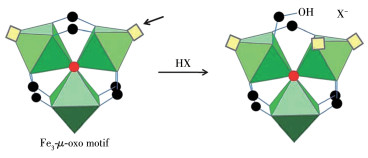
(1) 酸碱处理。酸碱处理是一种相对简便的合成后引入缺陷的策略,其原理是将不饱和位点引入到已经成型的MOFs结构中。例如,Vermoortele等利用强酸HClO4对MIL-100(Fe)进行合成后处理。酸处理后MIL-100(Fe)的XRD并未发生明显变化,但孔隙率却明显变小,这归结于ClO4-保留在带电骨架中(图 4)。通过化学吸附实验可得出,经过强酸处理后的MIL-100(Fe),在Lewis酸位点附近形成许多额外的Brønsted酸位点[54]。
图 4

(2) 热处理。MOFs缺陷位点大多存在于金属簇或金属节点上。这些位点通常与配体或结合水相连接。热处理的原理可认为是将与金属簇或金属节点连接的配体或结合水去除,从而实现缺陷位点的暴露。基于这一原理,Meng等将制备的Pt纳米粒子@MOFs复合材料通过加热使得部分配体发生坍塌制备出多孔的MOFs材料[55]。官能团修饰的配体与原配体形成的MOF在热稳定性上存在一定的差异。Xu等利用这一特性通过混合BDC和BDC-NH2制备出双配体UiO-66,随后经350 ℃的热处理去除BDC-NH2而仅保留BDC,得到分级多孔UiO-66(HP-UiO-66)[56]。利用酸碱处理或热处理方法虽然简便,但需注意使用酸碱剂量和热处理时间,过度的改性可能造成MOFs结构的垮塌。
(3) 溶剂辅助配体交换(solvent-assisted ligand exchange,SALE)。SALE是合成后处理最常用的方法之一,其原理是在溶剂中将另一种配体和MOFs的原有配体进行交换。SALE可以将功能化修饰的配体、更长的配体或者难以通过混合配体合成MOF的配体置换到MOF结构上[57-58]。对一些配位数高、稳定性较强的MOFs如UiO-66或沸石咪唑类骨架(ZIFs),SALE可以展现出更强大的作用。Karagiaridi等报道通过SALE将ZIF-8中85% 的甲基咪唑配体用咪唑替代。配体缺少甲基基团的“阻碍”,将内部孔道直径扩大到0.58 nm,使得体积较大的环己烷和甲苯能够与骨架中存在的配位不饱和位点发生反应[57]。除对配体进行置换外,金属离子也可以通过溶剂辅助进行置换。双金属MOFs的构造不仅可以在合成前加入双金属源,也可以在合成后进行二次溶剂热合成将一部分金属进行置换。例如,Lee等将制备的NH2-UiO-66与TiCl4混合在DMF中进行二次溶剂热,将部分Zr置换为Ti,可制备出双金属NH2-UiO-66(Zr/Ti)[52]。
2. 表征手段
随着缺陷MOFs越来越受关注,证明其缺陷存在的表征技术也面临着巨大的挑战。常用的证明MOFs缺陷的表征手段包括PXRD、比表面积分析、TGA-DSC等技术。但本文中总结的所有表征技术不一定适用于所有缺陷类型,不同类型的缺陷需要选择适合的表征手段。
2.1 PXRD
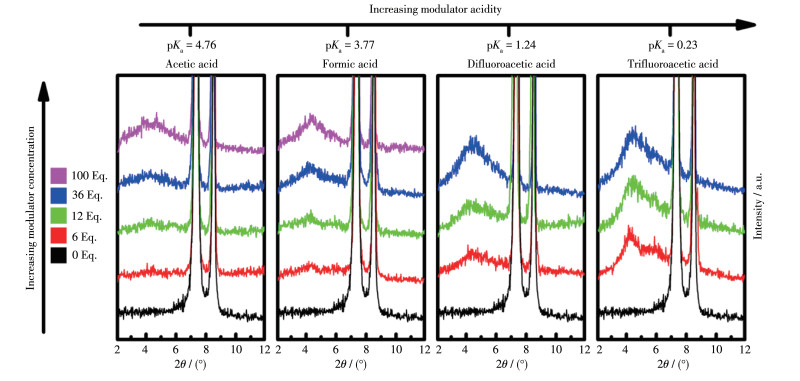
通过PXRD图可粗略地定性分析MOFs是否存在缺陷,但不可通过PXRD定量地分析缺陷。当骨架存在缺陷时,其晶面或结晶度会遭受到破坏。因此,缺陷MOFs可通过PXRD图中峰强以及峰宽的变化初步地判断各个峰对应的晶面是否被破坏,从而初步判断出是否存在缺陷。Li等制备了酒石酸钾钠调制后的NH2-UiO-66,从PXRD中可以看出相较于完美NH2-UiO-66,缺陷NH2-UiO-66的峰宽和结晶度均出现明显的变化。由于酒石酸钾钠的螯合作用,将Zr-O簇上的部分Zr进行移除,因此,其Zr-O晶面(111)被破坏的程度最为明显。通过PXRD图可以看出,Zr-O晶面所对应的峰强和峰宽(7.32°)均出现明显变化,由此可初步说明缺陷的产生[59]。在合成MOFs的前驱体溶液中引入一元羧酸作为调节剂与配体发生竞争配位,骨架内部便会产生不饱和配位点。Shearer等发现在合成UiO-66的过程中,引入不同的一元羧酸可在低角度区域PXRD图中被观察到(图 5),峰的强弱与一元羧酸的酸度和投加量相关[60]。目前为止,在PXRD图中观察到一元羧酸的存在只适用于UiO-66及其衍生物。
图 5

2.2 比表面积分析
Brunauer-Emmett-Teller(BET)法不仅可以得到MOFs的比表面积还可确定其孔道分布 和孔容(孔道体积)。一般当MOFs进行缺陷化处理时,其比表面积、孔道分布和孔道体积会发生改变。例如,Hu等通过将3种含氮化合物(多巴胺、吡咯、2-甲基咪唑)引入到UiO-66中,含氮化合物与对苯二甲酸配体的竞争配位不仅提高UiO-66的比表面积,也改变其孔道的分布。3种含氮化合物的配位使得UiO-66骨架内部出现较大的微孔结构(1.1~1.3 nm)。此外,利用含氮化合物与对苯二甲酸进行竞争配位,也可明显地增加UiO-66的孔道体积。其中,利用吡咯掺杂配位后的UiO-66的孔体积为0.41 cm3·g-1,明显高于UiO-66的孔体积(0.11 cm3·g-1)[35]。但比表面积分析仅可作为辅助证据而不能作为证明MOFs缺陷的直接证据,通过将MOFs和比表面积较小的物质复合或对其进行修饰处理也可改变其本身的比表面积。
2.3 TGA-DSC
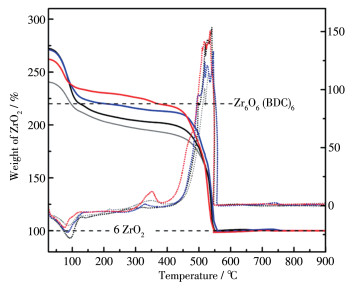
TGA-DSC已经被认为是重要的分析缺失配体缺陷的方法之一。在TGA过程中,随着温度升高,MOFs将会随着配体的分解而逐渐变成相应的金属氧化物。当在有氧条件下,TGA曲线终点归化为100% 时,可通过质量守恒定律计算出一个完整结构单元所应占的百分率。通过DSC信号观察配体开始分解的温度,可计算出配体损失的百分率,将有缺陷MOF的TGA曲线按同样方法进行绘制,即可观察到配体损失的百分率是否与完美结构配体损失的百分率相一致。以UiO-66为例(图 6),经过有氧高温煅烧后,UiO-66将完全变成ZrO2。完美UiO-66 (Zr6O6(BDC)6)的相对分子质量是6ZrO2的2.2倍,因此当TGA曲线终点ZrO2为100% 时,UiO-66起始点应为220%。配体缺失UiO-66在达到配体分解的温度时,TGA曲线上的百分率一定低于220%,两者之间的差值即为缺失配体的百分率。由于一个Zr-O簇可连接12个配体,因此通过TGA曲线也可粗略地计算出配体的损失个数[38]。Zhang等同样利用TGA曲线证实合成温度的改变会造成MIL-88B(Fe)部分配体的缺失。与无缺陷MIL-88B(Fe)的TGA曲线相比,缺陷MIL-88B(Fe)配体损失百分比明显减小,由此可印证配体的缺失[40]。
图 6

2.4 EPR
通过EPR的测定可直接观察到MOFs材料中是否存在永久性空位,而根据空位的产生与否可直接判定MOFs材料中是否存在缺陷;同时也可根据EPR信号的强弱判断缺陷的程度。Chang等利用高温加热的方式对MIL-125-NH2构造缺陷。通过EPR测定在g=2.003处出现明显的氧空位的信号,进而说明缺陷MIL-125-NH2的成功制备[61]。而对于部分特殊空位(例如锆空位)则无法通过EPR技术证实,这是由于锆空位具有抗磁性,在检测过程中会自动消除信号而无法在谱图中显示[62]。
2.5 XPS
XPS是一种常用的表征纳米材料的手段。XPS不仅能够分析MOFs材料表面的化学组成及含量,还可以分析其化学价态、化学键等信息。根据各元素精细谱峰的位置、面积可以推断出其含量、化学状态等信息。Li等制备出一种含Zr缺失的NH2-UiO-66,通过XPS分析得出在缺陷前后Zr—O—Zr的键能发生明显的偏移且峰的面积明显变小,从而推断出Zr—O—Zr键在调制的过程中部分被破坏[59]。对于金属掺杂的缺陷,XPS则可直接通过判断掺杂金属是否与骨架形成配位键而确定材料是否成功制备。Cao等通过对O1s进行分析,在UiO-66中发现存在Co—O键,确定Co成功地掺杂在UiO-66的金属簇上[32]。Lin等在合成UiO-66的前驱体溶液中加入一定量的FeCl3·6H2O,得到Fe/Zr双金属Fe-UiO-66[51]。通过XPS测定Fe-UiO-66中的Zr元素和O元素的精细谱,发现其Zr—O键能相较于UiO-66发生明显的红移,说明Fe元素成功掺杂在UiO-66结构中。
2.6 HR-TEM
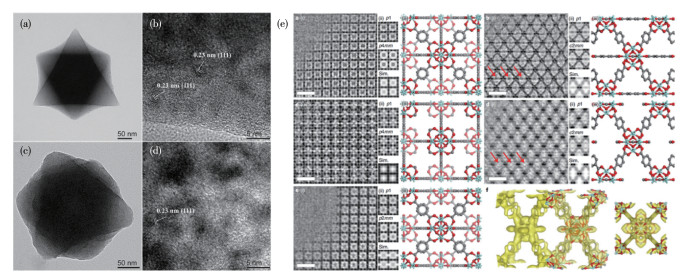
HR-TEM是一种以原子分辨率观察真实空间缺陷的有效工具,通过HR-TEM所呈现出的图像可以直观地观察到缺陷的存在。Li等利用HR-TEM呈现出无缺陷NH2-UiO-66(图 7a和7b)和缺陷NH2-UiO-66(图 7c和7d)[59]。从图中可以看出缺陷NH2-UiO-66正八面体的棱边被破坏,其局部放大图出现明显的空洞,这是由配体缺失造成的。此外,HR-TEM还可与其它技术相结合,用于分析MOFs的微观晶胞结构。Zhu等将HR-TEM所呈现出的图像与电子衍射层析技术(electron tomography)相结合,可直接确定UiO-66的晶胞结构[63]。这项工作为确定粉末MOFs结构提供了新的思路,也有效克服了部分MOFs难以生长出晶体而无法确定其晶胞结构的弊端。之后,Liu等将低剂量电子束透射电子显微镜(low-dose transmission electron microscopy)与电子晶体学(electron crystallography)相结合,再通过实际观察,成功绘制出缺陷UiO-66的晶胞结构图(图 7e)[64]。此外,作者也通过密度泛函理论(DFT)计算证实所观测和绘制结果的合理性。
图 7
2.7 AC-TEM
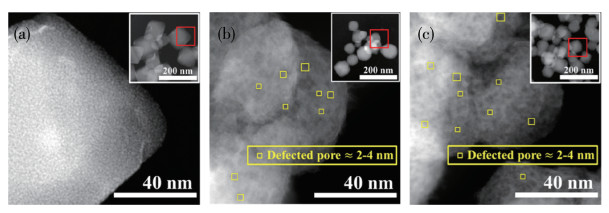
AC-TEM与HR-TEM的功能类似,通过呈现出的图像也可以直观地观察到缺陷的存在。相比于HR-TEM,AC-TEM的优势在于其具有更高的分辨率,甚至可达到埃级和亚埃级。高分辨率意味着可利用AC-TEM在原子尺度上对材料结构和化学性质进行表征,甚至还可观察出纳米材料在不同时间下的成核和生长情况[65]。利用AC-TEM也可对缺陷MOFs进行表征,精准定位其缺陷位点。Liu等利用AC-TEM表征出UiO-66的缺陷位点(图 8)。无缺陷UiO-66呈现出八面体的形态且粒径大约为150 nm (图 8a)。而缺陷UiO-66(图 8b和8c)的形貌不仅由良好的正八面体变成粒径为50~100 nm的立方体,而且在局部放大图可以清晰地看到呈椭圆形的缺陷位点密集地分布在每一个UiO-66颗粒上[66]。
图 8

2.8 XAS
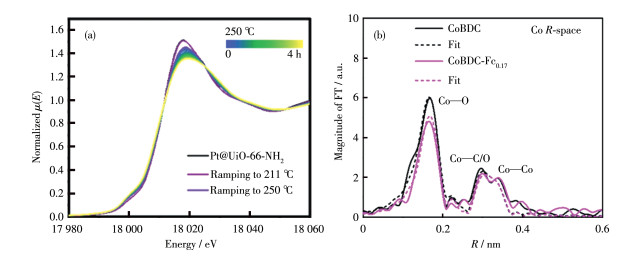
XAS可进一步分为X射线吸收近边结构(XANES)和扩展X射线吸收精细结构(EXAFS)光谱。近年来越来越多的研究者利用XAS来表征纳米材料。当选定目标元素具有不同的电子氧化态和几何结构时,XANES便会呈现出不同的震荡峰。此外,通过拟合可从EXAFS获取吸收原子临近配位原子的种类、距离、配位数和无序度因子等结构信息[67]。当MOFs进行缺陷化处理时,利用XAS技术可以捕捉到缺陷前后配位环境的微弱变化。例如,Meng等制备出Pt纳米粒子@MOFs复合材料,通过加热使得部分配体发生坍塌制备出多孔的MOFs材料。作者通过XANES谱图(图 9a)可以清晰地观察到缺陷结构的白线峰(white line)的峰强明显低于完美结构的峰强,这是由配体的缺失造成的[55]。Xue等同样制备出一种骨架内部存在配体缺失的Co-MOF(CoBDC-Fc),XANES分析难以看出白线峰的变化,但作者通过EXAFS谱图(图 9b)观察到配位环境的改变,Co—O键的峰强变化说明CoBDC-Fc0.17的Co的O配位数小于CoBDC的Co的O配位数,说明其骨架内部存在配体的缺失[68]。
图 9

3. 缺陷型MOFs应用于水处理
近年来,随着城市、工业的高速发展以及人类的活动,水污染问题已经成为全世界关注的重点之一[69-71]。磷超标所引发的水体富营养化[72-73],新污染物(ECs)和微量重金属对人体健康及水生态系统产生潜在威胁[74-76]。针对上述问题,许多研究者将缺陷MOFs通过光催化、光芬顿、活化过硫酸盐和吸附手段将水中污染物进行有效去除并且已经取得诸多进展。对此本文总结了缺陷MOFs在去除水中污染物领域的相关工作(表 1和2),同时对相关应用领域进行详细描述。
表 1
 表 1 缺陷MOFs的制备及其用于高级氧化去除水中污染物Table 1. Fabrication of defective MOFs and their application for removal of pollutants from the water via advanced oxidation processes
 下载:
导出CSV
MOF Fabrication process Application Performance Ref. MIL-101(Fe) Four defective MIL-101(Fe) were fabricated by adding benzoic acid, acetic acid, oxalic acid, or citric acid as modulators into the precursor solution of MIL-101(Fe). Persulfate (PS) activation forrhodamine B (RhB) degradation The degradation efficiency of MIL-101(Fe)-HBC toward RhB (50 g·L-1) reached 94.05% within 50 min under visible light irradiation. PS concentration: 10 mmol·L-1. [31] NH2-MIL-88(B) Three defective NH2-MIL-88(B) were fabricated by adding benzoic acid, pyrrole, and pyrrole-2-carboxylic acid into the precursor solution. Photo-Fenton for acetamiprid (ACTM) degradation Pca-MIL88(Fe) displayed 100% degradation efficiency toward ACTM (50 mg·L-1) within 40 min under visible light irradiation. H2O2 dosage: 35 µL. [34] Fe(Ⅱ)-MOF-X Fe(Ⅱ)-MOF-X were fabricated by adding formic acid, benzoic acid, oxalic acid, and citric acid as modulators into the precursor solution. PS activation for sulfamethoxazole (SMX) degradation The SMX removal rate over Fe-MOF-CA reached 91.69% within 120 min. cPS∶cSMX=200∶1. [77] Fe-MOFs Series Fe-MOFs were fabricated by adding formic acid as a modulator into the precursor solution. PS activation for SMX degradation The Fe-MOFs-2 exhibited the best activity for SMX degradation (95.1%) within 120 min. [78] MIL-125-NH2 As-prepared MIL-125-NH2 was put into a propionic acid solution via the solvothermal method. Photocatalytic RhB degradation The degradation efficiency of H-MIL-125-NH2-VO toward RhB (250 mg·L-1) reached 99% under visible light irradiation. [61] NH2-MIL-125(Ti) As-prepared NH2-MIL-125(Ti) was heated at 300 ℃. Photocatalytic Cr(Ⅵ) reduction The photocatalytic reduction efficiency over NM-300 could reach 81.5% toward 10 mg·L-1 Cr(Ⅵ) within 75 min under visible light irradiation. [33] UiO-66 Series Cu-doped UiO-66 were fabricated by adding Cu(Ac)2 with different concentrations into the precursor solution of UiO-66. Photocatalytic ciprofloxacin (CIP) degradation 0.8CuUiO-66 displayed 93% degradation efficiency toward 30 mg·L-1 CIP within 60 min under ultraviolet light irradiation. [79] UiO-66 CoUiO-X was fabricated by adding CoCl2 with different concentrations into the precursor solution of UiO-66. Cooperation of adsorption and photocatalysis for tetracycline (TC) removal The photocatalytic degradation efficiency of CoUiO-1 toward TC (20 mg·L-1) reached 94% within 120 min under sunlight irradiation. [32] UiO-66-NH2 U-OCl-Ti was prepared by using ZrOCl2·8H2O as the Zr precursor combined with the post-synthetic treatment of Ti substitution. Photocatalytic Cr(Ⅵ) reduction The photocatalytic reduction efficiency over U-OCl-Ti could reach over 75% toward 40 mg·L-1 Cr(Ⅵ) within 120 min under visible light irradiation. [80] ZnIr-MOF ZnIr-MOF was prepared by the solvothermal method by mixing two Ir-based ligands (ppyCOOH= 3-(pyridin-2-yl)benzoic acid, 2-pyPO3H2=2-pyridylphosphonic acid) and Zn(NO3)2. Photocatalytic RhB degradation The degradation efficiency of ZnIr-MOF-d0.3 toward RhB (50 mg·L-1) reached over 90% within 10 min under visible light irradiation [81] PCN-134 PCN-134 was fabricated by the solvothermal method by mixing phenyl tribenzoate, tetra-(4-carboxyl phenyl) porphyrin as well as ZrCl4. Cooperation of adsorption and photocatalysis for diclofenac (DF) removal PCN-134 displayed over 99% degradation efficiency toward DF within 300 min under ultraviolet light irradiation. [82] 表 2
表 2 缺陷MOFs的制备及其用于吸附去除水中污染物Table 2. Fabrication of defective MOFs and their application for removal of pollutants from the water via adsorption下载:
导出CSV
MOF Fabrication process Application Performance Ref. Ce-BDC The synthesis time was shortened and the ratio of ligand and metal was reduced. Phosphorus (P) and fluorine (F) adsorption The maximum adsorption capacity of Ce-BDC-48 toward P and F was 278.8 and 128.0 mg·g-1, respectively. [83] UiO-66 Benzoic acid with different concentrations was added into the precursor solution of UiO-66 to compete with the ligand. Roxarsone (ROX) adsorption The maximum adsorption capacity of UiO-66-20 could reach 730 mg·g-1 within 30 min. [84] UiO-66(Zr) HP-UiO-66(Zr)-XA was fabricated by adding four fatty acids with different lengths into the precursor solution of UiO-66(Zr) to compete with the ligand. Phosphate (PO43-) adsorption The maximum adsorption capacity of HP-UiO-66(Zr)-OA was 186.6 mg·g-1. [29] UiO-66 The synthesis temperature was increased and the ratio of ligand and metal was reduced. Lead (Pb2+) adsorption The maximum adsorption capacity of UiO-66-1∶1-120 was 172.1 mg·g-1. [85] UiO-66 The dosage of hydrochloric acid was increased during the synthesis of UiO-66. Perfluorooctanesulfonate (PFBS) adsorption The maximum adsorption capacity of UiO-66-10 was 1.24 mmol·g-1. [86] UiO-66 10 g UiO-66 and sodium acetate were mixed in a three-neck flask and heated by reflux, followed by acid washing to remove the sodium acetate Methyl orange (MO) and Coomassie brilliant blue R250 adsorption HP-UiO-66 displayed super adsorption performance toward MO and R250 [87] UiO-66 Hydrochloric acid was introduced during the synthesis of UiO-66. Ashanti acid (ASA) and ROX adsorption The adsorption efficiency of UiO-66-D-NH2 toward 1 mg·L-1 organic arsenic could reach 99.1%. [88] UiO-66 37% concentrated hydrochloric acid was introduced during the synthesis of UiO-66. DF adsorption The maximum adsorption capacity of defective UiO-66 was 321 mg·g-1. [89] UiO-66 UiO-66 was prepared by mixing two ligands (terephthalic acid, and 2-amino-terephthalic acid), followed by heat treatment at 350 ℃ to remove 2-amino-terephthalic acid. As(Ⅴ) adsorption The maximum adsorption capacity of HP-UiO-66-40% was 248.75 mg·g-1. [56] UiO-66 ZrCl4 was replaced by La(NO3)3 or Ce(NO3)3 during the synthesis of UiO-66. As(Ⅴ) and F adsorption The maximum adsorption capacities of La-fum toward As(Ⅴ) and F were 1.665 and 4.459 mmol·g-1, respectively. [90] UiO-66 UiO-66-X was fabricated by introducing acetic, benzoic, and trifluoroacetic acid to compete with the ligand. Sb(Ⅴ) adsorption The adsorption performance of UiO-66-TFA improved by 197.7% compared with UiO-66. [91] Hf/Ti-UiO-66 TiCp2Cl2/HfCl4 was mixed with as-prepared UiO-66 to heat. Cefoperazone adsorption The maximum adsorption capacity of Hf-UiO-66 was 346 mg·g-1. [92] UiO-66 Terephthalic acid was replaced by three ligands containing N (dopamine, pyrrole, and 2-methylimidazole), respectively during the synthesis of UiO-66. RhB adsorption The maximum adsorption capacity of pyrrole-UiO-66 was 384.1 mg·g-1. [35] NH2-UiO-66 NH2-UiO-66 was modulated to obtain SS-NH2-UiO-66-5 by using Seignette salt with different concentrations. Pb2+ adsorption The maximum adsorption capacity of SS-NH2-UiO-66-5 was 186.14 mg·g-1. [59] UiO-66- (COOH)2 concentrations was added into the precursor solution of UiO-66-(COOH)2 to compete with the ligand, followed by acid washing to remove the sodium benzoate. Dysprosium (Dy3+) adsorption The maximum adsorption capacity of UiO-66-(COOH)2-B10 was 150.6 mg·g-1. [93] UiO-67(Zr) HCl or TFA with different concentrations was added into the precursor solution of UiO-67(Zr). Glyphosate (GP) adsorption The maximum adsorption capacity of defective UiO-67(Zr) reached 322.58 mg·g-1. [94] MOF-808 The ratio of ligand and metal was changed. TC adsorption The maximum adsorption capacity of MOF-808def was 296 mg·g-1. [39] MOF-808 MOF-808 was treated with hydrochloric acid. Eosin y(EY) and MO adsorption The maximum adsorption capacities of defective MOF-808 toward EY and MO were 661.7 and 532.4 mg·g-1, respectively. [95] PCN-250 Fatty acids with different concentrations and lengths were added into the precursor solution of PCN-250, followed by acid washing to remove the fatty acids. Methylene blue (MB) adsorption The removal efficiencies of PCN-250(C9-1.4M) and PCN-250(C6-1.4M) could reach 99% after 2 h. [27] Zn-ZIF As-prepared ZIF-L was heated for different times to obtain Zn-ZIF. PO43- adsorption The maximum adsorption capacity of Zn-ZIF-72 was (102±2) mg·g-1. [96] 3.1 缺陷MOFs用于高级氧化
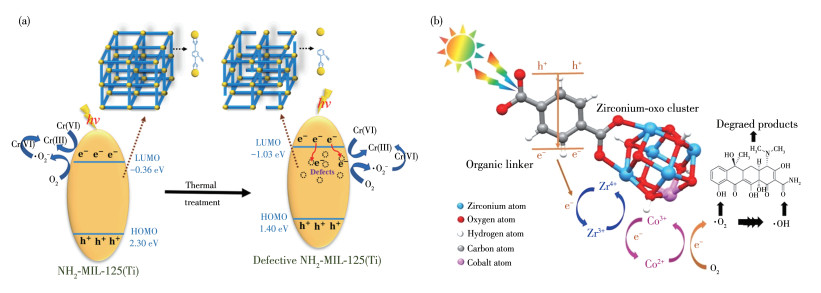
MOFs本身所具有的多孔结构和丰富的Lewis酸位点使其在光催化领域有潜在的应用价值[97]。一般来说,光催化剂的光催化能力主要取决于4个方面:光的吸收能力、禁带宽度、光生电子与空穴的分离效率和电子转移的速率[98]。通过缺陷工程对MOFs进行结构调整,可以有效地减小禁带宽度、抑制光生电子和空穴的复合以及增加光生电子的转移速率。因此,缺陷MOFs被广泛用于有机污染物的降解和Cr(Ⅵ)的还原(表 1)。Mo等采用合成后热处理的方式对NH2-MIL-125(Ti)进行缺陷构造。热处理可使得NH2-MIL-125(Ti)中部分氨基-对苯二甲酸配体分解,得到配体缺失的光催化剂(NM-X)[33]。热处理后由于配体的缺失导致更多的Ti-O簇被暴露出来。光致发光光谱(PL)、交流阻抗(EIS)、瞬时光电流响应均证明缺陷NM-X比原始的NH2-MIL-125(Ti)具有更快的电子转移能力,从而有效增强NH2-MIL-125(Ti)的光催化还原Cr(Ⅵ)性能。增加热处理的时间会形成更多的配体缺陷,但过长的处理时间可能会导致骨架的坍塌。因此,热处理300 min的NM-300相比于NM-500具有更优异的电子转移能力。在光催化还原性能测试中,NM-300展现出更强的光催化还原Cr(Ⅵ)活性。如图 10a所示,配体的缺失可使得NH2-MIL-125(Ti)的LUMO位处于更具有还原性的位置,带隙的减小使得光催化剂的光生电子更易于跃迁并产生有益于Cr(Ⅵ)还原的活性物质(光生电子e-和超氧自由基·O2-),进而提升其光催化还原Cr(Ⅵ)的性能。
图 10

金属的掺杂也是一条改善光催化剂性能的有效途径。以UiO-66为例,根据先前的报道,UiO-66的禁带宽度大约为3.88 eV,较宽的带隙意味着光生电子从HOMO跃迁至LUMO需要克服较大的阻力[99]。而金属掺杂后的UiO-66则可以有效地减小其禁带宽度,使光生电子更容易发生跃迁。Yasin等通过DFT和实验结合印证当Ti取代部分Zr时,UiO-66的禁带宽度将会变小,这也意味着光生电子跃迁所需要克服的阻力变小。通过实验证明部分取代的UiO-66(Ti5Zr1)-NH2的带隙为2.60 eV;理论计算结果表明,Ti可以在晶格内被完全取代,预测带隙值将低至1.62 eV,远低于原始的UiO-66的带隙值[100]。Wang等通过水热法将一部分Ti引入到UiO-66骨架内实现对MB的高效降解[101]。而当一些过渡金属例如Fe、Co进行掺杂时,在光催化过程中金属价态的转变会更容易产生高活性自由基。Cao等利用一锅水热法将一定量的Co掺杂到制备UiO-66的前驱体溶液中,制备出Zr/Co双金属UiO-66(Co-UiO-X)[32]。当没有Co的掺杂时,配体被光激发后,产生的光生电子转移至Zr-O簇中形成Zr3+。随后Zr3+与氧气反应生成·O2-,伴随着Zr3+被氧化还原为Zr4+。但在此过程中由于光生电子与空穴的复合速度较快,导致UiO-66的光催化性能较差。然而,当光催化剂中存在Co的掺杂,电子可以通过金属间转移被捕获,可最大限度减少光诱导电子和空穴的复合。此外,Co3+和Co2+与H2O反应产生更多的·O2-和·OH,从而进一步提高Co-UiO-X光催化降解TC的能力(图 10b)。
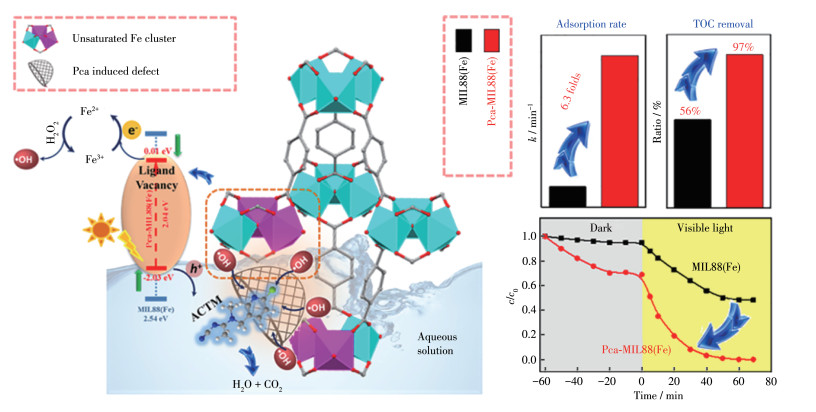
MOFs也可作为异相催化剂激发过氧化氢(H2O2)和过硫酸盐(peroxydisulfate,PDS;peroxymonosulfate,PMS)等,使其产生具有高氧化能力的活性氧物种(reactive oxygen species,ROS),用于降解水中有机污染物[102-103]。在高级氧化体系中,H2O2或PS可通过被金属价态转变或光生电子激发进而产生高活性ROS。而构造缺陷MOFs的一大优势在于其可有效抑制光生电子和空穴的复合,同时促进电子的转移速率。因此,更高的ROS产率便可极大地提升污染物降解的效率。此外,缺陷MOFs的制备可暴露更多的金属簇,金属价态的转化也可增强高级氧化的降解性能(表 1)。Wang等在合成NH2-MIL-88B(Fe)的前驱体溶液中加入3种不同的单齿配体(苯甲酸、吡咯和吡咯-2-羧酸),得到具有丰富空位和配体缺失的Bac-MIL88(Fe)、Py-MIL88(Fe)和Pca-MIL88(Fe)[34]。由于配体的缺失,3种缺陷NH2-MIL-88B(Fe)均可暴露出更多Fe-O簇,可更好地被可见光激发,其中PyMIL88(Fe)和Pca-MIL88(Fe)由于单齿配体存在的含N-π共轭结构进一步提高其对光的吸收。PL、EIS和循环伏安(CV)同时证明缺陷NH2-MIL-88B(Fe)具有更强的光生电子转移能力。Fe2+和Fe3+的快速转换促进H2O2高效转化为高活性羟基自由基(·OH),从而加快有啶虫脒(ACTM)的降解(图 11)。最佳光催化剂Pca-MIL88(Fe)相比无缺陷NH2-MIL-88B(Fe)不仅在吸附能力上提高7.3倍,且光芬顿降解ACTM的速率提升5.5倍。此外,Pca-MIL88(Fe)还展现出优秀的循环利用性,在5轮循环后依旧能展现出接近100% 的降解效率。此外,Pca-MIL88(Fe)可以在90 min内展现出97% 的总有机碳(TOC)去除率,相比于NH2-MIL-88B(Fe)的TOC去除率可提高1.7倍。
图 11

3.2 缺陷MOFs用于吸附去除水中污染物
相比于传统的吸附剂如沸石、活性炭、分子筛等,MOFs吸附剂的一大优势在于可以调整其结构,以此来暴露更丰富的吸附位点[104-106]。对于一些较大尺寸的污染物,MOFs的最小开窗直径可能会增加污染物进入到骨架的内部的难度,通过缺陷工程进行调整则可以很好地扩大开窗孔径,提高传质速率,缩短吸附平衡时间[107]。因此,缺陷型MOFs被广泛应用于吸附去除水中污染物(表 2)。在众多MOFs中,Zr-MOFs尤其是UiO-66由于其具有超大的比表面积、化学和水稳定性强、高配位数、便于进行结构调整等优点而被广泛用于吸附领域[108-110]。对于一些特定的污染物例如磷和砷,UiO-66的Zr-O簇会对其展现出亲和作用,但由于UiO-66的最小开窗直径为0.6 nm,严重阻碍传质的速率[111]。Xu等利用2种配体(对苯二甲酸、2-氨基对苯二甲酸)制备出混合配体UiO-66。由于2-氨基对苯二甲酸配体的热稳定性不如对苯二甲酸,在350 ℃的温度下2-氨基对苯二甲酸被破坏,骨架内部只保留对苯二甲酸配体,这就制备出分级多孔UiO-66(HP-UiO-66)[56]。配体的缺失使得UiO-66的孔道直径范围由原来的小于2 nm变为2~10 nm,远大于As(Ⅴ)的离子半径(0.058 nm),充分提高其传质速率。由于配体的缺失也导致更多吸附位点的暴露。HP-UiO-66展现出对As(Ⅴ) 更强的吸附性能(最大吸附量为248.75 mg·g-1)。
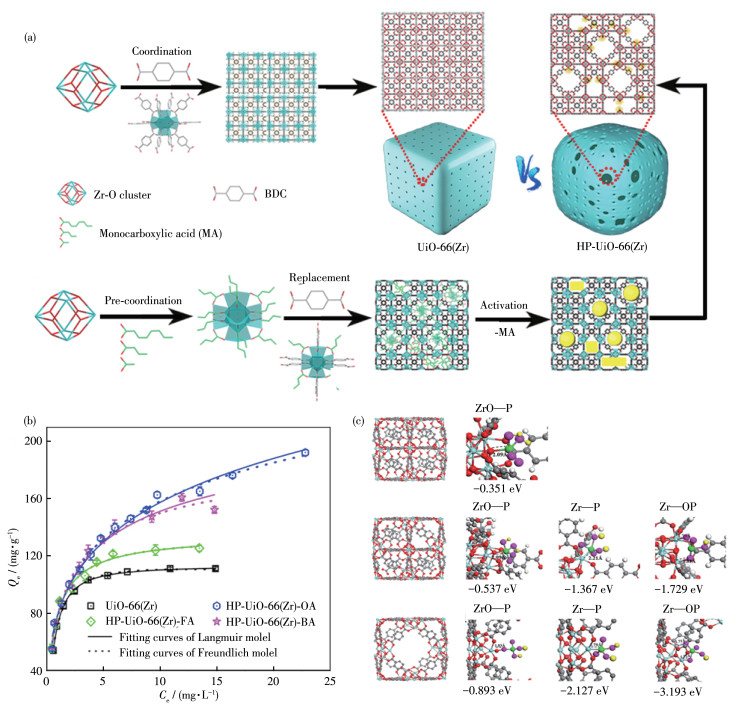
磷既是一种污染物也是一种稀缺的资源,过量的磷排放(> 0.02 mg·L-1)会破坏生态系统的平衡导致水体富营养化;磷作为一种不可再生资源,对磷的回收利用也成为当今一项研究热点[72, 112]。Li等利用UiO-66中的Zr-O簇对磷酸盐的亲和特性,用3种不同链长的脂肪酸(甲酸(FA)、丁酸(BA)和辛酸(OA))取代一部分配体,之后使用酸将骨架上配位的脂肪酸进行洗脱活化,得到分级多孔UiO-66(Zr)(HP-UiO-66 (Zr)-XA)(图 12a)[29]。全孔道分析图显示HP-UiO-66 (Zr)-FA、HP-UiO-66(Zr)-BA、HP-UiO-66(Zr)-OA均出现介孔结构,且介孔在全孔道的占有率分别为38.8%、41.7% 和64.3%。从图 12b可以看出,HP-UiO-66(Zr)-OA对于磷酸盐的吸附容量均大于原始的UiO-66(Zr),且最大吸附量从37.7 mg·g-1提升至186.6 mg·g-1。由于配体的缺失,不仅骨架内部的吸附位点被暴露出来,氧空位的产生为磷酸盐提供额外的吸附位点,多级孔的存在更是提高磷酸盐的传质速率,减少磷酸盐进入到骨架内部所需的时间。因此,不仅HP-UiO-66(Zr)-OA的最大吸附容量相较完美UiO-66(Zr)提升4.8倍,内部扩散的速率相较完美UiO-66(Zr)可提升1.9倍。通过XPS分析确定其吸附的机理:无缺陷UiO-66(Zr)仅存在一种吸附方式(Zr-O-P(单核单配位)),而缺陷UiO-66(Zr)增加2种对磷的吸附方式(Zr-P、Zr-O-P(双核双配位))。DFT计算(图 12c)证实配体的缺失或簇的缺失可有效地降低吸附位点与污染物之间的吸附能,进一步说明HP-UiO-66(Zr)-XA吸附的优越性。
图 12
 图 12. (a) UiO-66(Zr)和缺陷UiO-66(Zr)的制备流程示意图; (b) 不同吸附剂对磷酸盐的吸附性能图; (c) DFT计算的不同吸附形式的吸附能[29]Figure 12. (a) Formation schematic of pristine UiO-66(Zr) and defective UiO-66(Zr); (b) Adsorption capacity of series sorbents toward phosphate; (c) Adsorption energy of different adsorption forms calculated by DFT[29]
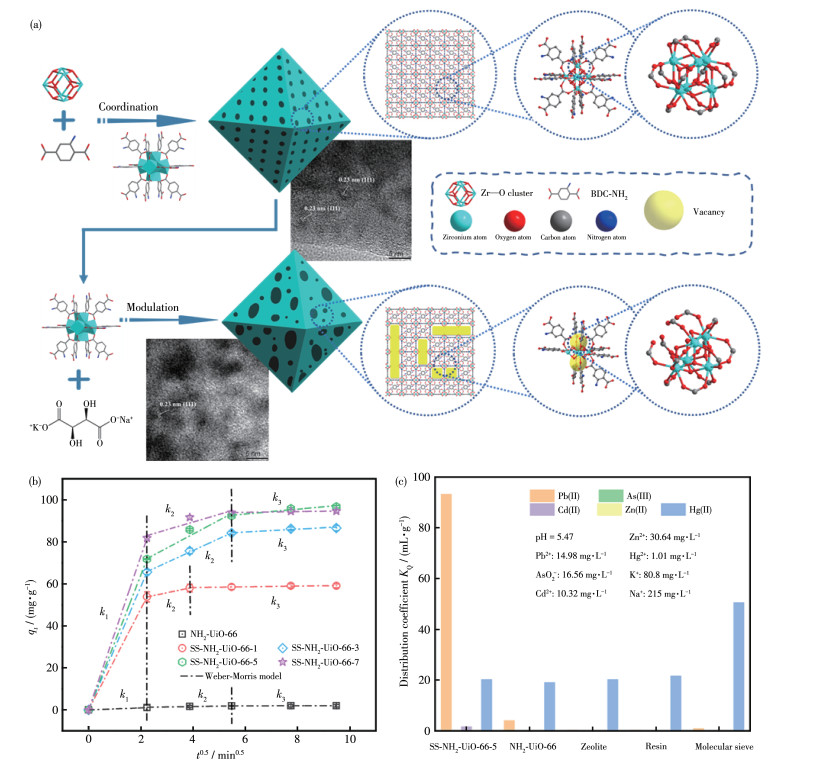
目前,制备缺陷MOFs用于吸附水中高毒性阳离子重金属的研究相对较少,其中一个原因是绝大多数制备缺陷的策略难以提供有利于阳离子型污染物的吸附位点。针对这一问题,Li等利用一种无毒无害的羧酸螯合剂酒石酸钾钠对NH2-UiO-66进行水热处理(图 13a),通过改变酒石酸钾钠的浓度得到一系列具有丰富空位和大孔结构的吸附剂(SS-NH2-UiO-66-X)[59]。酒石酸钾钠的作用点在于可以和Zr-O簇上的Zr发生配位作用,使得部分Zr发生脱落,从而产生不饱和配位氧(Zr空位)。通过XPS、TGA、元素分析(EA)和XAS表征手段证明Zr空位的产生,此外EA、TGA和EPR的结果也显示在调制的过程中存在一定的配体缺失。配体的缺失可增加孔道的直径,全孔道分析证实在调制过程中大孔的出现,通过HR-TEM也可清晰地观察到缺陷位点的存在。孔道直径的增加有效提高Pb2+向骨架内部扩散的速率(图 13b),骨架内部存在的Zr空位可作为Pb2+的吸附位点,使得SS-NH2-UiO-66-5在最佳条件下(pH=5.46)对Pb2+的最大吸附量高达186.14 mg· g-1,相比于无缺陷NH2-UiO-66,吸附容量提升34.2倍且吸附速率提升66.9倍。SS-NH2-UiO-66-5在5轮循环中不仅展现出良好的循环利用性,用吸附溶液体积的1/5的酸溶液进行处理即可将Pb2+进行高效地脱附,说明SS-NH2-UiO-66-5具有良好的富集功能。此外,采用同样的制备策略可提升其它Zr-MOFs(MOF-801、UiO-66和MOF-808)对Pb2+ 的吸附性能。通过XAS和XPS证实其吸附的机理,即SS-NH2-UiO-66-5由于存在不饱和配位的氧,可与Pb2+形成O—Pb键。在真实的铅冶炼废水中存在大量共存离子,SS-NH2-UiO-66-5对Pb2+展现出超高的选择性吸附(图 13c),通过实验和DFT计算不仅证实缺陷的构造可有效降低污染物和吸附剂之间的吸附能,同时也证明其选择性吸附的机理,吸附剂与Pb2+之间的吸附能小于Tl、Cd、Zn,意味着SS-NH2-UiO-66-5更易于和Pb2+发生配位,这也与选择性吸附的实验结果完美匹配。在后续的研究中,通过利用缺陷工程开发广谱性吸附剂也可成为处理废水中重金属离子的一条新的思路。
图 13
 图 13. NH2-UiO-66和缺陷NH2-UiO-66的制备流程示意图; (b) 不同吸附剂对Pb2+的吸附性能图; (c) 不同吸附剂在铅冶炼废水中对Pb2+的吸附性能图[59]Figure 13. (a) Formation schematic of pristine NH2-UiO-66 and defective NH2-UiO-66; (b) Adsorption capacity of different sorbents toward Pb2+; (c) Adsorption capacity of different sorbents toward Pb2+ in lead smelting wastewater[59]
4. 结论与展望
通过缺陷化处理可使MOFs在保证其母体骨架不垮塌的前提下高效地提升在水处理应用中的性能。本文总结了目前关于缺陷MOFs的制备策略、表征手段以及在水处理领域的应用。本文将缺陷MOFs的制备分为合成前引入和合成后处理引入两方面,并对表征缺陷MOFs的技术进行详细的介绍。对MOFs进行缺陷构造并将其应用于水环境修复领域时,Zr-MOFs(包括UiO系列、PCN系列、MOF-808等)受到研究者们的广泛青睐。由于Zr-MOFs具有中心金属配位数较高、与羧酸类配体配位较为稳定等优点,研究者更易于根据意愿对其结构进行改造。此外,以Fe、Ti为中心金属、羧酸类连接剂为配体的MIL系列通过调制法、双金属构造、热处理等方法也可成功构造缺陷。相较于以羧酸为配体的MOFs,以咪唑及衍生物为配体的MOFs在进行缺陷构造时会受到一定的局限性,因此其需要采用相对温和的方式进行缺陷构造。缺陷MOFs可在高级氧化工艺(光催化、光芬顿、活化过硫酸盐)中展现出比原始MOFs更多的优势,更快的电子转移、更低的光生电子和空穴的复合速率、更多活性自由基的产生是缺陷MOFs可展现更强性能的主要原因。缺陷使得MOFs的孔道尺寸变大,更多吸附位点被暴露且会创造额外的吸附位点,使其在吸附过程中的吸附容量和吸附速率大大提升。因此,缺陷MOFs在水处理领域有很大的应用潜力。
缺陷型MOFs在未来还有很大的研究空间。今后的研究内容可以着重包括几个方面:(1) 缺陷型MOFs的宏量制备。缺陷型MOFs虽然在性能上比原始的MOFs有更多的优势,但缺陷型MOFs的产率更低。发展至今,MOF的宏量生产已经取得诸多进展,甚至出现公斤级的制备工艺[113],可在此基础上进行缺陷构造以实现缺陷MOFs的公斤级制备。(2) 过硫酸盐-高级氧化(PS-AOP)在近些年来被广泛应用于降解水中微量有机污染物。缺陷工程可对以过渡金属Fe、Mn、Co、Cu、Ni为中心金属的MOFs结构进行调整,缺陷MOFs在激发PS降解有机污染物时,不仅可能增强自由基的降解路径,也可能增加非自由基的降解路径。(3) 缺陷型MOFs可与导体或半导体复合制备复合物。缺陷型MOFs的制备可促进光生电子与空穴的分离,减小带隙,但其无法有效地拓宽光的吸收范围。缺陷型MOFs可尝试与具有较好光吸收能力的导体或半导体如g-C3N4、苝四甲酸酐(PTCDA)等复合来进一步提升其高级氧化的性能[99, 114]。(4) 缺陷型MOFs的负载化应用。粉体材料的一大问题在于难以进行固液分离,将缺陷MOFs负载到合适的基质可推动缺陷型MOFs的实际应用[115]。(5) MOFs的缺陷可通过微电子衍射技术(micro electron diffraction,MicroED) 进行表征[116-117]。通过将晶体学与冷冻电子显微镜相结合,可将缺陷型MOFs的结构进行解析,从而精准确定MOFs的缺陷位点。(6) 缺陷MOFs去除水中污染物机理探究。可利用DFT计算辅助对机理机制的探究[118]。(7) 探究缺陷MOFs对环境的影响。目前还缺乏相关研究关注对环境的影响,未来需关注缺陷MOFs的离子溶出或配体溶出对水生动物植物的影响[119-120]。最后,缺陷MOFs在进行性能测试时需选用复杂的真实水体,关注实际废水的处理效果将有助于缺陷MOFs的实际化应用。
-
-
[1]
Wang C C, Li J R, Lv X L, Zhang Y Q, Guo G S. Photocatalytic Organic Pollutants Degradation in Metal-Organic Frameworks[J]. Energy Environ. Sci., 2014, 7(9): 2831-2867. doi: 10.1039/C4EE01299B
-
[2]
Zhou H C, Jeffrey R L, Yaghi O M. Introduction to Metal-Organic Frameworks[J]. Chem. Rev., 2012, 112(2): 673-674. doi: 10.1021/cr300014x
-
[3]
Du X D, Wang S, Ye F, Zhang Q R. Derivatives of Metal-Organic Frameworks for Heterogeneous Fentonlike Processes: From Preparation to Performance and Mechanisms in Wastewater Purification—A Mini Review[J]. Environ. Res., 2022, 206: 112414. doi: 10.1016/j.envres.2021.112414
-
[4]
Du X D, Zhou M H. Strategies to Enhance Catalytic Performance of Metal-Organic Frameworks in Sulfate Radical-Based Advanced Oxidation Processes for Organic Pollutants Removal[J]. Chem. Eng. J., 2021, 403: 126346. doi: 10.1016/j.cej.2020.126346
-
[5]
Li Y H, Yi X H, Li Y X, Wang C C, Wang P, Zhao C, Zheng W W. Robust Cr(Ⅵ) Reduction over Hydroxyl Modified UiO-66 Photocatalyst Constructed from Mixed Ligands: Performances and Mechanism Insight with or without Tartaric Acid[J]. Environ. Res., 2021, 201: 111596. doi: 10.1016/j.envres.2021.111596
-
[6]
Wang F X, Wang C C, Du X D, Li Y, Wang F, Wang P. Efficient Removal of Emerging Organic Contaminants via Photo-Fenton Process over Micron-Sized Fe-MOF Sheet[J]. Chem. Eng. J., 2022, 429: 132495. doi: 10.1016/j.cej.2021.132495
-
[7]
衣晓虹, 王崇臣. 铁基金属-有机骨架及其复合物高级氧化降解水中新兴有机污染物[J]. 化学进展, 2021,33,(3): 471-489. YI X H, WANG C C. Elimination of Emerging Organic Contaminants in Wastewater by Advanced Oxidation Process over Iron-Based MOFs and Their Composites[J]. Prog. Chem., 2021, 33(3): 471-489.
-
[8]
周云彩, 王崇臣, 王鹏, 付会芬, 赵晨. 原位光化学还原法制备AgUiO-66-NH2复合物以增强其光催化性能[J]. 无机化学学报, 2020,36,(11): 2100-2112. doi: 10.11862/CJIC.2020.207ZHOU Y C, WANG C C, WANG P, FU H F, ZHAO C. In-Situ Photochemical Reduction of Ag-UiO-66-NH2 Composite for Enhanced Photocatalytic Performance[J]. Chinese J. Inorg. Chem., 2020, 36(11): 2100-2112. doi: 10.11862/CJIC.2020.207
-
[9]
Murray L J, Dinca M, Long J R. Hydrogen Storage in Metal-Organic Frameworks[J]. Chem. Soc. Rev., 2009, 38(5): 1294-1314. doi: 10.1039/b802256a
-
[10]
Sumida K, Rogow D L, Mason J A, McDonald T M, Bloch E D, Herm Z R, Bae T H, Long J R. Carbon Dioxide Capture in Metal-Organic Frameworks[J]. Chem. Rev., 2012, 112(2): 724-781. doi: 10.1021/cr2003272
-
[11]
Daglar H, Gulbalkan H C, Avci G, Aksu G O, Altundal O F, Altintas C, Erucar I, Keskin S. Effect of Metal-Organic Framework (MOF) Database Selection on the Assessment of Gas Storage and Separation Potentials of MOFs[J]. Angew. Chem. Int. Ed., 2021, 60(14): 7828-7837. doi: 10.1002/anie.202015250
-
[12]
Li C, Liu D H, Peng J, Du Q Z, He H. Ratiometric Fluorescence Sensing of Metal-Organic Frameworks: Tactics and Perspectives[J]. Coord. Chem. Rev., 2020, 404: 213113. doi: 10.1016/j.ccr.2019.213113
-
[13]
Zhang Y Q, Sheng S S, Mao S, Wu X H, Li Z, Tao W Q, Jenkinson I R. Highly Sensitive and Selective Fluorescent Detection of Phosphate in Water Environment by a Functionalized Coordination Polymer[J]. Water Res., 2019, 163: 114883. doi: 10.1016/j.watres.2019.114883
-
[14]
Yamada T, Otsubo K, Makiura R, Kitagawa H. Designer Coordination Polymers: Dimensional Crossover Architectures and Proton Conduction[J]. Chem. Soc. Rev., 2013, 42(16): 6655-6669. doi: 10.1039/c3cs60028a
-
[15]
Sadakiyo M, Okawa H, Shigematsu A, Ohba M, Yamada T, Kitagawa H. Promotion of Low-Humidity Proton Conduction by Controlling Hydrophilicity in Layered Metal-Organic Frameworks[J]. J. Am. Chem. Soc., 2012, 134(12): 5472-5475. doi: 10.1021/ja300122r
-
[16]
Meng X, Wang H N, Song S Y, Zhang H J. Proton-Conducting Crystalline Porous Materials[J]. Chem. Soc. Rev., 2017, 46(2): 464-480. doi: 10.1039/C6CS00528D
-
[17]
Wang C Y, Wang C C, Zhang X W, Ren X Y, Yu B Y, Wang P, Zhao Z X, Fu H F. A New Eu-MOF for Ratiometrically Fluorescent Detection toward Quinolone Antibiotics and Selective Detection toward Tetracycline Antibiotics[J]. Chin. Chem. Lett., 2022, 33: 1353-1357. doi: 10.1016/j.cclet.2021.08.095
-
[18]
Dhaka S, Kumar R, Deep A, Kurade M B, Ji S W, Jeon B H. Metal-Organic Frameworks (MOFs) for the Removal of Emerging Contaminants from Aquatic Environments[J]. Coord. Chem. Rev., 2019, 380: 330-352. doi: 10.1016/j.ccr.2018.10.003
-
[19]
Ren X Y, Wang C C, Li Y, Wang C Y, Wang P, Gao S J. Ag Removal and Recovery from Wastewater Adopting NH2-MIL-125 as Efficient Adsorbent: A 3Rs (Reduce, Recycle and Reuse) Approach and Practice[J]. Chem. Eng. J., 2022, 442: 136306. doi: 10.1016/j.cej.2022.136306
-
[20]
庞达, 王崇臣, 王鹏, 付会芬, 赵晨. ZIF-67高效吸附去除水中的洛克沙胂[J]. 环境化学, 2020,39,(6): 1451-1463. PANG D, WANG C C, WANG P, FU H F, ZHAO C. Efficiently Adsorptive Removal towards Roxarsone with ZIF-67[J]. Environmental Chemistry, 2020, 39(6): 1451-1463.
-
[21]
Taddei M. When Defects Turn into Virtues: The Curious Case of Zirconium-Based Metal-Organic Frameworks[J]. Coord. Chem. Rev., 2017, 343: 1-24. doi: 10.1016/j.ccr.2017.04.010
-
[22]
Chong S Y, Thiele G, Kim J. Excavating Hidden Adsorption Sites in Metal-Organic Frameworks Using Rational Defect Engineering[J]. Nat. Commun., 2017, 8(1): 1539. doi: 10.1038/s41467-017-01478-4
-
[23]
Dissegna S, Epp K, Heinz W R, Kieslich G, Fischer R A. Defective Metal-Organic Frameworks[J]. Adv. Mater., 2018, 30(37): e1704501. doi: 10.1002/adma.201704501
-
[24]
Fang Z, Bueken B, De Vos D E, Fischer R A. Defect-Engineered Metal-Organic Frameworks[J]. Angew. Chem. Int. Ed., 2015, 54(25): 7234-7254. doi: 10.1002/anie.201411540
-
[25]
Shoaee M, Anderson M W, Attfield M P. Crystal Growth of the Nanoporous Metal-Organic Framework HKUST-1 Revealed by In Situ Atomic Force Microscopy[J]. Angew. Chem. Int. Ed., 2008, 47(44): 8525-8528. doi: 10.1002/anie.200803460
-
[26]
Ravon U, Savonnet M, Aguado S, Domine M E, Janneau E, Farrusseng D. Engineering of Coordination Polymers for Shape Selective Alkylation of Large Aromatics and the Role of Defects[J]. Microporous Mesoporous Mater., 2010, 129(3): 319-329. doi: 10.1016/j.micromeso.2009.06.008
-
[27]
Kirchon A, Li J L, Xia F Q, Day G S, Becker B, Chen W M, Sue H J, Fang Y, Zhou H C. Modulation Versus Templating: Fine-Tuning of Hierarchally Porous PCN-250 Using Fatty Acids to Engineer Guest Adsorption[J]. Angew. Chem. Int. Ed., 2019, 58(36): 12425-12430. doi: 10.1002/anie.201905006
-
[28]
Cai G R, Yan P, Zhang L L, Zhou H C, Jiang H L. Metal-Organic Framework-Based Hierarchically Porous Materials: Synthesis and Applications[J]. Chem. Rev., 2021, 121(20): 12278-12326. doi: 10.1021/acs.chemrev.1c00243
-
[29]
Li M H, Liu Y B, Li F, Shen C S, Kaneti Y V, Yamauchi Y, Yuliarto B, Chen B, Wang C C. Defect-Rich Hierarchical Porous UiO-66(Zr) for Tunable Phosphate Removal[J]. Environ. Sci. Technol., 2021, 55(19): 13209-13218.
-
[30]
Zhao C, Pan X, Wang Z H, Wang C C. 1+1 > 2: A Critical Review of MOF/Bismuth-Based Semiconductor Composites for Boosted Photocatalysis[J]. Chem. Eng. J., 2021, 417: 128022. doi: 10.1016/j.cej.2020.128022
-
[31]
Guo H S, Su S N, Liu Y, Ren X H, Guo W L. Enhanced Catalytic Activity of MIL-101(Fe) with Coordinatively Unsaturated Sites for Activating Persulfate to Degrade Organic Pollutants[J]. Environ. Sci. Pollut. Res., 2020, 27(14): 17194-17204. doi: 10.1007/s11356-020-08316-z
-
[32]
Cao J, Yang Z H, Xiong W P, Zhou Y Y, Peng Y R, Li X, Zhou C Y, Xu R, Zhang Y R. One-Step Synthesis of Co-Doped UiO-66 Nanoparticle with Enhanced Removal Efficiency of Tetracycline: Simultaneous Adsorption and Photocatalysis[J]. Chem. Eng. J., 2018, 353: 126-137. doi: 10.1016/j.cej.2018.07.060
-
[33]
Mo G L, Wang L X, Luo J H. Controlled Thermal Treatment of NH2-MIL-125(Ti) for Drastically Enhanced Photocatalytic Reduction of Cr(Ⅵ)[J]. Sep. Purif. Technol., 2021, 277: 119643. doi: 10.1016/j.seppur.2021.119643
-
[34]
Wang Y X, Zhong Z, Muhammad Y, He H, Zhao Z X, Nie S X, Zhao Z X. Defect Engineering of NH2-MIL-88B(Fe) Using Different Monodentate Ligands for Enhancement of Photo-Fenton Catalytic Performance of Acetamiprid Degradation[J]. Chem. Eng. J., 2020, 398: 125684. doi: 10.1016/j.cej.2020.125684
-
[35]
Hu P, Zhao Z X, Sun X D, Muhammad Y, Li J, Chen S B, Pang C J, Liao T T, Zhao Z X. Construction of Crystal Defect Sites in N-Coordinated UiO-66 via Mechanochemical In-Situ N-Doping Strategy for Highly Selective Adsorption of Cationic Dyes[J]. Chem. Eng. J., 2019, 356: 329-340. doi: 10.1016/j.cej.2018.09.060
-
[36]
Wißmann G, Schaate A, Lilienthal S, Bremer I, Schneider A M, Behrens P. Modulated Synthesis of Zr-Fumarate MOF[J]. Microporous Mesoporous Mater., 2012, 152: 64-70. doi: 10.1016/j.micromeso.2011.12.010
-
[37]
Vermoortele F, Bueken B, Le Bars G, Van de Voorde B, Vandichel M, Houthoofd K, Vimont A, Daturi M, Waroquier M, Van Speybroeck V, Kirschhock C, De Vos D E. Synthesis Modulation as a Tool to Increase the Catalytic Activity of Metal-Organic Frameworks: The Unique Case of UiO-66(Zr)[J]. J. Am. Chem. Soc., 2013, 135(31): 11465-11468. doi: 10.1021/ja405078u
-
[38]
Shearer G C, Chavan S, Ethiraj J, Vitillo J G, Svelle S, Olsbye U, Lamberti C, Bordiga S, Lillerud K P. Tuned to Perfection: Ironing out the Defects in Metal-Organic Framework UiO-66[J]. Chem. Mater., 2014, 26(14): 4068-4071. doi: 10.1021/cm501859p
-
[39]
Fu M, Deng X P, Wang S Q, Yang F L, Lin L C, Zaworotko M J, Dong Y C. Scalable Robust Nano-Porous Zr-Based MOF Adsorbent with High-Capacity for Sustainable Water Purification[J]. Sep. Purif. Technol., 2022, 288: 120620. doi: 10.1016/j.seppur.2022.120620
-
[40]
Zhang S P, Zhuo Y F, Ezugwu C I, Wang C C, Li C H, Liu S W. Synergetic Molecular Oxygen Activation and Catalytic Oxidation of Formaldehyde over Defective MIL-88B(Fe) Nanorods at Room Temperature[J]. Environ. Sci. Technol., 2021, 55(12): 8341-8350. doi: 10.1021/acs.est.1c01277
-
[41]
Marx S, Kleist W, Baiker A. Synthesis, Structural Properties, and Catalytic Behavior of Cu-BTC and Mixed-Linker Cu-BTC-Pydc in the Oxidation of Benzene Derivatives[J]. J. Catal., 2011, 281(1): 76-87. doi: 10.1016/j.jcat.2011.04.004
-
[42]
Kozachuk O, Luz I, Llabres i Xamena F X, Noei H, Kauer M, Albada H B, Bloch E D, Marler B, Wang Y, Muhler M, Fischer R A. Multifunctional, Defect-Engineered Metal-Organic Frameworks with Ruthenium Centers: Sorption and Catalytic Properties[J]. Angew. Chem. Int. Ed., 2014, 53(27): 7058-62. doi: 10.1002/anie.201311128
-
[43]
Feng Y, Chen Q, Jiang M Q, Yao J F. Tailoring the Properties of UiO-66 through Defect Engineering: A Review[J]. Ind. Eng. Chem. Res., 2019, 58(38): 17646-17659. doi: 10.1021/acs.iecr.9b03188
-
[44]
Yang J M, Ying R J, Han C X, Hu Q T, Xu H M, Li J H, Wang Q, Zhang W. Adsorptive Removal of Organic Dyes from Aqueous Solution by a Zr-Based Metal-Organic Framework: Effects of Ce Doping[J]. Dalton Trans., 2018, 47(11): 3913-3920. doi: 10.1039/C8DT00217G
-
[45]
Bakuru V R, Churipard S R, Maradur S P, Kalidindi S B. Exploring the Brønsted Acidity of UiO-66 (Zr, Ce, Hf) Metal-Organic Frame-works for Efficient Solketal Synthesis from Glycerol Acetalization[J]. Dalton Trans., 2019, 48(3): 843-847. doi: 10.1039/C8DT03512A
-
[46]
Nouar F, Breeze M I, Campo B C, Vimont A, Clet G, Daturi M, Devic T, Walton R I, Serre C. Tuning the Properties of the UiO-66 Metal Organic Framework by Ce Substitution[J]. Chem. Commun., 2015, 51(77): 14458-14461. doi: 10.1039/C5CC05072C
-
[47]
Min X, Wu X, Shao P, Ren Z, Ding L, Luo X. Ultra-High Capacity of Lanthanum-Doped UiO-66 for Phosphate Capture: Unusual Doping of Lanthanum by the Reduction of Coordination Number[J]. Chem. Eng. J., 2019, 358: 321-330. doi: 10.1016/j.cej.2018.10.043
-
[48]
Feng J F, Liu T F, Shi J, Gao S Y, Cao R. Dual-Emitting UiO-66 (Zr & Eu) Metal-Organic Framework Films for Ratiometric Temperature Sensing[J]. ACS Appl. Mater. Interfaces, 2018, 10(24): 20854-20861. doi: 10.1021/acsami.8b04889
-
[49]
Tu J P, Zeng X L, Xu F J, Wu X, Tian Y F, Hou X D, Long Z. Microwave-Induced Fast Incorporation of Titanium into UiO-66 Metal-Organic Frameworks for Enhanced Photocatalytic Properties[J]. Chem. Commun., 2017, 53(23): 3361-3364. doi: 10.1039/C7CC00076F
-
[50]
Smith S J, Ladewig B P, Hill A J, Lau C H, Hill M R. Postsynthetic Ti Exchanged UiO-66 Metal-Organic Frameworks that Deliver Exceptional Gas Permeability in Mixed Matrix Membranes[J]. Sci. Rep., 2015, 5: 7823. doi: 10.1038/srep07823
-
[51]
Lin Y X, Zhang Y, Li G J. Promotion of Sulfameter Degradation by Coupling Persulfate and Photocatalytic Advanced Oxidation Processes with Fe-Doped MOFs[J]. Sep. Purif. Technol., 2022, 282: 119632. doi: 10.1016/j.seppur.2021.119632
-
[52]
Lee Y, Kim S, Kang J K, Cohen S M. Photocatalytic CO2 Reduction by a Mixed Metal (Zr/Ti), Mixed Ligand Metal-Organic Framework under Visible Light Irradiation[J]. Chem. Commun., 2015, 51(26): 5735-5738. doi: 10.1039/C5CC00686D
-
[53]
Tang J, Salunkhe R R, Liu J, Torad N L, Imura M, Furukawa S, Yamauchi Y. Thermal Conversion of Core-Shell Metal-Organic Frameworks: A New Method for Selectively Functionalized Nanoporous Hybrid Carbon[J]. J. Am. Chem. Soc., 2015, 137(4): 1572-1580. doi: 10.1021/ja511539a
-
[54]
Vermoortele F, Ameloot R, Alaerts L, Matthessen R, Carlier B, Fernandez E V R, Gascon J, Kapteijn F, De Vos D E. Tuning the Catalytic Performance of Metal-Organic Frameworks in Fine Chemistry by Active Site Engineering[J]. J. Mater. Chem., 2012, 22(20): 10313-10321. doi: 10.1039/c2jm16030g
-
[55]
Meng F, Zhang S, Ma L, Zhang W, Li M, Wu T, Li H, Zhang T, Lu X, Huo F, Lu J. Construction of Hierarchically Porous Nanoparticles@Metal-Organic Frameworks Composites by Inherent Defects for the Enhancement of Catalytic Efficiency[J]. Adv. Mater., 2018, 30(49): e1803263. doi: 10.1002/adma.201803263
-
[56]
Xu R M, Ji Q H, Zhao P, Jian M P, Xiang C, Hu C Z, Zhang G, Tang C C, Liu R P, Zhang X W, Qu J H. Hierarchically Porous UiO-66 with Tunable Mesopores and Oxygen Vacancies for Enhanced Arsenic Removal[J]. J. Mater. Chem. A, 2020, 8(16): 7870-7879. doi: 10.1039/C9TA13747E
-
[57]
Karagiaridi O, Lalonde M B, Bury W, Sarjeant A A, Farha O K, Hupp J T. Opening ZIF-8: A Catalytically Active Zeolitic Imidazolate Framework of Sodalite Topology with Unsubstituted Linkers[J]. J. Am. Chem. Soc., 2012, 134(45): 18790-18796. doi: 10.1021/ja308786r
-
[58]
Marshall R J, Forgan R S. Postsynthetic Modification of Zirconium Metal-Organic Frameworks[J]. Eur. J. Inorg. Chem., 2016, 2016(27): 4310-4331. doi: 10.1002/ejic.201600394
-
[59]
Li Y H, Wang C C, Zeng X, Sun X Z, Zhao C, Fu H F, Wang P. Seignette Salt Induced Defects in Zr-MOFs for Boosted Pb Adsorption: Universal Strategy and Mechanism Insight[J]. Chem. Eng. J., 2022, 442: 136276. doi: 10.1016/j.cej.2022.136276
-
[60]
Shearer G C, Chavan S, Bordiga S, Svelle S, Olsbye U, Lillerud K P. Defect Engineering: Tuning the Porosity and Composition of the Metal-Organic Framework UiO-66 via Modulated Synthesis[J]. Chem. Mater., 2016, 28(11): 3749-3761. doi: 10.1021/acs.chemmater.6b00602
-
[61]
Chang Y J, Huang H L, Yang T, Wang L, Zhu H J, Zhong C L. Simultaneous Introduction of Oxygen Vacancies and Hierarchical Pores into Titanium-Based Metal-Organic Framework for Enhanced Photocatalytic Performance[J]. J. Colloid Interface Sci., 2021, 599: 785-794. doi: 10.1016/j.jcis.2021.04.134
-
[62]
Gupta S K, Pathak N, Ghosh P S, Rajeshwari B, Natarajan V, Kadam R M. Temperature Dependent Electron Paramagnetic Resonance (EPR) of SrZrO3[J]. J. Magn. Magn. Mater., 2015, 391: 101-107. doi: 10.1016/j.jmmm.2015.04.108
-
[63]
Zhu L K, Zhang D L, Xue M, Li H, Qiu S L. Direct Observations of the MOF (UiO-66) Structure by Transmission Electron Microscopy[J]. CrystEngComm, 2013, 15(45): 9356. doi: 10.1039/c3ce41122b
-
[64]
Liu L M, Chen Z J, Wang J J, Zhang D L, Zhu Y H, Ling S L, Huang K W, Belmabkhout Y, Adil K, Zhang Y X, Slater B, Eddaoudi M, Han Y. Imaging Defects and Their Evolution in a Metal-Organic Framework at Sub-Unit-Cell Resolution[J]. Nat. Chem., 2019, 11(7): 622-628. doi: 10.1038/s41557-019-0263-4
-
[65]
Zhang Y C, Guerra-Nunez C, Utke I, Michler J, Agrawal P, Rossell M D, Erni R. Atomic Layer Deposition of Titanium Oxide on Single-Layer Graphene: An Atomic-Scale Study toward Understanding Nucleation and Growth[J]. Chem. Mater., 2017, 29(5): 2232-2238. doi: 10.1021/acs.chemmater.6b05143
-
[66]
Liu L, Qiao Z W, Cui X F, Pang C J, Liang H, Xie P, Luo X, Huang Z Q, Zhang Y J, Zhao Z X. Amino Acid Imprinted UiO-66s for Highly Recognized Adsorption of Small Angiotensin-Converting-Enzyme-Inhibitory Peptides[J]. ACS Appl. Mater. Interfaces, 2019, 11(26): 23039-23049. doi: 10.1021/acsami.9b07453
-
[67]
Penner-Hahn J E. X-ray Absorption Spectroscopy in Coordination Chemistry[J]. Coord. Chem. Rev., 1999, 90-192: 1101-1123.
-
[68]
Xue Z Q, Liu K, Liu Q L, Li Y L, Li M R, Su C Y, Ogiwara N, Kobayashi H, Kitagawa H, Liu M, Li G Q. Missing-Linker Metal-Organic Frameworks for Oxygen Evolution Reaction[J]. Nat. Commun., 2019, 10(1): 5048. doi: 10.1038/s41467-019-13051-2
-
[69]
Vörösmarty C J, McIntyre P B, Gessner M O, Dudgeon D, Prusevich A, Green P, Glidden S, Bunn S E, Sullivan C A, Liermann C R, Davies P M. Global Threats to Human Water Security and River Biodiversity[J]. Nature, 2010, 467(7315): 555-561. doi: 10.1038/nature09440
-
[70]
Shen Y, Zhang Z H, Xiao K J. Evaluation of Cobalt Oxide, Copper Oxide and Their Solid Solutions as Heterogeneous Catalysts for Fenton-Degradation of Dye Pollutants[J]. RSC Adv., 2015, 5(111): 91846-91854. doi: 10.1039/C5RA18923C
-
[71]
Akram N, Guo J, Ma W L, Guo Y, Hassan A, Wang J D. Synergistic Catalysis of Co(OH)2/CuO for the Degradation of Organic Pollutant under Visible Light Irradiation[J]. Sci. Rep., 2020, 10(1): 1939. doi: 10.1038/s41598-020-59053-9
-
[72]
Conley D J, Paerl H W, Howarth R W, Boesch D F, Seitzinger S P, Havens K E, Lancelot C, Likens G E. Controlling Eutrophication: Nitrogen and Phosphorus[J]. Science, 2009, 323(5917): 1014-1015. doi: 10.1126/science.1167755
-
[73]
Lewis W M, Wurtsbaugh W A, Paerl H W. Rationale for Control of Anthropogenic Nitrogen and Phosphorus to Reduce Eutrophication of Inland Waters[J]. Environ. Sci. Technol., 2011, 45(24): 10300-10305. doi: 10.1021/es202401p
-
[74]
Peng Y G, Huang H L, Zhang Y X, Kang C F, Chen S M, Song L, Liu D H, Zhong C L. A Versatile MOF-Based Trap for Heavy Metal Ion Capture and Dispersion[J]. Nat. Commun., 2018, 9(1): 187. doi: 10.1038/s41467-017-02600-2
-
[75]
Kumar A, Khan M, He J H, Lo I M C. Recent Developments and Challenges in Practical Application of Visible-Light-Driven TiO2-Based Heterojunctions for PPCP Degradation: A Critical Review[J]. Water Res., 2020, 170: 115356. doi: 10.1016/j.watres.2019.115356
-
[76]
Zeng H J, Yu Z X, Shao L Y, Li X H, Zhu M, Liu Y C, Feng X F, Zhu X M. Ag2CO 3@UiO-66-NH2 Embedding Graphene Oxide Sheets Photocatalytic Membrane for Enhancing the Removal Performance of Cr(Ⅵ) and Dyes Based on Filtration[J]. Desalination, 2020, 491: 114558. doi: 10.1016/j.desal.2020.114558
-
[77]
Chen H J, Wan J Q, Yan Z C, Ma Y G, Wang Y, Xie Y C, Hou J. Construction of Ultra-High Defective Iron-Based Metal Organic Frameworks with Small Molecule Acid Regulator for Enhanced Degradation of Sulfamethoxazole[J]. J. Clean. Prod., 2022, 348: 131367. doi: 10.1016/j.jclepro.2022.131367
-
[78]
Sun J, Wan J Q, Wang Y, Yan Z C, Ma Y W, Ding S, Tang M, Xie Y C. Modulated Construction of Fe-Based MOF via Formic Acid Modulator for Enhanced Degradation of Sulfamethoxazole Design, Degradation Pathways, and Mechanism[J]. J. Hazard. Mater., 2022, 429: 128299. doi: 10.1016/j.jhazmat.2022.128299
-
[79]
Yin L M, Wang D B, Li X P, He Y Y, Liu X Q, Xu Y Y, Chen H. One-Pot Synthesis of Oxygen-Vacancy-Rich Cu-Doped UiO-66 for Collaborative Adsorption and Photocatalytic Degradation of Ciprofloxacin[J]. Sci. Total Environ., 2022, 815: 151962. doi: 10.1016/j.scitotenv.2021.151962
-
[80]
Feng Y, Chen Q, Cao M J, Ling N, Yao J F. Defect-Tailoring and Titanium Substitution in Metal-Organic Framework UiO-66-NH2 for the Photocatalytic Degradation of Cr(Ⅵ) to Cr(Ⅲ)[J]. ACS Appl. Nano Mater., 2019, 2(9): 5973-5980. doi: 10.1021/acsanm.9b01403
-
[81]
Fan K, Nie W X, Wang L P, Liao C H, Bao S S, Zheng L M. Defective Metal-Organic Frameworks Incorporating Iridium-Based Metal loligands: Sorption and Dye Degradation Properties[J]. Chemistry, 2017, 23(27): 6615-6624. doi: 10.1002/chem.201700365
-
[82]
Gao Y X, Xia J, Liu D C, Kang R X, Yu G, Deng S B. Synthesis of Mixed-Linker Zr-MOFs for Emerging Contaminant Adsorption and Photodegradation under Visible Light[J]. Chem. Eng. J., 2019, 378: 122118. doi: 10.1016/j.cej.2019.122118
-
[83]
He J J, Xu Y H, Xiong Z K, Lai B, Sun Y, Yang Y, Yang L W. The Enhanced Removal of Phosphate by Structural Defects and Competitive Fluoride Adsorption on Cerium-Based Adsorbent[J]. Chemosphere, 2020, 256: 127056. doi: 10.1016/j.chemosphere.2020.127056
-
[84]
Li B, Zhu X Y, Hu K L, Li Y S, Feng J F, Shi J L, Gu J L. Defect Creation in Metal-Organic Frameworks for Rapid and Controllable Decontamination of Roxarsone from Aqueous Solution[J]. J. Hazard. Mater., 2016, 302: 57-64. doi: 10.1016/j.jhazmat.2015.09.040
-
[85]
Ali S, Zuhra Z, Abbas Y, Shu Y F, Ahmad M, Wang Z Y. Tailoring Defect Density in UiO-66 Frameworks for Enhanced Pb Adsorption[J]. Langmuir, 2021, 37(46): 13602-13609. doi: 10.1021/acs.langmuir.1c02032
-
[86]
Clark C A, Heck K N, Powell C D, Wong M S. Highly Defective UiO-66 Materials for the Adsorptive Removal of Perfluorooctanesulfonate[J]. ACS Sustain. Chem. Eng., 2019, 7(7): 6619-6628. doi: 10.1021/acssuschemeng.8b05572
-
[87]
Cai G R, Ma X, Kassymova M, Sun K, Ding M L, Jiang H L. Large-Scale Production of Hierarchically Porous Metal-Organic Frameworks by a Reflux-Assisted Post-synthetic Ligand Substitution Strategy[J]. ACS Cent. Sci., 2021, 7(8): 1434-1440. doi: 10.1021/acscentsci.1c00743
-
[88]
Xu Y Y, Lv J X, Song Y, Zhou X Y, Tian C, Hong X J, Cai Y P, Zhao C Y, Lin Z. Efficient Removal of Low-Concentration Organoarsenic by Zr-Based Metal-Organic Frameworks: Cooperation of Defects and Hydrogen Bonds[J]. Environ. Sci. Nano, 2019, 6(12): 3590-3600. doi: 10.1039/C9EN00923J
-
[89]
Zhuang S T, Wang J L. Adsorptive Removal of Pharmaceutical Pollutants by Defective Metal Organic Framework UiO-66: Insight into the Contribution of Defects[J]. Chemosphere, 2021, 281: 130997. doi: 10.1016/j.chemosphere.2021.130997
-
[90]
Prabhu S M, Chuaicham C, Park C M, Jeon B H, Sasaki K. Synthesis and Characterization of Defective UiO-66 for Efficient Co-immobilization of Arsenate and Fluoride from Single/Binary Solutions[J]. Environ. Pollut., 2021, 278: 116841. doi: 10.1016/j.envpol.2021.116841
-
[91]
Peng M M, You D, Shi H, Shao P H, Ren W, Yang L M, Sheng X, Shao J C, Ding X, Ding L, Wang H Z, Yu K, Luo X B. Disclosing the Role of Defective UiO-66 over Sb Removal: A Joint Experimental and Theoretical Study[J]. Chem. Eng. J., 2022, 448: 137612. doi: 10.1016/j.cej.2022.137612
-
[92]
Qin M H, Shi Y M, Lu D K, Deng J J, Shi G Y, Zhou T S. High-Performance Hf/Ti-Doped Defective Zr-MOFs for Cefoperazone Adsorption: Behavior and Mechanisms[J]. Appl. Surf. Sci., 2022, 595: 153494. doi: 10.1016/j.apsusc.2022.153494
-
[93]
Pei L, Zhao X D, Liu B S, Li Z J, Wei Y H. Rationally Tailoring Pore and Surface Properties of Metal-Organic Frameworks for Boosting Adsorption of Dy3+[J]. ACS Appl. Mater. Interfaces, 2021, 13(39): 46763-46771. doi: 10.1021/acsami.1c14302
-
[94]
Fang F, Lv Q K, Li P, Tao Y, Zhang Y, Zhou Y, Li X D, Li J. Screening of Hierarchical Porous UiO-67 for Efficient Removal of Glyphosate from Aqueous Solution[J]. J. Environ. Chem. Eng., 2022, 10(3): 107824. doi: 10.1016/j.jece.2022.107824
-
[95]
Liu B Y, Liu M X, Xie Z Y, Li Y R, Zhang A B. Performance of Defective Zr-MOFs for the Adsorption of Anionic Dyes[J]. J. Mater. Sci., 2022, 57(9): 5438-5455. doi: 10.1007/s10853-022-06874-w
-
[96]
Zhang H C, Huang C, Zhang Z H, Xiang L, Yue S R, Shen Z Z, Li J. Structure Engineering of Zn-ZIF Adsorbents for Efficient and Highly-Selective Phosphate Removal from Wastewater: Roles of Surface Mesopore and Defect[J]. Appl. Surf. Sci., 2022, 586: 152814. doi: 10.1016/j.apsusc.2022.152814
-
[97]
Wang C C, Wang X, Liu W. The Synthesis Strategies and Photocatalytic Performances of TiO2/MOFs Composites: A State-Of-The-Art Review[J]. Chem. Eng. J., 2020, 391: 123601. doi: 10.1016/j.cej.2019.123601
-
[98]
Wang C C, Yi X Y, Wang P. Powerful Combination of MOFs and C3N4 for Enhanced Photocatalytic Performance[J]. Appl. Catal. B-Environ., 2019, 247: 24-48. doi: 10.1016/j.apcatb.2019.01.091
-
[99]
Yi X H, Ma S Q, Du X D, Zhao C, Fu H F, Wang P, Wang C C. The Facile Fabrication of 2D/3D Z-Scheme g-C3N4/UiO-66 Heterojunction with Enhanced Photocatalytic Cr(Ⅵ) Reduction Performance under White Light[J]. Chem. Eng. J., 2019, 375: 121944. doi: 10.1016/j.cej.2019.121944
-
[100]
Yasin A S, Li J T, Wu N Q, Musho T. Study of the Inorganic Substitution in a Functionalized UiO-66 Metal-Organic Framework[J]. Phys. Chem. Chem. Phys., 2016, 18(18): 12748-12754. doi: 10.1039/C5CP08070C
-
[101]
Wang A N, Zhou Y J, Wang Z L, Chen M, Sun L Y, Liu X. Titanium Incorporated with UiO-66(Zr)-Type Metal-Organic Framework (MOF) for Photocatalytic Application[J]. RSC Adv., 2016, 6(5): 3671-3679. doi: 10.1039/C5RA24135A
-
[102]
Zhao C, Wang J S, Chen X, Wang Z H, Ji H D, Chen L, Liu W, Wang C C. Bifunctional Bi12O17Cl2/MIL-100(Fe) Composites toward Photocatalytic Cr(Ⅵ) Sequestration and Activation of Persulfate for Bisphenol A Degradation[J]. Sci. Total Environ., 2021, 752: 141901. doi: 10.1016/j.scitotenv.2020.141901
-
[103]
Yi X H, Ji H D, Wang C C, Li Y, Li Y H, Zhao C, Wang A, Fu H F, Wang P, Zhao X, Liu W. Photocatalysis-Activated SR-AOP over PDINH/MIL-88A(Fe) Composites for Boosted Chloroquine Phosphate Degradation: Performance, Mechanism, Pathway and DFT Calculations[J]. Appl. Catal. B-Environ., 2021, 293: 120229. doi: 10.1016/j.apcatb.2021.120229
-
[104]
Thorarinsdottir A E, Harris T D. Metal-Organic Framework Magnets[J]. Chem. Rev., 2020, 120(16): 8716-8789. doi: 10.1021/acs.chemrev.9b00666
-
[105]
Kirchon A, Feng L, Drake H F, Joseph E A, Zhou H C. From Fundamentals to Applications: A Toolbox for Robust and Multifunctional MOF Materials[J]. Chem. Soc. Rev., 2018, 47(23): 8611-8638. doi: 10.1039/C8CS00688A
-
[106]
Hassan M H, Stanton R, Secora J, Trivedi D J, Andreescu S. Ultrafast Removal of Phosphate from Eutrophic Waters Using a Cerium-Based Metal-Organic Framework[J]. ACS Appl. Mater. Interfaces, 2020, 12(47): 52788-52796. doi: 10.1021/acsami.0c16477
-
[107]
Cirujano F G, Martin N, Wee L H. Design of Hierarchical Architectures in Metal-Organic Frameworks for Catalysis and Adsorption[J]. Chem. Mater., 2020, 32(24): 10268-10295. doi: 10.1021/acs.chemmater.0c02973
-
[108]
Feng L, Day G S, Wang K Y, Yuan S, Zhou H C. Strategies for Pore Engineering in Zirconium Metal-Organic Frameworks[J]. Chem, 2020, 6(11): 2902-2923. doi: 10.1016/j.chempr.2020.09.010
-
[109]
Yuan S, Zou L F, Qin J S, Li J L, Huang L, Feng L, Wang X, Bosch M, Alsalme A, Cagin T, Zhou H C. Construction of Hierarchically Porous Metal-Organic Frameworks through Linker Labilization[J]. Nat. Commun., 2017, 8: 15356. doi: 10.1038/ncomms15356
-
[110]
王茀学, 王崇臣, 王鹏, 邢碧枞. UiO系列金属-有机骨架的合成方法与应用[J]. 无机化学学报, 2017,33,(5): 713-737. WANG F W, WANG C C, WANG P, XING B C. Synthesis and Applications of UiO Series MOFs[J]. Chinese J. Inorg. Chem., 2017, 33(5): 713-737.
-
[111]
Cavka J H, Jakobsen S, Olsbye U, Guillou N, Lamberti C, Bordiga S, Lillerud K P. A New Zirconium Inorganic Building Brick Forming Metal Organic Frameworks with Exceptional Stability[J]. J. Am. Chem. Soc., 2008, 130(42): 13850-13851. doi: 10.1021/ja8057953
-
[112]
Ashley K, Cordell D, Mavinic D. A Brief History of Phosphorus: From the Philosopher's Stone to Nutrient Recovery and Reuse[J]. Chemosphere, 2011, 84(6): 737-46. doi: 10.1016/j.chemosphere.2011.03.001
-
[113]
陈丹丹, 衣晓虹, 王崇臣. 机械化学法制备金属-有机骨架及其复合物研究进展[J]. 无机化学学报, 2020,36,(10): 1805-1821. doi: 10.11862/CJIC.2020.212CHEN D D, YI X H, WANG C C. Preparation of Metal-Organic Frameworks and Their Composites Using Mechanochemical Methods[J]. Chinese J. Inorg. Chem., 2020, 36(10): 1805-1821. doi: 10.11862/CJIC.2020.212
-
[114]
Wei X, Wang C C, Li Y, Wang P, Wei Q. The Z-Scheme NH2-UiO-66/PTCDA Composite for Enhanced Photocatalytic Cr(Ⅵ) Reduction under Low-Power Led Visible Light[J]. Chemosphere, 2021, 280: 130734. doi: 10.1016/j.chemosphere.2021.130734
-
[115]
Zhang X W, Wang F, Wang C C, Wang P, Fu H F, Zhao C. Photocatalysis Activation of Peroxodisulfate over the Supported Fe3O4 Catalyst Derived from MIL-88A(Fe) for Efficient Tetracycline Hydrochloride Degradation[J]. Chem. Eng. J., 2021, 426: 131927. doi: 10.1016/j.cej.2021.131927
-
[116]
Roy S, Huang Z H, Bhunia A, Castner A, Gupta A K, Zou X D, Ott S. Electrocatalytic Hydrogen Evolution from a Cobaloxime-Based Metal-Organic Framework Thin Film[J]. J. Am. Chem. Soc., 2019, 141(40): 15942-15950. doi: 10.1021/jacs.9b07084
-
[117]
Ge M, Wang Y Z, Carraro F, Liang W B, Roostaeinia M, Siahrostami S, Proserpio D M, Doonan C, Falcaro P, Zheng H Q, Zou X D, Huang Z H. High-Throughput Electron Diffraction Reveals a Hidden Novel Metal-Organic Framework for Electrocatalysis[J]. Angew. Chem. Int. Ed., 2021, 60(20): 11391-11397. doi: 10.1002/anie.202016882
-
[118]
Qi J J, Yang X Y, Pan P Y, Huang T B, Yang X D, Wang C C, Liu W. Interface Engineering of Co(OH)2 Nanosheets Growing on the KNbO3 Perovskite Based on Electronic Structure Modulation for Enhanced Peroxymonosulfate Activation[J]. Environ. Sci. Technol., 2022, 56(8): 5200-5212. doi: 10.1021/acs.est.1c08806
-
[119]
Qiu X C, Liu L, Xu W, Chen C, Li M, Shi Y H, Wu X Y, Chen K, Wang C C. Zeolitic Imidazolate Framework-8 Nanoparticles Exhibit More Severe Toxicity to the Embryo/Larvae of Zebrafish (Danio rerio) when Co-exposed with Cetylpyridinium Chloride[J]. Antioxidants, 2022, 11(5): 945. doi: 10.3390/antiox11050945
-
[120]
Shi Y H, Rong X S, Chen C, Wu M, Takai Y, Qiu X C, Wang C C, Yohei S, Yuji O. Effects of ZIF-8 Nanoparticles on the Survival, Development, and Locomotor Activity of Early-Life-Stages of Zebrafish (Danio rerio)[J]. J. Fac. Agric. Kyushu Univ., 2021, 66(2): 211-216.
-
[1]
-


图 7 (a) 完美NH2-UiO-66的HR-TEM图像和(b) 局部放大图; (c) 缺陷NH2-UiO-66的HR-TEM图像及(d) 局部放大图[59]; (e) 完美和配体缺失的UiO-66的HR-TEM图及对应的晶胞结构图[64]
Figure 7 (a) HR-TEM image and (b) partial enlarged image of perfect NH2-UiO-66; (c) HR-TEM image and (d) partial enlarged image of defective NH2-UiO-66[59]; (e) HR-TEM images and corresponding unit cell of perfect UiO-66 and UiO-66 with missing ligands[64]
图 10 (a) NH2-MIL-125(Ti)和缺陷NH2-MIL-125(Ti)的光催化还原Cr(Ⅵ)机理图[33]; (b) Co掺杂UiO-66光催化降解TC机理示意图[32]
Figure 10 (a) Mechanism diagram of photocatalytic reduction of Cr(Ⅵ) by NH2-MIL-125(Ti) and defective NH2-MIL-125(Ti)[33]; (b) Schematic diagram of photocatalytic degradation mechanism of TC by Co-doped UiO-66[32]
图 12 (a) UiO-66(Zr)和缺陷UiO-66(Zr)的制备流程示意图; (b) 不同吸附剂对磷酸盐的吸附性能图; (c) DFT计算的不同吸附形式的吸附能[29]
Figure 12 (a) Formation schematic of pristine UiO-66(Zr) and defective UiO-66(Zr); (b) Adsorption capacity of series sorbents toward phosphate; (c) Adsorption energy of different adsorption forms calculated by DFT[29]
图 13 NH2-UiO-66和缺陷NH2-UiO-66的制备流程示意图; (b) 不同吸附剂对Pb2+的吸附性能图; (c) 不同吸附剂在铅冶炼废水中对Pb2+的吸附性能图[59]
Figure 13 (a) Formation schematic of pristine NH2-UiO-66 and defective NH2-UiO-66; (b) Adsorption capacity of different sorbents toward Pb2+; (c) Adsorption capacity of different sorbents toward Pb2+ in lead smelting wastewater[59]
表 1 缺陷MOFs的制备及其用于高级氧化去除水中污染物
Table 1. Fabrication of defective MOFs and their application for removal of pollutants from the water via advanced oxidation processes
MOF Fabrication process Application Performance Ref. MIL-101(Fe) Four defective MIL-101(Fe) were fabricated by adding benzoic acid, acetic acid, oxalic acid, or citric acid as modulators into the precursor solution of MIL-101(Fe). Persulfate (PS) activation forrhodamine B (RhB) degradation The degradation efficiency of MIL-101(Fe)-HBC toward RhB (50 g·L-1) reached 94.05% within 50 min under visible light irradiation. PS concentration: 10 mmol·L-1. [31] NH2-MIL-88(B) Three defective NH2-MIL-88(B) were fabricated by adding benzoic acid, pyrrole, and pyrrole-2-carboxylic acid into the precursor solution. Photo-Fenton for acetamiprid (ACTM) degradation Pca-MIL88(Fe) displayed 100% degradation efficiency toward ACTM (50 mg·L-1) within 40 min under visible light irradiation. H2O2 dosage: 35 µL. [34] Fe(Ⅱ)-MOF-X Fe(Ⅱ)-MOF-X were fabricated by adding formic acid, benzoic acid, oxalic acid, and citric acid as modulators into the precursor solution. PS activation for sulfamethoxazole (SMX) degradation The SMX removal rate over Fe-MOF-CA reached 91.69% within 120 min. cPS∶cSMX=200∶1. [77] Fe-MOFs Series Fe-MOFs were fabricated by adding formic acid as a modulator into the precursor solution. PS activation for SMX degradation The Fe-MOFs-2 exhibited the best activity for SMX degradation (95.1%) within 120 min. [78] MIL-125-NH2 As-prepared MIL-125-NH2 was put into a propionic acid solution via the solvothermal method. Photocatalytic RhB degradation The degradation efficiency of H-MIL-125-NH2-VO toward RhB (250 mg·L-1) reached 99% under visible light irradiation. [61] NH2-MIL-125(Ti) As-prepared NH2-MIL-125(Ti) was heated at 300 ℃. Photocatalytic Cr(Ⅵ) reduction The photocatalytic reduction efficiency over NM-300 could reach 81.5% toward 10 mg·L-1 Cr(Ⅵ) within 75 min under visible light irradiation. [33] UiO-66 Series Cu-doped UiO-66 were fabricated by adding Cu(Ac)2 with different concentrations into the precursor solution of UiO-66. Photocatalytic ciprofloxacin (CIP) degradation 0.8CuUiO-66 displayed 93% degradation efficiency toward 30 mg·L-1 CIP within 60 min under ultraviolet light irradiation. [79] UiO-66 CoUiO-X was fabricated by adding CoCl2 with different concentrations into the precursor solution of UiO-66. Cooperation of adsorption and photocatalysis for tetracycline (TC) removal The photocatalytic degradation efficiency of CoUiO-1 toward TC (20 mg·L-1) reached 94% within 120 min under sunlight irradiation. [32] UiO-66-NH2 U-OCl-Ti was prepared by using ZrOCl2·8H2O as the Zr precursor combined with the post-synthetic treatment of Ti substitution. Photocatalytic Cr(Ⅵ) reduction The photocatalytic reduction efficiency over U-OCl-Ti could reach over 75% toward 40 mg·L-1 Cr(Ⅵ) within 120 min under visible light irradiation. [80] ZnIr-MOF ZnIr-MOF was prepared by the solvothermal method by mixing two Ir-based ligands (ppyCOOH= 3-(pyridin-2-yl)benzoic acid, 2-pyPO3H2=2-pyridylphosphonic acid) and Zn(NO3)2. Photocatalytic RhB degradation The degradation efficiency of ZnIr-MOF-d0.3 toward RhB (50 mg·L-1) reached over 90% within 10 min under visible light irradiation [81] PCN-134 PCN-134 was fabricated by the solvothermal method by mixing phenyl tribenzoate, tetra-(4-carboxyl phenyl) porphyrin as well as ZrCl4. Cooperation of adsorption and photocatalysis for diclofenac (DF) removal PCN-134 displayed over 99% degradation efficiency toward DF within 300 min under ultraviolet light irradiation. [82]  下载: 导出CSV
表 2 缺陷MOFs的制备及其用于吸附去除水中污染物
Table 2. Fabrication of defective MOFs and their application for removal of pollutants from the water via adsorption
MOF Fabrication process Application Performance Ref. Ce-BDC The synthesis time was shortened and the ratio of ligand and metal was reduced. Phosphorus (P) and fluorine (F) adsorption The maximum adsorption capacity of Ce-BDC-48 toward P and F was 278.8 and 128.0 mg·g-1, respectively. [83] UiO-66 Benzoic acid with different concentrations was added into the precursor solution of UiO-66 to compete with the ligand. Roxarsone (ROX) adsorption The maximum adsorption capacity of UiO-66-20 could reach 730 mg·g-1 within 30 min. [84] UiO-66(Zr) HP-UiO-66(Zr)-XA was fabricated by adding four fatty acids with different lengths into the precursor solution of UiO-66(Zr) to compete with the ligand. Phosphate (PO43-) adsorption The maximum adsorption capacity of HP-UiO-66(Zr)-OA was 186.6 mg·g-1. [29] UiO-66 The synthesis temperature was increased and the ratio of ligand and metal was reduced. Lead (Pb2+) adsorption The maximum adsorption capacity of UiO-66-1∶1-120 was 172.1 mg·g-1. [85] UiO-66 The dosage of hydrochloric acid was increased during the synthesis of UiO-66. Perfluorooctanesulfonate (PFBS) adsorption The maximum adsorption capacity of UiO-66-10 was 1.24 mmol·g-1. [86] UiO-66 10 g UiO-66 and sodium acetate were mixed in a three-neck flask and heated by reflux, followed by acid washing to remove the sodium acetate Methyl orange (MO) and Coomassie brilliant blue R250 adsorption HP-UiO-66 displayed super adsorption performance toward MO and R250 [87] UiO-66 Hydrochloric acid was introduced during the synthesis of UiO-66. Ashanti acid (ASA) and ROX adsorption The adsorption efficiency of UiO-66-D-NH2 toward 1 mg·L-1 organic arsenic could reach 99.1%. [88] UiO-66 37% concentrated hydrochloric acid was introduced during the synthesis of UiO-66. DF adsorption The maximum adsorption capacity of defective UiO-66 was 321 mg·g-1. [89] UiO-66 UiO-66 was prepared by mixing two ligands (terephthalic acid, and 2-amino-terephthalic acid), followed by heat treatment at 350 ℃ to remove 2-amino-terephthalic acid. As(Ⅴ) adsorption The maximum adsorption capacity of HP-UiO-66-40% was 248.75 mg·g-1. [56] UiO-66 ZrCl4 was replaced by La(NO3)3 or Ce(NO3)3 during the synthesis of UiO-66. As(Ⅴ) and F adsorption The maximum adsorption capacities of La-fum toward As(Ⅴ) and F were 1.665 and 4.459 mmol·g-1, respectively. [90] UiO-66 UiO-66-X was fabricated by introducing acetic, benzoic, and trifluoroacetic acid to compete with the ligand. Sb(Ⅴ) adsorption The adsorption performance of UiO-66-TFA improved by 197.7% compared with UiO-66. [91] Hf/Ti-UiO-66 TiCp2Cl2/HfCl4 was mixed with as-prepared UiO-66 to heat. Cefoperazone adsorption The maximum adsorption capacity of Hf-UiO-66 was 346 mg·g-1. [92] UiO-66 Terephthalic acid was replaced by three ligands containing N (dopamine, pyrrole, and 2-methylimidazole), respectively during the synthesis of UiO-66. RhB adsorption The maximum adsorption capacity of pyrrole-UiO-66 was 384.1 mg·g-1. [35] NH2-UiO-66 NH2-UiO-66 was modulated to obtain SS-NH2-UiO-66-5 by using Seignette salt with different concentrations. Pb2+ adsorption The maximum adsorption capacity of SS-NH2-UiO-66-5 was 186.14 mg·g-1. [59] UiO-66- (COOH)2 concentrations was added into the precursor solution of UiO-66-(COOH)2 to compete with the ligand, followed by acid washing to remove the sodium benzoate. Dysprosium (Dy3+) adsorption The maximum adsorption capacity of UiO-66-(COOH)2-B10 was 150.6 mg·g-1. [93] UiO-67(Zr) HCl or TFA with different concentrations was added into the precursor solution of UiO-67(Zr). Glyphosate (GP) adsorption The maximum adsorption capacity of defective UiO-67(Zr) reached 322.58 mg·g-1. [94] MOF-808 The ratio of ligand and metal was changed. TC adsorption The maximum adsorption capacity of MOF-808def was 296 mg·g-1. [39] MOF-808 MOF-808 was treated with hydrochloric acid. Eosin y(EY) and MO adsorption The maximum adsorption capacities of defective MOF-808 toward EY and MO were 661.7 and 532.4 mg·g-1, respectively. [95] PCN-250 Fatty acids with different concentrations and lengths were added into the precursor solution of PCN-250, followed by acid washing to remove the fatty acids. Methylene blue (MB) adsorption The removal efficiencies of PCN-250(C9-1.4M) and PCN-250(C6-1.4M) could reach 99% after 2 h. [27] Zn-ZIF As-prepared ZIF-L was heated for different times to obtain Zn-ZIF. PO43- adsorption The maximum adsorption capacity of Zn-ZIF-72 was (102±2) mg·g-1. [96]
下载: 导出CSV
-



 扫一扫看文章
计量
- PDF下载量: 140
- 文章访问数: 5793
- HTML全文浏览量: 799