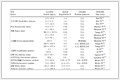
Table 1.
Crystal data and structure refinement for 1 and 2

Mn(Ⅱ)/Zn(Ⅱ) Complexes Based on 3, 4-Pyrazoledicarboxylic Acid: Syntheses, Structures, and Luminescent Properties
Yu-Ting ZHAO , Lin SUN , Ying XU , Bing-Xin YANG , Qi LIU , Mei-Ling CHENG


Considerable effort has been devoted to the designing and making of coordination compounds with pyrazolecarboxylic acid ligands, owing to their impressive structural diversity and their novel functional properties and applications in catalysis[1-4], fluorescence[5-7], molecular magnetism[8-11], and gas separation and storage[12-15]. Among numerous pyrazolecarboxylic acid ligands, 4-pyrazolecarboxylic acid[1, 6, 11-13, 16-17], 3, 5-dimethyl-1H-pyrazole-4-carboxylic acid[2, 13, 18-19], 3-methyl-1H-pyrazole-4-carboxylic acid[20-21], 5-methyl-1H-pyrazole-3-carboxylic acid[9, 22-24], 1-H-pyrazole-3, 5-dicarboxylic acid[4-5, 7, 25], have already been studied, and a number of complexes containing these ligands have been reported. In the reported complexes, pyrazolecarboxylic acids exhibit good coordination abilities, and the N and O donor atoms on the pyrazole rings and the carboxylic groups can coordinate with metal ions in multi-coordination modes. Among these, 3, 4-pyrazoledicarboxylic acid (H3pdc) consists of a pyrazole ring and two carboxyl groups and could form various complexes with interesting structures[3, 26-29]. The H2pdc- and Hpdc2- anions exhibit many different coordination modes: N, O-chelating fashion, O monodentate mode, μ2-κ: N, O; κ: O mode, μ2-κ: N, O; κ: O' mode, μ2-κ: N, O; κ: N' mode, μ3-κ: N, O; κ: O', O"; κ: O"' mode, and μ3-κ: N, O; κ: O'; κ: N' mode in the resulting complexes. On the other hand, the N ancillary ligands, such as imidazole (ImH), 4, 4'-bipyridine, 1, 10-phenanthroline, and 2, 2'-bipyridine were also used in the synthesis processes of complexes with pyrazolecarboxylic acids, which can coordinate to metal ions by the N atoms[3, 8-9, 28], and also can be involved in hydrogen bonds and π⋯π interactions, then affect the coordination structures and the supramolecular structures. But only two Ni(Ⅱ) complexes [Ni(Hpdc)(ImH)(H2O)2]2·4H2O and [Ni(Hpdc)(ImH)2 (H2O)]2·2.5H2O[28] and a Cu(Ⅱ) complex [Cu(Hpdc) (ImH)]n[3] constructed from H3pdc and ImH ligands have been reported. As the continuation of our research in constructing novel coordination complexes containing pyrazolecarboxylic acids[3, 9, 20-21, 23-24, 26-29], two new transition metal complexes [Mn(Hpdc)(ImH)(H2O)]n (1) and [Zn(Hpdc)(4-PT)(H2O)3]·2H2O(2) have been synthesized through the self-assembly of H3pdc with corresponding metal salts in the presence of N ancillary ligands, ImH and 5-(4-pyridyl)tetrazole (4-PT), respectively. In this paper, the syntheses, crystal structures, and luminescent properties of complexes 1 and 2 as well as the electrochemical property of 1 are described.
All solvents and starting materials for synthesis were purchased commercially and used as received. H3pdc was synthesized and purified according to the literature methods[29-30]. The elemental analyses (C, H, and N) were performed on a Perkin-Elmer 2400 SeriesⅡ element analyzer. FT-IR spectra were recorded on a Nicolet 460 spectrophotometer in the form of KBr pellets. Single-crystal X-ray diffraction measurements of the title compounds were carried out with a Bruker Smart Apex Ⅱ CCD diffractometer. Thermogravimetric analyses (TGA) experiments were carried out on a Dupont thermal analyzer from room temperature to 850 ℃ at a heating rate of 10 ℃·min-1 under an N2 atmosphere. Powder X-ray diffraction (PXRD) determinations were performed on an X-ray diffractometer (D/max 2500 PC, Rigaku) with Mo Kα radiation (λ=0.154 06 nm). The operating voltage and current were 60 kV and 300 mA, respectively. The PXRD measurements were carried out over a 2θ range of 3°-80° in continuous scanning mode (1.0 (°)·min-1). Solid-state luminescence spectra of 1 and 2 were recorded on a Varian Cary Eclipse spectrometer. The cyclic voltammogram (CV) curve of 1 was recorded on a CHI 660D electrochemical workstation.
To a solution of H3pdc (0.1 mmol, 0.015 6 g) in EtOH (5 mL) was added a solution of Mn(OAc)2 (0.1 mmol, 0.024 5 g) in deionized water (6 mL). After stirring for 30 min, ImH (0.25 mmol, 0.017 0 g) was added to the light yellow solution and stirred for a further 2.5 h. The resulting solution was evaporated at room temperature slowly. Light yellow block crystals of 1 were obtained after 15 d. After filtration, the product was washed thoroughly with deionized water and then dried in the air. Yield: 64% (0.018 8 g, based on H3pdc). Elemental analysis found(%): C, 33.49; H, 2.90; N, 18.65; Calcd. for C8H8MnN4O5(%): C, 32.53; H, 2.71; N, 18.98. IR (KBr, cm-1): 3 434 (s), 3 132 (vs), 1 623 (w), 1 614 (m), 1 456 (m), 1 400 (vs), 1 350 (w), 1 140 (vw), 1 109 (vw), 1 075 (s), 950 (m), 859 (m), 812 (w), 522 (m).
H3pdc (0.1 mmol, 0.015 6 g), ZnCl2 (0.1 mmol, 0.013 6 g) and 4-PT (0.1 mmol, 0.014 7 g) were dissolved in 8 mL deionized water. The resulting solution was transferred to a Teflon-lined autoclave (25 mL) and heated at 150 ℃ for 72 h. Then the solution was cooled to the ambient temperature at the rate of 5 ℃·h-1. After filtration, the product was washed with deionized water and then dried in the air. Colorless block crystals of 2 were obtained (0.031 8 g, 70 %, based on 3, 4-H3pdc). Elemental analysis found(%): C, 28.79; H, 3.34; N, 21.82; Calcd. for C11H15N7O9Zn(%): C, 29.03; H, 3.30; N, 21.55. IR (KBr, cm-1): 3 425 (vs), 2 924 (w), 1 715 (m), 1 638 (s), 1 559 (w), 1 541 (w), 1 507 (w), 1 458 (w), 1 437 (w), 1 384 (vs), 1 023 (w), 581 (w).
Single-crystal X-ray diffraction measurements of 1 and 2 were carried out with a Bruker Smart Apex Ⅱ CCD diffractometer at 296(2) K (1) or 293(2) K (2). Intensities of reflections were measured using graphitemonochromatized Mo Kα radiation (λ =0.071 073 nm) with the φ-ω scans mode in a range of 1.478°-27.470° (1) or 2.456°-32.569° (2). The structures were solved by direct methods using the SHELXS program of the SHELXL package[31] and refined by full-matrix least-squares methods on F2 with SHELXL. Anisotropic thermal factors were assigned to all the non - hydrogen atoms. The H atoms attached to C atoms were placed geometrically and with their thermal parameters constrained to Uiso(H) =1.2Ueq(C). H atoms on lattice water molecule O8 in 2, were not located due to the large uncertainties in their positions. All other hydrogen atoms bonded to O or N atoms were located from difference maps and refined with isotropic thermal parameters 1.5 times those of their carrier atoms. Crystallographic data for 1 and 2 are summarized in Table 1.
 下载:
导出CSV
| Parameter | 1 | 2 |
| Empirical formula | C8H8MnN4O5 | C11H15N7O9Zn |
| Formula weight | 295.12 | 454.67 |
| Crystal size/mm | 0.24×0.22×0.20 | 0.30×0.26×0.22 |
| Crystal system | Orthorhombic | Triclinic |
| Space group | Pbca | P1 |
| a/nm | 1.025 00(8) | 0.707 84(12) |
| b/nm | 0.768 70(6) | 0.828 98(14) |
| c/nm | 2.755 4(2) | 1.693 1(3) |
| α/(°) | 78.381(3) | |
| β/(°) | 85.699(3) | |
| γ/(°) | 64.986(3) | |
| V/nm3 | 2.171 0(3) | 0.881 8(3) |
| Z | 8 | 2 |
| Dc/(g·cm-3) | 1.806 | 1.712 |
| F(000) | 1 192 | 464 |
| μ/mm-1 | 1.237 | 1.457 |
| θ range for data collection/(°) | 1.478-27.470 | 2.456-32.569 |
| Independent reflection (Rint) | 2 477 (0.028 0) | 5 153 (0.079 4) |
| Number of observations | 2 477 | 5 153 |
| Number of parameters | 163 | 253 |
| Goodness-of-fit on F2 | 1.080 | 1.026 |
| R1, wR2 [I > 2σ(I)] | 0.030 2, 0.075 9 | 0.047 6, 0.134 0 |
| R1, wR2 (all data) | 0.035 7, 0.078 5 | 0.065 3, 0.147 2 |
| (Δρ)max, (Δρ)min/(e·nm-3) | 408, -338 | 925, -576 |
The IR spectra of 1 and 2 reflect the binding patterns of Hpdc2-, ImH and 4-PT (Fig.S1, Supporting information). The strong and broad absorption band around the 3 000-3 600 cm-1 region is assigned as the characteristic peak of OH vibration, indicating that coordination water molecules or lattice aqua molecules exist in the complexes. The strong peaks at 1 623 cm-1 (1), 1 638 cm-1 (2) and 1 456 cm-1 (1), 1 437 cm-1 (2) indicate the presence of —COO—. In addition, the absorption peaks at 1 560-1 300 cm-1 are ascribed to the framework vibration absorption peak of the pyrazole ring. The peak at 1 614 cm-1 in 1 is the asymmetric stretching vibration νas(C=N) of ImH. While for complex 2, the peak at 1 559 cm-1 is the symmetric stretching vibration νs(N=N) of the coordinated 4-PT. The identities of 1 and 2 were finally confirmed by X-ray crystallography.
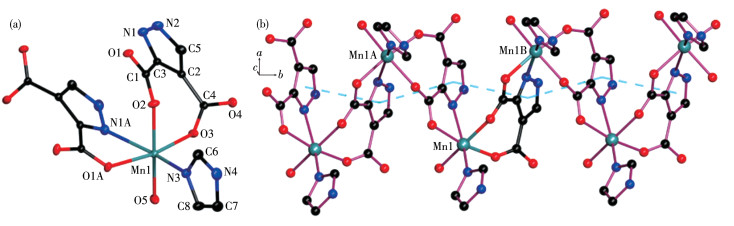
Complex 1 crystallizes in the orthorhombic space group Pbca and the asymmetric unit of 1 contains one Mn(Ⅱ) center, one Hpdc2- anion, one ImH molecule, and one coordinated water molecule. As illustrated in Fig. 1a, the coordination sphere of each Mn(Ⅱ) ion is defined by O1A, O2, O3, and N1A atoms from two Hpdc2- anions, N3 atom from the ImH molecule and its adjacent O5 atom from the coordinated water molecule, forming a distorted octahedral geometry. The equatorial positions are occupied by O1A, N3, O3, and N1A atoms, O2 and O5 atoms are located in the axial positions, and the bond angles of O3—Mn1—N1A, N3—Mn1—O3, O1A—Mn1—N3, and O1A—Mn1—N1A adds up to 358.73°, close to 360°, showing that O1A, N3, O3, and N1A atoms are in the equatorial position. The bond angle of O2—Mn1—O5 is 172.56°, deviating from 180°, further indicating that the geometry around each Mn(Ⅱ) ion is distorted octahedral. The mean Mn—OHpdc bond distance of 0.215 29(15) nm (Table S1) is comparable to those in [Mn(HMPCA)2(phen)]·2H2O (0.215 8(4) nm; H2MPCA=5-methyl-1H-pyrazole-3-carboxylic acid, phen=phenanthrolin)[32] and [Mn(3, 5-H2pdc)2(H2O)2]·2H2O(0.217 9(3) nm; 3, 5-H3pdc=3, 5-pyrazoledicarboxylic acid)[33]. However, the Mn—NHpdc bond length of 0.240 66(18) nm is slightly longer than Mn—NImH (0.218 40(18) nm), and a little longer than those in [Mn(HMPCA)2(phen)]·2H2O(0.222 49(2) nm) and [Mn(3, 5-H2pdc)2(H2O)2]·2H2O(0.220 7(4) nm).
The hydrogen atoms are omitted for clarity; Symmetry codes: A: 1/2+x, 3/2-y, 1-z; B: -1/2+x, y, 1/2-z
The Hpdc2- ligand in 1 adopts a μ2-κ: O, N; κ: O', O" coordination mode, in which two carboxylate groups exhibit different coordination modes: the 4-position carboxylate group coordinates to Mn1 ion in monodentate mode, whereas the 3-position carboxylate group coordinates to Mn1 and Mn1A ions in μ2-κ: O; κ: O' mode, which eventually interconnects the Mn(Ⅱ) ions to form an infinitely extended 1D coordination chain (Fig. 1b). A separation of 0.396 14(3) nm between the centroids of the two pyrazolyl rings is observed, indicating the existence of the significant intermolecular π⋯π interactions. Analysis of the crystal packing of 1 shows that these 1D chains are further extended into a 3D supramolecular structure via N—H⋯O hydrogen-bonding interactions between ImH, pyrazole rings (N4 and N2) and carboxylate oxygen atoms (O1B and O4A; Symmetry codes: A: 1/2+x, 3/2-y, 1-z; B: -1/2+x, y, 1/2-z), along with O—H⋯O hydrogen bonds between coordination water molecule (O5) and carboxylate oxygen atoms (O4C and O4D; Symmetry codes: C: x, -1+y, z; D: 1/2-x, -1/2+y, z) (Fig. 2 and Table S2).

Only hydrogen atoms involved in the hydrogen bonds are shown; Hydrogen bonds are indicated by dashed lines; Symmetry codes: A: 1/2+x, 3/2-y, 1-z; B: -1/2+x, y, 1/2-z; C: x, -1+y, z; D: 1/2-x, -1/2+y, z
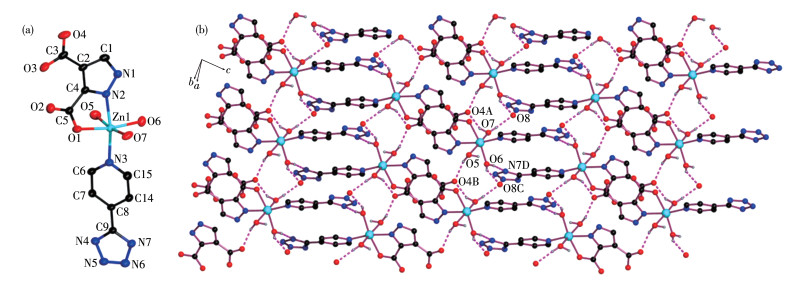
Complex 2 crystallizes in the triclinic space group P1. As illustrated in Fig. 3a, the asymmetric unit of 2 contains one Zn(Ⅱ) center, one Hpdc2- anion, one 4-PT molecule, three coordinated water molecules, and two lattice water molecules. The coordination sphere of each Zn(Ⅱ) ion is defined by O1 and N2 atoms from one Hpdc2- anion, one N3 atom from the 4-PT molecule as well as its adjacent O5, O6, and O7 atoms from the coordinated water molecules, forming a distorted octahedral geometry. The equatorial positions are occupied by O1, O5, O6, and O7 atoms, N2 and N3 atoms are located in the axial positions, and the bond angles of O1—Zn1—O5, O5—Zn1—O6, O6—Zn1—O7, and O7—Zn1—O1 are added up to 358.70°, close to 360° (Table S1), showing that O1, O5, O6, and O7 atoms are in the equatorial position. The bond angle of N2—Zn1— N3 is 169.53°, deviating from 180°, further indicating that each Zn(Ⅱ) ion is in a distorted octahedral environment. The partly deprotonated Hpdc2- anion in 2 adopts an O, N-chelating mode, different from that in 1. The bond distances of Zn1—N2 and Zn1—O1 are 0.216 1(2) and 0.213 4(2) nm, respectively, which are close to those in the reported Zn-pyrazole carboxylate complexes: [Zn(3, 5-Hdcp)(H2O)4]·1.5H2O (0.214 7(16) and 0.214 8(18) nm) [34] and [Zn(H2pdc)2(H2O)2]·2H2O (0.211 7(16) and 0.207 4(17) nm)[35].
The lattice water molecules are omitted for charity; Only hydrogen atoms involved in the hydrogen bonds are shown; The hydrogen bonds are indicated by pink dashed lines; Symmetry codes: A: 1-x, 1-y, -z; B: 2-x, 1-y, -z; C: 1+x, y, z; D: 2-x, -y, 1-z
Complex 2 contains multiple intramolecular hydrogen bonds between the undeprotic carboxyl group (O3) from Hpdc2-, the coordinated water molecule (O7) as well as nitrogen atom (N4) from 4-PT and carboxylate group (O2) from Hpdc2-, lattice water molecule (O8) (Table S2). The adjacent mononuclear units are packed into a 2D structure via O—H⋯O intermolecular hydrogen bonds between coordination water molecules (O5 and O7) and carboxylate oxygen atoms (O4A and O4B; Symmetry codes: A: 1/2+x, 3/2 -y, 1-z; B: -1/2+x, y, 1/2-z), along with O—H⋯N hydrogen interaction between coordinated water molecule (O6) and 4-PT (N7D; D: Symmetry code: 1/2-x, -1/2+y, z) (Fig. 3b). Finally, these 2D layers and the lattice water molecules (O8 and O9) are interlinked via the interaction of O—H⋯O and O—H⋯N hydrogen bonds, generating a 3D supramolecular architecture (Fig. 4).
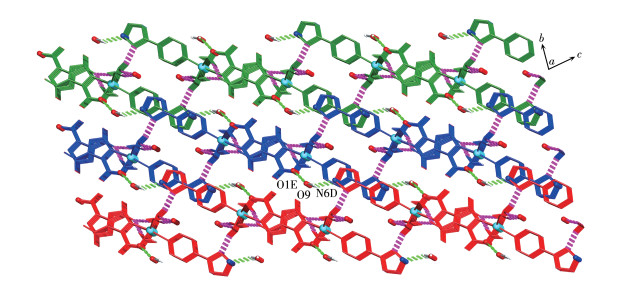
The different 2D layers are shown in red, green, and blue respectively; Only hydrogen atoms involved in the hydrogen bonds are shown; The hydrogen bonds in the 2D layers are indicated by pink dashed lines, and the hydrogen bonds connected different layers are indicated by bright green dashed lines; Symmetry codes: D: 2-x, -y, 1-z; E: x, 1+y, z
For complexes 1 and 2, the experimental PXRD patterns and peak positions of the simulated ones were shown good correlations with each other (Fig. S2), confirming the good phase purity of the complexes.
In order to examine the thermal stability of complexes 1 and 2, the TGA was carried out (Fig.S3). For 1, the first weight loss of 29.47% between 188 and 315 ℃ is attributed to the loss of one coordination water molecule and one ImH molecule (Calcd. 29.17%). Then the remaining Hpdc2- ligand decomposed gradually, but this degradation did not end at 800 ℃. For 2, the first weight loss of 8.21% between 50 and 153 ℃ is attributed to the loss of two lattice water molecules (Calcd. 7.91%). The second degradation stage was in a range of 153-372 ℃ with a weight loss of 44.36%, corresponding to the loss of three coordinate water molecules and a 4-PT molecule (Calcd. 44.15%). The remaining material finally degraded to ZnO (Calcd. 17.86%, Obsd. 18.68%).
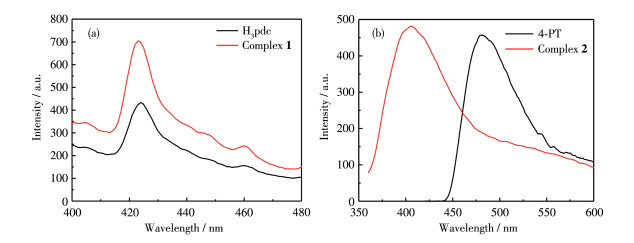
The solid-state luminescent properties of free ligands H3pdc and 4-PT, and complexes 1 and 2 were investigated at room temperature. Upon excitation at 370 nm, the strongest emission peak for H3pdc appeared at 423 nm. Complex 1 exhibited an emission peak centered at 424 nm (Fig. 5a), resembling that of H3pdc. Therefore, the origin of the main emissions of 1 may be attributable to the internal charge transfer (π-π*) of Hpdc2-. Complex 2 exhibited a broad emission peak at 405 m (λex=340 nm) (Fig. 5b), which can probably be assigned to the intraligand (π-π*) fluorescent emission of free 4-PT because the similar emission band shape was observed in the free 4-PT (λmax=487 nm). While the maximum emission wavelength of 2 underwent a blue shift of 82 nm, which should be attributed to the ligand-to-metal charge transfer.
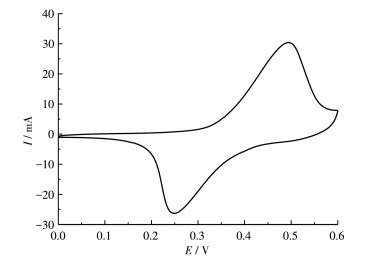
The electrochemical property of complex 1 was investigated using a three-electrode electrochemical cell. The working electrode was fabricated according to the literature methods[28], the resulting Ni foam coated with 1 was used as the working electrode, and platinum foil and a saturated calomel electrode (SCE) were used as the counter and reference electrodes, respectively. The electrochemical measurements were carried out in a 2 mol·L-1 KOH aqueous electrolyte at room temperature. The CV curve of 1 is shown in Fig. 6, during scanning from 0 to 0.6 V in 5 mV·s-1. The resulting CV curve only had one pair of the oxidation-reduction peaks, which correspond to the Mn(Ⅱ)/Mn(Ⅲ) redox process, Epa=0.49 V, Epc=0.24 V, ΔE=0.25 V, which shows that the electron transfer in the electrolysis of the complex is quasi-reversible.
Two new complexes, [Mn(Hpdc) (ImH) (H2O)]n (1) and [Zn(Hpdc)(4-PT)(H2O)3]·2H2O (2), were successfully synthesized by the reaction of corresponding metal salts with H3pdc, in the presence of N auxiliary ligands, ImH and 4-PT. The partly deprotonated ligand Hpdc2- in 1 and 2 adopt two kinds of coordination modes, μ2-κ: O, N; κ: O', O" and O, N-chelating mode, respectively, thus the structures of 1 and 2 change from 1D chainlike to mononuclear. Significantly, the μ2-κ: O, N; κ: O', O" coordinated Hpdc2- in 1 is unprecedented in the chemistry of metal complexes. In the function of abundant intermolecular N—H⋯O, O—H⋯O, and O—H⋯N hydrogen bonds, both 1 and 2 are extended to a 3D supramolecular architecture. In addition, two complexes displayed purple fluorescence in the solid state at room temperature. The electrochemical property of complex 1 shows that the electron transfer of Mn(Ⅱ) between Mn(Ⅲ) in electrolysis is a quasi-reversible process.
Supporting information is available at http://www.wjhxxb.cn
Tu B B, Pang Q Q, Xu H S, Li X M, Wang Y L, Ma Z, Weng L H, Li Q W. Reversible Redox Activity in Multicomponent Metal-Organic Frameworks Constructed from Trinuclear Copper Pyrazolate Building Blocks[J]. J. Am. Chem. Soc., 2017, 139(23): 7998-8007. doi: 10.1021/jacs.7b03578
Tabacaru A, Xhaferaj N, Martins L M D R S, Alegria E C B A, Chay R S, Giacobbe C, Domasevitch K V, Pombeiro A J L, Galli S, Pettinari C. Metal Azolate/Carboxylate Frameworks as Catalysts in Oxidative and C—C Coupling Reactions[J]. Inorg. Chem., 2016, 55(12): 5804-5817. doi: 10.1021/acs.inorgchem.5b02997
Cheng M L, Qin M N, Sun L, Liu L, Liu Q, Tang X Y. Highly Efficient Cu(Ⅱ)-Pyrazoledicarboxylate Heterogeneous Catalysts for a Base-Free Aerobic Oxidation of Benzylic Alcohol to Benzaldehyde with Hydrogen Peroxide as the Oxidant[J]. Dalton Trans., 2020, 49(23): 7758-7765. doi: 10.1039/C9DT04927D
Shi F N, Silva A R, Yang T H, Rocha J. Mixed Cu(Ⅱ)-Bi(Ⅲ) Metal Organic Framework with a 2D Inorganic Subnetwork and Its Catalytic Activity[J]. CrystEngComm, 2013, 15(19): 3776-3779. doi: 10.1039/c3ce27056d
Klongdee F, Boonmak J, Youngme S. Anion-Dependent Self-Assembly of Copper Coordination Polymers Based on Pyrazole-3, 5-dicarboxylate and 1, 2-Di(4-pyridyl)ethylene[J]. Dalton Trans., 2017, 46(14): 4806-4815. doi: 10.1039/C7DT00406K
Wang J, Yao S, Li G, Huo Q S, Zhang L R, Liu Y L. A Novel Trinuclear Cd(Ⅱ) Cluster-Based Metal-Organic Framework: Synthesis, Structure and Luminescence Properties[J]. RSC Adv., 2015, 5(124): 102525-102529. doi: 10.1039/C5RA22184F
Yang J H, Zheng S L, Yu X L, Chen X M. Syntheses, Structures, and Photoluminescent Properties of Three Silver(Ⅰ) Cluster-Based Coordination Polymers with Heteroaryldicarboxylate[J]. Cryst. Growth Des., 2004, 4(4): 831-836. doi: 10.1021/cg0342258
Roy M, Adhikary A, Debnath T, Das A K, Mondal R. Designing Ferromagnetism in Cu(Ⅱ) Complexes Using an Elusive Near-Orthogonal Bridging Mode of the Pyrazole Ring[J]. Polyhedron, 2019, 160: 46-52. doi: 10.1016/j.poly.2018.12.032
Cheng M L, Sun L, Han W, Wang S, Liu Q, Sun X Q, Xi H T. Effect of N Ancillary Ligands on the Structure, Nuclearity and Magnetic Behavior of Cu(Ⅱ)-Pyrazolecarboxylate Complexes[J]. New J. Chem., 2016, 40(12): 10504-10511. doi: 10.1039/C6NJ02338J
Li J P, Li B J, Pan M T, Liu B, Cheng J J, Li R Y, Gao X L, Wang S M, Hou H W, Liu Z Y. Five Multidimensional Co(Ⅱ)-Complexes (Zero-Dimensional to Three-Dimensional) Derived from an Asymmetric 5-(Pyridin-3-yl)-1H-pyrazole-3-carboxylic Acid: Syntheses, Structures, and Magnetic Properties[J]. Cryst. Growth Des., 2017, 17(6): 2975-2986. doi: 10.1021/acs.cgd.6b01478
Wang M, He L, Lin Q P. Dimension-Related Magnetism in Heterometallic Complexes Based on the Same[LnCu(dicarboxylpyrazole)2] Building Moieties[J]. J. Solid State Chem., 2018, 265: 29-35. doi: 10.1016/j.jssc.2018.05.023
Qi X L, Ye J W, Lin R B, Liao P Q, Liu S Y, He C T, Zhang J P, Chen X M. Syntheses, Structures and Gas Sorption Properties of Two Coordination Polymers with a Unique Type of Supramolecular Isomerism[J]. Inorg. Chem. Front., 2015, 2(2): 136-140. doi: 10.1039/C4QI00190G
Fu H R, Zhang J. Structural Transformation and Hysteretic Sorption of Light Hydrocarbons in a Flexible Zn-Pyrazole-Adenine Frame-work[J]. Chem. Eur. J., 2015, 21(15): 5700-5703. doi: 10.1002/chem.201406323
Wang J H, Luo D, Li M, Li D. Local Deprotonation Enables Cation Exchange, Porosity Modulation, and Tunable Adsorption Selectivity in a Metal-Organic Framework[J]. Cryst. Growth Des., 2017, 17(6): 3387-3394. doi: 10.1021/acs.cgd.7b00346
Quartapelle P E, Fukushima T, Barea E, Navarro J A R, Horike S, Kitagawa S. A Soft Copper(Ⅱ) Porous Coordination Polymer with Unprecedented Aqua Bridge and Selective Adsorption Properties[J]. Chem.-Eur. J., 2012, 18(41): 13117-13125. doi: 10.1002/chem.201201820
Padial N M, Procopio E Q, Montoro C, López E, Oltra J E, Colombo V, Maspero A, Masciocchi N, Galli S, Senkovska I, Kaskel S, Barea E, Navarro J A R. Highly Hydrophobic Isoreticular Porous Metal-Organic Frameworks for the Capture of Harmful Volatile Organic Compounds[J]. Angew. Chem. Int. Ed., 2013, 52(32): 8290-8294. doi: 10.1002/anie.201303484
Tu B B, Pang Q Q, Ning E L, Yan W Q, Qi Y, Wu D F, Li Q W. Heterogeneity within a Mesoporous Metal-Organic Framework with Three Distinct Metal-Containing Building Units[J]. J. Am. Chem. Soc., 2015, 137(42): 13456-13459. doi: 10.1021/jacs.5b07687
Kongpatpanich K, Horike S, Sugimoto M, Fukushima T, Umeyama D, Tsutsumi Y, Kitagawa S. Synthesis and Porous Properties of Chromium Azolate Porous Coordination Polymers[J]. Inorg. Chem., 2014, 53(18): 9870-9875. doi: 10.1021/ic501459m
Qi X L, Zhang C, Wang B Y, Wei X, He C T, Liu S Y, Zhang W X, Chen X M. Two New Polar Coordination Polymers with Diamond Networks: Interpenetration and Thermal Phase Transition[J]. CrystEngComm, 2013, 15(45): 9530-9536. doi: 10.1039/c3ce41111g
Yu L L, Wang X M, Cheng M L, Rong H G, Song Y D, Liu Q. A Three-Dimensional Copper Coordination Polymer Constructed by 3-Methyl-1H-pyrazole-4-carboxylic Acid with Higher Capacitance for Supercapacitors[J]. Cryst. Growth Des., 2018, 18(1): 280-285. doi: 10.1021/acs.cgd.7b01219
Liu J, Cheng M L, Yu L L, Chen S C, Shao Y L, Liu Q, Zhai C W, Yin F X. Three Metal Complexes Derived from 3-Methyl-1H-pyrazole-4-carboxylic Acid: Synthesis, Crystal Structures, Luminescence and Electrocatalytic Properties[J]. RSC Adv., 2016, 6(57): 52040-52047. doi: 10.1039/C6RA10989F
Hu F L, Yin X H, Mi Y, Zhang S S, Luo W Q, Zhuang Y. Synthesis, Structure, and Properties of Two Novel Copper(Ⅱ) Complexes, [Cu(phen)(L)2]·6H2O and [Cu(phen)3]·(ClO4)2[J]. Inorg. Chem. Commun., 2009, 12(12): 1189-1192. doi: 10.1016/j.inoche.2009.09.015
Cheng M L, Han W, Liu Q, Bao J T, Li Z F, Chen L T, Sun X Q, Xi H T. Synthesis, Crystal Structures, and Luminescent Properties of Pb(Ⅱ) and Sr(Ⅱ) Coordination Polymers Constructed by 5-Methyl-1H-pyrazole-3-carboxylic Acid[J]. J. Coord. Chem., 2014, 67(2): 215-226. doi: 10.1080/00958972.2013.879983
唐李志鹏, 杨明炜, 程美令, 刘琦. 两个基于羧基-水分子链构筑的超分子镉配合物的合成、晶体结构和荧光性质[J]. 无机化学学报, 2015,31,(3): 603-610. TANG L Z P, YANG M W, CHENG M L, LIU Q. Syntheses, Crystal Structures and Luminescent Properties of Two Cadmium Supramolecular Complexes Based on Water-Carboxylate Chains[J]. Chinese J. Inorg. Chem., 2015, 31(3): 603-610.
Jacobsen J, Reinsch H, Stock N. Systematic Investigations of the Transition between Framework Topologies in Ce/Zr-MOFs[J]. Inorg. Chem., 2018, 57(20): 12820-12826. doi: 10.1021/acs.inorgchem.8b02019
Chen L T, Tao F, Wang L D, Hong J, Jia X Y, Bao J T, Ji Y Z, Cheng M L, Liu Q. Two Metal Complexes Based on the Ligand 3, 4-Pyrazoledicarboxylic Acid: Synthesis, Structures, and Luminescent Properties[J]. Z. Anorg. Allg. Chem., 2013, 639(3/4): 552-557.
Cheng M L, Tao F, Chen L T, Wang L D, Liu Q. Lanthanide(Ⅲ)-Based Coordination Monomers and Polymers of 3, 4-Pyrazoledicarboxylate: Extended Synergy within the Ligand, Structures and Magnetic Properties[J]. Inorg. Chim. Acta, 2015, 429: 22-29. doi: 10.1016/j.ica.2015.01.035
Cheng M L, Liu L, Sun L, Tao F, Qin M N, Liu Q, Tang X Y. Metal-to-Ligand Ratio Controlled Assembly of Two Ni(Ⅱ) Complexes: Structures, Luminescent and Electrochemical Properties[J]. J. Chem. Crystallogr., 2021, 51(2): 265-272. doi: 10.1007/s10870-020-00854-1
Wang L D, Tao F, Cheng M L, Liu Q, Han W, Wu Y J, Yang D D, Wang L J. Syntheses, Crystal Structures, and Luminescence of Two Main-Group Metal Complexes Based on 3, 4-Pyrazoledicarboxylic Acid[J]. J. Coord. Chem., 2012, 65(6): 923-933. doi: 10.1080/00958972.2012.663494
Riahi A, Shkoor M, Fatunsin O, Khera R A, Fischer C, Langer P. Regioselective Synthesis of 4-Acyl-1-hydroxy-2, 3-benzodioates by Chelation-Controlled [3+3] Annulation of 3-Acyl-4-ethoxy-2-oxo-3-enoates with 1, 3-Bis(trimethylsilyloxy)-1, 3-butadienes[J]. Org. Biomol. Chem., 2009, 7(20): 4248-4251. doi: 10.1039/b905556h
Sheldrick G M. SHELXT-2013. University of Göttingen, Germany, 2013.
翟长伟, 程美令, 韩伟, 刘琦. 以5-甲基-3-吡唑甲酸和菲咯啉为配体的锰和镉的配合物的合成、晶体结构和荧光性能[J]. 无机化学学报, 2015,31,(7): 1409-1416. ZHAI C W, CHENG M L, HAN W, LIU Q. Syntheses, Crystal Structures and Luminescent Properties of Manganese and Cadmium Complexes Based on 5-Methyl-1H-pyrazole-3-carboxylic Acid and Phenanthroline Ligands[J]. Chinese J. Inorg. Chem., 2015, 31(7): 1409-1416.
Shi F N, Yang T H. Diverse Structures of Manganese(Ⅱ) Complexes Based on 3, 5-Pyrazoledicarboxylic Acid from Discrete Molecules to Polymers[J]. Inorg. Chim. Acta, 2014, 412: 79-87. doi: 10.1016/j.ica.2013.12.017
Liu C B, Liu L, Wang S S, Li X Y, Che G B, Zhao H, Xu Z L. Hydrothermal Syntheses and Crystal Structures of Three Zn(Ⅱ) Coordination Compounds Constructed with 3, 5-Pyrazoledicarboxylic Acid[J]. J. Inorg. Organomet. Polym. Mater., 2012, 22(6): 1370-1376. doi: 10.1007/s10904-012-9741-5
秦梦娜, 王利东, 程美令, 刘露, 刘琦, 唐晓艳. 含有3, 4-吡唑二甲酸的锌(Ⅱ)配合物: 合成、结构和荧光性质[J]. 无机化学学报, 2020,36,(3): 529-535. QIN M N, WANG L D, CHENG M L, LIU L, LIU Q, TANG X Y. Syntheses, Crystal Structures and Luminescent Properties of Zn(Ⅱ) Complexes Based on 3, 4-Pyrazoledicarboxylic Acid[J]. Chinese J. Inorg. Chem., 2020, 36(3): 529-535.

Figure 1 (a) Coordination environment of Mn(Ⅱ) ion in 1 with thermal ellipsoid at 30% probability level; (b) 1D coordination chain in 1
The hydrogen atoms are omitted for clarity; Symmetry codes: A: 1/2+x, 3/2-y, 1-z; B: -1/2+x, y, 1/2-z

Figure 2 (a) N—H⋯O and O—H⋯O hydrogen-bonding interactions between different asymmetric units; (b) 3D network of 1 constructed by hydrogen bonds
Only hydrogen atoms involved in the hydrogen bonds are shown; Hydrogen bonds are indicated by dashed lines; Symmetry codes: A: 1/2+x, 3/2-y, 1-z; B: -1/2+x, y, 1/2-z; C: x, -1+y, z; D: 1/2-x, -1/2+y, z

Figure 3 (a) Coordination environment of Zn(Ⅱ) ion in 2 with thermal ellipsoid at 30% probability level; (b) 2D layer constructed by intermolecular O—H⋯O(N) hydrogen bonds in 2
The lattice water molecules are omitted for charity; Only hydrogen atoms involved in the hydrogen bonds are shown; The hydrogen bonds are indicated by pink dashed lines; Symmetry codes: A: 1-x, 1-y, -z; B: 2-x, 1-y, -z; C: 1+x, y, z; D: 2-x, -y, 1-z

Figure 4 Three-dimensional supramolecular architecture of 2 constructed by all hydrogen bonds
The different 2D layers are shown in red, green, and blue respectively; Only hydrogen atoms involved in the hydrogen bonds are shown; The hydrogen bonds in the 2D layers are indicated by pink dashed lines, and the hydrogen bonds connected different layers are indicated by bright green dashed lines; Symmetry codes: D: 2-x, -y, 1-z; E: x, 1+y, z

Figure 5 Solid-state emission spectra for complex 1, free H3pdc (λex=370 nm) (a) and complex 2 (λex=340 nm), free 4-PT (λex=320 nm) (b) at room temperature
Table 1. Crystal data and structure refinement for 1 and 2
| Parameter | 1 | 2 |
| Empirical formula | C8H8MnN4O5 | C11H15N7O9Zn |
| Formula weight | 295.12 | 454.67 |
| Crystal size/mm | 0.24×0.22×0.20 | 0.30×0.26×0.22 |
| Crystal system | Orthorhombic | Triclinic |
| Space group | Pbca | P1 |
| a/nm | 1.025 00(8) | 0.707 84(12) |
| b/nm | 0.768 70(6) | 0.828 98(14) |
| c/nm | 2.755 4(2) | 1.693 1(3) |
| α/(°) | 78.381(3) | |
| β/(°) | 85.699(3) | |
| γ/(°) | 64.986(3) | |
| V/nm3 | 2.171 0(3) | 0.881 8(3) |
| Z | 8 | 2 |
| Dc/(g·cm-3) | 1.806 | 1.712 |
| F(000) | 1 192 | 464 |
| μ/mm-1 | 1.237 | 1.457 |
| θ range for data collection/(°) | 1.478-27.470 | 2.456-32.569 |
| Independent reflection (Rint) | 2 477 (0.028 0) | 5 153 (0.079 4) |
| Number of observations | 2 477 | 5 153 |
| Number of parameters | 163 | 253 |
| Goodness-of-fit on F2 | 1.080 | 1.026 |
| R1, wR2 [I > 2σ(I)] | 0.030 2, 0.075 9 | 0.047 6, 0.134 0 |
| R1, wR2 (all data) | 0.035 7, 0.078 5 | 0.065 3, 0.147 2 |
| (Δρ)max, (Δρ)min/(e·nm-3) | 408, -338 | 925, -576 |
 下载: 导出CSV

 扫一扫看文章


扫一扫关注我们