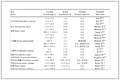
Table 1.
Crystal data and structure refinements for MCu and MFe

Ferrocene-Functionalized Metal-Organic Macrocycles Mimicking Hydrogenase for Photocatalytic Nitro Reduction
Jing ZHANG , Yang YANG , Zhong WEI , Xu JING , Chun-Ying DUAN


Enzymes in nature utilize their internal microenvironment containing various functional groups to carry out the efficient chemical transformation of various substrates under normal conditions[1-2]. Supramolecular chemists are committed to simulating the structural characteristics and action mechanism of enzymes using supramolecules with redox -active metal sites and hydrophobic cavities, which can be further functionalized and applied in synthetic chemistry[2-3]. Designed metal-organic supramolecules with specific hydrophobic cavities and functionalized activation sites can act as catalytic hosts[4]. By recognizing and activating substrate molecules through host-guest interactions, a highly efficient and selective transformation of particular substrates[5], such as aldehydes[6], nitro compounds[7], alkenes, or alkynes[8], can be achieved. Metalorganic macrocycles are constructed by coordination between functionalized ligands and redox-active transition metal centers. In addition, modifying the cavity with functionalized groups to change the cavity structure to adapt to the shape of different substrates or to introduce various properties are attractive routes in the enzyme mimetic process[9].
Transition metal centers in metal-organic macrocycles can temporarily store energy and electrons by switching between redox states[10]. After encapsulating dyes, fast electron transfer between the excited dye molecules and metal centers can be achieved through pseudo-intramolecular pathways[11]. Thereby accelerating and stabilizing the charge separation state generated in the photocatalytic reaction. The host-guest combination supramolecular strategy has broad applications and has been demonstrated in the fields of combining organic dyes to simulate natural photocatalytic systems for specific organic small molecule transformations[12-14]. It was previously reported that such composite systems can effectively utilize photons and use water as a source of protons to generate hydrogen, and subsequently combine photocatalytic proton reduction with substrate hydrogenation reactions to construct new catalytic platforms[9, 15-16].
Ferrocene has been applied to the peripheral modification of ligands in redox structures, due to its redox activity[17]. Meanwhile, as a convergence of flexible rotatability and rigidity, it can act as building blocks for metal -organic complexes[18-19]. In this work, we synthesized a hydrazide primary building block by using the redox-active ferrocene as the foundation and subsequently introduced the triphenylphosphine unit to form the ligand H2FcP. The triphenylphosphine unit oxidized during the subsequent self-assembly with metal salts in the air, and the final ligand formed two isomorphic supramolecular macrocycles with rhombic cavities with Fe and Cu metal centers (MFe and MCu). The macrocycles can encapsulate the classical organic dye fluorescein (Fl) to form the supramolecule photocatalytic systems, which can catalytic proton reduction and nitro substrates reduction as an enzyme mimetic system with the use of electron sacrificial agent triethylamine. In the photocatalytic hydrogen evolution reaction (HER) and the nitro reduction reaction, MCu, which carries both Cu(Ⅱ) and ferrocene, showed even better catalytic properties. The photocatalytic systems were then validated for the simulation of the enzymic catalytic process by employing the Michaelis-Menten mechanism[20-21].
All the chemicals were of reagent grade quality obtained from commercial sources and used without further purification. All solvents are purified using reported methods before being put into use[22]. Reaction mixtures were stirred by using Teflon-coated magnetic stir bars. Elevated temperatures were maintained using a Thermostat-controlled silicone oil bath. The elemental analyses of C, H, and N were performed in a Vario EL Ⅲ elemental analyzer. NMR spectra were measured on a BRUKER 400M spectrometer. Chemical shifts of the NMR spectra were reported relative to DMSO-d6 (1H NMR: δ =2.50, 13C NMR: δ =39.52) or CD3CN (1H NMR: δ=1.94, 13C NMR: δ=1.32, 118.26). ESI-MS spectra were carried out on an HPLC-Q-TOF MS spectrometer using acetonitrile as the mobile phase.
The fluorescent spectra were measured on an Edinburgh FS920 fluorescence spectrometer. The solution UV-Vis spectra were recorded on a SHIMADZU UV 2600 UV-Vis spectrophotometer. The cuvettes used were WondaQuartz 45 (12.5 mm×12.5 mm) cuvettes from Shimadzu.
The generated H2 was determined by a GC 7890T instrument analysis using a 5A molecular sieve column (0.6 m×3.0 mm) with a thermal conductivity detector, and argon as carrier gas.
The HPLC analysis was performed on a SHIMADZU LC 2030 Plus analyzer using a ZORBAX SB-C18 reverse phase column (250 mm×4.6 mm ID, s-5 µm) eluting with methanol/water to determine the yields of the catalytic reactions. (Detection: λ=230 nm; Temperature: 25.0 ℃) Methanol and water were used to prepare mobile phase solvents for HPLC.
The cyclic voltammetry (CV) measurements were performed on a CHI 660E electrochemical workstation with a three-electrode system using an Ag/AgCl electrode as the reference electrode, 0.5 mm diameter platinum silk as the counter electrode, and a glassy carbon electrode as the working electrode. The measurements were performed after degassing the solutions with argon to eliminate the effects of oxygen.
1, 1'-dihydrazideferrocene was prepared by the reported procedure[23]. To a solution of hydrazine hydrate (10 mL) in ethanol (20 mL), dimethyl 1, 1'-ferrocenedicarboxylate (2 g, 6.06 mmol) was added slowly in ethanol. After the mixed solution was stirred and refluxed for 7 h, most of the solvent was evaporated. Then the orange crystal precipitation formed after cooling. The product (1, 1'-dihydrazideferrocene) was collected by filtration and washed with ethanol and diethyl ether. Yield: 70%. ESI-MS: m/z=303.1 ([M+H]+). Elemental analysis Calcd. for C12H14N4O2Fe(%): C 47.71, H 4.67, N 18.55; Found(%): C 47.67, H 4.70, N 18.51.
The mixture of 2-diphenylphosphinobenzaldehyde (1.2 g, 4.2 mmol) and 1, 1'-dihydrazideferrocene (604 mg, 2 mmol) was dissolved in 50 mL methanol, then the solution was refluxed overnight at 70 ℃. The orange solids were formed and then collected through filtration. Yield: 70%. ESI-MS: m/z=847.20 ([M+H]+). 1H NMR (400 MHz, DMSO-d6): δ 11.88 (s, 2H), 8.62 (s, 2H), 7.82 (dd, J=15.0, 8.1 Hz, 2H), 7.72 (dd, J=8.2, 6.92 Hz, 2H), 7.61-7.67 (m, 8H), 7.5-7.58 (m, 16H), 5.35 (s, 4H), 4.97 (s, 4H), 4.08 (s, 2H). 31P NMR (162 MHz, DMSO-d6): δ -15.75.
Ligand H2FcP (84.6 mg, 0.1 mmol) was dissolved in 20 mL acetonitrile, then Cu(OTf)2 (35.4mg, 0.1 mmol) was added. The resulting solution was stirred at 60 ℃ for 24 h. After that, the resulting solution was cooled to room temperature. Then, orange block crystals (MCu) were obtained after slow diffusion of 100 mL diethyl ether into the solution. Yield: about 70%. Anal. Calcd. for C104H80N8O 20F12P4S4Fe2Cu2(%): H, 3.25; C, 50.35; N, 4.52. Found(%): H, 3.28; C, 50.36; N, 4.54. 1H NMR (400 MHz, CD3CN): δ 4.69 (s, 4H), 5.11 (s, 4H), 6.21 (s, 2H), 7.08 (s, 2H), 7.63-7.89 (m, 22H), 8.09 (s, 2H), 8.44 (s, 2H), 10.87 (s, 2H). 13C NMR (101 MHz, CD3CN): δ 169.86, 150.05, 135.18, 133.62, 132.23, 131.83, 131.53, 130.83, 129.51, 128.56, 128.44, 127.93, 127.57, 72.30. 31P NMR (162 MHz, CD3CN): δ -3.46. ESI-MS: m/z=627.742 4 ([Cu2(FcPO)2]3+), 940.607 1 ([Cu2(FcPO)2]2+).
The synthesis of macrocycle MFe was similar to that described for MCu with the ligand H2FcP (84.6 mg, 0.1 mmol) and Fe(OTf)2 (35.4 mg, 0.1 mmol). Orange block crystals were obtained after slow diffusion of 100 mL diethyl ether into the solution. Yield: about 60%. Anal. Calcd. for C104H80N8O20F12P4S4Fe4(%): H, 3.27; C, 50.67; N, 4.55. Found(%): H, 3.32; C, 50.66; N, 4.56. 31P NMR (162 MHz, CD3CN): δ -4.37. ESI-MS: m/z=1 866.19 ([H+Fe2(FcPO)2]+), 933.62 ([Fe2(FcPO)2]2+), 622.75 ([3H+Fe2(FcPO)2]3+), 467.31 ([Fe2(FcPO)2]4+).
The single crystal data were collected on a Bruker SMART APEX CCD diffractometer equipped with graphite monochromated Mo Kα (λ=0.071 073 nm) ray source using the SMART and SAINT programs collected data[24-25]. The structure was solved by direct methods and refined on F2 by full-squares methods with the SHELXTL module in Olex2 software version 1.5[26-28]. The structure refinement of macrocycles MCu and MFe are listed in Table 1.
 下载:
导出CSV
| Parameter | MCu | MFe |
| Formula | C106H83Cu2F12Fe2N9O20P4S4 | C112H95F6Fe4N13O14P4S2 |
| Formula weight | 2 521.77 | 2 372.45 |
| Crystal system | Monoclinic | Triclinic |
| Space group | C2/c | P1 |
| a/nm | 3.182 0(2) | 1.383 55(8) |
| b/nm | 1.473 28(11) | 1.521 81(9) |
| c/nm | 2.733 00(19) | 1.527 96(9) |
| α/(°) | 94.143 0(10) | |
| β/(°) | 115.590 9(15) | 100.573(2) |
| γ/(°) | 114.219 0(10) | |
| V/nm3 | 11.555 4(15) | 2.844 8(3) |
| Z | 4 | 1 |
| Dc/(g·cm-3) | 1.426 | 1.313 |
| F(000) | 5 048.0 | 1 154.0 |
| Reflection collected | 111 144 | 61 704 |
| Unique reflection (Rint) | 10 173 (0.206 1) | 16 648 (0.029 4) |
| Goodness of fit on F2 | 1.036 | 1.040 |
| Final R indices* [I > 2σ(I)] R1, wR2 | 0.073 4, 0.169 7 | 0.044 8, 0.118 7 |
| R indices* (all data) R1, wR2 | 0.127 6, 0.200 9 | 0.061 1, 0.127 2 |
| *R1=∑||Fo|-|Fc||/∑|Fo|; wR2=[∑w(|Fo|-|Fc|)2/∑wFo2]1/2. | ||
CCDC: 2166465, MCu; 2166466, MFe.
The ligand H2FcP respectively reacted with two kinds of transition metal salts in acetonitrile solution to generate two analogical M2L2 metal-organic macrocycles. The triphenylphosphine unit oxidized to triphenylphosphine oxide (TPPO) by oxygen in the air during the self-assembly process (Fig. 1a). Therefore, the ligand unit in the self-assembled macrocycle was named H2FcPO.
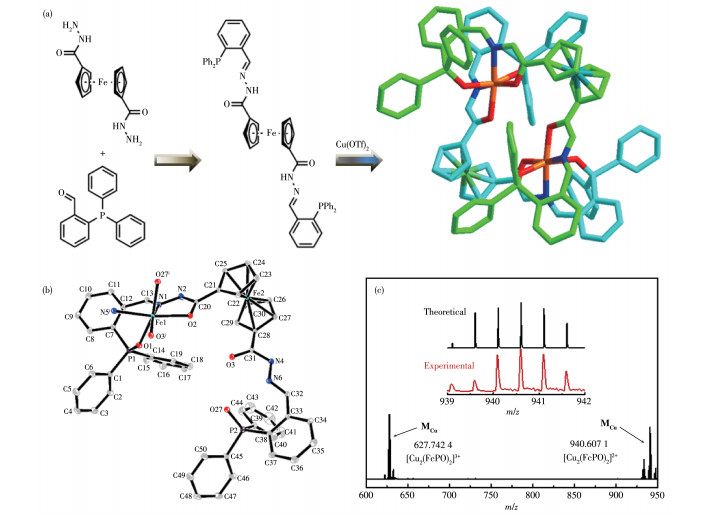
The macrocycles' single crystals were obtained by slow diffusion of the diethyl ether vapor into the corresponding acetonitrile solution. Single crystal structure analysis revealed that the crystals of MCu and MFe are isomorphic and crystallize in the monoclinic C2/c and triclinic P1 space groups, respectively. The ferrocene units and transition metal cations were located at opposite vertices of the elongated rhombus, respectively. The average distance between two ferrocene units is 0.98 nm, and the distance between the Cu(Ⅱ)/Fe(Ⅱ) ions is 0.56 nm in MCu/MCu. Thus, there is a 0.56 nm×0.98 nm diamond-shaped window in the cross-section of the macrocycles. Then measurements were taken to obtain the torsion angle between the two cyclopentadiene of ferrocene. The result shows the angle is 58°. Each ligand moiety is bound to the metal center using a carbonyl oxygen atom, a hydrazide nitrogen atom, and an oxygen atom of the TPPO unit. Abundant phenyl rings extending from the elongated rhombus may facilitate aromatic stacking interaction with Fl molecules.
The mass spectra of MCu in homogeneous conditions were obtained by ESI-MS characterization. The ESI-MS spectrum of complex MCu exhibited an intense peak at m/z=627.742 4 and 940.607 1, which is respectively allocated to [Cu2 (FcPO)2]3+ and [Cu2(FcPO)2]2+ (Fig. 1c). The macrocycle showed a high positive charge, and the protons at the amide position were desorbed.
To construct the subsequent enzyme-mimetic photocatalytic system, the conventional organic molecule Fl was introduced as the photosensitizer guest for photoinduced electron transfer. This intermolecular interaction between the guest molecule and the macrocycle was captured using the UV-Vis spectrum. Macrocycle MFe (10.0 µmol·L-1) in a DMF solution exhibited metalligand charge transfer bands at 313 nm. Then Fl solution (1.0 mmol·L-1) was added to the cuvette proportionally. With the increasing concentration of Fl, two sharp isosbestic points appeared at 342 and 439 nm (Fig. 2a). This signal indicates the host-guest interactions between macrocycle MFe and the encapsulated Fl. Unlike MFe, the DMF solution of MCu (10.0 µmol· L-1) exhibited absorption peaks at 273 and 316 nm, and after adding Fl solution (1.0 mmol·L-1), isosbestic points of 346 and 430 nm appeared (Fig. 2b).
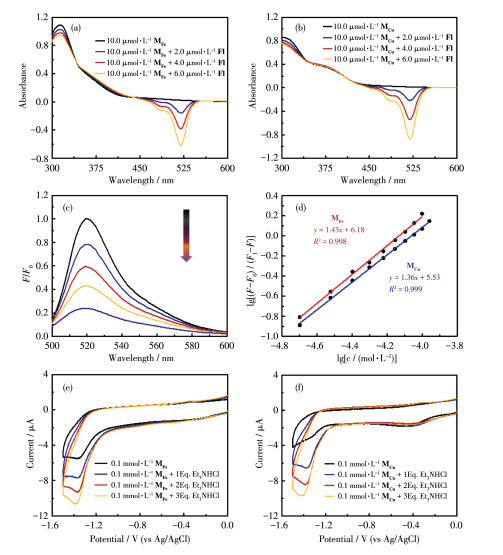
Fluorescence spectroscopy was also used to characterize host-guest molecular interactions, which helps to provide an overview of electron transfer pathways. The macrocycles have also been shown to be effective in quenching Fl in the excited state. In the process of adding MFe to the EtOH/H2O (1∶1, V/V) solution of Fl (10.0 µmol·L-1), the fluorescence spectra were characterized and found that the emission intensity of the excited state of Fl (Fl*) was continuously quenched (Fig. 2c). Hillplot fitting of fluorescence spectral curve indicated that host-guest clathrate was formed with an association constant as Ka=1.5×10⁶ L·mol-1 (Fig. 2d). The constant indicates that MFe binds tightly to Fl, while the fluorescence curves suggest the quenching process is carried out by electron transfer from Fl* to MFe in a pseudo-intramolecular pathway. Afterward, MFe was replaced with MCu and the same titration experiment was carried out. After continuous quenching of the solution of Fl* using the solution of MCu (10.0 µmol·L-1), it was found that MCu strongly quenched Fl*. The Hill-plot fitting of the titration curve showed that the association constant Ka=3.4×10⁵ L·mol-1 (Fig. 2d).
After it became clear that both macrocycles could indeed transfer electrons with photosensitizers, the next experiment verified the ability of macrocycles to act as catalysts for reduction reactions. CV experiments were carried out to verify whether both macrocycles can reduce protons in solution and the response of MFe/MCu upon increasing proton concentration. CV characterization of MFe (10.0 µmol·L-1) in a DMF solution under an argon atmosphere displayed the reduction process of FeⅡ /FeⅠ at - 1.36 V. The potential fell within the range of aqueous phase proton reduction[29]. The addition of Et3NHCl to corresponding DMF solutions led to new catalytic waves which increased with a gradual increase increment of proton concentration (Fig. 2e). The newly generated waves indicate that MFe, as a catalyst, is capable to reduce proton under electrocatalytic conditions. The identical experimental approach was used for MCu. The host MCu showed redox waves of -1.34 and -0.42 V in the CV test. After the addition of Et3NHCl, a new catalytic wave was generated, and the wave continued to strengthen as the proton concentration continued to increase, which was similar to MFe (Fig. 2f).
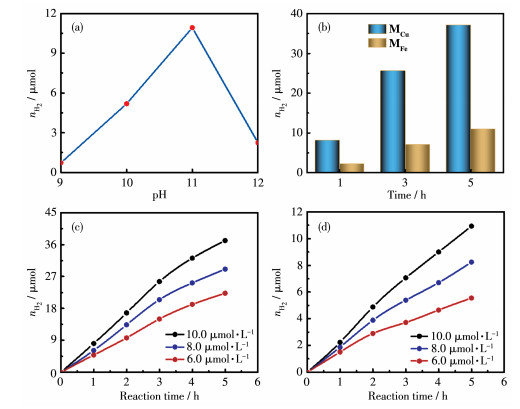
The above characterization results indicate that the macrocyclic-based system has the capability of modeling photocatalytic enzymes and further experiments will verify the homogeneous catalytic reduction capacities of the constructed system. Subsequent photocatalytic HER was carried out under the following conditions: irradiation of the EtOH/H2O (4.5 mL, 1∶1, V/V) solution containing Fl (1.0 mmol·L-1), MFe (10.0 µmol· L-1), Et3N (0.5 mL) under a 300 W xenon lamp. Greater efficiency of HER was achieved at pH=11.0 (Fig. 3a). The total amount of hydrogen released by catalyst MCu and MFe at the same reaction time was compared at pH =11.0 (Fig. 3b). The experiments indicate that the catalysis occurs inside the complex formed by the macrocycle and Fl. In addition, no hydrogen was released in the shortage of the MFe and MCu catalyst, or the absence of irradiation. Subsequent kinetic experiments showed that the amount of hydrogen released exhibited a linear relationship with the concentration of either catalyst of MCu and MFe (Fig. 3c and 3d).
Having elucidated that macrocyclic compounds are sufficient to activate protons, we envisage whether the activated protons could be used as hydrogen donors for the reductive hydrogenation of small molecules, directly hydrogenating the encapsulated substrate molecules. To prove this assumption, we combined the hydrogenation of nitro compounds with the photocatalytic system. Under the optimized experimental conditions, nitrobenzene (0.05 mmol) was added to the ethanol/ H2O (1∶1, V/V) solution containing macrocycles (0.1 mmol·L-1), Et3N (φ=10%), and Fl (1.0 mmol·L-1) at pH =11.0. The product, aniline, was produced directly with a yield up to 99% in 6 h in the MCu system, and a yield up respectively to 99% in 7.5 h in the MFe system (Table 2). Likewise, the photocatalytic efficiency of MCu for proton reduction was higher compared to MFe, and similar catalytic properties were observed in the nitro reduction reaction. At the same time, no hydrogen was produced in the photocatalytic nitroreduction reaction, which has great selectivity.
下载:
导出CSV
 |
||||
| Catalyst | Yield / % | |||
 |
 |
 |
 |
|
| MCu | 99 (6 h) | 99 (8 h) | 99 (9 h) | 99 (18 h) |
| MFe | 99 (7.5 h) | 99 (9 h) | 99 (10 h) | 99 (24 h) |
| * The reaction was carried out using the following conditions: catalyst (MFe or MCu): 0.1 mmol·L-1, Fl: 1.0 mmol·L-1, substrate: 0.05 mmol, Et3N: φ=10%, 300 W xenon lamp; the amino products were characterized using HPLC and the yields were calculated using the internal standard method. | ||||
With a fixed concentration of Et3N and nitrobenzene, the loading of the macrocycle varied from 0.05 to 0.2 mmol·L-1, and the initial reaction rate of nitrobenzene varied linearly with the catalyst concentration (Fig. 4a and 4b). Under the optimized conditions for both systems, the size of aromatic nitro substrates increased from nitrobenzene (S1) to N, N-dimethyl-4-nitroaniline (S2), 1-nitronaphthalene (S3), and 1-nitropyrene (S4). All substrates could be completely converted to amino products for different reaction times. For the substrate with the same size, MCu consistently exhibited better catalytic performance compared to MFe. The law of linearity indicates that the reaction follows a first-order kinetic model, which also means that the reaction occurs in the cavity of macrocycles. The interaction of the substrate with the macrocycles can be viewed as the binding of the enzyme to the substrate, and the macrocycles are nitroreductase-like species.
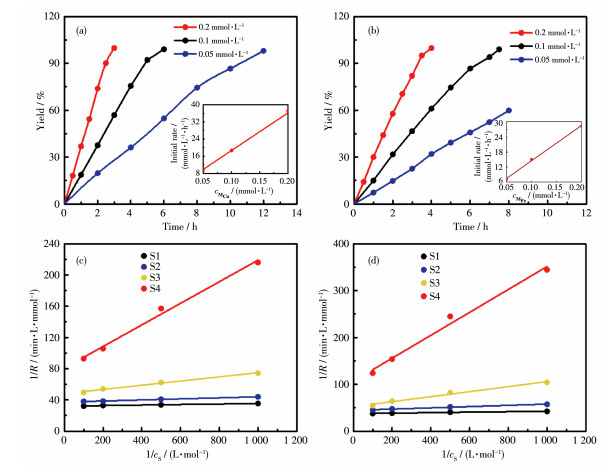
Insert: the interrelation between the initial rate and the concentration of the catalyst
To better confirm that the constructed photocatalytic system can simulate the process of enzyme activation and substrate reduction, the method of changing the substrate concentration was subsequently adopted, and kinetic experiments were carried out. It was found that after the substrate concentration reached saturation, the reciprocal of the reaction rate and the inverse of the substrate concentration had a linear relationship, and this result is in line with the Michaelis-Menten kinetic equation, confirming that the constructed photocatalytic system can be used as a model for enzyme catalysis. The results of the Lineweaver-Burk plot were fitted to obtain Michaelis constant Km, and further calculations yielded kcat. For the MCu-catalyzed nitrobenzene reduction reaction, the fitted Km was 1.04×10⁻⁴ mmol·L-1 and the kcat was 0.312 min-1. As the substrate size increased, the Km value gradually increased to 1.73×10⁻³ mmol·L-1 and the kcat decreased to 0.012 3 min-1 (Table 3). After using MFe instead of MCu, similar catalytic results and characteristics were obtained. The conversion of the other substrates also showed a corresponding decrease for the same reaction time and conditions. The conclusion was also obtained by comparing the Km and kcat of MFe and MCu. Both constants were relatively similar, but MFe performed less well overall than MCu. As shown in Table 3, for the same size substrate, MCu exhibited a smaller Km value and larger kcat value (except for S4). This comparison proves that the MCu system has better catalytic activity in nitroreduction reactions.
下载:
导出CSV
| Substrate | MCu | MFe | |||
| Km/(mmol·L-1) | kcat/min-1 | Km/(mmol·L-1) | kcat/min-1 | ||
| S1 | 1.04×10⁻⁴ | 0.312 | 1.38×10⁻⁴ | 0.266 | |
| S2 | 1.80×10⁻⁴ | 0.268 | 3.02×10⁻⁴ | 0.255 | |
| S3 | 5.56×10⁻⁴ | 0.208 | 1.03×10⁻³ | 0.192 | |
| S4 | 1.73×10⁻³ | 0.012 3 | 2.29×10⁻³ | 0.093 7 | |
Two isomorphic metal-organic macrocycles (MFe and MCu) were constructed using ferrocene-based ligands, which were paired with organic photosensitizers to form a photocatalytic system to pattern the hydrogenation of natural enzymes, such as water splitting reactions and the hydrogenation of nitro compounds. For MFe, its loading of fluorescein was followed by a successful hydrogen evolution reaction for the photolysis of water to hydrogen in the presence of triethylamine as an electron sacrificial agent, and it also showed good activity in the subsequent reductive hydrogenation of aromatic nitro compounds. In contrast, MCu, which replaces the transition metal in the coordination center with Cu, shows more intense activity in the HER reaction and also performs better in the nitroreduction reaction. Afterward, the Michaelis-Menten mechanism was verified by making changes in the concentration of these two photocatalytic mimetic enzyme systems, and the change in the rate of mimetic enzyme reaction in relation to substrate concentration during this process. The results of the catalytic mechanism validation reveal the affinity of different sizes of substrates to the enzyme, simulate the substrate selective process of natural enzymes, and make an extension to the path of artificially constructing enzyme -mimetic catalytic systems.
Eisenmesser E Z, Bosco D A, Akke M, Kern D. Enzyme Dynamics During Catalysis[J]. Science, 2002, 295: 1520-1523. doi: 10.1126/science.1066176
Ueda Y, Ito H, Fujita D, Fujita M. Permeable Self-Assembled Molecular Containers for Catalyst Isolation Enabling Two-Step Cascade Reactions[J]. J. Am. Chem. Soc., 2017, 139(17): 6090-6093. doi: 10.1021/jacs.7b02745
Cullen W, Metherell A J, Wragg A B, Taylor C G P, Williams N H, Ward M D. Catalysis in a Cationic Coordination Cage Using a Cavity-Bound Guest and Surface-Bound Anions: Inhibition, Activation, and Autocatalysis[J]. J. Am. Chem. Soc., 2018, 140(8): 2821-2828. doi: 10.1021/jacs.7b11334
Jing X, Yang Y, He C, Chang Z D, Reek J N H, Duan C Y. Control of Redox Events by Dye Encapsulation Applied to Light-Driven Splitting of Hydrogen Sulfide[J]. Angew. Chem. Int. Ed., 2017, 56(39): 11759-11763. doi: 10.1002/anie.201704327
Hooley R J. Taking on the Turnover Challenge[J]. Nat. Chem., 2016, 8(3): 202-204. doi: 10.1038/nchem.2461
Li J W, Ren Y W, Qi C R, Jiang H F. The First Porphyrin-Salen Based Chiral Metal-Organic Framework for Asymmetric Cyanosilylation of Aldehydes[J]. Chem. Commun., 2017, 53(58): 8223-8226. doi: 10.1039/C7CC03499G
Wu F, Qiu L G, Ke F, Jiang X. Copper Nanoparticles Embedded in Metal-Organic Framework MIL-101(Cr) as a High Performance Catalyst for Reduction of Aromatic Nitro Compounds[J]. Inorg. Chem. Commun., 2013, 32: 5-8. doi: 10.1016/j.inoche.2013.03.003
Ma Y Y, Peng H Y, Liu J N, Wang Y H, Hao X L, Feng X J, Khan S U, Tan H Q, Li Y G. Polyoxometalate-Based Metal-Organic Frameworks for Selective Oxidation of Aryl Alkenes to Aldehydes[J]. Inorg. Chem., 2018, 57(7): 4109-4116. doi: 10.1021/acs.inorgchem.8b00282
Yang Y, Li H N, Jing X, Wu Y C, Shi Y P, Duan C Y. Dye-Loaded Metal-Organic Helical Capsules Applied to the Combination of Photocatalytic H2S Splitting and Nitroaromatic Hydrogenation[J]. Chem. Commun., 2022, 58(6): 807-810. doi: 10.1039/D1CC06166F
Jin Y H, Zhang Q Q, Zhang Y Q, Duan C Y. Electron Transfer in the Confined Environments of Metal-Organic Coordination Supramolecular Systems[J]. Chem. Soc. Rev., 2020, 49(15): 5561-5600. doi: 10.1039/C9CS00917E
Jing X, He C, Zhao L, Duan C Y. Photochemical Properties of Host-Guest Supramolecular Systems with Structurally Confined Metal-Organic Capsules[J]. Acc. Chem. Res., 2019, 52(1): 100-109. doi: 10.1021/acs.accounts.8b00463
李和川, 李明凤, 何成, 段春迎. 基于非贵金属镍的金属有机大环的光解水放氢性能[J]. 无机化学学报, 2018,34,(1): 11-19. LI H C, LI M F, HE C, DUAN C Y. Construction of a Noble-Metal-Free Nickel Metal-Organic Macrocycle for Photocatalytic Hydrogen Production[J]. Chinese J. Inorg. Chem., 2018, 34(1): 11-19.
杨林林, 景旭, 何成, 段春迎. 氧杂蒽染料修饰钴-硫脲配合物的光解水放氢性能[J]. 无机化学学报, 2017,33,(6): 913-922. YANG L L, JING X, HE C, DUAN C Y. Photocatalytic Hydrogen Production Based on Cobalt-Thiosemicarbazone Complex with the Xanthene Dye Moiety[J]. Chinese J. Inorg. Chem., 2017, 33(6): 913-922.
张文言, 杨阳, 黄慧琳, 景旭, 段春迎. 异硫氰酸荧光素后修饰的金属有机三元环光解水制氢[J]. 无机化学学报, 2020,36,(10): 1988-1996. ZHANG W Y, YANG Y, HUANG H L, JING X, DUAN C Y. Photocatalytic Hydrogen Production Based on Metal-Organic Triangle Modified by Fluorescein Isothiocyanate[J]. Chinese J. Inorg. Chem., 2020, 36(10): 1988-1996.
Liu H L, Chang L N, Chen L Y, Li Y W. Nanocomposites of Platinum/Metal-Organic Frameworks Coated with Metal-Organic Frameworks with Remarkably Enhanced Chemoselectivity for Cinnamaldehyde Hydrogenation[J]. ChemCatChem, 2016, 8(5): 946-951. doi: 10.1002/cctc.201501256
Zhang J Z, An B, Li Z, Cao Y H, Dai Y H, Wang W Y, Zeng L Z, Lin W B, Wang C. Neighboring Zn-Zr Sites in a Metal-Organic Framework for CO2 Hydrogenation[J]. J. Am. Chem. Soc., 2021, 143(23): 8829-8837. doi: 10.1021/jacs.1c03283
Vasdev R A S, Findlay J A, Garden A L, Crowley J D. Redox Active [Pd2L4]4+ Cages Constructed from Rotationally Flexible 1, 1'-Disubstituted Ferrocene Ligands[J]. Chem. Commun., 2019, 55(52): 7506-7509. doi: 10.1039/C9CC03321A
Horikoshi R. Discrete Metal Complexes from N-Heterocyclic Ferrocenes: Structural Diversity by Ligand Design[J]. Coord. Chem. Rev., 2013, 257(3/4): 621-637.
Plajer A J, Rizzuto F J, Krbek L K S, Gisbert Y, Agramunt V M, Nitschke J R. Oxidation Triggers Guest Dissociation During Reorganization of an FeⅡ 4L6 Twisted Parallelogram[J]. Chem. Sci., 2020, 11(38): 10399-10404. doi: 10.1039/D0SC04352D
Coleman M H. Graphical Analysis of Enzyme Kinetic Data[J]. Nature, 1965, 205: 798-799. doi: 10.1038/205798a0
Michaelis L, Menten M L. The Kinetics of Invertin Action[J]. FEBS Lett., 2013, 587(17): 2712-2720. doi: 10.1016/j.febslet.2013.07.015
Armarego W L F, Chai C L L. Purification of Laboratory Chemicals. 6th ed. Burlington: Elsevier, 2009: 27-28
Li M X, Cai P, Duan C Y, Lu F, Xie J, Meng Q J. Octanuclear Metallocyclic Ni4Fc4 Compound: Synthesis, Crystal Structure, and Electrochemical Sensing for Mg2+[J]. Inorg. Chem., 2004, 43: 5174-5176. doi: 10.1021/ic049530c
SMART, Data Collection Software, Version 5.629. Bruker AXS Inc., Madison, WI, 2003.
SAINT, Data Reduction Software, Version 6.54. Bruker AXS Inc., Madison, WI, 2003.
Bourhis L J, Dolomanov O V, Gildea R J, Howard J A K, Puschmann H. The Anatomy of a Comprehensive Constrained, Restrained Refinement Program for the Modern Computing Environment-Olex2 Dissected[J]. Acta Crystallogr. Sect. A, 2015, A71: 59-75.
Dolomanov O V, Bourhis L J, Gildea R J, Howard J A K, Puschmann H. OLEX2: A Complete Structure Solution, Refinement and Analysis Program[J]. J. Appl. Cryst., 2009, 42: 339-341. doi: 10.1107/S0021889808042726
Sheldrick G M. A Short History of SHELX[J]. Acta Crystallogr. Sect. A, 2008, A64: 112-122.
Du P W, Eisenberg R. Catalysts Made of Earth-Abundant Elements (Co, Ni, Fe) for Water Splitting: Recent Progress and Future Challenges[J]. Energy Environ. Sci., 2012, 5(3): 6012-6021.

Figure 1 (a) Self-assembly of metal-organic macrocycles MCu; (b) Molecular view of macrocycle MFe with thermal ellipsoids at 30% probability (Symmetry code: 1-x, -y, 1 -z; Fe: cyan, O: red, N: blue, P: purple; H atoms, anions, and solvent molecules are omitted for clarity); (c) Partial ESI-MS spectra of MCu (0.1 mmol·L-1) in an acetonitrile solution

Figure 2 UV-Vis spectra of the DMF solution containing (a) MFe or (b) MCu, upon addition of Fl; (c) Emission spectra of the EtOH/H2O solution containing Fl (10.0 µmol·L-1) (black line) upon addition of MFe (colored lines); (d)Summary of curve Hill-plot fitting results for the addition of MFe or MCu to Fl solutions (EtOH/H2O); CV curves of (e) MFe or (f) MCu, upon addition of Et3NHCl (colored lines), Scan rate: 100 mV·s-1

Figure 3 (a) Photocatalytic hydrogen evolution in ethanol/water (1:1, V/V) solution containing MFe (10.0 µmol·L-1) and Et3N (φ=10%) at different pH values; (b) Graphical representation of the hydrogen production of the above catalytic systems for different reaction times, with MFe and MCu catalysts respectively; Kinetic experiment of the photocatalytic hydrogen evolution in ethanol/water (1∶1, V/V) solution containing Et3N (φ=10%) at pH=11.0 with different concentrations of (c) MFe or (d) MCu

Figure 4 Variation in the yield of photocatalytic nitrobenzene reduction under standard reaction conditions by varying the loading of (a) MCu or (b) MFe; Double reciprocal plot obtained by varying the substrate concentration under standard experimental conditions for the (c) MCu or (d) MFe system
Insert: the interrelation between the initial rate and the concentration of the catalyst
Table 1. Crystal data and structure refinements for MCu and MFe
| Parameter | MCu | MFe |
| Formula | C106H83Cu2F12Fe2N9O20P4S4 | C112H95F6Fe4N13O14P4S2 |
| Formula weight | 2 521.77 | 2 372.45 |
| Crystal system | Monoclinic | Triclinic |
| Space group | C2/c | P1 |
| a/nm | 3.182 0(2) | 1.383 55(8) |
| b/nm | 1.473 28(11) | 1.521 81(9) |
| c/nm | 2.733 00(19) | 1.527 96(9) |
| α/(°) | 94.143 0(10) | |
| β/(°) | 115.590 9(15) | 100.573(2) |
| γ/(°) | 114.219 0(10) | |
| V/nm3 | 11.555 4(15) | 2.844 8(3) |
| Z | 4 | 1 |
| Dc/(g·cm-3) | 1.426 | 1.313 |
| F(000) | 5 048.0 | 1 154.0 |
| Reflection collected | 111 144 | 61 704 |
| Unique reflection (Rint) | 10 173 (0.206 1) | 16 648 (0.029 4) |
| Goodness of fit on F2 | 1.036 | 1.040 |
| Final R indices* [I > 2σ(I)] R1, wR2 | 0.073 4, 0.169 7 | 0.044 8, 0.118 7 |
| R indices* (all data) R1, wR2 | 0.127 6, 0.200 9 | 0.061 1, 0.127 2 |
| *R1=∑||Fo|-|Fc||/∑|Fo|; wR2=[∑w(|Fo|-|Fc|)2/∑wFo2]1/2. | ||
 下载: 导出CSV
Table 2. Photocatalytic nitroreduction reaction of nitro compounds by MFe or MCu*
|
||||
| Catalyst | Yield / % | |||
|
|
|
|
|
| MCu | 99 (6 h) | 99 (8 h) | 99 (9 h) | 99 (18 h) |
| MFe | 99 (7.5 h) | 99 (9 h) | 99 (10 h) | 99 (24 h) |
| * The reaction was carried out using the following conditions: catalyst (MFe or MCu): 0.1 mmol·L-1, Fl: 1.0 mmol·L-1, substrate: 0.05 mmol, Et3N: φ=10%, 300 W xenon lamp; the amino products were characterized using HPLC and the yields were calculated using the internal standard method. | ||||
下载: 导出CSV
Table 3. Determined values of Km and kcat of different substrates with different catalysts (MCu and MFe) under optimized photocatalytic reduction reaction conditions
| Substrate | MCu | MFe | |||
| Km/(mmol·L-1) | kcat/min-1 | Km/(mmol·L-1) | kcat/min-1 | ||
| S1 | 1.04×10⁻⁴ | 0.312 | 1.38×10⁻⁴ | 0.266 | |
| S2 | 1.80×10⁻⁴ | 0.268 | 3.02×10⁻⁴ | 0.255 | |
| S3 | 5.56×10⁻⁴ | 0.208 | 1.03×10⁻³ | 0.192 | |
| S4 | 1.73×10⁻³ | 0.012 3 | 2.29×10⁻³ | 0.093 7 | |
下载: 导出CSV

 扫一扫看文章


扫一扫关注我们