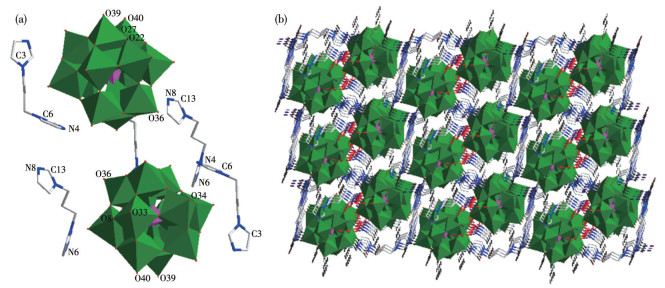
Figure 1.
(a) Structural units and(b)3D structure of the compound

Construction and Properties of the Electrochemical Bisphenol A Sensor Based on Polyoxometalates and Multi-walled Carbon Nanotubes
Na LI , Cong ZHANG , Ju-Jie REN , Min CUI , Hai-Yan ZHAO , Hong-Yue ZHANG , Shi-Xu CHEN , Hong-Yan HAN , Huan ZHANG


Polyoxometalates (POMs) as a kind of high negative oxygen clusters composed of a series of transition metal oxides arranged and connected through edge-, corner- or face-shared methods can be easily functionalized by metal ions or organic molecules[1-2]. POMs can carry out multi-step, fast, and reversible multi-electron transfer reactions without the collapse of their structure. However, POMs had a low surface area and were difficult to separate from aqueous solution, so all kinds of POM-based inorganic-organic hybrid materials have been synthesized. More and more attention was attracted to this area to investigate their fascinating structures and properties, especially electrochemical activity[3-11]. POM- based inorganic- organic hybrid materials in the electrochemical reaction can continue to rapid, reversible, and step-by-step multi-electron transfer under the mild condition without decomposition[12], which makes them show excellent electrocatalytic ability and stability. However, the poor conductivity of POMs limits their use as electrode modification materials in electrochemical sensors.
Bisphenol A (BPA) is widely used in the manufacture of epoxy/polycarbonate resin products, which are considerably used in baby bottles, plastic food containers, and medical devices. However, BPA is an endocrine-disrupting chemical, which does extremely harm to the healthy growth of infants[13-15]. Since 2 March 2011, the production of baby bottles with the chemical BPA has been banned. So, it is necessary to propose a selective analysis procedure to monitor BPA in the different real samples[16-18], and most researchers are focusing on the use of electrochemical sensors for BPA detection[19-21]. So the electrochemical method was a dopted to detect BPA in this work. Many inorganic compounds, organic compounds, and metal complexes have been used as electrocatalysts to detect BPA[22-26]. Regrettably, the number of highly selective and longterm stable redox catalysts remains limited.
Herein, we synthesized a new compound: (H2L)2(HL)2L(PMo12O40)2·2H2O (marked as PMo12), as the active center to modify the glassy carbon electrode (GCE) to test BPA (PMo12/GCE). To improve the conductivity of the prepared working electrode, we also used multi-walled carbon nanotubes (MWCNTs) to modify the electrode. MWCNTs which maintain a fixed distance between layers have many unusual mechanical and electrochemical properties[27]. MWCNTs are considered to be a typical 1D nanomaterial and are one of the frontier fields of international science in recent years. Therefore, to improve the conductivity of the modified electrode, we used the drop coating method to drop the MWCNTs on the electrode surface to modify the electrode. As far as we know, the structure reported in this paper is currently unreported, and the current study has not reported the introduction of these two compounds into electrochemical sensors at the same time. The differential pulse voltammetry (DPV) technique, cyclic voltammetry (CV), and electrochemical impedance spectroscopy (EIS) were used for the determination of BPA, and the test conditions were optimized, such as the pH value of the system, the amount of the MWCNTs, and the target compound. The detection performance of the modified electrode under the optimal parameters is as follows: in a range of 1-20 μmol·L-1, the detection limit of 0.5 μmol·L-1 (S/N=3). The practicality of the sensor was verified by the application of actual samples. The results showed that the recovery rate of BPA was 95.5%-100.7% in the detection of actual samples, indicating that the sensor could be used for the detection of actual samples.
The reagents included MWCNTs (Shenzhen Nanotech Port Co., Ltd.) and BPA (Tianjin Guangfu Fine Chemical Research Institute), and phosphate buffered saline (PBS, 0.05 mol·L-1, pH 7.0) was prepared from K2HPO4-KH2PO4 containing 0.1 mol·L-1 KCl. Ligand L (L=1, 3-bis(1-imidazolyl) propane) (Jinan Henghua Century Co., Ltd.). The reagents were all ana-lytically pure, and the water used for the electrochemical experiment was distilled water.
Instruments: CHI660D electrochemical workstation (Shanghai Chenhua Instrument Co., Ltd.); BT1250 electronic balance (Sartorius Scientific Instruments Co.Ltd.); KH22200B ultrasonic cleaner (Kunshan Hechuang Ultrasonic Instrument Co., Ltd.); Constant temperature magnetic heating stirrer (Jintan Honghua Instrument Factory, Jiangsu Province); Perkin-Elmer 2400 CHN Elemental analyzer. Powder X-ray diffraction (XRD) patterns were recorded in a Rigaku XRD- 6000 diffractometer with Cu Kα radiation (λ=0.154 2 nm) at 40 kV and 30 mA with 2θ=5°-50°. Fourier transform infrared spectrum (FT-IR, 400-4 000 cm-1, Nicolet6700, USA) was used to determine the composition of the compound. X-ray photoelectron spectrosco- py (XPS) equipped with an Al Kα monochromated X- ray source (Thermo Scientific Escalab 250Xi, USA). Thermogravimetric (TG) analysis (STD-2960, USA) was applied with the temperature raised from room temperature to 1 000 ℃ at 10 ℃·min-1 under nitrogen.
0.1 mmol of L, 0.1 mmol of Cu(OAC)2·4H2O, and 0.1 mmol of H 3PMo12O40 were dissolved in 10 mL deionized water, the pH value of the mixture was adjusted to 4.56 by 1 mol·L-1 of sodium hydroxide solution, and then the mixture was transferred into 25 mL Teflonlined autoclave and maintained at 160 ℃ for 5 d. After cooling down to room temperature, the resulting green crystal was filtered and washed with distilled water and dried at room temperature. The calculated yield of PMo12 was 76%. Elemental analysis: Calcd. (%): C 9.92, H 1.23, N 5.14. Found(%): C 9.88, H 1.45, N 5.22.
Crystals of good form and quality are glued to the capillary glass wire, then the crystal data of the compound was collected on a Bruker smart apex CCD area- detector diffractometer with a graphite monochromator and Mo Kα (λ=0.071 073 nm) radiation at room temperature. The diffraction data were collected by ω-scan method at 298 K. The structure was solved by the direct method using SHELXTL-2019 on a legend computer and was modified using full-matrix least squares[28]. All non-hydrogen atoms were refined anisotropically. Hydrogen atoms were located in the calculated positions and refined by using a riding model. The crystal and the structural refinement data for the compound are summarized in Table S1 (Supporting information) and the hydrogen bonds are listed in Table S2.
0.01 g of PMo12 was weighed and dissolved in 10 mL secondary water for ultrasonic dispersion for 30 min to evenly disperse to obtain suspension of PMo12. 0.01 g of MWCNTs were weighed and dissolved in 10 mL dimethyl formamide (DMF) for ultrasonic dispersion for 30 min to obtain the suspension of MWCNTs.
A GCE was used as the basic electrode in this study. Firstly, the GCEs were polished with 1.0, 0.3, and 0.05 μm aluminum oxide powder on the polishing plate successively, after each polishing, the electrodes were cleaned by ultrasonic in water, anhydrous ethanol, and water, then dried with nitrogen. 2 μL of MWCNTs suspension was absorbed with a pipette gun and dripped onto the pretreated GCE. The suspension was dried and used as MWCNTs/GCE. PMo12/GCE with 3 μL of PMo12 solution and PMo12/MWCNTs/GCE with 2 μL of MWCNTs suspension and 3 μL of PMo12 solution were prepared by the same method.
A three-electrode system was used in the experiment: working electrode (modified electrode), reference electrode (Ag/AgCl electrode), and counter electrode (platinum plate). The electrochemical impedance was scanned in a solution of 5 mmol·L-1 [Fe(CN)6]3-/ [Fe(CN)6]4- (containing 0.1 mol·L-1 KCl) at a frequency of 0.1-106 Hz with an open circuit potential. After each use, the electrodes were rinsed with two times of distilled water. All experiments were carried out at room temperature.
Single-crystal X-ray diffraction analysis reveals that the compound crystallizes in the triclinic crystal system. The unit cell parameters are a=1.160 20(9) nm, b=1.208 01(11) nm, c=1.923 89(17) nm, α = 82.607 0(10)°, β=87.961(2)°, γ=76.003 0(10)° (Table S1)
The compound contains two water molecules, two protonated ligands H2L, two protonated ligands HL, one L, and two Keggin [PMo12O40]3- (Fig. 1a), the [PMo12O40]3- contains one [PO4] tetrahedron and twelve [MoO6] octahedron, the [PO4] located in the center of the cage formed by the twelve [MoO6]. P1 is tetracoordinated, coordinating with the four surrounding oxygens (O1, O2, O3, O4), respectively, and the bond length of P1—O is 0.151 1-0.154 6 nm. Mo is hexacoordinated, and Mo—O bond length is 0.162 6-0.238 5 nm. Valence calculation indicates that all the P atoms are in +5 oxidation state, the Mo atoms are in +6 oxidation state, and the ligands are protonated to balance the charge of the entire molecule.
The adjacent polyacid anions are linked together by O—H…O, and then the two polyacid anions are linked with five ligands by N—H…O to form secondary building units. The adjacent secondary building units link each other to form 3D supramolecular structures by N—H…O and C—H…O (Fig. 1b, Table S2).
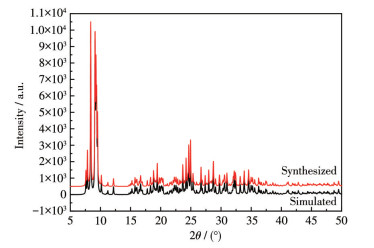
The diffraction peaks of the compound can match well with the simulated data in the key positions (Fig. 2), this can indicate the phase purity of the compound. The peak at 2θ=7.6°, 7.7°, 8.4°, 9.1°, 10.1°, 12.1°, 15.2°, 15.8°, 16.6°, 18.3, 18.7°, 19.3°, 23.6°, 24.1°, 24.6°, 25.0°, 26.6°, 27.9°, and 28.7° correspond to the (010), (100), (011), (101), (111), (102), (020), (112), (013), (202), (121), (123), (300), (115), (105), (320), (233), (006), and (331) planes, respectively.
The peaks of IR (Fig. 3) in the region of 700-1 100 cm-1 are correlated to the polymetallic oxygen cluster νas (P—Oa), νas (Mo—Od), νas (Mo—Ob—Mo), and νas (Mo—Oc—Mo), and the peaks in a range of 1 200- 2 000 cm-1 correspond to the ligand. It is further proved that the compound is a polyacid structure.
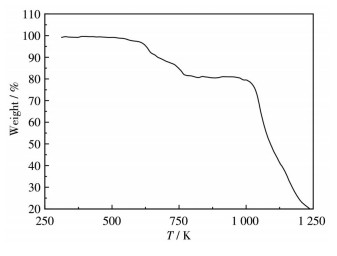
The compound is a two-step weight loss (Fig. 4), the first step lost the ligand molecule at 20-494 ℃, and the weight loss of 17.7% (calculated 15.9%), the second step loss at 494-1 000 ℃ is due to the entire structure collapse.
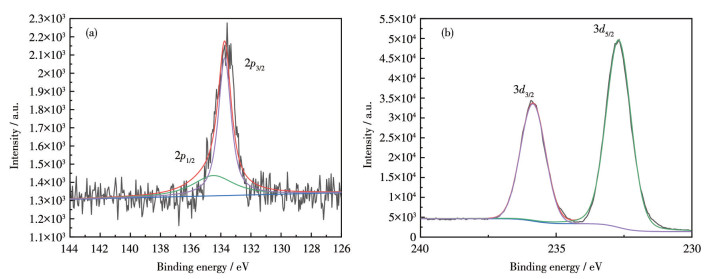
The high-resolution XPS spectra were used to analyze the elements of the compound (Fig. 5). The P2p peaks were observed with the binding energy of 134.5 eV (2p1/2) and 133.7 eV (2p3/2) in Fig. 5a, and the peaks of Mo were observed at 235.1 eV (3d3/2) and 232.0 eV (3d5/2) in Fig. 5b, suggesting the existence of Mo6+ ionsin in PMo12[29].
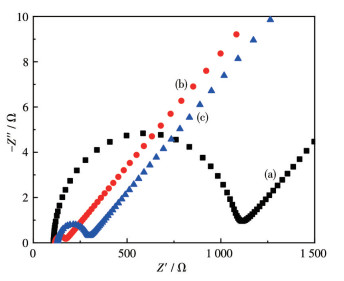
EIS was employed to illustrate the electrical conductivity of the electrodes. Nyquist spectra were obtained by alternating-current impedance test of the working electrode in 0.1 mol·L-1 KCl solution containing 5 mmol·L-1 [Fe(CN)6]3-/[Fe(CN)6]4-. The EIS data were simulated with electrical equivalent circuit mod- els by using ZSimpWin software. As shown in Fig. 6, the Rct of MWCNTs/GCE was about 57 Ω. While after modifying the GCE with PMo12, the Rct increased to 960 Ω mainly because of the intrinsic low conductivity of PMo 12. Compared with PMo12/GCE, the Rct of PMo12/ MWCNTs/GCE decreased to 92 Ω suggesting the electrical conductivity of the working electrode was significantly improved by MWCNTs. The above results have confirmed that PMo12/MWCNTs/GCE had excellent electrochemical performance and was suitable to construct sensors[30].
To obtain the high performance of the electrochemical sensor, the conditions of the modified electrode were discussed. The influence of the quantity of POMs and MWCNTs on the modified electrode was evaluated.
The results demonstrated the BPA oxidation peak current was the strongest when the amount ofMWCNTs was 2.0 μL in 1.0-3.0 μL as shown in Fig. S1, and the peak current was the strongest when the amount of POMs was 3.0 μL in 1.0-5.0 μL as shown in Fig.S2.
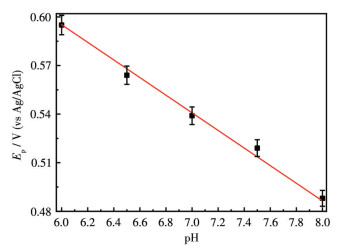
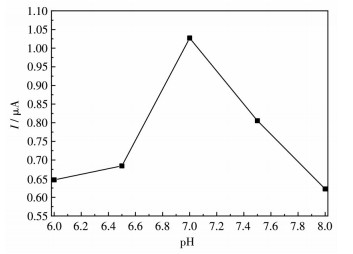
As shown in Fig. 7, 0.05 mol·L-1 PBS with different pH values were optimized. As can be seen from the figure, the oxidation peak current of BPA was the highest at pH 7.0, so PBS with pH 7.0 were selected for the experiment. And it can be seen that there is a good linear relationship between peak potential and pH (Fig. 8), and the linear equation is y=-0.055x+0.92. According to the Nernst equation[31], Formula 1:
0.05 mol·L-1 PBS containing 15 μmol·L-1 BPA
|
|
(1) |
Where Ep is the peak potential, m is the number of protons participating in the reaction, and n is the number of electrons transferred in the reaction. It can be seen from the figure that the slope is close to the theoretical value of 0.059, indicating that the same number of electrons and protons are transferred in the electrocatalytic process of BPA.
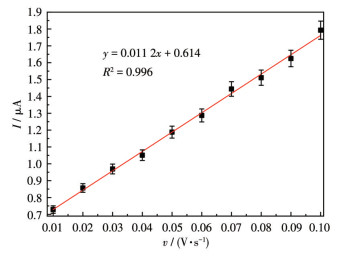
In addition, the catalytic mechanism of the modified electrode on BPA was studied by CV. With the increase of the scanning speed (from 10 to 100 mV· s-1), the oxidation peak current intensity of the modified electrode is linearly related to the scanning speed (v), this shows that the electrode catalysis of BPA is an adsorption-controlled electrochemical reaction process (Fig. 9, 10).
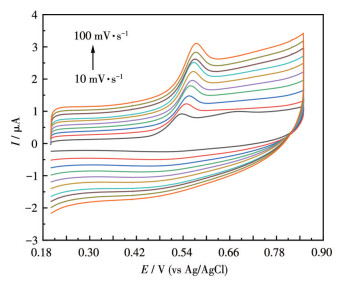
0.05 mol·L-1 PBS containing 15 μmol·L-1 BPA
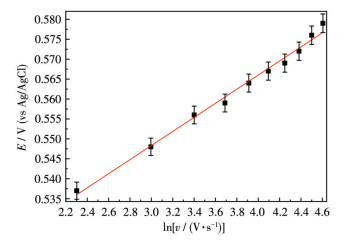
As shown in Fig. 11, the peak potential Ep increased with the logarithm of the scanning speed and had a good linear relationship in the scanning speed range. According to Laviron´s theory[32], for irreversible oxidation reactions, the relationship between Ep and v can be expressed as Formula 2:
|
|
(2) |
Here, E⊖ is the formal potential, α is the electron transfer coefficient, K⊖ is the rate constant of the standard hetero-electron transfer, T is the temperature (298 K), F is the Faraday constant (96 500 C·mol-1), n is the number of transferred electrons, and R is the gas constant (8.314 J·mol-1·K-1). According to the linear equation in Fig. 10: Ep=0.018 1ln v+0.493 (α is assumed to be 0.5 for a completely irreversible electrode process), the slope shows that BPA has transferred two electrons in the oxidation reaction, and from the Ep-pH relationship we know that the number of protons and electrons transferred is the same. Thus, the oxidation of BPA involves two protons and two electrons (Formula 3), which is consistent with the report[33-34].
|
|
(3) |
POMs anions have reversible redox activity, which can proceed with fast and reversible electron transfer[35]:
|
|
(4) |
The electrocatalytic oxidation of BPA by PMo12 was presumed as follows[36]:
|
|
(5) |
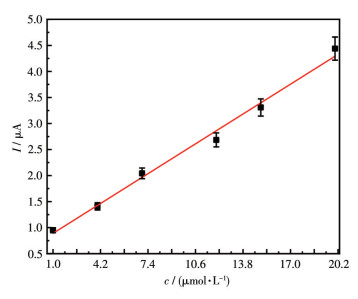
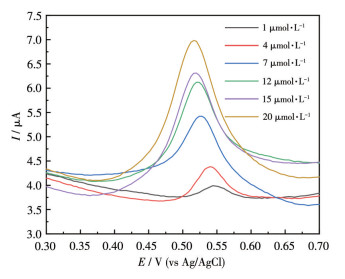
The oxidation peak potential of BPA detected by the modified electrode was 0.5 V. As shown in Fig. 12 and Fig. 13, the linear range was 1-20 μmol·L-1 (1, 4, 7, 12, 15, and 20 μmol·L-1), I=0.711c+0.179 (R2=0.989), and the detection limit was 0.5 μmol·L-1 (S/N=3). These results indicate that the modified electrode is suitable for the electrochemical detection of BPA in PBS. The performance of the prepared sensor was compared with other BPA sensors reported in Table 1. It can be seen that the prepared sensor has the lowest detection limit and a wide linear range.

 下载:
导出CSV
下载:
导出CSV
To investigate the stability of the modified electrodes, PMo12/MWCNTs/GCEs were placed in the fridge for 9 d before being tested. As shown in Fig. 14, this data indicates that the electrochemical sensor for detecting BPA had strong stability.
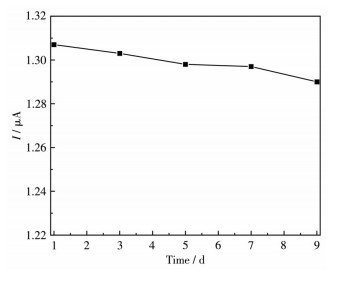
0.05 mol·L-1 PBS (pH 7) containing 15 μmol·L-1 BPA
To evaluate the anti-interference performance of the prepared electrochemical sensor, 10 μmol·L-1 BPAwas added to PBS and several potential interferers of 10 μmol·L-1 (2-naphthol, catechol, p-nitrophenol, 4- acetaminophen, hydroquinone) as shown in Fig. 15. In the studied potentials, the distractors did not affect the current response of BPA. The results show that the modified electrode electrochemical sensor had a high anti-interference performance.
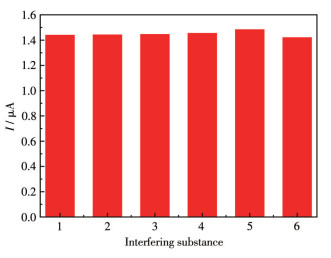
1: no interferers; 2: 2‐naphthol; 3: catechol; 4: p-nitrophenol; 5: 4‐acetaminophen; 6: hydroquinone
In previous tests, we have carried out a series of sensor performance tests on the PMo12/MWCNTs/GCE modified electrode under optimal experimental conditions, which proved that the modified electrode has the potential to become a sensor. To test the application of the modified electrode further in practice, 5 and 10 μmol·L-1 BPA were added to tap water (Sample 1) and lake water (Sample 2) respectively. DPV was used to determine the results, as shown in Table 2. The recov- ery rate was 95.5%-100.7%, and the results show that the sensor can be used in practical applications.
下载:
导出CSV
| Sample | Scalar addition / (μmol·L-1) | Detection value / (μmol·L-1) | Recovery rate / % | Relative standard deviation / % |
| Tap water | 5 | 5.05 | 100.6 | 1.92 |
| 10 | 9.40 | 95.5 | 2.03 | |
| Lake water | 5 | 5.06 | 100.7 | 3.03 |
| 10 | 9055 | 96.6 | 2.20 |
In conclusion, we synthesized new organicinorganic hybrids successfully based on POMs by a simple, eco-friendly route and utilized them as novel electrode materials for the fabrication of an ultrasensitive electrochemical sensor for BPA detection. As far as we know, the reports for BPA detection utilizing PMo12-MWCNTs-based electrochemical sensors were really rare. In the optimum conditions, this electrochemical sensor presented excellent electrochemical properties to BPA with a linear range from 1-20 μmol·L-1, and a detection limit of 0.5 μmol·L-1 (S/N=3), and the electrochemical sensor exhibited satisfactory antiinterference and stability. Furthermore, the constructed sensor was successfully applied to measure the amount of BPA in real medicinal samples with satisfactory results. These results pave the way for utilizing POMs as structural components sensing platform design and extended POM applications in environmental pollution testing.
Supporting information is available at http://www.wjhxxb.cn
Müller A, Kögerler P, Dress A W M. Giant[J]. Metal - Oxide - Based Spheres and Their Topology: From Pentagonal Building Blocks to Keplerates and Unusual Spin Systems. Coord. Chem. Rev., 2001, 222: 193-218.
Hutin M, Rosnes M H, Long D L, Cronin L. Polyoxometalates: Synthesis and Structure-From Building Blocks to Emergent Materials// Reedijk J, Poeppelmeier K. Comprehensive Inorganic Chemistry: Vol. 2. 2nd ed. Oxford: Elsevier, 2013: 241-269
Zou C, Zhang Z J, Xuan X, Gong Q H, Li J, Wu C D. A Multifunctional Organic-Inorganic Hybrid Structure Based on MnⅢ-Porphyrin and Polyoxometalate as a Highly Effective Dye Scavenger and Heterogenous Catalyst[J]. J. Am. Chem. Soc., 2012, 134(1): 87-90. doi: 10.1021/ja209196t
Li S J, Peng Q P, Chen X N, Wang R Y, Zhai J X, Hu W H, Ma F J, Zhang J, Liu S X. A Ta/W Mixed Addenda Heteropolyacid with Excellent Acid Catalytic Activity and Proton-Conducting Property[J]. J. Solid State Chem., 2016, 243: 1-7. doi: 10.1016/j.jssc.2016.08.003
Song J, Luo Z, Britt D K, Furukawa H, Yaghi O M, Hardcastle K I, Hill C L. A Multiunit Catalyst with Synergistic Stability and Reactivity: A Polyoxometalate-Metal Organic Framework for Aerobic Decontami- nation[J]. J. Am. Chem. Soc., 2011, 133: 16839-16846. doi: 10.1021/ja203695h
Kamata K, Yonehara K, Sumida Y, Yamaguchi K, Hikichi S, Mizuno N. Efficient Epoxidation of Olefins with ≥99% Selectivity and Use of Hydrogen Peroxide[J]. Science, 2003, 300(5621): 964-966. doi: 10.1126/science.1083176
Müller A, Krickemeyer E, Bögge H, Schmidtmann M, Beugholt C, Das S K, Peters F. Giant Ring - Shaped Building Blocks Linked to Form a Layered Cluster Network with Nanosized Channels: [Mo124ⅥMo28ⅤO429(μ3 - O)28H14(H2O)66.5]16-[J]. Chem. Eur. J., 1999, 5(5): 1496-1502. doi: 10.1002/(SICI)1521-3765(19990503)5:5<1496::AID-CHEM1496>3.0.CO;2-D
Falaise C, Khlifi S, Bauduin P, Schmid P, Shepard W, Ivanov A A, Sokolov M N, Shestopalov M A, Abramov P A, Cordier S, Marrot J, Haouas M, Cadot E. "Host in Host"Supramolecular Core-Shell Type Systems Based on Giant Ring - Shaped Polyoxometalates[J]. Angew. Chem. Int. Ed., 2021, 60: 14146-14153. doi: 10.1002/anie.202102507
Dong P F, Li N, Zhao H Y, Cui M, Zhang C, Han H Y, Ren J J. POMs as Active Center for Sensitively Electrochemical Detection of Bisphenol A and Acetaminophen[J]. Chem. Res. Chin. Univ., 2019, 35(4): 592-597. doi: 10.1007/s40242-019-8370-8
Shi S K, Li X, Guo H L, Fan Y H, Li H Y, Dang D B, Bai Y. Ionothermal Synthesis of an Antimonomolybdate Cluster, [Sb8Mo13VIMo5VO66]5-, and Its Catalytic Behavior to the Reduction of Nitrobenzene[J]. Inorg. Chem., 2020, 59(16): 11213-11217. doi: 10.1021/acs.inorgchem.0c00825
Li N, Mu B, Lv L, Huang R D. Assembly of New Polyoxometalate- Templated Metal-Organic Frameworks Based on Flexible Ligands[J]. J. Solid State Chem., 2015, 226: 88-93. doi: 10.1016/j.jssc.2015.02.005
Fernandes D M, Freire C. Carbon Nanomaterial-Phosphomolybdate Composites for Oxidative Electrocatalysis[J]. ChemElectroChem, 2015, 2(2): 269-279. doi: 10.1002/celc.201402271
Wang Y L, Ma Y Y, Zhao Q, Hou L, Han Z G. Polyoxometalate - Based Crystalline Catalytic Materials for Efficient Electrochemical Detection of Cr(Ⅵ)[J]. Sens. Actuators B, 2020, 305: 127469. doi: 10.1016/j.snb.2019.127469
Moghadam F H, Taher M A, Karimi-Maleh H. A Sensitive and Fast Approach for Voltammetric Analysis of Bisphenol A as a Toxic Compound in Food Products Using a Pt-SWCNTs/Ionic Liquid Modified Sensor[J]. Food Chem. Toxicol., 2021, 152: 112166. doi: 10.1016/j.fct.2021.112166
蒋小良, 曾铭, 郝雨, 徐正华, 王洁泉, 陈凯, 黄钧. 微波条件下双酚A向食品模拟物的迁移研究[J]. 中国无机分析化学, 2013,3,(4): 69-72. JIANG X L, ZENG M, HAO Y, XU Z H, WANG J Q, CHEN K, HUANG J. Study of Migration of Bisphenol A to Food Simulants un- der Microwave Radiation[J]. Chinese Journal of Inorganic Analytical, 2013, 3(4): 69-72.
Yola M L, Atar N. A Novel Voltametric Sensor Based on Gold Nanoparticles Involved in p-Aminothiophenol Functionalized Multiwalled Carbon Nanotubes: Application to the Simultaneous Determination of Quercetin and Rutin[J]. Electrochim. Acta, 2014, 119: 24-31. doi: 10.1016/j.electacta.2013.12.028
Xiao C Y, Wang L H, Zhou Q, Huang X H. Hazards of Bisphenol A (BPA) Exposure: A Systematic Review of Plant Toxicology Studies[J]. J. Hazard. Mater., 2020, 384: 121488. doi: 10.1016/j.jhazmat.2019.121488
Dhanjai , Sinha A, Wu L X, Lu X B, Chen J P, Jain R. Advances in Sensing and Biosensing of Bisphenols: A Review[J]. Anal. Chim. Acta, 2018, 998: 1-27. doi: 10.1016/j.aca.2017.09.048
Qin W L, Liu X, Chen H P, Yang J. Amperometric Sensors for Detection of Phenol in Oilfield Wastewater Using Electrochemical Polymerization of Zincon Film[J]. Anal. Methods, 2014, 6(15): 5734-5740. doi: 10.1039/C3AY41855C
Mazzotta E, Malitesta C, Margapoti E. Direct Electrochemical Detection of Bisphenol A at PEDOT-modified Glassy Carbon Electrodes[J]. Anal. Bioanal. Chem., 2013, 405(11): 3587-3592. doi: 10.1007/s00216-013-6723-6
Sun P Y, Wu Y H. An Amperometric Biosensor Based on Human Cytochrome P450 2C9 in Polyacrylamide Hydrogel Films for Bisphenol A Determination[J]. Sens. Actuators B, 2013, 178: 113-118. doi: 10.1016/j.snb.2012.12.055
Huang D H, Huang X Z, Chen J Y, Ye R H, Lin Q, Chen S. An Electrochemical Bisphenol: A Sensor Based on Bimetallic Ce-Zn-MOF[J]. Electrocatalysis, 2021, 12(4): 456-468. doi: 10.1007/s12678-021-00659-6
Zhang R Y, Zhang Y, Deng X L, Sun S G, Li Y C. A Novel Dualsignal Electrochemical Sensor for Bisphenol A Determination by Coupling Nanoporous Gold Leaf and Self-Assembled Cyclodextrin[J]. Electrochim. Acta, 2018, 271: 417-424. doi: 10.1016/j.electacta.2018.03.113
Zhang J, Xu X J, Chen L. An Ultrasensitive Electrochemical Bisphenol A Sensor Based on Hierarchical Ce-Metal-Organic Framework Modified with Cetyltrimethy Lammonium Bromide[J]. Sens. Actuators B, 2018, 261: 425-433. doi: 10.1016/j.snb.2018.01.170
Wu Y Y, Zheng Z Y, Yang J Y, Lin Y J, Zhang X S, Chen Y W, Gao W H. Bisphenol A Electrochemiluminescence Sensor Based on Reduced Graphene Oxide - Bi2ZnS4 Nanocomposite[J]. J. Electroanal. Chem., 2018, 817: 118-127. doi: 10.1016/j.jelechem.2018.03.064
Ndlovu T, Arotiba O A, Sampath S, Krause R W, Mamba B B. An Exfoliated Graphite - Based Bisphenol A Electrochemical Sensor[J]. Sensors, 2012, 12: 11601-11611. doi: 10.3390/s120911601
Rao H B, Liu Y T, Zhong J, Zhang Z Y, Zhao X, Liu X, Jiang Y Y, Zou P, Wang X X, Wang Y Y. Gold Nanoparticle/Chitosan@N, S Codoped Multiwalled Carbon Nanotubes Sensor: Fabrication, Characterization, and Electrochemical Detection of Catechol and Nitrite[J]. ACS Sustainable Chem. Eng., 2017, 5: 10926-10939. doi: 10.1021/acssuschemeng.7b02840
Sheldrick G M. A Short History of SHELX[J]. Acta Crystallogr. Sect. A, 2008, 64(1): 112-122. doi: 10.1107/S0108767307043930
Jiao J, Zuo J W, Pang H J, Tan L C, Chen T, Ma H Y. A Dopamine Electrochemical Sensor Based on Pd-Pt Alloy Nanoparticles Decorated Polyoxometalate and Multiwalled Carbon Nanotubes[J]. J. Electroanal. Chem., 2018, 827: 103-111. doi: 10.1016/j.jelechem.2018.09.014
滕达, 王庆, 李娜, 赵海燕, 黄如丹. 基于多酸的超分子化合物的合成与电化学性质[J]. 分子科学学报, 2019,35,(2): 149-150. TENG D, WANG Q, LI N, ZHAO H Y, HUANG R D. Synthesis and Electrochemical Properties of Supramolecular Compounds Based on POMs[J]. Journal of Molecular Science, 2019, 35(2): 149-150.
Bard A J, Faulkner L R. Electrochemical Methods: Fundamentals and Applications[J]. Surf. Technol., 1983, 20: 91-92. doi: 10.1016/0376-4583(83)90080-8
Laviron E. General Expression of the Linear Potential Sweep Voltammogram in the Case of Diffusionless Electrochemical Systems[J]. J. Electroanal. Chem. Interfacial Electrochem., 1979, 101: 19-28. doi: 10.1016/S0022-0728(79)80075-3
Zhang R Y, Zhang Y, Deng X L, Sun S G, Li Y C. A Novel Dualsignal Electrochemical Sensor for Bisphenol A Determination by Coupling Nanoporous Gold Leaf and Self- Assembled Cyclodextrin[J]. Electrochim. Acta, 2018, 271: 417-424. doi: 10.1016/j.electacta.2018.03.113
Jiang L Y, Santiago I, Foord J. A Comparative Study of Fouling-Free Nano Diamond and Nanocarbon Electrochemical Sensors for Sensitive Bisphenol A Detection[J]. Carbon, 2021, 174: 390-395. doi: 10.1016/j.carbon.2020.11.073
Skunik M, Kulesza P J. Phosphomolybdate -Modified Multi - walled Carbon Nanotubes as Effective Mediating Systems for Electrocatalytic Reduction of Bromate[J]. Anal. Chim. Acta, 2009, 631: 153-160. doi: 10.1016/j.aca.2008.10.031
Zhang L, Li S B, O′Halloran K P, Zhang Z F, Ma H Y, Wang X M, Tan L C, Pang H J. A Highly Sensitive Non - enzymatic Ascorbic Acid Electrochemical Sensor Based on Polyoxometalate/Tris(2, 2′ - bipyridine)ruthenium(Ⅱ)/Chitosan-Palladium Inorganic-Organic Self- Assembled Film[J]. Colloids Surf. A, 2021, 641: 126184.
Qin W L, Liu X, Chen H P, Yang J. Amperometric Sensors for Detection of Phenol in Oilfield Wastewater Using Electrochemical Polymerization of Zincon Film[J]. Anal. Methods, 2014, 6: 5734-5740. doi: 10.1039/C3AY41855C
Mazzotta E, Malitesta C, Margapoti E. Direct Electrochemical Detec- tion of Bisphenol A at PEDOT-Modified Glassy Carbon Electrodes[J]. Anal. Bioanal. Chem., 2013, 405: 3587-3592. doi: 10.1007/s00216-013-6723-6
Messaoud N B, Ghica M E, Dridi C, Ali M B, Brett C M A. Electrochemical Sensor Based on Multiwalled Carbon Nanotube and Gold Nanoparticle Modified Electrode for the Sensitive Detection of Bisphenol A[J]. Sens. Actuators B, 2017, 253: 513-522.
董宝田, 冯庆霞, 宫斌. 高效液相色谱法测定聚碳酸酯副产物氯化钠中双酚A和苯酚[J]. 化学分析计量, 2021,7,56-59. DONG B T, FENG Q X, GONG B. Determination of Bisphenol A and Phenol in By-product Sodium Chloride of Synthesis of Polycarbonate by High Performance Liquid Chromatography[J]. Chemical Analysis and Meterage, 2021, 7: 56-59.

Figure 7 Relationship between peak current and pH
0.05 mol·L-1 PBS containing 15 μmol·L-1 BPA

Figure 9 CV curves of PMo12/MWCNTs/GCEs at different scan rates
0.05 mol·L-1 PBS containing 15 μmol·L-1 BPA

Figure 12 DPV of PMo12/MWCNTs/GCEs with different concentrations of BPA (1‐20 μmol·L-1)

Figure 14 Stability of PMo12/MWCNTs/GCEs
0.05 mol·L-1 PBS (pH 7) containing 15 μmol·L-1 BPA

Figure 15 Anti‐interference experiment of PMo12/MWCNTs/GCEs
1: no interferers; 2: 2‐naphthol; 3: catechol; 4: p-nitrophenol; 5: 4‐acetaminophen; 6: hydroquinone
Table 2. Test results of actual sample
| Sample | Scalar addition / (μmol·L-1) | Detection value / (μmol·L-1) | Recovery rate / % | Relative standard deviation / % |
| Tap water | 5 | 5.05 | 100.6 | 1.92 |
| 10 | 9.40 | 95.5 | 2.03 | |
| Lake water | 5 | 5.06 | 100.7 | 3.03 |
| 10 | 9055 | 96.6 | 2.20 |
 下载: 导出CSV

 扫一扫看文章


扫一扫关注我们