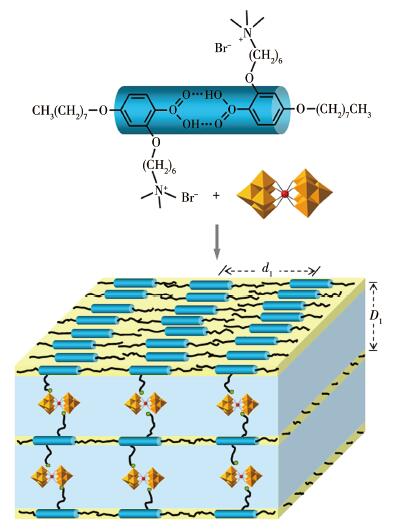
Figure 1.
Schematic structure of cyclic carboxylic dimer of A6 through hydrogen bonding and schematic representation of quasi-2D lamellar-smectic mesophase for A6Eu

Lamellar-Smectic Polyoxometalate Liquid Crystal Encapsulated by Branched Bola-FormAmphiphiles
Jing ZHANG , Yu-feng WANG , Cheng-yan NIU , Jing-jing TAN , Xin-e DUAN , Xue-hong WEI


The construction of organic/inorganic hybrid liquid crystals (LCs) is of great interest in both chemistry and material science over recent years due to the synergetic combination of the functional properties of inorganic nanoparticles and the assembly characteristics of organic LC components[1].On the one hand, the introduction of inorganic nanoparticles could endow the LCs with abundant physical properties, such as optics, electronics, and magnetics, which yielding multifunctional materials[2-3].On the other hand, the assembly structure of LC could act as excellent matrix to control the physical performance of inorganic nanoparticles dynamically[4].Various inorganic nanoparticles have been introduced into the hybrid LCs, such as fullerene, silsesquioxanes, gold and silver metal oxide particles[5-10].
Polyoxometalates (PMs), as a kind of inorganic nanoscale polyanions, have been becoming one of the most attractive building components for the design of multifunctional materials due to their welldefined structures, diverse chemical and electronic properties[11-16].The incorporation of PMs into hybrid LCs makes them promising candidates as functional materials[17-19].We developed a general method to obtain thermotropic PMs-based LCs by encapsulating PMs with amphiphilic surfactants through ionic self-assembly strategy, which results in diverse self-assembled structures[20-21].Polarz et al.achieved a series of lyotropic liquid crystal materials by modifying PMs with organic components[22-23].Zhang and co-workers reported lyotropic and thermotropic PM clustomesogens by rationally changing the density of the peripheral surfactant[24].Despite the fact that these achievements enriched the design principles of PM mesogens[25-27], most of the reported self-assembled structures of PMs-based LCs are concentrated on lamellar and/or columnar mesophases.The PMs-based hybrid liquid crystals with novel organizations are rarely reported.We succeed in designing the nematic phase by encapsulating PMs with T-shaped surfactant[28].Guo and co-workers realized the blue phase with three-dimensional superstructures by covalently grafting azobenzene-mesogens onto the surface of PM[29].Hao et al.constructed cubic ionic Liquid crystals by modifying the lacunary Keggin PM with cationic surfactants[30].PMs-based hybrid LCs with novel self-assembled structures would endow themselves with functional properties, which are desirable from the viewpoint of potential applications.
It has been found that the orientation of the peripheral mesogenic units has a pivotal influence on the assembly structure of the LCs[31-32].For organic/inorganic hybrid LCs, the terminal attachment of mesogens often leads to simple smectic or columnar phases, whereas the lateral attachment of T-shaped quaternary ammonium often result in nematic mesophases[33-34].One of our persistent interests is concentrated on fabricating novel organizations with branched bola-form surfactants, which may provide an effective way to regulate the self-assembly behaviour.
Inspired by the synergistic effect of PMs with the organic counterions, we herein synthesized a quaternary ammoniumA6 with carboxylic acid group by following our reported methods[35].The formation of intermolecular hydrogen bonding between carboxylic acid groups gives rise to a branched bola-form structure.The branched surfactant was used to encapsulate europium-containing PM Na9[EuW10O36](denoted as EuW10), as shown in Fig. 1.The branched molecular structure facilitates the lateral attachment of mesogenic moieties to the inorganic nanocluster EuW10.The resultant PM complex organizes into quasi-2D lamellar-smectic mesophase through a delicate synergy between the inorganic PM and the peripheral organic surfactants.In addition, the luminescence of EuW10 is well retained in the LC matrices, which allows the exploitation of luminescent clustomesogens.We believe that the modification of branched organic components provides a selective route for the development of new functional liquid crystal materials with novel organized structures.
A solution of A6 dissolved in chloroform was added dropwise into an aqueous solution of EuW10 with stirring at room temperature.The initial molar ratio of A6 to EuW10 was controlled at 7∶1.After stirring for 5 h at 45 ℃, the organic phase was separated, washed with deionized water three times.Then A6Eu was obtained by evaporating the solvent to dryness.Finally, the product was further dried in a vacuum desiccator until the weight remained constant.
IR (KBr, cm-1): 3 411, 2 954, 2 925, 2 856, 2 589, 2 474, 1 731, 1 700, 1 608, 1 575, 1 467, 1 438, 1 386, 1 257, 1 189, 1 025, 941, 867, 840, 782, 711.Anal.Calcd.for A6Eu (C192H336N8O68NaEuW10)(%): C, 39.36;H, 5.78;N, 1.91.Found(%): C, 39.01;H, 5.93;N, 1.84, corresponding to a chemical formula: (C24H42O4N)8Na[EuW10O36].By assuming that the organic components have decomposed completely and all inorganic residual materials are Na2O, MoO3 and Eu2O3 at 700 ℃, a mass residue of 42.7% from thermogravimetric analysis (TGA) is in perfect agreement with the calculated value of 43.1% from the given formula (C24H42O4N)8Na[EuW10O36].
Infrared spectrum (IR) was measured on Brook optical apex 80v Fourier transform infrared spectrometer, equipped with DTGS detector from press KBr pellets with the resolution of 4 cm-1.Elemental analysis(C, H, N) was conducted on a Flash EA1112 from Thermo Quest Italia SPA company.TGA was performed using a Q500 thermal analyzer with a heating rate of10 ℃·min-1 under flowing air.Differential scanning calorimetric (DSC) measurements were performed on a Netzsch DSC 204 with a scanning rate of 5 ℃·min-1.The optical textures of the mesophases were obtained with a Zeiss Axioskop 40 polarizing microscope equipped with a Linkam THMSE 600 hot stage.Temperature-dependent X-ray diffraction (XRD) patterns were performed on a Bruker AXS D8 ADVANCE X-ray diffractometer with a mri Physikalische Geräte GmbH TC-Basic temperature chamber (using Cu Kα1 radiation of a wavelength of 0.154 nm).X-ray tube was operated at a generator voltage of 40 kV and a generator current of 30 mA with a scanning speed of 2 (°)·min-1 from 0.9° to 31° (2θ).Luminescence measurements were carried out on a F7100 spectrophotometer with a xenon lamp as the excitation source.
The quaternary ammonium surfactant A6 containing carboxylic acid group was synthesized by referencing our reported procedures[35].The europium-containing PM EuW10 was freshly synthesized as a crystalline material according to the published procedures[36].The surfactant encapsulated polyoxo-metalate complex A6Eu was prepared through ionic selfassembly strategy following the procedures reported previously[37-38].The chemical composition of A6Eu was identified by infrared (IR) spectra, elemental analysis, and TGA measurements.
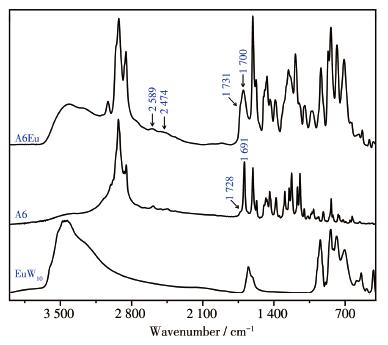
The IR spectrum of A6Eu, A6 and EuW10 are showed in Fig. 2.The assignments of characteristic infrared spectra of A6Eu, A6 and EuW10 are summarized in Table S1.The infrared spectrum of A6Eu showed the characteristic absorption bands of both the organic amphiphile and the inorganic nanocluster.The IR spectrum of EuW10 showed the characteristic absorption bands of Na9EuW10O36 at 939, 867, 838, and 781 cm-1 corresponding to the antisymmetric stretching vibration of W—Od, W—Ob—W, and W—Oc—W, respectively.The IR spectrum of the resultant complex A6Eu exhibited similar absorption bands at 944, 858, 842, and 784 cm-1.According to the characteristic IR spectra of EuW10 and the corresponding complex, it can be seen that the structure of the inorganic nanocluster in the complex is well preserved.The IR spectrum of A6Eu showed a broad band at 3 411 cm-1 attributed to the hydrogen-bonded O—H stretching mode, which may derive from both adsorbed water and carboxyl group, whereas the former can be removed upon heating.The asymmetric and symmetric stretching vibrations of —CH2— appeared at higher wavenumbers (2 925 and 2 856 cm-1), respectively, which indicates the disordered conformation of the alkyl chains[39].The bands at 1 602, 1 571, and 1 500 cm-1 are assigned to the vibration modes of the aromatic rings.The strong band at 1 247 cm-1 is attributed to the phenyl ring O vibration mode.The above characteristic IR bands indicate the presence of ammonium A6 in the resultant complex.
For the amphiphile A6, the weak satellite bands appeared at 2 586 and 2 445 cm-1, which illustrates the formation of hydrogen bonding derived from carboxylic acid[40].The band with strong absorption intensity at 1 700 cm-1 is assigned to H-bonded carbonyl stretching vibration in the closed dimeric form[41], indicating that A6 alone exist in the state of carboxylic acid dimers, definitely[35].For the corresponding complex A6Eu, we also observed the characteristic vibration bands that confirm the hydrogen-bonding dimer of carboxylic acids appearing at 2 589 and 2 474 cm-1 derived from —OH stretching and at 1 700 cm-1 from H-bonded carbonyl stretching vibration in the closed dimeric form.Therefore, we can infer that cyclic H-bonded dimers in A6Eu is formed, as shown in Fig. 1.The weak band emerging at 1 731 cm-1 is attributed to free carbonyl group, indicating that few monomers should still exist in the bulk complex.Owing to the incompatibility between hydrophobic alkyl chains and hydrophilic ionic moieties, the microphase segregation could make the ionic moieties apart from nonpolar alkyl chains and H-bonded dimers.Thus, we proposed that the H-bonded dimers which acting as the mesogenic units has been laterally attached to the inorganic nanocluster, as shown in Fig. 1.
The thermal properties of A6Eu were investigated by TGA, DSC, temperature-dependant FT-IR, polarized optical microscopy (POM) and temperature-dependent XRD.
The TGA curve of as-prepared A6Eu (Fig.S1) showed that the decomposition temperature was mostly higher than 200 ℃.The DSC traces of A6Eu (Fig.S2) in the first cooling and second heating processes were collected.Owing to the low enthalpy, A6Eu did not show a clear exothermal event on the cooling process.An endothermal halo with peak at 140 ℃ was investigated on the second heating process, which can be attributed to the transition from the LC mesophase to the isotropic state.The broad transition finished at 160 ℃, which corresponds to the clearing point.
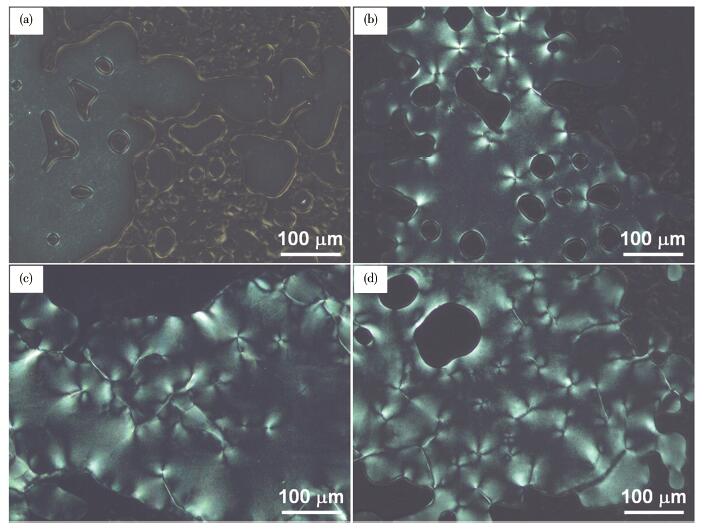
We further studied the phase behaviors of A6Eu by POM.Upon cooling from the isotropic state, A6Eu showed homeotropically aligned domains, as displayed in Fig. 3a.After shearing mechanically, schlieren texture (Fig. 3b) was observed, indicating the existence of liquid crystal state.The schlieren textures were maintained to 28 ℃ (Fig. 3c).A6Eu exhibited schlierentexture (Fig. 3d) on the heating process, indicative of the similar mesophase to that on the cooling process.
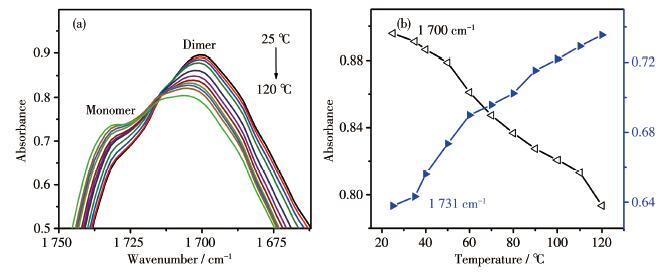
In order to confirm the existence of branched H-bonded dimer in the liquid crystalline temperature range, temperature-dependent IR spectroscopy was carried out.The IR spectra of A6Eu with respect to the carbonyl stretching vibration are shown in Fig. 4.The plots of absorption of H-bonded C=O stretching vibration and the free C=O stretching vibration versus the temperature are shown in Fig. 4b.With the increase of temperature, the absorbance at 1 700 cm-1 attributed to the H-bonded C=O stretching vibration decreased, while the absorbance at 1 731 cm-1 assigned to free C=O stretching vibration increased.In addition, the H-bonded C=O stretching vibration shifted up to 1 706 cm-1 when heated to 120 ℃, indicating the weakening of H-bonded strength.Below 140 ℃, the absorbance at 1 706 cm-1 still existed, indicating the maintaining of H-bonded dimer (Fig.S3).When further increasing to 160 ℃, the band at 1 706 cm-1 in peak height was lower than that at 1 714 cm-1, implying the collapse of the H-bonded dimer.These results verify that the branched molecular architecture maintains below the clear-ing temperature.
The asymmetrical and symmetrical stretching vibrations of the methylene group (Fig.S4) are powerful indicators of the alkyl chain conformation.The upward shifts with the temperature are indicative of an increase of gauche conformers, indicating that the conformation of alkyl chain tends to be disordered.
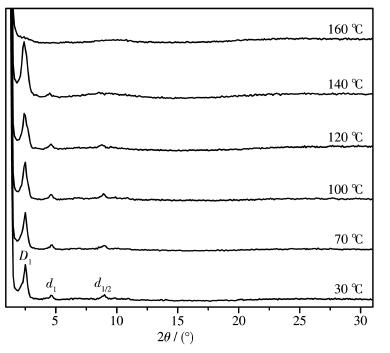
Temperature-dependent XRD was performed to further identify the mesophase and obtain the detailed information about the stacking structures.The surfactant A6 alone was found to form simple smectic structures in which the mesogen of carboxylic dimer of A6 is organized perpendicular to the layer planes[35].Interestingly, after being modified electrostatically with EuW10, the organized structure of the resultant complex A6Eu became different from that of A6 alone.Fig. 5 displays the XRD patterns of A6Eu at different temperatures on the second heating runs.Two kinds of layer periodicity were observed at 30 ℃.The diffraction peak at 2θ≈2.5° corresponds to a layered structure with layer spacing D1 of 3.53 nm, a similar length as found in the case of A6.Two equidistant diffraction peaks at 2θ≈4.6° and 9.0° are evidence for the existence of another layered structure[42]with a shorter layer spacing d1 of 1.92 nm.These two layer spacings D1 and d1 reveal temperature dependence, which increase with increasing temperature.Upon heating to 120 ℃, the layer spacing D1 increased to 3.68 nm.The layer spacing d1 increased to 1.9 nm when heating to 140 ℃, as shown in Table S1.No significant XRD diffractions were observed in the lowangle region at 160 ℃, which corresponds to the isotropic state of A6Eu.No appearance of sharp diffractions at wideangle region over the whole temperature range corresponds to the fluidlike alkyl chains and indicates the liquid nature of the mesophase.
On the basis of the XRD results, the organized structure of A6Eu in the mesophase could be speculated.Considering the microphase segregation between hydrophilic ionic moieties and hydrophobic nonpolar alkyl chains along the long axis of H-bonded dimer, the aggregation of the anionic nanocluster and the lateral alkyl chains terminated by ionic quaternary ammonium, and a cross-stacking orientation could be anticipated for the two kinds of layer periodicity.The complex A6Eu self-assembles into a quasi-2D lamellar-smectic mesophase where the mesogen is organized parallel to the layer planes[43-44], which is driven by synergetic supramolecular interactions.The maximum molecular length of A6 along the long axis of H-bonded dimer with all trans-conformation could be estimated to be 3.64 nm (Fig.S5), calculated by MM2 force field method.Combining the short-axis diameter (0.80 nm) of EuW10 and the maximum molecular length of A6 along the short axis of H-bonded dimer (2.66 nm), the total thickness of a single complex should be ca.6.12 nm.The layer structure D1 should be attributed to long-ranged periodicity which is stabilized by electrostatic interactions between the cationic ammonium and the negatively charged nanocluster due to the stronger diffraction intensity.Another layer periodicity d1 should be derived from the layer structure along the long axis of the H-bonded dimer.The measured layer spacing was smaller than the simulated maximum molecular length, indicating the presence of a disorder conformation or a partial interdigitation of alkyl chains in the mesophase, as illustrated in Fig. 1.
The hydrogen-bonding dimer of carboxylic acids acting as mesogenic group, is non-conjugated moiety, which would not quench the fluorescence of EuW10 in the complex.The powder sample A6Eu displayed obvious red emission under the irradiation of ultraviolet excitation (Fig. 6a), suggesting that the luminescence of EuW10 is well retained during the encapsulation process.
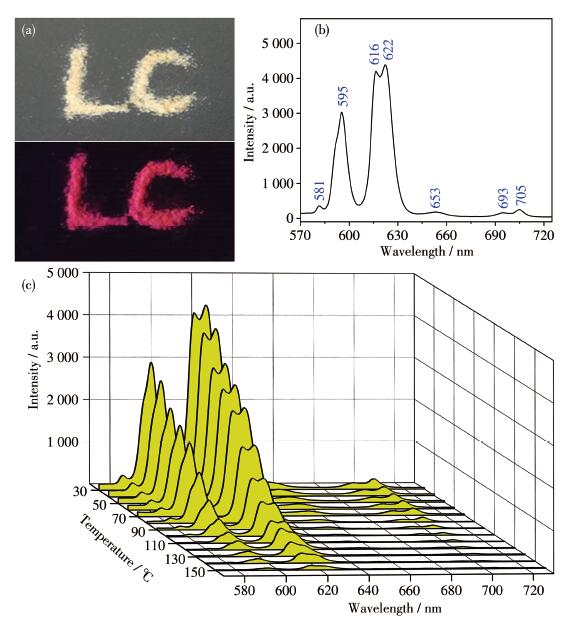
The emission spectrum (Fig. 6b) of A6Eu shows the characteristic of 5D0→7Fj(j=0, 1, 2, 3, 4) transitions of Eu3+.The band at 581, 595, 616 and 622, 653, 693 and 705 nm are attributed to the 5D0→7F0, 5D0→7F1, 5D0→7F2, 5D0→7F3, and 5D0→7F4 transitions of Eu3+, respectively[45-46].The symmetric forbidden transition 5D→7F0 at 581 nm was clearly detected as a single peak, indicating that there is low symmetry and local symmetry in the chemical environment of Eu3+ ion of A6Eu.The intensity of magnetic dipole transition 5D0→7F1 hardly changes with the chemical surroundings of Eu3+, whereas the electric dipole transition 5D0→7F2 is sensitive to the microenvironments of Eu3+.Thus, the intensity ratio of the 5D0→7F2 to 5D0→7F1, referred as I(0→2)/I(0→1), could be used to investigate the change of Eu3+ symmetry under different conditions.The intensity ratio increases with the decrease of the symmetry of Eu3+[47].The value of I(0→2)/I(0→1) changed from 0.20 for EuW10 to 1.46 for A6Eu (Calcd.from Fig.S6), indicating that Eu3+ symmetry becomes poorer in the surfactant-encapsulated complex, compared with unrestrictedsingle inorganic clusters.
We investigated the temperature dependence of luminescence intensity, in order to study the thermalstability of A6Eu in the liquid crystalline phase.Asshown in Fig. 6c, the 5D0→7Fj(j=0, 1, 2, 3, 4) transitions of Eu3+ decreased slowly as the temperatureincreased, which is derived from the quenching of non-radiative transition[48].The above results demonstratethat the photophysical performance regulation of the A6Eu can be achieved by precisely controlling the temperature, which is helpful for the further developmentof the PM-based luminescence devices.
In summary, we designed and synthesized novel organic/inorganic hybrid complex by encapsulating europium-containing PM with ammonium surfactant bearing carboxylic acid group through ionic self-assembly strategy.The dimerization of carboxylic acid groups through intermolecular hydrogen bonding gives rise to a branched structure of the organic components, which further facilitates the lateral attachment of mesogenic moieties to PM.The lateral attachment route is beneficial to the formation of quasi-2D lamellar-smectic mesophase in which the mesogen is organized parallel to the layer planes, while the surfactant alone formed simple smectic structures.In addition, the luminescence of PM is well retained in the mesophase, which allows the exploitation of luminescent clustomesogens.We believe that the lateral attachment route for lamellar-smectic mesophase as presented here will give an access into the construction of multifunctional liquid crystal materials with novel organized structures.
Bisoyi H K, Kumar S. Chem. Soc. Rev. , 2011, 40(1): 306-319 doi: 10.1039/B901793N
Demortière A, Buathong S, Pichon B P, Panissod P, Guillon D, BéginColin S, Donnio B. Small, 2010, 6(12): 1341-1346 doi: 10.1002/smll.201000285
Poulos A S, Constantin D, Davidson P, Impéror M, Pansu B, Panine P, Nicole L, Sanchez C. Langmuir, 2008, 24(12): 6285-6291 doi: 10.1021/la8004322
Shen N N, Wang Z P, Jin J, Gong L K, Zhang Z Z, Huang X Y. CrystEngComm, 2020, 22(20): 3395-3405 doi: 10.1039/D0CE00057D
Li W S, Yamamoto Y, Fukushima T, Saeki A, Seki S, Tagawa S, Masunaga H, Sasaki S, Takata M, Aida T. J. Am. Chem. Soc. , 2008, 130(28): 8886-8887 doi: 10.1021/ja802757w
Draper M, Saez I M, Cowling S J, Gai P, Heinrich B, Donnio B, Guillon D, Goodby J W. Adv. Funct. Mater. , 2011, 21(7): 1260-1278 doi: 10.1002/adfm.201001606
Umadevi S, Feng X, Hegmann T. Adv. Funct. Mater. , 2013, 23(11): 1393-1403 doi: 10.1002/adfm.201202727
Qi H, Shopsowitz K E, Hamad W Y, MacLachlan M J. J. Am. Chem. Soc. , 2011, 133(11): 3728-3731 doi: 10.1021/ja110369d
Lin P C, Cong Y H, Sun C, Zhang B Y. Nanoscale, 2016, 8(4): 2403-2411 doi: 10.1039/C5NR07620J
Mori T, Sharma A, Hegmann T. ACS Nano, 2016, 10(1): 1552-1564 doi: 10.1021/acsnano.5b07164
Song Y F, Tsunashima R. Chem. Soc. Rev. , 2012, 41(22): 7384-7402 doi: 10.1039/c2cs35143a
应俊, 张宝月, 田爱香. 无机化学学报, 2020, 36(10): 1831-1844 doi: 10.11862/CJIC.2020.218YING J, ZHANG B Y, TIAN A X. Chinese J. Inorg. Chem. , 2020, 36(10): 1831-1844 doi: 10.11862/CJIC.2020.218
Wang L H, Xu L, Mu Z C, Wang C G, Sun Z X. J. Mater. Chem. , 2012, 22(44): 23627-23632 doi: 10.1039/c2jm35314h
Xia C X, Wang Z, Sun D, Jiang B L, Xin X. Chem. Eur. J. , 2018, 24(63): 16857-16864 doi: 10.1002/chem.201803800
Sun N, Wu A L, Yu Y, Gao X P, Zheng L Q. Chem. Eur. J. , 2019, 25(24): 6203-6211 doi: 10.1002/chem.201900478
张静, 王丽娜, 陈晓飞, 王玉峰, 牛成艳, 吴立新, 唐智勇. 物理化学学报, 2020, 36(9): 1912002 https://www.cnki.com.cn/Article/CJFDTOTAL-DLXB201502001.htmZHANG J, WANG L N, CHEN X F, WANG Y F, NIU C Y, WU L X, TANG Z Y. Acta Phys. -Chim. Sin. , 2020, 36(9): 1912002 https://www.cnki.com.cn/Article/CJFDTOTAL-DLXB201502001.htm
Zhang T R, Liu S Q, Kurth D G, Faul C F J. Adv. Funct. Mater. , 2009, 19(4): 642-652 doi: 10.1002/adfm.200801409
Watfa N, Floquet S, Terazzi E, Haouas M, Salomon W, Korenev V S, Taulelle F, Guénée L, Hijazi A, Naoufal, D, Piguete C, Cadot E. Soft Matter, 2015, 11(6): 1087-1099 doi: 10.1039/C4SM02551B
Shi N, Wang R, Wang X S, Tan J Y, Guan Y, Li Z B, Wan X H, Zhang J. Chem. Commun. , 2019, 55(8): 1136-1139 doi: 10.1039/C8CC09154D
Li W, Wu L X. Chin. J. Chem. , 2015, 33(1): 15-23 doi: 10.1002/cjoc.201400474
Zhang J, Li J F, Yuan H, Zhang G H, Li B, Li W, Wei X H, Duan X E, Wu L X. Chem. Asian J. , 2016, 11(14): 2001-2005 doi: 10.1002/asia.201600532
Klaiber A, Polarz S. ACS Nano, 2016, 10(11): 10041-10048 doi: 10.1021/acsnano.6b04677
Polarz S, Smarsly B, Antonietti M. ChemPhysChem, 2001, 2(7): 457-461 doi: 10.1002/1439-7641(20010716)2:7<457::AID-CPHC457>3.0.CO;2-#
Zhang T, Spitz C, Antonietti M, Faul C F J. Chem. Eur. J. , 2005, 11(3): 1001-1009 doi: 10.1002/chem.200400796
Li W, Bu W F, Li H L, Wu L X, Li M. Chem. Commun. , 2005(30), 3785-3787 doi: 10.1039/b503550c
Misra A, Kozma K, Streb C, Nyman M. Angew. Chem. Int. Ed. , 2020, 59(2): 596-612 doi: 10.1002/anie.201905600
Martinetto Y, Pegot B, Roch-Marchal C, Cottyn-Boitte B, Floquet S. Eur. J. Inorg. Chem. , 2020(3): 228-247
Li B, Zhang J, Wang S, Li W, Wu L X. Eur. J. Inorg. Chem. , 2013(10/11): 1869-1875
Wang J, Lin C G, Zhang J Y, Wei J, Song Y F, Guo J B. J. Mater. Chem. C, 2015, 3(16): 4179-4187 doi: 10.1039/C5TC00395D
Huang Z H, Zhang G P, Wang L, Song A X, Hao J C. Langmuir, 2020, 36(13): 3471-3481 doi: 10.1021/acs.langmuir.9b02909
Li W, Zhang J, Li B, Zhang M L, Wu L X. Chem. Commun. , 2009(35): 5269-5271 doi: 10.1039/b909605a
Goodby J W, Saez I M, Cowling S J, Görtz V, Draper M, Hall A W, Sia S, Cosquer G, Lee S E, Raynes E P. Angew. Chem. Int. Ed. , 2008, 47(15): 2754-2787 doi: 10.1002/anie.200701111
Cseh L, Mehl G H. J. Am. Chem. Soc. , 2006, 128(41): 13376-13377 doi: 10.1021/ja066099c
Saez I M, Goodby J W. J. Mater. Chem. , 2005, 15(1): 26-40 doi: 10.1039/b413416h
Zhang J, Zhou M J, Wang S, Carr J, Li W, Wu L X. Langmuir, 2011, 27(7): 4134-4141 doi: 10.1021/la2000574
Sugeta M, Yamase T. Bull. Chem. Soc. Jpn. , 1993, 66(2): 444-449 doi: 10.1246/bcsj.66.444
Li H L, Sun H, Qi W, Xu M, Wu L X. Angew. Chem. Int. Ed. , 2007, 46(8): 1300-1303 doi: 10.1002/anie.200603934
Yan Y, Li B, Li W, Li H L, Wu L X. Soft Matter, 2009, 5(20): 4047-4053 doi: 10.1039/b912011d
Li W, Yin S, Wu Y, Wu L X. J. Phys. Chem. B, 2006, 110(34): 16961-16966 doi: 10.1021/jp062074o
Jeong K, Jin S, Ge J J, Knapp B S, Graham M J, Ruan J, Guo M, Xiong H, Harris F W, Cheng S Z D. Chem. Mater. , 2005, 17(11): 2852-2865 doi: 10.1021/cm050338y
Lee J Y, Painter P C, Coleman M M. Macromolecules, 1988, 21(2): 346-355 doi: 10.1021/ma00180a011
Cheng X H, Das M K, Diele S. Tschierske C. Angew. Chem. Int. Ed. , 2002, 41(21): 4031-4035 doi: 10.1002/1521-3773(20021104)41:21<4031::AID-ANIE4031>3.0.CO;2-5
Cheng X H, Prehm M, Das M K, Kain J, Baumeister U, Diele S, Leine D, Blume A, Tschierske C. J. Am. Chem. Soc. , 2003, 125(36): 10977-10996 doi: 10.1021/ja036213g
Cheng X H, Das M K, Baumeister U, Diele S, Tschierske C. J. Am. Chem. Soc. , 2004, 126(40): 12930-12940 doi: 10.1021/ja048224v
Zhang J L, Tan J Y, Wan X H, Zhang J. Chin. J. Polym. Sci. , 2019, 37(11): 1113-1118 doi: 10.1007/s10118-019-2287-z
Zhang J, Liu Y, Li Y, Zhao H X, Wan X H. Angew. Chem. Int. Ed. , 2012, 51(19): 4598-4602 doi: 10.1002/anie.201107481
Bu W F, Li H L, Li W, Wu L X, Zhai C X, Wu Y Q. J. Phys. Chem. B, 2004, 108(40): 12776-12782
Qi W, Li H L, Wu L X. Adv. Mater. , 2007, 19(15): 1983-1987 doi: 10.1002/adma.200602430

Figure 1 Schematic structure of cyclic carboxylic dimer of A6 through hydrogen bonding and schematic representation of quasi-2D lamellar-smectic mesophase for A6Eu

Figure 3 POM images: (a) homeotropically aligned domains of A6Eu at 140 ℃ on the cooling process; (b) schlieren texture of A6Eu after mechanical shearing at 140 ℃ on the cooling process; (c) schlieren texture of A6Eu at 28 ℃ on the cooling process; (d) schlieren texture of A6Eu at 100 ℃ on the heating process

Figure 4 (a) Temperature-dependent FT-IR spectra of A6Eu in the region of C=O stretching vibration; (b) Absorbance changes of H-bonded C=O stretching vibration at 1 700 cm-1 and free C=O stretching vibration at 1 731 cm-1 as a function of temperature

 扫一扫看文章


扫一扫关注我们
 下载:
下载:
 下载:
下载:


