
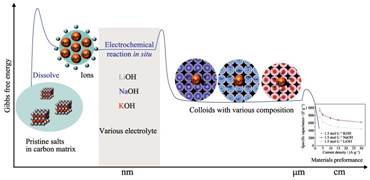
Scheme 1.
Schematic fabrication of Fe-based electrodes with various compositions


With the development of society, energy demand is increasing recently. Safe, clean and sustainable energy storage devices are necessary to satisfy the need for electrical energy storage[1-5]. Electrochemical capacitors, also called supercapacitors, store energy in two closely spaced layers with opposing charges or electrodes with redox reactions near surface[6-8], which offer high power densities and ideal cycling ability. However, supercapacitors are still limited by low energy den- sities[9]. A large variety of materials such as graphene[10-13], nanotube[14-16], MXene[17-20] and transition metal oxides/hydroxides have been explored in supercapacitors recently[21-24].
Iron oxides have a broad working window in negative range and high theoretical specific capacitances[25]. Therefore, various iron oxides have received increasing interests in the field of supercapacitors. At present, the specific capacitance of most iron oxides is far from their theoretical value mainly due to relatively large particle size and poor conductivity. Porous Fe2O3 nanoparticles on graphene delivered a specific capacitance of 357 F·g-1 at 10 mV·s-1. Graphene improved the conductivity of the electrode and porous structure provided rich surface for redox reaction[26]. A hydrothermal method was used to synthesize reduced graphene oxide (rGO)/Fe2O3 aerogel. A specific capacitance over 700 F·g-1 was achieved due to the synergetic effect of the higher conductivity of rGO, and the mesoporous structure of Fe2O3 nanoparticles[27]. Carbon fabric (CF), vertically aligned graphene nanosheets (VAGN) and FeOOH nanorods were incorporated into an electrode. This CF/VAGN/FeOOH electrode can charge/discharge at a low potential window (0 to -1.1 V vs Hg/ HgO), and exhibited a high specific capacitance of 909 F·g-1 aided by the unique structure of VAGN[28]. Fe3O4 nanospheres were in situ decorated in graphene to form a nanocomposite, which exhibited a notably enhanced specific capacity of 268 F·g-1 at 2 mV·s-1. The unique structure of the graphene/Fe3O4 could provide more pathways for rapid transfer of electrons and transport or diffusion of electrolyte ions during fast charge/dis- charge processes[29].
Interface plays a key role in electrochemical reactions in supercapacitors. Interface consists of electrode materials and electrolyte in supercapacitors[30]. In order to construct suitable interface, we can tune various electrolytes to construct different interface[31]. Herein, we choose FeCl3·6H2O served as a precursor to synthesize electrode materials in different kinds of electrolytes. The electrode exhibited a specific capacitance of 1 113 F·g-1 at a current density of 3 A·g-1 in 2 mol·L-1 KOH solution. The electrode exhibited specific capacitances of 927 and 755 F·g-1 at a current density of 3 A·g-1 in 1.5 mol·L-1 NaOH and 1.5 mol·L-1 LiOH electro- lyte, respectively.
FeCl3·6H2O was purchased from Tianjin Huadong Reagent Factory and was used without further purification. FeCl3·6H2O salt was mixed with conductive carbon and polyvinylidene fluoride (PVDF) with a weight ratio of 6:3:1, then proper NMP was dropped into the mixture to form homogenous mixture. Then the mixture was incorporated onto nickel foams and put into the oven at 55 ℃ for 7 hours. The nickel foam with paste was pressed at 15 MPa for 5 s. The geometrical area of working electrode was 1 cm×1 cm. The mass loading of FeCl3·6H2O in the electrode was 1.55 to 2.71 mg. The working electrode was put in electrolyte and carried out electrochemical reaction to form active Fe - based electrode.
The structural investigation of Fe - based electrodes was detected using a scanning electron microscope (SEM, Hitachi, S - 4800 field emission scanning electron microscope, 10 kV). All electrochemical measurements were carried out using electrochemical workstation (CHI 660e) in room temperature.
LiOH·H2O was purchased from Tianjin Huadong Reagent Factory. KOH and NaOH were purchased from Beijing Chemical Works. Then they were mixed with deionized water to form different concentrations of electrolyte for electrochemical reaction. Electrochemical measurements were carried out in a three-electrode cell. The counter electrode and reference electrode were Pt wire and saturated calomel electrode (SCE), respectively. The electrolytes were different concentrations of KOH, NaOH and LiOH aqueous solution. Cyclic voltammograms (CV) were carried out at scan rates of 2, 5, 10, 25, and 50 mV·s-1, respectively. Galvanostatic charge and discharge (GCD) measurement was carried out at current densities of 3, 5, 10, 15, and 30 A·g-1, respectively. The specific capacitance of Fe - based electrode was calculated from GCD curves according to equation[32]:
|
$ C = \frac{{I\Delta t}}{{m\Delta V}} $ |
where I is the current (A), m is the mass of active ions loaded in electrode (g), Δt is the discharge time (s) and ΔV is the potential window (V).
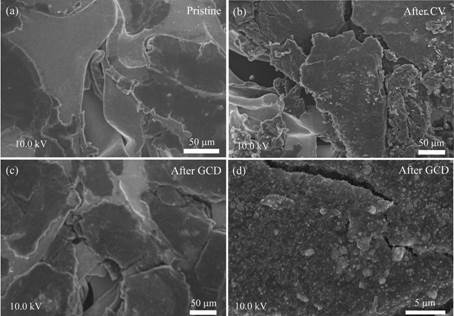
In a typical synthesis process, FeCl3·6H2O salt was mixed with conductive carbon and PVDF to load on nickel foam, forming working electrode. The electrode was put in electrolyte, in which pristine salts were distributed in conductive matrix. CV measurement was used for the working electrode at 1 mV·s-1 about 10 cycles in a three - electrode cell to obtain active Fe - based electrode. Salts dissolve into ions and ions interact with OH- instantly to form colloids, which was shown in Scheme 1. By tuning the kind of electrolytes, we can obtain various colloids with different compositions. The morphologies of the Fe - based electrode were investigated by SEM. Pristine salts, conductive carbon and PVDF were pasted on nickel foam (Fig. 1a). The sample showed rough after experiencing cyclic voltammetry measurement. It seemed that active materials had been formed in Fig. 1b. After GCD measurement, there were so many particles ensuring enough surface areas for electrochemical reaction, which could lead to superior specific capacitances (Fig. 1c and 1d).
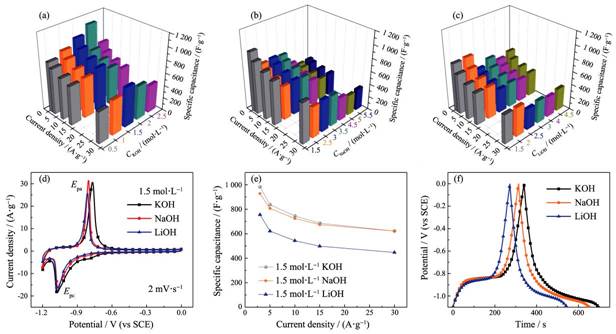
In order to compare the electrochemical characteristics of Fe - based electrode with different compositions, the electrochemical measurements were carried out using a three-electrode cell in different concentrations of various kinds of electrolytes. The detailed val- ues were shown in Table S1. It can be found that the specific capacitance could be effectively tuned by changing the kind of electrolytes. Fig. 2 showed electrochemical performance of Fe-based electrode materials in various aqueous electrolytes. In KOH electrolyte, the synthesized electrode exhibited a highest specific capacitance of 1 113 F·g-1 at a current density of 3 A· g-1 in 2 mol·L-1 aqueous solution. The value was higher than data reported in relatively literatures (Table S2) [28-29, 33-38]. Moreover, the Fe - based electrode synthesized in KOH solution showed relatively high capacitances in 1.5 mol·L-1 (Fig. 2a). Fe-based electrode showed a capacitance of 927 F·g-1 at a current density of 3 A·g-1 in 1.5 mol·L-1 NaOH (Fig. 2b). In LiOH aqueous solution, Fe-based electrode showed the highest value of 766 F·g-1 in 2 mol·L-1 LiOH. Fig. 2d showed CV curves of Fe-based electrodes in 1.5 mol·L-1 electrolyte, where Epa was anodic peak potential and Epc was cathodic peak potential. The difference between anode peak potential and cathode peak potential indicates the reversible degree of the reaction. A pair of redox peak was obtained over a 1.2 V potential win- dow at a scan rate of 2 mV·s-1. Fig. 2e showed specific capacitances of Fe-based electrodes at various current densities in different electrolytes. It can be seen that Fe -based electrode synthesized in KOH electrolyte exhibited the highest values under the same concentration. Under the same concentration of 1.5 mol·L-1, the capacitance calculated from GCD curves was determined to be 982, 927 and 755 F·g-1 in KOH, NaOH and LiOH, respectively (Fig. 2f).
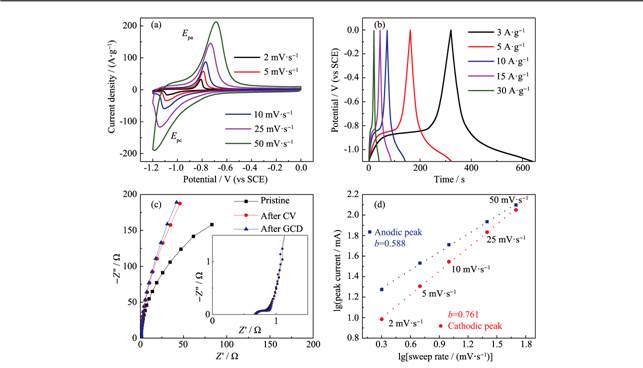
To further evaluate the electrochemical behavior of the Fe-based electrode materials in KOH electrolyte, a series of electrochemical results were shown in Fig. 3. CV curves at different scan rates from 2 to 50 mV·s-1 were shown in Fig. 3a. One pair of redox peaks at various scan rates was clearly observed. The linear slopes and presence of triangular with respect to the charge and discharge demonstrated that the capacitive characteristic of redox reaction in the electrodes (Fig. 3b). The specific capacitances were calculated according to galvanostatic charge and discharge curves. The capacitances were 1 113, 731, 641, 592 and 535 F·g-1 at current densities of 3, 5, 10, 15 and 30 A·g-1, respectively. Electrochemical impedance spectroscopy was collected with a frequency ranging from 0.01 to 100 000 Hz at 0 V. Nyquist plots were exhibited in Fig. 3c. The insert was the local enlargement in high frequency region, which showed a semicircle. And the intercept on the x-axis was equivalent series resistance with a value of about 0.7 Ω, which was attributed to intrinsic resistance of ionic resistance of electrolyte, and contact resistance with current collector. The b-value was calculated according to CV curves at different scan rates, which was between 0.5 and 1. Diffusion process played a key role in redox reaction. Cycling stability was shown in Fig. S1. Capacitance was maintained 87.4% after 50 cycles.
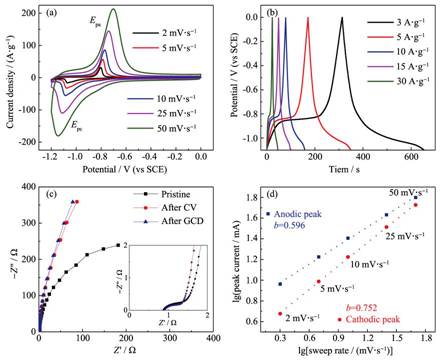
Electrochemical behavior of the Fe - based electrode materials in 1.5 mol·L-1 NaOH electrolyte were shown in Fig. 4. CV curves were measured at the scan rates from 2 to 50 mV·s-1. Galvanostatic charge and discharge measurements were conducted at current densities ranging from 3 to 30 A·g-1 (Fig. 4b). The charge and discharge curves were close to ideal capacitive behaviour. The specific capacitance was 927 F·g-1 at a current density of 3 A·g-1. The value still maintained 622 F·g-1 at 30 A·g-1. Equivalent series resistance was about 0.85 Ω (Fig. 4c), which was higher than that in KOH aqueous solution. In anodic process, the b- value was about 0.596. In cathodic process, the b- value was 0.752, which was higher than that in anodic process. It demonstrated that anodic process could be controlled by diffusion process.
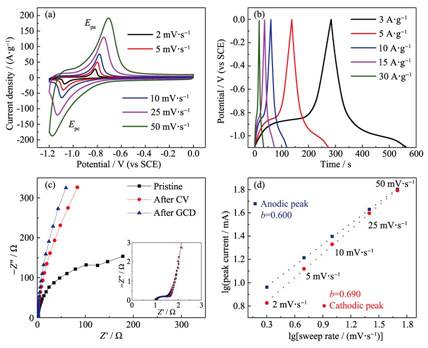
Electrochemical behavior of the Fe - based electrode materials in 2 mol·L-1 LiOH electrolyte were shown in Fig. 5. A pair of redox peak at different scan rates was shown in CV curves (Fig. 5a). Galvanostatic charge and discharge measurements were conducted at current densities ranging from 3 to 30 A·g-1 (Fig. 5b).The specific capacitances were 766, 620 and 540 F·g-1 at current densities of 3, 5 and 10 A·g-1, respectively.Equivalent series resistance was about 1 Ω (Fig. 5c), which was higher than that in KOH and NaOH aqueous solution. In anodic process, the b-value was about 0.600. In cathodic process, the b-value was 0.690, which was similar to that in anodic process.
In conclusion, electrochemical interface could be tuned by various electrolytes with kinds of cations to achieve favourable specific capacitances. Fe3+ colloidal systems showed the highest specific capacitance of 1 113 F·g-1 at 3 A·g-1 in 2 mol·L-1 KOH aqueous electrolyte. The results demonstrated that tuning the kind of electrolytes may tune compositions of Fe-based electrodes to improve electrochemical performance. The active materials were synthesized in a three-electrode cell by in situ reaction, which exhibited superior reactive ability in the measurement conditions. Furthermore, by extending the colloid model, a novel method of in situ composition adjustment to cross-scale control of material properties is provided. This novel method may be applied in synthesizing other electrode materials with high specific capacitance.
Supporting information is available at http://www.wjhxxb.cn
Ghidiu M, Lukatskaya M R, Zhao M Q, et al. Nature, 2014, 516(7529):78-81 doi: 10.1038/nature13970
Janoschka T, Martin N, Martin U, et al. Nature, 2015, 527(7576):78-81 doi: 10.1038/nature15746
Cha E, Patel M D, Park J, et al. Nat. Nanotechnol., 2018, 13(4):337-344
Lee J, Kitchaev D A, Kwon D H, et al. Nature, 2018, 556(7700):185-190 doi: 10.1038/s41586-018-0015-4
Wang H L, Liang X T, Wang J T, et al. Nanoscale, 2020, 12(1):14-42 doi: 10.1039/C9NR07008G
Huang P, Lethien C, Pinaud S, et al. Science, 2016, 351(6274):691-695 doi: 10.1126/science.aad3345
Pech D, Brunet M, Durou H, et al. Nat. Nanotechnol., 2010, 5(9):651-654 doi: 10.1038/nnano.2010.162
Acerce M, Voiry D, Chhowalla M. Nat. Nanotechnol., 2015, 10(4):313-318
梁晰童, 潘伟, 陈昆峰, 等.应用化学, 2016, 33(8):867-875 http://yyhx.ciac.jl.cn/CN/Y2016/V33/I8/867LIANG Xi-Tong, PAN Wei, CHEN Kun-Feng, et al. Chinese J. Appl. Chem., 2016, 33(8):867-875 http://yyhx.ciac.jl.cn/CN/Y2016/V33/I8/867
Xiong Z Y, Yun X W, Qiu L, et al. Adv. Mater., 2019, 31(16):1804434 doi: 10.1002/adma.201804434
Witomska S, Liu Z Y, Czepa W, et al. J. Am. Chem. Soc., 2019, 141(1):482-487 doi: 10.1021/jacs.8b11181
Sahoo R, Lee T H, Pham D T, et al. ACS Nano, 2019, 13(9):10776-10786 doi: 10.1021/acsnano.9b05605
蔡晓庆, 季振源, 沈小平, 等.无机化学学报, 2017, 33(1):26-32 http://www.wjhxxb.cn/wjhxxbcn/ch/reader/view_abstract.aspx?file_no=20170103&flag=1CAI Xiao-Qing, JI Zhen-Yuan, SHEN Xiao -Ping, et al. Chinese J. Inorg. Chem., 2017, 33(1):26-32 http://www.wjhxxb.cn/wjhxxbcn/ch/reader/view_abstract.aspx?file_no=20170103&flag=1
Zang X N, Shen C W, Kao E, et al. Adv. Mater., 2018, 30(5):1704754 doi: 10.1002/adma.201704754
Chen Y J, Wang Y S, Wang Z P, et al. Adv. Energy Mater., 2018, 8(19):1702981 doi: 10.1002/aenm.201702981
周阅微, 季昀辉, 谭徜彬, 等.无机化学学报, 2019, 35(8):1419-1426 http://www.wjhxxb.cn/wjhxxbcn/ch/reader/view_abstract.aspx?file_no=20190812&flag=1ZHOU Yue-Wei, JI Yun-Hui, TAN ChangBin, et al. Chinese J. Inorg. Chem., 2019, 35(8):1419-1426 http://www.wjhxxb.cn/wjhxxbcn/ch/reader/view_abstract.aspx?file_no=20190812&flag=1
Zhang C F, McKeon L M, Kremer M P, et al. Nat. Commun., 2019, 10:1795 doi: 10.1038/s41467-019-09398-1
Yang W J, Yang J, Byun J J, et al. Adv. Mater., 2019, 31(37):1902725 doi: 10.1002/adma.201902725
Wang X H, Mathis T S, Li K, et al. Nat. Energy, 2019, 4(3):241-248
Tian W Q, VahidMohammadi A, Reid M S, et al. Adv. Mater., 2019, 31(41):1902977 doi: 10.1002/adma.201902977
Liang X T, Chen K F, Xue D F. Adv. Energy Mater., 2018, 8(16):1703329 doi: 10.1002/aenm.201703329
普颖慧, 杜东峰, 于世凡, 等.无机化学学报, 2018, 34(11):1983-1990 http://www.wjhxxb.cn/wjhxxbcn/ch/reader/view_abstract.aspx?file_no=20181105&flag=1PU Ying-Hui, DU Dong-Feng, YU Shi-Fan, et al. Chinese J. Inorg. Chem., 2018, 34(11):1983-1990 http://www.wjhxxb.cn/wjhxxbcn/ch/reader/view_abstract.aspx?file_no=20181105&flag=1
Chen K F, Xue D F. Sci. China Technol. Sci., 2015, 58(11):1768-1778 doi: 10.1007/s11431-015-5915-z
Liang X T, Xue D F. Nanotechnology, 2020, 31(7):074001 doi: 10.1088/1361-6528/ab51c6
Xu B Y, Zheng M B, Tang H, et al. Nanotechnology, 2019, 30(20):204002 doi: 10.1088/1361-6528/ab009f
Choi J W, Ock I W, Kim K H, et al. Adv. Funct. Mater., 2018, 28(42):1803695 doi: 10.1002/adfm.201803695
Serrapede M, Rafique A, Fontana M, et al. Carbon, 2019, 144:91-100 doi: 10.1016/j.carbon.2018.12.002
Liao Q Y, Wang C X. CrystEngComm, 2019, 21(4):662-672 doi: 10.1039/C8CE01639A
Sheng S, Liu W, Zhu K, et al. J. Colloid Interface Sci., 2019, 536:235-244 doi: 10.1016/j.jcis.2018.10.060
Chen K F, Liu F, Liang X T, et al. Surf. Rev. Lett., 2017, 24(3):1730005 doi: 10.1142/S0218625X17300052
Sun C T, Xue D F. Sci. China Technol. Sci., 2019, 62(4):707710
Song Y, Liu T Y, Li M Y, et al. Adv. Energy Mater., 2018, 8(26):1801784 doi: 10.1002/aenm.201801784
Wang Y, Chen Z X, Lei T, et al. Adv. Energy Mater., 2018, 8(16):1703453 doi: 10.1002/aenm.201703453
罗学飞, 郭蕾, 魏倩倩, 等.无机化学学报, 2018, 34(5):823-833 http://www.wjhxxb.cn/wjhxxbcn/ch/reader/view_abstract.aspx?file_no=20180502&flag=1LUO Xue-Fei, GUO Lei, WEI Qian-Qian, et al. Chinese J. Inorg. Chem., 2018, 34(5):823-833 http://www.wjhxxb.cn/wjhxxbcn/ch/reader/view_abstract.aspx?file_no=20180502&flag=1
Zhou J H, Xu S C, Ni L, et al. J. Power Sources, 2019, 438:227047 doi: 10.1016/j.jpowsour.2019.227047
武中钰, 范蕾, 陶友荣, 等.无机化学学报, 2018, 34(7):1249-1260 http://www.wjhxxb.cn/wjhxxbcn/ch/reader/view_abstract.aspx?file_no=20180706&flag=1WU Zhong-Yu, FAN Lei, TAO You-Rong, et al. Chinese J. Inorg. Chem., 2018, 34(7):1249-1260 http://www.wjhxxb.cn/wjhxxbcn/ch/reader/view_abstract.aspx?file_no=20180706&flag=1
韩丹丹, 赵远, 申烨, 等.无机化学学报, 2019, 35(8):1485-1492 http://www.wjhxxb.cn/wjhxxbcn/ch/reader/view_abstract.aspx?file_no=20190820&flag=1HAN Dan-Dan, ZHAO Yuan, SHEN Ye, et al. Chinese J. Inorg. Chem., 2019, 35(8):1485-1492 http://www.wjhxxb.cn/wjhxxbcn/ch/reader/view_abstract.aspx?file_no=20190820&flag=1
Xia H, Hong C Y, Li B, et al. Adv. Funct. Mater., 2015, 25:627-635 doi: 10.1002/adfm.201403554

Scheme 1 Schematic fabrication of Fe-based electrodes with various compositions
Compositions can be tuned by various electrolytes including LiOH, NaOH and KOH, respectively; Salts dissolve into ions, then form colloids withvarious composition by electrochemical reaction in situ

图 1 SEM images of FeCl3·6H2O electrodes: (a) Salts in carbon and PVDF matrix; (b) Electrode materials react with KOH electrolyte after CV cycles; (c, d) Electrode materials after GCD

图 2 Electrochemical performance of FeCl3·6H2O based electrode materials in various aqueous electrolytes:(a~c) Specific capacitances of Fe-based electrodes; (d) Comparison of the CV curves at 2 mV·s-1; (e) Specific capacitances of Fe-based electrodes; (f) GCD curves at a current density of 3 A·g-1

图 3 Electrochemical performance of FeCl3 electrode in 2 mol·L-1 KOH: (a) CV curves at scan rates from 2 to 50 mV·s-1; (b) GCD curves tested at various current densities from 3 to 30 A·g-1; (c) Nyquist plots of Fe-based electrode; Insert shows the high frequency region of the plots; (d) Relationship between peak current and sweep rate

图 4 Electrochemical performance of FeCl3 electrode in 1.5 mol·L-1 NaOH: (a) CV curves at scan rates from 2 to 50 mV·s-1; (b) GCD curves tested at various current densities from 3 to 30 A·g-1; (c) Nyquist plots of Fe-based electrode; Insert shows the high frequency region of the plots; (d) Relationship between peak current and sweep rate

图 5 Electrochemical performance of FeCl3 electrode in 2 mol·L-1 LiOH: (a) CV curves at scan rates from 2 to 50 mV·s-1; (b) GCD curves tested at various current densities from 3 to 30 A·g-1; (c) Nyquist plots of Fe-based electrode; Insert shows the high frequency region of the plots; (d) Relationship between peak current and sweep rate

 扫一扫看文章


扫一扫关注我们
 下载:
 下载: