Citation:
TANG Shu-Xuan, ZHANG Li, RUAN Hua-Peng, ZHAO Yue, TAN Geng-Wen, WANG Xin-Ping. An Isolable Dinuclear Iron Hydride Radical Cation[J]. Chinese Journal of Inorganic Chemistry,
2020, 36(6): 1131-1136.
doi:
10.11862/CJIC.2020.115
State Key Laboratory of Coordination Chemistry, Jiangsu Key Laboratory of Advanced Organic Materials, School of Chemistry and Chemical Engineering, Collaborative Innovation Center of Advanced Microstructures, Nanjing University, Nanjing 210023, China
2.
Center of Materials Science and Engineering, Guangxi University of Science and Technology, Liuzhou, Guangxi 545006, China
3.
College of Chemistry, Chemical Engineering and Materials Science, Soochow University, Suzhou, Jiangsu 215123, China
Received Date:
10 February 2020 Revised Date:
13 March 2020 Available Online:
10 June 2020
Abstract:
The dinuclear iron hydride radical cation salt cis-[Fe2Cp2(μ-H)(μ-PPh2)(CO)2]·+[Al(OC(CF3)3)4]-(cis-1·+[Al(OC(CF3)3)4]-) was isolated as a crystalline solid. It has been characterized by single crystal X-ray crystallography, electron paramagnetic resonance (EPR), infrared, and UV-Vis spectroscopy, in conjunction with density functional theory (DFT) calculations. EPR and DFT calculation studies reveal that the spin density of the radical is mainly equally located at both of the iron atoms.
Transition metal hydride radical cations (TMHRCs) have been the research focus for a long time because of their pivotal roles in various organic reactions and biological processes[1], such as proton-coupled electron transfer[2], hydrogen activation[3], and catalytic hydrogenation reactions[4]. In contrast to the closed-shell transition metal hydrides, TMHRCs have an open shell electronic configuration, thus they are generally highly reactive and the stabilization of TMHRCs is quite challenging due to the presence of fragile TM-hydride bonds, which easily undergo homolytical or heterolytical cleavage[1a]. Until now, numbers of TMHRCs have been observed and characterized in solution phase[5], such as niobium hydride[6], molybdenum hydride[7], tungsten hydride[8], ruthenium hydride[9] and copper hydride[10]. However, there are few stable first-row TMHRCs having been isolated and structurally characterized[11-12].
The iron hydride species have been discovered and investigated as key intermediates in catalysis[13], biological processes[14], energy storage and transfer[15]. Although lots of efforts have been devoted to the synthesis and characterization of new iron hydride radical cations, most of them only exist in solution phase and are only stable under low temperature, making them difficult to be isolated in solid state[16]. For example, the dinuclear iron hydride radical cation cis-[Fe2Cp2(μ-H)(μ-PPh2)(CO)2]·+ was synthesized and characterized by electron paramagnetic resonance (EPR) and infrared spectroscopy (IR) in the solution phase in 2004[16b]. However, this radical cation was quite air-sensitive and decomposed easily at room tempera μture, which hindered the further research. Until now, there are only few examples of iron hydride radical cations that have been isolated[12], including [Fe(Cp*)(dppe)H]·+ (dppe=l, 2-bis(diphenyl phosphino)ethane, Cp*=η-C6Me5) radical cation[12a-12b], [Fe(Cp*)(dcpe)H]·+ (dcpe=1, 2-C2H4(PCy2)2; ) radical cation[12c], and [Cp*Fe(pdt)Fe(dppe)(CO)H]·+ (pdt2-=CH2(CH2S-)2) radical cation[12d].
By the aid of weakly coordinating anions, we have recently successfully obtained several main-group element- and transition metal-centred radical cations[17]. Inspired by these previous work, we were interested in stabilizing iron hydride radical cations by employing the weakly coordinating anion [Al(OC(CF3)3)4]- [18]. Herein, we report the synthesis and characterization of the isolable dinuclear iron hydride radical cation salt cis-[Fe2Cp2(μ-H)(μ-PPh2)(CO)2]·+[Al(OC(CF3)3)4]- (cis-1·+[Al(OC(CF3)3)4]-), in which the spin density mainly resides at the iron centers.
1.
Experimental
1.1
Materials and methods
All experiments were carried out under a nitrogen atmosphere by using standard Schlenk techniques and an argon-filled glovebox. Solvents were purified under standard procedures. Trans-1[16b] and Ag[Al(OC(CF3)3)4][18] were synthesized according to the literature methods. Single crystal X-ray diffraction was carried out by using a Bruker D8 CMOS detector at 173 K. The structures were solved by direct methods and all refined on F2 with the SHELX-2018 software package[19]. The H atom of the Fe-H-Fe moiety in cis-1·+ was positioned from difference Fourier maps and refined freely. Infrared spectra were collected on VECTOR22 FT-IR spectrometer, using KBr pellet. EPR spectra were obtained using a Bruker EMX plus-6/1 variable-temperature apparatus, and were simulated using WINEPR SimFonia. UV-Vis spectra were recorded on the Lambda 750 spectrometer. Element analyses were performed at Shanghai Institute of Organic Chemistry, the Chinese Academy of Sciences.
CCDC: 1910053.
1.2
Synthesis of cis-1·+[Al(OC(CF3)3)4]-
Trans-1 (97 mg, 0.2 mmol) and Ag[Al(OC(CF3)3)4] (215 mg, 0.2 mmol) were added into a 100 mL Schlenk flask. The temperature was cooled down to 233 K and chlorobenzene (50 mL) was added via cannula. The mixture was warmed up to r.t. naturally and stirred overnight. Then the brown mixture was filtered and the filtrate was concentrated. The reddish brown crystal of cis-1·+[Al(OC(CF3)3)4]- was obtained by leaving the concentrated solution at 263 K for one week. The crude product was purified by recrystalliza-tion from a hexane/chlorobenzene mixed solution at 263 K. Yield: 0.13 g, 48%; Element analysis Calcd.for C40H21AlF36Fe2O6P(%): C 33.11, H 1.46; Found(%): C 32.81, H 1.55.
2.
Results and discussion
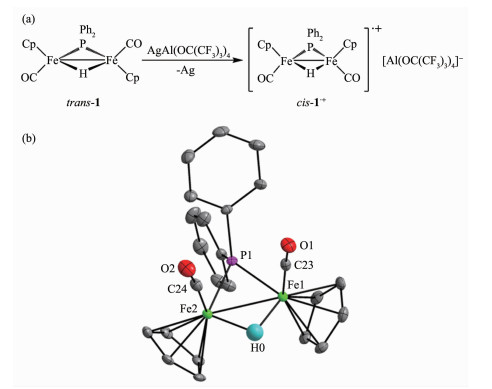
The radical cation salt cis-1·+[Al(OC(CF3)3)4]- was synthesized by selective one-electron oxidation of trans-1[16b] with Ag[Al(OC(CF3)3)4][18] in chlorobenzene at room temperature (Fig. 1a). It is highly sensitive to oxygen and moisture, but can be stored in an N2 atmosphere for months. It has been fully characterized by single crystal X-ray diffraction, EPR, IR and UV-Vis spectroscopy, in conjunction with theoretical calculations.
Figure 1
Figure 1.
(a) Synthesis of cis-1·+[Al(OC(CF3)3)4]-; (b) Thermal ellipsoid (30%) drawing of cis-1·+
All hydrogen atoms except the hydride are not shown for clarity in (b); Selected bond lengths (nm) and angles (°): Fe1-Fe2 0.257 00(9), Fe1-P1 0.219 65(13), Fe2-P1 0.219 78(11), Fe1-H0 0.163 34, Fe2-H0 0.172 07, O2-C24-Fe2 174.3(4), O1-C23-Fe1 177.3(4), Fe1-Fe2-H0 38.700, Fe2-Fe1-H0 41.200, Fe1-Fe2-P1 54.18(4), Fe2-Fe1-P1 54.23(3), H0-Fe1-C23 97.900, P1-Fe1-C23 90.61(2), H0-Fe2-C24 101.60, P1-Fe2-C24 92.17(1)
The crystal structure of cis-1·+, including the selected bond distances and angles, are shown in Fig. 1b. The salient feature is the cis configuration of the two cyclopentadienyl (Cp) groups in cis-1·+, in contrast to the trans form in the starting material trans-1[20]. This is consistent with the observation of fast isomeriza-tion of trans-1·+ to cis-1·+ in solution[16b]. The Fe-Fe bond distance decreases from 0.270 98(3) to 0.257 00(9) nm, and the Fe-P bond distances increase from 0.218 36(4), 0.219 40(4) nm to 0.219 65(13), 0.219 78(11) nm upon one-electron oxidation. This indicates that the interac-tion between the iron atoms becomes stronger, while the interaction between the iron atom and the phosphorus atom becomes weaker. Although the conformation has changed, bond cleavage does not happen. The two iron atoms are still connected by the diphenylphosphide ligand and the bridging hydrogen atom, and each iron atom remains coordinating with one carbonyl ligand and one Cp ligand.
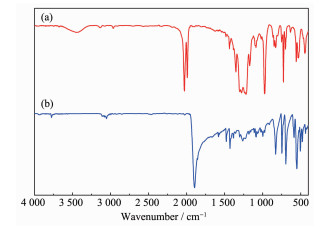
In the IR spectrum of cis-1·+[Al(OC(CF3)3)4]-, the absorption peaks of the carbonyl groups were at 1 990 and 2 029 cm-1, which were blue-shifted in comparison to those of the neutral compound trans-1 (1 855 and 1 898 cm-1) (Fig. 2). According to Dewar-Chatt-Duncanson model, it can be interpreted by the decreasing of backdonation from the Fe centers to the carbonyl groups due to the removal of one electron.
Figure 2
Figure 2.
IR spectra of (a) cis-1·+[Al(OC(CF3)3)4]- and (b) trans-1
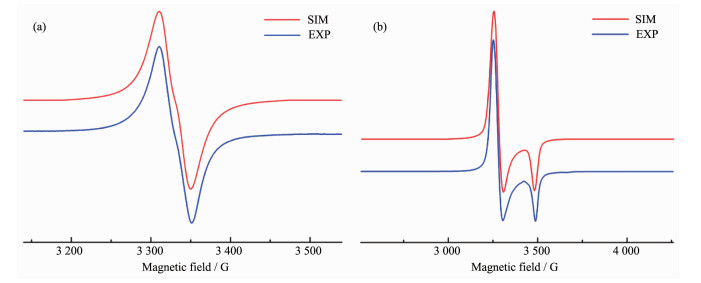
The EPR spectra of cis-1·+[Al(OC(CF3)3)4]- were recorded at 298 K in solution and solid state, and the results were simulated by WinEPR SimFonia (Fig. 3). The solution EPR spectrum exhibited a relatively broad isotropic signal at g=2.113, which deviated from the g value of free electron (g=2.002 3), but was close to the iron-centred radical [FeH(dppe)2] (g=2.085)[16d], suggesting the free electron has a strong interaction with the iron nuclei. The coupling with one phosphorus nucleus (a(31P)=20 G) was included to get a best simulation result. The room temperature powder spectrum displayed an anisotropic spectrum with gx=2.156, gy=2.128, and gz=2.023, which were also close to the g factors of the paramagnetic iron hydride complex [FeHCl(dppe)2][ClO4] (gx=2.185, gy=2.100, and gz=1.981)[16d].
Figure 3
Figure 3.
(a) Solution EPR spectrum of 1 μmol·L-1cis-1·+[Al(OC(CF3)3)4]- in chlorobenzene at 298 K; (b) Powder EPR spectrum of cis-1·+[Al(OC(CF3)3)4]- at 298 K
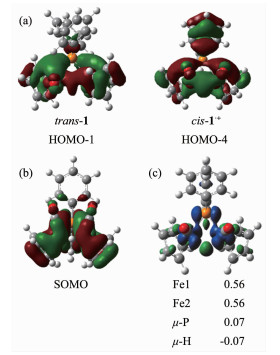
Density functional theory (DFT) calculations[21] have been used to get more insight into the electronic structure of cis-1·+ (Fig. 4). The crystal structure was well reproduced by calculation at the UB3LYP/LanL2DZ/6-31G(d) level of theory (Table 1, S2 and S3). The calculation results revealed that the Wiberg bond order of the Fe-Fe bond increases from 0.464 9 to 0.659 8, while the Wiberg bond orders of the Fe-P bond decrease from 0.919 3, 0.919 1 to 0.894 8, 0.894 6 upon one-electron oxidation. The result is consistent with the changes of bond distances observed in single crystal X-ray diffraction. In addition, the bond orders of the Fe-Fe and Fe-H bonds were close to 0.5 in both trans-1 and cis-1·+, which indicate that there should be a three-center two-electron (3-c-2) bond present among the hydrogen atom and two iron atoms. The 3-c-2 bond was represented by the HOMO-1 in trans-1, and HOMO-4 in cis-1·+ (Fig. 4a). The singly occupied molecular orbital (SOMO) as well as the spin density are mainly distributed among the Fe fragments, which indicates that the free electron is mainly located on each iron atom (Fig. 4b and 4c).
Figure 4
Figure 4.
(a) Three-center two-electron bond in trans-1 and cis-1·+; (b) SOMO; (c) Spin density of cis-1·+
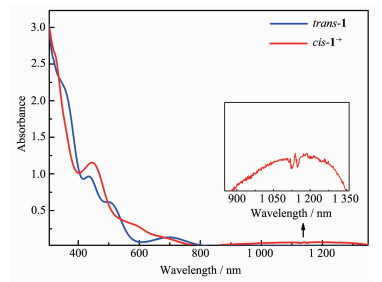
The UV-Vis absorption spectra of trans-1 and cis-1·+[Al(OC(CF3)3)4]- were recorded in chlorobenzene solution at room temperature (Fig. 5). The spectrum of trans-1 revealed three absorption peaks at 436, 503, and 700 nm, while the spectrum of cis-1·+[Al(OC(CF3)3)4]- showed four peaks maxima at 445, 591, 688, and 1 200 nm. Judging from the time-dependent DFT (TD-DFT) calculations at UB3LYP/LanL2DZ/6-31G(d) level of theory, the absorptions of cis-1·+[Al(OC(CF3)3)4] at 591, 688, and 1 200 nm are mainly assigned to SOMO→LUMO(α), HOMO-4(β)→LUMO(β), and HOMO-1(β)→LUMO (β) electronic transitions, respe-ctively (Table S5 in Supporting information).
Figure 5
Figure 5.
Absorption spectra of 0.1 mmol·L-1trans-1 and cis-1·+[Al(OC(CF3)3)4]- in chlorobenzene at 298 K
In summary, we have successfully isolated and fully characterized the stable dinuclear iron hydride radical cation cis-1·+, in which the Cp ligands feature a cis conformation, in contrast to the trans form in the precursor trans-1. The EPR and theoretical calculations reveal that the spin density mainly resides at the iron centers. The synthesis of other TMHRCs and their reactivity studies are currently going on in our laboratory.
Acknowledgments:
We thank the National Key R & D Program of China (Grants No. 2016YFA0300404, 2018YFA0306004, X.W.), the National Natural Science Foundation of China (Grants No. 21525102, 21690062, X.W., 21601082, G.T.), and the Fundamental Research Funds for the Central Universities (Grants No. 14380191, X.W., 14380194, G.T.) for financial support. The calculations were performed at the High-Performance Computing Center of Nanjing University.
[1]
(a) Hu Y, Shaw A P, Estes D P, et al. Chem. Rev., 2016, 116: 8427-8462 (b)Wiedner E S, Chambers M B, Pitman C L, et al. Chem. Rev., 2016, 116: 8655-8692 (c)Schilter D, Camara J M, Huynh M T, et al. Chem. Rev., 2016, 116: 8693-8749
[2]
(a) Liu T F, Guo M Y, Orthaber A, et al. Nat. Chem., 2018, 10: 881-887 (b)Huang T, Rountree E S, Traywick A P, et al. J. Am. Chem. Soc., 2018, 140: 14655-14669 (c)Bourrez M, Steinmetz R, Ott S, et al. Nat. Chem., 2014, 7: 140-145
[3]
(a) Ogata H, Lubitz W, Higuchi Y. DaltonTrans., 2009: 7577-7587 (b)Frey M. ChemBioChem, 2002, 3: 153-160 (c)Evans D J, Pickett C J. Chem. Soc. Rev., 2003, 32: 268-275 (d)Lubitz W, Ogata H, Rüdiger O, et al. Chem. Rev., 2014, 114: 4081-4148 (e)Hembre R T, Scott McQueen J, Day V W. J. Am. Chem. Soc., 1996, 118: 798-803
[4]
Shaw A P, Ryland B L, Franklin M J, et al. J. Org. Chem., 2008, 73:9668-9674 doi: 10.1021/jo801928t
[5]
(a) Ryan O B, Tilset M, Parker V D. J. Am. Chem. Soc., 1990, 112: 2618-2626 (b)Roberts J A S, Appel A M, DuBois D L, et al. J. Am. Chem. Soc., 2011, 133: 14604-14613
[6]
(a) Blaine C A, Ellis J E, Mann K R. Inorg. Chem., 1995, 34: 1552-1561 (b)Roullier L, Lucas D, Mugnier Y, et al. J. Organomet. Chem., 1990, 396: C12-C16
[7]
Baya M, Houghton J, Daran J C, et al. Chem. Eur. J., 2007, 13:5347-5359 doi: 10.1002/chem.200700293
[8]
Klingler R J, Huffman J C, Kochi J K. J. Am. Chem. Soc., 1980, 102:208-216 doi: 10.1021/ja00521a033
[9]
Ryan O B, Tilset M. J. Am. Chem. Soc., 1991, 113:9554-9561 doi: 10.1021/ja00025a020
[10]
Eberhart M S, Norton J R, Zuzek A, et al. J. Am. Chem. Soc., 2013, 135:17262-17265 doi: 10.1021/ja408925m
(a) Hamor P, Toupet L, Hamon J R, et al. Organometallics, 1992, 11: 1429-1431 (b)Tilset M, Fjeldahl I, Hamon J R, et al. J. Am. Chem. Soc., 2001, 123: 9984-10000 (c)Zhang F J, Jia J, Dong S L, et al. Organometallics, 2016, 35: 1151-1159 (d)Yu X, Tung C H, Wang W G, et al. Organometallics, 2017, 36: 2245-2253
(a) Bianchini C, Laschi F, Peruzzini M, et al. Inorg. Chem., 1990, 29: 3394-3402 (b)Alvarez C M, Esther García M, Ruiz M A, et al. Organometallics, 2004, 23: 4750-4758 (c)Jiménez-Tenorio M, Carmen Puerta M, Valerga P. Organometallics, 1994, 13: 3330-3337 (d)Gargano M, Giannoccaro P, Rossi M, et al. J. Chem. Soc. DaltonTrans., 1975: 9-12
[17]
(a) Zheng X, Wang X Y, Zhang Z C, et al. Angew. Chem. Int. Ed., 2015, 54: 9084-9087 (b)Wang W Q, Wang X Y, Zhang Z C, et al. Chem. Commun., 2015, 51: 8410-8413 (c)Li S Y, Wang X Y, Zhang Z C, et al. DaltonTrans., 2015, 44: 19754-19757 (d)Zheng X, Zhang Z C, Tan G W, et al. Inorg. Chem., 2016, 55: 1008-1010 (e)Wang W Q, Li J, Yin L, et al. J. Am. Chem. Soc., 2017, 139: 12069-12075 (f)Tan G W, Wang X P. Chin. J. Chem., 2018, 36: 573-586
Figure 3
(a) Solution EPR spectrum of 1 μmol·L-1cis-1·+[Al(OC(CF3)3)4]- in chlorobenzene at 298 K; (b) Powder EPR spectrum of cis-1·+[Al(OC(CF3)3)4]- at 298 K



 下载:

 下载: