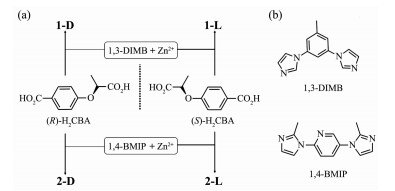
Scheme 1.
Synthetic routes of HCPs (a) and structures of auxiliary ligands 1, 3-DIMB and 1, 4-BMIP (b)


Helical chirality as a basic feature is widely existed in nature products and artificial materials[1-2]. In living system, nucleic acid molecules with fascinating double helixes act as very important intermediates in storing and transferring genetic informations[3]. In non-living system, carbohelicenes are constructed by an all carbon helical skeleton incorporating consecutive ortho-fused benzene rings, which have chirality and chiroptical properties[4]. Therefore, the research on the chiral compounds with helical chains possesses both theoretical and realistic significance[5-7].
In homochiral coordination polymers (HCPs), helicity and chirality are often bound to each other, offering an approach to understand the relationship of chirality and helicity[8-10]. Some methods, including spontaneous resolution, asymmetric induction and use of chiral ligands, have been developed to construct HCPs. Among them, self-assembly of chiral ligands and metal ions is the most direct and effective synthetic strategy. So the choice of chiral ligands is a key factor to gain multifunctional HCPs[11-14].
As cheap and readily available nature products, hydroxyl acids should be suitable enantiotopic linkers for the formation of HCPs. However, their flexible skeletons and preferred chelating coordination modes make it very difficult to obtain higher dimensional HCPs. To overcome these limitations, we used p-hydroxybenzoic acid to modify the -OH group of lactic acid, and synthesized a pair of lactate derivatives ((R)-H2CBA and (S)-H2CBA)[15]. Containing lactic acid and benzoic acid units, the (R)-H2CBA and (S)-H2CBA) have semi-rigid skeletons and multiple coordination modes, providing a convenient approach to synthesize HCPs (Scheme 1a)[16]. Moreover, introduction of nitrogenous auxiliary ligands is also a feasible method in the synthesis process of HCPs.
Based on these considerations, rigid 1, 3-DIMB and 1, 4-BMIP were chosen as auxiliary ligand to help (R)-H2CBA and (S)-H2CBA to build HCPs (Scheme 1b). Under hydrothermal conditions, two pair of Zn-based HCPs with helixes, namely, {[Zn((R)-CBA)(1, 3-DIMB)]·H2O}n (1-D), {[Zn((S)-CBA)(1, 3-DIMB)]·H2O}n (1-L), [Zn2((R)-CBA)2(1, 4-BMIP)]n (2-D) and [Zn2((S)-CBA)2 (1, 4-BMIP)2]n (2-L) have been synthesized. Herein, their synthesis, crystal structures, thermal stabilities, CD spectra, and luminescent properties were reported.
All chemical reagent were purchased from Energy-Chemical and used without further purification except for (R)-H2CBA and (S)-H2CBA, which were syn-thesized according to the previously reported method[15]. Elemental analysis was carried out on a Perkin-Elmer 240C elemental analyzer. FT-IR spectra were measured as KBr pellets on a Nicolet Magna 750 FT-IR spectro-meter in a range of 400~4 000 cm-1. The powder X-ray diffraction (PXRD) analysis was recorded on a Rigaku Dmax2500 diffractometer (U=40 kV and I=40 mA) with Cu Kα radiation (λ=0.154 056 nm) from 5.00°~50.00°(2θ). The luminescence spectra were performed on a Hitachi FL-4500 fluorescence spectro-photometer. Solid CD spectra were measured on a MOS-450 spectropolarimeter at room temperature.
A mixture of Zn(BF4)2 (36 mg, 0.15 mmol), (R)-H2CBA (21 mg, 0.1 mmol), 1, 3-DIMB (22 mg, 0.1 mmol), Na2CO3 (12.7 mg, 0.12 mmol) and H2O (6 mL) was sealed in a 25 mL Teflon-lined stainless steel vessel and heated at 130 ℃ for 3 days. After cooling to room temperature, the colourless block crystals 1-D were obtained with a yield of 40% (based on (R)-H2CBA). Anal. Calcd. for C25H26N4O6Zn(%):C, 55.21; H, 4.82; N, 10.30. Found(%): C, 56.04.1; H, 4.32; N, 9.88. IR (KBr, cm-1): 3 428(m), 1 603(s), 1 598(m), 1 414(m), 1 387(m), 1 355(m), 1 306(m), 1 238(m), 1 169(w), 854(w), 786(w), 730(w), 681(w), 656(w).
The procedure was same as that of 1-D, except that (S)-H2CBA was replaced by (R)-H2CBA. Colorless block crystals of 1-L were obtained with a yield of 35% (based on (S)-H2CBA). Anal. Calcd. for C25H26N4O6Zn(%): C, 55.21; H, 4.82; N, 10.30. Found(%): C, 55.47; H, 4.12; N, 9.74. IR (KBr, cm-1): 3 428(m), 1 603(s), 1 510(m), 1 411(m), 1 386(m), 1 349(m), 1 306(m), 1 238(m), 1 176(w), 854(w), 780(w), 730(w), 681(w), 656(w).
The procedure was same as that of 1-D, except that 1, 4-BMIP was replaced by 1, 3-DIMB. Colorless block crystals of 2-D were obtained with a yield of 35% (based on (R)-H2CBA). Anal. Calcd. for C33H29N5O10Zn2(%): C, 50.40; H, 3.72; N, 8.91. Found(%): C, 48.16; H, 4.02; N, 7.76. IR (KBr, cm-1): 3 428(w), 3 125(w), 2 983(w), 1 677(m), 1 603(s), 1 541(s), 1 485(m), 1 417(s), 1 300(m), 1 231(s), 1 139(m), 1 089(m), 1 040(m), 866(m), 780(m), 656(m), 575(w), 507(w).
The procedure was same as that of 2-D, except that (S)-H2CBA was replaced by (R)-H2CBA. Colorless block crystals of 2-L were obtained with a yield of 30% (based on (S)-H2CBA). Anal. Calcd. for C33H29N5O10Zn2(%): C, 50.40; H, 3.72; N, 8.91. Found(%): C 47.86, H 4.25, N 8.26. IR (KBr, cm-1): 3 428(w), 3 125(w), 2 983(w), 1 670(m), 1 603(s), 1 547(s), 1 491(m), 1 423(s), 1 306(m), 1 231(s), 1 139(m), 1 089(m), 1 040(m), 854(m), 780(m), 656(m), 581(w), 501(w).
The single crystal diffraction data of 1-D, 1-L, 2-D and 2-L were collected on a Rigaku four-circle 003 CCD diffractometer at room temperature using graphite monochromated Mo Kα radiation (λ=0.071 073 nm). The data integration and reduction were carried out with Rigaku OD 2015 software. Empirical absorption corrections were applied by using spherical harmonics, implemented in SCALE3 ABSPACK scaling algorithm. In Olex2-1.2, the structures of complexes were solved by the direct methods using SHELXS-2017 and refined on F2 by full-matrix least-squares using the SHELXL-2017 program package[17-18]. All the hydrogen atoms were placed on their calculated positions and treated as riding atoms with default parameters. The crystal and refinement data are summarized in Table 1, while selective bond distances and angles are listed in Table 2.

 下载:
导出CSV
下载:
导出CSV
| Complex | 1-D | 1-L | 2-D | 2-L |
| Chemical formula | C25H24N4O5Zn·H2O | C25H24N4O5Zn·H2O | C33H29N5O10Zn2 | C33H29N5O10Zn2 |
| Formula weight | 543.87 | 543.87 | 393.18 | 393.18 |
| Crystal system | Orthorhombic | Orthorhombic | Monoclinic | Monoclinic |
| Space group | P212121 | P212121 | P21 | P21 |
| a/nm | 1.125 98(7) | 1.128 62(5) | 1.034 80(4) | 1.034 00(5) |
| b/nm | 1.420 54(8) | 1.421 15(8) | 1.059 56(4) | 1.059 93(5) |
| c/nm | 1.563 18(12) | 1.566 01(8) | 1.549 56(6) | 1.552 36(8) |
| V/nm3 | 2.500 3(3) | 2.511 8(2) | 1.692 07(11) | 1.694 38(14) |
| β/(°) | 95.173(4) | 95.182(4) | ||
| Z | 4 | 4 | 2 | 2 |
| Dc/(g·cm-3) | 1.397 | 1.391 | 1.543 | 1.541 |
| Absorption coefficient, μ/mm-1 | 1.030 | 1.025 | 1.482 | 1.480 |
| F(000) | 1 128 | 1 128 | 804 | 804 |
| θ range/(°) | 3.844 0~29.051 0 | 3.860 0~30.095 0 | 3.948 0~29.926 0 | 3.859 0~28.470 0 |
| Goodness of fit on F2 | 0.964 | 0.960 | 1.033 | 1.028 |
| Rint | 0.036 5 | 0.040 6 | 0.028 5 | 0.041 3 |
| R1a [I>2σ(I)] | 0.039 6 | 0.039 2 | 0.031 1 | 0.031 9 |
| wR2b [I>2σ(I)] | 0.118 6 | 0.119 6 | 0.079 6 | 0.077 6 |
| Flack parameter | -0.003(5) | 0.012(6) | -0.005(9) | -0.002(6) |
| a R1=∑||Fo|-|Fc||∑|Fo|; b wR2=[∑w((Fo2-Fc2)2/∑[w(Fo2)2]1/2. | ||||
下载:
导出CSV
| 1-D | |||||
| Zn(1)-N(1) | 0.203 7(3) | Zn(1)-N(4)#1 | 0.204 2(3) | Zn(1)-O(2)#2 | 0.196 8(3) |
| Zn(1)-O(4) | 0.196 5(3) | ||||
| N(1)-Zn(1)-N(4)#1 | 100.03(11) | O(2)#2-Zn(1)-N(4)#1 | 104.08(12) | O(4)-Zn(1)-N(1) | 128.57(16) |
| O(4)-Zn(1)-N(4)#1 | 102.73(14) | O(4)-Zn(1)-O(2)#2 | 110.37(14) | O(2)#2-Zn(1)-N(1) | 107.75(12) |
| 1-L | |||||
| Zn(1)-N(1) | 0.203 8(3) | Zn(1)-N4#1 | 0.204 0(3) | Zn(1)-O(2)#2 | 0.196 7(3) |
| Zn(1)-O(4) | 0.195 8(3) | ||||
| N(1)-Zn(1)-N(4)#1 | 100.13(11) | O(2)#2-Zn(1)-N1 | 107.79(12) | O(2)#2-Zn(1)-N(4)#1 | 104.22(12) |
| O(4)-Zn(1)-N(1) | 128.09(15) | O(4)-Zn(1)-N(4)#1 | 102.84(14) | O(4)-Zn(1)-O(2)#2 | 110.58(14) |
| 2-D | |||||
| Zn(1)-O(6)#1 | 0.203 4(2) | Zn(1)-O(1) | 0.200 5(2) | Zn(1)-O(9) | 0.200 1(3) |
| Zn(1)-N(1) | 0.201 1(2) | Zn(2)-O(6)#1 | 0.204 3(2) | Zn(2)-O(5)#3 | 0.218 1(4) |
| Zn(2)-O(4)#3 | 0.213 8(4) | Zn(2)-O(2) | 0.198 3(3) | Zn(2)-N(5)#2 | 0.203 4(2) |
| O(9)-Zn(1)-N(1) | 96.23(12) | N(1)-Zn(1)-O(6)#1 | 112.81(10) | O(1)-Zn(1)-O(6)#1 | 98.24(10) |
| O(1)-Zn(1)-N(1) | 97.00(10) | O(9)-Zn(1)-O(6)#1 | 132.15(13) | O(9)-Zn(1)-O(1) | 115.64(14) |
| O(2)-Zn(2)-O(4)#2 | 94.30(13) | O(2)-Zn(2)-O(5)#2 | 140.77(16) | O(6)#1-Zn(2)-O(4) | 96.04(14) |
| O(6)-Zn(2)-O(5) | 109.41(15) | O(2)-Zn(2)-O(6)#1 | 101.00(9) | O(2)-Zn(2)-N(5)#3 | 106.06(11) |
| N(5)#3-Zn(2)-O(6)#1 | 106.25(10) | ||||
| 2-L | |||||
| Zn(1)-O(7)#1 | 0.204 2(2) | Zn(1)-O(2) | 0.200 6(3) | Zn(1)-N(5)#2 | 0.201 3(3) |
| Zn(1)-O(9) | 0.199 8(3) | Zn(2)-O(7)#1 | 0.204 5(2) | Zn(2)-O(1) | 0.198 2(3) |
| Zn(2)-N(1) | 0.2031(3) | Zn(2)-O(5)#3 | 0.217 8(4) | Zn(2)-O(4)#3 | 0.213 2(4) |
| O(2)-Zn(1)-O(7)#1 | 98.28(10) | O(2)-Zn(1)-N(5)#2 | 97.00(11) | N(5)#2-Zn(1)-O(7)#1 | 112.61(11) |
| O(9)-Zn(1)-O(7)#1 | 132.21(14) | O(9)-Zn(1)-O(2) | 115.56(15) | O(9)-Zn(1)-N(5)#2 | 96.39(13) |
| O(7)#1-Zn(2)-O(5) | 109.07(16) | O(1)-Zn(2)-O(7)#1 | 101.18(10) | O(1)-Zn(2)-N(1) | 106.30(12) |
| O(7)#1-Zn(2)-O(4)#3 | 96.11(15) | O(1)-Zn(2)-O(5)#3 | 141.12(17) | O(1)-Zn(2)-O(4)#3 | 94.42(14) |
| N(1)-Zn(2)-O(7)#1 | 106.02(11) | ||||
| Symmetry codes: #1: 1+x, y, z; #2: 1.5-x, 1-y, -0.5+z for 1-D; #1: 1+x, y, z; #2: 1.5-x, 1-y, 0.5+z for 1-L; #1: 2-x, -0.5+y, 1-z; #2: 1-x, -0.5+y, 2-z; #3: 1+x, -1+y, z for 2-D; #1: 1-x, 0.5+y, 1-z; #2: -1+x, -1+y, z; #3: -x, 0.5+y, 1-z for 2-L. | |||||
CCDC: 1917675, 1-D; 1917676, 1-L; 1917677, 2-D; 1917678, 2-L.
Single-crystal X-ray diffraction confirmed that complexes 1-D and 1-L crystallize in orthorhombic chiral space group P212121 with Flack parameters of -0.003(5) and 0.012(6), respectively, indicating enantiomeric purity of the single crystals. As shown in Fig. 1, the mirror-image structures of 1-D and 1-L revealed their enantiomeric nature. Since the complexes 1-D and 1-L are enantiomers, we only discuss the detailed geometric features of 1-D. The asymmetric unit of 1-D contains one Zn(Ⅱ) ion, one deprotonated (R)-CBA2- ligand, one 1, 3-DIMB ligand and two half guest waters. The Zn(Ⅱ) ion center displays a tetra-hedral configuration and coordinates with two carboxyl oxygen atoms from two (R)-CBA2- ligands and two nitrogen atoms from two 1, 3-DIMB ligands.
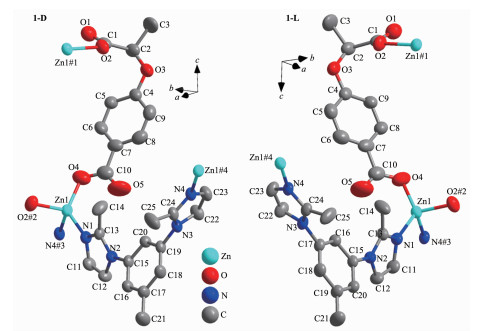
Symmetry codes : #1: 1.5-x, 1-y, 0.5+z; #2: 1.5-x, 1-y, -0.5+z; #3: 1+x, y, z; #4:-1+x, y, z for 1-D;
#1: 1.5-x, 1-y, -0.5+z; #2: 1.5-x, 1-y, 0.5+z; #3: 1+x, y, z; #4: -1+x, y, z for 1-L
The outstanding structural feature of 1-D and 1-L is the presence of helical chains. In 1-D, the Zn(Ⅱ) ions are bridged by (R)-CBA2- ligands to form an infinite left-handed helical chain along the c axis (Fig. 2a), and the opposite right-handed helical chain exists in 1-L (Fig. 2b). Finally, the adjacent helical chains connect to each other by 1, 3-DIMB ligands to construct the 2D framework of 1-D/1-L (Fig. 2c~d).
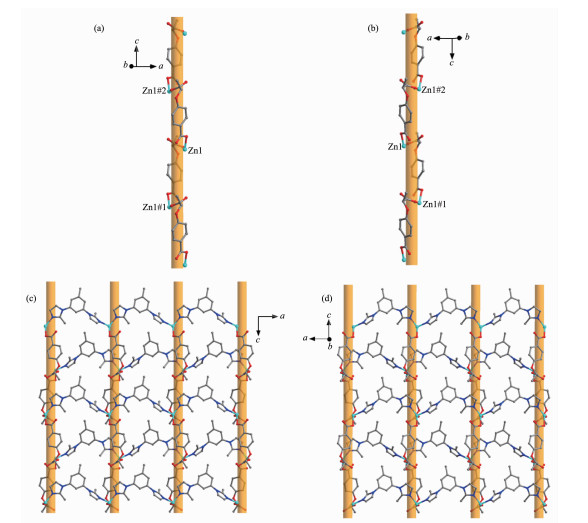
Symmetry codes: #1: 1.5-x, 1-y, 0.5+z; #2: 1.5-x, 1-y, 0.5+z in (a); #1: 1.5-x, 1-y, 0.5+z; #2: 1.5-x, 1-y, -0.5+z in (b)
Complexes 2-D and 2-L are also a pair of enantiomers (Fig. 3) and crystallize in monoclinic chiral space group P21 with Flack parameters of -0.005(9) and -0.002(6), respectively. In the same way, the complex 2-D is taken as representative to describe their structural features. The corresponding asymmetric unit is composed of two Zn2+ centers, two deprotonated (R)-CBA2- ligands and one 1, 4-BMIP ligand. The two (R)-CBA2- ligand connect three Zn2+ centers as κ3-linker and κ4-linker, respectively. For the unique coordination modes of (R)-CBA2- ligands, a dinuclear cluster Zn2(CO2)4 is formed. In the Zn2(CO2)4 cluster, Zn1 shows a tetrahedral configuration coordinated by two carboxylate O atoms from three (R)-CBA2- ligands and two N atoms from two 1, 4-BMIP ligands, while Zn2 shows distorted trigonal bipyramidal configuration connected by four carboxylate O atoms from three (R)-CBA2- ligands and one N atom from 1, 4-BMIP.
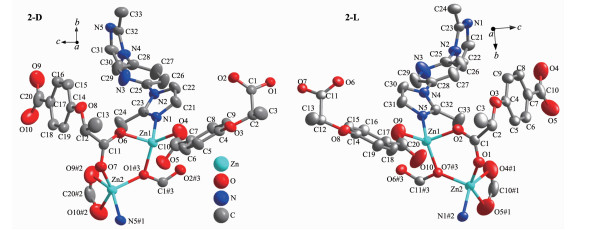
Symmetry codes: #1: 1-x, -0.5+y, 2-z; #2: 1+x, -1+y, z; #3: 2-x, -0.5+y, 1-z in 2-D; #1: -x, 0.5+y, 2-z; #2: -1+x, -1+y, z; #3: -1+x, -1+y, z in 2-L
The structural features of 2-D and 2-L are also the helical chains similar to the 1-D and 1-L (Fig. 4a~d). As shown in Fig. 2a, the Zn1 centers in 2-D are bridged by (R)-CBA2- ligands to form an infinite right-handed helical A-chain running along the b axis, and the opposite left-handed helical A-chain is constructed by (S)-CBA2- ligands and Zn1 ions in 2-L (Fig. 4b). Besides helical A-chain, the (R)-CBA2-/(S)-CBA2- ligands can connect Zn2 centers to form another left-handed/right-handed helical B-chain in 2-D/2-L (Fig. 4c~d). According to the ratio of 1:1, the helical A-chains and B-chains build a 2D Zn-CBA layer (Fig. 4e~f).
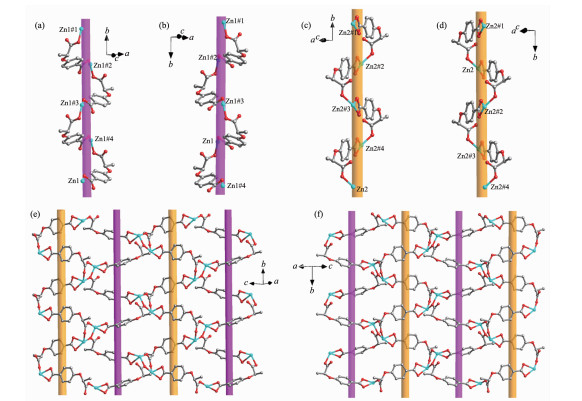
Symmetry codes: #1: x, 2+y, z; #2: 2-x, 1.5+y, 1-z; #3: x, 1+y, z; #4: 2-x, 0.5+y, 1-z in (a); #1: 1-x, 1.5+y, 1-z; #2: x, -1+y, z; #3: 1-x, -0.5+y, 1-z; #4: 1-x, 0.5+y, 1-z in (b); #1: x, 2+y, 2-z; #2: 1-x, 1.5+y, 2-z; #3: x, 1+y, z; #4: 1-x, 0.5+y, 2-z in (c); #1:-x, -0.5+y, 2-z; #2: -x, 0.5+y, 2-z; #3: -x, -0.5+y, 2-z; #4: -x, 1.5+y, 2-z in (d)
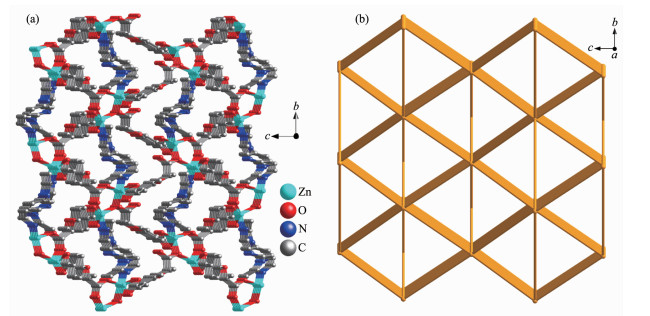
Finally, the adjacent Zn-(R)-CBA layers are connected together by the 1, 4-BMIP ligands in 2-D, resulting in a 3D framework (Fig. 5a). In the 3D frame-work, the Zn2(CO2)4 units are regarded as 6-connected nodes, while the (R)-CBA3- ligands and 1, 4-BMIP ligands are simple linkers. Thus, the whole framework of 2-D is topologically represented as a mab net with a point symbol of (44.610.8) (Fig. 5b)[19].
To examine the purity of complexes 1-D, 1-L, 2-D and 2-L, their powder X-ray diffractions were measured at room temperature. As shown in Fig.S5~6, the corresponding experimental mains peaks are consistent with their simulated patterns, demonstrating the phase purity of the products.
Moreover, thermal behaviors of complexes 1-D, 1-L, 2-D and 2-L were also studied by TGA to check the thermal stabilities of frameworks (Fig.S7~8). The complexes 1-D and 1-L displayed the weight loss of 3.0% from room temperature to 105 ℃, which should be attributed to the release of a guest water molecule (Calcd. 3.3%). Over 330 ℃, the frameworks started to decompose until 800℃ without stopping (Fig.S7). However, TGA curves of complexes 2-D and 2-L showed that there is no weight loss until 380 ℃. After 380 ℃, the frameworks began to decompose (Fig.S8).
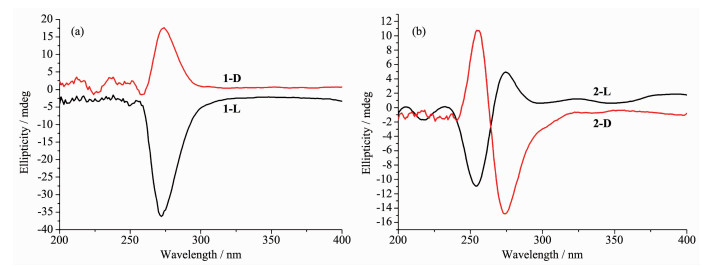
To further confirm the enantiomeric characteristic of complexes 1-D, 1-L, 2-D and 2-L, their CD experi-ments were carried out in KCl plates between 200 and 600 nm. As shown in Fig. 6a, the CD spectrum of 1-D exhibited a positive Cotton effect at about 270 nm, while complex 1-L displayed a negative CD signal at the same position. Furthermore, complex 2-D showed a positive CD signal at 256 nm and a negative CD signal at 273 nm, and a mirror image was also observed for 2-L at the same position (Fig. 6b). The above test results of CD spectrum indicate that complexes 1-D and 1-L, and 2-D and 2-L are enantiomers, respectively, and chirality of ligands (R)-H2CBA and (S)-H2CBA can be transferred to the corresponding coordination complex aggregates.
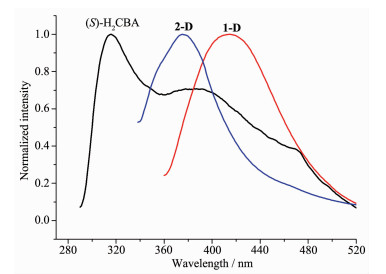
In consideration of the d10 metal inorganic-organic hybrid coordination polymers with excellent luminescent properties, the solid-state photolumin-escent spectra of complexes 1-D and 2-D were measured at room temperature. As depicted in Fig. 7, the photoluminescent spectra have emission peaks with maxima at 420 nm (λex=355 nm) for 1-D, 376 nm λex=310 nm) for 2-D, respectively. To better understand the above nature of emission band, the free ligand (R)-H2CBA was also investigated, which displayed an emission band at 320 nm (λex=280 nm). As compared to (R)-H2CBA, emission maxima of 1-D and 2-D have distinct red-shifts about 100 and 56 nm, respe-ctively, which should be ascribed to intraligand (n-π* or π-π*) emission[20-21].
In summary, two pairs of novel HCPs were prepared by hydrothermal method using lactate derivatives (R)-H2CBA and (S)-H2CBA as chiral ligands. In all the complexes, Zn(Ⅱ) centers and CBA2- ligands can construct different helical chains, which further prove that the helicity of HCPs can be dictated by the chirality of the ligands. With a variety of coordination modes, (R)-H2CBA and (S)-H2CBA are good candidates for the construction of interesting HCPs with helical chains.
Supporting information is available at http://www.wjhxxb.cn
Kulikov V, Johnson N A B, Surman A J, et al. Angew. Chem. Int. Ed., 2017, 56:1141-1145 doi: 10.1002/anie.201606658
Yashima E, Maeda K, Furusho Y. Acc. Chem. Res., 2008, 41:1166-1180 doi: 10.1021/ar800091w
Watson J D, Crick F H C. Nature, 1953, 171:737-738 doi: 10.1038/171737a0
Gingras M, Félix G, Peresutti R. Chem. Soc. Rev., 2013, 42:1007-1050 doi: 10.1039/C2CS35111K
Nakajima H, Nakajima M, Fujiwara T, et al. Macromolecules, 2012, 45:5993-6001 doi: 10.1021/ma3010058
Senthilkumar T, Asha S K. Chem. Commun., 2015, 51:8931-8934 doi: 10.1039/C5CC01532D
Liu H, Shen X B, Wang Z G, et al. Nanoscale, 2014, 6:9331-9338 doi: 10.1039/C3NR06913C
Wu B L, Wang S, Wang R, et al. Cryst. Growth Des., 2013, 13:518-525 doi: 10.1021/cg300971r
Du X, Fan R, Wang X, et al. Cryst. Growth Des., 2016, 16:1737-1745 doi: 10.1021/acs.cgd.5b01825
Li C, Zhou H, Sun Y, Guo J, et al. Cryst. Growth Des., 2018, 18:4252-4256 doi: 10.1021/acs.cgd.8b00617
Jiao C Q, Zhao Z, Ma C, et al. Cryst. Growth Des., 2016, 16:5624-5635 doi: 10.1021/acs.cgd.6b00197
Yue Q, Wang N N, Guo S Y, et al. Dalton Trans., 2016, 45:1335-1338 doi: 10.1039/C5DT04385A
Bisht K, Suresh E. J. Am. Chem. Soc., 2013, 135:15690-15693 doi: 10.1021/ja4075369
Liu Q, Xiong W L, Liu C M, et al. Inorg. Chem., 2013, 52:6773-6775 doi: 10.1021/ic400853r
Xu Z X, Ma Y L, Zhang L S, et al. Inorg. Chem. Commun., 2016, 73:115-118 doi: 10.1016/j.inoche.2016.10.013
Xu Z X, Ma Y L, Lv G L. J. Solid State Chem., 2017, 249:210-217 doi: 10.1016/j.jssc.2017.03.011
Dolomanov O V, Bourhis L J, Gildea R J, et al. J. Appl. Cryst., 2009, 42:339-341 doi: 10.1107/S0021889808042726
Sheldrick G M. Acta Crystallogr. Sect. C:Cryst. Struct. Commun., 2015, C71:3-8 doi: 10.1107/S2053273314026370
Aexandrov E V, Blatov V A, Kochetkov A V, et al. CrystEngComm, 2011, 13:3947-3958 doi: 10.1039/c0ce00636j
刘露, 李英, 王键吉, 等.无机化学学报, 2019, 35(3):546-552 http://www.wjhxxb.cn/wjhxxbcn/ch/reader/view_abstract.aspx?file_no=20190320LIU Lu, LI Ying, WANG Jian-Ji, et al. Chinese J. Inorg. Chem., 2019, 35(3):546-552 http://www.wjhxxb.cn/wjhxxbcn/ch/reader/view_abstract.aspx?file_no=20190320
Cui P, Chen Z, Gao D L, et al. Cryst. Growth Des., 2010, 10:4370-4378 doi: 10.1021/cg100467p

Scheme 1 Synthetic routes of HCPs (a) and structures of auxiliary ligands 1, 3-DIMB and 1, 4-BMIP (b)

Figure 1 Coordination environment in enantiomers 1-D and 1-L with 50% probability displacement ellipsoids
Symmetry codes : #1: 1.5-x, 1-y, 0.5+z; #2: 1.5-x, 1-y, -0.5+z; #3: 1+x, y, z; #4:-1+x, y, z for 1-D;
#1: 1.5-x, 1-y, -0.5+z; #2: 1.5-x, 1-y, 0.5+z; #3: 1+x, y, z; #4: -1+x, y, z for 1-L

Figure 2 (a) Left-handed helical chain in 1-D; (b) Right-handed helical chain in 1-L; (c) 2D layer of 1-D constructed by helical chains and 1, 3-DIMB ligands; (d) 2D layer of 1-L constructed by helical chains and 1, 3-DIMB ligands
Symmetry codes: #1: 1.5-x, 1-y, 0.5+z; #2: 1.5-x, 1-y, 0.5+z in (a); #1: 1.5-x, 1-y, 0.5+z; #2: 1.5-x, 1-y, -0.5+z in (b)

Figure 3 Enantiomeric nature of complexes 2-D and 2-L with 50% probability displacement ellipsoids
Symmetry codes: #1: 1-x, -0.5+y, 2-z; #2: 1+x, -1+y, z; #3: 2-x, -0.5+y, 1-z in 2-D; #1: -x, 0.5+y, 2-z; #2: -1+x, -1+y, z; #3: -1+x, -1+y, z in 2-L

Figure 4 (a) Right-handed helical A-chain in 2-D; (b) Left-handed helical A-chain in 2-L; (c) Left-handed helical B-chain in 2-D; (d) Right-handed helical B-chain in 2-L; (e) Helical Zn-(R)-CBA layer in 2-D; (f) Helical Zn-(S)-CBA layer in 2-L
Symmetry codes: #1: x, 2+y, z; #2: 2-x, 1.5+y, 1-z; #3: x, 1+y, z; #4: 2-x, 0.5+y, 1-z in (a); #1: 1-x, 1.5+y, 1-z; #2: x, -1+y, z; #3: 1-x, -0.5+y, 1-z; #4: 1-x, 0.5+y, 1-z in (b); #1: x, 2+y, 2-z; #2: 1-x, 1.5+y, 2-z; #3: x, 1+y, z; #4: 1-x, 0.5+y, 2-z in (c); #1:-x, -0.5+y, 2-z; #2: -x, 0.5+y, 2-z; #3: -x, -0.5+y, 2-z; #4: -x, 1.5+y, 2-z in (d)
Table 1. Crystal data and structure refinement details for complexes
| Complex | 1-D | 1-L | 2-D | 2-L |
| Chemical formula | C25H24N4O5Zn·H2O | C25H24N4O5Zn·H2O | C33H29N5O10Zn2 | C33H29N5O10Zn2 |
| Formula weight | 543.87 | 543.87 | 393.18 | 393.18 |
| Crystal system | Orthorhombic | Orthorhombic | Monoclinic | Monoclinic |
| Space group | P212121 | P212121 | P21 | P21 |
| a/nm | 1.125 98(7) | 1.128 62(5) | 1.034 80(4) | 1.034 00(5) |
| b/nm | 1.420 54(8) | 1.421 15(8) | 1.059 56(4) | 1.059 93(5) |
| c/nm | 1.563 18(12) | 1.566 01(8) | 1.549 56(6) | 1.552 36(8) |
| V/nm3 | 2.500 3(3) | 2.511 8(2) | 1.692 07(11) | 1.694 38(14) |
| β/(°) | 95.173(4) | 95.182(4) | ||
| Z | 4 | 4 | 2 | 2 |
| Dc/(g·cm-3) | 1.397 | 1.391 | 1.543 | 1.541 |
| Absorption coefficient, μ/mm-1 | 1.030 | 1.025 | 1.482 | 1.480 |
| F(000) | 1 128 | 1 128 | 804 | 804 |
| θ range/(°) | 3.844 0~29.051 0 | 3.860 0~30.095 0 | 3.948 0~29.926 0 | 3.859 0~28.470 0 |
| Goodness of fit on F2 | 0.964 | 0.960 | 1.033 | 1.028 |
| Rint | 0.036 5 | 0.040 6 | 0.028 5 | 0.041 3 |
| R1a [I>2σ(I)] | 0.039 6 | 0.039 2 | 0.031 1 | 0.031 9 |
| wR2b [I>2σ(I)] | 0.118 6 | 0.119 6 | 0.079 6 | 0.077 6 |
| Flack parameter | -0.003(5) | 0.012(6) | -0.005(9) | -0.002(6) |
| a R1=∑||Fo|-|Fc||∑|Fo|; b wR2=[∑w((Fo2-Fc2)2/∑[w(Fo2)2]1/2. | ||||
 下载: 导出CSV
Table 2. Selected bond lengths (nm) and bond angels (°) in 1-D, 1-L, 2-L and 2-D
| 1-D | |||||
| Zn(1)-N(1) | 0.203 7(3) | Zn(1)-N(4)#1 | 0.204 2(3) | Zn(1)-O(2)#2 | 0.196 8(3) |
| Zn(1)-O(4) | 0.196 5(3) | ||||
| N(1)-Zn(1)-N(4)#1 | 100.03(11) | O(2)#2-Zn(1)-N(4)#1 | 104.08(12) | O(4)-Zn(1)-N(1) | 128.57(16) |
| O(4)-Zn(1)-N(4)#1 | 102.73(14) | O(4)-Zn(1)-O(2)#2 | 110.37(14) | O(2)#2-Zn(1)-N(1) | 107.75(12) |
| 1-L | |||||
| Zn(1)-N(1) | 0.203 8(3) | Zn(1)-N4#1 | 0.204 0(3) | Zn(1)-O(2)#2 | 0.196 7(3) |
| Zn(1)-O(4) | 0.195 8(3) | ||||
| N(1)-Zn(1)-N(4)#1 | 100.13(11) | O(2)#2-Zn(1)-N1 | 107.79(12) | O(2)#2-Zn(1)-N(4)#1 | 104.22(12) |
| O(4)-Zn(1)-N(1) | 128.09(15) | O(4)-Zn(1)-N(4)#1 | 102.84(14) | O(4)-Zn(1)-O(2)#2 | 110.58(14) |
| 2-D | |||||
| Zn(1)-O(6)#1 | 0.203 4(2) | Zn(1)-O(1) | 0.200 5(2) | Zn(1)-O(9) | 0.200 1(3) |
| Zn(1)-N(1) | 0.201 1(2) | Zn(2)-O(6)#1 | 0.204 3(2) | Zn(2)-O(5)#3 | 0.218 1(4) |
| Zn(2)-O(4)#3 | 0.213 8(4) | Zn(2)-O(2) | 0.198 3(3) | Zn(2)-N(5)#2 | 0.203 4(2) |
| O(9)-Zn(1)-N(1) | 96.23(12) | N(1)-Zn(1)-O(6)#1 | 112.81(10) | O(1)-Zn(1)-O(6)#1 | 98.24(10) |
| O(1)-Zn(1)-N(1) | 97.00(10) | O(9)-Zn(1)-O(6)#1 | 132.15(13) | O(9)-Zn(1)-O(1) | 115.64(14) |
| O(2)-Zn(2)-O(4)#2 | 94.30(13) | O(2)-Zn(2)-O(5)#2 | 140.77(16) | O(6)#1-Zn(2)-O(4) | 96.04(14) |
| O(6)-Zn(2)-O(5) | 109.41(15) | O(2)-Zn(2)-O(6)#1 | 101.00(9) | O(2)-Zn(2)-N(5)#3 | 106.06(11) |
| N(5)#3-Zn(2)-O(6)#1 | 106.25(10) | ||||
| 2-L | |||||
| Zn(1)-O(7)#1 | 0.204 2(2) | Zn(1)-O(2) | 0.200 6(3) | Zn(1)-N(5)#2 | 0.201 3(3) |
| Zn(1)-O(9) | 0.199 8(3) | Zn(2)-O(7)#1 | 0.204 5(2) | Zn(2)-O(1) | 0.198 2(3) |
| Zn(2)-N(1) | 0.2031(3) | Zn(2)-O(5)#3 | 0.217 8(4) | Zn(2)-O(4)#3 | 0.213 2(4) |
| O(2)-Zn(1)-O(7)#1 | 98.28(10) | O(2)-Zn(1)-N(5)#2 | 97.00(11) | N(5)#2-Zn(1)-O(7)#1 | 112.61(11) |
| O(9)-Zn(1)-O(7)#1 | 132.21(14) | O(9)-Zn(1)-O(2) | 115.56(15) | O(9)-Zn(1)-N(5)#2 | 96.39(13) |
| O(7)#1-Zn(2)-O(5) | 109.07(16) | O(1)-Zn(2)-O(7)#1 | 101.18(10) | O(1)-Zn(2)-N(1) | 106.30(12) |
| O(7)#1-Zn(2)-O(4)#3 | 96.11(15) | O(1)-Zn(2)-O(5)#3 | 141.12(17) | O(1)-Zn(2)-O(4)#3 | 94.42(14) |
| N(1)-Zn(2)-O(7)#1 | 106.02(11) | ||||
| Symmetry codes: #1: 1+x, y, z; #2: 1.5-x, 1-y, -0.5+z for 1-D; #1: 1+x, y, z; #2: 1.5-x, 1-y, 0.5+z for 1-L; #1: 2-x, -0.5+y, 1-z; #2: 1-x, -0.5+y, 2-z; #3: 1+x, -1+y, z for 2-D; #1: 1-x, 0.5+y, 1-z; #2: -1+x, -1+y, z; #3: -x, 0.5+y, 1-z for 2-L. | |||||
下载: 导出CSV

 扫一扫看文章


扫一扫关注我们