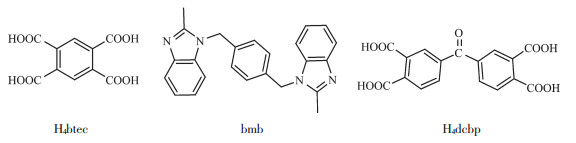
Scheme 1.
Structures of the ligands

Syntheses, Crystal Structures and Luminescence Properties of Two Zn(Ⅱ) Coordination Polymers Based on Flexible Bisbenzimidazole Ligand
Hong-Hong LAN , Xiao-Tong LI , Wen-Juan CHU , Chun-Ying XU , Bao-Ming JI


Coordination polymers (CPs) have been extensively investigated in the past few decades. Because of their vast applications such as gas storage[1-2], catalysis[3-4], molecular magnetism[5-6] and luminescence[7-9], CPs play a significant role in the development of functional materials. The properties of CPs mainly depend on the organic ligands and the center metal ions because they are involved in the formation of the final CPs[10-11]. This provides us with the opportunity to rationally select the precursors, which enables synthesis of CPs for specific structures and properties.
Aimed at the production of sensors and diodes, luminescent CPs materials have emerged as a rapidly growing field of research. The luminescence of CPs is commonly caused by the conjugated organic ligands and metal ions with closed shell electron configuration[12-14]. CPs based on d10 metal ions often display excellent luminescence behavior[15-18]. Among these, Zn(Ⅱ) CPs with organic linkers are one kind of the most interested luminescent CPs[19-21].
It is well known that polycarboxylate ligands and N-containing heterocyclic ligands are excellent candidates for the construction of CPs for their strong coordination abilities and diverse coordination modes[22-25]. As a member of N-containing heterocyclic ligands, 1, 4-bis(benzimidazol-1-yl)-benzene (bbix) has been studied in the synthesis of CPs[26-27]. It is noteworthy that bbix based CPs exhibits interesting structures and luminescent properties. Our research has focused on its derivatives, 1, 4-bis(2-methylbenzi-midazol-1-ylmethyl)benzene (bmb). The extra methyl of bmb will inevitably cause larger steric resistance. Does this affect its coordination abilities and consequently affect the structures and properties of the final CPs? Considering above mentioned points, we have synthesized some CPs based on bmb[28]. As a continuation of our work, herein, two CPs, {[Zn(bmb)0.5(btec)0.5(H2O)]·H2O}n (1) and {[Zn2(bmb)2(dcbp)]·5H2O}n (2), were synthesized based on bmb and polycarboxylate ligands (H4btec=1, 2, 4, 5-benzenetetracarboxylic acid, H4dcbp=4-(3, 4-dicarboxybenzoyl)phthalic acid) (Scheme 1). The structures, thermal stabilities and luminescent properties of complexes 1 and 2 were studied in detail.
All chemicals and reagents were commercially available and used without further purification. Ligands H4btec and H4dcbp were purchased from Alfa Aesar and bmb was synthesized according to the literature method[29]. Elemental analyses (C, H and N) were performed on a Elementar Vario EL Ⅲ elemental analyzer. IR spectra were recorded on a Bruker EQUINOX55 spectrophotometer in the 4 000~400 cm-1 region using KBr pellets. Thermogravimetric analyses (TGA) data were collected on a Perkin-Elmer TAG-7 instrument with a heating rate of 10 ℃·min-1. Powder X-ray diffraction (PXRD) measurements were carried out on a Bruker D8 Advance diffractometer with Cu Kα radiation (λ=0.154 18 nm) from 5° to 50°(2θ) at room temperature, using an operating voltage of 45 kV and an operating current of 40 mA. The luminescent spectra in solid states were performed on a Hitachi F-4500 fluorescence spectrophotometer at room temperature.
A mixture of Zn(CH3COO)2·2H2O (44 mg, 0.2 mmol), bmb (73.2 mg, 0.2 mmol), H4btec (0.2 mmol, 50.8 mg), and water (10 mL) was sealed in a Teflon-lined stainless steel vessel (25 mL) and heated at 150 ℃ for 5 days, and then cooled to room temperature naturally. The colorless block crystals of 1 were obtained with the yield of 41% based on Zn. Anal. Calcd. for C17H16N2O6Zn(%): C, 49.83; H, 3.94; N, 6.84. Found(%): C, 50.13; H, 3.98; N, 6.72. IR (KBr, cm-1): 3 422(s), 3 089(w), 1 623(m), 1 461(m), 1 384(s), 1 277(m), 1 155(w), 837(m), 751(s), 668(m), 550(m), 479(m).
Complex 2 was prepared by Zn(CH3COO)2·2H2O (44 mg, 0.2 mmol), bmb (73.2 mg, 0.2 mmol), and H4dcbp (0.2 mmol, 71.6 mg) using the same procedure for complex 1. Colorless block crystals of 2 were obtained with the yield of 33% based on Zn. Anal. Calcd. for C65H60N8O14Zn2(%): C, 59.69; H, 4.62; N, 8.57. Found(%): C, 59.54; H, 4.71; N, 8.43. IR (KBr, cm-1): 3 422(s), 1 712(w), 1 648(m), 1 596(m), 1 510(s), 1 476(m), 1 412(s), 1 363(m), 1 291(w), 1 138(m), 1 013(w), 868(m), 762(s), 672(m), 613(m), 509(m), 475(m).
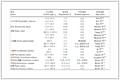
Single crystal X-ray diffraction data of the two complexes were collected on a Rigaku Saturn 724 CCD diffractomer (Mo Kα, λ=0.071 073 nm) at room temperature. Absorption corrections were applied by using multi-scan program. The structures were solved by direct methods and refined with a full-matrix leastsquares technique based on F2 with the SHELXTL software[30]. All non-hydrogen atoms were refined anisotropically, the hydrogen atoms of water molecules were located from difference Fourier maps and the other hydrogen atoms were generated geometrically. Crystal data and structural refinement parameters for 1 and 2 are summarized in Table 1. The selected bond lengths and angles for 1 and 2 are listed in Table 2.
 下载:
导出CSV
下载:
导出CSV
| Complex | 1 | 2 |
| Formula | C17H16N2O6Zn | C65H60N8O14Zn2 |
| Formula weight | 409.73 | 1 307.95 |
| Crystal system | Monoclinic | Triclinic |
| Space group | P21/c | P1 |
| a/nm | 1.058 8(2) | 1.247 5(3) |
| b/nm | 0.998 9(2) | 1.247 5(3) |
| c/nm | 1.656 0(3) | 2.072 7(4) |
| α/(°) | 98.61(3) | |
| β/(°) | 97.03(3) | 106.64(3) |
| γ/(°) | 103.74(3) | |
| V/nm3 | 1.738 3(6) | 2.918 8(13) |
| Z | 4 | 2 |
| Dc/(g·cm-3) | 1.554 | 1.488 |
| μ/mm-1 | 1.449 | 0.899 |
| F(000) | 828 | 1 356 |
| Reflection collected | 20 799 | 29 953 |
| Unique reflection | 4 691 | 10 257 |
| Goodness-of-fit on F2 | 1.168 | 1.114 |
| Rint | 0.040 9 | 0.053 0 |
| R1, wR2 [I > 2σ(I)] | 0.042 9 | 0.060 8 |
| R1, wR2 (all data) | 0.050 3 | 0.085 5 |
| Largest diff. peak and hole/(e·nm-3) | 460 and -460 | 420 and -430 |
下载:
导出CSV
| 1 | |||||
| Zn-O1 | 0.195 2(2) | Zn1-O5 | 0.193 1(2) | Zn1-O3 | 0.196 2(2) |
| Zn1-N1 | 0.200 5(2) | ||||
| O1-Zn1-N1 | 101.25(9) | O1-Zn1-O3 | 102.18(8) | O5-Zn1-O1 | 118.12(8) |
| O5-Zn1-N1 | 112.43(10) | O5-Zn1-O3 | 111.85(9) | O3-Zn1-N1 | 110.08(9) |
| 2 | |||||
| Zn1-O1 | 0.194 5(3) | Zn1-O4A | 0.194 8(3) | Zn1-N1 | 0.202 0(3) |
| Zn1-N5 | 0.204 8(3) | Zn2-O6B | 0.191 9(3) | Zn2-O8 | 0.193 2(3) |
| Zn2-N4C | 0.201 5(3) | Zn2-N8D | 0.202 8(3) | ||
| O1-Zn1-O4A | 102.47(13) | O1-Zn1-N1 | 128.08(13) | O1-Zn1-N5 | 98.67(13) |
| O4A-Zn1-N1 | 119.42(12) | O4A-Zn1-N5 | 101.84(12) | O1-Zn1-N5 | 101.02(13) |
| O6B-Zn2-O8 | 106.91(13) | O6B-Zn2-N4C | 101.13(14) | O6B-Zn2-N8D | 106.51(14) |
| O8-Zn2-N4C | 123.27(13) | O8-Zn2-N8D | 115.07(12) | N4C-Zn2-N8D | 102.16(13) |
| Symmetry codes: A: -x+1, -y+2, -z+1; B: -x+1, -y+3, -z; C: -x+1, -y+3, -z+1; D: x+1, y+2, z for 2. | |||||
CCDC: 1907377, 1; 1907378, 2.
Single-crystal X-ray diffraction analysis reveals that polymer 1 crystallizes in monoclinic system with P21/c space group. The asymmetric unit of 1 consists of one Zn(Ⅱ) ion, a half bmb, a half 1, 2, 4, 5-btec4-, one coordinated water molecule and one lattice water molecule. As shown in Fig. 1a, Zn1 is surrounded by one nitrogen atom (N1) from one bmb ligand, two oxygen atoms (O1, O3) from two different 1, 2, 4, 5-btec4- anions, and one oxygen atom (O5) from coordinated water molecule. The Zn-O bond lengths are in a range of 0.193 14(19)~0.196 22(17) nm, while the Zn-N ones is 0.200 5(2) nm. The coordination geometry of Zn1 can be described as a distorted tetrahedral geometry.
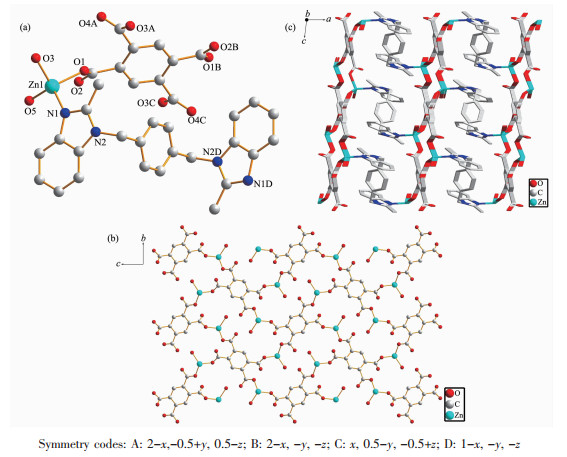
In 1, the deprotonated 1, 2, 4, 5-btec4- adopts a μ4-η1:η1:η1:η1 coordination mode. Four carboxylate groups coordinate with four Zn(Ⅱ) ions monodentately to generate a 2D sheet (Fig. 1b). The adjacent sheets are further connected by the bmb ligand in μ2-η1:η1 mode to give a 3D framework (Fig. 1c). The bridging bmb is extremely symmetric and displays trans-conformation. Two benzimidazole rings are coplanar and the dihedral angle between each benzimidazole and phenyl ring is 84.94°. The 3D framework is consolidated by intermolecular O-H…O hydrogen bonds (O5…O6 0.263 5(3) nm, O5…O2 0.263 2(3) nm, O6…O4 0.277 6(3) nm, O6…O3 0.276 4(3) nm).
Using a longer polycarboxylic acid ligand H4dcbp instead of 1, 2, 4, 5-H4btec under the same reaction conditions affords complex 2, which belongs to the triclinic space group P1. There are two crystallographically independent Zn(Ⅱ) ions, two bmb ligands, one dcbp anion, and five lattice water molecules (Fig. 2a) in the asymmetric unit of 2. The Zn1/Zn2 are surrounded by two nitrogen atoms (N1, N5/N4, N8) from two different bmb ligands, two carboxyl oxygen atoms (O1, O4/O6, O8) from two dcbp ligands to give a distorted tetrahedron geometry, respectively.
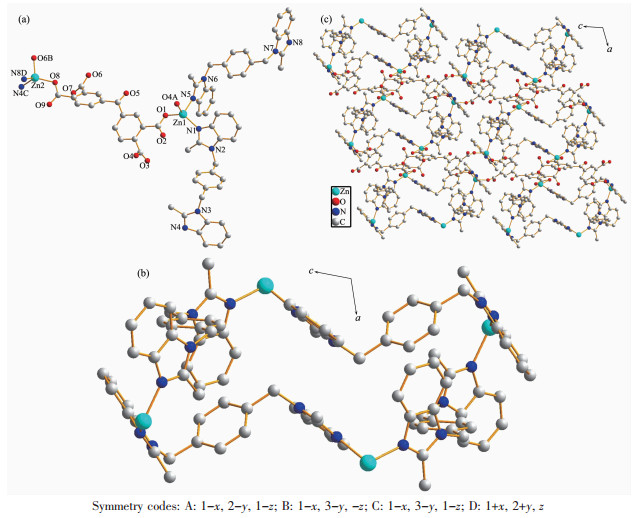
In 2, two bmb ligands both show μ2-η1:η1 mode to coordinate with two Zn(Ⅱ) ions. In this manner, four bmb connect four adjacent Zn(Ⅱ) ions to form a Zn4(bmb)4 secondary building units (SBUs) (Fig. 2b). One bmb displays trans-conformation, and the dihedral angle between benzimidazole ring and benzene are 85.96(2)° and 77.16(2)°, and the dihedral angle between two benzimidazole rings is 19.55(1)°. The other bmb displays cis-conformation. The dihedral angle between benzimidazole ring and benzene are 84.38(2)° and 82.46(3)°, and the dihedral angle between two benzimidazole rings is 3.64(2)°. Then these SBUs are jointed by dcbp ligands in the μ4-η1:η1:η1:η1 mode to give a 3D framework (Fig. 2c). The framework is also stabilized by intermolecular O-H…O hydrogen bonds (O11…O3 0.277 4(4) nm, O11…O9 0.277 7(4) nm, O12…O3 0.279 8(4) nm, O12…O14 0.285 1(5) nm, O14…O11 0.280 2(5) nm).
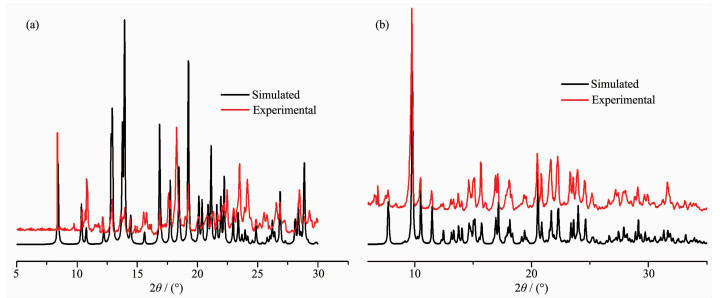
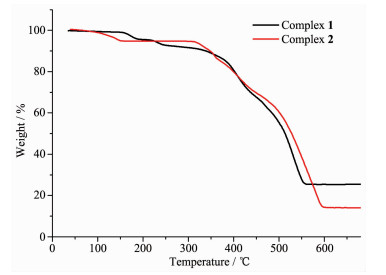
Powder X-ray diffraction (PXRD) patterns of 1 and 2 were determined at room temperature to characterize their purity. As shown in Fig. 3, the peak position of the measured patterns matched well with the simulated ones, indicating the purity of the samples. The thermal stability of 1 and 2 were investigated under nitrogen atmosphere by thermogravimetric analyses (TGA). As shown in Fig. 4, polymer 1 lost its lattice water molecules at 123 ℃ (Obsd. 4.25%, Calcd. 4.43%). The release of coordinated water molecules (Obsd. 4.48%, Calcd. 4.43%) occurred in a temperature range of 213~318 ℃. Then the further weight losses are attributed to the decomposition of 1. Polymer 2 lost lattice water molecules from room temperature to 157 ℃ (Obsd. 6.73%, Calcd. 6.88%). The framework is stable up to 312 ℃, then the weight decreased quickly and continuously until 600 ℃. The main residue should be ZnO (Obsd. 15.48%, Calcd. 15.67%).
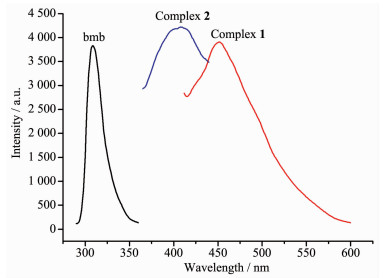
The solid state luminescence properties of complex 1 and 2 together with bmb, H4btec and H4dcbp were measured at room temperature (Fig. 5). The free ligand bmb shows intense emission band at 309 nm upon excitation at 293 nm, which can be attributed to the π→π* transitions. The emission of 1, 2, 4, 5-H4btec and H4dcbp is very weak compared to bmb and have no contribution to the luminescence of complexes 1 and 2. The maximum emission peaks of 1 and 2 are located at 451 nm (λex=391 nm) and 409 nm (λex=327 nm), respectively. The emissions of complexes 1 and 2 can probably be assigned to intraligand charge transitions of bmb[28].
In summary, two Zn(Ⅱ) coordination polymers with bmb and different carboxylic acid co-ligands have been synthesized and characterized. Complexes 1 and 2 all feature different 3D frameworks structures. The solid-state luminescent properties of 1 and 2 were investigated, and the emissions were assigned to intraligand charge transitions of bmb. The investigation should motivate further research of bmb as building block in the construction of coordination polymers.
Ma S Q, Zhou H C. Chem. Commun., 2010, 46:44-53 doi: 10.1039/B916295J
He Y B, Zhou W, Qian G D, et al. Chem. Soc. Rev., 2014, 43:5657-5678 doi: 10.1039/C4CS00032C
Wu C D, Hu A, Zhang L, et al. J. Am. Chem. Soc., 2005, 127:8940-8941 doi: 10.1021/ja052431t
Zhu L, Liu X Q, Jiang H L, et al. Chem. Rev., 2017, 117:8129-8176 doi: 10.1021/acs.chemrev.7b00091
Jia H P, Li W, Ju Z F, et al. Eur. J. Inorg. Chem., 2006, 21:4264-4270
Liu S J, Xue L, Hu T L, et al. Dalton Trans., 2012, 41:6813-6819 doi: 10.1039/c2dt30297g
Allendorf M D, Bauer C A, Bhakta R K, et al. Chem. Soc. Rev., 2009, 38:1330-1352 doi: 10.1039/b802352m
Xue L P, Chang X H, Li S H, et al. Dalton Trans., 2014, 43:7219-7226 doi: 10.1039/C4DT00211C
Miao S B, Li Z H, Xu C Y, et al. CrystEngComm, 2016, 18:4636-4642 doi: 10.1039/C6CE00625F
Loukopoulos E, Abdul-Sada A, Viseux E M E, et al. Cryst. Growth Des., 2018, 18:5638-5651 doi: 10.1021/acs.cgd.8b00960
Guillerm V, Xu H, Albalad J, et al. J. Am. Chem. Soc., 2018, 140:15022-15030 doi: 10.1021/jacs.8b09682
Bauer C A, Timofeeva T V, Settersten T B, et al. J. Am. Chem. Soc., 2007, 129:7136-7144 doi: 10.1021/ja0700395
Heine J, Muller-Buschbaum K. Chem. Soc. Rev., 2013, 42:9232-9242 doi: 10.1039/c3cs60232j
Guo Y X, Feng X, Han T Y, et al. J. Am. Chem. Soc., 2014, 136:15485-15488 doi: 10.1021/ja508962m
Chu Q, Liu G X, Huang Y Q, et al. Dalton Trans., 2007, 38:4302-4311
Xue L P. Chin. J. Struct. Chem., 2018, 37:119-124
Seward C, Jia W L, Wang R Y, et al. Angew. Chem. Int. Ed., 2004, 43:2933-2936 doi: 10.1002/anie.200353126
Miao S B, Xu C Y, Deng D S, et al. J. Cluster Sci., 2018, 29:313-317 doi: 10.1007/s10876-018-1333-2
Wang J P, Su B, Li J H, et al. Inorg. Chem. Commun., 2018, 90:29-33 doi: 10.1016/j.inoche.2018.02.001
彭艳芬, 刘天宝, 吴秋艳, 等.无机化学学报, 2018, 34(12):2245-2253 doi: 10.11862/CJIC.2018.280PENG Yan-Fen, LIU Tian-Bao, WU Qiu-Yan, et al. Chinese J. Inorg. Chem., 2018, 34(12):2245-2253 doi: 10.11862/CJIC.2018.280
喻敏, 宣芳, 刘光祥.无机化学学报, 2018, 35(1):133-140 http://www.wjhxxb.cn/wjhxxbcn/ch/reader/view_abstract.aspx?flag=1&file_no=20190116&journal_id=wjhxxbcnYU Ming, XUAN Fang, LIU Guang-Xiang. Chinese J. Inorg. Chem., 2018, 35(1):133-140 http://www.wjhxxb.cn/wjhxxbcn/ch/reader/view_abstract.aspx?flag=1&file_no=20190116&journal_id=wjhxxbcn
Wang L, Yang M, Li G, et al. Inorg. Chem., 2006, 45:2474-2478 doi: 10.1021/ic051566x
Hu Y, Ding M, Liu X Q, et al. Chem. Commun., 2016, 52:5734-5737 doi: 10.1039/C6CC01597B
Guo J, Sun D, Zhang L, et al. Cryst. Growth Des., 2012, 12:5649-5654 doi: 10.1021/cg301148p
Nikolaeva Y A, Balueva A S, Khafizov A A, et al. Dalton Trans., 2018, 47:7715-7720 doi: 10.1039/C8DT01073K
Wang X L, Hou L L, Zhang J W, et al. Inorg. Chim. Acta, 2013, 405:58-64 doi: 10.1016/j.ica.2013.05.016
杨玉亭, 屠长征, 姚立峰, 等.无机化学学报, 2018, 34(11):2049-2056 doi: 10.11862/CJIC.2018.257YANG Yu-Ting, TU Chang-Zheng, YAO Li-Feng, et al. Chinese J. Inorg. Chem., 2018, 34(11):2049-2056 doi: 10.11862/CJIC.2018.257
许春莺, 唐四叶, 苗少斌, 等.无机化学学报, 2016, 32(10):1825-1830 http://www.wjhxxb.cn/wjhxxbcn/ch/reader/view_abstract.aspx?flag=1&file_no=20161017&journal_id=wjhxxbcnXU Chun-Ying, TANG Shi-Ye, MIAO Shao-Bin, et al. Chinese J. Inorg. Chem., 2016, 32(10):1825-1830 http://www.wjhxxb.cn/wjhxxbcn/ch/reader/view_abstract.aspx?flag=1&file_no=20161017&journal_id=wjhxxbcn
Aakero C B, Desper J, Leonard B, et al. Cryst. Growth Des., 2005, 5:865-873 doi: 10.1021/cg049682i
Sheldrick G M. Acta Crystallogr. Sect. A:Found. Crystallogr., 2008, A64:112-122

Figure 1 (a) Coordination environment of Zn(Ⅱ) ion in 1 with hydrogen atoms omitted for clarity; (b) 2D sheet structure of 1; (c) 3D framework of 1

Figure 2 (a) Coordination environment of Zn(Ⅱ) ion in 2 with hydrogen atoms omitted for clarity; (b) Zn4(bmb)4 SBUs in 2; (c) 3D framework of 2
Table 1. Crystal data and structure refinement for 1 and 2
| Complex | 1 | 2 |
| Formula | C17H16N2O6Zn | C65H60N8O14Zn2 |
| Formula weight | 409.73 | 1 307.95 |
| Crystal system | Monoclinic | Triclinic |
| Space group | P21/c | P1 |
| a/nm | 1.058 8(2) | 1.247 5(3) |
| b/nm | 0.998 9(2) | 1.247 5(3) |
| c/nm | 1.656 0(3) | 2.072 7(4) |
| α/(°) | 98.61(3) | |
| β/(°) | 97.03(3) | 106.64(3) |
| γ/(°) | 103.74(3) | |
| V/nm3 | 1.738 3(6) | 2.918 8(13) |
| Z | 4 | 2 |
| Dc/(g·cm-3) | 1.554 | 1.488 |
| μ/mm-1 | 1.449 | 0.899 |
| F(000) | 828 | 1 356 |
| Reflection collected | 20 799 | 29 953 |
| Unique reflection | 4 691 | 10 257 |
| Goodness-of-fit on F2 | 1.168 | 1.114 |
| Rint | 0.040 9 | 0.053 0 |
| R1, wR2 [I > 2σ(I)] | 0.042 9 | 0.060 8 |
| R1, wR2 (all data) | 0.050 3 | 0.085 5 |
| Largest diff. peak and hole/(e·nm-3) | 460 and -460 | 420 and -430 |
 下载: 导出CSV
Table 2. Selected bond lengths (nm) and angles (°) for 1 and 2
| 1 | |||||
| Zn-O1 | 0.195 2(2) | Zn1-O5 | 0.193 1(2) | Zn1-O3 | 0.196 2(2) |
| Zn1-N1 | 0.200 5(2) | ||||
| O1-Zn1-N1 | 101.25(9) | O1-Zn1-O3 | 102.18(8) | O5-Zn1-O1 | 118.12(8) |
| O5-Zn1-N1 | 112.43(10) | O5-Zn1-O3 | 111.85(9) | O3-Zn1-N1 | 110.08(9) |
| 2 | |||||
| Zn1-O1 | 0.194 5(3) | Zn1-O4A | 0.194 8(3) | Zn1-N1 | 0.202 0(3) |
| Zn1-N5 | 0.204 8(3) | Zn2-O6B | 0.191 9(3) | Zn2-O8 | 0.193 2(3) |
| Zn2-N4C | 0.201 5(3) | Zn2-N8D | 0.202 8(3) | ||
| O1-Zn1-O4A | 102.47(13) | O1-Zn1-N1 | 128.08(13) | O1-Zn1-N5 | 98.67(13) |
| O4A-Zn1-N1 | 119.42(12) | O4A-Zn1-N5 | 101.84(12) | O1-Zn1-N5 | 101.02(13) |
| O6B-Zn2-O8 | 106.91(13) | O6B-Zn2-N4C | 101.13(14) | O6B-Zn2-N8D | 106.51(14) |
| O8-Zn2-N4C | 123.27(13) | O8-Zn2-N8D | 115.07(12) | N4C-Zn2-N8D | 102.16(13) |
| Symmetry codes: A: -x+1, -y+2, -z+1; B: -x+1, -y+3, -z; C: -x+1, -y+3, -z+1; D: x+1, y+2, z for 2. | |||||
下载: 导出CSV

 扫一扫看文章


扫一扫关注我们