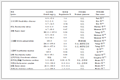
Table 1.
Crystal data and structure refinement for 1 and 2

Syntheses, Crystal Structures and Theoretical Calculation of Two Cadmium(Ⅱ) Complexes Assembled by Bis(imidazol) Ligands
Xiu-Mei LI , Ya-Ru PAN , Bo LIU , Shi ZHOU


The crystal engineering of metal coordination polymers (MCPs) is one of the most rapidly developing areas of chemical science owing to their diversity of type and physical-chemical properties[1]. Obviously, it is the important responsibility for chemists to rationally design and synthesize more MCPs with diverse structures. It is well known that the assembly processes and structures of MCPs are influenced by many factors, such as the coordination preferences of metal ions[2-3], the conformation of bridging ligands[4], solvent systems[5], counteranion[6] and pH value of the solution[7], which can also affect the nature of coor-dination networks and the framework formation.
In recent years, the direct use of two types of organic ligands has been found to be an effective method for the synthesis of MCPs. Aromatic carboxylate ligands are frequently chosen to construct various dimensions of MCPs because of their rich coordination modes, including monodentate, bridging and chelating. For example, benzoic acid, 1, 3-benzenedicarboxylate, 1, 4-benzenedicarboxylate, and 1, 2, 4, 5-benzene tetracarboxylate[8-11] are well used in the construction of MCPs due to their structural rigidity, chemical stability and appropriate connectivity. Besides the carboxylate linkers, bis(imidazole) bridging ligands with different length and flexibly, for example, 1, 3- bis(imidazol-1-ylmethyl)-benzene, 1, 4-bis(imidazol-1-ylmethyl)-benzene, 1, 4-bis(1H-benzimidazolyl)butane are frequently used in the assembly process of MCPs as bridging linker[12-15].
In view of these factors, we herein report the syntheses and characteristics of two new complexes containing 4-nitrobenzoic acid(nba) and 1, 3-bis(imi-dazol-1-ylmethyl)-benzene(mbix) or 1, 4-bis(imidazol-1-yl)-butane(bib), namely, [Cd(nba)2(mbix)]2 (1) and [Cd((bib)2Br2]n (2).
All reagents were purchased commercially and used without further purification. Elemental analyses (C, H and N) were measured on a Vario EL(Ⅲ) Elemental Analyzer. IR spectra were recorded in a range of 4 000~400 cm-1 on a Nicolet 6700 spectro-meter using a KBr pellet. The fluorescence spectra were performed on an F-7000 photospectrometer (Hitachi, High-Tech, Science, Japan). The powder X-ray diffraction (PXRD) studies were performed with a Bruker D8 Discover instrument (Cu Kα radiation, λ=0.154 184 nm, U=40 kV, I=40 mA) over a 2θ range of 5°~50° at room temperature.
[Cd(nba)2(mbix)]2 (1): The pH value of a mixture of Hnba (0.033 g, 0.2 mmol), Cd(OAc)2·2H2O (0.2 mmol, 0.053 g), mbix (0.048 g, 0.2 mmol), and 18 mL H2O was adjust to 7 with 40% NaOH, sealed in a Teflon-lined stainless steel vessel, heated to 150 ℃ for 5 days, and followed by slow cooling to room temperature. Yellow block crystals were obtained. Yield: 34%. Anal. Calcd. for C56H44Cd2N12O16(%): C, 49.24; H, 3.25; N, 12.31. Found(%): C, 48.57; H, 2.99; N, 11.65. IR (cm-1): 3 127w, 1 615m, 1 574s, 1 515m, 1 435w, 1 406m, 1 343s, 1 240w, 1 107w, 939w, 834m, 724m, 657w, 518w.
[Cd((bib)2Br2]n (2): The pH value of a mixture of Hnba (0.033 g, 0.2 mmol), Cd(OAc)2·2H2O (0.2 mmol, 0.053 g), bib (0.038 g, 0.2 mmol), and 18 mL H2O was adjust to 8 with 40% NaOH, sealed in a Teflon-lined stainless steel vessel, heated to 120 ℃ for 5 days, and followed by slow cooling to room temperature. Brown block crystals were obtained. Unfortunately, Hnba ligand did not participate in the coordination. Bromide ions are derived from reagent(1, 4-dibro-mobutane) for the synthesis of bib ligand. Yield: 23%. Anal. Calcd. For C20H28Br2CdN8(%): C, 36.80; H, 4.32; N, 17.17. Found(%): C, 36.21; H, 4.01; N, 16.85. IR (cm-1): 3 434w, 2 938w, 1 616w, 1 512s, 1 468w, 1 444w, 1 404w, 1 343w, 1 272w, 1 231s, 1 116s, 1 105s, 1 087s, 1 034w, 929s, 834m, 742s, 660s, 624w, 522w.
Single-crystal X-ray diffraction data for 1 and 2 were recorded on a Bruker D8 QUEST CMOS diffractometer with graphite-monochromated Mo Kα radiation (λ=0.071 073 nm) at 293 K. The structures were solved with the direct method of SHELXS-97 and refined with full-matrix least-squares techniques using the SHELXL-97 program[16-17]. The non-hydrogen atoms of the complexes were refined with anisotropic temperature parameters. The hydrogen atoms attached to carbons were generated geometrically. Crystallogra-phic parameters and the data collection statistics for structures 1 and 2 are given in Table 1. Selected bond lengths and bond angles are listed in Table 2.
 下载:
导出CSV
下载:
导出CSV
| Formula | C56H44Cd2N12O16 | C20H28Br2CdN8 |
| Formula weight | 1 365.83 | 652.72 |
| Crystal system | Triclinic | Monoclinic |
| Space group | |
P21/n |
| a / nm | 0.917 81(13) | 0.775 74(5) |
| b / nm | 1.325 90(19) | 1.848 92(12) |
| c / nm | 1.329 78(18) | 0.883 34(6) |
| α / (°) | 72.699(2) | |
| β / (°) | 81.779(2) | 113.479 0(10) |
| γ / (°) | 70.968(2) | |
| Volume / nm3 | 1.458 7(4) | 1.162 06(13) |
| Z | 1 | 2 |
| Dc / (g·cm-3) | 1.555 | 1.865 |
| θ range / (°) | 1.61~26.04 | 2.96~25.05 |
| F(000) | 688 | 644 |
| Reflection collected, unique | 7 953, 5 671 | 7 351, 2 050 |
| Reflection with I>2σ(I) | 4 364 | 1 881 |
| Goodness-of-fit on F2 | 1.022 | 1.103 |
| Rint | 0.028 8 | 0.017 5 |
| R1, wR2 [I>2σ(I)] | 0.052 1, 0.119 7 | 0.060 0, 0.186 2 |
下载:
导出CSV
| 1 | |||||
| Cd(1)-O(1) | 0.238 9(4) | Cd(1)-O(2) | 0.246 8(3) | Cd(1)-O(5A) | 0.235 3(4) |
| Cd(1)-O(6) | 0.236 0(3) | Cd(1)-N(4A) | 0.227 8(4) | Cd(1)-N(1) | 0.224 5(4) |
| N(1)-Cd(1)-N(4A) | 176.91(14) | N(1)-Cd(1)-O(5A) | 91.33(14) | N(1)-Cd(1)-O(6) | 90.21(14) |
| N(4A)-Cd(1)-O(6) | 91.26(14) | O(5A)-Cd(1)-O(6) | 129.09(13) | N(1)-Cd(1)-O(1) | 90.78(14) |
| N(4A)-Cd(1)-O(1) | 86.49(14) | O(5A)-Cd(1)-O(1) | 140.54(12) | O(6)-Cd(1)-O(1) | 90.29(13) |
| N(1)-Cd(1)-O(2) | 86.27(13) | N(4A)-Cd(1)-O(2) | 90.95(13) | O(5A)-Cd(1)-O(2) | 87.06(12) |
| O(6)-Cd(1)-O(2) | 143.78(13) | O(1)-Cd(1)-O(2) | 53.79(12) | N(1)-Cd(1)-O(6A) | 92.29(14) |
| 2 | |||||
| Cd(1)-N(1) | 0.236 5(7) | Cd(1)-N(1A) | 0.236 5(7) | Cd(1)-N(3) | 0.233 9(6) |
| Cd(1)-N(3A) | 0.233 9(6) | Cd(1)-Br(1) | 0.276 71(11) | Cd(1)-Br(1A) | 0.276 71(11) |
| N(3A)-Cd(1)-N(3) | 180.000(1) | N(3)-Cd(1)-N(1A) | 89.6(2) | N(3A)-Cd(1)-N(1) | 89.6(2) |
| N(3)-Cd(1)-N(1) | 90.4(2) | N(1A)-Cd(1)-N(1) | 180.00(15) | N(3A)-Cd(1)-Br(1) | 90.74(17) |
| N(3)-Cd(1)-Br(1) | 89.26(17) | N(1A)-Cd(1)-Br(1) | 90.05(17) | N(1)-Cd(1)-Br(1) | 89.95(17) |
| N(3)-Cd(1)-Br(1A) | 90.74(17) | N(1)-Cd(1)-Br(1A) | 90.05(17) | Br(1)-Cd(1)-Br(1A) | 180.0 |
| Symmetry codes: A: 2-x, -y, 2-z for 1; A: 2-x, -y, 2-z for 2. | |||||
CCDC: 1890724, 1; 1890726, 2.
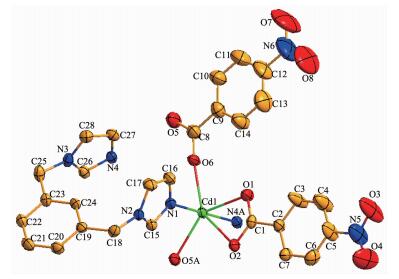
Single crystal X-ray analysis revealed that the asymmetric unit of complex 1 is composed of one crystallographically Cd(Ⅱ) ion, one mbix ligand, and two nba ligands. Each Cd(Ⅱ) ion is six-coordinated by two nitrogen atoms (N1 and N4A) from two mbix ligands respectively, and four oxygen atoms from three nba ligands(O1, O2, O5A and O6) respectively in a distorted octahedron coordination sphere. The atoms O1, O2, O5A and O6 constitute the basal plane of the octahedron, and the atoms N1 and N4A are located at the two vertex position. The Cd-O bond distance range from 0.235 3(4) to 0.246 8(3) nm, and the Cd-N distances vary from 0.224 5(4) to 0.224 8(4) nm. The N(O)-Cd-O(N) angles fall in a range of 53.79(12)°~176.91(14)°.
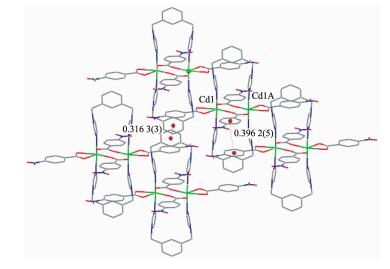
In complex 1, the mbix ligand takes cis-conformation bridging mode with a dihedral angle between the two imidazole rings of 25.78°, and the nba ligand coordinates to Cd ions in a bidentate bridging and chelting fashion. As depicted in Fig. 1, two Cd(Ⅱ) ions are bridged by four oxygen atoms of nba ligands to give crystallographically dimers with Cd1…Cd1A distance of 0.387 8 nm, and exhibits zero-dimensional structure. The two mbix ligands are attached on both sides of dimer. It is noteworthy that there exist π-π interactions among benzene rings of mbix/nba ligands of neighboring dimer. The benzene ring of mbix ligand centroid distance is 0.361 3(3) nm for C19C20C21C22C23C24 and C19′C20′C21′C22′C23′C24′ rings (Symmetry codes: 3-x, -y, 1-z), with the vertical distance to be 0.347 6(2) nm. Benzene ring of nba ligand centroid distance is 0.396 2(5) nm for C2C3C4C5C6C7 and C9C10C11C12C13C14 rings (Symmetry codes: 1+x, y, z), with the vertical distance to be 0.362 2(4) nm, indicating the existence of π-π effect, so that the structure is more stable. Therefore, an interesting three-dimensional supramolecular network structure is formed by π-π stacking (Fig. 2).
Symmetry codes: A: 2-x, -y, 2-z
Symmetry codes: A: 2-x, -y, 2-z
A single-crystal X-ray diffraction study reveals that complex 2 crystallizes in monoclinic space group P21/n and features a 2D network structure. The coordination environment of Cd(Ⅱ) ion in 2 is shown in Fig. 3. The Cd(Ⅱ) ion is six-coordinated by four nitrogen atoms (N1, N1A, N3, N3A) from four bib ligands respectively and two bromine ions (Br1 and Br1A) to furnish a slightly distorted octahedral coordination architecture. The bond distances of Cd-N in complex 2 fall in a range of 0.233 9(6)~0.236 5(7) nm, Cd-Br is 0.276 71(11) nm and the coordination angles around the Cd(Ⅱ) ion are in a range of 89.26(17)°~180.00(15)°.
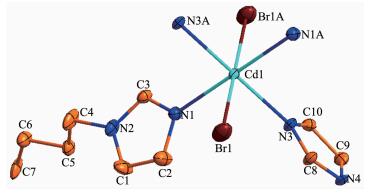
Hydrogen atoms are omitted for clarity; Probability level: 30%; Symmetry codes: A: 2-x, -y, 2-z
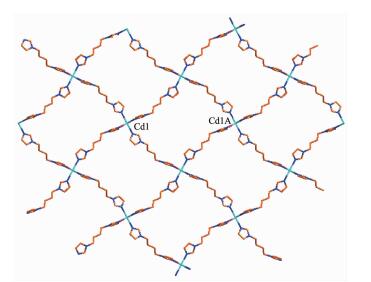
In the coordination environment, the four nitrogen atoms (N1, N1A, N3, N3A) are located in the basal plane, whereas two bromine ions (Br1, Br1A) occupy the axial positions from the opposite directions. In the crystal structure of complex 2, the bib ligand adopts a cis-conformation bridging mode with a dihedral angle between two imidazole rings of 58.73° and link the Cd(Ⅱ) ions to form a two-dimensional network structure with (4, 4) topology, as shown in Fig. 4.
Symmetry codes: A: 2-x, -y, 2-z
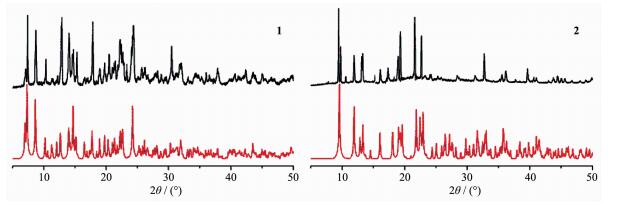
To investigate whether the analyzed crystal structure is truly representative of the bulk materials, X-ray powder diffraction (PXRD) technology has been performed for the complex at room temperature (Fig. 5). The main peak positions observed were in good agreement with the simulated ones. Although minor differences can be found in the positions, widths, and intensities of some peaks, the bulk synthesized materials and analyzed crystal can still be considered as homogeneous. The differences may be due to the preferred orientation of the powder samples[18-19].
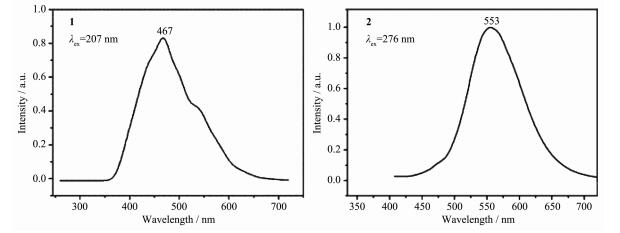
Metal-organic coordination polymers, especially d10 metal centers, such as Ag(Ⅰ), Au(Ⅰ), Zn(Ⅱ) and Cd(Ⅱ), and conjugated organic linker have been researched because of their fluorescent properties and potential applications as fluorescent-emitting materials, chemical sensors and electroluminescent displays[20]. Therefore, in the present work, the photoluminescent properties of Hnba, mbix, bib, complexes 1 and 2 have been investigated in the solid state at room temperature.
When excited at 207 nm, complex 1 exhibited blue luminescence and showed emission peak at 467 nm, and complex 2 showed green luminescence with emission peak at 553 nm (Fig. 6). The free ligands Hnba, mbix and bib showed photoluminescence with the emission maximum at 470, 436 and 440 nm, respectively, which can be assigned to intraligand (π→π*) transition[21]. Because the Cd(Ⅱ) ion is difficult to oxidize or reduce due to the d10 configuration, the emission of this compound is neither MLCT nor LMCT in nature[22-23]. Thus, the emission bands of complex 1 and 2 could be assigned to the emission of ligand-to-ligand charge transfer[24-26].
All calculations in this work were carried out with the Gaussian03 program[27]. The parameters of the molecular structure for calculation were all from the experimental data of the complex. Natural bond orbital (NBO) analysis was performed by density functional theory (DFT)[28] with the PBE0[29-30] hybrid functional and the LANL2DZ basis set[31-32].
The selected natural atomic charges and natural electron configuration for complex 1 is shown in Table 3. It is indicated that the electronic configurations of Cd(Ⅱ) ion, N and O atoms are 5s0.314d9.995p0.31, 2s1.382p4.19~4.20 and 2s1.67~1.702p5.02~5.11, respectively. Based on the above results, one can conclude that the Cd(Ⅱ) ion coordina-tion with N and O atoms is mainly on 4d, 5s, and 5p orbitals. N atoms form coordination bonds with Cd(Ⅱ) ion using 2s and 2p orbitals. All O atoms supply electrons of 2s and 2p to Cd(Ⅱ) ion, forming the coor-dination bonds. Therefore, the Cd(Ⅱ) ion obtained some electrons from two N atoms of mbix ligand, four O atoms of nba ligand[32]. According to valence-bond theory, the atomic net charge distribution and the NBO bond orders of the complex 1 (Table 3) shows the obvious covalent interaction between the coor-dinated atoms and Cd(Ⅱ) ion. The differences of the NBO bond orders for Cd-O and Cd-N bonds make their bond lengths become different[32], which is in good agreement with the X-ray crystal structural data of compound 1.
下载:
导出CSV
| Atom | Net charge | Electron configuration | Bond | Wiberg bond index | NBO bond order / a.u. |
| 1 | |||||
| Cd(1) | 1.389 64 | [core]5s0.314d9.995p0.31 | |||
| O(1) | -0.788 15 | [core]2s1.692p5.08 | Cd(1)-O(1) | 0.137 9 | 0.162 7 |
| O(2) | -0.737 01 | [core]2s1.702p5.02 | Cd(1)-O(2) | 0.131 1 | 0.154 3 |
| O(5A) | -0.775 80 | [core]2s1.692p5.07 | Cd(1)-O(5A) | 0.148 5 | 0.175 2 |
| O(6) | -0.782 43 | [core]2s1.672p5.11 | Cd(1)-O(6) | 0.156 1 | 0.185 1 |
| N(1) | -0.599 28 | [core]2s1.382p4.20 | Cd(1)-N(1) | 0.141 0 | 0.205 6 |
| N(4A) | -0.589 01 | [core]2s1.382p4.19 | Cd(1)-N(4A) | 0.137 7 | 0.200 1 |
| 2 | |||||
| Cd(1) | 1.167 78 | [core]5s0.364d9.995p0.47 | |||
| N(1) | -0.551 21 | [core]2s1.382p4.15 | Cd(1)-N(1) | 0.133 1 | 0.199 0 |
| N(1A) | -0.555 74 | [core]2s1.382p4.16 | Cd(1)-N(1A) | 0.134 1 | 0.199 7 |
| N(3) | -0.679 42 | [core]2s1.382p4.28 | Cd(1)-N(3) | 0.163 0 | 0.226 7 |
| N(3A) | -0.566 10 | [core]2s1.382p4.17 | Cd(1)-N(3A) | 0.138 5 | 0.204 5 |
| Br(1) | -0.757 10 | [core]4s1.924p5.84 | Cd(1)-Br(1) | 0.377 4 | 0.413 2 |
| Br(1A) | -0.756 84 | [core]4s1.924p5.84 | Cd(1)-Br(1A) | 0.385 1 | 0.418 2 |
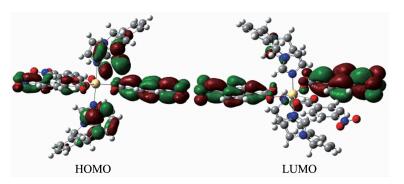
As can be seen from the Fig. 7, lowest unoccupied molecular orbital(LUMO) of 1 is mainly composed of nba and mbix ligands, whereas highest occupied molecular orbital (HOMO) mainly consists of nba ligand. So, LLCT may be inferred from some contours of molecular orbital of complex 1.
The selected natural atomic charges and natural electron configuration for complex 2 is displayed in Table 3. It means that the electronic configurations of Cd(Ⅱ) ion, N and Br atoms are 5s0.364d9.995p0.47, 2s1.382p4.15~4.28 and 4s1.924p5.84, respectively. In view of the above results, one can conclude that the Cd(Ⅱ) ion coordination with N and Br atoms is mainly on 4d, 5s, and 5p orbitals. N atoms form coordination bonds with Cd(Ⅱ) ion using 2s and 2p orbitals. All Br atoms supply electrons of 4s and 4p to Cd(Ⅱ) ion and form the coordination bonds. Therefore, the Cd(Ⅱ) ion obtained some electrons from four N atoms of bib ligand, two Br ions[32]. Thus, on the base of valence-bond theory, the atomic net charge distribution and the NBO bond orders of the complex 2 (Table 3) shows the obvious covalent interaction between the coordinated atoms and Cd(Ⅱ) ion. The differences of the NBO bond orders for Cd-O and Cd-Br bonds make their bond lengths be different[32], which is in good agreement with the X-ray crystal structural data of complex 2.
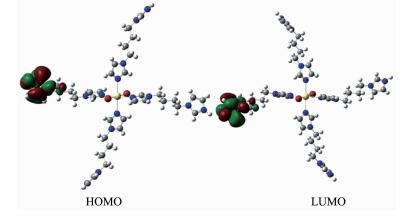
As can be seen from the Fig. 8, lowest unoccupied molecular orbital(LUMO) and highest occupied molecular orbital (HOMO) of 2 are all mainly made up of bib ligand, So, ILCT may be inferred from some contours of molecular orbital of complex 2.
Noro S, Kitaura R, Kondo M, et al. J. Am. Chem. Soc., 2002, 124:2568-2583 doi: 10.1021/ja0113192
Hu J S, Huang L F, Yao X Q, et al. Inorg. Chem., 2011, 50:2404-2414 doi: 10.1021/ic102207n
Cao R, Sun D F, Liang Y C, et al. Inorg. Chem., 2002, 41:2087-2094 doi: 10.1021/ic0110124
Forster P M, Burbank A R, Livage C, et al. Chem. Commun., 2004, 33:368-369
Mahata P, Natarajan S. Inorg. Chem., 2007, 46:1250-1258 doi: 10.1021/ic0617644
Kesanli B, Cui Y, Smith M R, et al. Angew. Chem. Int. Ed., 2005, 44:72-75 doi: 10.1002/(ISSN)1521-3773
Wu Q, Cao M J, Wei B, et al. Inorg. Chem. Comm., 2015, 62:111-114 doi: 10.1016/j.inoche.2015.10.035
Wang Z T, Wang S J, Li X M, et al. Chin. J. Struct. Chem., 2018, 37(3):467-474
Zhang Z, Pi M, Wang T, et al. J. Mol. Struct., 2011, 1-3:111-116
Croitor L, Chisca D, Coropceanu E B, et al. J. Mol. Struct., 2017, 6:136-141
Xing Z, Wang Q W, Sui W, et al. Chin. J. Struct. Chem., 2018, 1:125-130
李国峰, 王亚楠, 王庆伟, 等.无机化学学报, 2014, 30(11):2577-2583 http://www.wjhxxb.cn/wjhxxbcn/ch/reader/view_abstract.aspx?file_no=20141118&flag=1LI Guo-Feng, WANG Yan-Nan, WANG Qing-Wei, et al. Chinese J. Inorg. Chem., 2014, 30(11):2577-2583 http://www.wjhxxb.cn/wjhxxbcn/ch/reader/view_abstract.aspx?file_no=20141118&flag=1
Li X M, Sun M, Pan Y R, et al. Chin. J. Struct. Chem., 2016, 35(2):298-306
李国峰, 王亚楠, 王庆伟, 等.无机化学学报, 2015, 31(1):183-190 http://www.wjhxxb.cn/wjhxxbcn/ch/reader/view_abstract.aspx?file_no=20150127&flag=1LI Guo-Feng, WANG Yan-Nan, WANG Qing-Wei, et al. Chinese J. Inorg. Chem., 2015, 31(1):183-190 http://www.wjhxxb.cn/wjhxxbcn/ch/reader/view_abstract.aspx?file_no=20150127&flag=1
Li X M, Wang Z T, Pan Y R, et al. J. Inorg. Organomet. Polym., 2018, 28:258-267 doi: 10.1007/s10904-017-0738-y
Sheldrick G M. SHELXS 97, Program for the Solution of Crystal Structure, University of Göttingen, Germany, 1997.
Sheldrick G M. SHELXL 97, Program for the Refinement of Crystal Structure, University of Göttingen, Germany, 1997.
Gilbert A, Baggott J. Essentials of Molecular Photochemistry. Boca Raton:CRC Press, 1991.
Han Z B, He Y K, Ge C H, et al. Dalton Trans., 2007, 46:3020-3024
Kreno L E, Leong K, Farha O K, et al. Chem. Rev., 2012, 112:1105-1125 doi: 10.1021/cr200324t
Li J D, Long X F, Lin P, et al. Cryst. Growth Des., 2010, 10:146-157 doi: 10.1021/cg9007476
Wen L, Lu Z, Lin J, et al. Cryst. Growth Des., 2007, 7:93-99 doi: 10.1021/cg0604982
Lin J G, Zang S Q, Tian Z F, et al. CrystEngComm., 2007, 9:915-921 doi: 10.1039/b708389k
Mohamed G G, El-Gamel N E A. Spectrochim. Acta Part A, 2004, 60:3141-3154 doi: 10.1016/j.saa.2004.01.035
Mukhopadhyay U, Bernal I. Cryst. Growth Des., 2005, 5:1687-1689 doi: 10.1021/cg0501940
Li G L, Liu G Z, Huang L L, et al. J. Inorg. Organomet. Polym., 2014, 24:617-623 doi: 10.1007/s10904-014-0024-1
Frisch M J, Trucks G W, Schlegel H B, et al. Gaussian 03, Revision B.03, Gaussian, Inc., Pittsburgh, PA, 2003.
Parr R G, Yang W. Density Functional Theory of Atoms and Molecules. Oxford:Oxford University Press, 1989.
Ernzerhof M, Scuseria G E. J. Chem. Phys., 1999, 110:5029-5036 doi: 10.1063/1.478401
Adamo C, Barone V. J. Chem. Phys., 1999, 110:6158-6170 doi: 10.1063/1.478522
Dunning T H, Hay P J. Modern Theoretical Chemistry. New York:Plenum, 1976, 3:1-28
李章朋, 邢永恒, 张元红, 等.物理化学学报, 2009, 25(4):741-746 doi: 10.3866/PKU.WHXB20090423LI Zhang-Peng, XING Yong-Heng, ZHANG Yuan-Hong, et al. Acta Phys.-Chim. Sin., 2009, 25(4):741-746 doi: 10.3866/PKU.WHXB20090423

Figure 1 View of coordination environments of Cd(Ⅱ) ions of 1
Symmetry codes: A: 2-x, -y, 2-z

Figure 2 View of 3D supramolecular structure of complex 1 formed by π-π interactions
Symmetry codes: A: 2-x, -y, 2-z

Figure 3 View of coordination environments of Cd(Ⅱ) ion of 2
Hydrogen atoms are omitted for clarity; Probability level: 30%; Symmetry codes: A: 2-x, -y, 2-z

Figure 4 Two dimensional network structure of 2 with (4, 4) topology along c-axis
Symmetry codes: A: 2-x, -y, 2-z
Table 1. Crystal data and structure refinement for 1 and 2
| Formula | C56H44Cd2N12O16 | C20H28Br2CdN8 |
| Formula weight | 1 365.83 | 652.72 |
| Crystal system | Triclinic | Monoclinic |
| Space group | |
P21/n |
| a / nm | 0.917 81(13) | 0.775 74(5) |
| b / nm | 1.325 90(19) | 1.848 92(12) |
| c / nm | 1.329 78(18) | 0.883 34(6) |
| α / (°) | 72.699(2) | |
| β / (°) | 81.779(2) | 113.479 0(10) |
| γ / (°) | 70.968(2) | |
| Volume / nm3 | 1.458 7(4) | 1.162 06(13) |
| Z | 1 | 2 |
| Dc / (g·cm-3) | 1.555 | 1.865 |
| θ range / (°) | 1.61~26.04 | 2.96~25.05 |
| F(000) | 688 | 644 |
| Reflection collected, unique | 7 953, 5 671 | 7 351, 2 050 |
| Reflection with I>2σ(I) | 4 364 | 1 881 |
| Goodness-of-fit on F2 | 1.022 | 1.103 |
| Rint | 0.028 8 | 0.017 5 |
| R1, wR2 [I>2σ(I)] | 0.052 1, 0.119 7 | 0.060 0, 0.186 2 |
 下载: 导出CSV
Table 2. Selected bond lengths (nm) and bond angles (°) for 1 and 2
| 1 | |||||
| Cd(1)-O(1) | 0.238 9(4) | Cd(1)-O(2) | 0.246 8(3) | Cd(1)-O(5A) | 0.235 3(4) |
| Cd(1)-O(6) | 0.236 0(3) | Cd(1)-N(4A) | 0.227 8(4) | Cd(1)-N(1) | 0.224 5(4) |
| N(1)-Cd(1)-N(4A) | 176.91(14) | N(1)-Cd(1)-O(5A) | 91.33(14) | N(1)-Cd(1)-O(6) | 90.21(14) |
| N(4A)-Cd(1)-O(6) | 91.26(14) | O(5A)-Cd(1)-O(6) | 129.09(13) | N(1)-Cd(1)-O(1) | 90.78(14) |
| N(4A)-Cd(1)-O(1) | 86.49(14) | O(5A)-Cd(1)-O(1) | 140.54(12) | O(6)-Cd(1)-O(1) | 90.29(13) |
| N(1)-Cd(1)-O(2) | 86.27(13) | N(4A)-Cd(1)-O(2) | 90.95(13) | O(5A)-Cd(1)-O(2) | 87.06(12) |
| O(6)-Cd(1)-O(2) | 143.78(13) | O(1)-Cd(1)-O(2) | 53.79(12) | N(1)-Cd(1)-O(6A) | 92.29(14) |
| 2 | |||||
| Cd(1)-N(1) | 0.236 5(7) | Cd(1)-N(1A) | 0.236 5(7) | Cd(1)-N(3) | 0.233 9(6) |
| Cd(1)-N(3A) | 0.233 9(6) | Cd(1)-Br(1) | 0.276 71(11) | Cd(1)-Br(1A) | 0.276 71(11) |
| N(3A)-Cd(1)-N(3) | 180.000(1) | N(3)-Cd(1)-N(1A) | 89.6(2) | N(3A)-Cd(1)-N(1) | 89.6(2) |
| N(3)-Cd(1)-N(1) | 90.4(2) | N(1A)-Cd(1)-N(1) | 180.00(15) | N(3A)-Cd(1)-Br(1) | 90.74(17) |
| N(3)-Cd(1)-Br(1) | 89.26(17) | N(1A)-Cd(1)-Br(1) | 90.05(17) | N(1)-Cd(1)-Br(1) | 89.95(17) |
| N(3)-Cd(1)-Br(1A) | 90.74(17) | N(1)-Cd(1)-Br(1A) | 90.05(17) | Br(1)-Cd(1)-Br(1A) | 180.0 |
| Symmetry codes: A: 2-x, -y, 2-z for 1; A: 2-x, -y, 2-z for 2. | |||||
下载: 导出CSV
Table 3. Natural atomic charges, natural valence electron configurations, Wiberg bond indexes and NBO bond orders for 1 and 2
| Atom | Net charge | Electron configuration | Bond | Wiberg bond index | NBO bond order / a.u. |
| 1 | |||||
| Cd(1) | 1.389 64 | [core]5s0.314d9.995p0.31 | |||
| O(1) | -0.788 15 | [core]2s1.692p5.08 | Cd(1)-O(1) | 0.137 9 | 0.162 7 |
| O(2) | -0.737 01 | [core]2s1.702p5.02 | Cd(1)-O(2) | 0.131 1 | 0.154 3 |
| O(5A) | -0.775 80 | [core]2s1.692p5.07 | Cd(1)-O(5A) | 0.148 5 | 0.175 2 |
| O(6) | -0.782 43 | [core]2s1.672p5.11 | Cd(1)-O(6) | 0.156 1 | 0.185 1 |
| N(1) | -0.599 28 | [core]2s1.382p4.20 | Cd(1)-N(1) | 0.141 0 | 0.205 6 |
| N(4A) | -0.589 01 | [core]2s1.382p4.19 | Cd(1)-N(4A) | 0.137 7 | 0.200 1 |
| 2 | |||||
| Cd(1) | 1.167 78 | [core]5s0.364d9.995p0.47 | |||
| N(1) | -0.551 21 | [core]2s1.382p4.15 | Cd(1)-N(1) | 0.133 1 | 0.199 0 |
| N(1A) | -0.555 74 | [core]2s1.382p4.16 | Cd(1)-N(1A) | 0.134 1 | 0.199 7 |
| N(3) | -0.679 42 | [core]2s1.382p4.28 | Cd(1)-N(3) | 0.163 0 | 0.226 7 |
| N(3A) | -0.566 10 | [core]2s1.382p4.17 | Cd(1)-N(3A) | 0.138 5 | 0.204 5 |
| Br(1) | -0.757 10 | [core]4s1.924p5.84 | Cd(1)-Br(1) | 0.377 4 | 0.413 2 |
| Br(1A) | -0.756 84 | [core]4s1.924p5.84 | Cd(1)-Br(1A) | 0.385 1 | 0.418 2 |
下载: 导出CSV

 扫一扫看文章


扫一扫关注我们