Table 1.
Crystal data for compounds 1 and 2


Coordination polymers have attracted tremendous attention owing to their intriguing architectures and topologies, as well as potential applications in catalysis, magnetism, luminescence, molecular sensing, and gas absorption[1-8]. However, it is difficult to predict the structure of a coordination polymer, because there are many factors, such as the coordination geometry of the metal centers, type and connectivity of organic ligands, stoichiometry, reaction conditions, template effect, presence of auxiliary ligands, and pH values influen-cing the structures of target coordination polymers during self-assembly[9-14]. Undoubtedly, organic ligands play a crucial role in the construction of coordination polymers.
As we known, the multi-carboxylate biphenyl-type ligands have been certified to be of great significance as constructors due to their abundant coordination modes, which could satisfy different geometric requirements of metal centers[13-20]. Besides the main organic building blocks, many other components of a reaction system such as co-ligands or template agents can also play an important role in the generation of coordination polymers[21-22]. It is well known that co-ligands coordinate to metal centers as ancillary moieties, while the template agents do not coordinate to metal centers and often do not enter into the final structure, but have a structure-guiding behavior during the self-assembly synthesis. 4, 4′-Bipyridine(4, 4′-bipy) represents one of the most common examples of such a co-ligand or template agent[14, 23-24].
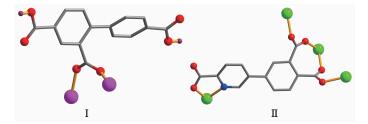
Therefore, based on the above reasons, we designed and synthesized two Co(Ⅱ) and Ni(Ⅱ) coordination polymers based on two biphenyl-type tricarboxylate ligands: biphenyl-2, 4, 4′-tricarboxylic acid (H3btc) and 5-(3, 4-dicarboxylphenyl)picolinic acid (H3dppa). In this article, we report the syntheses, crystal structures, and magnetic properties of two Co(Ⅱ) and Ni(Ⅱ) coordina-tion polymers constructed from biphenyl-type tricar-boxylate ligands.
All chemicals and solvents were of AR grade and used without further purification. Carbon, hydrogen and nitrogen were determined using an Elementar Vario EL elemental analyzer. IR spectra were recorded using KBr pellets and a Bruker EQUINOX 55 spectro-meter. Thermogravimetric analysis (TGA) data were collected on a LINSEIS STA PT1600 thermal analyzer with a heating rate of 10 ℃·min-1. Magnetic susce-ptibility data were collected in the 2~300 K tempera-ture range on a Quantum Design SQUID Magneto-meter MPMS XL-7 with a field of 0.1 T. A correction was made for the diamagnetic contribution prior to data analysis.
A mixture of CoCl26H2O (0.036 g, 0.15 mmol), H3btc (0.086 g, 0.30 mmol), 4, 4′-bipy (0.047 g, 0.3 mmol), NaOH (0.012 g, 0.30 mmol), and H2O (10 mL) was stirred at room temperature for 15 min, and then sealed in a 25 mL Teflon-lined stainless steel vessel, and heated at 160 ℃ for 3 days, followed by cooling to room temperature at a rate of 10 ℃·h-1. Pink block-shaped crystals of 1 were isolated manually, and washed with distilled water. Yield: 55% (based on H3btc). Anal. Calcd. for C50H34CoN4O12(%): C 63.77, H 3.64, N 5.95; Found(%): C 63.44, H 3.61, N 5.98. IR (KBr, cm-1): 1 677s, 1 604s, 1 571s, 1 414m, 1 375w, 1 319w, 1 287s, 1 237w, 1 209w, 1 174w, 1 119w, 1 097w, 1 069w, 1 008w, 914w, 840w, 812m, 763m, 706w, 685w, 622w.
A mixture of NiCl2·6H2O (71.0 mg, 0.30 mmol), H3dppa (57.4 mg, 0.20 mmol), 4, 4′-bipy (0.047 g, 0.3 mmol), NaOH (24.0 mg, 0.60 mmol), and H2O (10 mL) was stirred at room temperature for 15 min, then sealed in a 25 mL Teflon-lined stainless steel vessel, and heated at 160 ℃ for 3 days, followed by cooling to room temperature at a rate of 10 ℃·h-1. Green block-shaped crystals of 2 were isolated manually, washed with distilled water, and dried. Yield: 60% (based on H3dppa). Anal. Calcd. for C28H28Ni3N2O20(%): C 37.84, H 3.18, N 3.15; Found(%): C 38.06, H 3.19, N 3.17. IR (KBr, cm-1): 3 440m, 3 067w, 1 627m, 1 597s, 1 495w, 1 474w, 1 444m, 1 368m, 1 311w, 1 240w, 1 158 w, 1 117w, 1 087w, 1 041w, 1 016w, 852w, 817w, 776m, 735w, 709w, 654w.
The compounds are insoluble in water and common organic solvents, such as methanol, ethanol, acetone and DMF.
Two single crystals with dimensions of 0.27 mm×0.22 mm×0.21 mm (1) and 0.25 mm×0.23 mm×0.21 mm (2) were collected at 293(2) K on a Bruker SMART APEX Ⅱ CCD diffractometer with Mo Kα radiation (λ=0.071 073 nm). The structures were solved by direct methods and refined by full matrix least-square on F2 using the SHELXTL-2014 program[25]. All non-hydrogen atoms were refined anisotropically. All the hydrogen atoms except those of the water molecules in 2 were positioned geometrically and refined using a riding model. The hydrogen atoms of the water molecules in 2 were located from the difference Fourier maps. A summary of the crystallography data and structure refinements for 1 and 2 is given in Table 1. The selected bond lengths and angles for compounds 1 and 2 are listed in Table 2. Hydrogen bond parameters of compounds 1 and 2 are given in Tables 3 and 4.
 下载:
导出CSV
下载:
导出CSV
| Compound | 1 | 2 |
| Chemical formula | C50H34CoN4O12 | C28H28Ni3N2O20 |
| Molecular weight | 941.74 | 888.65 |
| Crystal system | Triclinic | Triclinic |
| Space group | |
|
| a / nm | 0.971 35(3) | 0.750 36(9) |
| b / nm | 1.376 38(6) | 0.958 82(12) |
| c / nm | 1.643 05(8) | 1.202 12(15) |
| α / (°) | 72.953(4) | 88.205(10) |
| β / (°) | 80.308(4) | 75.631(11) |
| γ / (°) | 77.675(3) | 76.874(10) |
| V / nm3 | 2.038 55(16) | 0.815 64(18) |
| Z | 2 | 1 |
| F(000) | 970 | 454 |
| θ range for data collection / (°) | 3.235~25.049 | 3.309~25.043 |
| Limiting indices | -11 ≤ h ≤ 11, -15 ≤ k ≤ 16, -19 ≤ l ≤ 17 | -8 ≤ h ≤ 8, -10 ≤ k ≤ 11, -14 ≤ l ≤ 10 |
| Reflection collected, unique (Rint) | 11 987, 7 234 (0.023 5) | 2 883, 5 852 (0.061 3) |
| Dc / (g·cm-3) | 1.534 | 1.809 |
| μ / mm-1 | 0.498 | 1.807 |
| Data, restraint, parameter | 7 234, 0, 606 | 2 883, 0, 241 |
| Goodness-of-fit on F2 | 0.998 | 1.030 |
| Final R indices [I≥2σ(I)] R1, wR2 | 0.043 6, 0.105 4 | 0.064 8, 0.130 3 |
| R indices (all data) R1, wR2 | 0.054 7, 0.114 1 | 0.104 5, 0.161 2 |
| Largest diff. peak and hole / (e·nm-3) | 383 and -359 | 744 and -653 |
下载:
导出CSV
| 1 | |||||
| Co(1)-O(1) | 0.210 9(2) | Co(1)-O(2)A | 0.204 6(2) | Co(1)-O(7) | 0.210 6(2) |
| Co(1)-O(8)B | 0.204 3(2) | Co(1)-N(1) | 0.217 8(2) | Co(1)-N(3) | 0.216 5(2) |
| O(8)B-Co(1)-O(2)A | 174.50(7) | O(8)B-Co(1)-O(7) | 91.25(7) | O(2)A-Co(1)-O(7) | 88.89(7) |
| O(8)B-Co(1)-O(1) | 88.75(7) | O(2)A-Co(1)-O(1) | 90.25(7) | O(7)-Co(1)-O(1) | 170.95(7) |
| O(8)B-Co(1)-N(3) | 91.77(7) | O(2)A-Co(1)-N(3) | 93.69(7) | O(7)-Co(1)-N(3) | 94.68(7) |
| O(1)-Co(1)-N(3) | 94.37(7) | O(8)B-Co(1)-N(1) | 87.87(7) | O(2)A-Co(1)-N(1) | 86.66(7) |
| O(7)-Co(1)-N(1) | 85.62(7) | O(1)-Co(1)-N(1) | 85.34(7) | N(3)-Co(1)-N(1) | 179.55(8) |
| 2 | |||||
| Ni(1)-O(2) | 0.205 1(4) | Ni(1)-O(3)A | 0.212 1(5) | Ni(1)-O(6)A | 0.203 8(5) |
| Ni(1)-O(7) | 0.208 2(5) | Ni(1)-O(8) | 0.209 0(5) | Ni(1)-N(1) | 0.212 0(5) |
| Ni(2)-O(5) | 0.206 7(4) | Ni(2)-O(5)B | 0.206 7(4) | Ni(2)-O(4)C | 0.214 8(4) |
| Ni(2)-O(4)D | 0.214 8(4) | Ni(2)-O(9) | 0.211 7(5) | Ni(2)-O(9)B | 0.211 7(5) |
| O(6)A-Ni(1)-O(2) | 173.2(2) | O(6)A-Ni(1)-O(7) | 90.1(2) | O(2)-Ni(1)-O(7) | 91.14(19) |
| O(6)A-Ni(1)-O(8) | 87.8(2) | O(2)-Ni(1)-O(8) | 99.0(2) | O(7)-Ni(1)-O(8) | 85.3(2) |
| O(6)A-Ni(1)-N(1) | 99.6(2) | O(2)-Ni(1)-N(1) | 78.71(18) | O(7)-Ni(1)-N(1) | 169.2(2) |
| O(8)-Ni(1)-N(1) | 99.9(2) | O(6)A-Ni(1)-O(3)A | 87.7(2) | O(3)A-Ni(1)-O(2) | 85.8(2) |
| O(7)-Ni(1)-O(3)A | 87.2(2) | O(8)-Ni(1)-O(3)A | 171.1(2) | N(1)-Ni(1)-O(3)A | 88.4(2) |
| O(5)B-Ni(2)-O(9)B | 94.6(2) | O(5)-Ni(2)-O(9)B | 85.4(2) | O(5)B-Ni(2)-O(4)D | 91.4(2) |
| O(5)-Ni(2)-O(4)D | 88.6(2) | O(9)B-Ni(2)-O(4)D | 86.3(2) | O(9)-Ni(2)-O(4)D | 93.7(2) |
| Symmetry codes: A: -x, -y+2, -z+2; B: -x+1, -y+2, -z+2 for 1; A: -x+2, -y+2, -z+2; B: -x+1, -y+2, -z+3; C: x-1, y, z; D: -x+2, -y+3, -z+3 for 2. | |||||
下载:
导出CSV
| D-H…A | d(D-H) / nm | d(H…A) / nm | d(D…A) / nm | ∠DHA / (°) |
| O(4)-H(4)…N(2)A | 0.082 | 0.185 | 0.267 1 | 174.3 |
| O(5)-H(5)…O(9)B | 0.082 | 0.182 | 0.262 0 | 163.6 |
| O(10)-H(9)…O(6)C | 0.082 | 0.185 | 0.265 5 | 166.9 |
| O(11)-H(27)…N(4)D | 0.082 | 0.185 | 0.266 5 | 177.8 |
| Symmetry codes: A: -x, -y+3, -z+1; B: x-1, y, z+1; C: x+1, y, z-1; D: -x+1, -y+1/2, -z+3. | ||||
下载:
导出CSV
| D-H…A | d(D-H) / nm | d(H…A) / nm | d(D…A) / nm | ∠DHA / (°) |
| O(7)-H(1W)…O(5)A | 0.082 | 0.193 | 0.275 1 | 174.8 |
| O(7)-H(2W)…O(2)B | 0.085 | 0.187 | 0.271 8 | 179.9 |
| O(8)-H(4W)…O(10)C | 0.085 | 0.174 | 0.258 6 | 179.8 |
| O(9)-H(5W)…O(3)D | 0.085 | 0.186 | 0.271 5 | 179.6 |
| O(9)-H(6W)…O(6) | 0.085 | 0.197 | 0.282 1 | 179.4 |
| O(10)-H(7W)…O(4)E | 0.085 | 0.205 | 0.290 2 | 179.5 |
| O(10)-H(8W)…O(1) | 0.085 | 0.186 | 0.270 9 | 179.4 |
| Symmetry codes: A: x, y, -z+1; B: -x+2, -y+1, -z+1; C: x+1, y, z; D: x-1, y, z; E: -x+2, -y+1, -z+2. | ||||
CCDC: 1889686, 1; 1889687, 2.
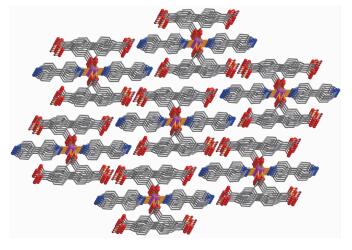
Single-crystal X-ray diffraction analysis reveals that compound 1 crystallizes in the triclinic space group
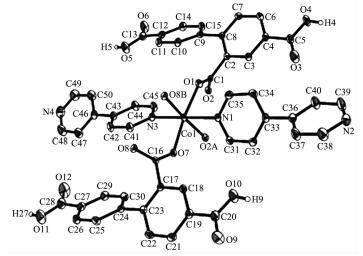
H atoms and lattice water molecules were omitted for clarity except H of COOH group; Symmetry codes: A:-x, -y+2, -z+2; B: -x+1, -y+2, -z+2
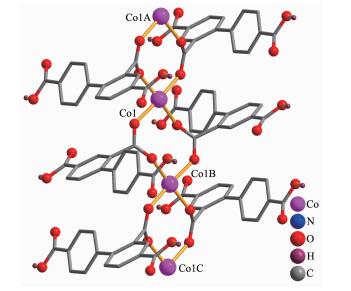
Symmetry codes: A:-x+1, -y+2, -z+2; B: -x, -y+2, -z+2; C: x-1, y, z
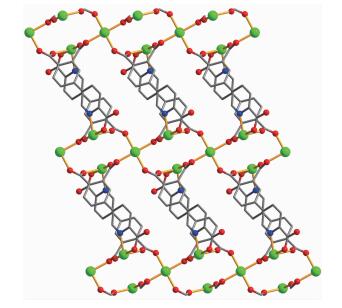
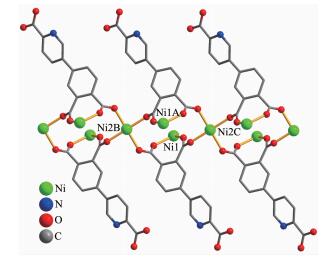
The asymmetric unit of 2 possesses two crystallographically independent Ni(Ⅱ) ions (Ni1 having full occupancy, Ni2 having half occupancy), one dppa3- block, three H2O ligands, and one lattice water molecule. As shown in Fig. 4, the Ni1 atom is six-coordinated and adopts a distorted octahedral {NiNO5} geometry formed by three carboxylate O and one N atom from two distinct μ4-dppa3- blocks and two O atoms from two water ligands. The six-coordinated Ni2 center is located on a 2-fold rotation axis and is surrounded by four O atoms from four different dppa3- blocks and two O atoms from two coordinated H2O molecules, thus adopting a distorted octahedral {NiO6} geometry. The Ni-O distances range from 0.203 8(5) to 0.214 8(4) nm, whereas the Ni-N distance is 0.212 0(5) nm, and these bonding parameters agree with those observed in other Ni(Ⅱ) compounds[13-14, 16]. In 2, the dppa3- block acts as a μ4-spacer (mode Ⅱ, Scheme 1), in which the carboxylate groups exhibit the monodentate and the bidentate modes. In dppa3-, the dihedral angle between the pyridyl and phenyl rings is 31.46°. Although 4, 4′-bipy was added during the synthesis of 2, a coordination of 4, 4′-bipy to Ni(Ⅱ) is not observed in compound 2. Interestingly, 4, 4′-bipy acts as a template. The neighboring Ni(Ⅱ) ions are bridged by means of carboxylate groups from the dppa3- moieties, giving rise to a 1D chain (Fig. 5). These 1D chains are multiply held together by the remaining COO- groups and N atoms of the μ4-dppa3- moieties to generate a 2D network (Fig. 6).
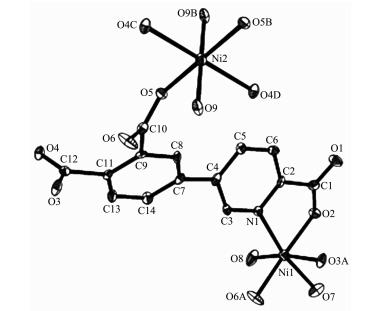
H atoms and lattice water molecules were omitted for clarity; Symmetry codes: A:-x+2, -y+2, -z+2; B: -x+1, -y+2, -z+3; C: x-1, y, z; D: -x+2, -y+3, -z+3
Symmetry codes: A:-x+2, -y+2, -z+1; B: x, y, z-1; C: x+1, y, z-1
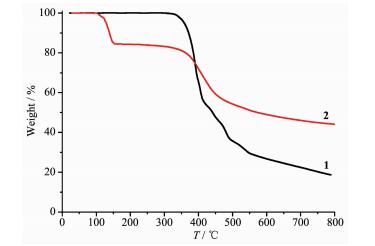
To determine the thermal stability of polymers 1 and 2, their thermal behaviors were investigated under nitrogen atmosphere by thermogravimetric analysis (TGA). As shown in Fig. 7, TGA curve of compound 1 showed that the sample remained stable until 322 ℃, followed by a decomposition on further heating. Compound 2 lost its two lattice water molecules and six H2O ligands in a range of 99~154 ℃ (Calcd. 16.2%, Obsd. 16.0%), followed by the decomposition at 281 ℃.
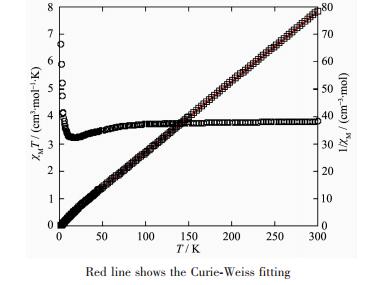
Variable-temperature magnetic susceptibility measurements were performed on powder samples of 1 in the 2~300 K temperature range (Fig. 8). As shown in Fig. 8, the χMT value at room temperature was 3.83 cm3·mol-1·K, which was higher than the value (1.87 cm3·mol-1·K) for one magnetically isolated high-spin Co(Ⅱ) ion (S=3/2, g=2.0). This is a common pheno-menon for Co(Ⅱ) ions due to their strong spin-orbital coupling interactions[13-15]. Upon cooling, the value decreased gradually and reached a minimum of 3.23 cm3·mol-1·K at 17.4 K. Below 17.4 K, however, the χMT value increased rapidly to a maximum of 6.62 cm3·mol-1·K at 2.0 K. In the 30~300 K temperature range, the magnetic susceptibility obeyed the Curie-Weiss law, χM=C/(T-θ), with θ=1.37 K, C=3.78 cm3·mol-1·K. The positive θ value indicates the presence of dominant ferromagnetic interactions between the adjacent Co(Ⅱ) centers. According to the chain structure of 1 (Fig. 2), there is one magnetic exchange pathway within the chain through two syn-anti carboxylate bridges, which could be responsible for the observed ferromagnetic exchange.
In summary, we have successfully synthesized and characterized two new cobalt (1) and nickel (2) coordination polymers by using two biphenyl-type tricarboxylic acids as bridging ligands under hydrothermal conditions. The polymers 1 and 2 feature 1D double-helix chain and 2D network, respectively. Magnetic studies for compound 1 demonstrate a ferromagnetic coupling between the adjacent Co(Ⅱ) centers. The results show that such biphenyl-type tricarboxylic acids can be used as versatile multifunctional building blocks toward the generation of new coordination polymers. Moreover, 4, 4′-bipyridine can tune the structures of the coor-dination polymers by its coordination or template effect.
Zheng X D, Lu T B. CrystEngComm, 2010, 12:324-336 doi: 10.1039/B911991D
Yan W, Han L J, Jia, H L, et al. Inorg. Chem., 2016, 55:8816-8821 doi: 10.1021/acs.inorgchem.6b01328
Li Q P, Du S W. RSC Adv., 2015, 5:9898-9903 doi: 10.1039/C4RA14939D
Cui Y J, Yue Y F, Qian G D, et al. Chem. Rev., 2012, 12:1126-1162
Ou Y C, Gao X, Zhou Y, et al. Cryst. Growth Des., 2016, 16:946-952 doi: 10.1021/acs.cgd.5b01500
Zeng M H, Yin Z, Tan Y X, et al. J. Am. Chem. Soc., 2014, 136:4680-4688 doi: 10.1021/ja500191r
Gu J Z, Wen M, Cai Y, et al. Inorg. Chem., 2019, 58:2403-2412 doi: 10.1021/acs.inorgchem.8b02926
Zou J Y, Li L, You S Y, et al. Cryst. Growth Des., 2018, 18:3997-4003 doi: 10.1021/acs.cgd.8b00344
Zhang L N, Zhang C, Zhang B, et al. CrystEngComm, 2015, 17:2837-2846 doi: 10.1039/C5CE00263J
Du M, Li C P, Liu C S, et al. Coord. Chem. Rev., 2013, 257:1282-1305 doi: 10.1016/j.ccr.2012.10.002
Chen X M, Tong M L. Acc. Chem. Res., 2007, 40:162-170 doi: 10.1021/ar068084p
Singh R, Bharatdwaj P K. Cryst. Growth Des., 2013, 13:3722-3733 doi: 10.1021/cg400756z
Gu J Z, Gao Z Q, Tang Y. Cryst. Growth Des., 2012, 12:3312-3323 doi: 10.1021/cg300442b
Gu J Z, Cui Y H, Liang X X, et al. Cryst. Growth Des., 2016, 16:4658-4670 doi: 10.1021/acs.cgd.6b00735
顾文君, 顾金忠.无机化学学报, 2017, 33(2):227-236 http://www.wjhxxb.cn/wjhxxbcn/ch/reader/view_abstract.aspx?file_no=20170204&flag=1GU Wen-Jun, GU Jin-Zhong. Chinese J. Inorg. Chem., 2017, 33(2):227-236 http://www.wjhxxb.cn/wjhxxbcn/ch/reader/view_abstract.aspx?file_no=20170204&flag=1
Gu J Z, Cai Y, Qian Z Y, et al. Dalton Trans., 2018, 47:7431-7444 doi: 10.1039/C8DT01299G
Gu J Z, Cai Y, Wen M, et al. Dalton Trans., 2018, 47:14327-14339 doi: 10.1039/C8DT02467G
Wu Y P, Wu X Q, Wang J F, et al. Cryst. Growth Des., 2016, 16:2309-2316 doi: 10.1021/acs.cgd.6b00093
Liu B, Zhou H F, Guan Z H, et al. Green Chem., 2016, 18:5418-5422 doi: 10.1039/C6GC01686C
赵素琴, 顾金忠.无机化学学报, 2016, 32(9):1611-1618 http://www.wjhxxb.cn/wjhxxbcn/ch/reader/view_abstract.aspx?file_no=20160916&flag=1ZHAO Su-Qin, GU Jin-Zhong. Chinese J. Inorg. Chem., 2016, 32(9):1611-1618 http://www.wjhxxb.cn/wjhxxbcn/ch/reader/view_abstract.aspx?file_no=20160916&flag=1
Stock N, Biswas S. Chem. Rev., 2012, 112:933-969 doi: 10.1021/cr200304e
Su J, Yao L D, Zhao M, et al. Inorg. Chem., 2015, 54:6169-6175 doi: 10.1021/acs.inorgchem.5b00180
Chandrasekhar V, Mohapatra C, Butcher R J. Cryst. Growth Des., 2012, 12:3285-3295 doi: 10.1021/cg3004189
Burd S D, Ma S, Perman J A, et al. J. Am. Chem. Soc., 2012, 134:3663-3666 doi: 10.1021/ja211340t
Spek A L. Acta Crystallogr. Sect. C:Struct. Chem., 2015, C71:9-18

Figure 1 Drawing of the asymmetric unit of compound 1 with 30% probability thermal ellipsoids
H atoms and lattice water molecules were omitted for clarity except H of COOH group; Symmetry codes: A:-x, -y+2, -z+2; B: -x+1, -y+2, -z+2

Figure 2 One dimesional double-helix chain in compound 1
Symmetry codes: A:-x+1, -y+2, -z+2; B: -x, -y+2, -z+2; C: x-1, y, z

Figure 4 Drawing of the asymmetric unit of compound 2 with 30% probability thermal ellipsoids
H atoms and lattice water molecules were omitted for clarity; Symmetry codes: A:-x+2, -y+2, -z+2; B: -x+1, -y+2, -z+3; C: x-1, y, z; D: -x+2, -y+3, -z+3

Figure 5 One dimensional chain unit in compound 2
Symmetry codes: A:-x+2, -y+2, -z+1; B: x, y, z-1; C: x+1, y, z-1
Table 1. Crystal data for compounds 1 and 2
| Compound | 1 | 2 |
| Chemical formula | C50H34CoN4O12 | C28H28Ni3N2O20 |
| Molecular weight | 941.74 | 888.65 |
| Crystal system | Triclinic | Triclinic |
| Space group | |
|
| a / nm | 0.971 35(3) | 0.750 36(9) |
| b / nm | 1.376 38(6) | 0.958 82(12) |
| c / nm | 1.643 05(8) | 1.202 12(15) |
| α / (°) | 72.953(4) | 88.205(10) |
| β / (°) | 80.308(4) | 75.631(11) |
| γ / (°) | 77.675(3) | 76.874(10) |
| V / nm3 | 2.038 55(16) | 0.815 64(18) |
| Z | 2 | 1 |
| F(000) | 970 | 454 |
| θ range for data collection / (°) | 3.235~25.049 | 3.309~25.043 |
| Limiting indices | -11 ≤ h ≤ 11, -15 ≤ k ≤ 16, -19 ≤ l ≤ 17 | -8 ≤ h ≤ 8, -10 ≤ k ≤ 11, -14 ≤ l ≤ 10 |
| Reflection collected, unique (Rint) | 11 987, 7 234 (0.023 5) | 2 883, 5 852 (0.061 3) |
| Dc / (g·cm-3) | 1.534 | 1.809 |
| μ / mm-1 | 0.498 | 1.807 |
| Data, restraint, parameter | 7 234, 0, 606 | 2 883, 0, 241 |
| Goodness-of-fit on F2 | 0.998 | 1.030 |
| Final R indices [I≥2σ(I)] R1, wR2 | 0.043 6, 0.105 4 | 0.064 8, 0.130 3 |
| R indices (all data) R1, wR2 | 0.054 7, 0.114 1 | 0.104 5, 0.161 2 |
| Largest diff. peak and hole / (e·nm-3) | 383 and -359 | 744 and -653 |
 下载: 导出CSV
Table 2. Selected bond distances (nm) and bond angles (°) for compounds 1 and 2
| 1 | |||||
| Co(1)-O(1) | 0.210 9(2) | Co(1)-O(2)A | 0.204 6(2) | Co(1)-O(7) | 0.210 6(2) |
| Co(1)-O(8)B | 0.204 3(2) | Co(1)-N(1) | 0.217 8(2) | Co(1)-N(3) | 0.216 5(2) |
| O(8)B-Co(1)-O(2)A | 174.50(7) | O(8)B-Co(1)-O(7) | 91.25(7) | O(2)A-Co(1)-O(7) | 88.89(7) |
| O(8)B-Co(1)-O(1) | 88.75(7) | O(2)A-Co(1)-O(1) | 90.25(7) | O(7)-Co(1)-O(1) | 170.95(7) |
| O(8)B-Co(1)-N(3) | 91.77(7) | O(2)A-Co(1)-N(3) | 93.69(7) | O(7)-Co(1)-N(3) | 94.68(7) |
| O(1)-Co(1)-N(3) | 94.37(7) | O(8)B-Co(1)-N(1) | 87.87(7) | O(2)A-Co(1)-N(1) | 86.66(7) |
| O(7)-Co(1)-N(1) | 85.62(7) | O(1)-Co(1)-N(1) | 85.34(7) | N(3)-Co(1)-N(1) | 179.55(8) |
| 2 | |||||
| Ni(1)-O(2) | 0.205 1(4) | Ni(1)-O(3)A | 0.212 1(5) | Ni(1)-O(6)A | 0.203 8(5) |
| Ni(1)-O(7) | 0.208 2(5) | Ni(1)-O(8) | 0.209 0(5) | Ni(1)-N(1) | 0.212 0(5) |
| Ni(2)-O(5) | 0.206 7(4) | Ni(2)-O(5)B | 0.206 7(4) | Ni(2)-O(4)C | 0.214 8(4) |
| Ni(2)-O(4)D | 0.214 8(4) | Ni(2)-O(9) | 0.211 7(5) | Ni(2)-O(9)B | 0.211 7(5) |
| O(6)A-Ni(1)-O(2) | 173.2(2) | O(6)A-Ni(1)-O(7) | 90.1(2) | O(2)-Ni(1)-O(7) | 91.14(19) |
| O(6)A-Ni(1)-O(8) | 87.8(2) | O(2)-Ni(1)-O(8) | 99.0(2) | O(7)-Ni(1)-O(8) | 85.3(2) |
| O(6)A-Ni(1)-N(1) | 99.6(2) | O(2)-Ni(1)-N(1) | 78.71(18) | O(7)-Ni(1)-N(1) | 169.2(2) |
| O(8)-Ni(1)-N(1) | 99.9(2) | O(6)A-Ni(1)-O(3)A | 87.7(2) | O(3)A-Ni(1)-O(2) | 85.8(2) |
| O(7)-Ni(1)-O(3)A | 87.2(2) | O(8)-Ni(1)-O(3)A | 171.1(2) | N(1)-Ni(1)-O(3)A | 88.4(2) |
| O(5)B-Ni(2)-O(9)B | 94.6(2) | O(5)-Ni(2)-O(9)B | 85.4(2) | O(5)B-Ni(2)-O(4)D | 91.4(2) |
| O(5)-Ni(2)-O(4)D | 88.6(2) | O(9)B-Ni(2)-O(4)D | 86.3(2) | O(9)-Ni(2)-O(4)D | 93.7(2) |
| Symmetry codes: A: -x, -y+2, -z+2; B: -x+1, -y+2, -z+2 for 1; A: -x+2, -y+2, -z+2; B: -x+1, -y+2, -z+3; C: x-1, y, z; D: -x+2, -y+3, -z+3 for 2. | |||||
下载: 导出CSV
Table 3. Hydrogen bond parameters of compound 1
| D-H…A | d(D-H) / nm | d(H…A) / nm | d(D…A) / nm | ∠DHA / (°) |
| O(4)-H(4)…N(2)A | 0.082 | 0.185 | 0.267 1 | 174.3 |
| O(5)-H(5)…O(9)B | 0.082 | 0.182 | 0.262 0 | 163.6 |
| O(10)-H(9)…O(6)C | 0.082 | 0.185 | 0.265 5 | 166.9 |
| O(11)-H(27)…N(4)D | 0.082 | 0.185 | 0.266 5 | 177.8 |
| Symmetry codes: A: -x, -y+3, -z+1; B: x-1, y, z+1; C: x+1, y, z-1; D: -x+1, -y+1/2, -z+3. | ||||
下载: 导出CSV
Table 4. Hydrogen bond parameters of compound 2
| D-H…A | d(D-H) / nm | d(H…A) / nm | d(D…A) / nm | ∠DHA / (°) |
| O(7)-H(1W)…O(5)A | 0.082 | 0.193 | 0.275 1 | 174.8 |
| O(7)-H(2W)…O(2)B | 0.085 | 0.187 | 0.271 8 | 179.9 |
| O(8)-H(4W)…O(10)C | 0.085 | 0.174 | 0.258 6 | 179.8 |
| O(9)-H(5W)…O(3)D | 0.085 | 0.186 | 0.271 5 | 179.6 |
| O(9)-H(6W)…O(6) | 0.085 | 0.197 | 0.282 1 | 179.4 |
| O(10)-H(7W)…O(4)E | 0.085 | 0.205 | 0.290 2 | 179.5 |
| O(10)-H(8W)…O(1) | 0.085 | 0.186 | 0.270 9 | 179.4 |
| Symmetry codes: A: x, y, -z+1; B: -x+2, -y+1, -z+1; C: x+1, y, z; D: x-1, y, z; E: -x+2, -y+1, -z+2. | ||||
下载: 导出CSV

 扫一扫看文章


扫一扫关注我们