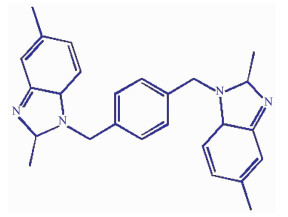
Scheme 1.
Structure of ligand dbim

Two 3D Zn(Ⅱ) Coordination Complexes Constructed From a Semi-rigid Bis(dimethylbenzimidazole) Ligand and Different Multi-carboxylic Acids: Structures and Fluorescence Properties
Lu LIU , Ying LI , Jian-Ji WANG , Yu-Ping ZHANG , Hong-Wei HOU


To date, the design and construction of coordina-tion complexes have been quickly developing because of their intriguing structural motifs and potential applications[1-9]. The researches in this field have been concentrated on the structural tuning of the resulting complexes via selecting proper metal centers and different organic ligands[10-12]. As far as we can see, 1-(4-((2, 6-dimethyl-2H-benzo[d]imidazol-3(3H)-yl)methyl) benzyl)-2, 7-dihydro-2, 5-dimethyl-1H-benzo[d]imidazole (dbim) (Scheme 1) has been rarely mentioned as the semi-rigid N-donor ligand in metal-organic coordina-tion polymer materials. Not only two dimethylbenzi-midazole of dbim can freely twist around two -CH2- groups with disparate angles to produce unlike conformations, but also the existence of the methyl in the imidazole ring and benzene ring can boost the donated electrons ability of dbim, which is conducive to enrich coordination ability of dbim with metal ions.
The polycarboxylate ligands, as a star in the coordination chemistry, are also of especial interest and have been widely used to fabricate various coor-dination complexes, owing to their strong coordination ability and diverse coordination modes[13-17]. In addition, the two-ligand assembly system is capable of providing more variability to build complicated and fascinating structures. Therefore, multidentate O-donor carboxy-late ligands, trimesic acid (H3btc) and 1, 2, 4, 5-benzene tetracarboxylic (H4btec) are introduced, and two diverse 3D complexes, {[Zn1.5(dbim)1.5(btc)]·6H2O}n (1) and {[Zn(dbim)0.5(btec)0.5(H2O)]·H2O}n (2) were synthesized. The crystal structure analysis of the complexes, and the effect of different multi-carboxylates on the final frameworks, are also discussed. The structural differences demonstrate that the backbones of the multi-carboxylates are key factors in formation of the final coordination complexes. Moreover, the photolu-minescence of the complexes 1 and 2 were also reported.
All reagents and solvents were commercially available except for dbim, which was synthesized according to the literature[18]. FT-IR spectra were recorded on a FTIR-7600 spectrophotometer with KBr pellets in 400~4 000 cm-1 region. Elemental analyses (C, H and N) were carried out on a FLASH EA 1112 elemental analyzer. The luminescence spectra for the powdered solid samples were measured at room temperature on a F7000 fluorescence spectrophoto-meter. The excitation slit and emission slit were both 2.0 nm.
A mixture of Zn(Ac)2·2H2O (0.2 mmol), dbim (0.1 mmol), H3btc (0.2 mmol) and NaOH (0.2 mmol) in H2O (10 mL) was kept in a 25 mL Teflon-lined stainless steel vessel at 140 ℃ for four days. After the mixture was cooled to room temperature at a rate of 5 ℃·h-1, colorless crystals suitable for X-ray diffraction were obtained with a yield of 55% (based on Zn). Anal. Calcd. for C96H96N12O18Zn3(%): C, 60.61; H, 5.08; N, 8.83. Found(%): C, 60.57; H, 5.09; N, 8.81. IR (KBr, cm-1): 3 418(w), 2 862(vw), 2 359(w), 1 698(w), 1 615(s), 1 567(s), 1 516(s), 1 493(s), 1 415(w), 1 330(s), 1 286(w), 1 259(w), 1 172(w), 1 100(w), 1 035(w), 994(w), 936(w), 867(w), 803(s), 726(s), 670(w).
A mixture of Zn(Ac)2·2H2O (0.2 mmol), dbim (0.1 mmol), H4btec (0.1 mmol), NaOH (0.2 mmol) and H2O (10 mL) was placed in a 25 mL Teflon-lined stainless steel container. The mixture was sealed and heated at 160 ℃ for three days. After the mixture was cooled to ambient temperature at a rate of 5 ℃·h-1, colorless crystals of 2 were obtained with a yield of 49% (based on Zn). Anal. Calcd. for C18H18N2O6Zn(%): C, 51.01; H, 4.28; N, 6.61. Found(%): C, 50.98; H, 4.27; N, 6.63. IR (KBr, cm-1): 3 424(m), 3 378(m), 2 923(w), 1 612(vs), 1 511(w), 1 488(s), 1 405(s), 1 355(vs), 1 135(s), 1 037(w), 868(m), 815(s), 759(m), 682(m), 607(m), 508(w).
The data of 1 and 2 were collected on a Xcalibur Eos Gemini CCD diffractomer (Cu Kα for 1, λ= 0.154 18 nm; Mo Kα for 2, λ=0.071 073 nm) at temp-erature of (20±1) ℃. Absorption corrections were applied by using multi-scan program. The data were modified for Lorentz and polarization effects. The structure of complex 1 was solved and refined by full-matrix least squares on F2 using OLEX2[19], while the structure of complex 2 was solved by direct methods and then refined by means of F2 with a full-matrix least-squares technique that adopted the SHELX-97 crystallographic software package[20]. The hydrogen atoms were placed at calculated positions and refined as riding atoms with isotropic displacement parameters. Crystallographic crystal data and structure processing parameters for 1 and 2 are summarized in Table 1. Selected bond lengths and bond angles of 1 and 2 are listed in Table 2.

 下载:
导出CSV
下载:
导出CSV
| Complex | 1 | 2 |
| Formula | C96H96N12O18Zn3 | C18H18N2O6Zn |
| Formula weight | 1 902.08 | 423.71 |
| Crystal system | Monoclinic | Monoclinic |
| Space group | C2/c | P21/c |
| a / nm | 3.432 8(4) | 1.070 2(2) |
| b / nm | 1.781 82(5) | 1.012 0(2) |
| c / nm | 2.237 1(2) | 1.668 2(3) |
| β / (°) | 136.44(2) | 93.15(3) |
| V / nm3 | 9.430(3) | 1.804(6) |
| Z | 4 | 4 |
| Dc / (g·cm-3) | 1.264 | 1.560 |
| Absorption coefficient / mm-1 | 1.412 | 1.400 |
| F(000) | 3 720 | 872 |
| θ range / (°) | 4.635~70.276 | 1.91~25.00 |
| GOF | 1.023 | 0.992 |
| R1a [I>2σ(I)] | 0.060 5 | 0.071 3 |
| wR2b [I>2σ(I)] | 0.169 4 | 0.188 0 |
| a R1=∑||Fo|-|Fc||/∑|Fo|; b wR2=[∑w(Fo2-Fc2)2/∑w(Fo2)2]1/2. | ||
下载:
导出CSV
| 1 | |||||
| Zn(1)-N(1) | 0.202 4(4) | Zn(2)-N(3) | 0.204 2(3) | Zn(1)#2-N(6) | 0.201 1(4) |
| Zn(1)-O(1) | 0.200 9(2) | Zn(1)#3-O(4) | 0.199 1(2) | Zn(2)-O(5) | 0.199 4(2) |
| Zn(1)-N(6)#4 | 0.201 1(4) | Zn(1)-O(4)#5 | 0.199 1(2) | Zn(2)-N(3)#6 | 0.204 1(3) |
| Zn(2)-O(5)#6 | 0.199 4(2) | ||||
| N(6)#4-Zn(1)-N(1) | 128.30(16) | O(1)-Zn(1)-N(1) | 103.66(11) | O(1)-Zn(1)-N(6)#4 | 106.34(12) |
| O(4)#5-Zn(1)-N(1) | 104.03(12) | O(4)#5-Zn(1)-N(6)#4 | 106.90(14) | O(4)#5-Zn(1)-O(1) | 105.84(10) |
| N(3)#6-Zn(2)-N(3) | 119.53(18) | O(5)-Zn(2)-N(3)#6 | 105.24(11) | O(5)#6-Zn(2)-N(3)#6 | 112.04(11) |
| O(5)-Zn(2)-N(3) | 112.04(11) | O(5)#6-Zn(2)-N(3) | 105.23(11) | O(5)#6-Zn(2)-O(5) | 101.38(14) |
| 2 | |||||
| Zn(1)#1-O(3) | 0.195 1(3) | Zn(1)-O(5) | 0.193 1(3) | Zn(1)-O(1) | 0.195 0(3) |
| Zn(1)-O(3)#3 | 0.195 1(3) | Zn(1)-N(1) | 0.200 0(4) | ||
| O(5)-Zn(1)-O(1) | 109.30(15) | O(5)-Zn(1)-O(3)#3 | 117.12(14) | O(1)-Zn(1)-O(3)#3 | 102.28(13) |
| O(5)-Zn(1)-N(1) | 114.13(18) | O(1)-Zn(1)-N(1) | 112.04(14) | O(3)#3-Zn(1)-N(1) | 101.26(14) |
| Symmetry codes: #2: 1-x, -1+y, 3/2-z; #3: 1/2-x, -1/2+y, 1/2-z; #4: 1-x, 1+y, 3/2-z; #5: 1/2-x, 1/2+y, 1/2-z; #6: 1-x, y, 3/2-z for 1; #1: -x+2, y+1/2, -z+1/2; #3: -x+2, y-1/2, -z+1/2 for 2. | |||||
CCDC:1584788, 1; 1584789, 2.
As illustrated in Fig. 1a, the asymmetric unit of complex 1 consists of two crystallographically inde-pendent Zn(Ⅱ) ion, one and a half dbim ligands, one btc3- ligand and six lattice water molecules. Zn1(Ⅱ) ion is four-coordinated by two carboxylate oxygen atoms (O1 and O4#5) from two btc3- anions, two nitrogen atoms (N1 and N6#4) from two dbim ligands. The Zn1 -O1/O4#5 bond distances are 0.200 9(2)/0.199 1(2) nm, while the Zn1-N1/N6#4 bond lengths are 0.202 4(4) /0.201 1(4) nm, respectively. Zn2 atom is also four-coordinated geometry, which is completed by two oxygen atoms (O5 and O5#6) originating from two different btc3- anions and two nitrogen atoms (N3 and N3#6) from two dbim ligands. Both of the distances of Zn2-O5/O5#6 are 0.199 4(2) nm, while the Zn2-N3/N3#6 bond lengths are 0.204 2(3)/0.204 1(3) nm.
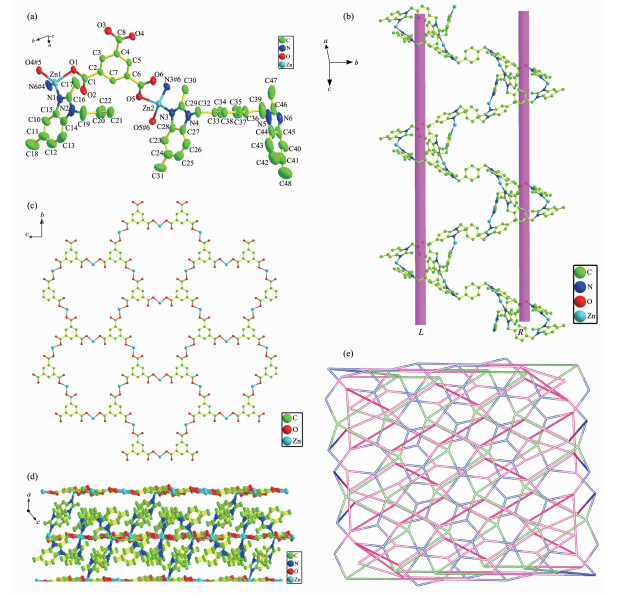
Symmetry codes in (a): #4: 1-x, 1+y, 1.5-z; #5: 0.5-x, 0.5+y, 0.5-z; #6: 1-x, y, 1.5-z
There are two independent dbim ligands in complex 1. dbim-Ⅰ exhibit asymmetrical cis-conforma-tion with an Ndonor…N-Csp3…Csp3 torsion angles of 108.256° and 114.981°. While dbim-Ⅱ exhibit symm-etrical trans-conformation with an Ndonor…N-Csp3…Csp3 torsion angle of 59.528°. The two types of dbim act as bidentate mode to link two adjacent Zn(Ⅱ) ions alternately to give rise to a meso-helix chain, as portrayed in Fig. 1b. The Zn…Zn distances across the dbim bridges are 1.199 1 nm (dbim-Ⅰ) and 1.322 8 nm (dbim-Ⅱ), separately. The btc3- anion presents a tridentate coordination mode, with three carboxylate groups adopting the monodentate modes. The Zn(Ⅱ)ions are connected by btc3- anions to form a 2D sheet structure (Fig. 1c), which is connected by dbim ligand via the Zn-N connection to generate a 3D framework (Fig. 1d). As discussed above, each btc3- anion links three Zn(Ⅱ) ions, and accordingly, the btc3- can be regarded as a 3-connected node. As for each Zn1(Ⅱ) ion and Zn2(Ⅱ) ion, they links two btc3- anions and two dbim ligands, respectively. Hence, the Zn1(Ⅱ)ion and Zn2(Ⅱ) ion are treated as a 4-connector, respe-ctively. According to the simplification principle, the resulting structure of complex 1 is a trinodal (3, 4, 4)-connected topology net with point symbol of (52·6·7·82)(52·6)(52·62·82) (Fig. 1e).
As illustrated in Fig. 2a, the asymmetric unit of complex 2 consists of one Zn(Ⅱ) ion, half a dbim ligand, half a btec4- ligand, one coordinated water molecule and one lattice water molecule. Each Zn(Ⅱ) ion is four-coordinated by two carboxylate oxygen atoms (O1 and O3#3) from two btec4- anions, one nitrogen atom (N1) from one dbim ligand and one oxygen atom (O5) from one water molecule. The Zn-O bond distances vary from 0.193 1(3) to 0.195 1(3) nm, while the Zn-N1 bond length is 0.200 0(4) nm. Ligand dbim adopts symmetric trans-conformation with an Ndonor…N-Csp3…Csp3 torsion angle of 74.697°. The btec4- anion presents a quadridentate coordination mode, with four carboxylate groups showing a monodentate mode. The Zn(Ⅱ) ions are connected by btec4- anions to form a 2D sheet structure (Fig. 2b), which is connected by dbim ligand in a tran-conformation via the Zn-N connection to generate a 3D pillar-layered framework (Fig. 2c). To further demonstrate the overall 3D structure of 2, we can consider each Zn(Ⅱ) as a 3-connecting node, which is linked to three equivalent nodes through one dbim ligand and two btec4- ligands. Moreover, the btec4- ligand can be simplified as a 4-connecting node and dbim is defined as a linker, the 3D framework of 2 can be described as (83)(85·10) topology (Fig. 2d).
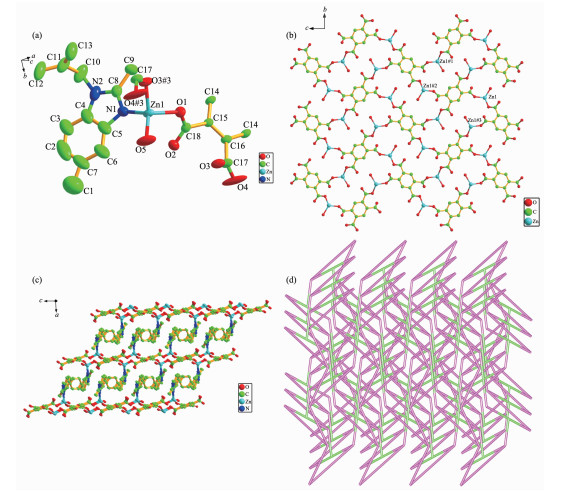
Symmetry codes: #3: 2-x, -0.5+y, 0.5-z in (a); #1: 2-x, 0.5+y, 0.5-z; #2: 2-x, 2-y, 1-z; #3: 2-x, -0.5+y, 0.5-z in (b)
As described above, the semi-rigid dbim ligand presents two independent conformation (dbim-Ⅰ and dbim-Ⅱ, respectively) in 1. dbim-Ⅰ exhibit asymm-etrical cis-conformation, while dbim-Ⅱ exhibit symm-etrical trans-conformation. The two types of dbim bridges adjacent Zn(Ⅱ) ions alternately to give rise to a meso-helix chain. However, in 2, dbim adopts single symmetric trans-conformation and serves as bridging pillar linking adjacent 2D Zn(Ⅱ)/btec4- layer, which makes 2 show 3D pillar-layered framework. The semi-rigid dbim can rotate freely when coordinating with central metal ions because of the flexible nature of the -(CH2)- spacers, which can greatly beautify and enrich the structure of complexes.
The carboxylate anions have important influence on the constructing of resultant 3D structures. In this work, we selected two multi-carboxylic acids (btc3- and btec4-) as co-ligands. By introducing ligand btc3-, 3D (3, 4, 4)-connected (52·6·7·82)(52·6)(52·62·82) topo-logy net 1 are obtained. When btec4- is introduced into the synthetic procedure of 2, 3D (3, 4)-connected (83)(85·10) topology are built. These results show diverse carboxylate co-ligands exert a pivotal influence on the features and overall structures of the resultant complexes.
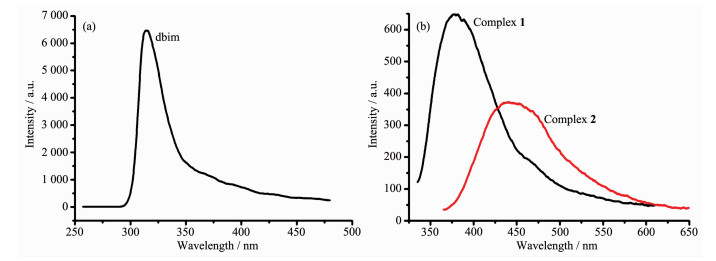
Fluorescence properties of the coordination complexes with d10 metal centers have attracted more interest owning to their potential applications[21-23]. Hence, the solid-state photoluminescent spectra of free dbim ligand and Zn(Ⅱ) complexes 1~2 were investi-gated at ambient temperature, as depicted in Fig. 3. The free ligand dbim displayed an emission band at 314 nm (λex=252 nm). As reported before[24], the photo-luminescent spectra of H3btc and H4btec showed different emission peak at 395 nm (λex=355 nm) and 340 nm (λex=310 nm), respectively. For complex 1, excited at 317 nm, it gave rise to an emission band at 380 nm (Fig. 3). As compared to dbim ligand, a red shift (66 nm) was observed. As compared to H3btc ligand, a smaller hypsochromic shift (15 nm) was observed. The emission spectrum of complex 2 displayed an emission band centered at 446 nm with excitation maximum at 355 nm and the emission band presented larger red shifts (106 and 132 nm) compared with those of ligand H4btec and dbim, respectively. According to the reference[24], the emission spectra of 1 and 2 are similar to those of H3btc and H4btec ligand, respectively, which also be mainly ascribed to the intraligand emission of H3btc and H4btec ligand, respectively[24-28].
In conclusion, by the introduction of two different multi-carboxylic acid co-ligands, two varied 3D architectures can be constructed from Zn(Ⅱ) salts and the semi-rigid bis(dimethylbenzimidazole) ligand. The successful fabrication of complexes 1 and 2 may furnish meritorious insights into the construction of wonderful frameworks. Moreover, 1 and 2 exhibit fluorescence properties, and maybe display potential for optical materials.
Sun L X, Qi Y, Wang Y M, et al. CrystEngComm, 2010, 12:1540-1547 doi: 10.1039/b909590j
Zhang J P, Lin Y Y, Huang X C, et al. Chem. Commun., 2005:1258-1260
Janiak C. Dalton Trans., 2003:2781-2804 http://cn.bing.com/academic/profile?id=e3e96819af0682b4ea47048a04cf427f&encoded=0&v=paper_preview&mkt=zh-cn
Janiak C, Vieth J K. New J. Chem., 2010, 34:2366-2388 doi: 10.1039/c0nj00275e
雷雪, 陈云舟, 李元祥, 等.无机化学学报, 2018, 34(3):545-550 http://www.wjhxxb.cn/wjhxxbcn/ch/reader/view_abstract.aspx?flag=1&file_no=20180318&journal_id=wjhxxbcnLEI Xue, CHEN Yun-Zhou, LI Yuan-Xiang, et al. Chinese J. Inorg. Chem., 2018, 34(3):545-550 http://www.wjhxxb.cn/wjhxxbcn/ch/reader/view_abstract.aspx?flag=1&file_no=20180318&journal_id=wjhxxbcn
吴琪, 苏志, 王红艳, 等.无机化学学报, 2017, 33(10):1889-1895 http://www.wjhxxb.cn/wjhxxbcn/ch/reader/view_abstract.aspx?flag=1&file_no=20171025&journal_id=wjhxxbcnWU Qi, SU Zhi, WANG Hong-Yan, et al. Chinese J. Inorg. Chem., 2017, 33(10):1889-1895 http://www.wjhxxb.cn/wjhxxbcn/ch/reader/view_abstract.aspx?flag=1&file_no=20171025&journal_id=wjhxxbcn
Xie Z, Ma L, deKrafft K E, et al. J. Am. Chem. Soc., 2010, 132:922-923 doi: 10.1021/ja909629f
Seo J S, Whang D, Lee H, et al. Nature, 2000, 404:982-986 doi: 10.1038/35010088
James S L. Chem. Soc. Rev., 2003, 32:276-288 doi: 10.1039/b200393g
Dong Y B, Zhao X, Huang R Q, et al. Inorg. Chem., 2004, 43:5603-5612 doi: 10.1021/ic049787a
Liu X G, Wang L Y, Zhu X, et al. Cryst. Growth Des., 2009, 9:3997-4005 doi: 10.1021/cg900134f
Hagrman P J, Hagrman D, Zubieta J. Angew. Chem. Int. Ed., 1999, 38:2638-2684 doi: 10.1002/(ISSN)1521-3773
Du M, Jiang X J, Zhao X J. Inorg. Chem., 2007, 46:3984-3995 doi: 10.1021/ic062098+
Zheng B, Bai J, Duan J, et al. J. Am. Chem. Soc., 2011, 133:748-751 doi: 10.1021/ja110042b
Li H, Eddaoudi M, O'Keeffe M, et al. Nature, 1999, 402:276-279 doi: 10.1038/46248
Sun D, Zhang N, Huang R B, et al. Cryst. Growth Des., 2010, 10:3699-3709 doi: 10.1021/cg100554u
Deng H, Doonan C J, Furukawa H, et al. Science, 2010, 327:846-850 doi: 10.1126/science.1181761
Bronisz R. Inorg. Chem., 2005, 44:4463-4465 doi: 10.1021/ic050449z
Dolomanov O V, Bourhis L J, Gildea R J, et al. J. Appl. Cryst., 2009, 42:339-341 doi: 10.1107/S0021889808042726
Sheldrick G M. Acta Crystallogr. Sect. A:Found. Crystallogr., 2008, A64:112-122 http://cn.bing.com/academic/profile?id=ecd6cbf1918033eb33dbac7eb5a74a29&encoded=0&v=paper_preview&mkt=zh-cn
Bai H Y, Ma J F, Yang J, et al. Cryst. Growth Des., 2010, 10:995-1016 doi: 10.1021/cg901332m
Wu Q, Esteghamatian M, Hu N X, et al. Chem. Mater., 2000, 12:79-83 doi: 10.1021/cm990372a
Santis G D, Fabbrizzi L, Licchelli M, et al. Angew. Chem. Int. Ed., 1996, 35:202-204 doi: 10.1002/(ISSN)1521-3773
Hua Q, Zhao Y, Xu G C, et al. Cryst. Growth Des., 2010, 10:2553-2562 doi: 10.1021/cg901480y
Stadler M, Puntoriero F, Campagna S, et al. Chem. Eur. J., 2005, 11:3997-4009 doi: 10.1002/(ISSN)1521-3765
Censo D D, Fantacci S, Angelis F D, et al. Inorg. Chem., 2008, 47:980-989 doi: 10.1021/ic701814h
Wang J H, Fang Y Q, Bourget-Merle L, et al. Chem. Eur. J., 2006, 12:8539-8548 doi: 10.1002/(ISSN)1521-3765
Ohkoshi S, Tokoro H, Hozumi T, et al. J. Am. Chem. Soc., 2006, 128:270-277 doi: 10.1021/ja0559092

Figure 1 (a) Coordination environment of Zn (Ⅱ) ion in 1 with hydrogen atoms omitted for clarity; (b) 1D meso-helix chain built though Zn(Ⅱ) ions and dbim linkers in 1; (c) 2D layer structure of 1 constructed by Zn(Ⅱ) ions and btc3- linkers; (d) Schematic view of 3D framework built by 1D Zn(Ⅱ)/dbim and 2D Zn(Ⅱ)/btc3- layers in 1; (e) Schematic description of a (3, 4, 4)-connected 3D network with (52·6·7·82)(52·6) (52·62·82) topology for 1
Symmetry codes in (a): #4: 1-x, 1+y, 1.5-z; #5: 0.5-x, 0.5+y, 0.5-z; #6: 1-x, y, 1.5-z

Figure 2 (a) Coordination environment of Zn(Ⅱ) ion in 2 with hydrogen atoms omitted for clarity; (b) 2D sheet generated by Zn(Ⅱ) ions and btec4- linkers in 2; (c) Schematic view of 3D framework built by 2D Zn(Ⅱ)/btec4- layers and dbim pillars in 2 with H atoms omitted for clarity; (d) Schematic view of the 3D topology network with the point symbol of (83)(85·10) for 2
Symmetry codes: #3: 2-x, -0.5+y, 0.5-z in (a); #1: 2-x, 0.5+y, 0.5-z; #2: 2-x, 2-y, 1-z; #3: 2-x, -0.5+y, 0.5-z in (b)

Figure 3 Photoluminescent spectra of ligand dbim (a) and complexes 1~2 (b) in solid state at room temperature
Table 1. Crystal data and structure refinement details for complexes 1 and 2
| Complex | 1 | 2 |
| Formula | C96H96N12O18Zn3 | C18H18N2O6Zn |
| Formula weight | 1 902.08 | 423.71 |
| Crystal system | Monoclinic | Monoclinic |
| Space group | C2/c | P21/c |
| a / nm | 3.432 8(4) | 1.070 2(2) |
| b / nm | 1.781 82(5) | 1.012 0(2) |
| c / nm | 2.237 1(2) | 1.668 2(3) |
| β / (°) | 136.44(2) | 93.15(3) |
| V / nm3 | 9.430(3) | 1.804(6) |
| Z | 4 | 4 |
| Dc / (g·cm-3) | 1.264 | 1.560 |
| Absorption coefficient / mm-1 | 1.412 | 1.400 |
| F(000) | 3 720 | 872 |
| θ range / (°) | 4.635~70.276 | 1.91~25.00 |
| GOF | 1.023 | 0.992 |
| R1a [I>2σ(I)] | 0.060 5 | 0.071 3 |
| wR2b [I>2σ(I)] | 0.169 4 | 0.188 0 |
| a R1=∑||Fo|-|Fc||/∑|Fo|; b wR2=[∑w(Fo2-Fc2)2/∑w(Fo2)2]1/2. | ||
 下载: 导出CSV
Table 2. Selected bond lengths (nm) and bond angles (°) for 1 and 2
| 1 | |||||
| Zn(1)-N(1) | 0.202 4(4) | Zn(2)-N(3) | 0.204 2(3) | Zn(1)#2-N(6) | 0.201 1(4) |
| Zn(1)-O(1) | 0.200 9(2) | Zn(1)#3-O(4) | 0.199 1(2) | Zn(2)-O(5) | 0.199 4(2) |
| Zn(1)-N(6)#4 | 0.201 1(4) | Zn(1)-O(4)#5 | 0.199 1(2) | Zn(2)-N(3)#6 | 0.204 1(3) |
| Zn(2)-O(5)#6 | 0.199 4(2) | ||||
| N(6)#4-Zn(1)-N(1) | 128.30(16) | O(1)-Zn(1)-N(1) | 103.66(11) | O(1)-Zn(1)-N(6)#4 | 106.34(12) |
| O(4)#5-Zn(1)-N(1) | 104.03(12) | O(4)#5-Zn(1)-N(6)#4 | 106.90(14) | O(4)#5-Zn(1)-O(1) | 105.84(10) |
| N(3)#6-Zn(2)-N(3) | 119.53(18) | O(5)-Zn(2)-N(3)#6 | 105.24(11) | O(5)#6-Zn(2)-N(3)#6 | 112.04(11) |
| O(5)-Zn(2)-N(3) | 112.04(11) | O(5)#6-Zn(2)-N(3) | 105.23(11) | O(5)#6-Zn(2)-O(5) | 101.38(14) |
| 2 | |||||
| Zn(1)#1-O(3) | 0.195 1(3) | Zn(1)-O(5) | 0.193 1(3) | Zn(1)-O(1) | 0.195 0(3) |
| Zn(1)-O(3)#3 | 0.195 1(3) | Zn(1)-N(1) | 0.200 0(4) | ||
| O(5)-Zn(1)-O(1) | 109.30(15) | O(5)-Zn(1)-O(3)#3 | 117.12(14) | O(1)-Zn(1)-O(3)#3 | 102.28(13) |
| O(5)-Zn(1)-N(1) | 114.13(18) | O(1)-Zn(1)-N(1) | 112.04(14) | O(3)#3-Zn(1)-N(1) | 101.26(14) |
| Symmetry codes: #2: 1-x, -1+y, 3/2-z; #3: 1/2-x, -1/2+y, 1/2-z; #4: 1-x, 1+y, 3/2-z; #5: 1/2-x, 1/2+y, 1/2-z; #6: 1-x, y, 3/2-z for 1; #1: -x+2, y+1/2, -z+1/2; #3: -x+2, y-1/2, -z+1/2 for 2. | |||||
下载: 导出CSV

 扫一扫看文章


扫一扫关注我们
