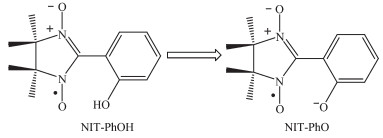
Scheme 1.
Nitronyl nitroxide radicals NIT-PhOH and NIT-PhO


Lanthanide-based complexes are attracting an increasing attention over the past decades because of their enchanting and potential applications in the realm of molecular magnetic materials[1-4].
The lanthanide ions are excellent candidates for developing molecular magnetic materials because of their outstanding single-ion anisotropy and large magnetic moments[5-6]. To date, a large number of lanthanide-based complexes such as pure lanthanide complexes[7-9] and mixed transition metal-4f compl- exes[10-11] or radical-4f complexes[12-15] have been obtained and characterized in terms of structures and magnetic properties, and plenty of them exhibit novel structures and good magnetic properties[16-19]. It should be noted that in contrast to 3d-4f or pure 4f systems, fewer Ln-radical complex has been reported so far. The research demonstrates that the magnetic properties of Ln-radical based complexes have a broad variation, among which both antiferromagnetic[20-21] and ferromagnetic[22-23] interactions between the radical ligand and the lanthanide ions center have been observed. Some of them have been observed to exhibit slow magnetic relaxation behaviors[21, 23]. For the applied radical ligands, the nitronyl nitroxide radicals (NITR) are one of the most explored owing to their stability and ease chemical modification[24]. Especially, since the first Dy(Ⅲ)-radical based molecule [Dy(hfac)3NITpPy]2 showing single-molecule magnetic behavior was discovered in 2007[25], much attention has been attracted by the nitronyl nitroxide-4f complexes[26-27]. Recently, a few Ln-nitronyl nitroxide complexes revealing magnetic relaxation have been described. To explore new Ln-nitronyl-nitroxide-based complexes, herein we employ the NIT-PhOH (Scheme 1) radical containing a hydroxyl group to build new Ln-radical complexes. Herein, the synthesis, crystallography and magnetic characterization of two new phenoxo-bridged lanthanide-radical binuclear complexes [Ln2(acac)4(NIT-PhO)2] (Ln=Tb (1), Y (2)) are reported. Before this, several complexes have been obtained through NIT-PhOH radical already[28-30], some of which have excellent magnetic property. In order to get more novel complexes with good magnetic property, we study further.
All chemicals were used as received without any further purification. The starting materials Ln(acac)3·3H2O were synthesized by the methods in the literature[31]. The radical ligand NIT-PhOH was prepared by the reported methods[32-33]. Elemental analyses for C, H, and N were obtained at the Institute of Elemental Organic Chemistry, Nankai University. The infrared spectra of the complexes in KBr pellets were obtained on a Bruker Tensor 27 IR spectrometer in a range of 4 000~400 cm-1 region. Magnetic measurements were performed on a SQUID MPMS XL-7 magnetometer. Diamagnetic corrections were made with Pascal′s constants for all of the constituent atoms.
Tb(acac)3·3H2O (0.103 g, 0.2 mmol) in 30 mL dry n-heptane was heated to reflux for 3 h. Then the solution was cooled to 60 ℃, and a dry CH2Cl2 solution of NIT-PhOH (0.050 g, 0.2 mmol) was added. The resulting mixture was stirred for 15 min at 60 ℃, then cooled to room temperature and filtered. After 2 days, the little azury rectangular crystals was obtained. Yield: 60%. Anal. Calcd. for C46O14N4H60Tb2(%): C, 45. 63; H, 4.99; N, 4.63. Found(%): C, 45.12; H, 4.86; N, 4.56. FT-IR(KBr, cm-1): 2 991(w), 1 603(s), 1 518(s), 1 392(s), 1 258(s), 1 173(m), 1 017(m), 922(m), 819(m), 766(m), 624(m), 537(w).
The preparation was similar to that of 1 but Y(acac)3·3H2O (0.089 g, 0.2 mmol) was used in place of Tb(acac)3·3H2O. Yield: 70%. Anal. Calcd. for C46O14N4H60Y2(%): C, 51.59; H, 5.65; N, 5.23. Found(%): C, 51.93; H, 6.09; N, 5.23. FT-IR (KBr, cm-1): 2 988(w), 1 603(s), 1 519(s), 1 397(s), 1 238(m), 1 169(m), 1 016(s), 919(s), 869(m), 811(s), 763(s), 653(w), 536(w).
X-ray single-crystal diffraction of complexes 1 and 2 was performed on a Rigaku mercury CCD diffractometer with graphite-mono-chromated Mo Kα radiation (λ=0.071 073 nm) at 113(2) K. In each case, absorption corrections were applied. The structures were solved by direct methods and refined with full-matrix least-squares technique using the SHELXS-97 and SHELXL-97 programs[34-35]. All non-hydrogen atoms were refined anisotropically and hydrogen atoms were added theoretically and refined isotropically using a riding mode. Crystallographic data and structure refinement results of the complexes 1 and 2 were listed in Table 1.

 下载:
导出CSV
下载:
导出CSV
| Complex | 1 | 2 |
| Empirical formula | C46H60N4O14Tb2 | C46H60N4O14Y2 |
| Molecular weight | 1 210.84 | 1 070.80 |
| Crystal system | Triclinic | Triclinic |
| Space group | P1 | P1 |
| a / nm | 1.047 8(4) | 1.043 4(5) |
| b / nm | 1.127 1(2) | 1.124 8(6) |
| c / nm | 1.182 3(3) | 1.189 1(5) |
| α / (°) | 104.01(2) | 104.520(4) |
| β / (°) | 98.761(17) | 98.864(2) |
| γ / (°) | 114.616(12) | 114.079(7) |
| V / nm3 | 1.179 8(6) | 1.180 4(10) |
| Z | 2 | 2 |
| Dc / (g·cm-3) | 1.704 | 1.506 |
| μ / mm-1 | 3.043 | 2.516 |
| θ range / (°) | 1.85~25.02 | 1.85~25.01 |
| F(000) | 606 | 554 |
| Reflection collected | 9 380 | 9 732 |
| Unique reflection | 4 149 | 4 146 |
| Rint | 0.060 0 | 0.067 7 |
| GOF (F2) | 1.063 | 1.058 |
| R1 [I>2σ(I)] | 0.043 3 | 0.055 0 |
| wR2 [I>2σ(I)] | 0.101 9 | 0.107 9 |
| R1 (all data) | 0.049 2 | 0.070 2 |
| wR2 (all data) | 0.104 9 | 0.114 9 |
CCDC: 1878666, 1; 1878665, 2.
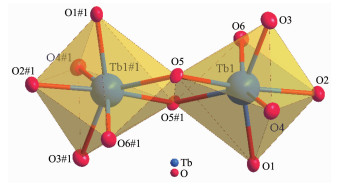
Single-crystal X-ray diffraction analysis reveals that complexes 1 and 2 are isostructural and crystallize in the triclinic space group P1. Selected bond parameters for complexes 1 and 2 are listed in Table 2. Both complexes have centrosymmetric binuclear structure bridged by two phenoxo groups. For their identical structural motifs, only the structure of complex 1 is described herein as representative. In the asymmetric unit of 1, there are crystallographically independent one Tb(acac)2 unit and one radical anion ligand(Fig. 1). As shown in Fig. 1, to each Tb(Ⅲ) ion, there are seven coordination sites, which are occupied by four oxygen atoms from two acac ligands, two phenoxo-O atoms and one NO group from one radical ligand. Coordination geometry around the Tb(Ⅲ) ions is analyzed by using the program of SHAPE[36] and the lower CShM values of the shape measure are found relative to capped octahedron(C3v)(Table 3). The coordination geometry of Tb(Ⅲ) ions is shown in Fig. 2. The two nitronyl nitroxide radical ainons act as bridge ligands to link two Tb(Ⅲ) ions through two μ2-O atoms of the phenoxo groups, leading to a binuclear Tb2O2 unit with the intramolecular Tb(Ⅲ)…Tb(Ⅲ) distance of 0.393 86(16) nm. The Tb-Oacac bond lengths are in a range of 0.227 3(4)~0.233 4(4) nm. The Tb-Oradical bond distance is 0.231 9(5) nm. The Tb-O-Tb bridge angle is 112.66(16)° (Tb(1)-O5-Tb(1)#1). These bond parameters are comparable to those reported in other lanthanide salicylic aldehyde substituted radical complexes[37]. The shortest separation between the uncoordinated NO groups is 0.545 3 nm. This separa-tion is large enough to convince us to consider the complexes in the solid state as a discrete binuclear Tb(Ⅲ) complex, although the possible weak intermole-cular interaction can not be excluded.
下载:
导出CSV
| 1 | |||||
| Tb(1)-O(6) | 0.231 9(5) | Tb(1)-O(5) | 0.236 5(4) | Tb(1)-O(5)#1 | 0.236 7(4) |
| Tb(1)-O(1) | 0.227 3(4) | Tb(1)-O(2) | 0.233 4(4) | Tb(1)-O(3) | 0.229 3(4) |
| Tb(1)-O(4) | 0.231 9(5) | O(6)-N(1) | 0.130 4(6) | O(7)-N(2) | 0.127 1(7) |
| N(1)-C(17) | 0.134 5(8) | N(1)-C(19) | 0.149 2(8) | N(2)-C(18) | 0.148 8(8) |
| N(2)-C(17) | 0.137 5(8) | ||||
| O(1)-Tb(1)-O(2) | 73.89(15) | O(3)-Tb(1)-O(4) | 75.94(17) | O(6)-Tb(1)-O(5) | 109.76(15) |
| O(1)-Tb(1)-O(6) | 113.78(16) | O(3)-Tb(1)-O(6) | 79.59(16) | O(3)-Tb(1)-O(5)#1 | 129.86(15) |
| O(6)-Tb(1)-O(5)#1 | 72.45(15) | N(1)-O(6)-Tb(1) | 136.8(4) | O(6)-N(1)-C(17) | 126.7(6) |
| C(11)-O(5)-Tb(1) | 125.0(4) | C(11)-O(5)-Tb(1)#1 | 121.8(3) | Tb(1)-O(5)-Tb(1)#1 | 112.66(16) |
| 2 | |||||
| Y(1)-O(1) | 0.226 2(3) | Y(1)-O(2) | 0.229 1(3) | Y(1)-O(3) | 0.231 1(3) |
| Y(1)-O(4) | 0.224 3(3) | Y(1)-O(5) | 0.235 7(3) | Y(1)-O(5)#2 | 0.232 7(3) |
| Y(1)-O(6) | 0.230 0(3) | O(7)-N(2) | 0.127 8(4) | O(6)-N(1) | 0.130 3(4) |
| N(1)-C(17) | 0.133 3(5) | N(1)-C(18) | 0.150 6(6) | N(2)-C(17) | 0.136 6(5) |
| N(2)-C(19) | 0.150 3(5) | ||||
| O(1)-Y(1)-O(2) | 76.89(11) | O(4)-Y(1)-O(3) | 74.75(11) | O(6)-Y(1)-O(5) | 72.88(10) |
| C(11)-O(5)-Y(1) | 120.6(2) | C(11)-O(5)-Y(1)#2 | 126.1(2) | O(6)-N(1)-C(17) | 126.1(4) |
| O(6)-N(1)-C(18) | 121.1(3) | O(7)-N(2)-C(17) | 126.0(4) | O(7)-N(2)-C(19) | 121.1(4) |
| N(1)-O(6)-Y(1) | 137.1(3) | O(1)-Y(1)-O(5) | 129.75(11) | O(2)-Y(1)-O(5) | 133.45(10) |
| Symmetry codes: #1: -x+1, -y, -z for 1; #2: -x+2, -y+1, -z+1 for 2. | |||||
下载:
导出CSV
| Atom | PBPY-7(D5h) | COC-7(C3v) | CTPR-7(C2v) | JPBPY-7(D5h) |
| Tb1 | 7.685 | 0.575 | 2.016 | 11.834 |
| Y1 | 7.785 | 0.521 | 2.047 | 11.639 |
| PBPY-7: Pentagonal bipyramid; COC-7: Capped octahedron; CTPR-7: Capped trigonal prism; JPBPY-7: Johnson pentagonal bipyramid J13. | ||||
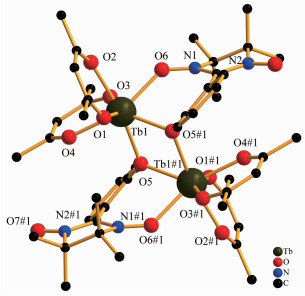
All hydrogen atoms are omitted for clarity; Symmetry codes:
#1:-x+1, -y, -z
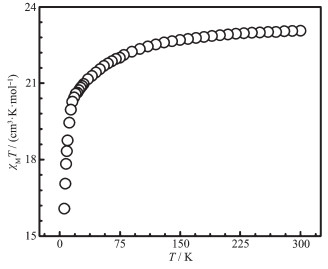
Variable temperature (300~2.0 K) direct current (dc) magnetic susceptibility was measured for the crystalline sample of 1 under an applied magnetic field of 2.0 kOe. As shown in Fig. 3, the χMT product for 1 was 23.07 cm3·K·mol-1 at 300 K, which is slightly lower than the theoretical value of 24.37 cm3·K·mol-1 for two isolated Tb(Ⅲ) ions (7F6, S=3, L=3, g=3/2, C=11.81 cm3·K·mol-1) and two uncoupled organic radicals (S=1/2). The value is comparable with the complex [Tb(hfac)2(NIT2PhO)][37]. On lowering the temperature, the χMT value gradually decreased before 18 K, then decreased sharply to the value of 10.30 cm3·K·mol-1 at 2.0 K. Based on the crystal structure of 1, this magnetic behavior may be ascribed to the combination of the depopulation of the Tb(Ⅲ) Stark sublevels, the magnetic exchange between the Tb(Ⅲ) ion and the coordinated NO group, and the Tb…Tb magnetic coupling transmitted by double phenolate bridges.
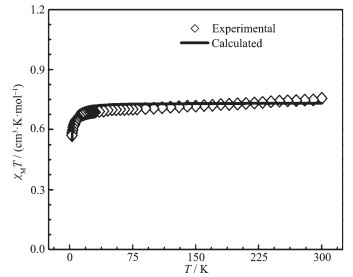
The magnetic susceptibility of complex 2 is measured under 5 kOe in a range of 2~300 K and the magnetic behavior is shown in Fig. 4. At room temperature, the χMT value of complex 2 was 0.74 cm3·K·mol-1, which is in agreement with the expected value of 0.75 cm3·K·mol-1 for an uncoupled system of two organic radicals (S=1/2). When the temperature was decreased, the χMT value decreased gradually and then reached to the minima value 0.58 cm3·K·mol-1 at 2.0 K. The magnetic data was analyzed by a theore-tical expression deduced from the spin Hamiltonian
|
$ {\chi _{\rm{M}}} = \frac{{N_g^2{\beta ^2}}}{{kT}}\frac{2}{{3 + \exp [ - 2J/(kT)]}} $ |
|
$ {\chi _{{\rm{total}}}} = \frac{{{\chi _{\rm{M}}}}}{{1 - \frac{{zJ'}}{{N_g^2{\beta ^2}}}{\chi _{\rm{M}}}}} $ |
The least-squares fit to the data yielded the following parameter values: g=1.99, J=-1.69 cm-1, zJ′=-0.067 cm-1, with an agreement factor R=9.30×10⁻⁴. R is defined as
Two isostructural Ln-radical complexes are prepared by using the nitronyl nitroxide radical with a phenolate group. These two complexes are binuclear complexes in which the nitronyl nitroxides are the radical anions and act as bridging ligands to bridge two Ln(Ⅲ) ions through two phenoxo groups. This is less common than the usually obtained Ln-nitronyl nitroxide complexes where the radical is neutral ligand. Magnetic measurements show that complex 2 displays a weak anti-ferromagnetic coupling interaction. This work could represent an important avenue to synthesize polynuclear lantnanide-nitroxide based complexes.
Hansen P, Lachowicz H K. Physics of Magnetic Materials. Singapore:World Scientific, 1985:158
Liu K, Zhang X J, Meng X X, et al. Chem. Soc. Rev., 2016, 45(9):2423-2439 doi: 10.1039/C5CS00770D
Zhe Y Z, Evangelisti M, Winpenny R E P. Angew. Chem. Int. Ed., 2011, 50(16):3692-3695 doi: 10.1002/anie.v50.16
任旻, 郑丽敏.化学学报, 2015, 73:1091-1113REN Min, ZHENG Li-Min. Acta Chim. Sinica, 2015, 73:1091-1113
李东平, 王倩, 谢一步, 等.无机化学学报, 2018, 34(8):1547-1554LI Dong-Ping, WANG Qian, XIE Yi-Bu, et al. Chinese J. Inorg. Chem., 2018, 34(8):1547-1554
Cornia A, Fabretti A C, Pacchioni M, et al. Angew. Chem., Int. Ed., 2003, 42(14):1645-1648 doi: 10.1002/anie.200350981
Guo F S, Day B M, Chen Y C, et al. Angew. Chem. Int. Ed., 2017, 56(38):11445-11449 doi: 10.1002/anie.v56.38
Goodwin C A P, Ortu F, Reta D, et al. Nature, 2017, 548(7668):439-442 doi: 10.1038/nature23447
Harriman K L M, Brosmer J L, Ungur L, et al. J. Am. Chem. Soc., 2017, 139(4):1420-1423 doi: 10.1021/jacs.6b12374
Peng J B, Zhang Q C, Kong X J, et al. J. Am. Chem. Soc., 2012, 134(7):3314-3317 doi: 10.1021/ja209752z
Song X Q, Liu P P, Liu Y A, et al. Dalton Trans., 2016, 45(19):8154-8163 doi: 10.1039/C6DT00212A
Bernot K, Pointillart F, Rosa P, et al. Chem. Commun., 2010, 46(35):6458-6460 doi: 10.1039/c0cc00966k
Rinehart J D, Fang M, Evans W J, et al. J. Am. Chem. Soc., 2011, 133(36):14236-14239 doi: 10.1021/ja206286h
Brian S D, Dimitris I A, Kuduva R V, et al. J. Am. Chem. Soc., 2018, 140(3):908-911 doi: 10.1021/jacs.7b12495
胡鹏, 高媛媛, 肖凤仪, 等.无机化学学报, 2017, 33(1):33-40 http://www.wjhxxb.cn/wjhxxbcn/ch/reader/view_abstract.aspx?flag=1&file_no=20170104&journal_id=wjhxxbcnHU Peng, GAO Yuan-Yuan, XIAO Feng-Yi, et al. Chinese J. Inorg. Chem., 2017, 33(1):33-40 http://www.wjhxxb.cn/wjhxxbcn/ch/reader/view_abstract.aspx?flag=1&file_no=20170104&journal_id=wjhxxbcn
Ishikawa N, Sugita M, Ishikawa T, et al. J. Am. Chem. Soc., 2003, 125(29):8694-8695 doi: 10.1021/ja029629n
Tang J K, Hewitt I, Madhu N T, et al. Angew. Chem. Int. Ed., 2006, 45(11):1729-1733 doi: 10.1002/(ISSN)1521-3773
Hewitt I J, Tang J K, Madhu N T, et al. Angew. Chem. Int. Ed., 2010, 49(36):6352-6356 doi: 10.1002/anie.201002691
Huang G, Fernandez-Garcia G, Badiane I, et al. Chem. Eur. J., 2018, 24(27):6983-6991 doi: 10.1002/chem.v24.27
Lescop C, Luneau D, Belorizky E, et al. Inorg. Chem., 1999, 38:5472 doi: 10.1021/ic990996i
Tian H X, Wang X F, Mei X L, et al. Inorg. Chem., 2013, 8:1320-1325
Sutter J P, Kahn M L, Golhen S, et al. Chem. Eur. J., 1998, 4(4):571-576 https://www.researchgate.net/publication/230534181_Synthesis_and_Magnetic_Behavior_of_Rare-Earth_Complexes_with_NO-Chelating_Nitronyl_Nitroxide_Triazole_Ligands_Example_of_a_GdIIIOrganic_Radical2_Compound_with_an_S92_Ground_State
Hu P, Zhu M, Mei X L, et al. Dalton Trans., 2012, 41:14651-14656 doi: 10.1039/c2dt31806g
Caneschi A, Gatteschi D, Rey P. Prog. Inorg. Chem., 1991, 39:331-429
Poneti G, Bernot K, Bogani L, et al. Chem. Commun., 2007, 18:1807-1809
Lannes A, Intissar M, Suffren Y, et al. Inorg. Chem., 2014, 53(18):9548-9560 doi: 10.1021/ic500779y
Bernot K, Pointillart F, Rosa P, et al. Chem. Commun., 2010, 46:6458-6460 doi: 10.1039/c0cc00966k
Mei X L, Liu R N, Wang C, et al. Dalton Trans., 2012, 41:2904-2909 doi: 10.1039/c2dt11671e
Mei X L, Wang X F, Wang J J, et al. New J. Chem., 2013, 37:3620-3626 doi: 10.1039/c3nj00739a
Liu R N, Zhang C M, Li L C, et al. Dalton Trans., 2012, 41:12139-12144 doi: 10.1039/c2dt31310c
Shinya K, Yasunori T, Yasuchika H, et al. Bull. Chem. Soc. Jpn., 2007, 80:1492-1503 doi: 10.1246/bcsj.80.1492
Tretyakov E V, Eltsov I V, Fokin S V, et al. Polyhedron, 2003, 22:2499-2514 doi: 10.1016/S0277-5387(03)00228-6
Kanda H, Narumi Y, Hosokoshi Y, et al. Inorg. Chim. Acta, 2004, 357:3125-3133 doi: 10.1016/j.ica.2004.03.017
Sheldrick G M. SHELXL-97, Program for the Refinement of Crystal Structures, University of Göttingen, Germany, 1997.
Sheldrick G M. SHELXS-97, Program for the Solution of Crystal Structures, University of Göttingen, Germany, 1997.
Lluncll M, Casanova D, Circra J, et al. SHAPE, Ver.2.1, University of Barcelona:Spain, Hebrew University of Jerusalem:Israel, 2005.
Liu R N, Liu L, Fang D, et al. Z. Anorg. Allg. Chem., 2015, 641(3/4):728-731
Benelli C, Caneschi A, Gatteschi D, et al. Inorg. Chem., 1993, 32(22):4797-4801 doi: 10.1021/ic00074a023
Jung J, Puget M, Cador O, et al. Inorg. Chem., 2017, 56(12):6788-6801 doi: 10.1021/acs.inorgchem.6b02952

Figure 1 Crystal structure of complex 1
All hydrogen atoms are omitted for clarity; Symmetry codes:
#1:-x+1, -y, -z
Table 1. Crystallographic data for complexes 1 and 2
| Complex | 1 | 2 |
| Empirical formula | C46H60N4O14Tb2 | C46H60N4O14Y2 |
| Molecular weight | 1 210.84 | 1 070.80 |
| Crystal system | Triclinic | Triclinic |
| Space group | P1 | P1 |
| a / nm | 1.047 8(4) | 1.043 4(5) |
| b / nm | 1.127 1(2) | 1.124 8(6) |
| c / nm | 1.182 3(3) | 1.189 1(5) |
| α / (°) | 104.01(2) | 104.520(4) |
| β / (°) | 98.761(17) | 98.864(2) |
| γ / (°) | 114.616(12) | 114.079(7) |
| V / nm3 | 1.179 8(6) | 1.180 4(10) |
| Z | 2 | 2 |
| Dc / (g·cm-3) | 1.704 | 1.506 |
| μ / mm-1 | 3.043 | 2.516 |
| θ range / (°) | 1.85~25.02 | 1.85~25.01 |
| F(000) | 606 | 554 |
| Reflection collected | 9 380 | 9 732 |
| Unique reflection | 4 149 | 4 146 |
| Rint | 0.060 0 | 0.067 7 |
| GOF (F2) | 1.063 | 1.058 |
| R1 [I>2σ(I)] | 0.043 3 | 0.055 0 |
| wR2 [I>2σ(I)] | 0.101 9 | 0.107 9 |
| R1 (all data) | 0.049 2 | 0.070 2 |
| wR2 (all data) | 0.104 9 | 0.114 9 |
 下载: 导出CSV
Table 2. Selected important bond lengths (nm) and angles (°) for complexes 1 and 2
| 1 | |||||
| Tb(1)-O(6) | 0.231 9(5) | Tb(1)-O(5) | 0.236 5(4) | Tb(1)-O(5)#1 | 0.236 7(4) |
| Tb(1)-O(1) | 0.227 3(4) | Tb(1)-O(2) | 0.233 4(4) | Tb(1)-O(3) | 0.229 3(4) |
| Tb(1)-O(4) | 0.231 9(5) | O(6)-N(1) | 0.130 4(6) | O(7)-N(2) | 0.127 1(7) |
| N(1)-C(17) | 0.134 5(8) | N(1)-C(19) | 0.149 2(8) | N(2)-C(18) | 0.148 8(8) |
| N(2)-C(17) | 0.137 5(8) | ||||
| O(1)-Tb(1)-O(2) | 73.89(15) | O(3)-Tb(1)-O(4) | 75.94(17) | O(6)-Tb(1)-O(5) | 109.76(15) |
| O(1)-Tb(1)-O(6) | 113.78(16) | O(3)-Tb(1)-O(6) | 79.59(16) | O(3)-Tb(1)-O(5)#1 | 129.86(15) |
| O(6)-Tb(1)-O(5)#1 | 72.45(15) | N(1)-O(6)-Tb(1) | 136.8(4) | O(6)-N(1)-C(17) | 126.7(6) |
| C(11)-O(5)-Tb(1) | 125.0(4) | C(11)-O(5)-Tb(1)#1 | 121.8(3) | Tb(1)-O(5)-Tb(1)#1 | 112.66(16) |
| 2 | |||||
| Y(1)-O(1) | 0.226 2(3) | Y(1)-O(2) | 0.229 1(3) | Y(1)-O(3) | 0.231 1(3) |
| Y(1)-O(4) | 0.224 3(3) | Y(1)-O(5) | 0.235 7(3) | Y(1)-O(5)#2 | 0.232 7(3) |
| Y(1)-O(6) | 0.230 0(3) | O(7)-N(2) | 0.127 8(4) | O(6)-N(1) | 0.130 3(4) |
| N(1)-C(17) | 0.133 3(5) | N(1)-C(18) | 0.150 6(6) | N(2)-C(17) | 0.136 6(5) |
| N(2)-C(19) | 0.150 3(5) | ||||
| O(1)-Y(1)-O(2) | 76.89(11) | O(4)-Y(1)-O(3) | 74.75(11) | O(6)-Y(1)-O(5) | 72.88(10) |
| C(11)-O(5)-Y(1) | 120.6(2) | C(11)-O(5)-Y(1)#2 | 126.1(2) | O(6)-N(1)-C(17) | 126.1(4) |
| O(6)-N(1)-C(18) | 121.1(3) | O(7)-N(2)-C(17) | 126.0(4) | O(7)-N(2)-C(19) | 121.1(4) |
| N(1)-O(6)-Y(1) | 137.1(3) | O(1)-Y(1)-O(5) | 129.75(11) | O(2)-Y(1)-O(5) | 133.45(10) |
| Symmetry codes: #1: -x+1, -y, -z for 1; #2: -x+2, -y+1, -z+1 for 2. | |||||
下载: 导出CSV
Table 3. Coordination geometry analysis for complexes 1 (Tb1) and 2 (Y1)
| Atom | PBPY-7(D5h) | COC-7(C3v) | CTPR-7(C2v) | JPBPY-7(D5h) |
| Tb1 | 7.685 | 0.575 | 2.016 | 11.834 |
| Y1 | 7.785 | 0.521 | 2.047 | 11.639 |
| PBPY-7: Pentagonal bipyramid; COC-7: Capped octahedron; CTPR-7: Capped trigonal prism; JPBPY-7: Johnson pentagonal bipyramid J13. | ||||
下载: 导出CSV

 扫一扫看文章


扫一扫关注我们