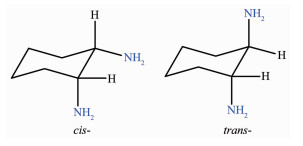
Scheme 1.
cis- and trans-configurations of 1, 2-cyclohexanediamine

Influences of cis-, trans-1, 2-Cyclohexanediamine Configurations on Iodoantimonate Organic-Inorganic Hybrid Isomers
Zhi-Wen LIANG , Xiao-Rou CHEN , Hui YU , Zhen-Hong WEI , Xiu-Xiu ZHANG , Hu CAI


During the past decades, organic-inorganic hybrid compounds have received considerable attention due to their opportunity to combine useful properties of both components[1-3], in which the inorganic component supplies the features of adjustable mechanical comp-osition, large polarity, good optoelectronic properties, thermal stability and electron mobility; and the organic component usually acts as a structure-directing agent and greatly affects the structure of the inorganic part, as well as balances the charge from the inorganic component.
As regards the metal-halide anions, an extensive work has been devoted to the semiconducting metal halide anions (Sn, Pb, Bi, Sb) because the semicond-uctor metals have an important application in photo-voltaic cells because they have suitable band gap width, high light absorption coefficient, the equilibrium electron hole injection distance, and electronic mobility characteristics[4-11]. On the other hand, it has been demonstrated that the organic amines as popular templates with tunable size, charge and shape can have a great effect on the final structures and properties of hybrids[12-13]. Most popularly used organic amine cations incorporated in hybrids are either alkylammo-nium[14-15] or single ring aromatic ammonium cations[16]. As have been already pointed out, the skeleton of diammonium cations is the key to the formation of novel inorganic structures[17-19].
1, 2-Cyclohexanediamine(DAC) is an extraord-inary interesting molecule because it displays two different stable cis- and trans-boat configurations as shown in Scheme 1[20-22]. Not only its adjacent two primary amines may have a synergistic effect on the finial structure, but also the cis- and trans-1, 2-cyclohexanediamines can react with the semiconduc-ting metal halide to give different structures of organic-inorganic hybrid compounds, which will help to lay a solid foundation for the following structure-property researches[23-27].
So, we prepared two organic-inorganic hybrid isomers (cis-1, 2-DACH2)[SbI5]·H2O (1) and {(trans-1, 2-DACH2)[SbI5]·H2O}n (2) by reactions of cis- and trans-1, 2-DAC with semiconducting metal halide iodoantimonate(Ⅲ), respectively. Herein, we report the syntheses, characterizations, fluorescent properties and DFT calculation of compounds 1 and 2.
The starting materials antimony triiodide (SbI3), trans-/cis-1, 2-DAC and the concentrated hydriodic acid (HI) are commercially available and were used as received. Powder X-ray diffraction data of the samples were recorded on an X-ray powder diffractometer (Beijing Persee Instrument Co., Ltd. XD-3) with Cu Kα radiation (λ=0.154 06 nm) operating at 40 kV and 15 mA in a range of 5.00°~55.00° (2θ). The elemental analysis of C, H and N were determined using a Vario EL Ⅲ elemental analyzer. The FT-IR spectra were recorded in a range of 4 000~400 cm-1 with a Nicolet 5700 Spectrometer using KBr pellets. The UV-Vis spectra were measured at room temperature using a Perkin-Elmer Lambda 900 spectrophotometer. The photoluminescence spectra were conducted on a Hitachi F-7000 fluorescence spectrometer. The DFT calculation of 1 and 2 were performed at the B3LYP level of theory as implemented in the Gaussian 03 program package.
To a solution of SbI3 (0.501 6 g, 1.0 mmol) in 10 mL HI aqueous solution (47%), cis-1, 2-DAC (0.222 1 g, 2.0 mmol) in 5 mL HI solution (47%) was added and the mixture was heated to 90 ℃ and kept stirring for half an hour. After slowly cooling down to room temperature, the mixture gave orange block crystals of 1, which were filtered and dried under vacuum. Yield: 0.614 0 g, 68%. Anal. Calcd. for C6H18N2OSbI5(%): C, 8.09; H, 2.04; N, 3.15. Found(%): C, 8.21; H, 2.02; N, 3.46. IR(KBr, cm-1): 3 437(s), 3 018(s), 2 933(s), 2 866(s), 1 622(m), 1 581(s), 1 561(s), 1 500(s), 1 459(s), 1 388(w), 1 348(w), 1 317(w), 1 266(w), 1 236(w), 1 185(w), 1 155(w), 1 107(w), 1 087(w), 1 036(w), 1 016(w), 955(w), 890(w), 853(w), 806(w), 752(w), 674(w), 613(w), 566(w), 494(w), 423(w).
The similar procedures for synthesis of compound 1 based on trans-1, 2-DAC (0.223 1 g, 2.0 mmol) and SbI3 (0.502 3 g, 1.0 mmol) in the concentrated HI aqueous solution gave orange block crystals of 2. Yield: 0.658 7 g, 74%. Anal. Calcd for C6H18N2OSbI5(%): C, 8.09; H, 2.04; N, 3.15. Found(%): C, 8.23; H, 1.89; N, 2.34. IR (KBr, cm-1): 3 561(m), 3 494(m), 3 066(m), 2 989(s), 2 942(s), 2 866(s), 1 625(w), 1 586(s), 1 544(m), 1 502(m), 1 477(s), 1 441(m), 1 388(w), 1 366(w), 1 354(w), 1 317(w), 1 277(w), 1 261(w), 1 237(w), 1 205(w), 1 175(w), 1 130(w), 1 079(w), 1 061(m), 1 023(w), 1 006(w), 998(m), 930(w), 898(w), 874(w), 837(w), 767(w), 507(w), 434(w).
Diffraction data of two block single crystals with dimensions of 0.20 mm×0.18 mm×0.15 mm for 1 and 0.25 mm×0.20 mm×0.15 mm for 2 were collected on a Bruker SMART CCD area detector diffractometer with graphite monochromated Mo Kα radiation (λ=0.071 073 nm). The crystal structures were solved by direct methods using SHELXSL-97. Non-hydrogen atoms were first refined isotropically followed by anisotropic refinement by full matrix least-squares calculations based on F2 (SHELXL-97)[28]. Hydrogen atoms on carbon and nitrogen atoms were placed in idealized positions and treated as riding atoms. While hydrogen atoms on water were first located in the difference Fourier maps then positioned geometrically and allowed to ride on their respective parent atoms. Crystal data and structure refinement results of compounds 1 and 2 were summarized in Table 1.
 下载:
导出CSV
下载:
导出CSV
| Compound | 1 | 2 |
| Formula | C6H18N2OSbI5 | C6H18N2OSbI5 |
| Formula weight | 890.48 | 890.48 |
| Crystal system | Monoclinic | Monoclinic |
| Space group | P21/c | P21/c |
| a / nm | 1.131 26(12) | 1.209 0(6) |
| b / nm | 0.824 53(9) | 0.838 8(4) |
| c / nm | 2.076 9(2) | 1.902 2(9) |
| β / (°) | 98.179(2) | 94.333(6) |
| V / nm3 | 1.917 5(4) | 1.923 5(16) |
| Z | 4 | 4 |
| Dc / (g·cm-3) | 3.085 | 3.075 |
| F(000) | 1 568 | 1 568 |
| θmax / (°) | 27.51 | 24.99 |
| μ(Mo Kα) / mm-1 | 9.475 | 9.446 |
| Total reflection | 11 031 | 12 715 |
| Unique reflection | 4 327 (Rint=0.046 1) | 3 382 (Rint=0.035 5) |
| Variable | 142 | 140 |
| R1, wR2 [I>2σ(I)] | 0.038 3, 0.099 4 | 0.029 4, 0.070 0 |
| R1, wR2 (all data) | 0.047 1, 0.106 2 | 0.035 6, 0.072 3 |
| GOF | 1.028 | 1.083 |
CCDC: 1818719, 1; 1818718, 2.
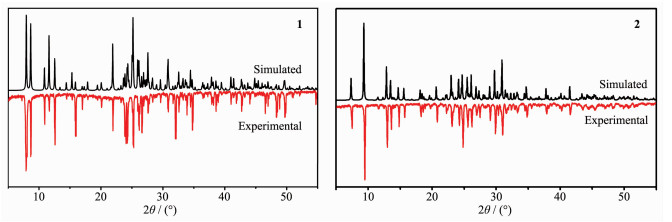
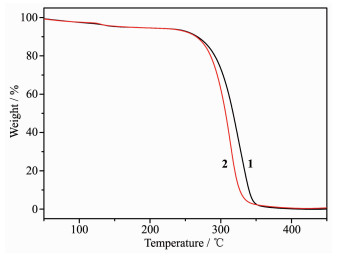
The phase purities of 1 and 2 were verified using the powder X-ray diffraction (PXRD) patterns which matched very well with the simulated ones in terms of the single-crystal X-ray data as shown in Fig. 1. TG analysis showed that compounds 1 and 2 have similar curves, both firstly lost their crystalline water at a range of 25~120 ℃, then completely decomposed their whole skeletons at a range of 270~350 ℃ (Fig. 2).
Compounds 1 and 2 are isomers, both crystallize in the monoclinic system with P21/c space group. In their asymmetric units, both have a [SbI5]2- anion, a protonated 1, 2-cyclohexanediamine cations (1, 2-DACH22+) and a solvated water. It can be seen from Fig. 3 that the cis- and trans-1, 2-DACH22+ keep their original configurations after reactions with SbI3.
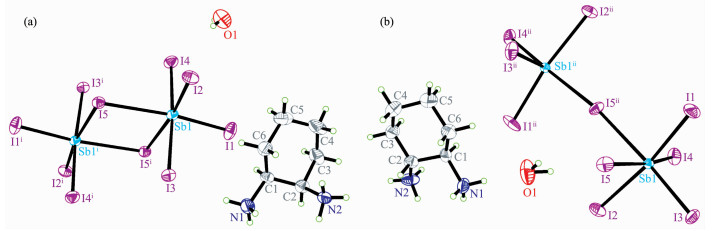
Displacement ellipsoids probability level: 50%; Symmetry codes: ⅰ 2-x, 2-y, -z for 1; ⅱ 3.5-x, -0.5+y, -0.5-z for 2
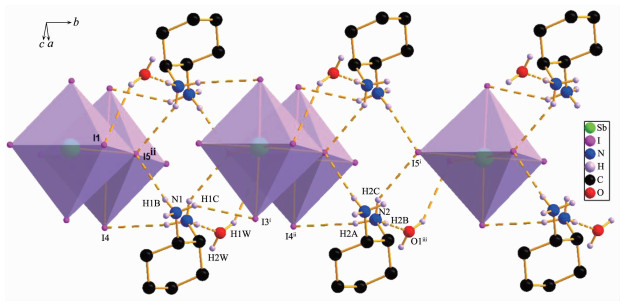
In compound 1, two [SbI6] octahedra are first constructed into a dimer [Sb2I10] by sharing with the I-I edge. In the dimer, there is a symmetric center locating at the middle of Sb(1)…Sb(1A) bond. The crystallographically independent antimony atom is coordinated by six I atoms in a significantly distorted octahedral coordination environment with bond lengths ranging from 0.282 40(6) to 0.329 49(7) nm and the maximum bond angle I(4)-Sb(1)-I(3) of 175.500(18)°(Table 2), consistent with those found in other halogenoantimonate(Ⅲ)[29-30]. On the other side, the cis-1, 2-DACH22+ works as a bridge connecting the [Sb2I10] dimers by hydrogen bonds N-H…I along b direction to form a chain, and the solvated water is linked to the chain by the N-H…O hydrogen bond(Fig. 4).
下载:
导出CSV
| 1 | |||||
| Sb(1)-I(1) | 0.282 40(6) | Sb(1)-I(3) | 0.311 71(6) | Sb(1)-I(5) | 0.329 49(7) |
| Sb(1)-I(2) | 0.284 29(6) | Sb(1)-I(4) | 0.294 36(6) | ||
| I(4)-Sb(1)-I(3) | 175.500(18) | I(2)-Sb(1)-I(4) | 90.843(19) | I(2)-Sb(1)-I(5) | 90.070(16) |
| I(1)-Sb(1)-I(5) | 171.688(20) | I(1)-Sb(1)-I(3) | 91.200(18) | I(3)-Sb(1)-I(5) | 87.571(15) |
| I(1)-Sb(1)-I(2) | 98.12(2) | I(2)-Sb(1)-I(3) | 88.848(18) | ||
| I(1)-Sb(1)-I(4) | 93.288(19) | I(4)-Sb(1)-I(5) | 87.938(16) | ||
| 2 | |||||
| Sb(1)-I(1) | 0.292 64(14) | Sb(1)-I(3) | 0.280 92(11) | Sb(1)-I(5) | 0.322 64(12) |
| Sb(1)-I(2) | 0.314 19(16) | Sb(1)-I(4) | 0.283 42(11) | ||
| I(1)-Sb(1)-I(2) | 172.01(2) | I(4)-Sb(1)-I(1) | 93.27(3) | I(2)-Sb(1)-I(5) | 88.06(2) |
| I(4)-Sb(1)-I(5) | 171.127(19) | I(3)-Sb(1)-I(2) | 93.51(2) | I(1)-Sb(1)-I(5) | 87.12(3) |
| I(3)-Sb(1)-I(4) | 96.52(4) | I(3)-Sb(1)-I(5) | 92.31(4) | ||
| I(3)-Sb(1)-I(1) | 93.05(2) | I(4)-Sb(1)-I(2) | 90.51(2) | ||
Symmetry codes: ⅰ 2-x, 1/2+y, 1/2-z, ⅱ x, 3/2-y, 1/2+z, ⅲ 1-x, 1/2+y, 1/2-z
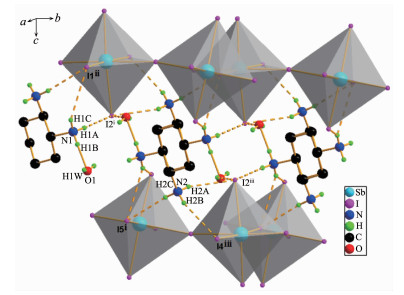
While, in compound 2, the [SbI6]2- ions are bridged by I5 atom to form a one-dimensional chain along b direction, and the trans-DACH22+ ions are connected to the anionic chain by hydrogen bonds in addition to the ionic bond between them. As shown in Table 2, the Sb-I distances, ranging from 0.280 92(11) to 0.322 64(12) nm for the terminal iodine atoms and from 0.283 42(11) to 0.314 19(16) nm for the bridging iodine ones, closely agree with those observed in other zigzag chain structures[31-32]. The trans-DACH22+ and solvated water act as two connecting-points tying together the one-dimensional strands into two-dimensional layered step-like structure by hydrogen bonds(Fig. 5).
Symmetry codes: ⅰ 3-x, 2-y, -z, ⅱ x, 3/2-y, 1/2+z, ⅲ 3-x, 1-y, -z
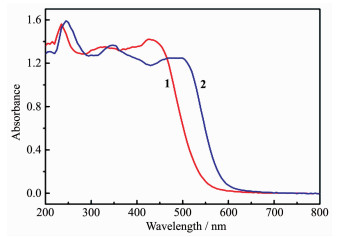
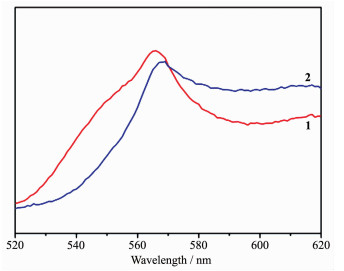
The room temperature absorptions of compounds 1 and 2 showed very similar curves as shown in Fig. 6. In the absorption spectrum of compound 1, there were three obviously peaks at 235, 362 and 429 nm, which can be attributed to the charge transfer transitions in the ligand, between the organic and inorganic layers, and within the inorganic layers. This is because the organic-inorganic hybrid is a type of semiconductor quantum well structure, typically with small band gap inorganic sheets (carrier) alternating with larger band gap organic layer (well)[33]. Compared with compound 1, the corresponding peaks in compound 2 were located at 245, 348 and 499 nm which have red shifts, consistent with the rule that the energy gap decreases as the dimensionality increases. The solid fluorescent spectra of compounds 1 and 2 are showed in Fig. 7. At the excitation wavelength of 365 nm, compounds 1 and 2 exhibited the emission peaks at 566 and 568 nm, respectively, both could be ascribed to the inorganic semiconducting moieties [SbI6][34-36].
The energy difference between the two configura-tions of free 1, 2-DAC is about 22 kJ·mol-1 from DFT calculations, in which the trans-configuration is more stable than the cis-one. After protonation, the energy difference is little increased to about 28 kJ·mol-1, and configuration conversion was expected between trans- and cis-configurations. However, compounds 1 and 2 lost their crystalline water at 25~120 ℃ (Fig. 2), so it is difficult to discuss the configuration inversion.
In this paper, by properly choosing 1, 2-cycloh-exanediamine(1, 2-DAC) with cis- and trans-config-urations to react with semiconductor halide SbI3, two different organic-inorganic halide (cis-1, 2-DACH2)[SbI5]·H2O (1) and {(trans-1, 2-DACH2)[SbI5]·H2O}n (2) were obtained. The single crystal diffraction and DFT calculations revealed that although compounds 1 and 2 are isomers, they are totally different in their prop-erties. The relationship between structure-property is of great significance for further research on the organic-inorganic hybrid materials in practical.
袁怀亮, 李俊鹏, 王鸣魁.物理学报, 2015, 64(3):038405 http://www.cnki.com.cn/Article/CJFDTotal-WLXB201503009.htmYUAN Huai-Liang, LI Jun-Peng, WANG Ming-Kui. Acta Phys. Sin., 2015, 64(3):038405 http://www.cnki.com.cn/Article/CJFDTotal-WLXB201503009.htm
Price M B, Butkus J, Jellicoe T C, et al. Nat. Commun., 2015, 6:8420 doi: 10.1038/ncomms9420
Kerner R A, Rand B P. J. Phys. Chem. Lett., 2018, 9:132-137 doi: 10.1021/acs.jpclett.7b02401
Love J A, Feuerstein M, Wolff C M, et al. ACS Appl. Mater. Interfaces, 2017, 9:42011-42019 doi: 10.1021/acsami.7b10361
Choi W, Cho M Y, Konar A, et al. Adv. Mater., 2012, 24:5832-5836 doi: 10.1002/adma.201201909
Kirchartz T, Bisquert J, Mora Sero I, et al. Phys. Chem. Chem. Phys., 2015, 17:4007-4014 doi: 10.1039/C4CP05174B
Filippetti A, Caddeo C, Delugas P, et al. J. Mater. Chem. C, 2017, 5:12758-12768 doi: 10.1039/C7TC04717G
Manser J S, Christians J A, Kamat P V. Chem. Rev., 2016, 116:12956-13008 doi: 10.1021/acs.chemrev.6b00136
Feng J, Xiao B. J. Phy. Chem. C, 2014, 118:19655-19660 doi: 10.1021/jp506498k
Chen K, Barker A J, Morgan F L C, et al. J. Phys. Chem. Lett., 2015, 6:153-158 doi: 10.1021/jz502528c
Li B, Chrzanowski M, Zhang Y, et al. Coord. Chem. Rev., 2016, 307:106-129 doi: 10.1016/j.ccr.2015.05.005
Guo X Y, Huang H L, Ban Y J, et al. J. Membr. Sci., 2015, 478:130-139 doi: 10.1016/j.memsci.2015.01.007
Yu H, Wei Z H, Hao Y H, et al. New J. Chem., 2017, 41:9586-9589 doi: 10.1039/C7NJ02229H
Kataoka S, Banerjee S, Kawai A, et al. J. Am. Chem. Soc., 2015, 137:4158-4163 doi: 10.1021/jacs.5b00290
Longo G, Gil Escrig L, Degen M J, et al. Chem. Commun., 2015, 51:7376-7378 doi: 10.1039/C5CC01103E
Gandeepan P, Cheng C H. Acc. Chem. Res., 2015, 48:1194-1206 doi: 10.1021/ar500463r
Eddaoud M, Sava D F, Eubank J F, et al. Chem. Soc. Rev., 2015, 44:228-249 doi: 10.1039/C4CS00230J
Lustig W P, Mukherjee S, Rudd N D, et al. Chem. Soc. Rev., 2017, 46:3242-3285 doi: 10.1039/C6CS00930A
Han S, Zhang J, Sun Z, et al. Inorg. Chem., 2017, 56:13078-13085 doi: 10.1021/acs.inorgchem.7b01863
Hamdi M, Karoui S, Oueslati A, et al. J. Mol. Struct., 2018, 1154:516-523 doi: 10.1016/j.molstruc.2017.10.063
Mkaouar I, Hamdi B, Karaa N, et al. Polyhedron, 2015, 87:424-432 doi: 10.1016/j.poly.2014.10.035
Ewing S J, Vaqueiro P. Inorg. Chem., 2014, 53:8845-8847 doi: 10.1021/ic5011314
Yamada H, Furusho Y, Yashima E. J. Am. Chem. Soc., 2012, 134:7250-7253 doi: 10.1021/ja301430h
袁国军, 刘光祥, 刘少贤, 等.无机化学学报, 2018, 34:404-408 doi: 10.11862/CJIC.2018.055YUAN Guo-Jun, LIU Guang-Xiang, LIU Shao-Xian, et al. Chinese J. Inorg. Chem., 2018, 34:404-408 doi: 10.11862/CJIC.2018.055
袁国军, 刘光祥, 时超.无机化学学报, 2017, 33:1855-1860 doi: 10.11862/CJIC.2017.225YUAN Guo-Jun, LIU Guang-Xiang, SHI Chao. Chinese J. Inorg. Chem., 2017, 33:1855-1860 doi: 10.11862/CJIC.2017.225
Solomek T, Powers-Riggs N E, Wu Y L, et al. J. Am. Chem. Soc., 2017, 139:3348-3351 doi: 10.1021/jacs.7b00233
Sheldrick G M. Acta Crystallogr. Sect. C:Cryst. Struct. Commun., 2015, C71:3-8
Sghaier M O M, Holderna-Natkaniec K, Czarneck P, et al. Polyhedron, 2014, 79:37-42 doi: 10.1016/j.poly.2014.04.030
Wang Y, Shi C, Han X B. J. Phys. Chem. C, 2017, 121:23039-23044 doi: 10.1021/acs.jpcc.7b05126
Hebig J C, Kuhn I, Flohre J, et al. ACS Energy Lett., 2016, 1:309-314 doi: 10.1021/acsenergylett.6b00170
Mao C Y, Liao W Q, Wang Z X, et al. Dalton Trans., 2016, 45:5229-5233 doi: 10.1039/C5DT04939C
Weclawik M, Gagor A, Jakubas R, et al. Inorg. Chem. Front., 2016, 3:1306-1316 doi: 10.1039/C6QI00260A
Sun Z H, Zeb A, Liu S J, et al. Angew. Chem. Int. Ed., 2016, 55:11854-11858 doi: 10.1002/anie.201606079
Gao W L, Ma Y M, Zhou Y M, et al. Mater. Lett., 2018, 216:84-87 doi: 10.1016/j.matlet.2018.01.002
Mix L T, Carroll E C, Morozov D, et al. Biochemistry, 2018, 57:1733-1747 doi: 10.1021/acs.biochem.7b01114

Figure 3 Asymmetric units of compounds 1 (a) and 2 (b)
Displacement ellipsoids probability level: 50%; Symmetry codes: ⅰ 2-x, 2-y, -z for 1; ⅱ 3.5-x, -0.5+y, -0.5-z for 2

Figure 4 Anionic dimers [Sb2I10]2- connecting the cis-DACH22+ cations by hydrogen bonds
Symmetry codes: ⅰ 2-x, 1/2+y, 1/2-z, ⅱ x, 3/2-y, 1/2+z, ⅲ 1-x, 1/2+y, 1/2-z

Figure 5 trans-DACH22+ cations connected to the 1D chain by hydrogen bonds
Symmetry codes: ⅰ 3-x, 2-y, -z, ⅱ x, 3/2-y, 1/2+z, ⅲ 3-x, 1-y, -z
Table 1. Crystallographic data for compounds 1 and 2
| Compound | 1 | 2 |
| Formula | C6H18N2OSbI5 | C6H18N2OSbI5 |
| Formula weight | 890.48 | 890.48 |
| Crystal system | Monoclinic | Monoclinic |
| Space group | P21/c | P21/c |
| a / nm | 1.131 26(12) | 1.209 0(6) |
| b / nm | 0.824 53(9) | 0.838 8(4) |
| c / nm | 2.076 9(2) | 1.902 2(9) |
| β / (°) | 98.179(2) | 94.333(6) |
| V / nm3 | 1.917 5(4) | 1.923 5(16) |
| Z | 4 | 4 |
| Dc / (g·cm-3) | 3.085 | 3.075 |
| F(000) | 1 568 | 1 568 |
| θmax / (°) | 27.51 | 24.99 |
| μ(Mo Kα) / mm-1 | 9.475 | 9.446 |
| Total reflection | 11 031 | 12 715 |
| Unique reflection | 4 327 (Rint=0.046 1) | 3 382 (Rint=0.035 5) |
| Variable | 142 | 140 |
| R1, wR2 [I>2σ(I)] | 0.038 3, 0.099 4 | 0.029 4, 0.070 0 |
| R1, wR2 (all data) | 0.047 1, 0.106 2 | 0.035 6, 0.072 3 |
| GOF | 1.028 | 1.083 |
 下载: 导出CSV
Table 2. Selected bond lengths (nm) and angles (°) for compounds 1 and 2
| 1 | |||||
| Sb(1)-I(1) | 0.282 40(6) | Sb(1)-I(3) | 0.311 71(6) | Sb(1)-I(5) | 0.329 49(7) |
| Sb(1)-I(2) | 0.284 29(6) | Sb(1)-I(4) | 0.294 36(6) | ||
| I(4)-Sb(1)-I(3) | 175.500(18) | I(2)-Sb(1)-I(4) | 90.843(19) | I(2)-Sb(1)-I(5) | 90.070(16) |
| I(1)-Sb(1)-I(5) | 171.688(20) | I(1)-Sb(1)-I(3) | 91.200(18) | I(3)-Sb(1)-I(5) | 87.571(15) |
| I(1)-Sb(1)-I(2) | 98.12(2) | I(2)-Sb(1)-I(3) | 88.848(18) | ||
| I(1)-Sb(1)-I(4) | 93.288(19) | I(4)-Sb(1)-I(5) | 87.938(16) | ||
| 2 | |||||
| Sb(1)-I(1) | 0.292 64(14) | Sb(1)-I(3) | 0.280 92(11) | Sb(1)-I(5) | 0.322 64(12) |
| Sb(1)-I(2) | 0.314 19(16) | Sb(1)-I(4) | 0.283 42(11) | ||
| I(1)-Sb(1)-I(2) | 172.01(2) | I(4)-Sb(1)-I(1) | 93.27(3) | I(2)-Sb(1)-I(5) | 88.06(2) |
| I(4)-Sb(1)-I(5) | 171.127(19) | I(3)-Sb(1)-I(2) | 93.51(2) | I(1)-Sb(1)-I(5) | 87.12(3) |
| I(3)-Sb(1)-I(4) | 96.52(4) | I(3)-Sb(1)-I(5) | 92.31(4) | ||
| I(3)-Sb(1)-I(1) | 93.05(2) | I(4)-Sb(1)-I(2) | 90.51(2) | ||
下载: 导出CSV

 扫一扫看文章


扫一扫关注我们