
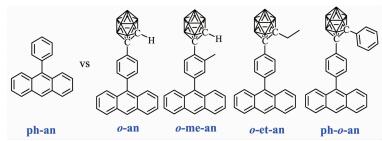
Figure Scheme1.
Illustration of o-carborane-functionalized anthracene derivatives


Usually, bright luminescence from luminophores in solutions is absent[1-3] upon aggregation. Such aggre-gation-caused quenching (ACQ) effect is triggered by intermolecular interactions[4] such as π…π stacking or excimers, further causing a detrimental effect on luminous efficiency[5-7], thus badly fulfill the needs of various applications. In stark contrast to ACQ, another unique photophysical phenomenon termed as aggregation-induced emission (AIE) established by Tang[8] shows excellent photophysical properties. In the past 20 years, AIE has become a significant principle to construct luminophores[9-11] in material science and biological technology. Generally, luminophores poss-essing AIE properties can be accessed via the restric-tion of intramolecular motion(RIM)[12], which blocks the non-radiative pathway and produces effective luminescence in aggregates. Therefore, direct trans-formation of conventional ACQ luminophores to AIE luminogens(AIEgens) will be a best choice to obtain AIEgens by embedding sufficient intramolecular motions[13]. From this point of view, AIEgens can be generated by modifying luminophores with well-known AIE archetypes[14-15] or in the other way replacing parts of AIE molecules with classical luminophores[16-17]. Despite these pioneering tactics and enormous AIE-active compounds in hand, some systems[18] remain to suffer from complicated molecular design and tedious synthetic procedures to cater for the requirements of various high-tech applications. Therefore, it is to be the theme to develop a novel strategy to realize efficient AIEgens.
Recently, luminophores containing o-carborane unit for photoelectric functional materials[19-20] have drawn much attention. The unique properties of o-carborane[21], such as polarizable σ-aromatic character and electron-withdrawing ability through substitution at the carbon cites, make excellent properties with satisfactory stability and fantastic luminous efficiency. For example, Kang et al.[22] revealed that CT (charge transfer) emissions in o-carborane-based luminophores originate from the orbital overlap between the chromophores and the carboranyl σ(C-C) orbitals. Chujo et al. [23] reported that the AIE properties of a variety of o-carborane-based conjugated systems were caused by intramolecular charge transfer from the π-conjugated groups to o-carborane. Lee et al.[24] indicated by experi-ments that the phosphorescence efficiency of iridium complexes could be manipulated by the substituents at carbon cites in o-carborane, and the carboranyl C-C bond vibration in the excited state would be respon-sible for phosphorescence efficiency. Our group[25] has previously demonstrated the luminescent efficiency of o-carborane-based iridium complexes exhibit solvent- or media-dependence, which is closely related to dielectric constant of media. It can be concluded that the variable C-C bond of o-carborane might be a useful tool to tune the photophysical properties of luminophores.
Besides aforementioned results, theoretical calculations[26] also uncovered that the C-C bond lengths of o-carborane could vary substantially with the nature of the carbon substituents. It should be anticipated that the vibrating motion of the C-C bond in o-carborane can provide a radiationless channel by modifying the substituents (such as alkyl and phenyl)[27], which result in weak luminescence in solution. However, the cage structure can suppress both the π…π stacking and the C-C bond vibration in aggregate state[28-29], thus giving rise to enhanced emissions with AIE properties. Such characteristic of the C-C bond in o-carborane could be the new strategy to realize transformation from ACQ luminophores to AIEgens. Herein, in order to confirm this idea, phenyl anthracene undergoing ACQ properties was designed with o-carborane cage bearing different substituents. Photophysical properties indicated that these compounds undergo the similar emission behavior in solution. However, the luminophores only with the substituents ethyl and phenyl in o-carborane show AIE properties. This observation can be ascribed to the elongation of C-C bond that dissipate the energy in excited state, and to the more rigid packing structures in crystalline state[30], leading to the transformation from ACQ luminophores to AIEgens.
All starting materials were purchased from commercial sources and were used directly without further purification. Reactions were carried out under an argon atmosphere using standard Schlenk procedure. The 1H, 13C, 11B NMR spectra were measured on DRX-400 at room temperature with CDCl3 as a deuterated reagent. Mass spectra were tested with a Bruker Daltonics Autoflex Ⅱ MALDI TOF MS spectrometer and a Micromass GC-TOF for EI-MS (70 eV) spectro-meter. Infrared spectra were performed on a Nicolet NEXUS870 FT-IR. UV-Vis absorption spectra were recorded with Shimadzu UV-2550 spectrophotometers. PL spectra were recorded on a Hitachi F-4600 fluorescence spectrophotometer.
All of the o-carborane-functionalized compounds (Scheme 1) were synthesized using o-carborane substituted halide as a starting material through the Suzuki reaction[31] (Supporting Information, Scheme S1). All the newly synthesized compounds are stable to air and light. These compounds were carefully characterized by NMR, MS and IR. Besides, the crystal structures of all the o-carborane-based comp-ounds were solved via X-ray crystallography (Fig.S13).
1-(4-bromophenyl)-2-ethyl-o-carborane (1-et): A DMF solution of 1-(4-bromophenyl)-o-carborane (299 mg, 1.0 mmol) was treated with sodium hydride (90.0 mg, 2.4 mmol) at -20 ℃. After stirring for 1 h, an excess amount of C2H5I (1.5 equiv, 1.5 mmol) was added into the above mixture. The reaction was stirred for another 4 h. After quenching the reaction mixture by saturated ammonium chloride solution (20.0 mL), the aqueous layer was extracted with diethyl ether (three times). Combined organic layers were filtered, dried over MgSO4, and concentrated under reduced pressure. Further purification was performed by column chromatography on silica. Elution with n-hexane gave white solid with a yield of 50% (160.3 mg). 1H NMR (400 MHz, chloroform-d): δ 7.55~7.46 (m, 4H), 3.25~1.70 (br, 10H, B-H), 1.88~1.82 (m, 2H), 0.98 (t, J=7.6 Hz, 3H). 13C NMR (101 MHz, chloroform-d): δ 132.64, 132.11, 129.99, 125.52, 83.24, 28.71, 13.85. 11B NMR (128 MHz, chloroform-d): δ -2.92(1B), -4.10(1B), -10.47 (8B). Anal. Calcd. for C10H19B10Br(%): C, 36.70; H, 5.85. Found(%): C, 37.47; H, 5.46. IR (KBr, cm-1): 2 583 (B-H). EI-MS (m/z): 327.23 (M+, 100.00%).
o-et-an: A mixture of 1-et (100.0 mg, 0.31 mmol) and 9-anthraceneboronic acid (81.4 mg, 0.37 mmol), Pd(P(Ph)3)4 (23.1 mg, 0.02 mmol), K2CO3 (84.5 mg, 0.62 mmol) in THF (20.0 mL) was refluxed for 48 h under argon. After cooling down to r.t., water (40.0 mL) was added. Then, the resulting mixture was extracted with CH2Cl2 (3×30 mL) and the combined organic layers were dried on MgSO4. Removal of the solvents in vacuum gave a residue, which was subjected to column chromatography on silica gel. Elution with n-hexane gave white solid with a yield of 36%(47.4 mg). 1H NMR (400 MHz, chloroform-d): δ 8.54 (s, 1H), 8.07 (d, J=8.4 Hz, 2H), 7.84 (d, J=8.4 Hz, 2H), 7.55~7.46 (m, 4H), 7.40~7.31 (m, 4H), 3.25~1.70 (br, 10H, B-H), 2.06 (q, J=7.5 Hz, 2H), 1.12 (t, J=7.6 Hz, 3H). 13C NMR (101 MHz, chloroform-d): δ 141.55, 134.86, 131.82, 131.31, 131.19, 130.12, 129.89, 128.57, 127.35, 126.15, 125.86, 125.29, 83.44, 28.91, 14.02. 11B NMR (128 MHz, chloroform-d): δ -3.09(1B), -4.17(1B), -9.69(4B), -10.60(4B). Anal. Calcd. for C24H28B10(%): C, 67.89; H, 6.65. Found(%): C, 67.55; H, 6.32. IR (KB, cm-1): 2 563 (B-H). MALDI-TOF(m/z): 424.56 (M+).
ph-o-an was synthesized by the same procedure as that of o-et-an. White solid, 58.6 mg, with a yield of 40%. 1H NMR (400 MHz, chloroform-d): δ 8.47 (s, 1H), 8.02 (d, J=8.5 Hz, 2H), 7.64~7.59 (m, 2H), 7.55 ~7.51 (m, 2H), 7.47~7.42 (m, 2H), 7.36 (m, 1H), 7.32 ~7.26 (m, 4H), 7.24~7.17 (m, 4H), 3.25~1.70 (br, 10H, B-H). 13C NMR (101 MHz, chloroform-d): δ 141.06, 131.18, 131.06, 130.84, 130.80, 130.06, 129.74, 128.44, 128.25, 127.08, 126.12, 125.56, 125.16. 11B NMR (128 MHz, chloroform-d): δ -2.22(3B), -9.26(3B), -10.31(4B). Anal. Calcd. for C28H28B10(%): C, 71.15; H, 5.97. Found(%): 70.88; H, 5.53. IR (KBr, cm-1): 2 593 (B-H). MALDI-TOF (m/z): 472.53 (M+).
o-me-an was synthesized by the same procedure as that of o-et-an. White solid, 38.1 mg, with a yield of 30%. 1H NMR (400 MHz, chloroform-d): δ 8.52 (s, 1H), 8.05 (d, J=8.4 Hz, 2H), 7.76 (d, J=8.3 Hz, 1H), 7.59 (d, J=8.8 Hz, 2H), 7.50~7.45 (m, 2H), 7.41~7.36 (m, 2H), 7.29 (dd, J=8.3, 1.7 Hz, 1H), 7.21 (s, 1H), 4.69 (s, 1H), 3.25~1.70 (br, 10H, B-H), 2.66 (s, 3H). 13C NMR (101 MHz, CDCl3): δ 140.16, 136.44, 134.99, 134.79, 131.34, 131.27, 131.16, 129.91, 129.70, 128.49, 127.41, 127.15, 126.32, 125.73, 125.24, 78.09, 77.35, 77.03, 76.71, 59.89, 23.37. 11B NMR (128 MHz, chloroform-d): δ -2.70 (2B), -8.66 (4B), -11.09 (2B), -13.11 (2B). Anal. Calcd. for C23H26B10(%): C, 67.28; H, 6.38. Found(%): 67.21; H, 6.08. IR (KBr, cm-1): 2 571 (B-H). MALDI-TOF(m/z) : 410.54 (M+).
X-ray diffraction data were collected on a Bruker Smart CCD Apex DUO diffractometer with graphite monochromated Mo Kα radiation (λ=0.071 073 nm) using the ω-2θ scan mode. Data were corrected for Lorenz and polarization effects. The structure was solved by direct methods and refined on F2 by full-matrix least-squares methods using SHELXTL-2016. All calculations and molecular graphics were carried out on a computer using the SHELX-2016 program package and Diamond. All non-hydrogen atoms were refined anisotropically. All hydrogen atoms were generated geometrically and refined isotropically using the riding model. Crystal data, data collection parameters and the results of the analyses of o-et-an, ph-o-an and o-me-an are listed in Table 1.

 DownLoad:
CSV
DownLoad:
CSV
| Compound | o-et-an | ph-o-an | o-me-an |
| Chemical formula | C24H28B10 | C28H28B10 | C23H26B10 |
| Formula weight | 424.56 | 472.60 | 410.54 |
| Temperature / K | 296(2) | 293(2) | 296(2) |
| Crystal system | Triclinic | Monoclinic | Monoclinic |
| Space group | |
P21/c | P21/c |
| a / nm | 0.825 73(17) | 0.987 72(19) | 1.025 4(3) |
| b / nm | 2.473 2(5) | 2.955 7(5) | 1.065 3(3) |
| c / nm | 2.591 4(5) | 1.861 5(3) | 2.038 9(6) |
| α / (°) | 65.840(3) | ||
| β / (°) | 85.881(4) | 106.699(8) | 90.245(4) |
| γ / (°) | 87.488(4) | ||
| V / nm3 | 4.815 6(17) | 5.205 3(16) | 2.227 2(11) |
| Z | 8 | 8 | 4 |
| Dc / (g·cm-3) | 1.171 | 1.206 | 1.224 |
| μ / mm-1 | 0.060 | 0.062 | 0.062 |
| F(000) | 1 704 | 1 968.0 | 856.0 |
| θ range / (°) | 0.863~24.999 | 1.334~24.999 | 1.998~25.000 |
| Reflection collected, unique | 34 433, 16 269 (Rint=0.104 8) | 39 079, 9 156 (Rint=0.128 3) | 15 966, 3 891 (Rint=0.045 5) |
| Completeness to θ=25.000° / % | 95.9 | 99.9 | 99.3 |
| Data, restraint, parameter | 16 269, 6, 1 229 | 9 156, 0, 686 | 3 891, 0, 343 |
| GOF | 0.981 | 1.007 | 1.147 |
| Final R indices [I > 2σ(I)] | R1=0.113 1, wR2=0.280 2 | R1=0.069 2, wR2=0.186 1 | R1=0.045 7, wR2=0.139 0 |
| R indices (all data) | R1=0.225 4, wR2=0.352 7 | R1=0.119 5, wR2=0.241 3 | R1=0.053 8, wR2=0.159 2 |
| Largest diff. peak and hole / (e·nm-3) | 650 and -380 | 351 and -354 | 288 and -265 |
CCDC: 1834185, o-me-an; 1834186, ph-o-an; 1838538, o-et-an.
To check whether o-carboranyl unit can tune the emission behavior in comparison to the model compound (Scheme 1), photophysical properties of all the compounds were investigated. The absorption spectra were measured in THF solution (Fig.S15). However, no apparent change is observed[32]. All the compounds exhibit two bands due to π-π* transitions[33]: one is the sharp absorption band at ca. 260 nm, and the other shapes as three weak bands from ca. 340 to 400 nm. Thus, the introduction of o-carborane shows very little effect upon the anthracene unit in absorption measurements, which were proven by DFT (density functional theory) calculations (Fig.S24). Besides, all o-carborane-based compounds exhibit similar absorp-tion spectra compared to that of the model compound in non-polar solvents, such as n-hexane and toluene (Fig. S16 and S17). Thus, the polarity of solvent does not change the ground state energy of these luminophores.
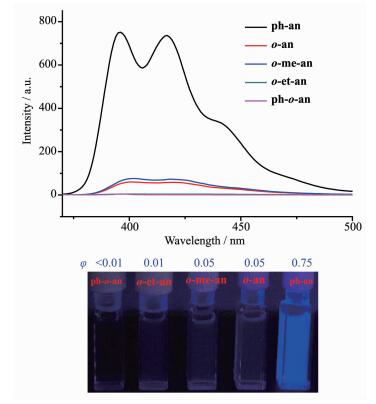
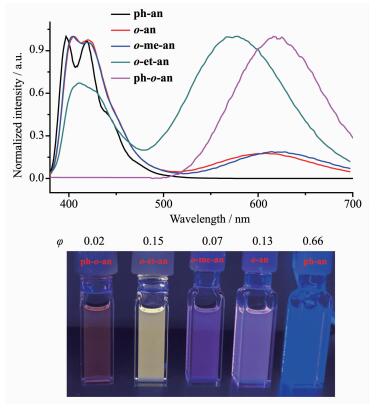
Photoluminescence (PL) spectra were then inves-tigated in THF solution. Compounds o-an[31], o-me-an, and o-et-an display the similar PL spectra as that of ph-an, whereas the control compound is much more emissive (Fig. 1). This could be ascribed to the variable C-C bond in o-carboranyl unit which is involved in the excited state to dissipate energy. Such variation of luminous efficiency is in accordance with reported results[30]. To get in-depth insights, the excited state structures for all the compounds have been investi-gated. During emission process, the larger C-C bond length variation in o-carborane was observed (Table S2). This adequately indicates that the C-C bond variation leads to a non-radiative decay from the excited states[34-35]. In addition, PL spectra in lower polarity solvent as toluene were studied, which exhibit dual emissions (Fig. 2) around 410 and 600 nm, attributed to LE(locally-excited) emission from phenyl anthra-cene and ICT(intramolecular charge transfer) emission from anthracene to o-carborane, respectively. This reveals that o-carborane can be the electron acceptor to induce intramolecular charge transfer[36-37]. However, compound ph-o-an presents only CT emission. Theoretical calculations show that the highest occupied molecular orbitals (HOMOs) of these compounds locate in the anthracenyl units, whereas the lowest unoccupied molecular orbitals (LUMOs) extend on the C-C bonds of o-carboranes in the cases of o-an, o-me-an and o-et-an (Fig.S25). However, LUMO of ph-o-an completely concentrates on the o-carborane cage. Hence only CT transition is formed to produce the solely low energy CT emission. Besides, these o-carborane-based compounds show a higher luminous efficiency in toluene than that in THF (Fig. 1 and 2), the same as the results previously reported [38]. This could be interpreted that the C-C bond in o-carborane is sensitive to polarity of solvent. Increasing the polarity of solvent could induce enhanced C-C bond length variation[39], further making the adverse effect to the luminous efficiency. Therefore, the C-C bond in o-carborane can be a lever to tune the excited state properties of chromophore, which serves as a non-radiative inducer for the excitons to decay.
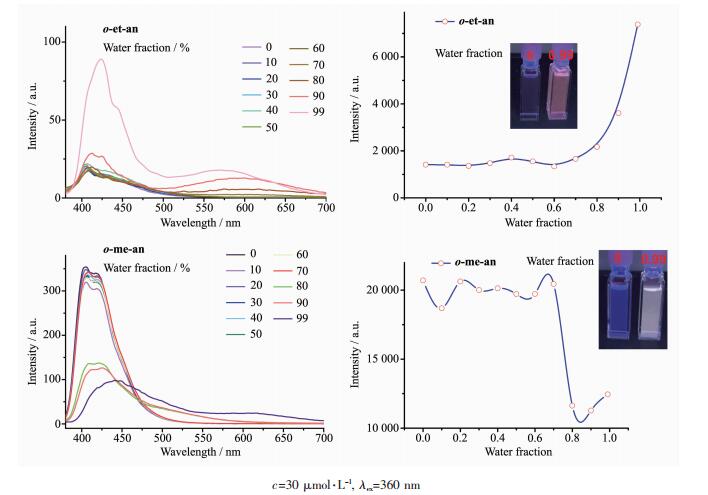
To address whether this "flexible" C-C bond can lead to AIE properties, PL spectra in THF/H2O with different water fractions were measured for all the compounds (Fig.S20~S23). In addition, to quantify the changes of emission efficiency in solution and in aggregate state, α value is defined as follows: α=φa / φs, where φa and φs represent the aggregation- and solution-luminous intensity, respectively. Model compound ph-an shows evident ACQ phenomenon with a small α value: 0.14, suggesting the non-ignorable fluorescence quenching effect[40] from the anthracenyl unit. However, those o-carborane-modified compounds exhibit totally different emission behaviors. Typical AIE effect was found in o-et-an and ph-o-an with α values: 5.18 and 23.49, respectively. They were both virtually non-emissive in THF. As the fraction of water is increased (less than 70%), no notable enhancement was detected. However, a sharp intensified emission was observed when the fraction of water reached 70%. PL spectra of o-et-an reached its summit when the water fraction is 99% (Fig. 3), whereas it is 80% in the case of ph-o-an. A further increase of water fraction to 90% leads to a decrease for ph-o-an in the emission intensity. Under this condition, ph-o-an might conglomerate into much larger particles and precipitate, thus causing the emission intensity to decline which is similar to the reported results[41-43]. Thus, o-et-an and ph-o-an are AIE active. On the contrary, in the cases of o-me-an and o-an, ACQ effects were observed with α values: 0.60 and 0.80, respectively. Compound o-me-an shows emission in pure THF as strong as that observed in THF/water solution until the water fraction reaches 70% (Fig. 3). Above this fraction, a dramatic decline in emission intensity was recorded. In addition, no apparent change in luminous intensity has occurred for o-an. Upon the water fraction up to 99%, low luminous intensity appears.
To unravel the roles that o-carborane has played, X-ray crystallographic analysis was carried out (Fig.S14). All the o-carborane-based luminophores display "face to face" (o-carborane to anthracene) packing patterns[44] without π…π stacking interactions. With careful investigation, compound o-an shows strong Ccage-H…π interaction. Such intermolecular interac-tions can′t fully eliminate C-C bond vibration and rotation of o-carborane in solid state, even in the case of o-me-an where sterically hindered methyl group is attached to the benzene ring (Fig. 4). On the other hand, the intermolecular B-H…π interaction was observed for compounds ph-o-an and o-et-an (Fig. 4 and S14). Besides, the o-carborane substituents (ethyl or phenyl) can effectively suppress both the C-C bond vibration and the rotation of o-carborane to ensure rigid packing structures, thus leading to a profound AIE effect.
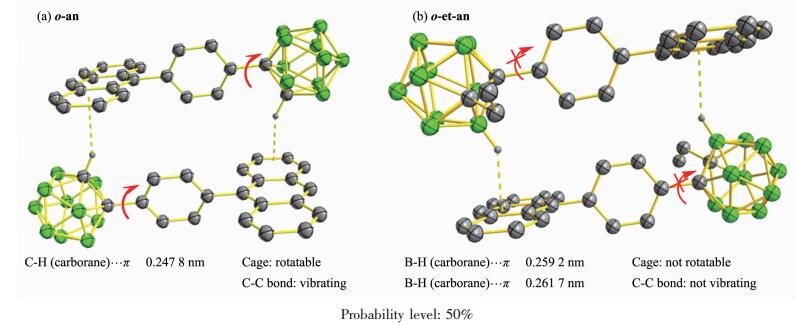
In conclusion, our approach to realize ACQ luminophores to AIEgens transformation has been proposed by the engineering of variable C-C bond of o-carborane cores in the fluorescent molecules. A series of o-carborane-based anthracene derivatives were syn-thesized. Photophysical properties studies demonstrate the C-C bond vibration as a main non-radiative decay in solution. However, with physical constraints via intermolecular interactions in aggregate state, such non-radiative decay channel can be inhibited and lead to AIE phenomenon. Therefore, the variable C-C bond in o-carborane could be an effective tool to construct AIEgens, and some potential applications are in process based on these molecules.
Supporting information is available at http://www.wjhxxb.cn
Bakalova R, Zhelev Z, Aoki I, et al. Anal. Chem., 2006, 78:5925-5932 doi: 10.1021/ac060412b
Zhelev Z, Ohba H, Bakalova R. J. Am. Chem. Soc., 2006, 128:6324-6325 doi: 10.1021/ja061137d
Birks J B. Photophysics of Aromatic Molecules. London:Wiley, 1970.
Chen R F, Knutson J R. Anal. Biochem., 1988, 172(1):61-77
Tang C W, VanSlyke S A. Appl. Phys. Lett., 1987, 51:913-915 doi: 10.1063/1.98799
Jares-Erijman E A, Jovin T M. Nat. Biotechnol., 2003, 21:1387-1395 doi: 10.1038/nbt896
Saigusa H, Lim E C. J. Phys. Chem., 1995, 99:15738-15747 doi: 10.1021/j100043a010
Luo J D, Xie Z L, Lam J W Y, et al. Chem. Commun., 2001:1740-1741 doi: 10.1007/s10904-006-9073-4
Zhang X Q, Chi Z G, Xu B J, et al. Dyes Pigm., 2011, 89:56-62 doi: 10.1016/j.dyepig.2010.09.003
Chan C Y K, Lam J W Y, Zhao Z J, et al. J. Mater. Chem. C, 2014, 2:4320-4327 doi: 10.1039/C4TC00097H
Chen B, Jiang Y B, Chen L, et al. Chem. Eur. J., 2014, 20:1931-1939 doi: 10.1002/chem.v20.7
Kamaldeep K S N, Kaur S, Bhalla V, et al. J. Mater. Chem. A, 2014, 2:8369-8375 doi: 10.1039/C4TA00397G
Yang B C, Niu X Y, Huang Z X, et al. Tetrahedron, 2013, 69:8250-8254 doi: 10.1016/j.tet.2013.07.038
Shen X Y, Wang Y J, Zhang H, et al. Chem. Commun., 2014, 50:8747-8750 doi: 10.1039/C4CC03024A
Jin Y, Xu Y B, Liu Y L, et al. Dyes Pigm., 2011, 90:311-318 doi: 10.1016/j.dyepig.2011.01.005
Huang J, Yang X, Wang J Y, et al. J. Mater. Chem., 2012, 22:2478-2484 doi: 10.1039/C1JM14054J
Chan C Y K, Lam J W Y, Zhao Z J, et al. J. Mater. Chem. C, 2014, 2:4320-4327 doi: 10.1039/C4TC00097H
Li Y, Xu L R, Su B. Chem. Commun., 2012, 48:4109-4111 doi: 10.1039/c2cc30553d
Li J F, Yang C L, Peng X L, et al. J. Mater. Chem. C, 2018, 6:19-28 doi: 10.1039/C7TC03780E
李欢欢, 燕红, 芦昌盛.无机化学学报, 2017, 33(8):1313-1329 doi: 10.11862/CJIC.2017.166LI Huan-Huan, YAN Hong, LU Chang-Sheng. Chinese J. Inorg. Chem., 2017, 33(8):1313-1329 doi: 10.11862/CJIC.2017.166
徐智伟, 韩磊, 杨震洲, 等.无机化学学报, 2011, 27(9):1669-1674XU Zhi-Wei, HAN Lei, YANG Zhen-Zhou, et al. Chinese J. Inorg. Chem., 2011, 27(9):1669-1674
Wee K-R, Cho Y-J, Song J K, et al. Angew. Chem, Int. Ed., 2013, 52:9682-9685 doi: 10.1002/anie.201304321
Naito H, Nishino K, Morisaki Y, et al. Angew. Chem. Int. Ed., 2017, 56:254-259 doi: 10.1002/anie.201609656
Lee Y H, Park J, Lee J, et al. J. Am. Chem. Soc., 2015, 137:8018-8021 doi: 10.1021/jacs.5b04576
Shi C, Sun H B, Tang X, et al. Angew. Chem. Int. Ed., 2013, 52:13434-13438 doi: 10.1002/anie.201307333
Wang J G, Chen X, Zhang G X, et al. J. Mater. Chem. C, 2014, 2:1149-1157 doi: 10.1039/C3TC31741B
Dash B P, Satapathy R, Maguire J A, et al. New J. Chem., 2011, 35:1955-1972 doi: 10.1039/c1nj20228f
Kokado K, Chujo Y. Macromolecules, 2009, 42:1418-1420 doi: 10.1021/ma8027358
Kokado K, Nagai A, Chujo Y. Macromolecules, 2010, 43:6463-6468 doi: 10.1021/ma100792z
潘淼, 李思华, 程茂玲, 等.无机化学学报, 2018, 34(4):627-632 doi: 10.11862/CJIC.2018.081PAN Miao, LI Si-Hua, CHENG Mao-Lin, et al. Chinese J. Inorg. Chem., 2018, 34(4):627-632 doi: 10.11862/CJIC.2018.081
Tu D S, Leong P, Guo S, et al. Angew. Chem. Int. Ed., 2017, 56:11370-11374 doi: 10.1002/anie.v56.38
杨立国, 张道鹏, 李大成, 等.无机化学学报, 2013, 29(4):875-882 http://www.wjhxxb.cn/wjhxxbcn/ch/reader/view_abstract.aspx?file_no=20130434YANG Li-Guo, ZHANG Dao-Peng, LI Da-Cheng, et al. Chinese J. Inorg. Chem., 2013, 29(4):875-882 http://www.wjhxxb.cn/wjhxxbcn/ch/reader/view_abstract.aspx?file_no=20130434
Han Y S, Jeong S, Ryu S C, et al. Mol. Cryst. Liq. Cryst., 2009, 513:163-178 doi: 10.1080/15421400903196245
Zhang Q S, Kuwabara H, Potscavage W J, et al. J. Am. Chem. Soc., 2014, 136:18070-18081 doi: 10.1021/ja510144h
黄嘉, 蒋亚东, 唐先忠, 等.无机化学学报, 2009, 25(3):501-505 http://www.wjhxxb.cn/wjhxxbcn/ch/reader/view_abstract.aspx?file_no=20090323HUANG Jia, JIANG Ya-Dong, TANG Xian-Zhong, et al. Chinese J. Inorg. Chem., 2009, 25(3):501-505 http://www.wjhxxb.cn/wjhxxbcn/ch/reader/view_abstract.aspx?file_no=20090323
Furue R, Nishimoto T, Park I, et al. Angew. Chem., Int. Ed., 2016, 55:7171-7175 doi: 10.1002/anie.201603232
Spokoyny A M, Machan C W, Clingerman D J, et al. Nat. Chem., 2011, 3:590-596 doi: 10.1038/nchem.1088Spokoyny A M, Machan C W, Clingerman D J, et al. Nat. Chem., 2011, 3:590-596 doi: 10.1038/nchem.1088
Lin R Y-Y, Lin H-W, Yen Y-S, et al. Energy Environ. Sci., 2013, 6:2477-2486 doi: 10.1039/c3ee41075g
Liu Y, Chen S M, Lam J W Y, et al. Chem. Mater., 2011, 23:2536-2544 doi: 10.1021/cm2003269
Zhao Y S, Xu J, Peng A, et al. Angew. Chem. Int. Ed., 2008, 47:7301-7305 doi: 10.1002/anie.v47:38
Zhao Z J, Chen S M, Shen X Y, et al. Chem. Commun., 2010, 46:686-688 doi: 10.1039/B915271G
陈芳芳, 卞祖强, 黄春辉.无机化学学报, 2008, 24(8):1219-1223 http://www.wjhxxb.cn/wjhxxbcn/ch/reader/view_abstract.aspx?file_no=20080805CHEN Fang-Fang, BIAN Zu-Qiang, HUANG Chun-Hui. Chinese J. Inorg. Chem., 2008, 24(8):1219-1223 http://www.wjhxxb.cn/wjhxxbcn/ch/reader/view_abstract.aspx?file_no=20080805
Naito H, Morisaki Y, Chujo Y. Angew. Chem. Int. Ed., 2015, 54:5084-5087 doi: 10.1002/anie.v54.17
Kobayashi K, Masu H, Shuto A, et al. Chem. Mater., 2005, 17:6666-6673 doi: 10.1021/cm051874t

Figure 1 PL spectra (above) and luminescence photographs (below) of o-carborane-based luminophores in THF

Figure 2 Normalized PL spectra (above) and luminescence photographs (below) of o-carborane-based luminophores in toluene

Figure 3 PL spectral changes of o-et-an and o-me-an in THF/H2O with same concentration at room temperature
Table 1. Crystallographic data for o-et-an, ph-o-an and o-me-an
| Compound | o-et-an | ph-o-an | o-me-an |
| Chemical formula | C24H28B10 | C28H28B10 | C23H26B10 |
| Formula weight | 424.56 | 472.60 | 410.54 |
| Temperature / K | 296(2) | 293(2) | 296(2) |
| Crystal system | Triclinic | Monoclinic | Monoclinic |
| Space group | |
P21/c | P21/c |
| a / nm | 0.825 73(17) | 0.987 72(19) | 1.025 4(3) |
| b / nm | 2.473 2(5) | 2.955 7(5) | 1.065 3(3) |
| c / nm | 2.591 4(5) | 1.861 5(3) | 2.038 9(6) |
| α / (°) | 65.840(3) | ||
| β / (°) | 85.881(4) | 106.699(8) | 90.245(4) |
| γ / (°) | 87.488(4) | ||
| V / nm3 | 4.815 6(17) | 5.205 3(16) | 2.227 2(11) |
| Z | 8 | 8 | 4 |
| Dc / (g·cm-3) | 1.171 | 1.206 | 1.224 |
| μ / mm-1 | 0.060 | 0.062 | 0.062 |
| F(000) | 1 704 | 1 968.0 | 856.0 |
| θ range / (°) | 0.863~24.999 | 1.334~24.999 | 1.998~25.000 |
| Reflection collected, unique | 34 433, 16 269 (Rint=0.104 8) | 39 079, 9 156 (Rint=0.128 3) | 15 966, 3 891 (Rint=0.045 5) |
| Completeness to θ=25.000° / % | 95.9 | 99.9 | 99.3 |
| Data, restraint, parameter | 16 269, 6, 1 229 | 9 156, 0, 686 | 3 891, 0, 343 |
| GOF | 0.981 | 1.007 | 1.147 |
| Final R indices [I > 2σ(I)] | R1=0.113 1, wR2=0.280 2 | R1=0.069 2, wR2=0.186 1 | R1=0.045 7, wR2=0.139 0 |
| R indices (all data) | R1=0.225 4, wR2=0.352 7 | R1=0.119 5, wR2=0.241 3 | R1=0.053 8, wR2=0.159 2 |
| Largest diff. peak and hole / (e·nm-3) | 650 and -380 | 351 and -354 | 288 and -265 |
 下载: 导出CSV

 扫一扫看文章


扫一扫关注我们

