表 1
Crystal data for compounds 1 and 2
Table 1.
Crystal data for compounds 1 and 2


In recent years, the rational design and construction of coordination polymers have received remarkable attention due to their potential applica-tions, architectures, and topologies[1-5]. There are many factors, such as the coordination geometry of the metal centers, type and connectivity of organic ligands, stoichiometry, reaction conditions, template effect, presence of auxiliary ligands, and pH values influenc-ing the structures of target coordination polymers during self-assembly[6-10]. Among these factors, organic ligands play a noteworthy role in constructing coor-dination compounds.
Multi-carboxylate biphenyl ligands have been certified to be of great significance as constructors due to their strong coordination abilities in various modes, which could satisfy different geometric requi-rements of metal centers[8-9, 11-14]. In order to extend our research in this field, we chose one biphenyl tricar-boxylic acid ligand, 5-(3, 4-dicarboxylphenyl)picolinic acid (H3dppa), to construct novel coordination comp-ounds. The ligand possesses the following features: (1) it contains a pyridyl and a phenyl ring with structural flexibility and conformation. Rotation of the C-C single bond between pyridyl and phenyl rings could form numbers of coordination geometries of metal ions. (2) It has seven potential coordination sites, one N atom from pyridyl ring and six O atoms of three carboxylate groups, which is benifical to contruct coordination polymerw with interesting structures by its rich coordination modes. (3) It can act as hydrogen-bond acceptor as well as donor, depending upon the degree of deprotonation.
Taking into account these factors, we herein report the syntheses, crystal structures and magnetic properties of two Cu(Ⅱ) and Mn(Ⅱ) coordination compounds constructed from biphenyl tricarboxylic acid ligands.
All chemicals and solvents were of AR grade and used without further purification. Carbon, hydrogen and nitrogen were determined using an Elementar Vario EL elemental analyzer. IR spectra were recorded using KBr pellets and a Bruker EQUINOX 55 spectrometer. Thermogravimetric analysis (TGA) data were collected on a LINSEIS STA PT1600 thermal analyzer with a heating rate of 10 ℃·min-1. Magnetic susceptibility data were collected in the 2~300 K temperature range with a Quantum Design SQUID Magnetometer MPMS XL-7 with a field of 0.1 T. A correction was made for the diamagnetic contribution prior to data analysis.
A mixture of CuCl2·2H2O (0.051 g, 0.30 mmol), H3dppa (0.086 g, 0.30 mmol), 4, 4′-bipy (0.047 g, 0.3 mmol), NaOH (0.024 g, 0.60 mmol), and H2O (10 mL) was stirred at room temperature for 15 min, and then sealed in a 25 mL Teflon-lined stainless steel vessel, and heated at 160 ℃ for 3 days, followed by cooling to room temperature at a rate of 10 ℃·h-1. Blue block-shaped crystals of 1 were isolated manually, and washed with distilled water. Yield: 55% (based on H3dppa). Anal. Calcd. for C48H50Cu2N6O22(%): C 48.44, H 4.23, N 7.06; Found(%): C 48.59, H 4.27, N 7.02. IR (KBr, cm-1): 3 667w, 3 317w, 2 979w, 1 726w, 1 603s, 1 557w, 1 493w, 1 423w, 1 382s, 1 347s, 1 307w, 1 254 m, 1 225w, 1 143w, 1 073w, 1 044w, 892w, 852w, 828w, 805m, 700w, 664w, 642w, 583w.
The synthesis of 2 was similar as compound 1 using MnCl2·4H2O (0.059 g, 0.30 mmol) instead of CuCl2·2H2O. Yellow block-shaped crystals of 2 were gained. Yield: 60% (based on H3dppa). Anal. Calcd. for C38H32Mn3N4O18(%): C 45.76, H 3.23, N 5.62; Found(%): C 45.61, H 3.21, N 5.65. IR (KBr, cm-1): 3 504w, 3 312w, 2 921w, 1 592s, 1 562s, 1 487w, 1 428w, 1 399 m, 1 307w, 1 248w, 1 213w, 1 160w, 1 090w, 1 062w, 1 026w, 1 003w, 921w, 903w, 852m, 811m, 706w, 658w, 630w, 589w. The compounds are insoluble in water and common organic solvents, such as methanol, ethanol, acetone and DMF.
The diffraction data of two single crystals with dimensions of 0.25 mm×0.23 mm×0.21 mm (1) and 0.28 mm×0.23 mm×0.21 mm (2) was collected at 293(2) K on a Bruker SMART APEX Ⅱ CCD diffractometer with Mo Kα radiation (λ=0.071 073 nm). The struc-tures were solved by direct methods and refined by full matrix least-square on F2 using the SHELXTL-2014 program[15]. All non-hydrogen atoms were refined anisotropically. All the hydrogen atoms were positioned geometrically and refined using a riding model. A summary of the crystallography data and structure refinements for 1 and 2 is given in Table 1. The selected bond lengths and angles for compounds 1 and 2 are listed in Table 2. Hydrogen bond para-meters of compounds 1 and 2 are given in Table 3.
 下载:
导出CSV
下载:
导出CSV
| Compound | 1 | 2 |
| Chemical formula | C48H50Cu2N6O22 | C38H32Mn3N4O18 |
| Molecular weight | 1 190.02 | 997.49 |
| Crystal system | Triclinic | Monoclinic |
| Space group | P1 | C2/c |
| a / nm | 0.710 81(6) | 2.481 35(10) |
| b / nm | 0.940 17(5) | 0.736 26(3) |
| c / nm | 1.843 62(10) | 2.400 42(9) |
| α / (°) | 90.217(4) | |
| β / (°) | 96.594(6) | 115.444(5) |
| γ / (°) | 99.334(6) | |
| V / nm3 | 1.207 38(14) | 3.960 0(3) |
| Z | 1 | 4 |
| F(000) | 614 | 2 028 |
| Crystal size / mm | 0.25×0.23×0.22 | 0.28×0.23×0.21 |
| θ range for data collection | 3.338~25.049 | 3.244~25.049 |
| Limiting indices | -8 ≤ h ≤ 8, -11 ≤ k ≤ 10, -20 ≤ l ≤ 21 | -29 ≤ h ≤ 29, -8 ≤ k ≤ 8, -28 ≤ l ≤ 24 |
| Reflection collected, unique (Rint) | 7 727, 4 274 (0.036 5) | 7 289, 3 518 (0.038 8) |
| Dc / (g·cm-3) | 1.637 | 1.673 |
| μ / mm-1 | 0.975 | 1.028 |
| Data, restraint, parameter | 4 274, 0, 355 | 3 518, 0, 297 |
| Goodness-of-fit on F2 | 1.026 | 1.053 |
| Final R indices [I≥2σ(I)] R1, wR2 | 0.055 8, 0.127 8 | 0.046 1, 0.100 4 |
| R indices (all data) R1, wR2 | 0.075 0, 0.143 1 | 0.064 8, 0.113 3 |
| Largest diff. peak and hole / (e·nm-3) | 943 and -1 029 | 518 and -490 |
下载:
导出CSV
| 1 | |||||
| Cu(1)-O(2) | 0.196 7(3) | Cu(1)-O(7) | 0.222 3(3) | Cu(1)-O(8) | 0.197 5(3) |
| Cu(1)-N(1) | 0.199 4(3) | Cu(1)-N(2) | 0.199 9(3) | ||
| O(2)-Cu(1)-O(8) | 161.32(13) | O(2)-Cu(1)-N(1) | 82.37(13) | O(8)-Cu(1)-N(1) | 96.55(13) |
| O(2)-Cu(1)-N(2) | 87.90(14) | O(8)-Cu(1)-N(2) | 91.46(14) | N(1)-Cu(1)-N(2) | 169.57(15) |
| O(2)-Cu(1)-O(7) | 105.19(13) | O(8)-Cu(1)-O(7) | 93.49(13) | N(1)-Cu(1)-O(7) | 93.56(13) |
| N(2)-Cu(1)-O(7) | 92.61(13) | ||||
| 2 | |||||
| Mn(1)-O(1) | 0.218 6(3) | Mn(1)-O(1)A | 0.218 6(3) | Mn(1)-O(4)B | 0.214 2(2) |
| Mn(1)-O(4)C | 0.214 2(2) | Mn(1)-O(7) | 0.222 7(2) | Mn(1)-O(7)A | 0.222 7(2) |
| Mn(2)-O(2) | 0.221 0(2) | Mn(2)-O(3) | 0.215 3(2) | Mn(2)-O(5)D | 0.216 5(2) |
| Mn(2)-O(6)E | 0.214 9(3) | Mn(2)-N(1)D | 0.230 2(3) | Mn(2)-N(2) | 0.226 6(3) |
| O(4)B-Mn(1)-O(4)C | 96.63(14) | O(4)B-Mn(1)-O(1) | 87.90(10) | O(4)C-Mn(1)-O(1) | 170.61(9) |
| O(1)-Mn(1)-O(1)A | 88.84(15) | O(4)B-Mn(1)-O(7)A | 85.31(9) | O(4)C-Mn(1)-O(7)A | 94.25(9) |
| O(1)-Mn(1)-O(7)A | 94.32(9) | O(1)-Mn(1)-O(7) | 86.15(9) | O(7)-Mn(1)-O(7)A | 179.35(14) |
| O(6)E-Mn(2)-O(3) | 85.37(10) | O(6)E-Mn(2)-O(5)D | 96.99(10) | O(3)-Mn(2)-O(5)D | 176.51(10) |
| O(6)E-Mn(2)-O(2) | 170.00(9) | O(3)-Mn(2)-O(2) | 84.78(9) | O(5)D-Mn(2)-O(2) | 92.77(10) |
| O(6)E-Mn(2)-N(2) | 87.30(11) | O(3)-Mn(2)-N(2) | 90.95(10) | O(5)D-Mn(2)-N(2) | 86.61(10) |
| O(2)-Mn(2)-N(2) | 91.11(10) | O(6)E-Mn(2)-N(1)D | 92.09(10) | O(3)-Mn(2)-N(1)D | 108.60(9) |
| O(5)D-Mn(2)-N(1)D | 73.95(9) | O(2)-Mn(2)-N(1)D | 92.71(10) | N(2)-Mn(2)-N(1)D | 160.34(10) |
| Symmetry codes: A: -x, y, -z+1/2; B: x, y+1, z; C: -x, y+1, -z+1/2; D: -x+1/2, -y+1/2, -z+1; E: x, -y, z-1/2 for 2. | |||||
下载:
导出CSV
| D-H…A | d(D-H) / nm | d(H…A) / nm | d(D…A) / nm | ∠DHA / (°) |
| 1 | ||||
| O(5)-H(1)…N(4)A | 0.082 | 0.183 | 0.260 3 | 157.6 |
| O(7)-H(1W)…O(1)B | 0.085 | 0.187 | 0.272 3 | 179.6 |
| O(7)-H(2W)…O(11)C | 0.073 | 0.199 | 0.271 5 | 171.6 |
| O(8)-H(3W)…O(4)D | 0.085 | 0.184 | 0.268 8 | 179.5 |
| O(8)-H(4W)…O(5)A | 0.085 | 0.175 | 0.260 3 | 179.5 |
| O(9)-H(5W)…O(10)E | 0.085 | 0.188 | 0.273 3 | 179.3 |
| O(9)-H(6W)…O(3)A | 0.085 | 0.184 | 0.268 5 | 178.2 |
| O(10)-H(7W)…O(4)D | 0.085 | 0.194 | 0.278 8 | 178.3 |
| O(11)-H(9W)…O3)A | 0.085 | 0.189 | 0.274 4 | 179.0 |
| O(11)-H(10W)…O(4)D | 0.085 | 0.216 | 0.300 9 | 179.2 |
| 2 | ||||
| O(7)-H(1W)…O(3)A | 0.086 | 0.224 | 0.294 4 | 138.8 |
| O(8)-H(3W)…O(2)B | 0.085 | 0.213 | 0.293 6 | 159.0 |
| Symmetry codes: A: -x+1, -y+1, -z+1; B: x-1, y, z; C: x, y-1, z; D: -x+2, -y+1, -z+1; E: -x+1, -y+1, -z for 1; A: x, y+1, z; B: -x+1/2, y-1/2, -z+1/2 for 2. | ||||
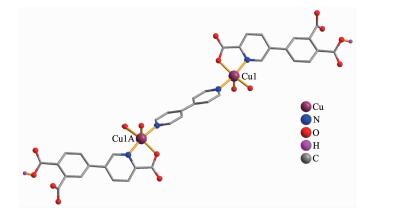
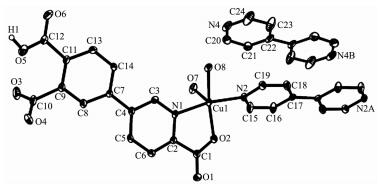
Single-crystal X-ray diffraction analysis reveals that compound 1 crystallizes in the triclinic space group P1. Its asymmetric unit contains one crystallographically unique Cu(Ⅱ) atom, one Hdppa2- block, a half of one 4, 4′-bipy moiety, two H2O ligands, a half of one free 4, 4′-bipy ligand, and three lattice water molecules. As depicted in Fig. 1, Cu1 atom is surrounded by three O and two N atoms in a slightly distorted {CuO3N2} square-pyramidal geometry with the τ value of 0.138 (τ=0 for a regular square-pyramidal geometry and τ=1 for a perfect trigonal-bipyramidal geometry)[16]. The two O (O2 and O8) and two N (N1 and N2) atoms occupy the basal plane, and one O (O7) atom resides at the apical position of the coordination polyhedron. The lengths of the Cu-O bonds range from 0.196 7(3) to 0.222 3(3) nm, whereas the Cu-N distances vary from 0.199 4(3) to 0.199 9(3) nm; these bonding parameters are comparable to those found in other reported Cu(Ⅱ) compounds[14, 17]. In 1, the Hdppa2- ligand adopts terminal coordination mode (mode Ⅰ, Scheme 1), in which the deprotonated carbo-xylate groups show the monodentate or uncoordinated modes. The dihedral angle between pyridyl and phenyl rings in the Hdppa2- is 17.51°. Two crystallographi-cally equal Cu(Ⅱ) centers are bridged by the 4, 4′-bipy ligand to form a discrete dinuclear copper(Ⅱ) structure with a Cu…Cu separation of 1.104(3) nm (Fig. 2). These Cu2 units are assembled to a 3D supramole-cular framework through O-H…O/N hydrogen bond (Fig. 3 and Table 3).
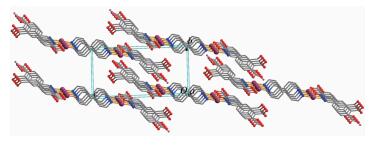
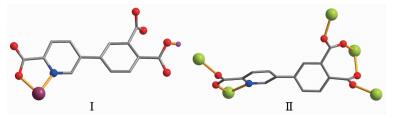
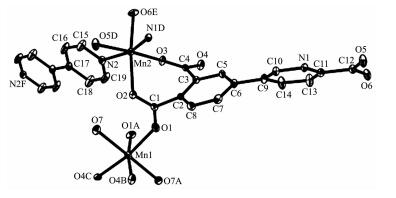
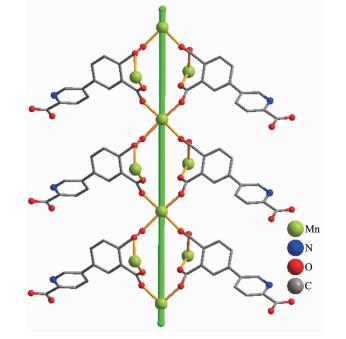
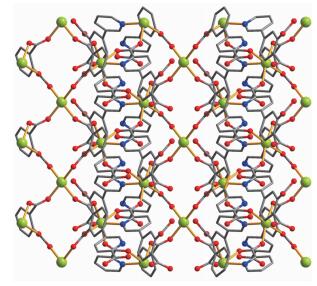
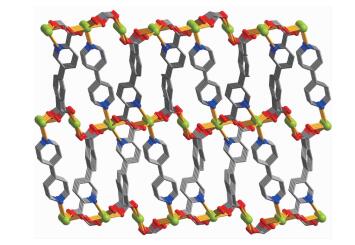
The asymmetric unit of 2 consists of two crystallographically distinct Mn atoms (Mn1 with half occupancy; Mn2 with full occupancy), one μ5-appa3- block, a half of one 4, 4′-bipy ligand, one coordinated and two lattice water molecules. As shown in Fig. 4, six-coordinate Mn1 atom reveals a distorted octahedral {MnO6} environment, filled by four carboxylate O atoms from four individual μ5-dppa3- blocks and two O atoms from two H2O ligands. The Mn2 center is coordinated by four carboxylate O atoms from three distinct dppa3- moieties and two N atoms from two different 4, 4′-bipy ligands, thus composing octahedral {MnO4N2} geometry. The Mn-O distances range from 0.214 2(2) to 0.222 7(2) nm, whereas the Mn-N distances vary from 0.226 6(3) to 0.230 2(3) nm; these bonding parameters are comparable to those observed in other Mn(Ⅱ) compounds[9, 11, 13]. In 2, the dppa3- block acts as a μ5-N, O6-spacer and its COO- groups take a bidentate bridging mode (mode Ⅱ, Scheme 1). In dppa3-, a dihedral angle (between pyridyl and benzene rings) is 46.31°. The carboxylate groups of dppa3- blocks bridge alternately neighboring Mn atoms to form the infinite right-handed or left-handed helical Mn-O-C-O-Mn chains (Fig. 5) with the Mn…Mn separ-ation of 0.545 7(2) and 0.534 8(2) nm. Two types of these helical chains are interconnected to each other through the Mn(Ⅱ) centers to produce a double-helix chain (Fig. 5). The adjacent double-helix subunits are further linked by the cptc3- blocks into a 2D sheet (Fig. 6). These 2D sheets are arranged into a 3D framework by further coordination interactions of the dppa3- and 4, 4′-bipy ligands to Mn atoms (Fig. 7).
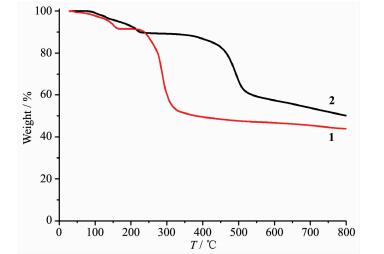
To determine the thermal stability of compounds 1 and 2, their thermal behaviors were investigated under nitrogen atmosphere by thermogravimetric analysis (TGA). As shown in Fig. 8, compound 1 loses its six lattice water molecules in the range of 41~162 ℃ (Obsd. 8.8%, Calcd. 9.1%), followed by the decom-position at 218 ℃. The TGA curve of 2 reveals that four lattice and two coordinated water molecules are released between 78 and 230 ℃ (Obsd. 10.5%, Calcd. 10.8%), and the dehydrated solid begins to decompose at 334 ℃.
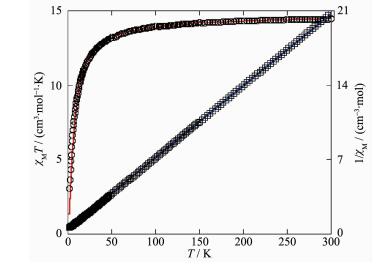
Variable-temperature magnetic susceptibility studies were carried out on powder sample of 2 in the 2~300 K temperature range. The χMT value at 300 K is 14.48 cm3·mol-1·K, which is larger than the value of 13.12 cm3·mol-1·K expected for three magnetically isolated high-spin Mn(Ⅱ) centers (SMn=5/2, g=2.0). Upon cooling, the χMT value drops down very slowly from 14.48 cm3·mol-1·K at 300 K to 13.97 cm3·mol-1·K at 100 K and then decreases steeply to 3.04 cm3·mol-1·K at 2 K (Fig. 9). The χM-1 vs T plot for 2 in the 2~300 K range obeys the Curie-Weiss law with a Weiss constant θ of -6.88 K and a Curie constant C of 14.78 cm3·mol-1·K. The negative value of θ and the decr-ease of the χMT should be attributed to the overall antiferromagnetic coupling between the Mn(Ⅱ) centers within double-helix chain unit. We attempted to fit the data for 2 by applying the following expression[18] for a 1D Mn(Ⅱ) chain:
|
$ \begin{array}{l} H{\rm{ = - }}J{S_i}{S_j}\\ {\chi _{{\rm{chain}}}}{\rm{ = [}}N{g^{\rm{2}}}{\beta ^{\rm{2}}}{\rm{(}}kT{\rm{)](}}A + B{x^{\rm{2}}}{\rm{)(1 + }}Cx + D{x^{\rm{3}}}{{\rm{)}}^{{\rm{ - 1}}}} \end{array} $ |
with A=2.916 7, B=208.04, C=15.543, D=2 707.2, and x=|J|/(kT).
The susceptibility for 2 was simulated using this rough model, and resulting in J=-3.01 cm-1, g=2.07, and R=4.98×10⁻⁵. The negative J parameter indicates a weak antiferromagnetic exchange coupling between the adjacent Mn(Ⅱ) centers in 2, which is in agree-ment with a negative θ value.
In summary, two new coordination compounds, namely [Cu2(Hdppa)2(4, 4′-bipy)(H2O)4]·4, 4′-bipy·6H2O (1) and {[Mn3(μ5-dppa)2(4, 4′-bipy)(H2O)2]·4H2O}n (2), have been synthesized under hydrothermal conditions. The compounds feature the 0D dinuclear and 3D framework structures, respectively. Magnetic studies show an antiferromagnetic coupling between the adjacent Mn(Ⅱ) centers in 2.
Hu Z G, Zhao D. CrystEngComm, 2017, 19:4066-4081 doi: 10.1039/C6CE02660E
Lv R, Li H, Su J, et al. Inorg. Chem., 2017, 56:12348-12356 doi: 10.1021/acs.inorgchem.7b01822
Li P Z, Wang X J, Liu J, et al. CrystEngComm, 2017, 19:4157-4161 doi: 10.1039/C7CE00100B
Cui Y, Yue Y, Qian G, et al. Chem. Rev., 2012, 112:1126-1162
Kuppler R J, Timmons D J, Fang Q R, et al. Coord. Chem. Rev., 2009, 253:3042-3066 doi: 10.1016/j.ccr.2009.05.019
Gu J Z, Cui Y H, Liang X X, et al. Cryst. Growth Des., 2016, 16:4658-4670 doi: 10.1021/acs.cgd.6b00735
Ji P F, Manna K, Lin Z, et al. J. Am. Chem. Soc., 2016, 138:12234-12242 doi: 10.1021/jacs.6b06759
Gu J Z, Gao Z Q, Tang Y. Cryst. Growth Des., 2012, 12:3312-3323 doi: 10.1021/cg300442b
Gu J Z, Wu J, Lv D Y, et al. Dalton Trans., 2013, 42:4822-4830 doi: 10.1039/c2dt32674d
Du M, Li C P, Liu C S, et al. Coord. Chem. Rev., 2013, 257:1282-1305 doi: 10.1016/j.ccr.2012.10.002
Gu J Z, Liang X X, Cui Y H, et al. CrystEngComm, 2017, 19:117-128 doi: 10.1039/C6CE02115H
鲁雅, 吕天喜, 胡未极, 等.无机化学学报, 2017, 33(10):1869-1875 doi: 10.11862/CJIC.2017.215LU Ya, LÜTian-Xi, HU Wei-Ji, et al. Chinese J. Inorg. Chem., 2017, 33(10):1869-1875 doi: 10.11862/CJIC.2017.215
赵素琴, 顾金忠.无机化学学报, 2016, 32(9):1611-1618ZHAO Su-Qin, GU Jin-Zhong. Chinese J. Inorg. Chem., 2016, 32(9):1611-1618
陈金伟, 温炳松, 曹芳利, 等.无机化学学报, 2017, 33(12):2322-2328 doi: 10.11862/CJIC.2017.229CHEN Jin-Wei, WEN Bing-Song, CAO Fang-Li, et al. Chinese J. Inorg. Chem., 2017, 33(12):2322-2328 doi: 10.11862/CJIC.2017.229
Spek A L. Acta Crystallogr. Sect. C:Struct. Chem., 2015, C71:9-18
Addison A W, Rao T N, Reedijk J, et al. J. Chem. Soc. Dalton Trans., 1984:1349-1356 doi: 10.1107/S1600536805006173/pdf
Gu J Z, Liang X X, Cai Y, et al. Dalton Trans., 2017, 46:10908-10925 doi: 10.1039/C7DT01742A
Hiller W, Strhel J, Datz A, et al. J. Am. Chem. Soc., 1984, 106:329-335 doi: 10.1021/ja00314a013

Figure 1 Drawing of the asymmetric unit of compound 1 with 30% probability thermal ellipsoids
H atoms are omitted for clarity except the H atoms of the COOH groups; Symmetry codes: A:-x+1, -y, -z

Figure 2 Dinuclear Cu(Ⅱ) unit of 1
H atoms are omitted for clarity except the H atoms of the COOH groups; Symmetry codes: A:-x+1, -y, -z

Figure 4 Drawing of the asymmetric unit of compound 2 with 30% probability thermal ellipsoids
H atoms were omitted for clarity; Symmetry codes: A:-x, y, -z+1/2; B: x, y+1, z; C:-x, y+1, -z+1/2; D: -x+1/2, -y+1/2, -z+1; E: x, -y, z-1/2; F: -x, -y+1, -z

Figure 9 Temperature dependence of χMT (○) and 1/χM(□) vs T for compound 2
Solid curve represents the best fit to the equations in the text and the line shows the Curie-Weiss fitting
Table 1. Crystal data for compounds 1 and 2
| Compound | 1 | 2 |
| Chemical formula | C48H50Cu2N6O22 | C38H32Mn3N4O18 |
| Molecular weight | 1 190.02 | 997.49 |
| Crystal system | Triclinic | Monoclinic |
| Space group | P1 | C2/c |
| a / nm | 0.710 81(6) | 2.481 35(10) |
| b / nm | 0.940 17(5) | 0.736 26(3) |
| c / nm | 1.843 62(10) | 2.400 42(9) |
| α / (°) | 90.217(4) | |
| β / (°) | 96.594(6) | 115.444(5) |
| γ / (°) | 99.334(6) | |
| V / nm3 | 1.207 38(14) | 3.960 0(3) |
| Z | 1 | 4 |
| F(000) | 614 | 2 028 |
| Crystal size / mm | 0.25×0.23×0.22 | 0.28×0.23×0.21 |
| θ range for data collection | 3.338~25.049 | 3.244~25.049 |
| Limiting indices | -8 ≤ h ≤ 8, -11 ≤ k ≤ 10, -20 ≤ l ≤ 21 | -29 ≤ h ≤ 29, -8 ≤ k ≤ 8, -28 ≤ l ≤ 24 |
| Reflection collected, unique (Rint) | 7 727, 4 274 (0.036 5) | 7 289, 3 518 (0.038 8) |
| Dc / (g·cm-3) | 1.637 | 1.673 |
| μ / mm-1 | 0.975 | 1.028 |
| Data, restraint, parameter | 4 274, 0, 355 | 3 518, 0, 297 |
| Goodness-of-fit on F2 | 1.026 | 1.053 |
| Final R indices [I≥2σ(I)] R1, wR2 | 0.055 8, 0.127 8 | 0.046 1, 0.100 4 |
| R indices (all data) R1, wR2 | 0.075 0, 0.143 1 | 0.064 8, 0.113 3 |
| Largest diff. peak and hole / (e·nm-3) | 943 and -1 029 | 518 and -490 |
 下载: 导出CSV
Table 2. Selected bond distances (nm) and bond angles (°) for compounds 1 and 2
| 1 | |||||
| Cu(1)-O(2) | 0.196 7(3) | Cu(1)-O(7) | 0.222 3(3) | Cu(1)-O(8) | 0.197 5(3) |
| Cu(1)-N(1) | 0.199 4(3) | Cu(1)-N(2) | 0.199 9(3) | ||
| O(2)-Cu(1)-O(8) | 161.32(13) | O(2)-Cu(1)-N(1) | 82.37(13) | O(8)-Cu(1)-N(1) | 96.55(13) |
| O(2)-Cu(1)-N(2) | 87.90(14) | O(8)-Cu(1)-N(2) | 91.46(14) | N(1)-Cu(1)-N(2) | 169.57(15) |
| O(2)-Cu(1)-O(7) | 105.19(13) | O(8)-Cu(1)-O(7) | 93.49(13) | N(1)-Cu(1)-O(7) | 93.56(13) |
| N(2)-Cu(1)-O(7) | 92.61(13) | ||||
| 2 | |||||
| Mn(1)-O(1) | 0.218 6(3) | Mn(1)-O(1)A | 0.218 6(3) | Mn(1)-O(4)B | 0.214 2(2) |
| Mn(1)-O(4)C | 0.214 2(2) | Mn(1)-O(7) | 0.222 7(2) | Mn(1)-O(7)A | 0.222 7(2) |
| Mn(2)-O(2) | 0.221 0(2) | Mn(2)-O(3) | 0.215 3(2) | Mn(2)-O(5)D | 0.216 5(2) |
| Mn(2)-O(6)E | 0.214 9(3) | Mn(2)-N(1)D | 0.230 2(3) | Mn(2)-N(2) | 0.226 6(3) |
| O(4)B-Mn(1)-O(4)C | 96.63(14) | O(4)B-Mn(1)-O(1) | 87.90(10) | O(4)C-Mn(1)-O(1) | 170.61(9) |
| O(1)-Mn(1)-O(1)A | 88.84(15) | O(4)B-Mn(1)-O(7)A | 85.31(9) | O(4)C-Mn(1)-O(7)A | 94.25(9) |
| O(1)-Mn(1)-O(7)A | 94.32(9) | O(1)-Mn(1)-O(7) | 86.15(9) | O(7)-Mn(1)-O(7)A | 179.35(14) |
| O(6)E-Mn(2)-O(3) | 85.37(10) | O(6)E-Mn(2)-O(5)D | 96.99(10) | O(3)-Mn(2)-O(5)D | 176.51(10) |
| O(6)E-Mn(2)-O(2) | 170.00(9) | O(3)-Mn(2)-O(2) | 84.78(9) | O(5)D-Mn(2)-O(2) | 92.77(10) |
| O(6)E-Mn(2)-N(2) | 87.30(11) | O(3)-Mn(2)-N(2) | 90.95(10) | O(5)D-Mn(2)-N(2) | 86.61(10) |
| O(2)-Mn(2)-N(2) | 91.11(10) | O(6)E-Mn(2)-N(1)D | 92.09(10) | O(3)-Mn(2)-N(1)D | 108.60(9) |
| O(5)D-Mn(2)-N(1)D | 73.95(9) | O(2)-Mn(2)-N(1)D | 92.71(10) | N(2)-Mn(2)-N(1)D | 160.34(10) |
| Symmetry codes: A: -x, y, -z+1/2; B: x, y+1, z; C: -x, y+1, -z+1/2; D: -x+1/2, -y+1/2, -z+1; E: x, -y, z-1/2 for 2. | |||||
下载: 导出CSV
Table 3. Hydrogen bond parameters of compounds 1 and 2
| D-H…A | d(D-H) / nm | d(H…A) / nm | d(D…A) / nm | ∠DHA / (°) |
| 1 | ||||
| O(5)-H(1)…N(4)A | 0.082 | 0.183 | 0.260 3 | 157.6 |
| O(7)-H(1W)…O(1)B | 0.085 | 0.187 | 0.272 3 | 179.6 |
| O(7)-H(2W)…O(11)C | 0.073 | 0.199 | 0.271 5 | 171.6 |
| O(8)-H(3W)…O(4)D | 0.085 | 0.184 | 0.268 8 | 179.5 |
| O(8)-H(4W)…O(5)A | 0.085 | 0.175 | 0.260 3 | 179.5 |
| O(9)-H(5W)…O(10)E | 0.085 | 0.188 | 0.273 3 | 179.3 |
| O(9)-H(6W)…O(3)A | 0.085 | 0.184 | 0.268 5 | 178.2 |
| O(10)-H(7W)…O(4)D | 0.085 | 0.194 | 0.278 8 | 178.3 |
| O(11)-H(9W)…O3)A | 0.085 | 0.189 | 0.274 4 | 179.0 |
| O(11)-H(10W)…O(4)D | 0.085 | 0.216 | 0.300 9 | 179.2 |
| 2 | ||||
| O(7)-H(1W)…O(3)A | 0.086 | 0.224 | 0.294 4 | 138.8 |
| O(8)-H(3W)…O(2)B | 0.085 | 0.213 | 0.293 6 | 159.0 |
| Symmetry codes: A: -x+1, -y+1, -z+1; B: x-1, y, z; C: x, y-1, z; D: -x+2, -y+1, -z+1; E: -x+1, -y+1, -z for 1; A: x, y+1, z; B: -x+1/2, y-1/2, -z+1/2 for 2. | ||||
下载: 导出CSV

 扫一扫看文章


扫一扫关注我们