Received Date:
09 January 2018 Revised Date:
23 March 2018 Available Online:
10 June 2018
Abstract:
A unique core-shell Co3O4@δ-MnO2/Pt arrays-type cathode on Ni foam has been fabricated by a facile, controlled hydrothermal approach. The array-type structure facilitates the electrode wetting and oxygen gas transport and supplies free volume for Li2O2 loading. The Co3O4@δ-MnO2/Pt cathode exhibits high catalytic effect for ORR and OER, where thin-layered Li2O2 shows conformal growth along the surface of the Co3O4@δ-MnO2/Pt arrays with the array-type structure remained. This growth behavior of Li2O2 renders easy decomposition of Li2O2 upon charge. Li-O2 cells with Co3O4@δ-MnO2/Pt delivers a high discharge capacity (2 480 mAh·g-1 at 100 mA·g-1) and long cycle life (65 cycles at 200 mA·g-1 with a limited capacity of 500 mAh·g-1), which are better than those with Co3O4 or Co3O4@δ-MnO2 cathodes.
Lithium-oxygen (Li-O2) batteries now have captured a world-wide attention due to the extremely high theoretical energy density of 3 505 Wh·kg-1, showing promising applications in electric vehicles[1-10]. In nona-queous Li-O2 batteries, during discharge, oxygen is reduced to O2- which reacts with Li+ to form Li2O2 at cathode. Upon the subsequent recharge, Li2O2 can be electrochemically decomposed to release oxygen and Li+[4]. Unlike the shuttle mechanism in Li-ion batteries, the deposition of insulating/insoluble Li2O2 will cause sluggish oxygen reduction/evolution reaction (ORR/OER) kinetics, leading to high polarization, low yieldable capacity and poor cycling stability[11-12]. It is widely acknowledged that the electrode kinetics can be enhanced by using efficient catalysts. Besides the components, the architecture of catalytic electrode should also be specially designed to adapt the Li2O2 deposition without drastically changing the structure of the electrodes[13-17].
Carbon materials have been widely used as the catalysts for Li-O2 batteries due to the low cost, high electronic conductivity, light weight and easy mani-pulation of the porosity[18-23]. However, carbon materials suffer from decomposition chemically or electrochemi-cally in contact with Li2O2 or LiO2[24-25]. In addition, the catalytic performance of carbon materials for OER is not satisfactory. Although noble metals provide the best catalytic activity for both ORR and OER[26-33], the high cost limits their large-scale applications. Transi-tion metals oxides, such as MnO2, Co3O4, NiO, and CoOOH, are suitable due to low cost, structural stability and relatively high catalytic activity for ORR/OER[34-42]. Thus, a compromise can be made by combining transition metals oxides and noble metals. However, unlike carbon materials, it is difficult to allocate free space for Li2O2 deposition in oxides.
Array-type electrode prepared by direct growth route is desirable since the voids between the arrays could be used to store Li2O2[37, 41, 43-46]. Cui et al.[37] first report a Co3O4-array-catalyzed Li-O2 cell with low polarization and high capacity. The work by Chang et al.[43] show that Li-O2 cell could sustain stable cycling up to 300 times at 500 mAh·g-1 when using a carbon/binder-free RuOx /TiN nanotube arrays cathode. Recent report by Liu et al.[44] show that Li-O2 batteries with TiO2-array cathode demonstrate long cycle life, superior rate capability, high round-trip efficiency, and good recoverability of the catalytic electrode. For the array-type electrode, realizing conformal growth of Li2O2 on the arrays is desirable to retain the voids between the arrays and keep intimate contact between Li2O2 and catalyst. Nevertheless, as previously reported, conformal growth of insulating Li2O2 will easily deactivate the catalyst with low capacity due to blocked electron transport[47-50].
In this work, we design a unique core-shell Co3O4@δ-MnO2/Pt arrays-type electrode on nickel foam by a controllable, facile route as binder-free electrodes for Li-O2 cells, where the Co3O4 acts as the "core" and ultrathin δ-MnO2 nanosheets with Pt as the "shell". MnO2 was selected because of its high catalytic activity for ORR/OER[34-36, 51]. Co3O4 acts both as the catalytically active component and as the substrate for MnO2 deposition. The decoration of Pt not only enhances the catalytic activity but also guides conformal growth of Li2O2. The advantages of this electrode design include: (1) the array-type structure facilitates the electrode wetting by electrolyte and O2 transport and supplies large room for Li2O2 loading; (2) the conformal growth of thin-layered Li2O2 on Co3O4@δ-MnO2/Pt enables its easy decomposition upon charge; (3) the porous structure of δ-MnO2 assures high Li2O2 loading despite the conformal growth mode; (4) the side reactions related to binder and conductive agent are totally precluded or largely reduced due to binder- and conductive-agent-free electrode configura-tion. As a result, Li-O2 cells with core-shell Co3O4@δ-MnO2/Pt arrays exhibit high capacity and long cycle life.
1.
Experimental
1.1
Electrode preparation
Co3O4@δ-MnO2/Pt arrays-type electrodes were synthesized by three steps. First, Co3O4 nanowire arrays on Ni foam substrate were prepared by a facile hydrothermal route. Co(NO3)2·6H2O (1.2 mmol), NH4F (1.2 mmol), and urea (3 mmol) were dissolved into 50 mL of deionized (DI) water under vigorous stirring. The solution was then transferred into a Teflon-lined stainless steel autoclave with a piece of Ni foam immersed. The autoclave was sealed and heated in an electric oven at 120 ℃ for 5 h. After being cooled to room temperature, the Ni foam piece with a pink deposit was collected, washed with DI water and absolute ethanol several times, and dried at 60 ℃ in air overnight. The product was further heated at 400 ℃ for 2 h in air to obtain Ni-supported Co3O4 (Co3O4/Ni). For the growth of δ-MnO2 in the second step, a piece of Co3O4/Ni was first immersed into a 0.04 mol·L-1 aqueous solution of glucose for 24 h, followed by carbonization at 450 ℃ in Ar for 2 h. After that, 80 mg KMnO4 (99.5%, Sinopharm Chemical Reagent Co., Ltd.) was dissolved in 60 mL of DI water with vigorous stirring to form a homogeneous solution. The carbon modified Co3O4/Ni was soaked in the above solution for 1.5 h. Afterwards, the mixture was transferred into a Teflon-lined stainless steel autoclave and heated at 85 ℃ for 2.5 h. After cooling down to room tempera-ture naturally, the Ni foam with a brown deposit was collected and washed repeatedly with DI water and absolute ethanol. The electrode was then dried at 60 ℃ in air overnight followed by heating at 300 ℃ in Ar for 2 h to obtain Ni-supported core-shell Co3O4/δ-MnO2. Finally, for the platinum deposition, H2PtCl6·6H2O was dispersed in DI water at a concentration of 0.24 mg·mL-1 under stirring, a piece of Ni-supported Co3O4@δ-MnO2 was soaked in the above solution overnight. The electrode was then dried at 60 ℃ in air for 5 h followed by heating at 300 ℃ in Ar for 2 h to get Ni-supported Co3O4@δ-MnO2/Pt. The total loading of Co3O4@δ-MnO2/Pt on Ni substrate is around 1.4 mg·cm-2 and Pt loading is around 0.2 mg·cm-2.
1.2
Electrode characterization
X-ray diffraction (XRD) patterns of the electrodes were acquired using a Rigaku D/Max-2550pc powder diffractometer equipped with Cu Kα radiation (λ=0.154 1 nm). The operating voltage and current were 40 kV and 250 mA, respectively, and 2θ=10°~80°. The morphologies of the pristine and cycled electrodes were observed by field-emission scanning electron microscopy (SEM) using an S-4800 microscope (Hitachi, Japan) at an accelerating voltage of 5 kV. Transmission electron microscopy (TEM) and high-resolution TEM (HRTEM) were conducted on a JEM 2100F microscope at an accelerating voltage of 200 kV. X-ray photoelectron spectra (XPS) of the discharged and charged electrodes were collected on a KRATOS AXIS ULTRA-DLD spectrometer with Al Kα radiation (hν=1 486.6 eV). To analyze the cycled elec-trodes by SEM, TEM and XPS, the electrodes or electrode components were carefully handled before the various ex-situ characterizations[52].
1.3
Electrochemical measurements
Coin-type Li-O2 cells were assembled in the Ar-filled glovebox using lithium foil as the anode, Ni-supported Co3O4@δ-MnO2/Pt as the cathode, and Celgard C480 membrane as the separator. The electro-lyte was 1 mol·L-1 LiClO4 (≥99.99%, Sigma-Aldrich) in tetraethylene glycol dimethyl ether (TEGDME). The cathodes were dried at 80 ℃ in vacuum overnight before cell assembly. The assembled cells were purged with pure O2 for 20 min and stayed at open voltage circuit (OCV) for 5 h before the electrochemical tests. Charge and discharge cycling was performed on a Neware battery cycler (Shenzhen, China) in a voltage window of 2.0~4.5 V (vs Li/Li+). The specific capacity (mAh·g-1) and current density (mA·g-1) of the cells were calculated based on the weight of Co3O4@δ-MnO2/Pt. For the cells using Co3O4 and Co3O4@δ-MnO2 catalysts, the specific capacity and current density were calculated based on the weight of Co3O4 and Co3O4@δ-MnO2, respectively. Electrochemical imped-ance spectroscopy (EIS) measurements were conducted on the VersaSTAT3 electrochemistry workstation by applying an AC signal of 5 mV amplitude over the frequency range 10-2 to 105 Hz. All of the electro-chemical tests were performed at 25 ℃.
2.
Results and discussion
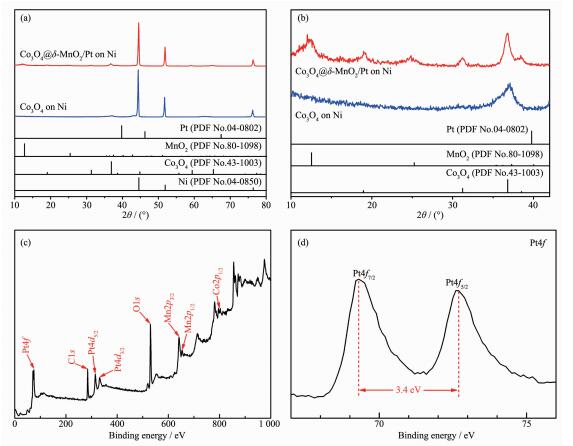
Fig. 1a and the enlarged view (Fig. 1b) show the XRD patterns of Co3O4 and Co3O4@δ-MnO2/Pt supported on Ni foam. The three strong diffraction peaks at 44.5°, 51.8°, and 76.4° (2θ) are from the nickel subs-trate, and the presence of Co3O4 and Co3O4@δ-MnO2/Pt is confirmed by XRD patterns in Fig. 1b, while the presence of Pt is not detected in XRD due to the low content. The XRD shows that the MnO2 is δ-MnO2. In order to further confirm the existence of Pt, XPS analysis was performed. The survey spectrum in Fig. 1c reveals the presence of the expected O, Co, Mn and Pt elements. In Fig. 1d, the bands at 69.3 and 72.7 eV correspond to the binding energy of Pt4f7/2 and Pt4f5/2, respectively[53]. In Fig.S1a, the peaks at 778.6 and 794.1 eV are the Co2p spectra of Co3+, and the peaks at 780.3 and 796.0 eV are Co2p of Co2+[54]. The bands at 639.8 and 651.4 eV (Fig.S1b) correspond to the binding energy of Mn2p3/2 and Mn2p1/2, in good accordance with the previous report[55].
图 1
图 1
(a) XRD patterns of Co3O4 and Co3O4@δ-MnO2/Pt on Ni foam; (b) Enlarged view in (a);
(c) XPS survey spectrum and (d) Pt4f XPS spectrum of Co3O4@δ-MnO2/Pt
Figure 1.
(a) XRD patterns of Co3O4 and Co3O4@δ-MnO2/Pt on Ni foam; (b) Enlarged view in (a);
(c) XPS survey spectrum and (d) Pt4f XPS spectrum of Co3O4@δ-MnO2/Pt
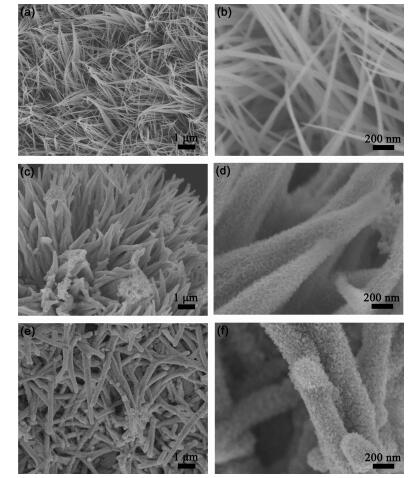
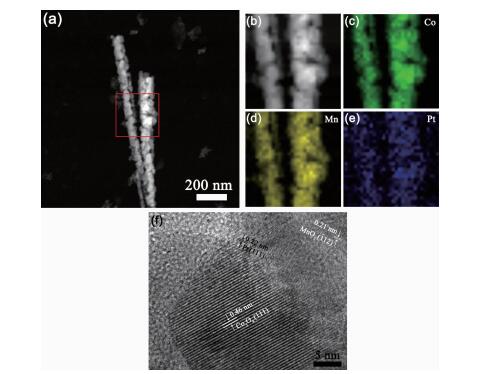
The morphology and structural features of the prepared electrodes were characterized by SEM and TEM. Fig. 2 shows the SEM images of Co3O4, Co3O4@δ-MnO2, and Co3O4@δ-MnO2/Pt at different magnifica-tions. Note that Co3O4 nanowires grow uniformly on the skeletons of the Ni foam. The Co3O4 nanowires have a diameter below 200 nm and a length of several microns (Fig. 2(a, b)). After the MnO2 growth, thin MnO2 nanosheets are uniformly covered on the whole surface of the Co3O4 nanowires, forming a core-shell porous structure as shown in Fig. 2(c, d). As seen in Fig. 2(e, f), the introduction of Pt does not change the morphology of core-shell Co3O4@δ-MnO2 obviously with the array structure maintained. The pores in Pt/δ-MnO2 and the voids between the arrays are beneficial to the electr-olyte infiltration and oxygen gas transportation and provide the space for Li2O2 deposition. The Co3O4@δ-MnO2/Pt was further characterized by TEM, HRTEM and energy dispersive X-ray spectroscopy (EDS) mapping as shown in Fig. 3. The results confirm that Co3O4, δ-MnO2 and Pt construct a uniform electrode, where Co3O4 exhibits a polycrystalline nanowire struc-ture, δ-MnO2 has a sheet-like shape and Pd nanocry-stals have a small size below 20 nm. In Fig. 3f, the lattice spacings of 0.46, 0.22 and 0.21 nm correspond to the planes of Co3O4 (111), Pt (111) and δ-MnO2 (112), respectively. The above characterizations confirm the formation of Co3O4@δ-MnO2/Pt.
图 2
图 2
SEM images of (a, b) Co3O4, (c, d) Co3O4@δ-MnO2, and (e, f) Co3O4@δ-MnO2/Pt
Figure 2.
SEM images of (a, b) Co3O4, (c, d) Co3O4@δ-MnO2, and (e, f) Co3O4@δ-MnO2/Pt
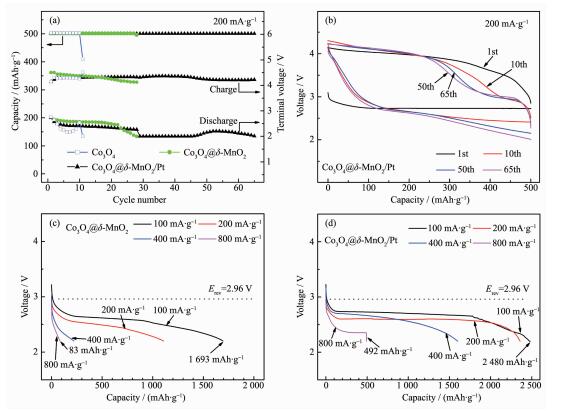
The electrocatalytic activity of Co3O4@δ-MnO2/Pt was investigated in Li-O2 cells and compared with that of Co3O4 and Co3O4@δ-MnO2. The current density and specific capacity were calculated by the total mass of catalyst on the Ni substrate. The cycling performance of the Co3O4, Co3O4@δ-MnO2 and Co3O4@δ-MnO2/Pt-catalyzed Li-O2 cells was evaluated by galvanostatic cycling at 200 mA·g-1 between 2.0~4.5 V with a limited capacity of 500 mAh·g-1. As shown in Fig. 4(a, b), the cell with Co3O4@δ-MnO2/Pt catalyst can sustain stable cycling for 65 cycles. While for the cells with Co3O4 and Co3O4@δ-MnO2 catalytic cathodes, the cycling can last only 10 cycles and 28 cycles, respectively (Fig. 4a and Fig.S2). To demonstrate the high catalytic activity of Co3O4@δ-MnO2/Pt, the cell was also cycled at a higher limited capacity of 1 000 mAh·g-1 at a current density of 200 mA·g-1. In this case, the stable cycling can still last 32 cycles (Fig.S3). It should noted that the electrode has a relatively high catalyst loading of about 1.4 mg·cm-2. The cycling performance of the cell is better than or comparable with those with similar catalysts and same limited capacity[56-57]. The better cycle performance of the Li-O2 cell with Co3O4@ δ-MnO2/Pt catalyst can be attributed to the unique microstructure and components of the cathode. Pt nanoparticles are highly efficient in catalyzing the ORR/OER in the air cathode[58], leading to enhanced formation/decomposition of Li2O2 and thereby long cycle life. In addition, the binder-free electrode design also contributes to good cycling stability of the cell with Co3O4@δ-MnO2/Pt catalyst. Of note is that, the cell shows performance degradation after 60 cycles. This may result from factors such as decomposition of electrolyte or Li corrosion. A previous report show that Pt shows no selectivity in its catalytic activity toward Li2O2 oxidation reaction and electrolyte decomposition[31], which is also partly responsible for the limited cycle life.
图 4
图 4
(a) Terminal voltages of Co3O4, Co3O4@δ-MnO2 and Co3O4@δ-MnO2/Pt-catalyzed Li-O2 cells at a limited capacity of 500 mAh·g-1; (b) Voltage profiles of Co3O4@δ-MnO2/Pt-catalyzed Li-O2 cell; Discharge profiles of (c) Co3O4@δ-MnO2 and (d) Co3O4@δ-MnO2/Pt-catalyzed Li-O2 cells at various current densities Cells were discharged and charged to 500 mAh·g-1 at 200 mA·g-1
Figure 4.
(a) Terminal voltages of Co3O4, Co3O4@δ-MnO2 and Co3O4@δ-MnO2/Pt-catalyzed Li-O2 cells at a limited capacity of 500 mAh·g-1; (b) Voltage profiles of Co3O4@δ-MnO2/Pt-catalyzed Li-O2 cell; Discharge profiles of (c) Co3O4@δ-MnO2 and (d) Co3O4@δ-MnO2/Pt-catalyzed Li-O2 cells at various current densities Cells were discharged and charged to 500 mAh·g-1 at 200 mA·g-1
Fig. 4(c, d) show the discharge profiles of the Co3O4 @δ-MnO2 and Co3O4@δ-MnO2/Pt-catalyzed Li-O2 cells at various current densities. In the figures, Erev is the reversible potential of Li-O2 cells, namely, 2.96 V vs Li/Li+. At 100 mA·g-1, the cell with Co3O4@δ-MnO2/Pt yields a capacity of 2 480 mAh·g-1 and exhibits a high discharge plateau of 2.71 V. When the current density increases from 100 to 800 mA·g-1, the discharge capacity and plateaus decrease gradually. But even at 800 mA·g-1, the cell could still deliver a capacity of 492 mAh·g-1 due to the excellent catalytic activity of Co3O4@δ-MnO2/Pt for ORR. In comparison, the cell with Co3O4@δ-MnO2 catalyst shows a lower capacity of 1 693 mAh·g-1 and a lower discharge plateau of 2.59 V at 100 mA·g-1. The discharge capacity decreases rapidly to 83 mAh·g-1 when the current density increases to 800 mA·g-1. The low capacity of the Co3O4@δ-MnO2-catalyzed cell indicates its poor ORR catalytic activity. The obviously enha-nced catalytic activity of Co3O4@δ-MnO2/Pt is closely related to the introduction of Pt. It is expected that the presence of Pt will alter the crystallization behavior of Li2O2 by supplying catalytically active sites.
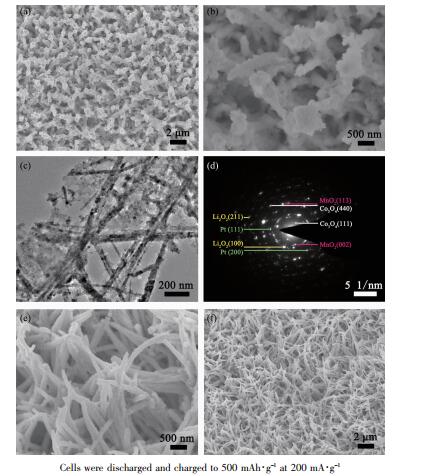
To clarify the superior catalytic activity of Co3O4 @δ-MnO2/Pt and the role that it plays in increasing the cycle performance of the cell, the electrodes after discharge were observed by SEM and TEM. The loading of the SEM/TEM holders to the chamber was finished as soon as possible to minimize the exposure of the samples to air. As shown in Fig. 5(a, b), no large Li2O2 particles can be found on the discharged Co3O4 @δ-MnO2/Pt electrode, and the pristine array-type structure of Co3O4@δ-MnO2/Pt was generally preserved after discharge to 500 mAh·g-1. To reveal the growth position of Li2O2 on the electrode, the morphologies were observed and compared to the original Co3O4@δ-MnO2/Pt. In the discharged electrodes, it seems that the Li2O2 forms inside the porous δ-MnO2 and a fluffy substance grows conformally along the surface of the Co3O4@δ-MnO2/Pt arrays, where the original array structure with voids is clearly visible. Namely, the pores in the pristine Co3O4@δ-MnO2/Pt were filled by the Li2O2. This form of Li2O2 is usually rich in defects and poorly crystallized and thus easily to be decomp-osed[59]. The fluffy substance is further characterized by TEM (Fig. 5c) and is confirmed to be Li2O2 by selected area electron diffraction (SAED, Fig. 5d). From these results, it can be concluded that Co3O4@δ-MnO2/Pt arrays catalyzes the conformal growth of thin-layered Li2O2 along the surface of electrode.
图 5
图 5
(a, b) SEM images, (c) TEM image and (d) SAED pattern of Co3O4@δ-MnO2/Pt after the first discharge;
(e, f) SEM images of Co3O4@δ-MnO2/Pt after the first charge
Figure 5.
(a, b) SEM images, (c) TEM image and (d) SAED pattern of Co3O4@δ-MnO2/Pt after the first discharge;
(e, f) SEM images of Co3O4@δ-MnO2/Pt after the first charge
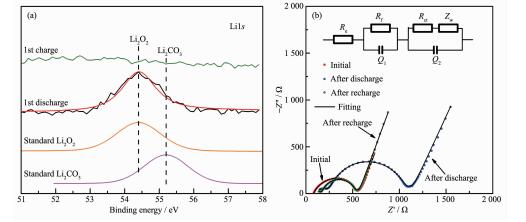
For the Co3O4@δ-MnO2/Pt electrode, after recharge, the porous structure is visible again, indi-cative of sufficient decomposition of the discharge product (Fig. 5e). Besides, the array-type structure of Co3O4@δ-MnO2/Pt remains intact (Fig. 5f). The rever-sible formation/decomposition of Li2O2 is confirmed by Li1s XPS (Fig. 6a) and further supported by EIS mea-surements (Fig. 6b and Table 1). In the Nyquist plots, the fitted curves are obtained by using the equivalent circuit in the inset, where Re represents ohm resi-stance of cell components, Rf and Q1 represent surface film resistance and relaxation capacitance, Rct and Q2 correspond to the charge transfer resistance and double-layer capacitance, and Zw is associated with the bulk diffusion of Li ions. In the table, Y is admittance response of constant phase element Q1 and Q2 and n is index of the angular frequency[60]. The remarkable increase in Rct (from 331.9 to 767.1 Ω) after discharge indicates the deposition of insulating Li2O2 which passivates the electrode, whereas the decrease in Rct (from 767.1 to 301.6 Ω) denotes the sufficient removal of Li2O2 after recharge. From these results, it can be seen that the Ni-supported Co3O4@δ-MnO2/Pt electrode is highly efficient in catalyzing ORR/OER by controlling the Li2O2 growth, which can explain the high discharge capacity and long cycle life of the cells.
表 1
表 1
Fitting results of the Nyquist plots using the equivalent circuit
Table 1.
Fitting results of the Nyquist plots using the equivalent circuit
图 6
(a) Li1s XPS after the first cycle and (b) Nyquist plots and corresponding fittings of Li-O2 cells with Co3O4@δ-MnO2/Pt electrode at the initial state and discharged/recharged to 2.2 V/4.3 V
Figure 6.
(a) Li1s XPS after the first cycle and (b) Nyquist plots and corresponding fittings of Li-O2 cells with Co3O4@δ-MnO2/Pt electrode at the initial state and discharged/recharged to 2.2 V/4.3 V
In summary, we propose a unique design of a core-shell Co3O4@δ-MnO2/Pt arrays-type electrode with a controllable, facile route. In this design, the array-type structure facilitates the electrode wetting and oxygen gas transport and supplies free volume for Li2O2 loading. The presence of Pt supplies the catalytically active centers and guides the conformal growth of thin-layered Li2O2. The conformal, thin-layered growth of Li2O2 on Co3O4@δ-MnO2/Pt enables its easy decomposition upon charge. The porous structure of δ-MnO2 makes high Li2O2 loading possible even though it has a conformal growth mode. As a result, Li-O2 cell catalyzed by Co3O4@δ-MnO2/Pt arrays delivers high discharge capacity (2 480 mAh·g-1 at 100 mA·g-1) and shows good cycling stability (65 cycles at 200 mA·g-1 with a limited capacity of 500 mAh·g-1). This work provides a new design of efficient catalytic cathode for Li-O2 cells.
Piao T, Park S M, Doh C H, et al. J. Electrochem. Soc., 2009, 146(8):2794-2798
Figure 1
(a) XRD patterns of Co3O4 and Co3O4@δ-MnO2/Pt on Ni foam; (b) Enlarged view in (a);
(c) XPS survey spectrum and (d) Pt4f XPS spectrum of Co3O4@δ-MnO2/Pt
Figure 4
(a) Terminal voltages of Co3O4, Co3O4@δ-MnO2 and Co3O4@δ-MnO2/Pt-catalyzed Li-O2 cells at a limited capacity of 500 mAh·g-1; (b) Voltage profiles of Co3O4@δ-MnO2/Pt-catalyzed Li-O2 cell; Discharge profiles of (c) Co3O4@δ-MnO2 and (d) Co3O4@δ-MnO2/Pt-catalyzed Li-O2 cells at various current densities Cells were discharged and charged to 500 mAh·g-1 at 200 mA·g-1
Figure 5
(a, b) SEM images, (c) TEM image and (d) SAED pattern of Co3O4@δ-MnO2/Pt after the first discharge;
(e, f) SEM images of Co3O4@δ-MnO2/Pt after the first charge
Figure 6
(a) Li1s XPS after the first cycle and (b) Nyquist plots and corresponding fittings of Li-O2 cells with Co3O4@δ-MnO2/Pt electrode at the initial state and discharged/recharged to 2.2 V/4.3 V



 下载:
下载:


 下载:
下载:



