

 Table 1.
Crystal data and structure refinement parameters for hybrids 1 and 2
Citation:
TIAN Yue, LI Fei, ZHANG Guo-Cui, ZHOU Hong-Ping, WU Jie-Ying, TIAN Yu-Peng. Two Solid Fluorescent Organic-Inorganic Hybrids: Synthesis, Crystal Structures and Strong Red Fluorescence Emissions[J]. Chinese Journal of Inorganic Chemistry,
2017, 33(4): 664-672.
doi:
10.11862/CJIC.2017.060

两种固体荧光有机-无机杂化物的合成、结构及强红光发射
摘要:
采用 (E)-4-(4-(diphenylamino) styryl)-1-methylpyridinium iodide (DPASPI, DPASP=(E)-4-(4-(diphenylamino) styryl)-1-methylpyridi-nium), 设计合成2种新型有机-无机杂化物 (DPASP)2[Zn (NCS)4]·2CH3OH (1) 和{(DPASP)2[Cd (SCN)(NCS)3]·2CH3OH}n(2).通过单晶X射线衍射进行了表征, 结果表明杂化物1和2是由有机吡啶阳离子和异硫氰酸金属配阴离子组成的, 具有不同空间结构.通过1H NMR谱图解释了离子间相互作用.对具有高量子产率的杂化物1和2的红光发光性质进行了研究.
English
Two Solid Fluorescent Organic-Inorganic Hybrids: Synthesis, Crystal Structures and Strong Red Fluorescence Emissions
Abstract:
Two organic-inorganic hybrids, (DPASP)2[Zn (NCS)4]·2CH3OH (1) and {(DPASP)2[Cd (SCN)(NCS)3]·2CH3OH}n (2), have been facilely prepared from (E)-4-(4-(diphenylamino) styryl)-1-methylpyridinium iodide (DPASPI, DPASP=(E)-4-(4-(diphenylamino) styryl)-1-methylpyridinium) at gram scale. Their crystal structures have been confirmed by single-crystal X-ray diffraction analysis, which show that the hybrids 1 and 2 consist of organic pyridium cations and metal thiocyanato anions bearing different spacial structure through self-assembly processes. Furthermore, the interactions between the ions have been investigated by 1H NMR spectra. Finally, red photolumencent properties with enhanced quantum yields of hybrids 1 and 2 were investigated.
-
0 Introduction
Recently, organic-inorganic hybrid materials have attracted considerable interest due to their potential application in nanomedicine, catalysis and photoactive devices[1-3]. One important hybrid, pyridinium salt, has also been focused on. Researchers have taken much effort to design and synthesize novel pyridinium salts with the push-pull π-conjugated dipolar feature in the pursuit of enhancing the intramolecular charge transfer (ICT) upon excitation[4-5]. Multiple pyridinium salts containing porphyrin[6-7], carbazole[8], tetraphenyle-thene[9-10] and triphenylamine unit[11], are designed for photolumincent organic-inorganic hybrid materials on plentiful photoluminescent applications, including second harmonic generation imaging, dye-sensitized solar cells (DSSCs), DNA photocleavage and chemose-nsor. In general, the bulk of pyridinium salts assemble with anions, such as I-, Br-, BF4-, PF6- [12-13].
The thiocyanato anion, as a versatile ligand, plays a functional role in cooperative magnetic prop-erties on the applications of coordination polymers (CPs) or metal-organic frameworks (MOFs), owing to adopting multiple coordination modes[14]. There are different styles of the coordination networks varying from the metals and ligands[15]. In addition, as having d10 electronic configuration, the metal ions Zn2+ and Cd2+ are particular flexible for the construction of coordination networks varying from tetrahedral to octahedral; are reversible for the formation of coor-dination bonds enabling to rearrange metal ions and ligands in highly regular networks; are feasible to all kinds of architectures and the topological types, which have attracted extensive attention upon optical, electronic and magnetic properties[16]. Our previous work, Tian et al.[17] have successfully synthesized a series of trans-4-(4′-N, N-dialkylaminostyryl)-N-methyl pyridinium and its derivatives featuring with [Cd (SCN)3]n- and applied them in nonlinear optical materials. So far, the zig-zag of [M (NCS)n] chains through thiocy-anato bridge as metal anions have diversified the architectural beauty of coordination hybrids, taking advantages as mentioned above[18]. Therefore, it is high-light that organic-inorganic hybrid materials achieve peculiar and induced photoluminescent properties via easy synthesis, well-defined structure and molecular arrangement.
In this work, two organic-inorganic hybrid mater-ials (DPASP)2[Zn (NCS)4]·2CH3OH (1) and {(DPASP)2[Cd (SCN)(NCS)3]·2CH3OH}n (2) have been synthesized from (E)-4-(4-(diphenylamino) styryl)-1-methylpyridin-ium iodide (DPASPI). They have been characterized by 1H NMR, 13C NMR, and FT-IR spectra, then struc-turally characterized by single-crystal X-ray diffraction analysis. Their structure-property relationships have been preliminarily investigated. For the first time, two pyridinium salts with strong red fluorescence emiss-ions have been investigated.
1 Experimental
1.1 Materials and general procedures
All of the chemicals and solvents were purchased from commercially available resources with further purification by conventional methods. The 1H NMR and 13C NMR spectra were recorded at 25 ℃ using Bruker Avance 400 spectrometer with TMS as internal standard. FT-IR spectra were recorded on NEXUS 870 (Nicolet) spectrophotometer in the 400~4 000 cm-1 region using a powder sample on a KBr plate. The solid-state luminescence spectra were measured on an F-4500 FL spectrophotometer with the EX Slit: 5.0 nm, EM Slit: 5.0 nm, and PMT Voltage: 700 V for DPASPI, hybrids 1 and 2. For time-resolved fluores-cence measurements, the fluorescence signals were collimated and focused onto the entrance slit of a monochromator with the output plane equipped with a photomultiplier tube (HORIBA HuoroMax-4P). The decays were analyzed by least-squares. The quality of the exponential fits was evaluated by the goodness of fit (χ2). Quantum yield was measured by integrating sphere. Thermogravimetry (TG) and differential thermogravimetry (DTG) methods in the temperation range from 50 to 800 ℃ under a flowing atmosphere of nitrogen.
1.2 Synthesis of the hybrids
1.3 Single-crystal X-ray diffraction analysis
The X-ray diffraction measurements were perfo-rmed on a Bruker SMART CCD area detector using graphite monochromated Mo Kα radiation (λ=0.071 069 nm) at 296 K. Intensity data were collected in the variable ω-scan mode. The structures were solved by direct methods and difference Fourier syntheses. The non-hydrogen atoms were refined anisotropically and hydrogen atoms were introduced geometrically. Calcu-lations were performed with the SHELXTL-97 program package[20]. The crystal data and structure refinement parameters were listed in Table 1.
Table 1.
Crystal data and structure refinement parameters for hybrids 1 and 2
 Table 1. Crystal data and structure refinement parameters for hybrids 1 and 2
CCDC: 1517533, 1; 1060372, 2.
1.2.2 Synthesis of 1
AgNO3 (1.70 g, 10 mmol) in 20 mL methanol was added to 30 mL methanol solution of DPASPI (4.90 g, 10 mmol). The mixture was refluxed for 3 h, and then filtered to remove silver iodide precipitation. The filtrate was added into 20 mL methanol solution of KSCN (0.97 g, 10 mmol), followed by refluxing for about 3 h and then filtered to remove KNO3. After evaporation of the clear red solution, shining micro-crystals were formed, filtered, washed with water and methanol, and pure product A was obtained. Pure product A (1.27 g, 3.00 mmol) and Zn (SCN)2 (0.55 g, 3.00 mmol) were refluxed in 25 mL methanol. Red product was obtained by filtration. Yield: 1.60 g, 81%. 1H NMR (DMSO-d6, 400 MHz): δ 8.768 (d, J=6.4 Hz, 2H), 8.131 (d, J=6.4 Hz, 2H), 7.930 (d, J=16.0 Hz, 1H), 7.620 (d, J=8.8 Hz, 2H), 7.381 (t, J=7.8 Hz, 4H), 7.290 (d, J=16.0 Hz, 1H), 7.164 (t, J=7.4 Hz, 2H), 7.120 (d, J=7.6 Hz, 4H), 6.950 (d, J=8.4 Hz, 2H), 4.251 (s, 3H); 13C NMR (DMSO-d6, 100 MHz): δ 152.798, 149.433, 146.180, 144.752, 140.490, 133.387, 129.814, 129.622, 127.950, 125.367, 122.885, 120.692, 120.442, 46.646. FT-IR (KBr, cm-1): 3 032 (w), 2 363 (w), 2 071 (vs), 1 579 (vs), 1 519 (vs), 1 489 (vs), 1 329 (s), 1 292 (s), 1 172 (vs), 692 (w), 667 (w), 534 (m) (Fig. 4). Anal. Calcd. for C36H31N10O2S8Zn2(%): C, 42.27; H, 3.05; N, 13.69. Found (%): C, 42.78; H, 3.01; N, 14.09.
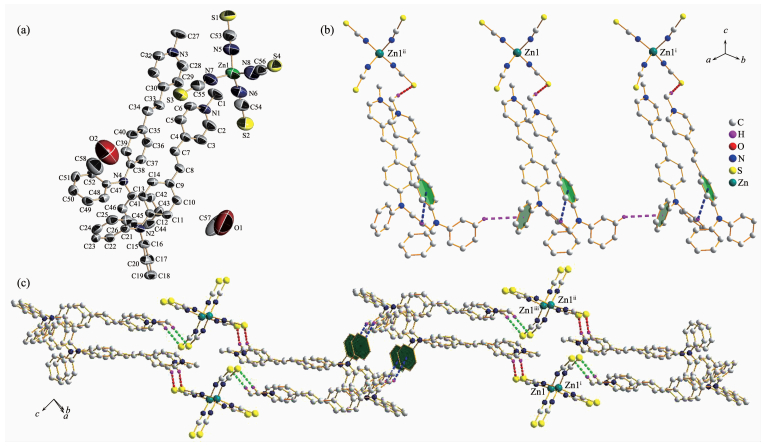 Figure 1.
(a) ORTEP diagram of hybrid 1; (b) 1D chain bridged by C-H…S and C-H…π in hybrid 1;
(c) 2D layer formed by C-H…S and C-H…π in hybrid 1
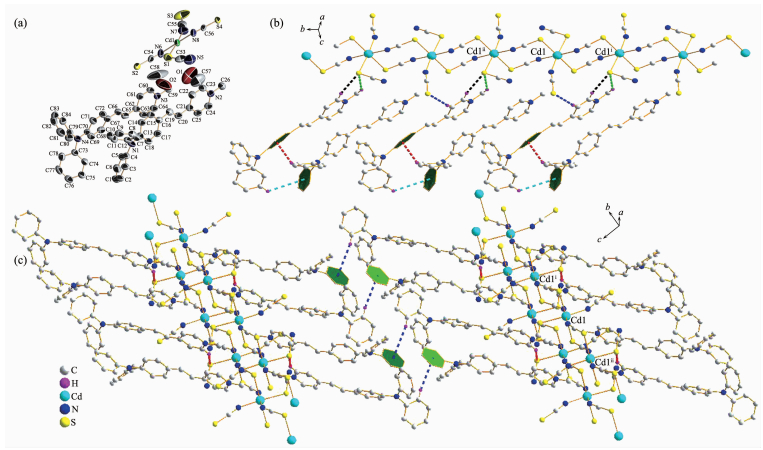 Figure 2.
(a) ORTEP diagram of hybrid 2; (b) 1D chain bridged by C-H…S and C-H…π in hybrid 2;
(c) 2D layer formed by C-H…S and C-H…π in hybrid 2
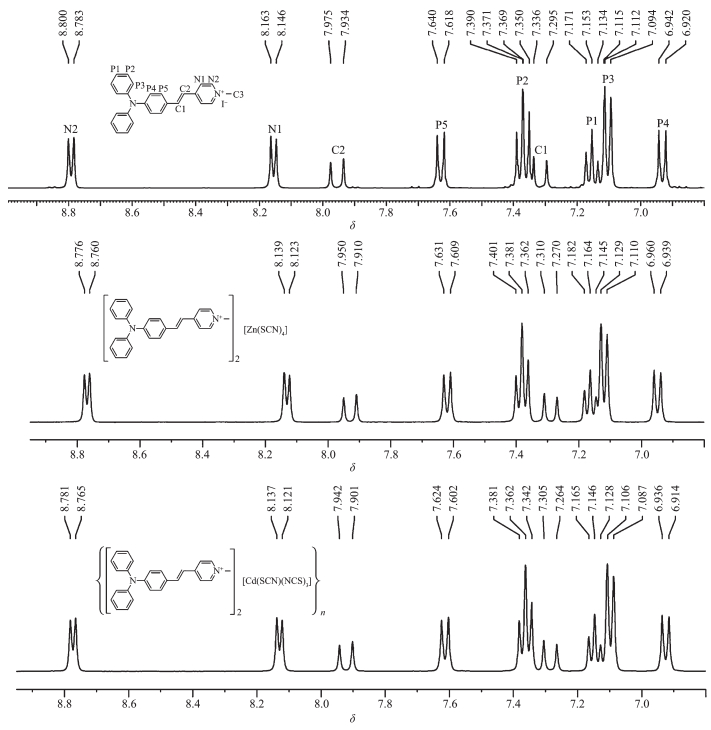 Figure 3.
1H NMR spectra of DPASPI, hybrids 1 and 2 in DMSO-d6 solvent
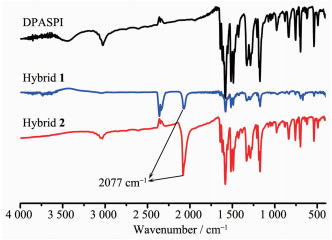 Figure 4.
FT-IR spectra of DPASPI, hybrids 1 and 2
1.2.1 Synthesis of DPASPI
DPASPI was prepared according to the literature method[17, 19]. 1H NMR (DMSO-d6, 400 MHz): δ 8.792 (d, J=6.8 Hz, 2H), 8.155 (d, J=6.8 Hz, 2H), 7.955 (d, J=16.4 Hz, 1H), 7.629 (d, J=8.8 Hz, 2H), 7.370 (t, J=7.8 Hz, 4H), 7.316 (d, J=16.4 Hz, 1H), 7.153 (t, J=7.4 Hz, 2H), 7.104 (d, J=8.0 Hz, 4H), 6.931 (d, J=8.8 Hz, 2H), 4.225 (s, 3H); 13C NMR (DMSO-d6, 100 MHz): δ 152.780, 149.385, 146.170, 144.749, 140.450, 129.829, 129.662, 127.987, 125.354, 124.464, 122.888, 120.672, 120.443, 46.700. FT-IR (KBr, cm-1): 3 435 (w), 1 578 (vs), 1 515 (vs), 1 487 (vs), 1 329 (s), 1 283 (s), 1 178 (vs), 978 (w), 836 (m), 754 (m), 695 (m), 536 (m).
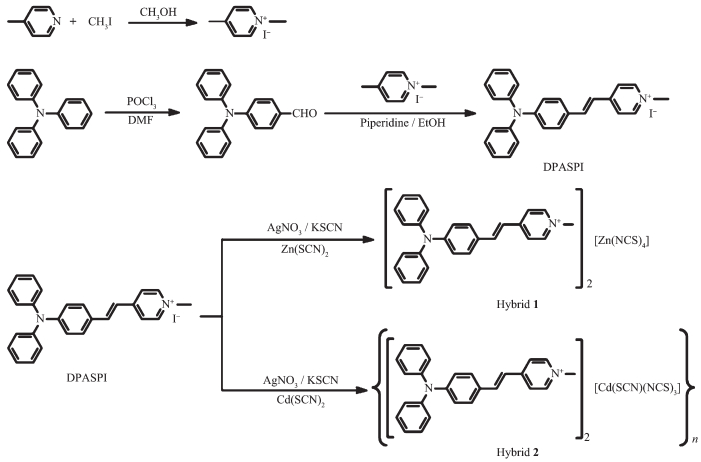 Figure Scheme 1.
Synthesis routes for hybrids 1 and 2
1.2.3 Synthesis of 2
The synthesis of 2 was same with hybrid 1 except that Zn (SCN)2 was changed into Cd (SCN)2 (0.68 g, 3.00 mmol). Color: red. Yield:1.94 g, 92%. 1H NMR (DMSO-d6, 400 MHz): δ 8.773 (d, J=6.4 Hz, 2H), 8.129 (d, J=6.4 Hz, 2H), 7.922 (d, J=16.4 Hz, 1H), 7.613 (d, J=8.8 Hz, 2H), 7.362 (t, J=7.8 Hz, 4H), 7.285 (d, J=16.4 Hz, 1H), 7.146 (t, J=7.4 Hz, 2H), 7.092 (d, J=7.6 Hz, 4H), 6.925 (d, J=8.8 Hz, 2H), 4.222 (s, 3H); 13C NMR (DMSO-d6, 100 MHz): δ 152.797, 149.407, 146.194, 144.776, 140.484, 129.824, 129.660, 128.012, 125.358, 124.468, 122.922, 120.709, 120.492, 46.663. FT-IR (KBr, cm-1): 3 032 (w), 2 359 (w), 2 077 (vs), 1 580 (vs), 1 516 (vs), 1 488 (vs), 1 333 (s), 1 287 (s), 1 208 (s), 1 171 (vs), 976 (w), 835 (w), 756 (m), 696 (m), 536 (m) (Fig. 4). Anal. Calcd. for C32H31CdN6O2S4(%): C, 49.77; H, 4.05; N, 10.88. Found (%): C, 49.06; H, 4.23; N, 11.08.
2 Results and discussion
2.1 Structural description of hybrids 1 and 2
Hybrid 1 crystallizes in the triclinic P1 space group. The asymmetric unit contains one [Zn (NCS)4]2- anion, two DPASP cations and two CH3OH molecules. Zn2+ ion is four-coordinated by four nitrogen atoms of four distinct NCS-anions (Fig. 1a). As listed in Table 2, the Zn-N bond lengths fall between 0.193 9(7) and 0.198 1(8) nm, and the angles of N-Zn-N range from 106.22(3)° to 114.13(3)°. As shown in Fig. 1b, the molecules of 1 are connected by DPASP cations forming hydrogen bonding interactions with the S atom of [Zn (NCS)4]2- anions (C27-H27B…S2 0.283 2(4) nm), and C20-H20…π (0.371 7(2) nm) and C43-H43…π (0.354 5(2) nm) contacts. As Zn…Zn…Zn angle is 180°, the [Zn (NCS)4]2- anions and DPASP cations are parallel to one another and run along the crystallo-graphic a axis. As shown in Fig. 1c, the hydrogen bond (C2-H2…S1 0.273 9(2) nm) and C46-H46…π (0.273 9(2) nm) interactions between adjacent layers assemble neighboring wavelike layers to form highly regular 2D network. Therefore, the alleged 2D network is constructed from the connection between [Zn (NCS)4]2- anion and DPASP cations through hydrogen bonding interactions in hybrid 1.
Table 2.
Selected bond lengths (nm) and bond angles (°)
Hybrid 1 Zn (1)-N (5) 0.197 9(6) Zn (1)-N (7) 0.193 9(7) O (1)-C (57) 0.143 2(9) Zn (1)-N (6) 0.196 5(7) Zn (1)-N (8) 0.198 2(8) O (2)-C (58) 0.143 0(8) N (5)-Zn (1)-N (6) 114.13(3) N (5)-Zn (1)-N (8) 106.22(3) N (6)-Zn (1)-N (8) 107.74(3) N (5)-Zn (1)-N (7) 109.28(3) N (5)-Zn (1)-N (7) 109.33(3) N (7)-Zn (1)-N (8) 110.06(3) Hybrid 2 Cd (1)-N (7) 0.224 7(6) Cd (1)-S (1) 0.264 79(17) S (2)-Cd (1)ⅱ 0.276 82(15) Cd (1)-N (8) 0.231 1(5) Cd (1)-S (4)ⅰ 0.274 17(14) S (4)-Cd (1)ⅱ 0.274 17(14) Cd (1)-N (6) 0.235 0(5) Cd (1)-S (2)ⅱ 0.276 82(15) N (6)-Cd (1)-S (1) 83.79(2) N (6)-Cd (1)-S (4)ⅰ 87.04(2) S (1)-Cd (1)-S (4)ⅰ 87.35(5) N (7)-Cd (1)-N (6) 91.5(2) N (7)-Cd (1)-S (4)ⅰ 94.56(2) S (1)-Cd (1)-S (2)ⅱ 91.15(5) N (7)-Cd (1)-S (1) 174.79(2) N (8)-Cd (1)-S (4)ⅰ 92.68(2) Symmetry codes: ⅰ x, y+1, z; ⅱ-x+2, -y+1, -z+1 Table 2. Selected bond lengths (nm) and bond angles (°)Compared to hybrid 1, anions in hybrid 2 as bridging ligands play an important role in the coor-dination polymers, as well as terminal groups[21]. Hybrid 2 also crystallizes in the triclinic P1 space group. The asymmetric unit include one [Cd (SCN)(NCS)3]2- anion, two DPASP cations and two CH3OH molecules. In comparison with hybrid 1, Cd2+ ion is four-coordinated to three nitrogen atoms and one sulfur atom (Fig. 2a). The Cd-N distances are 0.224 7(6), 0.231 1(5) and 0.235 0(5) nm, respectively, and Cd-S distance is 0.264 8(17) nm; the bond angles around Cd are in the range of 83.79(2)°~174.79(2)° (Table 2). In hybrid 2, the 1D linear framework is constructed by linear {[Cd (SCN)(NCS)3]2-}n chains together via a series of weak intra-and inter-chain C-H…S (C50-H50…S3 0.299 4(3) nm, C51-H51…S1 0.291 4(2) nm and C52-H52B…S1 0.298 8(2) nm) and C-H…π (C11-H11…π 0.303 7(4) nm and C29-H29…π 0.358 9(4) nm) interactions (Fig. 2b). Adjacent Cd2+ ions are linked by two bridging thiocyanato anions with the Cd…Cd distances of 0.566 6(9) and 0.577 5(9) nm, which are shorter than the average distance of two adjacent Zn distance (ca. 0.998 8(8) nm) in hybrid 1, and Cd…Cd…Cd angle is 170.84(9)°. As displayed in Fig. 2c, the 1D {[Cd (SCN)(NCS)3]2-}n chains can be further extended to a 2D supramolecular structure through the weak interactions (C47-H47…S1 0.287 9(2) nm and C33-H33…π 0.337 7(3) nm) with DPASP cations as coun-terions forming 2D layer of hybrid 2.
2.2 1H NMR and FT-IR spectra of DPASPI, hybrids 1 and 2
Furthermore, the interactions can also be inves-tigated with 1H NMR spectra which are in good agree-ment with the results of X-ray structural analyses. The 1H NMR spectra of DPASPI, hybrids 1 and 2 are represented in Fig. 3. In hybrids 1 and 2, the resona-nces of the two protons of the vinyl-H shift up field and the resonances of the three protons of the alkyl-H shift down field, relative to the corresponding protons of DPASPI. The results manifest that ICT is surely induced by the electron-withdrawing effects imposed by the [Zn (NCS)4]2- and [Cd (SCN)(NCS)3]2- anions, which indicates 1 and 2 have better photoluminescent properties than DPASPI. Interestingly, δ of 6.950 (d, J=8.4 Hz, 2H) and 4.251 (s, 3H) also shift to low field in 1, in contrast to DPASPI and 2. The FT-IR spectra (Fig. 4) show characteristic band of NSC group are identified in 2 077 cm-1.
2.3 Photoluminescent properties of DPASPI, hybrids 1 and 2 in solid state
It is generally acknowledged that transition metal coordination polymers assembled from Zn or Cd centers possess excellent luminescent properties, because core-like d-orbitals and thus no d-d transitions are possible[22]. The excitation spectra of DPASPI, hybrids 1 and 2 exhibit the wavelength band in the range of 500~600 nm, which are attributed to ICT transition of the whole molecule. The solid state emission spectra of DPASPI, hybrids 1 and 2 have been studied at room temperature, as illustrated in Fig. 5a. The emission bands at 406, 426 and 455 nm are observed for DPASPI, hybrids 1 and 2, respectively. The different photolu-minescence of hybrids 1 and 2 may be attributed to the difference in the substituting groups at NCS- and SCN- relative to the zinc/cadmium metal ions and/or their local coordination environments.
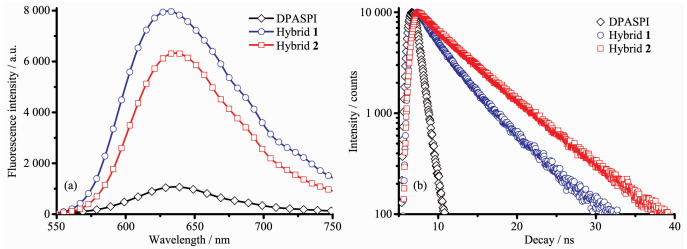 Figure 5.
Emission spectra (a) and transient fluorescence (b) spectra of DPASPI, hybrids 1 and 2 in solid state at room temperature
As displayed in Fig. 5b, the time-resolved PL decays of DPASPI, hybrids 1 and 2 are measured using a time-correlated single-photon counting (TCSPC) technique. During the measurements, the compounds are excited with the optimal excitation wavelength (λex-max) in order to obtain the largest relative fluoresc-ence intensity. The fluorescence decay lifetimes and amplitudes of DPASPI, hybrids 1 and 2 are summarized in Table 3. As previously reported[23], the result reveals that there are more than one component in the excited state of hybrids 1 and 2. There exist two kinds of excited state, which is in accordance with the two excitation bands for hybrids 1 and 2. However, for DPASPI there is only one excitation bands. The average fluorescence decay lifetime of 1 at 386 nm emission is 4.06 ns, and that of 2 at 380 nm is 6.03 ns. Meanwhile, the quantum yields (Φ) of 1 and 2 (19% and 20%, respectively) are much larger than that of DPASPI (1%), which indicates two novel organic-inorganic hybrid multiply quantum yields approximately 20 times than DPASPI. Introducing the transition-metal thiocyanato anions to the π-conjugated pyridinium salts should provide a more stable environment for the excited state in infrared region and much enhanced fluorescence quantum yields.
Table 3.
τ and Φd of DPASPI, hybrids 1 and 2 in the solid state
Hybrid λex/nm λem/nm τ1/ns A1/% τ2/ ns A2/% τ/ns Φ DPASPI 458 535 7.20 100 - — 7.20 0.01 1 386 631 3.08 59.76 7.64 40.24 4.06 0.19 2 380 636 3.66 20.43 7.23 79.57 6.03 0.20 Table 3. τ and Φd of DPASPI, hybrids 1 and 2 in the solid stateAbove all, hybrids 1 and 2 exhibit intense fluore-scent emissions and prominent transient fluorescence in solid state at room temperature, which manifests that they have more excellent fluorescent properties than DPASPI. These emission bands (550~750 nm) in the red region suggest that these hybrids may be potential candidates as near infrared red-light-emitting materials.
2.4 Thermogravimetric properties
The thermogravimetry (TG) and differential ther-mogravimetry (DTG) curves are presented in Fig. 6. The decomposition temperature (weight loss of 10 %) of DPASPI, hybrids 1 and 2 is 297, 369 and 399 ℃, respectively. At 452 ℃, DPASPI almost vanish, while hybrids 1 and 2 showed weight loss of about 48.7% and 27.6%, respectively. As shown in Fig. 6b, Tp (the maximum weight loss rate) of DPASPI, hybrids 1 and 2 is 303, 333 and 360 ℃, respectively. In short, the thermal stabilities of hybrids 1 and 2 exceed that of DPASPI largely, and hybrids 2 behaves the best.
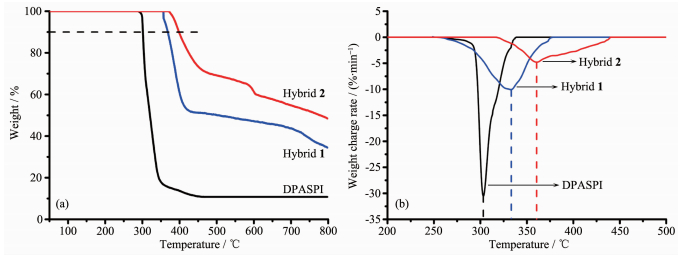 Figure 6.
TG curves (a) and DTG curves (b) of DPASPI, hybrids 1 and 2
3 Conclusions
In summary, we have described a facile and efficient method for the gram scale synthesis of two novel solid fluorescent organic-inorganic hybrids. Hybrids 1 and 2 have essentially different extended network structures, which have beneficial advantages for the ICT ability and photoluminescent properties. Hybrids 1 and 2 are demonstrated to display strong red fluorescence emissions in solid-state at room temperature, which suggests they might be potential near infrared-light-emitted materials. Accordingly, two hybrids bearing transition-metal thiocyanato anions, pyridinium salts turn out to be excellent fluorescent materials with enhanced quantum yield by facile replacement reaction.
-
-
[1]
Nicole L, Robert C L, Rozes L, et al. Nanoscale, 2014, 6(12):6267-6292 doi: 10.1039/c4nr01788a
-
[2]
Kim H S, Pham T C T, Yoon K B. Chem. Comm., 2012, 48(39):4659-4673 doi: 10.1039/c2cc30919j
-
[3]
Pardo R, Zayat M, Levy D. Coord. Chem. Rev., 2011, 40(2):627-687 http://digital.csic.es/handle/10261/27566
-
[4]
Beverina L, Pagani G A. Acc. Chem. Res., 2014, 47(2):319-329 doi: 10.1021/ar4000967
-
[5]
Langton M J, Robinson S W, Marques I, et al. Nat. Chem., 2014, 6(12):1039-1043 doi: 10.1038/nchem.2111
-
[6]
Therien M J. Nat. Chem., 2009, 458(9):716-717
-
[7]
Sullivan I, Brown C L, Llansola-Portoles M J, et al. J. Phys. Chem. C, 2015, 119(37):21294-21303 doi: 10.1021/acs.jpcc.5b02174
-
[8]
Zheng Y C, Zheng M L, Li K, et al. RSC Adv., 2015, 5(1):770-774 doi: 10.1039/C4RA11133H
-
[9]
Zhao N, Li M, Yan Y, et al. J. Mater. Chem. C, 2013, 1(31):4640-4646 doi: 10.1039/c3tc30759j
-
[10]
Xu H R, Li K, Jiao S Y, et al. Analyst, 2015, 140(12):4182-4188 doi: 10.1039/C5AN00484E
-
[11]
Dumat B, Bordeau G, Faurel-Paul E, et al. J. Am. Chem. Soc., 2013, 135(34):12697-12706 doi: 10.1021/ja404422z
-
[12]
Zhao D B, Fei Z F, Geldbach T J, et al. J. Am. Chem. Soc., 2004, 126(48):15876-15882 doi: 10.1021/ja0463482
-
[13]
Cole J M, Lin T C, Edwards A J, et al. ACS Appl. Mater. Interfaces, 2015, 7(8):4693-4698 doi: 10.1021/am508213c
-
[14]
Ma Q, Zhu M L, Yuan C X, et al. Cryst. Growth Des., 2010, 10(4):1706-1714 doi: 10.1021/cg901297y
-
[15]
Werner J, Tomkowicz Z, Reinert T, et al. Eur. J. Inorg. Chem., 2015, 15(19):3066-3075
-
[16]
Mahmoudi G, Morsali A. CrystEngComm., 2007, 9(11):1062-1072 doi: 10.1039/b707228g
-
[17]
Hao F Y, Zhang X J, Tian Y P, et al. J. Mater. Chem., 2009, 19(48):9163-9169 doi: 10.1039/b914656c
-
[18]
Aoyagi N, Shinha Y, Ikeda-Ohno A, et al. Cryst. Growth Des., 2015, 15(3):1422-1429 doi: 10.1021/cg501792m
-
[19]
Zhao C F, He G S, Bhawalkar J aD, et al. Chem. Mater., 1995, 7(10):1979-1983 doi: 10.1021/cm00058a032
-
[20]
Sheldrick G M. SHELX-97, Program for the Solution and the Refinement of Crystal Structures, University of Göttingen, Germany, 1997.
-
[21]
Jin F, Li J F, Zhou H P, et al. J. Mol. Struct., 2007, 829(1/2/3):202-207
-
[22]
Niu C Y, Wu B L, Zheng X F, et al. Cryst. Growth Des., 2008, 8(5):1566-1574 doi: 10.1021/cg700839p
-
[23]
Kong L, Yang J X, Zhou H P, et al. Sci. China Chem., 2013, 56(1):106-116 doi: 10.1007/s11426-012-4794-4
-
[1]
-

Figure 1 (a) ORTEP diagram of hybrid 1; (b) 1D chain bridged by C-H…S and C-H…π in hybrid 1; (c) 2D layer formed by C-H…S and C-H…π in hybrid 1
Thermal ellipsoids are drawn at the 50% probability level for (a); Symmetry codes: ⅰ x-1, y+1, z; ⅱ x+1, y-1, z in (b); ⅰ x-1, y+1, z; ⅱ-x-1, 1-y, 1-z; ⅲ-x, -y, 1-z in (c)

Figure 2 (a) ORTEP diagram of hybrid 2; (b) 1D chain bridged by C-H…S and C-H…π in hybrid 2; (c) 2D layer formed by C-H…S and C-H…π in hybrid 2
Thermal ellipsoids are drawn at the 50% probability level for (a); Symmetry codes: ⅰ 2-x, 1-y, 1-z; ⅱ 2-x, -y, 1-z in (b); ⅰ 2-x, 1-y, 1-z; ⅱ 2-x, -y, 1-z in (c)

Figure 5 Emission spectra (a) and transient fluorescence (b) spectra of DPASPI, hybrids 1 and 2 in solid state at room temperature
Table 2. Selected bond lengths (nm) and bond angles (°)
Hybrid 1 Zn (1)-N (5) 0.197 9(6) Zn (1)-N (7) 0.193 9(7) O (1)-C (57) 0.143 2(9) Zn (1)-N (6) 0.196 5(7) Zn (1)-N (8) 0.198 2(8) O (2)-C (58) 0.143 0(8) N (5)-Zn (1)-N (6) 114.13(3) N (5)-Zn (1)-N (8) 106.22(3) N (6)-Zn (1)-N (8) 107.74(3) N (5)-Zn (1)-N (7) 109.28(3) N (5)-Zn (1)-N (7) 109.33(3) N (7)-Zn (1)-N (8) 110.06(3) Hybrid 2 Cd (1)-N (7) 0.224 7(6) Cd (1)-S (1) 0.264 79(17) S (2)-Cd (1)ⅱ 0.276 82(15) Cd (1)-N (8) 0.231 1(5) Cd (1)-S (4)ⅰ 0.274 17(14) S (4)-Cd (1)ⅱ 0.274 17(14) Cd (1)-N (6) 0.235 0(5) Cd (1)-S (2)ⅱ 0.276 82(15) N (6)-Cd (1)-S (1) 83.79(2) N (6)-Cd (1)-S (4)ⅰ 87.04(2) S (1)-Cd (1)-S (4)ⅰ 87.35(5) N (7)-Cd (1)-N (6) 91.5(2) N (7)-Cd (1)-S (4)ⅰ 94.56(2) S (1)-Cd (1)-S (2)ⅱ 91.15(5) N (7)-Cd (1)-S (1) 174.79(2) N (8)-Cd (1)-S (4)ⅰ 92.68(2) Symmetry codes: ⅰ x, y+1, z; ⅱ-x+2, -y+1, -z+1  下载: 导出CSV
Table 3. τ and Φd of DPASPI, hybrids 1 and 2 in the solid state
Hybrid λex/nm λem/nm τ1/ns A1/% τ2/ ns A2/% τ/ns Φ DPASPI 458 535 7.20 100 - — 7.20 0.01 1 386 631 3.08 59.76 7.64 40.24 4.06 0.19 2 380 636 3.66 20.43 7.23 79.57 6.03 0.20
下载: 导出CSV
-


 扫一扫看文章
计量
- PDF下载量: 11
- 文章访问数: 1827
- HTML全文浏览量: 271
 下载: