Login In
2026 Volume 42 Issue 6
2026, 42(6):
Abstract:
2026, 42(6): 100257
doi: 10.1016/j.actphy.2026.100257
Abstract:
2026, 42(6): 100279
doi: 10.1016/j.actphy.2026.100279
Abstract:
Wireless local area network (WLAN) and fifth generation (5G) are rapidly progressing, so people have focused on high-efficiency electromagnetic protection (EMP) materials. However, early EMP materials often prioritized electromagnetic attenuation efficiency while neglecting mechanical flexibility. This limitation has restricted their application in emerging fields such as wearable electronics, soft robotics, and intelligent sensing systems. Therefore, flexible EMP materials need to be developed. Flexible EMP materials were systematically divided into flexible electromagnetic interference (EMI) shielding materials and flexible electromagnetic wave absorption (EWA) materials in this review. In addition, these two categories were further classified according to different material systems and design strategies. Flexible EMI shielding materials, based on different substrates of conductive polymers, carbon-based nanomaterials, MXenes, and metal composites, were summarized for their high shielding effectiveness (SE) and high compliance. Thin-film architecture has been widely applied in both EMI shielding and wave absorption systems, and the role of it was also introduced. Subsequently, flexible EWA materials with a variety of structural designs, including polymer-based composites, sponges, foams, and aerogels, have been systematically introduced. In this review, a comprehensive understanding of flexible EMI shielding materials and EWA materials is given, the mechanism and material classification of recent research results are explained, and the guiding significance of design ideas for next-generation flexible EMP materials is provided.
Wireless local area network (WLAN) and fifth generation (5G) are rapidly progressing, so people have focused on high-efficiency electromagnetic protection (EMP) materials. However, early EMP materials often prioritized electromagnetic attenuation efficiency while neglecting mechanical flexibility. This limitation has restricted their application in emerging fields such as wearable electronics, soft robotics, and intelligent sensing systems. Therefore, flexible EMP materials need to be developed. Flexible EMP materials were systematically divided into flexible electromagnetic interference (EMI) shielding materials and flexible electromagnetic wave absorption (EWA) materials in this review. In addition, these two categories were further classified according to different material systems and design strategies. Flexible EMI shielding materials, based on different substrates of conductive polymers, carbon-based nanomaterials, MXenes, and metal composites, were summarized for their high shielding effectiveness (SE) and high compliance. Thin-film architecture has been widely applied in both EMI shielding and wave absorption systems, and the role of it was also introduced. Subsequently, flexible EWA materials with a variety of structural designs, including polymer-based composites, sponges, foams, and aerogels, have been systematically introduced. In this review, a comprehensive understanding of flexible EMI shielding materials and EWA materials is given, the mechanism and material classification of recent research results are explained, and the guiding significance of design ideas for next-generation flexible EMP materials is provided.
2026, 42(6): 100193
doi: 10.1016/j.actphy.2025.100193
Abstract:
Integrating plasmonic metal nanocrystal/semiconductor hybrids is a novel approach to contribute photocatalyst with high performance. However, a deep insight of activity acceleration remains elusive because of the complex physicochemical behavior of localized surface plasmon resonance (LSPR) effects. Herein, Au nanobipyramids (NBs) capable of strong local electric field (LEF) are precisely synthesized and encapsulated in TpBD-COF via an in situ growth strategy. As expected, the optimized AuNBs/TpBD-COF hybrid displays a remarkable improvement in photocatalytic H2 generation reaction, with apparent quantum efficiency (AQE) of 0.58% at 420 nm. Electromagnetic simulation and femtosecond transient absorption spectroscopy demonstrate the critical role of amplified local electric field in generating charge-separated excitons and thus yielding more hot carriers (energetic electron/hole pairs) for H2 evolution in TpBD-COF. These findings provide a deep insight to examine the LSPR effects for improving the COF-based photocatalytic performance.
Integrating plasmonic metal nanocrystal/semiconductor hybrids is a novel approach to contribute photocatalyst with high performance. However, a deep insight of activity acceleration remains elusive because of the complex physicochemical behavior of localized surface plasmon resonance (LSPR) effects. Herein, Au nanobipyramids (NBs) capable of strong local electric field (LEF) are precisely synthesized and encapsulated in TpBD-COF via an in situ growth strategy. As expected, the optimized AuNBs/TpBD-COF hybrid displays a remarkable improvement in photocatalytic H2 generation reaction, with apparent quantum efficiency (AQE) of 0.58% at 420 nm. Electromagnetic simulation and femtosecond transient absorption spectroscopy demonstrate the critical role of amplified local electric field in generating charge-separated excitons and thus yielding more hot carriers (energetic electron/hole pairs) for H2 evolution in TpBD-COF. These findings provide a deep insight to examine the LSPR effects for improving the COF-based photocatalytic performance.
2026, 42(6): 100203
doi: 10.1016/j.actphy.2025.100203
Abstract:
Immunotherapy has become a key focus in cancer treatment, and cancer nanovaccines have made significant progress as a representative approach in this field. However, some issues such as low immunogenicity, inefficient antigen delivery, and poor immune responses have limited the advancement of immunotherapy. To address these limitations, this study developed a pH-responsive nanovaccine (Lyc-OVA) based on Lycium barbarum-derived carbon dots (Lyc-CDs) synthesized via a green hydrothermal method. Owing to retained Lycium barbarum polysaccharides (LBP, 18.43% total sugar content), Lyc-CDs demonstrated superior loading efficiency (48.40%) and pH-responsive release (80% OVA released within 24 h at pH 5.4) of OVA. Molecular docking simulations identified hydrogen bonding and π-cation interactions between LBP monosaccharides (rhamnose/galactose) and OVA. Lyc-OVA promoted dendritic cell maturation (32.87% CD80+CD86+ cells, comparable to LPS) and cytokine secretion (TNF-α: 13.10 pg mL−1; IFN-γ: 17.78 pg mL−1; IL-6: 3.74 pg mL−1). In a bilateral B16-OVA melanoma model, Lyc-OVA suppressed primary/distal tumor growth (80.36%/82.16% inhibition rates) by activating CD4+CD8+T cells, reducing immunosuppressive Treg/MDSC populations, and reshaping the tumor immune microenvironment. This work highlights the multifunctional role of natural polysaccharides in nanovaccine and provides an effective strategy for tumor immunotherapy.
Immunotherapy has become a key focus in cancer treatment, and cancer nanovaccines have made significant progress as a representative approach in this field. However, some issues such as low immunogenicity, inefficient antigen delivery, and poor immune responses have limited the advancement of immunotherapy. To address these limitations, this study developed a pH-responsive nanovaccine (Lyc-OVA) based on Lycium barbarum-derived carbon dots (Lyc-CDs) synthesized via a green hydrothermal method. Owing to retained Lycium barbarum polysaccharides (LBP, 18.43% total sugar content), Lyc-CDs demonstrated superior loading efficiency (48.40%) and pH-responsive release (80% OVA released within 24 h at pH 5.4) of OVA. Molecular docking simulations identified hydrogen bonding and π-cation interactions between LBP monosaccharides (rhamnose/galactose) and OVA. Lyc-OVA promoted dendritic cell maturation (32.87% CD80+CD86+ cells, comparable to LPS) and cytokine secretion (TNF-α: 13.10 pg mL−1; IFN-γ: 17.78 pg mL−1; IL-6: 3.74 pg mL−1). In a bilateral B16-OVA melanoma model, Lyc-OVA suppressed primary/distal tumor growth (80.36%/82.16% inhibition rates) by activating CD4+CD8+T cells, reducing immunosuppressive Treg/MDSC populations, and reshaping the tumor immune microenvironment. This work highlights the multifunctional role of natural polysaccharides in nanovaccine and provides an effective strategy for tumor immunotherapy.
2026, 42(6): 100210
doi: 10.1016/j.actphy.2025.100210
Abstract:
Hydrogen peroxide (H2O2) is regarded as an ecologically sustainable oxidant with broad applications. Photocatalytic generation of H2O2 from pure water and oxygen offers a green and energy-efficient alternative to conventional processes. Here, single-atom praseodymium (Pr) was anchored onto tubular porous graphitic carbon nitride (Pr-TCN) via a simple impregnation method for visible-light-induced H2O2 production (λ ≥ 420 nm). The isolated Pr sites accelerate the in-plane charge transfer by establishing a smooth and flexible transfer pathway for photogenerated electrons, and promote *OOH intermediate formation, thereby enhancing water oxidation. The optimized 5% Pr-TCN achieves a H2O2 generation rate of 227.37 μmol g−1 h−1, 1.8 times higher than unadulterated TCN. This work demonstrates a scalable single-atom engineering strategy for developing efficient photocatalysts for sustainable H2O2 production.
Hydrogen peroxide (H2O2) is regarded as an ecologically sustainable oxidant with broad applications. Photocatalytic generation of H2O2 from pure water and oxygen offers a green and energy-efficient alternative to conventional processes. Here, single-atom praseodymium (Pr) was anchored onto tubular porous graphitic carbon nitride (Pr-TCN) via a simple impregnation method for visible-light-induced H2O2 production (λ ≥ 420 nm). The isolated Pr sites accelerate the in-plane charge transfer by establishing a smooth and flexible transfer pathway for photogenerated electrons, and promote *OOH intermediate formation, thereby enhancing water oxidation. The optimized 5% Pr-TCN achieves a H2O2 generation rate of 227.37 μmol g−1 h−1, 1.8 times higher than unadulterated TCN. This work demonstrates a scalable single-atom engineering strategy for developing efficient photocatalysts for sustainable H2O2 production.
2026, 42(6): 100235
doi: 10.1016/j.actphy.2025.100235
Abstract:
Atomic simulation is becoming a vital tool in modern science, bridging the gap between theory and experiments. Since its birth in 1950s, the balance between accuracy and speed has been the main theme in simulating atomic world and in recent years machine learning potential based methods emerged as a promising alternative to density functional theory calculations for exploring complex potential energy surface (PES). Here we report our implementation of LASPAI (www.laspai.com), a web-based platform for future atomic simulations, which is built using the generalized global neural network potential for fast PES evaluation as implemented in LASP software, together with a series of general diffusion generative models, stochastic surface walking (SSW) global optimization, and other common simulation tools for the PES exploration of molecules and materials. We show that LASPAI platform offers a task-orientated, user-friendly, web-based graphical user interface (GUI) to greatly simplify and speed-up atomic simulations for a wide range of scientific areas, ranging from molecule and material structure prediction to solid-gas, solid-liquid, solid-solid interface identification, and reaction pathway simulations. It aims to provide a fast chemical knowledge delivery for scientists to design new materials and reactions.
Atomic simulation is becoming a vital tool in modern science, bridging the gap between theory and experiments. Since its birth in 1950s, the balance between accuracy and speed has been the main theme in simulating atomic world and in recent years machine learning potential based methods emerged as a promising alternative to density functional theory calculations for exploring complex potential energy surface (PES). Here we report our implementation of LASPAI (www.laspai.com), a web-based platform for future atomic simulations, which is built using the generalized global neural network potential for fast PES evaluation as implemented in LASP software, together with a series of general diffusion generative models, stochastic surface walking (SSW) global optimization, and other common simulation tools for the PES exploration of molecules and materials. We show that LASPAI platform offers a task-orientated, user-friendly, web-based graphical user interface (GUI) to greatly simplify and speed-up atomic simulations for a wide range of scientific areas, ranging from molecule and material structure prediction to solid-gas, solid-liquid, solid-solid interface identification, and reaction pathway simulations. It aims to provide a fast chemical knowledge delivery for scientists to design new materials and reactions.
2026, 42(6): 100244
doi: 10.1016/j.actphy.2026.100244
Abstract:
Designing efficient S-scheme photocatalysts for simultaneous H2 evolution and organic oxidation is highly desirable for sustainable energy conversion. Herein, a novel SnS2/CdS S-scheme heterojunction loaded with transition metal single atoms (TM = Pt, Pd, Au) was constructed. Systematic density functional theory (DFT) calculations are performed to investigate the geometric structure, electronic properties, and the mechanisms of surface H adsorption and lactic acid (LA) oxidation reactions. The results reveal that in the heterojunction, electrons transfer from CdS to SnS2 through interfacial Cd–S bonds, forming a stable composite structure, while the TM single atoms are stabilized by forming TM–S bonds with surface S atoms. The incorporation of TM atoms enhances the interfacial electron transfer. Notably, the TM atoms anchored on the CdS surface effectively modulate the p-band center of neighboring S atoms, thereby weakening the S–H bond and optimizing the H adsorption-desorption equilibrium. Concurrently, those on the SnS2 surface enhance the adsorption energy of LA and reduce the energy barrier of the rate-determining step in the dehydrogenation oxidation process. This work demonstrates that the strategic placement of single atoms on different components of an S-scheme heterojunction can synergistically enhance both the reduction and oxidation half-reactions, offering profound insights for the rational design of high-performance single-atom-loaded S-scheme photocatalytic systems for cooperative H2 production and value-added chemical synthesis.
Designing efficient S-scheme photocatalysts for simultaneous H2 evolution and organic oxidation is highly desirable for sustainable energy conversion. Herein, a novel SnS2/CdS S-scheme heterojunction loaded with transition metal single atoms (TM = Pt, Pd, Au) was constructed. Systematic density functional theory (DFT) calculations are performed to investigate the geometric structure, electronic properties, and the mechanisms of surface H adsorption and lactic acid (LA) oxidation reactions. The results reveal that in the heterojunction, electrons transfer from CdS to SnS2 through interfacial Cd–S bonds, forming a stable composite structure, while the TM single atoms are stabilized by forming TM–S bonds with surface S atoms. The incorporation of TM atoms enhances the interfacial electron transfer. Notably, the TM atoms anchored on the CdS surface effectively modulate the p-band center of neighboring S atoms, thereby weakening the S–H bond and optimizing the H adsorption-desorption equilibrium. Concurrently, those on the SnS2 surface enhance the adsorption energy of LA and reduce the energy barrier of the rate-determining step in the dehydrogenation oxidation process. This work demonstrates that the strategic placement of single atoms on different components of an S-scheme heterojunction can synergistically enhance both the reduction and oxidation half-reactions, offering profound insights for the rational design of high-performance single-atom-loaded S-scheme photocatalytic systems for cooperative H2 production and value-added chemical synthesis.
2026, 42(6): 100269
doi: 10.1016/j.actphy.2026.100269
Abstract:
Effective electromagnetic (EM) wave absorption with minimal coating thickness in the low- to mid-frequency range (2.0–8.0 GHz) remains a significant challenge. Herein, the EM parameters required for low- to mid-frequency EM wave absorption are systematically investigated, and CST Microwave Studio is employed to model and simulate how these target parameters can be realized through microstructural design. The results demonstrate that increasing the real parts of the relative permittivity (εr′) and permeability (μr′) is beneficial for achieving low- to mid-frequency EM wave absorption with reduced coating thickness. Moreover, CST simulations reveal that, for the same material system and identical volume filling fraction, increasing the specific surface area of the absorber contributes to an enhancement of εr′. Guided by these principles, FeCo cubes, FeCo particles, and FeCo foams with controlled specific surface areas and high permeability were synthesized. Experimental results confirm that an increased specific surface area effectively enhances εr′, thereby promoting low- to mid-frequency absorption. As a result, the FeCo foam achieves an effective absorption bandwidth (EAB) of 3.2 GHz (4.8–8.0 GHz) in the C-band with a coating thickness of 2.0 mm, and 1.5 GHz (2.1–3.6 GHz) in the S-band with a coating thickness of 4.0 mm. This work provides valuable insights into the rational design of advanced low- to mid-frequency EM absorbing materials.
Effective electromagnetic (EM) wave absorption with minimal coating thickness in the low- to mid-frequency range (2.0–8.0 GHz) remains a significant challenge. Herein, the EM parameters required for low- to mid-frequency EM wave absorption are systematically investigated, and CST Microwave Studio is employed to model and simulate how these target parameters can be realized through microstructural design. The results demonstrate that increasing the real parts of the relative permittivity (εr′) and permeability (μr′) is beneficial for achieving low- to mid-frequency EM wave absorption with reduced coating thickness. Moreover, CST simulations reveal that, for the same material system and identical volume filling fraction, increasing the specific surface area of the absorber contributes to an enhancement of εr′. Guided by these principles, FeCo cubes, FeCo particles, and FeCo foams with controlled specific surface areas and high permeability were synthesized. Experimental results confirm that an increased specific surface area effectively enhances εr′, thereby promoting low- to mid-frequency absorption. As a result, the FeCo foam achieves an effective absorption bandwidth (EAB) of 3.2 GHz (4.8–8.0 GHz) in the C-band with a coating thickness of 2.0 mm, and 1.5 GHz (2.1–3.6 GHz) in the S-band with a coating thickness of 4.0 mm. This work provides valuable insights into the rational design of advanced low- to mid-frequency EM absorbing materials.
2026, 42(6): 100271
doi: 10.1016/j.actphy.2026.100271
Abstract:
The optimization of dielectric properties through controlling polarization effects in heterogeneous materials remains challenging due to structural complexity. This work demonstrates the precise regulation of interface polarization strength through molecular grafting-induced dipole reorientation. Experimental analyses confirm that the orientation of these dipoles effectively modulates the interfacial polarization: the –CF3 group enhances, while the –NH2 group suppresses electron transfer and polarization loss effects. The optimized MXene/ZnO modified with –CF3 composite exhibits exceptional electromagnetic wave absorption performance, achieving a minimum reflection loss of −66.7 dB and an effective absorption bandwidth of 5.05 GHz. This work demonstrates a novel strategy for the precise tuning of electromagnetic parameters through interfacial dipole engineering, offering new insights for the design of advanced electromagnetic wave-absorbing materials.
The optimization of dielectric properties through controlling polarization effects in heterogeneous materials remains challenging due to structural complexity. This work demonstrates the precise regulation of interface polarization strength through molecular grafting-induced dipole reorientation. Experimental analyses confirm that the orientation of these dipoles effectively modulates the interfacial polarization: the –CF3 group enhances, while the –NH2 group suppresses electron transfer and polarization loss effects. The optimized MXene/ZnO modified with –CF3 composite exhibits exceptional electromagnetic wave absorption performance, achieving a minimum reflection loss of −66.7 dB and an effective absorption bandwidth of 5.05 GHz. This work demonstrates a novel strategy for the precise tuning of electromagnetic parameters through interfacial dipole engineering, offering new insights for the design of advanced electromagnetic wave-absorbing materials.
2026, 42(6): 100276
doi: 10.1016/j.actphy.2026.100276
Abstract:
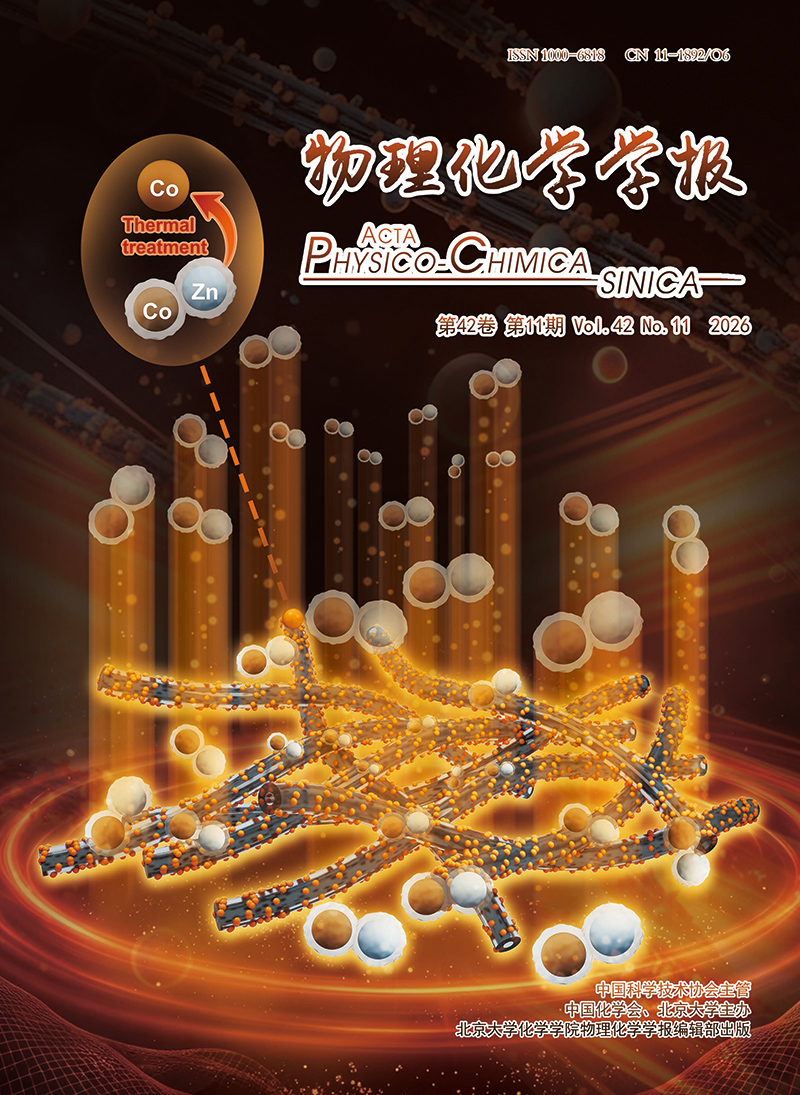
Achieving high-performance microwave absorbers characterized by wide bandwidth, robust absorption, lightweight properties, and thin profiles remains a critical challenge within modern radar stealth and electromagnetic compatibility domains. In this study, we introduce a straightforward and cost-effective strategy for fabricating lightweight and efficient microwave absorbers utilizing composites derived from bimetallic zeolitic imidazolate frameworks (ZIFs). A variety of ZIF-8@ZIF-67 precursors incorporating multi-walled carbon nanotubes (MWCNTs) were synthesized through a sequential wet-chemical process. These precursors underwent conversion into porous bimetallic MOF-derived CoZn-C/MWCNTs composites via subsequent pyrolysis. The composition, microstructure, and electromagnetic characteristics of the pyrolyzed materials were precisely regulated by varying the Co/Zn molar ratio within the precursors. Due to the synergistic magnetic and dielectric dissipations, the 3 : 1 Co/Zn composite exhibited the best attenuation constant and impedance matching among all synthesized samples. Thus, the optimized composite provided a significant effective absorption bandwidth of 5.29 GHz at a thickness of 1.9 mm, coupled with an outstanding minimum reflection loss of −23.78 dB at 2.0 mm, even with a minimal filler loading of 20 wt.%. The enhanced scattering suppression behavior was additionally verified through radar cross-section simulation. This research provides a novel viewpoint on the rational design of lightweight MOF-based composites for broadband electromagnetic wave absorption performance.
Achieving high-performance microwave absorbers characterized by wide bandwidth, robust absorption, lightweight properties, and thin profiles remains a critical challenge within modern radar stealth and electromagnetic compatibility domains. In this study, we introduce a straightforward and cost-effective strategy for fabricating lightweight and efficient microwave absorbers utilizing composites derived from bimetallic zeolitic imidazolate frameworks (ZIFs). A variety of ZIF-8@ZIF-67 precursors incorporating multi-walled carbon nanotubes (MWCNTs) were synthesized through a sequential wet-chemical process. These precursors underwent conversion into porous bimetallic MOF-derived CoZn-C/MWCNTs composites via subsequent pyrolysis. The composition, microstructure, and electromagnetic characteristics of the pyrolyzed materials were precisely regulated by varying the Co/Zn molar ratio within the precursors. Due to the synergistic magnetic and dielectric dissipations, the 3 : 1 Co/Zn composite exhibited the best attenuation constant and impedance matching among all synthesized samples. Thus, the optimized composite provided a significant effective absorption bandwidth of 5.29 GHz at a thickness of 1.9 mm, coupled with an outstanding minimum reflection loss of −23.78 dB at 2.0 mm, even with a minimal filler loading of 20 wt.%. The enhanced scattering suppression behavior was additionally verified through radar cross-section simulation. This research provides a novel viewpoint on the rational design of lightweight MOF-based composites for broadband electromagnetic wave absorption performance.
2026, 42(6): 100285
doi: 10.1016/j.actphy.2026.100285
Abstract:
Herein, a novel strategy for fabricating microwave absorption materials via molecular-level design that synergistically regulates dielectric and magnetic losses. The method utilizes a polyimide precursor containing both carboxyl and benzimidazole functional groups as the key component. Through an ice-templating process followed by in-situ ion exchange, Ni2+ ions are uniformly incorporated into the polymeric skeleton. Subsequent thermal imidization and carbonization yield nitrogen-doped two-dimensional carbon nanosheets embedded with uniformly dispersed Ni/NiO nanoparticles (BPCN@Ni/NiO). This material exhibits significantly superior microwave absorption properties compared to its counterpart synthesized without the benzimidazole structure (NPCN@Ni/NiO). BPCN@Ni/NiO achieves a remarkable minimum reflection loss (RLmin) of −69.02 dB with effective absorption bandwidth (EAB) of 8.92 GHz (8.28–17.2 GHz). Microstructural analyses confirm its three-dimensional interconnected nanosheet architecture, highly dispersed Ni/NiO species, and homogeneous elemental distribution. The performance enhancement is attributed to the synergistic complexation of Ni2+ ions by benzimidazole and carboxyl groups, which enables efficient loading and uniform dispersion of nickel species, thereby optimizing impedance matching. Furthermore, the unique 2D conductive network, abundant heterogeneous interfaces (C/Ni/NiO), defect-induced dipole polarization, and magnetic coupling between Ni and NiO collectively contribute to synergistic multiple loss mechanisms, ultimately endowing the material with excellent microwave attenuation capability. This work offers a new pathway for designing lightweight, efficient, and broadband carbon-based composite absorbers through precise molecular engineering.
Herein, a novel strategy for fabricating microwave absorption materials via molecular-level design that synergistically regulates dielectric and magnetic losses. The method utilizes a polyimide precursor containing both carboxyl and benzimidazole functional groups as the key component. Through an ice-templating process followed by in-situ ion exchange, Ni2+ ions are uniformly incorporated into the polymeric skeleton. Subsequent thermal imidization and carbonization yield nitrogen-doped two-dimensional carbon nanosheets embedded with uniformly dispersed Ni/NiO nanoparticles (BPCN@Ni/NiO). This material exhibits significantly superior microwave absorption properties compared to its counterpart synthesized without the benzimidazole structure (NPCN@Ni/NiO). BPCN@Ni/NiO achieves a remarkable minimum reflection loss (RLmin) of −69.02 dB with effective absorption bandwidth (EAB) of 8.92 GHz (8.28–17.2 GHz). Microstructural analyses confirm its three-dimensional interconnected nanosheet architecture, highly dispersed Ni/NiO species, and homogeneous elemental distribution. The performance enhancement is attributed to the synergistic complexation of Ni2+ ions by benzimidazole and carboxyl groups, which enables efficient loading and uniform dispersion of nickel species, thereby optimizing impedance matching. Furthermore, the unique 2D conductive network, abundant heterogeneous interfaces (C/Ni/NiO), defect-induced dipole polarization, and magnetic coupling between Ni and NiO collectively contribute to synergistic multiple loss mechanisms, ultimately endowing the material with excellent microwave attenuation capability. This work offers a new pathway for designing lightweight, efficient, and broadband carbon-based composite absorbers through precise molecular engineering.