Login In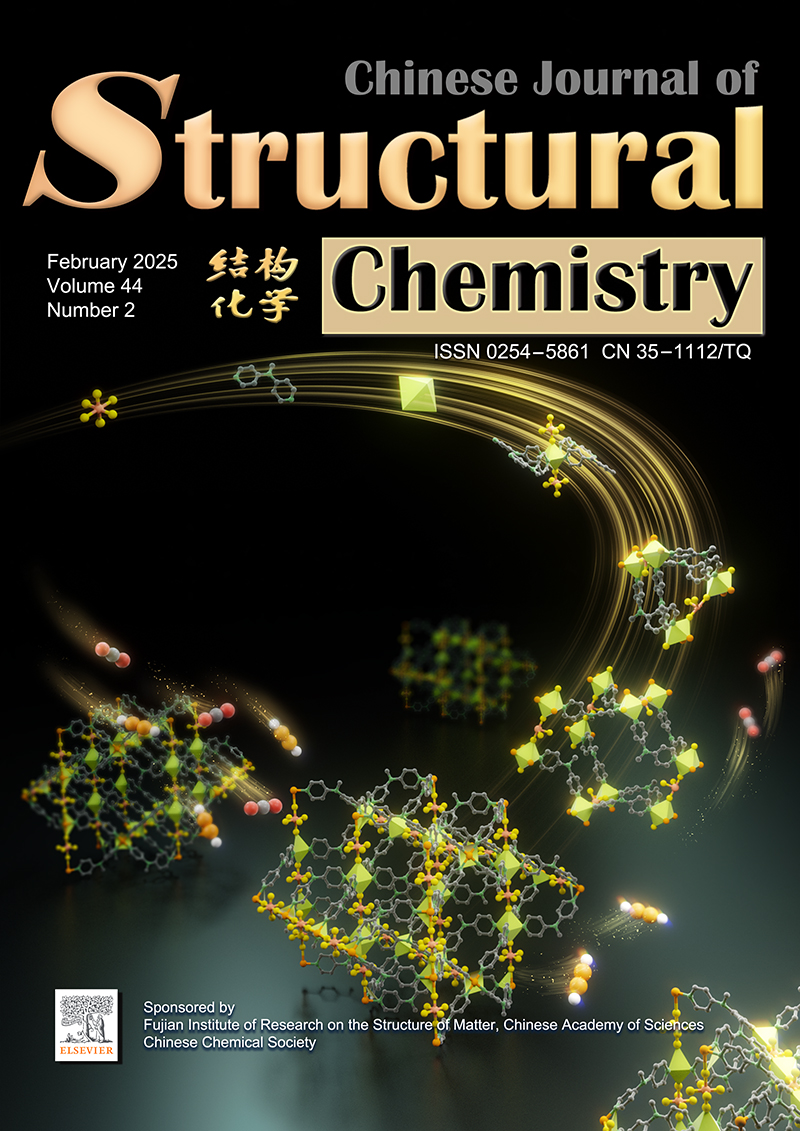
2026 Volume 45 Issue 4
2026, 45(4): 100845
doi: 10.1016/j.cjsc.2025.100845
Abstract:
The rapid pace of industrialization has resulted in the alarming discharge of detrimental chemicals into the environment, prompting the scientific community to rethink conventional wastewater treatment technologies. Sonophotocatalysis, a synergistic green approach, harnessing the combined forces of ultrasound and visible light, has emerged as a promising frontier in environmental remediation. Leveraging the exceptional surface area, porosity, and coordination flexibility of Zeolitic Imidazole Frameworks (ZIF-67), a type of Metal-organic framework (MOF), makes it an excellent scaffold for catalyst design. Forming the core of this approach, a CoWO4-decorated ZIF-67 hybrid nanocomposite was developed and utilized as a sonophotocatalyst to degrade tetracycline (TC) under dual-energy exposure. The CoWO4/ZIF-67 catalyst achieved an unprecedented TC degradation efficiency of 98% within 75 minutes, outperforming standalone sonocatalytic and photocatalytic treatment, with excellent reusability. Mechanistic insights, supported by theoretical studies, revealed a strong interaction between the structural and physicochemical properties of the catalyst and energy-induced reactive oxygen species (ROS) generation. A large-scale continuous-flow sonophotocatalytic reactor of 20 L was fabricated to evaluate the performance of the synthesized catalyst on real wastewater samples containing interfering ions. The system achieved an 85% reduction in total organic carbon (TOC), demonstrating excellent scalability and practical applicability, offering a promising approach for treating emerging organic pollutants in an efficient and environmentally friendly manner.
The rapid pace of industrialization has resulted in the alarming discharge of detrimental chemicals into the environment, prompting the scientific community to rethink conventional wastewater treatment technologies. Sonophotocatalysis, a synergistic green approach, harnessing the combined forces of ultrasound and visible light, has emerged as a promising frontier in environmental remediation. Leveraging the exceptional surface area, porosity, and coordination flexibility of Zeolitic Imidazole Frameworks (ZIF-67), a type of Metal-organic framework (MOF), makes it an excellent scaffold for catalyst design. Forming the core of this approach, a CoWO4-decorated ZIF-67 hybrid nanocomposite was developed and utilized as a sonophotocatalyst to degrade tetracycline (TC) under dual-energy exposure. The CoWO4/ZIF-67 catalyst achieved an unprecedented TC degradation efficiency of 98% within 75 minutes, outperforming standalone sonocatalytic and photocatalytic treatment, with excellent reusability. Mechanistic insights, supported by theoretical studies, revealed a strong interaction between the structural and physicochemical properties of the catalyst and energy-induced reactive oxygen species (ROS) generation. A large-scale continuous-flow sonophotocatalytic reactor of 20 L was fabricated to evaluate the performance of the synthesized catalyst on real wastewater samples containing interfering ions. The system achieved an 85% reduction in total organic carbon (TOC), demonstrating excellent scalability and practical applicability, offering a promising approach for treating emerging organic pollutants in an efficient and environmentally friendly manner.
2026, 45(4): 100846
doi: 10.1016/j.cjsc.2025.100846
Abstract:
Excimers host an important role in nature and modern industrial applications; however, a precise understanding regarding their configuration remains elusive owing to the difficulty in observing their formation in situ. Here we present an experimental scheme enabling in-situ visualization of structural evolution of molecules through photo-difference electron density. Application to pyrene crystals revealed an unanticipated excimer formation pathway. By observing the photo-induced molecular shift and rotation, we discovered the unconventional T-shaped configuration of pyrene excimers, which consists of more closely adjacent nonparallel molecules tending towards a perpendicular orientation, rather than the conventional sandwich configuration formed by adjacent parallel molecules. The results help demystify the molecular orientation and configuration associated with excimer discovered decades ago, and shed light on revealing fundamental mechanism of excimers in the fields of biomolecule detection, photovoltaics, and organic electronics.
Excimers host an important role in nature and modern industrial applications; however, a precise understanding regarding their configuration remains elusive owing to the difficulty in observing their formation in situ. Here we present an experimental scheme enabling in-situ visualization of structural evolution of molecules through photo-difference electron density. Application to pyrene crystals revealed an unanticipated excimer formation pathway. By observing the photo-induced molecular shift and rotation, we discovered the unconventional T-shaped configuration of pyrene excimers, which consists of more closely adjacent nonparallel molecules tending towards a perpendicular orientation, rather than the conventional sandwich configuration formed by adjacent parallel molecules. The results help demystify the molecular orientation and configuration associated with excimer discovered decades ago, and shed light on revealing fundamental mechanism of excimers in the fields of biomolecule detection, photovoltaics, and organic electronics.
2026, 45(4): 100847
doi: 10.1016/j.cjsc.2025.100847
Abstract:
Ultraviolet (UV) nonlinear optical (NLO) crystals are essential for advancing laser-based technologies in the UV region. However, overcoming the inherent trade-off between nonlinearity and bandgap in UV NLO materials remains a fundamental challenge. Herein, we propose an innovative molecular design strategy employing 5-hydroxy-2-pyridinecarboxylic acid as a novel molecular motif, characterized by its moderate π-conjugated, multidentate coordination capability, and low toxicity. By combining this organic ligand with alkali metals, we successfully obtained a noncentrosymmetric hybrid crystal, Na2(C6H4NO3)2∙H2O. This compound achieves an exceptional combination of a strong phase-matched second-harmonic generation response (6.2 × KDP), large birefringence (0.394), and a short UV cutoff edge (282 nm), effectively mitigating typical performance limitations. This work not only provides a promising candidate for UV laser applications but also demonstrates an effective strategy for designing high-performance hybrid crystals for coherent UV light generation.
Ultraviolet (UV) nonlinear optical (NLO) crystals are essential for advancing laser-based technologies in the UV region. However, overcoming the inherent trade-off between nonlinearity and bandgap in UV NLO materials remains a fundamental challenge. Herein, we propose an innovative molecular design strategy employing 5-hydroxy-2-pyridinecarboxylic acid as a novel molecular motif, characterized by its moderate π-conjugated, multidentate coordination capability, and low toxicity. By combining this organic ligand with alkali metals, we successfully obtained a noncentrosymmetric hybrid crystal, Na2(C6H4NO3)2∙H2O. This compound achieves an exceptional combination of a strong phase-matched second-harmonic generation response (6.2 × KDP), large birefringence (0.394), and a short UV cutoff edge (282 nm), effectively mitigating typical performance limitations. This work not only provides a promising candidate for UV laser applications but also demonstrates an effective strategy for designing high-performance hybrid crystals for coherent UV light generation.
2026, 45(4): 100848
doi: 10.1016/j.cjsc.2025.100848
Abstract:
Although surface-enhanced Raman scattering (SERS) technology has been widely applied in fields such as environmental pollutant monitoring and early cancer diagnosis, the design of universal substrates to enable high-sensitivity detection across multiple scenarios remains a pressing problem to be solved. In this study, an innovative defect engineering strategy was employed to successfully develop a SERS substrate based on molybdenum oxide sub-nanowires (MoO3-x Sub-NWs) with a high oxygen vacancy (Vo) concentration. This substrate uniquely combines the gradient defect states induced by Vo and the quantum confinement effect generated by the one-dimensional sub-nanostructure, thereby achieving the synergy of chemical enhancement and electromagnetic enhancement. Experimental results demonstrate that the substrate exhibits an enhancement factor as high as 7.8×10⁷ for rhodamine 6G, achieves a LOD of 10-11 M for dyes such as methyl orange, and enables effective detection of various environmental pollutants including polychlorinated phenols, polycyclic aromatic hydrocarbons, and polystyrene microspheres. In terms of biomedical applications, based on the PCA-LDA model, the method achieves a three-category classification accuracy of 92.22% for hepatocellular carcinoma cells (HepG2), esophageal cancer cells (TE-1), and white blood cells (WBC), a discrimination accuracy of 90% for esophageal cancer subtypes (TE-1 and KYSE), and an ROC curve AUC value of 0.97. This study provides a new paradigm for the development of high-performance universal SERS substrates and possesses significant application value in the fields of environmental monitoring and non-invasive tumor diagnosis.
Although surface-enhanced Raman scattering (SERS) technology has been widely applied in fields such as environmental pollutant monitoring and early cancer diagnosis, the design of universal substrates to enable high-sensitivity detection across multiple scenarios remains a pressing problem to be solved. In this study, an innovative defect engineering strategy was employed to successfully develop a SERS substrate based on molybdenum oxide sub-nanowires (MoO3-x Sub-NWs) with a high oxygen vacancy (Vo) concentration. This substrate uniquely combines the gradient defect states induced by Vo and the quantum confinement effect generated by the one-dimensional sub-nanostructure, thereby achieving the synergy of chemical enhancement and electromagnetic enhancement. Experimental results demonstrate that the substrate exhibits an enhancement factor as high as 7.8×10⁷ for rhodamine 6G, achieves a LOD of 10-11 M for dyes such as methyl orange, and enables effective detection of various environmental pollutants including polychlorinated phenols, polycyclic aromatic hydrocarbons, and polystyrene microspheres. In terms of biomedical applications, based on the PCA-LDA model, the method achieves a three-category classification accuracy of 92.22% for hepatocellular carcinoma cells (HepG2), esophageal cancer cells (TE-1), and white blood cells (WBC), a discrimination accuracy of 90% for esophageal cancer subtypes (TE-1 and KYSE), and an ROC curve AUC value of 0.97. This study provides a new paradigm for the development of high-performance universal SERS substrates and possesses significant application value in the fields of environmental monitoring and non-invasive tumor diagnosis.
2026, 45(4): 100849
doi: 10.1016/j.cjsc.2025.100849
Abstract:
Developing efficient and durable electrocatalysts that minimize or eliminate Ir usage is essential for large-scale hydrogen production through proton exchange membrane water electrolysis. In this work, two IrOx-Co3O4 catalysts with distinct interfacial configurations were constructed to clarify the effect of structural coupling on activity and stability. The embedded IrOx-Co3O4 was prepared via a galvanic replacement-induced embedding process, while the surface-exposed IrOx-Co3O4 was obtained through photo-reduction deposition. Structural analyses confirm the formation of strong Co-O-Ir linkages in embedded IrOx-Co3O4, in contrast to discrete surface IrOx nanoparticles in the exposed sample. Electrochemical measurements show that exposed-IrOx delivers a lower overpotential of ≈ 331 mV at 10 mA cm-2 but suffers from fast Ir dissolution, whereas embedded IrOx maintains stable operation with a voltage of 1.78 V at 1 A cm-2 for over 200 h in a PEM cell. In-situ Raman and DEMS results reveal that embedded IrOx follows a dominating classical adsorbate-evolution mechanism (AEM), while exposed IrOx-Co3O4 involves a lattice-oxygen-mediated mechanism (LOM), leading to its inferior stability. This work highlights that strengthening Co-O-Ir interface effectively suppresses Ir loss and provides a general strategy for designing robust Ir-based catalysts for acidic water electrolysis.
Developing efficient and durable electrocatalysts that minimize or eliminate Ir usage is essential for large-scale hydrogen production through proton exchange membrane water electrolysis. In this work, two IrOx-Co3O4 catalysts with distinct interfacial configurations were constructed to clarify the effect of structural coupling on activity and stability. The embedded IrOx-Co3O4 was prepared via a galvanic replacement-induced embedding process, while the surface-exposed IrOx-Co3O4 was obtained through photo-reduction deposition. Structural analyses confirm the formation of strong Co-O-Ir linkages in embedded IrOx-Co3O4, in contrast to discrete surface IrOx nanoparticles in the exposed sample. Electrochemical measurements show that exposed-IrOx delivers a lower overpotential of ≈ 331 mV at 10 mA cm-2 but suffers from fast Ir dissolution, whereas embedded IrOx maintains stable operation with a voltage of 1.78 V at 1 A cm-2 for over 200 h in a PEM cell. In-situ Raman and DEMS results reveal that embedded IrOx follows a dominating classical adsorbate-evolution mechanism (AEM), while exposed IrOx-Co3O4 involves a lattice-oxygen-mediated mechanism (LOM), leading to its inferior stability. This work highlights that strengthening Co-O-Ir interface effectively suppresses Ir loss and provides a general strategy for designing robust Ir-based catalysts for acidic water electrolysis.
2026, 45(4): 100850
doi: 10.1016/j.cjsc.2025.100850
Abstract:
Halide solid electrolytes for all-solid-state lithium batteries have garnered significant research interest from academia and industry, owing to their intrinsic high safety, satisfying ionic conductivity, wide electrochemical window, and favorable mechanical properties. However, interfacial instability at the whole battery system level remains a critical challenge hindering their practical implementation at a large scale. Rational electrolytes designs and explorations require a coherent perspective to address the interface problems with systematic discussions on improvement strategies. This review provides a systematic examination of interfacial engineering across multiple scales, bridging fundamental material properties, electrode-electrolyte interfaces, multi-component composite structures, and scalable manufacturing. With a particular emphasis on the complex interactions at halide solid electrolyte interfaces, we discuss innovative strategies to enhance interfacial stability of electrode/electrolyte. This review aims to deepen the fundamental understanding of interfacial chemistry and accelerate the development of halide-based all-solid-state lithium batteries, thereby facilitating their deployment in next-generation energy storage systems.
Halide solid electrolytes for all-solid-state lithium batteries have garnered significant research interest from academia and industry, owing to their intrinsic high safety, satisfying ionic conductivity, wide electrochemical window, and favorable mechanical properties. However, interfacial instability at the whole battery system level remains a critical challenge hindering their practical implementation at a large scale. Rational electrolytes designs and explorations require a coherent perspective to address the interface problems with systematic discussions on improvement strategies. This review provides a systematic examination of interfacial engineering across multiple scales, bridging fundamental material properties, electrode-electrolyte interfaces, multi-component composite structures, and scalable manufacturing. With a particular emphasis on the complex interactions at halide solid electrolyte interfaces, we discuss innovative strategies to enhance interfacial stability of electrode/electrolyte. This review aims to deepen the fundamental understanding of interfacial chemistry and accelerate the development of halide-based all-solid-state lithium batteries, thereby facilitating their deployment in next-generation energy storage systems.
2026, 45(4): 100851
doi: 10.1016/j.cjsc.2025.100851
Abstract:
The development of efficient and cost-effective electrocatalysts for water splitting is crucial for advancing sustainable energy technologies. Antiperovskite carbides, with their compositional tunability and low cost, have emerged as promising candidates. In this work, a series of Ni3-xCoxInC antiperovskite carbides were synthesized, among which the sample with the optimized Ni/Co ratio exhibited impressive electrocatalytic activity toward the hydrogen evolution reaction (HER). Specifically, the catalyst achieved a low overpotential of 140 mV at 10 mA cm-2, together with robust durability under prolonged operating conditions. The enhanced HER performance is attributed to the synergistic interaction between Ni and Co atoms, as well as the increased density of carbon defects introduced during synthesis, which together facilitate favourable adsorption and desorption of reaction intermediates. This study not only offers a new perspective for the development of water-splitting catalysts but also expands the application scope of polymetallic carbides and intermetallic compounds in electrochemical energy conversion.
The development of efficient and cost-effective electrocatalysts for water splitting is crucial for advancing sustainable energy technologies. Antiperovskite carbides, with their compositional tunability and low cost, have emerged as promising candidates. In this work, a series of Ni3-xCoxInC antiperovskite carbides were synthesized, among which the sample with the optimized Ni/Co ratio exhibited impressive electrocatalytic activity toward the hydrogen evolution reaction (HER). Specifically, the catalyst achieved a low overpotential of 140 mV at 10 mA cm-2, together with robust durability under prolonged operating conditions. The enhanced HER performance is attributed to the synergistic interaction between Ni and Co atoms, as well as the increased density of carbon defects introduced during synthesis, which together facilitate favourable adsorption and desorption of reaction intermediates. This study not only offers a new perspective for the development of water-splitting catalysts but also expands the application scope of polymetallic carbides and intermetallic compounds in electrochemical energy conversion.
2026, 45(4): 100857
doi: 10.1016/j.cjsc.2025.100857
Abstract:
The development of highly efficient and stable RuO2-based electrocatalysts as promising alternatives to IrO2 for acidic oxygen evolution reaction (OER) is crucial for the practical application of proton exchange membrane water electrolyzers (PEMWEs). Although considerable efforts have been devoted to breaking the scaling relationship of adsorbate evolution mechanism (AEM) pathway through modulating the electronic structure of catalysts and the binding energies of reaction intermediate species, limited attention has been paid to the role of interfacial water structure at the interface between catalyst and electrolyte. Here, we anchored RuO2 onto oxophilic MoO3 nanosheet, and realized an optimized connectivity of hydrogen-bond network in the electric double layer (EDL). Through advanced in-situ spectroscopies, we demonstrate that the reconstructed interfacial water molecules can accelerate the dissociation and the follow-up proton transport across the interface, promoting a high-proton-flux interface that ensures simultaneous enhancement of both activity and stability. Consequently, the obtained RuO2/MoO3 heterojunction exhibits remarkable activity and stability in acidic OER (with an overpotential of 235 mV at a current density of 100 mA cm-2 and excellent long-term durability of 420 h at 10 mA cm-2). When evaluated in a PEMWE device, it requires only 1.63 V to achieve a current density of 1.0 A cm-2 and shows no significant voltage degradation over 500 hours of continuous operation at a current density of 100 mA cm-2.
The development of highly efficient and stable RuO2-based electrocatalysts as promising alternatives to IrO2 for acidic oxygen evolution reaction (OER) is crucial for the practical application of proton exchange membrane water electrolyzers (PEMWEs). Although considerable efforts have been devoted to breaking the scaling relationship of adsorbate evolution mechanism (AEM) pathway through modulating the electronic structure of catalysts and the binding energies of reaction intermediate species, limited attention has been paid to the role of interfacial water structure at the interface between catalyst and electrolyte. Here, we anchored RuO2 onto oxophilic MoO3 nanosheet, and realized an optimized connectivity of hydrogen-bond network in the electric double layer (EDL). Through advanced in-situ spectroscopies, we demonstrate that the reconstructed interfacial water molecules can accelerate the dissociation and the follow-up proton transport across the interface, promoting a high-proton-flux interface that ensures simultaneous enhancement of both activity and stability. Consequently, the obtained RuO2/MoO3 heterojunction exhibits remarkable activity and stability in acidic OER (with an overpotential of 235 mV at a current density of 100 mA cm-2 and excellent long-term durability of 420 h at 10 mA cm-2). When evaluated in a PEMWE device, it requires only 1.63 V to achieve a current density of 1.0 A cm-2 and shows no significant voltage degradation over 500 hours of continuous operation at a current density of 100 mA cm-2.
2026, 45(4): 100858
doi: 10.1016/j.cjsc.2025.100858
Abstract:
The demand for green production of hydrogen peroxide (H2O2) has triggered extensive research on photocatalytic synthesis, but there are still problems of low catalytic efficiency. Herein, N, S co-doped carbon dots (N, S-CDs) were anchored on the covalent triazine frames (CTFs) to successfully form the N, S-CDs/CTFs S-scheme heterojunction by a simple hydrothermal method for achieving the optimal photocatalytic H2O2 production rate of 10350 μM g-1 h-1 in pure water. Between the interface of N, S-CDs and CTFs, a five-membered or six-membered nitrogen-containing and sulphur-containing heterocycles linked together to accelerate the electron transfer rate through the conjugation effect. In addition, the S-scheme heterostructure can effectively form an internal electric field (IEF) at the interface, which can promote the separation of electrons and holes. For practical application, the H2O2 produced by the N, S-CDs/CTFs composite photocatalytic system can also be used for photocatalytic antimicrobial treatments, which achieved a bactericidal rate of 86% against E. coli, which is 28% higher than that of pure CTFs. The design displays great potential in the fields of photocatalytic H2O2 generation and photocatalytic antimicrobial, and it also makes the photocatalytic antimicrobial technology more stable and efficient, meanwhile, it also expands a new direction for the application of homogeneous CDs in photocatalysis.
The demand for green production of hydrogen peroxide (H2O2) has triggered extensive research on photocatalytic synthesis, but there are still problems of low catalytic efficiency. Herein, N, S co-doped carbon dots (N, S-CDs) were anchored on the covalent triazine frames (CTFs) to successfully form the N, S-CDs/CTFs S-scheme heterojunction by a simple hydrothermal method for achieving the optimal photocatalytic H2O2 production rate of 10350 μM g-1 h-1 in pure water. Between the interface of N, S-CDs and CTFs, a five-membered or six-membered nitrogen-containing and sulphur-containing heterocycles linked together to accelerate the electron transfer rate through the conjugation effect. In addition, the S-scheme heterostructure can effectively form an internal electric field (IEF) at the interface, which can promote the separation of electrons and holes. For practical application, the H2O2 produced by the N, S-CDs/CTFs composite photocatalytic system can also be used for photocatalytic antimicrobial treatments, which achieved a bactericidal rate of 86% against E. coli, which is 28% higher than that of pure CTFs. The design displays great potential in the fields of photocatalytic H2O2 generation and photocatalytic antimicrobial, and it also makes the photocatalytic antimicrobial technology more stable and efficient, meanwhile, it also expands a new direction for the application of homogeneous CDs in photocatalysis.
2026, 45(4): 100860
doi: 10.1016/j.cjsc.2025.100860
Abstract:
2026, 45(4): 100861
doi: 10.1016/j.cjsc.2025.100861
Abstract:
Electrocatalytic water splitting has emerged as a promising route for sustainable hydrogen production. However, the sluggish oxygen evolution reaction (OER) severely restricts its overall efficiency. Herein, a trimetallic electrocatalyst was rationally designed and synthesized via a sequential ion-exchange strategy. The as-prepared Fe/NiCoO2, featuring the multi-metallic electronic synergy and unique hierarchical architecture, provides high intrinsic activity, abundant active sites, and efficient mass diffusion. Benefiting from these compositional and structural merits, the electrode delivers ultralow overpotentials of 248 and 353 mV at current densities of 10 and 500 mA cm-2, respectively, with a small Tafel slope of 39.15 mV dec-1. Furthermore, Fe/NiCoO2 exhibits exceptional long-term stability over 200 h under high current densities of 500 mA cm-2, outperforming the benchmark noble-metal-based catalysts. In-situ Raman spectroscopy reveals that the initial Fe/NiCoO2 undergoes self-reconstruction into Fe/NiCoOOH during the OER process. Density functional theory (DFT) calculations certify that the incorporation of Fe into NiCoO2 effectively tunes the 3d-orbital electron distribution, which optimizes the adsorption energies of oxygen-containing intermediates and enhances charge transfer kinetics. This study provides a promising strategy for designing noble-metal-free catalysts with tailored nanostructures and multi-active site configurations to facilitate efficient industrial-scale water oxidation.
Electrocatalytic water splitting has emerged as a promising route for sustainable hydrogen production. However, the sluggish oxygen evolution reaction (OER) severely restricts its overall efficiency. Herein, a trimetallic electrocatalyst was rationally designed and synthesized via a sequential ion-exchange strategy. The as-prepared Fe/NiCoO2, featuring the multi-metallic electronic synergy and unique hierarchical architecture, provides high intrinsic activity, abundant active sites, and efficient mass diffusion. Benefiting from these compositional and structural merits, the electrode delivers ultralow overpotentials of 248 and 353 mV at current densities of 10 and 500 mA cm-2, respectively, with a small Tafel slope of 39.15 mV dec-1. Furthermore, Fe/NiCoO2 exhibits exceptional long-term stability over 200 h under high current densities of 500 mA cm-2, outperforming the benchmark noble-metal-based catalysts. In-situ Raman spectroscopy reveals that the initial Fe/NiCoO2 undergoes self-reconstruction into Fe/NiCoOOH during the OER process. Density functional theory (DFT) calculations certify that the incorporation of Fe into NiCoO2 effectively tunes the 3d-orbital electron distribution, which optimizes the adsorption energies of oxygen-containing intermediates and enhances charge transfer kinetics. This study provides a promising strategy for designing noble-metal-free catalysts with tailored nanostructures and multi-active site configurations to facilitate efficient industrial-scale water oxidation.
2026, 45(4): 100862
doi: 10.1016/j.cjsc.2025.100862
Abstract:
Separating natural gas to obtain high-purity CH4 is of great significance for tackling pressing energy crises and mitigating environmental issues. However, the low C3H8 and C2H6 capture efficiency of current adsorbents frequently results in inadequate CH4 purification. In this work, we have successfully constructed a dual-pore Zr-MOF (FJI-W60), in which the larger channels facilitate rapid molecular diffusion, while the smaller pores can create strong interactions with C3H8 and C2H6 molecules. These significant features collectively ensure the highly efficient adsorption of C3H8 and C2H6. Static and dynamic adsorption experiments reveal that FJI-W60 exhibits high uptake capacity and rapid adsorption kinetics for both C3H8 and C2H6. The practical breakthrough experiments validate the outstanding CH4 purification performance of FJI-W60. At 298 K, 8.6 mol kg-1 of high-purity can be obtained from the 5/10/85 C3H8/C2H6/CH4 (v/v/v) mixture, which exceeds most CH4-purification materials.
Separating natural gas to obtain high-purity CH4 is of great significance for tackling pressing energy crises and mitigating environmental issues. However, the low C3H8 and C2H6 capture efficiency of current adsorbents frequently results in inadequate CH4 purification. In this work, we have successfully constructed a dual-pore Zr-MOF (FJI-W60), in which the larger channels facilitate rapid molecular diffusion, while the smaller pores can create strong interactions with C3H8 and C2H6 molecules. These significant features collectively ensure the highly efficient adsorption of C3H8 and C2H6. Static and dynamic adsorption experiments reveal that FJI-W60 exhibits high uptake capacity and rapid adsorption kinetics for both C3H8 and C2H6. The practical breakthrough experiments validate the outstanding CH4 purification performance of FJI-W60. At 298 K, 8.6 mol kg-1 of high-purity can be obtained from the 5/10/85 C3H8/C2H6/CH4 (v/v/v) mixture, which exceeds most CH4-purification materials.