
Scheme 1.
Visible-light-mediated four-component reaction for the synthesis of phosphorodithioate-containing quinoxalin-2(1H)-ones.

Visible-light-induced four-component difunctionalization of alkenes to construct phosphorodithioate-containing quinoxalin-2(1H)-ones
Xiao-Ming Chen , Lianhui Song , Jun Pan , Fei Zeng , Yi Xie , Wei Wei , Dong Yi


Quinoxalin-2(1H)-ones as a highly valuable class of N-heterocycle scaffolds are widely presented in many natural products, functional materials, and pharmaceutical molecules [1-3]. In particular, the C3-substituted quinoxalin-2(1H)-one derivatives exhibit a broad range of chemical and biological activities [4-6]. Traditional synthetic methods generally encounter some problems including relatively harsh reaction conditions, the need for extra steps to prepare raw materials, and narrow substrate range. The direct incorporation of functional group into C3 position of quinoxalin-2(1H)-ones is the most effective approach to access C3-substituted quinoxalin-2(1H)-one derivatives [7-45]. Among these strategies, the recently developed multi-component difunctionalizations of alkenes have emerged as a powerful protocol for the assembly of various C3-functionlized quinoxalin-2(1H)-ones in terms of their high reaction efficiency and enhanced molecular diversities [35-47]. Nevertheless, these elegant strategies are mostly focused on three-component reactions and require heating condition, metal-reagents or stoichiometric amounts of oxidants. To the best of our knowledge, only one example of the four-component reaction of quinoxalin-2(1H)-ones, alkenes, aryldiazonium, and sodium metabisulfite has been reported for the synthesis of sulfonated quinoxalin-2(1H)-ones [48]. It is still a challenging task to develop new and simple four-component difunctionalizations of alkenes for assembling structurally diverse substituted quinoxalin-2(1H)-ones in one-pot procedure.
Phosphorodithioate structural moiety is frequently found in various pharmaceutically and biologically important compounds, which possess exceptional biological activities including insecticidal, antiviral, DNAzyme activities, butyrylcholinesterase and acetylcholinesterase inhibiting properties [49-51]. Generally, phosphorodithioates were synthesized through Al2O3-promoted substitution reactions of potassium/ammonium salt of thiophosphate with RX or NaH-mediated reactions of (RO)2P(=S)Cl with RSH [52-56]. These methods suffer from limitations such as the use of relatively complex starting materials, strong base, and poor functional group tolerance. Thus, considerable research efforts have been devoted to introducing phosphorodithioate structural unit into frameworks [57-61]. Visible light as a clean and sustainable energy-source has been widely utilized for accomplishing various organic transformations in synthetic chemistry during the past several years [62-75]. Herein, we wish to disclose a new and efficient strategy for the synthesis of phosphorodithioate-containing quinoxalin-2(1H)-ones through visible-light-induced 4CzIPN (2 mol%) catalyzed four-component difunctionalization reactions of alkenes with quinoxalin-2(1H)-ones, P4S10 and alcohols (Scheme 1).
Initially, 1-methylquinoxalin-2(1H)-one (1a), styrene (2a), P4S10 (3) and EtOH (4a) were chosen as model substrates to optimize the reaction conditions under the irradiation of 3 W blue LED lamps. When the model reaction was conducted in EtOH/CH3CN (1:9) at room temperature by using Rose Bengal (2 mol%) as photocatalyst, the desired product 5aa was obtained in 21% yield (Table 1, entry 1). The optimization of various photocatalysts found that 1,2,3,5-tetrakis(carbazol-9-yl)-4,6-dicyanobenzene (4CzIPN) was the best one to give the product 5aa in 72% yield (Table 1, entries 2-9). Changing the EtOH/CH3CN mixed solution with EtOH/DMSO also delivered the product 5aa in 70% yield (Table 1, entry 10). Conducting the reaction with other mixed solvents would lead to the lower reaction efficiency (Table 1, entries 11-15). Product 5aa was also obtained in 57% yield when EtOH was employed as the single solvent (Table 1, entry 16). Further screening of the volume ratio of solvent showed that EtOH/CH3CN (1:12) was the optimal reaction medium (Table 1, entry 20). The reaction efficiency was not obviously affected by increasing the loading of photocatalyst from 2 mol% to 5 mol% (Table 1, entry 22). Decreasing the loading of photocatalyst from 2 mol% to 1 mol% led to a decreased yield of 5aa (Table 1, entry 23). None of the desired product was detected in the absence of photocatalyst (Table 1, entry 24). Performing the reaction with other light sources such as green LED and white LED afforded the product 5aa in the relatively lower yields (Table 1, entries 25 and 26). No transformation was observed in the absence of visible-light irradiation (Table 1, entry 27).
With the optimal conditions in hand, we subsequently evaluated the application scope and limitations of this visible-light-induced four-component protocol. As shown in Scheme 2, various substituted alkenes were firstly tested under the standard conditions. Aromatic alkenes bearing electron-donating groups (OMe, tBu and Me) on the aromatic rings were suitable substrates and generated the corresponding products 5ab-5af in 63%-88% yields. Aromatic alkenes attaching electron-deficient groups (CH2Cl, F, Cl, Br and CO2Me) on the benzene rings were also examined, and the reactions underwent smoothly to afford the desired products 5ag–5an in 62%-80% yields. It should be noted that the steric hindrance has no obvious effect on the reaction efficiency. Ortho-methyl- and chloro-substituted styrenes as well as 1-vinylnaphthalene were compatible with this procedure to provide the desired products (5af, 5al and 5ao) in satisfactory yields. 2-Vinylnaphthalene and heterocycle alkene such as 2-vinylthiophene could also be employed in this reaction to give the products 5ap and 5aq. Interestingly, when 4-nitrostyrene was used in this reaction procedure, none of the product 5ar was detected and the hydrophosphorodithiolation product of 4-nitrostyrene 5ar' was isolated in 53% yield. Nevertheless, none of the corresponding products were observed when aliphatic alkenes such as 1-hexene and 1-octene were employed in this reaction system.

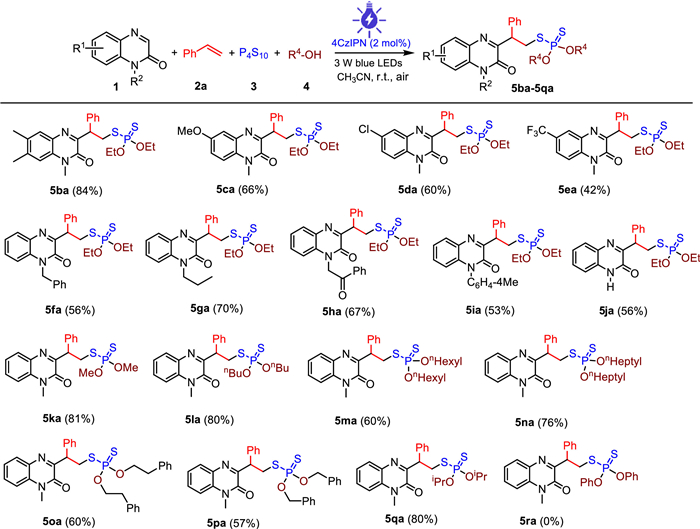
The scope of various quinoxalin-2(1H)-ones and alcohols was further examined (Scheme 3). The aromatic ring of quinoxalin-2(1H)-ones bearing electron-rich substituent showed better reactivity than the substrate containing deficient substituent (5ba-5ea). A series of N-protecting groups including benzyl, propargyl, ketone, and aryl groups could be accommodated well in this reaction, affording the desired products 5fa-5ia in 53%-70% yields. To our delight, N-free quinoxalin-2(1H)-one was also suitable substrate, delivering the corresponding product 5ja in 56% yield. With regards to alcohols, in addition to ethanol, other chain alcohols such as methanol, n-butanol, 1-hexanol, and 1-heptanol all worked well to afford the products 5ka-5na in 60%-81% yields. Phenylethanol, phenylmethanol and more sterically demanding alcohol such as iso-propanol were also tolerated in this reaction system, providing the corresponding products 5oa-5qa in 57%-80% yields, respectively. Unfortunately, when phenol was used for this multi-component reaction, no desired product 5ra was detected.
In order to investigate the possible reaction mechanism, some control experiments were performed. Firstly, O,O-diethyl S-hydrogen phosphorodithioate 6a was detected in this reaction system. Subsequently, when the reaction of 1-methylquinoxalin-2(1H)-one (1a), styrene (2a), and O,O-diethyl S-hydrogen phosphorodithioate 6a was carried out under the standard conditions, product 5aa was isolated in 77% yield (Scheme 4a). Both results suggested that O,O-diethyl S-hydrogen phosphorodithioate might be a key intermediate in this reaction system. Then, when the radical scavenger TEMPO (2,2,6,6-tetramethyl-1-piperidinyloxy) was added into model reaction system, the reaction was extremely suppressed and TEMPO-trapped complex A was observed by LC-MS (Scheme 4b). Next, only a trace amount of product was detected when the model reaction was carried out under nitrogen atmosphere (Scheme 4c), indicating dioxygen in air is essential for this transformation.

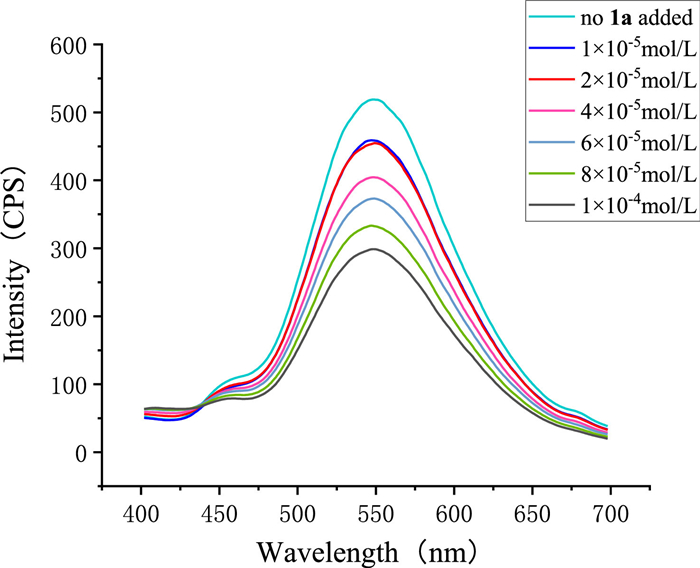
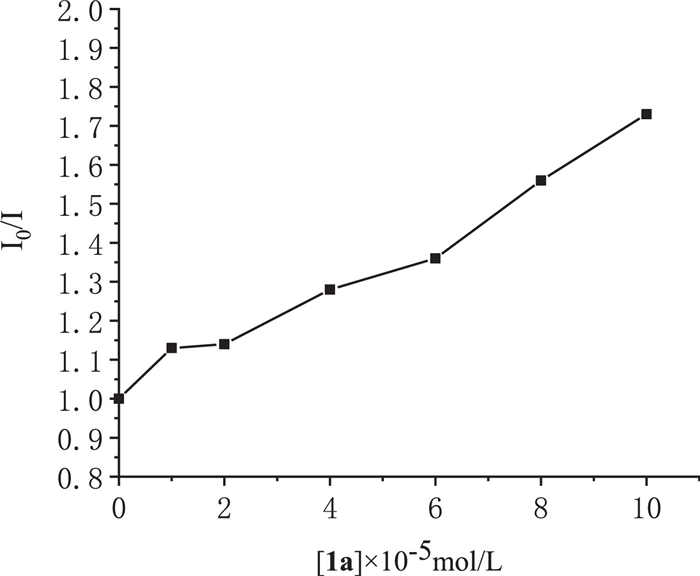
In addition, to verify an electron transfer process between substrates and photocatalyst, fluorescence quenching experiments were carried out under visible-light irradiation. The emission intensity of the excited photocatalyst decreased gradually along with the increase of the loading of 1-methylquinoxalin-2(1H)-one 1a (Figs. 1 and 2). Nevertheless, when the interaction of photocatalyst with styrene 2a or O,O-diethyl S-hydrogen phosphorodithioate 6a, fluorescence quenching phenomenon of photocatalyst was not obviously observed (Supporting information). The above results suggested that visible-light-mediated electron transfer process should occur between quinoxalin-2(1H)-one and excited photocatalyst.
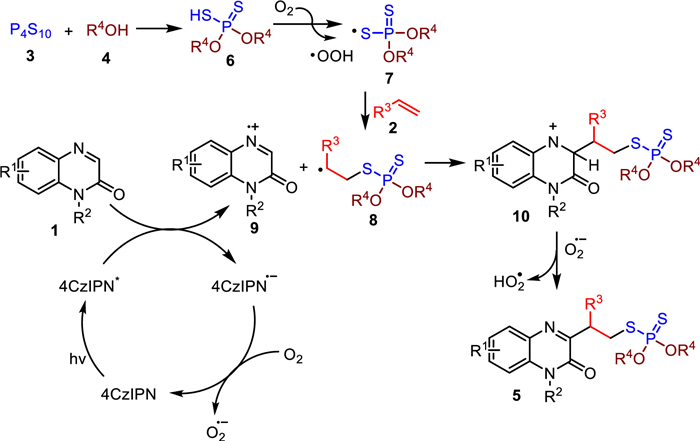
On the basis of the above experimental results and previous reports [42,43,76], a possible mechanism was proposed as presented in Scheme 5. Firstly, the reaction of P4S10 3 with alcohol 4 produced O,O-dialkyl S-hydrogen phosphorodithioate 6, which was further oxidized by dioxygen in air to form thiyl radical 7. Subsequently, the addition of thiyl radical 7 to alkene 2 would lead to the formation of alkyl radical intermediate 8. On the other hand, ground-state 4CzIPN was photo-activated to generate its excited state 4CzIPN* in the presence of visible-light irradiation. Then, the single-electron transfer (SET) occurred between the excited state of 4CzIPN* and quinoxalin-2(1H)-one 1 to give radical cation 9 with the release of 4CzIPN•−. 4CzIPN•− would be oxidized by O2 to deliver a superoxide anion radical (O2•−) and regenerate the photocatalyst. Next, the interaction of alkyl radical intermediate 8 with radical cation 9 produced a nitrogen cation intermediate 10. Finally, intermediate 10 underwent the deprotonation process to afford the desired product 5.
In summary, a new and facile visible-light-mediated strategy has been developed for the construction of phosphorodithioate-containing quinoxalin-2(1H)-ones via 4CzIPN catalyzed four-component reaction of alkenes, quinoxalin-2(1H)-ones, P4S10 and alcohols. This photocatalytic multi-component reaction could undergo under metal-free and mild conditions with the successive introduction of a phosphorodithioate and a quinoxalin-2(1H)-one structural moiety into one molecular framework. Preliminary mechanistic studies revealed that this photocatalytic reaction involve a radical process. The notable advantages of this strategy make this method attractive in synthetic chemistry.
The authors declare that they have no known competing financial interests or personal relationships that could have appeared to influence the work reported in this paper.
Xiao-Ming Chen: Writing – original draft, Resources, Data curation, Conceptualization. Lianhui Song: Methodology, Investigation, Data curation. Jun Pan: Funding acquisition, Formal analysis, Data curation. Fei Zeng: Formal analysis, Data curation. Yi Xie: Formal analysis, Data curation. Wei Wei: Writing – review & editing, Supervision, Resources, Project administration, Funding acquisition, Conceptualization. Dong Yi: Writing – review & editing, Resources, Funding acquisition.
This work was supported by Natural Science Foundation of Hunan Province (No. 2024JJ7198), Science Research Excellent Youth Project of Hunan Provincial Department of Education (No. 23B0751), Natural Science Foundation of Shandong Province (No. ZR2021MB065), and National Natural Science Foundation of China (No. 22101237).
Supplementary material associated with this article can be found, in the online version, at doi:
H.M. Refaat, A.A. Moneer, O.M. Khalil, Arch. Pharmacal Res. 27 (2004) 1093–1098. doi: 10.1007/BF02975110
X.Y. Qin, X. Hao, H. Han, et al., J. Med. Chem. 58 (2015) 1254–1267. doi: 10.1021/jm501484b
M.I. Shahin, D.A. Abou El Ella, N.S.M. Ismailand, K.A.M. Abouzid, Bioorg. Chem. 56 (2014) 16–26. doi: 10.1016/j.bioorg.2014.05.010
S.A. Galal, S.H.M. Khairat, F.A.F. Ragab, et al., Eur. J. Med. Chem. 86 (2014) 122–132. doi: 10.1016/j.ejmech.2014.08.048
N. Udilova, A.V. Kozlov, W. Bieberschulte, et al., Biochem. Pharmacol. 65 (2003) 59–65. doi: 10.1016/S0006-2952(02)01452-1
H. Nohl, W. Bieberschulte, B. Dietrich, N. Udilova, A.V. Kozlov, J. Heterocycl. Chem. 43 (2006) 541–548. doi: 10.1002/jhet.5570430304
Y. Li, M. Gao, L. Wang, X. Cui, Org. Biomol. Chem. 14 (2016) 8428–8432. doi: 10.1039/C6OB01283C
X.K. He, J. Lu, A.J. Zhang, et al., Org. Lett. 22 (2020) 5984–5989. doi: 10.1021/acs.orglett.0c02080
W-T. Ouyang, H-T. Ji, J. Jiang, et al., Chem. Commun. 59 (2023) 14029–14032. doi: 10.1039/D3CC04020H
L.Y. Xie, S. Peng, T.G. Fan, et al., Sci. China Chem. 62 (2019) 460–464. doi: 10.1007/s11426-018-9446-1
L.Y. Xie, Y.S. Bai, X.Q. Xu, et al., Green Chem. 22 (2020) 1720–1725. doi: 10.1039/C9GC03899J
H.F. Liu, M.X. He, H.T. Tang, Org. Chem. Front. 9 (2022) 5955–5961. doi: 10.1039/D2QO01281B
W. Wei, L. Wang, H. Yue, et al., ACS Sustain. Chem. Eng. 6 (2018) 17252–17257. doi: 10.1021/acssuschemeng.8b04652
L.Y. Xie, L.L. Jiang, J.X. Tan, et al., ACS Sustain. Chem. Eng. 7 (2019) 14153–14160. doi: 10.1021/acssuschemeng.9b02822
C.P. Yuan, Z.Z. Xie, Y. Zheng, et al., Chem. Commun. 59 (2023) 10125–10128. doi: 10.1039/D3CC02744A
J. Yuan, S. Liu, L. Qu, Adv. Synth. Catal. 359 (2017) 4197–4207. doi: 10.1002/adsc.201701058
L. Wang, P. Bao, W. Liu, et al., Chin. J. Org. Chem. 38 (2018) 3189–3196. doi: 10.6023/cjoc201807014
M. Gao, Y. Li, L. Xie, R. Chauvin, X. Cui, Chem. Commun. 52 (2016) 2846–2849. doi: 10.1039/C5CC08049E
K.J. Li, Y.Y. Jiang, K. Xu, C.C. Zeng, B.G. Sun, Green Chem. 21 (2019) 4412–4421. doi: 10.1039/C9GC01474H
J. Wang, B. Sun, L. Zhang, et al., Org. Chem. Front. 7 (2020) 113–118. doi: 10.1039/C9QO01055F
L. Yang, P. Gao, X.H. Duan, Y.R. Gu, L.N. Guo, Org. Lett. 20 (2018) 1034–1037. doi: 10.1021/acs.orglett.7b03984
L.Y. Xie, Y.L. Chen, L. Qin, et al., Org. Chem. Front. 6 (2019) 3950–3955. doi: 10.1039/C9QO01240K
J. Zhou, P. Zhou, T. Zhao, Q. Ren, J. Li, Adv. Synth. Catal. 361 (2019) 5371–5382. doi: 10.1002/adsc.201901008
J. Xu, H. Yang, H. Cai, et al., Org. Lett. 21 (2019) 4698–4702. doi: 10.1021/acs.orglett.9b01578
M. Zhang, G. Nan, X. Zhao, W. Wei, Chin. J. Org. Chem. 42 (2022) 4315–4322. doi: 10.6023/cjoc202209013
Y.H. Lu, Z.T. Zhang, H.Y. Wu, et al., Chin. Chem. Lett. 34 (2023) 108036. doi: 10.1016/j.cclet.2022.108036
L.Y. Xie, Y.S. Liu, H.R. Ding, et al., Chin. J. Catal. 41 (2020) 1168–1173. doi: 10.1016/S1872-2067(19)63526-6
H.Y. Song, J. Jiang, C. Wu, et al., Green Chem. 25 (2023) 3292–3296. doi: 10.1039/D2GC04843D
H.Y. Song, Z.T. Zhang, H.Y. Tan, et al., Asian J. Org. Chem. 12 (2023) e202200658. doi: 10.1002/ajoc.202200658
K. Sun, F. Xiao, B. Yu, W.M. He, Chin. J. Catal. 42 (2021) 1921–1943. doi: 10.1016/S1872-2067(21)63850-0
C. Ma, H. Meng, J. Li, et al., Chin. J. Chem. 40 (2022) 2655–2662. doi: 10.1002/cjoc.202200386
W. Wei, L. Wang, P. Bao, et al., Org. Lett. 20 (2018) 7125–7130. doi: 10.1021/acs.orglett.8b03079
P. Bao, F. Liu, Y. Lv, et al., Org. Chem. Front. 7 (2020) 492–498. doi: 10.1039/C9QO01334B
K.L. Wang, H.T. Ji, L.J. Ou, W.M. He, Eur. J. Org. Chem. 26 (2023) e202300752.
Q. Yang, B. Wang, M. Wu, Y.Z. Lei, Molecules 28 (2023) 2513. doi: 10.3390/molecules28062513
F. Xiang, D. Wang, K. Xu, C.C. Zeng, Org. Lett. 26 (2024) 411–415. doi: 10.1021/acs.orglett.3c04124
J. Shen, J. Xu, L. Huang, Q. Zhu, P. Zhang, Adv. Synth. Catal. 362 (2020) 230–241. doi: 10.1002/adsc.201901314
C.D. Clinton, C.D. Prasad, R.S. Thombal, Y.R. Lee, Adv. Synth. Catal. 363 (2021) 776–784. doi: 10.1002/adsc.202001182
Z. Shao, S. Zhang, Y. Chen, et al., Tetrahedron 76 (2020) 131199. doi: 10.1016/j.tet.2020.131199
N. Meng, L. Wang, Q. Liu, et al., J. Org. Chem. 85 (2020) 6888–6896. doi: 10.1021/acs.joc.9b03505
H.S. Dutta, A. Ahmad, A.A. Khan, et al., Adv. Synth. Catal. 361 (2019) 5534–5539. doi: 10.1002/adsc.201901212
N. Meng, Y. Lv, Q. Liu, et al., Chin. Chem. Lett. 32 (2021) 258–262. doi: 10.1016/j.cclet.2020.11.034
Z. Wang, Q. Liu, R. Liu, et al., Chin. Chem. Lett. 33 (2022) 1479–1482. doi: 10.1016/j.cclet.2021.08.036
Y. Lv, J. Luo, M. Lin, et al., Adv. Synth. Catal. 363 (2021) 5122–5128. doi: 10.1002/adsc.202100876
L. Lin, P. Wang, T. Dong, et al., Org. Lett. 25 (2023) 1088–1093. doi: 10.1021/acs.orglett.2c04315
S. Peng, L.Y. Xie, L. Yang, Org. Biomol. Chem. 20 (2022) 1462–1474. doi: 10.1039/D1OB02143E
S. Singh, N. Dagar, G. Pal, S.R. Roy, Green Chem. 24 (2022) 8460–8465. doi: 10.1039/D2GC03017A
Y. Lv, J. Luo, M. Lin, H. Yue, B. Dai, L. He, Org. Chem. Front. 8 (2021) 5403–5409. doi: 10.1039/D1QO00816A
F.A.F. Ali, A.C. Chukwudebe, T.R. Fukuto, J. Agric. Food Chem. 34 (1986) 45–48. doi: 10.1021/jf00067a012
W.S. Marshall, M.H. Caruthers, Science 259 (1993) 1564–1570. doi: 10.1126/science.7681216
T.S. Kumar, T. Yang, S. Mishra, et al., J. Med. Chem. 56 (2013) 902–914. doi: 10.1021/jm301372c
P.A. Gurevich, T.V. Komina, G. Yu, et al., Khim.-Farm. Zh. 18 (1984) 489–490.
T.V. Smirnova, L.Y. Kozenasheva, L.N. Kurkovskaya, Zh. Obshch. Khim. 53 (1983) 1734–1739.
B. Miller, J. Am. Chem. Soc. 82 (1960) 6205.
B. Miller, Tetrahedron 20 (1964) 2069–2078. doi: 10.1016/S0040-4020(01)98479-0
B. Kaboudin, S. Emadi, A. Hadizadeh, Bioorg. Chem. 37 (2009) 101–105. doi: 10.1016/j.bioorg.2009.05.002
Y. Xu, J. Gao, C. Wang, et al., Org. Chem. Front. 8 (2021) 3457–3462. doi: 10.1039/D1QO00346A
J. Wang, F. Han, S. Hao, et al., J. Org. Chem. 87 (2022) 12844–12853. doi: 10.1021/acs.joc.2c01435
C. Qu, Y. Lv, J. Huang, et al., Green Chem. 25 (2023) 10678–10683. doi: 10.1039/D3GC02665E
C. Qu, Y. Wang, Y. Lv, et al., Org. Chem. Front. 11 (2024) 171–175. doi: 10.1039/D3QO01588B
J. Hao, Y. Lv, S. Tian, et al., Chin. Chem. Lett. 35 (2024) 109513. doi: 10.1016/j.cclet.2024.109513
P. Xiang, K. Sun, S. Wang, et al., Chin. Chem. Lett. 33 (2022) 5074–5079. doi: 10.1016/j.cclet.2022.03.096
W.B. He, S.J. Zhao, J.Y. Chen, et al., Chin. Chem. Lett. 34 (2023) 107640. doi: 10.1016/j.cclet.2022.06.063
J. Xuan, X.K. He, W.J. Xiao, Chem. Soc. Rev. 49 (2020) 2546–2556. doi: 10.1039/C9CS00523D
D. Yi, L. He, Z. Qi, et al., Chin. J. Chem. 39 (2021) 859–865. doi: 10.1002/cjoc.202000549
X.Y. Yu, J.R. Chen, W.J. Xiao, Chem. Rev. 121 (2021) 506–561. doi: 10.1021/acs.chemrev.0c00030
T. Zou, Y. He, R. Liu, et al., Chin. Chem. Lett. 34 (2023) 107822. doi: 10.1016/j.cclet.2022.107822
B.G. Cai, G.Y. Xu, J. Xuan, Chin. Chem. Lett. 34 (2023) 108335. doi: 10.1016/j.cclet.2023.108335
Y.H. Lu, C. Wu, J.C. Hou, et al., ACS Catal. 13 (2023) 13071–13076. doi: 10.1021/acscatal.3c02268
R. Liu, S. Fu, X. Chu, et al., Chin. J. Org. Chem. 42 (2022) 2462–2470. doi: 10.6023/cjoc202204014
B.G. Cai, C. Empel, W.Z. Yao, R.M. Koenigs, J. Xuan, Angew. Chem. Int. Ed. 62 (2023) e202312031. doi: 10.1002/anie.202312031
H. Xu, X. Li, J. Ma, et al., Chin. Chem. Lett. 34 (2023) 108403. doi: 10.1016/j.cclet.2023.108403
Y. Lv, H. Cui, N. Meng, et al., Chin. Chem. Lett. 33 (2022) 97–114. doi: 10.1016/j.cclet.2021.06.068
Z. Wang, N. Meng, Y. Lv, et al., Chin. Chem. Lett. 34 (2023) 107599. doi: 10.1016/j.cclet.2022.06.022
Y. Lv, H. Ding, J. You, et al., Chin. Chem. Lett. 35 (2024) 109107. doi: 10.1016/j.cclet.2023.109107
Á. Szabó, G. Szarka, L. Trif, et al., Int. J. Mol. Sci. 23 (2022) 15963. doi: 10.3390/ijms232415963

Scheme 1 Visible-light-mediated four-component reaction for the synthesis of phosphorodithioate-containing quinoxalin-2(1H)-ones.

Scheme 2 Substrate scope of various alkenes. Reaction condition: 1a (0.1 mmol), 2 (0.25 mmol), 3 (0.2 mmol), 4a (0.15 mL), 4CzIPN (2 mol%), CH3CN (1.8 mL), 3 W blue LED lamps, r.t., air, 6 h. Isolated yields based on 1a.

Scheme 3 Substrate scope of various quinoxalin-2(1H)-ones and alcohols. Reaction condition: 1 (0.1 mmol), 2a (0.25 mmol), 3 (0.2 mmol), 4 (0.15 mL), 4CzIPN (2 mol%), CH3CN (1.8 mL), 3 W blue LED lamps, r.t., air, 6 h. Isolated yields based on 1.

 扫一扫看文章


扫一扫关注我们
 DownLoad:


 下载:
下载:


