

Table 1.
Synthesis of group 10 metal complexes ligated to alkenylphosphoryl compounds


Alkenes can provide two π electrons to interact with an empty orbital of metal, forming a σ bond, while the empty π* orbital can cocurrently receive electrons from the central metal to form a π-back-donation bond. The unique nature makes them excellent ligands in coordination chemistry.[1] Many metal complexes coordinated with alkenes such as Ni(COD)2, Pd2(dba)3 and Zeise salt are reported. These complexes are widely applied in organic synthesis and catalysis. During the transition metal-cata- lyzed synthesis and conversion of alkenes, the interaction between alkenes and catalyst would also lead to in-situ generation of alkene-metal complexes, which might play a positive or negative role in these reactions.[1]
Alkenylphosphoryl compounds are a kind of important building blocks in organic synthesis.[2] Some of them are also bioactive.[3] However, traditional methods for their synthesis are limited.[4] In 1996, we disclosed the palladium-catalyzed hydrophosphorylation of alkynes with (EtO)2P(O)H, generating the corresponding alkenylpho-sphoryl compounds.[5] Since then, the field has grown rapidly, and a variety of such compounds have been synthesized through transition metal-mediated hydrophosphorylation.[6] Today, some of them can even be prepared on industrial scales.[7] Structurally speaking, alkenylpho-sphoryl compounds commonly have an alkene unit and an electron-withdrawing phosphoryl group, and would strongly interact with transition metals through σ and π bonds formation. Recently, we reported that the vinyl-Pd-phosphoryl complexes upon heating could undergo reductive elimination to give the alkene-palladium complexes.[8] Herein, we report a more facile synthesis of such complexes by simply mixing alkenylphosphoryl compounds with Pd(PEt3)4. Similar nickel and platinum complexes were also synthesized by the method. Their reactivity is also preliminarily investigated. The present work can not only enrich the coordination chemistry of alkenes, but also provide more mechanistic insights into the palladium-catalyzed hydrophosphorylation of alkynes with P(O)-H compounds.
When an equivalent alkenylphosphoryl compound 1a was added to a solution of Pd(PEt3)4 in C6D6 at room temperature (Table 1, Entry 1), the color of the solution turned from brown to colorless immediately. As followed by 1H NMR and 31P NMR spectroscopies, the reaction took place very fast since the starting martials disappeared completely in half an hour. Besides that of PEt3, three new phosphorus signals were clearly observed at δ 30.6 (dd, J1=J2=11.0 Hz, 1P), 15.9 (dd, J1=J2=11.0 Hz, 1P), 11.1 (dd, J1= J2=11.0 Hz, 1P), indicative of the formation of a new metal complex. After removal of the volatiles in vacuum, 3a was obtained as a white solid. By recrystallization of the solid at -30 ℃ in toluene/hexane, the single crystal suitable for X-ray analysis was obtained. The molecular structure clearly showed that the palladium atom ligated to two PEt3 coordinated with the alkene unit (Figure 1). Interestingly, it seems that the palladium atom did not interact with the phosphoryl group in the static state, despite the fact that the oxygen atom in the phosphoryl group also bears lone pairs. The result might be mainly ascribed to the formation of strong π-back-donation bond between the alkene unit and the central palladium atom. The low chemical valence of palladium (the value is zero) and the strong electron-donating ligands (PEt3) might also play an important role.
 下载:
导出CSV
下载:
导出CSV
 | ||||
| Entry | 1 | 2 | 3 | Isolated yield/% |
| 1 |  |
Pd(PEt3)4 | 3a | 91 |
| 2 |  |
3b | 96 | |
| 3 |  |
3c | 95 | |
| 4 |  |
3d | 90 | |
| 5 |  |
3e | 89 | |
| 6 | 1e | Ni(PEt3)4 | 3f | 83 |
| 7 | 1e | Pt(PEt3)4 | 3g | 80 |
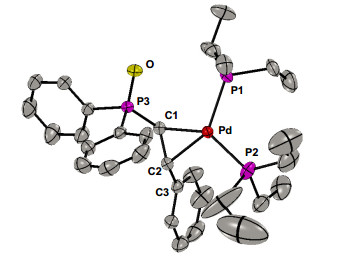
Thermal ellipsoids are drawn at 50% probability. H atoms are omitted for clarity. Selected bond lengths (Å) and angles (°): C(1)—C(2)=1.435(3), C(1)—Pd=2.106(2), C(2)—Pd=2.146(2), P(12)—Pd=2.3279(6), P(2)—Pd=2.3169(7), P(3)—C(1)=1.775(2); C(1)—Pd—C(2)=39.44(9), C(2)—C(1)—Pd=71.81(13), C(1)—Pd—P(1)=104.30(7), C(2)—Pd—P(2)=104.03(3), P(1)—Pd—P(2)=112.13(3)
This reaction seems to be a general method for synthesizing such kind of metal complexes. As shown in Table 1, alkenylphosphoryl compounds 1b~1e all could rapidly replace two PEt3 ligand in Pd(PEt3)4 at room temperature to produce the corresponding palladium complexes in high yields (Table 1, Entries 2~4). By using similar strategy, the nickel and platinum complexes 3f and 3g were also generated in 83% and 80% isolated yields, respectively (Table 1, Entries 5, 6).
Subsequently, the reactivity of these complexes was preliminarily studied as exemplified by complex 3e. It was found that 3e could react with acetic acid to release the alkenylphosphoryl compound 1e gradually (Eq. 1). The reaction proceeded very slowly at room temperature. As indicated from 1H NMR and 31P NMR spectroscopies, the ratio of 3e to 1e was 1:0.2 at 0.5 h, 1:0.26 at 4 h, and 1:0.6 at 20 h. Interestingly, under similar reaction conditions, a new product phosphonium 4 was deposited as a crystal (the lattice contains one molecule of HOAc and C6D6) by further addition of 2 equiv. of PEt3 (Eq. 2). Phosphonium 4 was considered to be generated by the reaction with HOAc, PEt3, and compound 1e released in situ. The hypothesis was further confirmed by a separated experiment: by mixing compound 1e, 2 equiv. of HOAc and 2 equiv. of PEt3 in C6D6 at room temperature, phosphonium 4 was generated in a quantitative yield (Eq. 3). The structure of phosphonium 4 was unambiguously determined by X-ray diffraction analysis (Figure 2). Worth noting is that the formation of phosphoniums from alkenes usually required transition metals or strong acids, [9] while HOAc, a weak acid, served well in the present reaction. The result would be ascribed to the special phosphoryl group in alkenes. This finding also provides a solid evidence for the phosphine-catalyzed transformations of alkenes.[10]
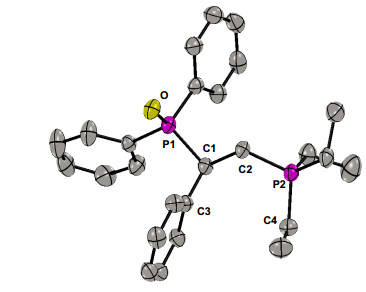
Thermal ellipsoids are drawn at 50% probability. H atoms, OAc-, HOAc and solvent C6D6 are all omitted for clarity. Selected bond lengths (Å) and angles (°): C(2)—P(2)=1.807(3), C(1)—C(2)=1.550(3), C(1)—P(1)=1.828(3), C(4)—P(2)=1.799(3), C(1)—C(3)=1.535(4), P(1)—O=1.489(2); P(1)—C(1)—C(2)=108.12(18), C(3)—C(1)—C(2)=113.8(2), C(1)—C(2)—P(2)=115.61(19), C(2)—P(2)—C(4)=107.26(13), O—P(1)—C(1)=113.69(12)
|
|
(1) |
|
|
(2) |
|
|
(3) |
Being similar to Pd(PEt3)4, complex 3d could also undergo hydropalladation with the combination of phenylacetylene and (EtO)2P(O)H, regioselectively producing the corresponding vinyl-Pd-phosphoryl complex 5 (Eq. 4). However, the reaction rate was rather slow. As reported, the hydropalladation with Pd(PEt3)4 would be complete in ca. 30 h, [8, 11] while the yield of the current reaction was only ca. 45% in 50 h. The results would be attributed to the strong coordination ability of alkenylphosphoryl compound, which hindered the interaction of phenylacetylene with palladium atom and thus decreased the rate of hydropalladation. Along this line, it would also be rational to deduce that alkenylphosphoryl compounds from the palladium-catalyzed hydrophosphorylation of alkynes with H-phosphonates might play a negative role in the hydropalladation step of the catalytic cycle.[5, 6, 8]
|
|
(4) |
A facile synthesis of group 10 metal complexes with alkenylphosphoryl compounds was reported. The alkene unit could be released by the aid of acetic acid. The preliminary studies on their reactivity also revealed that alkenylphosphoryl compounds might hinder the hydropalladation step in the palladium-catalyzed hydrophosphorylation of alkynes with H-phosphonates. The current work not only enriched the coordination chemistry of alkenes, but also promoted understanding to the related chemical reactions.
Reactions for the synthesis of metal intermediates were conducted in a glove box (O2 < 1.0×10⁻⁷, H2O < 1.0× 10⁻⁷). Dry solvents were obtained by purification according to standard methods. 1H NMR and 31P NMR spectra were acquired on a JEOL LA-400 spectrometer (400 MHz for 1H NMR, and 160 MHz for 31P NMR spectroscopy) or a JEOL LA-500 instrument (500 MHz for 1H NMR, and 202 MHz for 31P NMR spectroscopy) in deuterated solvents. Chemical shifts for 1H NMR are referred to internal Me4Si (δ 0). Data for 31P NMR were relative to H3PO4 (85% solution in D2O, δ 0). X-ray analysis was performed by the Analytical Center at the National Institute of Advanced Industrial Science and Technology, Japan. Complexes 3d and 3e are known, please refer to Ref. [8] for their characterized data.
In a glove box, 0.076 mmol of Pd(PEt3)4 and 0.076 mmol of PhCHCHP(O)Ph2 were dissolved in 0.5 mL of dry and degassed C6D6 in a NMR tube. The reaction was complete after standing the mixture at room temperature for 0.5 h as indicated from 1H NMR and 31P NMR spectra. Removal of the volatile (solvent, PEt3) in vacuum afforded a white solid. Recrystallization of the white solid from toluene and hexane at -30 ℃ gave analytically pure product 3a with isolated yield of 91%. Crystals suitable for X-ray crystallography was obtained from recrystallization of the white solid from hexane and toluene at -30 ℃. CCDC 1921746, Unit cell parameters (Å): a=10.0079(17), b=15.531(3), c=23.020(4), P-1. 1H NMR (500 MHz, C6D6) δ: 8.31~8.35 (m, 2H), 7.92~7.96 (m, 2H), 7.18 (d, J=8.5 Hz, 2H), 7.05~7.08 (m, 8H), 6.92 (t, J=7.0 Hz, 1H), 3.97~4.06 (m, 1H), 3.79~3.84 (m, 1H), 2.00~2.09 (m, 3H), 1.83~1.92 (m, 3H), 1.14~1.23 (m, 3H), 1.02~1.12 (m, 12H), 0.63 (dt, JH—H=7.5 Hz, JP—H=15.0 Hz, 9H); 31P NMR (202 MHz, C6D6) δ: 30.57 (dd, JP—P=11.0 Hz, 1P), 15.88 (t, 1P, JP—P=11.0 Hz), 11.10 (dd, JP—P=11.0 Hz, JP—P=11.0 Hz, 1P).
In a glove box, 0.068 mmol of Pd(PEt3)4 and 0.068 mmol of CH2CHP(O)Ph2 were dissolved in 0.5 mL of dry and degassed C6D6 in a NMR tube. The reaction was complete after standing the mixture at room temperature for 0.5 h as indicated from 1H NMR and 31P NMR spectra. Removal of the volatile (solvent, PEt3) afforded colorless oil 3b with isolated yield of 96%. 1H NMR (500 MHz, C6D6) δ: 8.39~8.43 (m, 2H), 7.84~7.88 (m, 2H), 7.22~7.25 (m, 2H), 7.18 (d, J=8.0 Hz, 1H), 7.03~7.06 (m, 3H), 3.34~3.42 (m, 1H), 2.66~2.77 (m, 1H), 2.23~2.31 (m, 1H), 1.95~2.04 (m, 3H), 1.81~1.90 (m, 3H), 1.27~1.37 (m, 6H), 1.04 (dt, J=7.5 Hz, JP—H=15.0 Hz, 9H), 0.80 (dt, J=7.5 Hz, JP—H=15.0 Hz, 9H); 31P NMR (202 MHz, C6D6) δ: 30.88 (dd, 1P, JP—P=10.1 Hz, JP—P=11.1 Hz), 14.40 (dd, JP—P=11.0 Hz, JP—P=18.4 Hz, 1P), 14.0 (dd, JP—P=11.5 Hz, JP—P=18.6 Hz, 1P).
In a glove box, 0.068 mmol of Pd(PEt3)4 and 0.068 mmol of CH2CHP(O)(OEt)2 were dissolved in 0.5 mL of dry and degassed C6D6 in a NMR tube. The reaction was complete after standing the mixture at room temperature for 0.5 h as indicated from 1H NMR and 31P NMR spectra. Removal of the volatile (solvent, PEt3) afforded colorless oil 3c with isolated yield of 95%. 1H NMR (500 MHz, C6D6) δ: 4.14~4.22 (m, 2H), 4.06~4.11 (m, 2H), 2.97~3.06 (m, 1H), 2.55~2.76 (m, 2H), 1.74~1.91 (m, 6H), 1.36~1.42 (m, 6H), 1.24 (t, J=7.0 Hz, 3H), 1.18 (t, J=7.0 Hz, 3H), 1.02 (td, J=7.5 Hz, JP—H=15.0 Hz, 9H), 0.91 (td, J=7.5 Hz, JP—H=15.0 Hz, 9H). 31P NMR (202 MHz, C6D6) δ: 30.70 (dd, JP—P=8.3 Hz, JP—P=9.7 Hz, 1P), 15.00 (dd, JP—P=7.3 Hz, JP—P=18.4 Hz, 1P), 13.25 (dd, JP—P=16.6 Hz, JP—P=16.2 Hz, 1P).
In a glove box, 0.05 mmol of Ni(COD)2 and 0.05 mmol of PhC(CH2)P(O)Ph2 were dissolved in 0.5 mL of dry and degassed C6D6 in a NMR tube, The reaction was complete after standing the mixture at room temperature for 0.5 h as indicated from 1H NMR and 31P NMR spectra. Removal of the volatile (solvent, PEt3) afforded a red solid. Crystallization of the red solid from the toluene and hexane system at -30 ℃ gave analytically pure product 3f with isolated yield of 83%. 1H NMR (400 MHz, C6D6) δ: 8.32~8.36 (m, 2H), 7.94~7.98 (m, 4H), 7.03~7.12 (m, 8H), 6.83 (t, J=6.4 Hz, 1H), 2.21~2.31 (m, 1H), 1.87~2.03 (m, 4H), 1.46~1.57 (m, 3H), 1.15~1.30 (m, 6H), 0.81 (dt, J=7.6 Hz, JP—H=13.6 Hz, 9H), 0.70 (dt, J=7.6 Hz, JP—H=14.0 Hz, 9H); 31P NMR (162 MHz, C6D6) δ: 33.94 (b, 1P), 20.71 (db, JP—P=26.2 Hz, 1P), 10.45 (db, JP—P=26.2 Hz, 1P).
In a glove box, 0.05 mmol of Pt(PEt3)4 and 0.05 mmol of PhC(CH2)P(O)Ph2 were dissolved in 0.5 mL of dry and degassed C6D6 in a NMR tube, The reaction was complete after standing the mixture at room temperature for 0.5 h as indicated from 1H NMR and 31P NMR spectra. Removal of the volatile (solvent, PEt3) afforded a white solid. Crystallization of the white solid from the toluene and hexane system at -30 ℃ gave analytically pure product 3g with isolated yield of 80%. 1H NMR (500 MHz, C6D6) δ: 8.37~8.41 (m, 2H), 7.94 (d, J=7.5 Hz, 2H), 7.85~7.89 (m, 2H), 6.99~7.13 (m, 8H), 6.78 (t, J=7.0 Hz, 1H), 2.42~2.50 (m, 1H), 2.09~2.19 (m, 3H), 1.91~2.01 (m, 1H), 1.74~1.84 (m, 3H), 1.32~1.47 (m, 6H), 0.77 (td, JH—H=7.5 Hz, JP—H=15.0 Hz, 9H), 0.68 (td, JH—H=7.5 Hz, JP—H=15 Hz, 9H); 31P NMR (202 MHz, C6D6) δ: 33.71 (ddt, JP—P=10.9 Hz, JP—P=14.7 Hz, JPt—P=58.8 Hz, 1P), 14.74 (ddt, JP—P=14.7 Hz, JP—P=36.6 Hz, JPt—P=1867.1 Hz, 1P), 12.03 (ddt, JP—P=10.9 Hz, JP—P=36.8 Hz, JPt—P=1716.2 Hz, 1P).
In a glove box, 0.05 mmol of 3e, 2 equiv. of HOAc and 2 equiv. of PEt3 were dissolved in 0.5 mL of dry and degassed C6D6 in a NMR tube. Phosphonium 4 was deposited gradually as single crystal suitable for X-ray crystallography when standing the mixture at room temperature, colorless solid, isolated yield 85%. CCDC 1921747, Unit cell parameters (Å): a=9.0172(4), b=25.1788(11), c=14.4272(6), P21/n. Three A alerts existed in the X-ray analysis data. One alert concerns the short length of one C—C bond in solvent C6D6 contained in the lattice, which might be ascribed to the large thermal motion. Other two alerts concern the short distance between two AcO- ions, which should be ascribed to the formation of hydrogen bond. These alerts do not affect the confirmation of molecular structure. 1H NMR (500 MHz, C6D6) δ: 16.19 (broad, 1H), 8.86~8.83 (m, 2H), 8.39~8.35 (m, 2H), 8.14 (d, J=8.0 Hz, 2H), 7.40~7.38 (m, 2H), 7.18~7.13 (m, 2H), 7.06~7.01 (m, 3H), 6.85 (t, J=8.0 Hz, 2H), 5.70~5.66 (m, 1H), 2.63~2.59 (m, 1H), 2.52~2.46 (m, 1H), 2.28 (s, 6H), 1.95~1.88 (m, 3H), 1.58~1.50 (m, 3H), 0.28~0.21 (m, 9H); 31P NMR (202 MHz, C6D6) δ: 42.07 (d, JP—P=47.9 Hz, 1P), 34.01 (d, JP—P=47.9 Hz, 1P).
Phosphonium 4 could also be prepared by mixing 1e, 2 equiv. of HOAc and 2 equiv. of PEt3 in C6D6 at room temperature. the NMR yield was quantitative.
Supporting Information Copies of 1H NMR and 31P NMR spectroscopies, and cif files of 3a and 4. The Supporting Information is available free of charge via the Internet at http://sioc-journal.cn/.
For selected book and reviews, see: (a) Lawrance, G. A. Introduction to Coordination Chemistry, Wiley, Chichester, UK, 2010.
(b) Burgess, J.; Steel, P. J. Coord. Chem. Rev. 2011, 255, 2094.
(c) Steobenau, E. J.; Jordan, R. F. J. Am. Chem. Soc. 2006, 128, 8162.
(d) Harvey, B. G.; Ernst, R. D. Eur. J. Inorg. Chem. 2017, 2017, 1205.
(e) Defieber, C.; Grutzmacher, H.; Carreira, E. M. Angew. Chem., Int. Ed. 2008, 47, 4482.
(f) Johnson, J. B.; Rovis, T. Angew. Chem., Int. Ed. 2008, 47, 840.
(g) Feng, X.; Du, H. Chin. J. Org. Chem. 2015, 35, 259(in Chinese).
(冯向青, 杜海峰, 有机化学, 2015, 35, 259.)
For selected reviews, see: (a) Dembitsky, V. M.; Quntar, A. A. A. A.; Haj-Yehia, A.; Srebnik, M. Mini-Rev. Org. Chem. 2005, 2, 91.
(b) Minami, T.; Motoyoshiya, J. Synthesis 1992, 333.
(c) Wang, H.-Q.; Liu, Z.-J. Chin. J. Org. Chem. 2003, 23, 321(in Chinese).
(王宏青, 刘钊杰, 有机化学, 2003, 23, 321.)
(a) Al-Quntar, A. A.-A.; Baum, O.; Reich, R.; Srebnik, M. Arch. Pharm. 2004, 337, 76.
(b) Liu, Z.; MacRitchie, N.; Pyne, S.; Pyne, N. J.; Bittman, R. Bioorg. Med. Chem. 2013, 21, 2503.
(c) Harnden, M. R.; Parkin, A.; Parratt, M. J.; Perkins, R. M. J. Med. Chem. 1993, 36, 1343.
(d) Tonelli, F.; Lim, K. G.; Loveridge, C.; Long, J.; Pitson, S. M.; Tigyi, G.; Bittman, R.; Pyne, S.; Pyne, N. J. Cell. Signalling 2010, 22, 1536.
(a) Kosolapoff, G. M. J. Am. Chem. Soc. 1948, 70, 1971.
(b) Mulla, K.; Aleshire, K. L.; Forster, P. M.; Kang, J. Y. J. Org. Chem. 2016, 81, 77 and references cited therein.
Han, L.-B.; Tanaka, M. J. Am. Chem. Soc. 1996, 118, 1571. http://www.researchgate.net/publication/231524991_Palladium-Catalyzed_Hydrophosphorylation_of_Alkynes_via_Oxidative_Addition_of_HP(O)(OR)2
(a) Coudray, L.; Montchamp, J.-L. Eur. J. Org. Chem. 2008, 3601.
(b) Delacroix, O.; Gaumont, A. C. Curr. Org. Chem. 2005, 9, 1851. (c) Xu, Q.; Han, L.-B. J. Organomet. Chem. 2011, 696, 130.
http://www.katayamakagaku.co.jp/products/chemicalproducts/flameretardant/index.html
Chen, T.; Zhao, C.-Q.; Han, L.-B. J. Am. Chem. Soc. 2018, 140, 3139. doi: 10.1021/jacs.8b00550
(a) Stewart, I. C.; Bergman, R. G.; Toste, F. D. J. Am. Chem. Soc. 2003, 125, 8696.
(b) Okuma, K.; Izaki, T. Bull. Chem. Soc. Jpn. 2005, 78, 1831.
(c) Kentaro, O., Koichiro, Y.; Toshiharu, I.; Keiko, Y.; Kosei, S. Bull. Chem. Soc. Jpn. 2007, 80, 1785.
(d) Arisawa, M.; Yamaguchi, M. J. Am. Chem. Soc. 2006, 128, 50.
(e) Arisawa, M.; Yamaguchi, M. In ACS Symposium Series, Ed.: Laali, K. K., American Chemical Society, Washington, DC, 2007, Vol. 965, Chapter 22, pp. 477~492.
For a review, see: Guo, H.; Fan, Y. C.; Sun, Z.; Wu, Y.; Kwon, O. Chem. Rev. 2018, 118, 10049.
Both electronic and steric factors affect the regioselectivity of hydropalladation, for details, please see Ref. [

Figure 1 ORTEP drawing of palladium complex 3a
Thermal ellipsoids are drawn at 50% probability. H atoms are omitted for clarity. Selected bond lengths (Å) and angles (°): C(1)—C(2)=1.435(3), C(1)—Pd=2.106(2), C(2)—Pd=2.146(2), P(12)—Pd=2.3279(6), P(2)—Pd=2.3169(7), P(3)—C(1)=1.775(2); C(1)—Pd—C(2)=39.44(9), C(2)—C(1)—Pd=71.81(13), C(1)—Pd—P(1)=104.30(7), C(2)—Pd—P(2)=104.03(3), P(1)—Pd—P(2)=112.13(3)

Figure 2 ORTEP drawing of phosphonium 4
Thermal ellipsoids are drawn at 50% probability. H atoms, OAc-, HOAc and solvent C6D6 are all omitted for clarity. Selected bond lengths (Å) and angles (°): C(2)—P(2)=1.807(3), C(1)—C(2)=1.550(3), C(1)—P(1)=1.828(3), C(4)—P(2)=1.799(3), C(1)—C(3)=1.535(4), P(1)—O=1.489(2); P(1)—C(1)—C(2)=108.12(18), C(3)—C(1)—C(2)=113.8(2), C(1)—C(2)—P(2)=115.61(19), C(2)—P(2)—C(4)=107.26(13), O—P(1)—C(1)=113.69(12)
Table 1. Synthesis of group 10 metal complexes ligated to alkenylphosphoryl compounds
| ||||
| Entry | 1 | 2 | 3 | Isolated yield/% |
| 1 | |
Pd(PEt3)4 | 3a | 91 |
| 2 | |
3b | 96 | |
| 3 | |
3c | 95 | |
| 4 | |
3d | 90 | |
| 5 | |
3e | 89 | |
| 6 | 1e | Ni(PEt3)4 | 3f | 83 |
| 7 | 1e | Pt(PEt3)4 | 3g | 80 |
 下载: 导出CSV

 扫一扫看文章


扫一扫关注我们


