Electrodeposited Sn-based Catalysts for CO2 Electroreduction
English
Electrodeposited Sn-based Catalysts for CO2 Electroreduction
-
The accelerating consumption of fossil fuels inevitably causes serious CO2 emissions all over the world, which brings out environmental and climate deterioration. At the same time, the proportion of renewable energy such as wind and solar energies has been increasing significantly among the energy resources[1, 2]. However, efficient technologies are urgently needed to store and convert the renewable energy due to their local and intermittent properties. Electrochemical CO2 reduction reaction (CO2RR) can produce chemicals and liquid fuels using renewable electricity input, which has been considered as a feasible avenue for simultaneous conversion of renewable energy and CO2[1–4].
In spite of continuous achievements in CO2RR, there are still some challenges on developing efficient catalysts to both accelerate the sluggish kinetics of CO2RR and inhibit the competitive hydrogen evolution reaction (HER) at industrial current densities[5]. At present, economic and technical analysis suggests that the production of valuable C1 chemicals such as formic acid and CO is the most economically practicable route for CO2RR[6]. Although some noble metal catalysts (e.g. Pd, Au and Ag) have shown considerable CO2RR performances[7, 8], it is more meaningful and practical to exploit non-noble metal catalysts with high faradaic efficiency, industrial current density and considerable stability at low overpotentials. Among the widely-investigated catalysts, Sn-based catalysts have been identified as the most promising one for catalyzing CO2RR to C1 products with high performance[9, 10].
The preparation method affects the composition and structure of Sn-based catalysts, and thereby determines the catalytic performance of CO2RR. Although electrodeposition technology has been applied to catalyst preparation for CO2RR in its infancy, it has been attracting much interest due to several advantages: (1) The composition and structure of catalysts can be facilely controlled by adjusting electrodeposition parameters such as electrolyte, current density, conductive substrate, deposition time and temperature, etc. (2) Gas diffusion electrode can be prepared in one step by electrodepositing metal or oxide catalysts on gas diffusion media like Cu foam or carbon paper without the use of organic binders, thus improving the catalyst utilization efficiency. (3) The fabrication process is simple, eco-friendly and easy to be scaled up for further practical applications of CO2RR[11, 12].
In this perspective, a brief survey of Sn-based catalysts including metal, alloy and their oxide for catalyzing CO2RR to produce C1 chemicals as well as catalytic mechanisms on their surfaces and interfaces are carried out[13–23]. The composition and structure of Sn-based catalysts can be conveniently controlled by the electrodeposition parameters, thus affecting the CO2RR performance. Further fundamental understanding and industrial applications of electrodeposited Sn-based catalysts in CO2 electrolyzer device are also discussed.
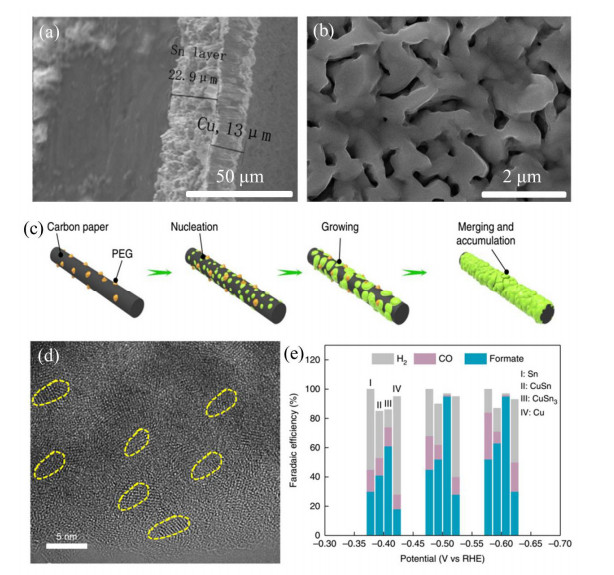
Electrodeposition is actually electrochemically reducing metal cations to their corresponding metal and alloy on conductive substrates in electrolyte solutions, which is the basis of electroplating, electroforming, electrolytic refining and metal electrolytic smelting[12]. Recently, electrodeposition technology has been explored as a useful method to prepare Sn-based catalysts for CO2RR. Wang et al.[13] electrodeposited various Sn films on Cu film in the 0.1 M SnCl2 and 0.4 M K4P2O7 aqueous electrolyte with adding 0.1 g·L‒1 sodium dodecyl benzene sulfonate, 0.2 g·L‒1 quinol, 0.5 g·L‒1 gelatin and 0.05 M tartaric acid as additives. The thickness of electrodeposited Sn films was affected by current density from 5 to 20 mA·cm‒2 for the constant time of 10 min. The thickness of Sn film reached 22.9 μm at 20 mA·cm‒2 (Fig. 1a). The electrodeposited Sn film showed the formate faradaic efficiency of 91.0% at ‒1.4 V vs. SCE. Wang et al.[14] utilized an electrodeposition method to prepare porous Sn film on 0.1 mm-thick Cu foil in the aqueous solution of 0.018 M SnCl2 and 0.05 M sodium citrate at the constant current of 2.4 mA for the deposition time of 5~35 min. The thickness of porous Sn films was influenced by the electrodeposition time. The porous Sn film with a thickness of 325 nm electrodeposited for 15 min demonstrated the maximum formate faradaic efficiency of 91.5% at ‒1.8 V vs. Ag/AgCl. Scanning electron microscopy (SEM) image of porous Sn film showed no change after CO2RR, indicative of a high stability (Fig. 1b). Shen et al.[15] synthesized the bimetallic Sn-Cu nanoparticles by a two-step electrodeposition process. Sn nanoparticles were firstly potentiostatically electrodeposited on Cu foil in the aqueous solution of 10 mM SnCl2 and 0.1 M KCl for 7 min at −0.6 V vs. Ag/AgCl, and then Cu species were electrodeposited on Sn nanoparticles in 10 mM CuCl2 and 0.1 M KCl solution to obtain bimetallic Sn-Cu nanoparticles. The Sn-Cu nanoparticles displayed a formate faradaic efficiency of 92.0% at ‒0.95 V vs. RHE in 0.1 M KHCO3 electrolyte and remained stable for 12 h. In situ Raman spectroscopy results and density functional theory (DFT) calculations indicate that the reaction pathway has a two-step course from CO2 to CO2•‒ and CO2•‒ to HCOO•. Cui et al.[16] coelectrodeposited CuSn3 alloy on carbon paper substrate in 0.01 M SnCl2, 0.01 M CuCl2, 0.06 M (NH4)2C2O4 and 50 ppm PEG2000 solution at –0.6 V vs. Ag/AgCl for 20 h (Fig. 1c). High-resolution transmission electron microscopy (HRTEM) image revealed some crystals in the amorphous CuSn3 alloy (Fig. 1d). CuSn3 alloy showed a current density of 33.0 mA·cm−2 with formate faradaic efficiency of 95.0% (Fig. 1e) at −0.50 V vs. RHE for 50 h. DFT calculations indicated that the alloying of Sn and Cu could facilitate formate production while suppress the competitive HER. In situ X-ray absorption spectroscopy (XAS) results suggested that the valence state of Sn species maintained positive in CuSn3 alloy during the CO2RR. Haruyama et al.[17] prepared Cu3Sn alloy on Cu substrates by electrodeposition in 0.04 M SnSO4, 0.16 M CuSO4, 0.05 M C6H14N2O7 and 0.5 M K4P2O7 solution at 3.2 mA·cm−2 for 5 min. Cu3Sn alloy displayed CO as a major product with faradaic efficiency above 35.0% at the potential between −0.69 V and −1.09 V vs. RHE. DFT calculations indicated that Cu sites had a more contribution to the stabilization of H*, CO* and COOH* than Sn sites in Cu3Sn (002).
Figure 1
Figure 1. (a) SEM image of the cross-section of Sn/Cu electrode deposited at 20 mA·cm–2. (b) SEM image of the Sn/Cu electrode after CO2RR at –1.8 V vs. Ag/AgCl. (c) Schematic of the preparation of Sn-Cu alloy. (d) High-resolution transmission electron microscopy (HRTEM) image of CuSn3 electrode. (e) Potential-dependent faradaic efficiency of Sn, CuSn, CuSn3 and Cu electrodes for CO2RR. Reproduced from references [13, 14] and [16]In contrast to mild current density and applied potential in the above electrodeposition process, there is an alternative electrodeposition route that requires a high current density or applied potential to generate hydrogen bubbles as a dynamic template. Generally, proton in aqueous solution can be electroreduced to hydrogen gas at high overpotentials. The formed hydrogen bubbles are able to exclude the grown deposits as dynamic hydrogen bubble template (DHBT) during electrodeposition[12]. DHBT-assistant electrodeposition technology can efficiently acquire a porous or dendritic morphology without extra additive templates, enhancing the specific surface area of catalysts. Woo et al.[18] prepared dendritic Sn catalysts on Sn foil by electrodeposition in 0.05 M SnCl2 and 1 M HCl solution at −2.0 V vs. SCE for 60 s and then heat treated at 180 oC for 3 h in air. The heat-treated Sn catalysts presented a formate yield of 228.6 μmol·h−1·cm−2 at −1.36 V vs. RHE for 18 h. SEM image of the heat-treated Sn catalyst displayed that the catalyst maintained its morphology after CO2RR (Fig. 2a). Cheng et al.[19] employed a two-step electrodeposition to fabricate the spiky Cu@Sn nanocones on Cu foam. Firstly, the Cu nanocones were electrodeposited on Cu foam in 0.03 M CuSO4, 0.0024 M NiSO4, 0.05 M Na3C6H5O7, 0.24 M NaH2PO2, 0.5 M H3BO3 and 6 g·L−1 polyethylene glycol solution at −1.12 V vs. Ag/AgCl at 75 oC for 20 min and then immersed in 0.1 M H2SO4 to remove Ni species. Secondly, Sn was electrodeposited in 0.05 M SnSO4, 2 M NaOH and 0.1 M Na3C6H5O7 on Cu nanocones at 3.3 mA·cm−2 for 2100 s to prepare spiky Cu@Sn nanocones (Fig. 2b). These nanocones showed a formate faradaic efficiency of 90.4% and current density of 57.7 mA·cm−2 at ‒1.1 V vs. RHE. The high performance is ascribed to the three-dimensional (3D) porous structure with conical characters that favored the growth of active sites and accelerated mass transfer. Qiao et al.[20] also electrodeposited 3D porous Cu@Sn electrodes in two steps. Porous Cu was electrodeposited on Cu foil using DHBT in 0.2 M CuSO4 and 0.7 M H2SO4 solution at 1.0 A·cm−2 for 10 s. Then Sn was coated on the Cu electrode in 0.6 M SnCl2, 0.03 mM C18H29NaO3S and 0.15 M Na3C6H5O7 solution at 20 mA·cm−2 for 1 min to prepare 3D porous Cu@Sn (Fig. 2c). The 3D porous Cu@Sn electrode reached a formate faradaic efficiency close to 100% and current density of 16.5 mA·cm−2 at −0.93 V vs. RHE for 15 h. Wang et al.[21] fabricated A-Cu/SnO2 catalyst by an electrodeposition-annealing-electroreduction method. Firstly, Cu foam was electrodeposited on the surface of Cu foil with DHBT in 0.2 M CuSO4 and 1.5 M H2SO4 solution at 3.0 A·cm−2 for 15 s. Secondly, SnO2 was deposited in 0.02 M SnCl4, 0.075 M HNO3 and 0.1 M NaNO3 solution on Cu foam at −0.3 V vs. SCE for 30 min, followed by annealing at 200 oC in air for 6 h. Finally, the as-prepared electrode was electrochemically reduced in 0.1 M KHCO3 solution at −0.5 V vs. RHE for 1 h to acquire A-Cu/SnO2 catalyst (Fig. 2d). The A-Cu/SnO2 catalyst exhibited a CO faradaic efficiency of ~75.0% with the suppression of formate production and HER at −1.0 V vs. RHE for 10 h.
Even though the above Sn-based catalysts prepared by electrodeposition technology have a favorable formate faradaic efficiency, they are still limited by inferior mass activity. In order to obtain synergistic effects on Sn-Cu alloy, Ye et al.[22] presented a strategy to improve CO2RR mass activity through a decorated electrodeposition method. Sn-Cu alloy showed partial mass activity and current density of 1490.6±7.5 mA·mg−1 and 79.0±0.4 mA·cm−2 with a faradaic efficiency of 82.3±2.1% towards formate production at −1.14 V vs. RHE. DFT calculations manifested that Sn-Cu alloy was able to selectively facilitate CO2RR to formate by producing a key intermediate of HCOO* and suppress the competitive HER.
In order to further improve the Sn-based catalysts with higher C1 faradaic efficiency, current density and stability for CO2RR at low potentials, the rational preparation approach should be urgently designed. Ye et al.[23] demonstrated a 3D hierarchical Sn-Cu catalyst via co-electrodeposition with DHBT (Fig. 3a). It had a thin amorphous SnOx shell and metallic hierarchical Sn-Cu core (Fig. 3b). In situ XAS and ex situ structural characterizations revealed that the outer shell could regenerate in situ Sn/SnOx interfaces during the CO2RR due to sufficient Sn species in the core (Fig. 3c). The regenerative Sn2.7Cu catalyst showed the optimal CO2RR performance (Fig. 3d and e), achieving a C1 faradaic efficiency of 98.0±0.9% with 406.7±14.4 mA·cm–2 (Fig. 3d) at –0.70 V vs. RHE, as well as high stability. DFT calculations indicated that regenerative Sn/SnOx interfaces suppressed the competitive HER and promoted CO2RR to formate with the optimal binding for HCOO* intermediate, leading to a high performance of CO2RR.
Figure 2
Figure 2. (a) Field-emission scanning electron microscopy (FESEM) image of the heat-treated Sn electrode after CO2RR. (b) SEM image of Cu@Sn nanocones. (c) Schematic of the preparation of Cu@Sn for CO2RR. (d) Schematic of the preparation of Cu/SnO2and A-Cu/SnO2. Reproduced from references [18, 19, 20] and [21]In summary, various electrodeposited Sn-based catalysts have been investigated to catalyze the CO2RR and shown promising practical applications. Alloying Sn with Cu is an efficient strategy to decrease the reaction barrier, and thus obtain a low overpotential and high mass activity of CO2RR. The Sn-enriched hierarchical Sn-Cu core drives the in situ reconstruction of SnOx shell to Sn/SnOx interface during the CO2RR. The binding of HCOO* intermediate is optimized over the Sn/SnOx interface, which promotes the formate production with high faradaic efficiency, industrial current density and considerable stability at low overpotentials. However, some challenges still remain in fundamental and application aspects. Although the in situ XAS results show that the SnOx is highly reduced and Sn species keep a positive valence state during the CO2RR, the oxidation state of Sn species needs to be accurately determined for providing more deep insights into the active site structure and reaction mechanism. Mössbauer spectroscopy is a powerful and unique technique to monitor the dynamic evolution of oxidation state of all Sn species during the CO2RR[24]. Developing in situ/operando Mössbauer spectroscopy technique is vitally important to investigate the relationship between the coordination structural features of Sn species in the catalysts and CO2RR performance, thus identifying the active site. The combination of in situ/operando spectroscopy techniques and DFT calculations would help to clarify the CO2RR mechanisms and guide rational design of more efficient Sn-based catalysts. For future industrial applications, CO2 electrolyzer device needs to simultaneously meet the requirements of high current density, energy efficiency and stability. Developing polymer electrolyte membranebased CO2 electrolyzer device is considered to be a feasible strategy for further practical applications due to its low resistance and highly compact structure[25]. Many efforts should be devoted to optimizing the gas diffusion electrode and membrane assembly for obtaining abundant and robust electrochemical interfaces as well as facilitating the mass transport of reactants and products for industrial applications of CO2RR.
Figure 3
Figure 3. (a) Schematic of the preparation of 3D hierarchical Sn-Cu catalyst. HRTEM images of the Sn2.7Cu gas diffusion electrode (GDE) before (b) and after CO2RR (c) in flow cell. Geometrical total current density (d) and potential-dependent faradaic efficiency (e) on Sn, Sn2.7Cu, SnCu1.1 and SnCu4.0 GDEs in flow cell. Reproduced from reference [23]
-
-
[1]
Dinh, C. T.; Burdyny, T.; Kibria, M. G.; Seifitokaldani, A.; Gabardo, C. M.; Arquer, F. P. G.; Kiani, A.; Edwards, J. P.; Luna, P. D.; Bushuyev, O. S.; Zou, C.; Quintero-Bermudez, R.; Pang, Y.; Sinton, D.; Sargent, E. H. CO2 electroreduction to ethylene via hydroxide-mediated copper catalysis at an abrupt interface. Science 2018, 360, 783–787. doi: 10.1126/science.aas9100
-
[2]
Gu, J.; Hsu, C. S.; Bai, L.; Chen, H. M.; Hu, X. Atomically dispersed Fe3+ sites catalyze efficient CO2 electroreduction to CO. Science 2019, 364, 1091–1094. doi: 10.1126/science.aaw7515
-
[3]
Wang, X.; Araújo, J. F.; Ju, W.; Bagger, A.; Schmies, H.; Kühl, S.; Rossmeisl, J.; Strasser, P. Mechanistic reaction pathways of enhanced ethylene yields during electroreduction of CO2–CO co-feeds on Cu and Cu-tandem electrocatalysts. Nat. Nanotechnol. 2019, 14, 1063–1070. doi: 10.1038/s41565-019-0551-6
-
[4]
Ross, M. B.; Luna, P. D.; Li, Y.; Dinh, C. T.; Kim, D.; Yang, P.; Sargent , E. H. Designing materials for electrochemical carbon dioxide recycling. Nat. Catal. 2019, 2, 648–658. doi: 10.1038/s41929-019-0306-7
-
[5]
Gong, Q.; Ding, P.; Xu, M.; Zhu, X.; Wang, M.; Deng, J.; Ma, Q.; Han, N.; Zhu, Y.; Lu, J.; Feng, Z.; Li, Y.; Zhou, W.; Li, Y. Structural defects on converted bismuth oxide nanotubes enable highly active electrocatalysis of carbon dioxide reduction. Nat. Commun. 2019, 10, 2807. doi: 10.1038/s41467-019-10819-4
-
[6]
Choi, Y. W.; Scholten, F.; Sinev, I.; Cuenya, B. R. Enhanced stability and CO/formate selectivity of plasma-treated SnOx/AgOx catalysts during CO2 electroreduction. J. Am. Chem. Soc. 2019, 141, 5261−5266. doi: 10.1021/jacs.8b12766
-
[7]
Bai, X.; Chen, W.; Zhao, C.; Li, S.; Song, Y.; Ge, R.; Wei, W.; Sun, Y. Exclusive formation of formic acid from CO2 electroreduction by a tunable Pd-Sn alloy. Angew. Chem. Int. Ed. 2017, 56, 12219−12223. doi: 10.1002/anie.201707098
-
[8]
Gao, D.; Zhang, Y.; Zhou, Z.; Cai, F.; Zhao, X.; Huang, W.; Li, Y.; Zhu, J.; Liu, P.; Yang, F.; Wang, G.; Bao, X. Enhancing CO2 electroreduction with the metal-oxide interface. J. Am. Chem. Soc. 2017, 139, 5652−5655. doi: 10.1021/jacs.7b00102
-
[9]
Deng, W.; Zhang, L.; Li, L.; Chen, S.; Hu, C.; Zhao, Z. J.; Wang, T.; Gong, J. Crucial role of surface hydroxyls on the activity and stability in electrochemical CO2 reduction. J. Am. Chem. Soc. 2019, 141, 2911−2915. doi: 10.1021/jacs.8b13786
-
[10]
Luc, W.; Collins, C.; Wang, S.; Xin, H.; He, K.; Kang, Y.; Jiao, F. Ag-Sn bimetallic catalyst with a core-shell structure for CO2 reduction. J. Am. Chem. Soc. 2017, 139, 1885−1893. doi: 10.1021/jacs.6b10435
-
[11]
Li, Q.; Rao, X.; Sheng, J.; Xu, J.; Yi, J.; Liu, Y.; Zhang, J. Energy storage through CO2 electroreduction: a brief review of advanced Sn-based electrocatalysts and electrodes. J. CO2 Util. 2018, 27, 48–59. doi: 10.1016/j.jcou.2018.07.004
-
[12]
Plowman, B. J.; Jones, L. A.; Bhargava, S. K. Building with bubbles: the formation of high surface area honeycomb-like films via hydrogen bubble templated electrodeposition. Chem. Commun. 2015, 51, 4331–4346. doi: 10.1039/C4CC06638C
-
[13]
Zhao, C.; Wang, J. Electrochemical reduction of CO2 to formate in aqueous solution using electro-deposited Sn catalysts. Chem. Eng. J. 2016, 293, 161–170. doi: 10.1016/j.cej.2016.02.084
-
[14]
Lv, W.; Zhou, J.; Kong, F.; Fang, H.; Wang, W. Porous tin-based film deposited on copper foil for electrochemical reduction of carbon dioxide to formate. Int. J. Hydrogen Energy 2016, 41, 1585–1591. doi: 10.1016/j.ijhydene.2015.11.100
-
[15]
Jiang, X.; Wang, X.; Liu, Z.; Wang, Q.; Xiao, X.; Pan, H.; Li, M.; Wang, J.; Shao, Y.; Peng, Z.; Shen, Y.; Wang, M. A highly selective tin-copper bimetallic electrocatalyst for the electrochemical reduction of aqueous CO2 to formate. Appl. Catal. B: Environ. 2019, 259, 118040. doi: 10.1016/j.apcatb.2019.118040
-
[16]
Zheng , X.; Ji, Y.; Tang, J.; Wang, J.; Liu, B.; Steinrück, H. G.; Lim, K.; Li, Y.; Toney, M. F.; Chan, K.; Cui, Y. Theory-guided Sn/Cu alloying for efficient CO2 electroreduction at low overpotentials. Nat. Catal. 2019, 2, 55–61.
-
[17]
Morimoto, M.; Takatsuji, Y.; Iikubo, S.; Kawano, S.; Sakakura, T.; Haruyama, T. Experimental and theoretical elucidation of electrochemical CO2 reduction on an electrodeposited Cu3Sn alloy. J. Phys. Chem. C 2019, 123, 3004−3010. doi: 10.1021/acs.jpcc.8b11431
-
[18]
Won, D. H.; Choi, C. H.; Chung, J.; Chung, M. W.; Kim, E. H.; Woo, S. I. Rational design of a hierarchical tin dendrite electrode for efficient electrochemical reduction of CO2. ChemSusChem. 2015, 8, 3092−3098. doi: 10.1002/cssc.201500694
-
[19]
Chen, C.; Pang, Y.; Zhang, F.; Zhong, J.; Zhang, B.; Cheng, Z. Sharp Cu@Sn nanocones on Cu foam for highly selective and efficient electrochemical reduction of CO2 to formate. J. Mater. Chem. A 2018, 6, 19621–19630. doi: 10.1039/C8TA06826G
-
[20]
Hou, X.; Cai, Y.; Zhang, D.; Li, L.; Zhang, X.; Zhu, Z.; Peng, L.; Liu, Y.; Qiao, J. 3D core-shell porous-structured Cu@Sn hybrid electrodes with unprecedented selective CO2-intoformate electroreduction achieving 100%. J. Mater. Chem. A 2019, 7, 3197–3205. doi: 10.1039/C8TA10650A
-
[21]
Li, Q.; Li, M.; Zhang, S.; Liu, X.; Zhu, X.; Ge, Q.; Wang, H. Tuning Sn-Cu catalysis for electrochemical reduction of CO2 on partially reduced oxides SnOx-CuOx-modified Cu electrodes. Catalysts 2019, 9, 476. doi: 10.3390/catal9050476
-
[22]
Ye, K.; Cao, A.; Shao, J.; Wang, G.; Si, R.; Ta, N.; Xiao, J.; Wang, G. Synergy effects on Sn-Cu alloy catalyst for efficient CO2 electroreduction to formate with high mass activity. Sci. Bull. 2020, https://doi.org/10.1016/j.scib.2020.01.020. doi: 10.1016/j.scib.2020.01.020
-
[23]
Ye, K.; Zhou, Z.; Shao, J.; Lin, L.; Gao, D.; Ta, N.; Si, R.; Wang, G.; Bao, X. In situ reconstruction of a hierarchical Sn-Cu/SnOx core/shell catalyst for high-performance CO2 electroreduction. Angew. Chem. Int. Ed. 2020, https://doi.org/10.1002/anie.201916538. doi: 10.1002/anie.201916538
-
[24]
Li, X.; Zhu, K.; Pang, J.; Tian, M.; Liu, J.; Rykov, A. I.; Zheng, M.; Wang, X.; Zhu, X.; Huang, Y.; Liu, B.; Wang, J.; Yang, W.; Zhang, T. Unique role of Mössbauer spectroscopy in assessing structural features of heterogeneous catalysts. Appl. Catal. B: Environ. 2018, 224, 518–532. doi: 10.1016/j.apcatb.2017.11.004
-
[25]
Yin, Z.; Peng, H.; Wei, X.; Zhou, H.; Gong, J.; Huai, M.; Xiao, L.; Wang, G.; Lu, J.; Zhuang, L. An alkaline polymer electrolyte CO2 electrolyzer operated with pure water. Energy Environ. Sci. 2019, 12, 2455–2462. doi: 10.1039/C9EE01204D

-
[1]
-
Figure 1 (a) SEM image of the cross-section of Sn/Cu electrode deposited at 20 mA·cm–2. (b) SEM image of the Sn/Cu electrode after CO2RR at –1.8 V vs. Ag/AgCl. (c) Schematic of the preparation of Sn-Cu alloy. (d) High-resolution transmission electron microscopy (HRTEM) image of CuSn3 electrode. (e) Potential-dependent faradaic efficiency of Sn, CuSn, CuSn3 and Cu electrodes for CO2RR. Reproduced from references [13, 14] and [16]
Figure 2 (a) Field-emission scanning electron microscopy (FESEM) image of the heat-treated Sn electrode after CO2RR. (b) SEM image of Cu@Sn nanocones. (c) Schematic of the preparation of Cu@Sn for CO2RR. (d) Schematic of the preparation of Cu/SnO2and A-Cu/SnO2. Reproduced from references [18, 19, 20] and [21]
Figure 3 (a) Schematic of the preparation of 3D hierarchical Sn-Cu catalyst. HRTEM images of the Sn2.7Cu gas diffusion electrode (GDE) before (b) and after CO2RR (c) in flow cell. Geometrical total current density (d) and potential-dependent faradaic efficiency (e) on Sn, Sn2.7Cu, SnCu1.1 and SnCu4.0 GDEs in flow cell. Reproduced from reference [23]
-
扫一扫看文章
计量
- PDF下载量: 5
- 文章访问数: 1804
- HTML全文浏览量: 158

DownLoad:
下载: