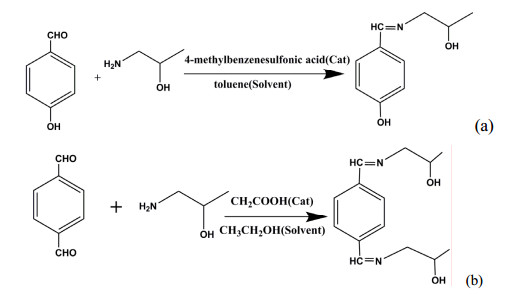
Scheme 1.
Syntheses routes of 4-(((2-hydroxypropyl)imino)methyl)phenol (a) and 1, 1΄-((1, 4-phenylenebis(methanylylidene))bis(azanylylidene))bis(propan-2-ol) (b)

Characterization and Infrared Stealthy Properties of Two Schiff-base Compounds Derived from 1-Amino-2-hydroxypropane and Their Complexes
Hui-Liang WEN , Bo-Wen LAI , Hua-Long PENG , Zhi-Qiang XIONG , Chong-Bo LIU


Crystal engineering has matured into a paradigm for the preparation or synthesis of new supramolecular compounds[1-3]. Crystal engineered materials can be exploited for many purposes such as hostguest compounds, biomedical materials, inorganic nonlinear optical materials, organic conductors, or coordination polymers[4-8]. Schiff bases are well known not only for their pharmacological properties[9], but also for their thermochromism and photochromism[10, 11], especially for infrared stealthy and electromagnetic wave absorption performance in the solid state[12, 13]. And interests in Schiff base compounds have grown recently, as a result of research indicating that their rich functional properties, such as antitumor, antibacterial activities, catalytic activity and electromagnetic wave absorption performances, can be significantly improved by coordinating to a metal ion[12-18]. Schiff base ligands with heterocyclic groups[19, 20] or hydroxyl[21, 22] or carboxyl groups[23-25], owning much more coordination sites, play an important role in the development of coordination chemistry as they readily form complexes with most of the transition metal ions[16], even with lanthanide ions[17].
In general, a detailed understanding of the supramolecular chemistry of functional groups is a prerequisite for the rational design of supramolecular synthons. The key to understand and design supramolecular structure lies in supramolecular synthons. Supramolecular synthons exist in two distinct categories: supramolecular homosynthons which are composed of identical complementary functional groups, also referred to as self-association motifs, for example, carboxylic acid dimers[26], amide dimers[27] and hydroxyl groups dimmers[28]; and supramolecular heterosynthons consisting of different but complementary functional groups like acid-aromatic nitrogen[29], acid-amide[30], hydroxylaromatic nitrogen[31], and so on. Schiff base ligands with heterocyclic group[9] or hydroxyl or carboxyl groups[32, 33], owning much more hydrogen bonding receptor and donors, have much more chances to form supramolecular synthons so as to further form high-dimensional supramolecular structures.
The lone-pair electrons on C=N group and the conjugated structures of Schiff base compounds make Schiff base compounds own relatively lower infrared emissivity[34]. According to Hugan-Rubens approximate theory[35], R≈1–(8εω/σ)1/2, where R is reflectivity, ε is dielectric constant, ω is frequency, and σ is conductivity, it could be deduced that infrared emissivity is inversely related to the conductivity, and the introduction of metal ions to Schiff base compounds would help to increase their conductivities. Schiff base coordination polymers would get lower infrared emissivity and higher infrared stealth properties[36]. Lv et al. synthesized a series of Schiff bases and their coatings. The infrared emissivity of Schiff base coatings at the wavelength of 8~14 µm was measured with the minimum one to be 0.63[37]. Hu et al. synthesized three Schiff base compounds and their iron complexes, and their electrical conductivity and infrared emissivity are tested, with the lowest infrared emissivity reaching 0.628[36].
Herein we report the syntheses (the reaction sequence is outlined in Scheme 1) and structural characterization of two new Schiff base compounds derived from 1-amino-2-hydroxypropane, and discuss the hydrogen bond interactions in them; furthermore, the infrared stealthy performance of two Schiff base compounds and their Fe(Ⅲ) complexes was tested.
All reagents were commercially available and used without further purification. Melting points were determined on a Micromelting point apparatus without correction. Elemental analyses of C, H and N were carried out with an Elementar Vario EL analyzer. Infrared spectra were recorded with a Nicolet Avatar 360 FT-IR spectrometer using the KBr pellet technique.
As shown in Scheme 1a, 10 mmol (1.22 g) 4-hydroxybenzaldehyde, 10 mmol (0.75 g) 1-amino2-hydroxypropane, and 20 mL toluene of solvent were put in a clean 100 mL three-necked flask, and a small amount of 4-methylbenzenesulfonic acid (P-TsOH) and anhydrous MgSO4 was added in turn, then stirred and refluxed at 140 ℃ for 18 h, followed by hot filtration. The solvent of the filtrate was removed under reduced pressure with a rotary evaporator, which led to yellow powder. Yellow crystals suitable for X-ray structure determination were achieved through recrystallization with anhydrous ethanol/dichloromethane (volume ratio 1:1). Yield: 36.5%, melt point: 140~142 ℃. Anal. Calcd. (%) for C7H10NO: C, 67.71; H, 8.11; N, 11.27. Found (%): C, 67.41; H, 8.51; N, 11.02. IR (KBr pellet, cm-1): 3219 s, 2961 w, 2933 w, 1569 m, 1423 m, 1380 m, 1189 m, 1098 m, 956 w, 846 m, 768 m, 683 w.
As shown in Scheme 1b, a mixture of 10 mmol (1.34 g) terephthalaldehyde, 10 mmol (0.75 g) 1-amino-2-hydroxypropane and 20 mL ethanol of solvent was put in a clean three-necked flask (100 mL), and a small amount of acetic acid and anhydrous MgSO4 was added in turn, then stirred and refluxed at room temperature for 18 h. After filtration, the solvent of the filtrate was removed under reduced pressure with a rotary evaporator, leading to yellow powder. Yellow crystals suitable for X-ray structure determination were achieved through recrystallization with anhydrous ethanol. Yield: 27.5%, melt point: 55~58 ℃. Anal. Calcd. (%) for C10H13NO2: C, 67.02; H, 7.31; N, 7.82. Found (%): C, 66.72; H, 7.71; N, 7.52. IR (KBr pellet, cm-1): 3401 s, 3112 m, 2907 m, 1560 m, 1445 m, 1197 m, 1135 w, 1084 m, 980 w, 870 s, 785 m, 698 w, 622 w.
C1: A mixture of FeCl3 (0.016 g, 0.1 mmol), compound 1 (0.019 g, 0.1 mmol), NaOH (0.15 mL, 0.65 M) and EtOH (10 mL) was heated 60 ℃ for 12 h. Dark brown powders were obtained by filtration and washed with ethanol for several times. Yield: 43.5%. IR data (KBr pellet, ν/cm-1): 3409 s, 1578 s, 1495 m, 1413 s, 1337 s, 1207 w, 1023 m, 957 w, 918 w, 829 m, 761 m.
C2: The FeCl3 (0.016 g, 0.1 mmol), compound 2 (0.025 g, 0.1 mmol), NaOH (0.15 mL, 0.65 M) and EtOH (10 mL) were heated 80 ℃ for 12 h. Dark brown powders were obtained by filtration and washed with ethanol for several times. Yield: 51.7%. IR data (KBr pellet, ν/cm-1): 3424 s, 1573 s, 1487 m, 1426 s, 1342 s, 1241 w, 1044 m, 962 w, 934 w, 841 m, 773 m.
1 smears: phenol formaldehyde resin (1 g), polyethylene glycol (0.075 g) and compound 1 (0.5 g) were respectively dispersed in ethanol (10 mL) followed by magnetic stirring for 30 min. After a part of ethanol was volatilized, a viscous product was uniformly covered on the pre-cleaned aluminum substrate, then dried at room temperature for 24 h. 2, C1 and C2 smears were prepared similarly to 1 smears, except that compound 2, C1 and C2 take place of compound 1 respectively.
The X-ray single-crystal data of compounds 1 and 2 were recorded on a Bruker APEX Ⅱ area detector diffractometer equipped with a graphite-monochromatic MoKα radiation (λ = 0.71073 Å) at 296(2) K. Semi-empirical absorption corrections were applied to the title compounds using the SADABS program[38]. The structures were solved by direct methods[39] and refined by full-matrix least-squares on F2 using SHELXL-97[40]. All non-hydrogen atoms were refined anisotropically. The hydroxyl hydrogen atom was located from difference Fourier maps, and the other hydrogen atoms were placed in the geometrically calculated positions. For 1, a yellow crystal with dimensions of 0.23mm × 0.22mm × 0.18mm was selected for X-ray analyses and a total of 2593 reflections were collected with 1721 unique ones (Rint = 0.0166) in the range of 2.79≤θ≤25.48º. The final R = 0.0328, wR = 0.0738 (w = 1/[σ2(Fo2) + (0.0294P)2 + 0.0587P], where P = (Fo2 + 2Fc2)/3) for 1511 observed reflections with I > 2σ(I)), S = 1.005, (Δ/σ)max = 0.000, (Δρ)max = 0.097 and (Δρ)min = –0.122 e/Å3. For 2, a yellow crystal (0.21mm × 0.20mm × 0.18mm) was selected for X-ray analyses and a total of 9458 reflections were collected with 1307 unique ones (Rint = 0.0971) in the range of 2.67≤θ≤25.49º. The final R = 0.0871, wR = 0.1748 (w = 1/[σ2(Fo2) + (0.0340P)2 + 2.9941P], where P = (Fo2 + 2Fc2)/3) for 775 observed reflections with I > 2σ(I)), S = 1.125, (Δ/σ)max = 0.000, (Δρ)max = 0.180 and (Δρ)min = –0.192 e/Å3. And the selected bond lengths and bond angles are given in Table 1. The hydrogen bond lengths and bond angles are listed in Table 2.

 DownLoad:
CSV
DownLoad:
CSV
| Compound 1 | |||||||
| Bond | Dist. | Bond | Dist. | Bond | Dist. | ||
| C(1)–C(2) | 1.385(3) | C(1)–C(6) | 1.394(2) | C(1)–O(1) | 1.349(2) | ||
| C(2)–C(3) | 1.371(3) | C(3)–C(4) | 1.397(2) | C(4)–C(5) | 1.397(3) | ||
| C(4)–C(7) | 1.452(2) | C(5)–C(6) | 1.365(3) | C(7)–N(1) | 1.264(2) | ||
| C(8)–C(9) | 1.519(3) | C(8)–N(1) | 1.456(2) | C(9)–C(10) | 1.508(2) | ||
| C(9)–O(2) | 1.423(2) | ||||||
| Angle | (°) | Angle | (°) | Angle | (°) | ||
| O(1)–C(1)–C(2) | 123.30(17) | O(1)–C(1)–C(6) | 117.92(17) | C(2)–C(1)–C(6) | 118.78(18) | ||
| C(3)–C(2)–C(1) | 120.32(17) | C(2)–C(3)–C(4) | 121.51(18) | C(5)–C(4)–C(3)) | 117.47(17) | ||
| C(5)–C(4)–C(7) | 122.93(16) | C(3)–C(4)–C(7) | 119.59(16) | C(6)–C(5)–C(4) | 121.12(17) | ||
| C(5)–C(6)–C(1) | 120.79(17) | N(1)–C(7)–C(4) | 125.28(17) | N(1)–C(8)–C(9) | 110.85(14) | ||
| O(2)–C(9)–C(10) | 111.74(15) | O(2)–C(9)–C(8) | 110.18(14) | C(10)–C(9)–C(8) | 111.95(16) | ||
| C(7)–N(1)–C(8) | 118.64(15) | ||||||
| Compound 2 | |||||||
| Bond | Dist. | Bond | Dist. | Bond | Dist. | ||
| C(1)–C(2) | 1.506(6) | C(2)–C(3) | 1.514(6) | C(2)–O(1) | 1.419(5) | ||
| C(3)–N(1) | 1.442(5) | C(4)–C(5) | 1.449(6) | C(4)–N(1) | 1.252(5) | ||
| C(5)–C(6) | 1.393(6) | C(5)–C(7) | 1.378(5) | C(6)–C(7)#1 | 1.373(6) | ||
| C(7)–C(6)#1 | 1.373(6) | ||||||
| Angle | (°) | Angle | (°) | Angle | (°) | ||
| O(1)–C(2)–C(1) | 109.9(4) | O(1)–C(2)–C(3) | 108.8(4) | C(1)–C(2)–C(3) | 111.6(4) | ||
| N(1)–C(3)–C(2) | 111.4(4) | N(1)–C(4)–C(5) | 124.9(4) | C(6)–C(5)–C(4)) | 122.9(4) | ||
| C(7)–C(5)–C(4) | 119.5(4) | C(7)–C(5)–C(6) | 117.6(4) | C(7)#1–C(6)–C(5) | 120.5(4) | ||
| C(6)#1–C(7)–C(5) | 121.9(4) | C(4)–N(1)–C(3) | 119.8(4) | ||||
| Symmetry operation for 2: #1: –x+2, –y+1, –z | |||||||
DownLoad:
CSV
| Compound | D–H∙∙∙A | d(D–H) | d(H∙∙∙A) | d(D∙∙∙A) | < (DHA) |
| O(1)–H(1)∙∙∙O(2)#1 | 0.78 | 1.87 | 2.644(2) | 179.1 | |
| O(2)–H(2A)∙∙∙N(1)#2 | 0.82 | 2.00 | 2.807(2) | 169.4 | |
| 1 | C(10)–H(10A)∙∙∙O(1)#3 | 0.96 | 2.58 | 3.398(4) | 142.4 |
| C(4)–H(4)∙∙∙O(2) #1 | 0.93 | 2.84 | 3.449(3) | 124.1 | |
| C(8)–H(8B)∙∙∙O(1) #4 | 0.97 | 2.70 | 3.663(3) | 171.0 | |
| C(1)–H(1)∙∙∙O(2) #5 | 0.93 | 2.74 | 3.537(3) | 144.5 | |
| 2 | O(1)–H(1)∙∙∙N(1)#1 | 0.82 2.05 2.835(5) | 2.05 | 2.835(5) | 159.9 |
| C(4)–H(4)∙∙∙O(1)#2 | 0.93 | 2.68 | 3.325(6) | 126.9 | |
| Symmetry transformations used to generate the equivalent atoms: for 1 #1: –x, y+1/2, –z+1; #2: x–1, y, z; #3: x–1, y, z+1; #4: x, y, z+1; #5: x+1, y, z. For 2 #1: –x+3/2, y–1/2, z; #2: –x–1/2, y+1/2, –z | |||||
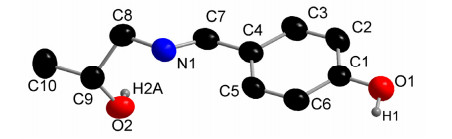
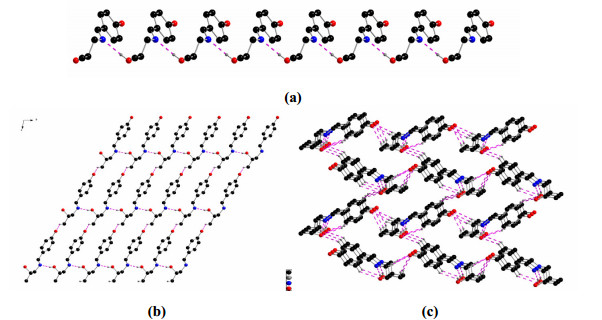
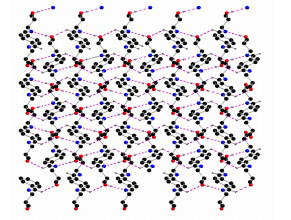
Compound 1 crystallizes in the monoclinic system space group P21. The asymmetric unit of 1 consists of one 4-(((2-hydroxypropyl)imino)methyl)phenol molecule, as shown in Fig. 1. In 1, 4-(((2-hydroxypropyl)imino)methyl)phenol molecules are joined into a helix chain through O(2)–H(2A)…N(1)#2 hydrogen bonds between hydroxyl groups and nitrogen atoms of imino groups (Fig. 2a). The repeating unit can be described as -O(2)– H(2A)···N(1)–C(8)–C(9)-, and the pitch of the helix running along the a axis is the same as its length (4.8873 Å). The helical chains are further interlinked into a supramolecular layer structure through C(10)–H(10A)…O(1)#3, as shown in Fig. 2b. Additionally, O(1)–H(1)…O(2)#1 hydrogen bonds between two hydroxyl groups and C(2)–H(2)…O(2)#1, C(5)–H(5)…O(2)#5 and C(8)–H(8B)…O(1)#4 hydrogen bonds lead to the formation of a 3D supramolecular structure (Fig. 2c, Table 2).
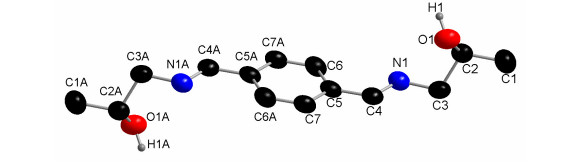
Compound 2 crystallizes in orthorhombic system, space group Pbca. The asymmetric unit of 2 consists of one1, 1΄-((1, 4-phenylenebis(methanylyli dene))bis(azanylylidene))bis(propan-2-ol) molecule, as shown in Fig. 3. In 2, 1, 1΄-((1, 4-phenylenebis(methanylylidene))bis(azanylylidene))bis(propan-2-ol) molecules are joined into a 2-D supramolecular structure through O(1)–H(1)…N(1) hydrogen bonds between hydroxyl groups and nitrogen atoms of imino groups and C(4)–H(4)…O(1) hydrogen bonds between methylene groups and oxygen atoms of hydroxyl groups (Fig. 4).
Measurement of infrared emissivity of two Schiff base compounds and their Fe(Ⅲ) complexes smears: the coated substrates are a circular aluminum sheet with a diameter of 6 cm, aluminum substrates are cleaned by 10% dilute H2SO4 and distilled water before use, and the coatings are prepared using a CCI-1000 coater with a coating thickness of 100 μm. Finally the coatings are dried at room temperature for 24 h. Infrared emissivity at the wavelength of 8~14 µm is measured by using IR-2 Infrared Emissometer (Shanghai Institute of Technological Physics, China). The electrical conductivity values were tested by a four point probe resistivity meter. The specimens for conductivity measurement were cylinders with the diameter of 10 mm and the thickness of 1 mm obtained by hydraulic pressing the corresponding powders under a pressure of 15 MPa. The infrared emissivity of two Schiff base compounds and their Fe(Ⅲ) complexes is shown in Table 3. It can be seen that the infrared emissivity values of all samples fall in the range of 0.66~0.73. The infrared emissivity of the Schiff base Fe(Ⅲ) complexes is obviously lower than those of the corresponding Schiff base compounds, in which C(2) has the lowest infrared emissivity (0.657) in all the samples. The infrared emissivity of the Schiff base Fe(Ⅲ) complexes are lower than those of corresponding Schiff base compounds, which indicate that Schiff base complexes would be one kind of potential candidates for infrared stealth materials. The formation of the N-Fe3+ coordination bond in the complexes of C(1) and C(2) increased their conductivities (Table 3), which further led to lower infrared emissivity of C(1) and C(2) (Table 3).
DownLoad:
CSV
| Samples | Conductivity (S·cm–1) | Infrared emissivity (8~14 µm) |
| 1 | 2.41×10⁻⁸ | 0.726 |
| 2 | 6.92×10⁻⁸ | 0.713 |
| C1 | 1.98×10⁻⁷ | 0.672 |
| C2 | 4.67×10⁻⁷ | 0.657 |
In this study, two new compounds derived from 1-amino-2-hydroxypropane were prepared and structurally characterized by X-ray diffraction. The molecular structures of the title compounds and intramolecular hydrogen bonding interactions were studied. The results show that hydroxyl groups of 1-amino-2-hydroxypropane help to form rich hydrogen bonds, which further aid to construct highdimensional supramolecular structures of compounds 1 and 2. The infrared emissivity of two Schiff base compounds and their Fe(Ⅲ) complexes were tested, showing that their Fe(Ⅲ) complexes owned lower infrared emissivity than the corresponding Schiff base compounds, and Schiff base complexes would be one kind of potential candidates for infrared stealth materials.
Macdonald, J. C.; Whitesides, G. M. Solid-state structures of hydrogen-bonded tapes based on cyclic secondary diamides. Chem. Rev. 1994, 94, 2383–2420. doi: 10.1021/cr00032a007
Wang, L.; Xu, L. Y.; Xue, R. F.; Lu, X. F.; Chen, R. X.; Tao, X. T. Cocrystallization of N-donor type compounds with 5-sulfosalicylic acid: the effect of hydrogen-bonding supramolecular architectures. Science China Chemistry 2012, 55, 138–144. doi: 10.1007/s11426-011-4394-8
Shen, C. J.; Sheng, T. L.; Fu, R. B.; Hu, S. M.; Chen, J. S.; Zhu, Q. L.; Ma, X.; Wu, X. T. Dinuclear copper(Ⅱ) complex with a new polycarboxylate ligand: syntheses, characterization and crystal structure. Chin. J. Struct. Chem. 2012, 31, 11–18.
Benito, J. M.; Gomez-Garcia, M.; Mellet, C. O.; Baussanne, I.; Defaye, J.; Fernandez, J. M. Optimizing saccharide-directed molecular delivery to biological receptors: design, synthesis, and biological evaluation of glycodendrimer-cyclodextrin conjugates. J. Am. Chem. Soc. 2004, 126, 10355–10363. doi: 10.1021/ja047864v
Shaheen, F.; Rehman, Z. U.; Ali, S.; Meetsma, A. Structural properties and antibacterial potency of new supramolecular organotin(Ⅳ) dithiocarboxylates. Polyhedron 2012, 31, 697–703. doi: 10.1016/j.poly.2011.10.025
Ishow, E.; Bellaiche, C.; Bouteiller, L.; Nakatani, K.; Delaire, J. A. Versatile synthesis of small NLO-active molecules forming amorphous materials with spontaneous second-order NLO response. J. Am. Chem. Soc. 2003, 125, 15744–15745. doi: 10.1021/ja038207q
Miyahira, T.; Hasegawa, H.; Takahashi, Y.; Inabe, T. Electrochemical crystallization of organic molecular conductors: electrode surface conditions for crystal growth. Cryst. Growth Des. 2013, 13, 1955–1960. doi: 10.1021/cg301852k
Marchal, C.; Filinchuk, Y.; Imbert, D.; Bunzli, J. C. G.; Mazzanti, M. Toward the rational design of lanthanide coordination polymers: a new topological approach. Inorg. Chem. 2007, 46, 6242–6244. doi: 10.1021/ic7009918
Liu, C. B.; Chen, Y.; Yan, L. S.; Huang, D. H.; Xiong, Z. Q. Syntheses, characterization, and antibacterial activities of four new Schiff base compounds derived from 1-phenyl-3-methyl-4-benzoyl-2-pyrazolin-5-one. J. Heterocycl. Chem. 2012, 49, 839–844. doi: 10.1002/jhet.874
Hadjoudis, E.; Vittorakis, M.; Moustakali-Mavridis, I. Photochromism and thermochromism of Schiff bases in the solid state and in rigid glasses. J. Tetrahedron 1987, 43, 1345–1360. doi: 10.1016/S0040-4020(01)90255-8
Akitsu, T.; Einaga, Y. Synthesis, crystal structures and electronic properties of Schiff base nickel(Ⅱ) complexes: towards solvatochromism induced by a photochromic solute. Polyhedron 2005, 24, 1869–1877. doi: 10.1016/j.poly.2005.06.019
Li, H. N.; Liu, C. B.; Dai, B.; Tang, X. H.; Zhang, Z. J.; Xiong, Z. Q.; Liu, X. M. Synthesis, conductivity and electromagnetic wave absorption properties of chiral poly Schiff bases and their silver complexes. J. Appl. Polym. Sci. 2015, 132, 10815(1-8).
Liu, C. B.; Li, L.; Zhang, X.; Chen, W. Y.; Zhang, Z. J.; Qin, Y. C.; Chen, D. Z. Synthesis, characterization of chiral poly(ferrocenyl-Schiff base) iron(Ⅱ) complexes/RGO composites with enhanced microwave absorption properties. Polymer. 2018, 150, 301–310. doi: 10.1016/j.polymer.2018.07.049
Kundua, B. K.; Chhabraa, V.; Malviyaa, N.; Gangulyb, R.; Mishrac, G. S.; Mukhopadhyay, S. Zeolite encapsulated host-guest Cu(Ⅱ) Schiff base complexes: superior activity towards oxidation reactions over homogenous catalytic systems. Micropor. Mesopor. Mater. 2018, 271, 100–117. doi: 10.1016/j.micromeso.2018.05.046
Gupta, K. C.; Sutara, A. K.; Lin, C. C. Polymer-supported Schiff base complexes in oxidation reactions. Coord. Chem. Rev. 2009, 253, 1926–1946. doi: 10.1016/j.ccr.2009.03.019
Gupta, K. C.; Sutar, A. K. Catalytic activities of Schiff base transition metal complexes. J. Coord. Chem. Rev. 2008, 252, 1420–1450. doi: 10.1016/j.ccr.2007.09.005
Kaczmarek, M. T.; Zabiszak, M.; Nowak, M.; Jastrzab, R. Lanthanides: Schiff base complexes, applications in cancer diagnosis, therapy, and antibacterial activity. Coord. Chem. Rev. 2018, 370, 42–54. doi: 10.1016/j.ccr.2018.05.012
Wen, H. L.; Du, X. L.; Liu, C. B. Research advance of flavonoids carboxylic acid compounds and their rare earth complexes. Chin. Rare Earths 2009, 30, 69–75.
Dhahagani, K.; Kesavan, M. P.; Kumar, G. G. V.; Ravi, L.; Rajagopal, G.; Rajesh, J. Crystal structure, optical properties, DFT analysis of new morpholine based Schiff base ligands and their copper(Ⅱ) complexes: DNA, protein docking analyses, antibacterial study and anticancer evaluation. Mater. Sci. Eng. C 2018, 90, 119–130. doi: 10.1016/j.msec.2018.04.032
Gryboś, R.; Szklarzewicz, J.; Jurowska, A.; Hodorowicz, M. Properties, structure and stability of V(Ⅳ) hydrazide Schiff base ligand complex. J. Mol. Struct. 2018, 1171, 880–887. doi: 10.1016/j.molstruc.2018.06.077
Kaczmarek, M. T.; Kubicki, M.; Hnatejko, Z. Two types of lanthanide Schiff base complexes: synthesis, structure and spectroscopic studies. Polyhedron 2015, 102, 224–232. doi: 10.1016/j.poly.2015.09.063
Kaczmarek, M. T.; Jastrząb, R.; Kubicki, M.; Gierszewski, M.; Sikorski, M. Suplamolecular polymer of Schiff base gadolinium complex: synthesis, crystal structure and spectroscopic properties. Inorg. Chim. Acta 2015, 430, 108–113. doi: 10.1016/j.ica.2015.02.026
Storr, T.; Thompson, K. H.; Orvig, C. Design of targeting ligands in medicinal inorganic chemistry. Chem. Soc. Rev. 2006, 35, 534–544. doi: 10.1039/b514859f
Kumar, K.; Tweedle, M. F. Macrocyclic polyaminocarboxylate complexes of lanthanides as magnetic resonance imaging contrast agents. Pure Appl. Chem. 1993, 65, 515–520. doi: 10.1351/pac199365030515
Gao, F.; Zhang, Y. Q.; Wang, S.; Liu, H.; Chen, X. Y. Syntheses, structures and magnetic properties of macrocyclic Schiff base-supported homodinuclear lanthanide complexes. Dalton Trans. 2018, 47, 11696–11704. doi: 10.1039/C8DT02243G
Tessa ten Cate, A.; Kooijman, H.; Spek, A. L.; Sijbesma, R. P.; Meijer, E. W. Conformational control in the cyclization of hydrogen-bonded supramolecular polymers. J. Am. Chem. Soc. 2004, 126, 3801–3808. doi: 10.1021/ja039408x
Tzeli, D.; Petsalakis, I. D.; Theodorakopoulos, G.; Ajami, D.; Rebek, J. J. Theoretical study of free and encapsulated carboxylic acid and amide dimers. Int. J. Quantum Chem. 2013, 113, 734–739. doi: 10.1002/qua.24062
Wen, H. L.; Chen, Y. H.; Liu, C. B.; Chen, D. D.; Hu, X. B. Crystal structure of 3-Hydroxy-3΄, 4΄-methylenedioxy flavone-6-carboxylic acid dimethylformamide solvate. J. Chem. Crystallogr. 2010, 40, 731–734. doi: 10.1007/s10870-010-9727-5
Shattock, T. R.; Vishweshwar, P.; Wang, Z. Q.; Zaworotko, M. J. 18-Fold interpenetration and concomitant polymorphism in the 2: 3 co-crystal of trimesic acid and 1, 2-bis(4-pyridyl)ethane. Cryst. Growth Des. 2005, 5, 2046–2049. doi: 10.1021/cg0501985
Rajput, L.; Biradha, K. Design of cocrystals via new and robust supramolecular synthon between carboxylic acid and secondary amide: honeycomb network with jailed aromatics. Cryst. Growth Des. 2009, 9, 40–42. doi: 10.1021/cg801132r
Varughese, S.; Pedireddi, V. R. A competitive molecular recognition study: syntheses and analysis of supramolecular assemblies of 3, 5-dihydroxybenzoic acid and its bromo derivative with some N-donor compounds. Chem. Eur. J. 2006, 12, 1597–1609. doi: 10.1002/chem.200500570
Zhao, Y.; Li, Z.; Li, H.; Wang, S.; Niu, M. Synthesis, crystal structure, DNA binding and in vitro cytotoxicity studies of Zn(Ⅱ) complexes derived from amino-alcohol Schiff-bases. Inorg. Chim Acta 2018, 482, 136–143. doi: 10.1016/j.ica.2018.06.008
Shankar, M.; Dennis, R. A.; Jeeva, M.; Purusothaman, R.; Vimalan, M.; Vetha, P. I. Synthesis, crystal growth, thermal and laser damage threshold properties of new Schiff base NLO material 4-nitro-benzoic acid (3-ethoxy-2-hydroxy-benzylidene)-hydrazide. Mate. Lett. 2018, 232, 113–117. doi: 10.1016/j.matlet.2018.08.090
Hu, Y. X. The synthesis of different structure Schiff bases and their complexes for infrared emissivity property. Nanjing University of Aeronautics and Astronautics 2016.
Fu, W. Electro-optic stealthy technology of aircraft. Electronics Optics & Control 2002, 01, 7–10.
Hu, Y. X.; Zhuang, H. Y.; Xu, G. Y.; Yan, L. J. The synthesis and infrared stealth performance of Schiff-bases of different structures and their iron compounds. Develop Appl. Materi. 2016, 31, 55–60.
Lv, X. L.; Xu, W. D.; Cui, C. A.; Chen, Y. H.; Ge, Q, L. The Synthesis of Schiff bases and their application in the low emissivity coating. J. PLA Univ. of Sci. Technol. 2000, 54–57.
Sheldrick, G. M. SADABS. Program for Empirical Absorption Correction of the Area Detector Data. University of Gottingen, Germany 1997.
Sheldrick, G. M. SHELXS-97. Program for Crystal Structure Solution. University of Gottingen, Germany 1997.
Sheldrick, G. M. SHELXL-97. Program for Crystal Structure Refinement. University of Gottingen, Germany 1997.

Scheme 1 Syntheses routes of 4-(((2-hydroxypropyl)imino)methyl)phenol (a) and 1, 1΄-((1, 4-phenylenebis(methanylylidene))bis(azanylylidene))bis(propan-2-ol) (b)

Figure 1 Asymmetric unit of 1 with displacement ellipsoids drawn at the 50% probability level. All hydrogen atoms except hydroxyl hydrogen atoms are omitted for clarity

Figure 2 (a) View of the 1D structure of compound 1 along the a axis. (b) View of the 2D structure of compound 1 along the c axis. (c) View of the 3D supramolecular structure of 1 along the a axis

Figure 3 Asymmetric unit of 2 with displacement ellipsoids drawn at 50% probability level (Symmetry code: –x+2, –y+1, –z). All hydrogen atoms except hydroxyl hydrogen atoms are omitted for clarity
Table 1. Selected Bond Lengths (Å) and Bond Angles (°) for Compounds 1 and 2
| Compound 1 | |||||||
| Bond | Dist. | Bond | Dist. | Bond | Dist. | ||
| C(1)–C(2) | 1.385(3) | C(1)–C(6) | 1.394(2) | C(1)–O(1) | 1.349(2) | ||
| C(2)–C(3) | 1.371(3) | C(3)–C(4) | 1.397(2) | C(4)–C(5) | 1.397(3) | ||
| C(4)–C(7) | 1.452(2) | C(5)–C(6) | 1.365(3) | C(7)–N(1) | 1.264(2) | ||
| C(8)–C(9) | 1.519(3) | C(8)–N(1) | 1.456(2) | C(9)–C(10) | 1.508(2) | ||
| C(9)–O(2) | 1.423(2) | ||||||
| Angle | (°) | Angle | (°) | Angle | (°) | ||
| O(1)–C(1)–C(2) | 123.30(17) | O(1)–C(1)–C(6) | 117.92(17) | C(2)–C(1)–C(6) | 118.78(18) | ||
| C(3)–C(2)–C(1) | 120.32(17) | C(2)–C(3)–C(4) | 121.51(18) | C(5)–C(4)–C(3)) | 117.47(17) | ||
| C(5)–C(4)–C(7) | 122.93(16) | C(3)–C(4)–C(7) | 119.59(16) | C(6)–C(5)–C(4) | 121.12(17) | ||
| C(5)–C(6)–C(1) | 120.79(17) | N(1)–C(7)–C(4) | 125.28(17) | N(1)–C(8)–C(9) | 110.85(14) | ||
| O(2)–C(9)–C(10) | 111.74(15) | O(2)–C(9)–C(8) | 110.18(14) | C(10)–C(9)–C(8) | 111.95(16) | ||
| C(7)–N(1)–C(8) | 118.64(15) | ||||||
| Compound 2 | |||||||
| Bond | Dist. | Bond | Dist. | Bond | Dist. | ||
| C(1)–C(2) | 1.506(6) | C(2)–C(3) | 1.514(6) | C(2)–O(1) | 1.419(5) | ||
| C(3)–N(1) | 1.442(5) | C(4)–C(5) | 1.449(6) | C(4)–N(1) | 1.252(5) | ||
| C(5)–C(6) | 1.393(6) | C(5)–C(7) | 1.378(5) | C(6)–C(7)#1 | 1.373(6) | ||
| C(7)–C(6)#1 | 1.373(6) | ||||||
| Angle | (°) | Angle | (°) | Angle | (°) | ||
| O(1)–C(2)–C(1) | 109.9(4) | O(1)–C(2)–C(3) | 108.8(4) | C(1)–C(2)–C(3) | 111.6(4) | ||
| N(1)–C(3)–C(2) | 111.4(4) | N(1)–C(4)–C(5) | 124.9(4) | C(6)–C(5)–C(4)) | 122.9(4) | ||
| C(7)–C(5)–C(4) | 119.5(4) | C(7)–C(5)–C(6) | 117.6(4) | C(7)#1–C(6)–C(5) | 120.5(4) | ||
| C(6)#1–C(7)–C(5) | 121.9(4) | C(4)–N(1)–C(3) | 119.8(4) | ||||
| Symmetry operation for 2: #1: –x+2, –y+1, –z | |||||||
 下载: 导出CSV
Table 2. Hydrogen Bond Lengths (Å) and Bond Angles (°) for Compounds 1 and 2
| Compound | D–H∙∙∙A | d(D–H) | d(H∙∙∙A) | d(D∙∙∙A) | < (DHA) |
| O(1)–H(1)∙∙∙O(2)#1 | 0.78 | 1.87 | 2.644(2) | 179.1 | |
| O(2)–H(2A)∙∙∙N(1)#2 | 0.82 | 2.00 | 2.807(2) | 169.4 | |
| 1 | C(10)–H(10A)∙∙∙O(1)#3 | 0.96 | 2.58 | 3.398(4) | 142.4 |
| C(4)–H(4)∙∙∙O(2) #1 | 0.93 | 2.84 | 3.449(3) | 124.1 | |
| C(8)–H(8B)∙∙∙O(1) #4 | 0.97 | 2.70 | 3.663(3) | 171.0 | |
| C(1)–H(1)∙∙∙O(2) #5 | 0.93 | 2.74 | 3.537(3) | 144.5 | |
| 2 | O(1)–H(1)∙∙∙N(1)#1 | 0.82 2.05 2.835(5) | 2.05 | 2.835(5) | 159.9 |
| C(4)–H(4)∙∙∙O(1)#2 | 0.93 | 2.68 | 3.325(6) | 126.9 | |
| Symmetry transformations used to generate the equivalent atoms: for 1 #1: –x, y+1/2, –z+1; #2: x–1, y, z; #3: x–1, y, z+1; #4: x, y, z+1; #5: x+1, y, z. For 2 #1: –x+3/2, y–1/2, z; #2: –x–1/2, y+1/2, –z | |||||
下载: 导出CSV
Table 3. Infrared Emissivity and Conductivities in 8~14 µm of Schiff Base and Their Fe(Ⅲ) Complexes
| Samples | Conductivity (S·cm–1) | Infrared emissivity (8~14 µm) |
| 1 | 2.41×10⁻⁸ | 0.726 |
| 2 | 6.92×10⁻⁸ | 0.713 |
| C1 | 1.98×10⁻⁷ | 0.672 |
| C2 | 4.67×10⁻⁷ | 0.657 |
下载: 导出CSV

 扫一扫看文章


扫一扫关注我们
