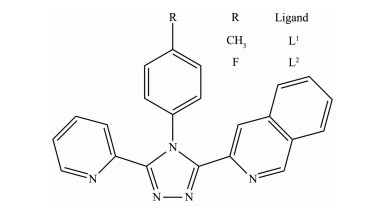
Scheme 1.
Structures of the ligands L1 and L2


3, 4, 5-Triarylsubstituted 1, 2, 4-triazole is a kind of very useful ligand in coordination chemistry due to its rich and versatile coordination modes[1-2]. Specially, some iron(Ⅱ) complexes based on the triaryltriazole can show interesting spin-crossover properties[3], which makes them be a type of potential molecular-based materials used as memory devices, displays and swit-ching[4-5]. In order to explore novel triaryltriazole-based iron(Ⅱ) spin-crossover complexes, a series of 4-aryl-substituted 3, 5-di(2-pyridyl)-1, 2, 4-triazoles[6-12] and asy-mmetrically 3, 4, 5-triarylsubstituted 1, 2, 4-triazoles[13-25] have been designed and synthesized successfully. Among them, the pyridyl, phenyl, pyrrolyl, imidazolyl and benzimidazolyl groups are the known aromatic rings attached on the 3, 4, 5-triarylsubstituted 1, 2, 4-triazoles. However, the quinolyl group, an important alkaloid with stronger conjugated system, is less observed to connect on the 1, 2, 4-triazoles. Up to now only two quinolyl substituted 1, 2, 4-triazoles have been reported by us[26-27]. As a continuation of our investiga-tion of the quinolyl substituted 1, 2, 4-triazoles, we designed and synthesized two new triaryltriazoles: 3-(2-pyridyl)-4-( p-methylphenyl)-5-(2-quinolyl)-1, 2, 4-triazole (L1) and 3-(2-pyridyl)-4-( p-fluorophenyl)-5-(2-quinolyl)-1, 2, 4-triazole (L2) as shown in Scheme 1. Herein we present the syntheses, crystal structures and spectral characterization of two copper(Ⅱ) complexes based on these ligands: trans-[Cu(L1)2(NO3)(H2O)]NO3·H2O (1) and trans-[Cu(L2)2(NO3)(H2O)]NO3·H2O (2).
All chemicals used were of analytical grade. Solvents were purified by conventional methods. The ligands L1 and L2 were synthesized via a similar literature method[23]. Elemental analyses (C, H, N) were carried out with a Thermo Finnigan Flash 1112A elemental analyzer. IR spectra were recorded on a Nicolet Avatar 380 FT-IR instrument with KBr pellets in a range of 4 000~400 cm-1.
A solution of Cu(NO3)2·3H2O (0.05 mmol) in MeOH (3 mL) was added to a solution of L1 (0.1 mmol) in anhydrous MeOH (3 mL). The mixture was stirred for 4 h at room temperature. A resulting green product was filtered and washed with H2O, then dried under vacuum to give 0.042 mmol (84%) of complex 1. The green single crystals of 1 suitable for X-ray diffraction were obtained by slow evaporation from the MeOH/MeCN (1:1, V/V) solution of the complex. Elemental analyses Calcd. for C46H38CuN12O8(%): C, 58.13; H, 4.03; N, 17.69. Found(%): C, 57.81; H, 4.25; N, 17.46. IR (KBr, cm-1): 3 343(w), 3 049(w), 3 011(w), 2 918(w), 1 597(m), 1 498(s), 1 387(vs), 1 289(m), 1 086(w), 828(m), 761(m).
The prepared procedure for 2 was the same as that for 1 except using L2 (0.1 mmol) to replace L1. Yield: 86.2%. Elemental analyses Calcd. for C44H32Cu F2N12O8(%): C, 55.14; H, 3.37; N, 17.54. Found(%): C, 55.31; H, 3.26; N, 17.69. IR (KBr, cm-1): 3 379(w), 3 075(w), 1 596(m), 1 508(vs), 1 384(s), 1 236(m), 1 155(w), 839(m), 759(m).
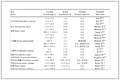
The well-shaped single crystals of 1 and 2 were selected for X-ray diffraction study. The unit cell parameters and intensity data were collected at 296(2) K on a Bruker SMART APEX Ⅱ CCD diffractometer using a graphite-monochromated Mo Kα (λ=0.071 073 nm) radiation. The structures were solved by direct methods and refined on F 2 by full-matrix least squares procedures using SHELXTL software[28]. All non-hydrogen atoms were refined anisotropically. All hydrogen atoms were fixed in calculated positions and refined isotropically. Two NO3- anions, O1W and O2W were found to be highly disordered with an occupancy factor of 0.5. Due to the disorder, the hydrogen atoms on the water were not calculated. The crystallographic data of 1 and 2 are listed in Table 1, and the selected bond lengths and angles are provided in Table 2.
 下载:
导出CSV
| Complex | 1 | 2 |
| Empirical formula | C46H38CuN12O8 | C44H32CuF2N12O8 |
| Formula weight | 950.42 | 958.36 |
| Crystal system | Triclinic | Triclinic |
| Space group | P1 | P1 |
| a / nm | 0.854 51(5) | 0.841 6(4) |
| b / nm | 0.961 20(7) | 0.958 7(4) |
| c / nm | 1.485 7(3) | 1.448 2(6) |
| α / (°) | 96.812(3) | 100.209(6) |
| β / (°) | 106.423(3) | 103.144(6) |
| γ / (°) | 101.713(2) | 100.201(6) |
| V / nm3 | 1.125 8(4) | 1.090 6(8) |
| Z | 1 | 1 |
| Dc / (g·cm-3) | 1.402 | 1.459 |
| μ / mm-1 | 0.553 | 0.578 |
| F(000) | 491 | 491 |
| Crystal size / mm | 0.13×0.11×0.07 | 0.16×0.12×0.08 |
| θ range / (°) | 1.45~25.00 | 1.48~25.00 |
| Reflection collected | 8 196 | 7 766 |
| Independent reflection | 3 943 (Rint=0.037 4) | 3 784 (Rint=0.023 1) |
| Reflection observed [I>2σ(I)] | 2 478 | 3 006 |
| Data, restraint, parameter | 3 943, 96, 351 | 3 784, 114, 352 |
| Goodness-of-fit on F2 | 1.025 | 1.118 |
| R1, wR2 [I>2σ(I)] | 0.069 8, 0.187 9 | 0.056 1, 0.170 4 |
| R1, wR2 (all data) | 0.115 1, 0.207 9 | 0.070 6, 0.181 8 |
| (Δρ)max, (Δρ)min / (e·nm-3) | 725, -345 | 547, -396 |
下载:
导出CSV
| 1 | |||||
| Cu1-N1 | 0.203 3(3) | Cu1-N2 | 0.197 0(4) | Cu1-O1 | 0.269 7(2) |
| Cu1-O1W | 0.239 7(19) | N2-N3 | 0.136 1(5) | C20-C23 | 0.151 6(6) |
| N1-Cu1-N2 | 80.31(14) | N1-Cu1-O1 | 96.76(2) | N2-Cu1-O1 | 96.95(2) |
| N1-Cu1-O1W | 94.9(3) | O1-Cu1-O1Wi | 170.4(3) | ||
| 2 | |||||
| Cu1-N1 | 0.203 6(3) | Cu1-N2 | 0.197 9(3) | Cu1-O1 | 0.263 9(3) |
| Cu1-O1W | 0.247 5(3) | N2-N3 | 0.136 2(4) | C20-F1 | 0.136 4(4) |
| N1-Cu1-N2 | 80.33(12) | N1-Cu1-O1 | 95.20(2) | N2-Cu1-O1 | 93.78(2) |
| N1-Cu1-O1W | 94.87(2) | O1-Cu1-O1Wi | 174.9(3) | ||
| Symmetry code: i -x, -y, -z for 1; i 1-x, 1-y, 1-z for 2. | |||||
CCDC: 1975981, 1; 1975982, 2.
Asymmetrically quinolyl substituted 3, 4, 5-triaryl-1, 2, 4-triazoles (L1 and L2) react with Cu(NO3)2·3H2O in molar ratio of 2:1 to form two monomeric complexes, trans-[Cu(L1)2(NO3)(H2O)]NO3·H2O (1) and trans-[Cu(L2)2(NO3)(H2O)]NO3·H2O (2), which are stable in air. The yields for 1 and 2 are 84% and 86.2%, respe-ctively. The elemental analyses were satisfactory and indicate that both 1 and 2 contain one Cu(Ⅱ), two triazole ligands, two NO3- and two water molecules.
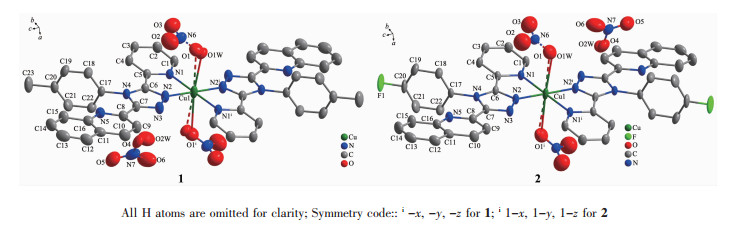
The crystal structures of 1 and 2 are presented in Fig. 1 together with the atomic labeling system. Complexes 1 and 2 all crystallize in the triclinic space group P1 and there is an inversion center at the Cu(Ⅱ) ion. Because 1 and 2 are isostructural complexes, herein, only the structure of 1 is discussed in detail. The asymmetric unit of 1 consists of half Cu(Ⅱ) cation, one L1 ligand, one coordinated NO3- and H2O molecule (their occupancy factors are 0.5), one NO3- counter ion and one lattice H2O molecule (their occupancy factors are also 0.5), which is agreement with the elemental analysis result. The Cu(Ⅱ) ion of 1 is coordinated by four nitrogen atoms from two L1 ligands in the equatorial plane and two oxygen atoms from NO3- and H2O in the axial positions to form a distorted octahedral [CuN4O2] geometry. Each L1 ligand coordinates to Cu(Ⅱ) ion via N1 atom of the pyridyl and N2 atom of the triazole, similar to the coordination modes in some related Cu(Ⅱ) complexes[13, 15, 17, 29-30]. The quinolyl group of L1 ligand is uncoordinated, which is different from the Fe(Ⅱ) complex with quinolyl substituted triaryl-triazole: cis-[FeL2(NCS)2] (L=3-( p-methylphenyl)-4-phenyl-5-(2-quinolyl)-1, 2, 4-triazole)[27]. The distance of Cu1-O1 (0.269 7 nm) is longer than the Cu1-O1W one (0.239 7 nm). The Cu-N bond lengths are within the normal ranges observed for the octahedral Cu(Ⅱ) complexes[13, 15, 17, 29-30]. However, the Cu-N bond to the triazole nitrogen is 0.006 3 nm shorter than that to the pyridyl nitrogen. The same feature has been observed in the similar Cu(Ⅱ) complexes[13, 15, 17]. The ligand L1 in 1 is non-planar. The triazole makes dihedral angles of 4.8(3)°, 10.1(3)° and 83.3(3)° with the quinolyl ring, the pyridyl ring and p-methylphenyl ring, respectively. The corresponding angles in L2 of 2 are 8.7(3)°, 9.0(3)° and 86.8(3)°, respectively.
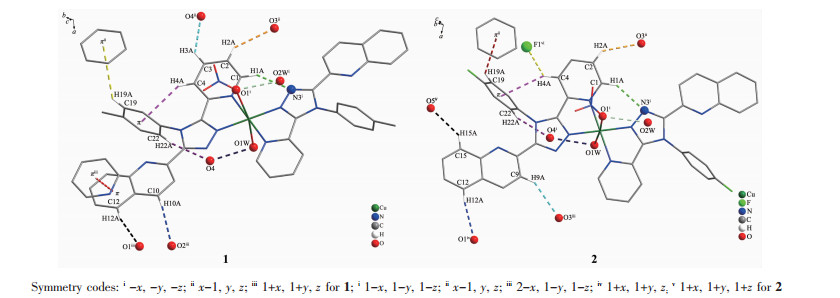
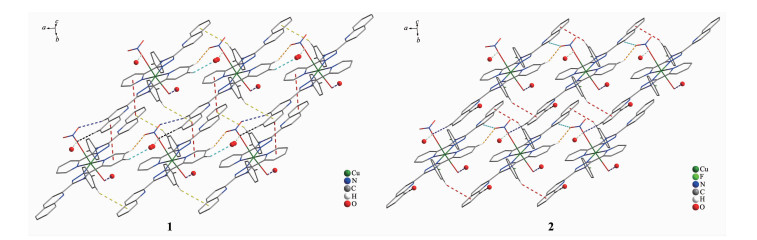
There are many intermolecular hydrogen bonds interactions in 1 (Fig. 2, Table 3), associated with the closer crystal packing. These hydrogen bond interac-tions include: (1) between water molecules and NO3- anion (O1W…O4 and O2Wi…O1i); (2) between pyridyl group and triazole ring (C1-H1A…N3i); (3) between pyridyl and NO3- anion (C2-H2A…O3ii and C3-H3A…O4ii); (4) between quinolyl group and the coordinated NO3- (C10-H10A…O2iii and C12-H12A…O1iii); (5) between p-methylphenyl ring and the uncoordinated NO3- (C22-H22A…O4). In addition, there are an intramolecular edge-to-face C-H…π interaction involving C4-H4A and p-methylphenyl ring (H4A…π 0.294 nm and ∠C4-H4A…π=145°) and an intermolecular edge-to-face C-H…π interaction involving C19-H19A and the phenyl ring of quinolyl group (H19A…π 0.326 nm and ∠C19-H19A…π=141°) (Table 3, Fig. 2). Notably, in 1 an offset face-to-face π-π stacking interaction exists between the phenyl ring of quinolyl group and pyridyl ring (dihedral angle: 12.2(3)°) with a centroid-centroid distance of 0.382 nm (Fig. 2, Table 4), while the corresponding stacking is not found in 2. These extensive hydrogen bonds and C-H…π interactions assemble the mononuclear units, NO3- anions and lattice water molecule into a 3D framework of the complexes (Fig. 3).
下载:
导出CSV
| D-H…A | d(D-H) / nm | d(H…A) / nm | d(D…A) / nm | ∠D-H…A / (°) | |
| 1 | |||||
| C1-H1A…N3i | 0.093 | 0.233 | 0.313 8(2) | 144 | |
| C2-H2A…O3ii | 0.093 | 0.263 | 0.341 9(2) | 143 | |
| C3-H3A…O4ii | 0.093 | 0.264 | 0.338 0(2) | 137 | |
| C4-H4A…π(Ph) | 0.093 | 0.294 | 0.373 8(4) | 145 | |
| C10-H10A…O2iii | 0.093 | 0.271 | 0.361 8(2) | 167 | |
| C12-H12A…O1iii | 0.093 | 0.269 | 0.360 6(2) | 166 | |
| C19-H19A…π(Ph)ii | 0.093 | 0.326 | 0.402 4(4) | 141 | |
| C22-H22A…O4 | 0.093 | 0.261 | 0.327 2(2) | 153 | |
| O1W…O4 | — | — | 0.278 5(2) | — | |
| O2Wi…O1i | — | — | 0.265 8(2) | — | |
| 2 | |||||
| C1-H1A…N3i | 0.093 | 0.234 | 0.314 1(2) | 144 | |
| C2-H2A…O3ii | 0.093 | 0.259 | 0.335 5(2) | 139 | |
| C4-H4A…π(Ph) | 0.093 | 0.291 | 0.373 3(4) | 147 | |
| C4-H4A…Fvi | 0.093 | 0.260 | 0.311 4(2) | 116 | |
| C9-H9A…O3iii | 0.093 | 0.267 | 0.349 4(2) | 147 | |
| C12-H12A…O1iv | 0.093 | 0.257 | 0.349 2(2) | 170 | |
| C15-H15A…O5v | 0.093 | 0.261 | 0.340 1(2) | 143 | |
| C19-H19A…π(Ph)ii | 0.093 | 0.301 | 0.377 5(4) | 141 | |
| C22-H22A…O4i | 0.093 | 0.243 | 0.326 3(3) | 148 | |
| O1W…O2Wi | — | — | 0.266 2(3) | — | |
| O2W…O1i | — | — | 0.283 9(3) | — | |
| Symmetry codes: i -x, -y, -z; ii x-1, y, z; iii 1+x, 1+y, z for 1; i 1-x, 1-y, 1-z; ii x-1, y, z; iii 2-x, 1-y, 1-z; iv 1+x, 1+y, z; v 1+x, 1+y, 1+z; vi 1-x, 2-y, 2-z for 2. | |||||
下载:
导出CSV
| π…π interaction | d(cent…cent) / nm | Dihedral angle / (°) |
| π(Ph)…π(Py)iii | 0.382 | 12.2(3) |
| Symmetry code: iii 1+x, 1+y, z. | ||
In the IR spectra of complexes 1 and 2, a weak broad peak at 3 343 cm-1 (1) or 3 379 cm-1 (2) can be attributed to the O-H stretching vibrations of water molecules. A medium band at 1 597 cm-1 (1) or 1 596 cm-1 (2) can be assigned to the coordinated pyridyl ring vibration[14]. A strong band at 1 384 cm-1 is assigned to characteristic N=O stretching vibrations of NO3- in 1 and 2[31]. In addition, the stretching vibration of F-C(Ph) in 2 can be observed at 1 236 cm-1[32]. These features are in consistent with the results of the X-ray analysis.
Two new Cu(Ⅱ) complexes based on the quinolyl and pyridyl substituted triaryltriazole have been synthesized and characterized by IR and X-ray crystallography. Structural analyses indicate that two complexes have a similar distorted octahedral [CuN4O2] core with one nitrate and one water molecule, respectively in the trans-position.
Klingele M H, Brooker S. Coord. Chem. Rev., 2003, 241:119-132 doi: 10.1016/S0010-8545(03)00049-3
Kitchen J A, Brooker S. Coord. Chem. Rev., 2008, 252:2072-2092 doi: 10.1016/j.ccr.2007.11.010
朱敦如, 齐丽, 程慧敏, 等.化学进展, 2009, 21:1187-1198ZHU Dun-Ru, QI Li, CHENG Hui-Min, et al. Prog. Chem., 2009, 21:1187-1198
Zhu D R, Xu Y, Yu Z, et al. Chem. Mater., 2002, 14:838-843 doi: 10.1021/cm010688u
Shen G P, Qi L, Wang L, et al. Dalton Trans., 2013, 42:10144-10152 doi: 10.1039/c3dt50821h
Klingele M H, Boyd P D W, Moubaraki B, et al. Eur. J. Inorg. Chem., 2006:573-589
齐丽, 朱敦如, 解大景, 等.无机化学学报, 2008, 24:868-872 doi: 10.3321/j.issn:1001-4861.2008.06.005QI Li, ZHU Dun-Ru, XIE Da-Jing, et al. Chinese J. Inorg. Chem., 2008, 24:868-872 doi: 10.3321/j.issn:1001-4861.2008.06.005
Zhou J, Yang J, Qi L, et al. Transition Met. Chem., 2007, 32:711-715 doi: 10.1007/s11243-007-0234-2
Yang J, Bao W W, Ren X M, et al. J. Coord. Chem., 2009, 62:1809-1816 doi: 10.1080/00958970802709333
Kitchen J A, Noble A, Brandt C D, et al. Inorg. Chem., 2008, 47:9450-9458 doi: 10.1021/ic801039j
Kitchen J A, White N G, Boyd M, et al. Inorg. Chem., 2009, 48:6670-6679 doi: 10.1021/ic900634t
Kitchen J A, Jameson G N L, Milway V A, et al. Dalton Trans., 2010, 39:7637-7639 doi: 10.1039/c0dt00716a
Shen G P, Zhao J, Jiang J J, et al. J. Mol. Struct., 2011, 1002:159-166 doi: 10.1016/j.molstruc.2011.07.017
Zhao J, Cheng H M, Shen G P, et al. J. Coord. Chem., 2011, 64:942-951 doi: 10.1080/00958972.2011.558897
Chen L, Zhao J, Shen G P, et al. J. Coord. Chem., 2011, 64:3980-3991 doi: 10.1080/00958972.2011.634909
沈国平, 赵建, 陈浪, 等.无机化学学报, 2012, 28:159-163 http://www.wjhxxb.cn/wjhxxbcn/ch/reader/view_abstract.aspx?file_no=20120127SHEN Guo-Ping, ZHAO Jian, CHEN Lang, et al. Chinese J. Inorg. Chem., 2012, 28:159-163 http://www.wjhxxb.cn/wjhxxbcn/ch/reader/view_abstract.aspx?file_no=20120127
陈浪, 程慧敏, 江静静, 等.无机化学学报, 2012, 28:381-385 http://www.wjhxxb.cn/wjhxxbcn/ch/reader/view_abstract.aspx?file_no=20120229CHEN Lang, CHENG Hui-Min, JIANG Jing-Jing, et al. Chinese J. Inorg. Chem., 2012, 28:381-385 http://www.wjhxxb.cn/wjhxxbcn/ch/reader/view_abstract.aspx?file_no=20120229
江静静, 陈浪, 赵建, 等.无机化学学报, 2012, 28:1940-1944 http://www.wjhxxb.cn/wjhxxbcn/ch/reader/view_abstract.aspx?file_no=20120924JIANG Jing-Jing, CHEN Lang, ZHAO Jian, et al. Chinese J. Inorg. Chem., 2012, 28:1940-1944 http://www.wjhxxb.cn/wjhxxbcn/ch/reader/view_abstract.aspx?file_no=20120924
Zhao J, Shen G P, Zhang Y, et al. J. Heterocycl. Chem., 2012, 49:1114-1119 doi: 10.1002/jhet.949
Jiang J J, Shen G P, He X, et al. J. Heterocycl. Chem., 2014, 51:1888-1892 doi: 10.1002/jhet.1894
He X, Cao D Y, Jiang J J, et al. J. Coord. Chem., 2014, 67:227-235 doi: 10.1080/00958972.2013.877585
Li B, Zhou Y F, Zhang S P, et al. J. Coord. Chem., 2016, 69:2647-2655 doi: 10.1080/00958972.2016.1214724
Zhou Y F, Zhang S P, Feng Z, et al. J. Heterocyl. Chem., 2017, 54:2773-2780 doi: 10.1002/jhet.2880
Zhang S P, Feng Z, Wu B, et al. J. Coord. Chem., 2018, 71:46-56 doi: 10.1080/00958972.2018.1425838
Ivanova N V, Sviridov S I, Stepanov A E. Tetrahedron Lett., 2006, 47:8025-8027 doi: 10.1016/j.tetlet.2006.09.061
Cheng H M, Zhu D R, Lu W. J. Heterocycl. Chem., 2010, 47:210-213
Shen G P, Cao D Y, Jiang X Y, et al. Chin. J. Struct. Chem., 2013, 32:1153-1158
Sheldrick G M. Acta Crystallogr. Sect. A, 2008, A64:112-122
Lu W, Zhu D R, Xu Y, et al. Struct. Chem., 2010, 21:237-244 doi: 10.1007/s11224-009-9569-y
卢伟, 解大景, 王作祥, 等.无机化学学报, 2010, 26:717-720 http://www.wjhxxb.cn/wjhxxbcn/ch/reader/view_abstract.aspx?file_no=20100428LU Wei, XIE Da-Jing, WANG Zuo-Xiang, et al. Chinese J. Inorg. Chem., 2010, 26:717-720 http://www.wjhxxb.cn/wjhxxbcn/ch/reader/view_abstract.aspx?file_no=20100428
余柱, 柏健, 王寒晖, 等.无机化学学报, 2019, 35:1312-1320 doi: 10.11862/CJIC.2019.143YU Zhu, BAI Jian, WANG Han-Hui, et al. Chinese J. Inorg. Chem., 2019, 35:1312-1320 doi: 10.11862/CJIC.2019.143
Zhang Y, Wu Y, He X, et al. Acta Crystallogr. Sect. C, 2018, C74:256-262
Table 1. Crystal data and structure refinement for 1 and 2
| Complex | 1 | 2 |
| Empirical formula | C46H38CuN12O8 | C44H32CuF2N12O8 |
| Formula weight | 950.42 | 958.36 |
| Crystal system | Triclinic | Triclinic |
| Space group | P1 | P1 |
| a / nm | 0.854 51(5) | 0.841 6(4) |
| b / nm | 0.961 20(7) | 0.958 7(4) |
| c / nm | 1.485 7(3) | 1.448 2(6) |
| α / (°) | 96.812(3) | 100.209(6) |
| β / (°) | 106.423(3) | 103.144(6) |
| γ / (°) | 101.713(2) | 100.201(6) |
| V / nm3 | 1.125 8(4) | 1.090 6(8) |
| Z | 1 | 1 |
| Dc / (g·cm-3) | 1.402 | 1.459 |
| μ / mm-1 | 0.553 | 0.578 |
| F(000) | 491 | 491 |
| Crystal size / mm | 0.13×0.11×0.07 | 0.16×0.12×0.08 |
| θ range / (°) | 1.45~25.00 | 1.48~25.00 |
| Reflection collected | 8 196 | 7 766 |
| Independent reflection | 3 943 (Rint=0.037 4) | 3 784 (Rint=0.023 1) |
| Reflection observed [I>2σ(I)] | 2 478 | 3 006 |
| Data, restraint, parameter | 3 943, 96, 351 | 3 784, 114, 352 |
| Goodness-of-fit on F2 | 1.025 | 1.118 |
| R1, wR2 [I>2σ(I)] | 0.069 8, 0.187 9 | 0.056 1, 0.170 4 |
| R1, wR2 (all data) | 0.115 1, 0.207 9 | 0.070 6, 0.181 8 |
| (Δρ)max, (Δρ)min / (e·nm-3) | 725, -345 | 547, -396 |
 下载: 导出CSV
Table 2. Selected bond distances (nm) and bond angles (°) for 1 and 2
| 1 | |||||
| Cu1-N1 | 0.203 3(3) | Cu1-N2 | 0.197 0(4) | Cu1-O1 | 0.269 7(2) |
| Cu1-O1W | 0.239 7(19) | N2-N3 | 0.136 1(5) | C20-C23 | 0.151 6(6) |
| N1-Cu1-N2 | 80.31(14) | N1-Cu1-O1 | 96.76(2) | N2-Cu1-O1 | 96.95(2) |
| N1-Cu1-O1W | 94.9(3) | O1-Cu1-O1Wi | 170.4(3) | ||
| 2 | |||||
| Cu1-N1 | 0.203 6(3) | Cu1-N2 | 0.197 9(3) | Cu1-O1 | 0.263 9(3) |
| Cu1-O1W | 0.247 5(3) | N2-N3 | 0.136 2(4) | C20-F1 | 0.136 4(4) |
| N1-Cu1-N2 | 80.33(12) | N1-Cu1-O1 | 95.20(2) | N2-Cu1-O1 | 93.78(2) |
| N1-Cu1-O1W | 94.87(2) | O1-Cu1-O1Wi | 174.9(3) | ||
| Symmetry code: i -x, -y, -z for 1; i 1-x, 1-y, 1-z for 2. | |||||
下载: 导出CSV
Table 3. Hydrogen-bond geometry and C-H…π interactions in 1 and 2
| D-H…A | d(D-H) / nm | d(H…A) / nm | d(D…A) / nm | ∠D-H…A / (°) | |
| 1 | |||||
| C1-H1A…N3i | 0.093 | 0.233 | 0.313 8(2) | 144 | |
| C2-H2A…O3ii | 0.093 | 0.263 | 0.341 9(2) | 143 | |
| C3-H3A…O4ii | 0.093 | 0.264 | 0.338 0(2) | 137 | |
| C4-H4A…π(Ph) | 0.093 | 0.294 | 0.373 8(4) | 145 | |
| C10-H10A…O2iii | 0.093 | 0.271 | 0.361 8(2) | 167 | |
| C12-H12A…O1iii | 0.093 | 0.269 | 0.360 6(2) | 166 | |
| C19-H19A…π(Ph)ii | 0.093 | 0.326 | 0.402 4(4) | 141 | |
| C22-H22A…O4 | 0.093 | 0.261 | 0.327 2(2) | 153 | |
| O1W…O4 | — | — | 0.278 5(2) | — | |
| O2Wi…O1i | — | — | 0.265 8(2) | — | |
| 2 | |||||
| C1-H1A…N3i | 0.093 | 0.234 | 0.314 1(2) | 144 | |
| C2-H2A…O3ii | 0.093 | 0.259 | 0.335 5(2) | 139 | |
| C4-H4A…π(Ph) | 0.093 | 0.291 | 0.373 3(4) | 147 | |
| C4-H4A…Fvi | 0.093 | 0.260 | 0.311 4(2) | 116 | |
| C9-H9A…O3iii | 0.093 | 0.267 | 0.349 4(2) | 147 | |
| C12-H12A…O1iv | 0.093 | 0.257 | 0.349 2(2) | 170 | |
| C15-H15A…O5v | 0.093 | 0.261 | 0.340 1(2) | 143 | |
| C19-H19A…π(Ph)ii | 0.093 | 0.301 | 0.377 5(4) | 141 | |
| C22-H22A…O4i | 0.093 | 0.243 | 0.326 3(3) | 148 | |
| O1W…O2Wi | — | — | 0.266 2(3) | — | |
| O2W…O1i | — | — | 0.283 9(3) | — | |
| Symmetry codes: i -x, -y, -z; ii x-1, y, z; iii 1+x, 1+y, z for 1; i 1-x, 1-y, 1-z; ii x-1, y, z; iii 2-x, 1-y, 1-z; iv 1+x, 1+y, z; v 1+x, 1+y, 1+z; vi 1-x, 2-y, 2-z for 2. | |||||
下载: 导出CSV
Table 4. π…π interaction in 1
| π…π interaction | d(cent…cent) / nm | Dihedral angle / (°) |
| π(Ph)…π(Py)iii | 0.382 | 12.2(3) |
| Symmetry code: iii 1+x, 1+y, z. | ||
下载: 导出CSV

 扫一扫看文章


扫一扫关注我们