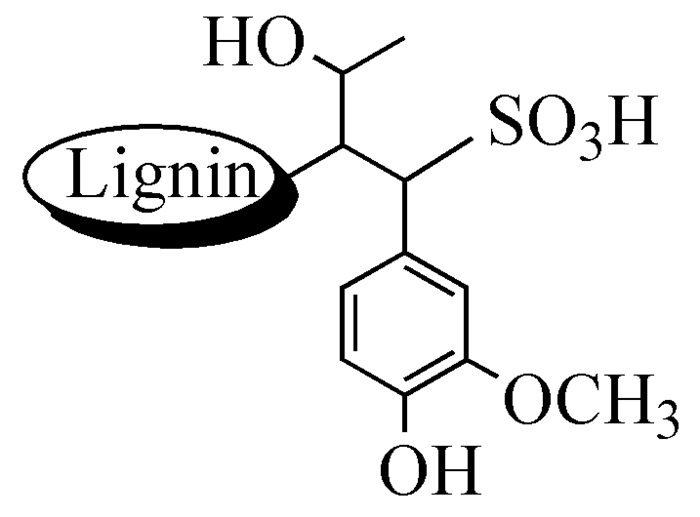
图式 1.
木质素磺酸的代表性结构
Scheme 1.
Representative structure of lignosulfonic acid


Pyrroles and their derivatives are found in several natural products, and they present antibacterial, antiviral, anti-inflammatory and antioxidant activities[1]. Several methodologies to synthesize pyrroles have been reported. One of the most important approaches is Paal-Knorr reac-tion[2, 3], in which 1, 4-dicarbonyl compounds and primary amines are used as raw materials.
The Paal-Knorr reaction is usually catalyzed by acids. According to reports, the acids used as catalysts include solid acids, Lewis acids and Brønsted acids. For example, montmorillonite KSF-clay, aluminum oxide[4], zeolites[5, 6], Al2O3[6, 7]and graphene oxide[8]are all solid acids. Bi(NO3)3·5H2O[9], Sc(OTf)3[10], zirconium phosphate, zirconium sulfophenylphosphonate[11], InCl3[12], SnCl2·2H2O[13], NiCl2[14]and iodine[15]are all Lewis acids. Ionic liquids[16], citric acid[17], L-trypto-phan[18], sulfamic acid[19], HCl[20], p-toluene-sulfonic acid (p-TSA)[21, 22], sulfamic acid-functionalized magnetic Fe3O4 nanoparticles[23], sulfonic acid cation exchange resin[1], poly(ethylene glycerol)-bounded sulfonic acid[24], squaric acid[25] and cellulose sulfuric acid[26]are all brønsted acids. However, these synthetic methods suffered from some drawbacks, such as long reaction time, low yield, toxic solvents, complicated separation procedures, expensive cost and corrosive volatile catalysts. Therefore, the development of simple, cheap, efficient and environmentally benign catalysts for the Paal-Knorr reaction is desirable.
In all of these reported catalysts, sulfonic acid derivatives were studied extensively. Sulfonic acid is strong acid. Sulfamic acid[19], p-TSA[21, 22], sulf-onic acid cationic exchange resin[1], poly(ethylene glycerol)-bounded sulfonic acid[24] and cellulose sulfuric acid[26]are all sulfonic acid derivatives which are used as catalysts for Paal-Knorr reaction.
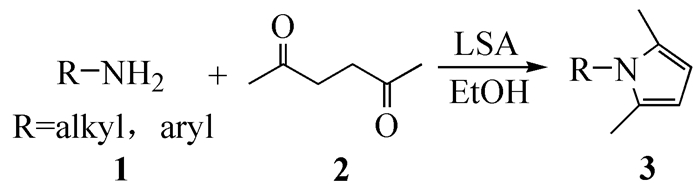
Lignin is the second most abundant, natural, renewable bioresource. There are plenty of sulfonic groups in the structure of lignosulfonic acid (LSA), which is one of the most important derivatives of natural polymer lignin. LSA is very cheap and can be produced during the papermaking process. Its structure is very complicated and the representative structure is shown in Scheme 1. Generally, it is discharged as waste of papermaking industry, which leads to the pollution of environment, so it is necessary to explore the applications of LSA. Many sulfonic acid derivatives are used as catalysts for Paal-Knorr reaction, therefore, because of the presence of sulfonic groups, LSA could be used as catalyst for Paal-Knorr reaction theoretically. Usually, sodium lignosulfonate that is used as surfactant and adsorbent is sold by paper-making companies. LSA can be obtained from lignosulfonate by proton exchange process. Especially, significant attention has been focused recently on designing environmentally benign, efficient, cost-effective and noncorrosive catalysts. The inexpensive, non-corrosive LSA is insoluble in organic solvents and therefore it can be used as a solid heterogeneous catalyst which can be easily separated from the reaction mixture. Chen[27]reported LSA as an acidic catalyst for synthesis of benzoxanthenes and amidoalkylnaphthols. The aim of this study is to utilize LSA as catalyst for synthesis of N-substituted pyrroles (as shown in Scheme 2) by Paal-Knorr reaction.
1H NMR spectra were measured on an AVANCE Ⅲ 500 spectrometer (Bruker, Switzerland) using TMS as internal standard and CDCl3 as solvent. Mass spectra were determined on LCQ Advantage MAX spectrometer (TOF MS ESI. Finnigan, USA). IR spectra of lignosulfonic acid were acquired with a Spectrum 65 infrared spectrum scanner (PerkinElmer, USA) in reflection mode. The sulfur content of LSA was analyzed by EuroEA3000 elemental analyzer (LeeMan Technology Co., Ltd. China).
3 g sodium lignosulfonate (SLS) was dissolved in 5mL 6mol/L hydrochloric acid solution and stored at room temperature for 2h. And then 15 mL ethanol was added into the solution to precipitate LSA. After that, LSA was filtered, washed with ethanol and dried. The LSA obtained by this method was denoted as LSAH.
The 732 cation exchange resin was activated in a saturated solution of NaCl for 24h, treated with 4 (wt)% NaOH for 2h, and washed by distilled water until neutral. Next, the resin was soaked with 4 (wt)% HCl solution for 12h. Then, the resin was transferred into a column and washed with distilled water until neutral. The LSA was prepared by ion-exchange of SLS and the 732 acidic resin. 5g SLS was dissolved in 50mL distilled water, and then the solution was allowed to flow through the 732 acidic resin column. The acidic eluent was collected, and LSA was obtained after freeze-drying the solution. The LSA obtained by this method was denoted as LSAIE. H+ content of LSA was determined by titration using NaOH standard solution.
A 50 mL round flask was charged with amine (1 mmol), hexane-2, 5-dione (1 mmol), 6 mL ethanol and LSA. The mixture was refluxed with stirring for a period. When the reaction was completed, as indicated by TLC, the reaction mixture was cooled, and then LSA was filtered and washed by ethanol. The combined ethanol solution was concentrated and purified by column chromatography. The structures of the product were confirmed by 1H NMR, MS, and their melting points were compared with data reported in the literature.
2, 5-dimethyl-1-o-tolyl-1H-pyrrole (3d): Yield 87%; Oil liquid; 1H NMR (500MHz, CDCl3) δ: 7.15~7.32 (m, 4H), 5.91 (s, 2H), 1.93 (s, 3H), 1.91 (s, 6H); MS (ESI) m/z: 186.1303 [M+H]+.
2, 5-dimethyl-1-phenethyl-1H-pyrrole (3e): Yield 90%; Oil liquid; 1H NMR (500MHz, CDCl3) δ: 7.29 (t, J=7.0Hz, 2H), 7.23 (d, J=7.0 Hz, 1H), 7.10 (d, J=7.0 Hz, 2H), 5.76 (s, 2H), 3.94 (t, J=7.5 Hz, 2H), 2.88 (t, J=7.5 Hz, 2H), 2.14 (s, 6H); MS(ESI) m/z: 200.1459 [M+H]+.
In this paper, two methods were used to prepare LSA. The S content of LSA was determined by elemental analysis and the H+ content was determined by acid-base titration. Method 1, the reaction of sodium ligosulfonate (SLS) and 6mol/L HCl for 2h at room temperature produced the LSAH and NaCl. Method 2, LSAIE was obtained by ion exchange of SLS and 732 acidic cationic exchange resin. As shown in Tab. 1, -SO3- density and H+ density of LSAH were 1.90 and 0.708 mmol/g, respectively, about 37% of sodium in SLS was replaced by H+, and most sulfur species were not in the acidic form. Whereas -SO3- density and H+ density of LSAIE were 2.46 and 2.199 mmol/g, respectively, and about 84% of sodium in SLS was replaced by H+. Compared with Method 1, more sodium was replaced by H+ in Method 2. So, Method 2 was used to prepare the LSA catalyst.
 下载:
导出CSV
下载:
导出CSV
| Entry | Catalyst | S content /(wt)%a |
-SO3- density /(mmol/g)b |
H+ density /(mmol/g)c |
| 1 | SLS | 6.19 | 1.93 | - |
| 2 | LSAH | 6.09 | 1.90 | 0.708 |
| 3 | LSAIE | 7.87 | 2.46 | 2.199 |
| a Determined by elemental analysis; b calculated from S content; c determined by acid-base titration | ||||
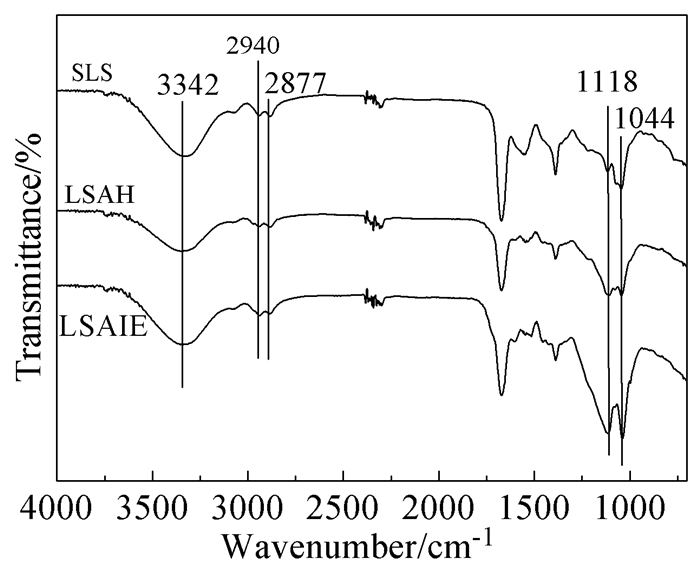
FT-IR spectra of LSA and SLS are shown in Fig. 1. The peak at 3342cm-1 is ascribed to O-H bond stretching. The characteristic peaks at 2940 and 2877 cm-1 are assigned to C-H bond stretching of CH2 group. The peaks at 1118cm-1 (asymmetric stretching of O=S=O in SO3-) and 1044cm-1(symmetric stretching of O=S=O in SO3-) confirmed the presence of SO3- groups in catalyst. For SLS, the peak at 1118cm-1 is weaker than at 1044cm-1. But, for LSAIE, the peak at 1118cm-1 is stronger than at 1044cm-1. The more H+ density of catalyst is, the stronger the peak at 1118cm-1 is.
As shown in Tab. 2, without catalyst, the reaction of aniline and hexane-2, 5-dione for 240min afforded 20% yield of 3a. When the reaction catalyzed by SLS was carried out for 300min, the yield of 3a was only 18%. Because there was no ionization of H+, SLS has no catalytic effect. The reaction of aniline with hexane-2, 5-dione under LSAIE catalysis for 30 minutes gave 3a in 88% yield. Using LSAH as catalyst, the yield of 3a is 69%. The catalytic effect of LSAIE was better than that of LSAH. The reason is that LSAIE has a higher H+ density than LSAH. The influence of LSAIE amount upon the yield of 3a was examined. As shown in Tab. 2, the optimal amount of LSAIE is 0.06g.
下载:
导出CSV
| Entry | Catalyst | Catalyst amount/g | Time/min | Yield/% |
| 1 | SLS | 0.05 | 300 | 18 |
| 2 | LSAH | 0.05 | 30 | 69 |
| 3 | LSAIE | 0.05 | 30 | 88 |
| 4 | No catalyst | 0.00 | 240 | 20 |
| 5 | LSAIE | 0.04 | 30 | 90 |
| 6 | LSAIE | 0.06 | 30 | 95 |
| 7 | LSAIE | 0.08 | 30 | 92 |
| 8 | LSAIE | 0.10 | 30 | 85 |
The reactions of hexane-2, 5-dione with other amines were studied. As shown in Tab. 3, aliphatic amines (1c, 1e) underwent a faster reaction compared with aromatic amine (1a). In the reactions of hexane-2, 5-dione and aromatic amine with electron-donating substituent (1b, 1f), the corresponding products can be obtained in excellent yields over 30 min. When aromatic amine with electron-withdrawing substituent (1h) was used, the N-substituted pyrrole was obtained in low yield with long reaction time. Electron-donating substituent in aromatic ring of amine contributes to the nucleophilicity of amine. Aromatic amines with electron-donating substituent are more nucleophilic than aromatic amines with electron-withdrawing substituent. Aliphatic amines are more nucleophilic than aromatic amines. Nucleophilicity of amine has a great influence upon the reaction. The stronger the nucleophilicity of amine is, the more easily the reaction proceeds. The reaction mechanism is shown in Scheme 3[14]. H+ ionized from LSA acted as catalyst for the reaction.
 下载:
导出CSV
下载:
导出CSV
| Entry | R | Product | Time/min | Yield/% | m.p./℃ | |
| Found | Reported | |||||
| 1 | C6H5 |  |
30 | 95 | 48.7~49.7 | 50.2~50.4[28] |
| 2 | p-CH3-C6H4 |  |
30 | 95 | 42.4~44.3 | 45.3~45.9[28] |
| 3 | C6H5-CH2 |  |
15 | 91 | 40.5~41.8 | 41~42[29] |
| 4 | o-CH3-C6H4 |  |
30 | 87 | Oil liquid | |
| 5 | C6H5-CH2CH2 |  |
15 | 90 | Oil liquid | |
| 6 | p-CH3O-C6H4 |  |
30 | 89 | 57.8~58.6 | 60.4~60.9[28] |
| 7 | p-NH2-C6H4 |  |
270 | 15 | 249.6~251.6 | 255.9~257.3[30] |
| 8 | p-NO2-C6H4 |  |
300 | 52 | 144.6~146.9 | 144.9~145.7[10] |
| 9 | m-Cl-C6H4 |  |
170 | 93 | 46.8~48.8 | 49.6~50.4[31] |
| 10 | p-Cl-C6H4 |  |
75 | 97 | 45.2~47.3 | 49~50[22] |
Using lignosulfonic acid as a catalyst, N-substituted pyrroles were synthesized efficiently by Paal-Knorr reaction of 2, 5-hexanedione and primary amine in good to excellent yields. H+ ionized from lignosulfonic acid plays a catalytic role in the reaction. Lignosulfonic acid is a heterogeneous environment-friendly catalyst that can be easily separated from synthetic systems. It has a good application prospect in this kind of catalytic reaction.
Y H He, G Q Wang, G Zhi. J. Heterocycl. Chem., 2010, 47(2): 486~489. https://www.researchgate.net/publication/230529741_N_-Substituted_pyrrole_synthesis_by_Paal-Knorr_condensation_using_recyclable_cationic_exchange_resin_in_water
L Ackermann, L T Kaspar, C J Gschrei. Chem. Commun., 2004, (24): 2824~2825. https://www.ncbi.nlm.nih.gov/pubmed/15599425
A Alberola, A G Ortega, M L Sadaba. Tetrahedron, 1999, 55(21): 6555~6566. doi: 10.1016/S0040-4020(99)00289-6
R Ballini, L Barboni, G Bosica et al. Synlett, 2000, (3): 391~393. https://www.researchgate.net/publication/264223984_ChemInform_Abstract_25-Dialkylfurans_and_Nitroalkanes_as_Source_of_235-Trialkylpyrroles
R Sreekumar, R Padmakumar. Synth. Commun., 1998, 28(9): 1661~1665. doi: 10.1080/00397919808006870
F Texier-Boullet, B Klein, J Hamelin. Synthesis-Stuttgart, 1986, (5): 409~411.
M Kidwai, K Singhal, S Rastogi. J. Heterocycl. Chem., 2006, 43(5): 1231~1236. doi: 10.1002/jhet.5570430514
C Y Chen, X Y Guo, G Q Lu et al. New Carbon Mater., 2017, 32(2): 160~167. doi: 10.1016/S1872-5805(17)60013-6
B K Banik, I Banik, M Renteriaa. Tetrahed. Lett., 2005, 46(15): 2643~2645. doi: 10.1016/j.tetlet.2005.02.103
J Y Chen, H Y Wu, Z G Zheng et al. Tetrahed. Lett., 2006, 47(30): 5383~5387. doi: 10.1016/j.tetlet.2006.05.085
M Curini, F Montanari, O Rosati et al. Tetrahed. Lett., 2003, 44(20): 3923~3925. doi: 10.1016/S0040-4039(03)00810-4
J X Chen, M C Liu, X L Yang et al. J. Braz. Chem. Soc., 2008, 19(5): 877~883. doi: 10.1590/S0103-50532008000500011
P Armugam, P T Perumal. Chem. Lett., 2006, 35(6): 632~633. doi: 10.1246/cl.2006.632
D Akbaslar, O Demirkol, S Giray. Synth. Commun., 2014, 44(9): 1323~1332. doi: 10.1080/00397911.2013.857691
B K Banik, S Samajdar, I Bnik. J. Org. Chem., 2004, 69(1): 213~216. https://www.ncbi.nlm.nih.gov/pubmed/14703403
B Wang, Y Gu, C Luo et al. Tetrahed. Lett., 2004, 45(17): 3417~3419. doi: 10.1016/j.tetlet.2004.03.012
L Akelis, J Rousseau, R Juskenas et al. Eur. J. Org. Chem., 2016, (1): 31~35.
K Aghapoor, F Mohsenzadeh, H R Darabi et al. Res. Chem. Intermed., 2016, 42(2): 407~415. doi: 10.1007/s11164-015-2026-1
H T Luo, Y R Kang, Q Li et al. Heteroatom. Chem., 2008, 19(2): 144~148. doi: 10.1002/hc.20389
D J Shaw, W F Wood. J. Chem. Educ., 1992, 69(12): A313. https://www.researchgate.net/publication/244474344_Preparation_of_25-dimethyl-1-phenylpyrrole
S Raghavan, K Anuradha. Synlett, 2003, (5): 711~713.
X H Zhu, G Chen, Z L Xu et al. Chin. J. Org. Chem., 2008, 28(1): 115~119.
H Veisi, P Mohammadi, J Gholami. Appl. Organomet. Chem., 2014, 28(12): 868~873. doi: 10.1002/aoc.3228
A J Abbas, A Sakineh, T Fatemah. J. Appl. Polym. Sci., 2012, 125(2): 1339~1345. doi: 10.1002/app.35172
A Najmadin, D Anahita, E Farshid et al. Monats. Chem., 2013, 144(3): 405~409. doi: 10.1007/s00706-012-0841-2
R Ali. React. Funct. Polym., 2011, 71(1): 80~83. doi: 10.1016/j.reactfunctpolym.2010.11.001
陈巍.华南理工大学博士学位论文, 2015, 64~68.
J X Chen, X L Yang, M C Liu et al. Synth. Commun., 2009, 39(23): 4180~4198. doi: 10.1080/00397910902898528
B K Banik, S Samajdar, I Banik. J. Org. Chem., 2004, 69(1): 213~216. doi: 10.1021/jo035200i
S K KPasha, V S V Satyanarayana, A S Kumar et al. Chin. Chem. Lett., 2011, 22(8): 891~894. doi: 10.1016/j.cclet.2010.12.053
D G Hulcoop, M Lautens. Org. Lett., 2007, 9(9): 1761~1764. https://www.ncbi.nlm.nih.gov/pubmed/17407300
Table 1. Acid density of the catalysts
| Entry | Catalyst | S content /(wt)%a |
-SO3- density /(mmol/g)b |
H+ density /(mmol/g)c |
| 1 | SLS | 6.19 | 1.93 | - |
| 2 | LSAH | 6.09 | 1.90 | 0.708 |
| 3 | LSAIE | 7.87 | 2.46 | 2.199 |
| a Determined by elemental analysis; b calculated from S content; c determined by acid-base titration | ||||
 下载: 导出CSV
Table 2. Effect of catalyst on synthesis of 3a
| Entry | Catalyst | Catalyst amount/g | Time/min | Yield/% |
| 1 | SLS | 0.05 | 300 | 18 |
| 2 | LSAH | 0.05 | 30 | 69 |
| 3 | LSAIE | 0.05 | 30 | 88 |
| 4 | No catalyst | 0.00 | 240 | 20 |
| 5 | LSAIE | 0.04 | 30 | 90 |
| 6 | LSAIE | 0.06 | 30 | 95 |
| 7 | LSAIE | 0.08 | 30 | 92 |
| 8 | LSAIE | 0.10 | 30 | 85 |
下载: 导出CSV
Table 3. Synthesis of N-substituted pyrrole catalyzed by LSAIE
| Entry | R | Product | Time/min | Yield/% | m.p./℃ | |
| Found | Reported | |||||
| 1 | C6H5 | |
30 | 95 | 48.7~49.7 | 50.2~50.4[28] |
| 2 | p-CH3-C6H4 | |
30 | 95 | 42.4~44.3 | 45.3~45.9[28] |
| 3 | C6H5-CH2 | |
15 | 91 | 40.5~41.8 | 41~42[29] |
| 4 | o-CH3-C6H4 | |
30 | 87 | Oil liquid | |
| 5 | C6H5-CH2CH2 | |
15 | 90 | Oil liquid | |
| 6 | p-CH3O-C6H4 | |
30 | 89 | 57.8~58.6 | 60.4~60.9[28] |
| 7 | p-NH2-C6H4 | |
270 | 15 | 249.6~251.6 | 255.9~257.3[30] |
| 8 | p-NO2-C6H4 | |
300 | 52 | 144.6~146.9 | 144.9~145.7[10] |
| 9 | m-Cl-C6H4 | |
170 | 93 | 46.8~48.8 | 49.6~50.4[31] |
| 10 | p-Cl-C6H4 | |
75 | 97 | 45.2~47.3 | 49~50[22] |
下载: 导出CSV

 扫一扫看文章


扫一扫关注我们